04
Inheritance A programmer
can tailor a derived class as needed
by adding new variables or methods, or by modifying the inherited ones
Software reuse is a fundamental benefit of inheritance
Using existing software components
to create new ones, we capitalize on the effort that went into
the design, implementation, and testing of the existing software<br>
05
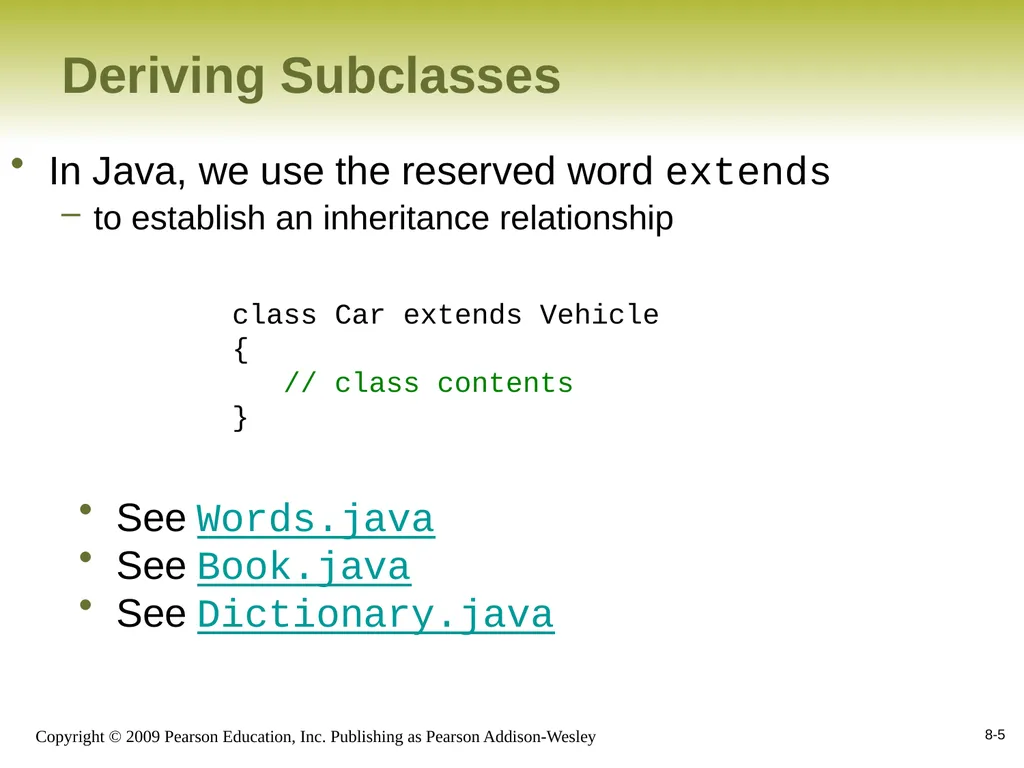
8-5 Deriving Subclasses In Java, we use the reserved word extends
to establish an inheritance relationship See Words.java
See Book.java
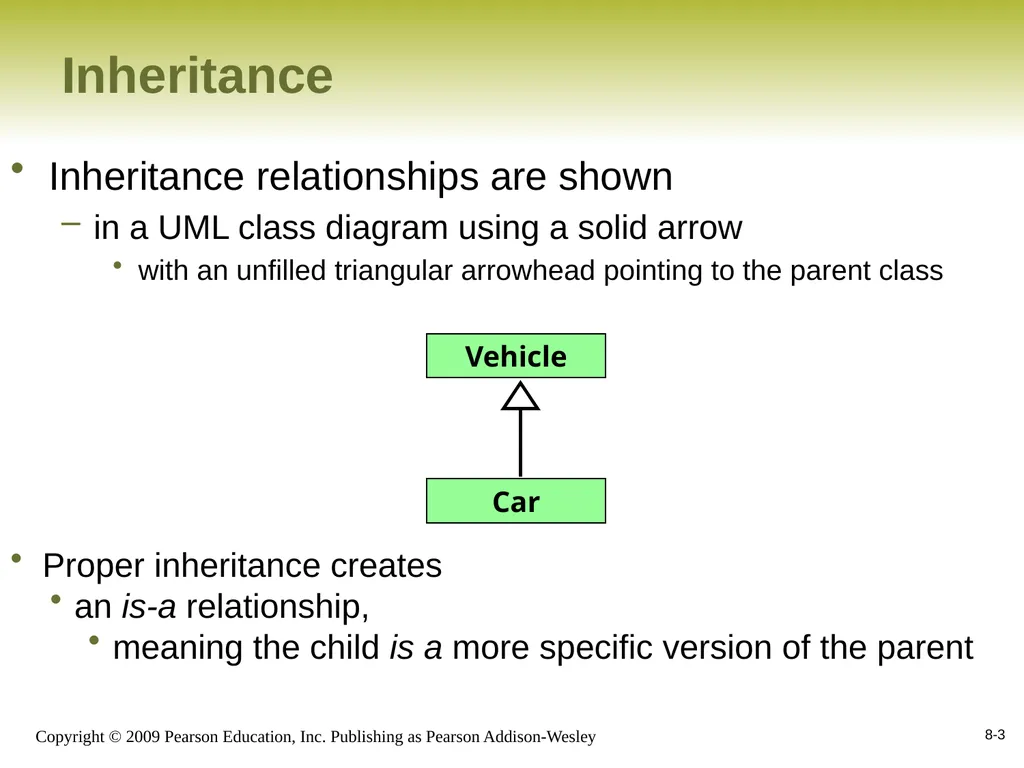
See Dictionary.java class Car extends Vehicle
{
// class contents
}<br>
06
8-6 The protected Modifier Visibility modifiers affect the way
that class members can be used in a child class
Variables and methods declared with private visibility
cannot be referenced by name in a child class
They can be referenced in the child class
if they are declared with public visibility –
but public variables violate the principle of encapsulation
There is a third visibility modifier that helps
in inheritance situations: protected<br>
07
8-7 The protected Modifier The protected modifier
allows a child class to reference
a variable or method directly in the child class
is not as tightly encapsulated as private visibility
A protected variable is visible
to any class in the same package as the parent class
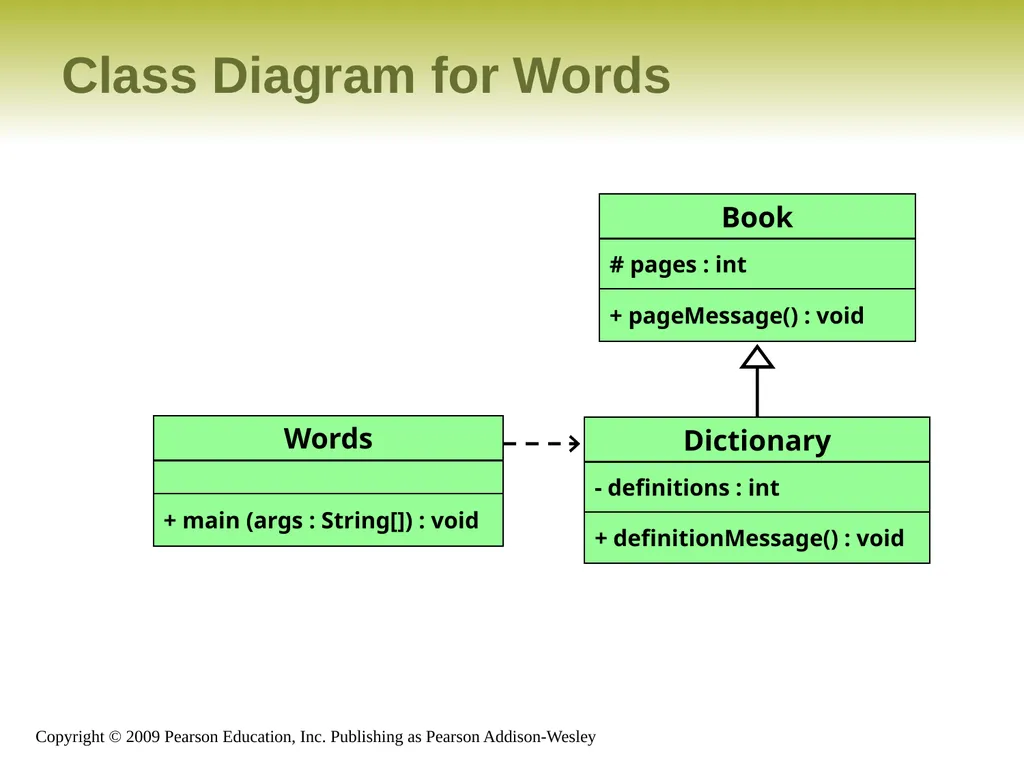
Protected variables and methods can be shown
with a # symbol preceding them in UML diagrams<br>
08
Class Diagram for Words<br>
09
8-9 The super Reference Constructors are not inherited,
even though they have public visibility
Yet we often want to use the parent's constructor
to set up the "parent's part" of the object
The super reference can be used
to refer to the parent class, and
often is used to invoke the parent's constructor
See Words2.java
See Book2.java
See Dictionary2.java<br>
10
The super Reference A child’s constructor
is responsible for calling the parent’s constructor
The first line of a child’s constructor
should use the super reference
to call the parent’s constructor
The super reference can also be used
to reference other variables and methods
defined in the parent’s class<br>
11
Multiple Inheritance Java supports single inheritance,
meaning that a derived class can have only one parent class
Multiple inheritance allows a class
to be derived from two or more classes,
inheriting the members of all parents
Collisions, such as the same variable name
in two parents, have to be resolved
Java does not support multiple inheritance
In most cases, the use of interfaces
gives us aspects of multiple inheritance<br>
12
Outline Creating Subclasses
Overriding Methods
Class Hierarchies
Inheritance and Visibility<br>
13
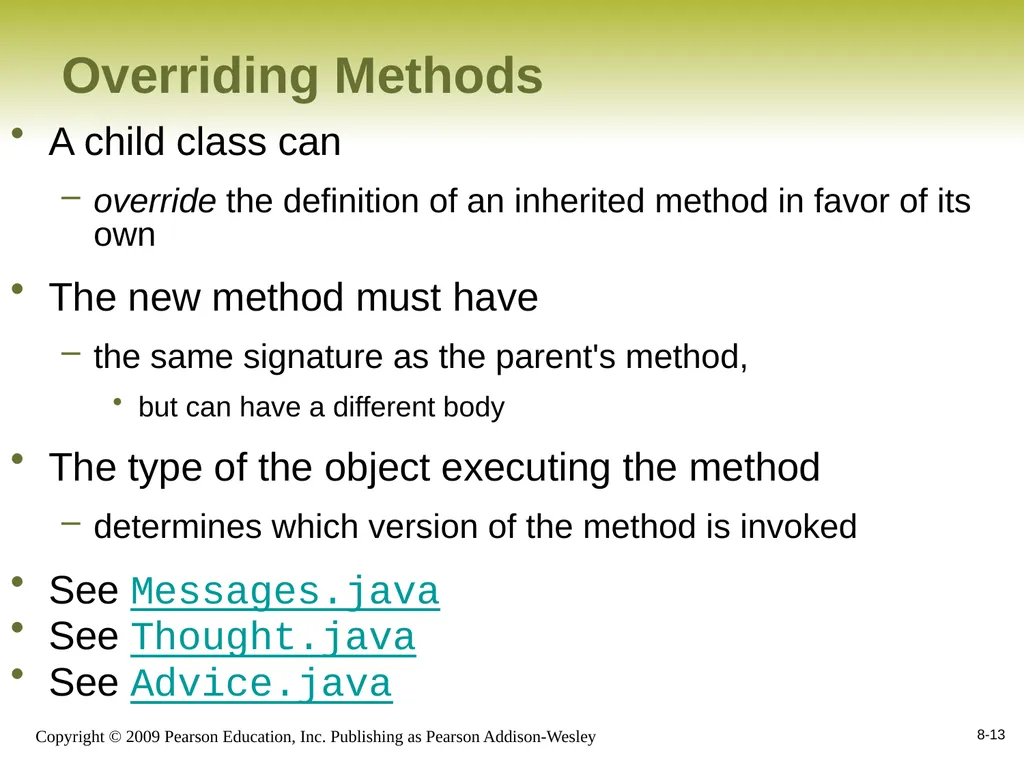
8-13 Overriding Methods A child class can
override the definition of an inherited method in favor of its own
The new method must have
the same signature as the parent's method,
but can have a different body
The type of the object executing the method
determines which version of the method is invoked
See Messages.java
See Thought.java
See Advice.java<br>
14
Overriding A method in the parent class can be invoked
using the super reference
If a method is declared with the final modifier
it cannot be overridden<br>
15
8-15 Overloading vs. Overriding Overloading deals with multiple methods
with the same name in the same class,
but with different signatures
Overriding deals with two methods,
one in a parent class and one in a child class,
that have the same signature
Overloading lets you define a similar operation
in different ways for different parameters
Overriding lets you define a similar operation
in different ways for different object types<br>
16
Outline Creating Subclasses
Overriding Methods
Class Hierarchies
Inheritance and Visibility<br>
17
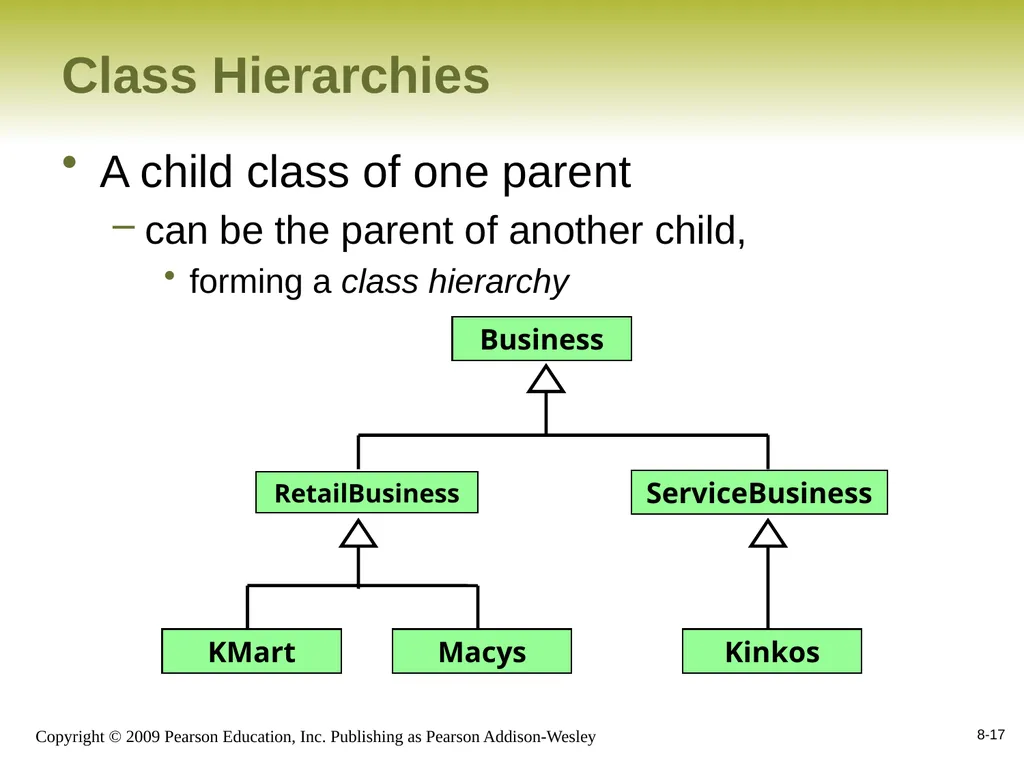
8-17 Class Hierarchies A child class of one parent
can be the parent of another child,
forming a class hierarchy<br>
18
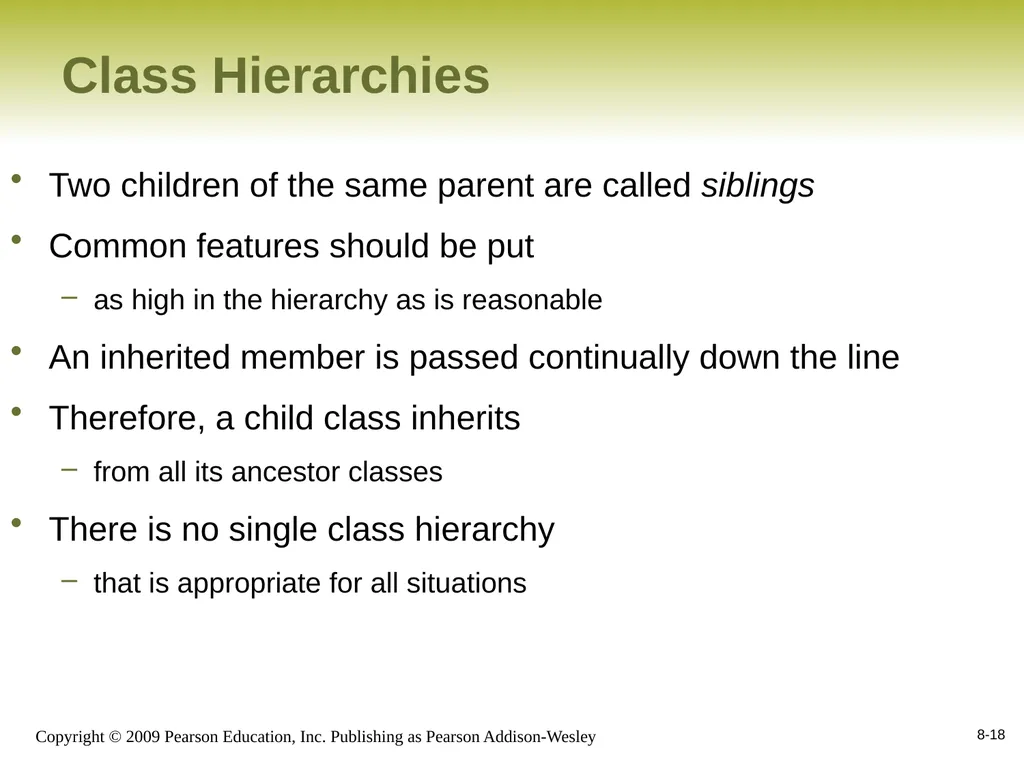
8-18 Class Hierarchies Two children of the same parent are called siblings
Common features should be put
as high in the hierarchy as is reasonable
An inherited member is passed continually down the line
Therefore, a child class inherits
from all its ancestor classes
There is no single class hierarchy
that is appropriate for all situations<br>
19
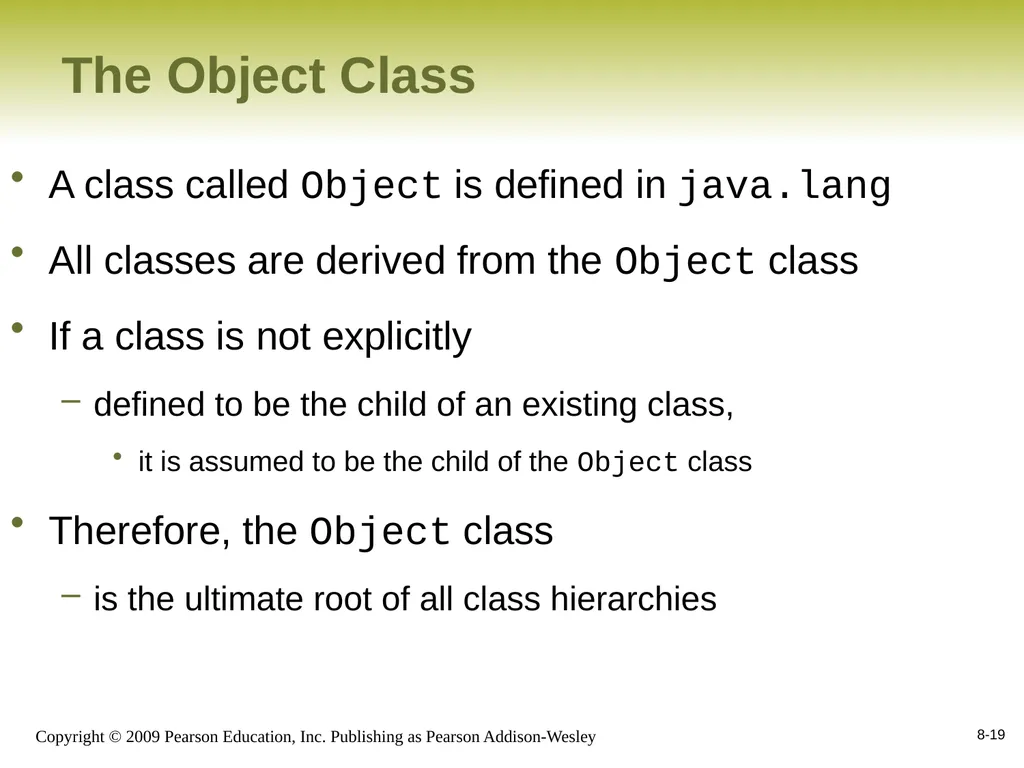
8-19 The Object Class A class called Object is defined in java.lang
All classes are derived from the Object class
If a class is not explicitly
defined to be the child of an existing class,
it is assumed to be the child of the Object class
Therefore, the Object class
is the ultimate root of all class hierarchies<br>
20
The Object Class The Object class contains a few useful methods,
which are inherited by all classes
For example, toString is defined in the Object class
Every time we define the toString method,
we are actually overriding an inherited definition
The toString method in the Object class
is defined to return a string that contains the name of the object’s
class along with some other information<br>
21
The Object Class The equals method of the Object class returns true
if two references are aliases
We can override equals in any class
to define equality in some more appropriate way
String class defines the equals method to return true
if two String objects contain the same characters
The designers of the String class have overridden
the equals method inherited from Object
in favor of a more useful version<br>
22
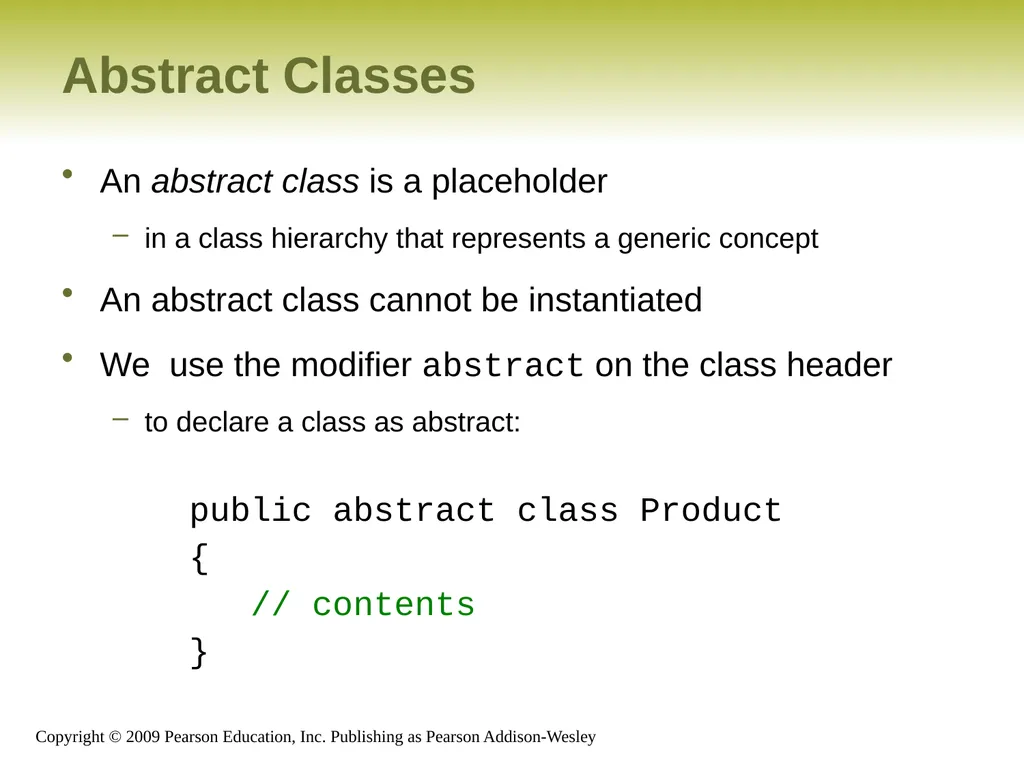
Abstract Classes An abstract class is a placeholder
in a class hierarchy that represents a generic concept
An abstract class cannot be instantiated
We use the modifier abstract on the class header
to declare a class as abstract: public abstract class Product
{
// contents
}<br>
23
Abstract Classes An abstract class often contains abstract methods
with no definitions (like an interface)
Unlike an interface, the abstract modifier must be
applied to each abstract method
An abstract class typically contains non-abstract
methods with full definitions
A class declared as abstract
does not have to contain abstract methods –
simply declaring it as abstract makes it so<br>
24
Abstract Classes The child of an abstract class
must override the abstract methods of the parent,
or it too will be considered abstract
An abstract method cannot be defined
as final or static
The use of abstract classes
is an important element of software design –
it allows us to establish common elements in a hierarchy that
are too generic to instantiate<br>
25
Interface Hierarchies Inheritance can be applied to interfaces as well as classes
That is, one interface can be derived from another interface
The child interface inherits all abstract methods of the parent
A class implementing the child interface must define
all methods from both the ancestor and child interfaces
Note that class hierarchies and interface hierarchies
are distinct (they do not overlap)<br>
26
Outline Creating Subclasses
Overriding Methods
Class Hierarchies
Inheritance and Visibility<br>
27
8-27 Visibility Revisited It's important to understand
one subtle issue related to inheritance and visibility
All variables and methods of a parent class,
even private members, are inherited by its children
As we've mentioned, private members
cannot be referenced by name in the child class
However, private members inherited
by child classes exist and can be referenced indirectly<br>
28
Visibility Revisited Because the parent can refer
to the private member, the child can reference it indirectly
using its parent's methods
The super reference can
be used to refer to the parent class,
even if no object of the parent exists<br>