
overview of cost auditing standards CMA (Dr.)
AS
Published · 49 slides · 0 views

1 / 1
Description
overview of cost auditing standards CMA (Dr.) BALWINDER SINGH Chairman, Cost Accounting Standards Board President (2019-20), The Institute of Cost Accountants of India The cost audit report is required to be in conformity with the cost
Related Topics
Share
Embed code
Download this presentation From Below
"overview of cost auditing standards CMA (Dr.)" is the property of its rightful owner. Permission is granted to download and print the materials on this website for personal, non-commercial use only, and to display it on your personal computer provided you do not modify the materials and that you retain all copyright notices contained in the materials. By downloading content from our website, you accept the terms of this agreement.
Presentation Transcript
01
overview of
cost auditing standards CMA (Dr.) BALWINDER SINGH
Chairman, Cost Accounting Standards Board
&
President (2019-20), The Institute of Cost Accountants of India<br>
Chairman, Cost Accounting Standards Board
&
President (2019-20), The Institute of Cost Accountants of India<br>
02
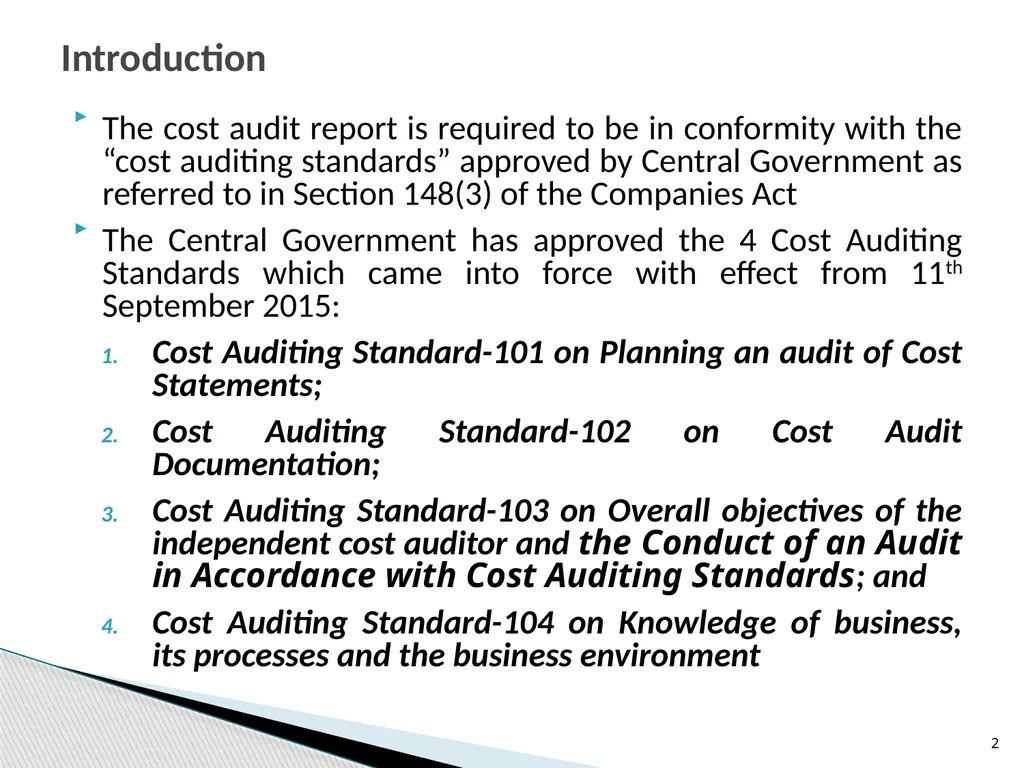
The cost audit report is required to be in conformity with the “cost auditing standards” approved by Central Government as referred to in Section 148(3) of the Companies Act
The Central Government has approved the 4 Cost Auditing Standards which came into force with effect from 11th September 2015:
Cost Auditing Standard-101 on Planning an audit of Cost Statements;
Cost Auditing Standard-102 on Cost Audit Documentation;
Cost Auditing Standard-103 on Overall objectives of the independent cost auditor and the Conduct of an Audit in Accordance with Cost Auditing Standards; and
Cost Auditing Standard-104 on Knowledge of business, its processes and the business environment 2 Introduction<br>
The Central Government has approved the 4 Cost Auditing Standards which came into force with effect from 11th September 2015:
Cost Auditing Standard-101 on Planning an audit of Cost Statements;
Cost Auditing Standard-102 on Cost Audit Documentation;
Cost Auditing Standard-103 on Overall objectives of the independent cost auditor and the Conduct of an Audit in Accordance with Cost Auditing Standards; and
Cost Auditing Standard-104 on Knowledge of business, its processes and the business environment 2 Introduction<br>
03
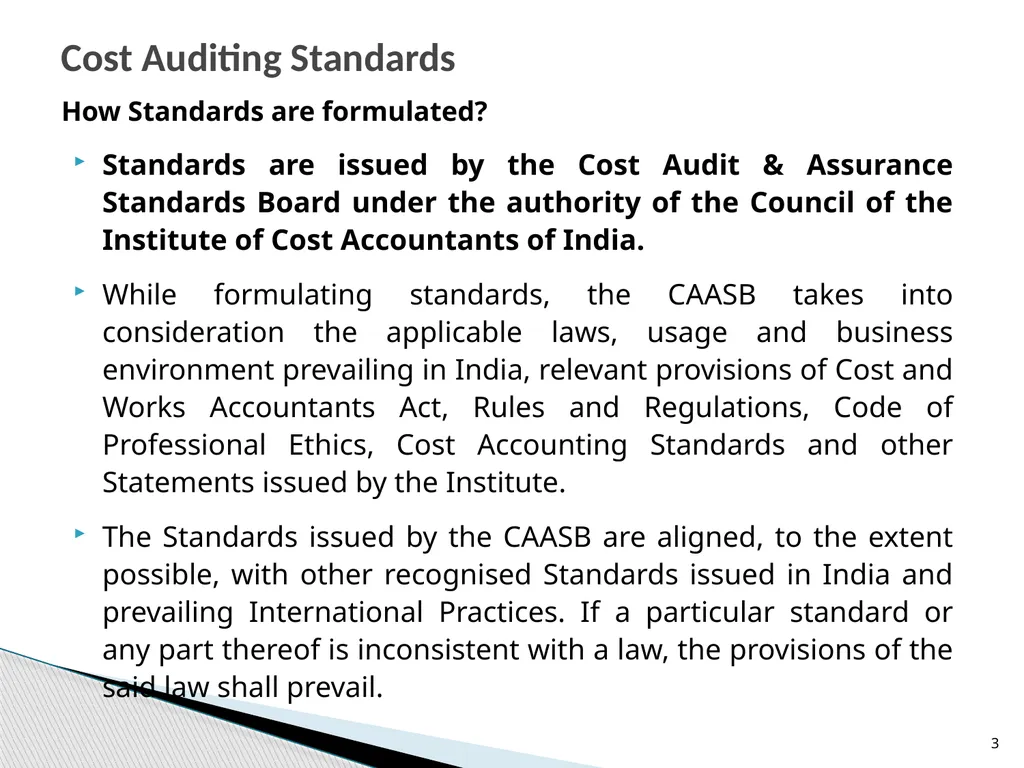
How Standards are formulated?
Standards are issued by the Cost Audit & Assurance Standards Board under the authority of the Council of the Institute of Cost Accountants of India.
While formulating standards, the CAASB takes into consideration the applicable laws, usage and business environment prevailing in India, relevant provisions of Cost and Works Accountants Act, Rules and Regulations, Code of Professional Ethics, Cost Accounting Standards and other Statements issued by the Institute.
The Standards issued by the CAASB are aligned, to the extent possible, with other recognised Standards issued in India and prevailing International Practices. If a particular standard or any part thereof is inconsistent with a law, the provisions of the said law shall prevail. 3 Cost Auditing Standards<br>
Standards are issued by the Cost Audit & Assurance Standards Board under the authority of the Council of the Institute of Cost Accountants of India.
While formulating standards, the CAASB takes into consideration the applicable laws, usage and business environment prevailing in India, relevant provisions of Cost and Works Accountants Act, Rules and Regulations, Code of Professional Ethics, Cost Accounting Standards and other Statements issued by the Institute.
The Standards issued by the CAASB are aligned, to the extent possible, with other recognised Standards issued in India and prevailing International Practices. If a particular standard or any part thereof is inconsistent with a law, the provisions of the said law shall prevail. 3 Cost Auditing Standards<br>
04
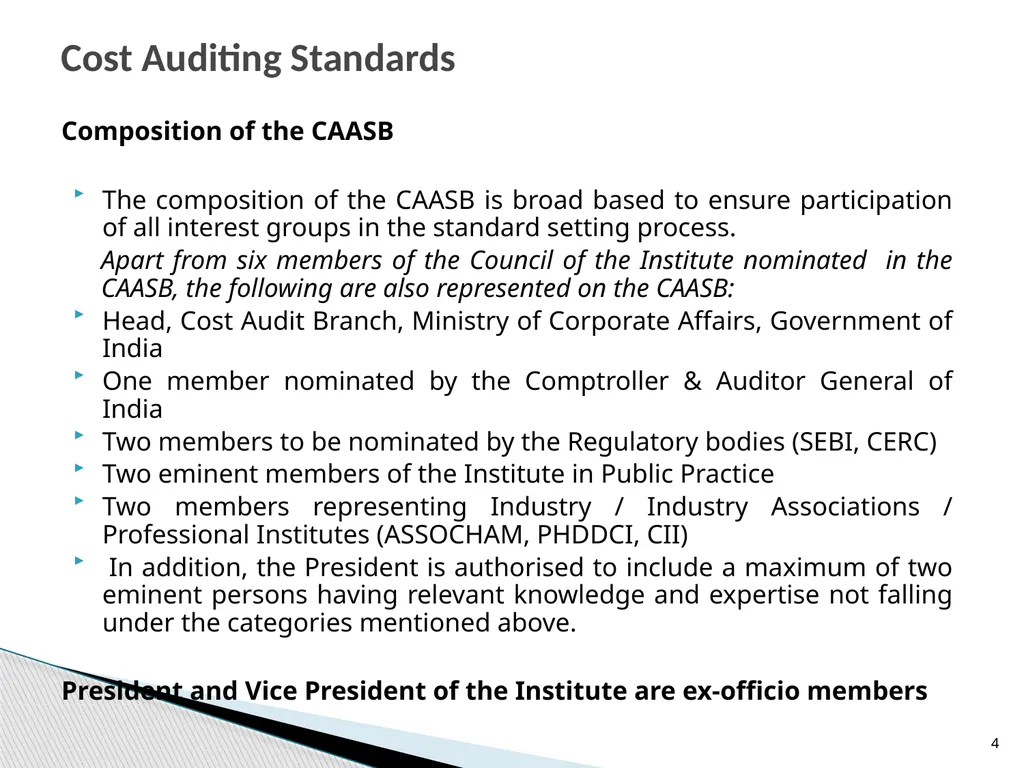
Composition of the CAASB
The composition of the CAASB is broad based to ensure participation of all interest groups in the standard setting process.
Apart from six members of the Council of the Institute nominated in the CAASB, the following are also represented on the CAASB:
Head, Cost Audit Branch, Ministry of Corporate Affairs, Government of India
One member nominated by the Comptroller & Auditor General of India
Two members to be nominated by the Regulatory bodies (SEBI, CERC)
Two eminent members of the Institute in Public Practice
Two members representing Industry / Industry Associations / Professional Institutes (ASSOCHAM, PHDDCI, CII)
In addition, the President is authorised to include a maximum of two eminent persons having relevant knowledge and expertise not falling under the categories mentioned above.
President and Vice President of the Institute are ex-officio members 4 Cost Auditing Standards<br>
The composition of the CAASB is broad based to ensure participation of all interest groups in the standard setting process.
Apart from six members of the Council of the Institute nominated in the CAASB, the following are also represented on the CAASB:
Head, Cost Audit Branch, Ministry of Corporate Affairs, Government of India
One member nominated by the Comptroller & Auditor General of India
Two members to be nominated by the Regulatory bodies (SEBI, CERC)
Two eminent members of the Institute in Public Practice
Two members representing Industry / Industry Associations / Professional Institutes (ASSOCHAM, PHDDCI, CII)
In addition, the President is authorised to include a maximum of two eminent persons having relevant knowledge and expertise not falling under the categories mentioned above.
President and Vice President of the Institute are ex-officio members 4 Cost Auditing Standards<br>
05
Exposure Draft is also sent to the following bodies:
Ministry of Corporate Affairs, Government of India
Comptroller and Auditor General of India
Reserve Bank of India
Central Board of Direct Taxes
Central Board of Excise and Customs
Securities and Exchange Board of India
Institute of Chartered Accountants of India
Institute of Company Secretaries of India
Industry Associations such as CII, FICCI, ASSOCHAM and PHDCCI, SCOPE
Concerned regulators or any other body considered relevant by the CAASB keeping in view the nature and requirements of the Standard. 5 Cost Auditing Standards<br>
Ministry of Corporate Affairs, Government of India
Comptroller and Auditor General of India
Reserve Bank of India
Central Board of Direct Taxes
Central Board of Excise and Customs
Securities and Exchange Board of India
Institute of Chartered Accountants of India
Institute of Company Secretaries of India
Industry Associations such as CII, FICCI, ASSOCHAM and PHDCCI, SCOPE
Concerned regulators or any other body considered relevant by the CAASB keeping in view the nature and requirements of the Standard. 5 Cost Auditing Standards<br>
06
Structure of the Standard
Each Standard generally follows the following structure.
Introduction
Objectives
Scope
Definitions
Requirements
Application and other explanatory material
Effective date
Statement of modification 6 Cost Auditing Standards<br>
Each Standard generally follows the following structure.
Introduction
Objectives
Scope
Definitions
Requirements
Application and other explanatory material
Effective date
Statement of modification 6 Cost Auditing Standards<br>
07
Cost Auditing Standard-101
Planning an Audit of Cost Statements 7<br>
Planning an Audit of Cost Statements 7<br>
08
5.1 Prior to entering the planning phase, the Cost Auditor shall ensure that:
the appointment as cost auditor is proper, he has received the letter of appointment and legal formalities regarding his appointment have been complied with;
the ethical requirements as per the regulations continue to be satisfied; [Arm’s Length relationship, such as acceptance of assignment to designing & implementation of cost accounting system for the entity]
an understanding of the terms of reference including the units to be covered, products/services to be covered, scope of coverage where the regulations leave it to be agreed between the auditor and the auditee. 8 Cost Auditing Standard-101 Planning an Audit of Cost Statements<br>
the appointment as cost auditor is proper, he has received the letter of appointment and legal formalities regarding his appointment have been complied with;
the ethical requirements as per the regulations continue to be satisfied; [Arm’s Length relationship, such as acceptance of assignment to designing & implementation of cost accounting system for the entity]
an understanding of the terms of reference including the units to be covered, products/services to be covered, scope of coverage where the regulations leave it to be agreed between the auditor and the auditee. 8 Cost Auditing Standard-101 Planning an Audit of Cost Statements<br>
09
5.2 The audit partner and other key members of an audit team shall be involved in planning the audit, including planning and participating in the discussion among audit team members.
5.3 The Cost Auditor shall formulate an Overall audit strategy that sets the scope, timing and direction of the audit.
5.4 In formulating the Overall audit strategy, the Cost Auditor shall consider all relevant factors. 9 Cost Auditing Standard-101 Planning an Audit of Cost Statements<br>
5.3 The Cost Auditor shall formulate an Overall audit strategy that sets the scope, timing and direction of the audit.
5.4 In formulating the Overall audit strategy, the Cost Auditor shall consider all relevant factors. 9 Cost Auditing Standard-101 Planning an Audit of Cost Statements<br>
10
5.4 Continue
These relevant factors include:
results of preliminary activities as specified in 5.1 above
knowledge from previous audits and other engagements with the auditee
knowledge of business
nature and scope of the audit
statutory deadlines and reporting format
relevant factors determining the direction of the audit efforts
nature, timing and extent of resources required for the audit. 10 Cost Auditing Standard-101 Planning an Audit of Cost Statements<br>
These relevant factors include:
results of preliminary activities as specified in 5.1 above
knowledge from previous audits and other engagements with the auditee
knowledge of business
nature and scope of the audit
statutory deadlines and reporting format
relevant factors determining the direction of the audit efforts
nature, timing and extent of resources required for the audit. 10 Cost Auditing Standard-101 Planning an Audit of Cost Statements<br>
11
5.5 The Cost Auditor shall develop an audit plan.
The audit plan will include the nature, extent and timing of risk assessment, audit procedures and other activities
[Need for reconciliation with financial reporting framework, Regulatory Requirement, Unique features of Industry, Reliance that can be placed on the work of financial or internal auditors or expert, ERP, Time line for CAR, BOD/ Audit Committee meeting, Resources required and available in terms of manpower, equipment etc., Audit Plan is more detailed than Audit Strategy as it includes the nature, timing and extent of audit procedures to be performed by audit team] 11 Cost Auditing Standard-101 Planning an Audit of Cost Statements<br>
The audit plan will include the nature, extent and timing of risk assessment, audit procedures and other activities
[Need for reconciliation with financial reporting framework, Regulatory Requirement, Unique features of Industry, Reliance that can be placed on the work of financial or internal auditors or expert, ERP, Time line for CAR, BOD/ Audit Committee meeting, Resources required and available in terms of manpower, equipment etc., Audit Plan is more detailed than Audit Strategy as it includes the nature, timing and extent of audit procedures to be performed by audit team] 11 Cost Auditing Standard-101 Planning an Audit of Cost Statements<br>
12
Planning for these audit procedures takes place over the course of the audit as the audit plan for the engagement develops.
For example, planning of the auditor’s risk assessment procedures occurs early in the audit process. However, planning the nature, timing and extent of specific further audit procedures depends on the outcome of those risk assessment procedures. 12 Cost Auditing Standard-101 Planning an Audit of Cost Statements<br>
For example, planning of the auditor’s risk assessment procedures occurs early in the audit process. However, planning the nature, timing and extent of specific further audit procedures depends on the outcome of those risk assessment procedures. 12 Cost Auditing Standard-101 Planning an Audit of Cost Statements<br>
13
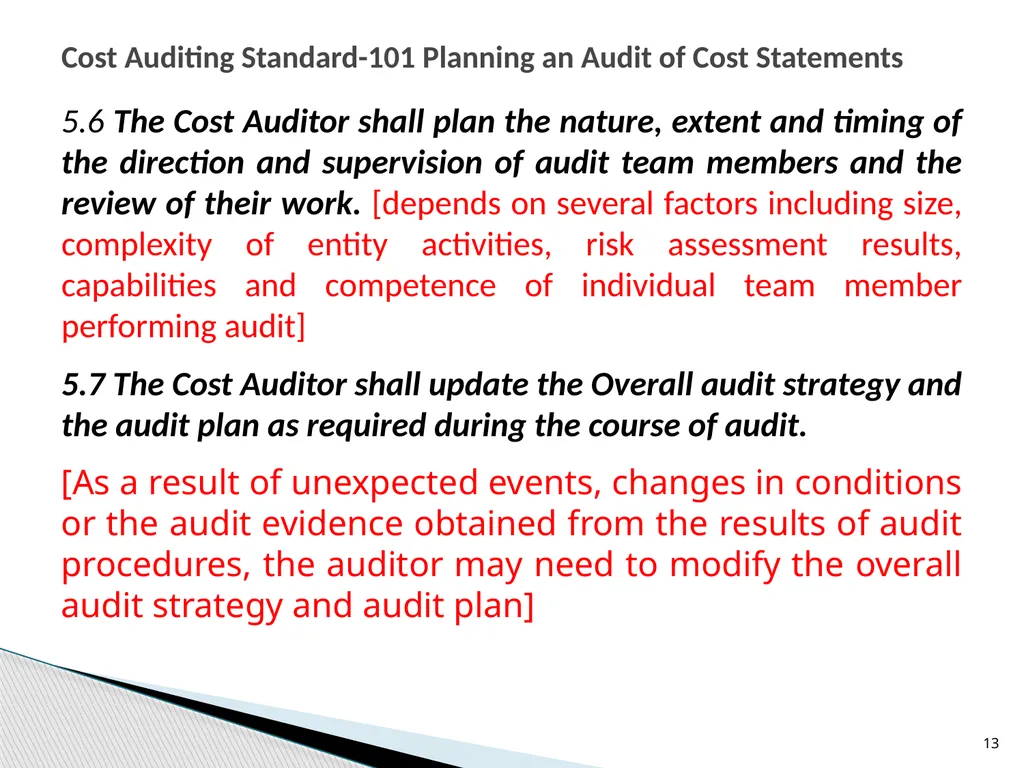
5.6 The Cost Auditor shall plan the nature, extent and timing of the direction and supervision of audit team members and the review of their work. [depends on several factors including size, complexity of entity activities, risk assessment results, capabilities and competence of individual team member performing audit]
5.7 The Cost Auditor shall update the Overall audit strategy and the audit plan as required during the course of audit.
[As a result of unexpected events, changes in conditions or the audit evidence obtained from the results of audit procedures, the auditor may need to modify the overall audit strategy and audit plan] 13 Cost Auditing Standard-101 Planning an Audit of Cost Statements<br>
5.7 The Cost Auditor shall update the Overall audit strategy and the audit plan as required during the course of audit.
[As a result of unexpected events, changes in conditions or the audit evidence obtained from the results of audit procedures, the auditor may need to modify the overall audit strategy and audit plan] 13 Cost Auditing Standard-101 Planning an Audit of Cost Statements<br>
14
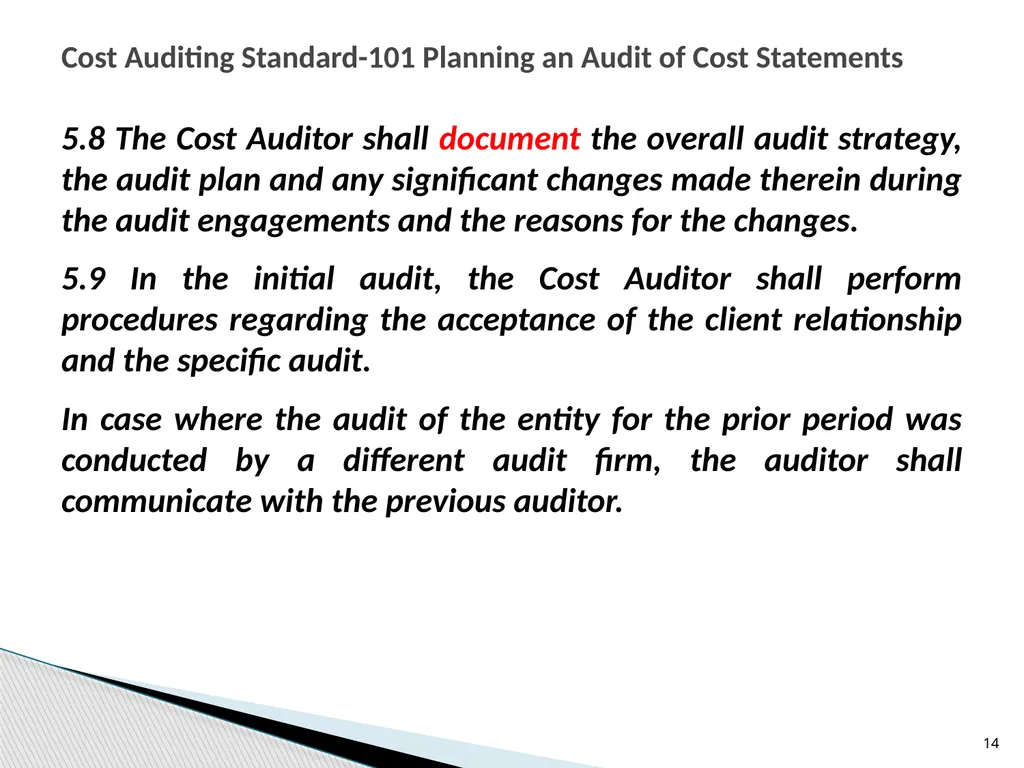
5.8 The Cost Auditor shall document the overall audit strategy, the audit plan and any significant changes made therein during the audit engagements and the reasons for the changes.
5.9 In the initial audit, the Cost Auditor shall perform procedures regarding the acceptance of the client relationship and the specific audit.
In case where the audit of the entity for the prior period was conducted by a different audit firm, the auditor shall communicate with the previous auditor. 14 Cost Auditing Standard-101 Planning an Audit of Cost Statements<br>
5.9 In the initial audit, the Cost Auditor shall perform procedures regarding the acceptance of the client relationship and the specific audit.
In case where the audit of the entity for the prior period was conducted by a different audit firm, the auditor shall communicate with the previous auditor. 14 Cost Auditing Standard-101 Planning an Audit of Cost Statements<br>
15
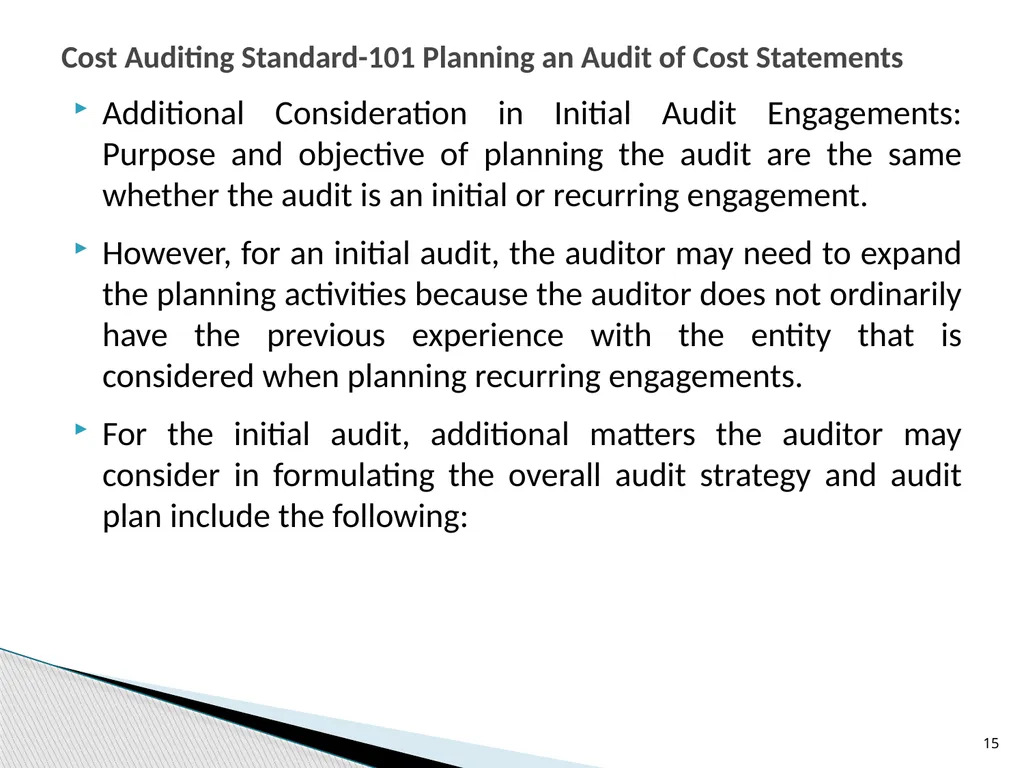
Additional Consideration in Initial Audit Engagements: Purpose and objective of planning the audit are the same whether the audit is an initial or recurring engagement.
However, for an initial audit, the auditor may need to expand the planning activities because the auditor does not ordinarily have the previous experience with the entity that is considered when planning recurring engagements.
For the initial audit, additional matters the auditor may consider in formulating the overall audit strategy and audit plan include the following: 15 Cost Auditing Standard-101 Planning an Audit of Cost Statements<br>
However, for an initial audit, the auditor may need to expand the planning activities because the auditor does not ordinarily have the previous experience with the entity that is considered when planning recurring engagements.
For the initial audit, additional matters the auditor may consider in formulating the overall audit strategy and audit plan include the following: 15 Cost Auditing Standard-101 Planning an Audit of Cost Statements<br>
16
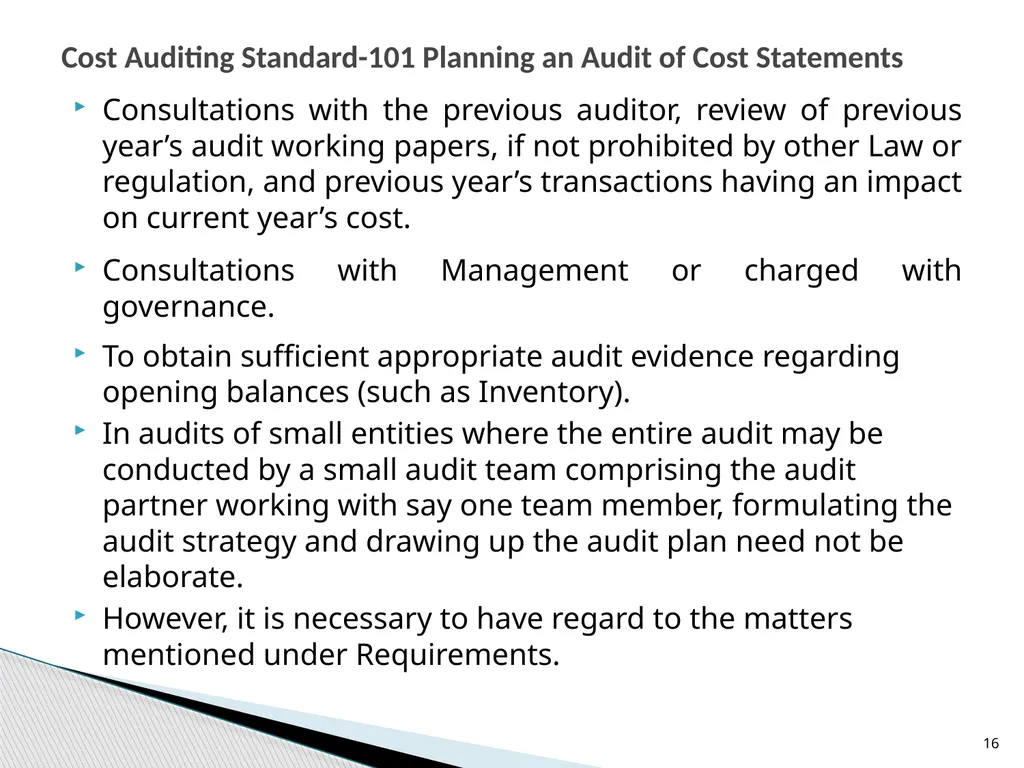
Consultations with the previous auditor, review of previous year’s audit working papers, if not prohibited by other Law or regulation, and previous year’s transactions having an impact on current year’s cost.
Consultations with Management or charged with governance.
To obtain sufficient appropriate audit evidence regarding opening balances (such as Inventory).
In audits of small entities where the entire audit may be conducted by a small audit team comprising the audit partner working with say one team member, formulating the audit strategy and drawing up the audit plan need not be elaborate.
However, it is necessary to have regard to the matters mentioned under Requirements. 16 Cost Auditing Standard-101 Planning an Audit of Cost Statements<br>
Consultations with Management or charged with governance.
To obtain sufficient appropriate audit evidence regarding opening balances (such as Inventory).
In audits of small entities where the entire audit may be conducted by a small audit team comprising the audit partner working with say one team member, formulating the audit strategy and drawing up the audit plan need not be elaborate.
However, it is necessary to have regard to the matters mentioned under Requirements. 16 Cost Auditing Standard-101 Planning an Audit of Cost Statements<br>
17
Cost Auditing Standard-102
Cost Audit Documentation 17<br>
Cost Audit Documentation 17<br>
18
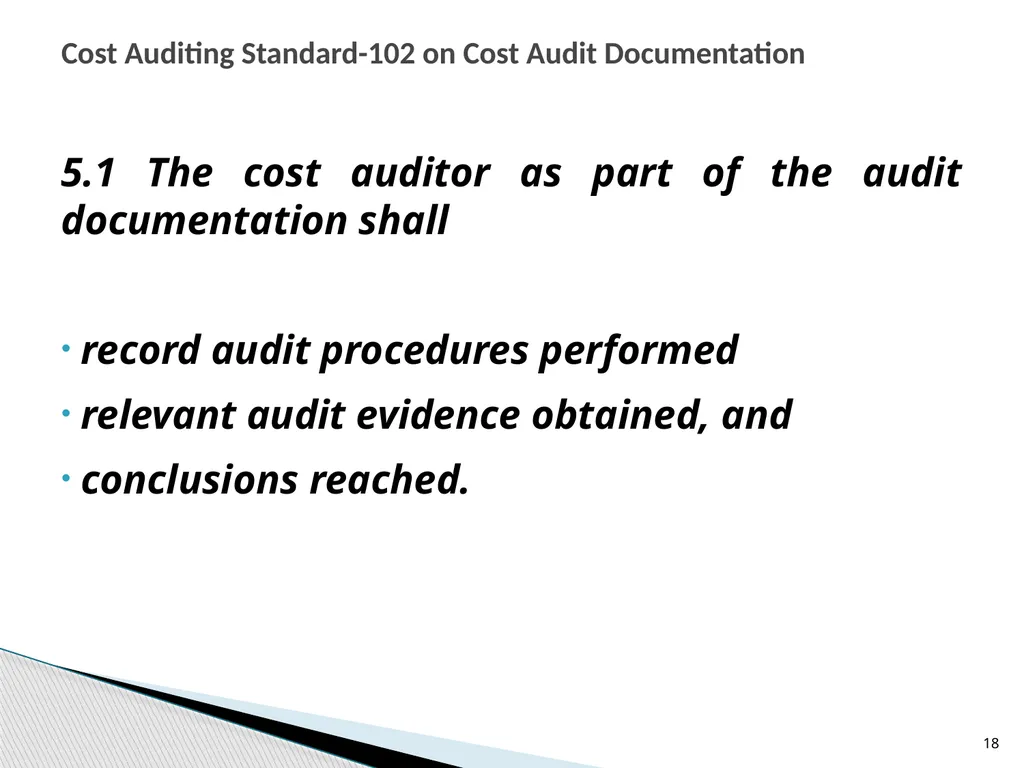
5.1 The cost auditor as part of the audit documentation shall
record audit procedures performed
relevant audit evidence obtained, and
conclusions reached. 18 Cost Auditing Standard-102 on Cost Audit Documentation<br>
record audit procedures performed
relevant audit evidence obtained, and
conclusions reached. 18 Cost Auditing Standard-102 on Cost Audit Documentation<br>
19
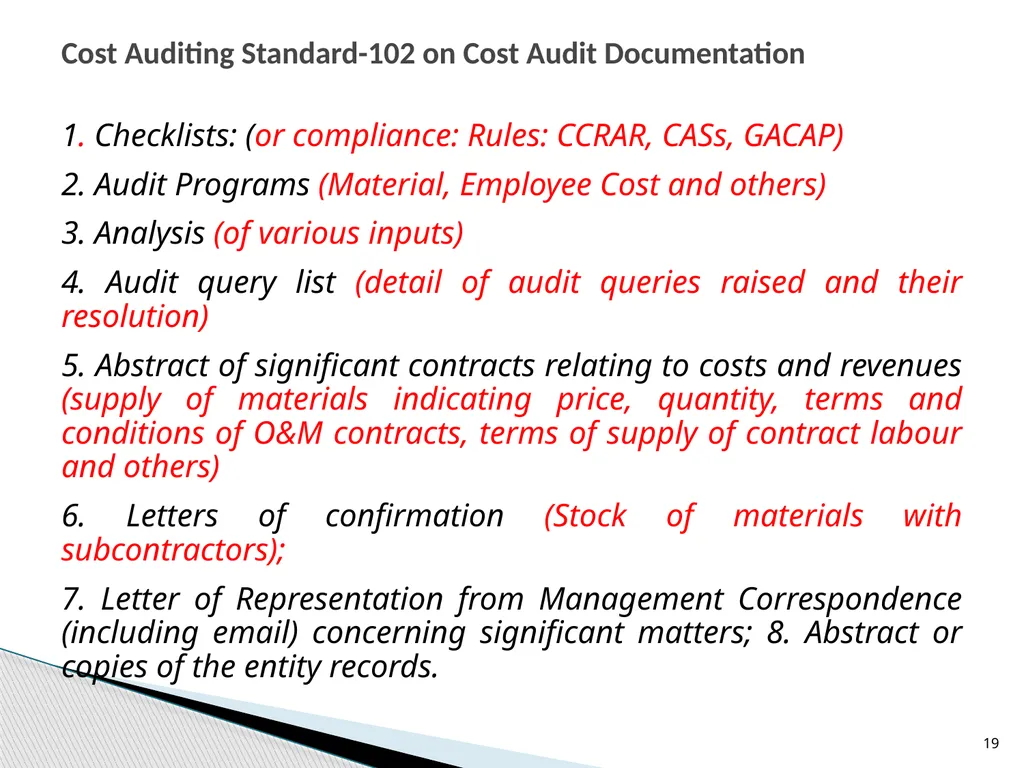
1. Checklists: (or compliance: Rules: CCRAR, CASs, GACAP)
2. Audit Programs (Material, Employee Cost and others)
3. Analysis (of various inputs)
4. Audit query list (detail of audit queries raised and their resolution)
5. Abstract of significant contracts relating to costs and revenues (supply of materials indicating price, quantity, terms and conditions of O&M contracts, terms of supply of contract labour and others)
6. Letters of confirmation (Stock of materials with subcontractors);
7. Letter of Representation from Management Correspondence (including email) concerning significant matters; 8. Abstract or copies of the entity records. 19 Cost Auditing Standard-102 on Cost Audit Documentation<br>
2. Audit Programs (Material, Employee Cost and others)
3. Analysis (of various inputs)
4. Audit query list (detail of audit queries raised and their resolution)
5. Abstract of significant contracts relating to costs and revenues (supply of materials indicating price, quantity, terms and conditions of O&M contracts, terms of supply of contract labour and others)
6. Letters of confirmation (Stock of materials with subcontractors);
7. Letter of Representation from Management Correspondence (including email) concerning significant matters; 8. Abstract or copies of the entity records. 19 Cost Auditing Standard-102 on Cost Audit Documentation<br>
20
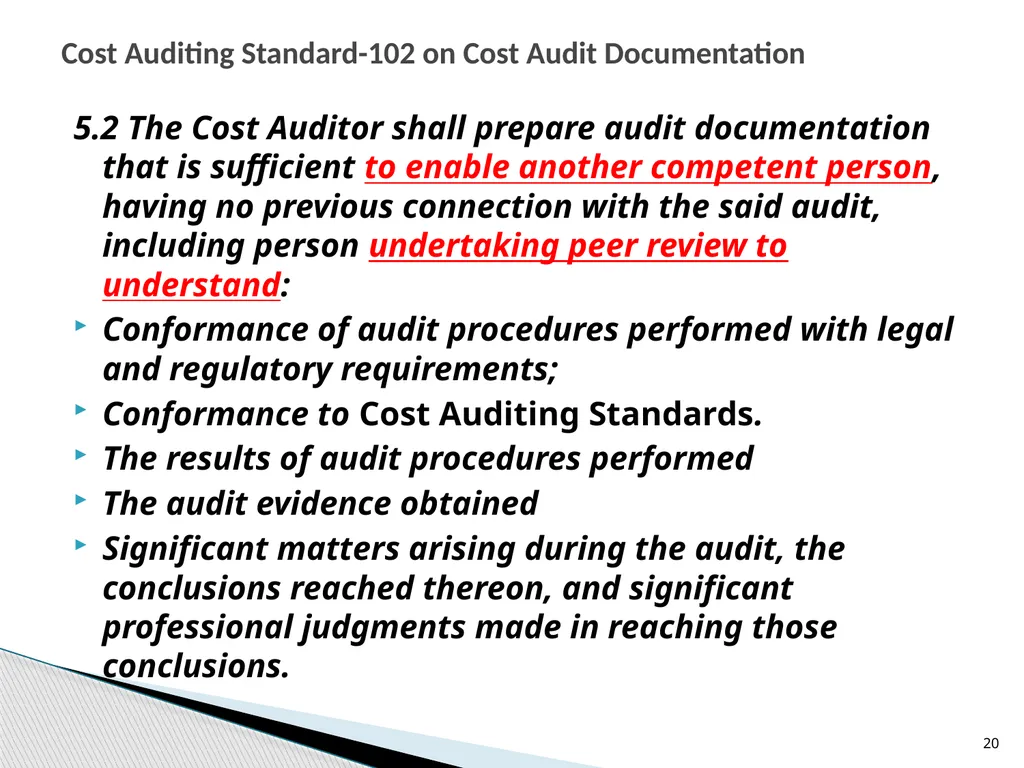
5.2 The Cost Auditor shall prepare audit documentation that is sufficient to enable another competent person, having no previous connection with the said audit, including person undertaking peer review to understand:
Conformance of audit procedures performed with legal and regulatory requirements;
Conformance to Cost Auditing Standards.
The results of audit procedures performed
The audit evidence obtained
Significant matters arising during the audit, the conclusions reached thereon, and significant professional judgments made in reaching those conclusions. 20 Cost Auditing Standard-102 on Cost Audit Documentation<br>
Conformance of audit procedures performed with legal and regulatory requirements;
Conformance to Cost Auditing Standards.
The results of audit procedures performed
The audit evidence obtained
Significant matters arising during the audit, the conclusions reached thereon, and significant professional judgments made in reaching those conclusions. 20 Cost Auditing Standard-102 on Cost Audit Documentation<br>
21
Audit documentation must contain evidence of conformance to requirements of Cost Auditing Standards in respect of this Standard and other standards :
Typical of such evidence are:
an adequately documented audit plan
the signed appointment letter from the auditee
Minutes of discussion with client personnel, with names of members of audit team present, particularly of the audit partner when he is present
Minutes of audit team discussions, with names of members of audit team present, particularly of the audit partner when he is present. 21 Cost Auditing Standard-102 on Cost Audit Documentation<br>
Typical of such evidence are:
an adequately documented audit plan
the signed appointment letter from the auditee
Minutes of discussion with client personnel, with names of members of audit team present, particularly of the audit partner when he is present
Minutes of audit team discussions, with names of members of audit team present, particularly of the audit partner when he is present. 21 Cost Auditing Standard-102 on Cost Audit Documentation<br>
22
Matters that give rise to significant risks of a material misstatement are significant matters.
Those that causes a revision of the Cost Auditor’s previous assessment of the risks of material misstatement is also a significant matter.
Cost Auditor may have reached a certain conclusion regarding the misstatement of the Material Cost in a Cost statement based on the availability of a well documented Bill of Materials but his assessment of risk may undergo a change if he finds that there is considerable use of substitute and alternate materials in the actual production process.
Matters that cause the Cost Auditor significant difficulty in applying necessary audit procedures are also significant, as for example heaps of bulk material in irregular shapes which make volumetric measurement of stock in a physical stock taking unreliable. 22 Cost Auditing Standard-102 on Cost Audit Documentation<br>
Those that causes a revision of the Cost Auditor’s previous assessment of the risks of material misstatement is also a significant matter.
Cost Auditor may have reached a certain conclusion regarding the misstatement of the Material Cost in a Cost statement based on the availability of a well documented Bill of Materials but his assessment of risk may undergo a change if he finds that there is considerable use of substitute and alternate materials in the actual production process.
Matters that cause the Cost Auditor significant difficulty in applying necessary audit procedures are also significant, as for example heaps of bulk material in irregular shapes which make volumetric measurement of stock in a physical stock taking unreliable. 22 Cost Auditing Standard-102 on Cost Audit Documentation<br>
23
The conclusions reached and the application of professional judgment in respect of these also needs to be documented.
For example the determination of the normal capacity for applying overheads is a significant matter in Cost Audit and requires not mere calculations but considerable judgment. These should be adequately documented.} 23 Cost Auditing Standard-102 on Cost Audit Documentation<br>
For example the determination of the normal capacity for applying overheads is a significant matter in Cost Audit and requires not mere calculations but considerable judgment. These should be adequately documented.} 23 Cost Auditing Standard-102 on Cost Audit Documentation<br>
24
5.3 The Cost Auditor shall record the discussions of significant matters with client personnel and outsiders.
[Minutes of the meeting with Management or those charged with governance, discussion with third parties seeking information or confirmation]
5.4 The Cost Auditor shall record any departure from the standard requirement in a Cost Auditing Standard.
If, in exceptional circumstances, the Cost Auditor finds it necessary to perform alternative audit procedures different from a corresponding requirement in a Cost Auditing Standards, the Cost Auditor shall document how the alternative audit procedures performed achieve the aim of that requirement, and the reasons for the departure. 24 Cost Auditing Standard-102 on Cost Audit Documentation<br>
[Minutes of the meeting with Management or those charged with governance, discussion with third parties seeking information or confirmation]
5.4 The Cost Auditor shall record any departure from the standard requirement in a Cost Auditing Standard.
If, in exceptional circumstances, the Cost Auditor finds it necessary to perform alternative audit procedures different from a corresponding requirement in a Cost Auditing Standards, the Cost Auditor shall document how the alternative audit procedures performed achieve the aim of that requirement, and the reasons for the departure. 24 Cost Auditing Standard-102 on Cost Audit Documentation<br>
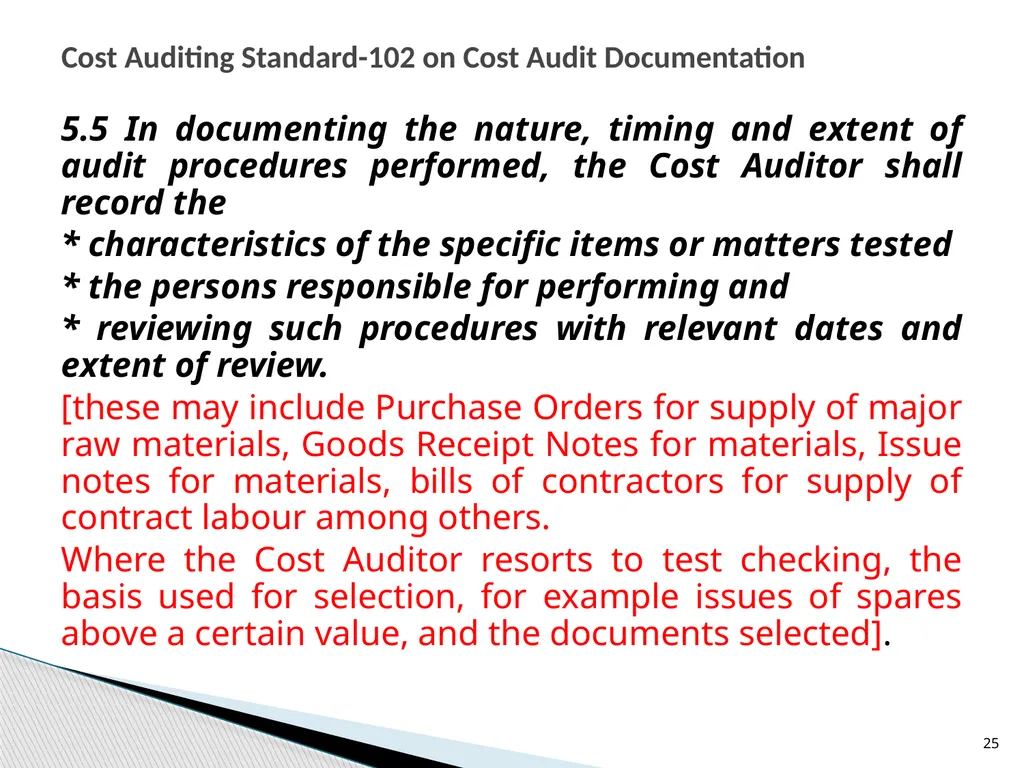
25
5.5 In documenting the nature, timing and extent of audit procedures performed, the Cost Auditor shall record the
* characteristics of the specific items or matters tested
* the persons responsible for performing and
* reviewing such procedures with relevant dates and extent of review.
[these may include Purchase Orders for supply of major raw materials, Goods Receipt Notes for materials, Issue notes for materials, bills of contractors for supply of contract labour among others.
Where the Cost Auditor resorts to test checking, the basis used for selection, for example issues of spares above a certain value, and the documents selected]. 25 Cost Auditing Standard-102 on Cost Audit Documentation<br>
* characteristics of the specific items or matters tested
* the persons responsible for performing and
* reviewing such procedures with relevant dates and extent of review.
[these may include Purchase Orders for supply of major raw materials, Goods Receipt Notes for materials, Issue notes for materials, bills of contractors for supply of contract labour among others.
Where the Cost Auditor resorts to test checking, the basis used for selection, for example issues of spares above a certain value, and the documents selected]. 25 Cost Auditing Standard-102 on Cost Audit Documentation<br>
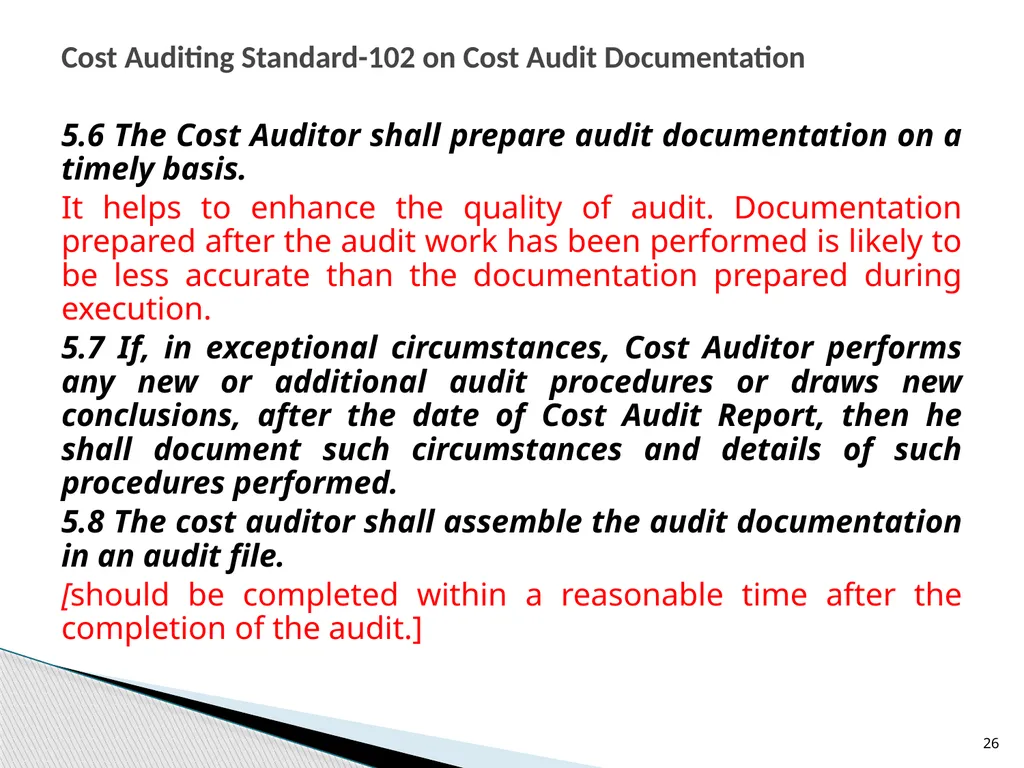
26
5.6 The Cost Auditor shall prepare audit documentation on a timely basis.
It helps to enhance the quality of audit. Documentation prepared after the audit work has been performed is likely to be less accurate than the documentation prepared during execution.
5.7 If, in exceptional circumstances, Cost Auditor performs any new or additional audit procedures or draws new conclusions, after the date of Cost Audit Report, then he shall document such circumstances and details of such procedures performed.
5.8 The cost auditor shall assemble the audit documentation in an audit file.
[should be completed within a reasonable time after the completion of the audit.] 26 Cost Auditing Standard-102 on Cost Audit Documentation<br>
It helps to enhance the quality of audit. Documentation prepared after the audit work has been performed is likely to be less accurate than the documentation prepared during execution.
5.7 If, in exceptional circumstances, Cost Auditor performs any new or additional audit procedures or draws new conclusions, after the date of Cost Audit Report, then he shall document such circumstances and details of such procedures performed.
5.8 The cost auditor shall assemble the audit documentation in an audit file.
[should be completed within a reasonable time after the completion of the audit.] 26 Cost Auditing Standard-102 on Cost Audit Documentation<br>
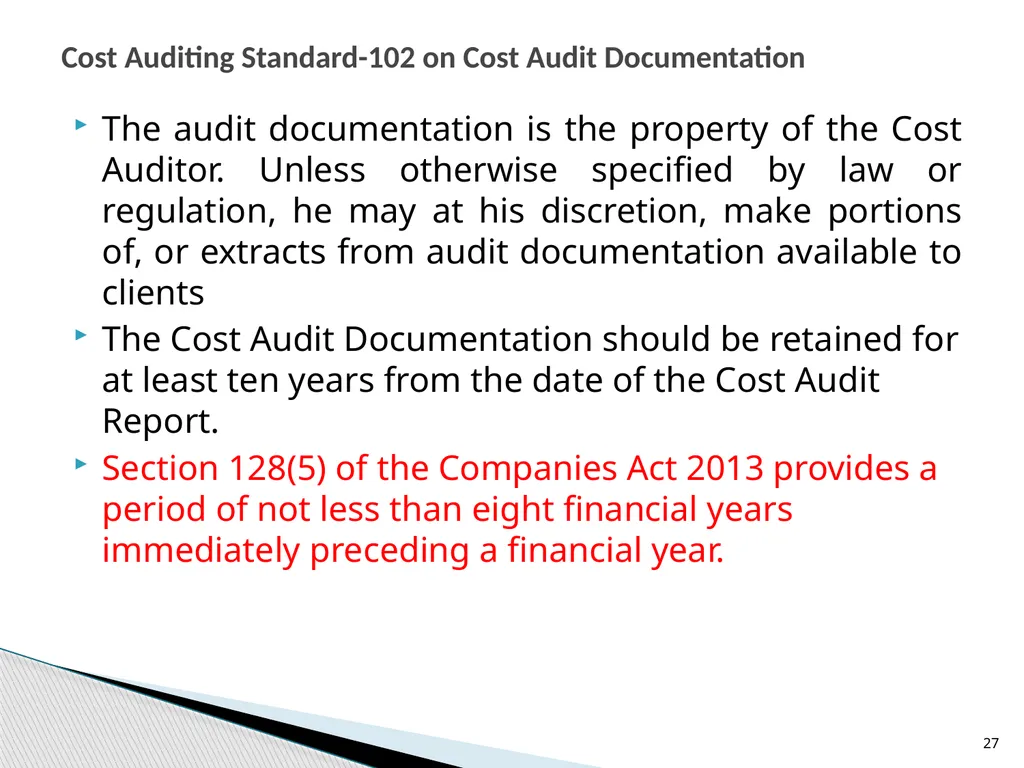
27
The audit documentation is the property of the Cost Auditor. Unless otherwise specified by law or regulation, he may at his discretion, make portions of, or extracts from audit documentation available to clients
The Cost Audit Documentation should be retained for at least ten years from the date of the Cost Audit Report.
Section 128(5) of the Companies Act 2013 provides a period of not less than eight financial years immediately preceding a financial year. 27 Cost Auditing Standard-102 on Cost Audit Documentation<br>
The Cost Audit Documentation should be retained for at least ten years from the date of the Cost Audit Report.
Section 128(5) of the Companies Act 2013 provides a period of not less than eight financial years immediately preceding a financial year. 27 Cost Auditing Standard-102 on Cost Audit Documentation<br>
28
Cost Auditing Standard-103
Overall Objectives of the Independent Cost Auditor and the Conduct of an Audit in Accordance with Cost Auditing Standards 28<br>
Overall Objectives of the Independent Cost Auditor and the Conduct of an Audit in Accordance with Cost Auditing Standards 28<br>
29
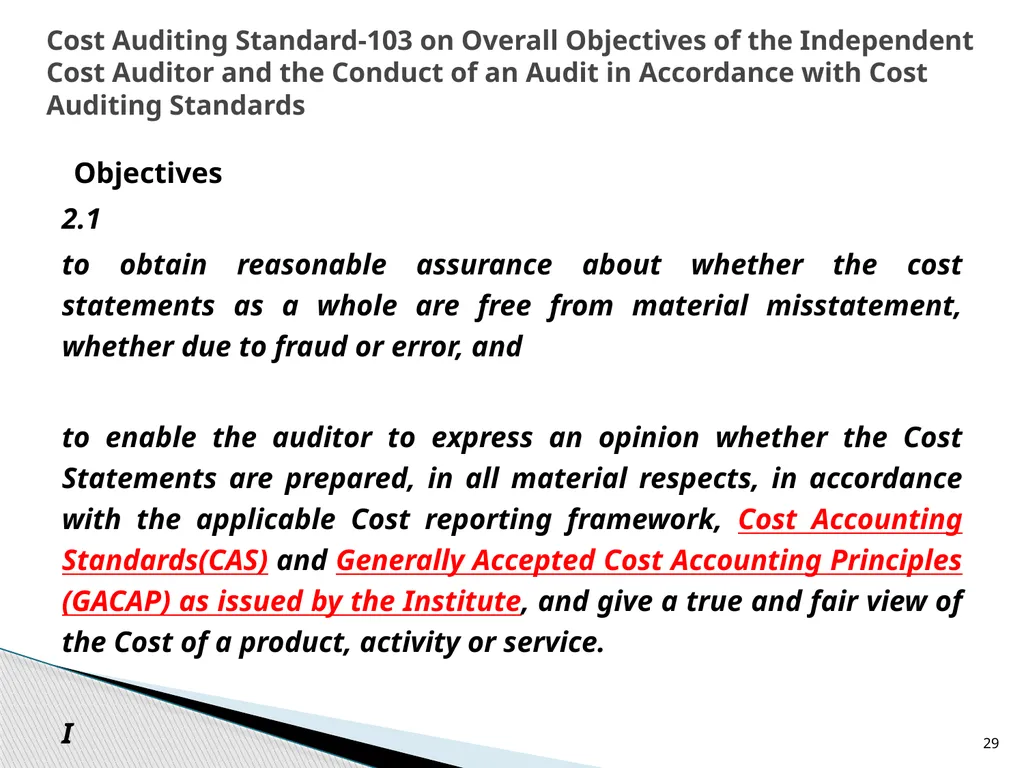
Objectives
2.1
to obtain reasonable assurance about whether the cost statements as a whole are free from material misstatement, whether due to fraud or error, and
to enable the auditor to express an opinion whether the Cost Statements are prepared, in all material respects, in accordance with the applicable Cost reporting framework, Cost Accounting Standards(CAS) and Generally Accepted Cost Accounting Principles (GACAP) as issued by the Institute, and give a true and fair view of the Cost of a product, activity or service.
I 29 Cost Auditing Standard-103 on Overall Objectives of the Independent Cost Auditor and the Conduct of an Audit in Accordance with Cost Auditing Standards<br>
2.1
to obtain reasonable assurance about whether the cost statements as a whole are free from material misstatement, whether due to fraud or error, and
to enable the auditor to express an opinion whether the Cost Statements are prepared, in all material respects, in accordance with the applicable Cost reporting framework, Cost Accounting Standards(CAS) and Generally Accepted Cost Accounting Principles (GACAP) as issued by the Institute, and give a true and fair view of the Cost of a product, activity or service.
I 29 Cost Auditing Standard-103 on Overall Objectives of the Independent Cost Auditor and the Conduct of an Audit in Accordance with Cost Auditing Standards<br>
30
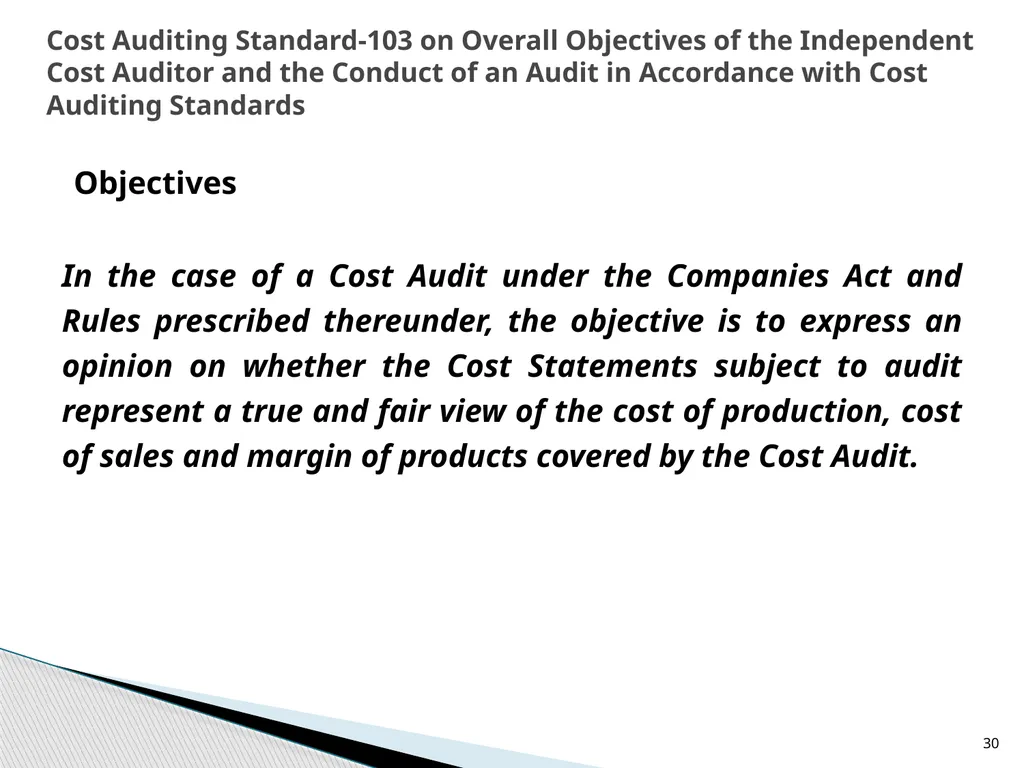
Objectives
In the case of a Cost Audit under the Companies Act and Rules prescribed thereunder, the objective is to express an opinion on whether the Cost Statements subject to audit represent a true and fair view of the cost of production, cost of sales and margin of products covered by the Cost Audit. 30 Cost Auditing Standard-103 on Overall Objectives of the Independent Cost Auditor and the Conduct of an Audit in Accordance with Cost Auditing Standards<br>
In the case of a Cost Audit under the Companies Act and Rules prescribed thereunder, the objective is to express an opinion on whether the Cost Statements subject to audit represent a true and fair view of the cost of production, cost of sales and margin of products covered by the Cost Audit. 30 Cost Auditing Standard-103 on Overall Objectives of the Independent Cost Auditor and the Conduct of an Audit in Accordance with Cost Auditing Standards<br>
31
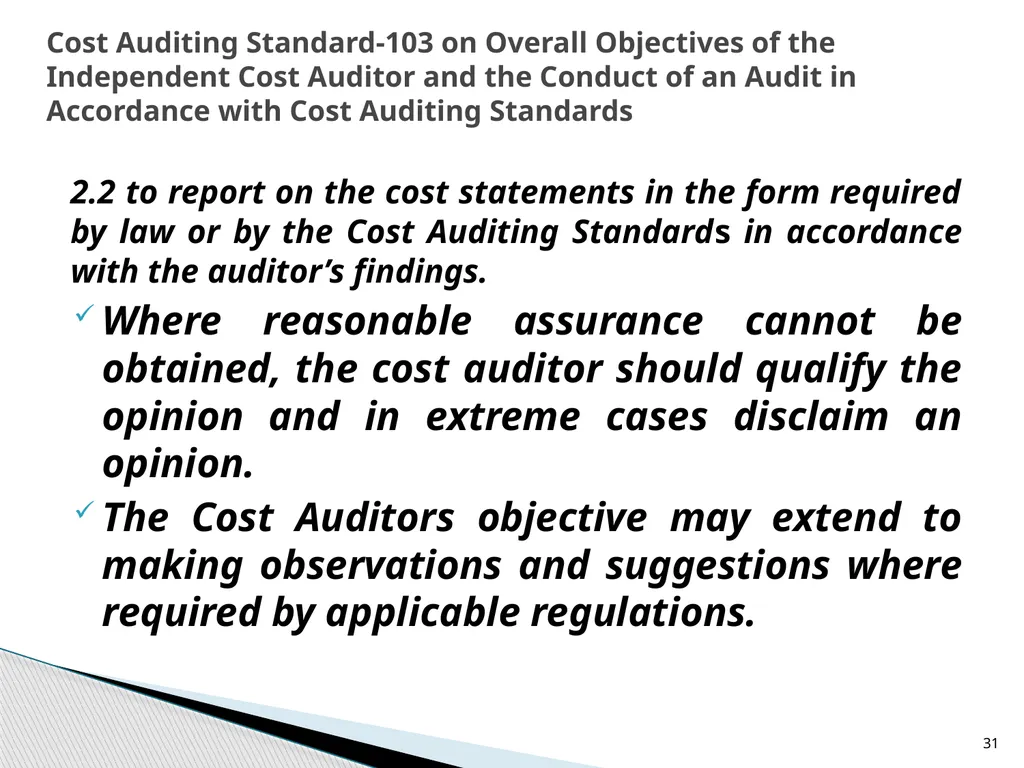
2.2 to report on the cost statements in the form required by law or by the Cost Auditing Standards in accordance with the auditor’s findings.
Where reasonable assurance cannot be obtained, the cost auditor should qualify the opinion and in extreme cases disclaim an opinion.
The Cost Auditors objective may extend to making observations and suggestions where required by applicable regulations. 31 Cost Auditing Standard-103 on Overall Objectives of the Independent Cost Auditor and the Conduct of an Audit in Accordance with Cost Auditing Standards<br>
Where reasonable assurance cannot be obtained, the cost auditor should qualify the opinion and in extreme cases disclaim an opinion.
The Cost Auditors objective may extend to making observations and suggestions where required by applicable regulations. 31 Cost Auditing Standard-103 on Overall Objectives of the Independent Cost Auditor and the Conduct of an Audit in Accordance with Cost Auditing Standards<br>
32
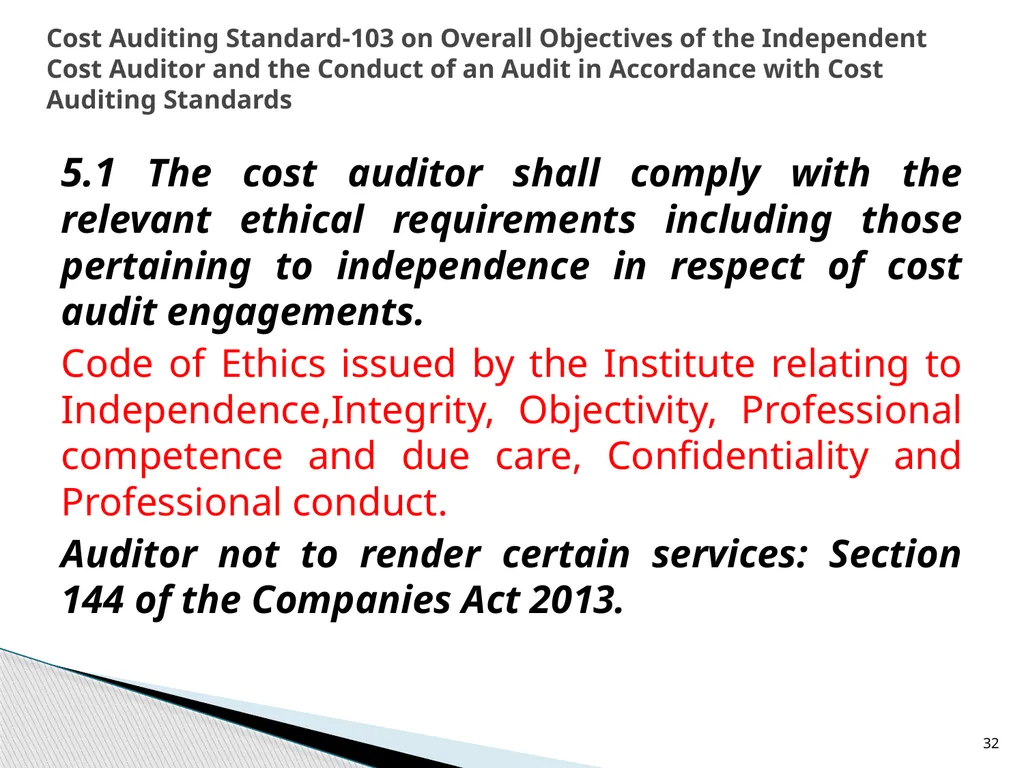
5.1 The cost auditor shall comply with the relevant ethical requirements including those pertaining to independence in respect of cost audit engagements.
Code of Ethics issued by the Institute relating to Independence,Integrity, Objectivity, Professional competence and due care, Confidentiality and Professional conduct.
Auditor not to render certain services: Section 144 of the Companies Act 2013. 32 Cost Auditing Standard-103 on Overall Objectives of the Independent Cost Auditor and the Conduct of an Audit in Accordance with Cost Auditing Standards<br>
Code of Ethics issued by the Institute relating to Independence,Integrity, Objectivity, Professional competence and due care, Confidentiality and Professional conduct.
Auditor not to render certain services: Section 144 of the Companies Act 2013. 32 Cost Auditing Standard-103 on Overall Objectives of the Independent Cost Auditor and the Conduct of an Audit in Accordance with Cost Auditing Standards<br>
33
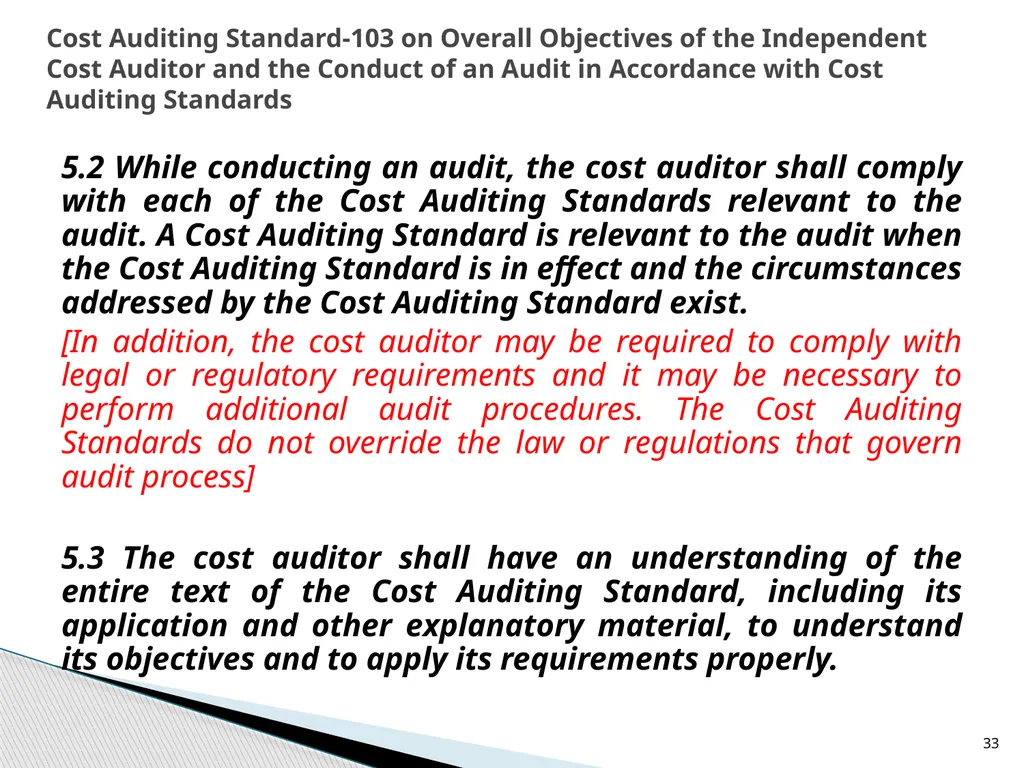
5.2 While conducting an audit, the cost auditor shall comply with each of the Cost Auditing Standards relevant to the audit. A Cost Auditing Standard is relevant to the audit when the Cost Auditing Standard is in effect and the circumstances addressed by the Cost Auditing Standard exist.
[In addition, the cost auditor may be required to comply with legal or regulatory requirements and it may be necessary to perform additional audit procedures. The Cost Auditing Standards do not override the law or regulations that govern audit process]
5.3 The cost auditor shall have an understanding of the entire text of the Cost Auditing Standard, including its application and other explanatory material, to understand its objectives and to apply its requirements properly. 33 Cost Auditing Standard-103 on Overall Objectives of the Independent Cost Auditor and the Conduct of an Audit in Accordance with Cost Auditing Standards<br>
[In addition, the cost auditor may be required to comply with legal or regulatory requirements and it may be necessary to perform additional audit procedures. The Cost Auditing Standards do not override the law or regulations that govern audit process]
5.3 The cost auditor shall have an understanding of the entire text of the Cost Auditing Standard, including its application and other explanatory material, to understand its objectives and to apply its requirements properly. 33 Cost Auditing Standard-103 on Overall Objectives of the Independent Cost Auditor and the Conduct of an Audit in Accordance with Cost Auditing Standards<br>
34
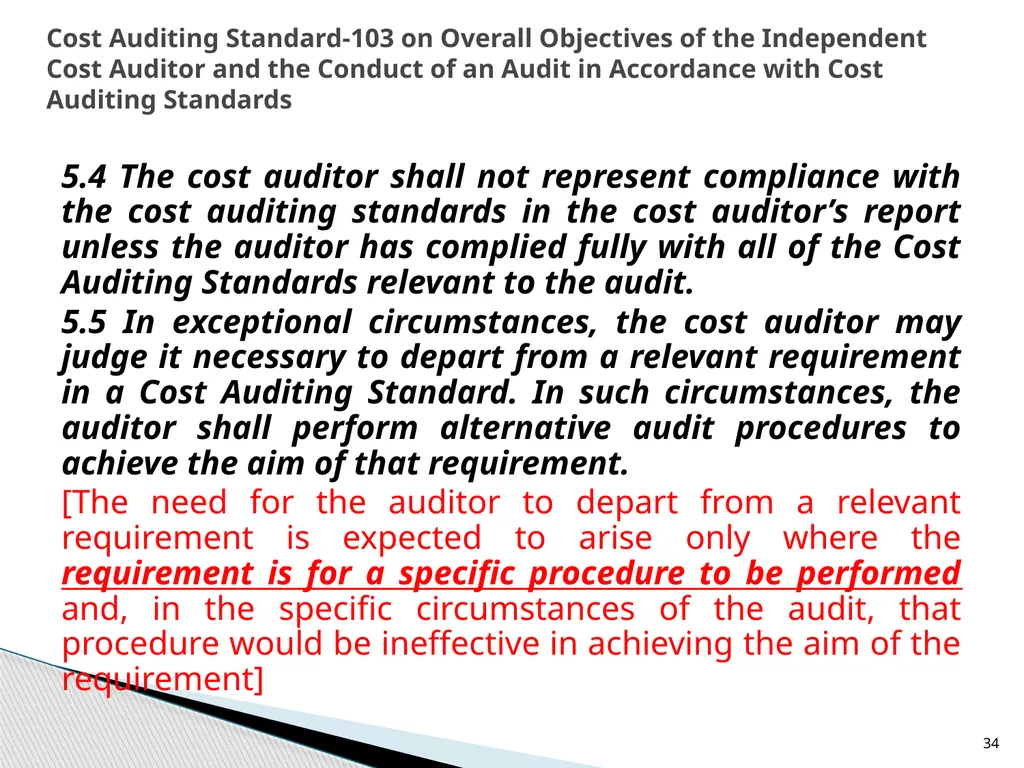
5.4 The cost auditor shall not represent compliance with the cost auditing standards in the cost auditor’s report unless the auditor has complied fully with all of the Cost Auditing Standards relevant to the audit.
5.5 In exceptional circumstances, the cost auditor may judge it necessary to depart from a relevant requirement in a Cost Auditing Standard. In such circumstances, the auditor shall perform alternative audit procedures to achieve the aim of that requirement.
[The need for the auditor to depart from a relevant requirement is expected to arise only where the requirement is for a specific procedure to be performed and, in the specific circumstances of the audit, that procedure would be ineffective in achieving the aim of the requirement] 34 Cost Auditing Standard-103 on Overall Objectives of the Independent Cost Auditor and the Conduct of an Audit in Accordance with Cost Auditing Standards<br>
5.5 In exceptional circumstances, the cost auditor may judge it necessary to depart from a relevant requirement in a Cost Auditing Standard. In such circumstances, the auditor shall perform alternative audit procedures to achieve the aim of that requirement.
[The need for the auditor to depart from a relevant requirement is expected to arise only where the requirement is for a specific procedure to be performed and, in the specific circumstances of the audit, that procedure would be ineffective in achieving the aim of the requirement] 34 Cost Auditing Standard-103 on Overall Objectives of the Independent Cost Auditor and the Conduct of an Audit in Accordance with Cost Auditing Standards<br>
35
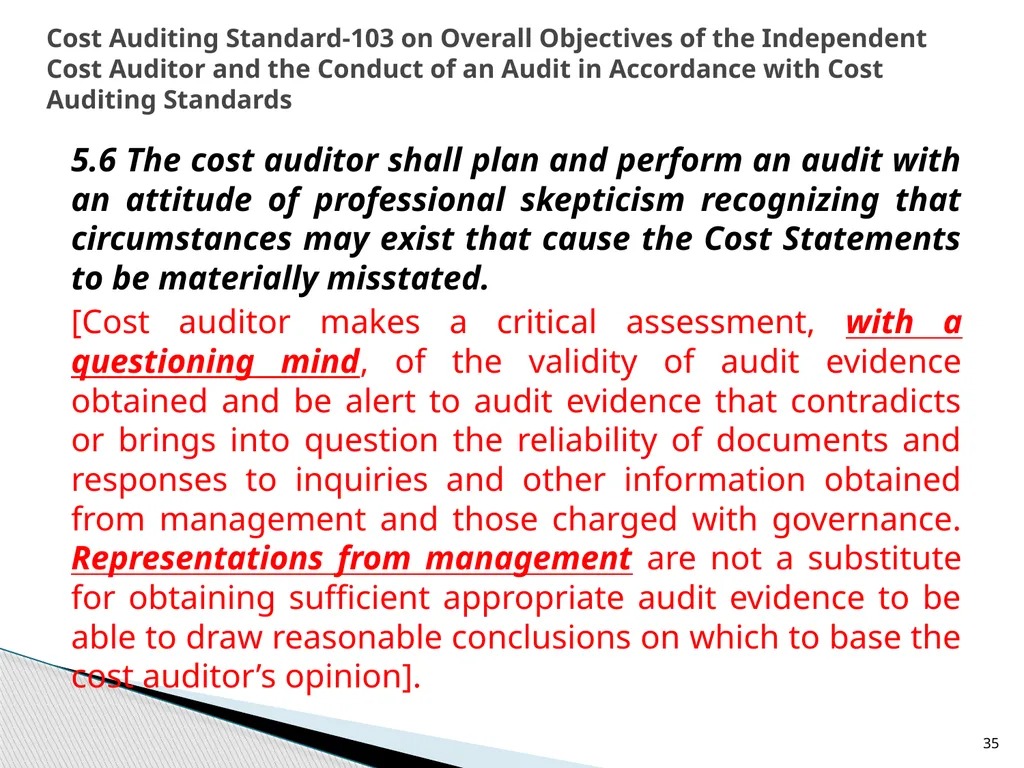
5.6 The cost auditor shall plan and perform an audit with an attitude of professional skepticism recognizing that circumstances may exist that cause the Cost Statements to be materially misstated.
[Cost auditor makes a critical assessment, with a questioning mind, of the validity of audit evidence obtained and be alert to audit evidence that contradicts or brings into question the reliability of documents and responses to inquiries and other information obtained from management and those charged with governance. Representations from management are not a substitute for obtaining sufficient appropriate audit evidence to be able to draw reasonable conclusions on which to base the cost auditor’s opinion]. 35 Cost Auditing Standard-103 on Overall Objectives of the Independent Cost Auditor and the Conduct of an Audit in Accordance with Cost Auditing Standards<br>
[Cost auditor makes a critical assessment, with a questioning mind, of the validity of audit evidence obtained and be alert to audit evidence that contradicts or brings into question the reliability of documents and responses to inquiries and other information obtained from management and those charged with governance. Representations from management are not a substitute for obtaining sufficient appropriate audit evidence to be able to draw reasonable conclusions on which to base the cost auditor’s opinion]. 35 Cost Auditing Standard-103 on Overall Objectives of the Independent Cost Auditor and the Conduct of an Audit in Accordance with Cost Auditing Standards<br>
36
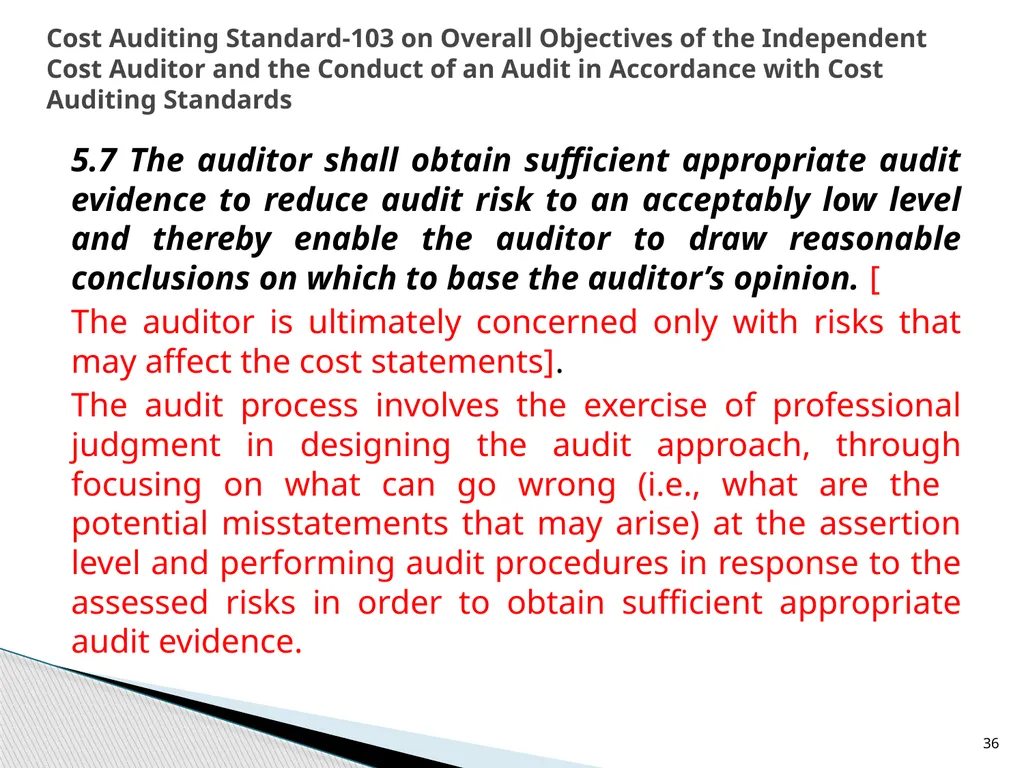
5.7 The auditor shall obtain sufficient appropriate audit evidence to reduce audit risk to an acceptably low level and thereby enable the auditor to draw reasonable conclusions on which to base the auditor’s opinion. [
The auditor is ultimately concerned only with risks that may affect the cost statements].
The audit process involves the exercise of professional judgment in designing the audit approach, through focusing on what can go wrong (i.e., what are the potential misstatements that may arise) at the assertion level and performing audit procedures in response to the assessed risks in order to obtain sufficient appropriate audit evidence. 36 Cost Auditing Standard-103 on Overall Objectives of the Independent Cost Auditor and the Conduct of an Audit in Accordance with Cost Auditing Standards<br>
The auditor is ultimately concerned only with risks that may affect the cost statements].
The audit process involves the exercise of professional judgment in designing the audit approach, through focusing on what can go wrong (i.e., what are the potential misstatements that may arise) at the assertion level and performing audit procedures in response to the assessed risks in order to obtain sufficient appropriate audit evidence. 36 Cost Auditing Standard-103 on Overall Objectives of the Independent Cost Auditor and the Conduct of an Audit in Accordance with Cost Auditing Standards<br>
37
5.8 The cost auditor shall exercise professional judgment in planning and performing the audit.
5.9 The cost auditor shall determine whether the Cost Reporting Framework followed by management in preparing cost statements is in line with the Companies Act and the Rules prescribed thereunder.
6.5(b) The Cost auditor is not responsible for preparing and presenting the cost statements in accordance with the applicable Cost reporting framework including inter-alia:
Designing, implementing and maintaining internal control relevant to the preparation and presentation of Cost Statements that are free from material misstatement, whether due to fraud or error;
Selecting and applying appropriate Cost accounting policies; and
Making cost estimates that are reasonable in the circumstances. 37 Cost Auditing Standard-103 on Overall Objectives of the Independent Cost Auditor and the Conduct of an Audit in Accordance with Cost Auditing Standards<br>
5.9 The cost auditor shall determine whether the Cost Reporting Framework followed by management in preparing cost statements is in line with the Companies Act and the Rules prescribed thereunder.
6.5(b) The Cost auditor is not responsible for preparing and presenting the cost statements in accordance with the applicable Cost reporting framework including inter-alia:
Designing, implementing and maintaining internal control relevant to the preparation and presentation of Cost Statements that are free from material misstatement, whether due to fraud or error;
Selecting and applying appropriate Cost accounting policies; and
Making cost estimates that are reasonable in the circumstances. 37 Cost Auditing Standard-103 on Overall Objectives of the Independent Cost Auditor and the Conduct of an Audit in Accordance with Cost Auditing Standards<br>
38
Cost Auditing Standard-104
Knowledge of Business, its Processes and the Business Environment 38<br>
Knowledge of Business, its Processes and the Business Environment 38<br>
39
In performing an audit of cost statement, records and other related documents, the cost auditor should have the knowledge of the client’s business to enable him to understand the processes and express his opinion on the cost statements.
The cost auditor’s level of knowledge for a cost audit engagement should include a general knowledge of the economy and the industry within which the entity operates, and a more particular knowledge of how the entity operates. 39 Cost Auditing Standard-104 on Knowledge of Business, its Processes and the Business Environment<br>
The cost auditor’s level of knowledge for a cost audit engagement should include a general knowledge of the economy and the industry within which the entity operates, and a more particular knowledge of how the entity operates. 39 Cost Auditing Standard-104 on Knowledge of Business, its Processes and the Business Environment<br>
40
5.1 The Cost Auditor shall have adequate level of understanding of the knowledge of Business, its Processes and the Business Environment to develop a reasonable assurance in order to express an opinion on the cost statements on which he is expressing an opinion.
[Understanding internal control, assessing risks of material misstatement of the cost statements; considering the appropriateness of the selection of application of cost accounting policies, identifying where special audit is necessary for example: abnormal losses, lower yields, higher wastages, higher utilities consumption, related party transactions etc. Relevant industry factors include industry conditions such as competitive environment, supplier, customer relations, and technological development etc. ] 40 Cost Auditing Standard-104 on Knowledge of Business, its Processes and the Business Environment<br>
[Understanding internal control, assessing risks of material misstatement of the cost statements; considering the appropriateness of the selection of application of cost accounting policies, identifying where special audit is necessary for example: abnormal losses, lower yields, higher wastages, higher utilities consumption, related party transactions etc. Relevant industry factors include industry conditions such as competitive environment, supplier, customer relations, and technological development etc. ] 40 Cost Auditing Standard-104 on Knowledge of Business, its Processes and the Business Environment<br>
41
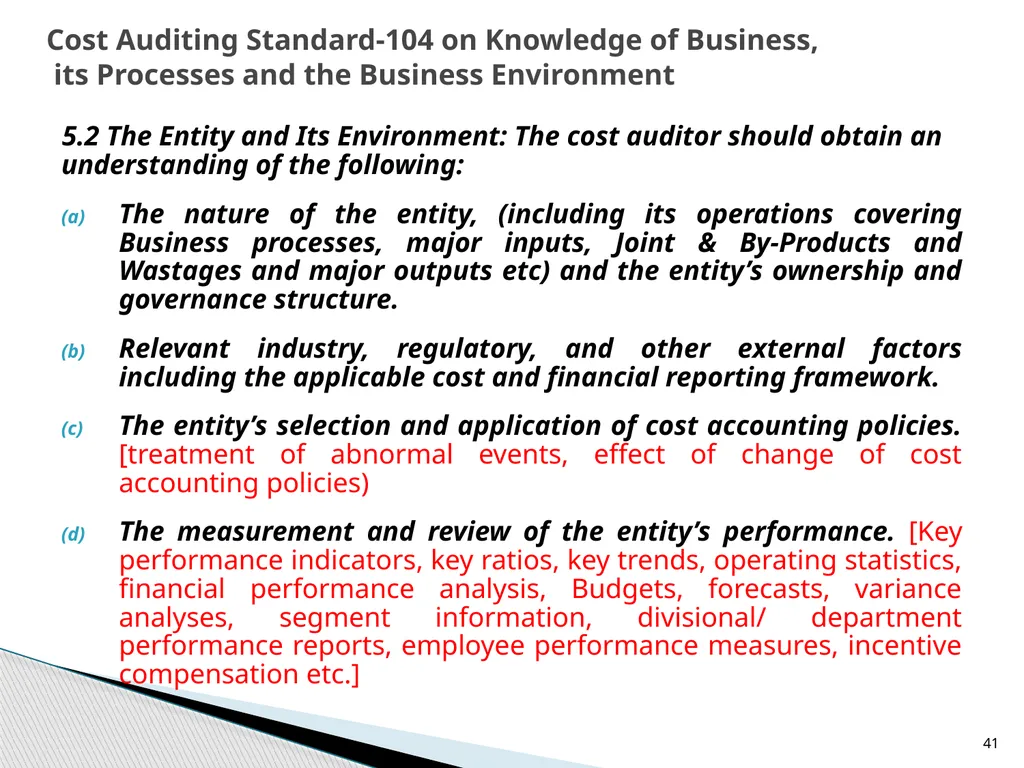
5.2 The Entity and Its Environment: The cost auditor should obtain an understanding of the following:
The nature of the entity, (including its operations covering Business processes, major inputs, Joint & By-Products and Wastages and major outputs etc) and the entity’s ownership and governance structure.
Relevant industry, regulatory, and other external factors including the applicable cost and financial reporting framework.
The entity’s selection and application of cost accounting policies. [treatment of abnormal events, effect of change of cost accounting policies)
The measurement and review of the entity’s performance. [Key performance indicators, key ratios, key trends, operating statistics, financial performance analysis, Budgets, forecasts, variance analyses, segment information, divisional/ department performance reports, employee performance measures, incentive compensation etc.] 41 Cost Auditing Standard-104 on Knowledge of Business, its Processes and the Business Environment<br>
The nature of the entity, (including its operations covering Business processes, major inputs, Joint & By-Products and Wastages and major outputs etc) and the entity’s ownership and governance structure.
Relevant industry, regulatory, and other external factors including the applicable cost and financial reporting framework.
The entity’s selection and application of cost accounting policies. [treatment of abnormal events, effect of change of cost accounting policies)
The measurement and review of the entity’s performance. [Key performance indicators, key ratios, key trends, operating statistics, financial performance analysis, Budgets, forecasts, variance analyses, segment information, divisional/ department performance reports, employee performance measures, incentive compensation etc.] 41 Cost Auditing Standard-104 on Knowledge of Business, its Processes and the Business Environment<br>
42
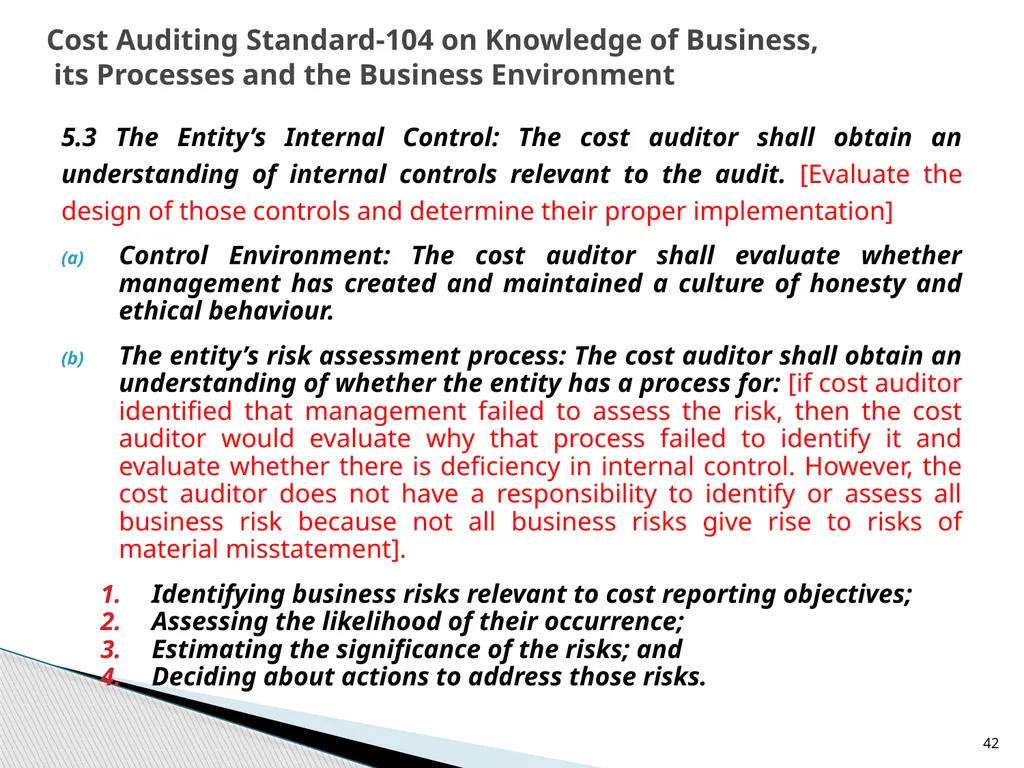
5.3 The Entity’s Internal Control: The cost auditor shall obtain an understanding of internal controls relevant to the audit. [Evaluate the design of those controls and determine their proper implementation]
Control Environment: The cost auditor shall evaluate whether management has created and maintained a culture of honesty and ethical behaviour.
The entity’s risk assessment process: The cost auditor shall obtain an understanding of whether the entity has a process for: [if cost auditor identified that management failed to assess the risk, then the cost auditor would evaluate why that process failed to identify it and evaluate whether there is deficiency in internal control. However, the cost auditor does not have a responsibility to identify or assess all business risk because not all business risks give rise to risks of material misstatement].
Identifying business risks relevant to cost reporting objectives;
Assessing the likelihood of their occurrence;
Estimating the significance of the risks; and
Deciding about actions to address those risks. 42 Cost Auditing Standard-104 on Knowledge of Business, its Processes and the Business Environment<br>
Control Environment: The cost auditor shall evaluate whether management has created and maintained a culture of honesty and ethical behaviour.
The entity’s risk assessment process: The cost auditor shall obtain an understanding of whether the entity has a process for: [if cost auditor identified that management failed to assess the risk, then the cost auditor would evaluate why that process failed to identify it and evaluate whether there is deficiency in internal control. However, the cost auditor does not have a responsibility to identify or assess all business risk because not all business risks give rise to risks of material misstatement].
Identifying business risks relevant to cost reporting objectives;
Assessing the likelihood of their occurrence;
Estimating the significance of the risks; and
Deciding about actions to address those risks. 42 Cost Auditing Standard-104 on Knowledge of Business, its Processes and the Business Environment<br>
43
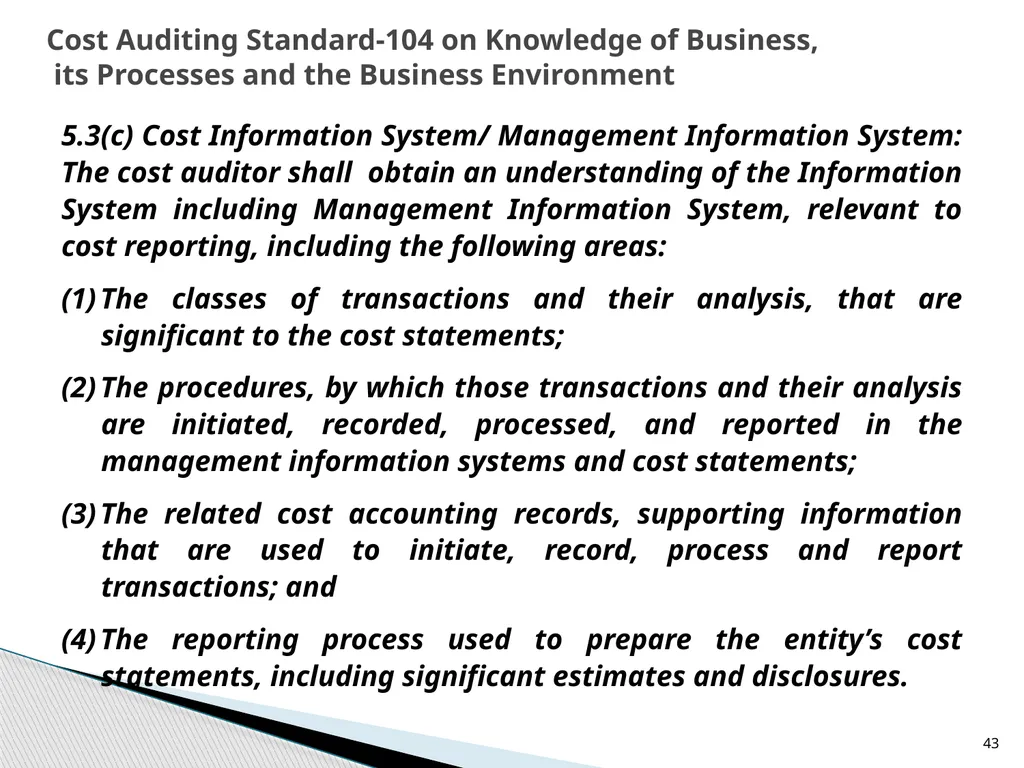
5.3(c) Cost Information System/ Management Information System: The cost auditor shall obtain an understanding of the Information System including Management Information System, relevant to cost reporting, including the following areas:
(1) The classes of transactions and their analysis, that are significant to the cost statements;
(2) The procedures, by which those transactions and their analysis are initiated, recorded, processed, and reported in the management information systems and cost statements;
(3) The related cost accounting records, supporting information that are used to initiate, record, process and report transactions; and
(4) The reporting process used to prepare the entity’s cost statements, including significant estimates and disclosures. 43 Cost Auditing Standard-104 on Knowledge of Business, its Processes and the Business Environment<br>
(1) The classes of transactions and their analysis, that are significant to the cost statements;
(2) The procedures, by which those transactions and their analysis are initiated, recorded, processed, and reported in the management information systems and cost statements;
(3) The related cost accounting records, supporting information that are used to initiate, record, process and report transactions; and
(4) The reporting process used to prepare the entity’s cost statements, including significant estimates and disclosures. 43 Cost Auditing Standard-104 on Knowledge of Business, its Processes and the Business Environment<br>
44
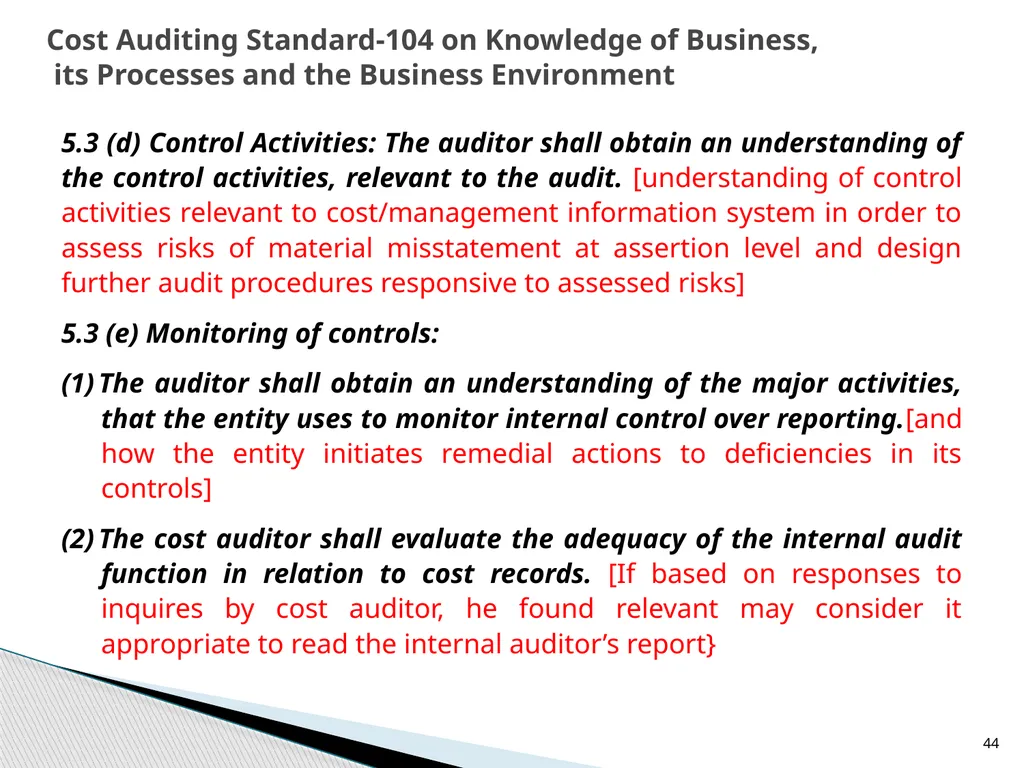
5.3 (d) Control Activities: The auditor shall obtain an understanding of the control activities, relevant to the audit. [understanding of control activities relevant to cost/management information system in order to assess risks of material misstatement at assertion level and design further audit procedures responsive to assessed risks]
5.3 (e) Monitoring of controls:
(1) The auditor shall obtain an understanding of the major activities, that the entity uses to monitor internal control over reporting.[and how the entity initiates remedial actions to deficiencies in its controls]
(2) The cost auditor shall evaluate the adequacy of the internal audit function in relation to cost records. [If based on responses to inquires by cost auditor, he found relevant may consider it appropriate to read the internal auditor’s report} 44 Cost Auditing Standard-104 on Knowledge of Business, its Processes and the Business Environment<br>
5.3 (e) Monitoring of controls:
(1) The auditor shall obtain an understanding of the major activities, that the entity uses to monitor internal control over reporting.[and how the entity initiates remedial actions to deficiencies in its controls]
(2) The cost auditor shall evaluate the adequacy of the internal audit function in relation to cost records. [If based on responses to inquires by cost auditor, he found relevant may consider it appropriate to read the internal auditor’s report} 44 Cost Auditing Standard-104 on Knowledge of Business, its Processes and the Business Environment<br>
45
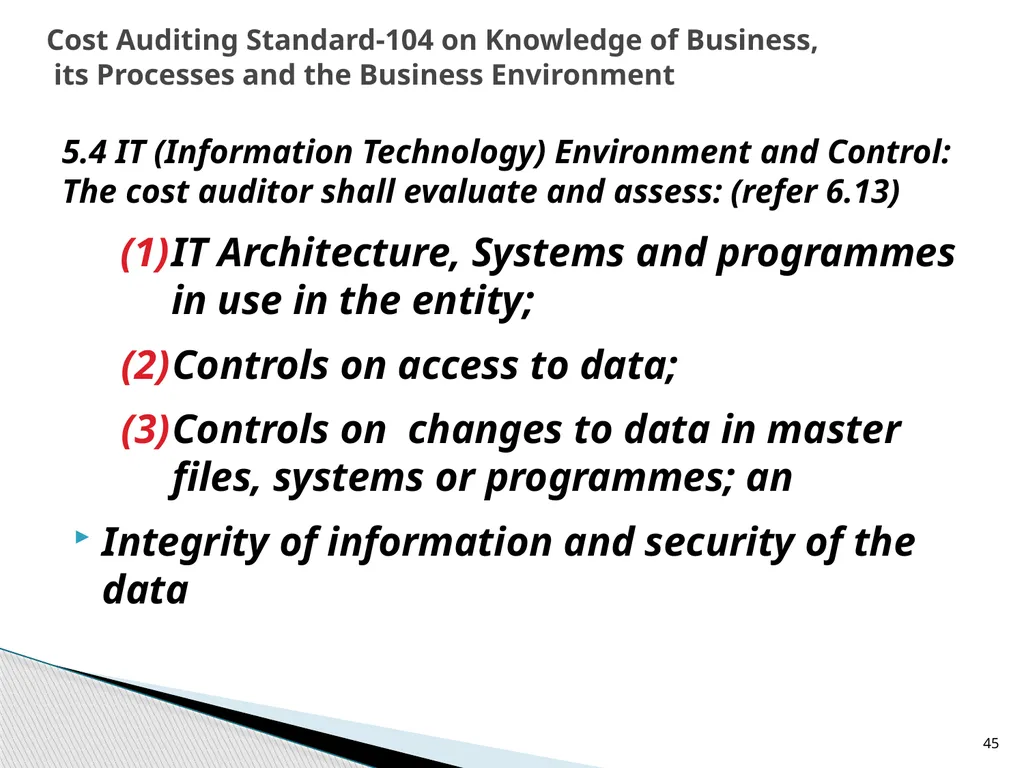
5.4 IT (Information Technology) Environment and Control: The cost auditor shall evaluate and assess: (refer 6.13)
IT Architecture, Systems and programmes in use in the entity;
Controls on access to data;
Controls on changes to data in master files, systems or programmes; an
Integrity of information and security of the data 45 Cost Auditing Standard-104 on Knowledge of Business, its Processes and the Business Environment<br>
IT Architecture, Systems and programmes in use in the entity;
Controls on access to data;
Controls on changes to data in master files, systems or programmes; an
Integrity of information and security of the data 45 Cost Auditing Standard-104 on Knowledge of Business, its Processes and the Business Environment<br>
46
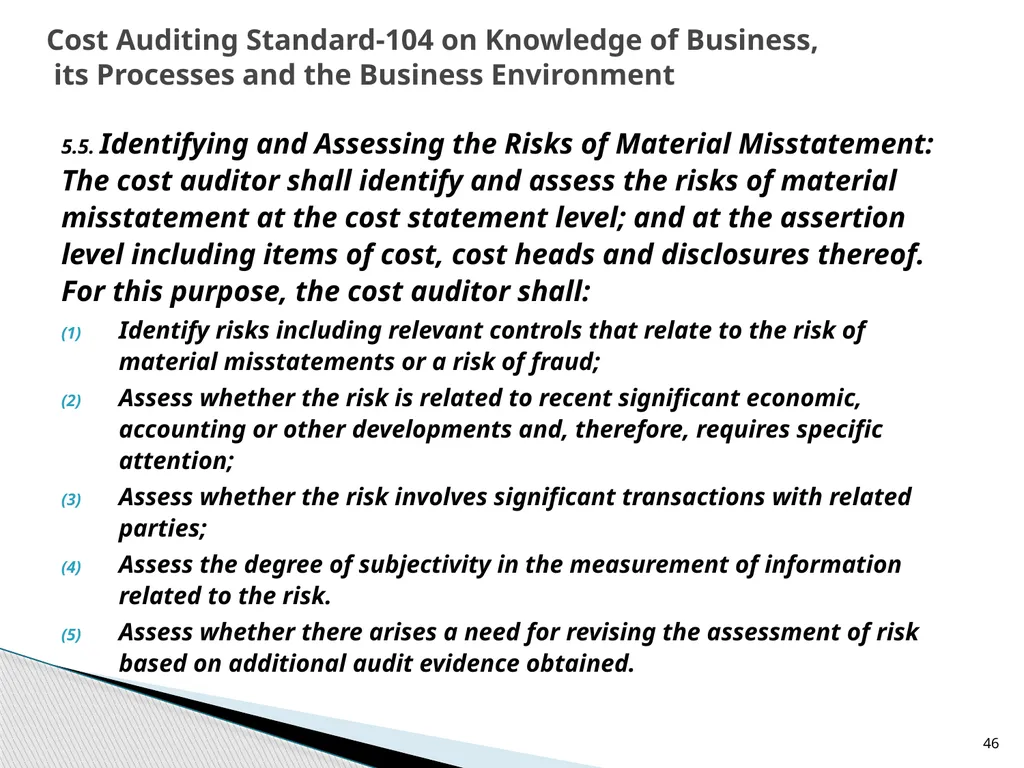
5.5. Identifying and Assessing the Risks of Material Misstatement: The cost auditor shall identify and assess the risks of material misstatement at the cost statement level; and at the assertion level including items of cost, cost heads and disclosures thereof. For this purpose, the cost auditor shall:
Identify risks including relevant controls that relate to the risk of material misstatements or a risk of fraud;
Assess whether the risk is related to recent significant economic, accounting or other developments and, therefore, requires specific attention;
Assess whether the risk involves significant transactions with related parties;
Assess the degree of subjectivity in the measurement of information related to the risk.
Assess whether there arises a need for revising the assessment of risk based on additional audit evidence obtained. 46 Cost Auditing Standard-104 on Knowledge of Business, its Processes and the Business Environment<br>
Identify risks including relevant controls that relate to the risk of material misstatements or a risk of fraud;
Assess whether the risk is related to recent significant economic, accounting or other developments and, therefore, requires specific attention;
Assess whether the risk involves significant transactions with related parties;
Assess the degree of subjectivity in the measurement of information related to the risk.
Assess whether there arises a need for revising the assessment of risk based on additional audit evidence obtained. 46 Cost Auditing Standard-104 on Knowledge of Business, its Processes and the Business Environment<br>
47
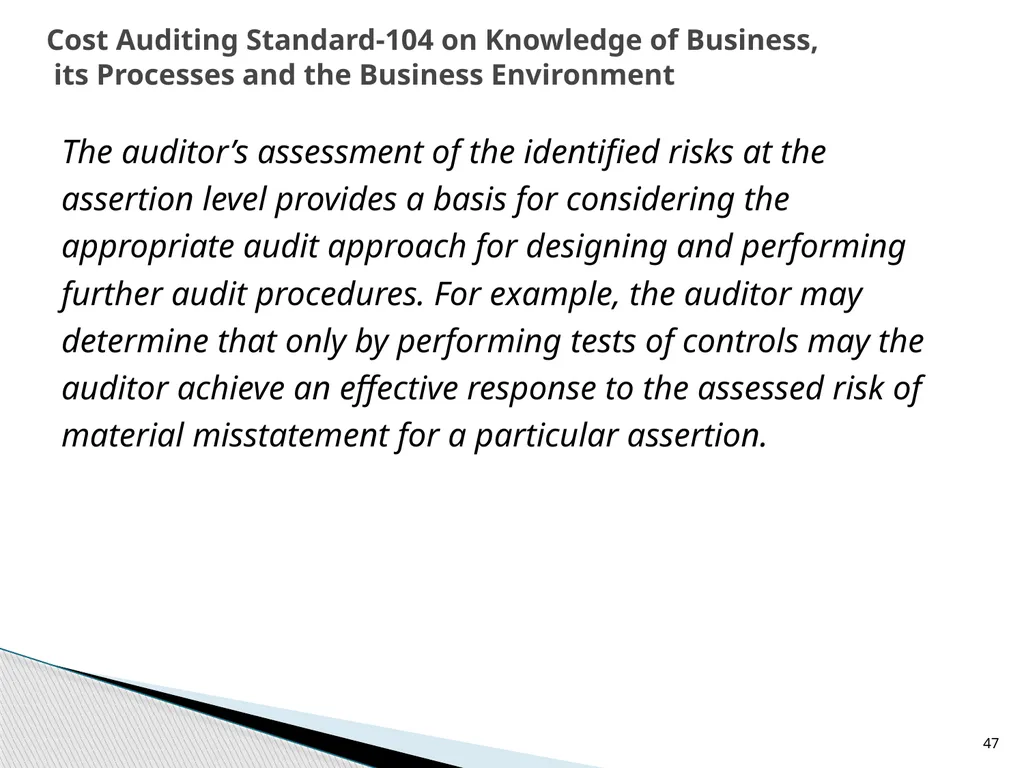
The auditor’s assessment of the identified risks at the assertion level provides a basis for considering the appropriate audit approach for designing and performing further audit procedures. For example, the auditor may determine that only by performing tests of controls may the auditor achieve an effective response to the assessed risk of material misstatement for a particular assertion. 47 Cost Auditing Standard-104 on Knowledge of Business,
its Processes and the Business Environment<br>
48
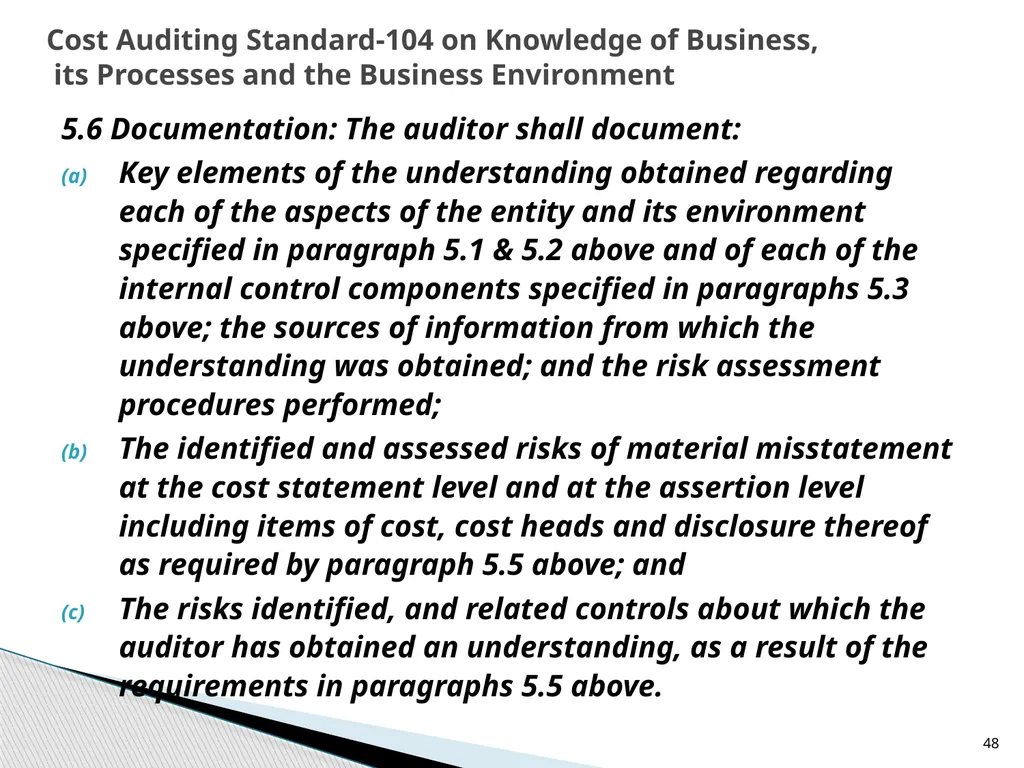
5.6 Documentation: The auditor shall document:
Key elements of the understanding obtained regarding each of the aspects of the entity and its environment specified in paragraph 5.1 & 5.2 above and of each of the internal control components specified in paragraphs 5.3 above; the sources of information from which the understanding was obtained; and the risk assessment procedures performed;
The identified and assessed risks of material misstatement at the cost statement level and at the assertion level including items of cost, cost heads and disclosure thereof as required by paragraph 5.5 above; and
The risks identified, and related controls about which the auditor has obtained an understanding, as a result of the requirements in paragraphs 5.5 above. 48 Cost Auditing Standard-104 on Knowledge of Business, its Processes and the Business Environment<br>
Key elements of the understanding obtained regarding each of the aspects of the entity and its environment specified in paragraph 5.1 & 5.2 above and of each of the internal control components specified in paragraphs 5.3 above; the sources of information from which the understanding was obtained; and the risk assessment procedures performed;
The identified and assessed risks of material misstatement at the cost statement level and at the assertion level including items of cost, cost heads and disclosure thereof as required by paragraph 5.5 above; and
The risks identified, and related controls about which the auditor has obtained an understanding, as a result of the requirements in paragraphs 5.5 above. 48 Cost Auditing Standard-104 on Knowledge of Business, its Processes and the Business Environment<br>
49
Thank You 49<br>