
Overview with new draft NICE guideline updates
JO
Published · 30 slides · 0 views
1 / 1



Description
Overview with new draft NICE guideline updates Management of Overactive Bladder (OAB) Overview Assessment Tests When to refer Conservative management Medication Surgical management options Assessment At the initial clinical assessment,
Related Topics
Share
Embed code
Download this presentation From Below
"Overview with new draft NICE guideline updates" is the property of its rightful owner. Permission is granted to download and print the materials on this website for personal, non-commercial use only, and to display it on your personal computer provided you do not modify the materials and that you retain all copyright notices contained in the materials. By downloading content from our website, you accept the terms of this agreement.
Presentation Transcript
01
Overview with new draft NICE guideline updates Management of Overactive Bladder (OAB)<br>
02
Overview Assessment
Tests
When to refer
Conservative management
Medication
Surgical management options<br>
Tests
When to refer
Conservative management
Medication
Surgical management options<br>
03
Assessment At the initial clinical assessment, categorise the woman's urinary incontinence (UI) as stress UI, mixed UI or urgency UI/overactive bladder (OAB). Start initial treatment on this basis.
In mixed UI, direct treatment towards the predominant symptom. [2006]
If stress incontinence is the predominant symptom in mixed UI, discuss with the woman the benefit of non-surgical management and medicines for OAB before offering surgery. [2013, amended 2019]
During the clinical assessment seek to identify relevant predisposing and precipitating factors and other diagnoses that may require referral for additional investigation and treatment. [2006]
Undertake routine digital assessment to confirm pelvic floor muscle contraction before the use of supervised pelvic floor muscle training for the treatment of UI. [2006, amended 2013]<br>
In mixed UI, direct treatment towards the predominant symptom. [2006]
If stress incontinence is the predominant symptom in mixed UI, discuss with the woman the benefit of non-surgical management and medicines for OAB before offering surgery. [2013, amended 2019]
During the clinical assessment seek to identify relevant predisposing and precipitating factors and other diagnoses that may require referral for additional investigation and treatment. [2006]
Undertake routine digital assessment to confirm pelvic floor muscle contraction before the use of supervised pelvic floor muscle training for the treatment of UI. [2006, amended 2013]<br>
04
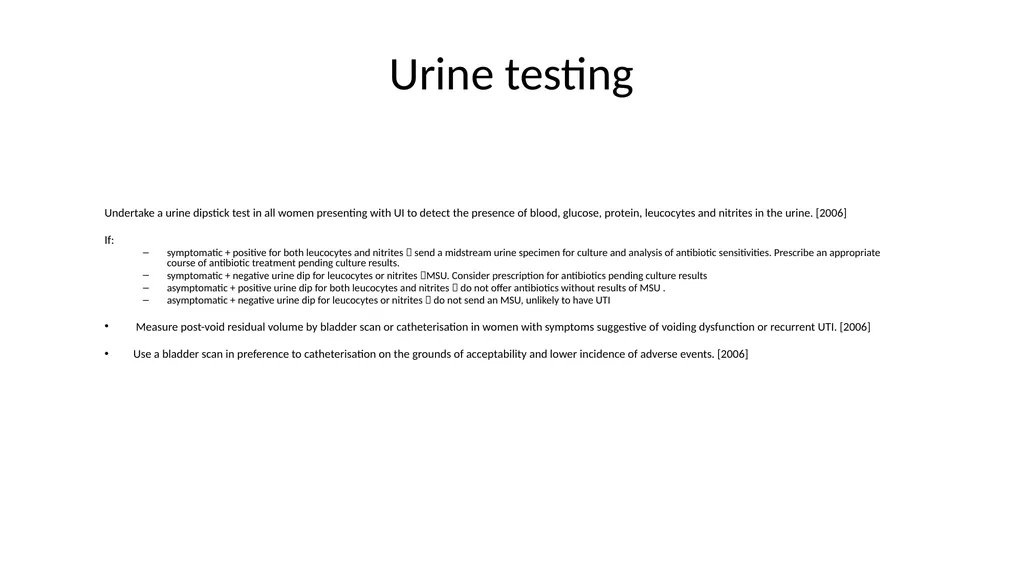
Urine testing Undertake a urine dipstick test in all women presenting with UI to detect the presence of blood, glucose, protein, leucocytes and nitrites in the urine. [2006]
If:
symptomatic + positive for both leucocytes and nitrites send a midstream urine specimen for culture and analysis of antibiotic sensitivities. Prescribe an appropriate course of antibiotic treatment pending culture results.
symptomatic + negative urine dip for leucocytes or nitrites MSU. Consider prescription for antibiotics pending culture results
asymptomatic + positive urine dip for both leucocytes and nitrites do not offer antibiotics without results of MSU .
asymptomatic + negative urine dip for leucocytes or nitrites do not send an MSU, unlikely to have UTI
Measure post-void residual volume by bladder scan or catheterisation in women with symptoms suggestive of voiding dysfunction or recurrent UTI. [2006]
Use a bladder scan in preference to catheterisation on the grounds of acceptability and lower incidence of adverse events. [2006]<br>
If:
symptomatic + positive for both leucocytes and nitrites send a midstream urine specimen for culture and analysis of antibiotic sensitivities. Prescribe an appropriate course of antibiotic treatment pending culture results.
symptomatic + negative urine dip for leucocytes or nitrites MSU. Consider prescription for antibiotics pending culture results
asymptomatic + positive urine dip for both leucocytes and nitrites do not offer antibiotics without results of MSU .
asymptomatic + negative urine dip for leucocytes or nitrites do not send an MSU, unlikely to have UTI
Measure post-void residual volume by bladder scan or catheterisation in women with symptoms suggestive of voiding dysfunction or recurrent UTI. [2006]
Use a bladder scan in preference to catheterisation on the grounds of acceptability and lower incidence of adverse events. [2006]<br>
05
Bladder diaries and quality of life Use bladder diaries in the initial assessment of women with UI or OAB.
Encourage women to complete a minimum of 3 days of the diary covering variations in their usual activities, such as both working and leisure days. [2006]
Do not use pad tests in the routine assessment of women with UI. [2006]
Use the following incontinence-specific quality-of-life scales when therapies are being evaluated: ICIQ, BFLUTS, I-QOL, SUIQQ, UISS, SEAPI-QMM, ISI and KHQ. [2006]<br>
Encourage women to complete a minimum of 3 days of the diary covering variations in their usual activities, such as both working and leisure days. [2006]
Do not use pad tests in the routine assessment of women with UI. [2006]
Use the following incontinence-specific quality-of-life scales when therapies are being evaluated: ICIQ, BFLUTS, I-QOL, SUIQQ, UISS, SEAPI-QMM, ISI and KHQ. [2006]<br>
06
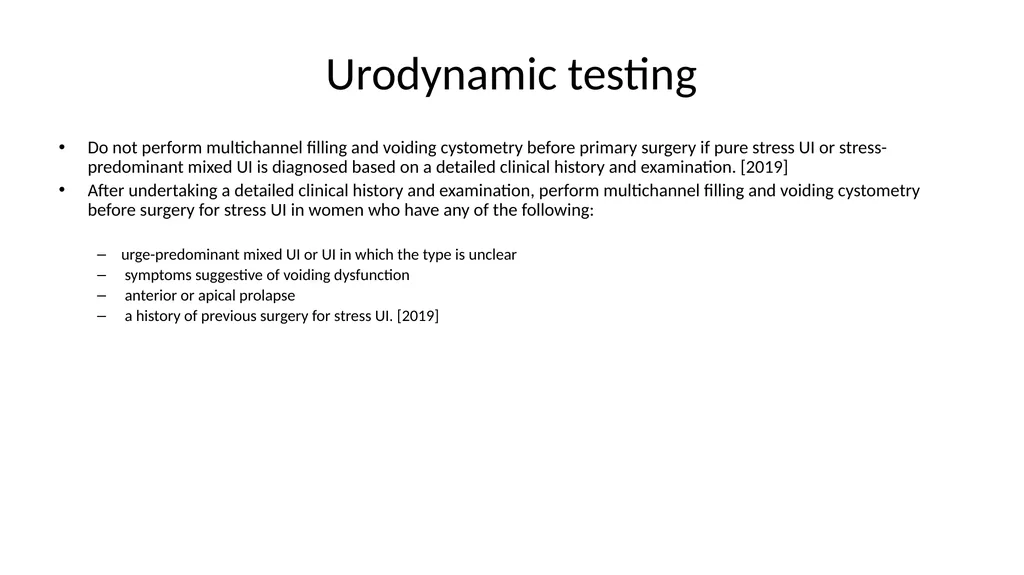
Urodynamic testing Do not perform multichannel filling and voiding cystometry before primary surgery if pure stress UI or stress-predominant mixed UI is diagnosed based on a detailed clinical history and examination. [2019]
After undertaking a detailed clinical history and examination, perform multichannel filling and voiding cystometry before surgery for stress UI in women who have any of the following:
urge-predominant mixed UI or UI in which the type is unclear
symptoms suggestive of voiding dysfunction
anterior or apical prolapse
a history of previous surgery for stress UI. [2019]<br>
After undertaking a detailed clinical history and examination, perform multichannel filling and voiding cystometry before surgery for stress UI in women who have any of the following:
urge-predominant mixed UI or UI in which the type is unclear
symptoms suggestive of voiding dysfunction
anterior or apical prolapse
a history of previous surgery for stress UI. [2019]<br>
07
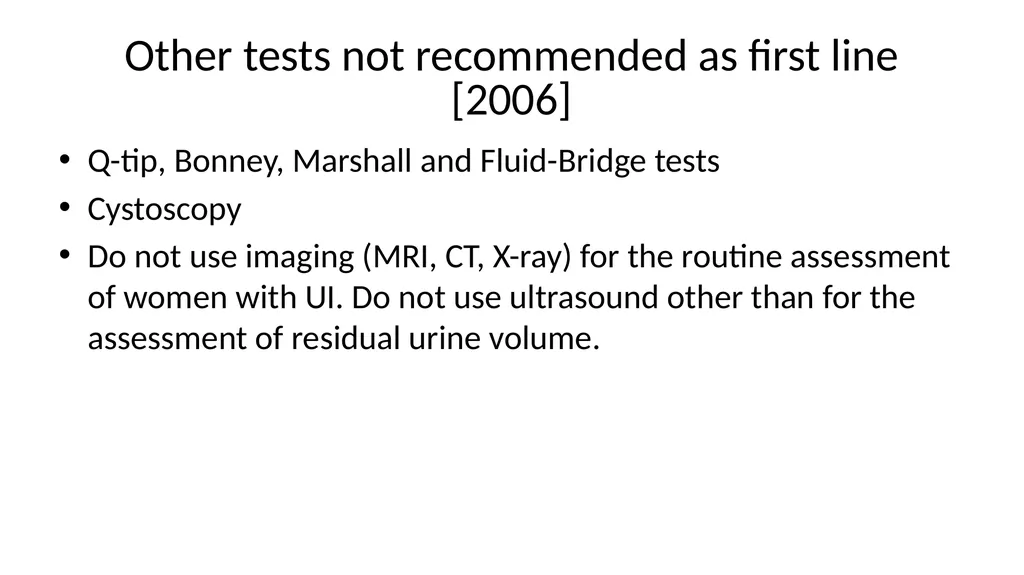
Other tests not recommended as first line [2006] Q-tip, Bonney, Marshall and Fluid-Bridge tests
Cystoscopy
Do not use imaging (MRI, CT, X-ray) for the routine assessment of women with UI. Do not use ultrasound other than for the assessment of residual urine volume.<br>
Cystoscopy
Do not use imaging (MRI, CT, X-ray) for the routine assessment of women with UI. Do not use ultrasound other than for the assessment of residual urine volume.<br>
08
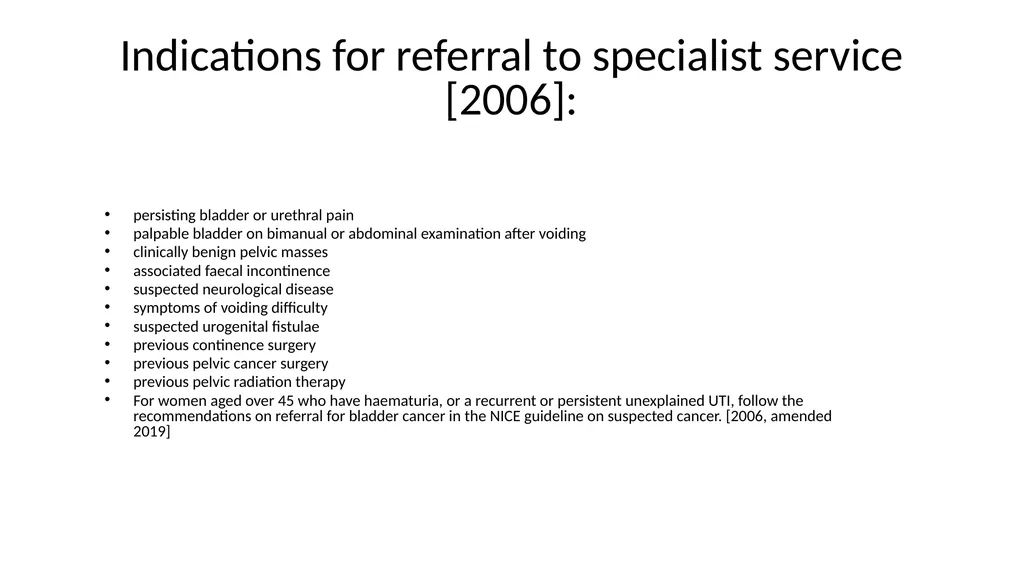
Indications for referral to specialist service [2006]: persisting bladder or urethral pain
palpable bladder on bimanual or abdominal examination after voiding
clinically benign pelvic masses
associated faecal incontinence
suspected neurological disease
symptoms of voiding difficulty
suspected urogenital fistulae
previous continence surgery
previous pelvic cancer surgery
previous pelvic radiation therapy
For women aged over 45 who have haematuria, or a recurrent or persistent unexplained UTI, follow the recommendations on referral for bladder cancer in the NICE guideline on suspected cancer. [2006, amended 2019]<br>
palpable bladder on bimanual or abdominal examination after voiding
clinically benign pelvic masses
associated faecal incontinence
suspected neurological disease
symptoms of voiding difficulty
suspected urogenital fistulae
previous continence surgery
previous pelvic cancer surgery
previous pelvic radiation therapy
For women aged over 45 who have haematuria, or a recurrent or persistent unexplained UTI, follow the recommendations on referral for bladder cancer in the NICE guideline on suspected cancer. [2006, amended 2019]<br>
09
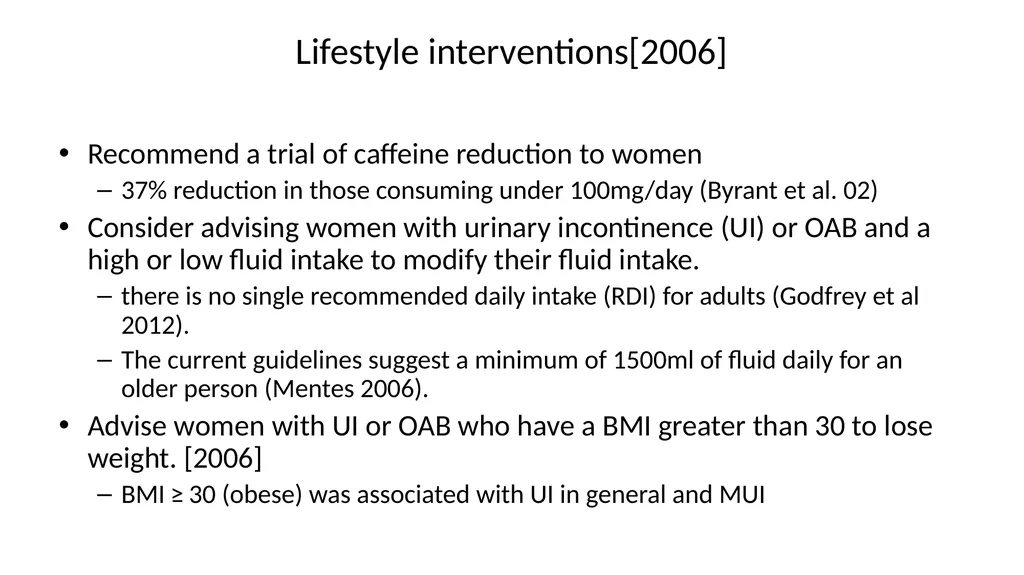
Lifestyle interventions[2006] Recommend a trial of caffeine reduction to women
37% reduction in those consuming under 100mg/day (Byrant et al. 02)
Consider advising women with urinary incontinence (UI) or OAB and a high or low fluid intake to modify their fluid intake.
there is no single recommended daily intake (RDI) for adults (Godfrey et al 2012).
The current guidelines suggest a minimum of 1500ml of fluid daily for an older person (Mentes 2006).
Advise women with UI or OAB who have a BMI greater than 30 to lose weight. [2006]
BMI ≥ 30 (obese) was associated with UI in general and MUI<br>
37% reduction in those consuming under 100mg/day (Byrant et al. 02)
Consider advising women with urinary incontinence (UI) or OAB and a high or low fluid intake to modify their fluid intake.
there is no single recommended daily intake (RDI) for adults (Godfrey et al 2012).
The current guidelines suggest a minimum of 1500ml of fluid daily for an older person (Mentes 2006).
Advise women with UI or OAB who have a BMI greater than 30 to lose weight. [2006]
BMI ≥ 30 (obese) was associated with UI in general and MUI<br>
10
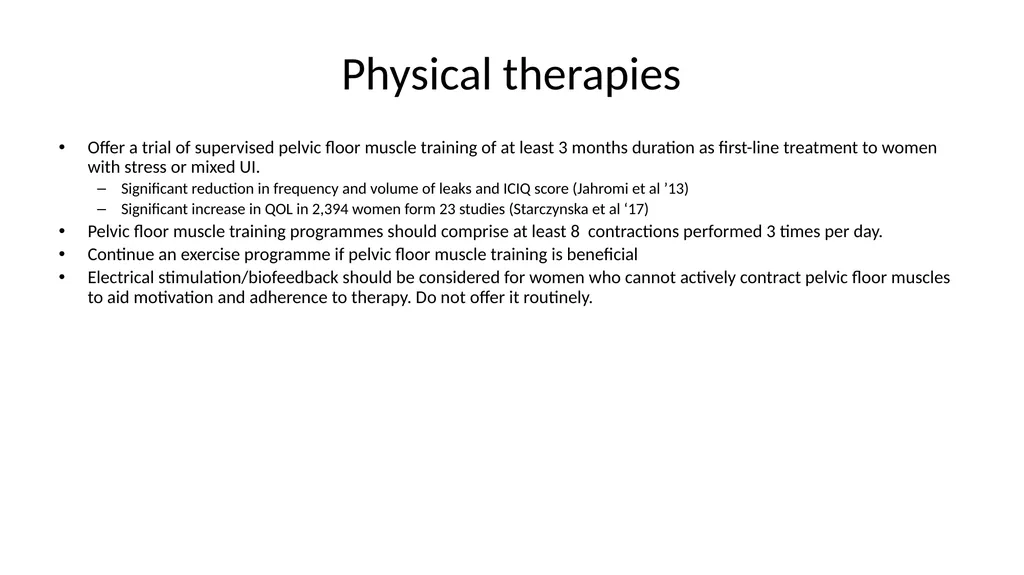
Physical therapies Offer a trial of supervised pelvic floor muscle training of at least 3 months duration as first-line treatment to women with stress or mixed UI.
Significant reduction in frequency and volume of leaks and ICIQ score (Jahromi et al ’13)
Significant increase in QOL in 2,394 women form 23 studies (Starczynska et al ‘17)
Pelvic floor muscle training programmes should comprise at least 8 contractions performed 3 times per day.
Continue an exercise programme if pelvic floor muscle training is beneficial
Electrical stimulation/biofeedback should be considered for women who cannot actively contract pelvic floor muscles to aid motivation and adherence to therapy. Do not offer it routinely.<br>
Significant reduction in frequency and volume of leaks and ICIQ score (Jahromi et al ’13)
Significant increase in QOL in 2,394 women form 23 studies (Starczynska et al ‘17)
Pelvic floor muscle training programmes should comprise at least 8 contractions performed 3 times per day.
Continue an exercise programme if pelvic floor muscle training is beneficial
Electrical stimulation/biofeedback should be considered for women who cannot actively contract pelvic floor muscles to aid motivation and adherence to therapy. Do not offer it routinely.<br>
11
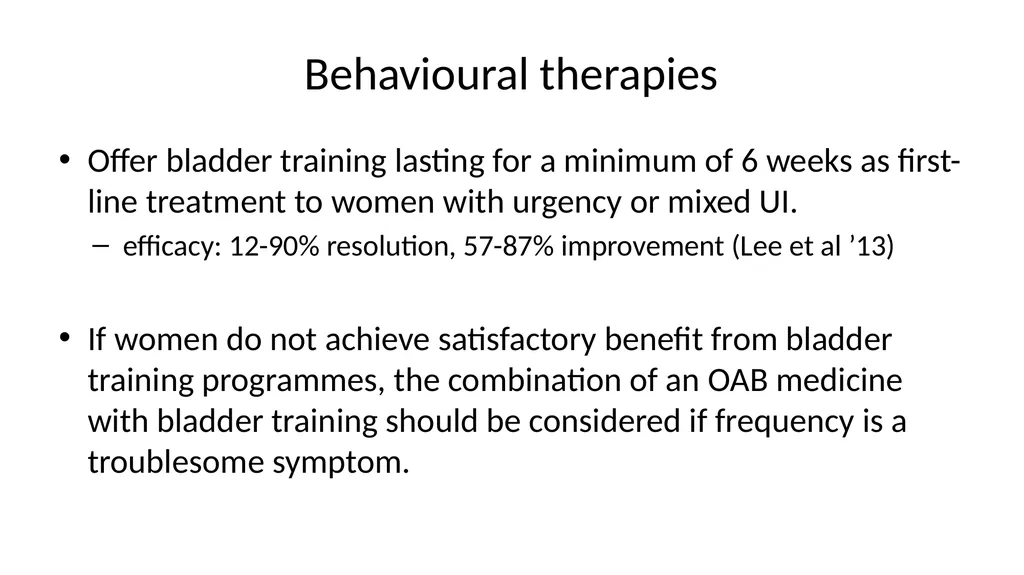
Behavioural therapies Offer bladder training lasting for a minimum of 6 weeks as first-line treatment to women with urgency or mixed UI.
efficacy: 12-90% resolution, 57-87% improvement (Lee et al ’13)
If women do not achieve satisfactory benefit from bladder training programmes, the combination of an OAB medicine with bladder training should be considered if frequency is a troublesome symptom.<br>
efficacy: 12-90% resolution, 57-87% improvement (Lee et al ’13)
If women do not achieve satisfactory benefit from bladder training programmes, the combination of an OAB medicine with bladder training should be considered if frequency is a troublesome symptom.<br>
12
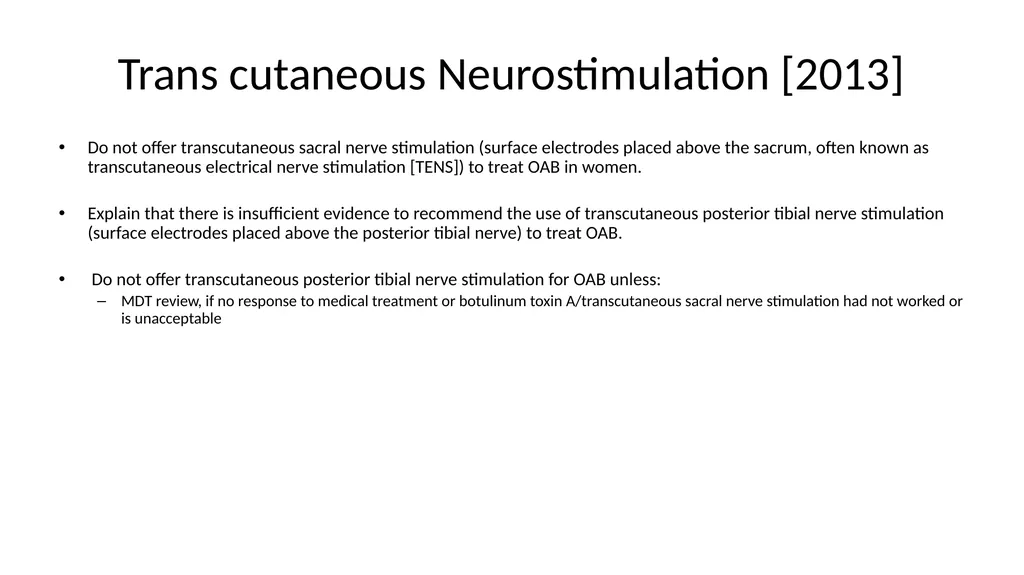
Trans cutaneous Neurostimulation [2013] Do not offer transcutaneous sacral nerve stimulation (surface electrodes placed above the sacrum, often known as transcutaneous electrical nerve stimulation [TENS]) to treat OAB in women.
Explain that there is insufficient evidence to recommend the use of transcutaneous posterior tibial nerve stimulation (surface electrodes placed above the posterior tibial nerve) to treat OAB.
Do not offer transcutaneous posterior tibial nerve stimulation for OAB unless:
MDT review, if no response to medical treatment or botulinum toxin A/transcutaneous sacral nerve stimulation had not worked or is unacceptable<br>
Explain that there is insufficient evidence to recommend the use of transcutaneous posterior tibial nerve stimulation (surface electrodes placed above the posterior tibial nerve) to treat OAB.
Do not offer transcutaneous posterior tibial nerve stimulation for OAB unless:
MDT review, if no response to medical treatment or botulinum toxin A/transcutaneous sacral nerve stimulation had not worked or is unacceptable<br>
13
Absorbent containment products, urinals and toileting aids Absorbent containment products, hand held urinals and toileting aids should not be considered as a treatment for UI. Use them only as:
a coping strategy pending definitive treatment
an adjunct to ongoing therapy
long-term management of UI only after treatment options have been explored
Offer a review at least once a year to women who are using absorbent containment products for long-term management of UI. The review should cover:
routine assessment of continence
assessment of skin integrity
changes to symptoms, comorbidities, lifestyle, mobility, medication, BMI, and social and environmental factors
the suitability of alternative treatment options
the efficacy of the absorbent containment product the woman is currently using and the quantities used
Long term management strategies<br>
a coping strategy pending definitive treatment
an adjunct to ongoing therapy
long-term management of UI only after treatment options have been explored
Offer a review at least once a year to women who are using absorbent containment products for long-term management of UI. The review should cover:
routine assessment of continence
assessment of skin integrity
changes to symptoms, comorbidities, lifestyle, mobility, medication, BMI, and social and environmental factors
the suitability of alternative treatment options
the efficacy of the absorbent containment product the woman is currently using and the quantities used
Long term management strategies<br>
14
Who should carry out these reviews: A registered healthcare professional who is trained in assessing continence and making referrals to specialist services or
A non-registered healthcare professional who is trained in assessing continence and making referrals to specialist services<br>
A non-registered healthcare professional who is trained in assessing continence and making referrals to specialist services<br>
15
Catheters Indwelling/intermittent or suprapubic should be considered for women in whom persistent urinary retention is causing incontinence, symptomatic infections or renal dysfunction, and in whom this cannot otherwise be corrected.
Indwelling catheters in urgency UI may not result in continence
Intermittent urethral catheterisation (CISC) to women with urinary retention who can be taught to self-catheterise or who have a carer who can perform the technique<br>
Indwelling catheters in urgency UI may not result in continence
Intermittent urethral catheterisation (CISC) to women with urinary retention who can be taught to self-catheterise or who have a carer who can perform the technique<br>
16
Indwelling catheters Consider the impact of long-term indwelling urethral catheterisation. Discuss the practicalities, benefits and risks with the woman/carer
Indications:
Chronic urinary retention in women unable to manage CISC
Skin wounds, pressure ulcers or irritations that are being contained by urine
Distress or disruption caused by bed and clothing changes
Where a woman expresses a preference for this form of management
Consider suprapubic catheter as an alternative – lower rates of symptomatic UTI, ‘bypassing’ and urethral complications than indwelling urethral catheters<br>
Indications:
Chronic urinary retention in women unable to manage CISC
Skin wounds, pressure ulcers or irritations that are being contained by urine
Distress or disruption caused by bed and clothing changes
Where a woman expresses a preference for this form of management
Consider suprapubic catheter as an alternative – lower rates of symptomatic UTI, ‘bypassing’ and urethral complications than indwelling urethral catheters<br>
17
Alternative products Do not use intravaginal or intraurethral devices for the routine management of UI
Do not advice women to consider such devices other than for occasional use when necessary to prevent leakage, for example during physical exercise
Do not recommend complementary therapies for the treatment of UI or OAB<br>
Do not advice women to consider such devices other than for occasional use when necessary to prevent leakage, for example during physical exercise
Do not recommend complementary therapies for the treatment of UI or OAB<br>
18
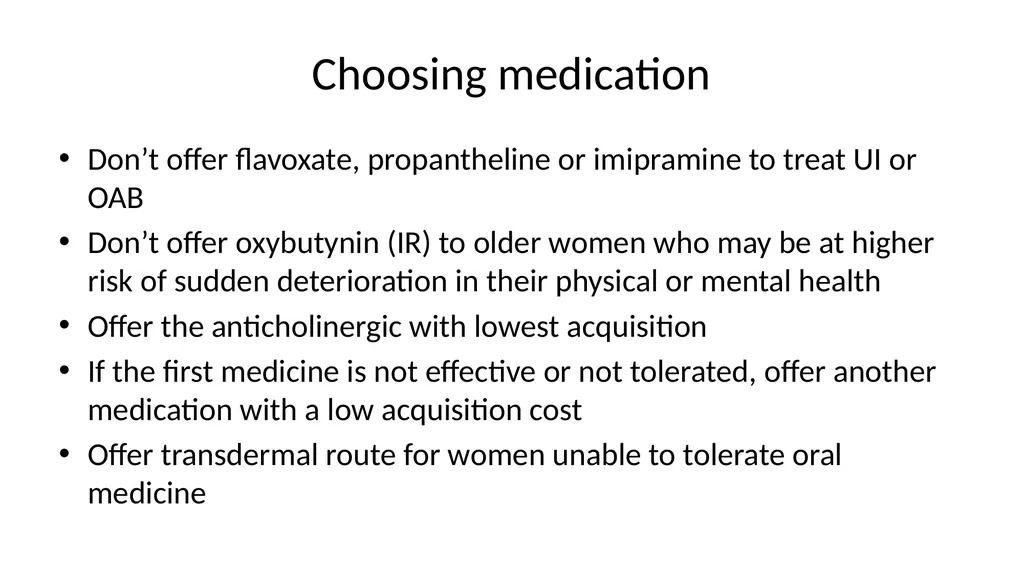
Choosing medication Don’t offer flavoxate, propantheline or imipramine to treat UI or OAB
Don’t offer oxybutynin (IR) to older women who may be at higher risk of sudden deterioration in their physical or mental health
Offer the anticholinergic with lowest acquisition
If the first medicine is not effective or not tolerated, offer another medication with a low acquisition cost
Offer transdermal route for women unable to tolerate oral medicine<br>
Don’t offer oxybutynin (IR) to older women who may be at higher risk of sudden deterioration in their physical or mental health
Offer the anticholinergic with lowest acquisition
If the first medicine is not effective or not tolerated, offer another medication with a low acquisition cost
Offer transdermal route for women unable to tolerate oral medicine<br>
19
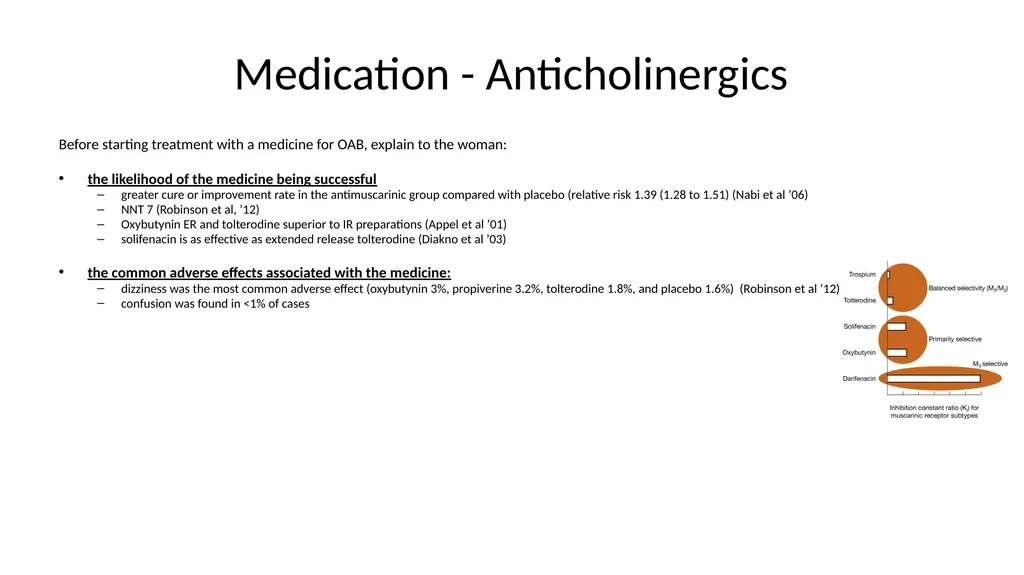
Medication - Anticholinergics Before starting treatment with a medicine for OAB, explain to the woman:
the likelihood of the medicine being successful
greater cure or improvement rate in the antimuscarinic group compared with placebo (relative risk 1.39 (1.28 to 1.51) (Nabi et al ’06)
NNT 7 (Robinson et al, ’12)
Oxybutynin ER and tolterodine superior to IR preparations (Appel et al ’01)
solifenacin is as effective as extended release tolterodine (Diakno et al ’03)
the common adverse effects associated with the medicine:
dizziness was the most common adverse effect (oxybutynin 3%, propiverine 3.2%, tolterodine 1.8%, and placebo 1.6%) (Robinson et al ‘12)
confusion was found in <1% of cases<br>
the likelihood of the medicine being successful
greater cure or improvement rate in the antimuscarinic group compared with placebo (relative risk 1.39 (1.28 to 1.51) (Nabi et al ’06)
NNT 7 (Robinson et al, ’12)
Oxybutynin ER and tolterodine superior to IR preparations (Appel et al ’01)
solifenacin is as effective as extended release tolterodine (Diakno et al ’03)
the common adverse effects associated with the medicine:
dizziness was the most common adverse effect (oxybutynin 3%, propiverine 3.2%, tolterodine 1.8%, and placebo 1.6%) (Robinson et al ‘12)
confusion was found in <1% of cases<br>
20
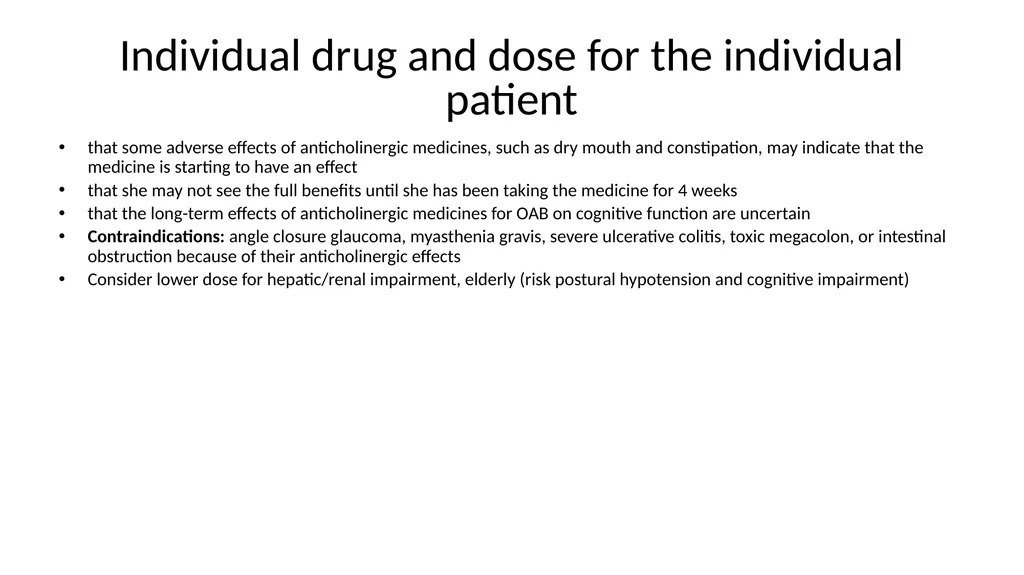
Individual drug and dose for the individual patient that some adverse effects of anticholinergic medicines, such as dry mouth and constipation, may indicate that the medicine is starting to have an effect
that she may not see the full benefits until she has been taking the medicine for 4 weeks
that the long-term effects of anticholinergic medicines for OAB on cognitive function are uncertain
Contraindications: angle closure glaucoma, myasthenia gravis, severe ulcerative colitis, toxic megacolon, or intestinal obstruction because of their anticholinergic effects
Consider lower dose for hepatic/renal impairment, elderly (risk postural hypotension and cognitive impairment)<br>
that she may not see the full benefits until she has been taking the medicine for 4 weeks
that the long-term effects of anticholinergic medicines for OAB on cognitive function are uncertain
Contraindications: angle closure glaucoma, myasthenia gravis, severe ulcerative colitis, toxic megacolon, or intestinal obstruction because of their anticholinergic effects
Consider lower dose for hepatic/renal impairment, elderly (risk postural hypotension and cognitive impairment)<br>
21
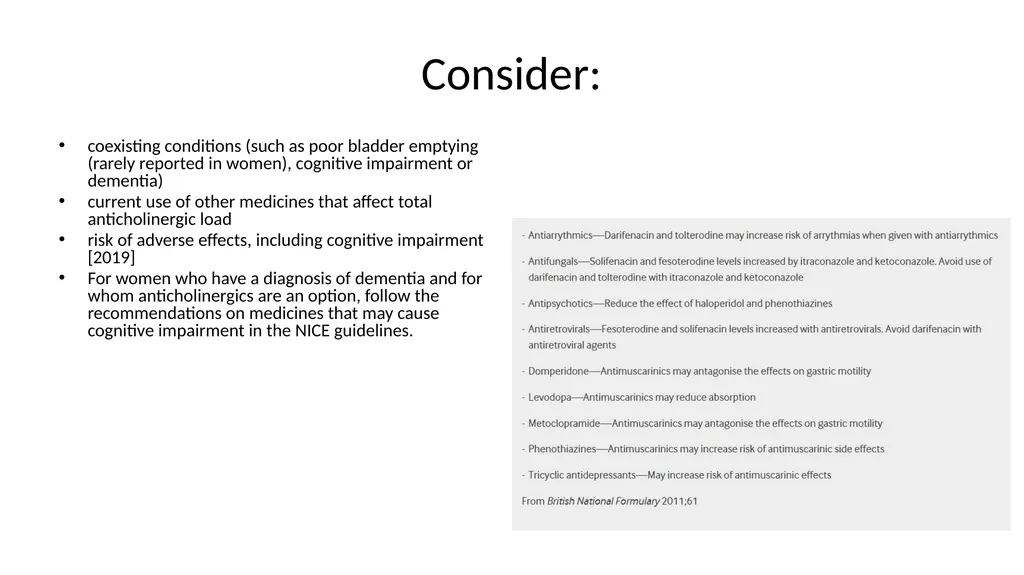
Consider: coexisting conditions (such as poor bladder emptying (rarely reported in women), cognitive impairment or dementia)
current use of other medicines that affect total anticholinergic load
risk of adverse effects, including cognitive impairment [2019]
For women who have a diagnosis of dementia and for whom anticholinergics are an option, follow the recommendations on medicines that may cause cognitive impairment in the NICE guidelines.<br>
current use of other medicines that affect total anticholinergic load
risk of adverse effects, including cognitive impairment [2019]
For women who have a diagnosis of dementia and for whom anticholinergics are an option, follow the recommendations on medicines that may cause cognitive impairment in the NICE guidelines.<br>
22
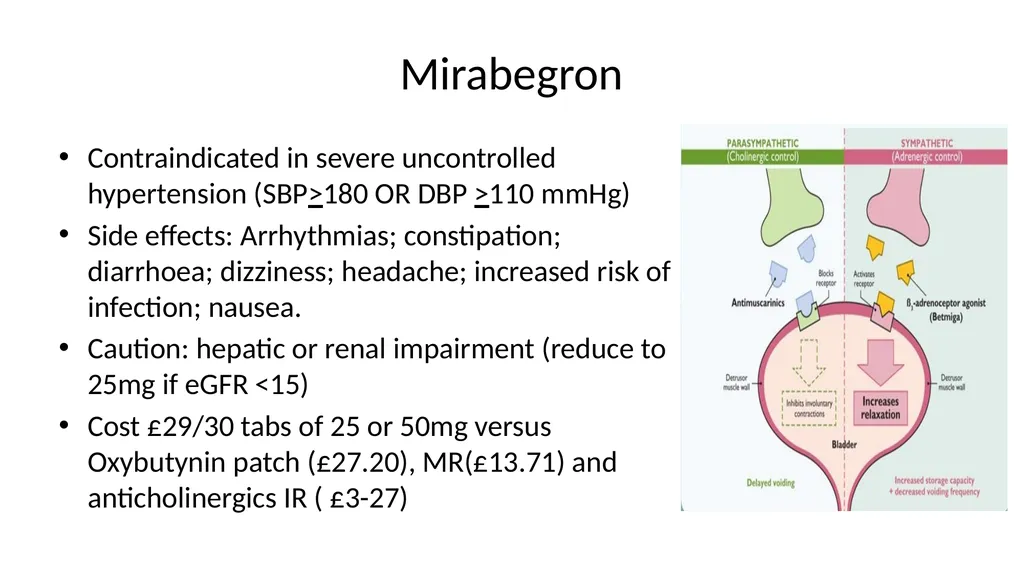
Mirabegron Contraindicated in severe uncontrolled hypertension (SBP>180 OR DBP >110 mmHg)
Side effects: Arrhythmias; constipation; diarrhoea; dizziness; headache; increased risk of infection; nausea.
Caution: hepatic or renal impairment (reduce to 25mg if eGFR <15)
Cost £29/30 tabs of 25 or 50mg versus Oxybutynin patch (£27.20), MR(£13.71) and anticholinergics IR ( £3-27)<br>
Side effects: Arrhythmias; constipation; diarrhoea; dizziness; headache; increased risk of infection; nausea.
Caution: hepatic or renal impairment (reduce to 25mg if eGFR <15)
Cost £29/30 tabs of 25 or 50mg versus Oxybutynin patch (£27.20), MR(£13.71) and anticholinergics IR ( £3-27)<br>
23
Alternative medications Consider Desmopression to specifically reduce nocturia in women with UI or OAB.
Use with caution in women with cystic fibrosis and avoid in over 65 years with cardiovascular disease or hypertension.
Do not offer systemic HRT to treat UI
Offer intravaginal oestrogens to treat OAB symptoms in postmenopausal women with vaginal atrophy<br>
Use with caution in women with cystic fibrosis and avoid in over 65 years with cardiovascular disease or hypertension.
Do not offer systemic HRT to treat UI
Offer intravaginal oestrogens to treat OAB symptoms in postmenopausal women with vaginal atrophy<br>
24
Reviewing medication Offer face-to –face or telephone review in 4 weeks after starting medication for OAB
If satisfied and optimal improvement continue
If not satisfied/no improvement try alternative medicine and review again in 4 weeks
Offer earlier review if not tolerating side effects
Refer to secondary care if not tolerated or effective
Offer a further review of medication stops working
Primary care review very 12 months if on long term medication (6 months if over 75 years) [2017]
40% patient preserve with anticholinergics at 1 year (Goodson et al. ’18)<br>
If satisfied and optimal improvement continue
If not satisfied/no improvement try alternative medicine and review again in 4 weeks
Offer earlier review if not tolerating side effects
Refer to secondary care if not tolerated or effective
Offer a further review of medication stops working
Primary care review very 12 months if on long term medication (6 months if over 75 years) [2017]
40% patient preserve with anticholinergics at 1 year (Goodson et al. ’18)<br>
25
Invasive procedures (brief overview) Offer urodynamic investigation to determine whether detrusor overactivity (DO) is causing her OAB symptoms
If no DO, seek advice on further management from local MDT [2013, amended 2019]<br>
If no DO, seek advice on further management from local MDT [2013, amended 2019]<br>
26
Botulinum toxin type A injection After local MDT [2019] in women demonstrating DO and those not demonstrating DO but with OAB symptoms
Discuss risks and benefits:
Likelihood of complete or partial symptom relief
The process of CISC, the risks and how long it might need to be continued. Women need to be able to perform CISC or accept indwelling catheter [amended 2019]
The risk of adverse effects, including an increased risk of urinary tract infection
Not much evidence about how long the injections work for, how well they work in the long term and their long-term risks [2019]
Use 100units as initial dose [2019]
Review within 12 weeks:
If good response, self refer if symptoms return
If inadequate symptom relief or lasting under 6 months consider increasing to 200 units dose [2019]
If no effect, discuss with local MDT [2019]<br>
Discuss risks and benefits:
Likelihood of complete or partial symptom relief
The process of CISC, the risks and how long it might need to be continued. Women need to be able to perform CISC or accept indwelling catheter [amended 2019]
The risk of adverse effects, including an increased risk of urinary tract infection
Not much evidence about how long the injections work for, how well they work in the long term and their long-term risks [2019]
Use 100units as initial dose [2019]
Review within 12 weeks:
If good response, self refer if symptoms return
If inadequate symptom relief or lasting under 6 months consider increasing to 200 units dose [2019]
If no effect, discuss with local MDT [2019]<br>
27
Percutaneous sacral nerve stimulation Offer after local MDT if: OAB not responded to non-surgical management including medication and
They are unable to perform CISC
Consider in women who have not responded to medication or botulinum toxin type A
Discuss long term implications:
Need for test stimulation and probability of the test’s success
Risk of failure
Long term commitment
Need for surgical revision
Adverse effects
Women to self refer if symptoms return after successful treatment<br>
They are unable to perform CISC
Consider in women who have not responded to medication or botulinum toxin type A
Discuss long term implications:
Need for test stimulation and probability of the test’s success
Risk of failure
Long term commitment
Need for surgical revision
Adverse effects
Women to self refer if symptoms return after successful treatment<br>
28
Augmentation cystoplasty Restrict for idiopathic DO, not responding to non-surgical management and who are willing and able to self-catheterise.
Complications:
Bowel disturbances, metabolic acidosis, mucus production and/or retention in the bladder, UTI and urinary retention.
Small risk of malignancy in an augmented bladder
Life-long follow up<br>
Complications:
Bowel disturbances, metabolic acidosis, mucus production and/or retention in the bladder, UTI and urinary retention.
Small risk of malignancy in an augmented bladder
Life-long follow up<br>
29
Urinary diversion Consider if non-surgical management has failed, and if botulinum toxin type A, percutaneous sacral nerve stimulation and augmentation cystoplasty are not appropriate or are unacceptable to her.
Provide life-long follow up<br>
Provide life-long follow up<br>
30
Thank you!<br>