
Oxford Research’s and Quercus Group’s
DP
Published · 12 slides · 0 views

1 / 1

Description
Oxford Researchs and Quercus Groups International Cluster Course 2016 Join this unique occasion to gain practical tools for developing innovative and sustainable clusters and to network and share experiences with cluster colleagues 3rd
Related Topics
Share
Embed code
Download this presentation From Below
"Oxford Research’s and Quercus Group’s" is the property of its rightful owner. Permission is granted to download and print the materials on this website for personal, non-commercial use only, and to display it on your personal computer provided you do not modify the materials and that you retain all copyright notices contained in the materials. By downloading content from our website, you accept the terms of this agreement.
Presentation Transcript
01
Oxford Research’s and Quercus Group’s
International Cluster Course 2016 “Join this unique occasion to gain practical tools for developing innovative and sustainable clusters and to network and share experiences with cluster colleagues”
3rd to 4th of November 2016 in Copenhagen – Denmark<br>
International Cluster Course 2016 “Join this unique occasion to gain practical tools for developing innovative and sustainable clusters and to network and share experiences with cluster colleagues”
3rd to 4th of November 2016 in Copenhagen – Denmark<br>
02
Background Clusters consisting of competitive companies, R&D institutions and public authorities have proven to be crucial sources for growth and innovation at national and international levels. Based on the American professor Michael E. Porter’s ground-breaking research in the eighties, clusters are today recognised as the most efficient approach to regional growth in large parts of the world.
Oxford Research has been offering practical cluster courses for cluster facilitators and policymakers since 2006. Also, over the past decade both Oxford Research and Quercus Group has worked intensively with cluster analyses, cluster evaluation, and hands-on cluster development for a wide range of international, national, and regional organisations. Our cluster courses are based on our experiences and knowledge from our diverse cluster work. In designing the course, we have naturally also listened to the insight and good ideas from the more than 250 participants at our past cluster development courses.
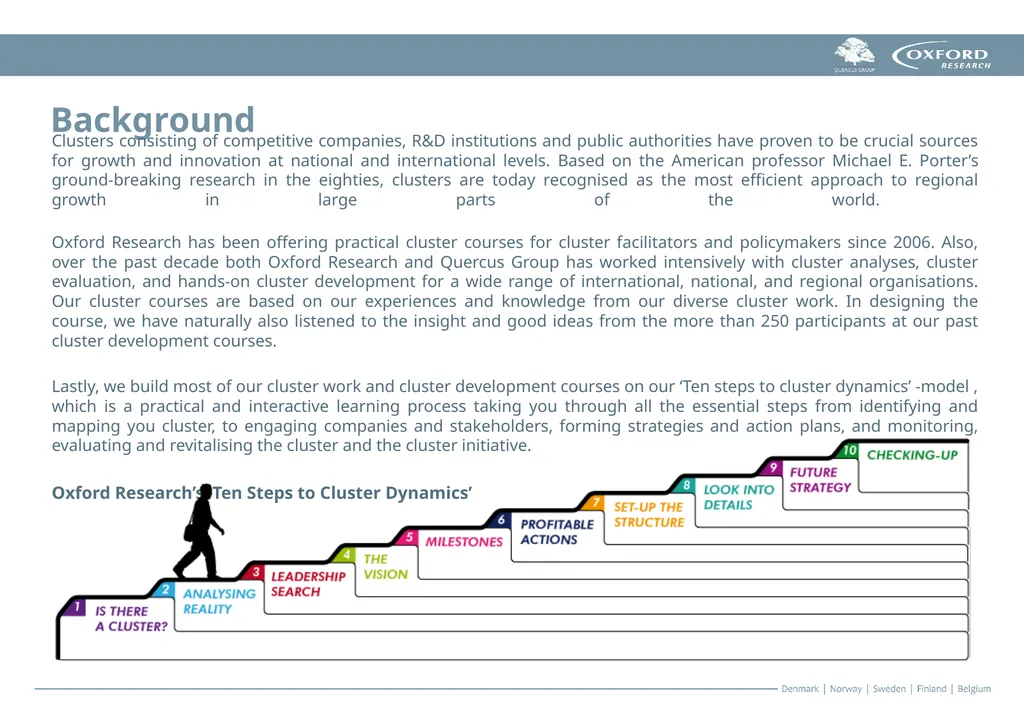
Lastly, we build most of our cluster work and cluster development courses on our ‘Ten steps to cluster dynamics’ -model , which is a practical and interactive learning process taking you through all the essential steps from identifying and mapping you cluster, to engaging companies and stakeholders, forming strategies and action plans, and monitoring, evaluating and revitalising the cluster and the cluster initiative.
Oxford Research’s ‘Ten Steps to Cluster Dynamics’<br>
Oxford Research has been offering practical cluster courses for cluster facilitators and policymakers since 2006. Also, over the past decade both Oxford Research and Quercus Group has worked intensively with cluster analyses, cluster evaluation, and hands-on cluster development for a wide range of international, national, and regional organisations. Our cluster courses are based on our experiences and knowledge from our diverse cluster work. In designing the course, we have naturally also listened to the insight and good ideas from the more than 250 participants at our past cluster development courses.
Lastly, we build most of our cluster work and cluster development courses on our ‘Ten steps to cluster dynamics’ -model , which is a practical and interactive learning process taking you through all the essential steps from identifying and mapping you cluster, to engaging companies and stakeholders, forming strategies and action plans, and monitoring, evaluating and revitalising the cluster and the cluster initiative.
Oxford Research’s ‘Ten Steps to Cluster Dynamics’<br>
03
Main content of the course Oxford Research’s & Quercus Group’s cluster development workshop is the essential cluster course for cluster facilitators and policy makers with interest in developing strong and innovative clusters. Regardless of their different points of departure , after completing the course the participants will be able to work with clusters in practice and to launch and develop innovative cluster initiatives.
Oxford Research’s ”Ten Steps to Cluster Dynamics’ will be the framework for the programme . The course will be an interactive process where discussion and group work will take point of departure in participants own clusters and cluster initiatives.
The course will review: Theoretical and practical knowledge about clusters and cluster development
Cluster cycles: Comprehensive understanding of clusters’ and cluster initiatives different development stages
Understanding of different cluster policies and approaches
Management and facilitation of clusters and network: Practical tools and methods for cluster development
Strategic development and action plans in relation to participants’ own clusters
Challenges for cluster and network facilitators: Pitfalls and criteria for success
Evaluation and monitoring of clusters and cluster initiatives
Insight into international good practice<br>
Oxford Research’s ”Ten Steps to Cluster Dynamics’ will be the framework for the programme . The course will be an interactive process where discussion and group work will take point of departure in participants own clusters and cluster initiatives.
The course will review: Theoretical and practical knowledge about clusters and cluster development
Cluster cycles: Comprehensive understanding of clusters’ and cluster initiatives different development stages
Understanding of different cluster policies and approaches
Management and facilitation of clusters and network: Practical tools and methods for cluster development
Strategic development and action plans in relation to participants’ own clusters
Challenges for cluster and network facilitators: Pitfalls and criteria for success
Evaluation and monitoring of clusters and cluster initiatives
Insight into international good practice<br>
04
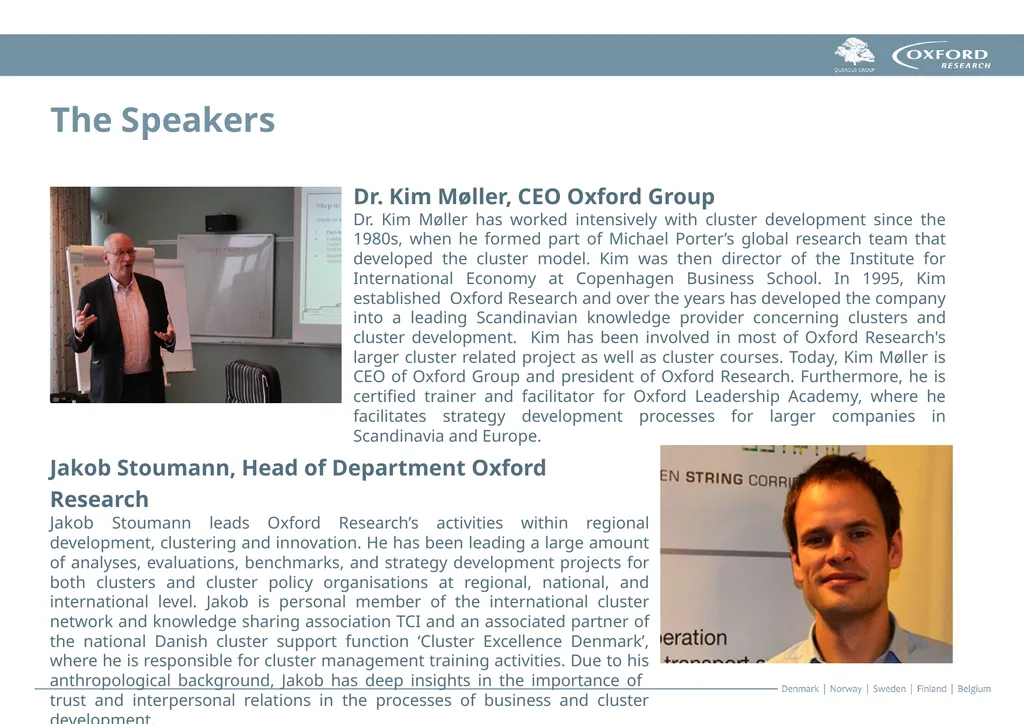
The Speakers Dr. Kim Møller, CEO Oxford Group
Dr. Kim Møller has worked intensively with cluster development since the 1980s, when he formed part of Michael Porter’s global research team that developed the cluster model. Kim was then director of the Institute for International Economy at Copenhagen Business School. In 1995, Kim established Oxford Research and over the years has developed the company into a leading Scandinavian knowledge provider concerning clusters and cluster development. Kim has been involved in most of Oxford Research's larger cluster related project as well as cluster courses. Today, Kim Møller is CEO of Oxford Group and president of Oxford Research. Furthermore, he is certified trainer and facilitator for Oxford Leadership Academy, where he facilitates strategy development processes for larger companies in Scandinavia and Europe. Jakob Stoumann, Head of Department Oxford Research
Jakob Stoumann leads Oxford Research’s activities within regional development, clustering and innovation. He has been leading a large amount of analyses, evaluations, benchmarks, and strategy development projects for both clusters and cluster policy organisations at regional, national, and international level. Jakob is personal member of the international cluster network and knowledge sharing association TCI and an associated partner of the national Danish cluster support function ‘Cluster Excellence Denmark’, where he is responsible for cluster management training activities. Due to his anthropological background, Jakob has deep insights in the importance of trust and interpersonal relations in the processes of business and cluster development.<br>
Dr. Kim Møller has worked intensively with cluster development since the 1980s, when he formed part of Michael Porter’s global research team that developed the cluster model. Kim was then director of the Institute for International Economy at Copenhagen Business School. In 1995, Kim established Oxford Research and over the years has developed the company into a leading Scandinavian knowledge provider concerning clusters and cluster development. Kim has been involved in most of Oxford Research's larger cluster related project as well as cluster courses. Today, Kim Møller is CEO of Oxford Group and president of Oxford Research. Furthermore, he is certified trainer and facilitator for Oxford Leadership Academy, where he facilitates strategy development processes for larger companies in Scandinavia and Europe. Jakob Stoumann, Head of Department Oxford Research
Jakob Stoumann leads Oxford Research’s activities within regional development, clustering and innovation. He has been leading a large amount of analyses, evaluations, benchmarks, and strategy development projects for both clusters and cluster policy organisations at regional, national, and international level. Jakob is personal member of the international cluster network and knowledge sharing association TCI and an associated partner of the national Danish cluster support function ‘Cluster Excellence Denmark’, where he is responsible for cluster management training activities. Due to his anthropological background, Jakob has deep insights in the importance of trust and interpersonal relations in the processes of business and cluster development.<br>
05
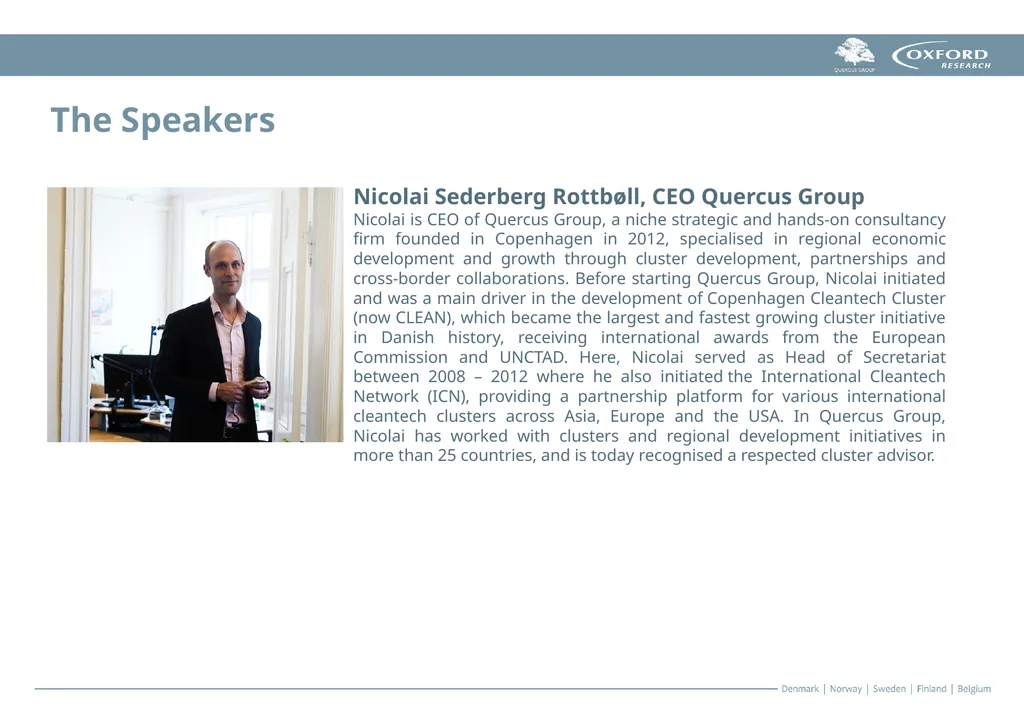
The Speakers Nicolai Sederberg Rottbøll, CEO Quercus Group
Nicolai is CEO of Quercus Group, a niche strategic and hands-on consultancy firm founded in Copenhagen in 2012, specialised in regional economic development and growth through cluster development, partnerships and cross-border collaborations. Before starting Quercus Group, Nicolai initiated and was a main driver in the development of Copenhagen Cleantech Cluster (now CLEAN), which became the largest and fastest growing cluster initiative in Danish history, receiving international awards from the European Commission and UNCTAD. Here, Nicolai served as Head of Secretariat between 2008 – 2012 where he also initiated the International Cleantech Network (ICN), providing a partnership platform for various international cleantech clusters across Asia, Europe and the USA. In Quercus Group, Nicolai has worked with clusters and regional development initiatives in more than 25 countries, and is today recognised a respected cluster advisor.<br>
Nicolai is CEO of Quercus Group, a niche strategic and hands-on consultancy firm founded in Copenhagen in 2012, specialised in regional economic development and growth through cluster development, partnerships and cross-border collaborations. Before starting Quercus Group, Nicolai initiated and was a main driver in the development of Copenhagen Cleantech Cluster (now CLEAN), which became the largest and fastest growing cluster initiative in Danish history, receiving international awards from the European Commission and UNCTAD. Here, Nicolai served as Head of Secretariat between 2008 – 2012 where he also initiated the International Cleantech Network (ICN), providing a partnership platform for various international cleantech clusters across Asia, Europe and the USA. In Quercus Group, Nicolai has worked with clusters and regional development initiatives in more than 25 countries, and is today recognised a respected cluster advisor.<br>
06
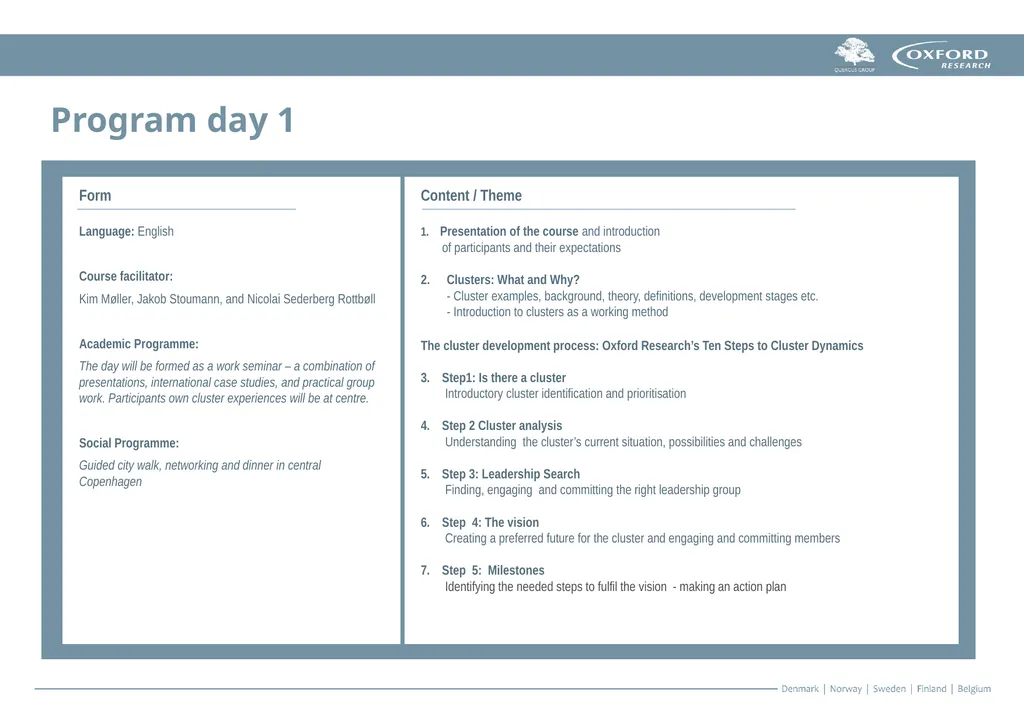
Program day 1 Content / Theme
1. Presentation of the course and introduction
of participants and their expectations
Clusters: What and Why?
- Cluster examples, background, theory, definitions, development stages etc.
- Introduction to clusters as a working method
The cluster development process: Oxford Research’s Ten Steps to Cluster Dynamics
3. Step1: Is there a cluster
Introductory cluster identification and prioritisation
4. Step 2 Cluster analysis
Understanding the cluster’s current situation, possibilities and challenges
5. Step 3: Leadership Search
Finding, engaging and committing the right leadership group
6. Step 4: The vision
Creating a preferred future for the cluster and engaging and committing members
7. Step 5: Milestones
Identifying the needed steps to fulfil the vision - making an action plan Form
Language: English
Course facilitator:
Kim Møller, Jakob Stoumann, and Nicolai Sederberg Rottbøll
Academic Programme:
The day will be formed as a work seminar – a combination of presentations, international case studies, and practical group work. Participants own cluster experiences will be at centre.
Social Programme:
Guided city walk, networking and dinner in central Copenhagen<br>
1. Presentation of the course and introduction
of participants and their expectations
Clusters: What and Why?
- Cluster examples, background, theory, definitions, development stages etc.
- Introduction to clusters as a working method
The cluster development process: Oxford Research’s Ten Steps to Cluster Dynamics
3. Step1: Is there a cluster
Introductory cluster identification and prioritisation
4. Step 2 Cluster analysis
Understanding the cluster’s current situation, possibilities and challenges
5. Step 3: Leadership Search
Finding, engaging and committing the right leadership group
6. Step 4: The vision
Creating a preferred future for the cluster and engaging and committing members
7. Step 5: Milestones
Identifying the needed steps to fulfil the vision - making an action plan Form
Language: English
Course facilitator:
Kim Møller, Jakob Stoumann, and Nicolai Sederberg Rottbøll
Academic Programme:
The day will be formed as a work seminar – a combination of presentations, international case studies, and practical group work. Participants own cluster experiences will be at centre.
Social Programme:
Guided city walk, networking and dinner in central Copenhagen<br>
07
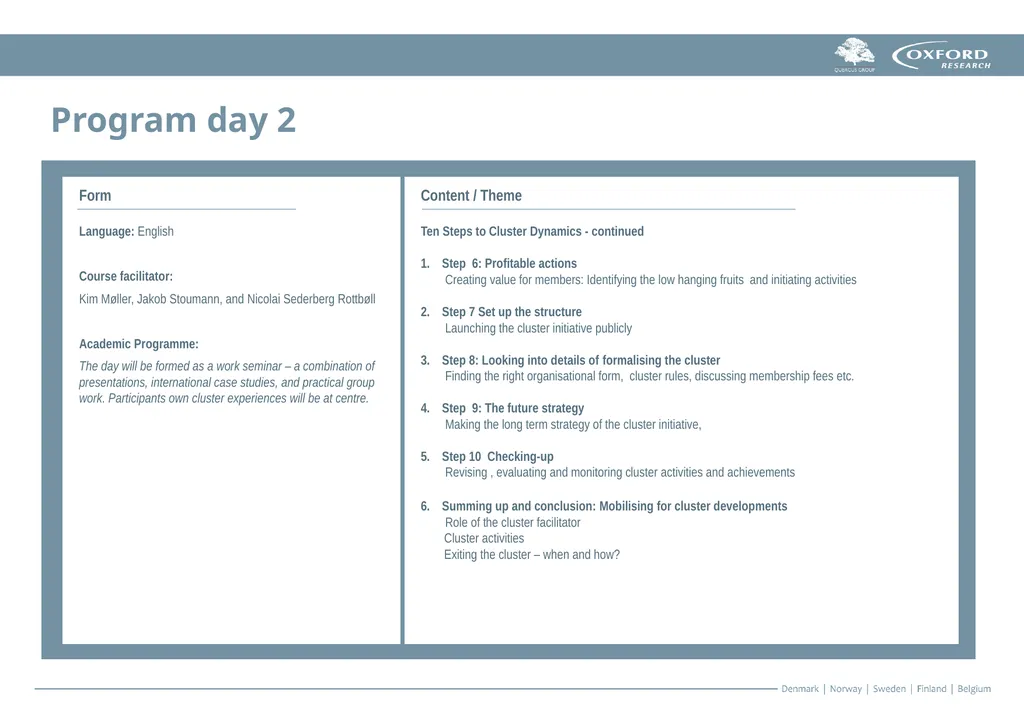
Program day 2 Content / Theme
Ten Steps to Cluster Dynamics - continued
1. Step 6: Profitable actions
Creating value for members: Identifying the low hanging fruits and initiating activities
2. Step 7 Set up the structure
Launching the cluster initiative publicly
3. Step 8: Looking into details of formalising the cluster
Finding the right organisational form, cluster rules, discussing membership fees etc.
4. Step 9: The future strategy
Making the long term strategy of the cluster initiative,
5. Step 10 Checking-up
Revising , evaluating and monitoring cluster activities and achievements
6. Summing up and conclusion: Mobilising for cluster developments
Role of the cluster facilitator Cluster activities Exiting the cluster – when and how? Form
Language: English
Course facilitator:
Kim Møller, Jakob Stoumann, and Nicolai Sederberg Rottbøll
Academic Programme:
The day will be formed as a work seminar – a combination of presentations, international case studies, and practical group work. Participants own cluster experiences will be at centre.<br>
Ten Steps to Cluster Dynamics - continued
1. Step 6: Profitable actions
Creating value for members: Identifying the low hanging fruits and initiating activities
2. Step 7 Set up the structure
Launching the cluster initiative publicly
3. Step 8: Looking into details of formalising the cluster
Finding the right organisational form, cluster rules, discussing membership fees etc.
4. Step 9: The future strategy
Making the long term strategy of the cluster initiative,
5. Step 10 Checking-up
Revising , evaluating and monitoring cluster activities and achievements
6. Summing up and conclusion: Mobilising for cluster developments
Role of the cluster facilitator Cluster activities Exiting the cluster – when and how? Form
Language: English
Course facilitator:
Kim Møller, Jakob Stoumann, and Nicolai Sederberg Rottbøll
Academic Programme:
The day will be formed as a work seminar – a combination of presentations, international case studies, and practical group work. Participants own cluster experiences will be at centre.<br>
08
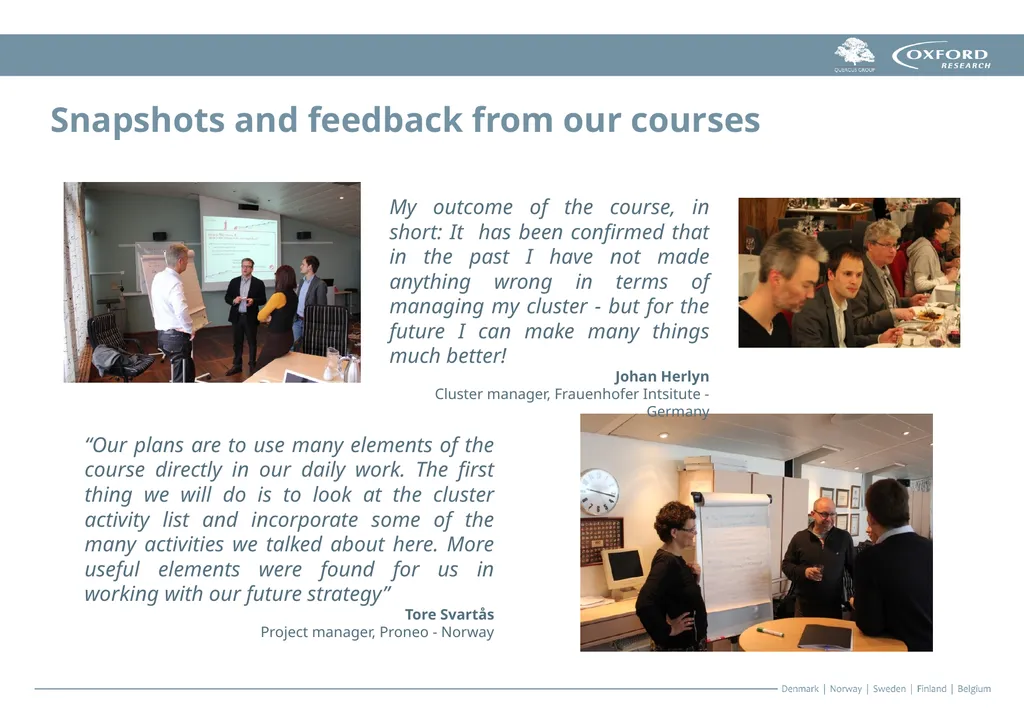
Snapshots and feedback from our courses<br>
09
Registration details Registration
Registration enquiries should be directed to Martin Stryhn Koch.
Participation fee will be invoiced after registration.
For further information, please contact Martin Stryhn Koch at mko@oxfordresearch.dk // +45 41 28 88 28
Price
Registration fee is 1200 Euros excl. vat.
Fee includes course materials, lunches as well as city walk and dinner on the first day.
Hotel stays are paid and booked individually. We recommend Radisson Falconer Hotel, just opposite from the course venue: http://www.radissonblu.com/falconerhotel-copenhagen
Cancellation of registrations: Registrations fees can be refunded fully until 14 days before the course and with 50% until a week before. After this the full registration fee will have to be paid.
Time and date
3rd to 4th of November 2016. Programme starts at 9.00 in the morning the 3rd Nov. and ends at 16.30 in afternoon the 4th Nov.
Venue
The workshop will take place at Oxford Research’s head office in Copenhagen - Falkoner Alle 20 - 2000 Frederiksberg<br>
Registration enquiries should be directed to Martin Stryhn Koch.
Participation fee will be invoiced after registration.
For further information, please contact Martin Stryhn Koch at mko@oxfordresearch.dk // +45 41 28 88 28
Price
Registration fee is 1200 Euros excl. vat.
Fee includes course materials, lunches as well as city walk and dinner on the first day.
Hotel stays are paid and booked individually. We recommend Radisson Falconer Hotel, just opposite from the course venue: http://www.radissonblu.com/falconerhotel-copenhagen
Cancellation of registrations: Registrations fees can be refunded fully until 14 days before the course and with 50% until a week before. After this the full registration fee will have to be paid.
Time and date
3rd to 4th of November 2016. Programme starts at 9.00 in the morning the 3rd Nov. and ends at 16.30 in afternoon the 4th Nov.
Venue
The workshop will take place at Oxford Research’s head office in Copenhagen - Falkoner Alle 20 - 2000 Frederiksberg<br>
10
About Oxford Research Oxford Research is a Nordic knowledge company focusing on the areas of industrial and regional development and welfare. Within these areas, we work with knowledge and innovation systems, development of municipalities and regions, and social, educational, and labour market policies. Oxford Research carries out evaluations and analyses, and offers strategic consultancy. We combine academic depth, excellent communication and strategic understanding.
Since 1995, Oxford Research have been involved in the analysis, evaluations, and development of clusters. However, the founder and president of Oxford Research, Dr. Kim Møller, worked with cluster development as early as in the 1980s, when he formed part of Michael Porter’s global research team that developed the cluster model. Today, Oxford Research has established a dedicated cluster team consisting of internal expertise and partner organisations. We and have been involved in a number of trans regional and European cluster projects, including:
International Cluster Development Courses for cluster managers and policy makers since 200
Cluster Study Trips to Denmark for international clients since 2009
Development of cluster benchmarks for International Cleantech Network
Training and development of cluster strategy action plan for Egyptian Renewable Energy Cluster
EU Cluster Policy Mapping for the European Cluster Observatory
In Scandinavia, our cluster work includes:
Associated partner – Cluster Excellence Denmark
Development of cluster mapping methodologies in cooperation with REG X – The Danish Cluster Academy
Roadmap for making Copenhagen a Nordic Fintech Hub
Baseline study for the Norwegian Centre of Expertise programme and evaluation of the ARENA programme
Monitoring of Copenhagen Cleantech Cluster (CLEAN)
Cluster mapping and strategy development for Copenhagen Fintech Innovation and Research
Development of a cluster-model for sustainable tourism in Southeastern Finland<br>
Since 1995, Oxford Research have been involved in the analysis, evaluations, and development of clusters. However, the founder and president of Oxford Research, Dr. Kim Møller, worked with cluster development as early as in the 1980s, when he formed part of Michael Porter’s global research team that developed the cluster model. Today, Oxford Research has established a dedicated cluster team consisting of internal expertise and partner organisations. We and have been involved in a number of trans regional and European cluster projects, including:
International Cluster Development Courses for cluster managers and policy makers since 200
Cluster Study Trips to Denmark for international clients since 2009
Development of cluster benchmarks for International Cleantech Network
Training and development of cluster strategy action plan for Egyptian Renewable Energy Cluster
EU Cluster Policy Mapping for the European Cluster Observatory
In Scandinavia, our cluster work includes:
Associated partner – Cluster Excellence Denmark
Development of cluster mapping methodologies in cooperation with REG X – The Danish Cluster Academy
Roadmap for making Copenhagen a Nordic Fintech Hub
Baseline study for the Norwegian Centre of Expertise programme and evaluation of the ARENA programme
Monitoring of Copenhagen Cleantech Cluster (CLEAN)
Cluster mapping and strategy development for Copenhagen Fintech Innovation and Research
Development of a cluster-model for sustainable tourism in Southeastern Finland<br>
11
About Quercus Group Quercus Group is a niche strategic and hands-on consultancy firm founded in Copenhagen in 2012, specialised in regional economic development and growth through cluster development, partnerships and cross-border collaborations. The company’s approach is rooted in hands-on experience in engaging people, businesses, academia and public players to join forces in cluster initiatives or larger regional projects.
Services
Cluster Development: Quercus Group’s expertise spans from developing new cluster initiatives from scratch to revitalising existing cluster initiatives e.g. through a strategy process. Services include assistance to ensure clarity and momentum in different phases, including; developing the scope, vision, strategy, organisation and securing funding. Quercus Group has previously assisted cluster development in the areas of cleantech, agribusiness, creative industries and green growth.
Trainings and workshops in Cluster Development and Public Private Partnerships: Quercus Group’s training service is developed from experience gained through working with cluster development, public private partnerships and multi-stakeholder projects in more than 25 countries. The overall approach is highly anchored in concrete examples and a hands-on pursuit. So far Quercus Group has trained international audiences both in Denmark, for Kenyan and Turkmen delegations, and in countries such as Austria, Belgium, Canada, Japan, Kenya, Australia, Lithuania, Romania, Serbia, Thailand and the United States.
Internationalization services:This includes development and establishment of cluster-to-cluster collaboration with the aim of boosting export and inward investments as well as facilitation of co-creation processes between markets. Recently, Quercus Group co-founded the Smart City World Labs, a new international organisation seeking to accelerate innovation and business opportunities between leading smart cities globally. Quercus Group also provides network- and partnership facilitation, market analysis, project development and business delegations to selected markets.<br>
Services
Cluster Development: Quercus Group’s expertise spans from developing new cluster initiatives from scratch to revitalising existing cluster initiatives e.g. through a strategy process. Services include assistance to ensure clarity and momentum in different phases, including; developing the scope, vision, strategy, organisation and securing funding. Quercus Group has previously assisted cluster development in the areas of cleantech, agribusiness, creative industries and green growth.
Trainings and workshops in Cluster Development and Public Private Partnerships: Quercus Group’s training service is developed from experience gained through working with cluster development, public private partnerships and multi-stakeholder projects in more than 25 countries. The overall approach is highly anchored in concrete examples and a hands-on pursuit. So far Quercus Group has trained international audiences both in Denmark, for Kenyan and Turkmen delegations, and in countries such as Austria, Belgium, Canada, Japan, Kenya, Australia, Lithuania, Romania, Serbia, Thailand and the United States.
Internationalization services:This includes development and establishment of cluster-to-cluster collaboration with the aim of boosting export and inward investments as well as facilitation of co-creation processes between markets. Recently, Quercus Group co-founded the Smart City World Labs, a new international organisation seeking to accelerate innovation and business opportunities between leading smart cities globally. Quercus Group also provides network- and partnership facilitation, market analysis, project development and business delegations to selected markets.<br>
12
Enjoy highlights from past courses here !<br>