01
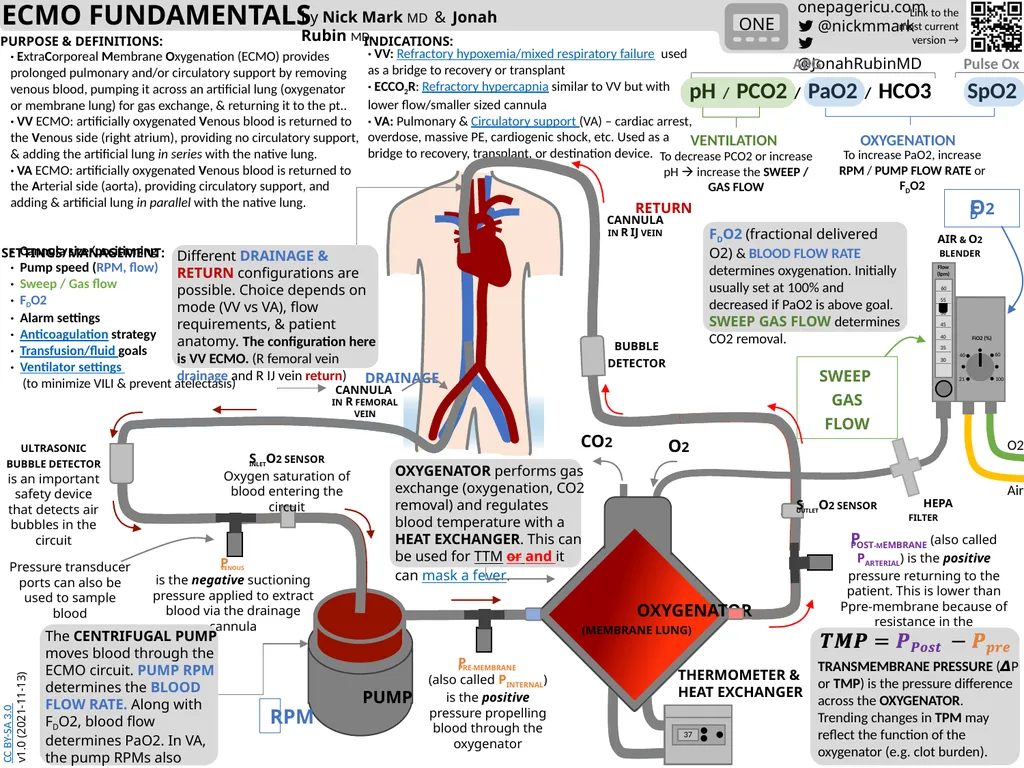
OXYGENATOR performs gas exchange (oxygenation, CO2 removal) and regulates blood temperature with a HEAT EXCHANGER. This can be used for TTM or and it can mask a fever. by Nick Mark MD & Jonah Rubin MD ecmo fundamentals onepagericu.com
@nickmmark
@JonahRubinMD Link to the most current version → PURPOSE & DEFINITIONS: O2 Air FDO2 (fractional delivered O2) & BLOOD FLOW RATE determines oxygenation. Initially usually set at 100% and decreased if PaO2 is above goal. SWEEP GAS FLOW determines CO2 removal. · ExtraCorporeal Membrane Oxygenation (ECMO) provides prolonged pulmonary and/or circulatory support by removing venous blood, pumping it across an artificial lung (oxygenator or membrane lung) for gas exchange, & returning it to the pt..
· VV ECMO: artificially oxygenated Venous blood is returned to the Venous side (right atrium), providing no circulatory support, & adding the artificial lung in series with the native lung.
· VA ECMO: artificially oxygenated Venous blood is returned to the Arterial side (aorta), providing circulatory support, and adding & artificial lung in parallel with the native lung.
· Cannula size/positioning
· Pump speed (RPM, flow)
· Sweep / Gas flow
· FDO2
· Alarm settings
· Anticoagulation strategy
· Transfusion/fluid goals
· Ventilator settings
(to minimize VILI & prevent atelectasis) PUMP RPM Pvenous
is the negative suctioning pressure applied to extract blood via the drainage cannula sweep gas flow FDO2 ultrasonic bubble detector is an important safety device that detects air bubbles in the circuit HEPA
filter O2 CO2 SinletO2 sensor
Oxygen saturation of blood entering the circuit OXYGENATOR
(membrane lung) The CENTRIFUGAL PUMP moves blood through the ECMO circuit. PUMP RPM determines the BLOOD FLOW RATE. Along with FDO2, blood flow determines PaO2. In VA, the pump RPMs also determines CO & MAP pH / PCO2 / PaO2 / HCO3 SpO2 VENTILATION OXYGENATION To decrease PCO2 or increase pH increase the SWEEP / GAS FLOW To increase PaO2, increase RPM / PUMP FLOW RATE or FDO2 ABG Pulse Ox CC BY-SA 3.0
v1.0 (2021-11-13) Different DRAINAGE & RETURN configurations are possible. Choice depends on mode (VV vs VA), flow requirements, & patient anatomy. The configuration here is VV ECMO. (R femoral vein drainage and R IJ vein return) SoutletO2 sensor INDICATIONS: · VV: Refractory hypoxemia/mixed respiratory failure used as a bridge to recovery or transplant
· ECCO2R: Refractory hypercapnia similar to VV but with lower flow/smaller sized cannula
· VA: Pulmonary & Circulatory support (VA) – cardiac arrest, overdose, massive PE, cardiogenic shock, etc. Used as a bridge to recovery, transplant, or destination device. PPRE-MEMBRANE
(also called PINTERNAL) is the positive pressure propelling blood through the oxygenator THERMOMETER & HEAT EXCHANGER PPOST-mEMBRANE (also called PARTERIAL) is the positive pressure returning to the patient. This is lower than Ppre-membrane because of resistance in the OXYGENATOR. SETTINGS/MANAGEMENT: DRAINAGE
cannula
in R femoral vein RETURN
cannula
in R IJ vein Pressure transducer ports can also be used to sample blood TRANSMEMBRANE PRESSURE (𝞓P or TMP) is the pressure difference across the OXYGENATOR.
Trending changes in TPM may reflect the function of the oxygenator (e.g. clot burden). bubble detector AIR & O2 blender<br>