
P1.3-534 Extending the Boundary Element Method to
Description: P1.3-534 Extending the Boundary Element Method to 3D acoustic propagation problems in the ocean GONZALEZ, Juan Domingo LAVIA, Edmundo Federico Argentinian Navy Research Office (DIIVARA) UNIDEF (CONICETMinDef) The Boundary Element
Related Topics
Download Presentation
"P1.3-534 Extending the Boundary Element Method to" is the property of its rightful owner. Permission is granted to download and print the materials on this website for personal, non-commercial use only, and to display it on your personal computer provided you do not modify the materials and that you retain all copyright notices contained in the materials. By downloading content from our website, you accept the terms of this agreement.
Presentation Transcript
slide1. P1.3-534 Extending the Boundary Element Method to 3D
acoustic propagation problems in the ocean
GONZALEZ, Juan Domingo & LAVIA, Edmundo Federico
Argentinian Navy Research Office (DIIV/ARA) & UNIDEF (CONICET/MinDef) The Boundary Element Method (BEM) can solve propagation problems in 3D homogeneous media but it is expensive in computational resources when long ranges are desired.
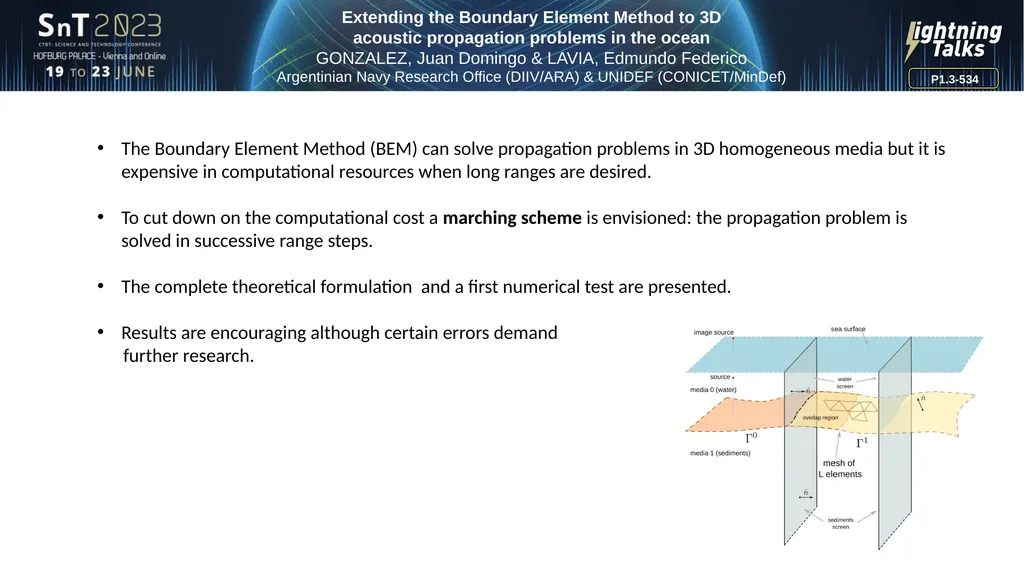
To cut down on the computational cost a marching scheme is envisioned: the propagation problem is solved in successive range steps.
The complete theoretical formulation and a first numerical test are presented.
Results are encouraging although certain errors demand
further research.<br>
acoustic propagation problems in the ocean
GONZALEZ, Juan Domingo & LAVIA, Edmundo Federico
Argentinian Navy Research Office (DIIV/ARA) & UNIDEF (CONICET/MinDef) The Boundary Element Method (BEM) can solve propagation problems in 3D homogeneous media but it is expensive in computational resources when long ranges are desired.
To cut down on the computational cost a marching scheme is envisioned: the propagation problem is solved in successive range steps.
The complete theoretical formulation and a first numerical test are presented.
Results are encouraging although certain errors demand
further research.<br>