
P3.5-342 Seismic Signal Classification using Deep
Description: P3.5-342 Seismic Signal Classification using Deep Neural Networks El Hassan Ait Laasri, Driss Agliz and Abderrahman Atmani Faculty of Applied Sciences, Ibn Zohr University Convolution 1 Max-Pooling Convolution 2 Max-Pooling Convolution 3 n1
Related Topics
Download Presentation
"P3.5-342 Seismic Signal Classification using Deep" is the property of its rightful owner. Permission is granted to download and print the materials on this website for personal, non-commercial use only, and to display it on your personal computer provided you do not modify the materials and that you retain all copyright notices contained in the materials. By downloading content from our website, you accept the terms of this agreement.
Presentation Transcript
slide1. P3.5-342 Seismic Signal Classification using Deep Neural Networks
El Hassan Ait Laasri, Driss Agliz and Abderrahman Atmani
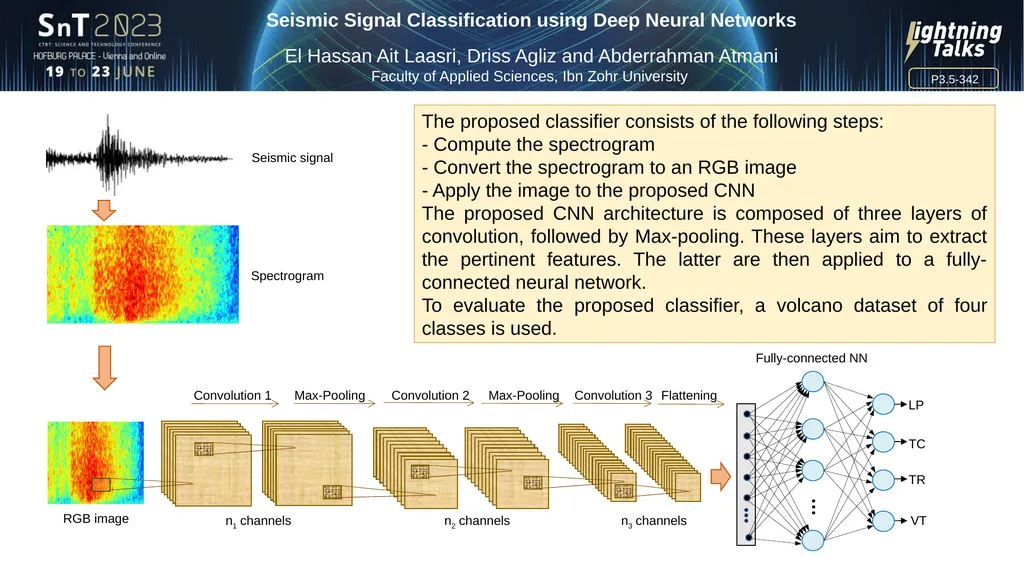
Faculty of Applied Sciences, Ibn Zohr University Convolution 1 Max-Pooling Convolution 2 Max-Pooling Convolution 3 n1 channels n2 channels n3 channels Fully-connected NN Flattening Spectrogram Seismic signal RGB image The proposed classifier consists of the following steps:
- Compute the spectrogram
- Convert the spectrogram to an RGB image
- Apply the image to the proposed CNN
The proposed CNN architecture is composed of three layers of convolution, followed by Max-pooling. These layers aim to extract the pertinent features. The latter are then applied to a fully-connected neural network.
To evaluate the proposed classifier, a volcano dataset of four classes is used.<br>
El Hassan Ait Laasri, Driss Agliz and Abderrahman Atmani
Faculty of Applied Sciences, Ibn Zohr University Convolution 1 Max-Pooling Convolution 2 Max-Pooling Convolution 3 n1 channels n2 channels n3 channels Fully-connected NN Flattening Spectrogram Seismic signal RGB image The proposed classifier consists of the following steps:
- Compute the spectrogram
- Convert the spectrogram to an RGB image
- Apply the image to the proposed CNN
The proposed CNN architecture is composed of three layers of convolution, followed by Max-pooling. These layers aim to extract the pertinent features. The latter are then applied to a fully-connected neural network.
To evaluate the proposed classifier, a volcano dataset of four classes is used.<br>