
Paediatric Prescribing and Referrals E and N Herts
EM
Published · 34 slides · 0 views

1 / 1

Description
Paediatric Prescribing and Referrals E and N Herts NHS Trust Ophthalmology Dept. To prescribe or not to prescribe? Guidelines for spectacle prescribing in infants and children Susan Leat (2011) This paper discusses considerations for
Related Topics
Share
Embed code
Download this presentation From Below
"Paediatric Prescribing and Referrals E and N Herts" is the property of its rightful owner. Permission is granted to download and print the materials on this website for personal, non-commercial use only, and to display it on your personal computer provided you do not modify the materials and that you retain all copyright notices contained in the materials. By downloading content from our website, you accept the terms of this agreement.
Presentation Transcript
01
Paediatric Prescribing and Referrals E and N Herts NHS Trust
Ophthalmology Dept.<br>
Ophthalmology Dept.<br>
02
To prescribe or not to prescribe? Guidelines for spectacle prescribing in infants and children Susan Leat (2011)
This paper discusses considerations for spectacle prescribing in infants and children, with reference to current literature.
The focus is on children who do not have other disorders, e.g.: strabismus, significant heterophoria or convergence excess.
However amblyogenic factors are discussed.
These guidelines are just an aid, the clinician must make decisions when examining a child.<br>
This paper discusses considerations for spectacle prescribing in infants and children, with reference to current literature.
The focus is on children who do not have other disorders, e.g.: strabismus, significant heterophoria or convergence excess.
However amblyogenic factors are discussed.
These guidelines are just an aid, the clinician must make decisions when examining a child.<br>
03
Infants and children from birth to six years Consider the following:
Is the refractive error within the normal range for the child’s age?
Will this refractive error emmetropise?
Will this level of refractive error disrupt normal visual development?
Will prescribing spectacles improve visual function?
Will prescribing spectacles interfere with emmetropisation?<br>
Is the refractive error within the normal range for the child’s age?
Will this refractive error emmetropise?
Will this level of refractive error disrupt normal visual development?
Will prescribing spectacles improve visual function?
Will prescribing spectacles interfere with emmetropisation?<br>
04
Refractive error from birth to 3 years The range of refractive error is wider at birth and in the first year of life than in later childhood.
Most infants are hypermetropic.
Average cycloplegic refractive error is +2.00D with a standard deviation of approx. 2.00D
A few infants are myopic at birth.
Most infants will emmetropise.<br>
Most infants are hypermetropic.
Average cycloplegic refractive error is +2.00D with a standard deviation of approx. 2.00D
A few infants are myopic at birth.
Most infants will emmetropise.<br>
05
Refractive error from birth to 3 years There is also a higher prevalence of astigmatism at birth.
69% of newborns have astigmatism of 1.00D or more.
All types of astigmatism decrease, infants lose approx two-thirds of their astigmatism between 9 and 21 months.<br>
69% of newborns have astigmatism of 1.00D or more.
All types of astigmatism decrease, infants lose approx two-thirds of their astigmatism between 9 and 21 months.<br>
06
Refractive error from birth to 3 years Anisometropia is more common in children than adults.
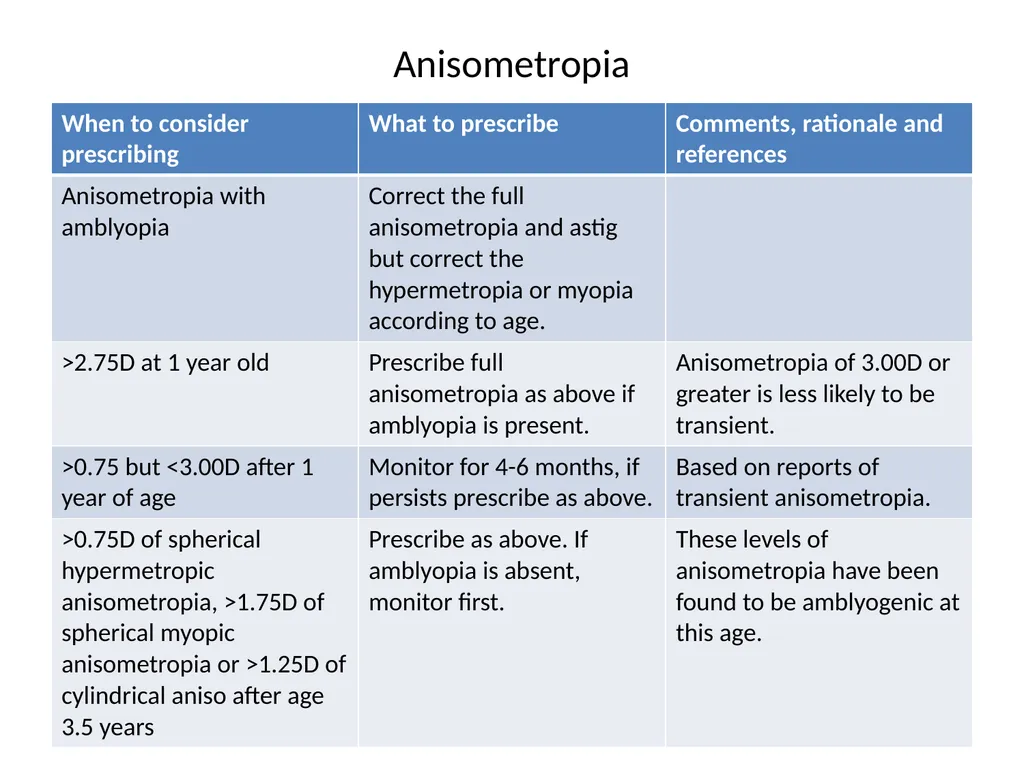
Approximately 7-11% of 1-4 year olds have anisometropia of 1.00D or more, compared to 0-5% of school children. These are not the same children.
Some children gain anisometropia, while others lose it.
Higher levels (3.00D or more) are more likely to remain.<br>
Approximately 7-11% of 1-4 year olds have anisometropia of 1.00D or more, compared to 0-5% of school children. These are not the same children.
Some children gain anisometropia, while others lose it.
Higher levels (3.00D or more) are more likely to remain.<br>
07
Refractive error in 3 to 6 year olds There is less change during this period of life.
Gwiazda and colleagues showed a slow movement towards emmetropia.
At age 6 the mean refractive error is 0.70 to 1.00D.
There is less change in astigmatism, although Gwiazda showed some decrease until approx 4-5 years.<br>
Gwiazda and colleagues showed a slow movement towards emmetropia.
At age 6 the mean refractive error is 0.70 to 1.00D.
There is less change in astigmatism, although Gwiazda showed some decrease until approx 4-5 years.<br>
08
Will this child’s refractive error emmetropise? The majority of children will emmetropise, but not all.
There is some evidence that children with very high refractive errors are less likely to emmetropise.
There is an association between lack of emmetropisation and strabismus.
The main tool to predict emmetropisation is to monitor the refraction.<br>
There is some evidence that children with very high refractive errors are less likely to emmetropise.
There is an association between lack of emmetropisation and strabismus.
The main tool to predict emmetropisation is to monitor the refraction.<br>
09
Will this child’s refractive error emmetropise? Those that emmetropise lose approx half of their spherical equivalent refractive error in the first year, and approx one-third between 9 and 21 months.
Two-thirds of the astigmatism is lost between 9 and 21 months.
Anisometropia can be transient, but if it is 3.00D at one year of age there is a high risk of it remaining. (Monitor, consider VAs).
Children with low vision are less likely to fully emmetropise.<br>
Two-thirds of the astigmatism is lost between 9 and 21 months.
Anisometropia can be transient, but if it is 3.00D at one year of age there is a high risk of it remaining. (Monitor, consider VAs).
Children with low vision are less likely to fully emmetropise.<br>
10
Will this level of refractive error disrupt normal visual development? Uncorrected high refractive error during the first few years of life is a risk factor for amblyopia.
Aurell and Norrsell found that infants with more than +4.00D were more likely to develop esotropia.
Poorer VA, accommodation and stereopsis have been associated with high hypermetropia.<br>
Aurell and Norrsell found that infants with more than +4.00D were more likely to develop esotropia.
Poorer VA, accommodation and stereopsis have been associated with high hypermetropia.<br>
11
Will this level of refractive error disrupt normal visual development? In 3-4 year olds, 1.50D of astigmatism is associated with poorer recognition acuity.
Anisometropia after age 3 is more likely to cause amblyopia than before that age.<br>
Anisometropia after age 3 is more likely to cause amblyopia than before that age.<br>
12
Will prescribing spectacles improve visual function? Amblyopia due to high hypermetropia responds to treatment with refractive correction.<br>
13
Will prescribing spectacles interfere with emmetropisation? Experimental animal studies show that refractive correction influences the development of refractive error.
Ingram and colleagues found the compliant spectacle wearers emmetropised less than the non-compliant spectacle wearers or controls.
We cannot assume that prescribing spectacles does not influence refractive development.<br>
Ingram and colleagues found the compliant spectacle wearers emmetropised less than the non-compliant spectacle wearers or controls.
We cannot assume that prescribing spectacles does not influence refractive development.<br>
14
Children in the school years Emmetropisation is essentially complete by six years.
The refraction of children with moderate hypermetropia still shows a drift towards emmetropia up to 9 or 10 years, then myopia commences.
Under correction of myopia may lead to further progression.
+1.50D of hypermetropia should be considered for correction, even if asymptomatic.<br>
The refraction of children with moderate hypermetropia still shows a drift towards emmetropia up to 9 or 10 years, then myopia commences.
Under correction of myopia may lead to further progression.
+1.50D of hypermetropia should be considered for correction, even if asymptomatic.<br>
15
Management Factors that indicate the need for spectacle prescribing:
Reduced uncorrected vision
Reduced corrected visual acuity
Reduced stereopsis
Reduced accommodation
Signs and symptoms such as poor co-ordination, asthenopia, headaches<br>
Reduced uncorrected vision
Reduced corrected visual acuity
Reduced stereopsis
Reduced accommodation
Signs and symptoms such as poor co-ordination, asthenopia, headaches<br>
16
Management Monitor the refractive error in infants and toddlers before prescribing.
Unchanging or increasing refractions are associated with amblyopia.
We could prescribe to bring the uncorrected portion just within the normal range, leaving a large stimulus for emmetropisation. (These children may be at more risk of developing esotropia).<br>
Unchanging or increasing refractions are associated with amblyopia.
We could prescribe to bring the uncorrected portion just within the normal range, leaving a large stimulus for emmetropisation. (These children may be at more risk of developing esotropia).<br>
17
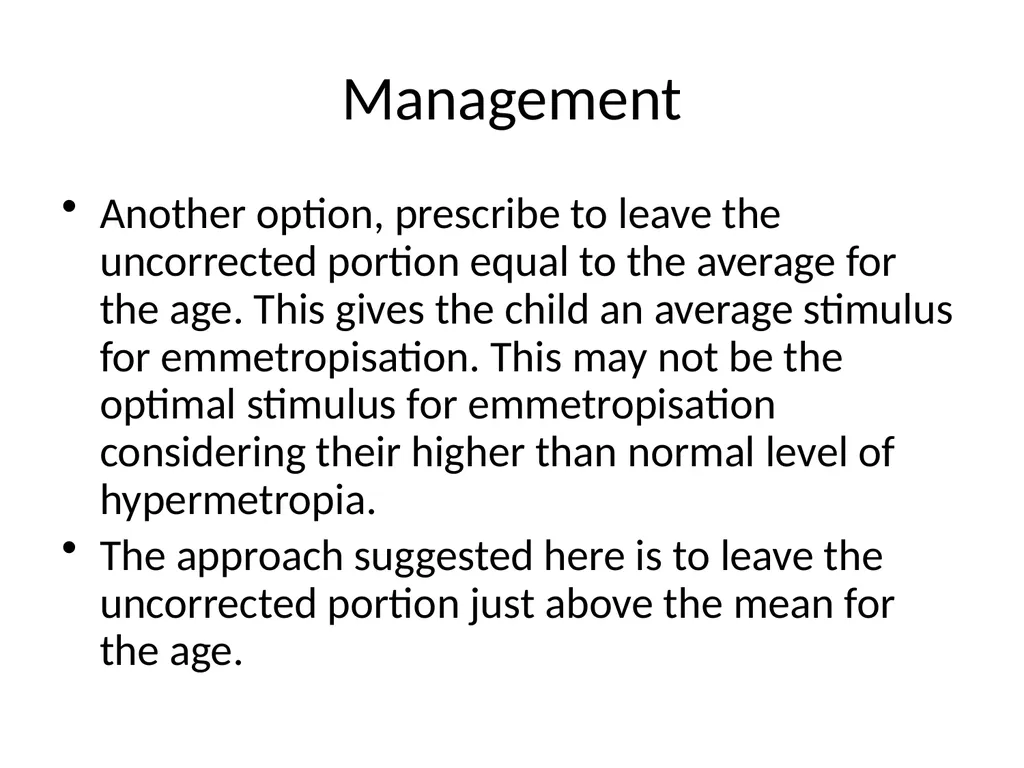
Management Another option, prescribe to leave the uncorrected portion equal to the average for the age. This gives the child an average stimulus for emmetropisation. This may not be the optimal stimulus for emmetropisation considering their higher than normal level of hypermetropia.
The approach suggested here is to leave the uncorrected portion just above the mean for the age.<br>
The approach suggested here is to leave the uncorrected portion just above the mean for the age.<br>
18
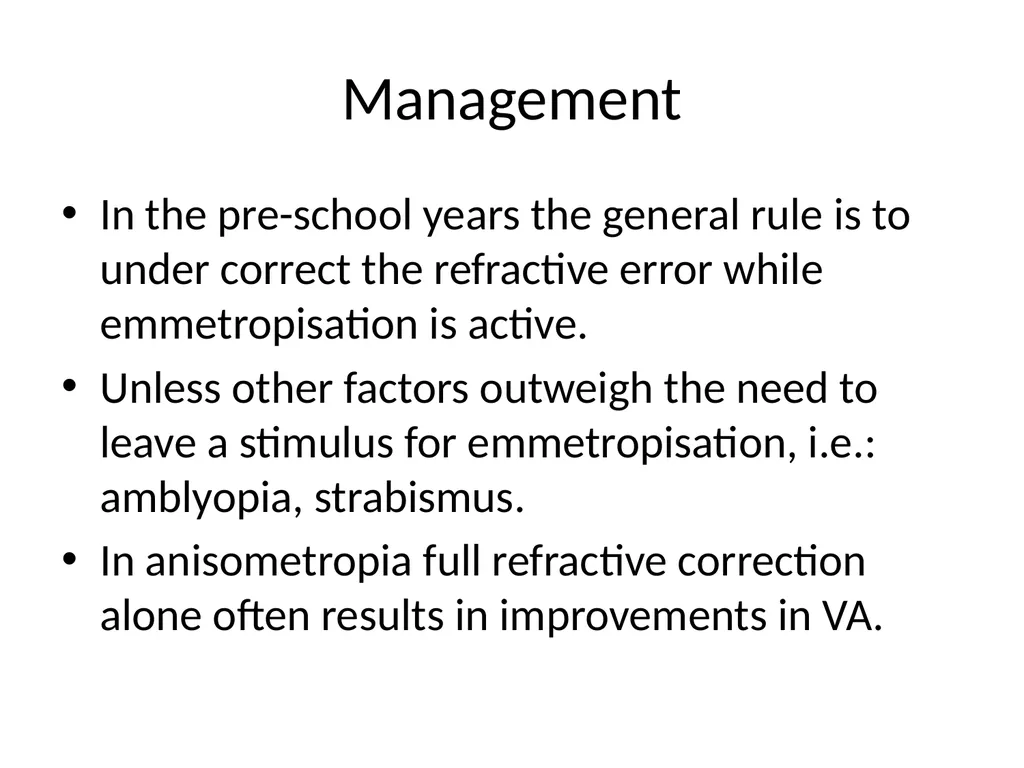
Management In the pre-school years the general rule is to under correct the refractive error while emmetropisation is active.
Unless other factors outweigh the need to leave a stimulus for emmetropisation, i.e.: amblyopia, strabismus.
In anisometropia full refractive correction alone often results in improvements in VA.<br>
Unless other factors outweigh the need to leave a stimulus for emmetropisation, i.e.: amblyopia, strabismus.
In anisometropia full refractive correction alone often results in improvements in VA.<br>
19
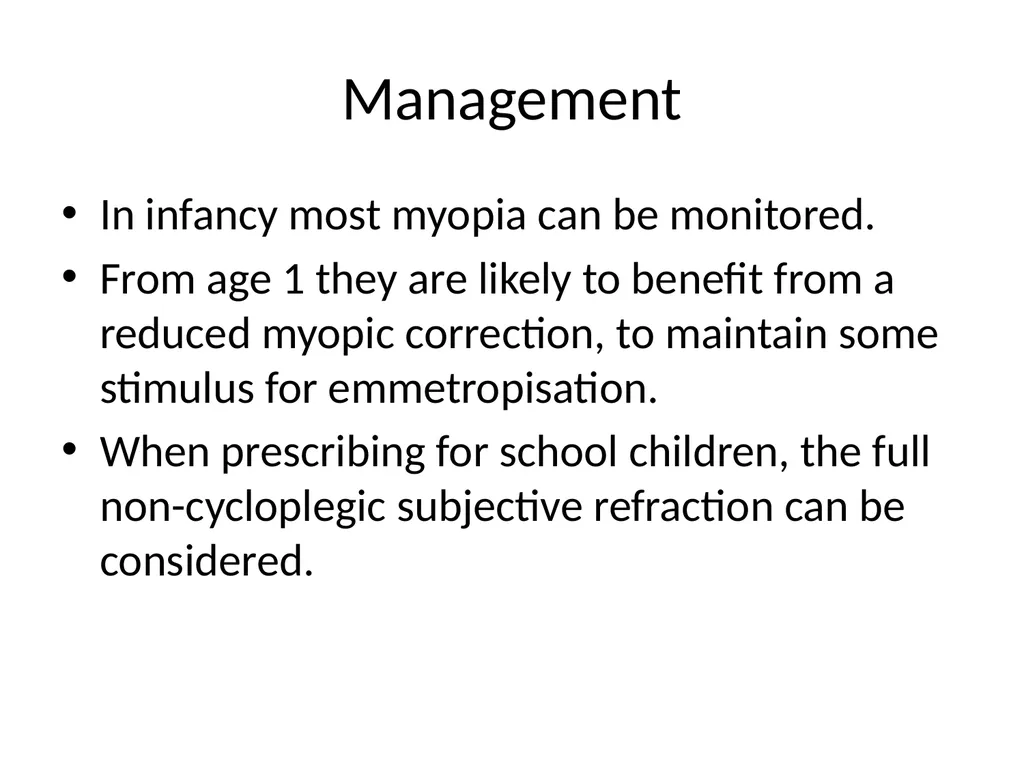
Management In infancy most myopia can be monitored.
From age 1 they are likely to benefit from a reduced myopic correction, to maintain some stimulus for emmetropisation.
When prescribing for school children, the full non-cycloplegic subjective refraction can be considered.<br>
From age 1 they are likely to benefit from a reduced myopic correction, to maintain some stimulus for emmetropisation.
When prescribing for school children, the full non-cycloplegic subjective refraction can be considered.<br>
20
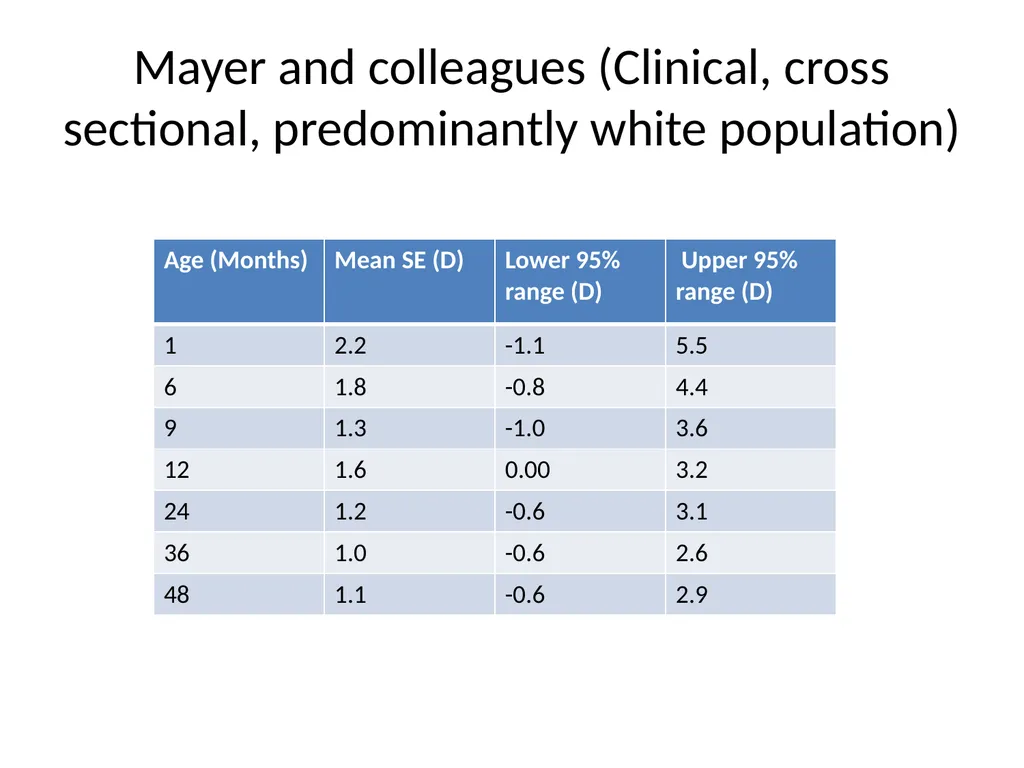
Mayer and colleagues (Clinical, cross sectional, predominantly white population)<br>
21
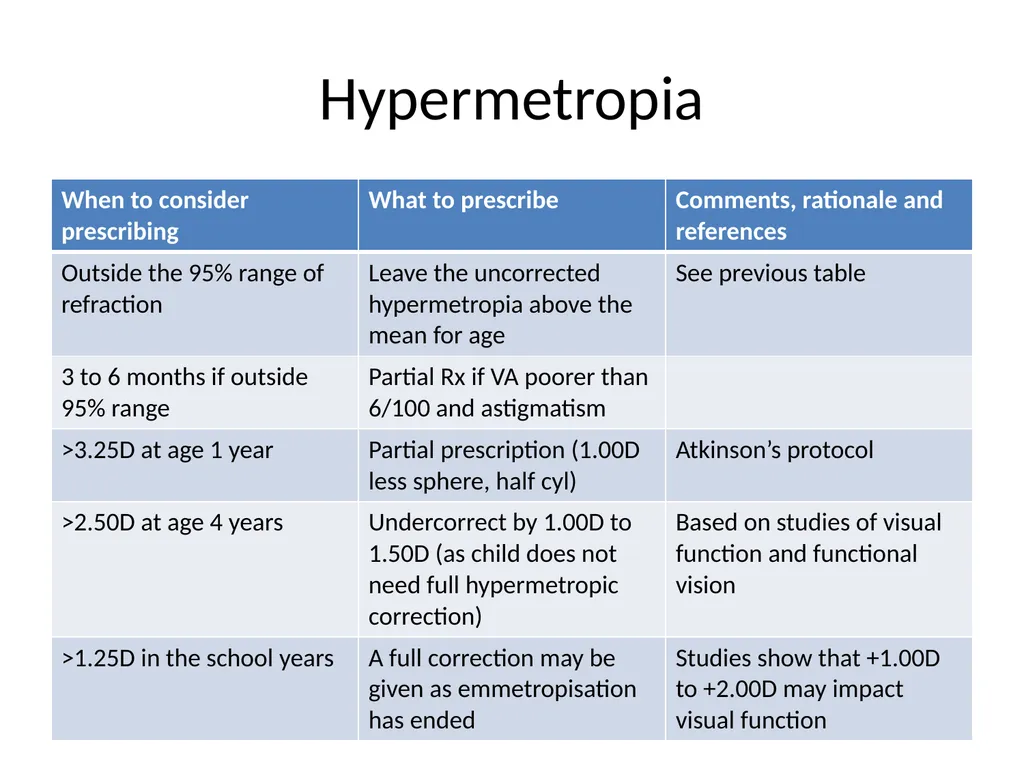
Hypermetropia<br>
22
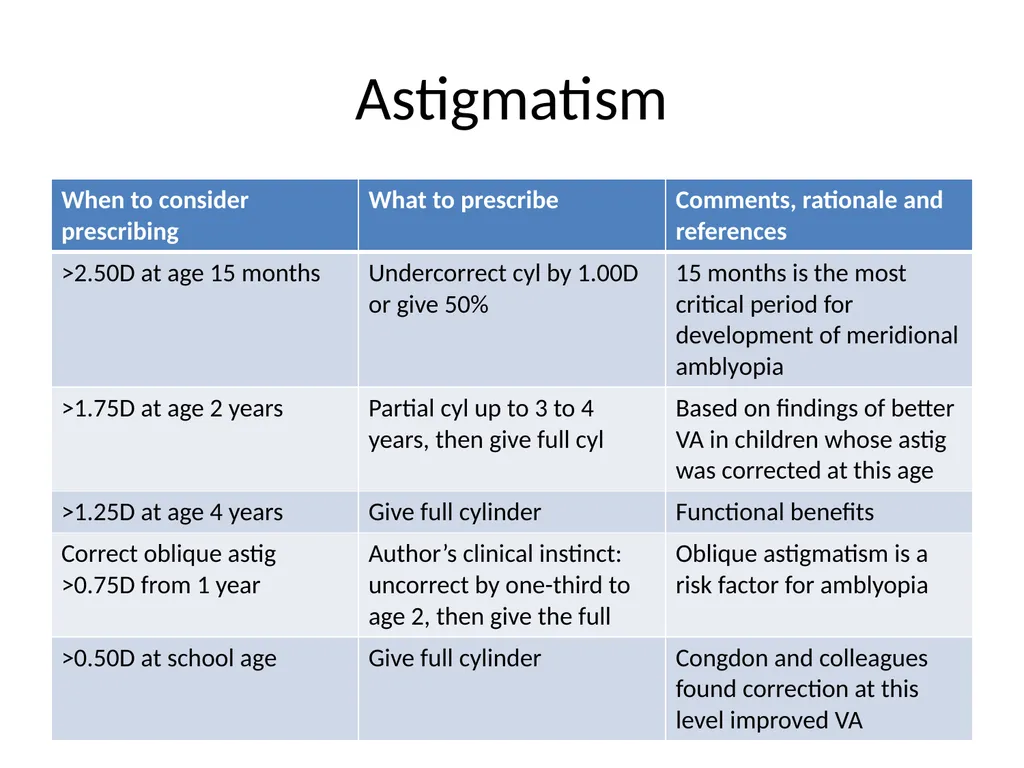
Astigmatism<br>
23
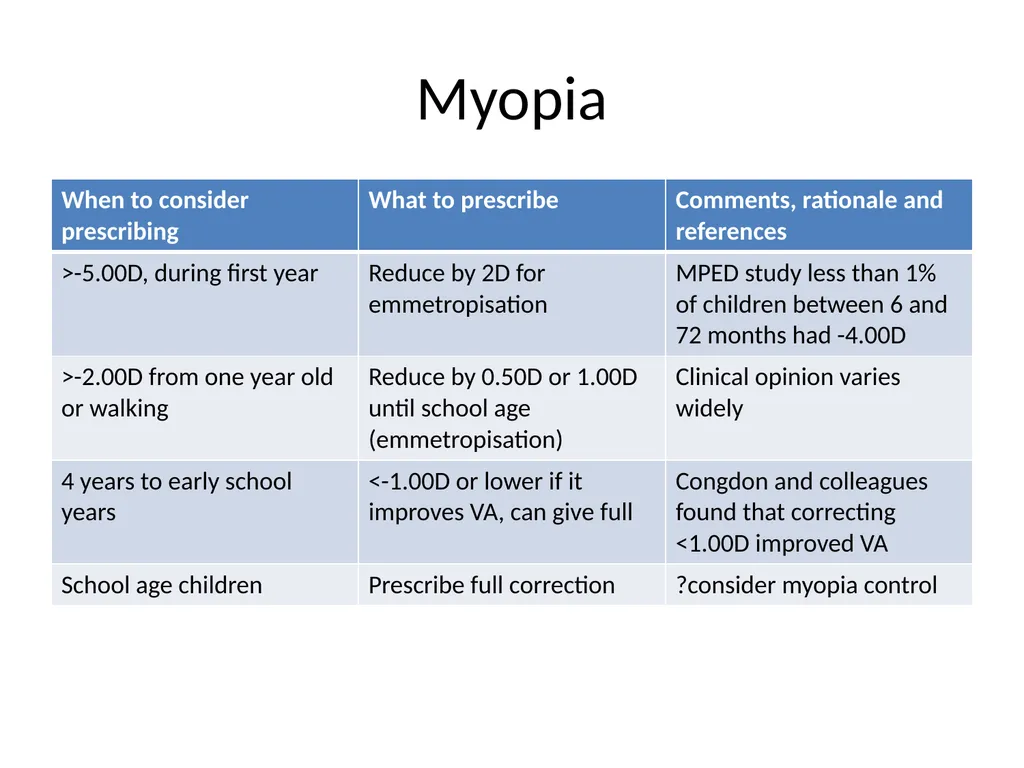
Myopia<br>
24
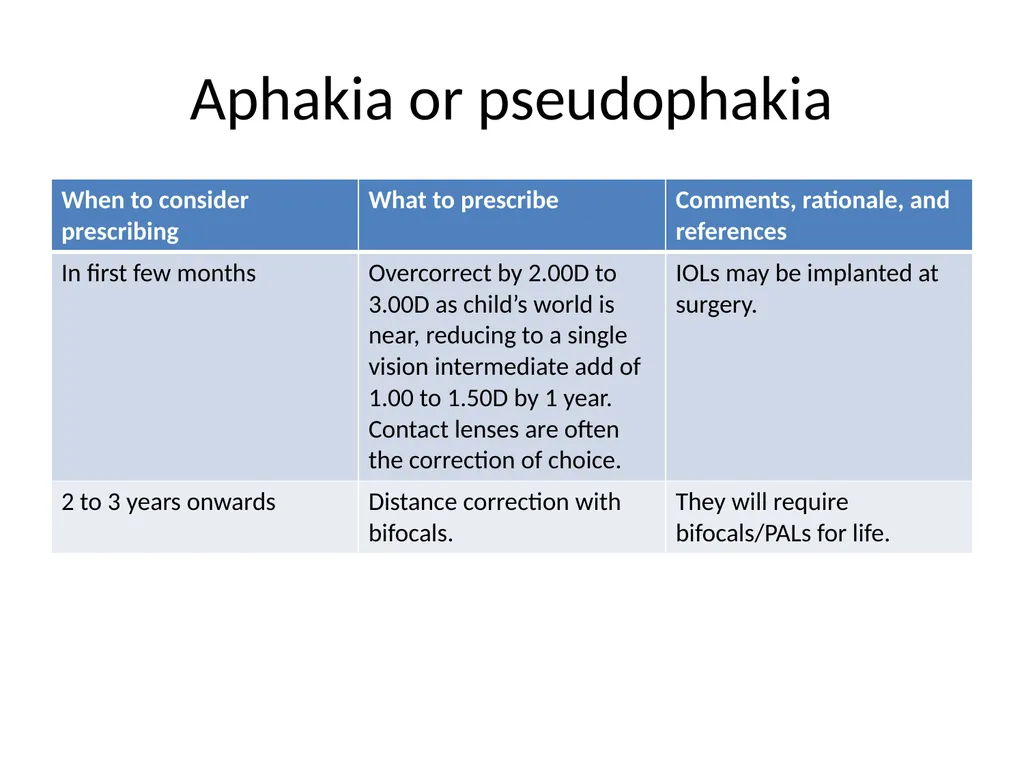
Aphakia or pseudophakia<br>
25
Anisometropia<br>
26
Referrals
Peer discussion<br>
Peer discussion<br>
27
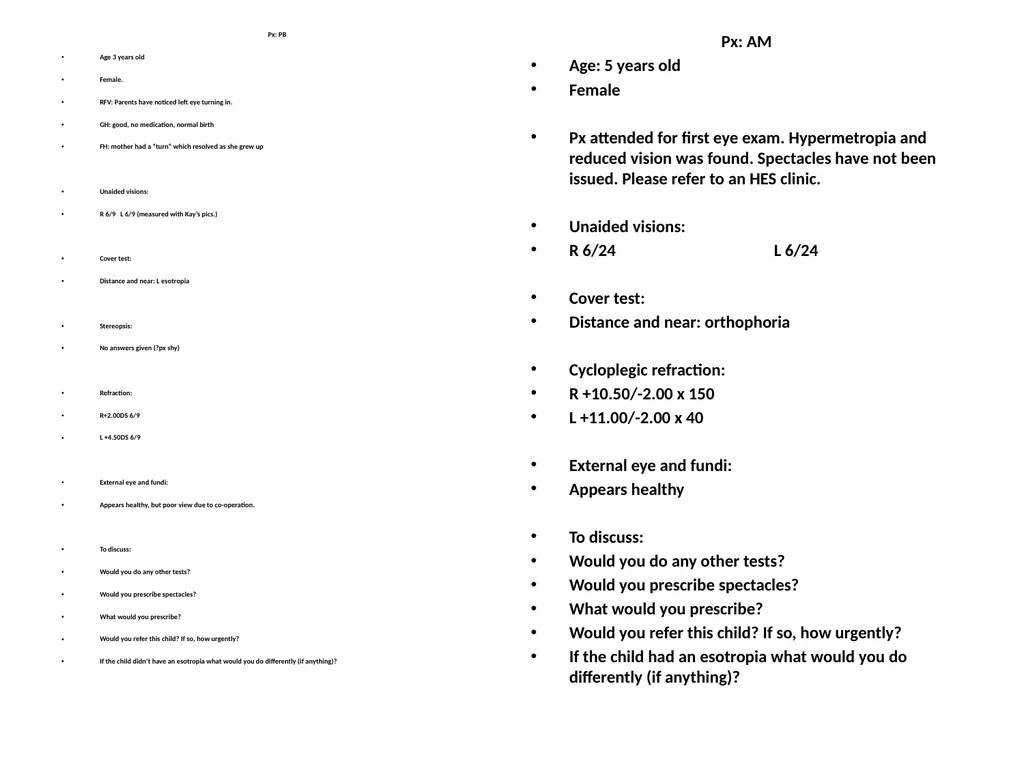
Px: PB
Age 3 years old
Female.
RFV: Parents have noticed left eye turning in.
GH: good, no medication, normal birth
FH: mother had a “turn” which resolved as she grew up
Unaided visions:
R 6/9 L 6/9 (measured with Kay’s pics.)
Cover test:
Distance and near: L esotropia
Stereopsis:
No answers given (?px shy)
Refraction:
R+2.00DS 6/9
L +4.50DS 6/9
External eye and fundi:
Appears healthy, but poor view due to co-operation.
To discuss:
Would you do any other tests?
Would you prescribe spectacles?
What would you prescribe?
Would you refer this child? If so, how urgently?
If the child didn’t have an esotropia what would you do differently (if anything)? Px: AM
Age: 5 years old
Female
Px attended for first eye exam. Hypermetropia and reduced vision was found. Spectacles have not been issued. Please refer to an HES clinic.
Unaided visions:
R 6/24 L 6/24
Cover test:
Distance and near: orthophoria
Cycloplegic refraction:
R +10.50/-2.00 x 150
L +11.00/-2.00 x 40
External eye and fundi:
Appears healthy
To discuss:
Would you do any other tests?
Would you prescribe spectacles?
What would you prescribe?
Would you refer this child? If so, how urgently?
If the child had an esotropia what would you do differently (if anything)?<br>
Age 3 years old
Female.
RFV: Parents have noticed left eye turning in.
GH: good, no medication, normal birth
FH: mother had a “turn” which resolved as she grew up
Unaided visions:
R 6/9 L 6/9 (measured with Kay’s pics.)
Cover test:
Distance and near: L esotropia
Stereopsis:
No answers given (?px shy)
Refraction:
R+2.00DS 6/9
L +4.50DS 6/9
External eye and fundi:
Appears healthy, but poor view due to co-operation.
To discuss:
Would you do any other tests?
Would you prescribe spectacles?
What would you prescribe?
Would you refer this child? If so, how urgently?
If the child didn’t have an esotropia what would you do differently (if anything)? Px: AM
Age: 5 years old
Female
Px attended for first eye exam. Hypermetropia and reduced vision was found. Spectacles have not been issued. Please refer to an HES clinic.
Unaided visions:
R 6/24 L 6/24
Cover test:
Distance and near: orthophoria
Cycloplegic refraction:
R +10.50/-2.00 x 150
L +11.00/-2.00 x 40
External eye and fundi:
Appears healthy
To discuss:
Would you do any other tests?
Would you prescribe spectacles?
What would you prescribe?
Would you refer this child? If so, how urgently?
If the child had an esotropia what would you do differently (if anything)?<br>
28
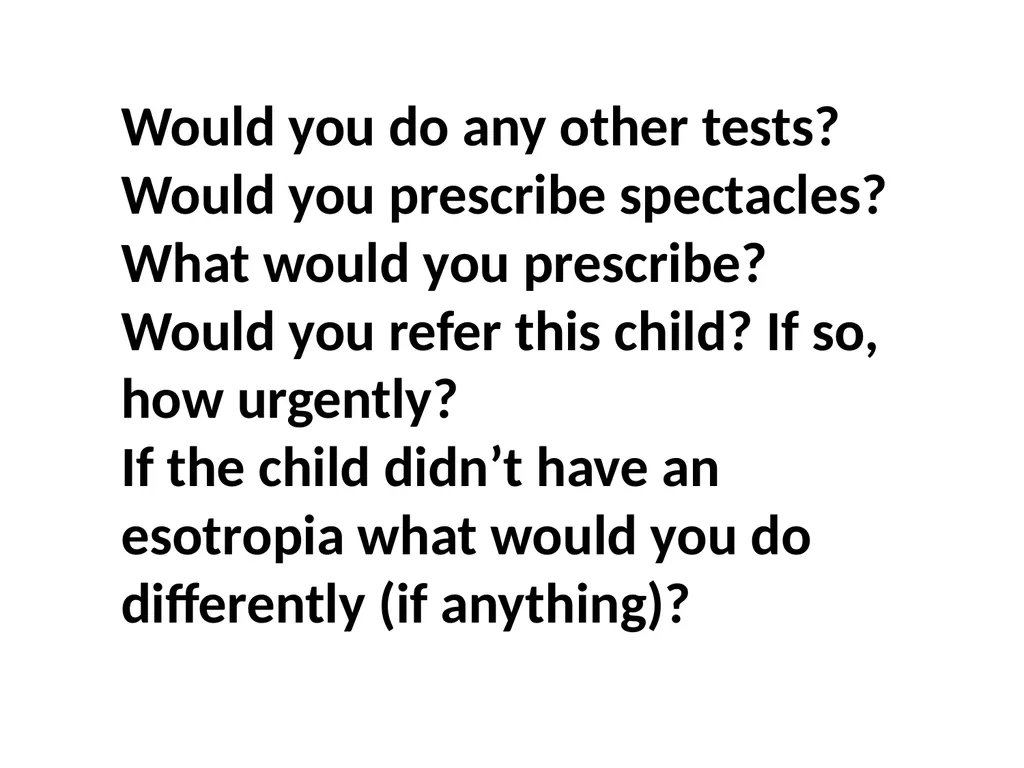
Would you do any other tests?
Would you prescribe spectacles?
What would you prescribe?
Would you refer this child? If so, how urgently?
If the child didn’t have an esotropia what would you do differently (if anything)?<br>
Would you prescribe spectacles?
What would you prescribe?
Would you refer this child? If so, how urgently?
If the child didn’t have an esotropia what would you do differently (if anything)?<br>
29
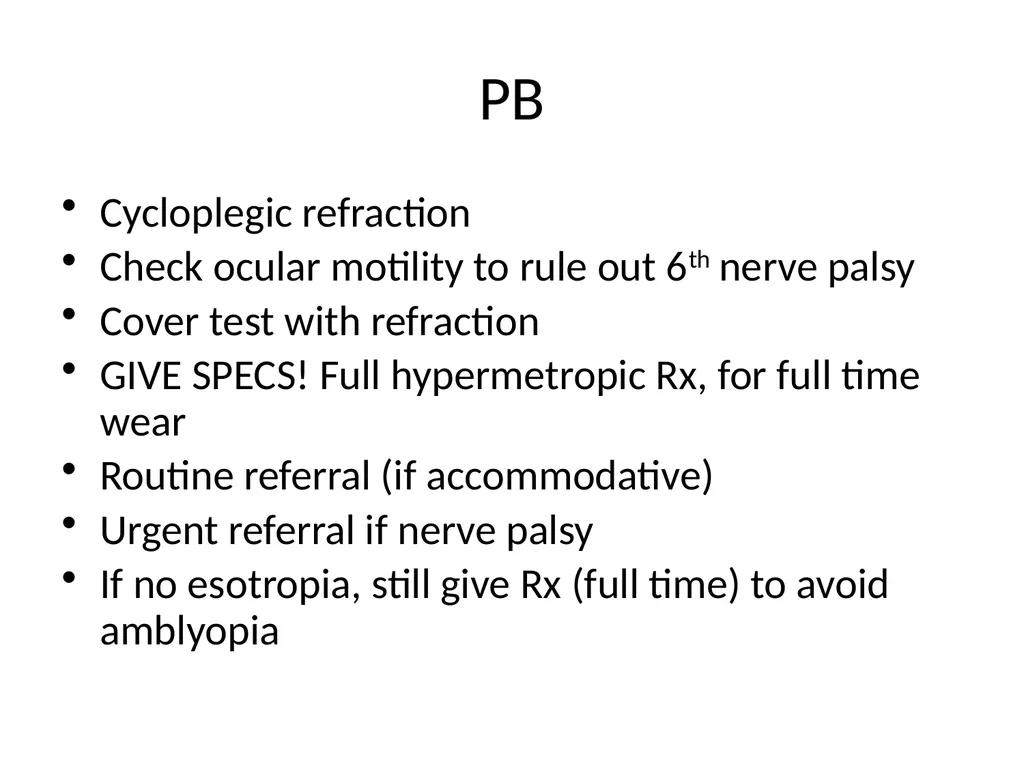
PB Cycloplegic refraction
Check ocular motility to rule out 6th nerve palsy
Cover test with refraction
GIVE SPECS! Full hypermetropic Rx, for full time wear
Routine referral (if accommodative)
Urgent referral if nerve palsy
If no esotropia, still give Rx (full time) to avoid amblyopia<br>
Check ocular motility to rule out 6th nerve palsy
Cover test with refraction
GIVE SPECS! Full hypermetropic Rx, for full time wear
Routine referral (if accommodative)
Urgent referral if nerve palsy
If no esotropia, still give Rx (full time) to avoid amblyopia<br>
30
Would you do any other tests?
Would you prescribe spectacles?
What would you prescribe?
Would you refer this child? If so, how urgently?
If the child had an esotropia what would you do differently (if anything)?<br>
Would you prescribe spectacles?
What would you prescribe?
Would you refer this child? If so, how urgently?
If the child had an esotropia what would you do differently (if anything)?<br>
31
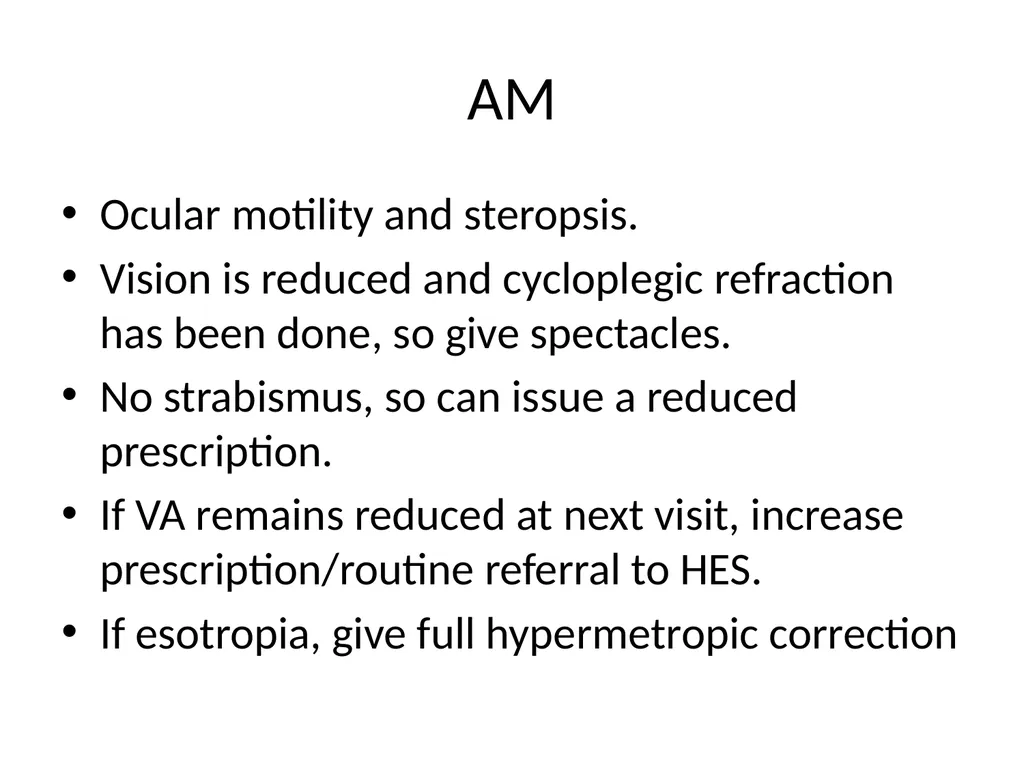
AM Ocular motility and steropsis.
Vision is reduced and cycloplegic refraction has been done, so give spectacles.
No strabismus, so can issue a reduced prescription.
If VA remains reduced at next visit, increase prescription/routine referral to HES.
If esotropia, give full hypermetropic correction<br>
Vision is reduced and cycloplegic refraction has been done, so give spectacles.
No strabismus, so can issue a reduced prescription.
If VA remains reduced at next visit, increase prescription/routine referral to HES.
If esotropia, give full hypermetropic correction<br>
32
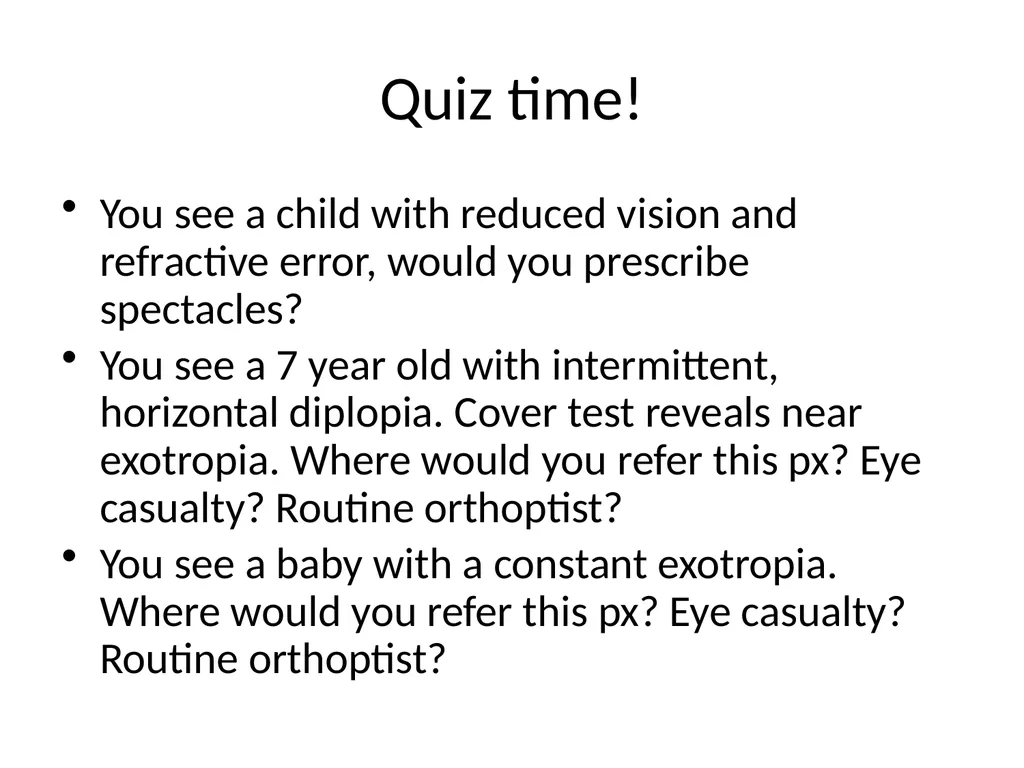
Quiz time! You see a child with reduced vision and refractive error, would you prescribe spectacles?
You see a 7 year old with intermittent, horizontal diplopia. Cover test reveals near exotropia. Where would you refer this px? Eye casualty? Routine orthoptist?
You see a baby with a constant exotropia. Where would you refer this px? Eye casualty? Routine orthoptist?<br>
You see a 7 year old with intermittent, horizontal diplopia. Cover test reveals near exotropia. Where would you refer this px? Eye casualty? Routine orthoptist?
You see a baby with a constant exotropia. Where would you refer this px? Eye casualty? Routine orthoptist?<br>
33
You see a child with an esotropia and high hypermetropia. Do you give the full plus? Or reduce the plus?<br>
34
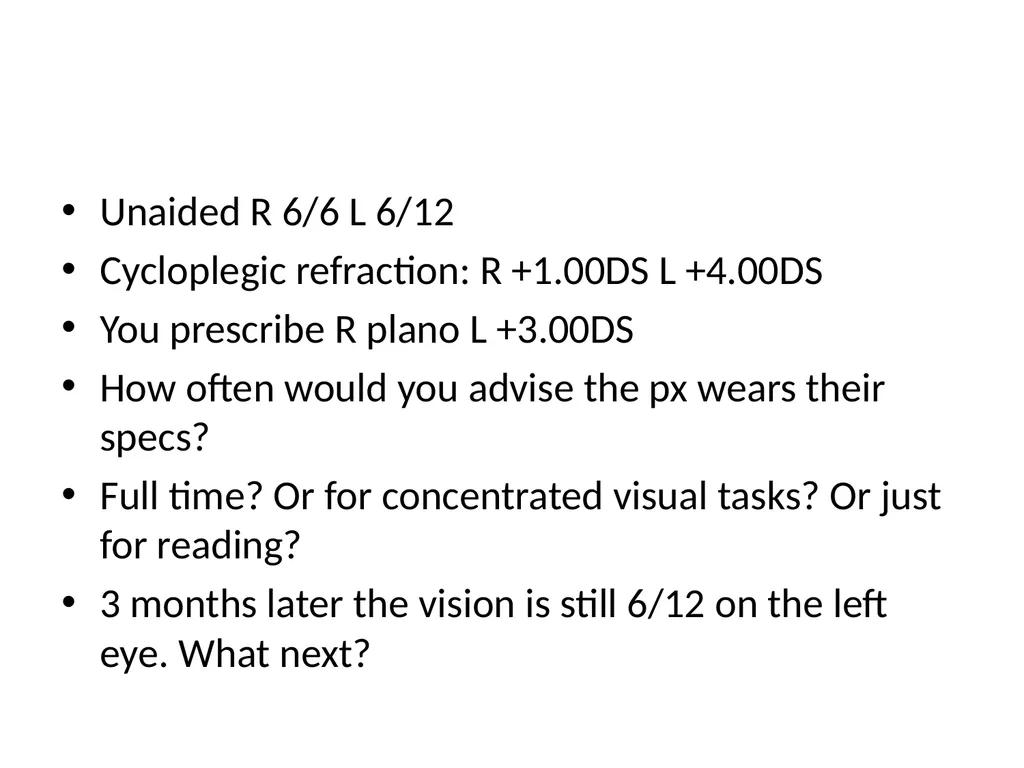
Unaided R 6/6 L 6/12
Cycloplegic refraction: R +1.00DS L +4.00DS
You prescribe R plano L +3.00DS
How often would you advise the px wears their specs?
Full time? Or for concentrated visual tasks? Or just for reading?
3 months later the vision is still 6/12 on the left eye. What next?<br>
Cycloplegic refraction: R +1.00DS L +4.00DS
You prescribe R plano L +3.00DS
How often would you advise the px wears their specs?
Full time? Or for concentrated visual tasks? Or just for reading?
3 months later the vision is still 6/12 on the left eye. What next?<br>