PALAMA Training Programmes and Courses Presentation of PALAMAs Training Programmes and Courses to ANNUAL CONGRESS OF THE 3rd PUBLIC SECTOR ECONOMISTS FORUM Presented by: Dr Thami Shezi 29 November 2011 Kruger Gate Protea Hotel 1 Content
"PALAMA Training Programmes and Courses" is the property of its rightful owner. Permission is granted to
download and print the materials on this website for personal, non-commercial use only, and to display it
on your personal computer provided you do not modify the materials and that you retain all copyright
notices contained in the materials. By downloading content from our website, you accept the terms of this
agreement.
Presentation Transcript
01
PALAMA Training Programmes and Courses Presentation of PALAMA’s Training Programmes and Courses to ANNUAL CONGRESS OF THE 3rd PUBLIC SECTOR ECONOMISTS’ FORUM Presented by: Dr Thami Shezi
29 November 2011
Kruger Gate Protea Hotel 1<br>
02
Content Introduction
PALAMA’s Mandate
Strategic Partnerships
Delivery Agreement for Outcome 12
Organisational Priorities for 2011-12
Administration Training
Management Training
Induction
Leadership Training
Conclusion 2<br>
03
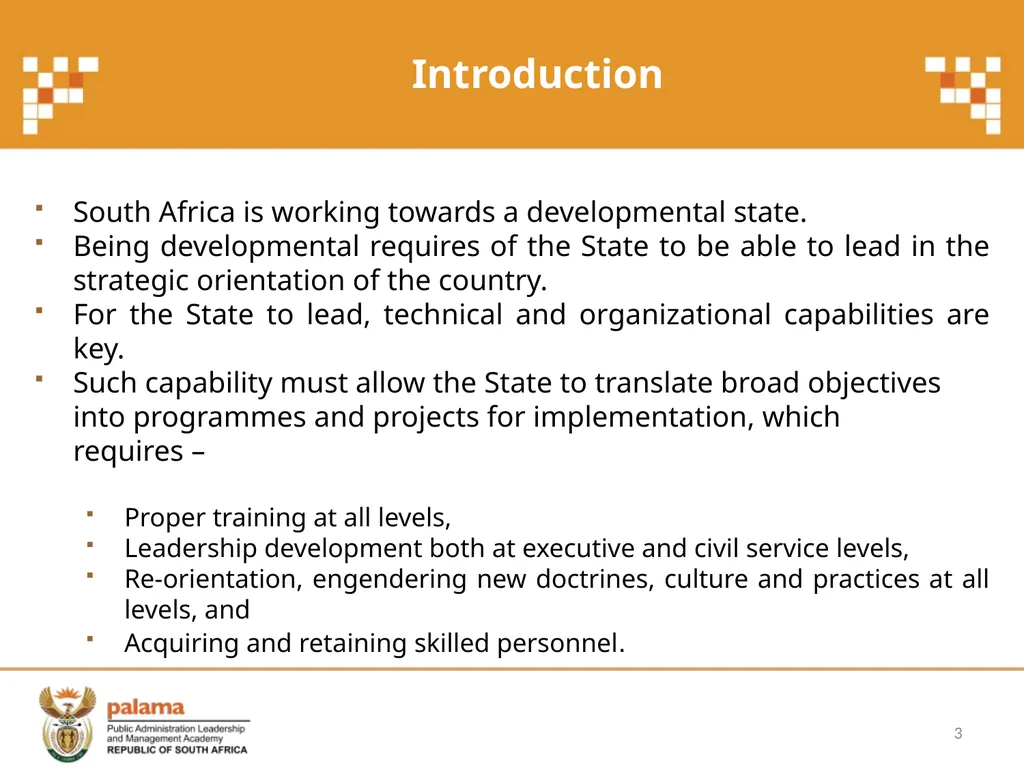
Introduction South Africa is working towards a developmental state.
Being developmental requires of the State to be able to lead in the strategic orientation of the country.
For the State to lead, technical and organizational capabilities are key.
Such capability must allow the State to translate broad objectives into programmes and projects for implementation, which requires –
Proper training at all levels,
Leadership development both at executive and civil service levels,
Re-orientation, engendering new doctrines, culture and practices at all levels, and
Acquiring and retaining skilled personnel. 3<br>
04
PALAMA’S Mandate In terms of the Public Service Act of 1994 (as amended)
There shall be a training institution listed as a Schedule 1 national department
The management and administration of such institution shall be under the control of the Minister for Public Service and Administration
Such institution
Shall provide such training or cause such training to be provided or conduct such examinations or tests or cause such examinations or tests to be conducted as the Head of the institute may with the approval of the Minister decide or as may be prescribed as a qualification for the appointment or transfer of persons in or to the public service;
May issue diplomas or certificates or cause diplomas or certificates to be issued to persons who have passed such examinations 4<br>
05
Strategic Partnerships PALAMA has established strategic partnerships with other government departments to support the rollout of key strategic programmes, e.g.
DPSA for the Service Delivery Improvement Plans
National Treasury for Standard Chart of Account (SCOA) training
and Municipal Finance Management Programme (MFMP) for Local
government
Collaborative arrangements also exist between PALAMA and a number of HEIs, in particular in the delivery of the EMDP, AMDP and Executive Development programmes.
Key to these partnering arrangements is the understanding and support for PALAMA vision, strategic thrusts and approach to training delivery for the public service 5<br>
06
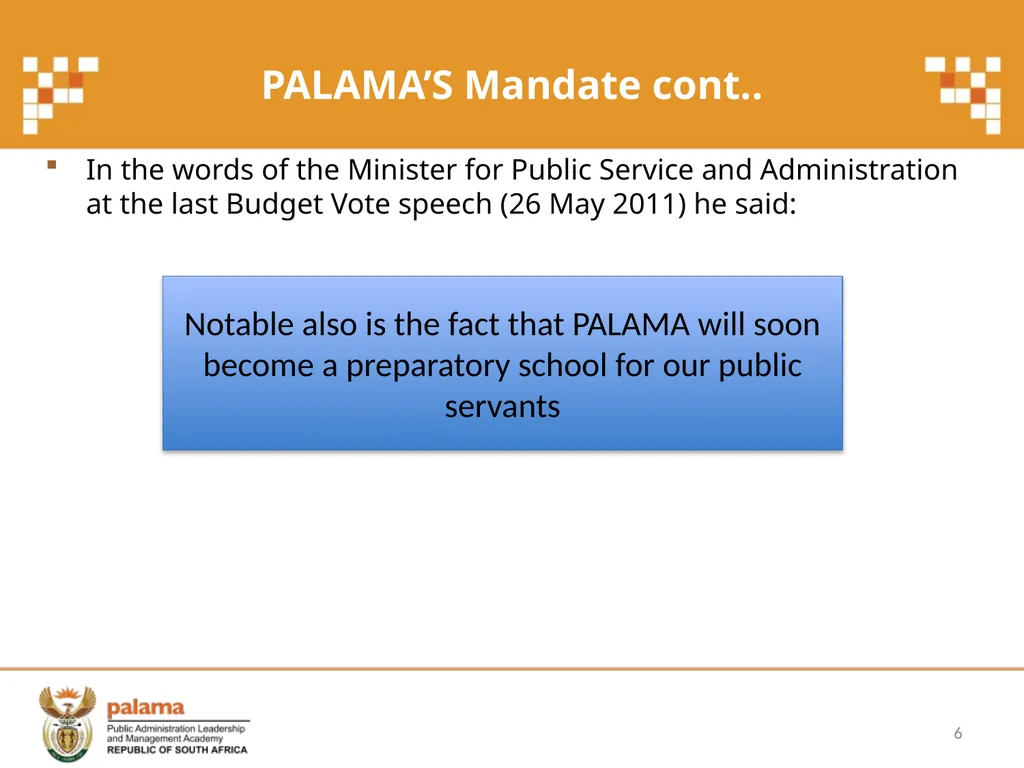
PALAMA’S Mandate cont.. In the words of the Minister for Public Service and Administration at the last Budget Vote speech (26 May 2011) he said: 6 Notable also is the fact that PALAMA will soon become a preparatory school for our public servants<br>
07
Delivery Agreement for Outcome 12 Background
In 2009, Government introduced the outcome-based performance approach and outlined 12 outcomes for achievement during this electoral cycle
The outcome directly impacting on the portfolio for Public Service and Administration relates to Outcome 12: An efficient, effective and development oriented Public Service and an empowered, fair and inclusive citizenship
In terms of the Delivery Agreement entered into by the Minister for the Public Service and Administration, the outcome covers the following key strategic areas: Service Delivery Quality and Access; Human Resource Management and Development; Business Process, Systems, Decision Rights and Accountability; Tackled Corruption Effectively; Nation Building and National Identity; Citizen Participation; and Social Cohesion 7<br>
08
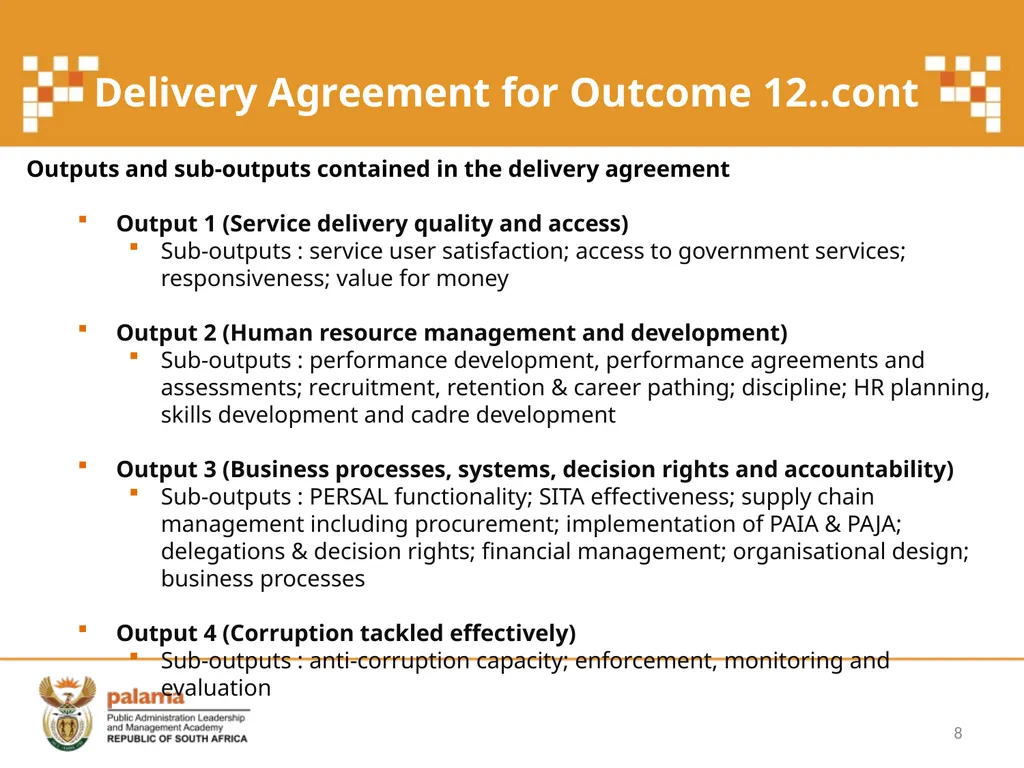
Delivery Agreement for Outcome 12..cont Outputs and sub-outputs contained in the delivery agreement
Output 1 (Service delivery quality and access)
Sub-outputs : service user satisfaction; access to government services; responsiveness; value for money
Output 2 (Human resource management and development)
Sub-outputs : performance development, performance agreements and assessments; recruitment, retention & career pathing; discipline; HR planning, skills development and cadre development
Output 3 (Business processes, systems, decision rights and accountability)
Sub-outputs : PERSAL functionality; SITA effectiveness; supply chain management including procurement; implementation of PAIA & PAJA; delegations & decision rights; financial management; organisational design; business processes
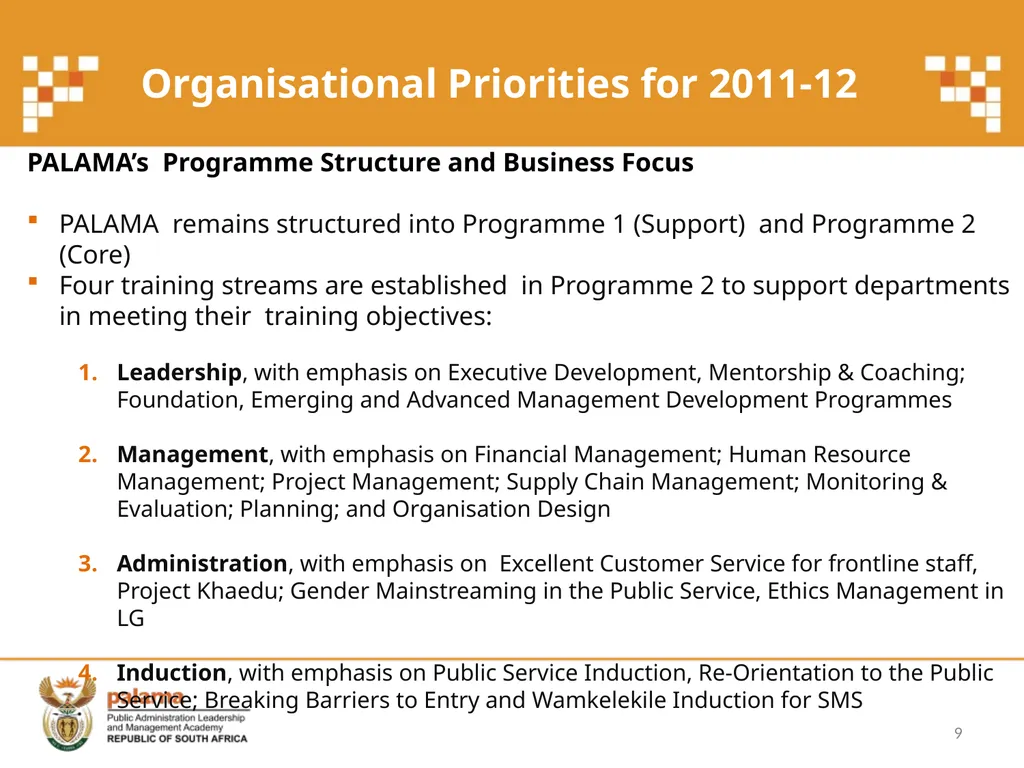
Organisational Priorities for 2011-12 PALAMA’s Programme Structure and Business Focus
PALAMA remains structured into Programme 1 (Support) and Programme 2 (Core)
Four training streams are established in Programme 2 to support departments in meeting their training objectives:
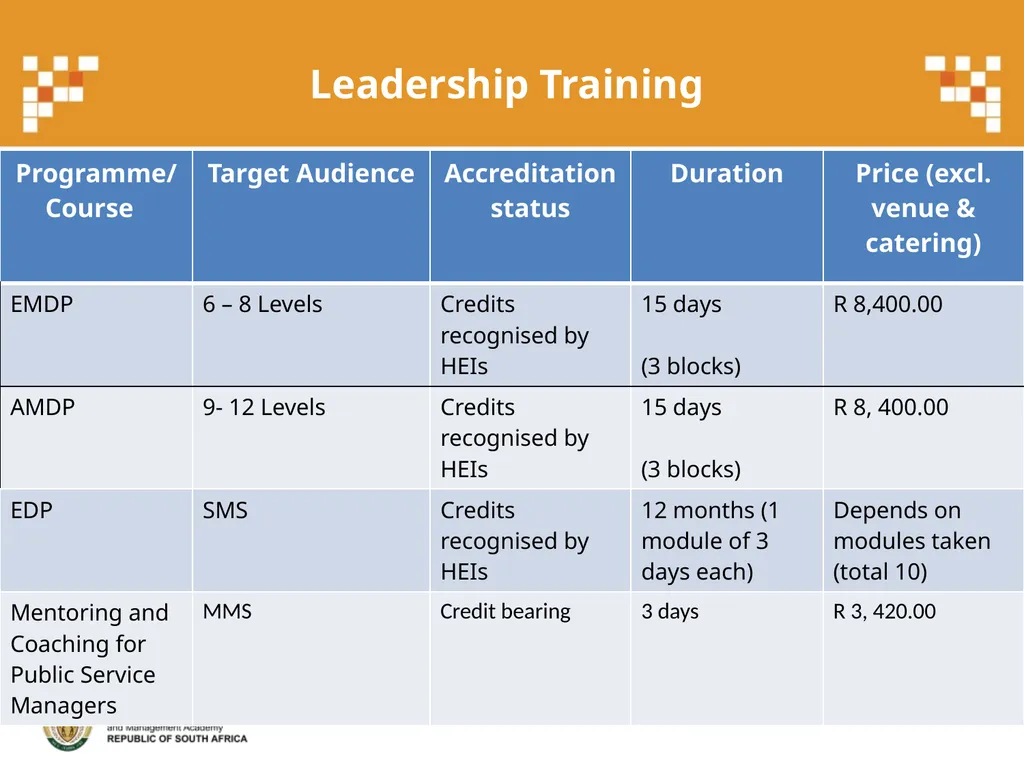
Leadership, with emphasis on Executive Development, Mentorship & Coaching; Foundation, Emerging and Advanced Management Development Programmes
Management, with emphasis on Financial Management; Human Resource Management; Project Management; Supply Chain Management; Monitoring & Evaluation; Planning; and Organisation Design
Administration, with emphasis on Excellent Customer Service for frontline staff, Project Khaedu; Gender Mainstreaming in the Public Service, Ethics Management in LG
Induction, with emphasis on Public Service Induction, Re-Orientation to the Public Service; Breaking Barriers to Entry and Wamkelekile Induction for SMS 9<br>
10
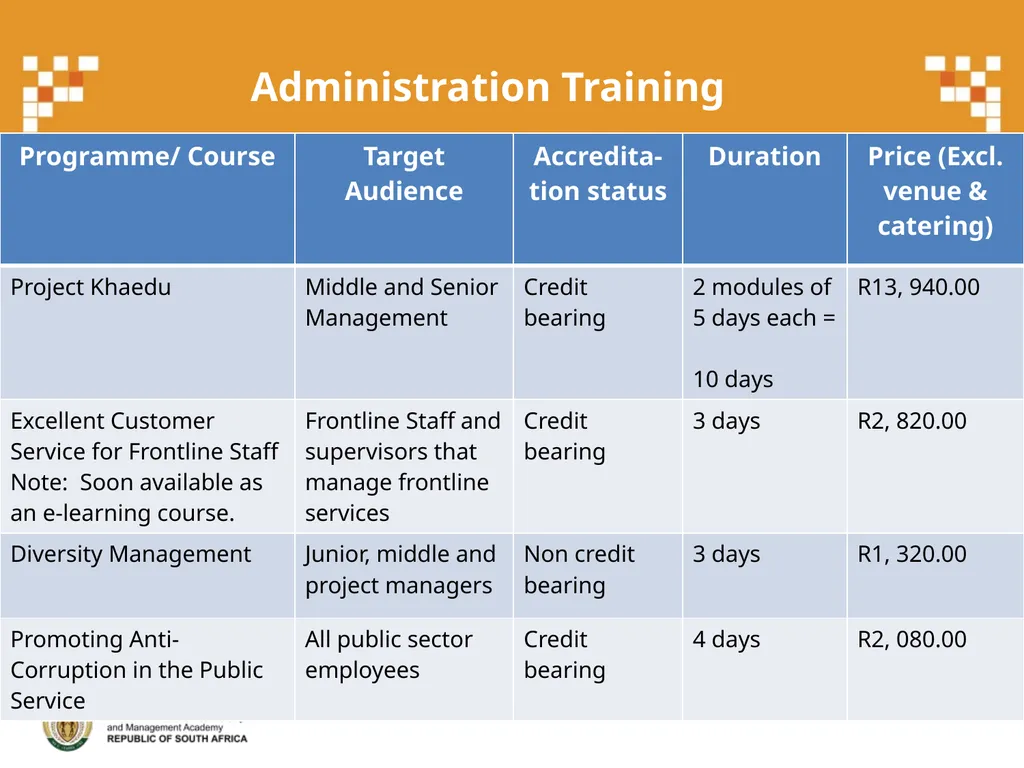
Administration Training<br>
11
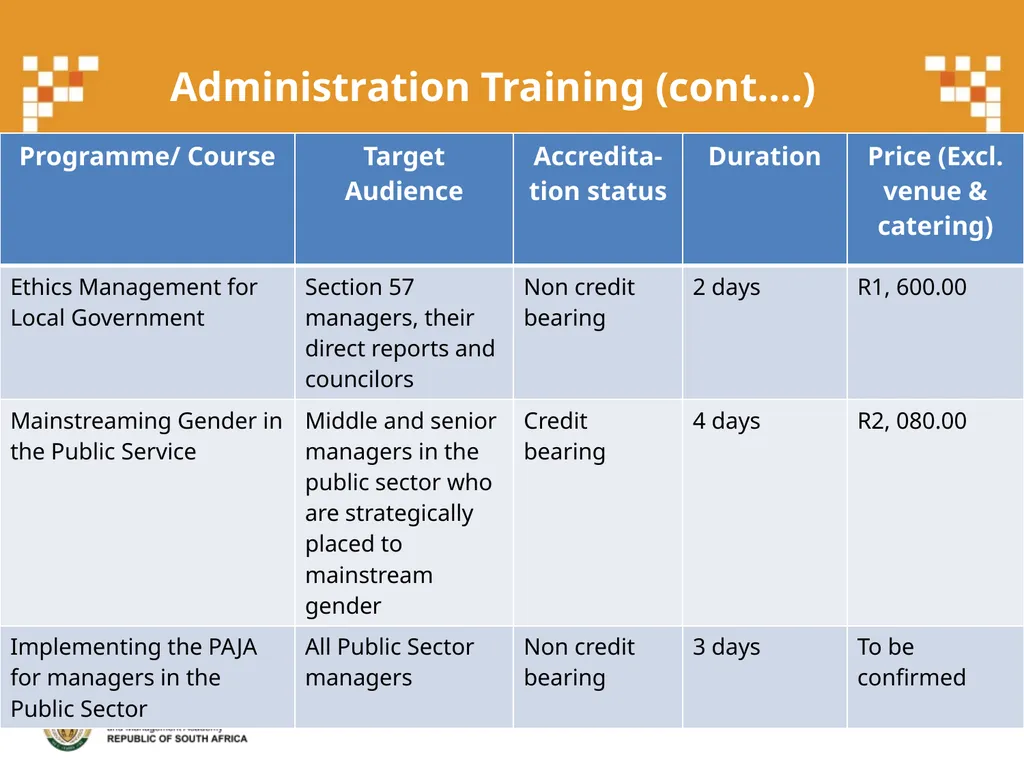
Administration Training (cont….)<br>
12
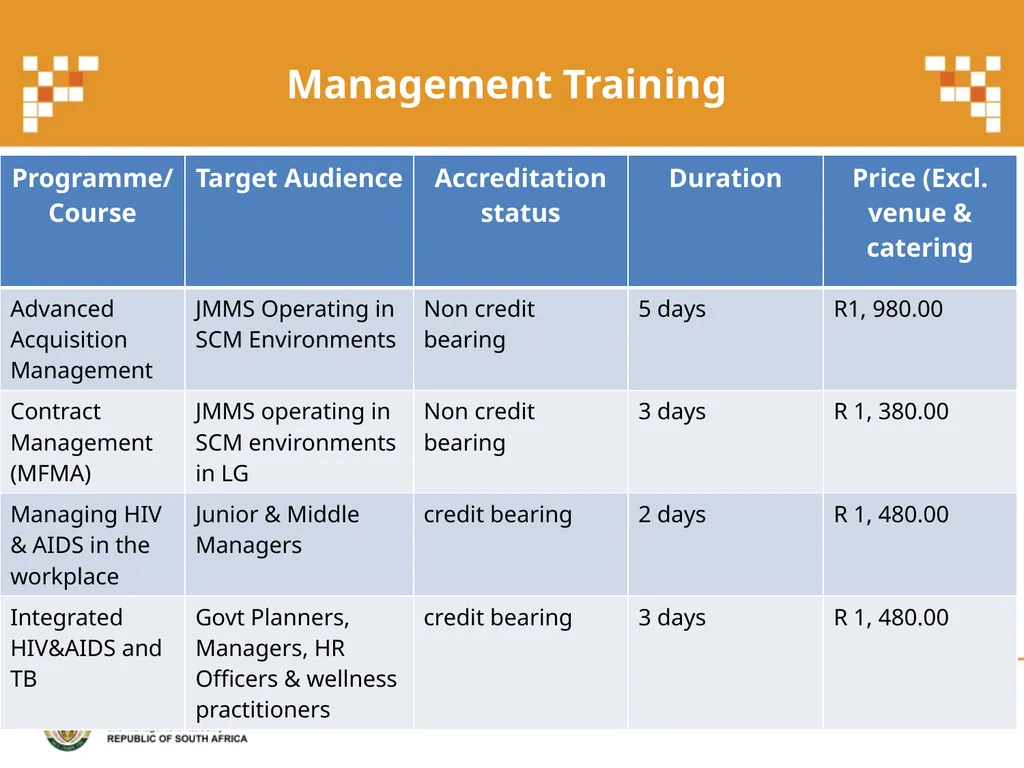
Management Training<br>
13
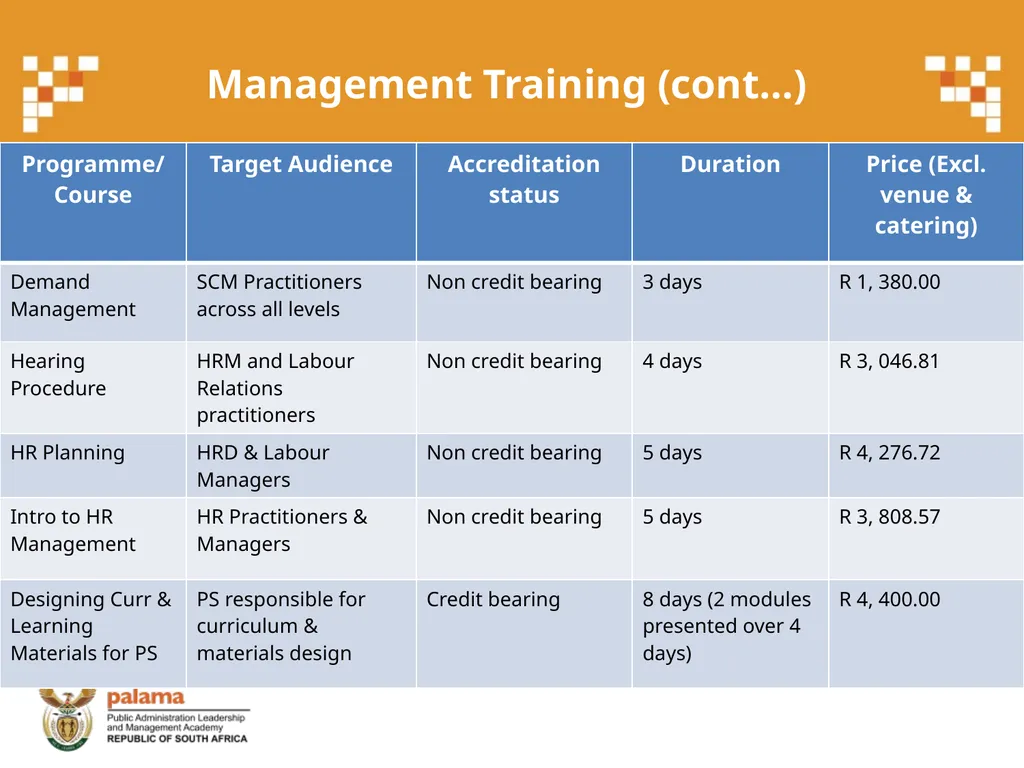
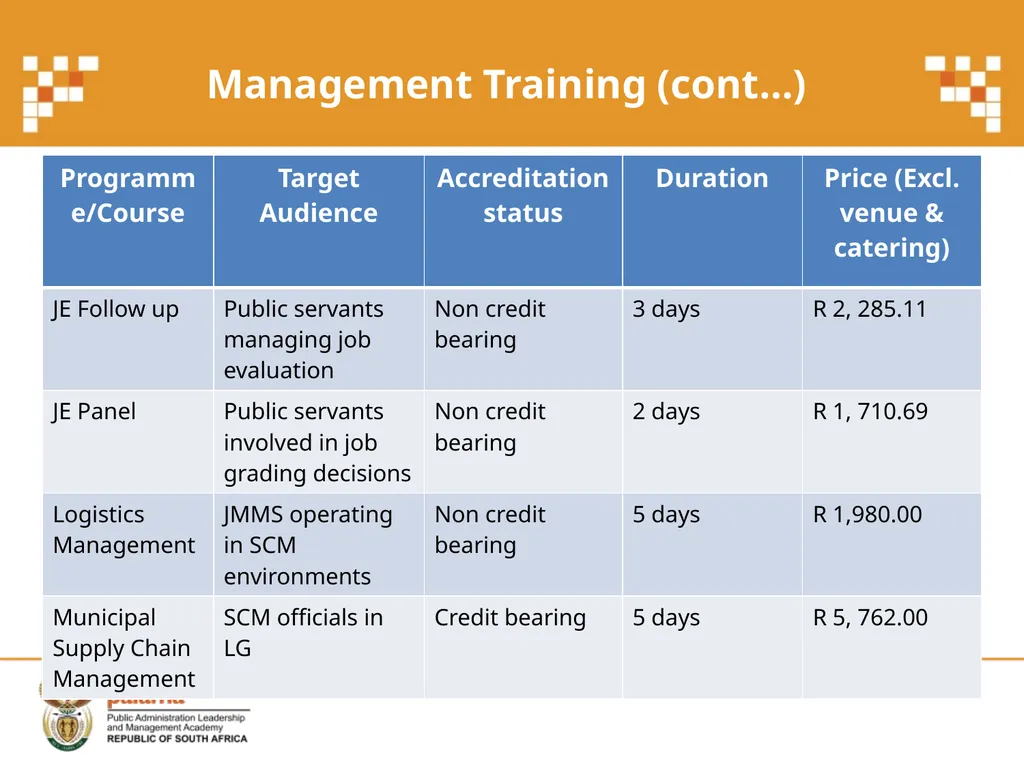
Management Training (cont…)<br>
14
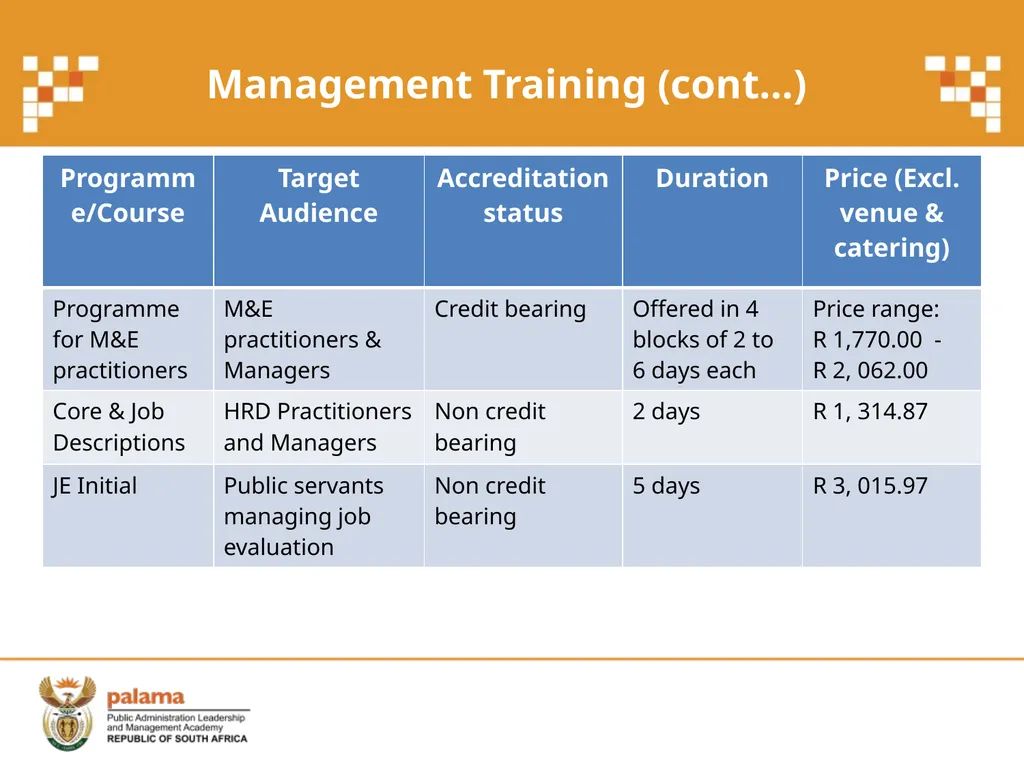
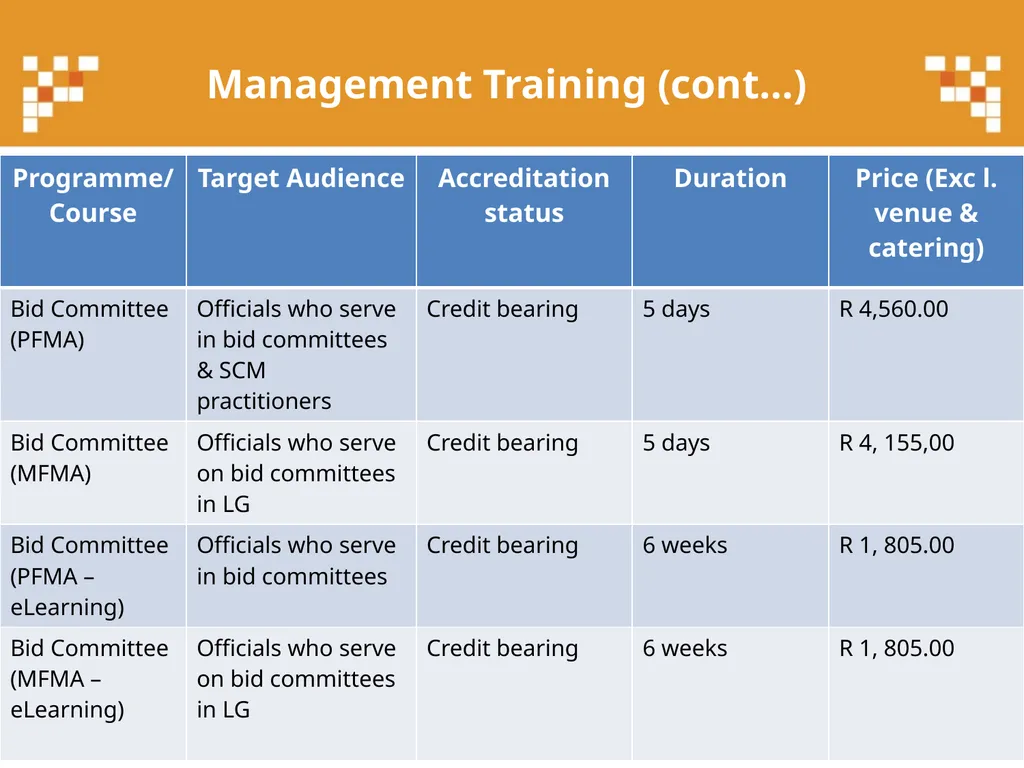
Management Training (cont…)<br>
15
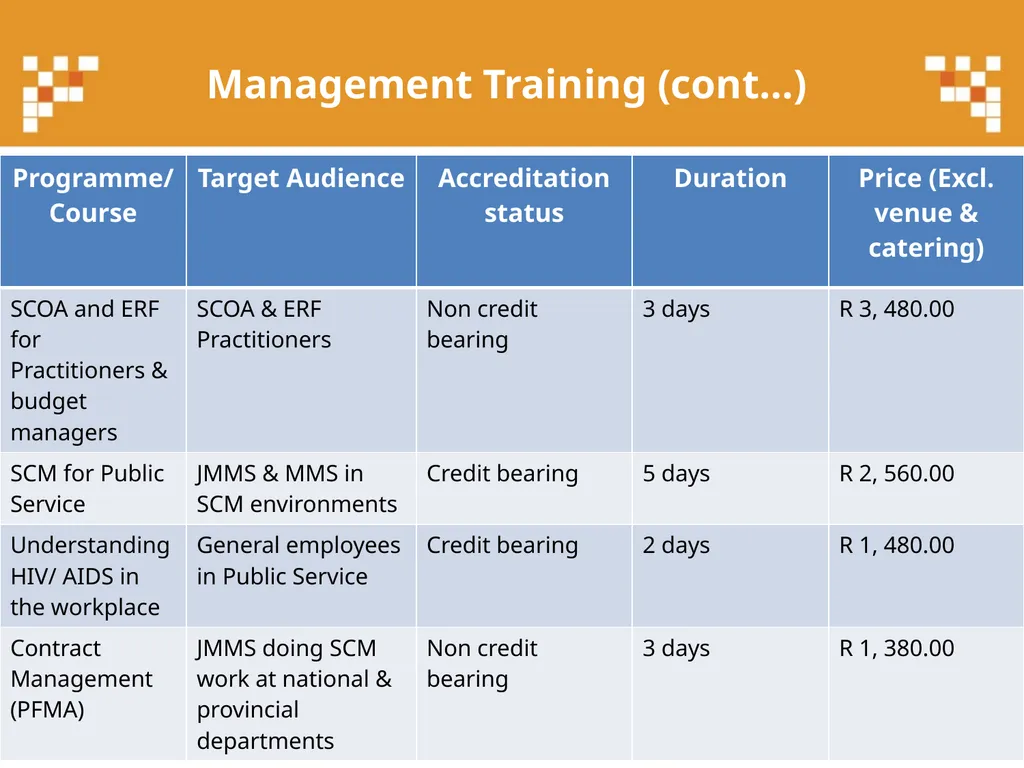
Management Training (cont…)<br>
16
Management Training (cont…)<br>
17
Management Training (cont…)<br>
18
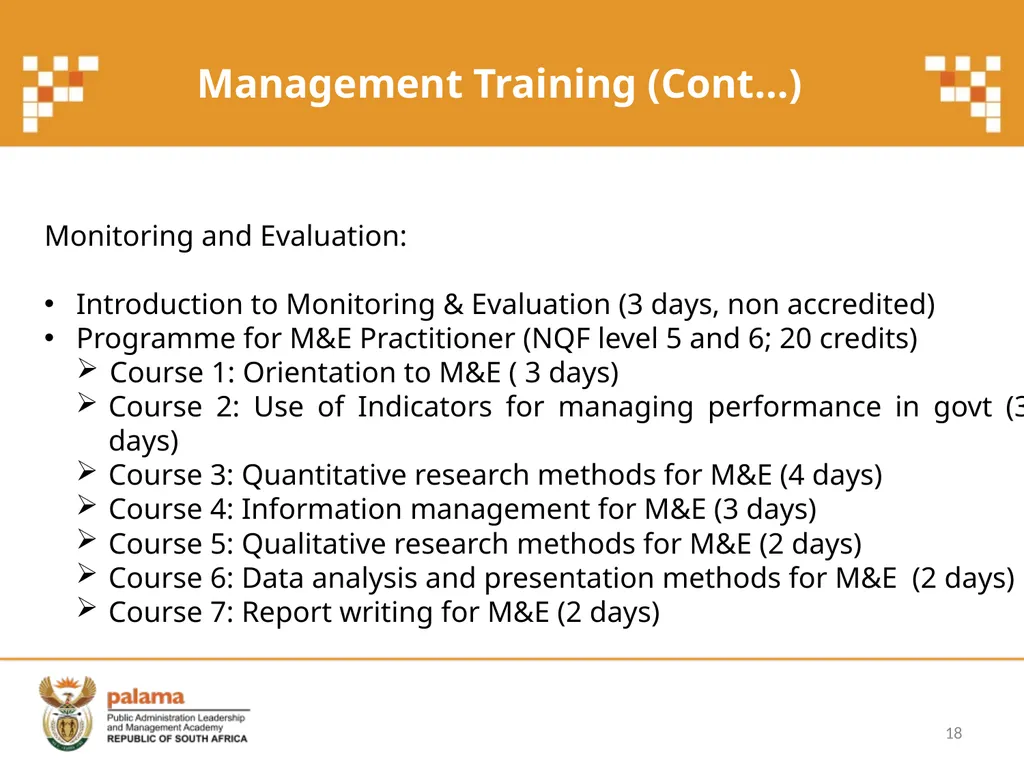
Management Training (Cont…) 18 Monitoring and Evaluation:
Introduction to Monitoring & Evaluation (3 days, non accredited)
Programme for M&E Practitioner (NQF level 5 and 6; 20 credits)
Course 1: Orientation to M&E ( 3 days)
Course 2: Use of Indicators for managing performance in govt (3 days)
Course 3: Quantitative research methods for M&E (4 days)
Course 4: Information management for M&E (3 days)
Course 5: Qualitative research methods for M&E (2 days)
Course 6: Data analysis and presentation methods for M&E (2 days)
Course 7: Report writing for M&E (2 days)<br>
19
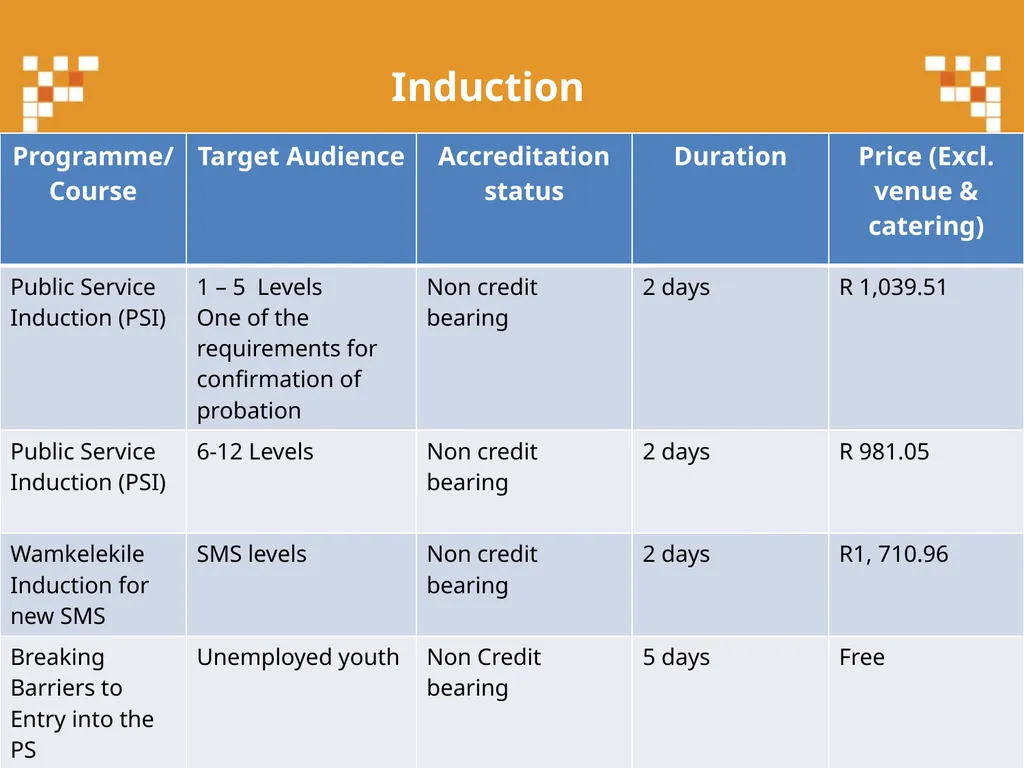
Induction<br>
20
Leadership Training<br>
21
Thank You For more information on our training and services:
To speak to a consultant : Tel 012 441 6777
Written Correspondence: Fax 012 441 6054
To request a quotation: contactcentre@palama.gov.za
Or visit our web site: www.palama.gov.za
Dr Thami Shezi
Director: Marketing
082 415 3390<br>