
PALESTINIAN-ISRAELI PULSE A Joint Poll September
JO
Published · 25 slides · 0 views

1 / 1

Description
PALESTINIAN-ISRAELI PULSE A Joint Poll September 2024 Dr. Khalil Shikaki Dr. Dahlia Scheindlin Dr. Nimrod Rosler Dr. Alon Yakter Funded by the Netherlands Representative Office in Ramallah and the Representative Office of Japan to Palestine
Related Topics
Share
Embed code
Download this presentation From Below
"PALESTINIAN-ISRAELI PULSE A Joint Poll September" is the property of its rightful owner. Permission is granted to download and print the materials on this website for personal, non-commercial use only, and to display it on your personal computer provided you do not modify the materials and that you retain all copyright notices contained in the materials. By downloading content from our website, you accept the terms of this agreement.
Presentation Transcript
01
PALESTINIAN-ISRAELI PULSE
A Joint Poll September 2024 Dr. Khalil Shikaki
Dr. Dahlia Scheindlin
Dr. Nimrod Rosler
Dr. Alon Yakter Funded by the Netherlands Representative Office in Ramallah and the Representative Office of Japan to Palestine through UNDP/PAPP<br>
A Joint Poll September 2024 Dr. Khalil Shikaki
Dr. Dahlia Scheindlin
Dr. Nimrod Rosler
Dr. Alon Yakter Funded by the Netherlands Representative Office in Ramallah and the Representative Office of Japan to Palestine through UNDP/PAPP<br>
02
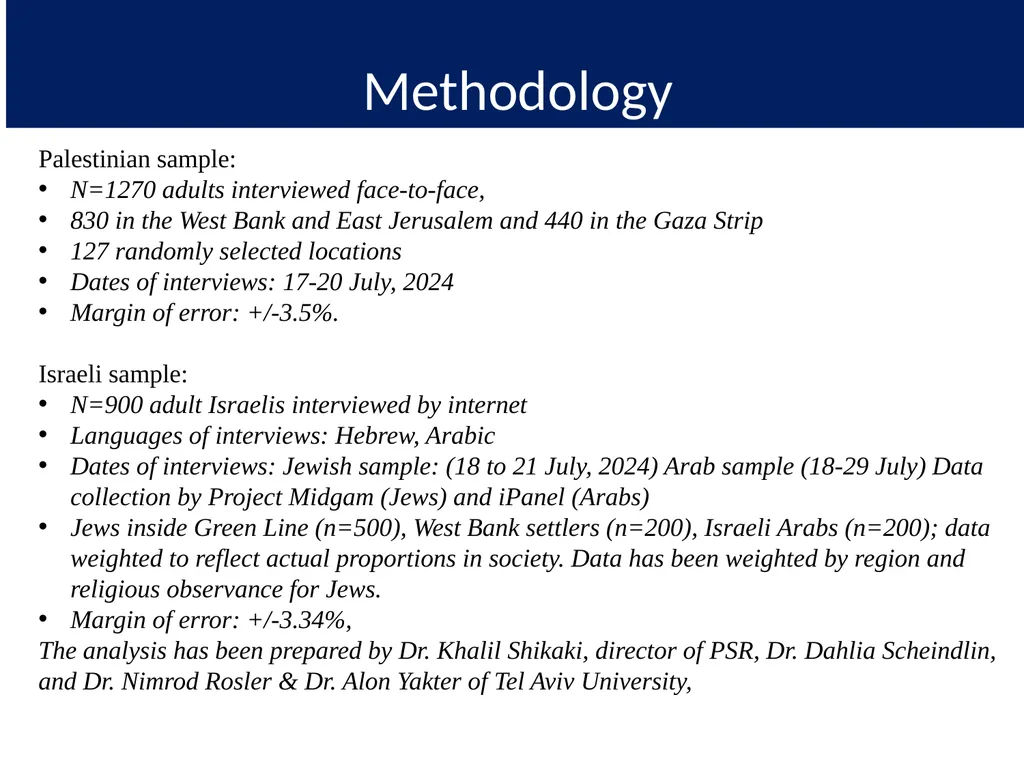
Methodology Palestinian sample:
N=1270 adults interviewed face-to-face,
830 in the West Bank and East Jerusalem and 440 in the Gaza Strip
127 randomly selected locations
Dates of interviews: 17-20 July, 2024
Margin of error: +/-3.5%.
Israeli sample:
N=900 adult Israelis interviewed by internet
Languages of interviews: Hebrew, Arabic
Dates of interviews: Jewish sample: (18 to 21 July, 2024) Arab sample (18-29 July) Data collection by Project Midgam (Jews) and iPanel (Arabs)
Jews inside Green Line (n=500), West Bank settlers (n=200), Israeli Arabs (n=200); data weighted to reflect actual proportions in society. Data has been weighted by region and religious observance for Jews.
Margin of error: +/-3.34%,
The analysis has been prepared by Dr. Khalil Shikaki, director of PSR, Dr. Dahlia Scheindlin, and Dr. Nimrod Rosler & Dr. Alon Yakter of Tel Aviv University,<br>
N=1270 adults interviewed face-to-face,
830 in the West Bank and East Jerusalem and 440 in the Gaza Strip
127 randomly selected locations
Dates of interviews: 17-20 July, 2024
Margin of error: +/-3.5%.
Israeli sample:
N=900 adult Israelis interviewed by internet
Languages of interviews: Hebrew, Arabic
Dates of interviews: Jewish sample: (18 to 21 July, 2024) Arab sample (18-29 July) Data collection by Project Midgam (Jews) and iPanel (Arabs)
Jews inside Green Line (n=500), West Bank settlers (n=200), Israeli Arabs (n=200); data weighted to reflect actual proportions in society. Data has been weighted by region and religious observance for Jews.
Margin of error: +/-3.34%,
The analysis has been prepared by Dr. Khalil Shikaki, director of PSR, Dr. Dahlia Scheindlin, and Dr. Nimrod Rosler & Dr. Alon Yakter of Tel Aviv University,<br>
03
Current Issues:
October 7, Israel-Gaza war,
Middle East war & peace<br>
October 7, Israel-Gaza war,
Middle East war & peace<br>
04
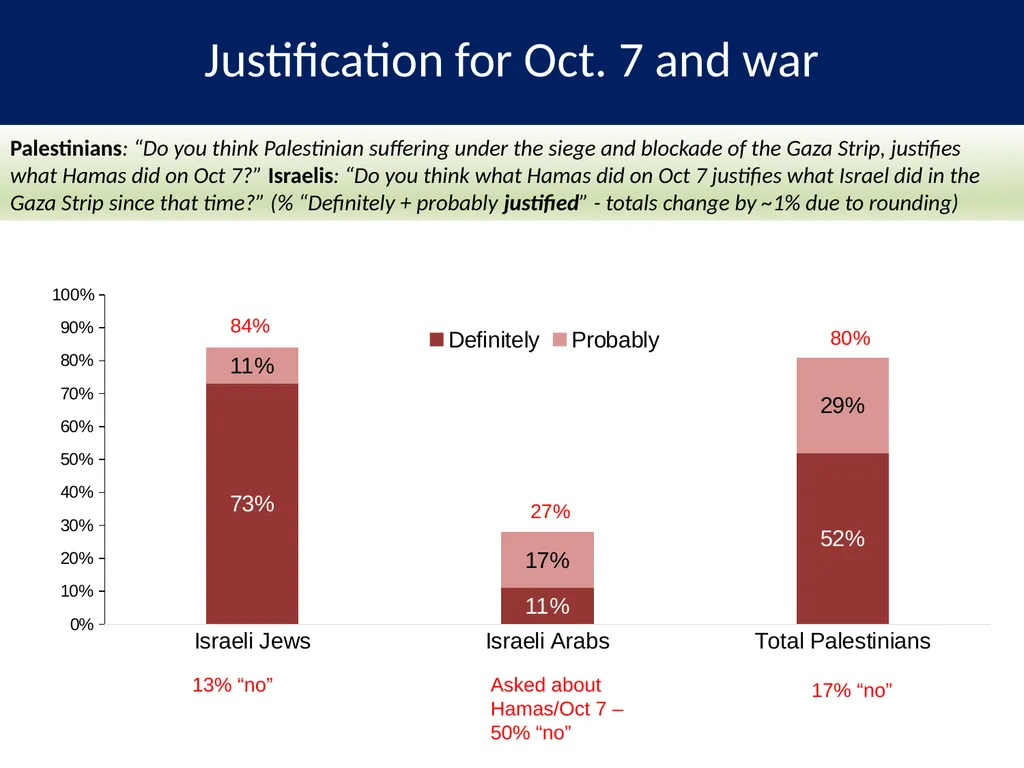
Palestinians: “Do you think Palestinian suffering under the siege and blockade of the Gaza Strip, justifies what Hamas did on Oct 7?” Israelis: “Do you think what Hamas did on Oct 7 justifies what Israel did in the Gaza Strip since that time?” (% “Definitely + probably justified” - totals change by ~1% due to rounding) Justification for Oct. 7 and war Asked about Hamas/Oct 7 – 50% “no” 84% 13% “no” 17% “no”<br>
05
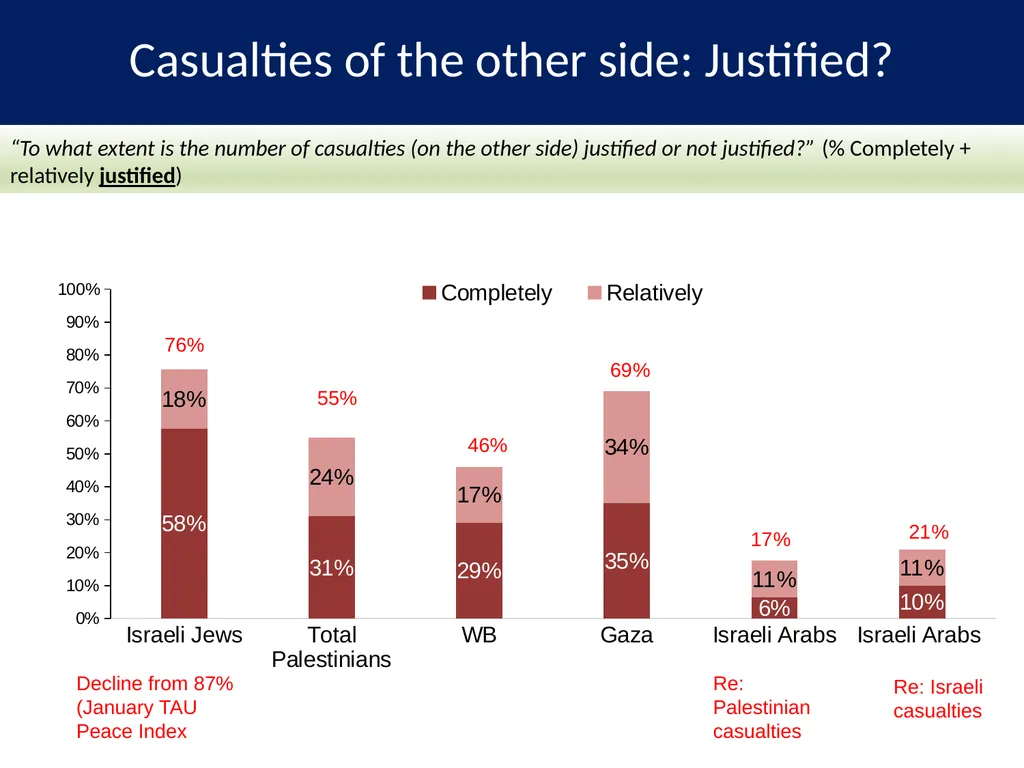
“To what extent is the number of casualties (on the other side) justified or not justified?” (% Completely + relatively justified) Casualties of the other side: Justified? Re: Palestinian casualties 76% Re: Israeli casualties 55% 46% Decline from 87% (January TAU Peace Index<br>
06
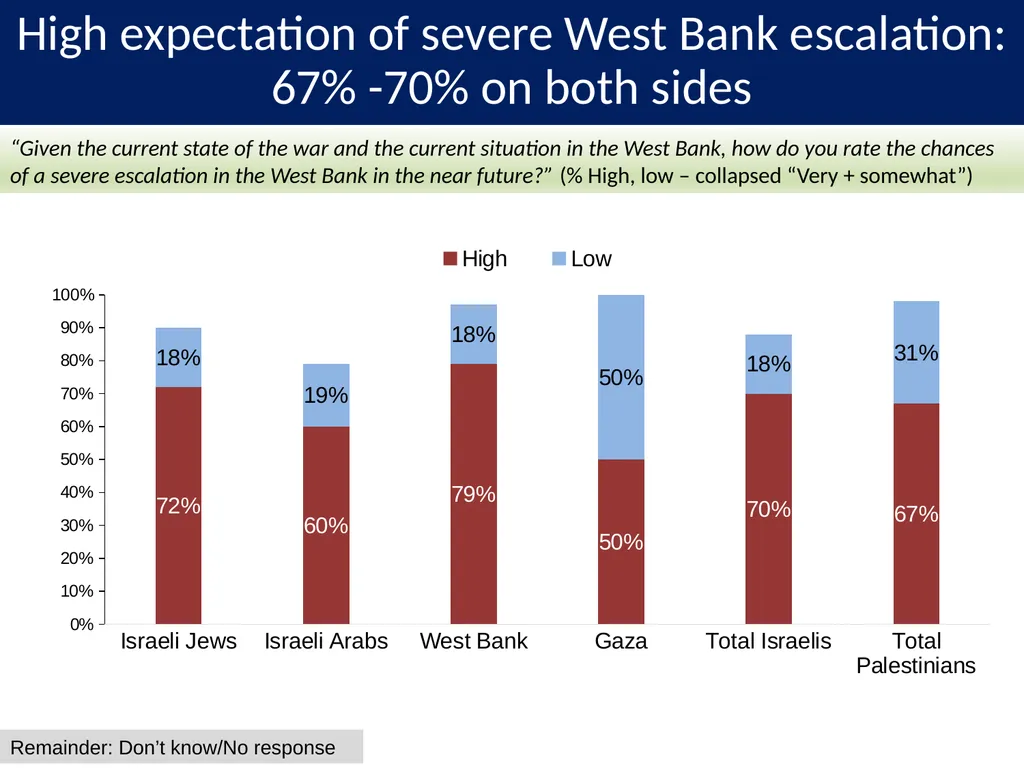
“Given the current state of the war and the current situation in the West Bank, how do you rate the chances of a severe escalation in the West Bank in the near future?” (% High, low – collapsed “Very + somewhat”) High expectation of severe West Bank escalation: 67% -70% on both sides Remainder: Don’t know/No response<br>
07
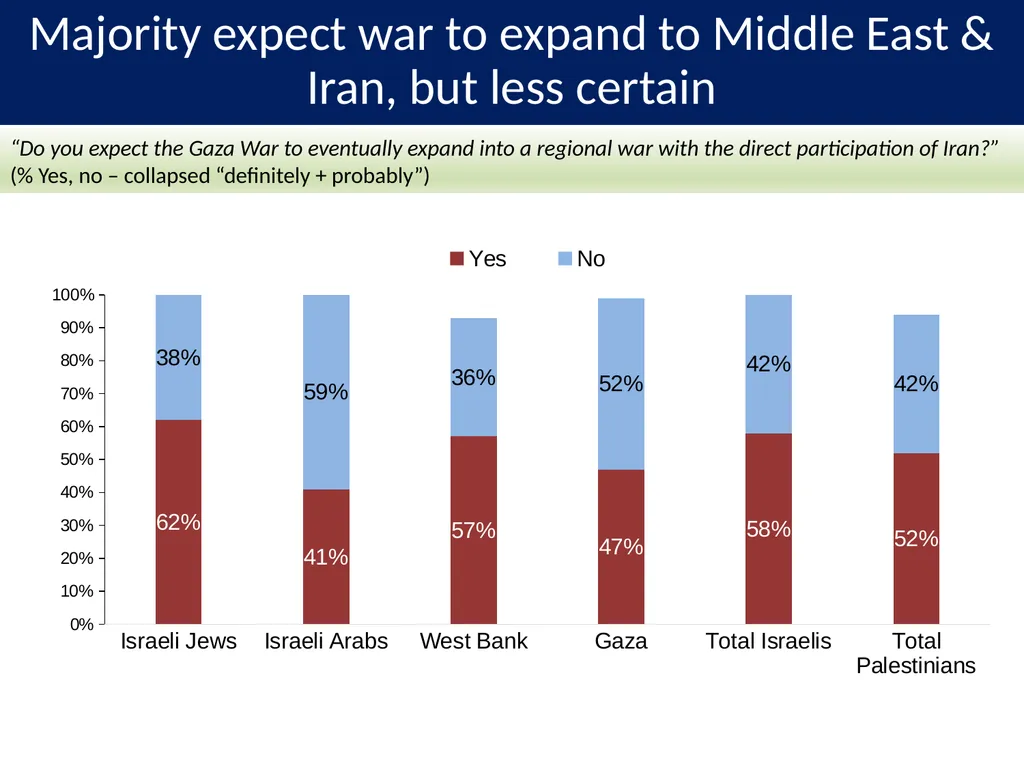
“Do you expect the Gaza War to eventually expand into a regional war with the direct participation of Iran?” (% Yes, no – collapsed “definitely + probably”) Majority expect war to expand to Middle East & Iran, but less certain<br>
08
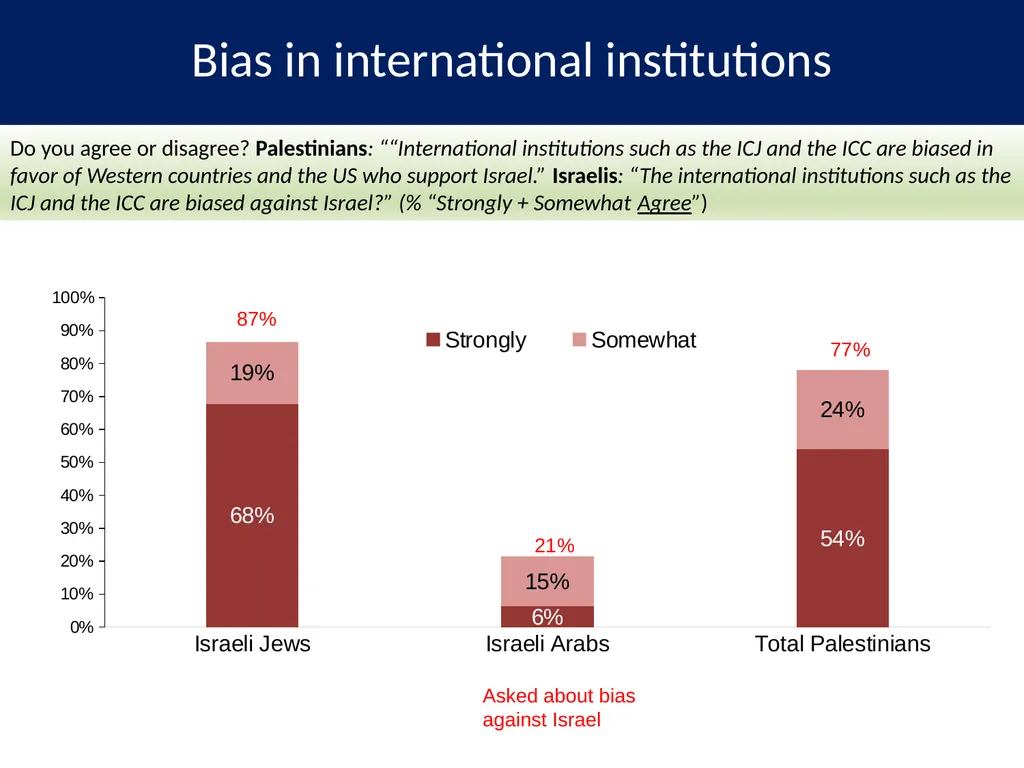
Do you agree or disagree? Palestinians: ““International institutions such as the ICJ and the ICC are biased in favor of Western countries and the US who support Israel.” Israelis: “The international institutions such as the ICJ and the ICC are biased against Israel?” (% “Strongly + Somewhat Agree”) Bias in international institutions Asked about bias against Israel 87%<br>
09
Long-term:
Two-state solution –
prospects & alternatives<br>
Two-state solution –
prospects & alternatives<br>
10
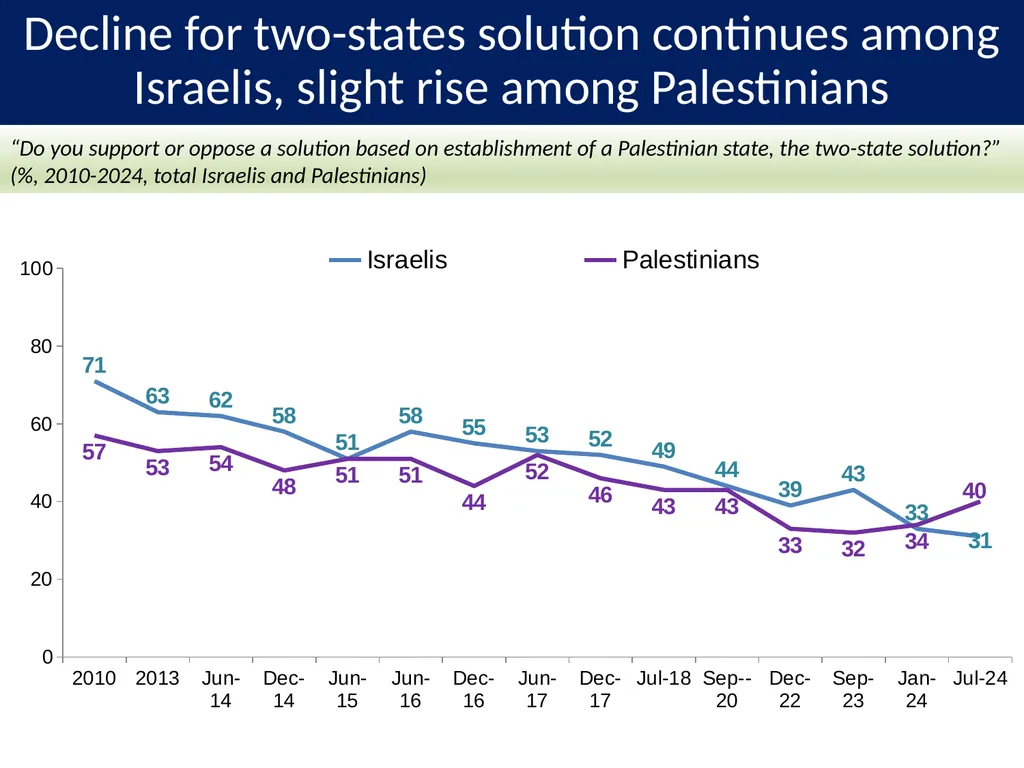
“Do you support or oppose a solution based on establishment of a Palestinian state, the two-state solution?” (%, 2010-2024, total Israelis and Palestinians) Decline for two-states solution continues among Israelis, slight rise among Palestinians<br>
11
Comparison: Israeli Jewish attitudes 1990s-2000s
(Question wording does not use term “two state solution”) Yehuda Ben Meir, Olena Bagno-Moldavsky: Vox Pop: Israel PO 2004-2009, INSS (Jewish population only) *’78: Reported in news article Do you support or oppose creation of Palestinian state (% support)<br>
12
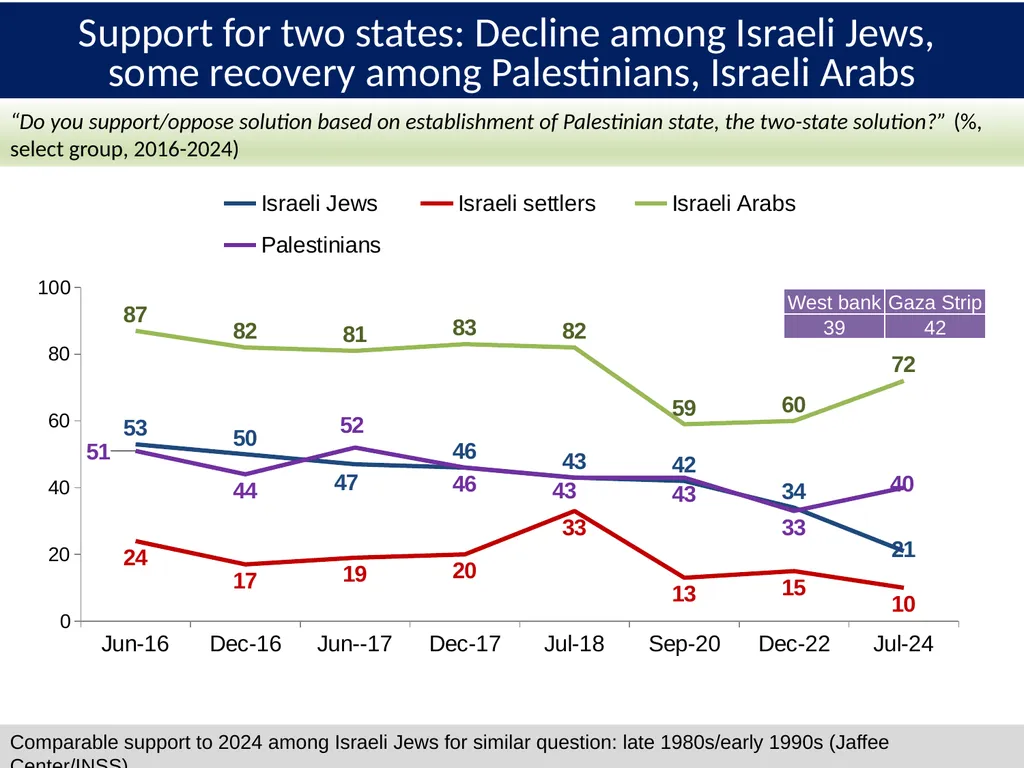
“Do you support/oppose solution based on establishment of Palestinian state, the two-state solution?” (%, select group, 2016-2024) Support for two states: Decline among Israeli Jews,
some recovery among Palestinians, Israeli Arabs Comparable support to 2024 among Israeli Jews for similar question: late 1980s/early 1990s (Jaffee Center/INSS)<br>
some recovery among Palestinians, Israeli Arabs Comparable support to 2024 among Israeli Jews for similar question: late 1980s/early 1990s (Jaffee Center/INSS)<br>
13
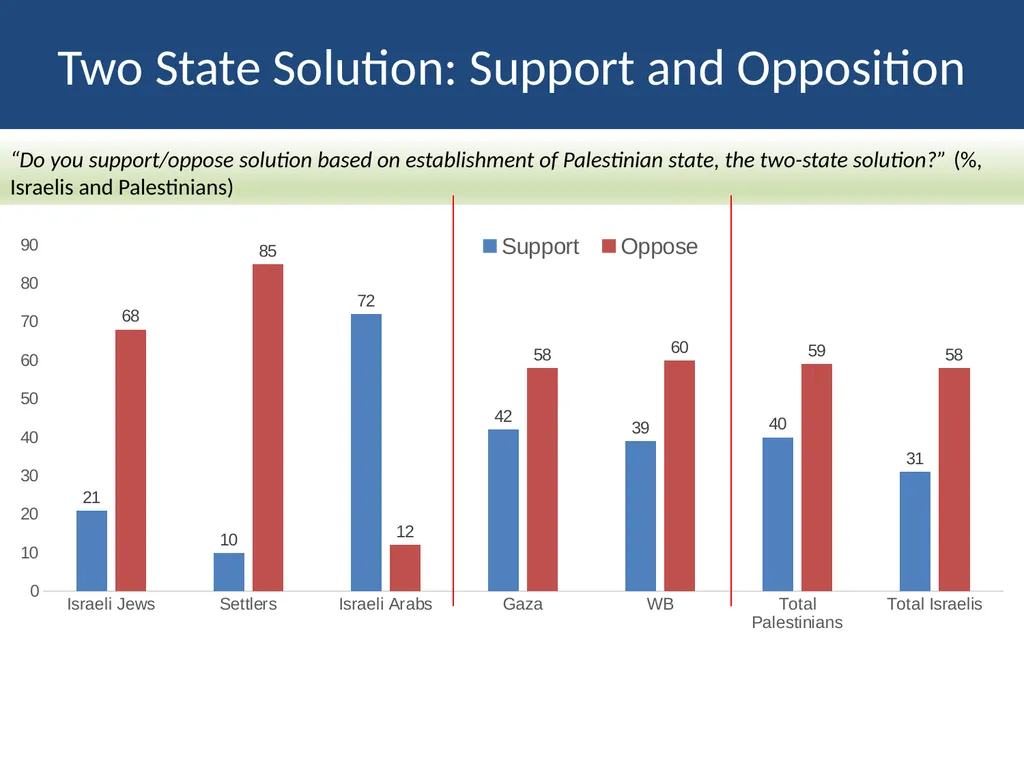
Two State Solution: Support and Opposition “Do you support/oppose solution based on establishment of Palestinian state, the two-state solution?” (%, Israelis and Palestinians)<br>
14
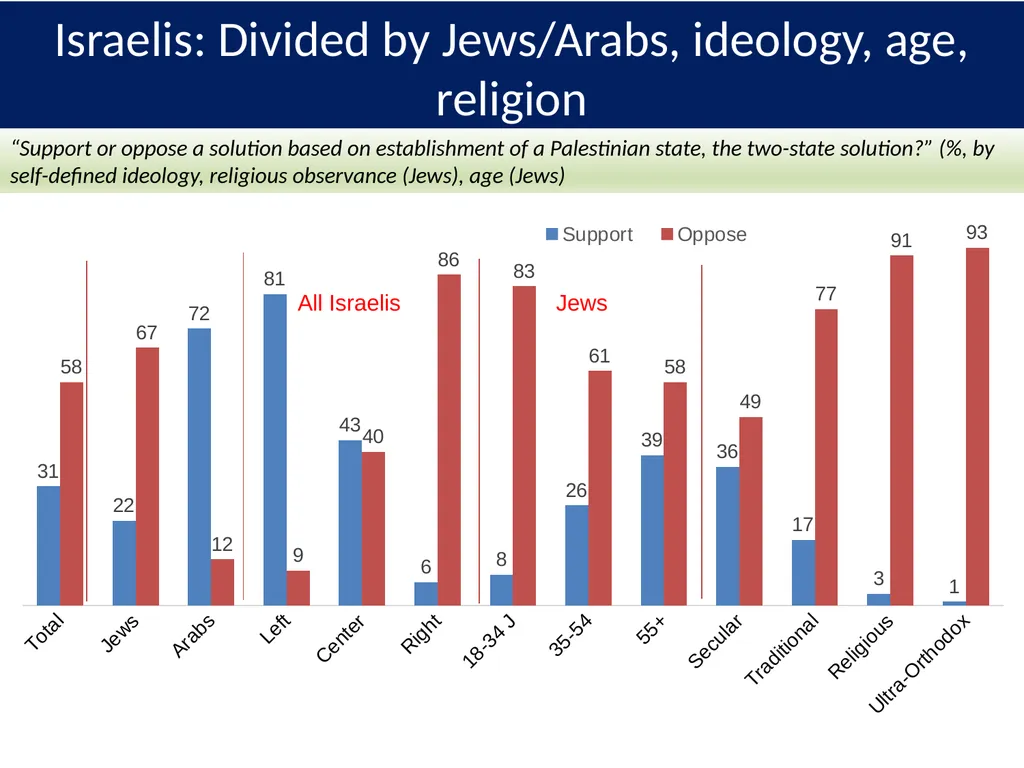
Israelis: Divided by Jews/Arabs, ideology, age, religion “Support or oppose a solution based on establishment of a Palestinian state, the two-state solution?” (%, by self-defined ideology, religious observance (Jews), age (Jews) All Israelis Jews<br>
15
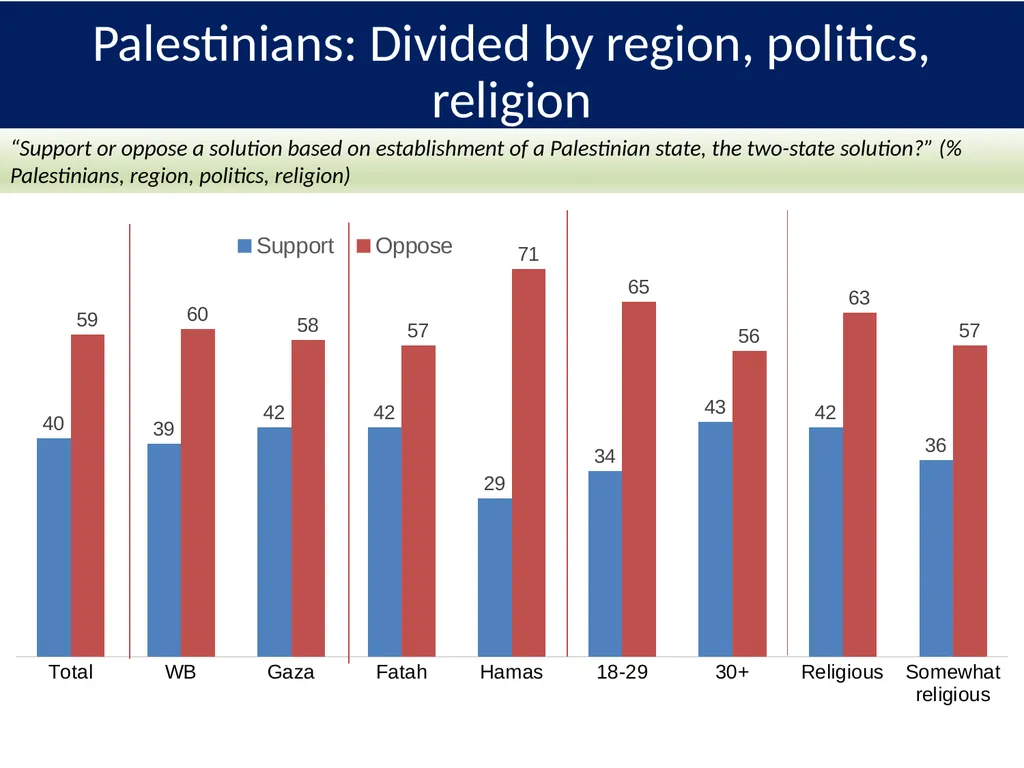
Palestinians: Divided by region, politics, religion “Support or oppose a solution based on establishment of a Palestinian state, the two-state solution?” (% Palestinians, region, politics, religion)<br>
16
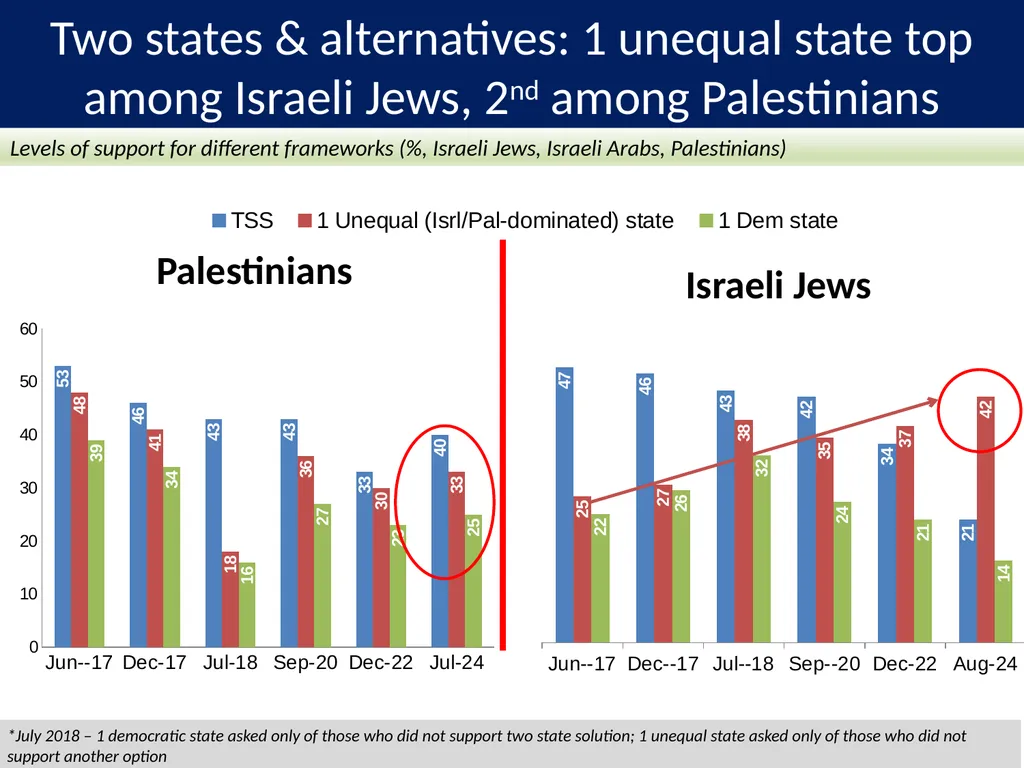
Two states & alternatives: 1 unequal state top among Israeli Jews, 2nd among Palestinians Levels of support for different frameworks (%, Israeli Jews, Israeli Arabs, Palestinians) Palestinians Israeli Jews *July 2018 – 1 democratic state asked only of those who did not support two state solution; 1 unequal state asked only of those who did not support another option<br>
17
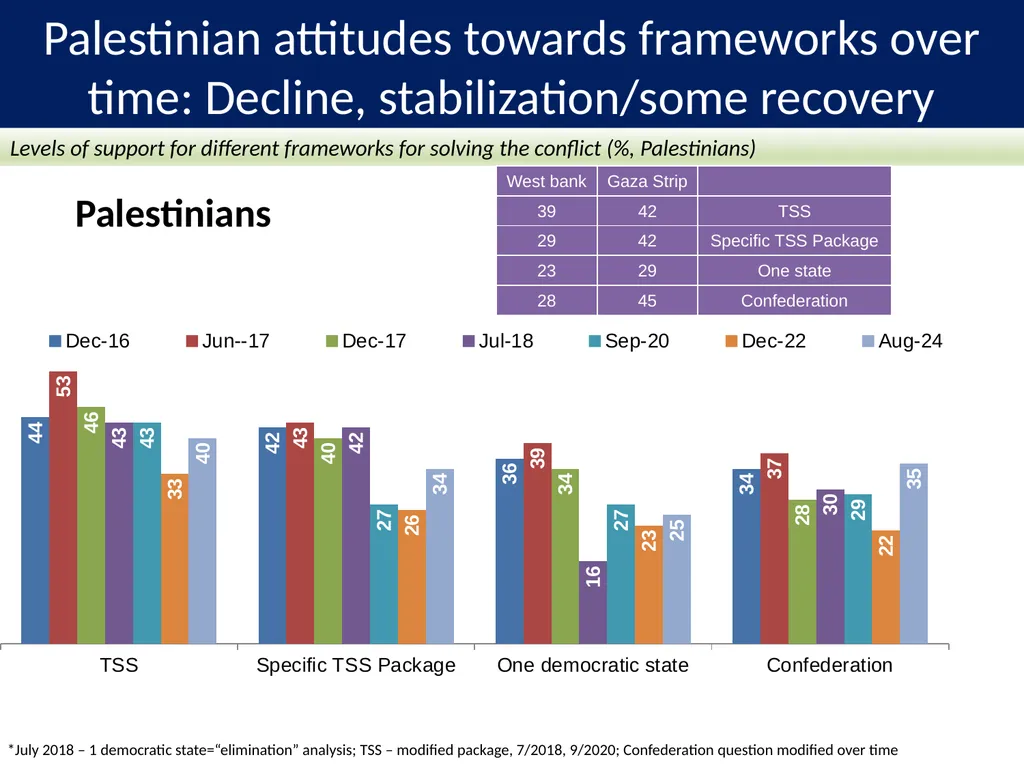
Palestinian attitudes towards frameworks over time: Decline, stabilization/some recovery Levels of support for different frameworks for solving the conflict (%, Palestinians) *July 2018 – 1 democratic state=“elimination” analysis; TSS – modified package, 7/2018, 9/2020; Confederation question modified over time Palestinians<br>
18
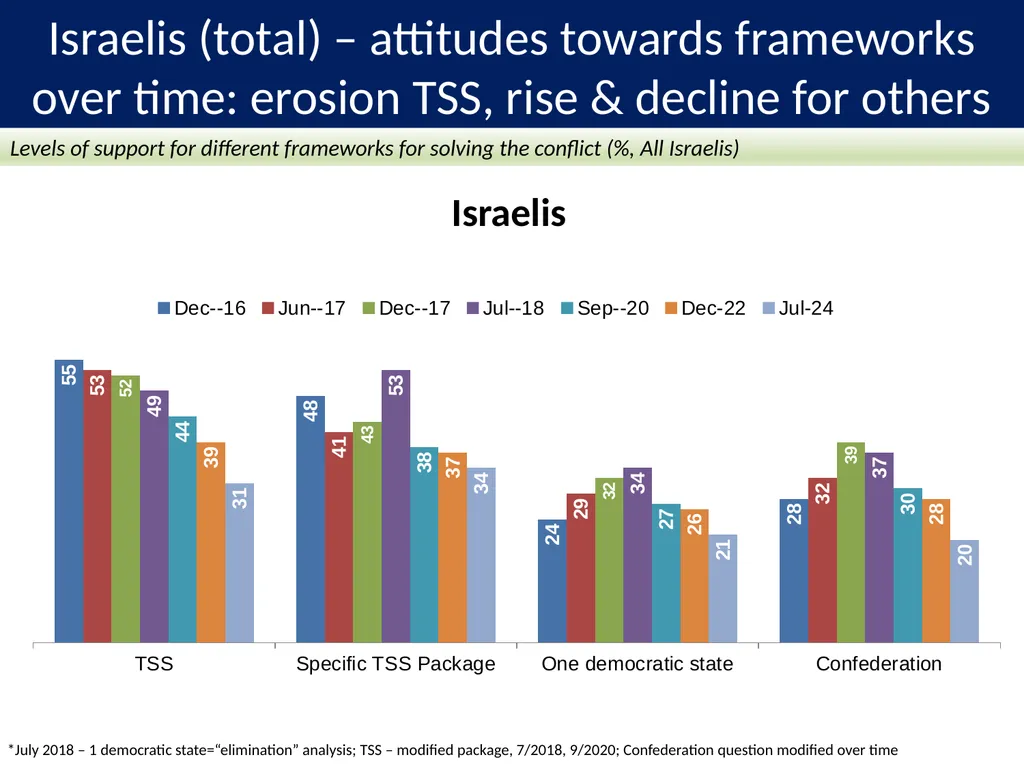
Israelis (total) – attitudes towards frameworks over time: erosion TSS, rise & decline for others Levels of support for different frameworks for solving the conflict (%, All Israelis) *July 2018 – 1 democratic state=“elimination” analysis; TSS – modified package, 7/2018, 9/2020; Confederation question modified over time Israelis<br>
19
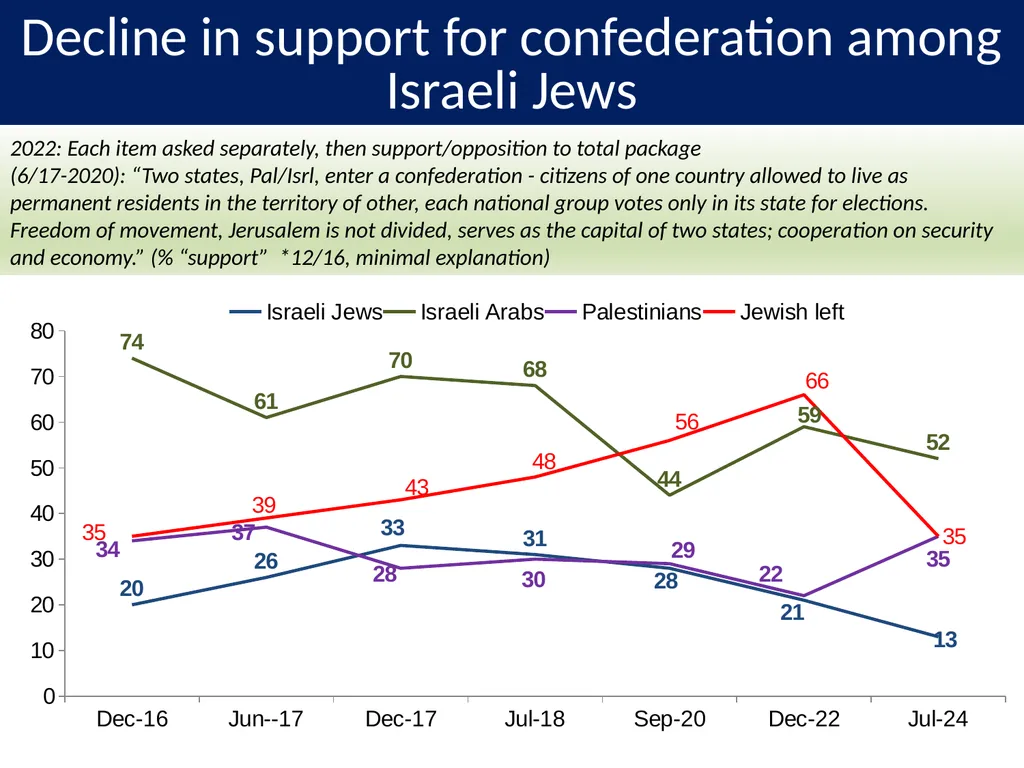
Decline in support for confederation among Israeli Jews 2022: Each item asked separately, then support/opposition to total package
(6/17-2020): “Two states, Pal/Isrl, enter a confederation - citizens of one country allowed to live as permanent residents in the territory of other, each national group votes only in its state for elections. Freedom of movement, Jerusalem is not divided, serves as the capital of two states; cooperation on security and economy.” (% “support” *12/16, minimal explanation)<br>
(6/17-2020): “Two states, Pal/Isrl, enter a confederation - citizens of one country allowed to live as permanent residents in the territory of other, each national group votes only in its state for elections. Freedom of movement, Jerusalem is not divided, serves as the capital of two states; cooperation on security and economy.” (% “support” *12/16, minimal explanation)<br>
20
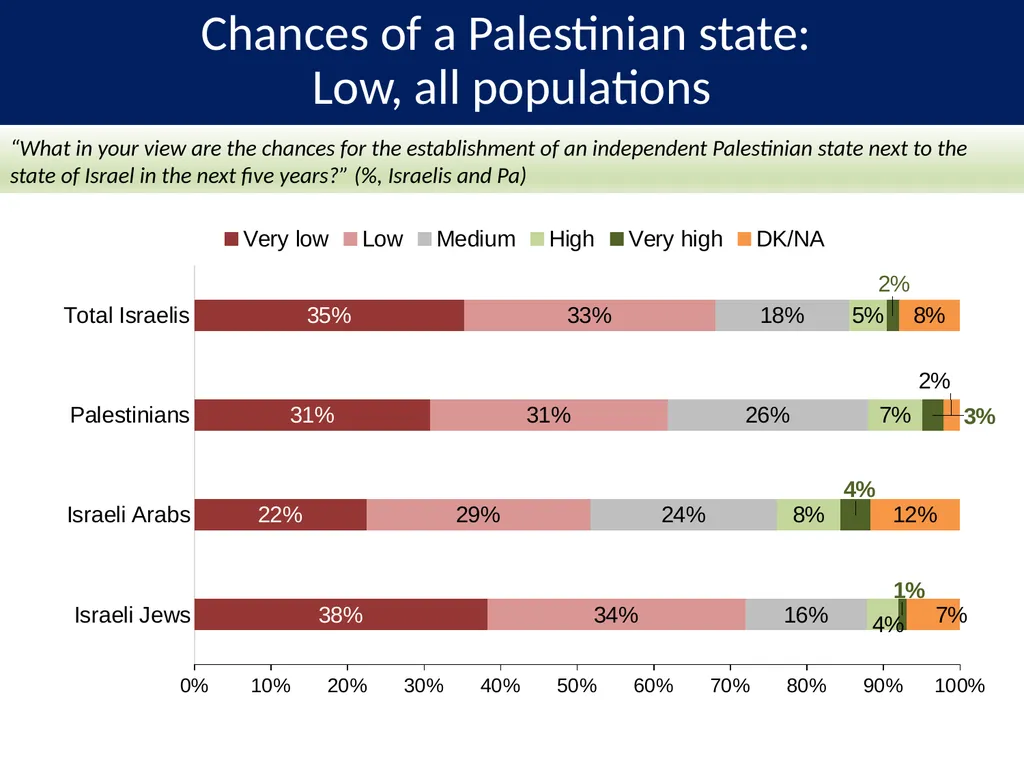
“What in your view are the chances for the establishment of an independent Palestinian state next to the state of Israel in the next five years?” (%, Israelis and Pa) Chances of a Palestinian state:
Low, all populations<br>
Low, all populations<br>
21
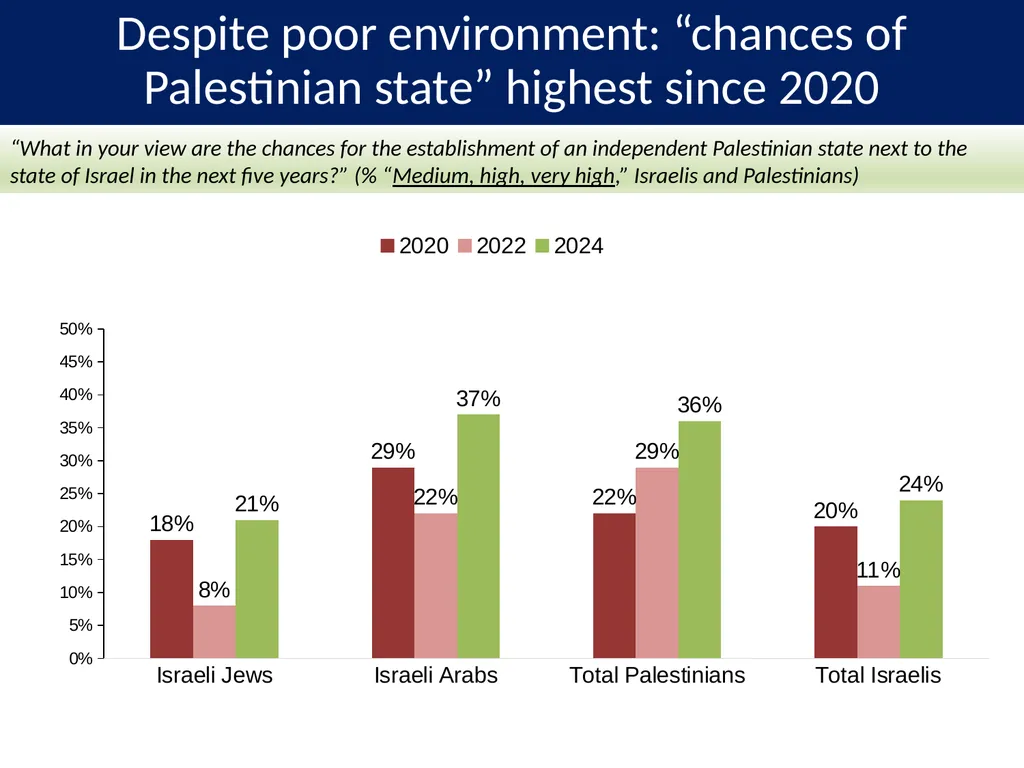
“What in your view are the chances for the establishment of an independent Palestinian state next to the state of Israel in the next five years?” (% “Medium, high, very high,” Israelis and Palestinians) Despite poor environment: “chances of Palestinian state” highest since 2020<br>
22
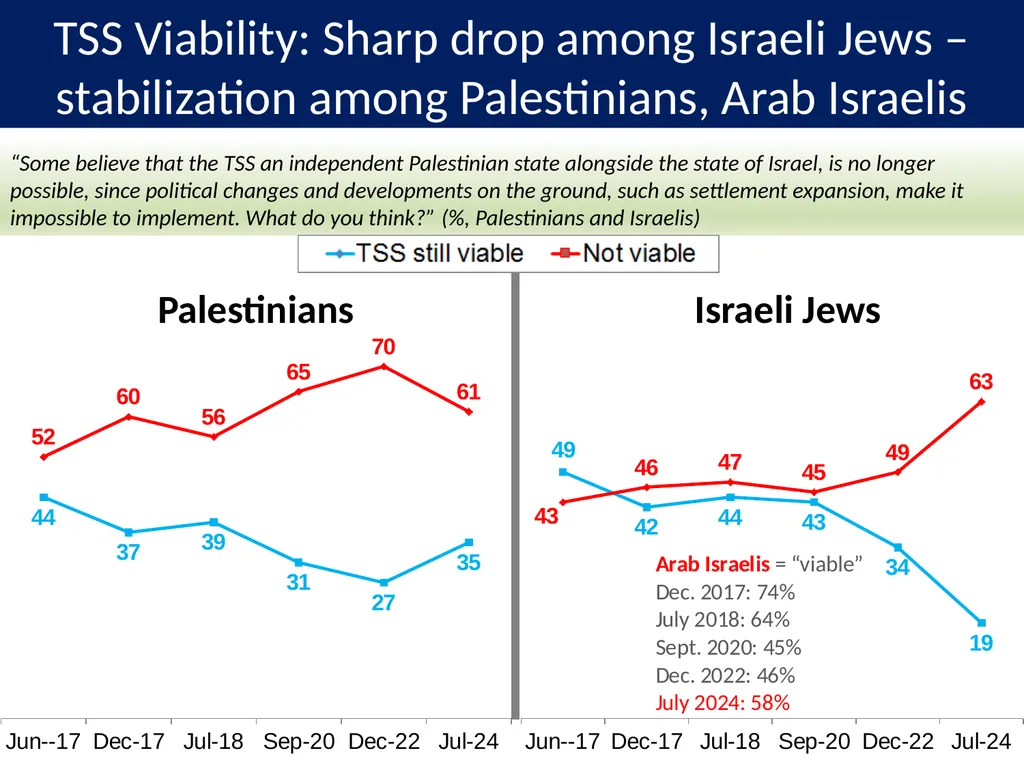
TSS Viability: Sharp drop among Israeli Jews – stabilization among Palestinians, Arab Israelis “Some believe that the TSS an independent Palestinian state alongside the state of Israel, is no longer possible, since political changes and developments on the ground, such as settlement expansion, make it impossible to implement. What do you think?” (%, Palestinians and Israelis) Palestinians Israeli Jews<br>
23
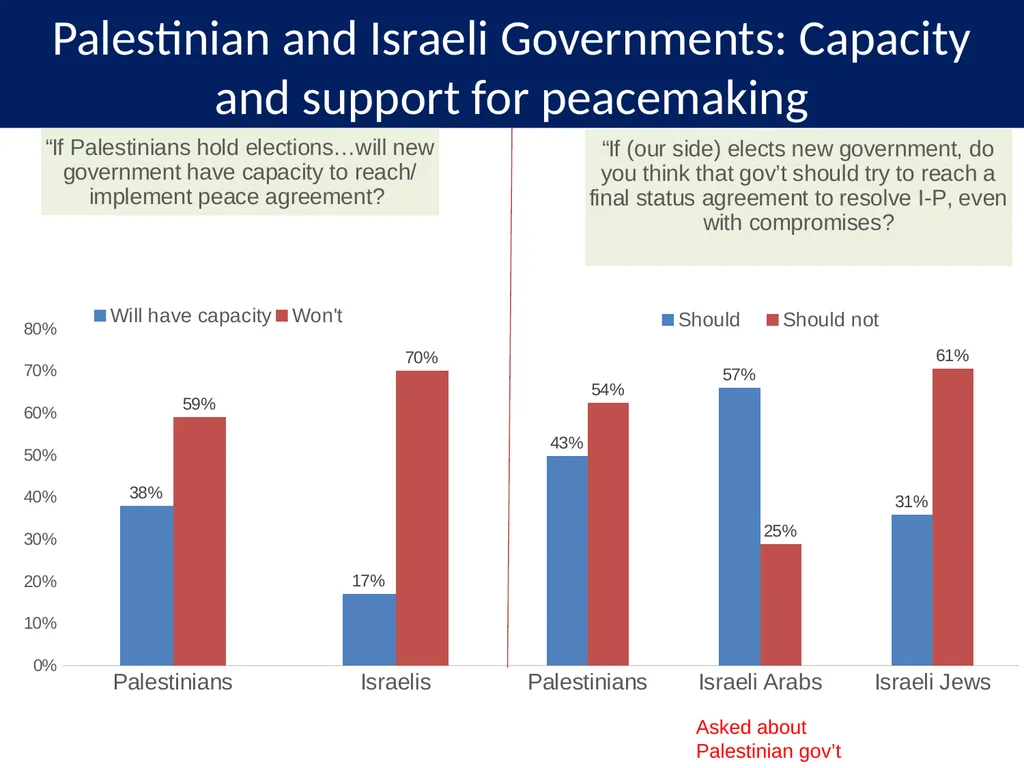
Palestinian and Israeli Governments: Capacity and support for peacemaking Asked about Palestinian gov’t<br>
24
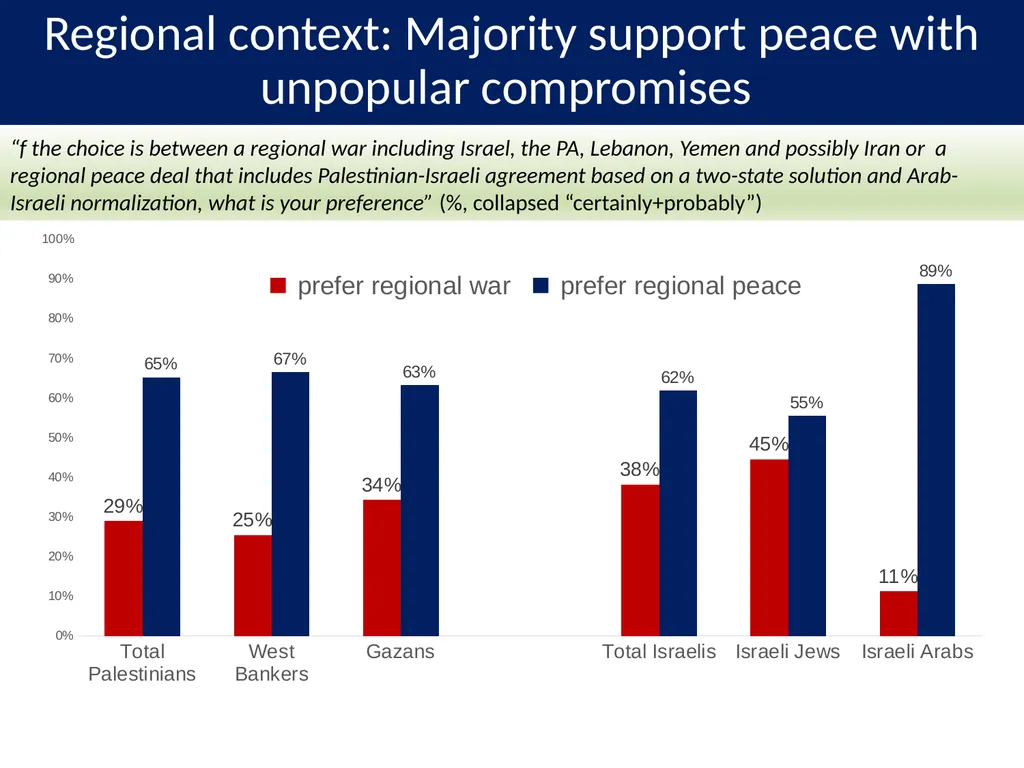
Regional context: Majority support peace with unpopular compromises “f the choice is between a regional war including Israel, the PA, Lebanon, Yemen and possibly Iran or a regional peace deal that includes Palestinian-Israeli agreement based on a two-state solution and Arab-Israeli normalization, what is your preference” (%, collapsed “certainly+probably”)<br>
25
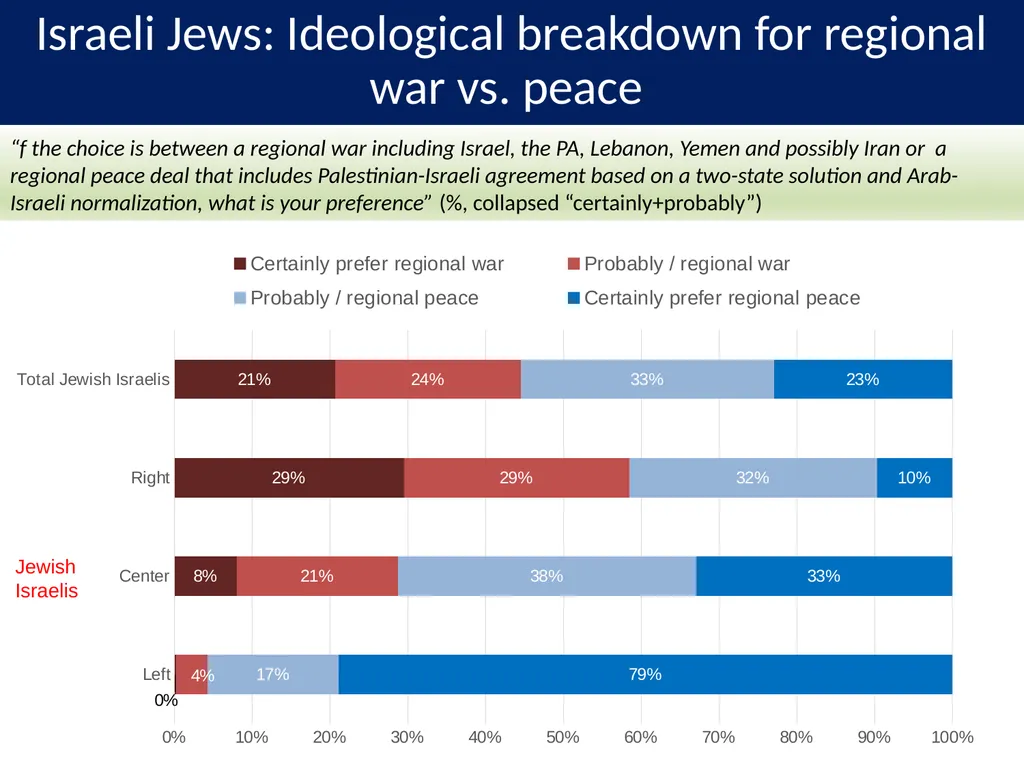
Israeli Jews: Ideological breakdown for regional war vs. peace “f the choice is between a regional war including Israel, the PA, Lebanon, Yemen and possibly Iran or a regional peace deal that includes Palestinian-Israeli agreement based on a two-state solution and Arab-Israeli normalization, what is your preference” (%, collapsed “certainly+probably”) Jewish Israelis<br>
26
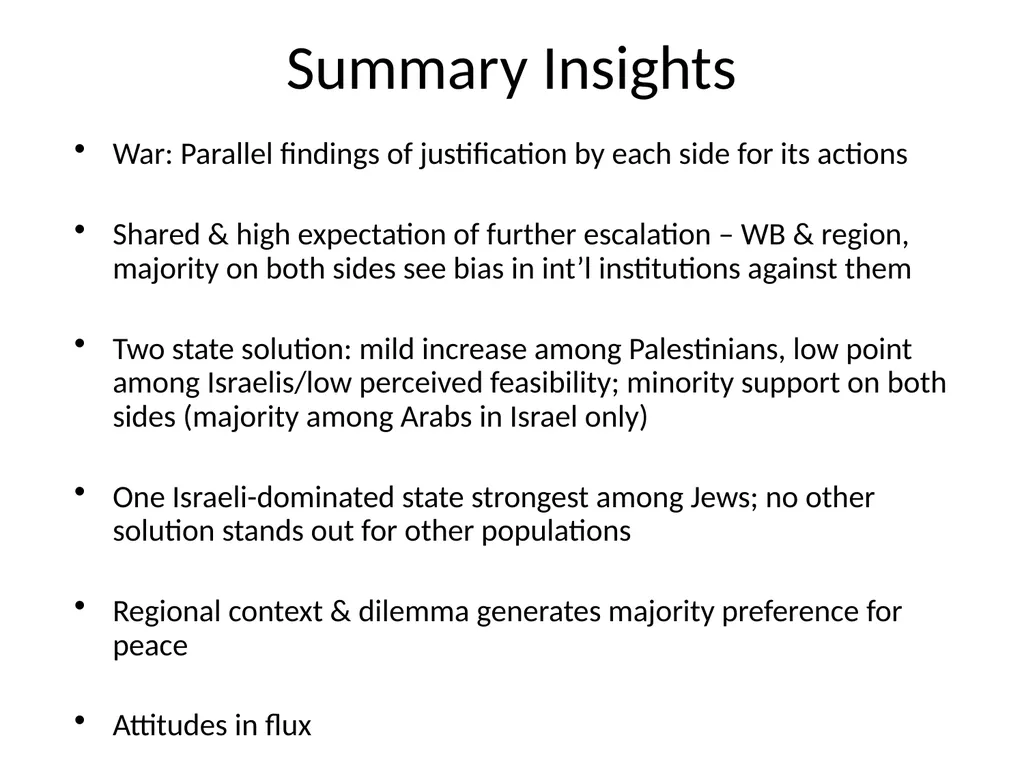
Summary Insights War: Parallel findings of justification by each side for its actions
Shared & high expectation of further escalation – WB & region, majority on both sides see bias in int’l institutions against them
Two state solution: mild increase among Palestinians, low point among Israelis/low perceived feasibility; minority support on both sides (majority among Arabs in Israel only)
One Israeli-dominated state strongest among Jews; no other solution stands out for other populations
Regional context & dilemma generates majority preference for peace
Attitudes in flux<br>
Shared & high expectation of further escalation – WB & region, majority on both sides see bias in int’l institutions against them
Two state solution: mild increase among Palestinians, low point among Israelis/low perceived feasibility; minority support on both sides (majority among Arabs in Israel only)
One Israeli-dominated state strongest among Jews; no other solution stands out for other populations
Regional context & dilemma generates majority preference for peace
Attitudes in flux<br>