
Palliative Care Case Presentation CNS Fiona Smith
KL
Published · 21 slides · 0 views

1 / 1
Description
Palliative Care Case Presentation CNS Fiona Smith and Dr Yvonne Cartwright DH NASH cirrhosis with portal hypertension diagnosed 2011 2014-2018 - 6 monthly cirrhosis surveillance. Stable Evidence of decompensation 2018 found to have
Related Topics
Share
Embed code
Download this presentation From Below
"Palliative Care Case Presentation CNS Fiona Smith" is the property of its rightful owner. Permission is granted to download and print the materials on this website for personal, non-commercial use only, and to display it on your personal computer provided you do not modify the materials and that you retain all copyright notices contained in the materials. By downloading content from our website, you accept the terms of this agreement.
Presentation Transcript
01
Palliative Care Case Presentation CNS Fiona Smith and Dr Yvonne Cartwright<br>
02
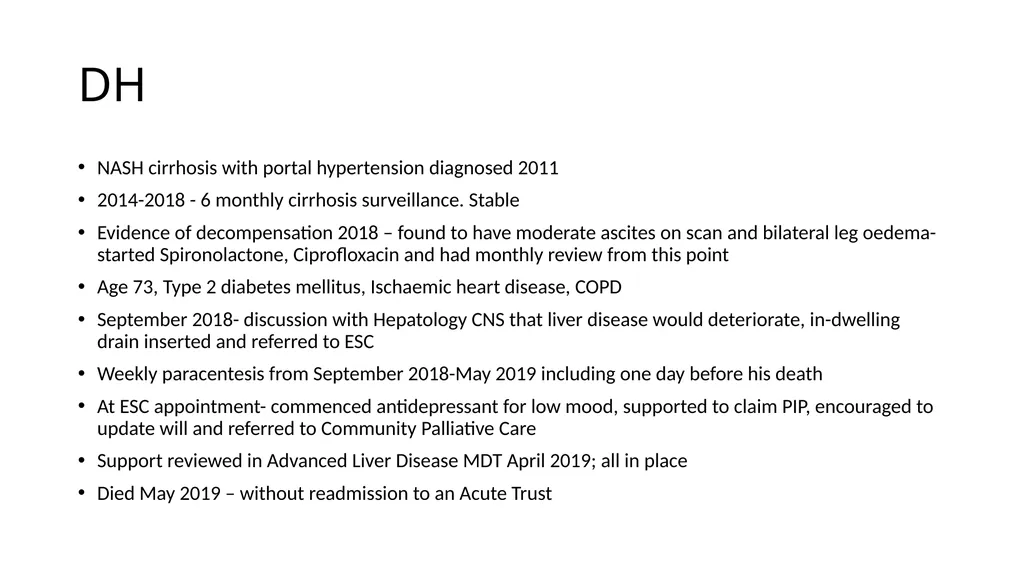
DH NASH cirrhosis with portal hypertension diagnosed 2011
2014-2018 - 6 monthly cirrhosis surveillance. Stable
Evidence of decompensation 2018 – found to have moderate ascites on scan and bilateral leg oedema- started Spironolactone, Ciprofloxacin and had monthly review from this point
Age 73, Type 2 diabetes mellitus, Ischaemic heart disease, COPD
September 2018- discussion with Hepatology CNS that liver disease would deteriorate, in-dwelling drain inserted and referred to ESC
Weekly paracentesis from September 2018-May 2019 including one day before his death
At ESC appointment- commenced antidepressant for low mood, supported to claim PIP, encouraged to update will and referred to Community Palliative Care
Support reviewed in Advanced Liver Disease MDT April 2019; all in place
Died May 2019 – without readmission to an Acute Trust<br>
2014-2018 - 6 monthly cirrhosis surveillance. Stable
Evidence of decompensation 2018 – found to have moderate ascites on scan and bilateral leg oedema- started Spironolactone, Ciprofloxacin and had monthly review from this point
Age 73, Type 2 diabetes mellitus, Ischaemic heart disease, COPD
September 2018- discussion with Hepatology CNS that liver disease would deteriorate, in-dwelling drain inserted and referred to ESC
Weekly paracentesis from September 2018-May 2019 including one day before his death
At ESC appointment- commenced antidepressant for low mood, supported to claim PIP, encouraged to update will and referred to Community Palliative Care
Support reviewed in Advanced Liver Disease MDT April 2019; all in place
Died May 2019 – without readmission to an Acute Trust<br>
03
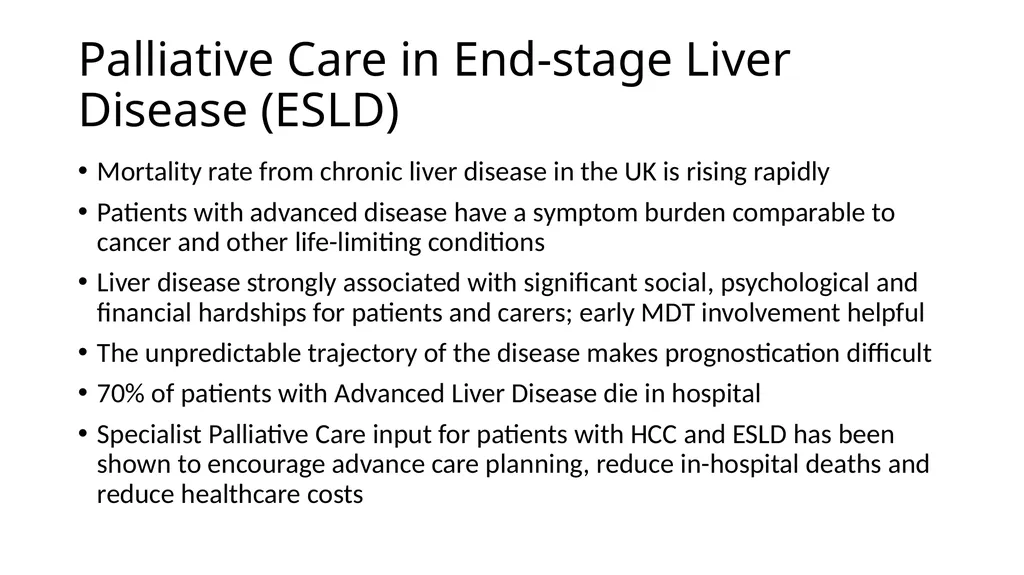
Palliative Care in End-stage Liver Disease (ESLD) Mortality rate from chronic liver disease in the UK is rising rapidly
Patients with advanced disease have a symptom burden comparable to cancer and other life-limiting conditions
Liver disease strongly associated with significant social, psychological and financial hardships for patients and carers; early MDT involvement helpful
The unpredictable trajectory of the disease makes prognostication difficult
70% of patients with Advanced Liver Disease die in hospital
Specialist Palliative Care input for patients with HCC and ESLD has been shown to encourage advance care planning, reduce in-hospital deaths and reduce healthcare costs<br>
Patients with advanced disease have a symptom burden comparable to cancer and other life-limiting conditions
Liver disease strongly associated with significant social, psychological and financial hardships for patients and carers; early MDT involvement helpful
The unpredictable trajectory of the disease makes prognostication difficult
70% of patients with Advanced Liver Disease die in hospital
Specialist Palliative Care input for patients with HCC and ESLD has been shown to encourage advance care planning, reduce in-hospital deaths and reduce healthcare costs<br>
04
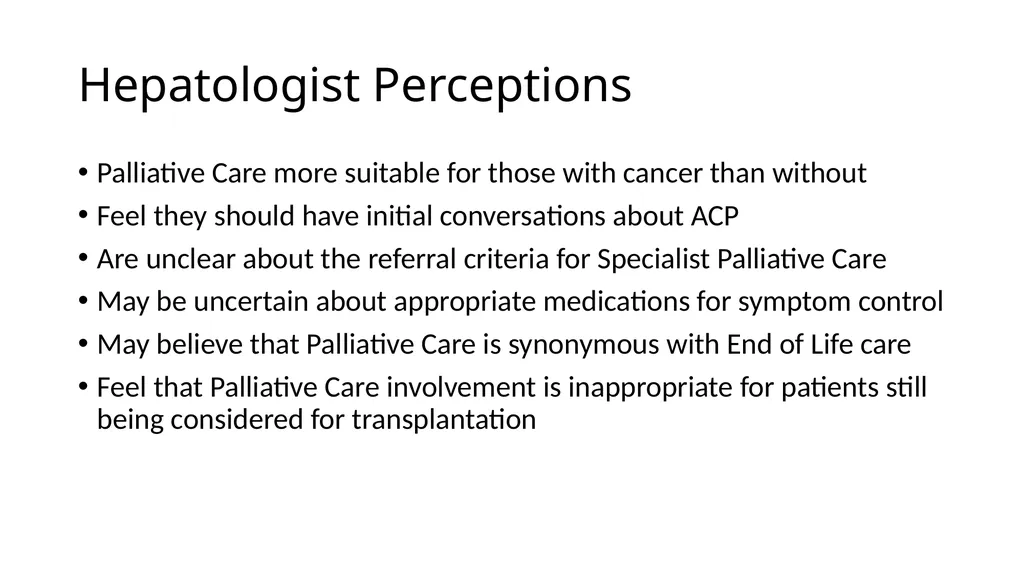
Hepatologist Perceptions Palliative Care more suitable for those with cancer than without
Feel they should have initial conversations about ACP
Are unclear about the referral criteria for Specialist Palliative Care
May be uncertain about appropriate medications for symptom control
May believe that Palliative Care is synonymous with End of Life care
Feel that Palliative Care involvement is inappropriate for patients still being considered for transplantation<br>
Feel they should have initial conversations about ACP
Are unclear about the referral criteria for Specialist Palliative Care
May be uncertain about appropriate medications for symptom control
May believe that Palliative Care is synonymous with End of Life care
Feel that Palliative Care involvement is inappropriate for patients still being considered for transplantation<br>
05
Role of the Hepatologist Recognition of decompensated cirrhosis and early consideration of appropriate treatment options
Is liver transplantation a feasible consideration or clearly precluded?
If so, transplant assessment, but bringing transplant into discussion enables discussion about prognosis. Palliative Care can be involved in parallel with being on Transplant w/l.
If not early discussion about stage of disease and prognosis
This leads to
Planning of management of decompensation events
offer of earlier Palliative Care input -> timely referral to Specialist Palliative care either hospital or community based (both may be appropriate)
Timely conversations about treatment escalation plans (including CPR), admission criteria (if appropriate), preferred place of care and death<br>
Is liver transplantation a feasible consideration or clearly precluded?
If so, transplant assessment, but bringing transplant into discussion enables discussion about prognosis. Palliative Care can be involved in parallel with being on Transplant w/l.
If not early discussion about stage of disease and prognosis
This leads to
Planning of management of decompensation events
offer of earlier Palliative Care input -> timely referral to Specialist Palliative care either hospital or community based (both may be appropriate)
Timely conversations about treatment escalation plans (including CPR), admission criteria (if appropriate), preferred place of care and death<br>
06
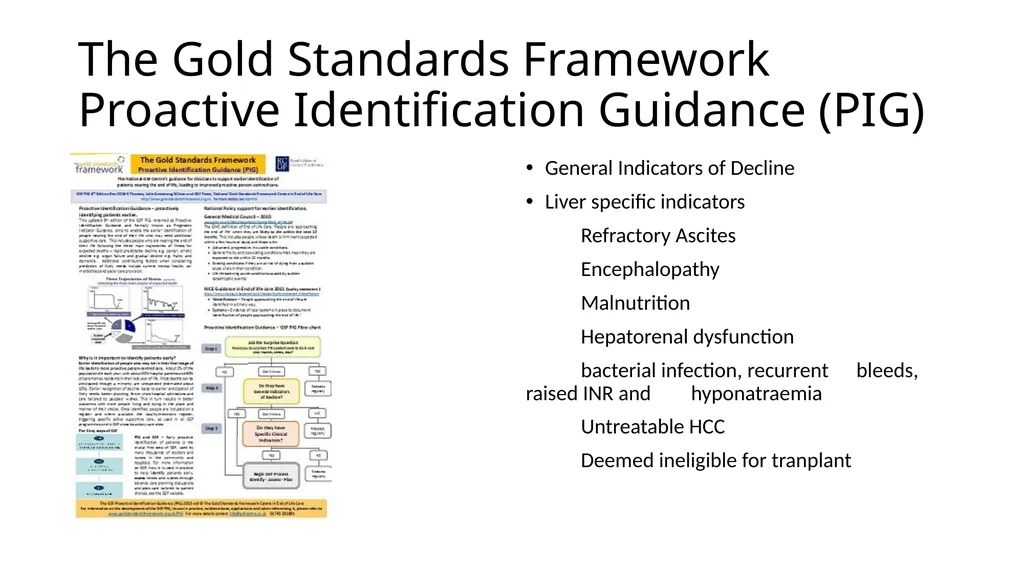
The Gold Standards Framework Proactive Identification Guidance (PIG) General Indicators of Decline
Liver specific indicators
Refractory Ascites
Encephalopathy
Malnutrition
Hepatorenal dysfunction
bacterial infection, recurrent bleeds, raised INR and hyponatraemia
Untreatable HCC
Deemed ineligible for tranplant<br>
Liver specific indicators
Refractory Ascites
Encephalopathy
Malnutrition
Hepatorenal dysfunction
bacterial infection, recurrent bleeds, raised INR and hyponatraemia
Untreatable HCC
Deemed ineligible for tranplant<br>
07
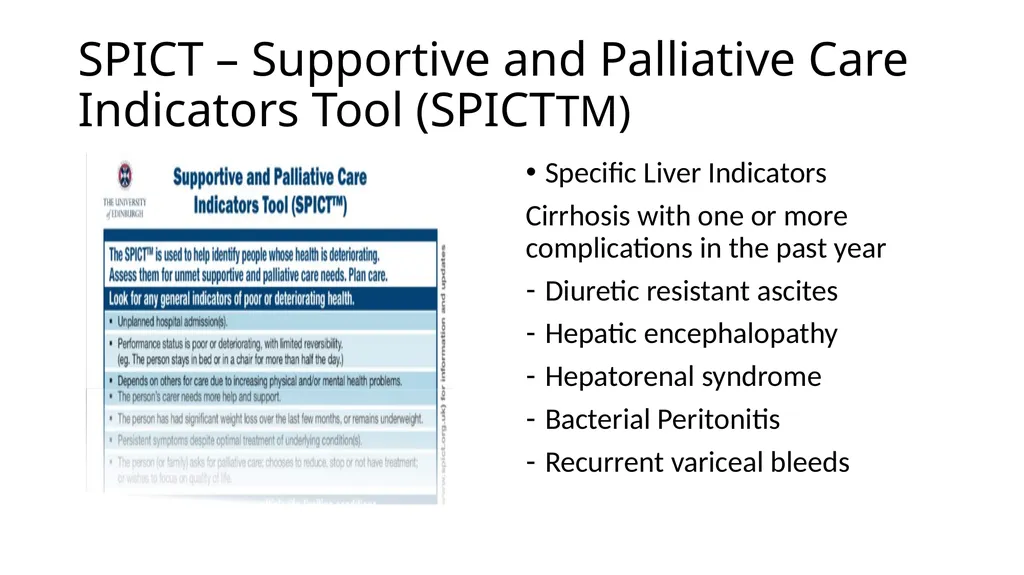
SPICT – Supportive and Palliative Care Indicators Tool (SPICTTM) Specific Liver Indicators
Cirrhosis with one or more complications in the past year
Diuretic resistant ascites
Hepatic encephalopathy
Hepatorenal syndrome
Bacterial Peritonitis
Recurrent variceal bleeds<br>
Cirrhosis with one or more complications in the past year
Diuretic resistant ascites
Hepatic encephalopathy
Hepatorenal syndrome
Bacterial Peritonitis
Recurrent variceal bleeds<br>
08
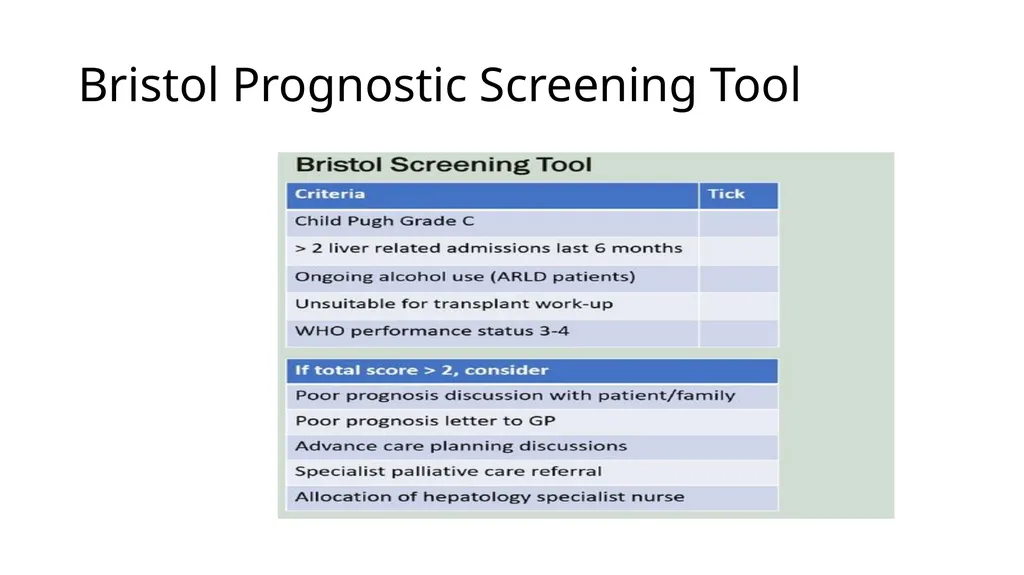
Bristol Prognostic Screening Tool<br>
09
Assess Symptoms needing assessment commonly include; pain, breathlessness, muscle cramps, sleep disturbance, depression, anxiety, fatigue and erectile dysfunction<br>
10
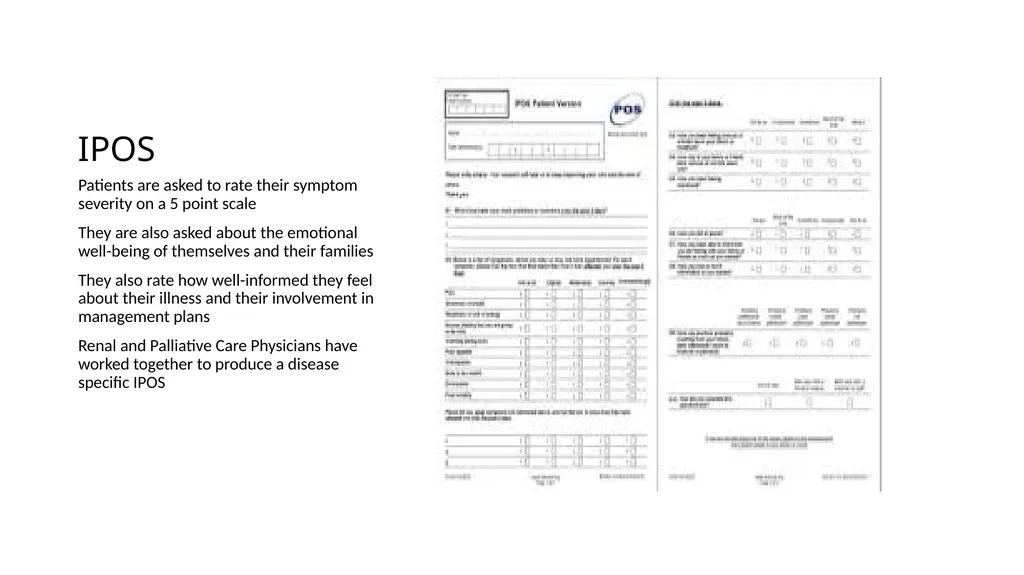
IPOS Patients are asked to rate their symptom severity on a 5 point scale
They are also asked about the emotional well-being of themselves and their families
They also rate how well-informed they feel about their illness and their involvement in management plans
Renal and Palliative Care Physicians have worked together to produce a disease specific IPOS<br>
They are also asked about the emotional well-being of themselves and their families
They also rate how well-informed they feel about their illness and their involvement in management plans
Renal and Palliative Care Physicians have worked together to produce a disease specific IPOS<br>
11
Management of Ascites 60% of patients with cirrhosis develop ascites; those with refractory ascites have a median survival of less than 6months
Day-case Paracentesis known to reduce healthcare costs, days spent in hospital and leads to reduced risk of dying in hospital
Indwelling drain and alfapump have similar safety profile to large volume paracentesis and are well evaluated in terms of HR-QOL
Pragmatic guidelines as to when/if HAS replacement can be discontinued would be extremely helpful<br>
Day-case Paracentesis known to reduce healthcare costs, days spent in hospital and leads to reduced risk of dying in hospital
Indwelling drain and alfapump have similar safety profile to large volume paracentesis and are well evaluated in terms of HR-QOL
Pragmatic guidelines as to when/if HAS replacement can be discontinued would be extremely helpful<br>
12
Management of Encephalopathy Distressing for patients and carers
Patients and carers often unaware that it is a potential complication of ESLD until it occurs for the first time
Optimal management of Hepatic Encephalopathy can have a significant effect on Health-related QOL and reduce hospital admissions
- Increases understanding of the condition
- Involves encouraging patients and carers to adjust laxative and enema doses
- Involves early consideration of the use of Rifaximin
Dietician input also well evaluated<br>
Patients and carers often unaware that it is a potential complication of ESLD until it occurs for the first time
Optimal management of Hepatic Encephalopathy can have a significant effect on Health-related QOL and reduce hospital admissions
- Increases understanding of the condition
- Involves encouraging patients and carers to adjust laxative and enema doses
- Involves early consideration of the use of Rifaximin
Dietician input also well evaluated<br>
13
Malnutrition Optimising nutrition can improve cognition in Hepatic Encephalopathy as well as quality of life
Early dietician involvement likely to be helpful
All members of the multi-disciplinary team should be able to give simple advice such as the role of a bedtime snack<br>
Early dietician involvement likely to be helpful
All members of the multi-disciplinary team should be able to give simple advice such as the role of a bedtime snack<br>
14
Symptom Management Recently published pragmatic guidelines from BASL
PATIENT GROUP:
Adult patients with Child Pugh B or C cirrhosis who are experiencing symptoms which interfere with their quality of life
https://www.basl.org.uk/uploads
Avoid Oxycodone as t1/2 triples in liver impairment
Fentanyl or Alfentanil probably sc opioid in last days of life in co-existent renal impairment<br>
PATIENT GROUP:
Adult patients with Child Pugh B or C cirrhosis who are experiencing symptoms which interfere with their quality of life
https://www.basl.org.uk/uploads
Avoid Oxycodone as t1/2 triples in liver impairment
Fentanyl or Alfentanil probably sc opioid in last days of life in co-existent renal impairment<br>
15
Plan Issues to consider
Identifying advocates
Wishes regarding CPR, treatment escalation and hospital admission
Important that patients and families are aware of uncertain trajectory
Preferred priorities of place of care and of death
Patient and Carer preferences particularly around personal care
Specific liver issues
Surveillance endoscopies
HCC screening
Treatment of SBP
Management of encephalopathy<br>
Identifying advocates
Wishes regarding CPR, treatment escalation and hospital admission
Important that patients and families are aware of uncertain trajectory
Preferred priorities of place of care and of death
Patient and Carer preferences particularly around personal care
Specific liver issues
Surveillance endoscopies
HCC screening
Treatment of SBP
Management of encephalopathy<br>
16
Successful interventions (1) Advanced Liver Disease MDT and Community Liver Disease Nurse- Western Sussex NHS Foundation Trust and St Barnabus House Hospice
- MDT comprises – Hepatology and Palliative Care Consultants, Community Liver Disease Nurse, Alcohol Liaison Services and Social Worker
- 77% of patients dying of ESLD in region had Palliative Care input
- only 28% of patients known to the service died in hospital<br>
- MDT comprises – Hepatology and Palliative Care Consultants, Community Liver Disease Nurse, Alcohol Liaison Services and Social Worker
- 77% of patients dying of ESLD in region had Palliative Care input
- only 28% of patients known to the service died in hospital<br>
17
Successful Interventions (2) Palliative Care Clinical Nurse Specialist for Liver Services at Royal Free Hospital
- inpatient Palliative Care CNS works alongside Hepatology and Hepatobiliary Teams
- weekly MDT and board rounds and a research and educational role
- Referrals for Specialist Palliative Care input for non-malignant disease have increased by 227% in one year<br>
- inpatient Palliative Care CNS works alongside Hepatology and Hepatobiliary Teams
- weekly MDT and board rounds and a research and educational role
- Referrals for Specialist Palliative Care input for non-malignant disease have increased by 227% in one year<br>
18
Successful Interventions (3) Exeter Advanced Liver Disease MDT
- All patients with a new episode of decompensated liver disease are discussed in an MDT with hepatology and palliative care clinicians, dietician, physiotherapy, occupational therapy, alcohol support worker and member of the local hospice team
- Ceiling of care agreed and discussed with the patient and carer
- If appropriate an emergency management plan is formed which is integrated within online medical records and therefore available to those attending the patient out of hours<br>
- All patients with a new episode of decompensated liver disease are discussed in an MDT with hepatology and palliative care clinicians, dietician, physiotherapy, occupational therapy, alcohol support worker and member of the local hospice team
- Ceiling of care agreed and discussed with the patient and carer
- If appropriate an emergency management plan is formed which is integrated within online medical records and therefore available to those attending the patient out of hours<br>
19
References “Palliative care in liver disease: what does good look like?” Woodland H et al Frontline Gastroenterology 2020; 11:218-227
Public Health England “Statistical commentary: end of life care profiles, 2018
“Supportive and Palliative care in people with cirrhosis: international systematic review of the perspective of patients, family members and health professionals” Low JTS et al J Hepatol 2018; 69:1260-73
“Advance Care planning (ACP) for specialists managing cirrhosis: a focus on patient-centred care” Brisebois A et al Hepatology 2018; 67:2025-40<br>
Public Health England “Statistical commentary: end of life care profiles, 2018
“Supportive and Palliative care in people with cirrhosis: international systematic review of the perspective of patients, family members and health professionals” Low JTS et al J Hepatol 2018; 69:1260-73
“Advance Care planning (ACP) for specialists managing cirrhosis: a focus on patient-centred care” Brisebois A et al Hepatology 2018; 67:2025-40<br>
20
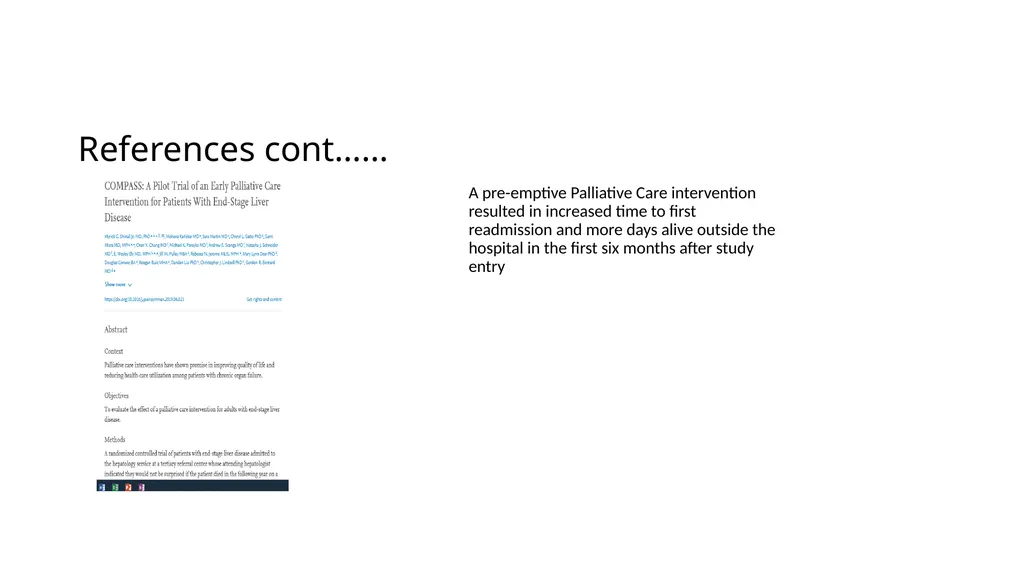
References cont…… A pre-emptive Palliative Care intervention resulted in increased time to first readmission and more days alive outside the hospital in the first six months after study entry<br>
21
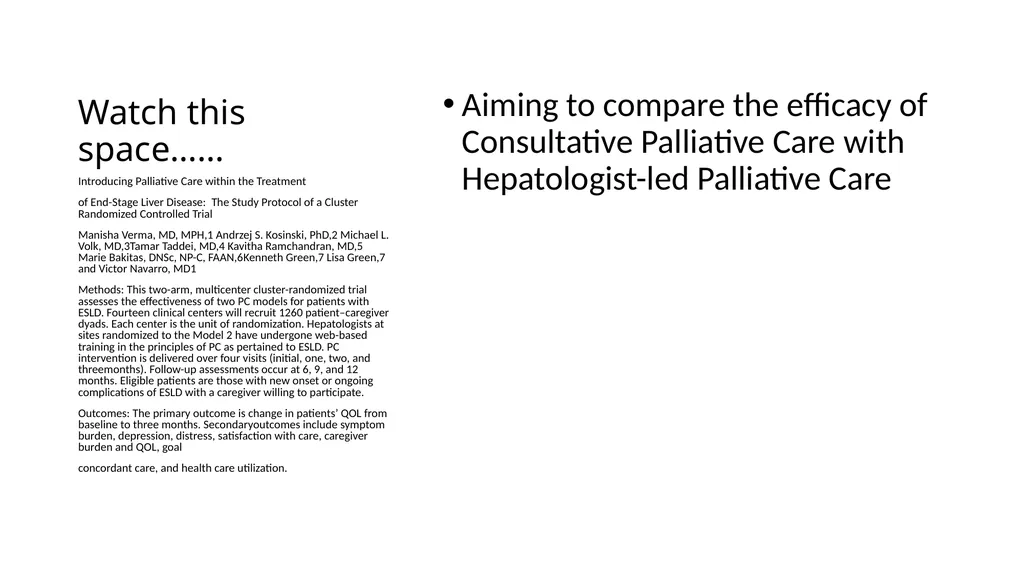
Watch this space…… Aiming to compare the efficacy of Consultative Palliative Care with Hepatologist-led Palliative Care Introducing Palliative Care within the Treatment
of End-Stage Liver Disease: The Study Protocol of a Cluster Randomized Controlled Trial
Manisha Verma, MD, MPH,1 Andrzej S. Kosinski, PhD,2 Michael L. Volk, MD,3Tamar Taddei, MD,4 Kavitha Ramchandran, MD,5 Marie Bakitas, DNSc, NP-C, FAAN,6Kenneth Green,7 Lisa Green,7 and Victor Navarro, MD1
Methods: This two-arm, multicenter cluster-randomized trial assesses the effectiveness of two PC models for patients with ESLD. Fourteen clinical centers will recruit 1260 patient–caregiver dyads. Each center is the unit of randomization. Hepatologists at sites randomized to the Model 2 have undergone web-based training in the principles of PC as pertained to ESLD. PC intervention is delivered over four visits (initial, one, two, and threemonths). Follow-up assessments occur at 6, 9, and 12 months. Eligible patients are those with new onset or ongoing complications of ESLD with a caregiver willing to participate.
Outcomes: The primary outcome is change in patients’ QOL from baseline to three months. Secondaryoutcomes include symptom burden, depression, distress, satisfaction with care, caregiver burden and QOL, goal
concordant care, and health care utilization.<br>
of End-Stage Liver Disease: The Study Protocol of a Cluster Randomized Controlled Trial
Manisha Verma, MD, MPH,1 Andrzej S. Kosinski, PhD,2 Michael L. Volk, MD,3Tamar Taddei, MD,4 Kavitha Ramchandran, MD,5 Marie Bakitas, DNSc, NP-C, FAAN,6Kenneth Green,7 Lisa Green,7 and Victor Navarro, MD1
Methods: This two-arm, multicenter cluster-randomized trial assesses the effectiveness of two PC models for patients with ESLD. Fourteen clinical centers will recruit 1260 patient–caregiver dyads. Each center is the unit of randomization. Hepatologists at sites randomized to the Model 2 have undergone web-based training in the principles of PC as pertained to ESLD. PC intervention is delivered over four visits (initial, one, two, and threemonths). Follow-up assessments occur at 6, 9, and 12 months. Eligible patients are those with new onset or ongoing complications of ESLD with a caregiver willing to participate.
Outcomes: The primary outcome is change in patients’ QOL from baseline to three months. Secondaryoutcomes include symptom burden, depression, distress, satisfaction with care, caregiver burden and QOL, goal
concordant care, and health care utilization.<br>