
Panel 2: Sub Theme: Capacity Development for


Description: Panel 2: Sub Theme: Capacity Development for Productivity and Effectiveness Focus: Integrating Needs Assessment into Teacher Recruitment, Deployment, Capacity Development and Related Factors What and why of Needs Assessment Needs Assessment
Related Topics
Download Presentation
"Panel 2: Sub Theme: Capacity Development for" is the property of its rightful owner. Permission is granted to download and print the materials on this website for personal, non-commercial use only, and to display it on your personal computer provided you do not modify the materials and that you retain all copyright notices contained in the materials. By downloading content from our website, you accept the terms of this agreement.
Presentation Transcript
slide1. Panel 2: Sub Theme: Capacity Development for Productivity and Effectiveness Focus: Integrating Needs Assessment into Teacher Recruitment, Deployment, Capacity Development and Related Factors<br>
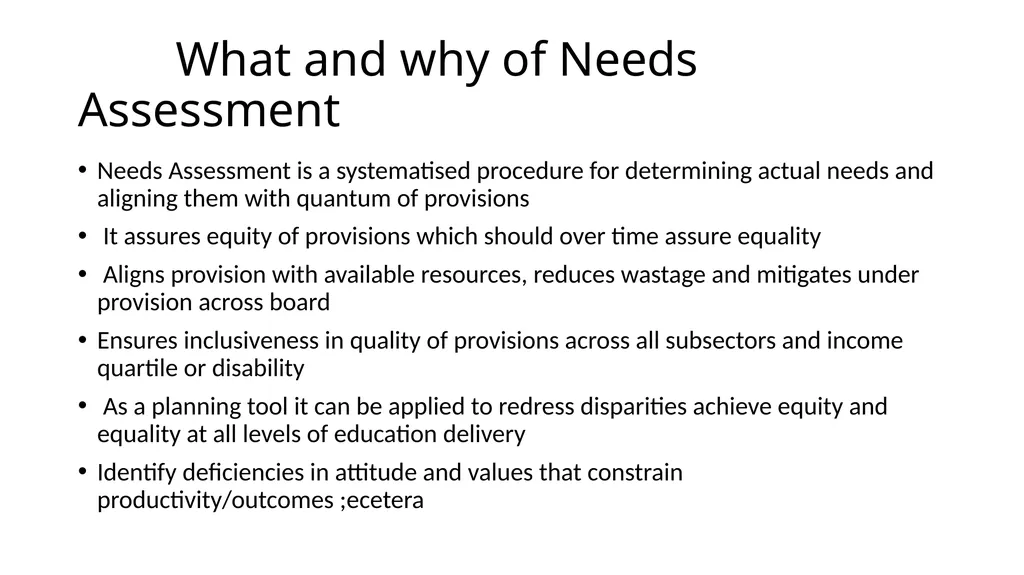
slide2. What and why of Needs Assessment Needs Assessment is a systematised procedure for determining actual needs and aligning them with quantum of provisions
It assures equity of provisions which should over time assure equality
Aligns provision with available resources, reduces wastage and mitigates under provision across board
Ensures inclusiveness in quality of provisions across all subsectors and income quartile or disability
As a planning tool it can be applied to redress disparities achieve equity and equality at all levels of education delivery
Identify deficiencies in attitude and values that constrain productivity/outcomes ;ecetera<br>
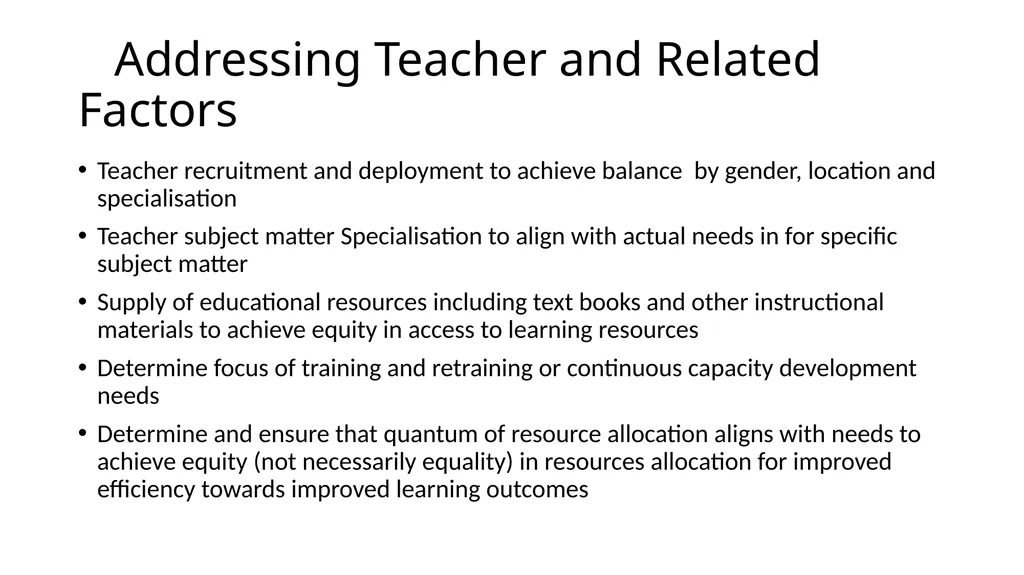
slide3. Addressing Teacher and Related Factors Teacher recruitment and deployment to achieve balance by gender, location and specialisation
Teacher subject matter Specialisation to align with actual needs in for specific subject matter
Supply of educational resources including text books and other instructional materials to achieve equity in access to learning resources
Determine focus of training and retraining or continuous capacity development needs
Determine and ensure that quantum of resource allocation aligns with needs to achieve equity (not necessarily equality) in resources allocation for improved efficiency towards improved learning outcomes<br>
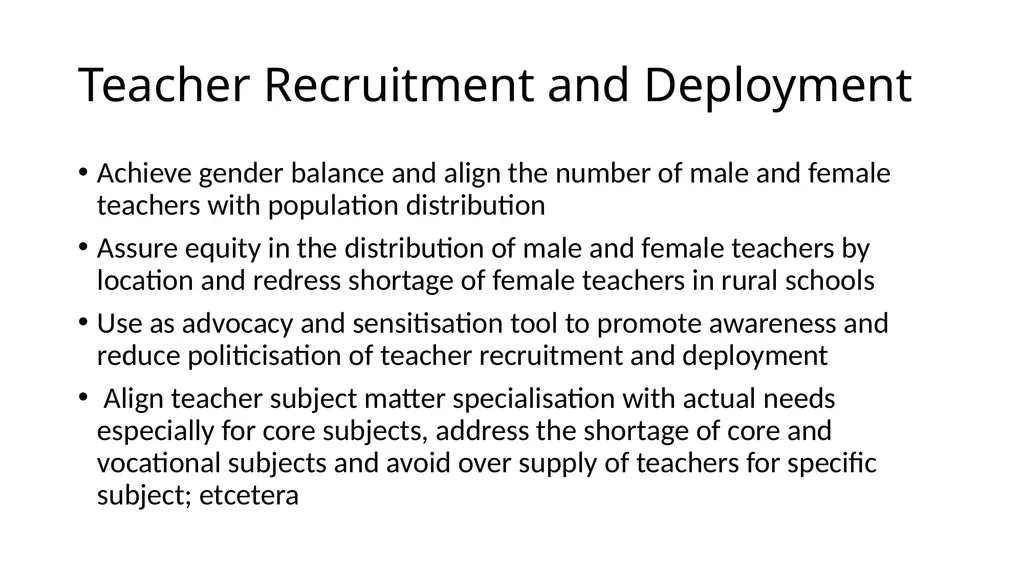
slide4. Teacher Recruitment and Deployment Achieve gender balance and align the number of male and female teachers with population distribution
Assure equity in the distribution of male and female teachers by location and redress shortage of female teachers in rural schools
Use as advocacy and sensitisation tool to promote awareness and reduce politicisation of teacher recruitment and deployment
Align teacher subject matter specialisation with actual needs especially for core subjects, address the shortage of core and vocational subjects and avoid over supply of teachers for specific subject; etcetera<br>
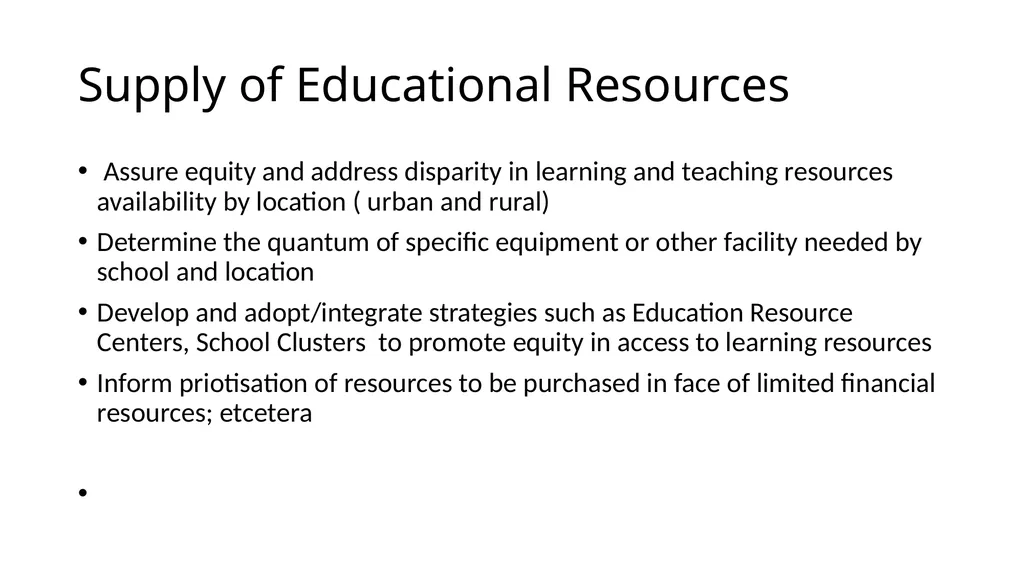
slide5. Supply of Educational Resources Assure equity and address disparity in learning and teaching resources availability by location ( urban and rural)
Determine the quantum of specific equipment or other facility needed by school and location
Develop and adopt/integrate strategies such as Education Resource Centers, School Clusters to promote equity in access to learning resources
Inform priotisation of resources to be purchased in face of limited financial resources; etcetera<br>
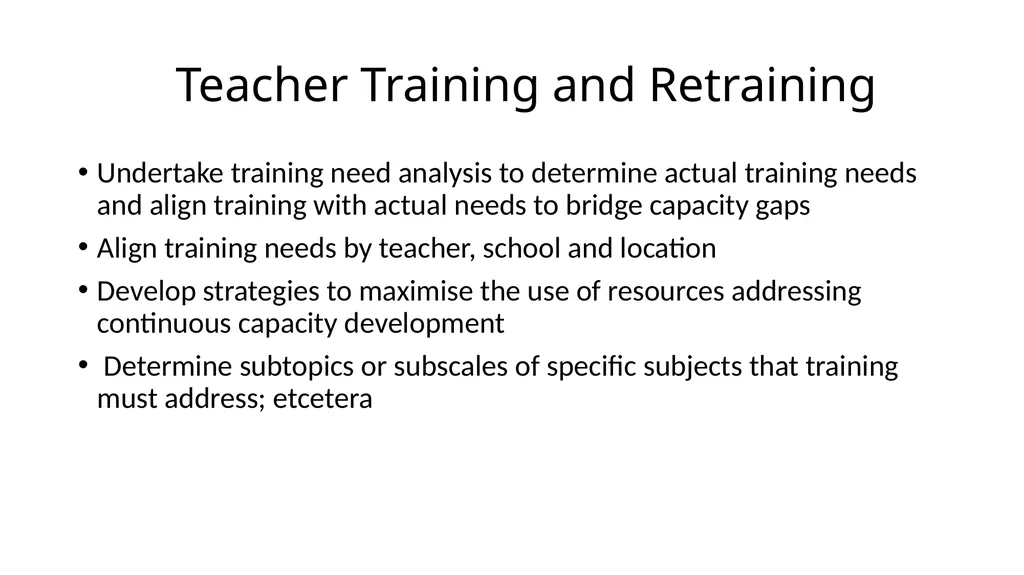
slide6. Teacher Training and Retraining Undertake training need analysis to determine actual training needs and align training with actual needs to bridge capacity gaps
Align training needs by teacher, school and location
Develop strategies to maximise the use of resources addressing continuous capacity development
Determine subtopics or subscales of specific subjects that training must address; etcetera<br>
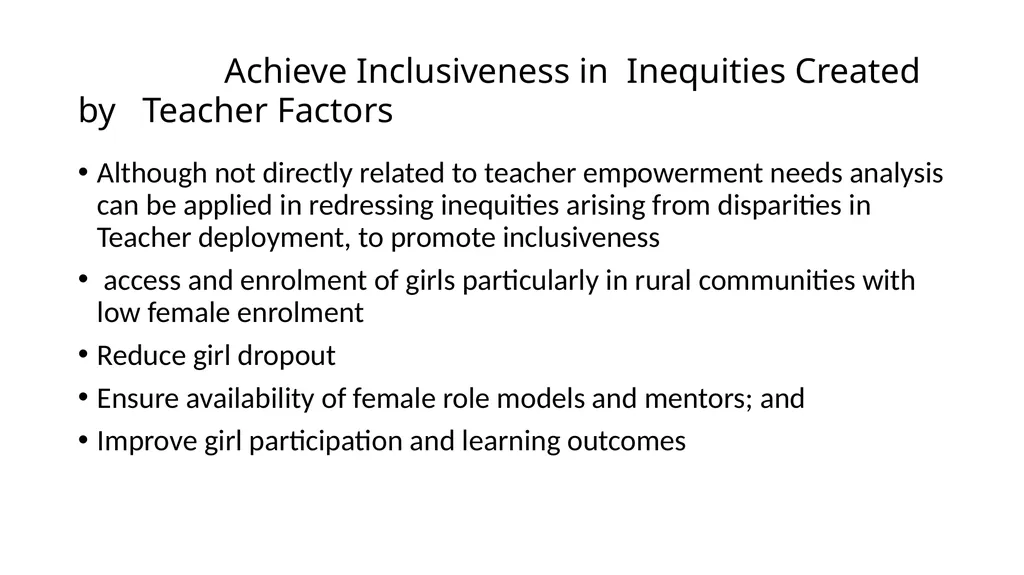
slide7. Achieve Inclusiveness in Inequities Created by Teacher Factors Although not directly related to teacher empowerment needs analysis can be applied in redressing inequities arising from disparities in Teacher deployment, to promote inclusiveness
access and enrolment of girls particularly in rural communities with low female enrolment
Reduce girl dropout
Ensure availability of female role models and mentors; and
Improve girl participation and learning outcomes<br>
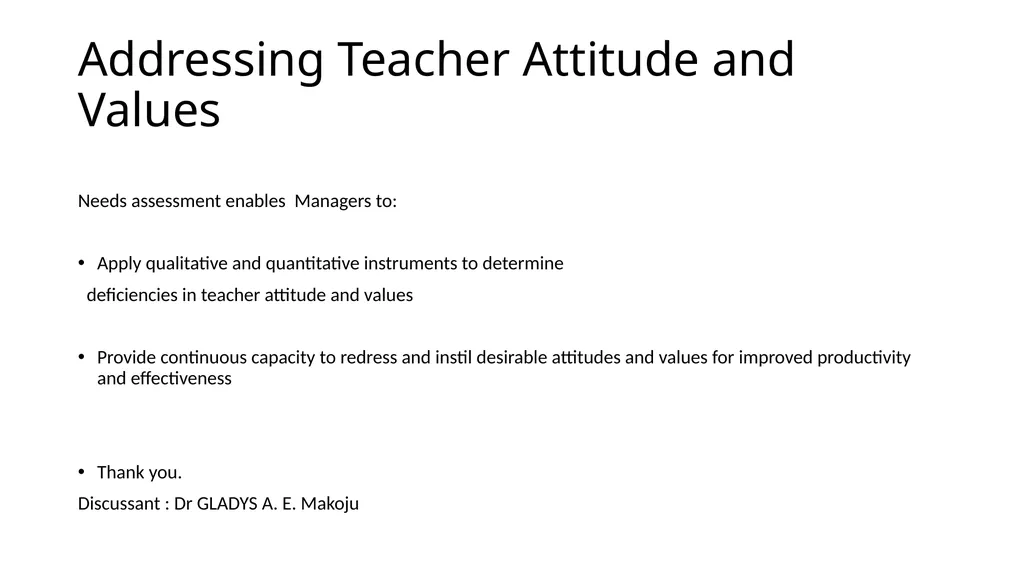
slide8. Addressing Teacher Attitude and Values Needs assessment enables Managers to:
Apply qualitative and quantitative instruments to determine
deficiencies in teacher attitude and values
Provide continuous capacity to redress and instil desirable attitudes and values for improved productivity and effectiveness
Thank you.
Discussant : Dr GLADYS A. E. Makoju<br>
slide2. What and why of Needs Assessment Needs Assessment is a systematised procedure for determining actual needs and aligning them with quantum of provisions
It assures equity of provisions which should over time assure equality
Aligns provision with available resources, reduces wastage and mitigates under provision across board
Ensures inclusiveness in quality of provisions across all subsectors and income quartile or disability
As a planning tool it can be applied to redress disparities achieve equity and equality at all levels of education delivery
Identify deficiencies in attitude and values that constrain productivity/outcomes ;ecetera<br>
slide3. Addressing Teacher and Related Factors Teacher recruitment and deployment to achieve balance by gender, location and specialisation
Teacher subject matter Specialisation to align with actual needs in for specific subject matter
Supply of educational resources including text books and other instructional materials to achieve equity in access to learning resources
Determine focus of training and retraining or continuous capacity development needs
Determine and ensure that quantum of resource allocation aligns with needs to achieve equity (not necessarily equality) in resources allocation for improved efficiency towards improved learning outcomes<br>
slide4. Teacher Recruitment and Deployment Achieve gender balance and align the number of male and female teachers with population distribution
Assure equity in the distribution of male and female teachers by location and redress shortage of female teachers in rural schools
Use as advocacy and sensitisation tool to promote awareness and reduce politicisation of teacher recruitment and deployment
Align teacher subject matter specialisation with actual needs especially for core subjects, address the shortage of core and vocational subjects and avoid over supply of teachers for specific subject; etcetera<br>
slide5. Supply of Educational Resources Assure equity and address disparity in learning and teaching resources availability by location ( urban and rural)
Determine the quantum of specific equipment or other facility needed by school and location
Develop and adopt/integrate strategies such as Education Resource Centers, School Clusters to promote equity in access to learning resources
Inform priotisation of resources to be purchased in face of limited financial resources; etcetera<br>
slide6. Teacher Training and Retraining Undertake training need analysis to determine actual training needs and align training with actual needs to bridge capacity gaps
Align training needs by teacher, school and location
Develop strategies to maximise the use of resources addressing continuous capacity development
Determine subtopics or subscales of specific subjects that training must address; etcetera<br>
slide7. Achieve Inclusiveness in Inequities Created by Teacher Factors Although not directly related to teacher empowerment needs analysis can be applied in redressing inequities arising from disparities in Teacher deployment, to promote inclusiveness
access and enrolment of girls particularly in rural communities with low female enrolment
Reduce girl dropout
Ensure availability of female role models and mentors; and
Improve girl participation and learning outcomes<br>
slide8. Addressing Teacher Attitude and Values Needs assessment enables Managers to:
Apply qualitative and quantitative instruments to determine
deficiencies in teacher attitude and values
Provide continuous capacity to redress and instil desirable attitudes and values for improved productivity and effectiveness
Thank you.
Discussant : Dr GLADYS A. E. Makoju<br>