Pantomime What is pantomime? Pantomime is a form of theatre in which meaning is expressed through gestures and facial expression. It may also be accompanied by narration or music. Props and set pieces are implied through movementgestures
"Pantomime What is pantomime? Pantomime is a form" is the property of its rightful owner. Permission is granted to
download and print the materials on this website for personal, non-commercial use only, and to display it
on your personal computer provided you do not modify the materials and that you retain all copyright
notices contained in the materials. By downloading content from our website, you accept the terms of this
agreement.
Presentation Transcript
01
Pantomime<br>
02
What is pantomime? Pantomime is a form of theatre in which meaning is expressed through gestures and facial expression. It may also be accompanied by narration or music.
Props and set pieces are implied through movement/gestures without them actually being present.<br>
03
Why should I learn about pantomime?<br>
04
It will enhance my understanding that performance is a process.
It will aid in being more aware of my surroundings in a performance.
I will be a more expressive performer in communicating physical aspects of a performance or character.<br>
05
Narrative Pantomime This is a form of performance where a group of actor/actresses act out a story silently simultaneously while a narrator reads the story aloud.
All props are pantomimed. This means that the performers act/react as if the said items are present.
Up to 2 chairs may be used in a performance.<br>
06
The stage The stage is to be used in a creative way so as to establish the setting (where the action of the story takes place).
2 Chairs may be used, but are not required.
Remember your to use stage positions in creating your performance and keep the performance faced out towards the audience.<br>
07
Examples of pantomime https://www.youtube.com/watch?v=GWbtGAF_gXc Marcel Marceau
https://www.youtube.com/watch?v=Y6ESAm7KrwM The Giving Tree<br>
08
Each group will have: 5 members (4 or 6 in rare cases. Mr. Peebles will decide these groups.)
1 group member will be the narrator. They are expected to read the fairytale enthusiastically with consistent and varying character voices.
All other group members are responsible for expressing the action of the story through body movement, use of space, pantomimed props and facial expression.
Each group member is to be doing something active in the scene at all times (being a character or scenic element). No one may stand stagnant and uninvolved.<br>
09
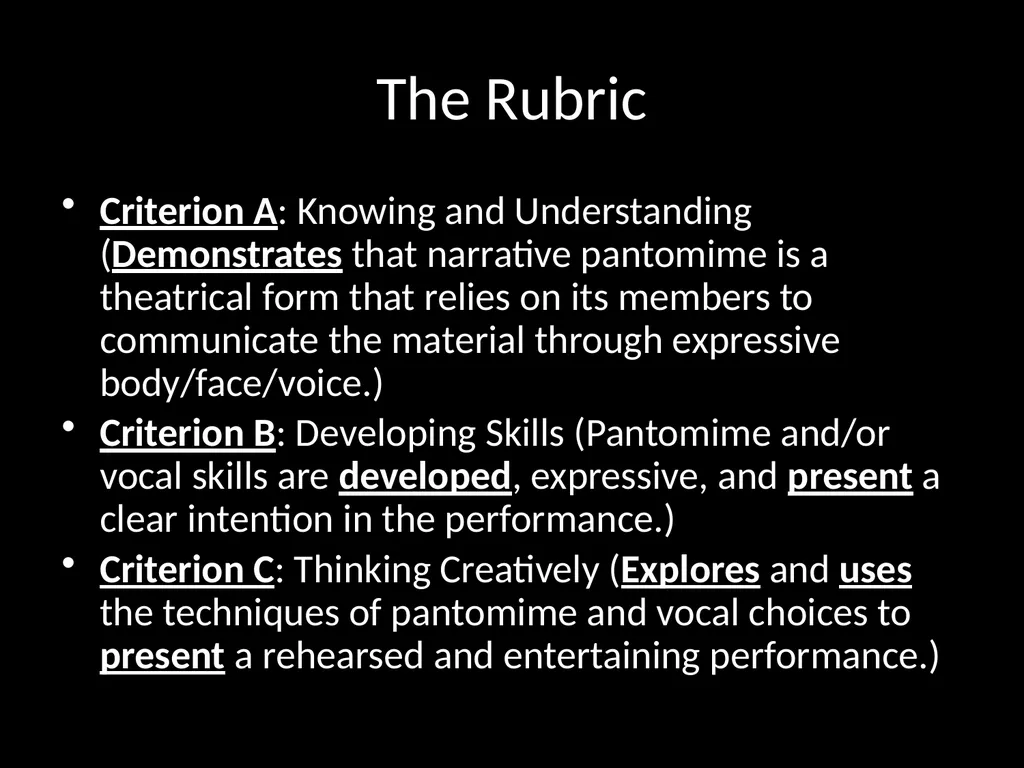
The Rubric Criterion A: Knowing and Understanding (Demonstrates that narrative pantomime is a theatrical form that relies on its members to communicate the material through expressive body/face/voice.)
Criterion B: Developing Skills (Pantomime and/or vocal skills are developed, expressive, and present a clear intention in the performance.)
Criterion C: Thinking Creatively (Explores and uses the techniques of pantomime and vocal choices to present a rehearsed and entertaining performance.)<br>