
Paper 1: EXPLORATIONS IN CREATIVE READING AND
SN
Published · 26 slides · 0 views
1 / 1
Description
Paper 1: EXPLORATIONS IN CREATIVE READING AND WRITING 1h 45 (incl 15 minutes reading time) Total marks: 80 Timings and marks Section A Structure ONE single 20th or 21st C literature prose fiction source eg. novel short story extract
Related Topics
Share
Embed code
Download this presentation From Below
"Paper 1: EXPLORATIONS IN CREATIVE READING AND" is the property of its rightful owner. Permission is granted to download and print the materials on this website for personal, non-commercial use only, and to display it on your personal computer provided you do not modify the materials and that you retain all copyright notices contained in the materials. By downloading content from our website, you accept the terms of this agreement.
Presentation Transcript
01
Paper 1: EXPLORATIONS IN CREATIVE READING AND WRITING 1h 45 (incl 15 minutes reading time)
Total marks: 80<br>
Total marks: 80<br>
02
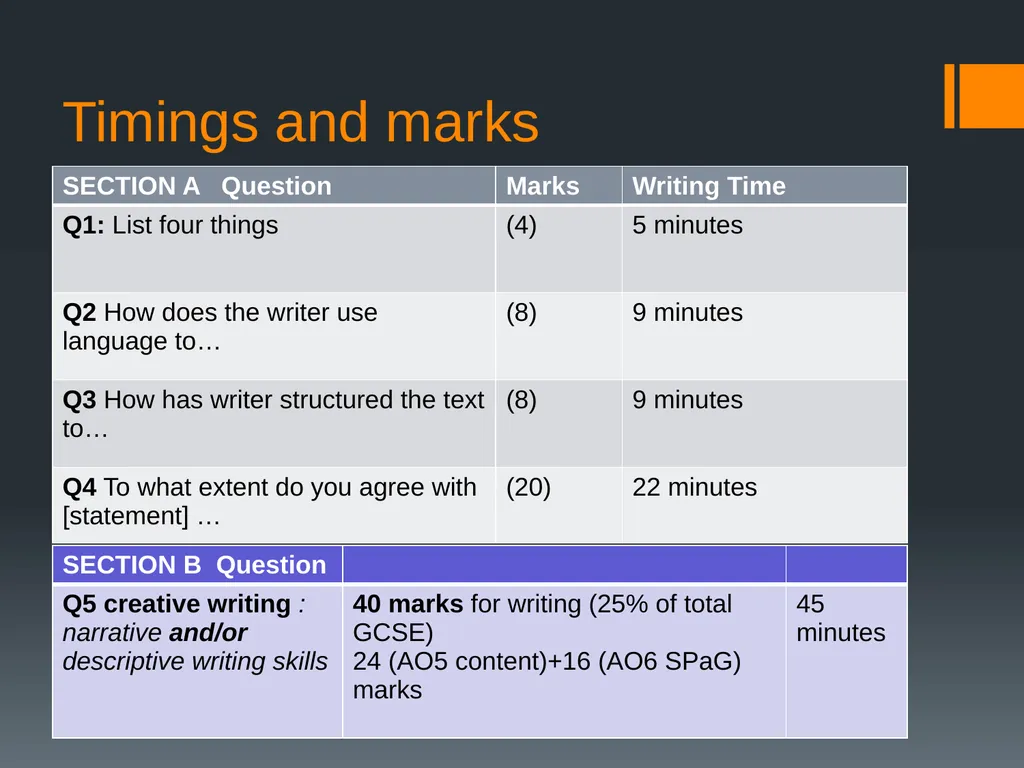
Timings and marks<br>
03
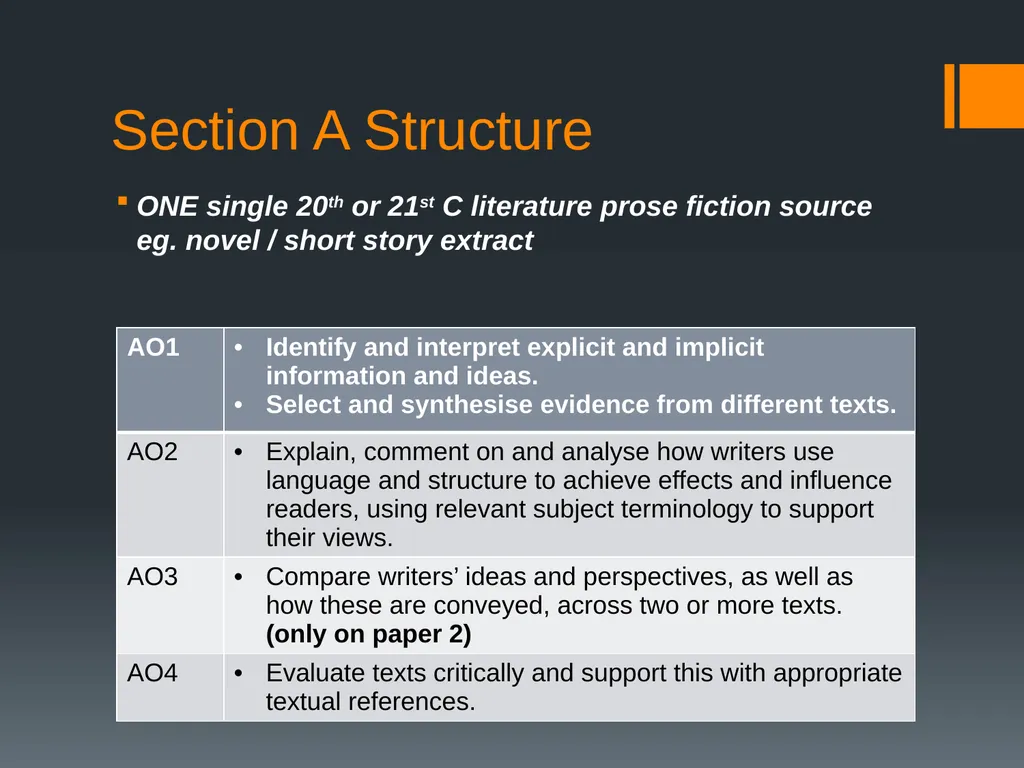
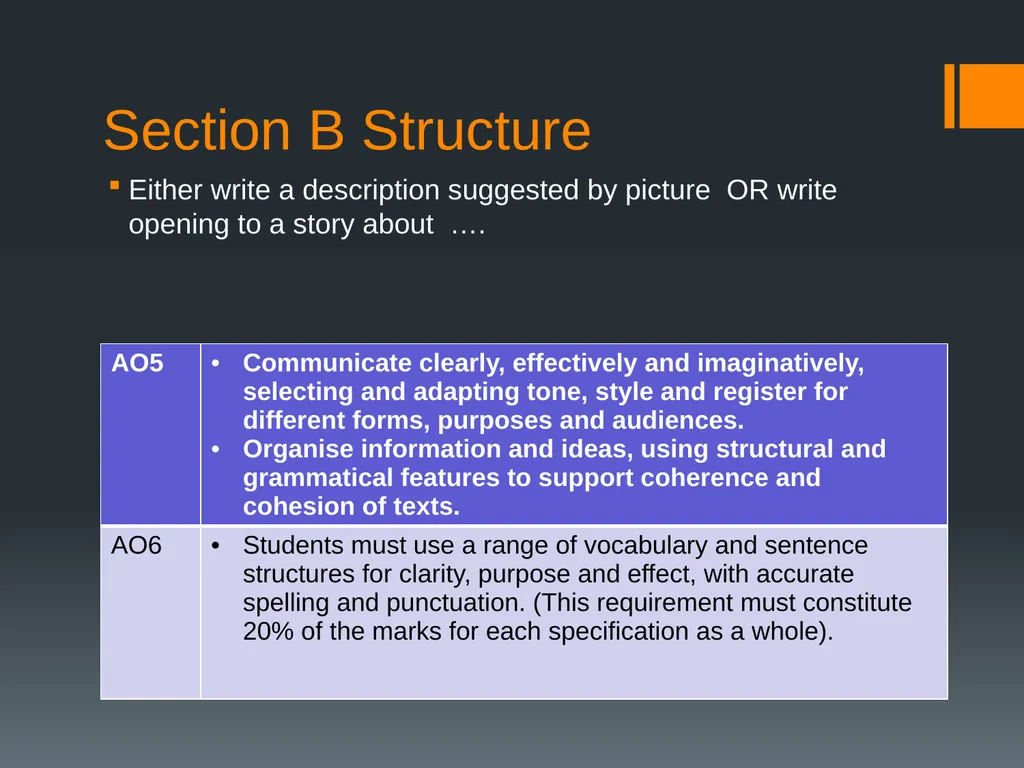
Section A Structure ONE single 20th or 21st C literature prose fiction source eg. novel / short story extract<br>
04
Section B Structure Either write a description suggested by picture OR write opening to a story about ….<br>
05
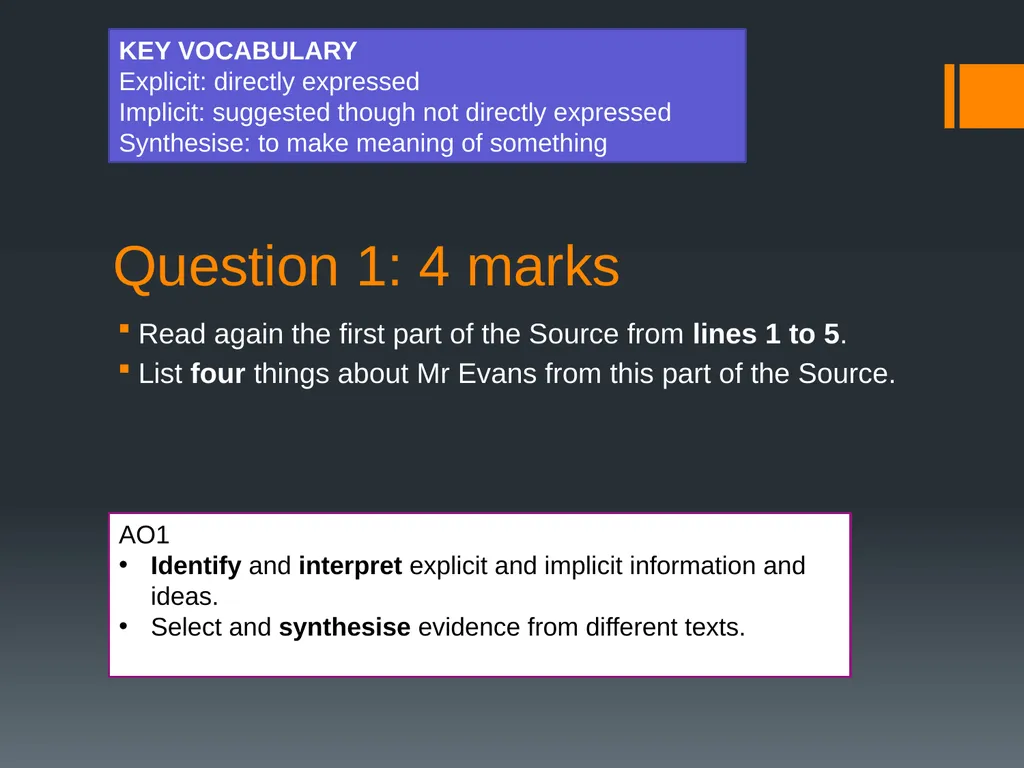
Question 1: 4 marks Read again the first part of the Source from lines 1 to 5.
List four things about Mr Evans from this part of the Source. AO1
Identify and interpret explicit and implicit information and ideas.
Select and synthesise evidence from different texts. KEY VOCABULARY
Explicit: directly expressed
Implicit: suggested though not directly expressed
Synthesise: to make meaning of something<br>
List four things about Mr Evans from this part of the Source. AO1
Identify and interpret explicit and implicit information and ideas.
Select and synthesise evidence from different texts. KEY VOCABULARY
Explicit: directly expressed
Implicit: suggested though not directly expressed
Synthesise: to make meaning of something<br>
06
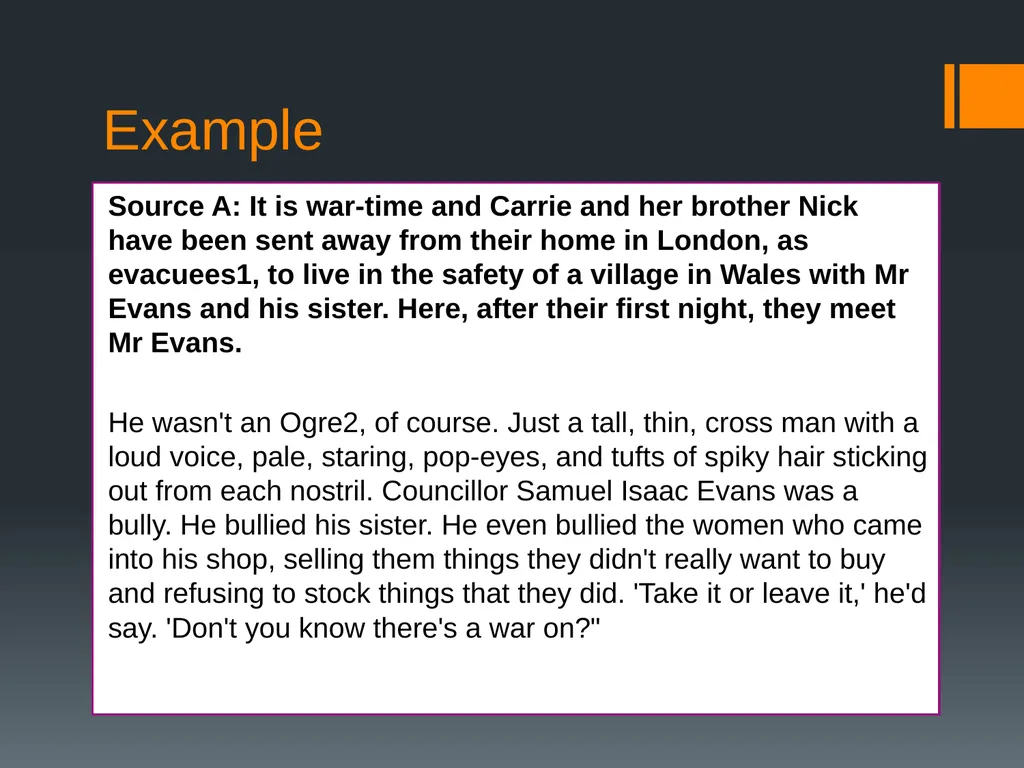
Example Source A: It is war-time and Carrie and her brother Nick have been sent away from their home in London, as evacuees1, to live in the safety of a village in Wales with Mr Evans and his sister. Here, after their first night, they meet Mr Evans.
He wasn't an Ogre2, of course. Just a tall, thin, cross man with a loud voice, pale, staring, pop-eyes, and tufts of spiky hair sticking out from each nostril. Councillor Samuel Isaac Evans was a bully. He bullied his sister. He even bullied the women who came into his shop, selling them things they didn't really want to buy and refusing to stock things that they did. 'Take it or leave it,' he'd say. 'Don't you know there's a war on?"<br>
He wasn't an Ogre2, of course. Just a tall, thin, cross man with a loud voice, pale, staring, pop-eyes, and tufts of spiky hair sticking out from each nostril. Councillor Samuel Isaac Evans was a bully. He bullied his sister. He even bullied the women who came into his shop, selling them things they didn't really want to buy and refusing to stock things that they did. 'Take it or leave it,' he'd say. 'Don't you know there's a war on?"<br>
07
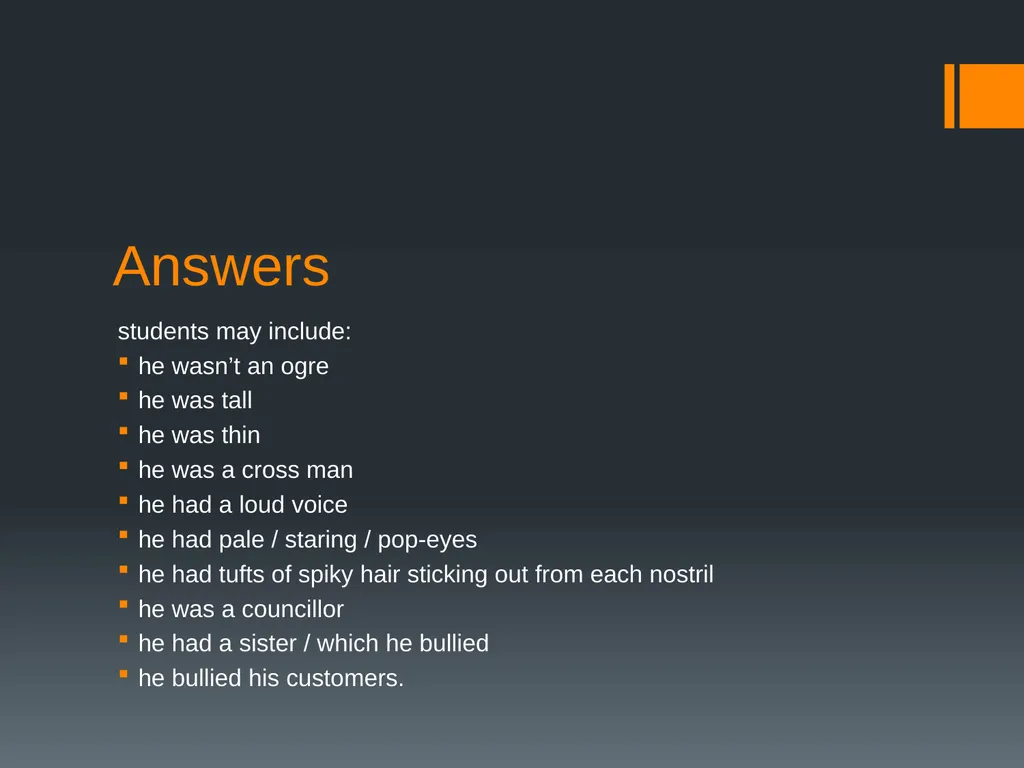
Answers students may include:
he wasn’t an ogre
he was tall
he was thin
he was a cross man
he had a loud voice
he had pale / staring / pop-eyes
he had tufts of spiky hair sticking out from each nostril
he was a councillor
he had a sister / which he bullied
he bullied his customers.<br>
he wasn’t an ogre
he was tall
he was thin
he was a cross man
he had a loud voice
he had pale / staring / pop-eyes
he had tufts of spiky hair sticking out from each nostril
he was a councillor
he had a sister / which he bullied
he bullied his customers.<br>
08
Tips Use a highlighter to spot words and phrases in the source
Ensure you only select from the specified lines.
Read the source carefully – it may not be what you first thought!
If time, check your answers
Do not spend more than 5 minutes on this question<br>
Ensure you only select from the specified lines.
Read the source carefully – it may not be what you first thought!
If time, check your answers
Do not spend more than 5 minutes on this question<br>
09
Question 2: 8 marks Look in detail at this extract from lines 6 to 12 of the Source.
(Extract in question paper)
How does the writer use language here to show us what Nick felt about being frightened?
You could include the writer’s choice of:
words and phrases
language features and techniques
sentence forms. AO2
Explain, comment on and analyse how writers use language and structure to achieve effects and influence readers, using relevant subject terminology to support their views<br>
(Extract in question paper)
How does the writer use language here to show us what Nick felt about being frightened?
You could include the writer’s choice of:
words and phrases
language features and techniques
sentence forms. AO2
Explain, comment on and analyse how writers use language and structure to achieve effects and influence readers, using relevant subject terminology to support their views<br>
10
What do they mean by language? Words : nouns/verbs/adjectives/adverbs/conjunctions/prepositions
Phrases: noun phrases/adjectival phrases
Language Features: word choice/tone/style/structure
Language Techniques: CRAPFOREST
Sentence Forms: simple/compound/complex<br>
Phrases: noun phrases/adjectival phrases
Language Features: word choice/tone/style/structure
Language Techniques: CRAPFOREST
Sentence Forms: simple/compound/complex<br>
11
Level 4 answer The writer emphasises the things Nick actually is afraid of by using the device of a list of nouns which includes alliteration: ‘Ogres and spiders and crabs and cold water and the dentist and dark nights’. The repetition of the conjunction ‘and’ further emphasises the individual fears but also develops the cumulative effect of all of them together. The varied list of fears helps to encompass most readers because they range from fantasy ‘Ogres’, to creepy-crawlies, to the commonplace ‘dentist and dark nights’. The compound sentence is then balanced by the phrase that stresses the word ‘but’ in, ‘but he wasn’t often afraid of people’. This juxtaposition, containing the emphasis ‘wasn’t often’ and the noun ‘people’ put Nick’s feelings for Mr Evans, as no threat, into perspective. Level 4: Perceptive,
Detailed analysis<br>
Detailed analysis<br>
12
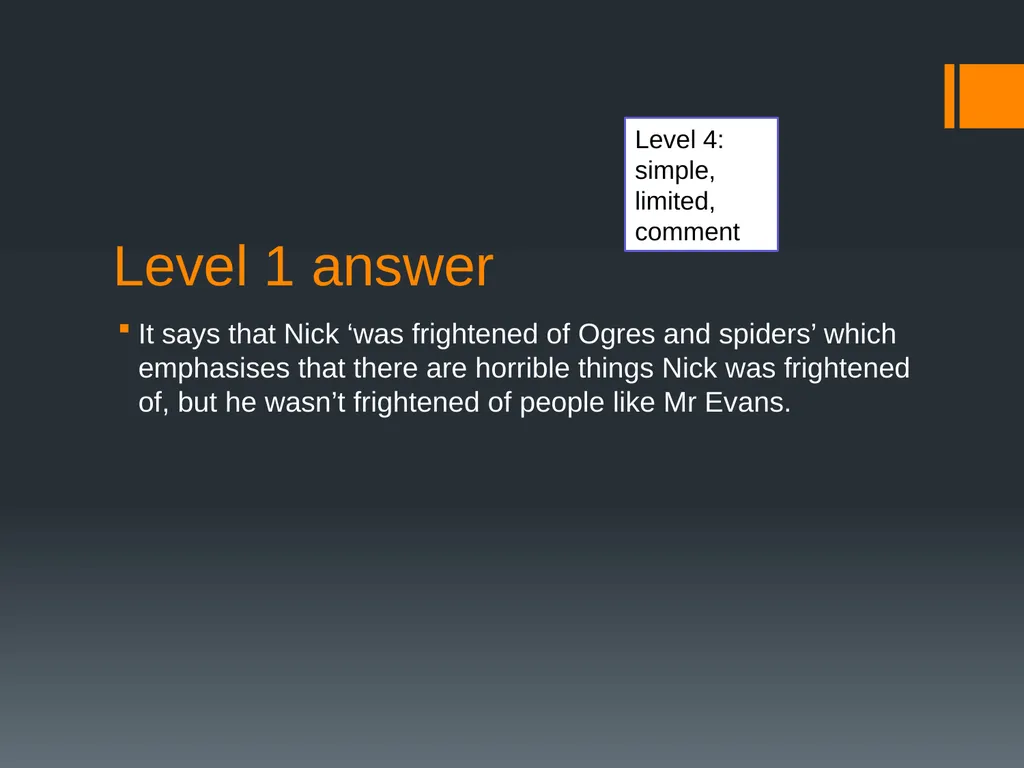
Level 1 answer It says that Nick ‘was frightened of Ogres and spiders’ which emphasises that there are horrible things Nick was frightened of, but he wasn’t frightened of people like Mr Evans. Level 4: simple, limited,
comment<br>
comment<br>
13
Tips Highlight anything interesting as you read, try to cover words, phrases, techniques, sentence structure, punctuation
Comment on language in the lines specified
Use PEE+E to ensure top level analysis
Closely analyse language: literal meaning and implied meaning<br>
Comment on language in the lines specified
Use PEE+E to ensure top level analysis
Closely analyse language: literal meaning and implied meaning<br>
14
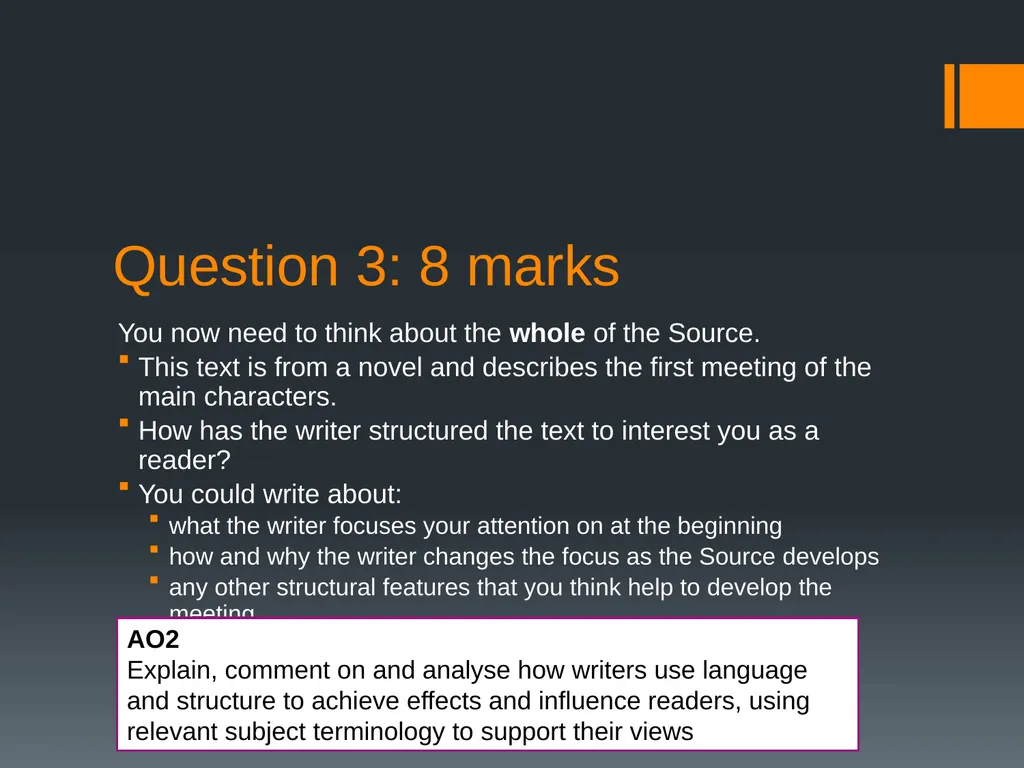
Question 3: 8 marks You now need to think about the whole of the Source.
This text is from a novel and describes the first meeting of the main characters.
How has the writer structured the text to interest you as a reader?
You could write about:
what the writer focuses your attention on at the beginning
how and why the writer changes the focus as the Source develops
any other structural features that you think help to develop the meeting.
[ AO2
Explain, comment on and analyse how writers use language and structure to achieve effects and influence readers, using relevant subject terminology to support their views<br>
This text is from a novel and describes the first meeting of the main characters.
How has the writer structured the text to interest you as a reader?
You could write about:
what the writer focuses your attention on at the beginning
how and why the writer changes the focus as the Source develops
any other structural features that you think help to develop the meeting.
[ AO2
Explain, comment on and analyse how writers use language and structure to achieve effects and influence readers, using relevant subject terminology to support their views<br>
15
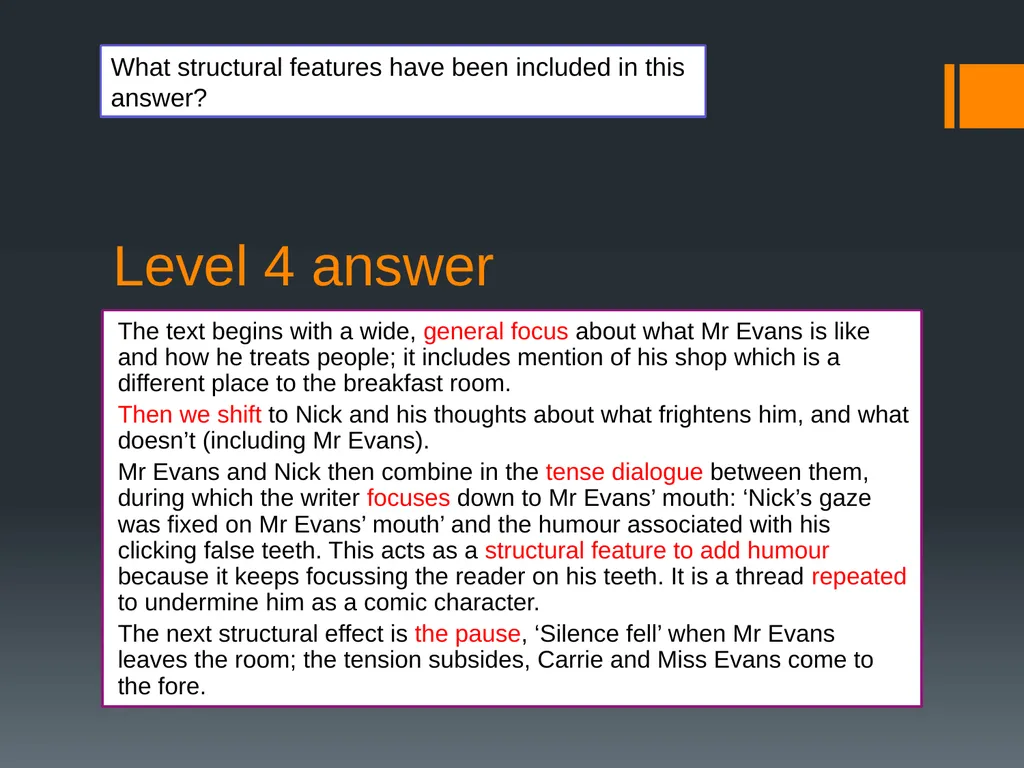
Level 4 answer The text begins with a wide, general focus about what Mr Evans is like and how he treats people; it includes mention of his shop which is a different place to the breakfast room.
Then we shift to Nick and his thoughts about what frightens him, and what doesn’t (including Mr Evans).
Mr Evans and Nick then combine in the tense dialogue between them, during which the writer focuses down to Mr Evans’ mouth: ‘Nick’s gaze was fixed on Mr Evans’ mouth’ and the humour associated with his clicking false teeth. This acts as a structural feature to add humour because it keeps focussing the reader on his teeth. It is a thread repeated to undermine him as a comic character.
The next structural effect is the pause, ‘Silence fell’ when Mr Evans leaves the room; the tension subsides, Carrie and Miss Evans come to the fore. What structural features have been included in this answer?<br>
Then we shift to Nick and his thoughts about what frightens him, and what doesn’t (including Mr Evans).
Mr Evans and Nick then combine in the tense dialogue between them, during which the writer focuses down to Mr Evans’ mouth: ‘Nick’s gaze was fixed on Mr Evans’ mouth’ and the humour associated with his clicking false teeth. This acts as a structural feature to add humour because it keeps focussing the reader on his teeth. It is a thread repeated to undermine him as a comic character.
The next structural effect is the pause, ‘Silence fell’ when Mr Evans leaves the room; the tension subsides, Carrie and Miss Evans come to the fore. What structural features have been included in this answer?<br>
16
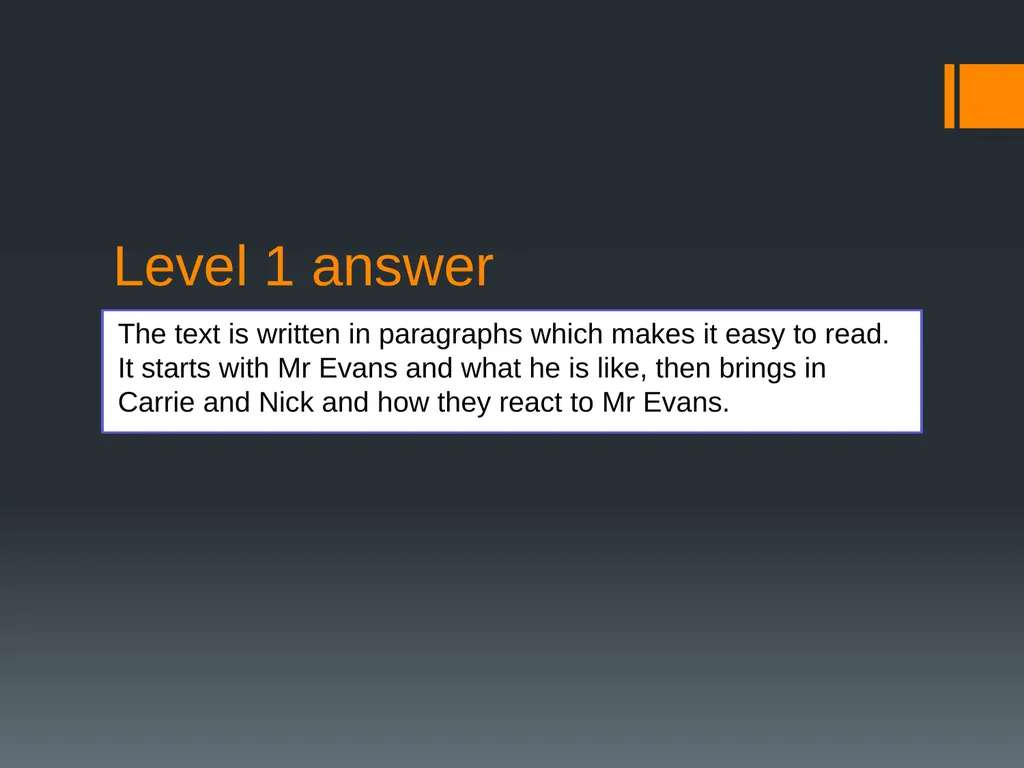
Level 1 answer The text is written in paragraphs which makes it easy to read. It starts with Mr Evans and what he is like, then brings in Carrie and Nick and how they react to Mr Evans.<br>
17
Tips Highlight structural features
Cover the whole text
Discuss effect
Use PEE+E to help keep you on track<br>
Cover the whole text
Discuss effect
Use PEE+E to help keep you on track<br>
18
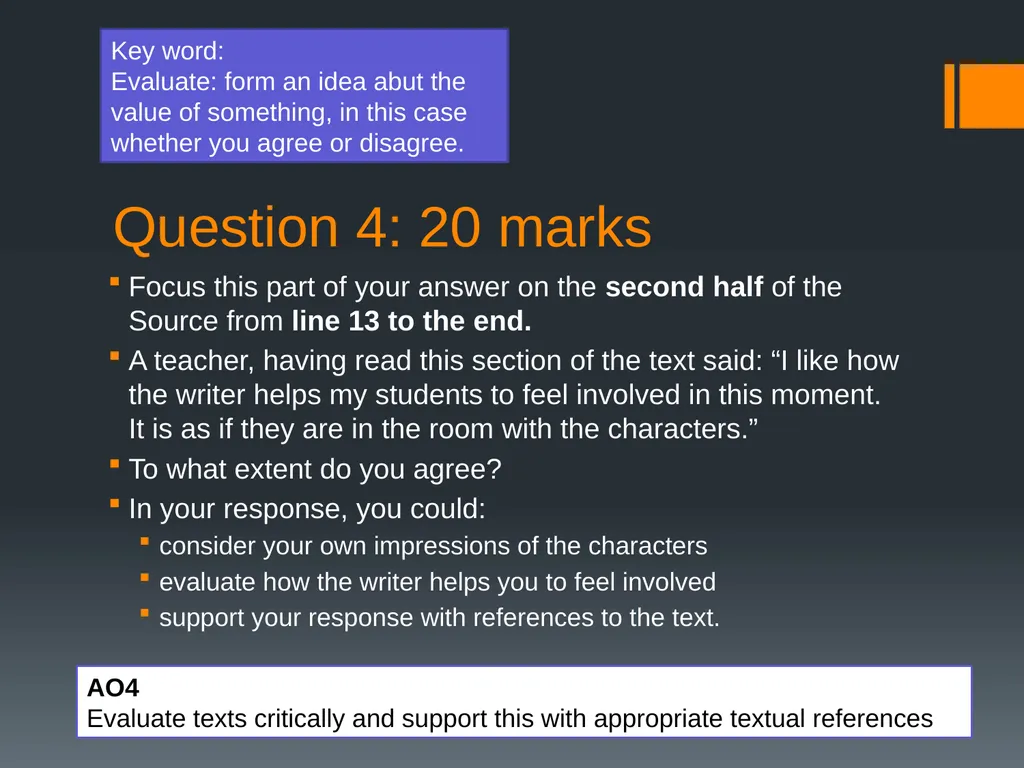
Question 4: 20 marks Focus this part of your answer on the second half of the Source from line 13 to the end.
A teacher, having read this section of the text said: “I like how the writer helps my students to feel involved in this moment. It is as if they are in the room with the characters.”
To what extent do you agree?
In your response, you could:
consider your own impressions of the characters
evaluate how the writer helps you to feel involved
support your response with references to the text. AO4
Evaluate texts critically and support this with appropriate textual references Key word:
Evaluate: form an idea abut the value of something, in this case whether you agree or disagree.<br>
A teacher, having read this section of the text said: “I like how the writer helps my students to feel involved in this moment. It is as if they are in the room with the characters.”
To what extent do you agree?
In your response, you could:
consider your own impressions of the characters
evaluate how the writer helps you to feel involved
support your response with references to the text. AO4
Evaluate texts critically and support this with appropriate textual references Key word:
Evaluate: form an idea abut the value of something, in this case whether you agree or disagree.<br>
19
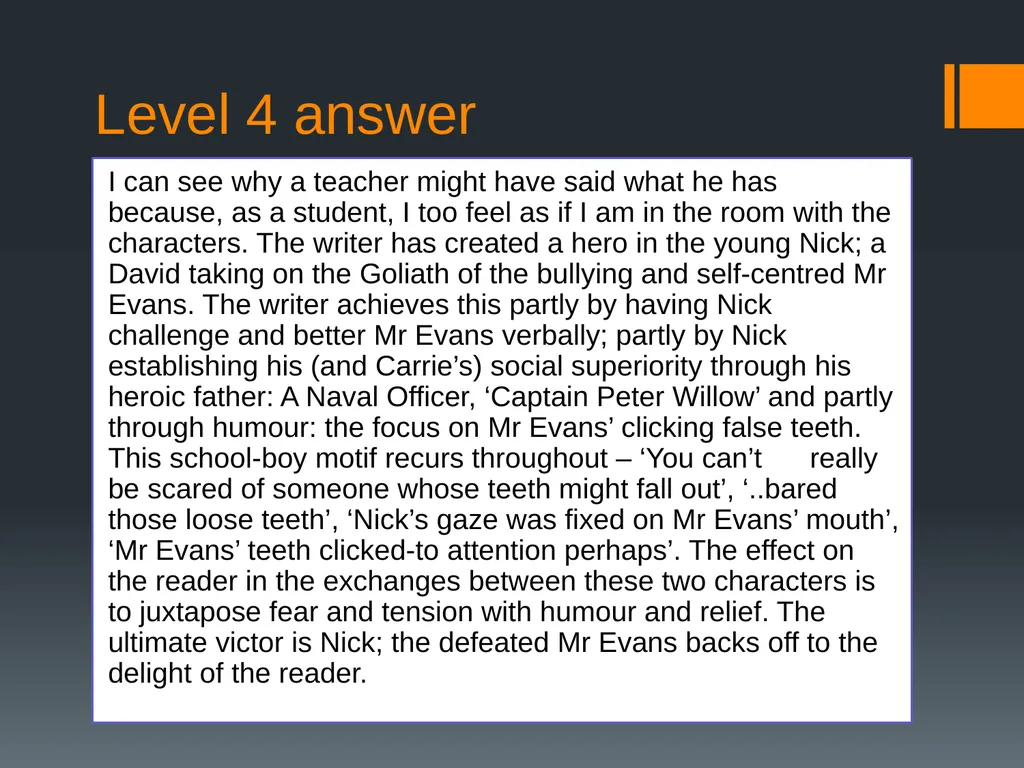
Level 4 answer I can see why a teacher might have said what he has because, as a student, I too feel as if I am in the room with the characters. The writer has created a hero in the young Nick; a David taking on the Goliath of the bullying and self-centred Mr Evans. The writer achieves this partly by having Nick challenge and better Mr Evans verbally; partly by Nick establishing his (and Carrie’s) social superiority through his heroic father: A Naval Officer, ‘Captain Peter Willow’ and partly through humour: the focus on Mr Evans’ clicking false teeth. This school-boy motif recurs throughout – ‘You can’t really be scared of someone whose teeth might fall out’, ‘..bared those loose teeth’, ‘Nick’s gaze was fixed on Mr Evans’ mouth’, ‘Mr Evans’ teeth clicked-to attention perhaps’. The effect on the reader in the exchanges between these two characters is to juxtapose fear and tension with humour and relief. The ultimate victor is Nick; the defeated Mr Evans backs off to the delight of the reader.<br>
20
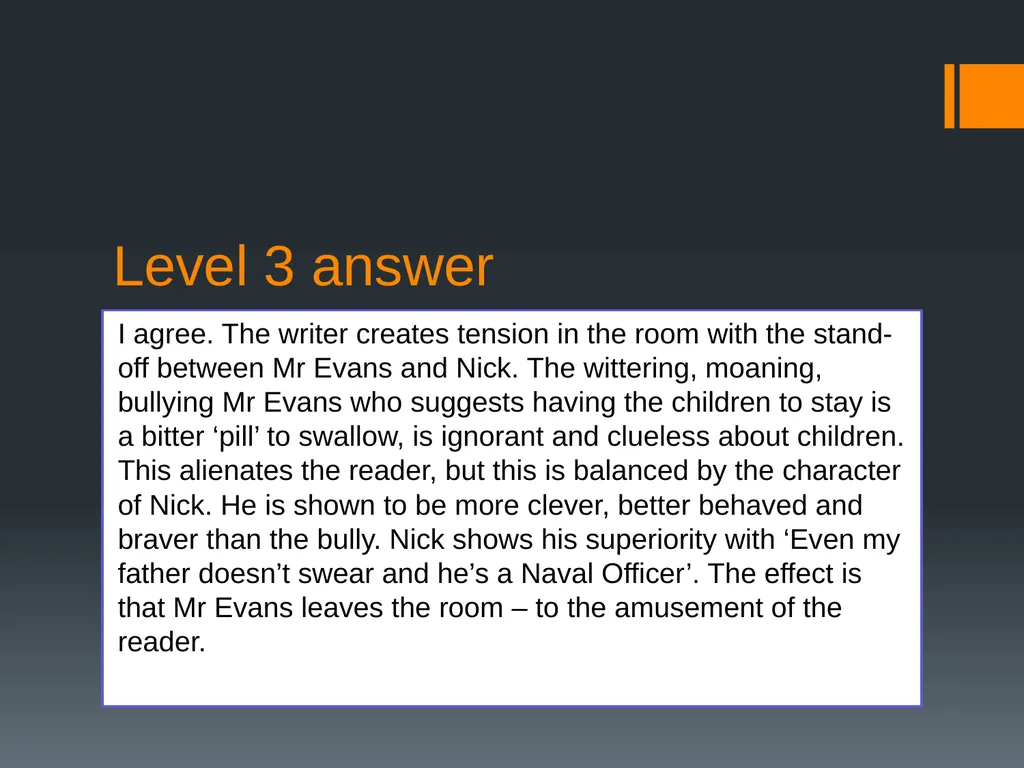
Level 3 answer I agree. The writer creates tension in the room with the stand-off between Mr Evans and Nick. The wittering, moaning, bullying Mr Evans who suggests having the children to stay is a bitter ‘pill’ to swallow, is ignorant and clueless about children. This alienates the reader, but this is balanced by the character of Nick. He is shown to be more clever, better behaved and braver than the bully. Nick shows his superiority with ‘Even my father doesn’t swear and he’s a Naval Officer’. The effect is that Mr Evans leaves the room – to the amusement of the reader.<br>
21
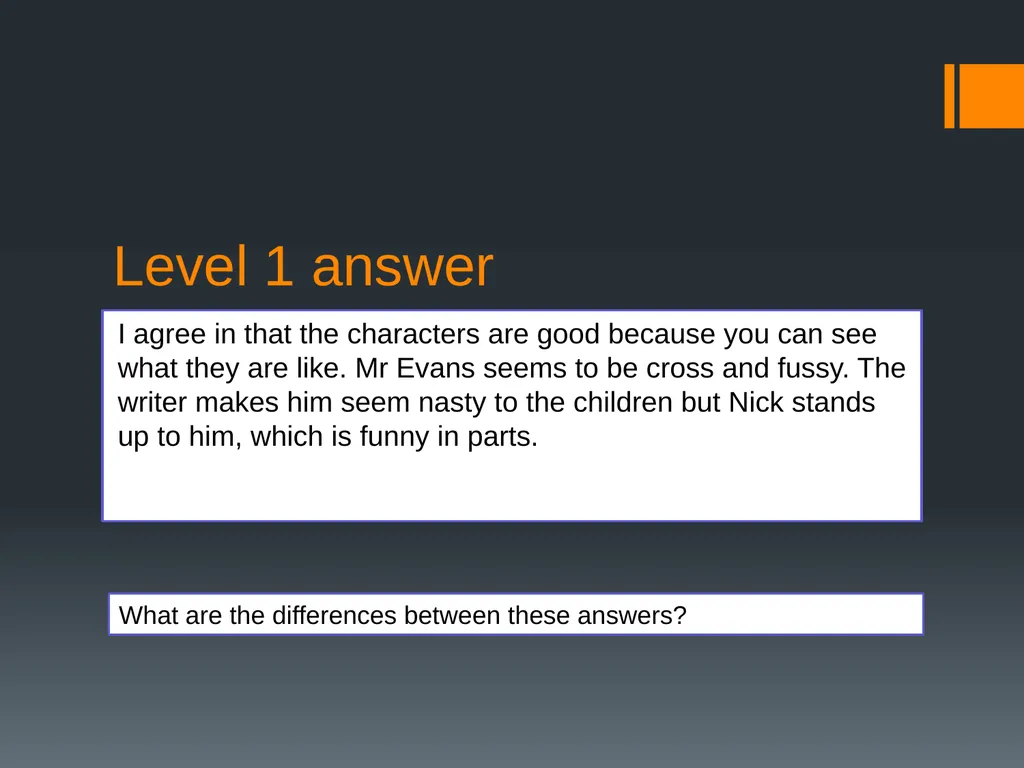
Level 1 answer I agree in that the characters are good because you can see what they are like. Mr Evans seems to be cross and fussy. The writer makes him seem nasty to the children but Nick stands up to him, which is funny in parts. What are the differences between these answers?<br>
22
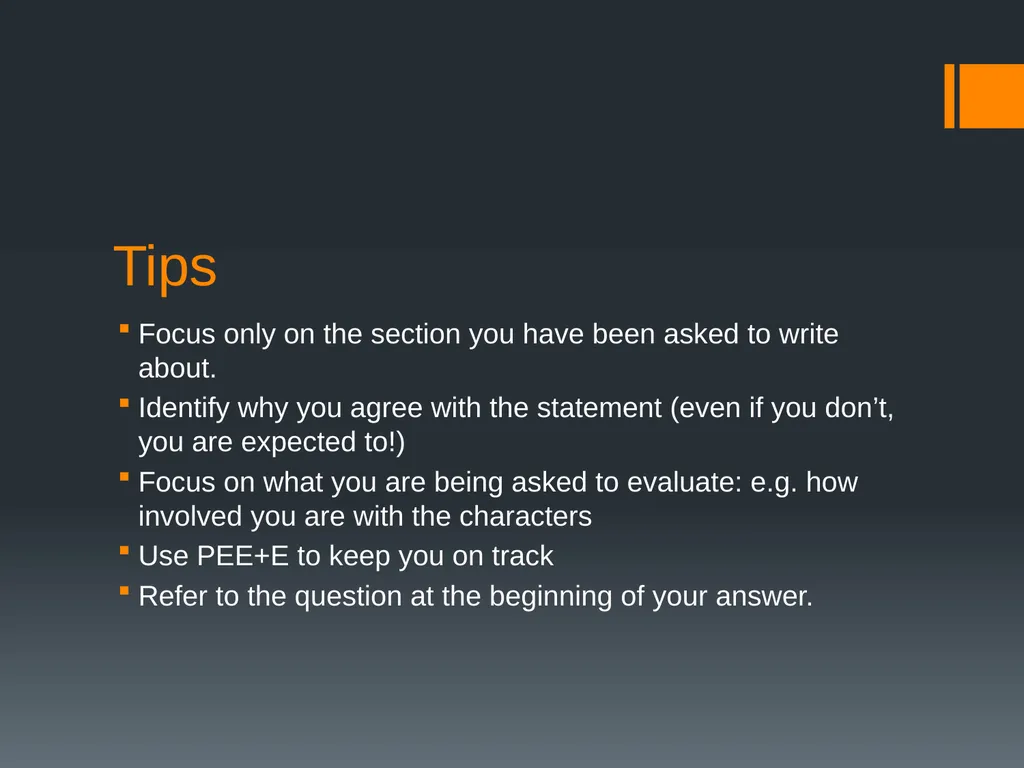
Tips Focus only on the section you have been asked to write about.
Identify why you agree with the statement (even if you don’t, you are expected to!)
Focus on what you are being asked to evaluate: e.g. how involved you are with the characters
Use PEE+E to keep you on track
Refer to the question at the beginning of your answer.<br>
Identify why you agree with the statement (even if you don’t, you are expected to!)
Focus on what you are being asked to evaluate: e.g. how involved you are with the characters
Use PEE+E to keep you on track
Refer to the question at the beginning of your answer.<br>
23
Question 5:40 marks
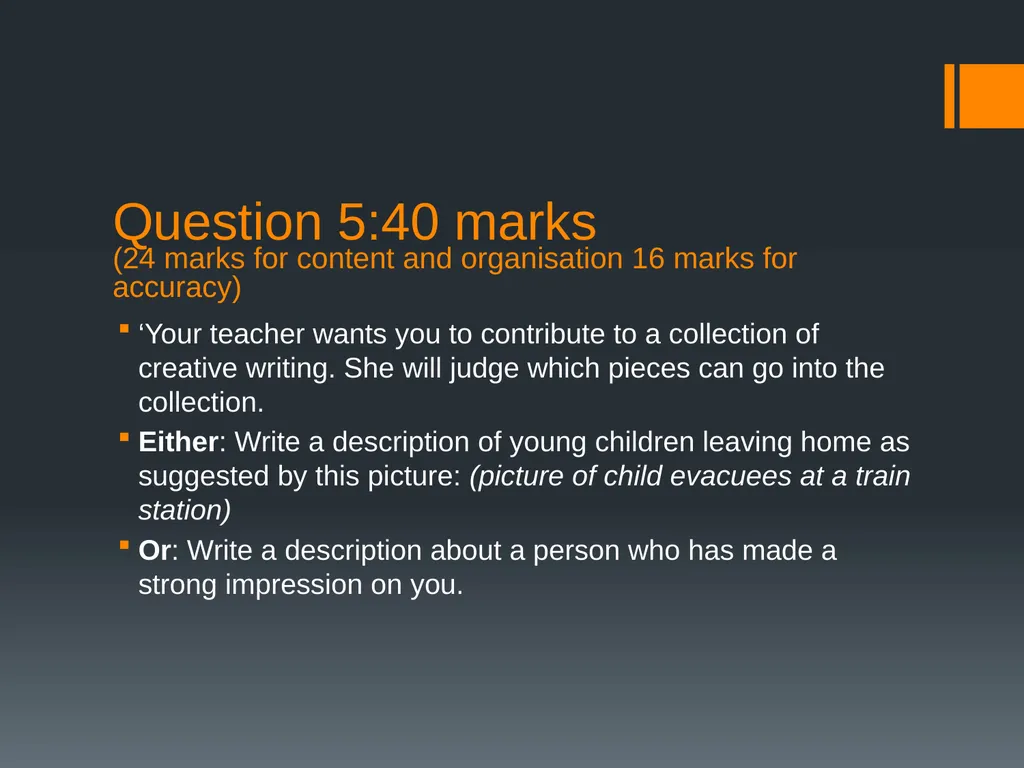
(24 marks for content and organisation 16 marks for accuracy) ‘Your teacher wants you to contribute to a collection of creative writing. She will judge which pieces can go into the collection.
Either: Write a description of young children leaving home as suggested by this picture: (picture of child evacuees at a train station)
Or: Write a description about a person who has made a strong impression on you.<br>
Either: Write a description of young children leaving home as suggested by this picture: (picture of child evacuees at a train station)
Or: Write a description about a person who has made a strong impression on you.<br>
24
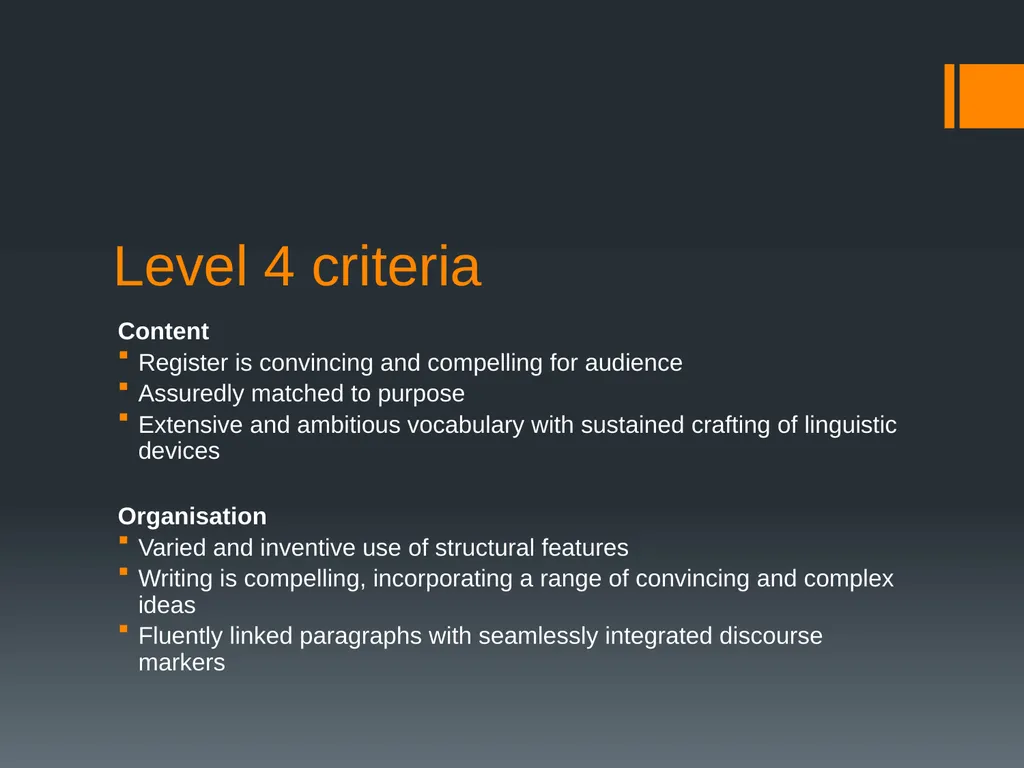
Level 4 criteria Content
Register is convincing and compelling for audience
Assuredly matched to purpose
Extensive and ambitious vocabulary with sustained crafting of linguistic devices
Organisation
Varied and inventive use of structural features
Writing is compelling, incorporating a range of convincing and complex ideas
Fluently linked paragraphs with seamlessly integrated discourse markers<br>
Register is convincing and compelling for audience
Assuredly matched to purpose
Extensive and ambitious vocabulary with sustained crafting of linguistic devices
Organisation
Varied and inventive use of structural features
Writing is compelling, incorporating a range of convincing and complex ideas
Fluently linked paragraphs with seamlessly integrated discourse markers<br>
25
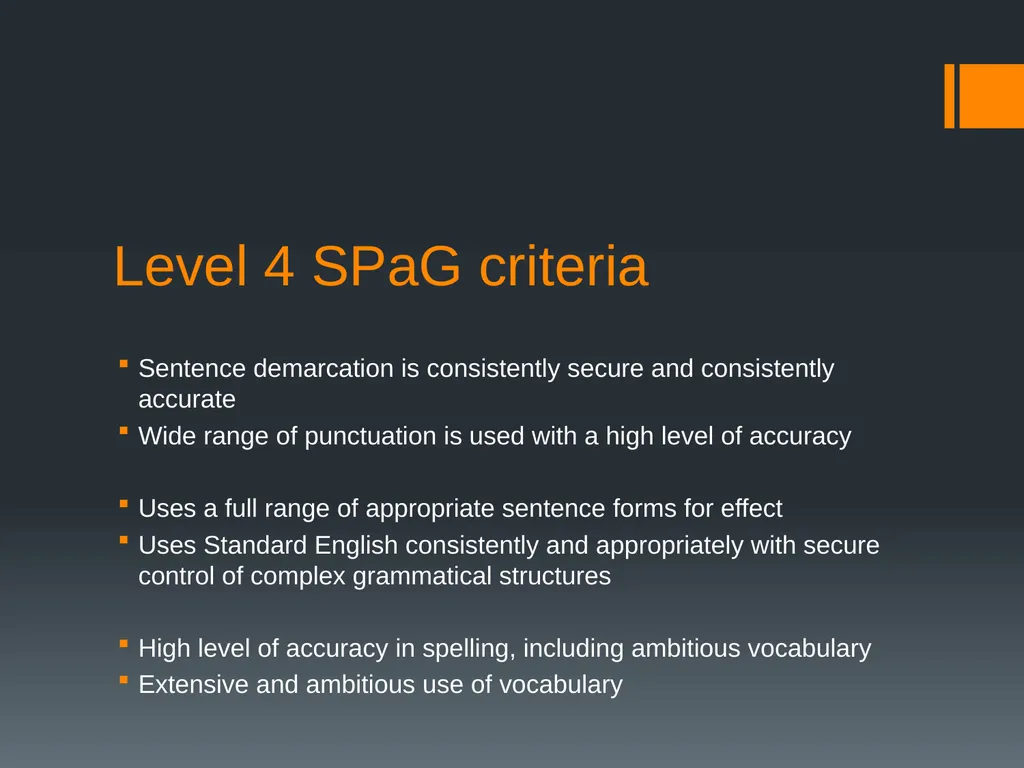
Level 4 SPaG criteria Sentence demarcation is consistently secure and consistently accurate
Wide range of punctuation is used with a high level of accuracy
Uses a full range of appropriate sentence forms for effect
Uses Standard English consistently and appropriately with secure control of complex grammatical structures
High level of accuracy in spelling, including ambitious vocabulary
Extensive and ambitious use of vocabulary<br>
Wide range of punctuation is used with a high level of accuracy
Uses a full range of appropriate sentence forms for effect
Uses Standard English consistently and appropriately with secure control of complex grammatical structures
High level of accuracy in spelling, including ambitious vocabulary
Extensive and ambitious use of vocabulary<br>
26
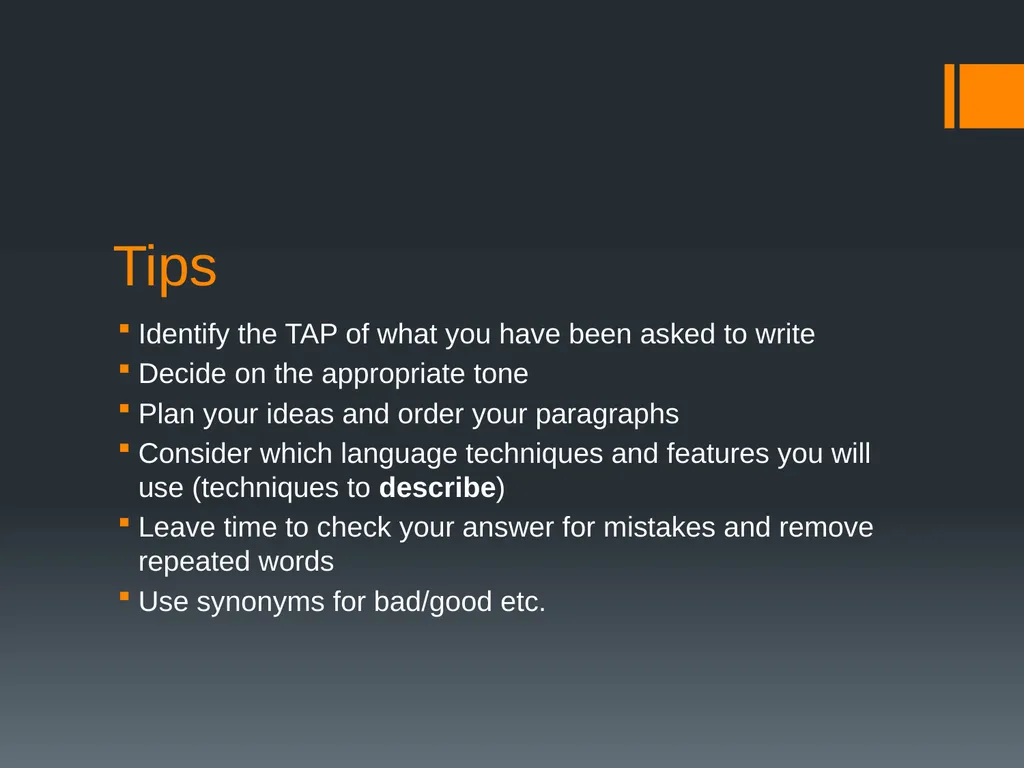
Tips Identify the TAP of what you have been asked to write
Decide on the appropriate tone
Plan your ideas and order your paragraphs
Consider which language techniques and features you will use (techniques to describe)
Leave time to check your answer for mistakes and remove repeated words
Use synonyms for bad/good etc.<br>
Decide on the appropriate tone
Plan your ideas and order your paragraphs
Consider which language techniques and features you will use (techniques to describe)
Leave time to check your answer for mistakes and remove repeated words
Use synonyms for bad/good etc.<br>