
Paradigm Shift Project Review Geneva Nov 10, 2015
TA
Published · 22 slides · 0 views

1 / 1

Description
Paradigm Shift Project Review Geneva Nov 10, 2015 1 Our greatest achievement is our greatest challenge 2 Context Globalization of economy in Space Increasing speed of movement change in Time Rapid social Evolution of the whole society
Related Topics
Share
Embed code
Download this presentation From Below
"Paradigm Shift Project Review Geneva Nov 10, 2015" is the property of its rightful owner. Permission is granted to download and print the materials on this website for personal, non-commercial use only, and to display it on your personal computer provided you do not modify the materials and that you retain all copyright notices contained in the materials. By downloading content from our website, you accept the terms of this agreement.
Presentation Transcript
01
Paradigm Shift
Project Review Geneva
Nov 10, 2015 1<br>
Nov 10, 2015 1<br>
02
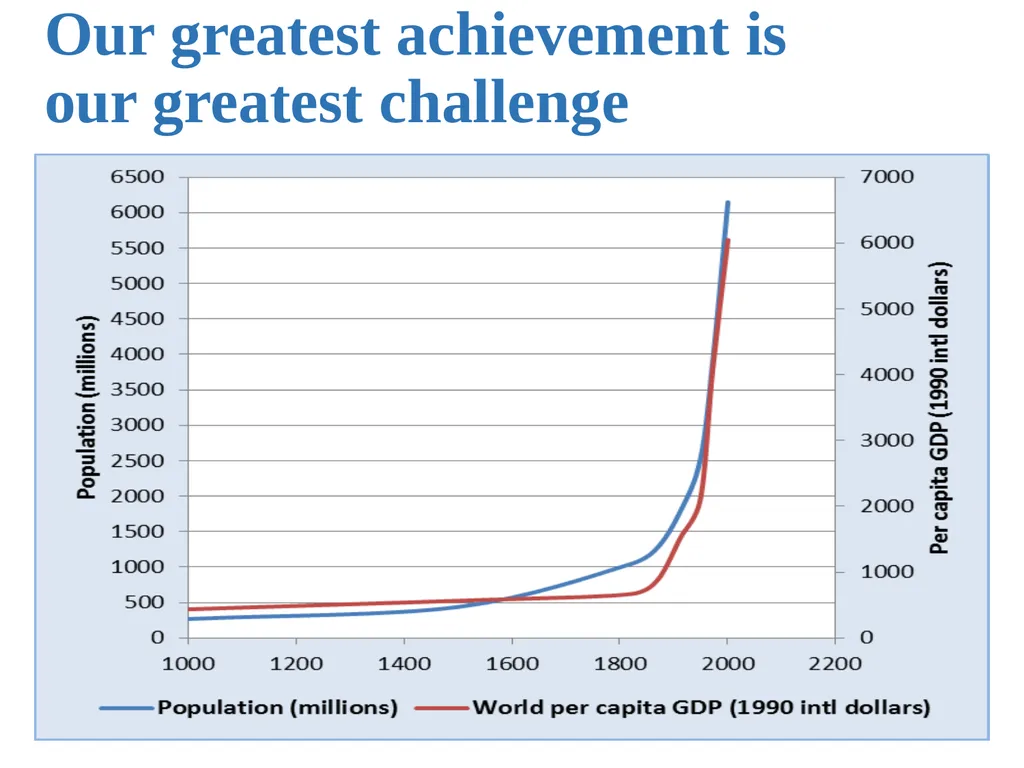
Our greatest achievement is
our greatest challenge 2<br>
03
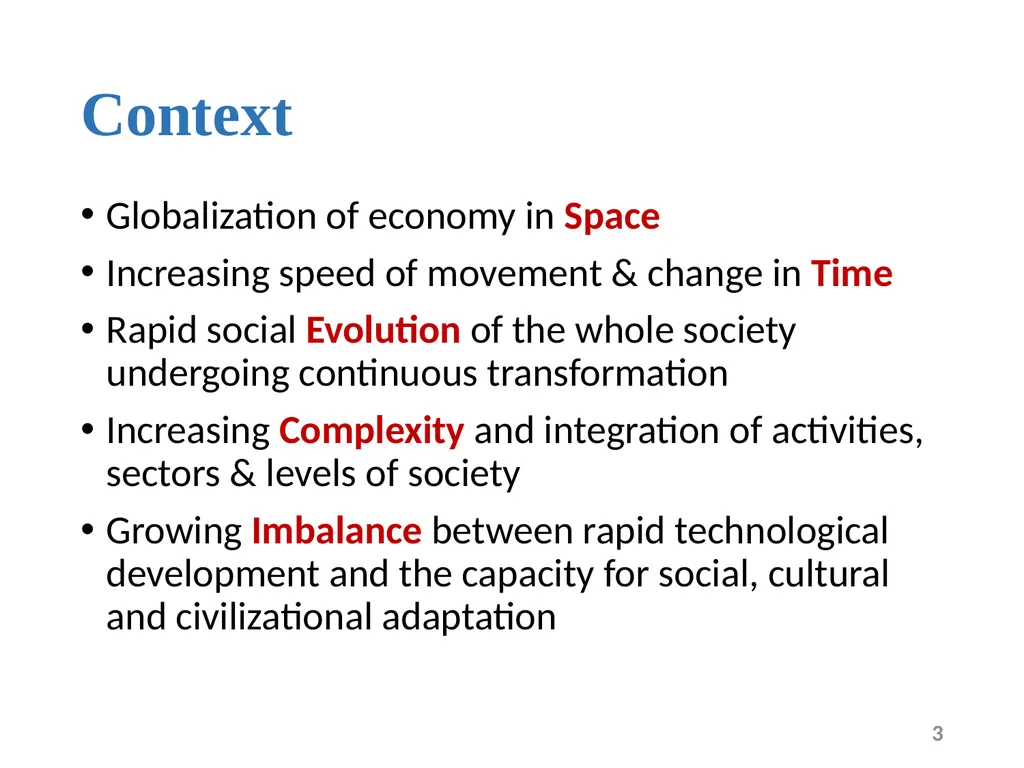
Context Globalization of economy in Space
Increasing speed of movement & change in Time
Rapid social Evolution of the whole society undergoing continuous transformation
Increasing Complexity and integration of activities, sectors & levels of society
Growing Imbalance between rapid technological development and the capacity for social, cultural and civilizational adaptation 3<br>
Increasing speed of movement & change in Time
Rapid social Evolution of the whole society undergoing continuous transformation
Increasing Complexity and integration of activities, sectors & levels of society
Growing Imbalance between rapid technological development and the capacity for social, cultural and civilizational adaptation 3<br>
04
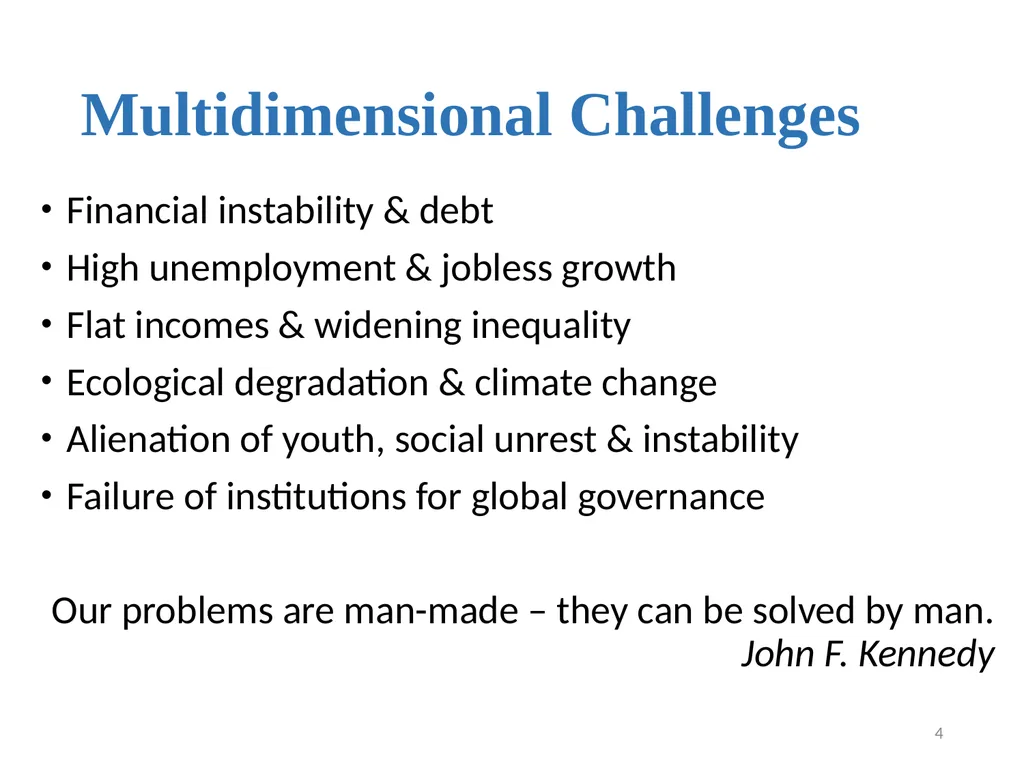
Multidimensional Challenges Financial instability & debt
High unemployment & jobless growth
Flat incomes & widening inequality
Ecological degradation & climate change
Alienation of youth, social unrest & instability
Failure of institutions for global governance
Our problems are man-made – they can be solved by man. John F. Kennedy 4<br>
High unemployment & jobless growth
Flat incomes & widening inequality
Ecological degradation & climate change
Alienation of youth, social unrest & instability
Failure of institutions for global governance
Our problems are man-made – they can be solved by man. John F. Kennedy 4<br>
05
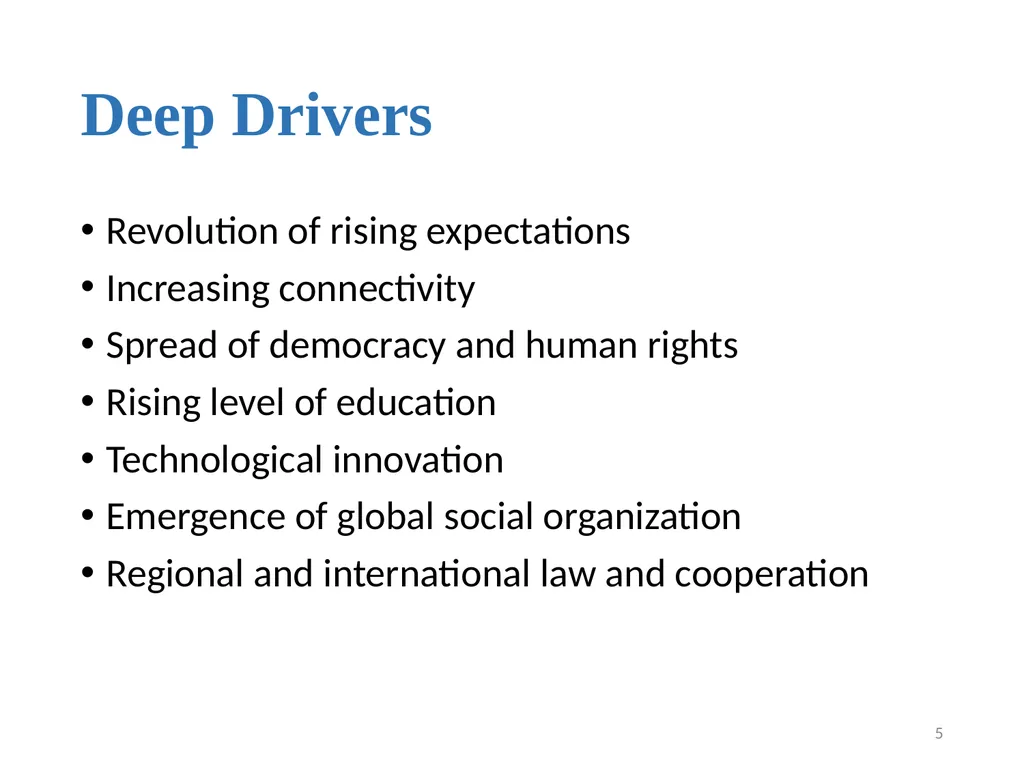
Deep Drivers Revolution of rising expectations
Increasing connectivity
Spread of democracy and human rights
Rising level of education
Technological innovation
Emergence of global social organization
Regional and international law and cooperation 5<br>
Increasing connectivity
Spread of democracy and human rights
Rising level of education
Technological innovation
Emergence of global social organization
Regional and international law and cooperation 5<br>
06
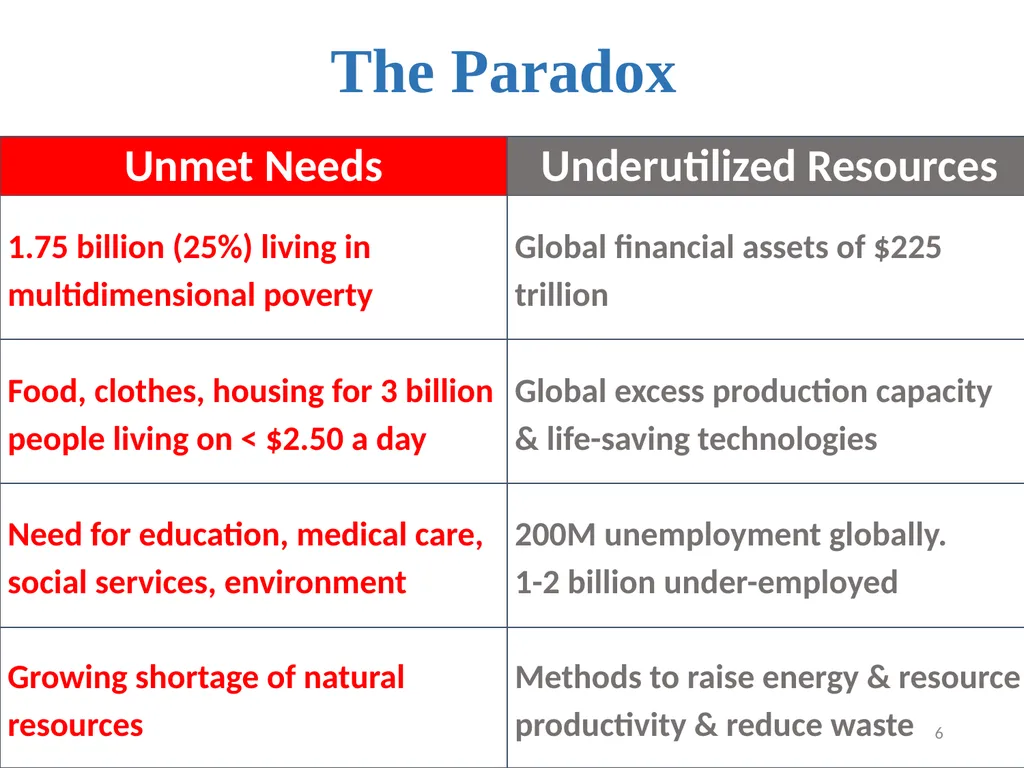
The Paradox 6<br>
07
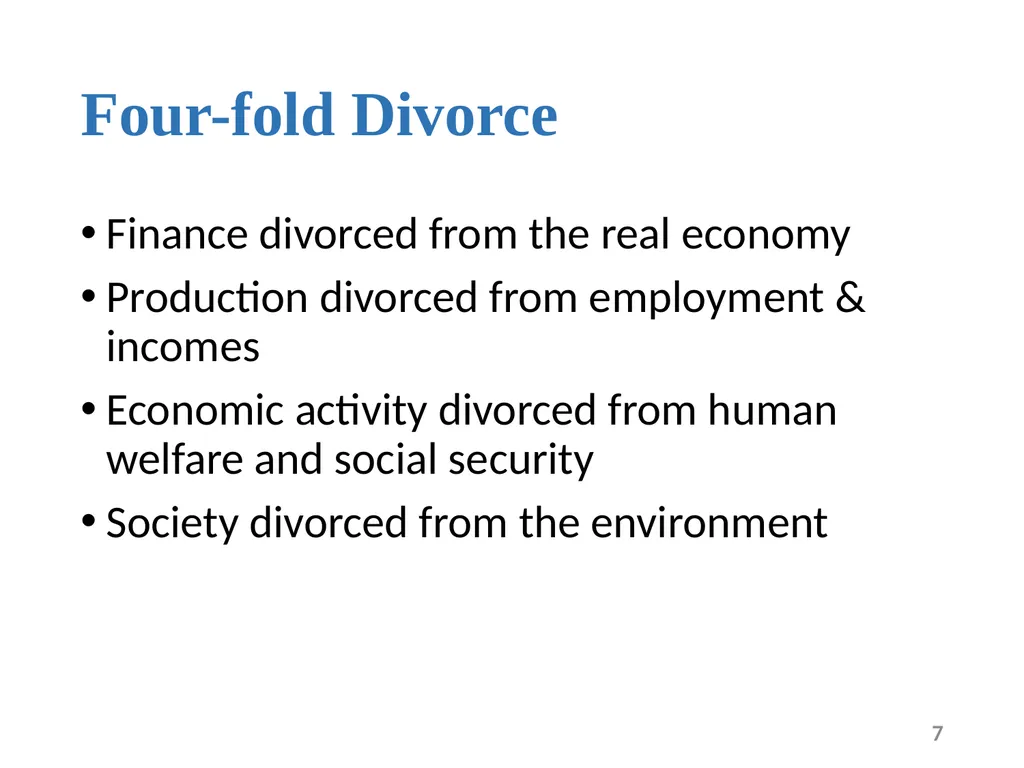
Four-fold Divorce Finance divorced from the real economy
Production divorced from employment & incomes
Economic activity divorced from human welfare and social security
Society divorced from the environment 7<br>
Production divorced from employment & incomes
Economic activity divorced from human welfare and social security
Society divorced from the environment 7<br>
08
The Big Question Is there any way that global society can be organized in a manner that promotes the security and welfare of all human beings, now and in the future? 8<br>
09
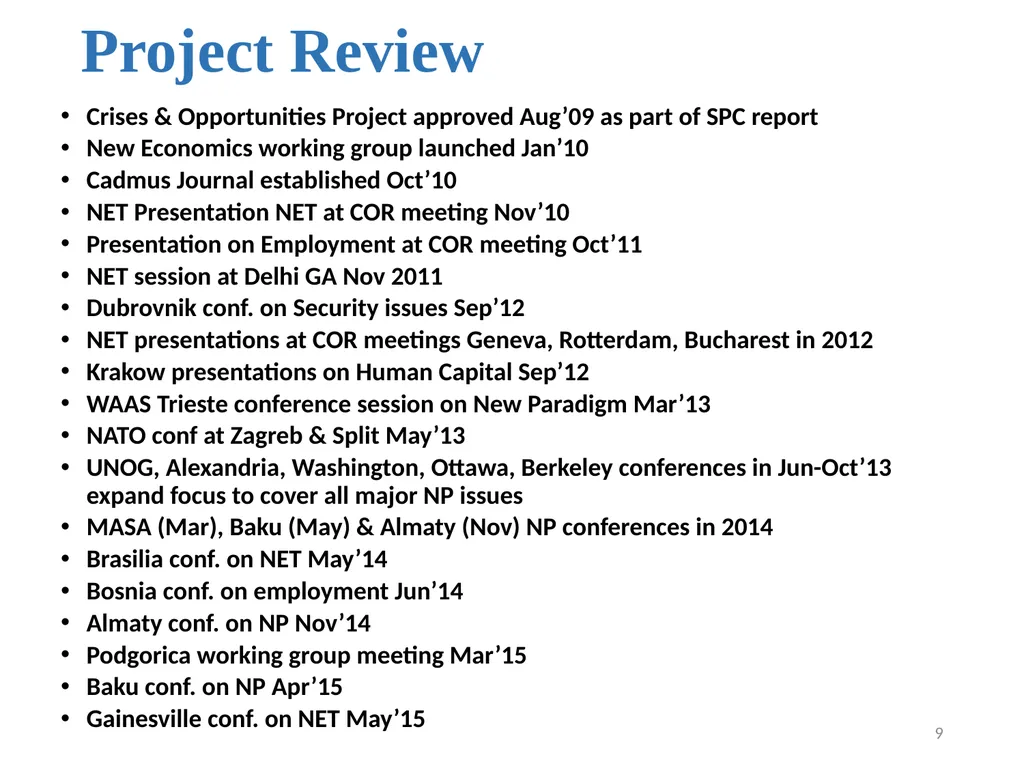
Project Review Crises & Opportunities Project approved Aug’09 as part of SPC report
New Economics working group launched Jan’10
Cadmus Journal established Oct’10
NET Presentation NET at COR meeting Nov’10
Presentation on Employment at COR meeting Oct’11
NET session at Delhi GA Nov 2011
Dubrovnik conf. on Security issues Sep’12
NET presentations at COR meetings Geneva, Rotterdam, Bucharest in 2012
Krakow presentations on Human Capital Sep’12
WAAS Trieste conference session on New Paradigm Mar’13
NATO conf at Zagreb & Split May’13
UNOG, Alexandria, Washington, Ottawa, Berkeley conferences in Jun-Oct’13 expand focus to cover all major NP issues
MASA (Mar), Baku (May) & Almaty (Nov) NP conferences in 2014
Brasilia conf. on NET May’14
Bosnia conf. on employment Jun’14
Almaty conf. on NP Nov’14
Podgorica working group meeting Mar’15
Baku conf. on NP Apr’15
Gainesville conf. on NET May’15 9<br>
New Economics working group launched Jan’10
Cadmus Journal established Oct’10
NET Presentation NET at COR meeting Nov’10
Presentation on Employment at COR meeting Oct’11
NET session at Delhi GA Nov 2011
Dubrovnik conf. on Security issues Sep’12
NET presentations at COR meetings Geneva, Rotterdam, Bucharest in 2012
Krakow presentations on Human Capital Sep’12
WAAS Trieste conference session on New Paradigm Mar’13
NATO conf at Zagreb & Split May’13
UNOG, Alexandria, Washington, Ottawa, Berkeley conferences in Jun-Oct’13 expand focus to cover all major NP issues
MASA (Mar), Baku (May) & Almaty (Nov) NP conferences in 2014
Brasilia conf. on NET May’14
Bosnia conf. on employment Jun’14
Almaty conf. on NP Nov’14
Podgorica working group meeting Mar’15
Baku conf. on NP Apr’15
Gainesville conf. on NET May’15 9<br>
10
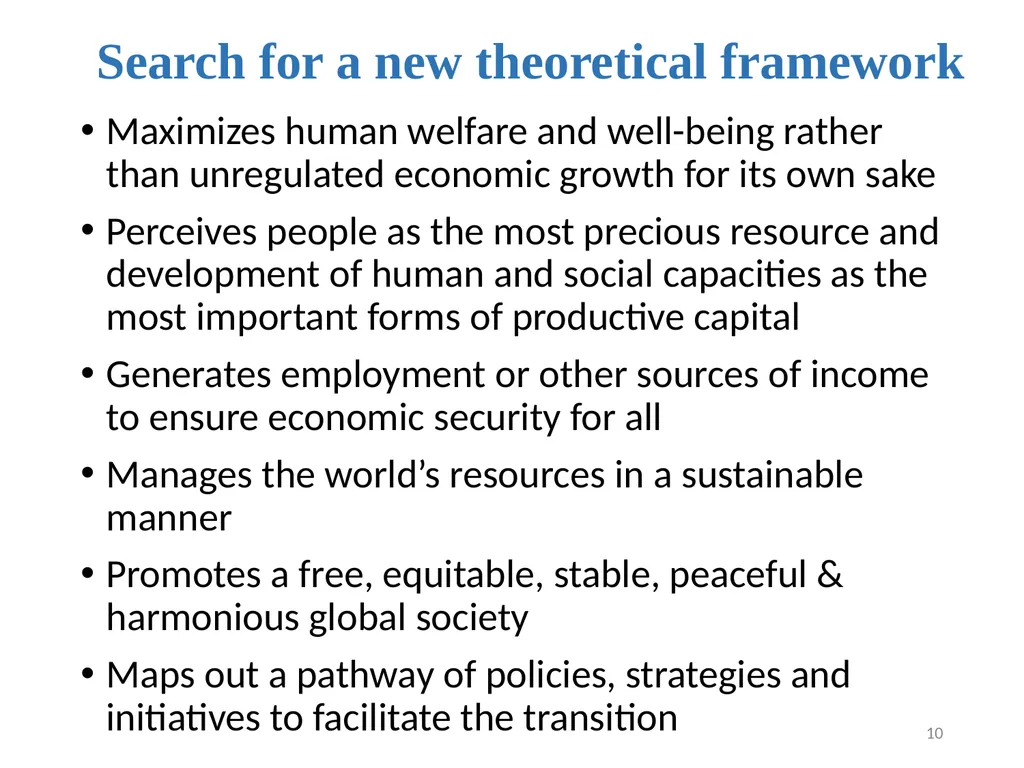
Search for a new theoretical framework Maximizes human welfare and well-being rather than unregulated economic growth for its own sake
Perceives people as the most precious resource and development of human and social capacities as the most important forms of productive capital
Generates employment or other sources of income to ensure economic security for all
Manages the world’s resources in a sustainable manner
Promotes a free, equitable, stable, peaceful & harmonious global society
Maps out a pathway of policies, strategies and initiatives to facilitate the transition 10<br>
Perceives people as the most precious resource and development of human and social capacities as the most important forms of productive capital
Generates employment or other sources of income to ensure economic security for all
Manages the world’s resources in a sustainable manner
Promotes a free, equitable, stable, peaceful & harmonious global society
Maps out a pathway of policies, strategies and initiatives to facilitate the transition 10<br>
11
New Economy 11<br>
12
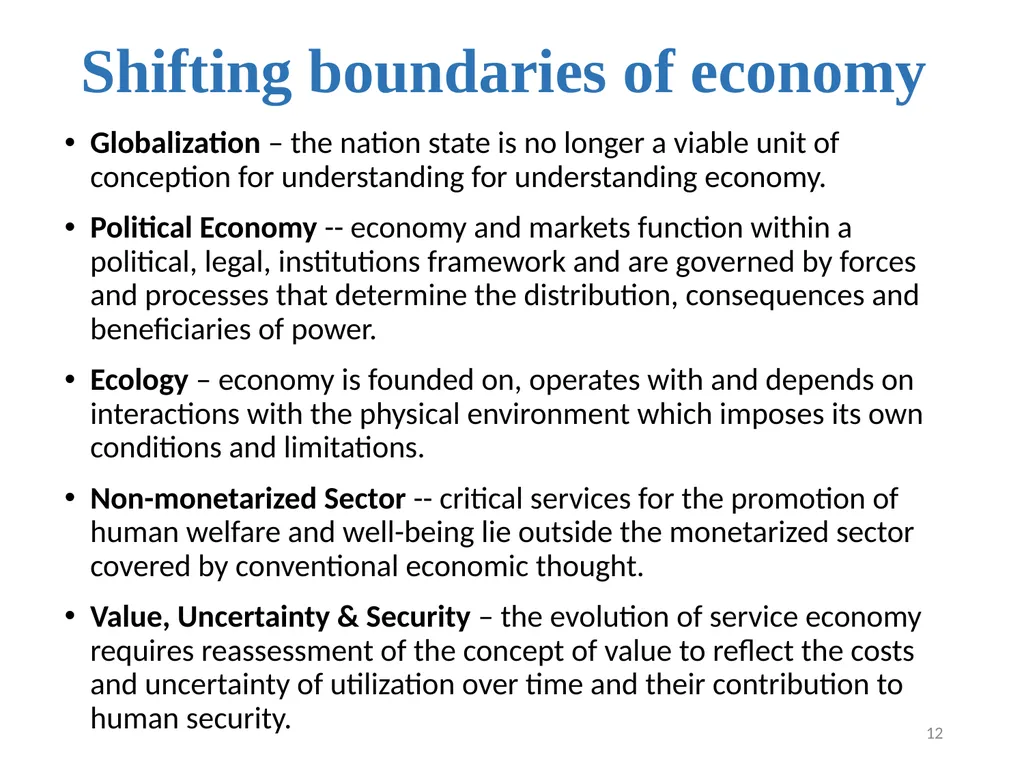
Shifting boundaries of economy Globalization – the nation state is no longer a viable unit of conception for understanding for understanding economy.
Political Economy -- economy and markets function within a political, legal, institutions framework and are governed by forces and processes that determine the distribution, consequences and beneficiaries of power.
Ecology – economy is founded on, operates with and depends on interactions with the physical environment which imposes its own conditions and limitations.
Non-monetarized Sector -- critical services for the promotion of human welfare and well-being lie outside the monetarized sector covered by conventional economic thought.
Value, Uncertainty & Security – the evolution of service economy requires reassessment of the concept of value to reflect the costs and uncertainty of utilization over time and their contribution to human security. 12<br>
Political Economy -- economy and markets function within a political, legal, institutions framework and are governed by forces and processes that determine the distribution, consequences and beneficiaries of power.
Ecology – economy is founded on, operates with and depends on interactions with the physical environment which imposes its own conditions and limitations.
Non-monetarized Sector -- critical services for the promotion of human welfare and well-being lie outside the monetarized sector covered by conventional economic thought.
Value, Uncertainty & Security – the evolution of service economy requires reassessment of the concept of value to reflect the costs and uncertainty of utilization over time and their contribution to human security. 12<br>
13
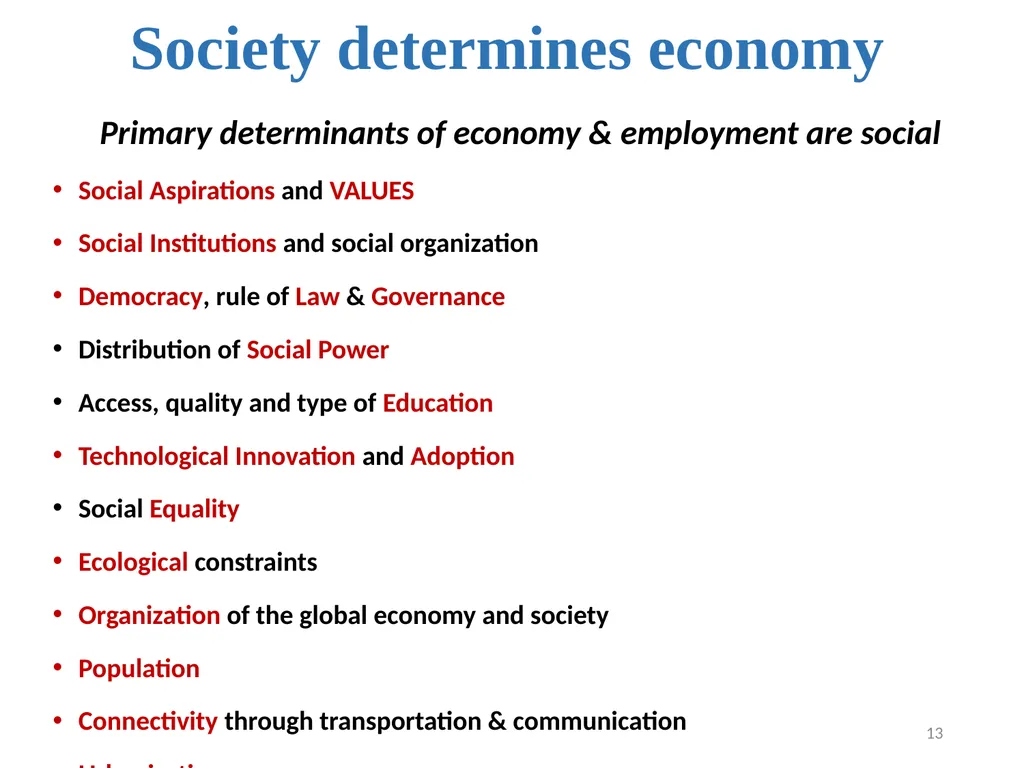
Society determines economy Primary determinants of economy & employment are social
Social Aspirations and VALUES
Social Institutions and social organization
Democracy, rule of Law & Governance
Distribution of Social Power
Access, quality and type of Education
Technological Innovation and Adoption
Social Equality
Ecological constraints
Organization of the global economy and society
Population
Connectivity through transportation & communication
Urbanization 13<br>
Social Aspirations and VALUES
Social Institutions and social organization
Democracy, rule of Law & Governance
Distribution of Social Power
Access, quality and type of Education
Technological Innovation and Adoption
Social Equality
Ecological constraints
Organization of the global economy and society
Population
Connectivity through transportation & communication
Urbanization 13<br>
14
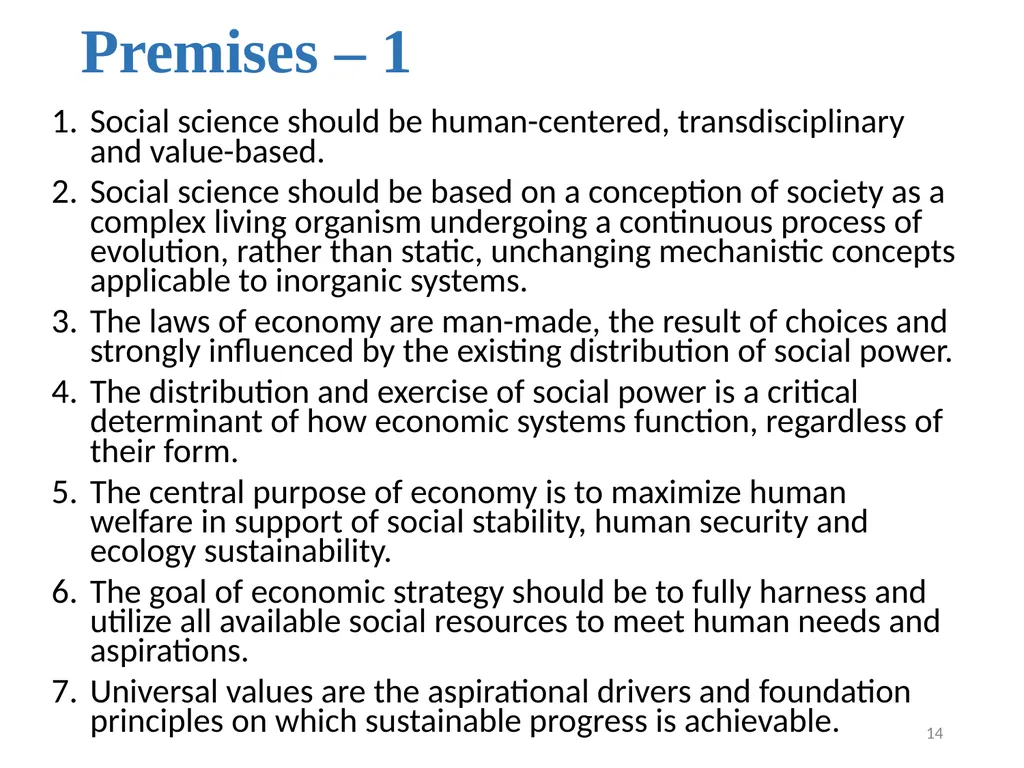
Premises – 1 Social science should be human-centered, transdisciplinary and value-based.
Social science should be based on a conception of society as a complex living organism undergoing a continuous process of evolution, rather than static, unchanging mechanistic concepts applicable to inorganic systems.
The laws of economy are man-made, the result of choices and strongly influenced by the existing distribution of social power.
The distribution and exercise of social power is a critical determinant of how economic systems function, regardless of their form.
The central purpose of economy is to maximize human welfare in support of social stability, human security and ecology sustainability.
The goal of economic strategy should be to fully harness and utilize all available social resources to meet human needs and aspirations.
Universal values are the aspirational drivers and foundation principles on which sustainable progress is achievable. 14<br>
Social science should be based on a conception of society as a complex living organism undergoing a continuous process of evolution, rather than static, unchanging mechanistic concepts applicable to inorganic systems.
The laws of economy are man-made, the result of choices and strongly influenced by the existing distribution of social power.
The distribution and exercise of social power is a critical determinant of how economic systems function, regardless of their form.
The central purpose of economy is to maximize human welfare in support of social stability, human security and ecology sustainability.
The goal of economic strategy should be to fully harness and utilize all available social resources to meet human needs and aspirations.
Universal values are the aspirational drivers and foundation principles on which sustainable progress is achievable. 14<br>
15
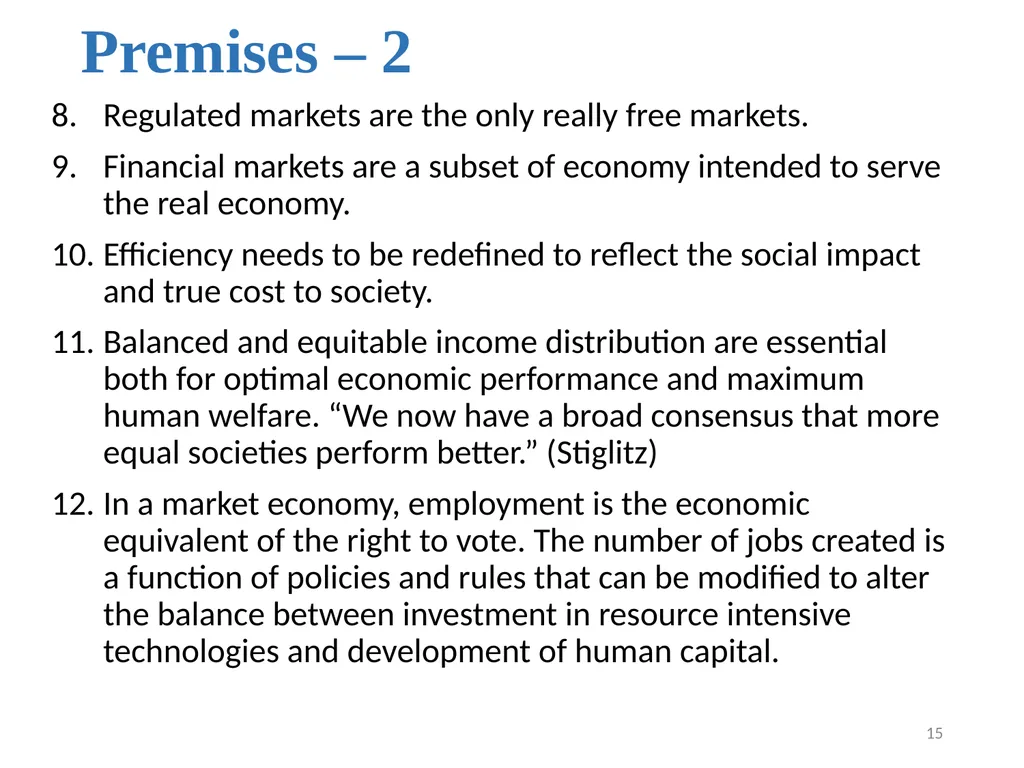
Premises – 2 Regulated markets are the only really free markets.
Financial markets are a subset of economy intended to serve the real economy.
Efficiency needs to be redefined to reflect the social impact and true cost to society.
Balanced and equitable income distribution are essential both for optimal economic performance and maximum human welfare. “We now have a broad consensus that more equal societies perform better.” (Stiglitz)
In a market economy, employment is the economic equivalent of the right to vote. The number of jobs created is a function of policies and rules that can be modified to alter the balance between investment in resource intensive technologies and development of human capital. 15<br>
Financial markets are a subset of economy intended to serve the real economy.
Efficiency needs to be redefined to reflect the social impact and true cost to society.
Balanced and equitable income distribution are essential both for optimal economic performance and maximum human welfare. “We now have a broad consensus that more equal societies perform better.” (Stiglitz)
In a market economy, employment is the economic equivalent of the right to vote. The number of jobs created is a function of policies and rules that can be modified to alter the balance between investment in resource intensive technologies and development of human capital. 15<br>
16
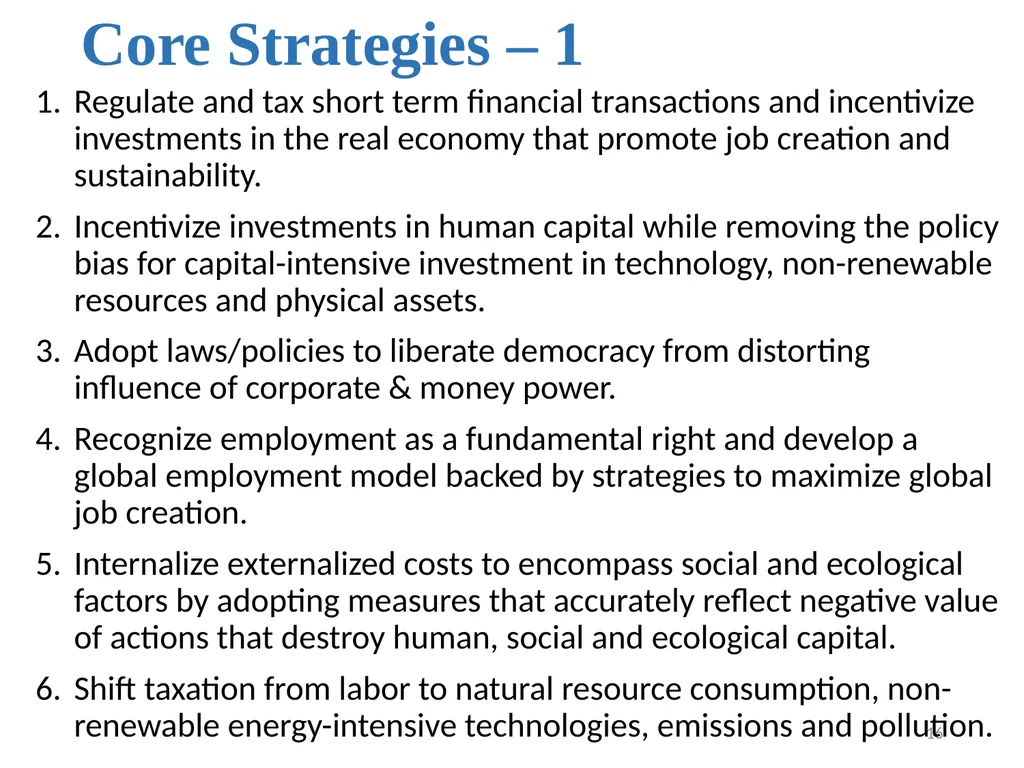
Core Strategies – 1 Regulate and tax short term financial transactions and incentivize investments in the real economy that promote job creation and sustainability.
Incentivize investments in human capital while removing the policy bias for capital-intensive investment in technology, non-renewable resources and physical assets.
Adopt laws/policies to liberate democracy from distorting influence of corporate & money power.
Recognize employment as a fundamental right and develop a global employment model backed by strategies to maximize global job creation.
Internalize externalized costs to encompass social and ecological factors by adopting measures that accurately reflect negative value of actions that destroy human, social and ecological capital.
Shift taxation from labor to natural resource consumption, non-renewable energy-intensive technologies, emissions and pollution. 16<br>
Incentivize investments in human capital while removing the policy bias for capital-intensive investment in technology, non-renewable resources and physical assets.
Adopt laws/policies to liberate democracy from distorting influence of corporate & money power.
Recognize employment as a fundamental right and develop a global employment model backed by strategies to maximize global job creation.
Internalize externalized costs to encompass social and ecological factors by adopting measures that accurately reflect negative value of actions that destroy human, social and ecological capital.
Shift taxation from labor to natural resource consumption, non-renewable energy-intensive technologies, emissions and pollution. 16<br>
17
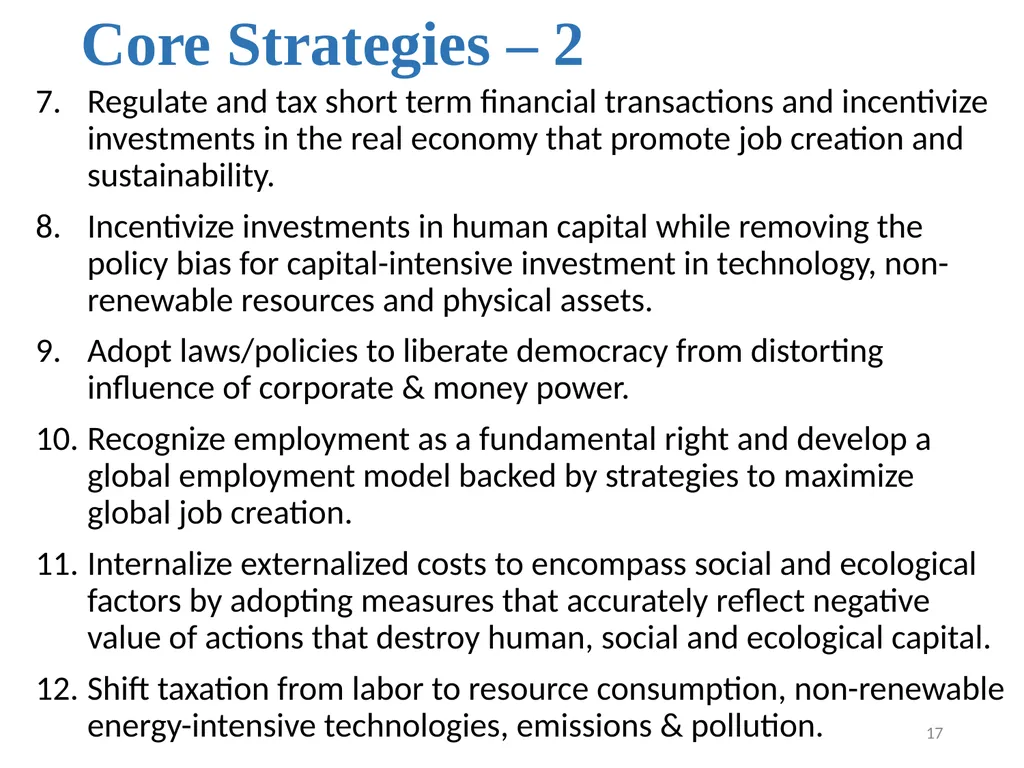
Core Strategies – 2 Regulate and tax short term financial transactions and incentivize investments in the real economy that promote job creation and sustainability.
Incentivize investments in human capital while removing the policy bias for capital-intensive investment in technology, non-renewable resources and physical assets.
Adopt laws/policies to liberate democracy from distorting influence of corporate & money power.
Recognize employment as a fundamental right and develop a global employment model backed by strategies to maximize global job creation.
Internalize externalized costs to encompass social and ecological factors by adopting measures that accurately reflect negative value of actions that destroy human, social and ecological capital.
Shift taxation from labor to resource consumption, non-renewable energy-intensive technologies, emissions & pollution. 17<br>
Incentivize investments in human capital while removing the policy bias for capital-intensive investment in technology, non-renewable resources and physical assets.
Adopt laws/policies to liberate democracy from distorting influence of corporate & money power.
Recognize employment as a fundamental right and develop a global employment model backed by strategies to maximize global job creation.
Internalize externalized costs to encompass social and ecological factors by adopting measures that accurately reflect negative value of actions that destroy human, social and ecological capital.
Shift taxation from labor to resource consumption, non-renewable energy-intensive technologies, emissions & pollution. 17<br>
18
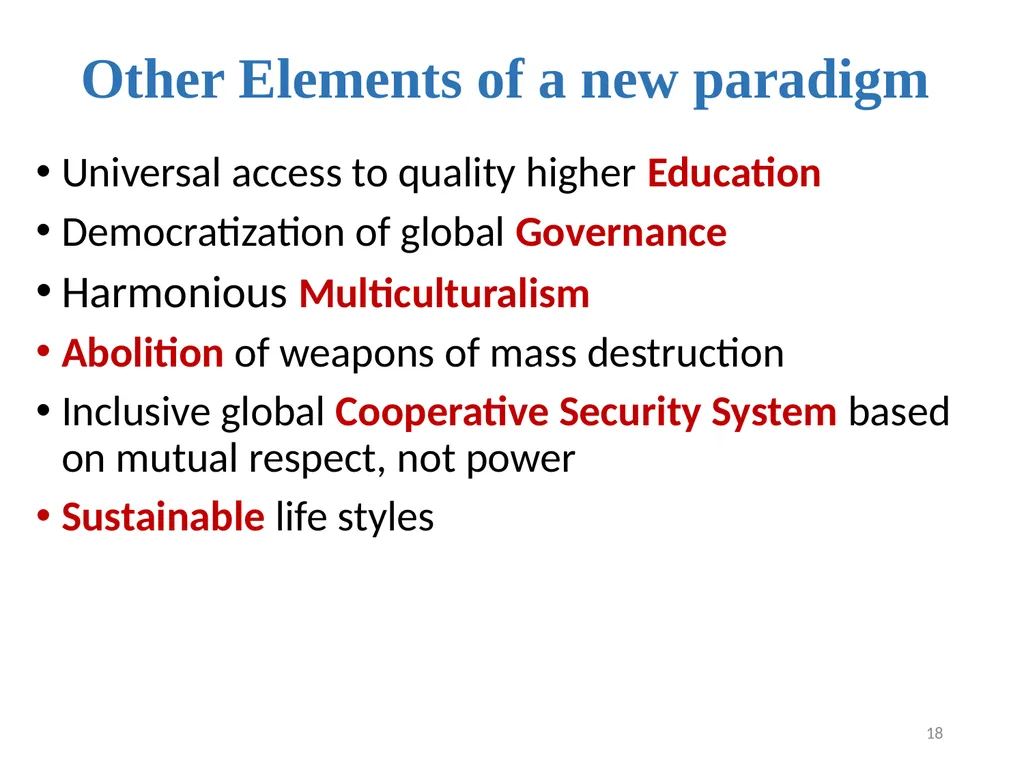
Other Elements of a new paradigm Universal access to quality higher Education
Democratization of global Governance
Harmonious Multiculturalism
Abolition of weapons of mass destruction
Inclusive global Cooperative Security System based on mutual respect, not power
Sustainable life styles 18<br>
Democratization of global Governance
Harmonious Multiculturalism
Abolition of weapons of mass destruction
Inclusive global Cooperative Security System based on mutual respect, not power
Sustainable life styles 18<br>
19
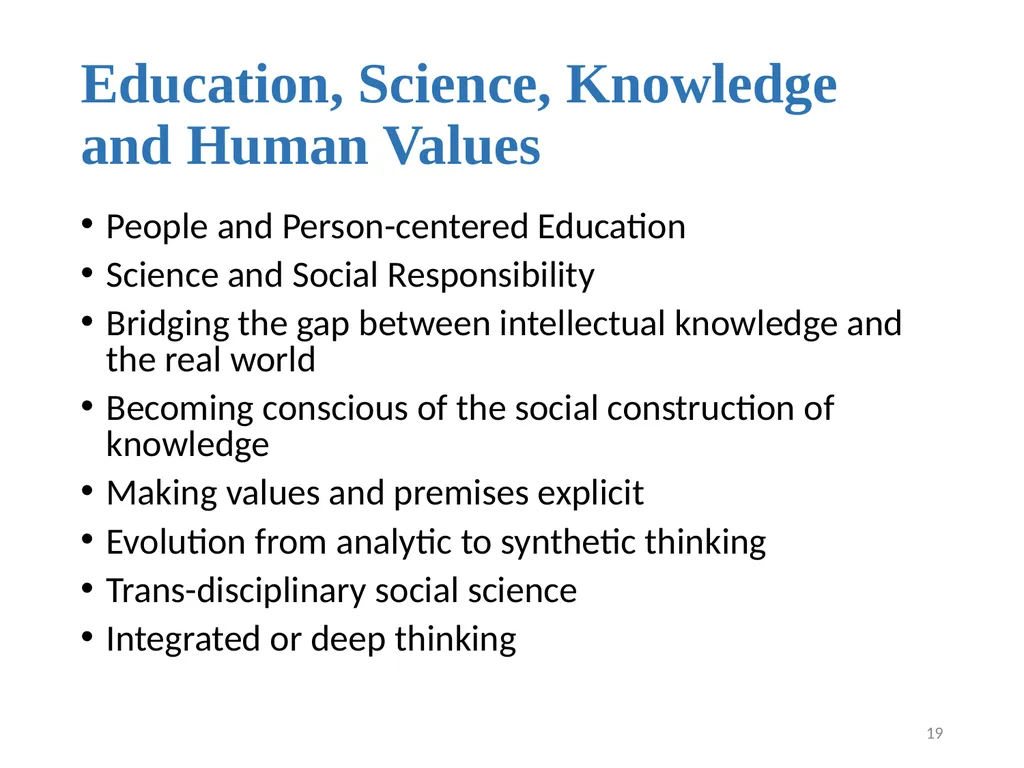
Education, Science, Knowledge and Human Values People and Person-centered Education
Science and Social Responsibility
Bridging the gap between intellectual knowledge and the real world
Becoming conscious of the social construction of knowledge
Making values and premises explicit
Evolution from analytic to synthetic thinking
Trans-disciplinary social science
Integrated or deep thinking 19<br>
Science and Social Responsibility
Bridging the gap between intellectual knowledge and the real world
Becoming conscious of the social construction of knowledge
Making values and premises explicit
Evolution from analytic to synthetic thinking
Trans-disciplinary social science
Integrated or deep thinking 19<br>
20
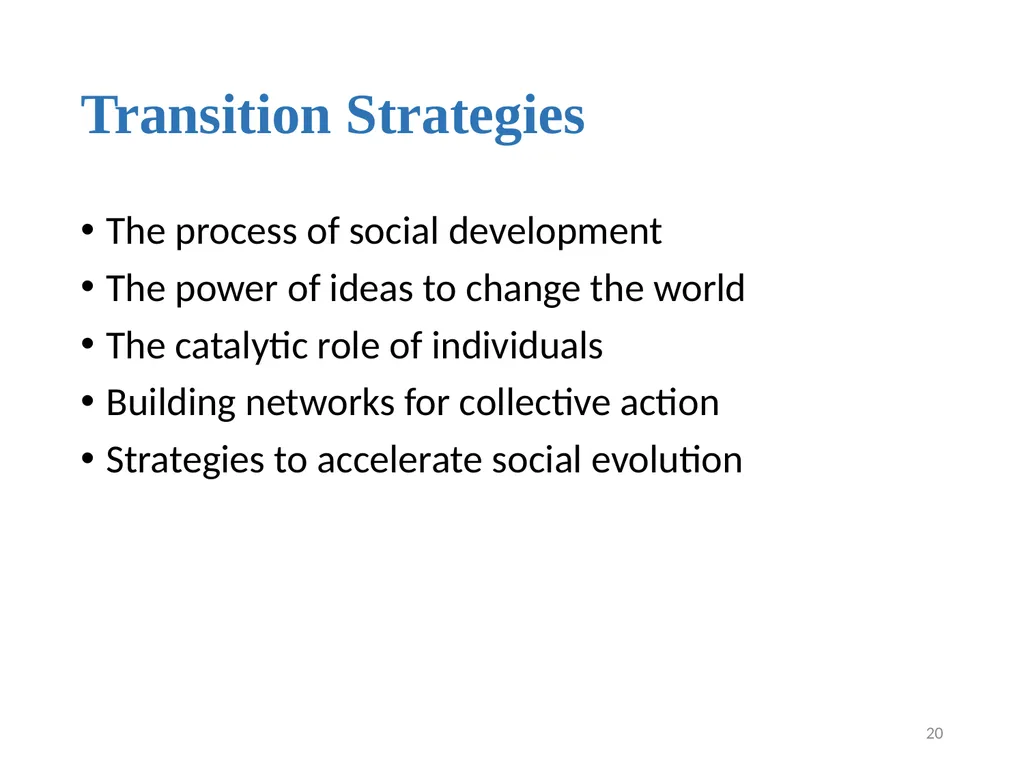
Transition Strategies The process of social development
The power of ideas to change the world
The catalytic role of individuals
Building networks for collective action
Strategies to accelerate social evolution 20<br>
The power of ideas to change the world
The catalytic role of individuals
Building networks for collective action
Strategies to accelerate social evolution 20<br>
21
21<br>
22
FUTURE?
Idea-based
Contextual
Life-centric & Value-based
Trans-disciplinary
Organic
Creative
Multi-paradigmatic
Person-centered
Individuality PRESENT
Information-based
Compartmentalized
Abstract & Detached
Discipline-specific
Mechanistic
Analytical
Paradigm-specific
Subject-centered
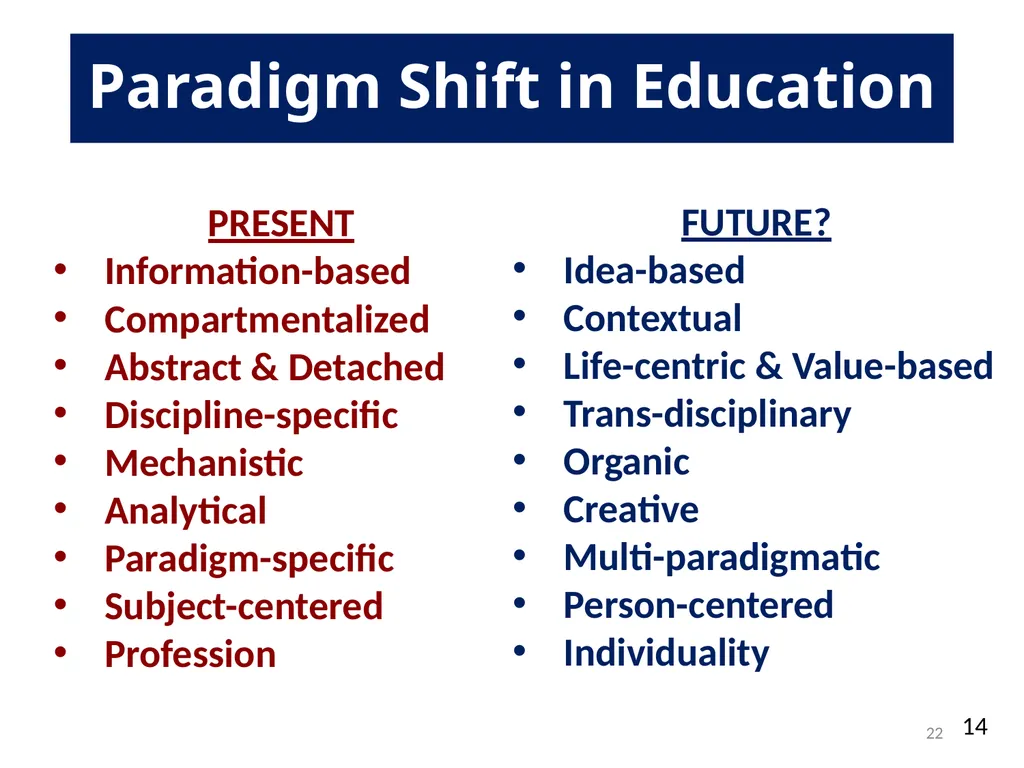
Profession 14 Paradigm Shift in Education 22<br>
Idea-based
Contextual
Life-centric & Value-based
Trans-disciplinary
Organic
Creative
Multi-paradigmatic
Person-centered
Individuality PRESENT
Information-based
Compartmentalized
Abstract & Detached
Discipline-specific
Mechanistic
Analytical
Paradigm-specific
Subject-centered
Profession 14 Paradigm Shift in Education 22<br>