03
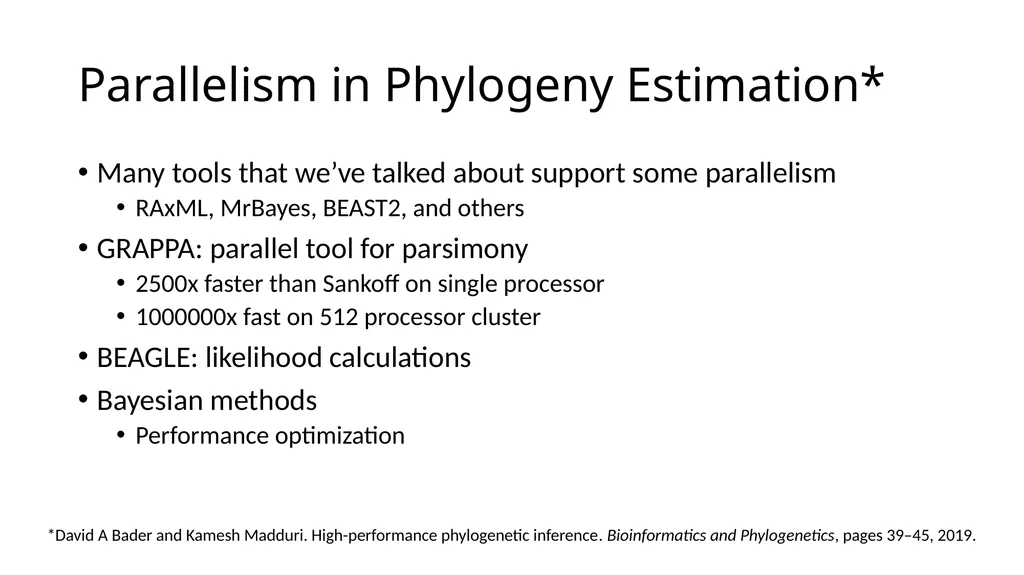
Parallelism in Phylogeny Estimation* Many tools that we’ve talked about support some parallelism
RAxML, MrBayes, BEAST2, and others
GRAPPA: parallel tool for parsimony
2500x faster than Sankoff on single processor
1000000x fast on 512 processor cluster
BEAGLE: likelihood calculations
Bayesian methods
Performance optimization *David A Bader and Kamesh Madduri. High-performance phylogenetic inference. Bioinformatics and Phylogenetics, pages 39–45, 2019.<br>
04
Parallelism and Supertree Methods Parallelism can also be applied to supertree methods
Superfine (2017)
Guide Tree Merger (2022, hopefully!)<br>
05
Why Supertree Methods? Tree of Life computation
Increasingly large amount of biological data available to analyze
Data sets could have thousands of taxa (or more!)
Supertree methods:
Construct trees on subsets of the taxa and assemble
Allows for divide-and-conquer approach<br>
06
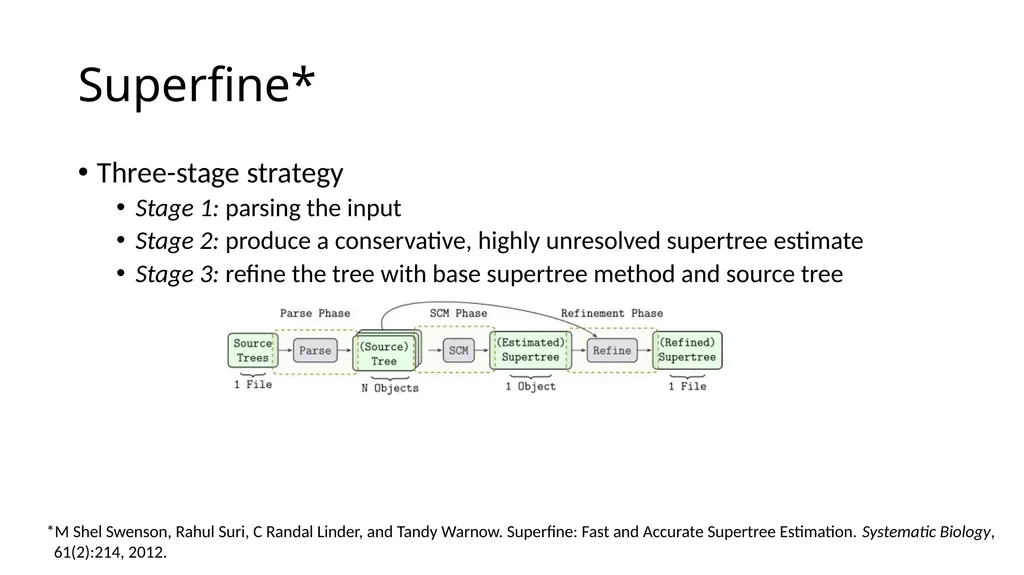
Superfine* Three-stage strategy
Stage 1: parsing the input
Stage 2: produce a conservative, highly unresolved supertree estimate
Stage 3: refine the tree with base supertree method and source tree *M Shel Swenson, Rahul Suri, C Randal Linder, and Tandy Warnow. Superfine: Fast and Accurate Supertree Estimation. Systematic Biology,
61(2):214, 2012.<br>
07
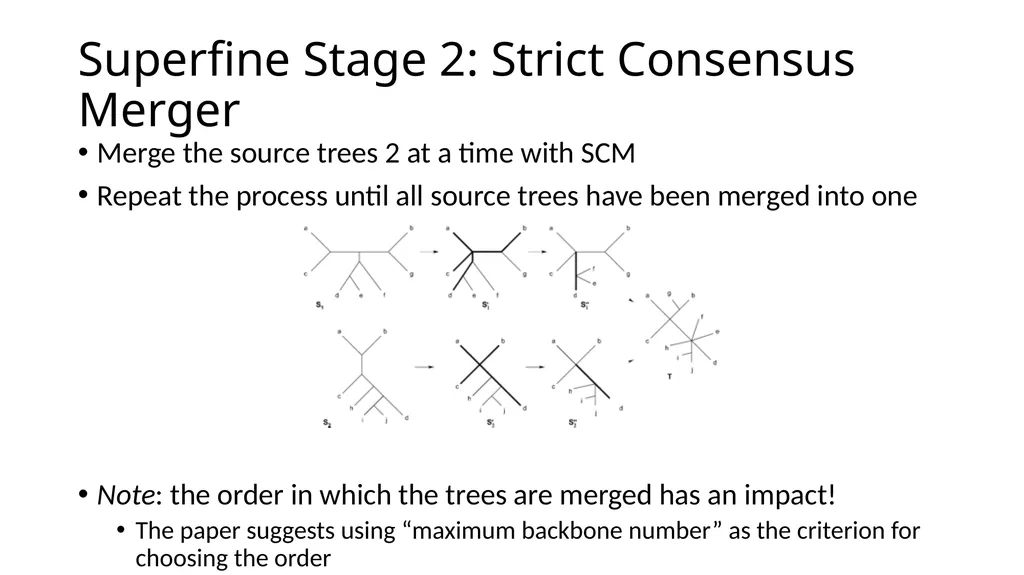
Superfine Stage 2: Strict Consensus Merger Merge the source trees 2 at a time with SCM
Repeat the process until all source trees have been merged into one
Note: the order in which the trees are merged has an impact!
The paper suggests using “maximum backbone number” as the criterion for choosing the order<br>
08
Superfine Stage 3: Refinement The SCM tree is (usually) not fully resolved, requiring the refinement of polytomies
Some notation:
T: a set of source trees
T: an SCM supertree on T
v: be a polytomy of T (a node of degree at least 4)<br>
09
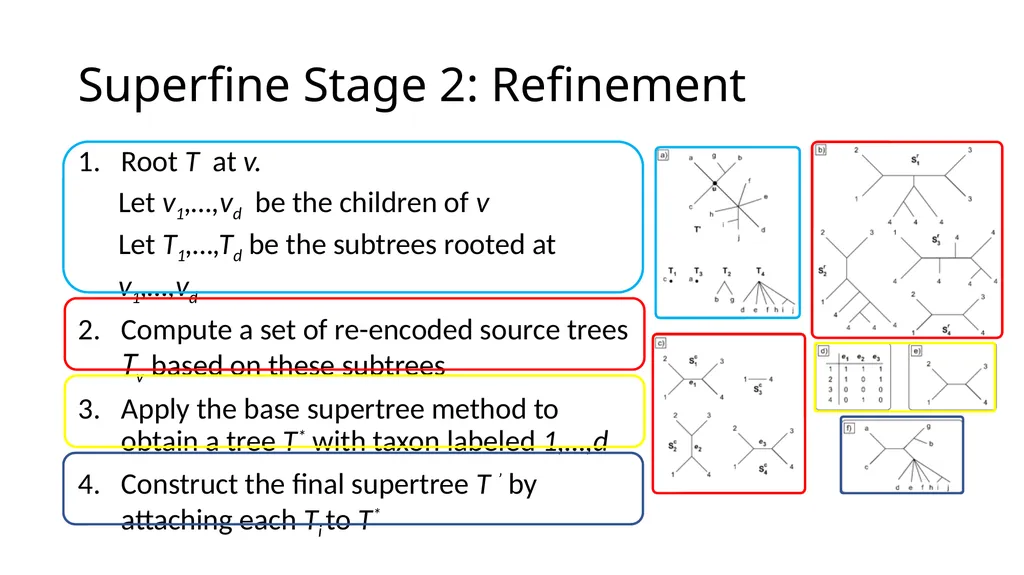
Superfine Stage 2: Refinement Root T at v.
Let v1,…,vd be the children of v
Let T1,…,Td be the subtrees rooted at
v1,…,vd
Compute a set of re-encoded source trees Tv based on these subtrees
Apply the base supertree method to obtain a tree T* with taxon labeled 1,…,d
Construct the final supertree T ’ by attaching each Ti to T*<br>
10
Superfine Performance Originally tested with MRP and QMC as base supertree methods
Superfine+MRP and Superfine+QMC outperform MRP or QMC alone
Both outperform other supertree methods
Both approach the accuracy of CA-ML
Running time of the refinement step:
Largely determined by the max degree of a node in the SCM tree
Max degree being small means refinement is quite fast
Even when the base supertree method is expensive!<br>
11
Parallel Superfine Paper Contributions Paper proposes a few improvements/changes to Superfine
Extending Superfine to use FastTree as an inference tool
FastTree is faster and topologically more accurate that RAxML, which Superfine uses as a base supertree method for ML analyses
Parallel Superfine<br>
12
Parallel Superfine Authors use the EPIC framework for multilevel parallelism
Parallelization occurs in the parse phase and the refinement phase
No parallelization of Strict Consensus Merger<br>
13
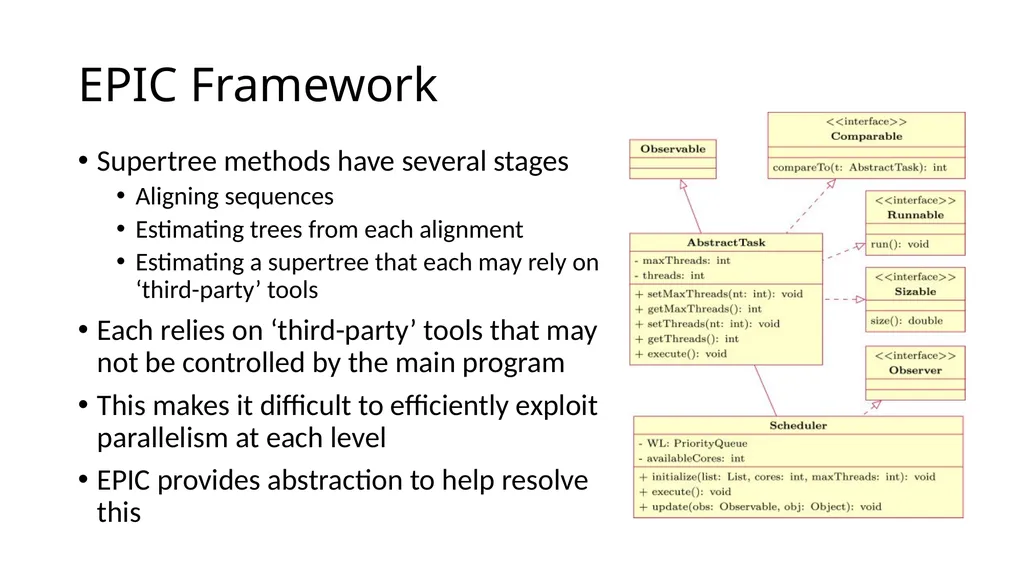
EPIC Framework Supertree methods have several stages
Aligning sequences
Estimating trees from each alignment
Estimating a supertree that each may rely on ‘third-party’ tools
Each relies on ‘third-party’ tools that may not be controlled by the main program
This makes it difficult to efficiently exploit parallelism at each level
EPIC provides abstraction to help resolve this<br>
14
Parallelization of Parse Phase Each source tree is independent, so we can exploit inter-tree parallelism when parsing them
There isn’t enough pay-off to try to exploit intra-tree parallelism (parsing each individual tree in parallel)
Each source tree can be parsed on one thread
The scheduler will ensure the longest Newick strings are parsed first
While it is simple to implement, parallelizing parse has ‘negligible impact’ on overall performance<br>
15
Parallelization of Refinement Phase The most expensive phase of Superfine
Idea: The order in which the polytomies are refined does not affect the quality of the output
Refine them in parallel!
Embarrassingly parallel!
Challenges
Load balancing
Third-party tools
Multilevel parallelization
Effificent usage of available cores<br>
16
Naïve Parallelization Creates a priority queue with all polytomies
Polytomies sorted in descending order by degree
Refinement of each polytomy processed in parallel
Performs well on simulated data
‘Disappointing’ on biological data<br>
17
Leveraging the EPIC Framework Allows us to leverage inter- and intra-polytomy parallelism
Inter-polytomy parallelism
Processes distinct polytomies in parallel
Intra-polytomy parallelism
Allows for the processing of high degree polytomies in parallel
Should be exploited in all polytomies with significantly high degree<br>
18
A Note on Chunking Using multiple threads leads to overheads
Chunking can help
Several units of work packaged and assigned to a thread
EPIC supports chunking, but the authors did not find it advantageous
They claim this time is negligible when compared to the time required to refine a polytomy<br>
19
Experiments Setups:
Sequential
Intra-parallel
Inter-parallel
Hybrid-parallel
Thread-counts
Data sets
1000-taxon simulated with birth/death, missing data
Several biological datasets (CPL, Marsupials, Placental Mammals, Seabirds, Legumes)<br>
20
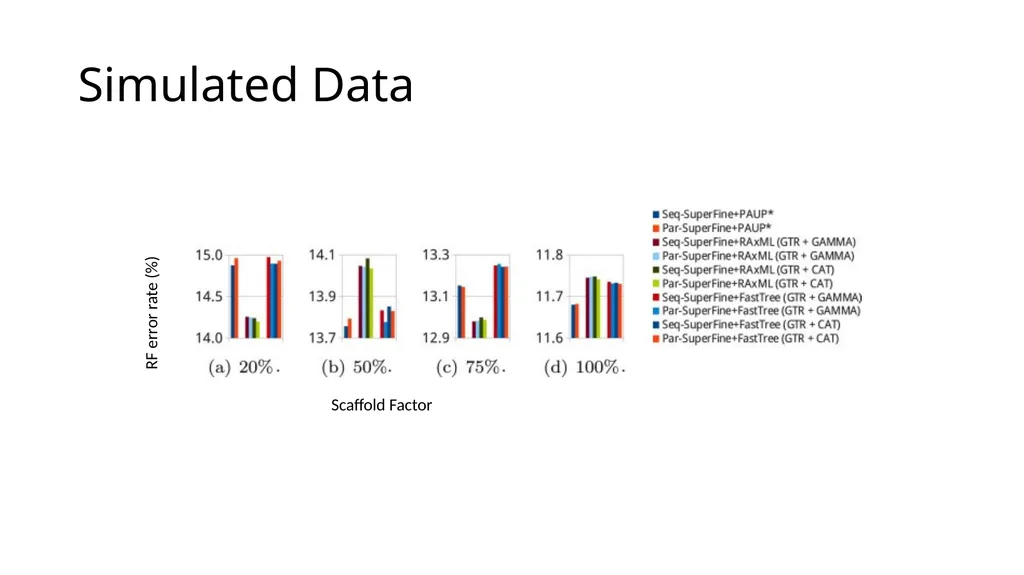
Simulated Data RF error rate (%) Scaffold Factor<br>
21
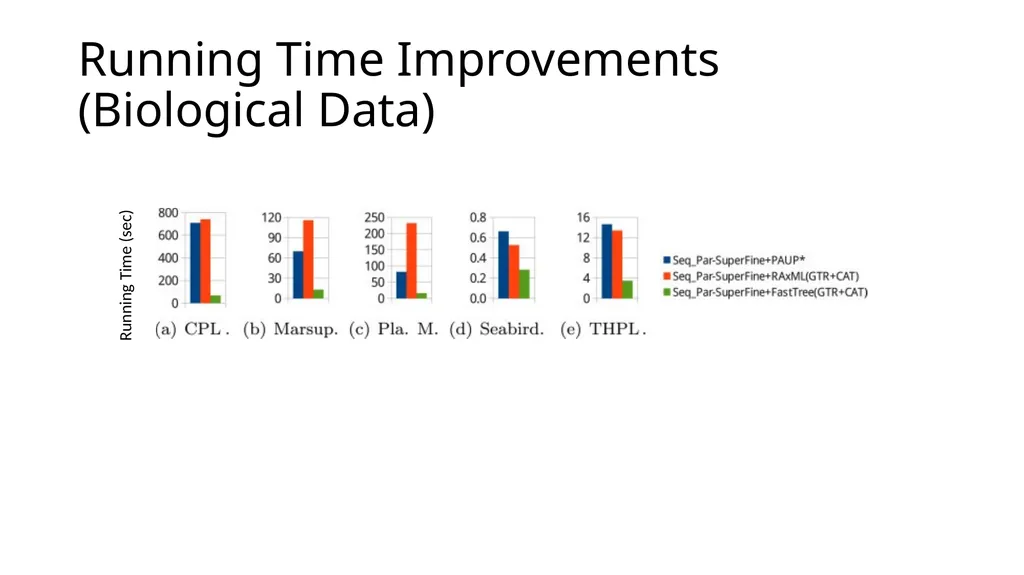
Running Time Improvements (Biological Data) Running Time (sec)<br>
22
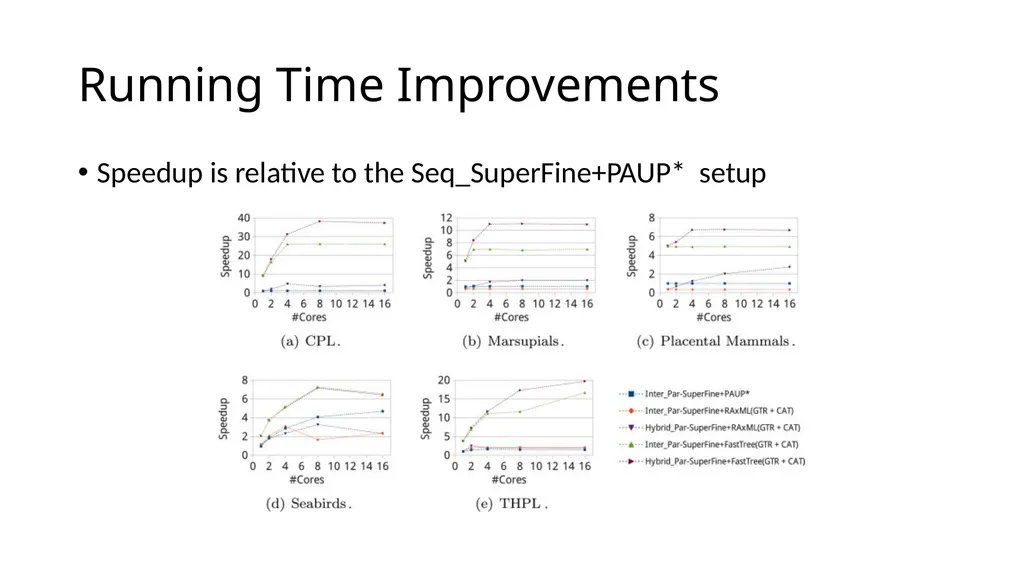
Running Time Improvements Speedup is relative to the Seq_SuperFine+PAUP* setup<br>
23
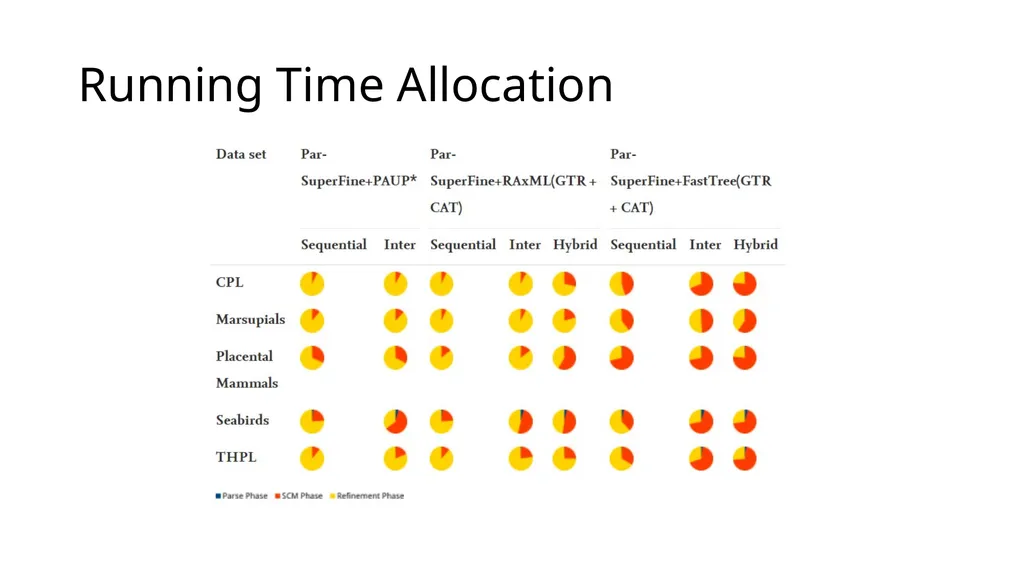
Running Time Allocation<br>
24
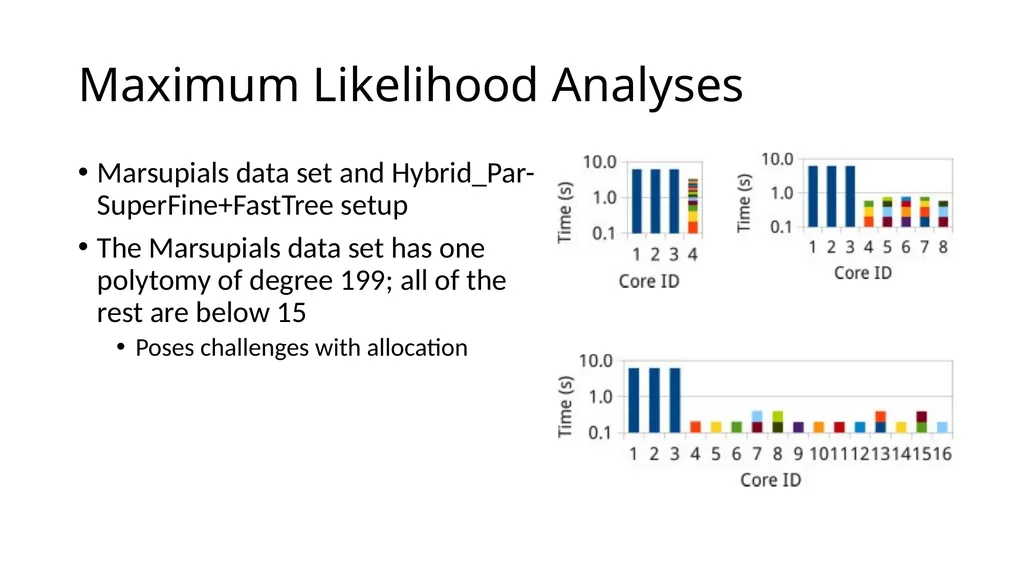
Maximum Likelihood Analyses Marsupials data set and Hybrid_Par-SuperFine+FastTree setup
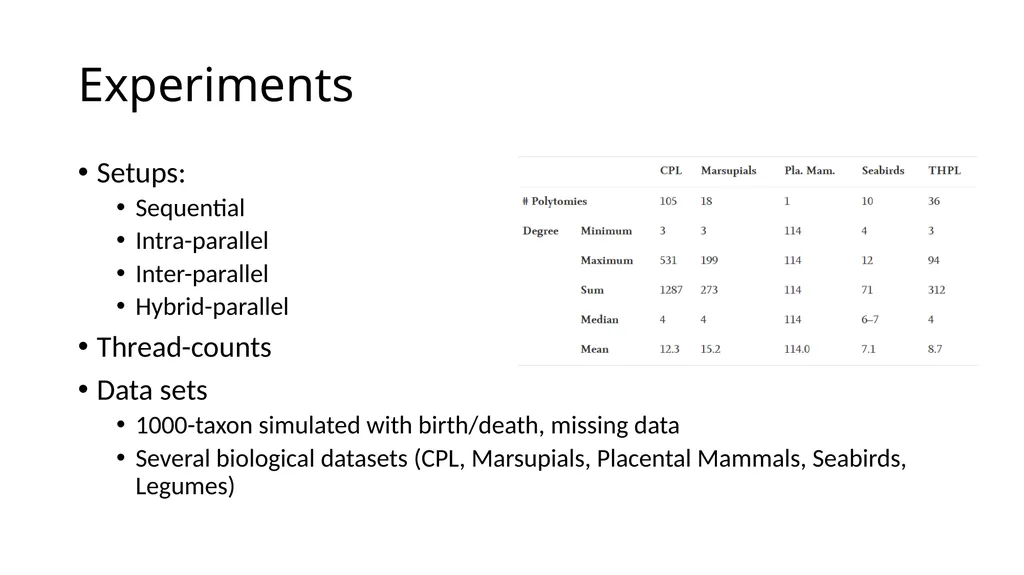
The Marsupials data set has one polytomy of degree 199; all of the rest are below 15
Poses challenges with allocation<br>
25
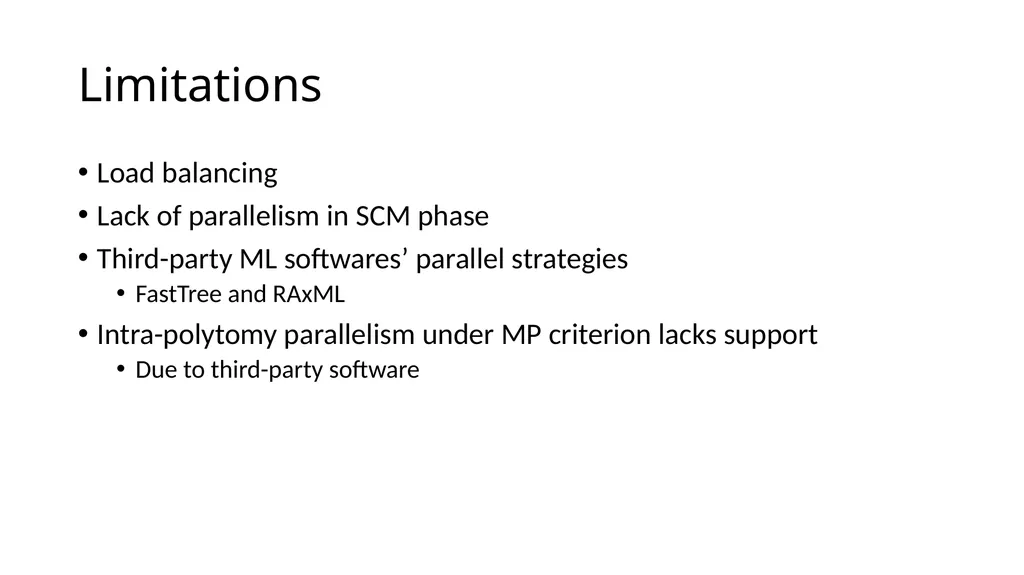
Limitations Load balancing
Lack of parallelism in SCM phase
Third-party ML softwares’ parallel strategies
FastTree and RAxML
Intra-polytomy parallelism under MP criterion lacks support
Due to third-party software<br>
26
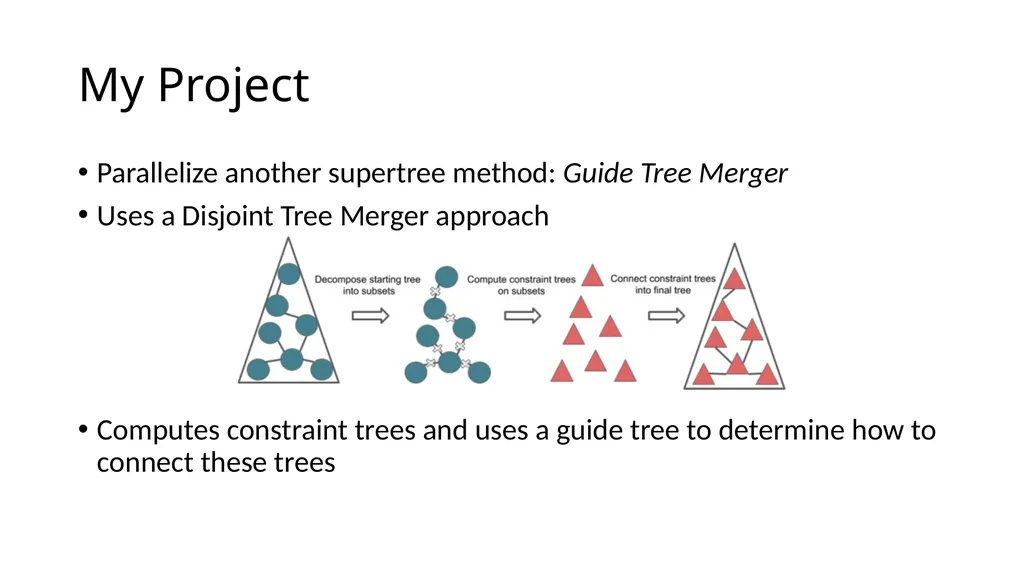
My Project Parallelize another supertree method: Guide Tree Merger
Uses a Disjoint Tree Merger approach
Computes constraint trees and uses a guide tree to determine how to connect these trees<br>
27
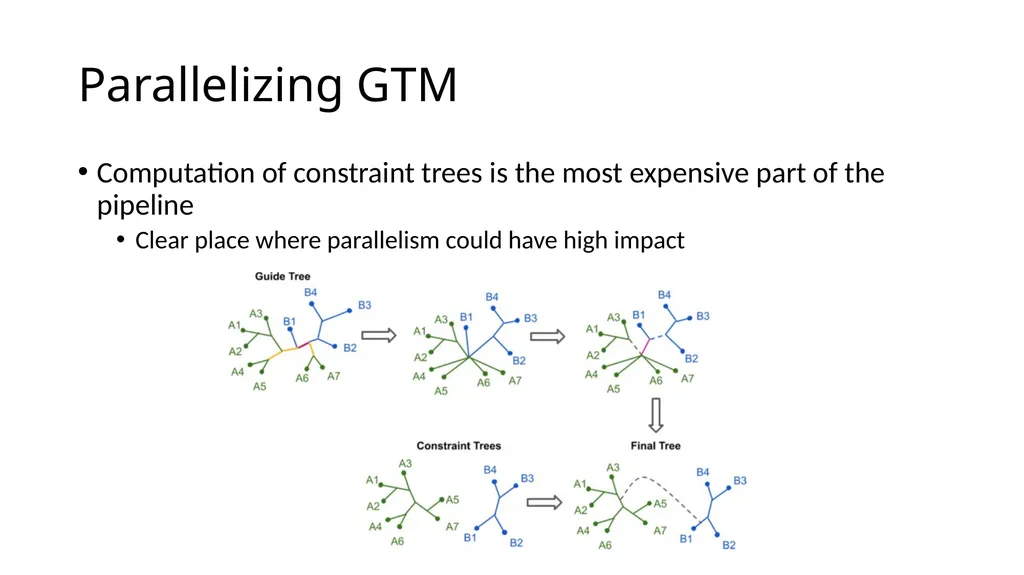
Parallelizing GTM Computation of constraint trees is the most expensive part of the pipeline
Clear place where parallelism could have high impact<br>