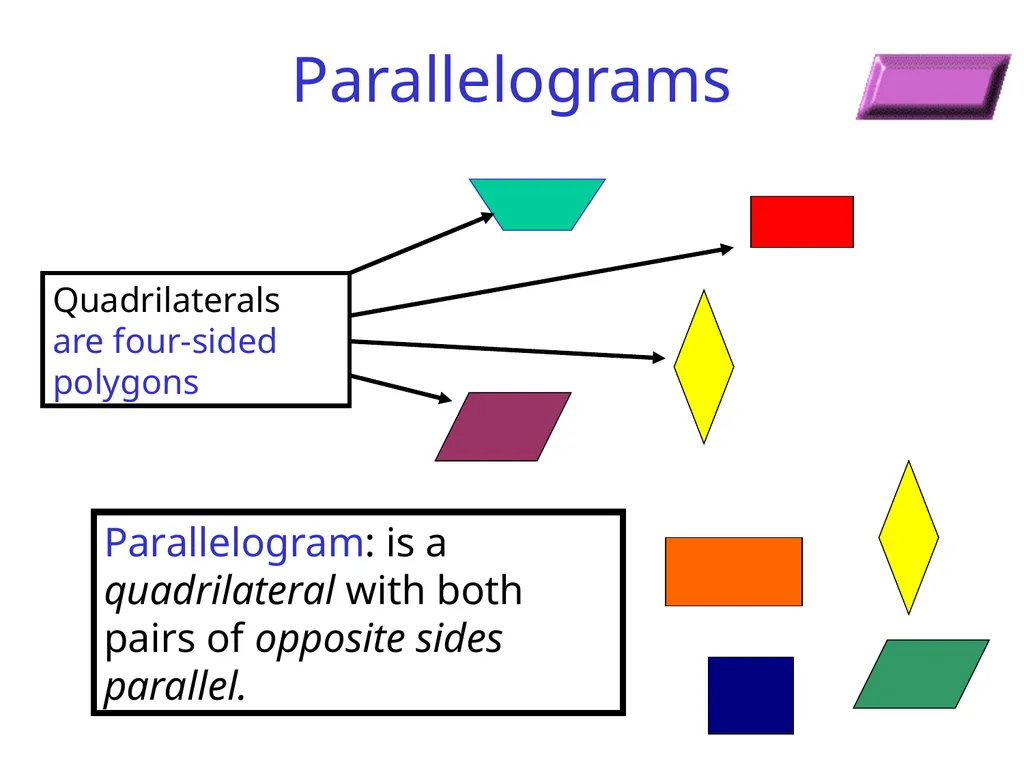
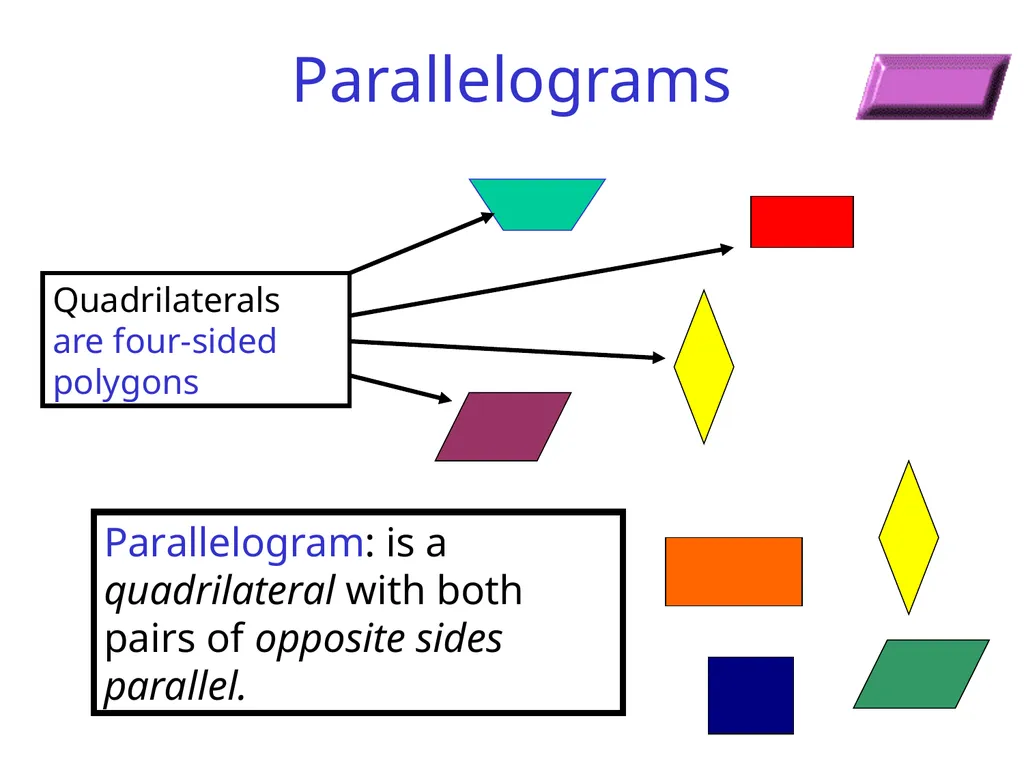
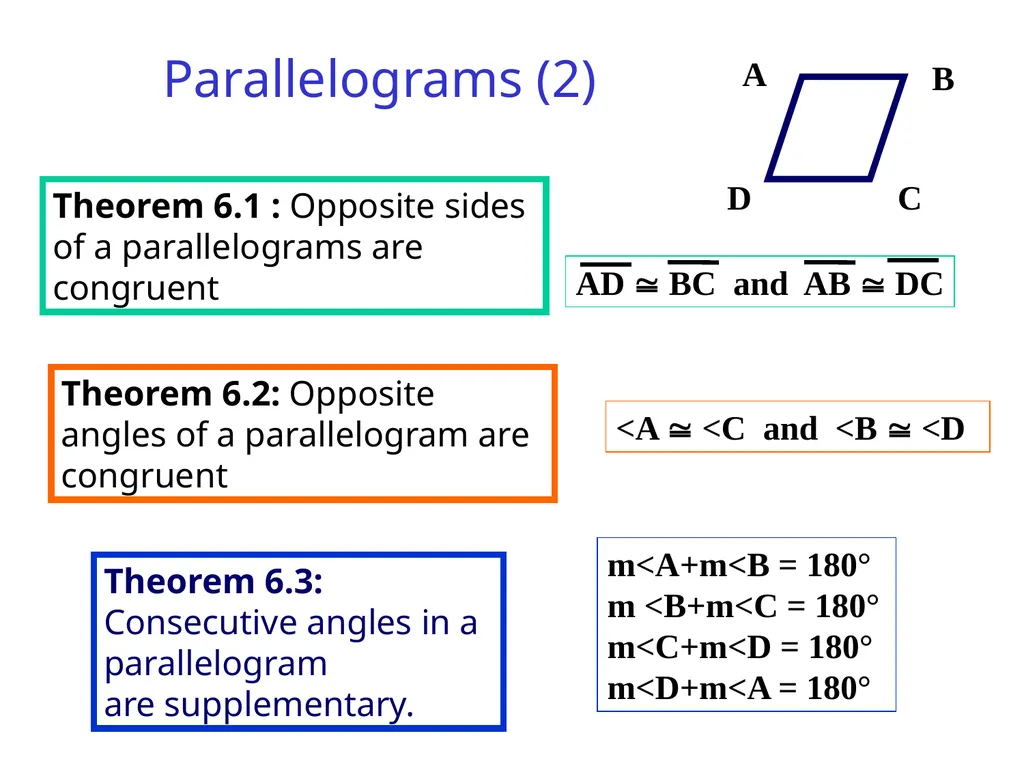
Parallelograms Quadrilaterals are four-sided polygons Parallelogram: is a quadrilateral with both pairs of opposite sides parallel. Parallelograms (2) Theorem 6.1 : Opposite sides of a parallelograms are congruent Theorem 6.2: Opposite
Related Topics
Share
Embed code
Download this presentation From Below
"Parallelograms Quadrilaterals are four-sided" is the property of its rightful owner. Permission is granted to
download and print the materials on this website for personal, non-commercial use only, and to display it
on your personal computer provided you do not modify the materials and that you retain all copyright
notices contained in the materials. By downloading content from our website, you accept the terms of this
agreement.
Presentation Transcript
01
Parallelograms Quadrilaterals are four-sided polygons Parallelogram: is a quadrilateral with both pairs of opposite sides parallel.<br>
02
Parallelograms (2) Theorem 6.1 : Opposite sides of a parallelograms are congruent Theorem 6.2: Opposite angles of a parallelogram are congruent Theorem 6.3: Consecutive angles in a parallelogram
are supplementary. A D C B AD BC and AB DC <A <C and <B <D m<A+m<B = 180°
m <B+m<C = 180°
m<C+m<D = 180°
m<D+m<A = 180°<br>
03
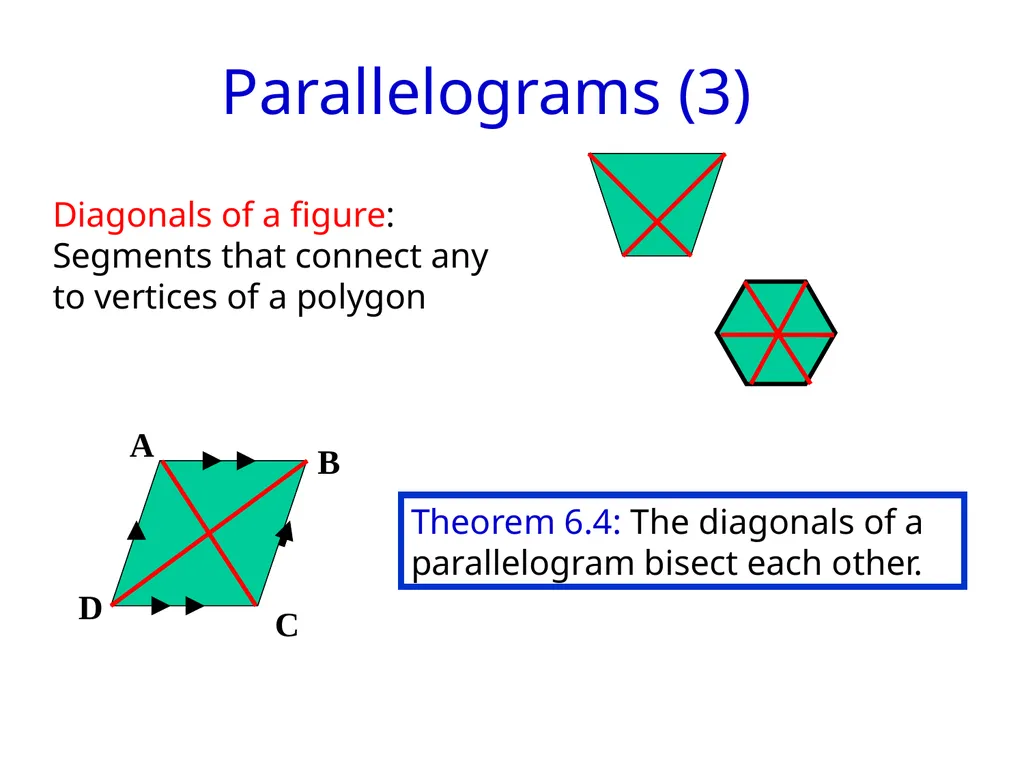
Parallelograms (3) Diagonals of a figure: Segments that connect any to vertices of a polygon Theorem 6.4: The diagonals of a parallelogram bisect each other. A B C D<br>
04
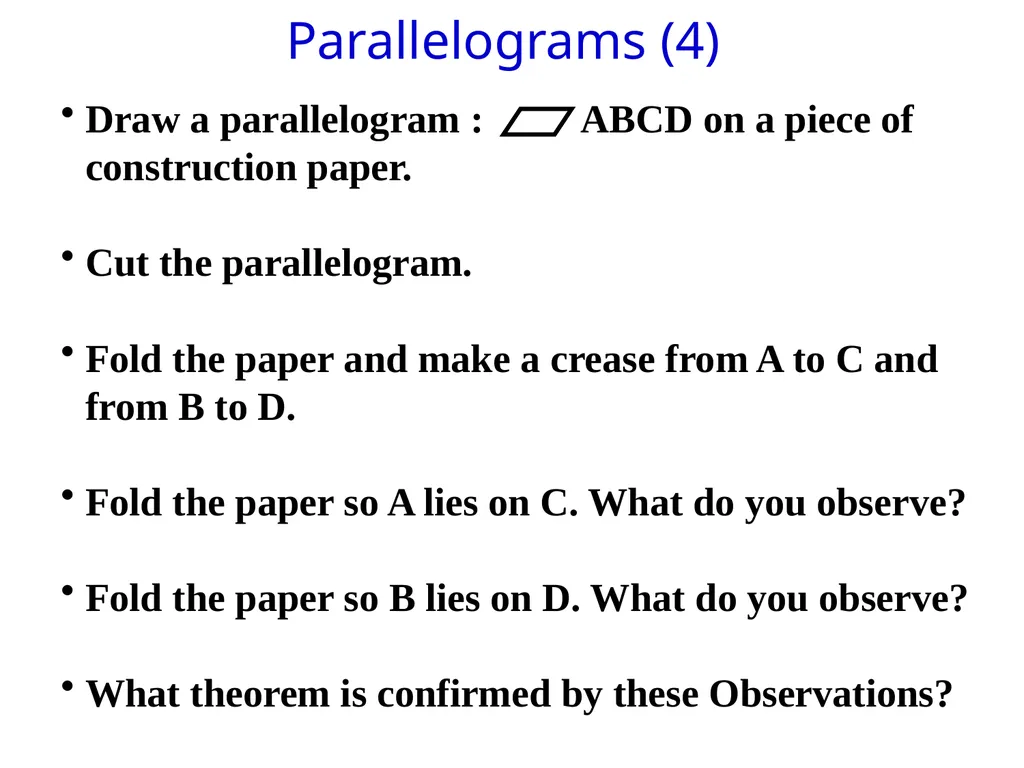
Parallelograms (4) Draw a parallelogram : ABCD on a piece of construction paper.
Cut the parallelogram.
Fold the paper and make a crease from A to C and from B to D.
Fold the paper so A lies on C. What do you observe?
Fold the paper so B lies on D. What do you observe?
What theorem is confirmed by these Observations?<br>
05
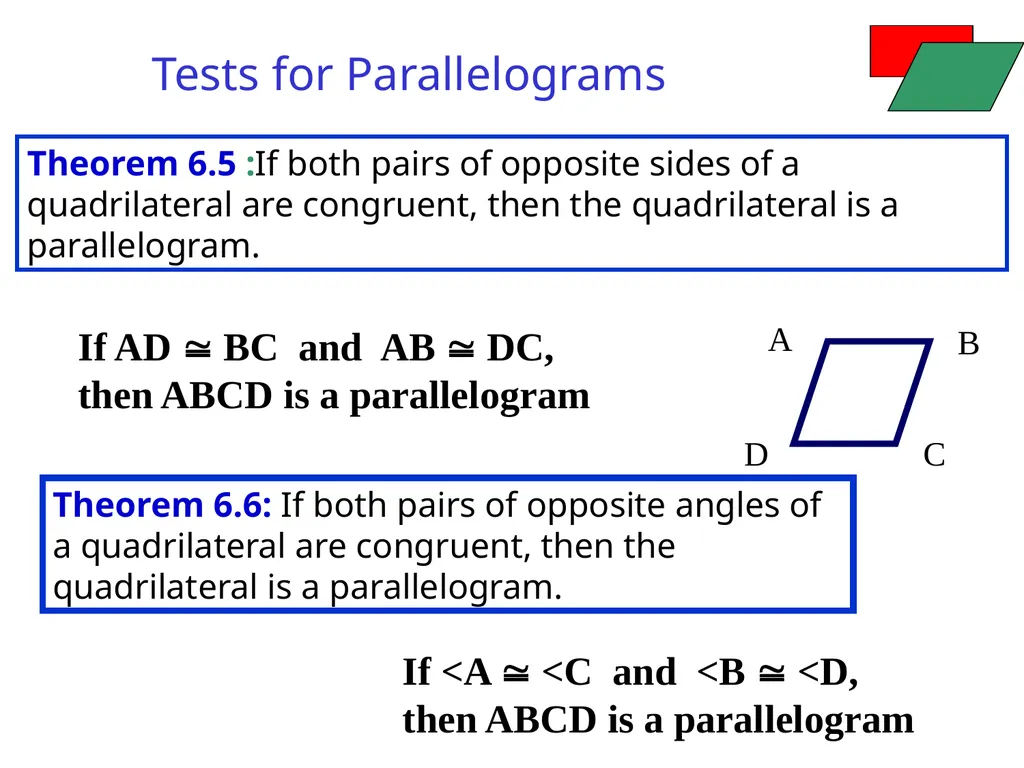
Tests for Parallelograms Theorem 6.5 :If both pairs of opposite sides of a quadrilateral are congruent, then the quadrilateral is a parallelogram. Theorem 6.6: If both pairs of opposite angles of a quadrilateral are congruent, then the quadrilateral is a parallelogram. A D C B If AD BC and AB DC, then ABCD is a parallelogram If <A <C and <B <D, then ABCD is a parallelogram<br>
06
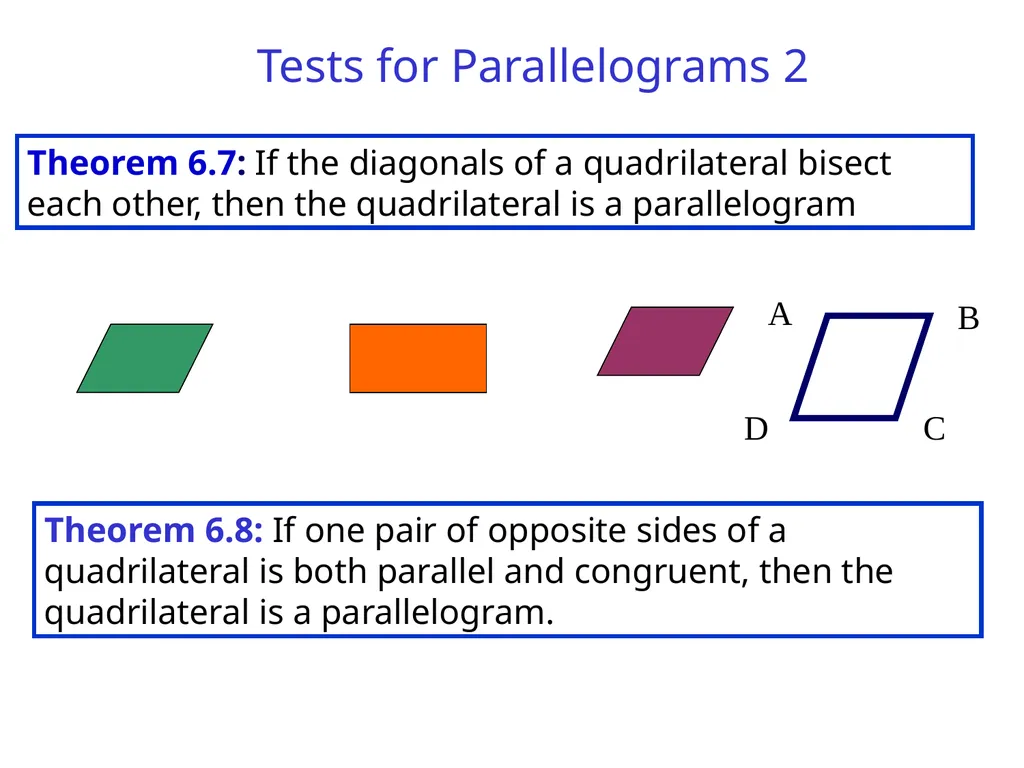
Tests for Parallelograms 2 Theorem 6.7: If the diagonals of a quadrilateral bisect each other, then the quadrilateral is a parallelogram A D C B Theorem 6.8: If one pair of opposite sides of a quadrilateral is both parallel and congruent, then the quadrilateral is a parallelogram.<br>
07
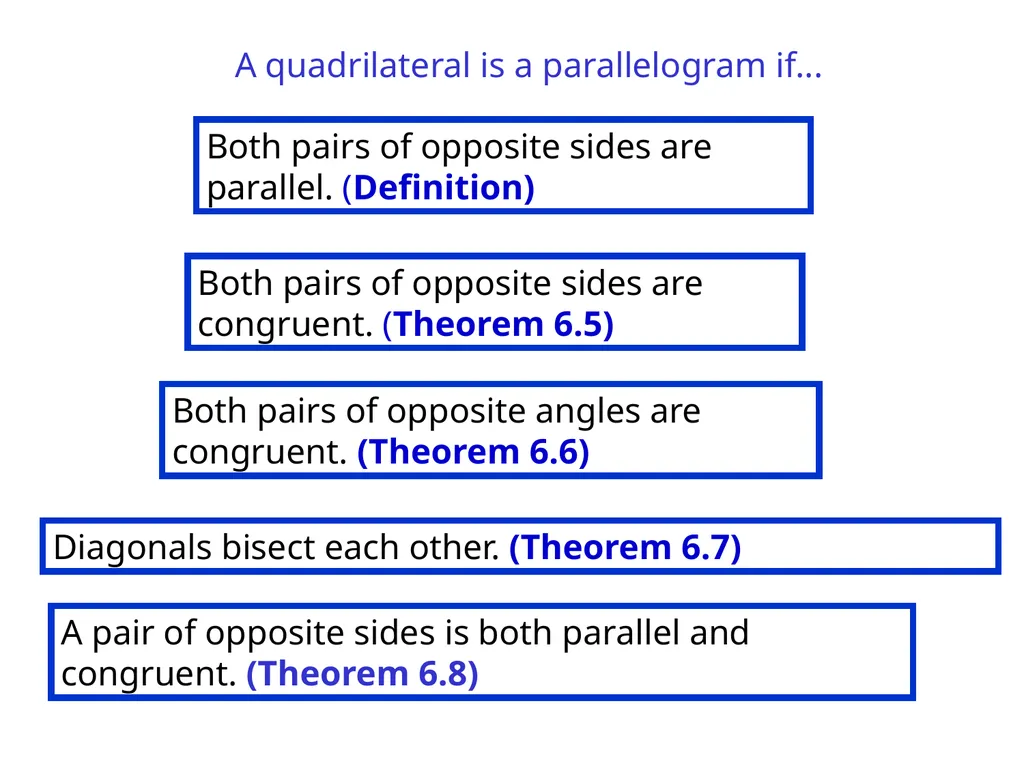
A quadrilateral is a parallelogram if... Diagonals bisect each other. (Theorem 6.7) A pair of opposite sides is both parallel and congruent. (Theorem 6.8) Both pairs of opposite sides are congruent. (Theorem 6.5) Both pairs of opposite angles are congruent. (Theorem 6.6) Both pairs of opposite sides are parallel. (Definition)<br>
08
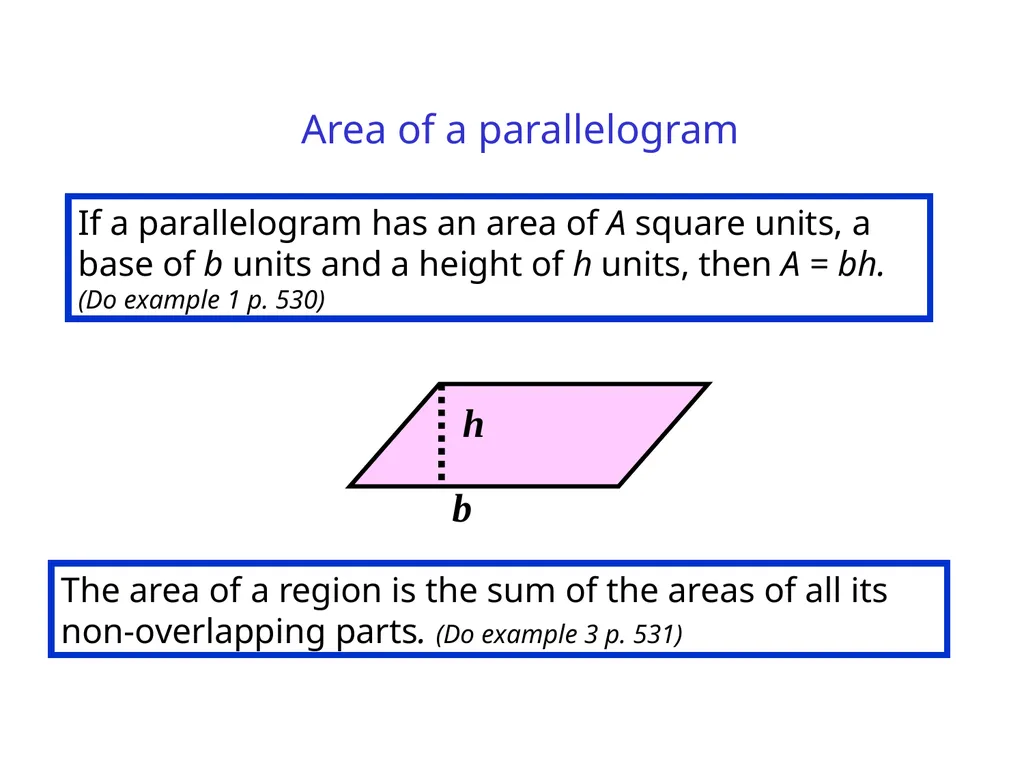
Area of a parallelogram If a parallelogram has an area of A square units, a base of b units and a height of h units, then A = bh. (Do example 1 p. 530) The area of a region is the sum of the areas of all its non-overlapping parts. (Do example 3 p. 531) b h<br>
09
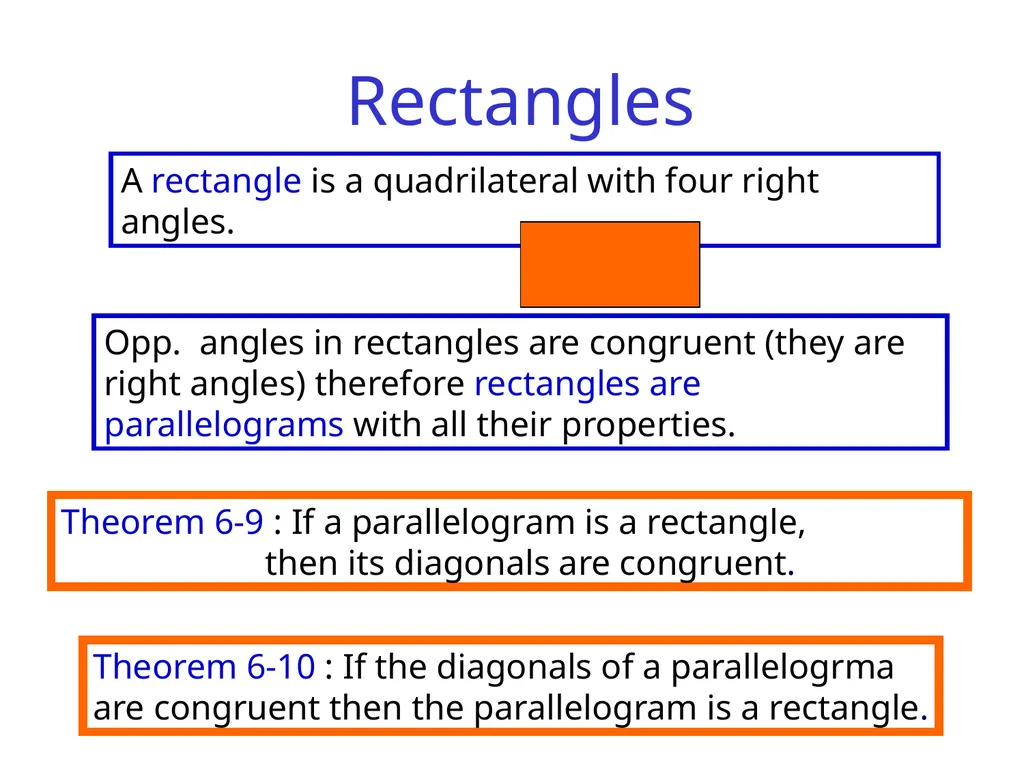
Rectangles A rectangle is a quadrilateral with four right angles. Theorem 6-9 : If a parallelogram is a rectangle,
then its diagonals are congruent. Opp. angles in rectangles are congruent (they are right angles) therefore rectangles are parallelograms with all their properties. Theorem 6-10 : If the diagonals of a parallelogrma
are congruent then the parallelogram is a rectangle.<br>
10
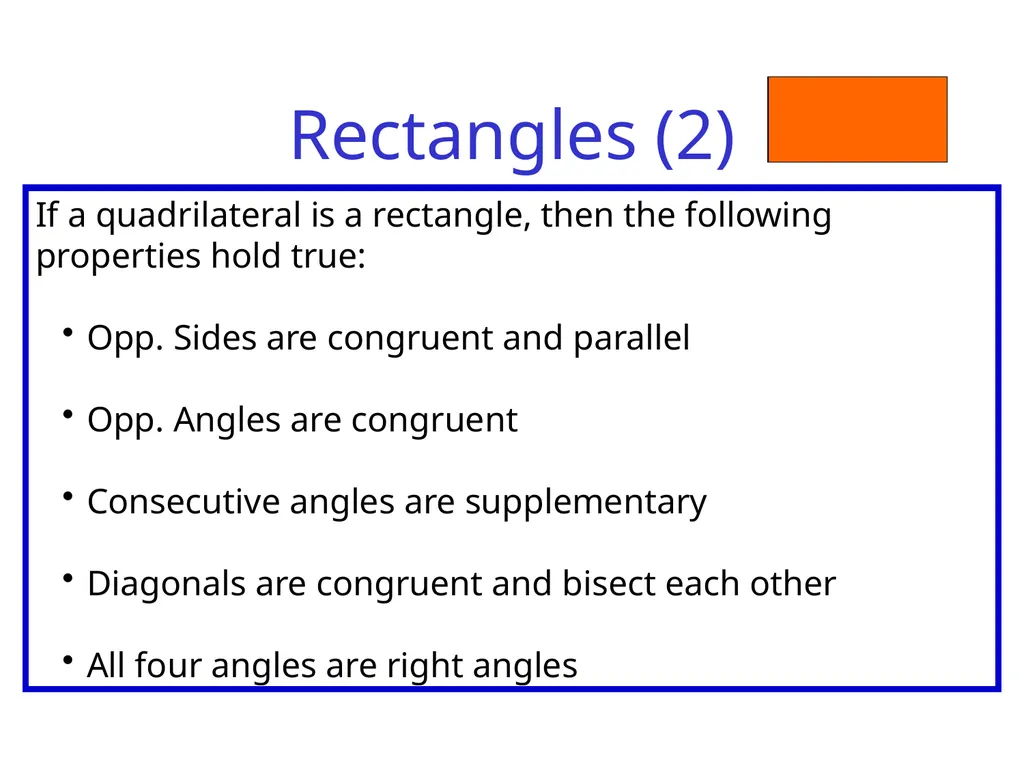
Rectangles (2) If a quadrilateral is a rectangle, then the following properties hold true:
Opp. Sides are congruent and parallel
Opp. Angles are congruent
Consecutive angles are supplementary
Diagonals are congruent and bisect each other
All four angles are right angles<br>
11
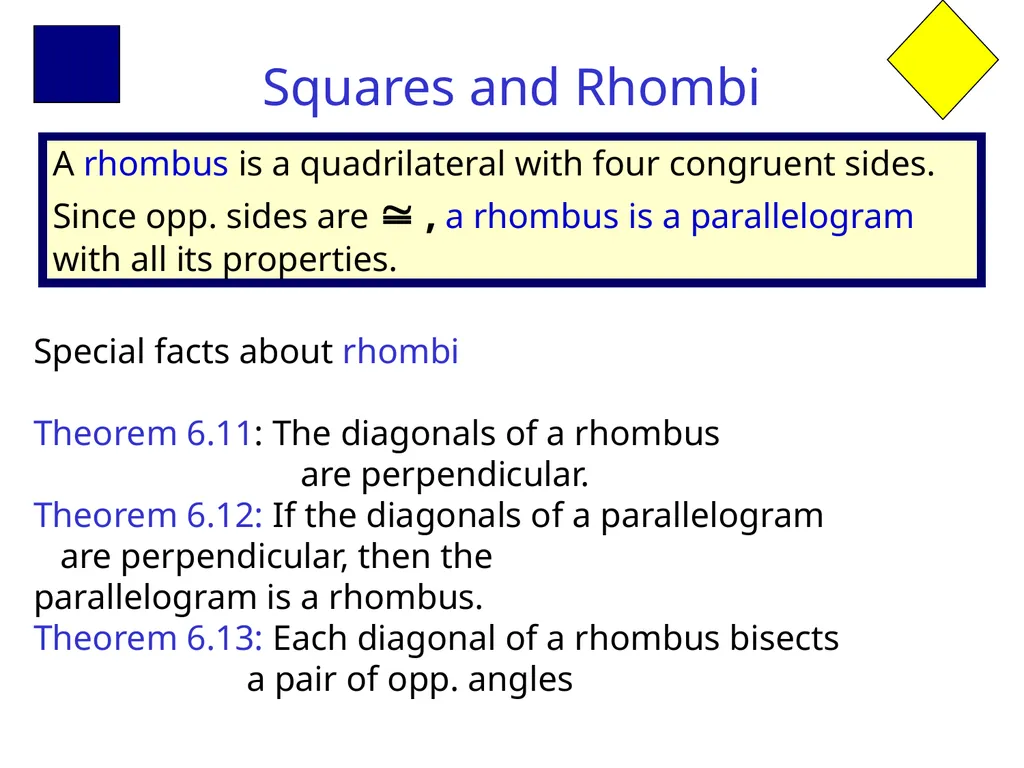
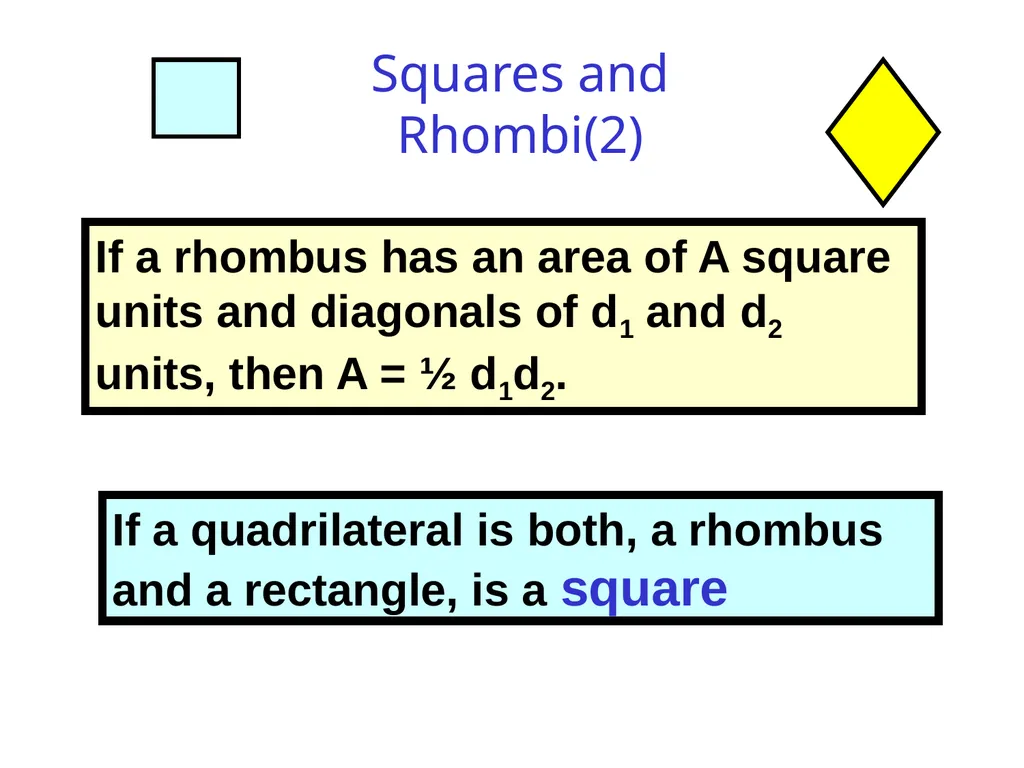
Squares and Rhombi A rhombus is a quadrilateral with four congruent sides. Since opp. sides are , a rhombus is a parallelogram with all its properties. Special facts about rhombi
Theorem 6.11: The diagonals of a rhombus
are perpendicular.
Theorem 6.12: If the diagonals of a parallelogram are perpendicular, then the parallelogram is a rhombus.
Theorem 6.13: Each diagonal of a rhombus bisects
a pair of opp. angles C<br>
12
Squares and Rhombi(2) If a quadrilateral is both, a rhombus and a rectangle, is a square If a rhombus has an area of A square units and diagonals of d1 and d2 units, then A = ½ d1d2.<br>
13
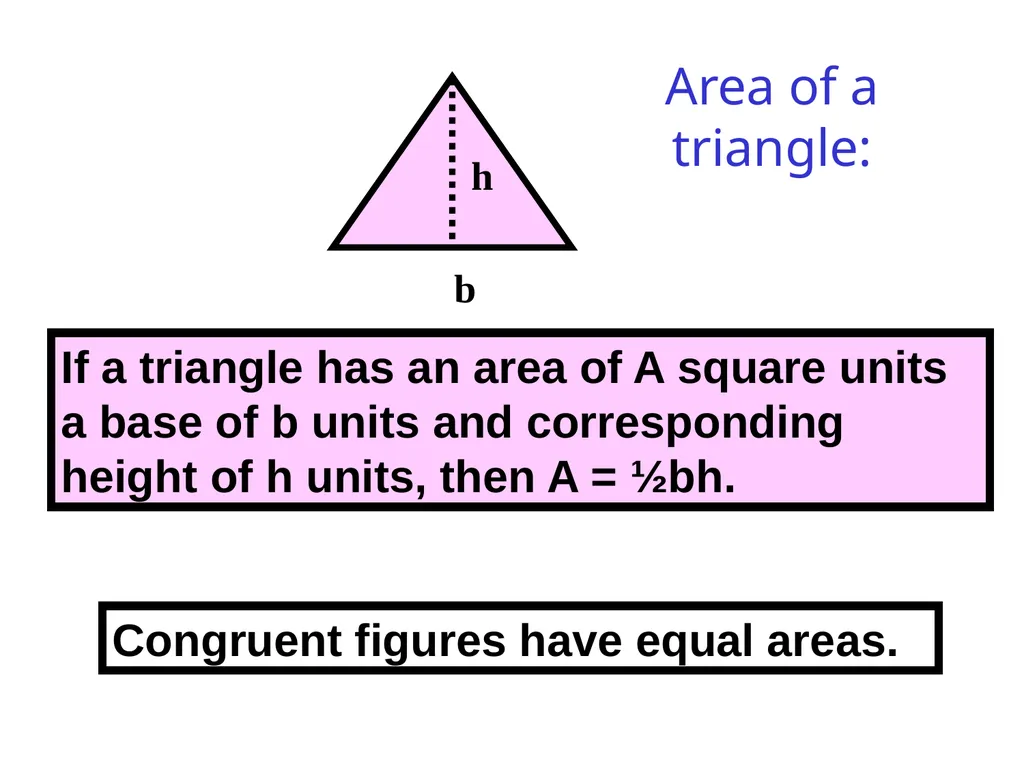
Area of a triangle: If a triangle has an area of A square units a base of b units and corresponding height of h units, then A = ½bh. h b Congruent figures have equal areas.<br>
14
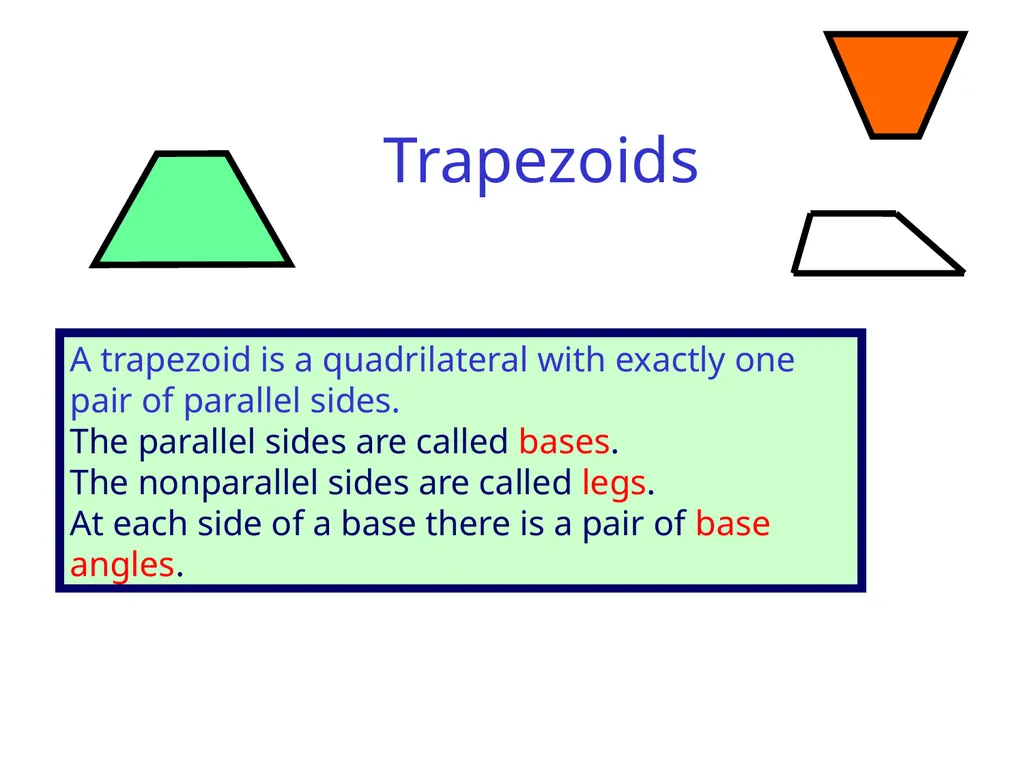
Trapezoids A trapezoid is a quadrilateral with exactly one pair of parallel sides.
The parallel sides are called bases.
The nonparallel sides are called legs.
At each side of a base there is a pair of base angles. C<br>
15
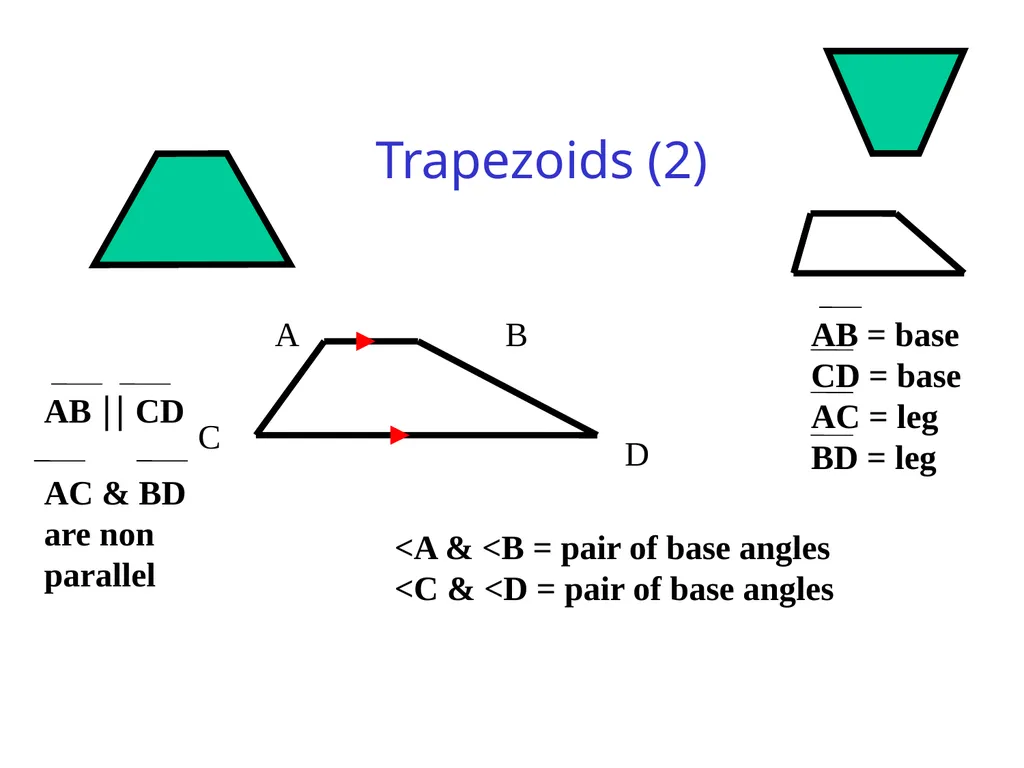
Trapezoids (2) C A C D B AB = base
CD = base
AC = leg
BD = leg AB CD
AC & BD are non parallel <A & <B = pair of base angles
<C & <D = pair of base angles<br>
16
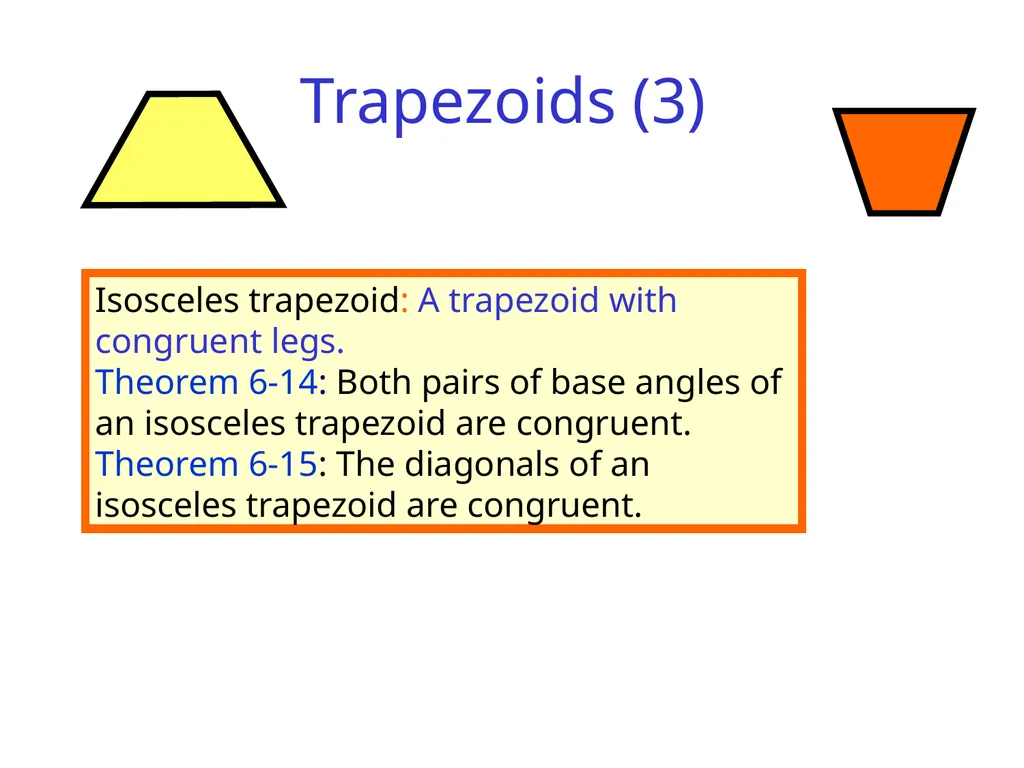
Trapezoids (3) Isosceles trapezoid: A trapezoid with congruent legs.
Theorem 6-14: Both pairs of base angles of an isosceles trapezoid are congruent.
Theorem 6-15: The diagonals of an isosceles trapezoid are congruent.<br>
17
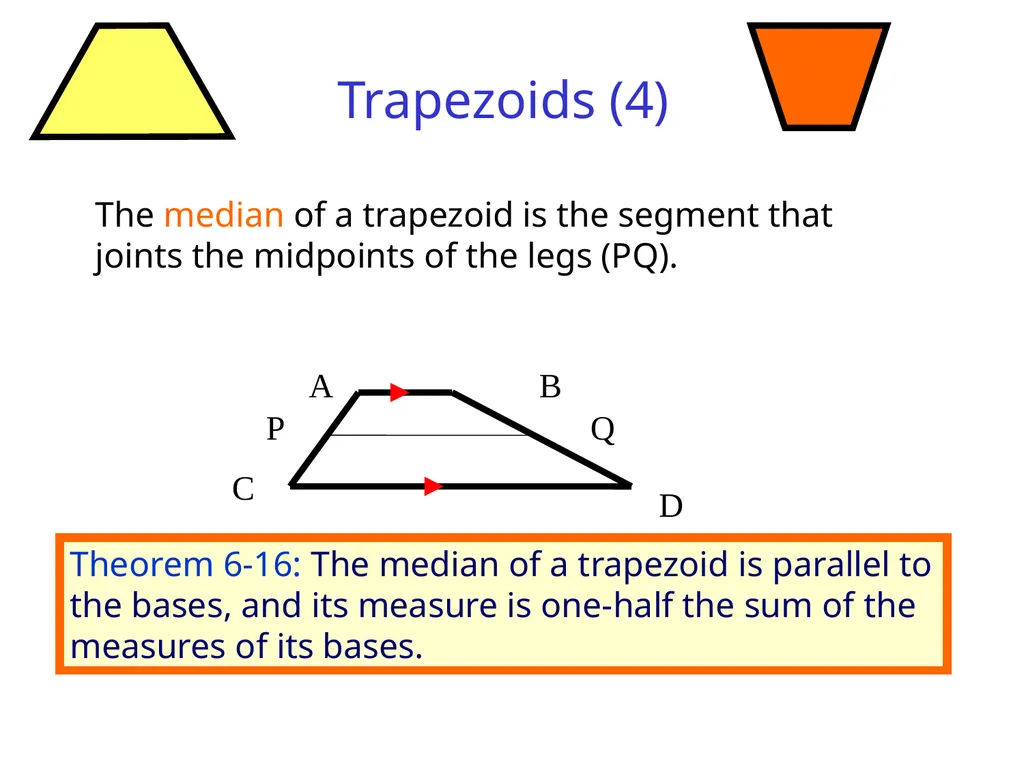
Trapezoids (4) C A C D B The median of a trapezoid is the segment that joints the midpoints of the legs (PQ). Q P Theorem 6-16: The median of a trapezoid is parallel to the bases, and its measure is one-half the sum of the measures of its bases.<br>
18
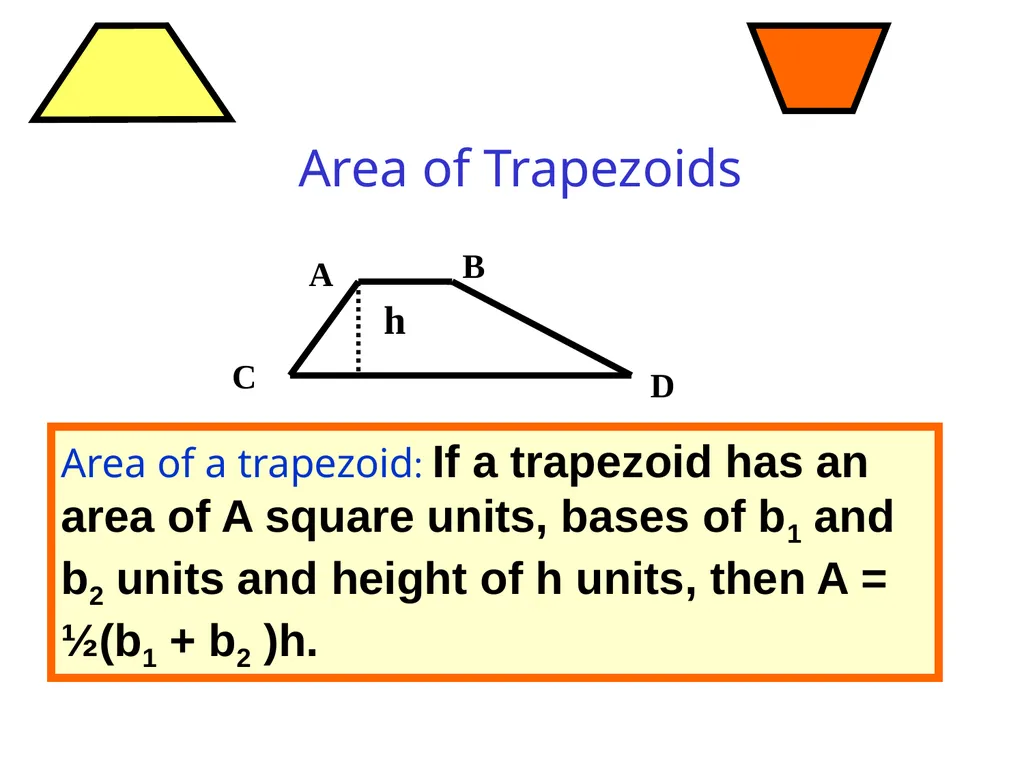
Area of Trapezoids C A C D B Area of a trapezoid: If a trapezoid has an area of A square units, bases of b1 and b2 units and height of h units, then A = ½(b1 + b2 )h. h<br>
19
This powerpoint was kindly donated to www.worldofteaching.com
http://www.worldofteaching.com is home to over a thousand powerpoints submitted by teachers. This is a completely free site and requires no registration. Please visit and I hope it will help in your teaching.<br>