
Paris Agreement and Rulebook Overview






Description: Paris Agreement and Rulebook Overview International climate governance Paris Agreement and Rulebook in detail - Mitigation adaptation - Means of implementation and support - Reporting compliance framework Implications for domestic law
Related Topics
Download Presentation
"Paris Agreement and Rulebook Overview" is the property of its rightful owner. Permission is granted to download and print the materials on this website for personal, non-commercial use only, and to display it on your personal computer provided you do not modify the materials and that you retain all copyright notices contained in the materials. By downloading content from our website, you accept the terms of this agreement.
Presentation Transcript
slide1. Paris Agreement and Rulebook<br>
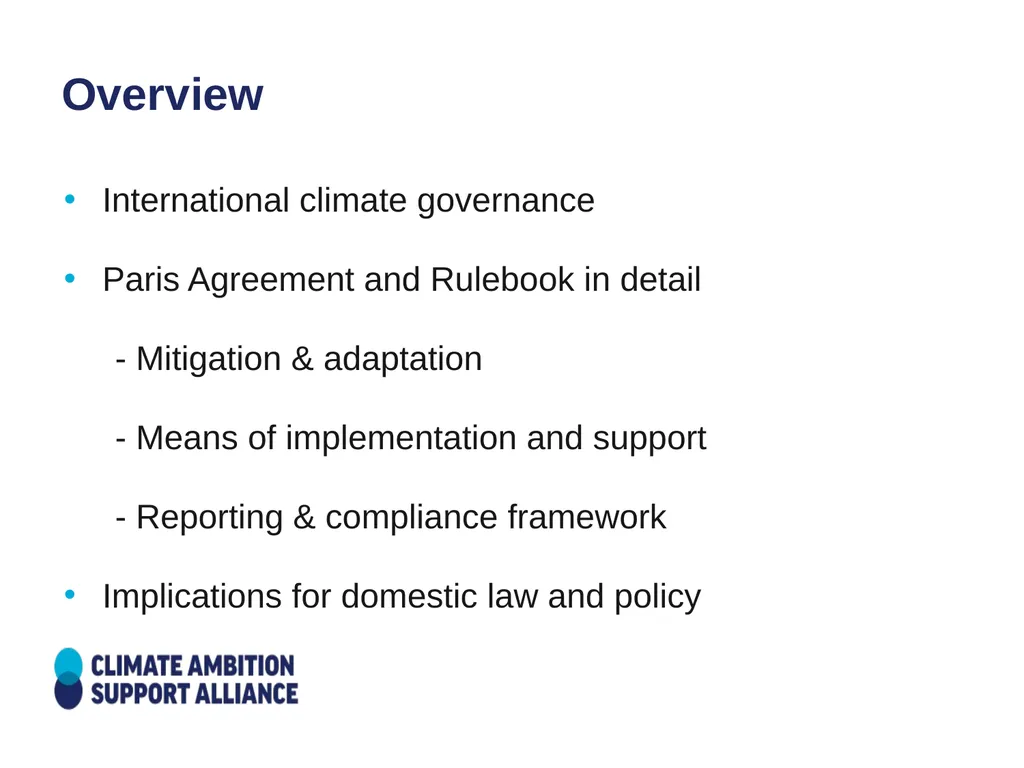
slide2. Overview International climate governance
Paris Agreement and Rulebook in detail
- Mitigation & adaptation
- Means of implementation and support
- Reporting & compliance framework
Implications for domestic law and policy<br>
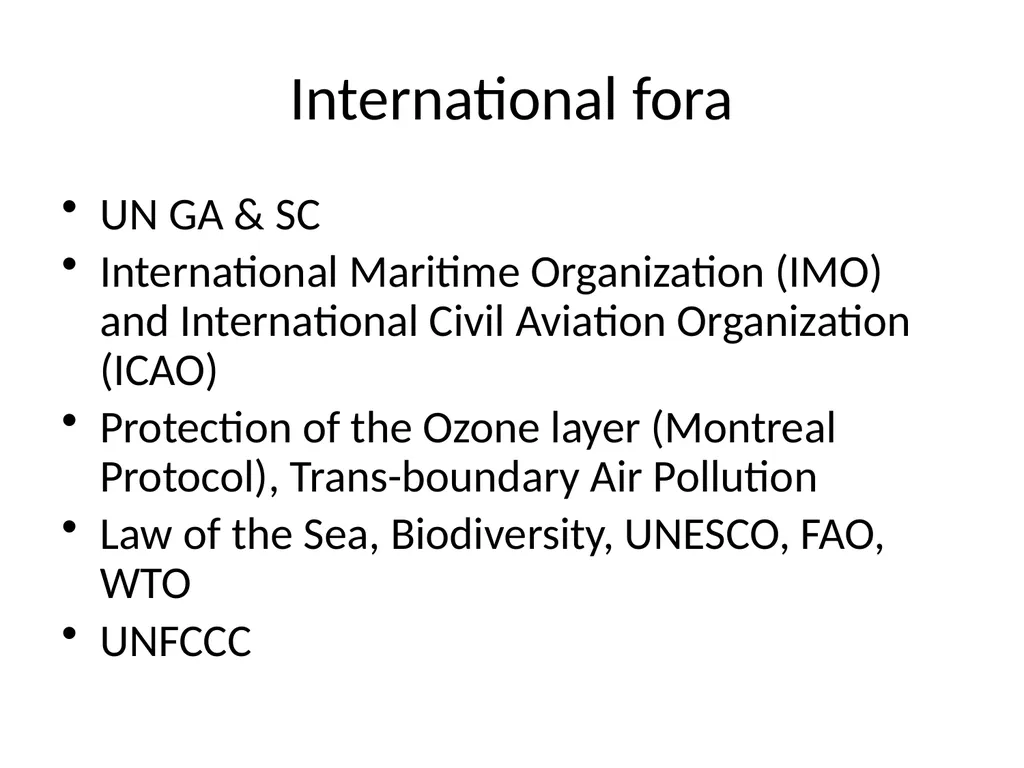
slide3. International fora UN GA & SC
International Maritime Organization (IMO) and International Civil Aviation Organization (ICAO)
Protection of the Ozone layer (Montreal Protocol), Trans-boundary Air Pollution
Law of the Sea, Biodiversity, UNESCO, FAO, WTO
UNFCCC<br>
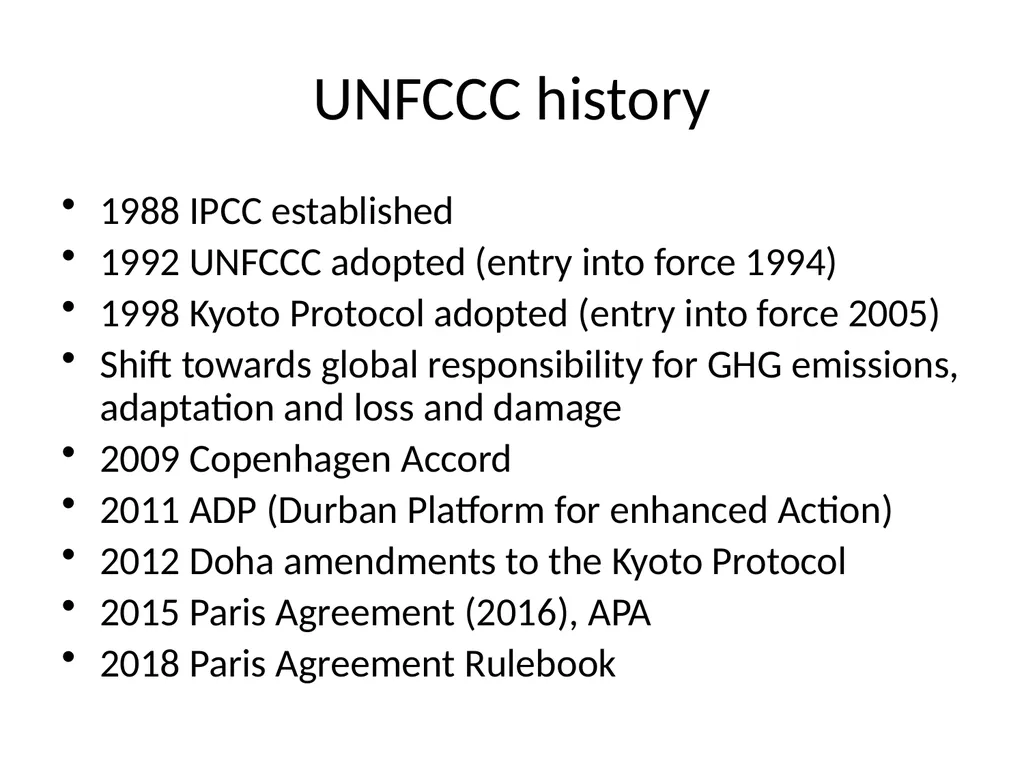
slide4. UNFCCC history 1988 IPCC established
1992 UNFCCC adopted (entry into force 1994)
1998 Kyoto Protocol adopted (entry into force 2005)
Shift towards global responsibility for GHG emissions, adaptation and loss and damage
2009 Copenhagen Accord
2011 ADP (Durban Platform for enhanced Action)
2012 Doha amendments to the Kyoto Protocol
2015 Paris Agreement (2016), APA
2018 Paris Agreement Rulebook<br>
slide5. UNFCCC Ultimate Objective: To stabilise greenhouse gas concentrations in the atmosphere at a level that would prevent dangerous anthropogenic interference with the climate system.
Guiding Principles:
Equity
Common but differentiated responsibilities and respective capabilities (CBDR-RC)
Specific needs and special circumstances of developing country Parties
Precautionary Principle
Sustainable Development
Principle of Cooperation Key commitments (based on the CBDR and RC)
All Parties:
Publish national inventories of greenhouse gas emissions
Developed Country Parties:
Adopt national mitigation policies
Provide new and additional financial resources for developing countries
Assist developing country Parties particularly vulnerable to climate change in meeting the costs of adaptation
Take all practicable steps to promote, facilitate and finance the transfer of technology
Take full account of the specific needs and special situations of the LDCs<br>
slide6. Kyoto Protocol Article 2 - Mitigation policies and measures
Article 3 – Legally binding targets for emissions of six GHG and timetable
Articles 6, 12 and 17 – New market-based mechanisms creating a new commodity: carbon
Articles 5, 7, 8,18 - Reporting and compliance
Article 11 - Financing for developing countries<br>
slide8. Paris Agreement Adopted in 2015
Entry into force: 2016
International (formally binding) treaty building on Copenhagen Accord
Framework agreement
PA work program to develop rules for implementation<br>
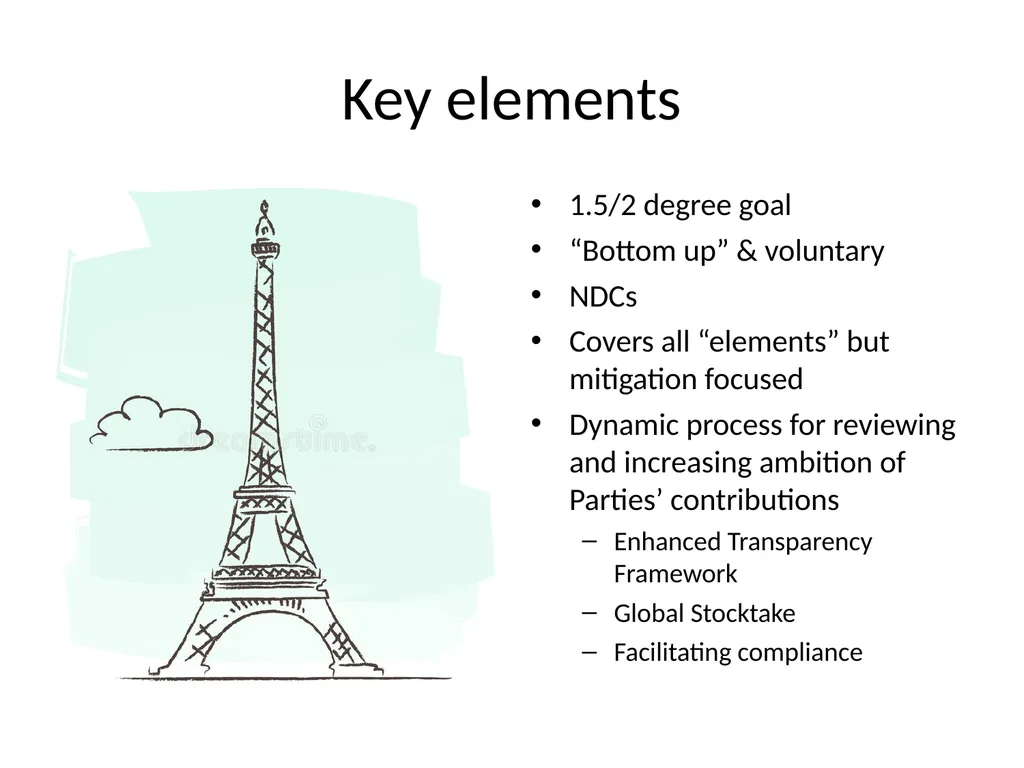
slide9. Key elements 1.5/2 degree goal
“Bottom up” & voluntary
NDCs
Covers all “elements” but mitigation focused
Dynamic process for reviewing and increasing ambition of Parties’ contributions
Enhanced Transparency Framework
Global Stocktake
Facilitating compliance<br>
slide10. PA vs. UNFCCC Equity and CBDRRC: capacity and national circumstances > historic responsibility
Upfront finance as a result of historic responsibilities (-)
Specific needs, special circumstances and vulnerability of developing country parties: all parties (mitigation/adaptation) but within vulnerability (+)
Precautionary principle: Art.2 (+), adaptation (+)
Sustainable Development: no bunker fuels, intellectual property rights (-)
Principle of Cooperation – e.g. address gaps in law (?)<br>
slide12. COP24 Katowice I “Rulebook”, “work program”, “implementation rules”
NDC guidance and accounting – not common time frames
Program and functioning of Forum on the Impact of the Implementation of Response Measures
Not Art.6 cooperative approaches/markets<br>
slide13. COP24 Katowice II Adaptation communication, increased visibility of adaptation efforts (recognition?)
Loss and damage
Monitoring of finance flows, adaptation fund & discussions on new finance goal start 2020
Technology framework (Art.10.4)
Not capacity building<br>
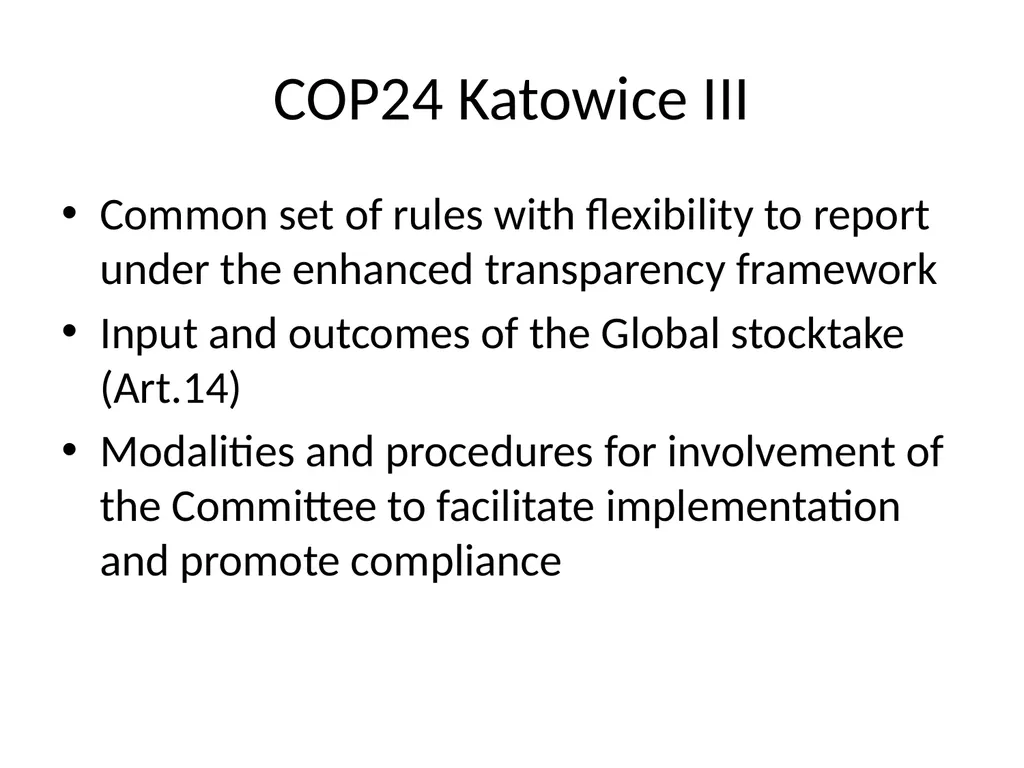
slide14. COP24 Katowice III Common set of rules with flexibility to report under the enhanced transparency framework
Input and outcomes of the Global stocktake (Art.14)
Modalities and procedures for involvement of the Committee to facilitate implementation and promote compliance<br>
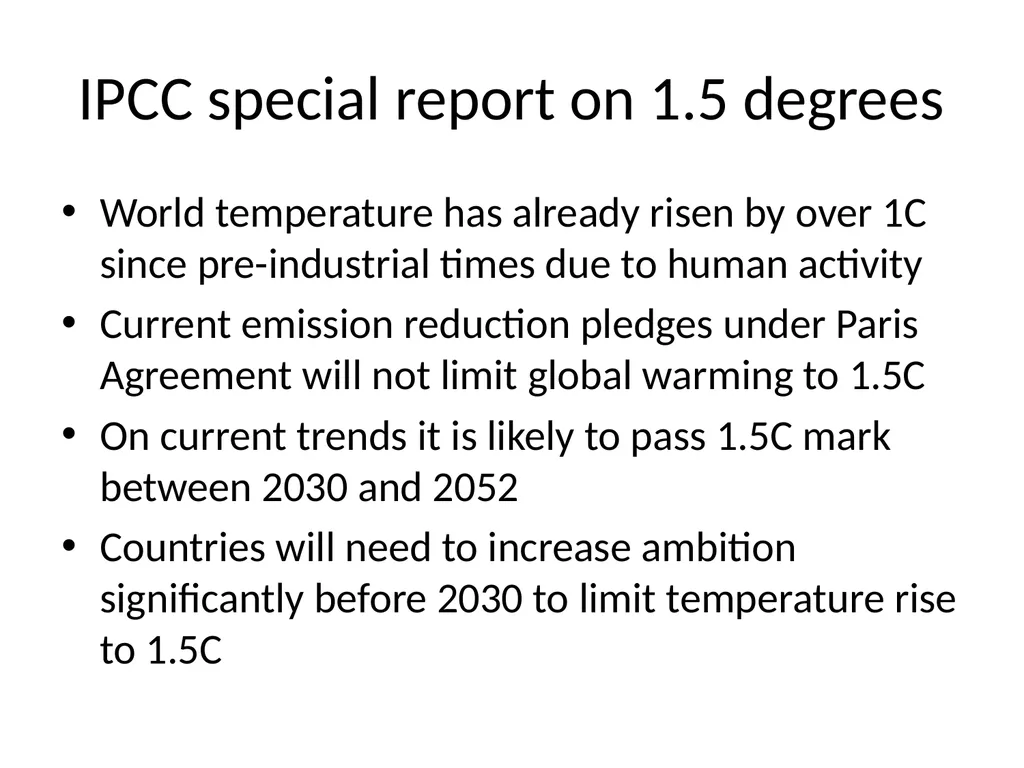
slide15. IPCC special report on 1.5 degrees World temperature has already risen by over 1C since pre-industrial times due to human activity
Current emission reduction pledges under Paris Agreement will not limit global warming to 1.5C
On current trends it is likely to pass 1.5C mark between 2030 and 2052
Countries will need to increase ambition significantly before 2030 to limit temperature rise to 1.5C<br>
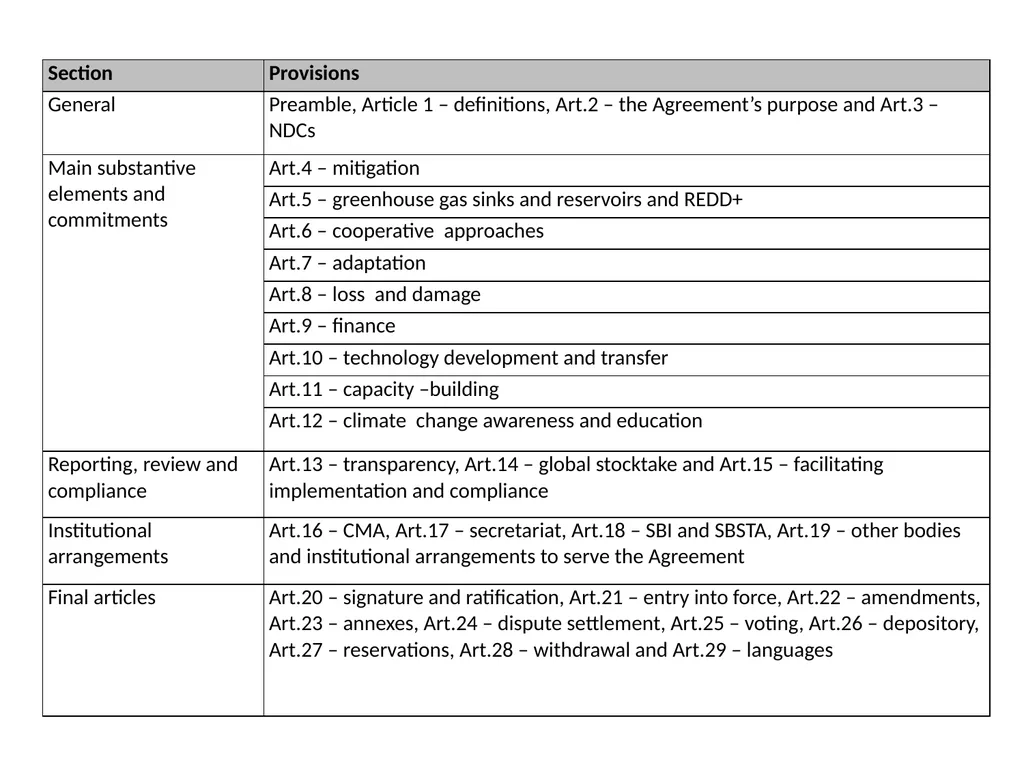
slide18. General part Preamble: sustainable development, food production, quality jobs, human rights, Mother Earth, “climate justice”, public participation etc.
Global goals: to keep global temperatures to “well below 2 °C above pre-industrial levels and pursue efforts to limit the temperature increase to 1.5 °C” (Art.2)
Guiding principles: equity and CBDRRC in the light of different national circumstances (Art.2)
Nationally determined contributions (NDCs) in general (Art.3) = main vehicle for climate action<br>
slide19. Mitigation and adaptation<br>
slide20. Mitigation (Art.4) Parties shall submit increasingly ambitious NDCs every 5 years and “pursue” domestic mitigation measures, with the aim of achieving the objectives of such contributions (Art.4.2).
Developed countries should continue taking the lead through economy-wide absolute emission reduction targets (Art.4.4)
Support for developing country Parties (Art.4.5) but not a precondition of action<br>
slide21. Mitigation (Art.4) Parties may act jointly (Art.4.16)
All Parties are encouraged to formulate long term low GHG emission development strategies (Art.4.19)
Parties shall provide national inventory reports and information to track progress (Art.13.7)<br>
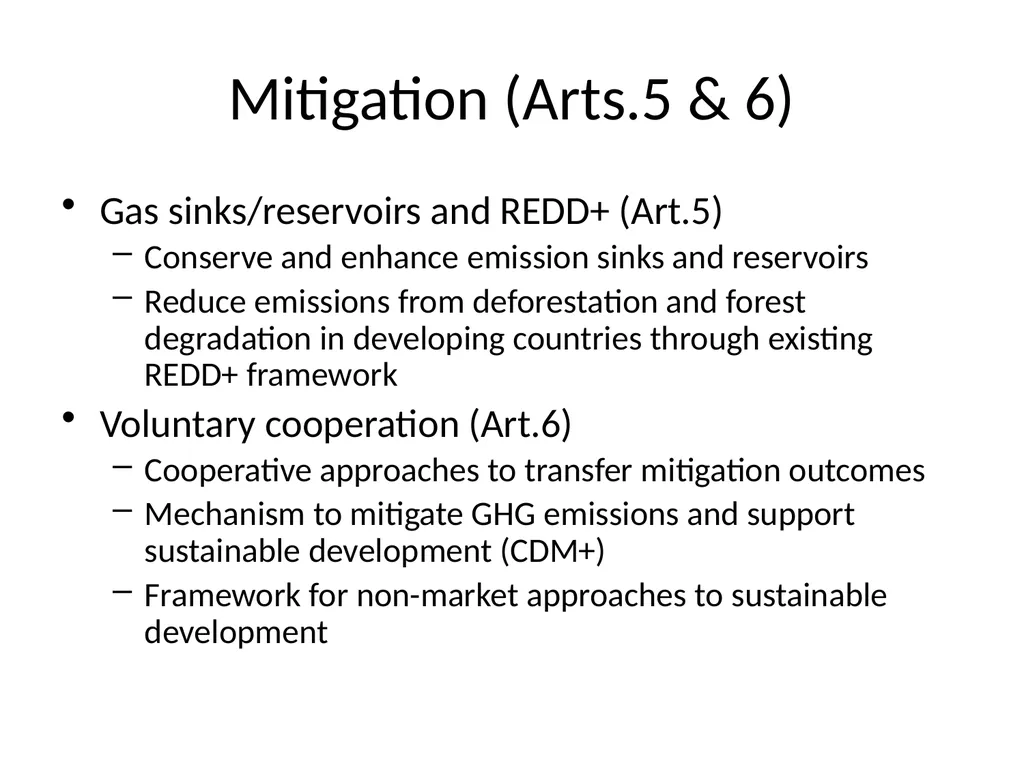
slide22. Mitigation (Arts.5 & 6) Gas sinks/reservoirs and REDD+ (Art.5)
Conserve and enhance emission sinks and reservoirs
Reduce emissions from deforestation and forest degradation in developing countries through existing REDD+ framework
Voluntary cooperation (Art.6)
Cooperative approaches to transfer mitigation outcomes
Mechanism to mitigate GHG emissions and support sustainable development (CDM+)
Framework for non-market approaches to sustainable development<br>
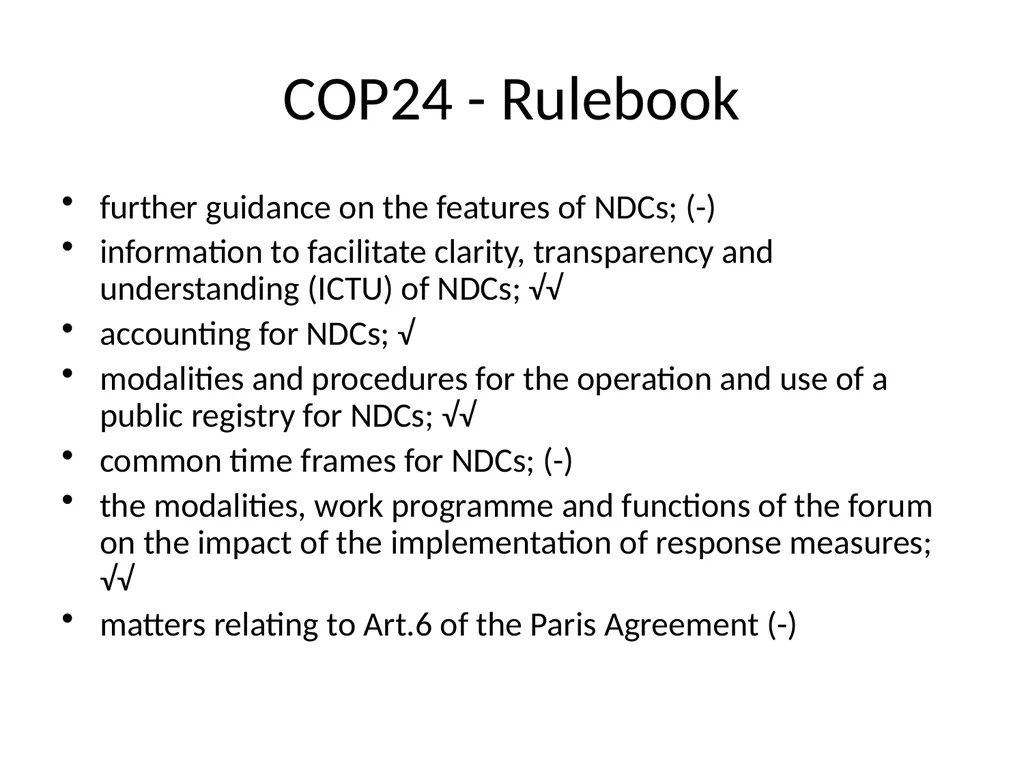
slide23. COP24 - Rulebook further guidance on the features of NDCs; (-)
information to facilitate clarity, transparency and understanding (ICTU) of NDCs; √√
accounting for NDCs; √
modalities and procedures for the operation and use of a public registry for NDCs; √√
common time frames for NDCs; (-)
the modalities, work programme and functions of the forum on the impact of the implementation of response measures; √√
matters relating to Art.6 of the Paris Agreement (-)<br>
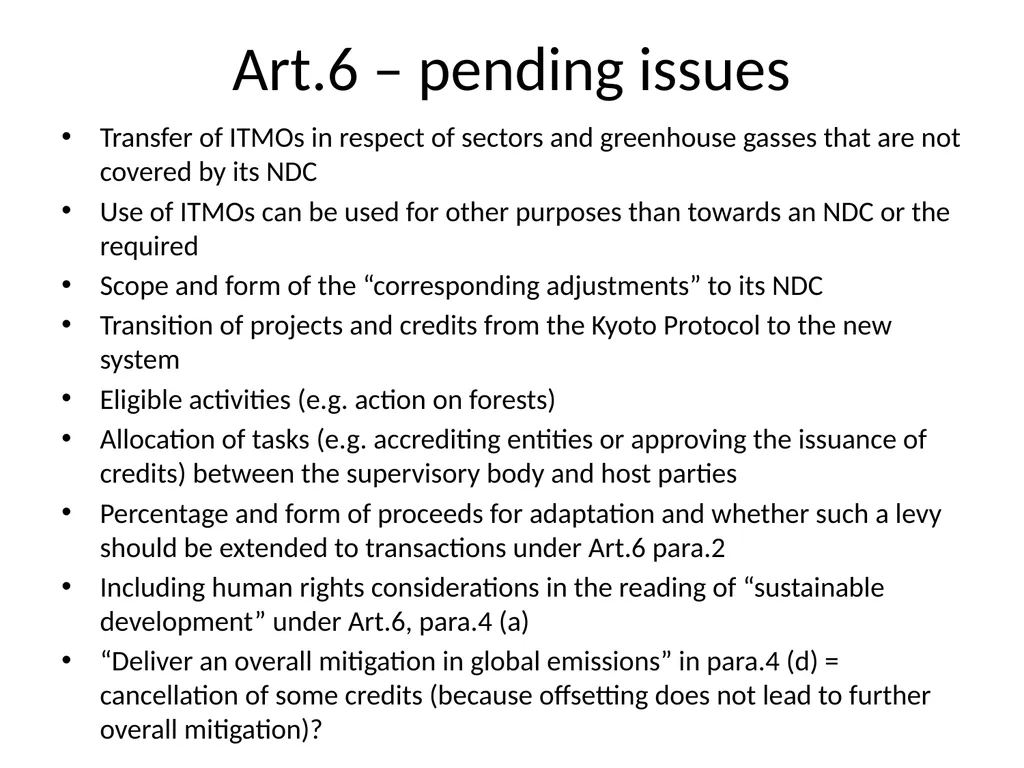
slide24. Art.6 – pending issues Transfer of ITMOs in respect of sectors and greenhouse gasses that are not covered by its NDC
Use of ITMOs can be used for other purposes than towards an NDC or the required
Scope and form of the “corresponding adjustments” to its NDC
Transition of projects and credits from the Kyoto Protocol to the new system
Eligible activities (e.g. action on forests)
Allocation of tasks (e.g. accrediting entities or approving the issuance of credits) between the supervisory body and host parties
Percentage and form of proceeds for adaptation and whether such a levy should be extended to transactions under Art.6 para.2
Including human rights considerations in the reading of “sustainable development” under Art.6, para.4 (a)
“Deliver an overall mitigation in global emissions” in para.4 (d) = cancellation of some credits (because offsetting does not lead to further overall mitigation)?<br>
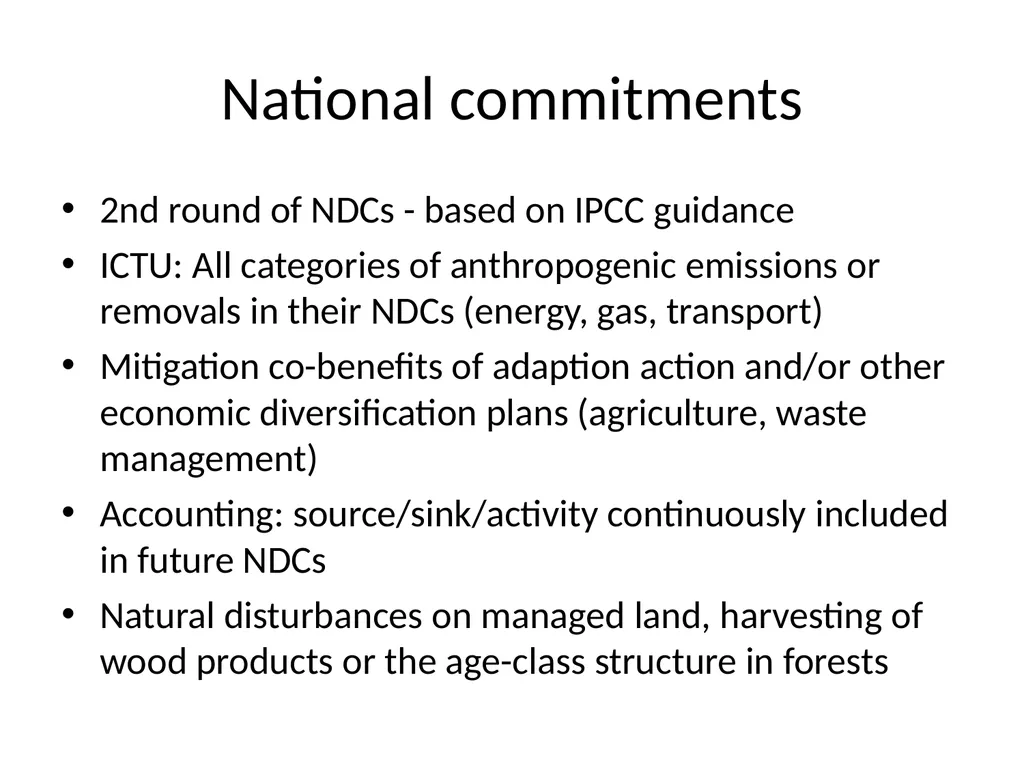
slide25. National commitments 2nd round of NDCs - based on IPCC guidance
ICTU: All categories of anthropogenic emissions or removals in their NDCs (energy, gas, transport)
Mitigation co-benefits of adaption action and/or other economic diversification plans (agriculture, waste management)
Accounting: source/sink/activity continuously included in future NDCs
Natural disturbances on managed land, harvesting of wood products or the age-class structure in forests<br>
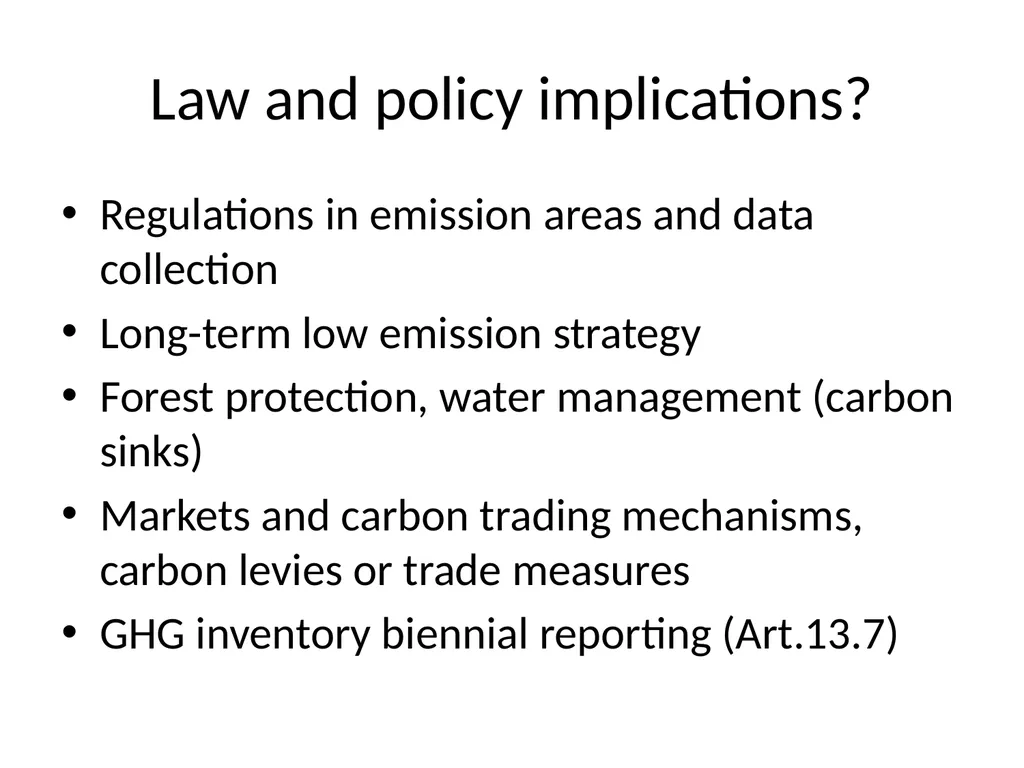
slide26. Law and policy implications? Regulations in emission areas and data collection
Long-term low emission strategy
Forest protection, water management (carbon sinks)
Markets and carbon trading mechanisms, carbon levies or trade measures
GHG inventory biennial reporting (Art.13.7)<br>
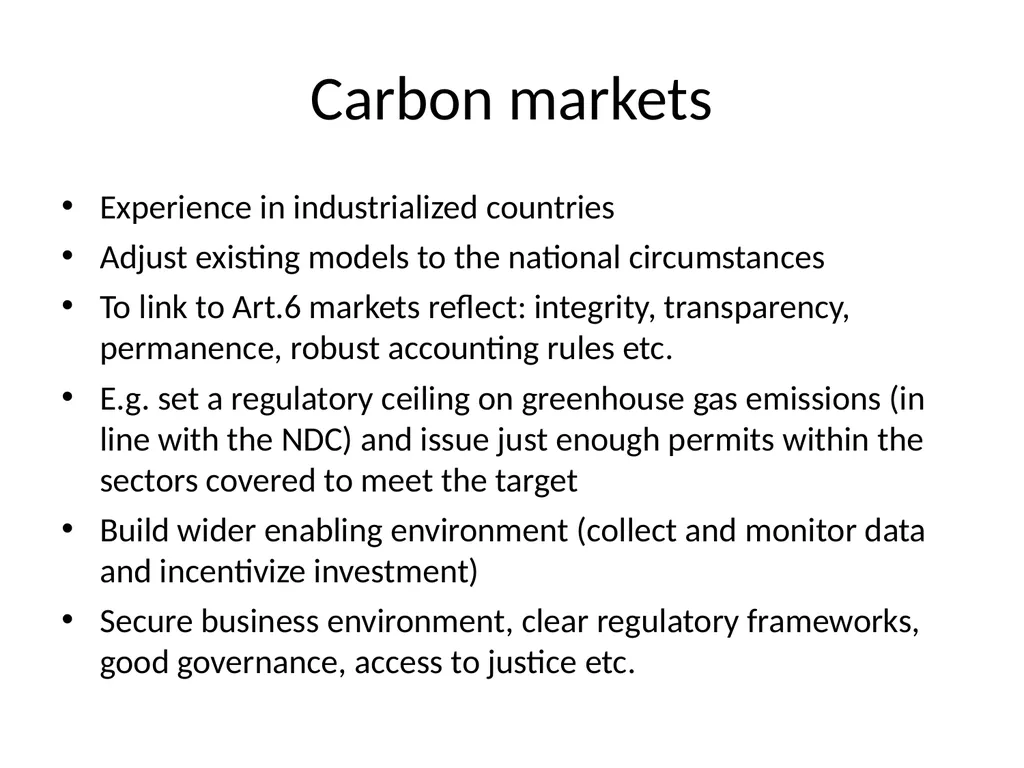
slide27. Carbon markets Experience in industrialized countries
Adjust existing models to the national circumstances
To link to Art.6 markets reflect: integrity, transparency, permanence, robust accounting rules etc.
E.g. set a regulatory ceiling on greenhouse gas emissions (in line with the NDC) and issue just enough permits within the sectors covered to meet the target
Build wider enabling environment (collect and monitor data and incentivize investment)
Secure business environment, clear regulatory frameworks, good governance, access to justice etc.<br>
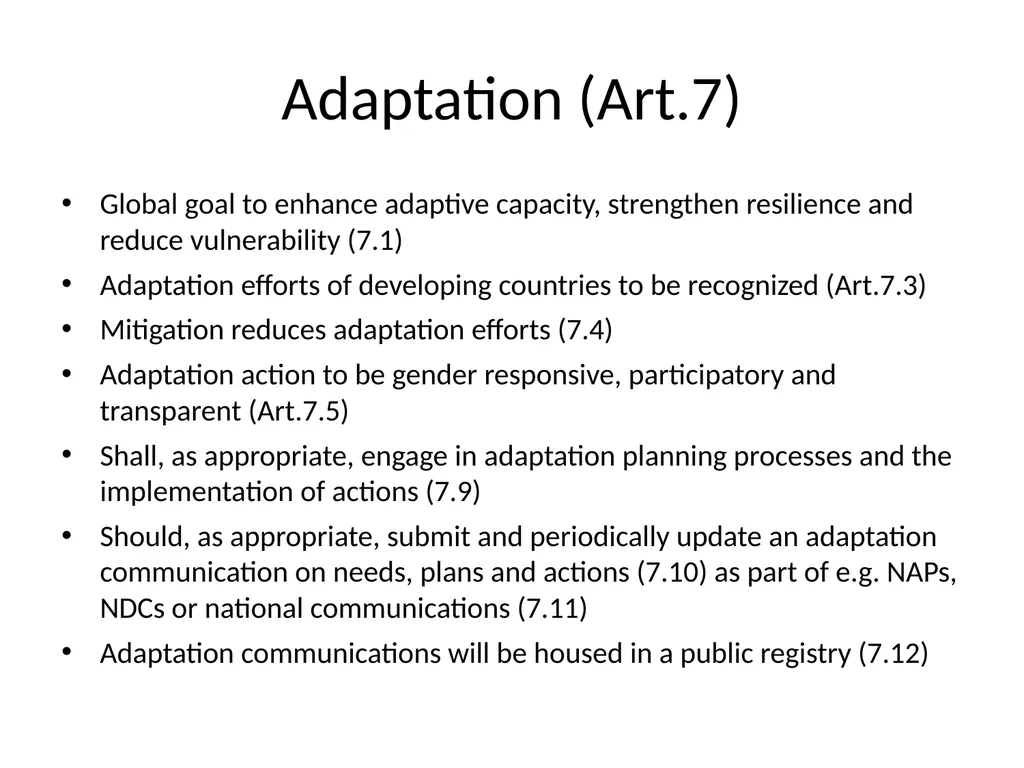
slide28. Adaptation (Art.7) Global goal to enhance adaptive capacity, strengthen resilience and reduce vulnerability (7.1)
Adaptation efforts of developing countries to be recognized (Art.7.3)
Mitigation reduces adaptation efforts (7.4)
Adaptation action to be gender responsive, participatory and transparent (Art.7.5)
Shall, as appropriate, engage in adaptation planning processes and the implementation of actions (7.9)
Should, as appropriate, submit and periodically update an adaptation communication on needs, plans and actions (7.10) as part of e.g. NAPs, NDCs or national communications (7.11)
Adaptation communications will be housed in a public registry (7.12)<br>
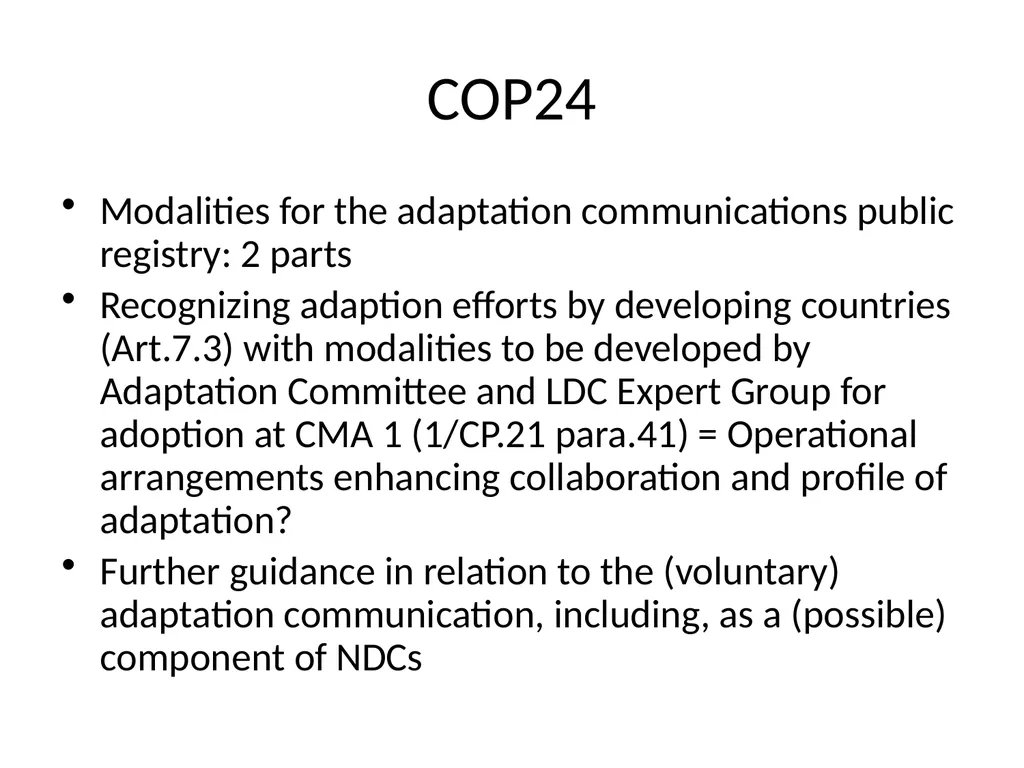
slide29. COP24 Modalities for the adaptation communications public registry: 2 parts
Recognizing adaption efforts by developing countries (Art.7.3) with modalities to be developed by Adaptation Committee and LDC Expert Group for adoption at CMA 1 (1/CP.21 para.41) = Operational arrangements enhancing collaboration and profile of adaptation?
Further guidance in relation to the (voluntary) adaptation communication, including, as a (possible) component of NDCs<br>
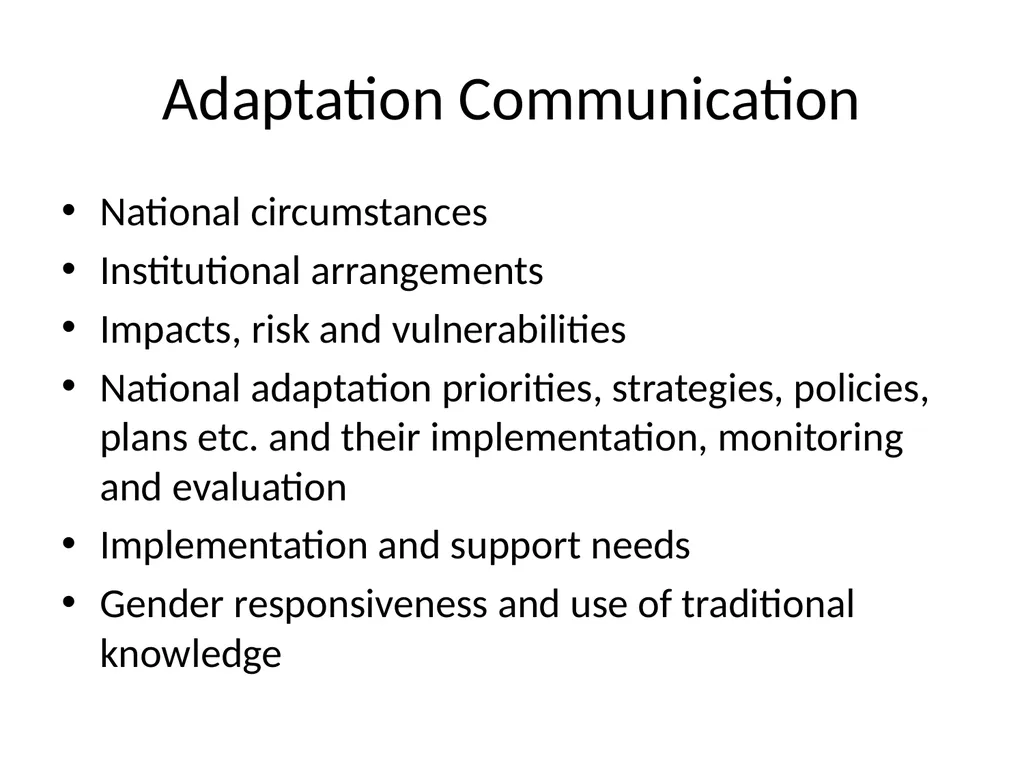
slide30. Adaptation Communication National circumstances
Institutional arrangements
Impacts, risk and vulnerabilities
National adaptation priorities, strategies, policies, plans etc. and their implementation, monitoring and evaluation
Implementation and support needs
Gender responsiveness and use of traditional knowledge<br>
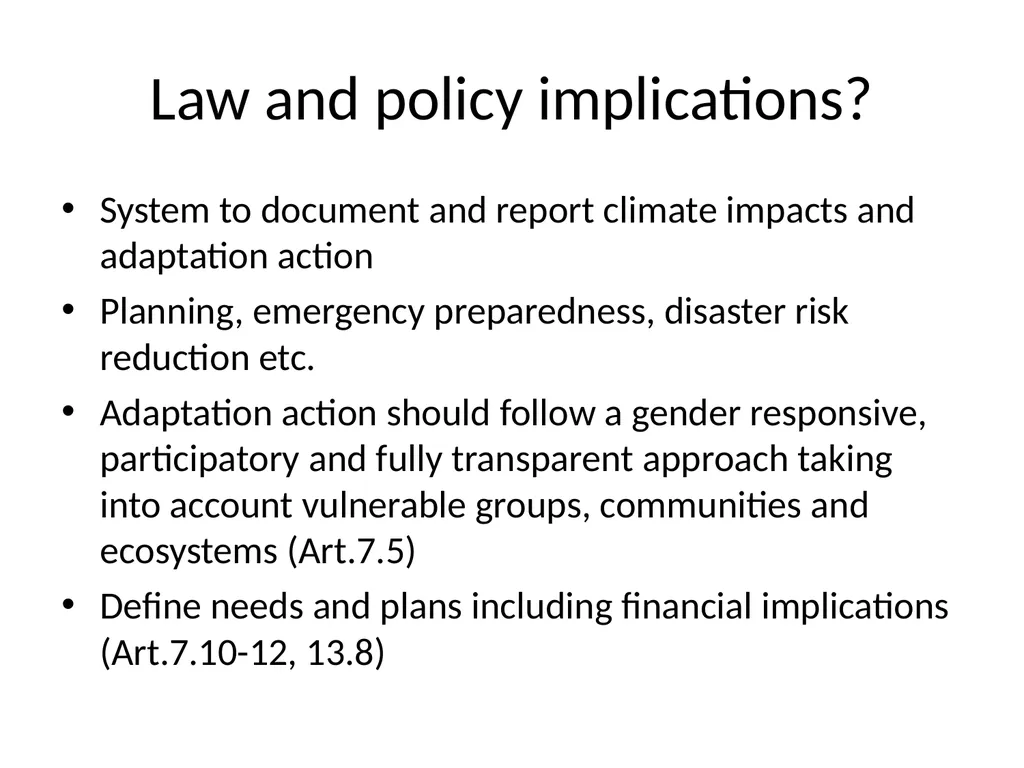
slide31. Law and policy implications? System to document and report climate impacts and adaptation action
Planning, emergency preparedness, disaster risk reduction etc.
Adaptation action should follow a gender responsive, participatory and fully transparent approach taking into account vulnerable groups, communities and ecosystems (Art.7.5)
Define needs and plans including financial implications (Art.7.10-12, 13.8)<br>
slide32. Loss & damage<br>
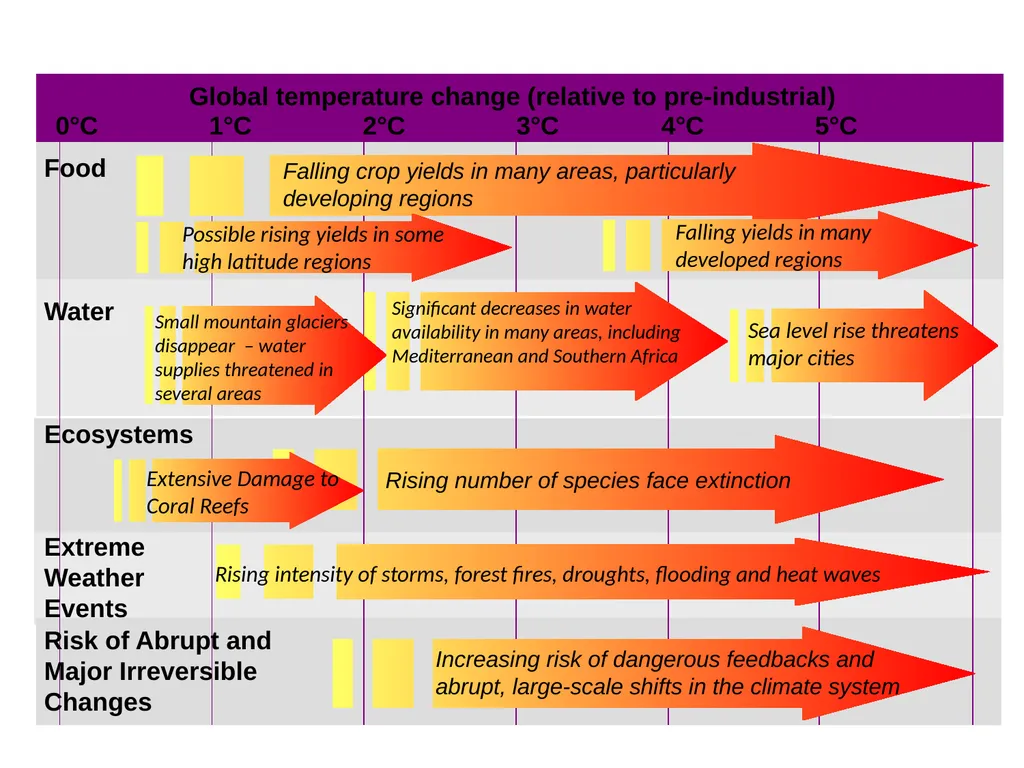
slide33. 1°C 2°C 5°C 4°C 3°C Sea level rise threatens major cities Falling crop yields in many areas, particularly developing regions Food Water Ecosystems Risk of Abrupt and Major Irreversible Changes Global temperature change (relative to pre-industrial) 0°C Falling yields in many developed regions Rising number of species face extinction Increasing risk of dangerous feedbacks and abrupt, large-scale shifts in the climate system Significant decreases in water availability in many areas, including Mediterranean and Southern Africa Small mountain glaciers disappear – water supplies threatened in several areas Extensive Damage to Coral Reefs Extreme Weather Events Rising intensity of storms, forest fires, droughts, flooding and heat waves Possible rising yields in some high latitude regions<br>
slide35. Loss & damage (Art.8) Further steps to be taken to address loss and damage due to climate impacts (Art.8)
Warsaw International Mechanism on loss and damage
Disaster response, risk assessment and management, insurance
Task force on displacement related to the adverse impacts of climate change (para.49, Decision 1/CP.21)
“Agrees that Article 8 does not involve or provide a basis for any liability or compensation” (para.51, Decision 1/CP.21)
Rulebook: Reference to L&D in Transparency and Global Stocktake guidelines<br>
slide36. Compensation & liability? Future work of WIM under PA? COP decision does not exclude application of general rules of public international law
Principle of prevention/no harm: “The existence of the general obligation of states to ensure that activities within their jurisdiction and control respect the environment of other states or of areas beyond national control is now part of the corpus of international law relating to the environment.” (ICJ, 1996)
UNFCCC and PA = lex specialis? International Law Commission’s (ILC) Draft Articles on the Responsibility of States for Internationally Wrongful Acts with Commentary, Art.55
Rules of transboundary pollution apply to climate change? ILA draft principles related to climate change<br>
slide37. Palau initiative “Do states have a legal responsibility to ensure that any activities on their territory that emit greenhouse gases do not harm other states?”<br>
slide38. Means of implementation and support<br>
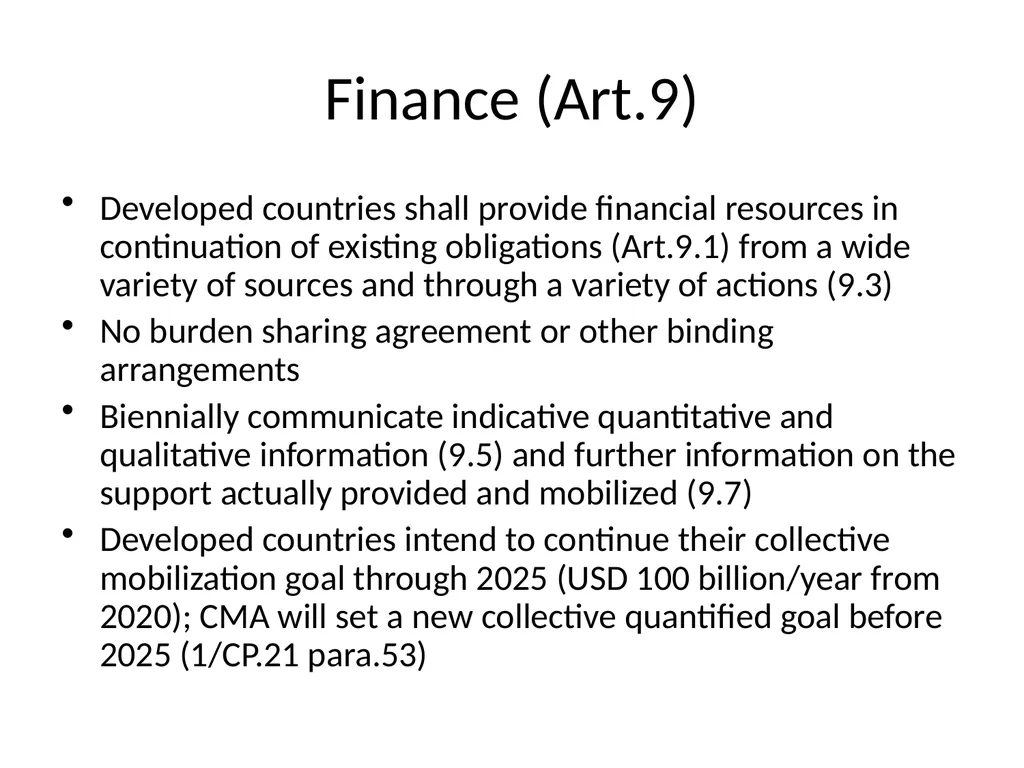
slide39. Finance (Art.9) Developed countries shall provide financial resources in continuation of existing obligations (Art.9.1) from a wide variety of sources and through a variety of actions (9.3)
No burden sharing agreement or other binding arrangements
Biennially communicate indicative quantitative and qualitative information (9.5) and further information on the support actually provided and mobilized (9.7)
Developed countries intend to continue their collective mobilization goal through 2025 (USD 100 billion/year from 2020); CMA will set a new collective quantified goal before 2025 (1/CP.21 para.53)<br>
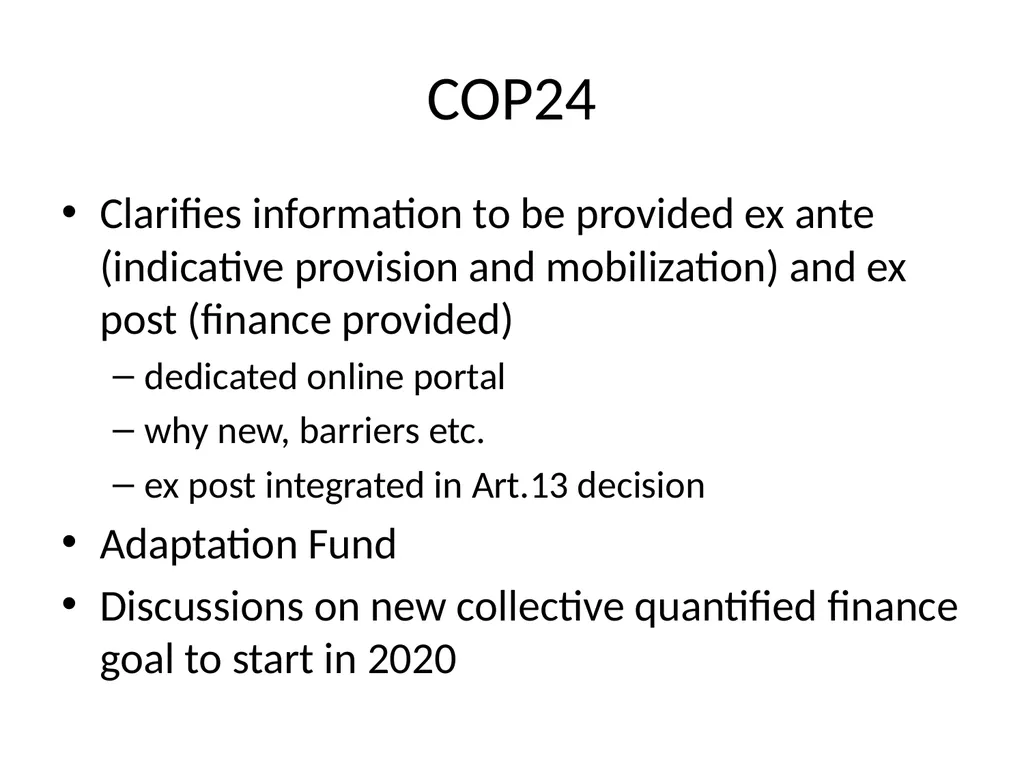
slide40. COP24 Clarifies information to be provided ex ante (indicative provision and mobilization) and ex post (finance provided)
dedicated online portal
why new, barriers etc.
ex post integrated in Art.13 decision
Adaptation Fund
Discussions on new collective quantified finance goal to start in 2020<br>
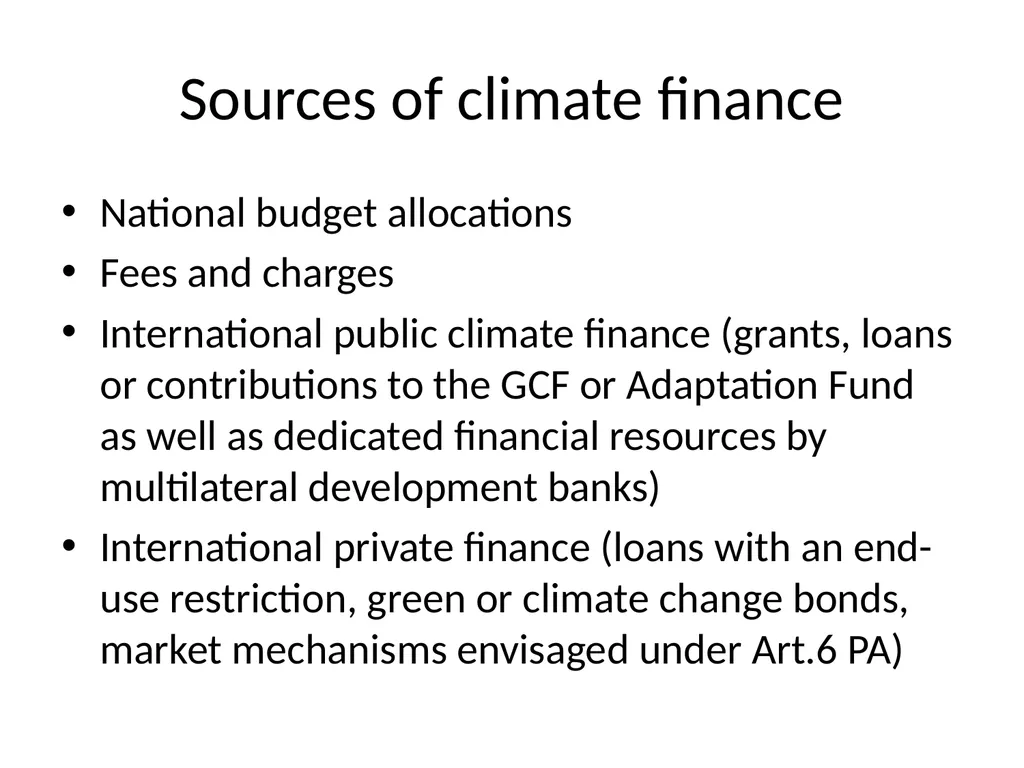
slide41. Sources of climate finance National budget allocations
Fees and charges
International public climate finance (grants, loans or contributions to the GCF or Adaptation Fund as well as dedicated financial resources by multilateral development banks)
International private finance (loans with an end-use restriction, green or climate change bonds, market mechanisms envisaged under Art.6 PA)<br>
slide42. Domestic law and policy Assessing costs of proposed climate change response actions in the short and medium term – and resources available;
Potential entry points for relevant finance institutions;
Mobilizing climate finance via
“financial mechanisms” such as loans, guarantees and insurance, green investment banks, climate trust funds, clean development mechanisms, carbon pricing, green bonds etc.
“facilitative modalities” are non-financial initiatives to help indirectly mobilize private finance by enhancing capacity building, knowledge transfer, governance structures, prudential regulation, corporate reporting, etc.
National efforts/mechanism to bundle and/or blend different climate finance resources<br>
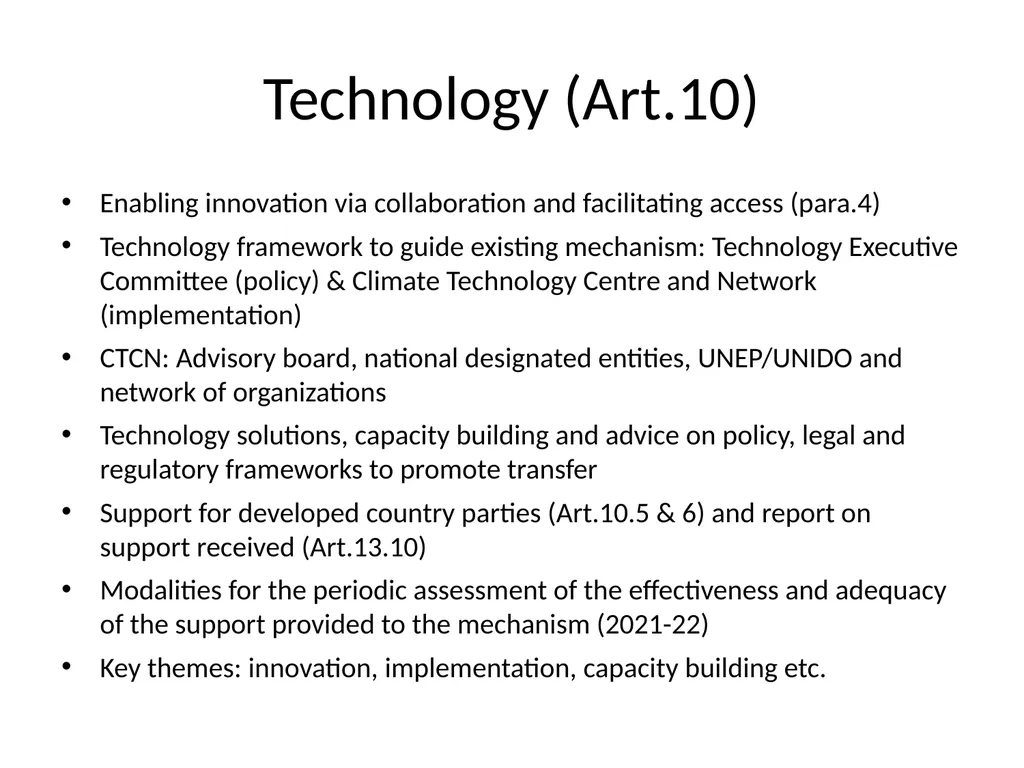
slide43. Technology (Art.10) Enabling innovation via collaboration and facilitating access (para.4)
Technology framework to guide existing mechanism: Technology Executive Committee (policy) & Climate Technology Centre and Network (implementation)
CTCN: Advisory board, national designated entities, UNEP/UNIDO and network of organizations
Technology solutions, capacity building and advice on policy, legal and regulatory frameworks to promote transfer
Support for developed country parties (Art.10.5 & 6) and report on support received (Art.13.10)
Modalities for the periodic assessment of the effectiveness and adequacy of the support provided to the mechanism (2021-22)
Key themes: innovation, implementation, capacity building etc.<br>
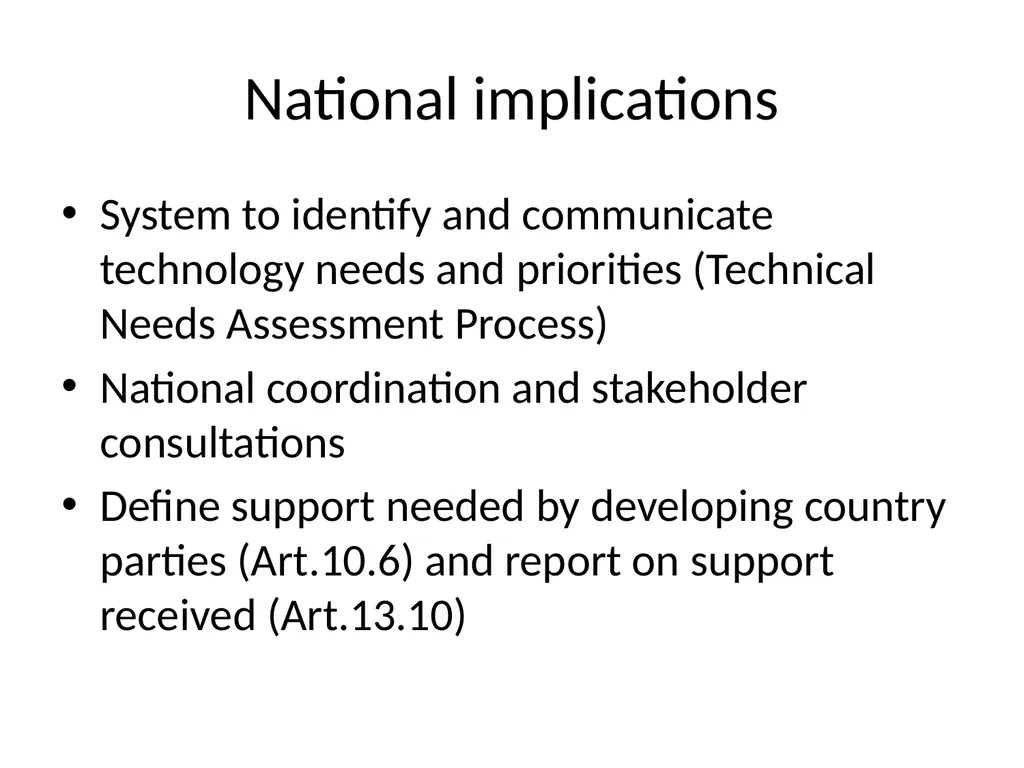
slide44. National implications System to identify and communicate technology needs and priorities (Technical Needs Assessment Process)
National coordination and stakeholder consultations
Define support needed by developing country parties (Art.10.6) and report on support received (Art.13.10)<br>
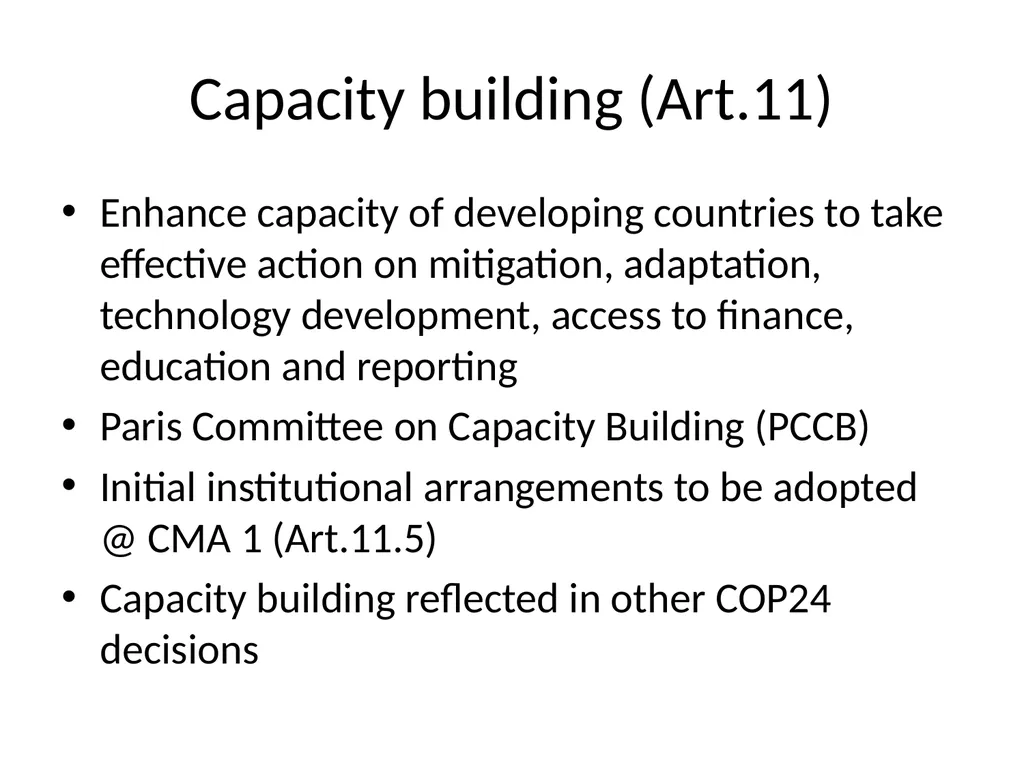
slide45. Capacity building (Art.11) Enhance capacity of developing countries to take effective action on mitigation, adaptation, technology development, access to finance, education and reporting
Paris Committee on Capacity Building (PCCB)
Initial institutional arrangements to be adopted @ CMA 1 (Art.11.5)
Capacity building reflected in other COP24 decisions<br>
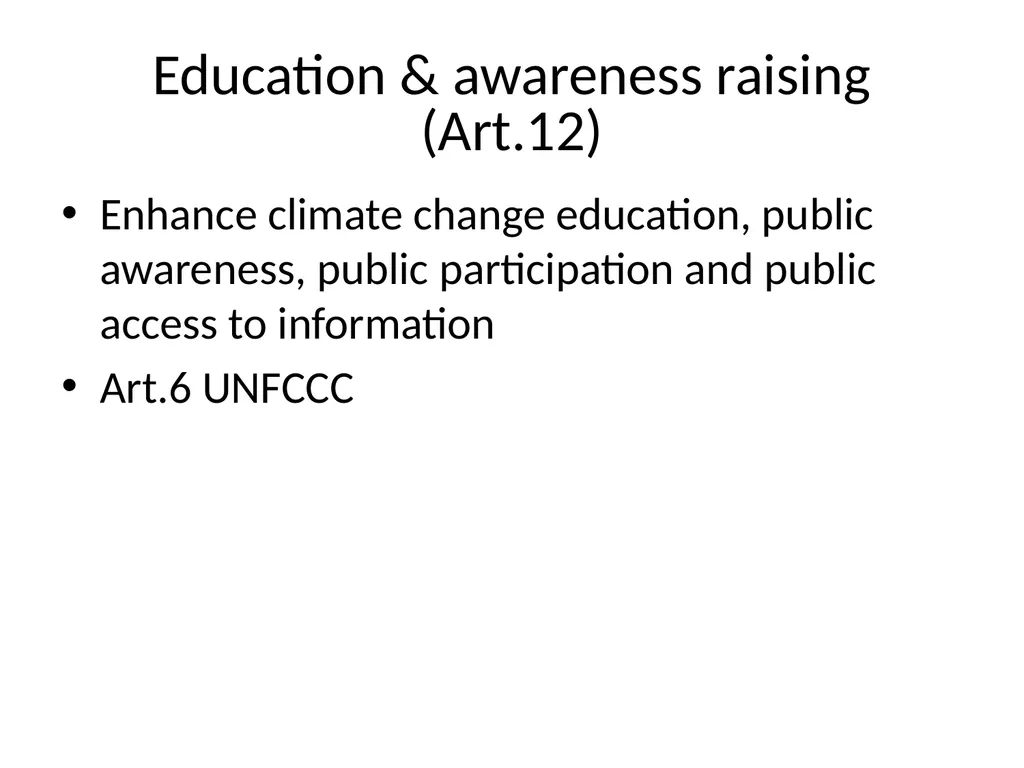
slide46. Education & awareness raising (Art.12) Enhance climate change education, public awareness, public participation and public access to information
Art.6 UNFCCC<br>
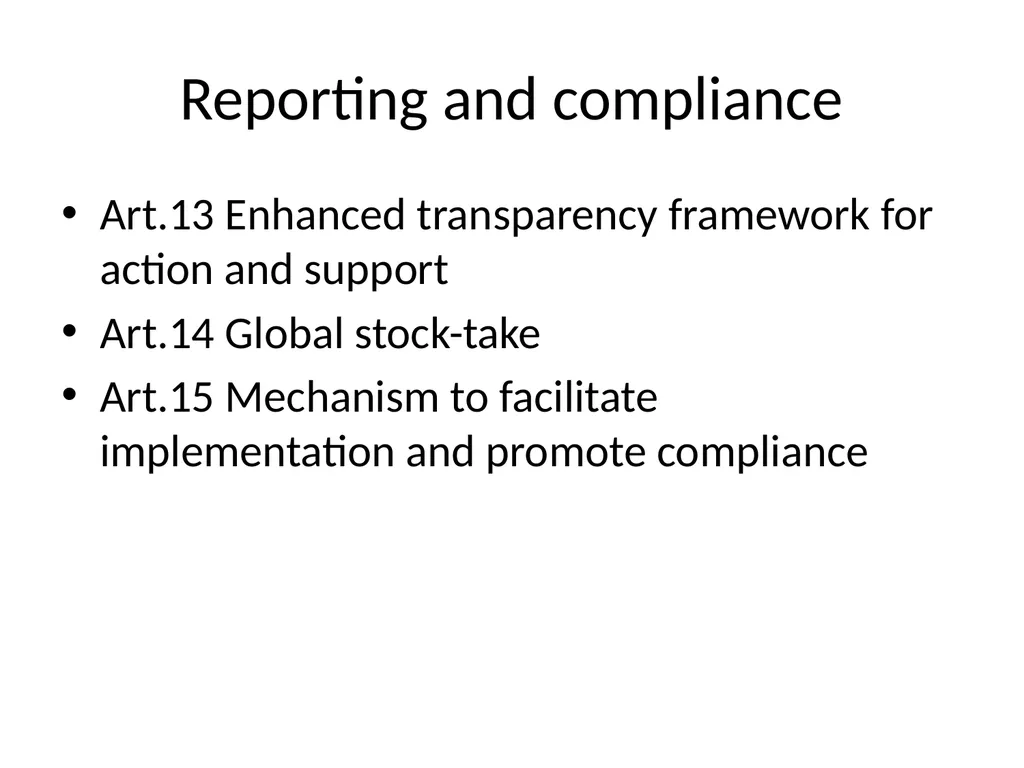
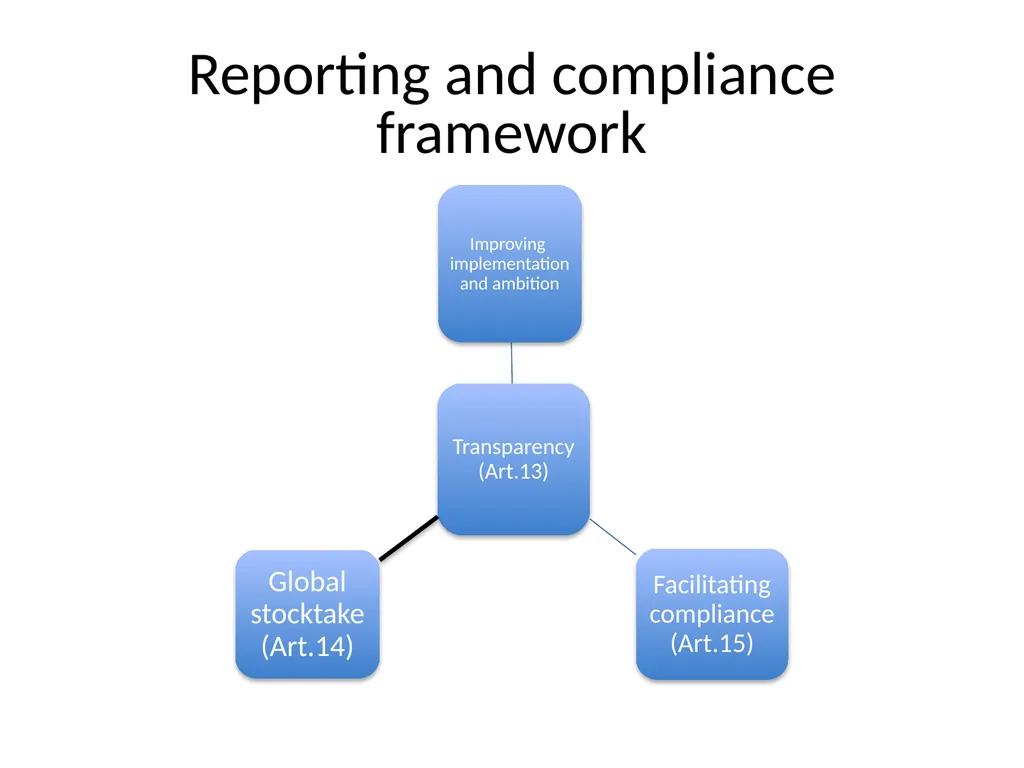
slide47. Reporting and compliance Art.13 Enhanced transparency framework for action and support
Art.14 Global stock-take
Art.15 Mechanism to facilitate implementation and promote compliance<br>
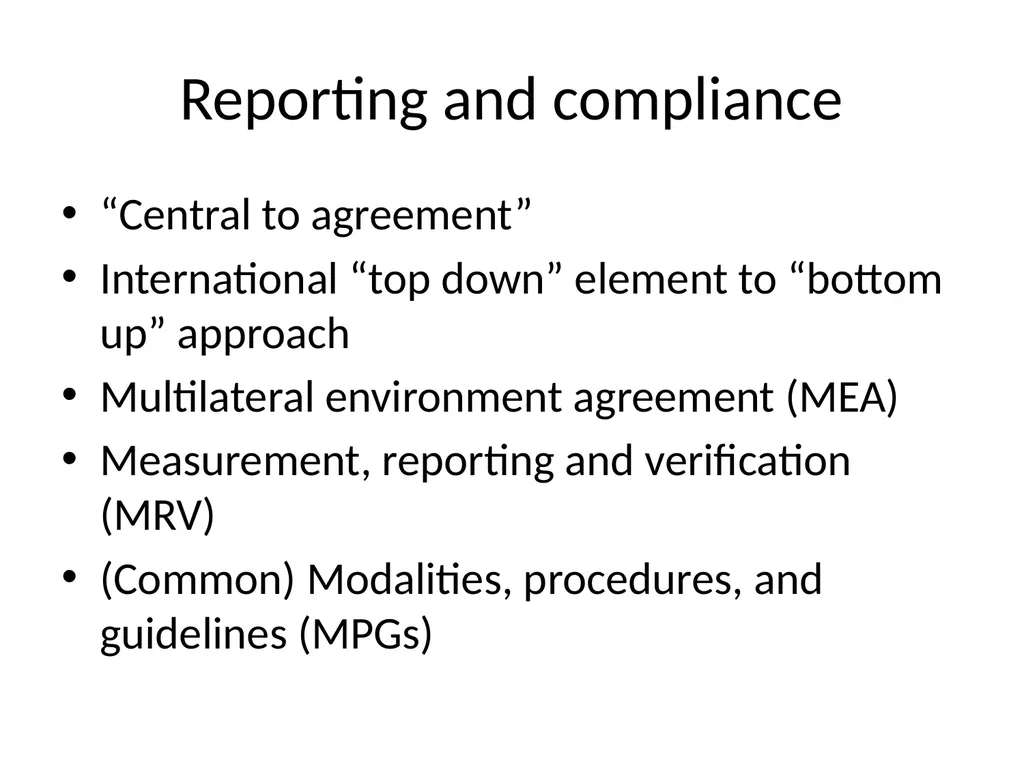
slide48. Reporting and compliance “Central to agreement”
International “top down” element to “bottom up” approach
Multilateral environment agreement (MEA)
Measurement, reporting and verification (MRV)
(Common) Modalities, procedures, and guidelines (MPGs)<br>
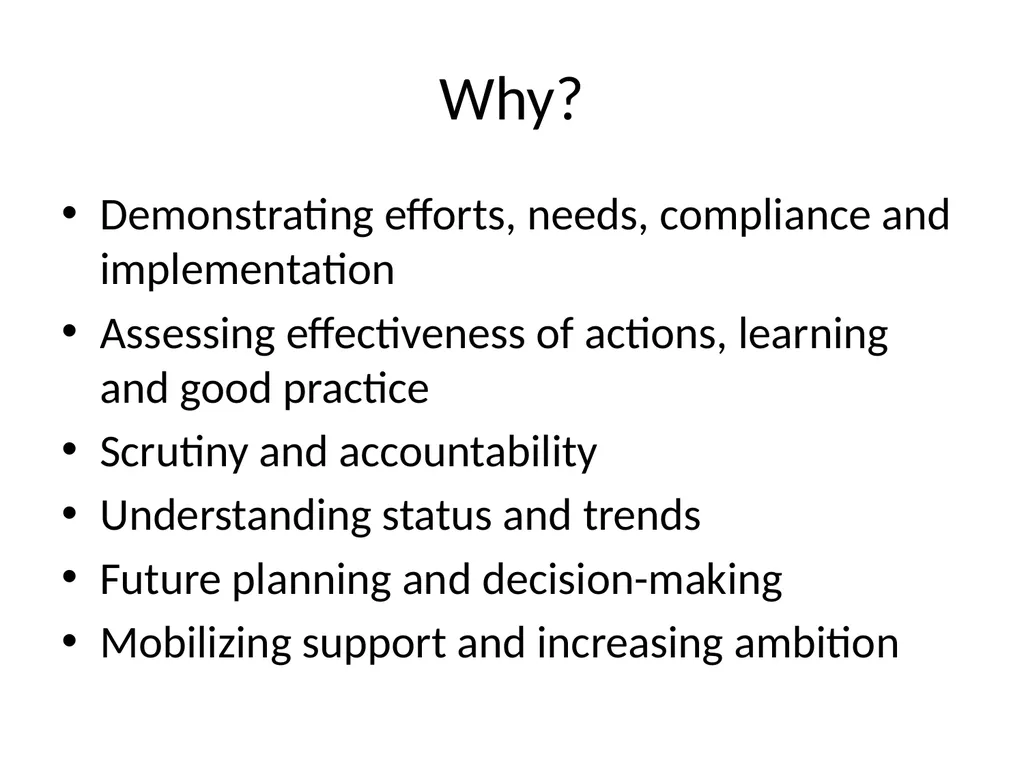
slide49. Why? Demonstrating efforts, needs, compliance and implementation
Assessing effectiveness of actions, learning and good practice
Scrutiny and accountability
Understanding status and trends
Future planning and decision-making
Mobilizing support and increasing ambition<br>
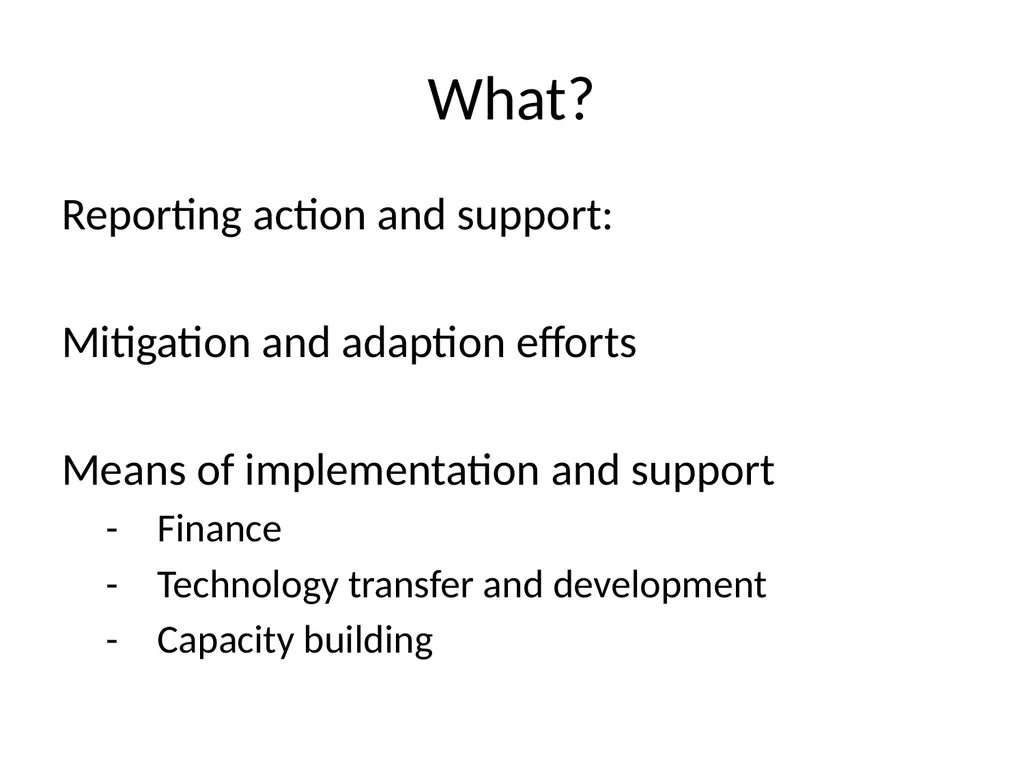
slide50. What? Reporting action and support:
Mitigation and adaption efforts
Means of implementation and support
- Finance
- Technology transfer and development
- Capacity building<br>
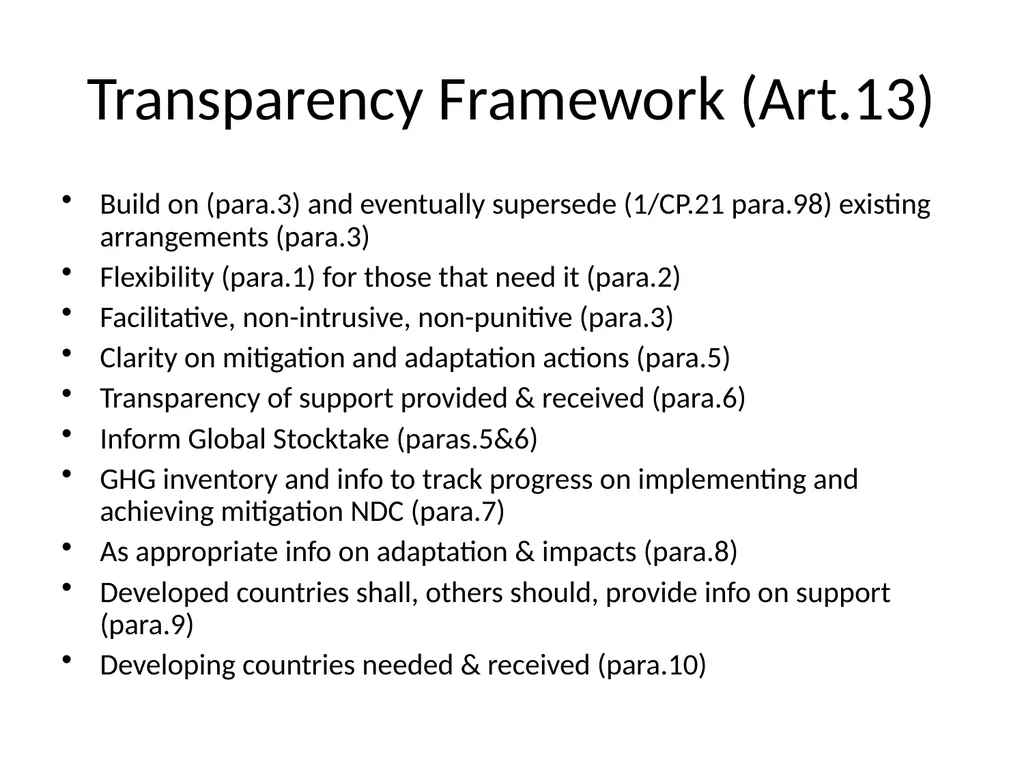
slide51. Transparency Framework (Art.13) Build on (para.3) and eventually supersede (1/CP.21 para.98) existing arrangements (para.3)
Flexibility (para.1) for those that need it (para.2)
Facilitative, non-intrusive, non-punitive (para.3)
Clarity on mitigation and adaptation actions (para.5)
Transparency of support provided & received (para.6)
Inform Global Stocktake (paras.5&6)
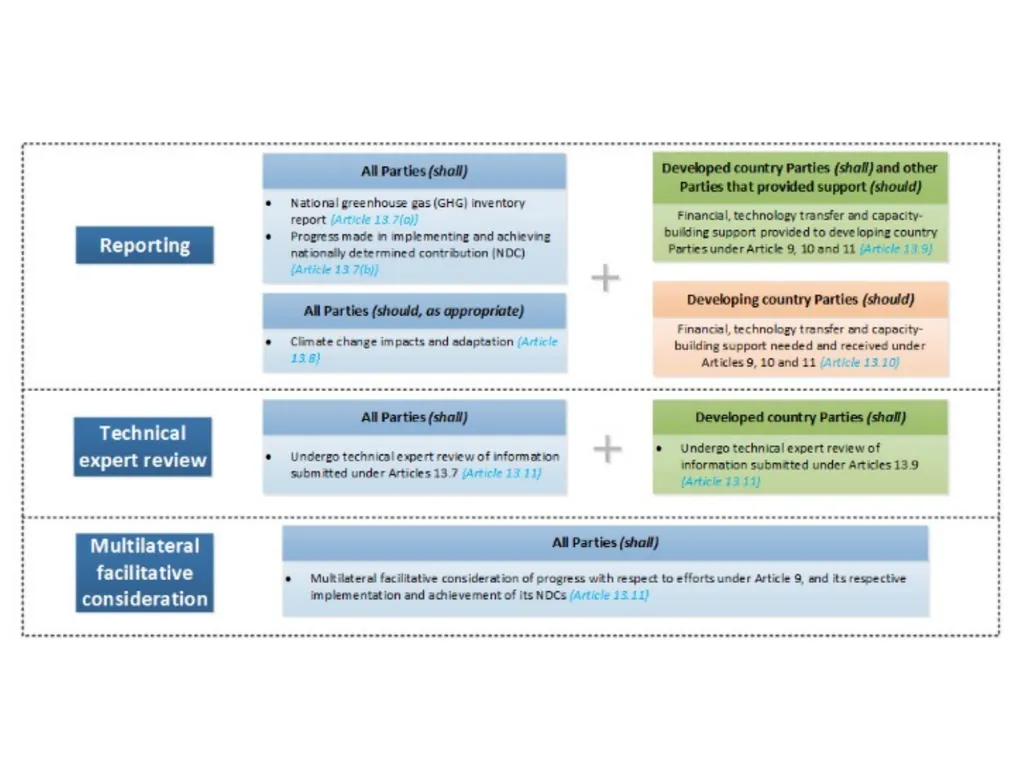
GHG inventory and info to track progress on implementing and achieving mitigation NDC (para.7)
As appropriate info on adaptation & impacts (para.8)
Developed countries shall, others should, provide info on support (para.9)
Developing countries needed & received (para.10)<br>
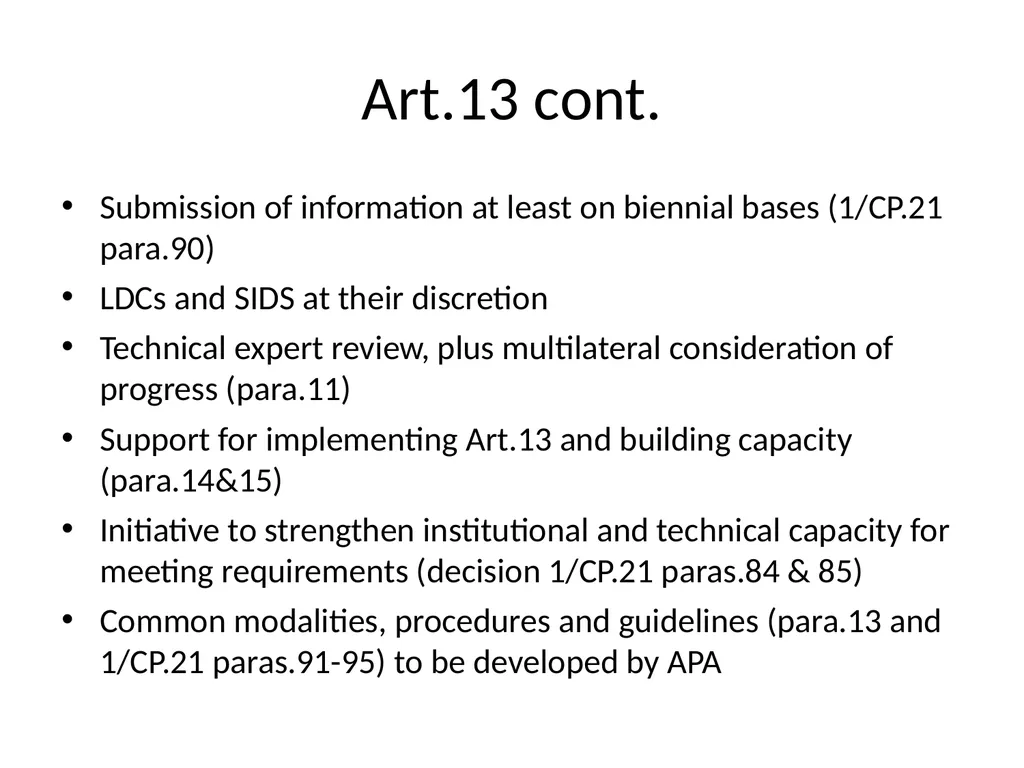
slide52. Art.13 cont. Submission of information at least on biennial bases (1/CP.21 para.90)
LDCs and SIDS at their discretion
Technical expert review, plus multilateral consideration of progress (para.11)
Support for implementing Art.13 and building capacity (para.14&15)
Initiative to strengthen institutional and technical capacity for meeting requirements (decision 1/CP.21 paras.84 & 85)
Common modalities, procedures and guidelines (para.13 and 1/CP.21 paras.91-95) to be developed by APA<br>
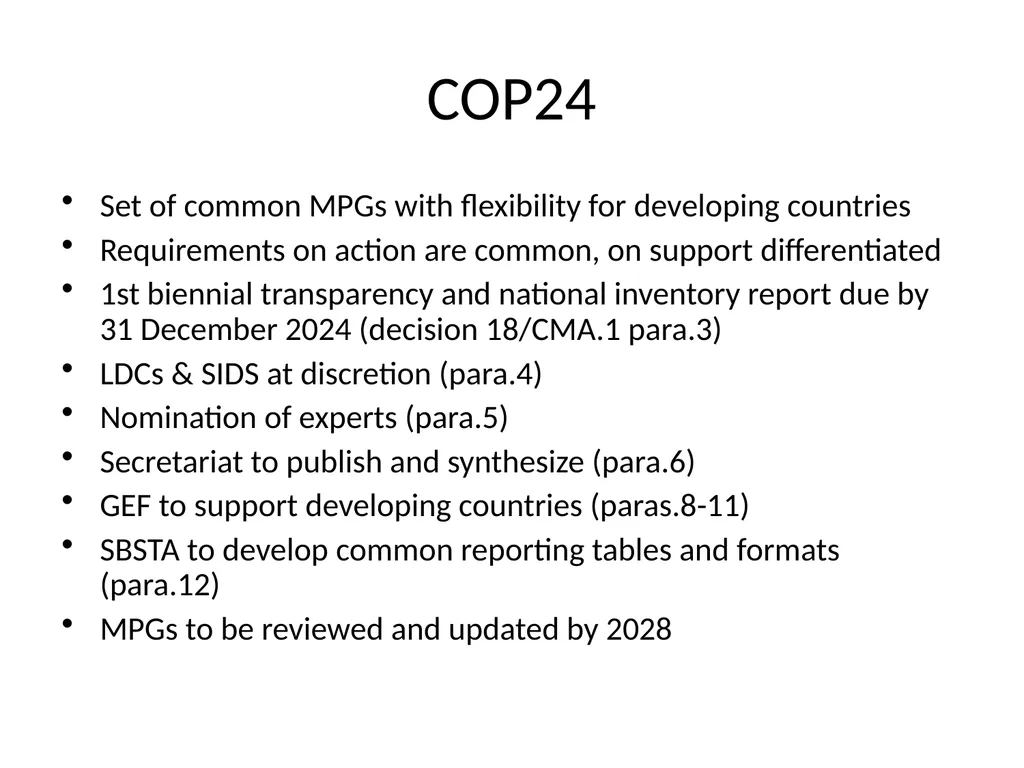
slide53. COP24 Set of common MPGs with flexibility for developing countries
Requirements on action are common, on support differentiated
1st biennial transparency and national inventory report due by 31 December 2024 (decision 18/CMA.1 para.3)
LDCs & SIDS at discretion (para.4)
Nomination of experts (para.5)
Secretariat to publish and synthesize (para.6)
GEF to support developing countries (paras.8-11)
SBSTA to develop common reporting tables and formats (para.12)
MPGs to be reviewed and updated by 2028<br>
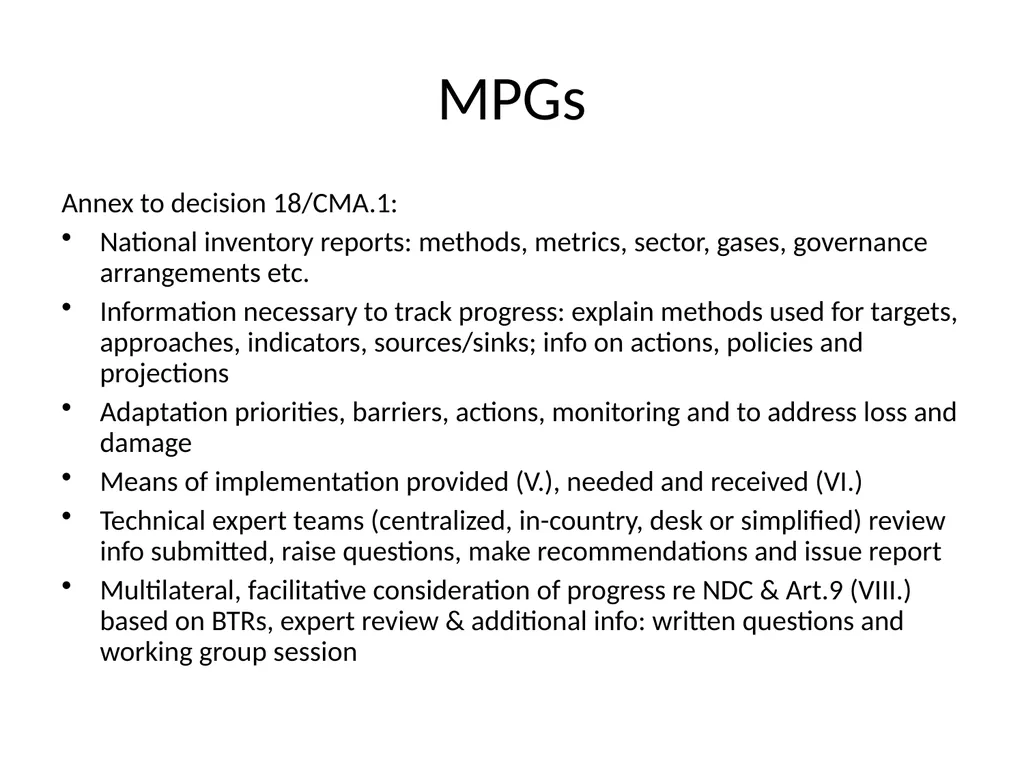
slide54. MPGs Annex to decision 18/CMA.1:
National inventory reports: methods, metrics, sector, gases, governance arrangements etc.
Information necessary to track progress: explain methods used for targets, approaches, indicators, sources/sinks; info on actions, policies and projections
Adaptation priorities, barriers, actions, monitoring and to address loss and damage
Means of implementation provided (V.), needed and received (VI.)
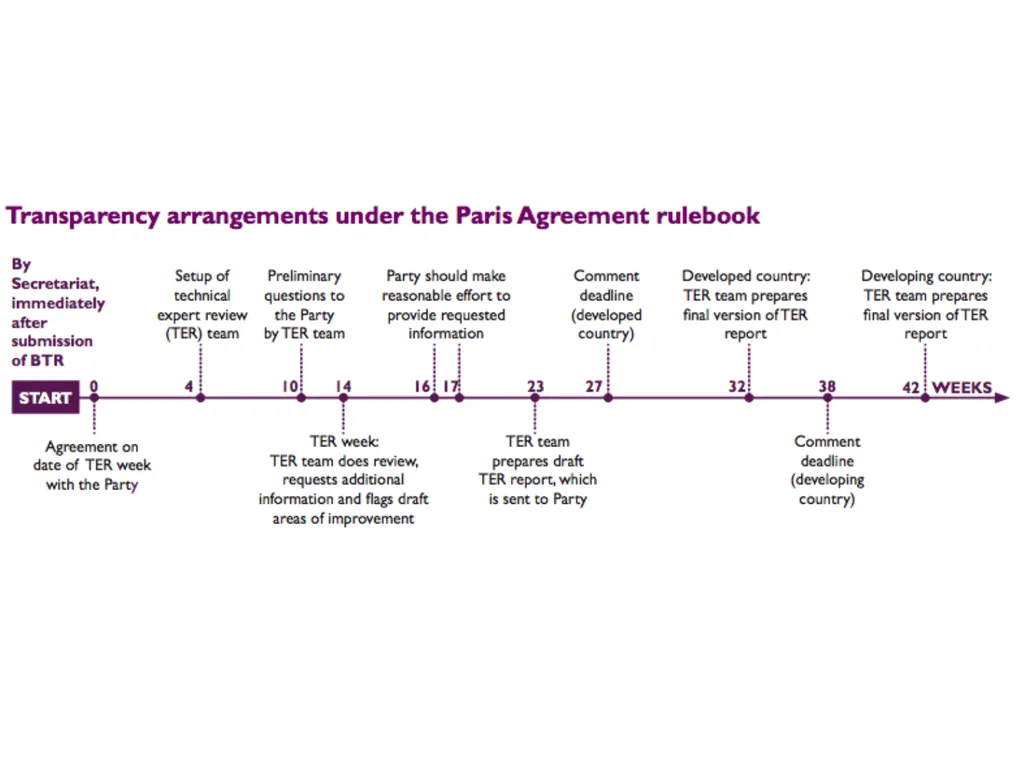
Technical expert teams (centralized, in-country, desk or simplified) review info submitted, raise questions, make recommendations and issue report
Multilateral, facilitative consideration of progress re NDC & Art.9 (VIII.) based on BTRs, expert review & additional info: written questions and working group session<br>
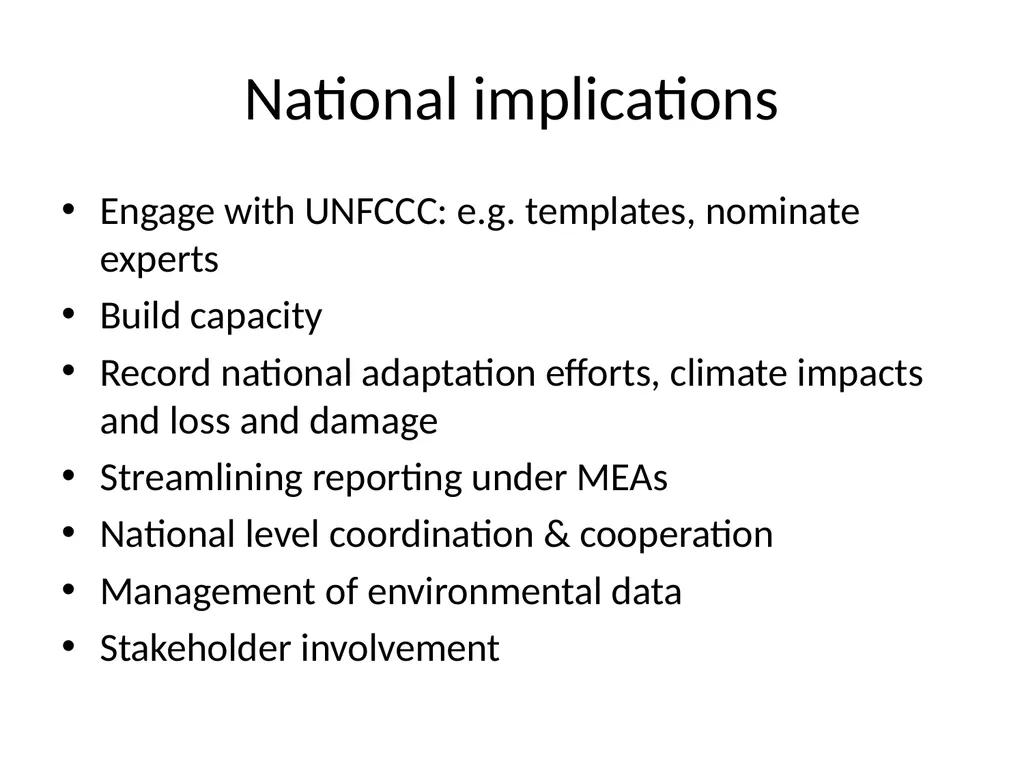
slide57. National implications Engage with UNFCCC: e.g. templates, nominate experts
Build capacity
Record national adaptation efforts, climate impacts and loss and damage
Streamlining reporting under MEAs
National level coordination & cooperation
Management of environmental data
Stakeholder involvement<br>
slide58. Reporting and compliance framework<br>
slide59. Global stocktake (Art.14) “The Conference of the Parties serving as the meeting of the Parties to this Agreement shall periodically take stock of the implementation of this Agreement to assess the collective progress towards achieving the purpose of this Agreement and its long-term goals (referred to as the “global stocktake”). It shall do so in a comprehensive and facilitative manner, considering mitigation, adaptation and the means of implementation and support, and in the light of equity and the best available science.”<br>
slide60. Global stocktake (Art.14) Every 5 years starting from 2023 (Art.14.2)
Outcome to inform parties’ NDCs (Art.14.3)
Development of further modalities (1/CP21, para.101)<br>
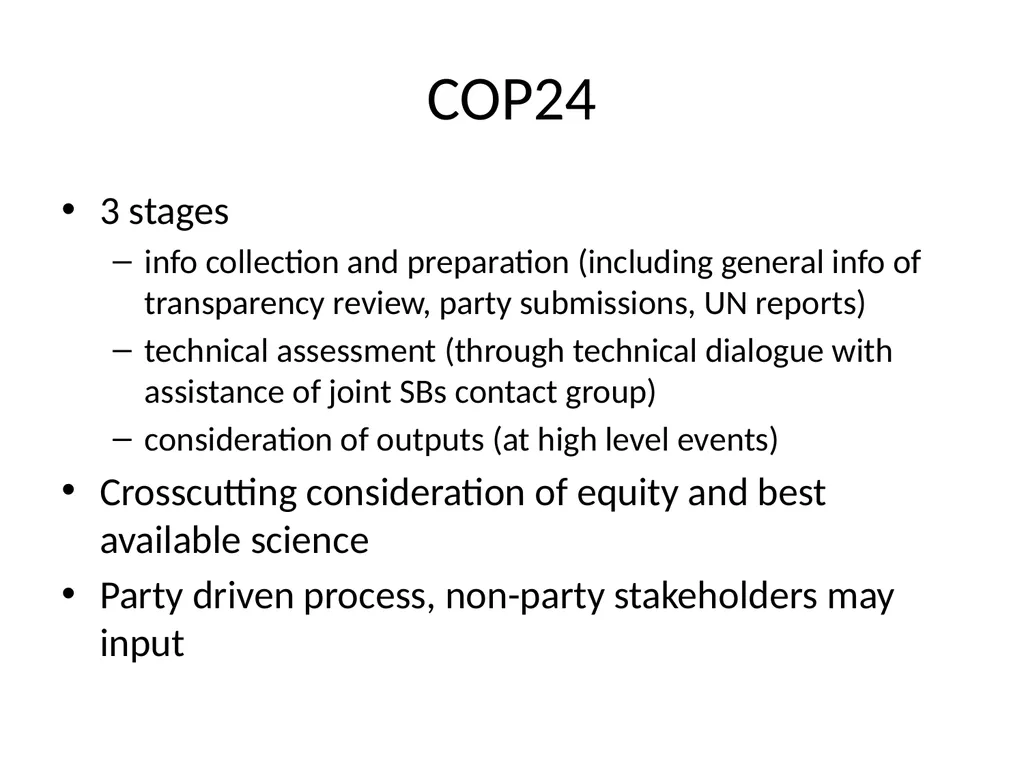
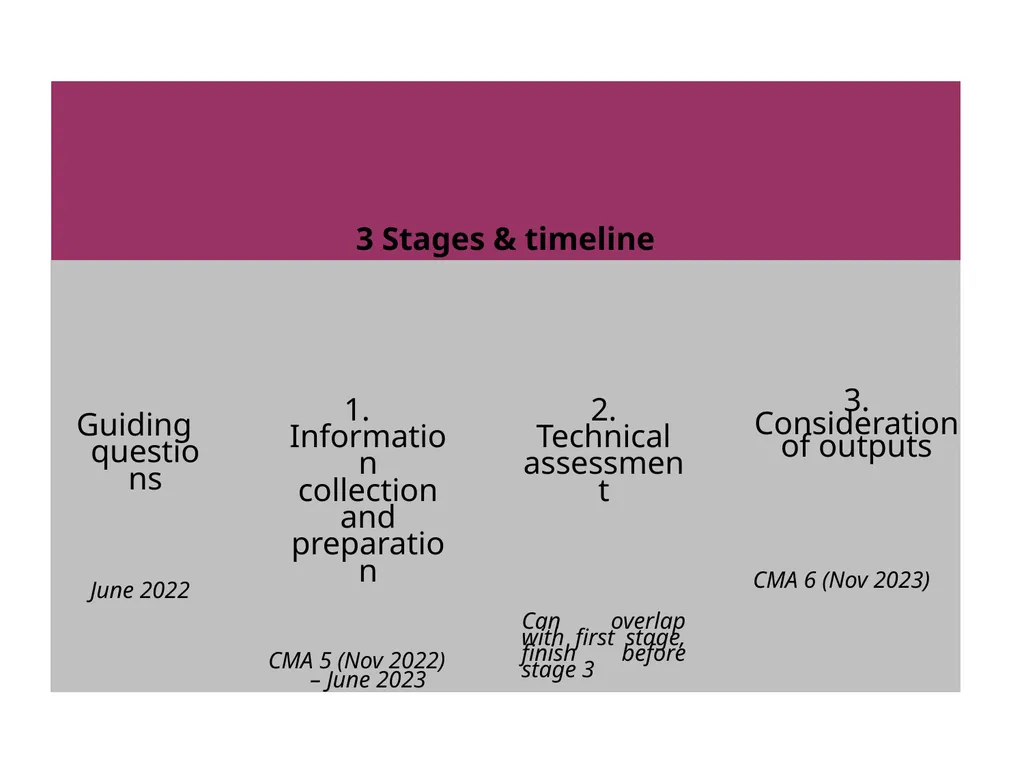
slide61. COP24 3 stages
info collection and preparation (including general info of transparency review, party submissions, UN reports)
technical assessment (through technical dialogue with assistance of joint SBs contact group)
consideration of outputs (at high level events)
Crosscutting consideration of equity and best available science
Party driven process, non-party stakeholders may input<br>
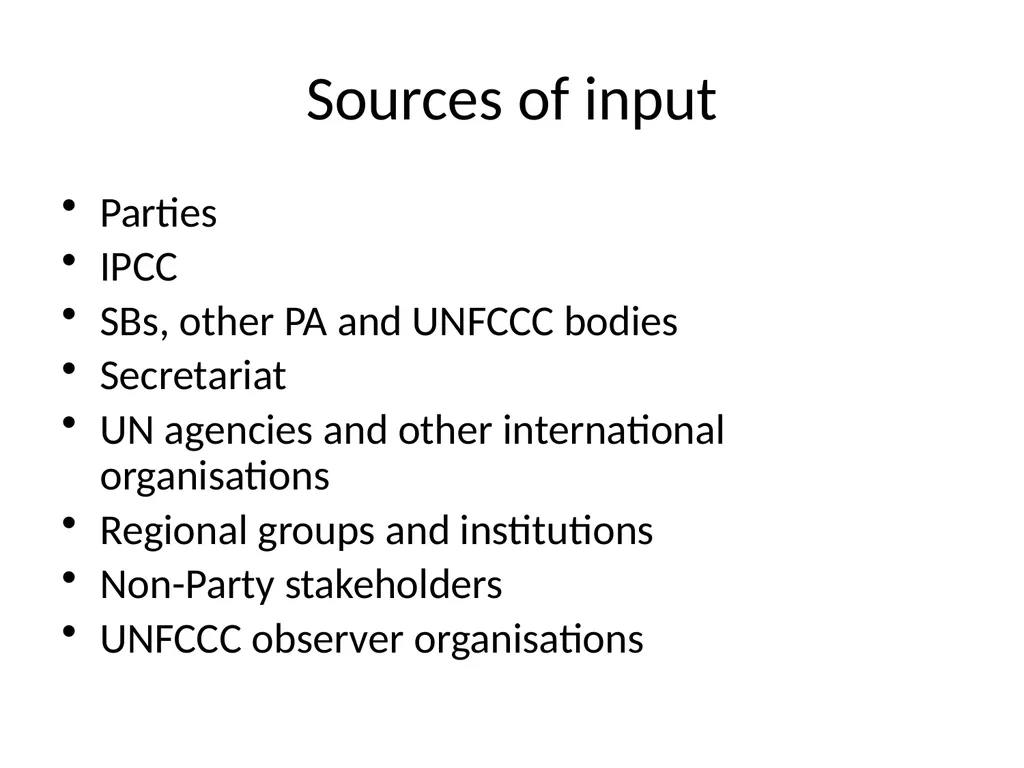
slide63. Sources of input Parties
IPCC
SBs, other PA and UNFCCC bodies
Secretariat
UN agencies and other international organisations
Regional groups and institutions
Non-Party stakeholders
UNFCCC observer organisations<br>
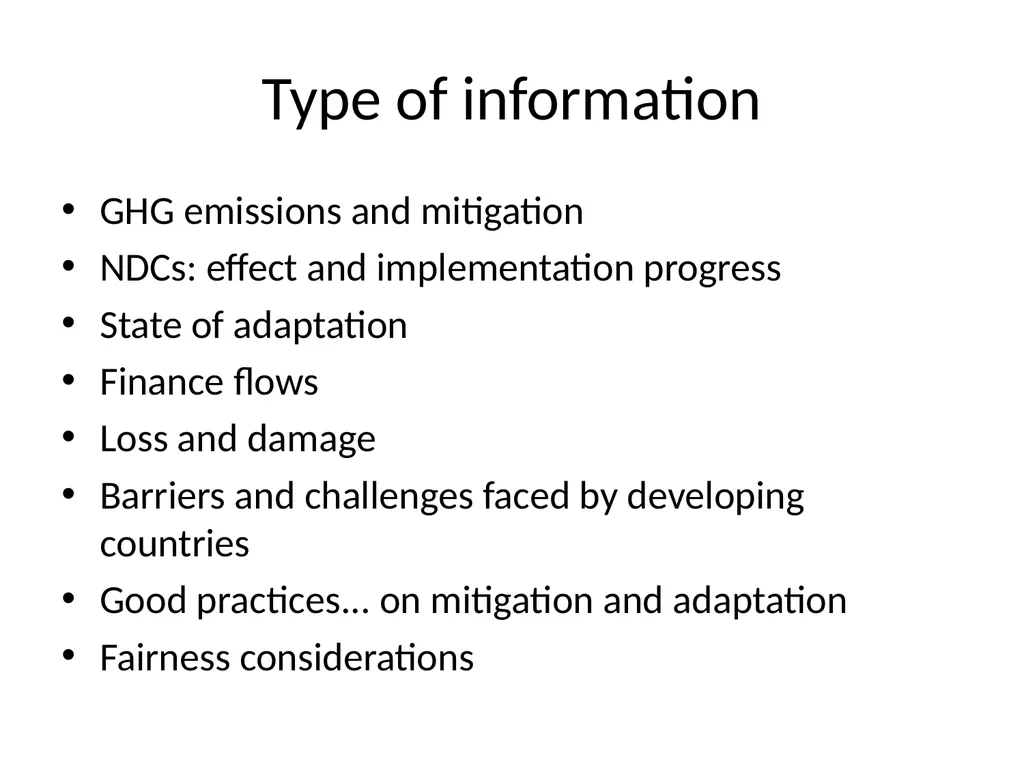
slide64. Type of information GHG emissions and mitigation
NDCs: effect and implementation progress
State of adaptation
Finance flows
Loss and damage
Barriers and challenges faced by developing countries
Good practices... on mitigation and adaptation
Fairness considerations<br>
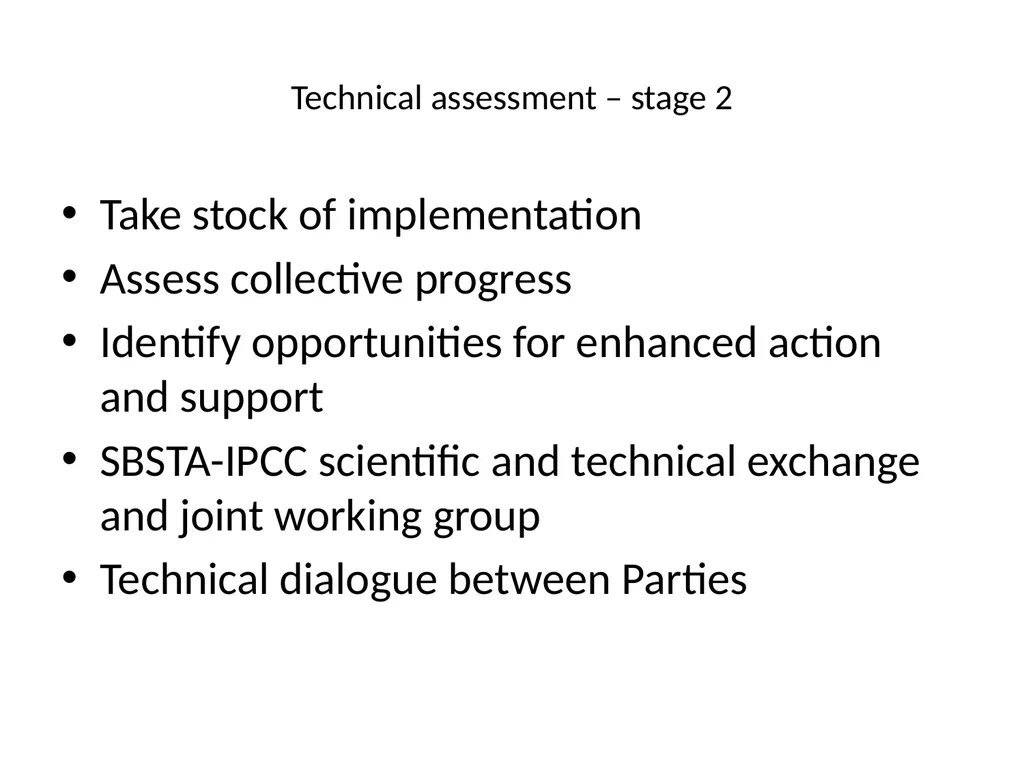
slide65. Technical assessment – stage 2 Take stock of implementation
Assess collective progress
Identify opportunities for enhanced action and support
SBSTA-IPCC scientific and technical exchange and joint working group
Technical dialogue between Parties<br>
slide66. Consideration of output - stage 3 Findings of TA presented and implications discussed by Parties at high-level events
Outputs should:
identify opportunities and challenges
Summarize key political messages
Be referenced in a CMA decision and/or declaration<br>
slide67. Limitations Have no individual Party focus
Include non-policy prescriptive consideration of collective progress
No guaranteed CMA decision
Reduced effectiveness given common time frames will only be applied from 2031<br>
slide68. Art.15 Mechanism to facilitate implementation and promote compliance established
Committee of 12 experts (Decision 1/CP.21, para.102)
Facilitative, transparent, non-adversarial and non-punitive
Not “address cases of non-compliance”
Modalities and procedures<br>
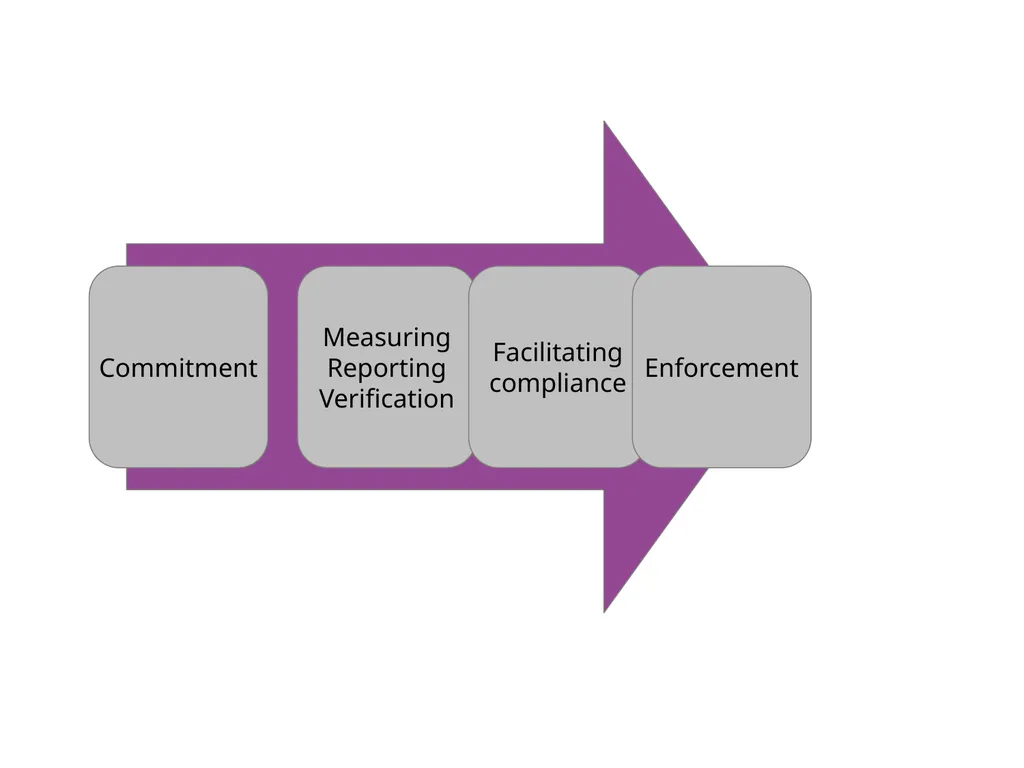
slide69. Commitment Measuring
Reporting
Verification Facilitating
compliance Enforcement<br>
slide70. COP24 Self referral
Committee can initiate consideration of a Party's compliance with the legally binding reporting requirements (“if” not “how”)
Committee may initiate consideration of significant and persistent inconsistencies with the Transparency Framework's MPGs with consent of party
Committee can bring systemic issues faced by a number of parties to the attention of the CMA – without singling out individual party
Committee to develop its rules of procedure
Modalities and procedures for Committee to be reviewed at CMA 7 in 2024<br>
slide71. Modalities & procedures Measures and outputs (IV. of the modalities):
Dialogue
Assistance to engage with finance, technology and capacity-building bodies
Findings of fact
Recommendations
Recommend and assist in developing an action plan
Special considerations:
national capabilities and circumstances
engage constructively and consult at all stages
special circumstances of SIDS and LDCs<br>
slide72. Institutional arrangements The Conference of the Parties serving as the Meeting of the Parties to the Paris Agreement (CMA) will be the main governing body
SBI and SBSTA will continue to serve the Paris Agreement and the CMA may establish additional subsidiary bodies
Secretariat
Compliance Committee, Capacity Building Committee, Adaptation Fund Board, Executive Committee WIM etc.<br>
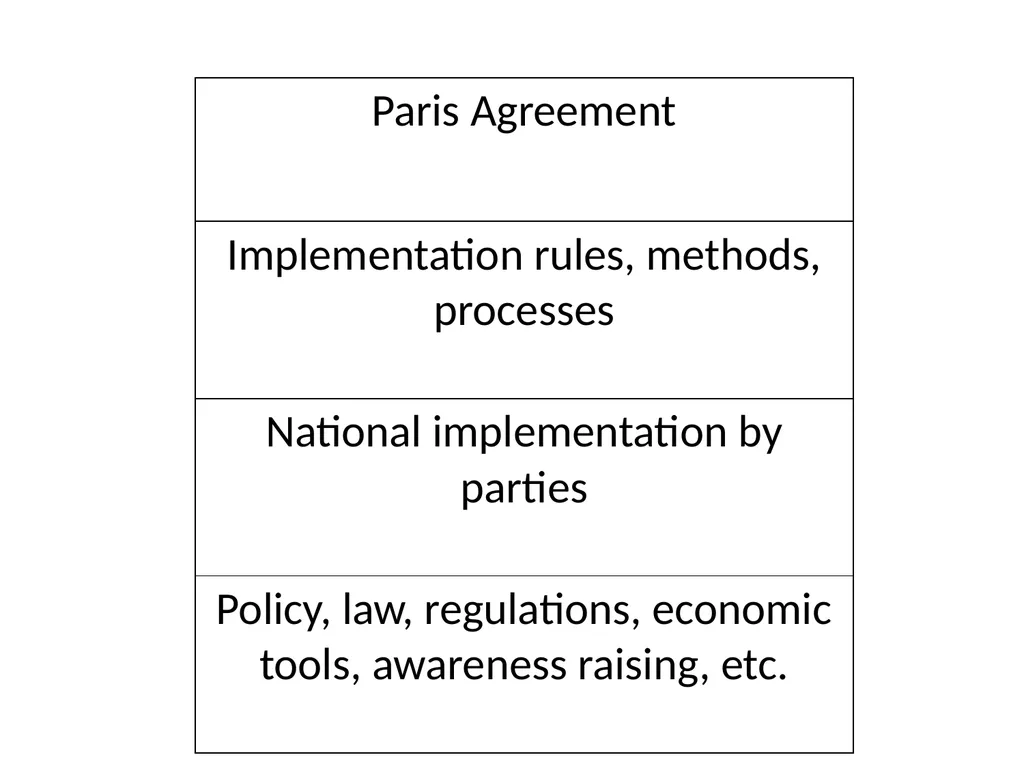
slide73. PA implementation Further rules at international level (e.g. features, timeframes, markets, capacity building, common tables)
Adjustment/communication of 1st NDC by 2020, then every 5 years
First transparency/inventory report by 31/12/2024 then every other year
Paris Agreement does not specify how parties are to implement their NDCs
Legislation, regulations, policy, policy instruments, economic tools (taxes), programmes, climate actions etc.<br>
slide2. Overview International climate governance
Paris Agreement and Rulebook in detail
- Mitigation & adaptation
- Means of implementation and support
- Reporting & compliance framework
Implications for domestic law and policy<br>
slide3. International fora UN GA & SC
International Maritime Organization (IMO) and International Civil Aviation Organization (ICAO)
Protection of the Ozone layer (Montreal Protocol), Trans-boundary Air Pollution
Law of the Sea, Biodiversity, UNESCO, FAO, WTO
UNFCCC<br>
slide4. UNFCCC history 1988 IPCC established
1992 UNFCCC adopted (entry into force 1994)
1998 Kyoto Protocol adopted (entry into force 2005)
Shift towards global responsibility for GHG emissions, adaptation and loss and damage
2009 Copenhagen Accord
2011 ADP (Durban Platform for enhanced Action)
2012 Doha amendments to the Kyoto Protocol
2015 Paris Agreement (2016), APA
2018 Paris Agreement Rulebook<br>
slide5. UNFCCC Ultimate Objective: To stabilise greenhouse gas concentrations in the atmosphere at a level that would prevent dangerous anthropogenic interference with the climate system.
Guiding Principles:
Equity
Common but differentiated responsibilities and respective capabilities (CBDR-RC)
Specific needs and special circumstances of developing country Parties
Precautionary Principle
Sustainable Development
Principle of Cooperation Key commitments (based on the CBDR and RC)
All Parties:
Publish national inventories of greenhouse gas emissions
Developed Country Parties:
Adopt national mitigation policies
Provide new and additional financial resources for developing countries
Assist developing country Parties particularly vulnerable to climate change in meeting the costs of adaptation
Take all practicable steps to promote, facilitate and finance the transfer of technology
Take full account of the specific needs and special situations of the LDCs<br>
slide6. Kyoto Protocol Article 2 - Mitigation policies and measures
Article 3 – Legally binding targets for emissions of six GHG and timetable
Articles 6, 12 and 17 – New market-based mechanisms creating a new commodity: carbon
Articles 5, 7, 8,18 - Reporting and compliance
Article 11 - Financing for developing countries<br>
slide8. Paris Agreement Adopted in 2015
Entry into force: 2016
International (formally binding) treaty building on Copenhagen Accord
Framework agreement
PA work program to develop rules for implementation<br>
slide9. Key elements 1.5/2 degree goal
“Bottom up” & voluntary
NDCs
Covers all “elements” but mitigation focused
Dynamic process for reviewing and increasing ambition of Parties’ contributions
Enhanced Transparency Framework
Global Stocktake
Facilitating compliance<br>
slide10. PA vs. UNFCCC Equity and CBDRRC: capacity and national circumstances > historic responsibility
Upfront finance as a result of historic responsibilities (-)
Specific needs, special circumstances and vulnerability of developing country parties: all parties (mitigation/adaptation) but within vulnerability (+)
Precautionary principle: Art.2 (+), adaptation (+)
Sustainable Development: no bunker fuels, intellectual property rights (-)
Principle of Cooperation – e.g. address gaps in law (?)<br>
slide12. COP24 Katowice I “Rulebook”, “work program”, “implementation rules”
NDC guidance and accounting – not common time frames
Program and functioning of Forum on the Impact of the Implementation of Response Measures
Not Art.6 cooperative approaches/markets<br>
slide13. COP24 Katowice II Adaptation communication, increased visibility of adaptation efforts (recognition?)
Loss and damage
Monitoring of finance flows, adaptation fund & discussions on new finance goal start 2020
Technology framework (Art.10.4)
Not capacity building<br>
slide14. COP24 Katowice III Common set of rules with flexibility to report under the enhanced transparency framework
Input and outcomes of the Global stocktake (Art.14)
Modalities and procedures for involvement of the Committee to facilitate implementation and promote compliance<br>
slide15. IPCC special report on 1.5 degrees World temperature has already risen by over 1C since pre-industrial times due to human activity
Current emission reduction pledges under Paris Agreement will not limit global warming to 1.5C
On current trends it is likely to pass 1.5C mark between 2030 and 2052
Countries will need to increase ambition significantly before 2030 to limit temperature rise to 1.5C<br>
slide18. General part Preamble: sustainable development, food production, quality jobs, human rights, Mother Earth, “climate justice”, public participation etc.
Global goals: to keep global temperatures to “well below 2 °C above pre-industrial levels and pursue efforts to limit the temperature increase to 1.5 °C” (Art.2)
Guiding principles: equity and CBDRRC in the light of different national circumstances (Art.2)
Nationally determined contributions (NDCs) in general (Art.3) = main vehicle for climate action<br>
slide19. Mitigation and adaptation<br>
slide20. Mitigation (Art.4) Parties shall submit increasingly ambitious NDCs every 5 years and “pursue” domestic mitigation measures, with the aim of achieving the objectives of such contributions (Art.4.2).
Developed countries should continue taking the lead through economy-wide absolute emission reduction targets (Art.4.4)
Support for developing country Parties (Art.4.5) but not a precondition of action<br>
slide21. Mitigation (Art.4) Parties may act jointly (Art.4.16)
All Parties are encouraged to formulate long term low GHG emission development strategies (Art.4.19)
Parties shall provide national inventory reports and information to track progress (Art.13.7)<br>
slide22. Mitigation (Arts.5 & 6) Gas sinks/reservoirs and REDD+ (Art.5)
Conserve and enhance emission sinks and reservoirs
Reduce emissions from deforestation and forest degradation in developing countries through existing REDD+ framework
Voluntary cooperation (Art.6)
Cooperative approaches to transfer mitigation outcomes
Mechanism to mitigate GHG emissions and support sustainable development (CDM+)
Framework for non-market approaches to sustainable development<br>
slide23. COP24 - Rulebook further guidance on the features of NDCs; (-)
information to facilitate clarity, transparency and understanding (ICTU) of NDCs; √√
accounting for NDCs; √
modalities and procedures for the operation and use of a public registry for NDCs; √√
common time frames for NDCs; (-)
the modalities, work programme and functions of the forum on the impact of the implementation of response measures; √√
matters relating to Art.6 of the Paris Agreement (-)<br>
slide24. Art.6 – pending issues Transfer of ITMOs in respect of sectors and greenhouse gasses that are not covered by its NDC
Use of ITMOs can be used for other purposes than towards an NDC or the required
Scope and form of the “corresponding adjustments” to its NDC
Transition of projects and credits from the Kyoto Protocol to the new system
Eligible activities (e.g. action on forests)
Allocation of tasks (e.g. accrediting entities or approving the issuance of credits) between the supervisory body and host parties
Percentage and form of proceeds for adaptation and whether such a levy should be extended to transactions under Art.6 para.2
Including human rights considerations in the reading of “sustainable development” under Art.6, para.4 (a)
“Deliver an overall mitigation in global emissions” in para.4 (d) = cancellation of some credits (because offsetting does not lead to further overall mitigation)?<br>
slide25. National commitments 2nd round of NDCs - based on IPCC guidance
ICTU: All categories of anthropogenic emissions or removals in their NDCs (energy, gas, transport)
Mitigation co-benefits of adaption action and/or other economic diversification plans (agriculture, waste management)
Accounting: source/sink/activity continuously included in future NDCs
Natural disturbances on managed land, harvesting of wood products or the age-class structure in forests<br>
slide26. Law and policy implications? Regulations in emission areas and data collection
Long-term low emission strategy
Forest protection, water management (carbon sinks)
Markets and carbon trading mechanisms, carbon levies or trade measures
GHG inventory biennial reporting (Art.13.7)<br>
slide27. Carbon markets Experience in industrialized countries
Adjust existing models to the national circumstances
To link to Art.6 markets reflect: integrity, transparency, permanence, robust accounting rules etc.
E.g. set a regulatory ceiling on greenhouse gas emissions (in line with the NDC) and issue just enough permits within the sectors covered to meet the target
Build wider enabling environment (collect and monitor data and incentivize investment)
Secure business environment, clear regulatory frameworks, good governance, access to justice etc.<br>
slide28. Adaptation (Art.7) Global goal to enhance adaptive capacity, strengthen resilience and reduce vulnerability (7.1)
Adaptation efforts of developing countries to be recognized (Art.7.3)
Mitigation reduces adaptation efforts (7.4)
Adaptation action to be gender responsive, participatory and transparent (Art.7.5)
Shall, as appropriate, engage in adaptation planning processes and the implementation of actions (7.9)
Should, as appropriate, submit and periodically update an adaptation communication on needs, plans and actions (7.10) as part of e.g. NAPs, NDCs or national communications (7.11)
Adaptation communications will be housed in a public registry (7.12)<br>
slide29. COP24 Modalities for the adaptation communications public registry: 2 parts
Recognizing adaption efforts by developing countries (Art.7.3) with modalities to be developed by Adaptation Committee and LDC Expert Group for adoption at CMA 1 (1/CP.21 para.41) = Operational arrangements enhancing collaboration and profile of adaptation?
Further guidance in relation to the (voluntary) adaptation communication, including, as a (possible) component of NDCs<br>
slide30. Adaptation Communication National circumstances
Institutional arrangements
Impacts, risk and vulnerabilities
National adaptation priorities, strategies, policies, plans etc. and their implementation, monitoring and evaluation
Implementation and support needs
Gender responsiveness and use of traditional knowledge<br>
slide31. Law and policy implications? System to document and report climate impacts and adaptation action
Planning, emergency preparedness, disaster risk reduction etc.
Adaptation action should follow a gender responsive, participatory and fully transparent approach taking into account vulnerable groups, communities and ecosystems (Art.7.5)
Define needs and plans including financial implications (Art.7.10-12, 13.8)<br>
slide32. Loss & damage<br>
slide33. 1°C 2°C 5°C 4°C 3°C Sea level rise threatens major cities Falling crop yields in many areas, particularly developing regions Food Water Ecosystems Risk of Abrupt and Major Irreversible Changes Global temperature change (relative to pre-industrial) 0°C Falling yields in many developed regions Rising number of species face extinction Increasing risk of dangerous feedbacks and abrupt, large-scale shifts in the climate system Significant decreases in water availability in many areas, including Mediterranean and Southern Africa Small mountain glaciers disappear – water supplies threatened in several areas Extensive Damage to Coral Reefs Extreme Weather Events Rising intensity of storms, forest fires, droughts, flooding and heat waves Possible rising yields in some high latitude regions<br>
slide35. Loss & damage (Art.8) Further steps to be taken to address loss and damage due to climate impacts (Art.8)
Warsaw International Mechanism on loss and damage
Disaster response, risk assessment and management, insurance
Task force on displacement related to the adverse impacts of climate change (para.49, Decision 1/CP.21)
“Agrees that Article 8 does not involve or provide a basis for any liability or compensation” (para.51, Decision 1/CP.21)
Rulebook: Reference to L&D in Transparency and Global Stocktake guidelines<br>
slide36. Compensation & liability? Future work of WIM under PA? COP decision does not exclude application of general rules of public international law
Principle of prevention/no harm: “The existence of the general obligation of states to ensure that activities within their jurisdiction and control respect the environment of other states or of areas beyond national control is now part of the corpus of international law relating to the environment.” (ICJ, 1996)
UNFCCC and PA = lex specialis? International Law Commission’s (ILC) Draft Articles on the Responsibility of States for Internationally Wrongful Acts with Commentary, Art.55
Rules of transboundary pollution apply to climate change? ILA draft principles related to climate change<br>
slide37. Palau initiative “Do states have a legal responsibility to ensure that any activities on their territory that emit greenhouse gases do not harm other states?”<br>
slide38. Means of implementation and support<br>
slide39. Finance (Art.9) Developed countries shall provide financial resources in continuation of existing obligations (Art.9.1) from a wide variety of sources and through a variety of actions (9.3)
No burden sharing agreement or other binding arrangements
Biennially communicate indicative quantitative and qualitative information (9.5) and further information on the support actually provided and mobilized (9.7)
Developed countries intend to continue their collective mobilization goal through 2025 (USD 100 billion/year from 2020); CMA will set a new collective quantified goal before 2025 (1/CP.21 para.53)<br>
slide40. COP24 Clarifies information to be provided ex ante (indicative provision and mobilization) and ex post (finance provided)
dedicated online portal
why new, barriers etc.
ex post integrated in Art.13 decision
Adaptation Fund
Discussions on new collective quantified finance goal to start in 2020<br>
slide41. Sources of climate finance National budget allocations
Fees and charges
International public climate finance (grants, loans or contributions to the GCF or Adaptation Fund as well as dedicated financial resources by multilateral development banks)
International private finance (loans with an end-use restriction, green or climate change bonds, market mechanisms envisaged under Art.6 PA)<br>
slide42. Domestic law and policy Assessing costs of proposed climate change response actions in the short and medium term – and resources available;
Potential entry points for relevant finance institutions;
Mobilizing climate finance via
“financial mechanisms” such as loans, guarantees and insurance, green investment banks, climate trust funds, clean development mechanisms, carbon pricing, green bonds etc.
“facilitative modalities” are non-financial initiatives to help indirectly mobilize private finance by enhancing capacity building, knowledge transfer, governance structures, prudential regulation, corporate reporting, etc.
National efforts/mechanism to bundle and/or blend different climate finance resources<br>
slide43. Technology (Art.10) Enabling innovation via collaboration and facilitating access (para.4)
Technology framework to guide existing mechanism: Technology Executive Committee (policy) & Climate Technology Centre and Network (implementation)
CTCN: Advisory board, national designated entities, UNEP/UNIDO and network of organizations
Technology solutions, capacity building and advice on policy, legal and regulatory frameworks to promote transfer
Support for developed country parties (Art.10.5 & 6) and report on support received (Art.13.10)
Modalities for the periodic assessment of the effectiveness and adequacy of the support provided to the mechanism (2021-22)
Key themes: innovation, implementation, capacity building etc.<br>
slide44. National implications System to identify and communicate technology needs and priorities (Technical Needs Assessment Process)
National coordination and stakeholder consultations
Define support needed by developing country parties (Art.10.6) and report on support received (Art.13.10)<br>
slide45. Capacity building (Art.11) Enhance capacity of developing countries to take effective action on mitigation, adaptation, technology development, access to finance, education and reporting
Paris Committee on Capacity Building (PCCB)
Initial institutional arrangements to be adopted @ CMA 1 (Art.11.5)
Capacity building reflected in other COP24 decisions<br>
slide46. Education & awareness raising (Art.12) Enhance climate change education, public awareness, public participation and public access to information
Art.6 UNFCCC<br>
slide47. Reporting and compliance Art.13 Enhanced transparency framework for action and support
Art.14 Global stock-take
Art.15 Mechanism to facilitate implementation and promote compliance<br>
slide48. Reporting and compliance “Central to agreement”
International “top down” element to “bottom up” approach
Multilateral environment agreement (MEA)
Measurement, reporting and verification (MRV)
(Common) Modalities, procedures, and guidelines (MPGs)<br>
slide49. Why? Demonstrating efforts, needs, compliance and implementation
Assessing effectiveness of actions, learning and good practice
Scrutiny and accountability
Understanding status and trends
Future planning and decision-making
Mobilizing support and increasing ambition<br>
slide50. What? Reporting action and support:
Mitigation and adaption efforts
Means of implementation and support
- Finance
- Technology transfer and development
- Capacity building<br>
slide51. Transparency Framework (Art.13) Build on (para.3) and eventually supersede (1/CP.21 para.98) existing arrangements (para.3)
Flexibility (para.1) for those that need it (para.2)
Facilitative, non-intrusive, non-punitive (para.3)
Clarity on mitigation and adaptation actions (para.5)
Transparency of support provided & received (para.6)
Inform Global Stocktake (paras.5&6)
GHG inventory and info to track progress on implementing and achieving mitigation NDC (para.7)
As appropriate info on adaptation & impacts (para.8)
Developed countries shall, others should, provide info on support (para.9)
Developing countries needed & received (para.10)<br>
slide52. Art.13 cont. Submission of information at least on biennial bases (1/CP.21 para.90)
LDCs and SIDS at their discretion
Technical expert review, plus multilateral consideration of progress (para.11)
Support for implementing Art.13 and building capacity (para.14&15)
Initiative to strengthen institutional and technical capacity for meeting requirements (decision 1/CP.21 paras.84 & 85)
Common modalities, procedures and guidelines (para.13 and 1/CP.21 paras.91-95) to be developed by APA<br>
slide53. COP24 Set of common MPGs with flexibility for developing countries
Requirements on action are common, on support differentiated
1st biennial transparency and national inventory report due by 31 December 2024 (decision 18/CMA.1 para.3)
LDCs & SIDS at discretion (para.4)
Nomination of experts (para.5)
Secretariat to publish and synthesize (para.6)
GEF to support developing countries (paras.8-11)
SBSTA to develop common reporting tables and formats (para.12)
MPGs to be reviewed and updated by 2028<br>
slide54. MPGs Annex to decision 18/CMA.1:
National inventory reports: methods, metrics, sector, gases, governance arrangements etc.
Information necessary to track progress: explain methods used for targets, approaches, indicators, sources/sinks; info on actions, policies and projections
Adaptation priorities, barriers, actions, monitoring and to address loss and damage
Means of implementation provided (V.), needed and received (VI.)
Technical expert teams (centralized, in-country, desk or simplified) review info submitted, raise questions, make recommendations and issue report
Multilateral, facilitative consideration of progress re NDC & Art.9 (VIII.) based on BTRs, expert review & additional info: written questions and working group session<br>
slide57. National implications Engage with UNFCCC: e.g. templates, nominate experts
Build capacity
Record national adaptation efforts, climate impacts and loss and damage
Streamlining reporting under MEAs
National level coordination & cooperation
Management of environmental data
Stakeholder involvement<br>
slide58. Reporting and compliance framework<br>
slide59. Global stocktake (Art.14) “The Conference of the Parties serving as the meeting of the Parties to this Agreement shall periodically take stock of the implementation of this Agreement to assess the collective progress towards achieving the purpose of this Agreement and its long-term goals (referred to as the “global stocktake”). It shall do so in a comprehensive and facilitative manner, considering mitigation, adaptation and the means of implementation and support, and in the light of equity and the best available science.”<br>
slide60. Global stocktake (Art.14) Every 5 years starting from 2023 (Art.14.2)
Outcome to inform parties’ NDCs (Art.14.3)
Development of further modalities (1/CP21, para.101)<br>
slide61. COP24 3 stages
info collection and preparation (including general info of transparency review, party submissions, UN reports)
technical assessment (through technical dialogue with assistance of joint SBs contact group)
consideration of outputs (at high level events)
Crosscutting consideration of equity and best available science
Party driven process, non-party stakeholders may input<br>
slide63. Sources of input Parties
IPCC
SBs, other PA and UNFCCC bodies
Secretariat
UN agencies and other international organisations
Regional groups and institutions
Non-Party stakeholders
UNFCCC observer organisations<br>
slide64. Type of information GHG emissions and mitigation
NDCs: effect and implementation progress
State of adaptation
Finance flows
Loss and damage
Barriers and challenges faced by developing countries
Good practices... on mitigation and adaptation
Fairness considerations<br>
slide65. Technical assessment – stage 2 Take stock of implementation
Assess collective progress
Identify opportunities for enhanced action and support
SBSTA-IPCC scientific and technical exchange and joint working group
Technical dialogue between Parties<br>
slide66. Consideration of output - stage 3 Findings of TA presented and implications discussed by Parties at high-level events
Outputs should:
identify opportunities and challenges
Summarize key political messages
Be referenced in a CMA decision and/or declaration<br>
slide67. Limitations Have no individual Party focus
Include non-policy prescriptive consideration of collective progress
No guaranteed CMA decision
Reduced effectiveness given common time frames will only be applied from 2031<br>
slide68. Art.15 Mechanism to facilitate implementation and promote compliance established
Committee of 12 experts (Decision 1/CP.21, para.102)
Facilitative, transparent, non-adversarial and non-punitive
Not “address cases of non-compliance”
Modalities and procedures<br>
slide69. Commitment Measuring
Reporting
Verification Facilitating
compliance Enforcement<br>
slide70. COP24 Self referral
Committee can initiate consideration of a Party's compliance with the legally binding reporting requirements (“if” not “how”)
Committee may initiate consideration of significant and persistent inconsistencies with the Transparency Framework's MPGs with consent of party
Committee can bring systemic issues faced by a number of parties to the attention of the CMA – without singling out individual party
Committee to develop its rules of procedure
Modalities and procedures for Committee to be reviewed at CMA 7 in 2024<br>
slide71. Modalities & procedures Measures and outputs (IV. of the modalities):
Dialogue
Assistance to engage with finance, technology and capacity-building bodies
Findings of fact
Recommendations
Recommend and assist in developing an action plan
Special considerations:
national capabilities and circumstances
engage constructively and consult at all stages
special circumstances of SIDS and LDCs<br>
slide72. Institutional arrangements The Conference of the Parties serving as the Meeting of the Parties to the Paris Agreement (CMA) will be the main governing body
SBI and SBSTA will continue to serve the Paris Agreement and the CMA may establish additional subsidiary bodies
Secretariat
Compliance Committee, Capacity Building Committee, Adaptation Fund Board, Executive Committee WIM etc.<br>
slide73. PA implementation Further rules at international level (e.g. features, timeframes, markets, capacity building, common tables)
Adjustment/communication of 1st NDC by 2020, then every 5 years
First transparency/inventory report by 31/12/2024 then every other year
Paris Agreement does not specify how parties are to implement their NDCs
Legislation, regulations, policy, policy instruments, economic tools (taxes), programmes, climate actions etc.<br>