
PART 3: STRATEGIC ACTIONS: STRATEGY IMPLEMENTATION
SB
Published · 64 slides · 0 views
1 / 1




Description
PART 3: STRATEGIC ACTIONS: STRATEGY IMPLEMENTATION CHAPTER 10 CORPORATE GOVERNANCE THE STRATEGIC MANAGEMENT PROCESS KNOWLEDGE OBJECTIVES KNOWLEDGE OBJECTIVES CORPORATE GOVERANCE: WHAT IS ALL THE FUSS ABOUT? Corporate governance can
Related Topics
Share
Embed code
Download this presentation From Below
"PART 3: STRATEGIC ACTIONS: STRATEGY IMPLEMENTATION" is the property of its rightful owner. Permission is granted to download and print the materials on this website for personal, non-commercial use only, and to display it on your personal computer provided you do not modify the materials and that you retain all copyright notices contained in the materials. By downloading content from our website, you accept the terms of this agreement.
Presentation Transcript
01
PART 3: STRATEGIC ACTIONS:
STRATEGY IMPLEMENTATION CHAPTER 10 CORPORATE GOVERNANCE<br>
STRATEGY IMPLEMENTATION CHAPTER 10 CORPORATE GOVERNANCE<br>
02
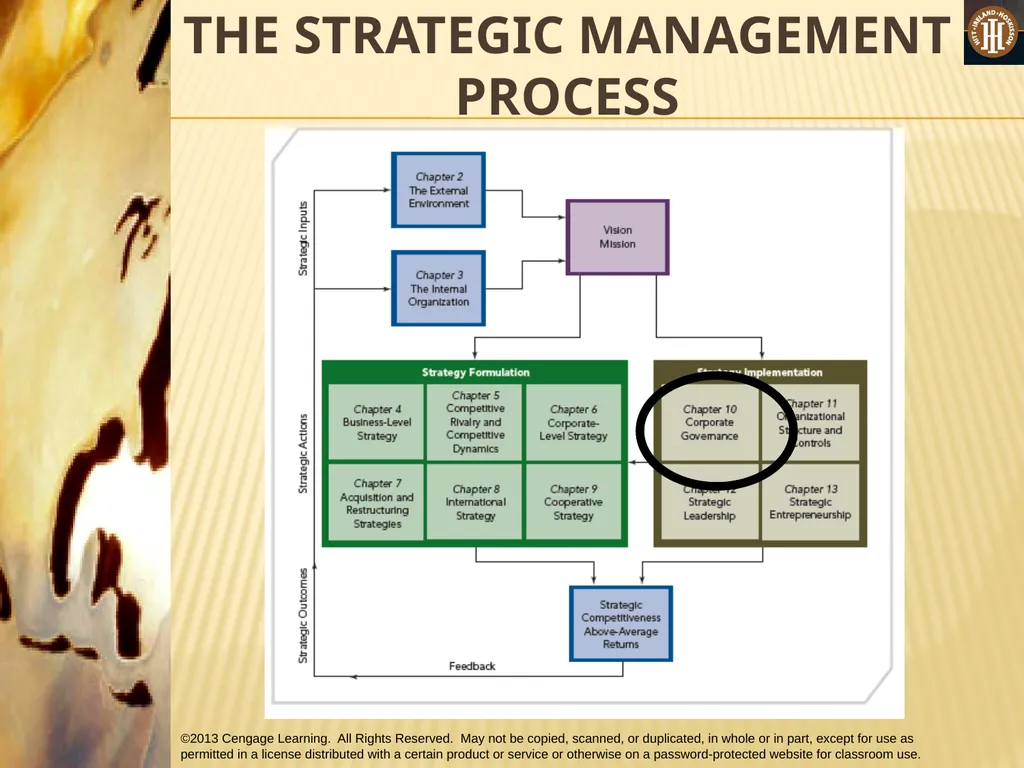
THE STRATEGIC MANAGEMENT PROCESS<br>
03
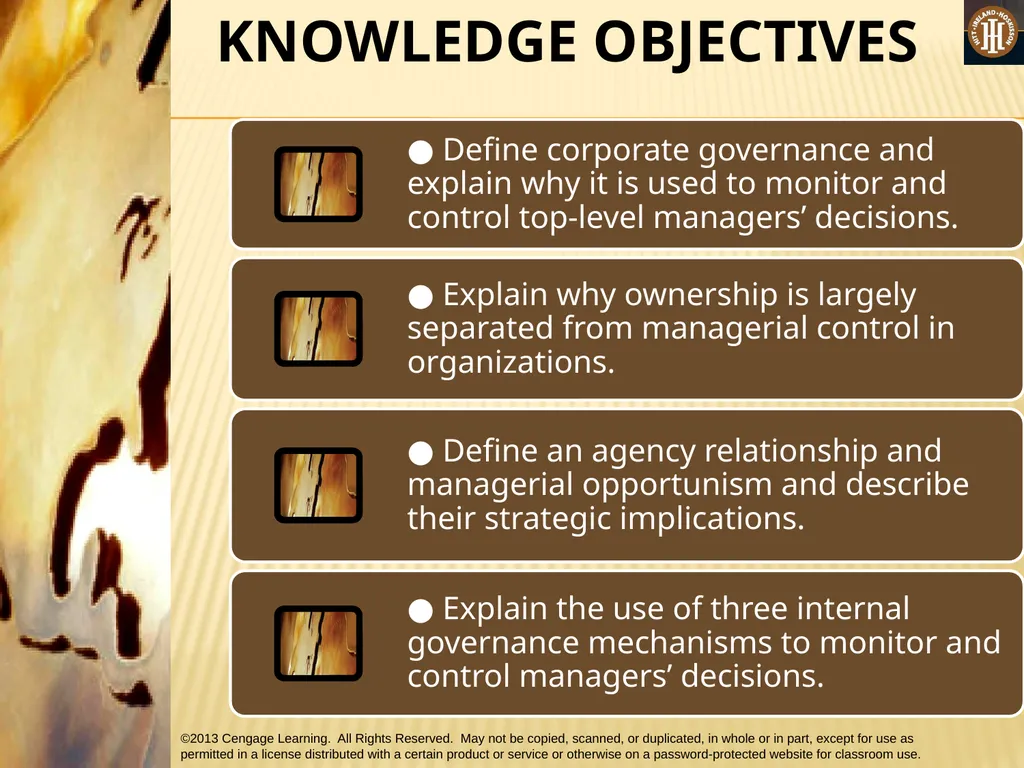
KNOWLEDGE OBJECTIVES<br>
04
KNOWLEDGE OBJECTIVES<br>
05
CORPORATE GOVERANCE: WHAT IS ALL THE FUSS ABOUT? ■ Corporate governance can destroy or create value for a firm.
■ It is concerned with:
1. strengthening the effectiveness of a company’s board of directors
2. verifying the transparency of a firm’s operations
3. enhancing accountability to shareholders
4. incentivizing executives
5. maximizing value-creation for stakeholders and shareholders OPENING CASE<br>
■ It is concerned with:
1. strengthening the effectiveness of a company’s board of directors
2. verifying the transparency of a firm’s operations
3. enhancing accountability to shareholders
4. incentivizing executives
5. maximizing value-creation for stakeholders and shareholders OPENING CASE<br>
06
CORPORATE GOVERANCE: WHAT IS ALL THE FUSS ABOUT? ■ Given recent criticisms, boards’ actions in nations throughout the world are being more carefully scrutinized and regulated.
■ In the U.S., that after being fired by their firm, a number of CEOs still remain as members of other firms’ boards of directors, is drawing close attention.
■ Corporate governance is weak in many Chinese firms and there is concern about the validity and reliability of some auditors’ work and the quality of companies’ financial statements. OPENING CASE<br>
■ In the U.S., that after being fired by their firm, a number of CEOs still remain as members of other firms’ boards of directors, is drawing close attention.
■ Corporate governance is weak in many Chinese firms and there is concern about the validity and reliability of some auditors’ work and the quality of companies’ financial statements. OPENING CASE<br>
07
CORPORATE GOVERANCE: WHAT IS ALL THE FUSS ABOUT? ■ The reason there is a “fuss” about corporate governance is that these activities are critical to globally signaling transparency coupled with strategic competitiveness.
■ Corporate governance fundamentals:
Corporate Directors should:
● Focus on creating long-term value for shareholders
● Use performance-related pay to attract and retain senior management
● Exercise sound business judgment to evaluate opportunities and manage risk
● Communicate with key shareholders OPENING CASE<br>
■ Corporate governance fundamentals:
Corporate Directors should:
● Focus on creating long-term value for shareholders
● Use performance-related pay to attract and retain senior management
● Exercise sound business judgment to evaluate opportunities and manage risk
● Communicate with key shareholders OPENING CASE<br>
08
CORPORATE GOVERNANCE Corporate governance: a set of mechanisms used to manage the relationships (and conflicting interests) among stakeholders, and to determine and control the strategic direction and performance of organizations (aligning strategic decisions with company values)
When CEOs are motivated to act in the best interests of the firm—particularly, the shareholders—the company’s value should increase.
Successfully dealing with this challenge is important, as evidence suggests that corporate governance is critical to firms’ success.<br>
When CEOs are motivated to act in the best interests of the firm—particularly, the shareholders—the company’s value should increase.
Successfully dealing with this challenge is important, as evidence suggests that corporate governance is critical to firms’ success.<br>
09
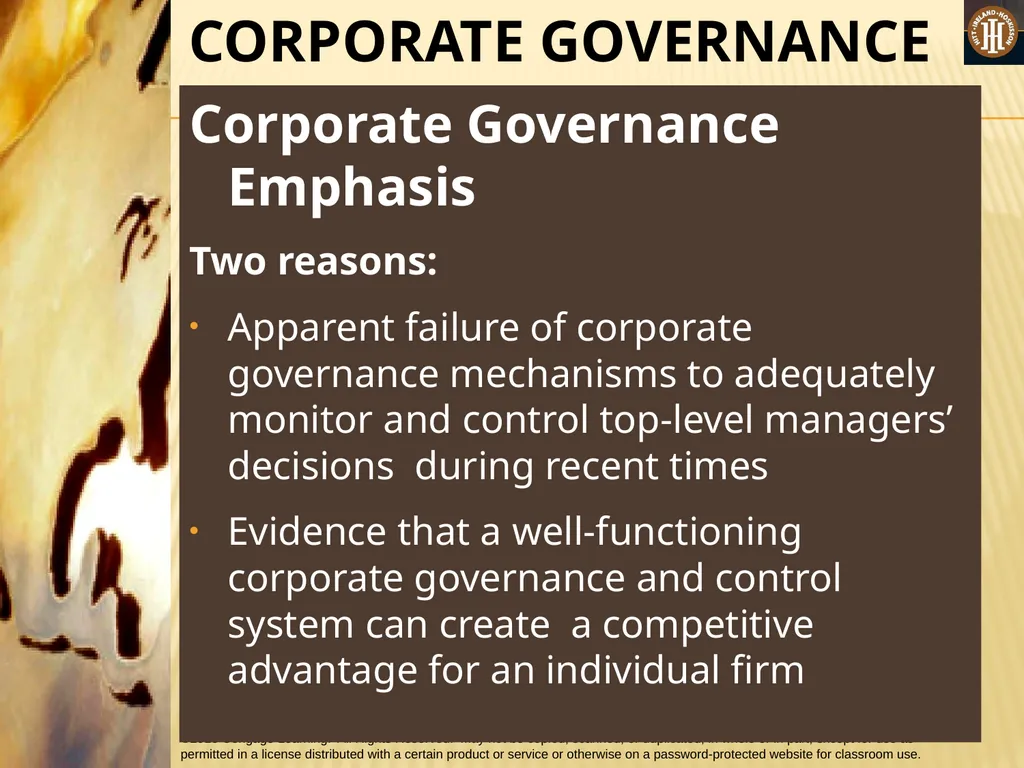
CORPORATE GOVERNANCE Corporate Governance Emphasis
Two reasons:
Apparent failure of corporate governance mechanisms to adequately monitor and control top-level managers’ decisions during recent times
Evidence that a well-functioning corporate governance and control system can create a competitive advantage for an individual firm<br>
Two reasons:
Apparent failure of corporate governance mechanisms to adequately monitor and control top-level managers’ decisions during recent times
Evidence that a well-functioning corporate governance and control system can create a competitive advantage for an individual firm<br>
10
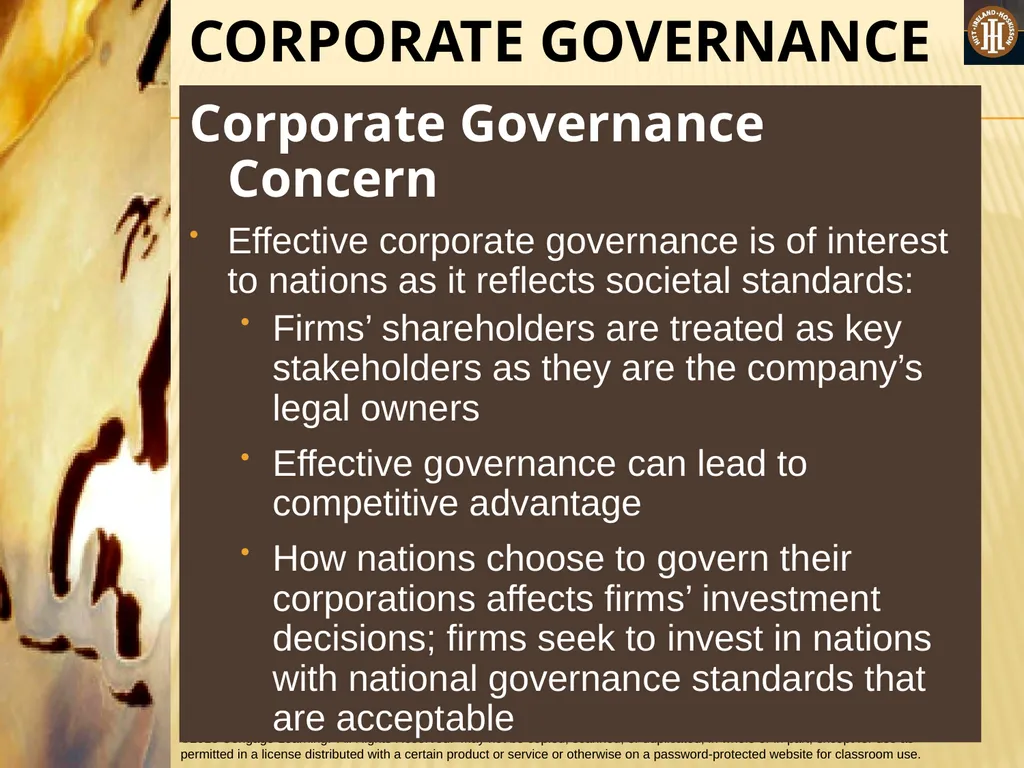
CORPORATE GOVERNANCE Corporate Governance Concern
Effective corporate governance is of interest to nations as it reflects societal standards:
Firms’ shareholders are treated as key stakeholders as they are the company’s legal owners
Effective governance can lead to competitive advantage
How nations choose to govern their corporations affects firms’ investment decisions; firms seek to invest in nations with national governance standards that are acceptable<br>
Effective corporate governance is of interest to nations as it reflects societal standards:
Firms’ shareholders are treated as key stakeholders as they are the company’s legal owners
Effective governance can lead to competitive advantage
How nations choose to govern their corporations affects firms’ investment decisions; firms seek to invest in nations with national governance standards that are acceptable<br>
11
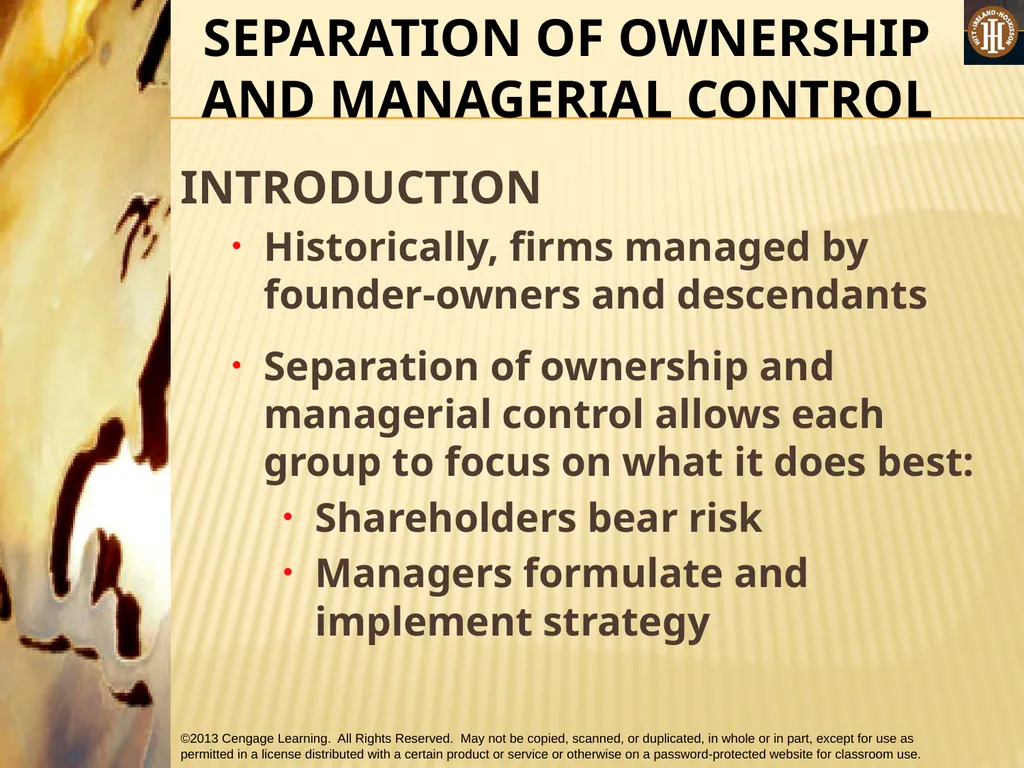
SEPARATION OF OWNERSHIP AND MANAGERIAL CONTROL INTRODUCTION
Historically, firms managed by founder-owners and descendants
Separation of ownership and managerial control allows each group to focus on what it does best:
Shareholders bear risk
Managers formulate and implement strategy<br>
Historically, firms managed by founder-owners and descendants
Separation of ownership and managerial control allows each group to focus on what it does best:
Shareholders bear risk
Managers formulate and implement strategy<br>
12
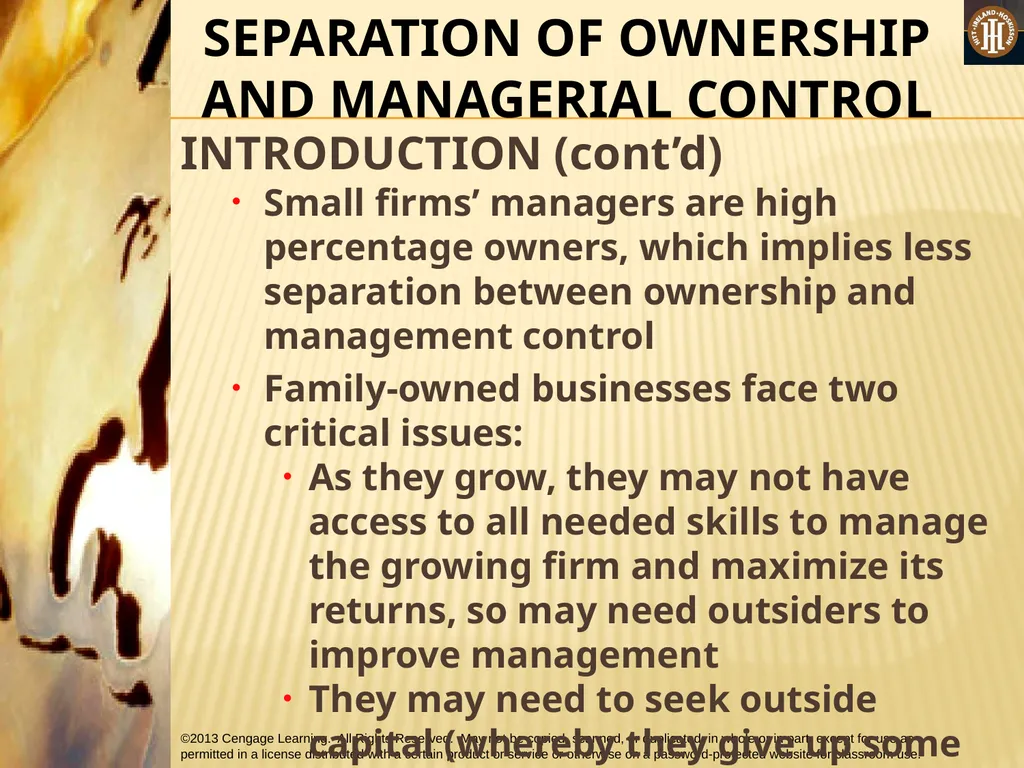
SEPARATION OF OWNERSHIP AND MANAGERIAL CONTROL INTRODUCTION (cont’d)
Small firms’ managers are high percentage owners, which implies less separation between ownership and management control
Family-owned businesses face two critical issues:
As they grow, they may not have access to all needed skills to manage the growing firm and maximize its returns, so may need outsiders to improve management
They may need to seek outside capital (whereby they give up some ownership control)<br>
Small firms’ managers are high percentage owners, which implies less separation between ownership and management control
Family-owned businesses face two critical issues:
As they grow, they may not have access to all needed skills to manage the growing firm and maximize its returns, so may need outsiders to improve management
They may need to seek outside capital (whereby they give up some ownership control)<br>
13
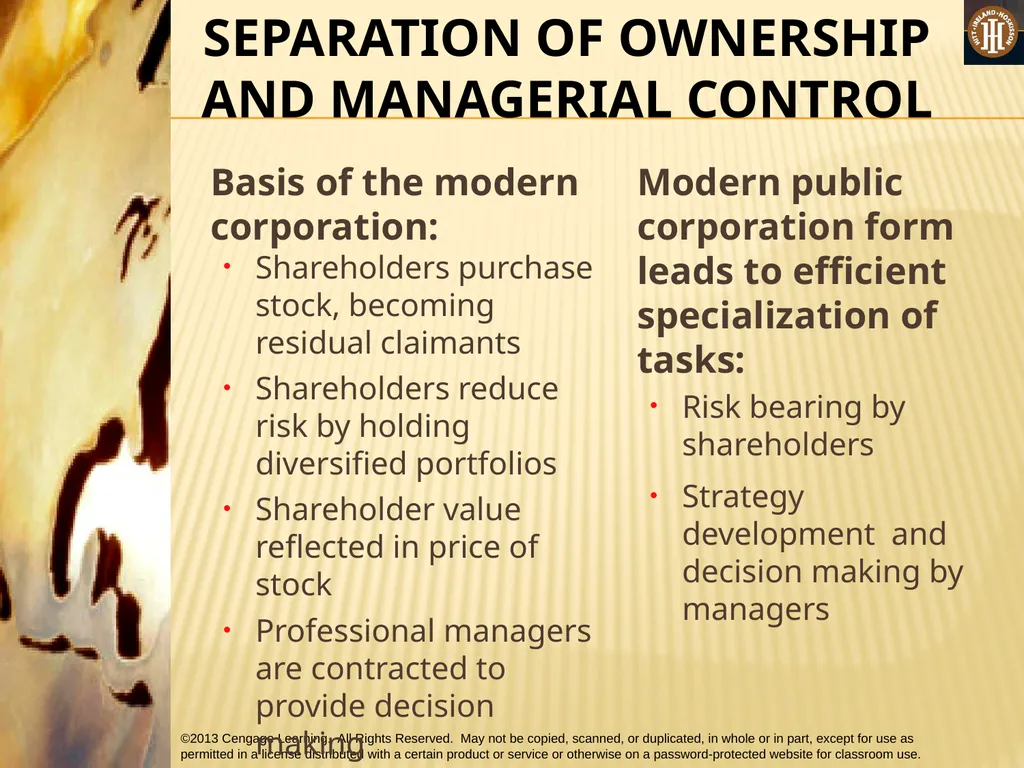
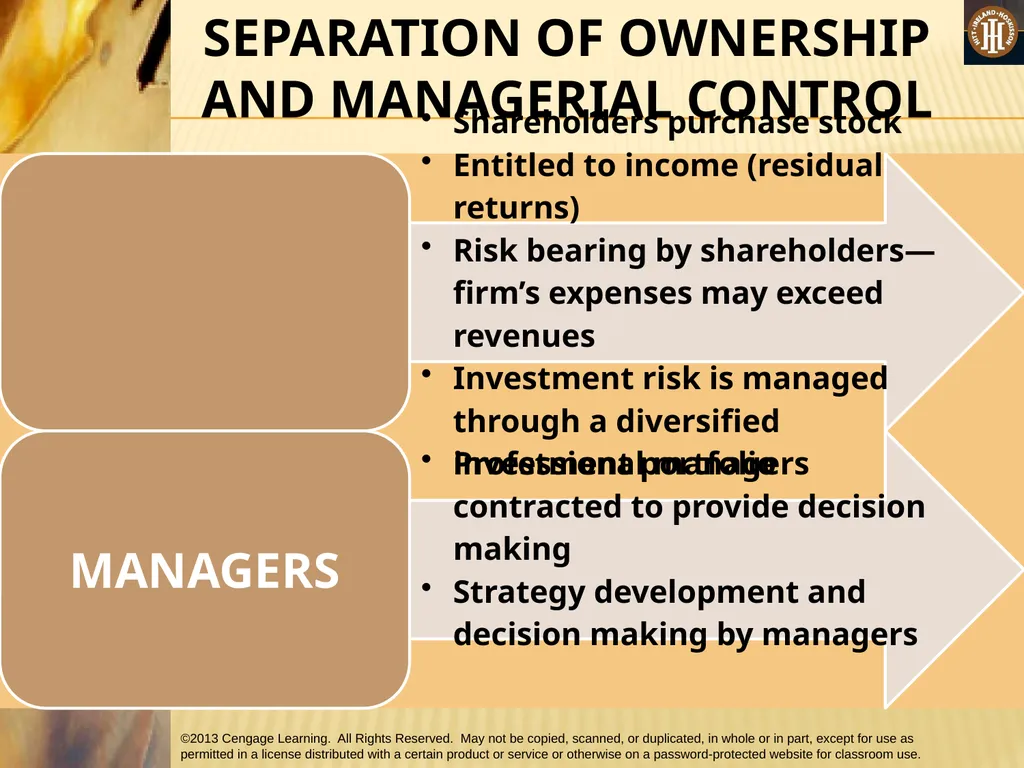
SEPARATION OF OWNERSHIP AND MANAGERIAL CONTROL Basis of the modern corporation:
Shareholders purchase stock, becoming residual claimants
Shareholders reduce risk by holding diversified portfolios
Shareholder value reflected in price of stock
Professional managers are contracted to provide decision making Modern public corporation form leads to efficient specialization of tasks:
Risk bearing by shareholders
Strategy development and decision making by managers<br>
Shareholders purchase stock, becoming residual claimants
Shareholders reduce risk by holding diversified portfolios
Shareholder value reflected in price of stock
Professional managers are contracted to provide decision making Modern public corporation form leads to efficient specialization of tasks:
Risk bearing by shareholders
Strategy development and decision making by managers<br>
14
SEPARATION OF OWNERSHIP AND MANAGERIAL CONTROL<br>
15
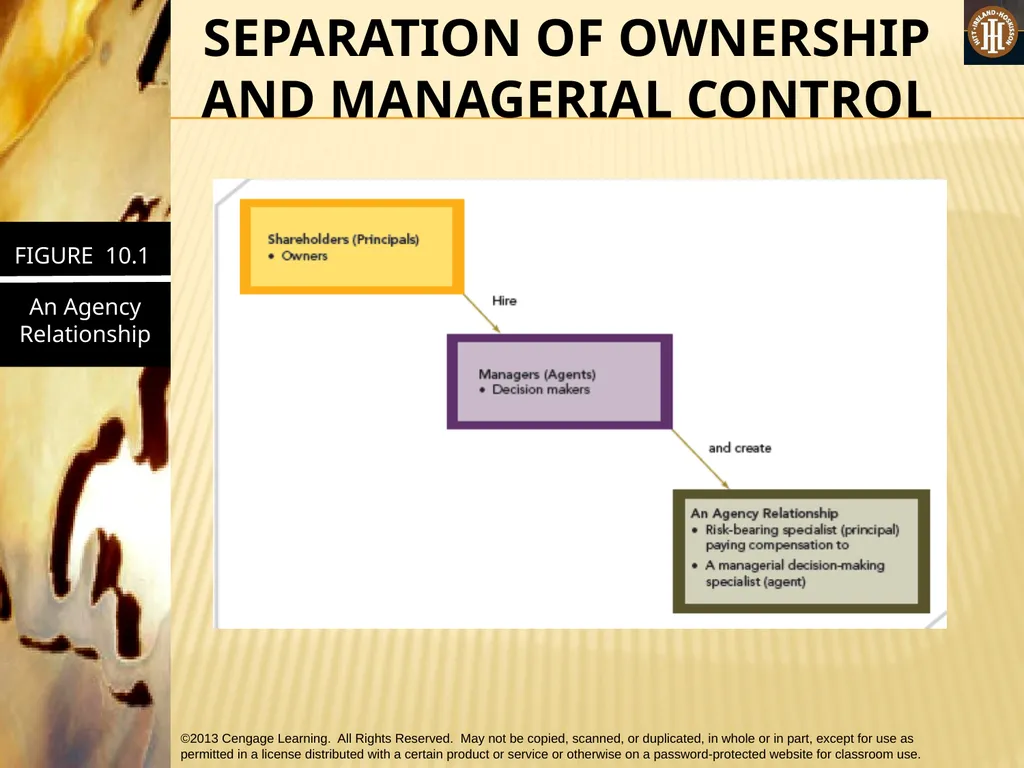
SEPARATION OF OWNERSHIP AND MANAGERIAL CONTROL FIGURE 10.1
An Agency Relationship<br>
An Agency Relationship<br>
16
SEPARATION OF OWNERSHIP AND MANAGERIAL CONTROL
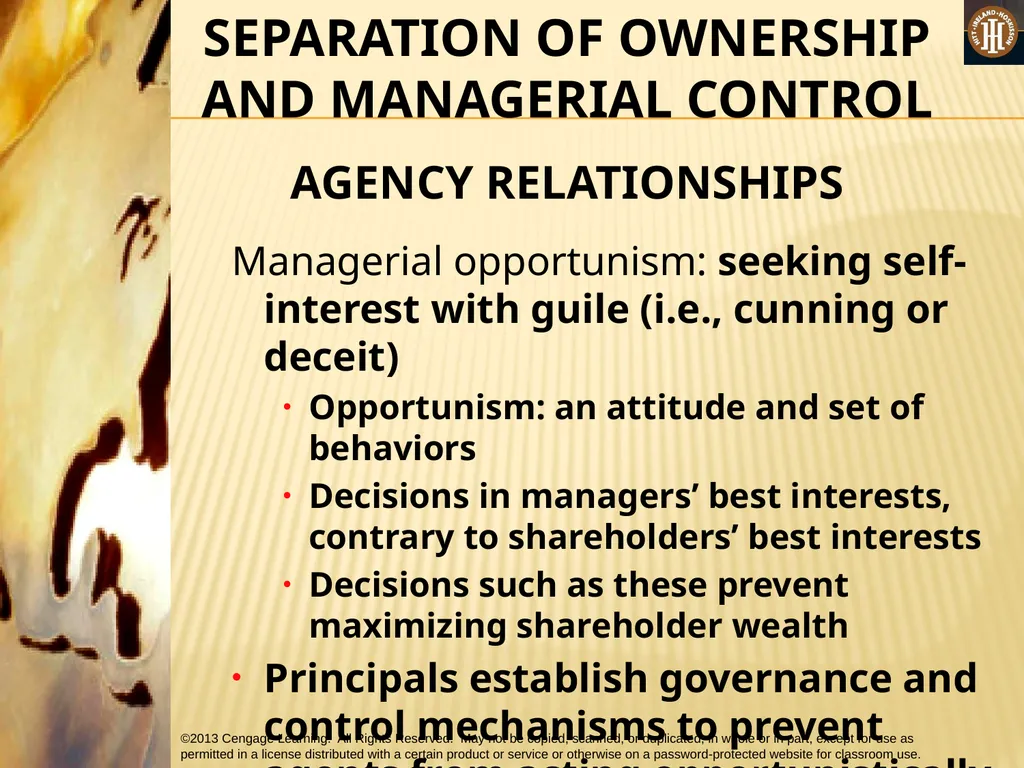
AGENCY RELATIONSHIPS Managerial opportunism: seeking self-interest with guile (i.e., cunning or deceit)
Opportunism: an attitude and set of behaviors
Decisions in managers’ best interests, contrary to shareholders’ best interests
Decisions such as these prevent maximizing shareholder wealth
Principals establish governance and control mechanisms to prevent agents from acting opportunistically.<br>
AGENCY RELATIONSHIPS Managerial opportunism: seeking self-interest with guile (i.e., cunning or deceit)
Opportunism: an attitude and set of behaviors
Decisions in managers’ best interests, contrary to shareholders’ best interests
Decisions such as these prevent maximizing shareholder wealth
Principals establish governance and control mechanisms to prevent agents from acting opportunistically.<br>
17
PRODUCT DIVERSIFICATION AS AN EXAMPLE OF AN AGENCY PROBLEM Two benefits that accrue to top-level managers and not to shareholders:
1. Increase in firm size: product diversification usually increases the size of a firm; that size is positively related to executive compensation
2. Firm portfolio diversification, which can reduce top executives’ employment risk (i.e., job loss, loss of compensation, and loss of managerial reputation)
Diversification reduces these risks because a firm and its managers are less vulnerable to reductions in demand associated with a single/limited number of businesses.<br>
1. Increase in firm size: product diversification usually increases the size of a firm; that size is positively related to executive compensation
2. Firm portfolio diversification, which can reduce top executives’ employment risk (i.e., job loss, loss of compensation, and loss of managerial reputation)
Diversification reduces these risks because a firm and its managers are less vulnerable to reductions in demand associated with a single/limited number of businesses.<br>
18
FREE CASH FLOW AS AN EXAMPLE OF AN AGENCY PROBLEM Free cash flow: resources remaining after the firm has invested in all projects that have positive net present values within its current businesses
Use of Free Cash Flows
■ Managers inclination to over-diversify and invest these funds in additional product diversification
■ Shareholders prefer distribution as dividends, so they can control how the cash is invested<br>
Use of Free Cash Flows
■ Managers inclination to over-diversify and invest these funds in additional product diversification
■ Shareholders prefer distribution as dividends, so they can control how the cash is invested<br>
19
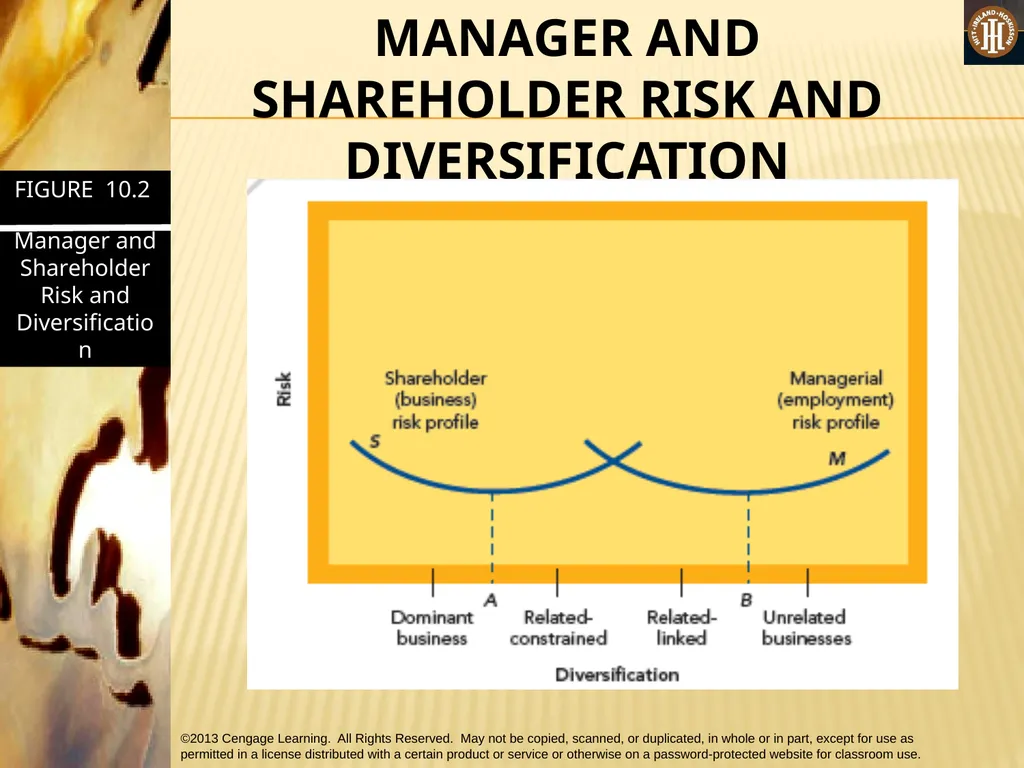
MANAGER AND SHAREHOLDER RISK AND DIVERSIFICATION FIGURE 10.2
Manager and Shareholder Risk and Diversification<br>
Manager and Shareholder Risk and Diversification<br>
20
MANAGER AND SHAREHOLDER RISK AND DIVERSIFICATION RISK
In general, shareholders prefer riskier strategies than managers
DIVERSIFICATION
Shareholders prefer more focused diversification
Managers prefer greater diversification, a level that maximizes firm size and their compensation while also reducing their employment risk
However, their preference is that the firm’s diversification falls short of where it increases their employment risk and reduces their employment opportunities (e.g., acquisition target from poor performance)<br>
In general, shareholders prefer riskier strategies than managers
DIVERSIFICATION
Shareholders prefer more focused diversification
Managers prefer greater diversification, a level that maximizes firm size and their compensation while also reducing their employment risk
However, their preference is that the firm’s diversification falls short of where it increases their employment risk and reduces their employment opportunities (e.g., acquisition target from poor performance)<br>
21
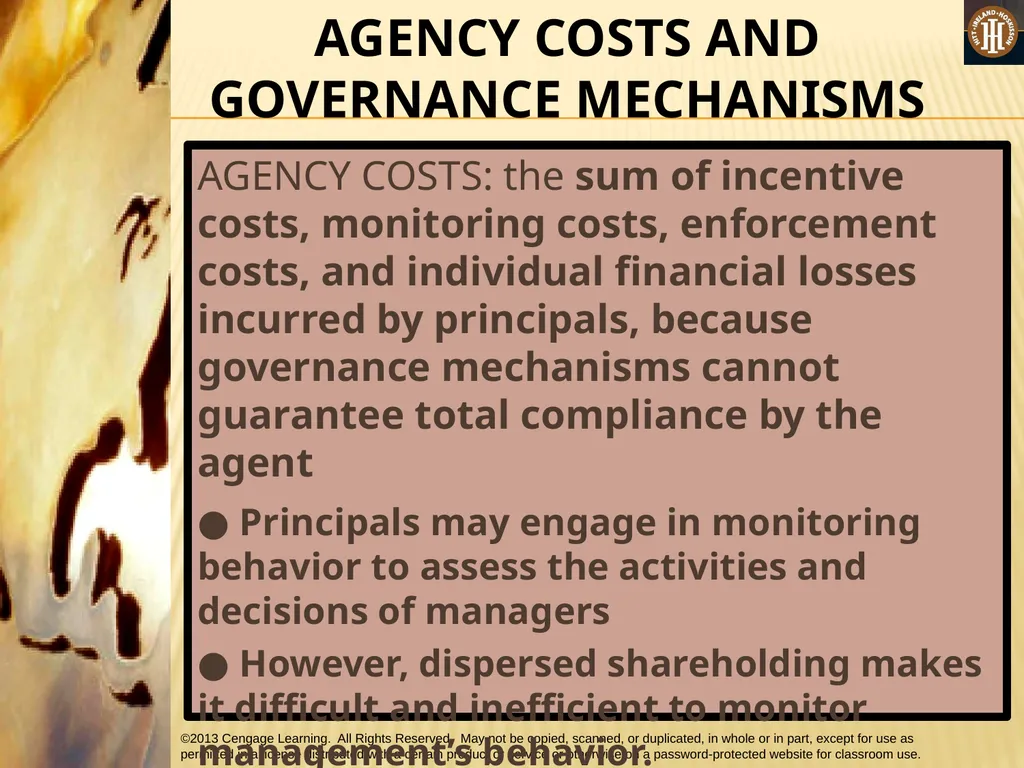
AGENCY COSTS AND GOVERNANCE MECHANISMS AGENCY COSTS: the sum of incentive costs, monitoring costs, enforcement costs, and individual financial losses incurred by principals, because governance mechanisms cannot guarantee total compliance by the agent
● Principals may engage in monitoring behavior to assess the activities and decisions of managers
● However, dispersed shareholding makes it difficult and inefficient to monitor management’s behavior.<br>
● Principals may engage in monitoring behavior to assess the activities and decisions of managers
● However, dispersed shareholding makes it difficult and inefficient to monitor management’s behavior.<br>
22
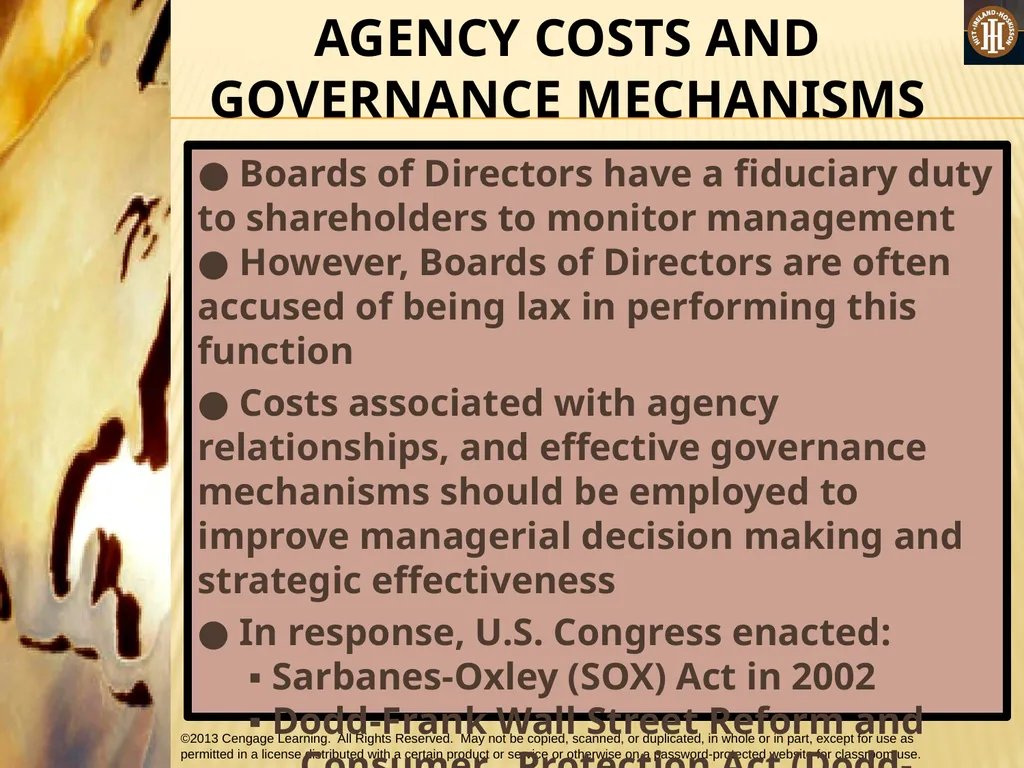
AGENCY COSTS AND GOVERNANCE MECHANISMS ● Boards of Directors have a fiduciary duty to shareholders to monitor management
● However, Boards of Directors are often accused of being lax in performing this function
● Costs associated with agency relationships, and effective governance mechanisms should be employed to improve managerial decision making and strategic effectiveness
● In response, U.S. Congress enacted:
▪ Sarbanes-Oxley (SOX) Act in 2002
▪ Dodd-Frank Wall Street Reform and Consumer Protection Act (Dodd-Frank) in mid-2010<br>
● However, Boards of Directors are often accused of being lax in performing this function
● Costs associated with agency relationships, and effective governance mechanisms should be employed to improve managerial decision making and strategic effectiveness
● In response, U.S. Congress enacted:
▪ Sarbanes-Oxley (SOX) Act in 2002
▪ Dodd-Frank Wall Street Reform and Consumer Protection Act (Dodd-Frank) in mid-2010<br>
23
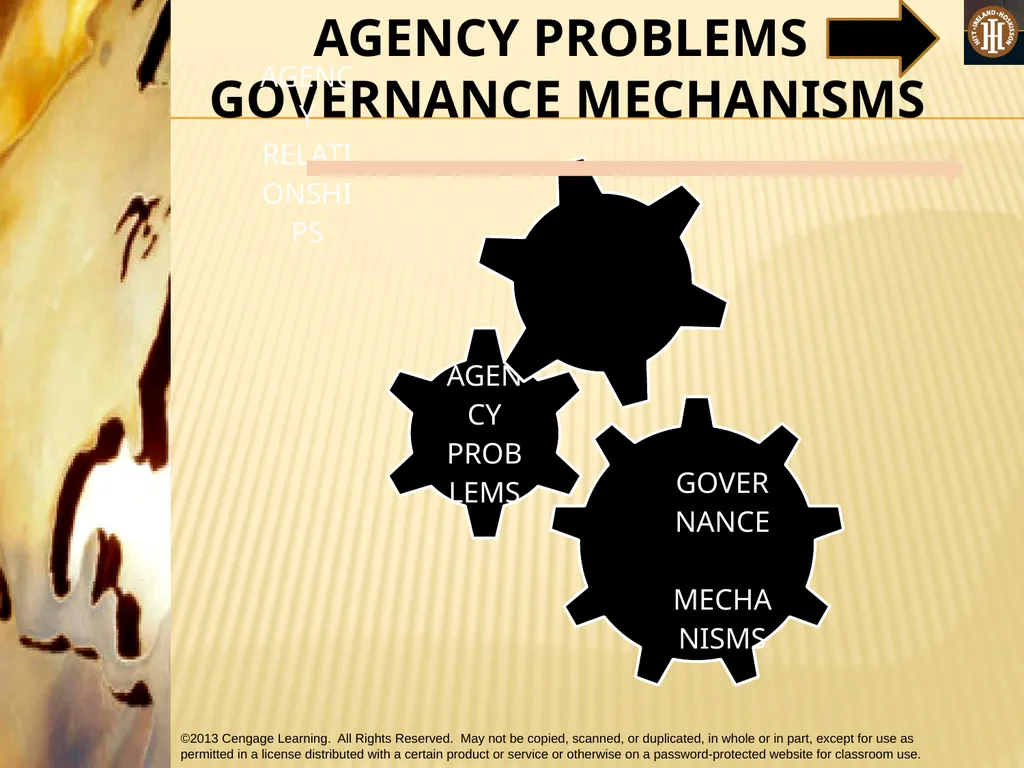
AGENCY PROBLEMS GOVERNANCE MECHANISMS<br>
24
AGENCY COSTS AND GOVERNANCE MECHANISMS All of the following are consequences of the Sarbanes-Oxley Act:
● Decrease in foreign firms listing on U.S. stock exchanges at the same time as listing on foreign exchanges increased
● Internal auditing scrutiny has improved and there is greater trust in financial reporting
● Section 404 creates excessive costs for firms
Determining governance practices that strike a balance between protecting stakeholders’ interests and allowing firms to implement strategies with some degree of risk is difficult<br>
● Decrease in foreign firms listing on U.S. stock exchanges at the same time as listing on foreign exchanges increased
● Internal auditing scrutiny has improved and there is greater trust in financial reporting
● Section 404 creates excessive costs for firms
Determining governance practices that strike a balance between protecting stakeholders’ interests and allowing firms to implement strategies with some degree of risk is difficult<br>
25
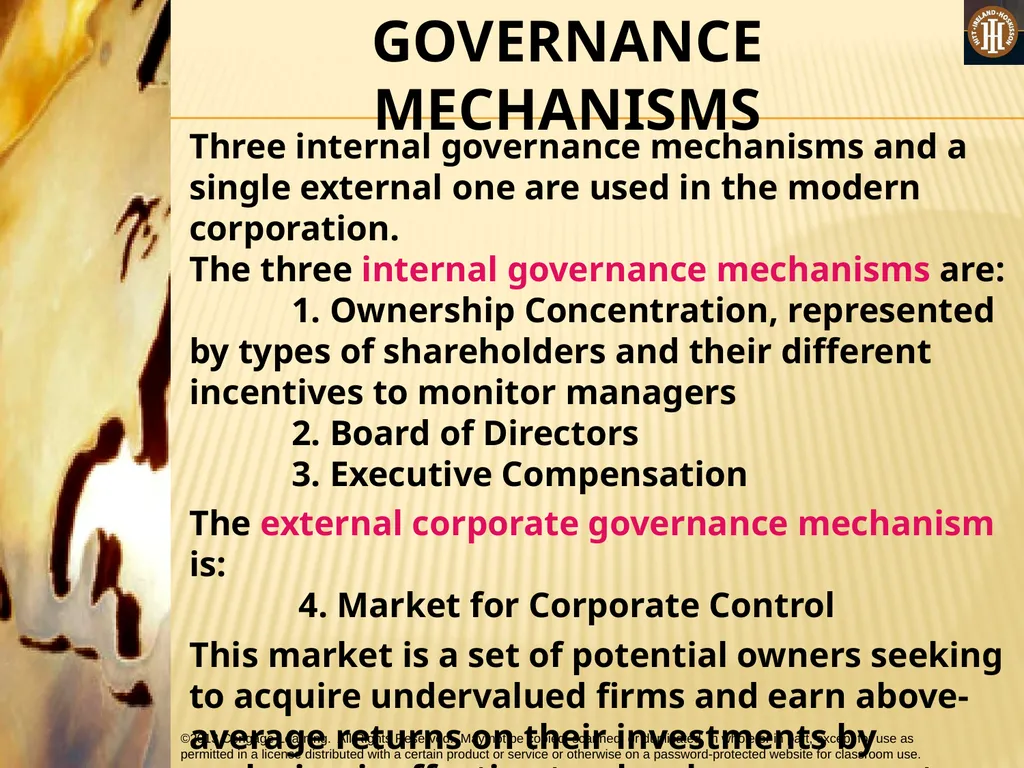
GOVERNANCE MECHANISMS Three internal governance mechanisms and a single external one are used in the modern corporation.
The three internal governance mechanisms are:
1. Ownership Concentration, represented by types of shareholders and their different incentives to monitor managers
2. Board of Directors
3. Executive Compensation
The external corporate governance mechanism is:
4. Market for Corporate Control
This market is a set of potential owners seeking to acquire undervalued firms and earn above-average returns on their investments by replacing ineffective top-level management teams.<br>
The three internal governance mechanisms are:
1. Ownership Concentration, represented by types of shareholders and their different incentives to monitor managers
2. Board of Directors
3. Executive Compensation
The external corporate governance mechanism is:
4. Market for Corporate Control
This market is a set of potential owners seeking to acquire undervalued firms and earn above-average returns on their investments by replacing ineffective top-level management teams.<br>
26
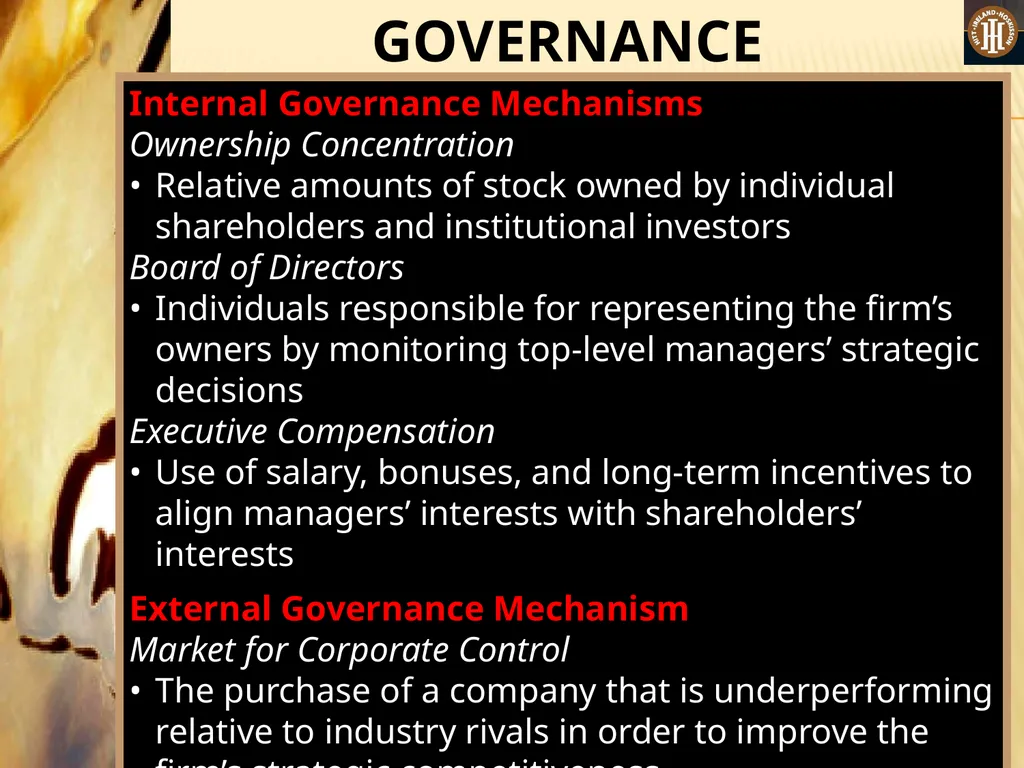
GOVERNANCE MECHANISMS Internal Governance Mechanisms
Ownership Concentration
• Relative amounts of stock owned by individual shareholders and institutional investors
Board of Directors
• Individuals responsible for representing the firm’s owners by monitoring top-level managers’ strategic decisions
Executive Compensation
• Use of salary, bonuses, and long-term incentives to align managers’ interests with shareholders’ interests
External Governance Mechanism
Market for Corporate Control
• The purchase of a company that is underperforming relative to industry rivals in order to improve the firm’s strategic competitiveness<br>
Ownership Concentration
• Relative amounts of stock owned by individual shareholders and institutional investors
Board of Directors
• Individuals responsible for representing the firm’s owners by monitoring top-level managers’ strategic decisions
Executive Compensation
• Use of salary, bonuses, and long-term incentives to align managers’ interests with shareholders’ interests
External Governance Mechanism
Market for Corporate Control
• The purchase of a company that is underperforming relative to industry rivals in order to improve the firm’s strategic competitiveness<br>
27
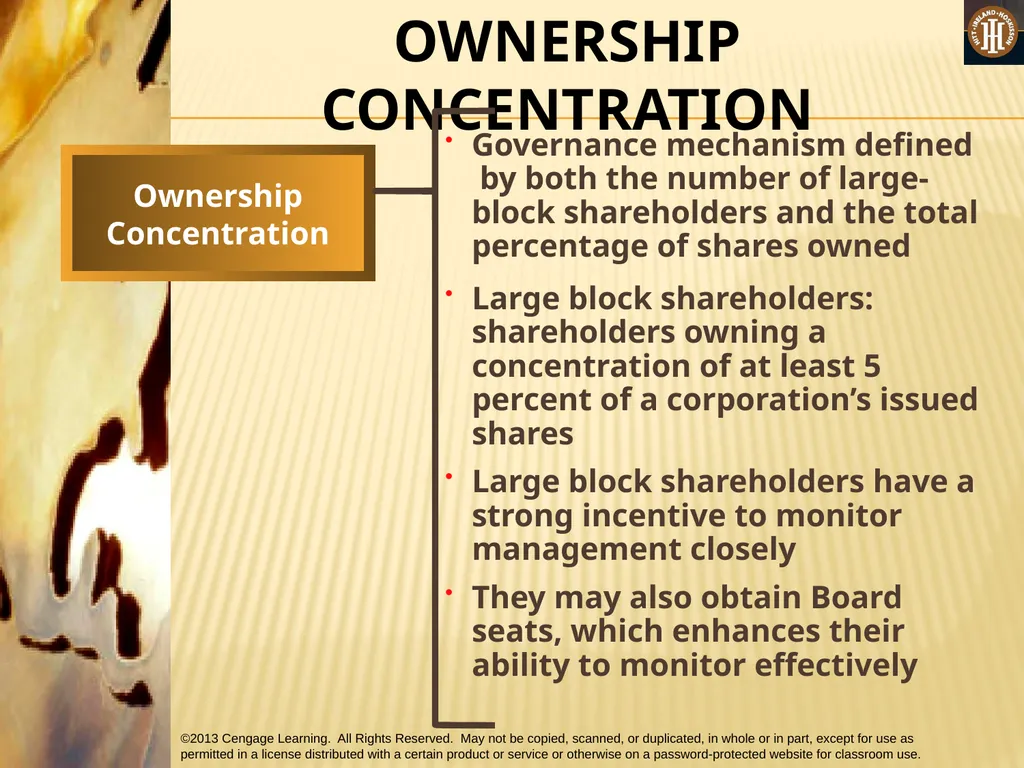
OWNERSHIP CONCENTRATION Governance mechanism defined by both the number of large-block shareholders and the total percentage of shares owned
Large block shareholders: shareholders owning a concentration of at least 5 percent of a corporation’s issued shares
Large block shareholders have a strong incentive to monitor management closely
They may also obtain Board seats, which enhances their ability to monitor effectively<br>
Large block shareholders: shareholders owning a concentration of at least 5 percent of a corporation’s issued shares
Large block shareholders have a strong incentive to monitor management closely
They may also obtain Board seats, which enhances their ability to monitor effectively<br>
28
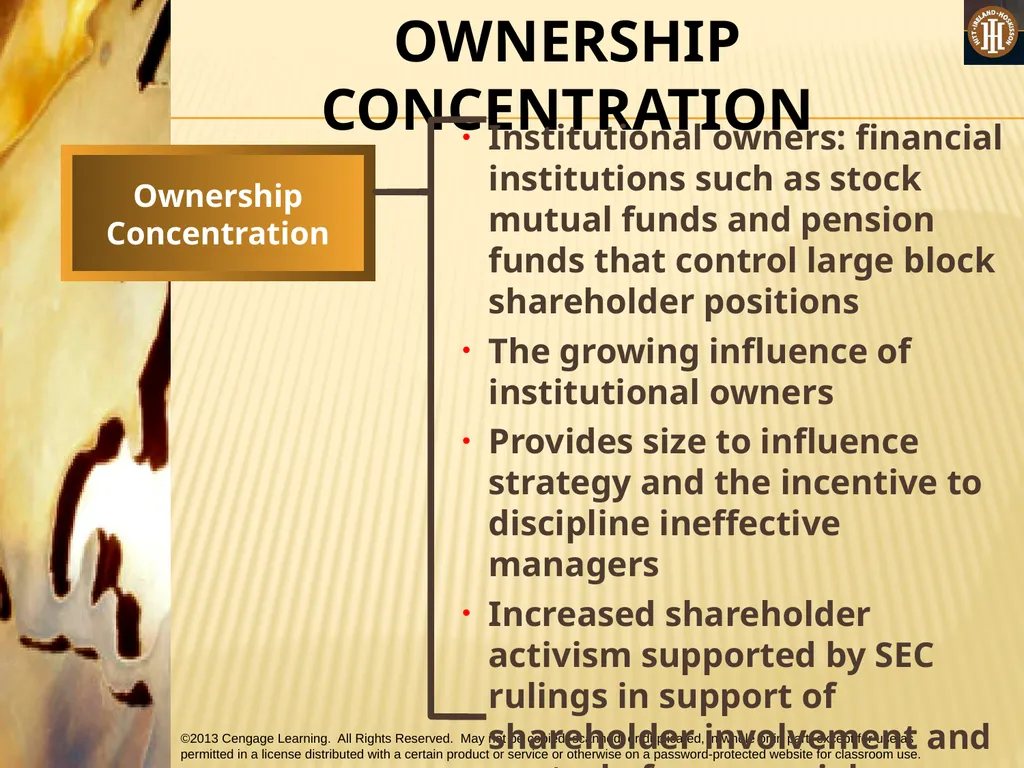
OWNERSHIP CONCENTRATION Institutional owners: financial institutions such as stock mutual funds and pension funds that control large block shareholder positions
The growing influence of institutional owners
Provides size to influence strategy and the incentive to discipline ineffective managers
Increased shareholder activism supported by SEC rulings in support of shareholder involvement and control of managerial decisions<br>
The growing influence of institutional owners
Provides size to influence strategy and the incentive to discipline ineffective managers
Increased shareholder activism supported by SEC rulings in support of shareholder involvement and control of managerial decisions<br>
29
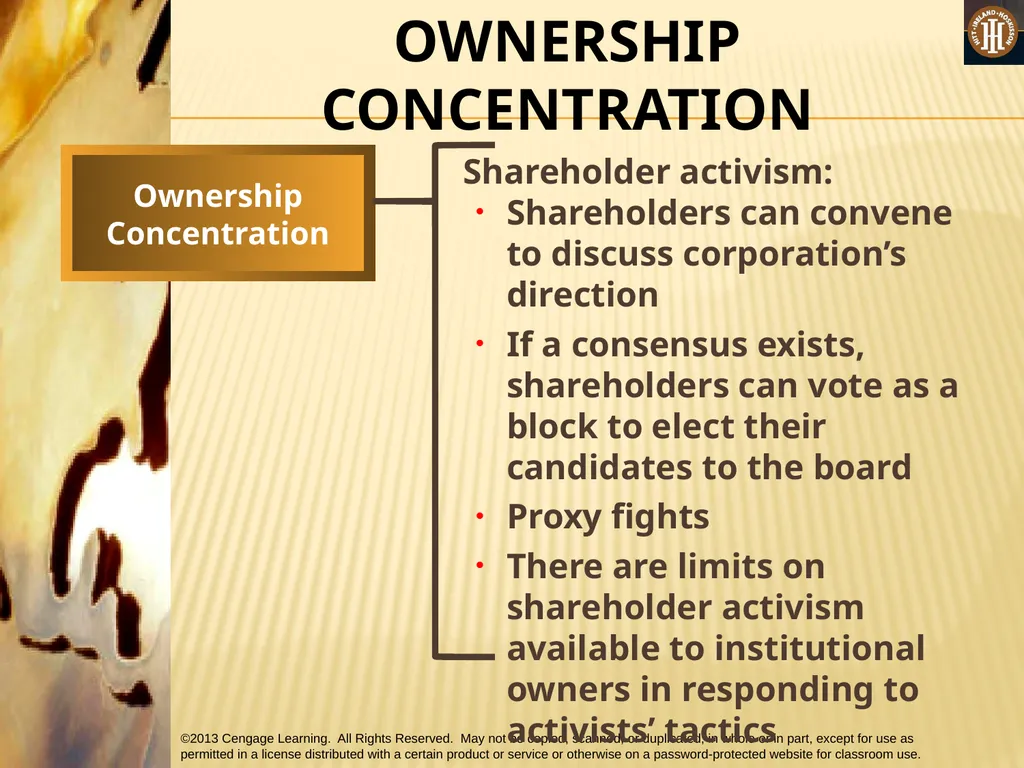
OWNERSHIP CONCENTRATION Shareholder activism:
Shareholders can convene to discuss corporation’s direction
If a consensus exists, shareholders can vote as a block to elect their candidates to the board
Proxy fights
There are limits on shareholder activism available to institutional owners in responding to activists’ tactics<br>
Shareholders can convene to discuss corporation’s direction
If a consensus exists, shareholders can vote as a block to elect their candidates to the board
Proxy fights
There are limits on shareholder activism available to institutional owners in responding to activists’ tactics<br>
30
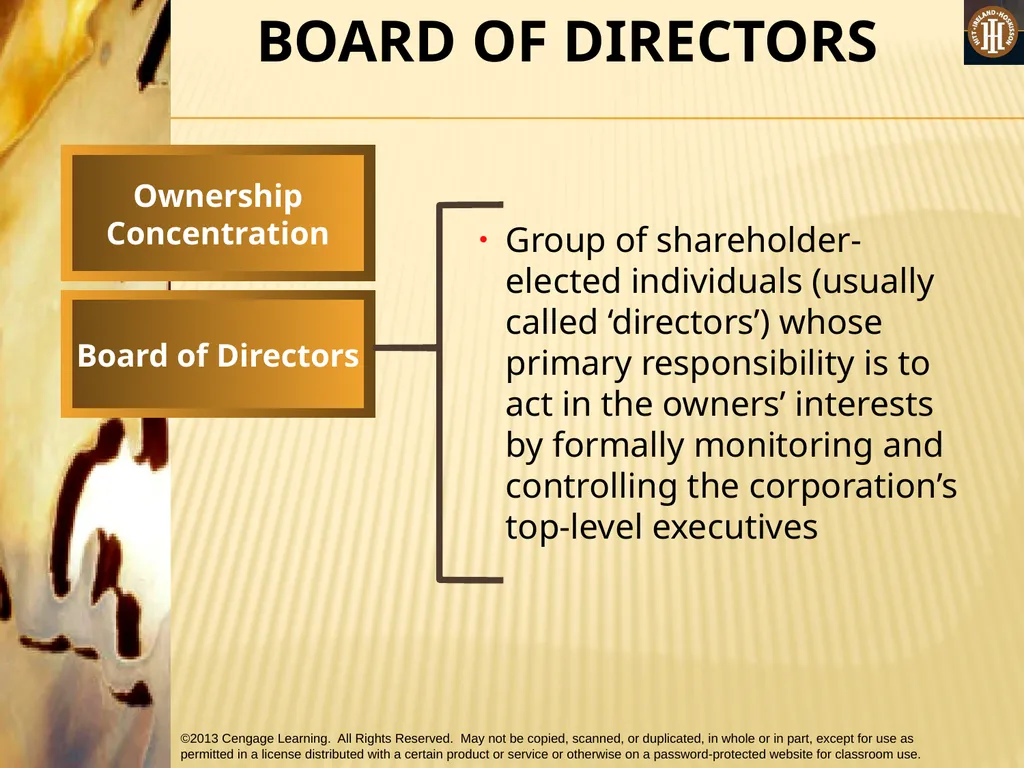
BOARD OF DIRECTORS Group of shareholder-elected individuals (usually called ‘directors’) whose primary responsibility is to act in the owners’ interests by formally monitoring and controlling the corporation’s top-level executives<br>
31
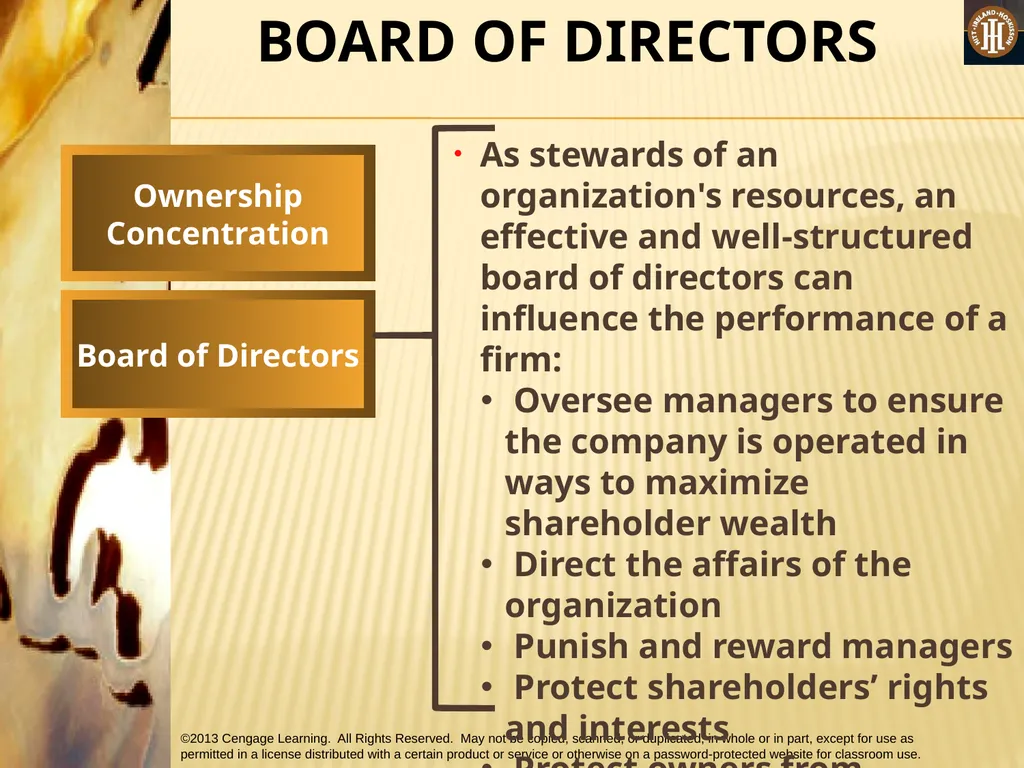
BOARD OF DIRECTORS As stewards of an organization's resources, an effective and well-structured board of directors can influence the performance of a firm:
Oversee managers to ensure the company is operated in ways to maximize shareholder wealth
Direct the affairs of the organization
Punish and reward managers
Protect shareholders’ rights and interests
Protect owners from managerial opportunism<br>
Oversee managers to ensure the company is operated in ways to maximize shareholder wealth
Direct the affairs of the organization
Punish and reward managers
Protect shareholders’ rights and interests
Protect owners from managerial opportunism<br>
32
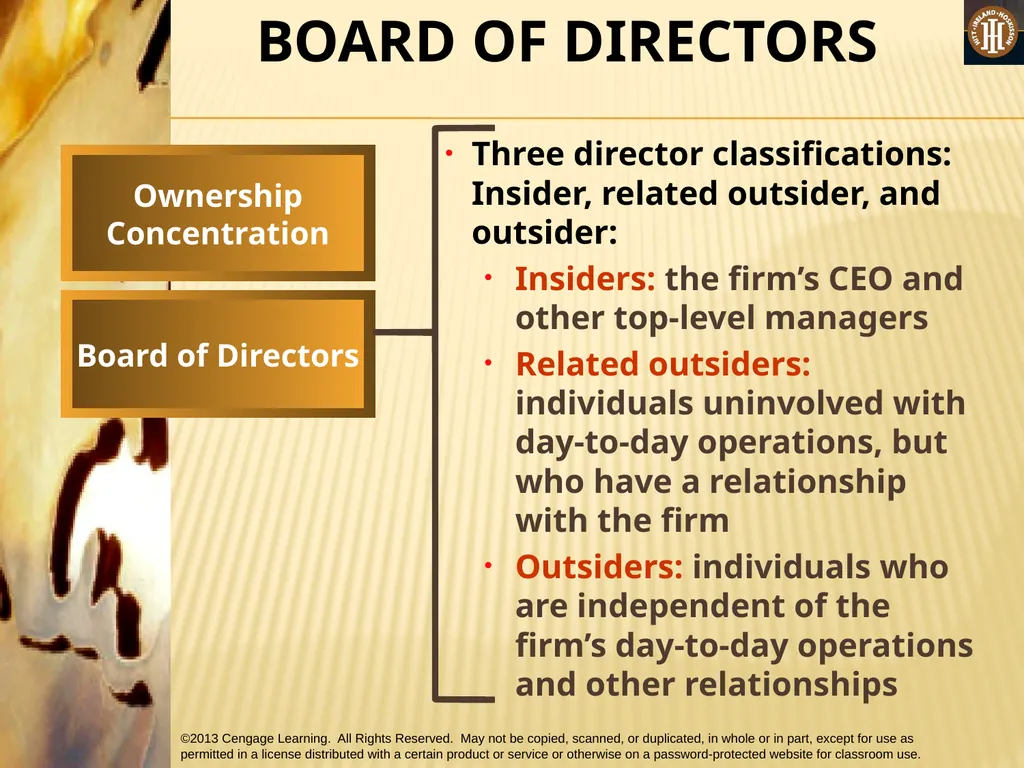
BOARD OF DIRECTORS Three director classifications: Insider, related outsider, and outsider:
Insiders: the firm’s CEO and other top-level managers
Related outsiders: individuals uninvolved with day-to-day operations, but who have a relationship with the firm
Outsiders: individuals who are independent of the firm’s day-to-day operations and other relationships<br>
Insiders: the firm’s CEO and other top-level managers
Related outsiders: individuals uninvolved with day-to-day operations, but who have a relationship with the firm
Outsiders: individuals who are independent of the firm’s day-to-day operations and other relationships<br>
33
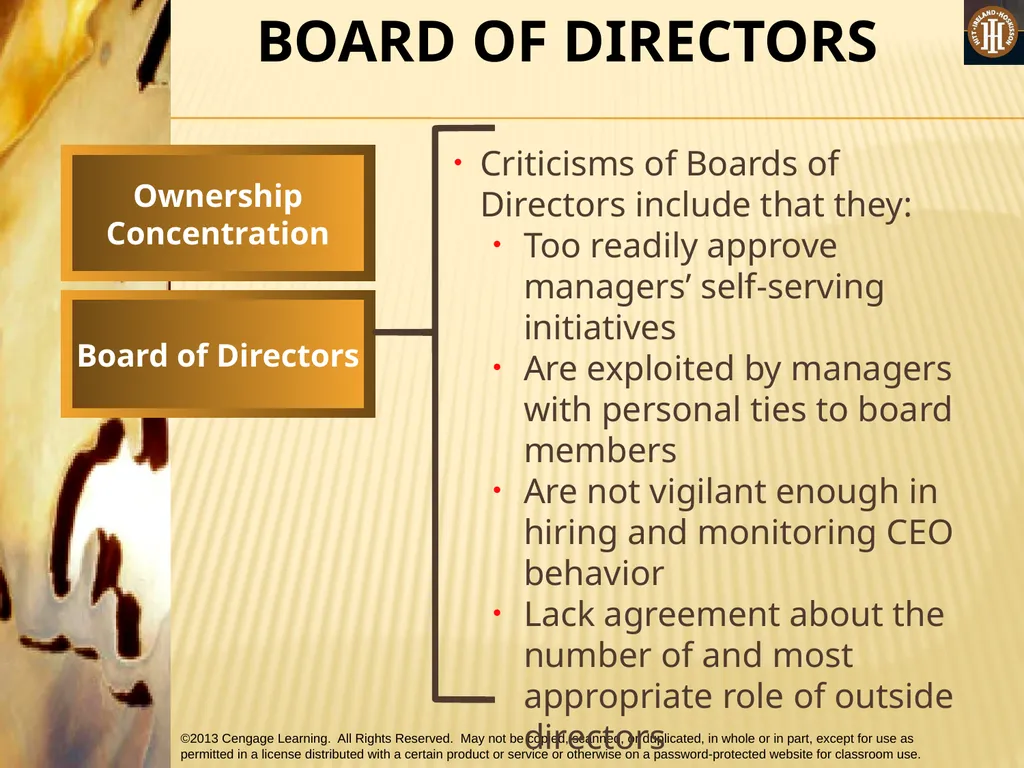
BOARD OF DIRECTORS Criticisms of Boards of Directors include that they:
Too readily approve managers’ self-serving initiatives
Are exploited by managers with personal ties to board members
Are not vigilant enough in hiring and monitoring CEO behavior
Lack agreement about the number of and most appropriate role of outside directors<br>
Too readily approve managers’ self-serving initiatives
Are exploited by managers with personal ties to board members
Are not vigilant enough in hiring and monitoring CEO behavior
Lack agreement about the number of and most appropriate role of outside directors<br>
34
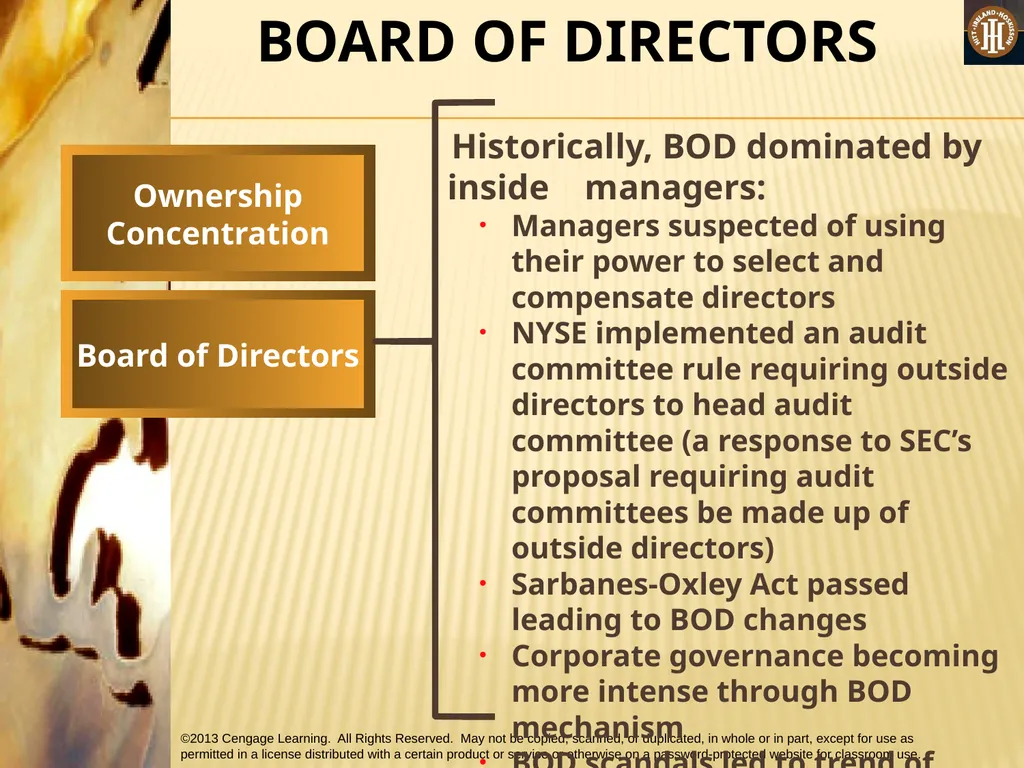
BOARD OF DIRECTORS Historically, BOD dominated by inside managers:
Managers suspected of using their power to select and compensate directors
NYSE implemented an audit committee rule requiring outside directors to head audit committee (a response to SEC’s proposal requiring audit committees be made up of outside directors)
Sarbanes-Oxley Act passed leading to BOD changes
Corporate governance becoming more intense through BOD mechanism
BOD scandals led to trend of separating roles of CEO and Board Chairperson<br>
Managers suspected of using their power to select and compensate directors
NYSE implemented an audit committee rule requiring outside directors to head audit committee (a response to SEC’s proposal requiring audit committees be made up of outside directors)
Sarbanes-Oxley Act passed leading to BOD changes
Corporate governance becoming more intense through BOD mechanism
BOD scandals led to trend of separating roles of CEO and Board Chairperson<br>
35
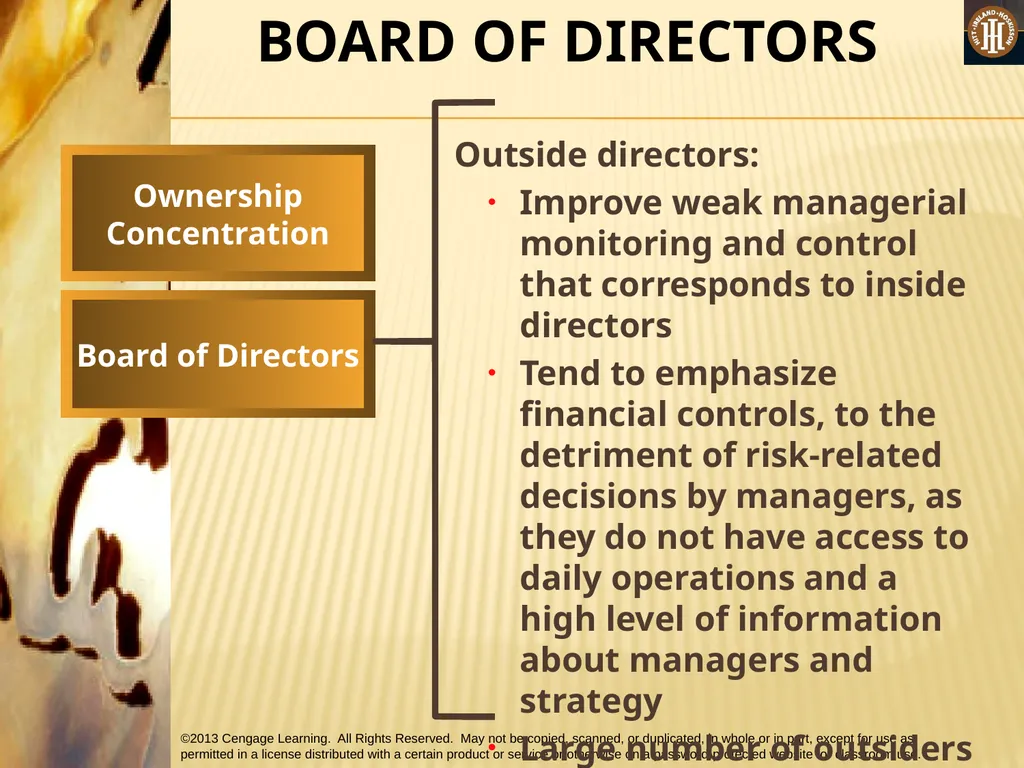
BOARD OF DIRECTORS Outside directors:
Improve weak managerial monitoring and control that corresponds to inside directors
Tend to emphasize financial controls, to the detriment of risk-related decisions by managers, as they do not have access to daily operations and a high level of information about managers and strategy
Large number of outsiders can create problems<br>
Improve weak managerial monitoring and control that corresponds to inside directors
Tend to emphasize financial controls, to the detriment of risk-related decisions by managers, as they do not have access to daily operations and a high level of information about managers and strategy
Large number of outsiders can create problems<br>
36
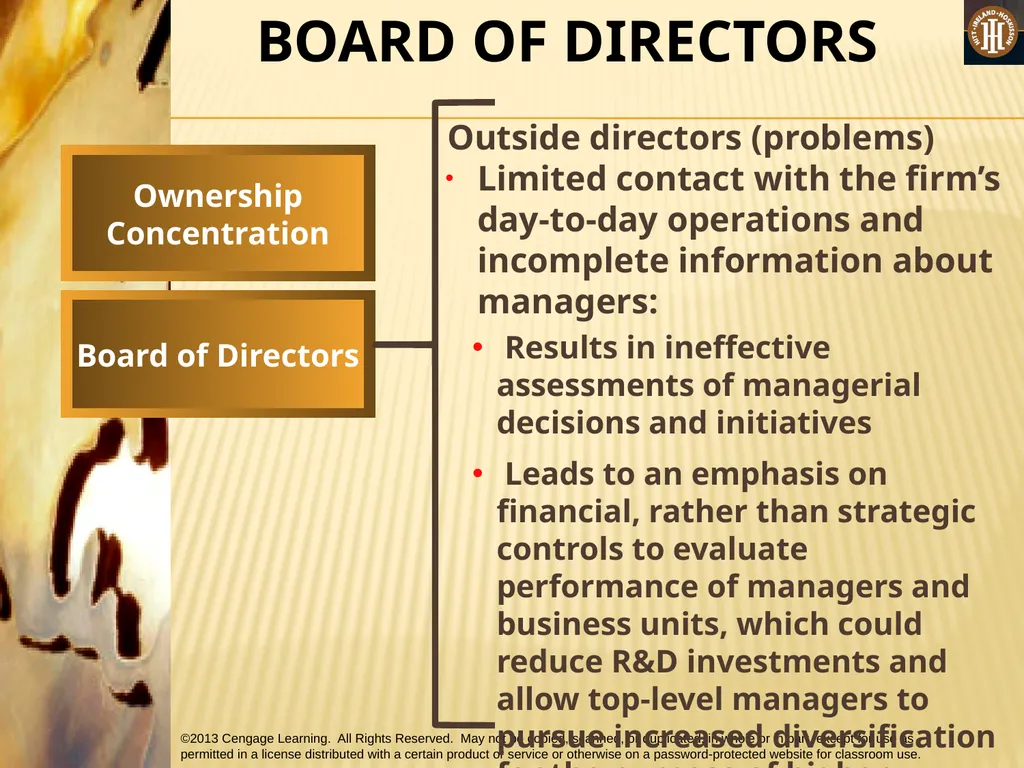
BOARD OF DIRECTORS Outside directors (problems)
Limited contact with the firm’s day-to-day operations and incomplete information about managers:
Results in ineffective assessments of managerial decisions and initiatives
Leads to an emphasis on financial, rather than strategic controls to evaluate performance of managers and business units, which could reduce R&D investments and allow top-level managers to pursue increased diversification for the purpose of higher compensation and minimizing their employment risk<br>
Limited contact with the firm’s day-to-day operations and incomplete information about managers:
Results in ineffective assessments of managerial decisions and initiatives
Leads to an emphasis on financial, rather than strategic controls to evaluate performance of managers and business units, which could reduce R&D investments and allow top-level managers to pursue increased diversification for the purpose of higher compensation and minimizing their employment risk<br>
37
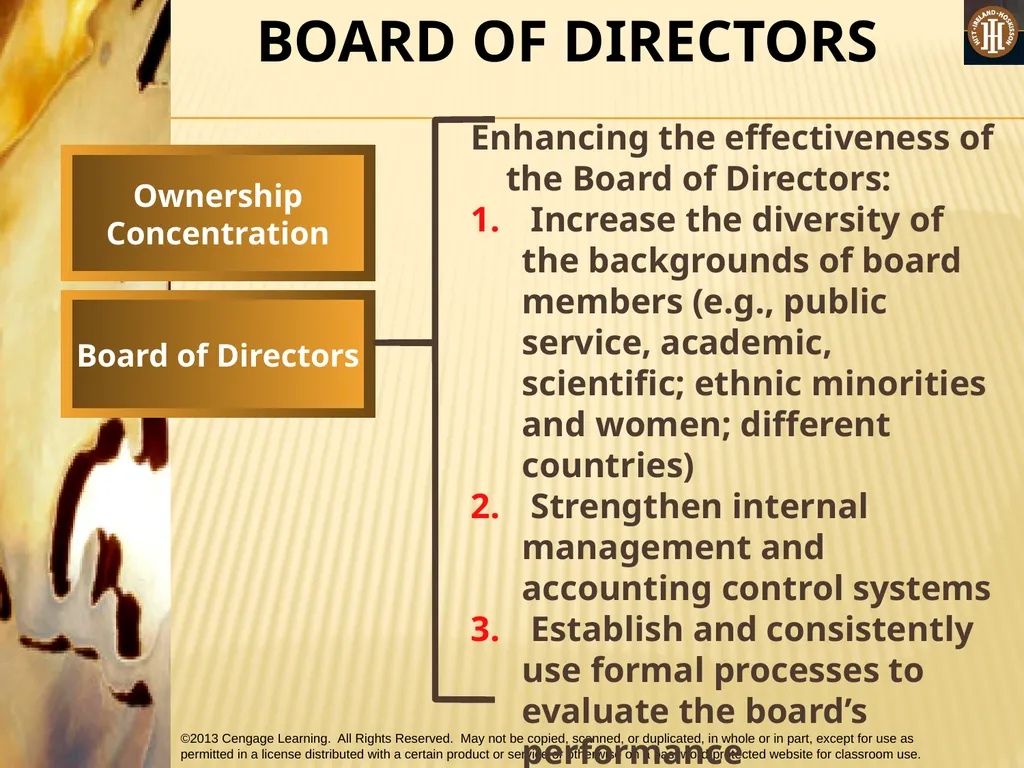
BOARD OF DIRECTORS Enhancing the effectiveness of the Board of Directors:
Increase the diversity of the backgrounds of board members (e.g., public service, academic, scientific; ethnic minorities and women; different countries)
Strengthen internal management and accounting control systems
Establish and consistently use formal processes to evaluate the board’s performance<br>
Increase the diversity of the backgrounds of board members (e.g., public service, academic, scientific; ethnic minorities and women; different countries)
Strengthen internal management and accounting control systems
Establish and consistently use formal processes to evaluate the board’s performance<br>
38
BOARD OF DIRECTORS Enhancing the effectiveness of the Board of Directors:
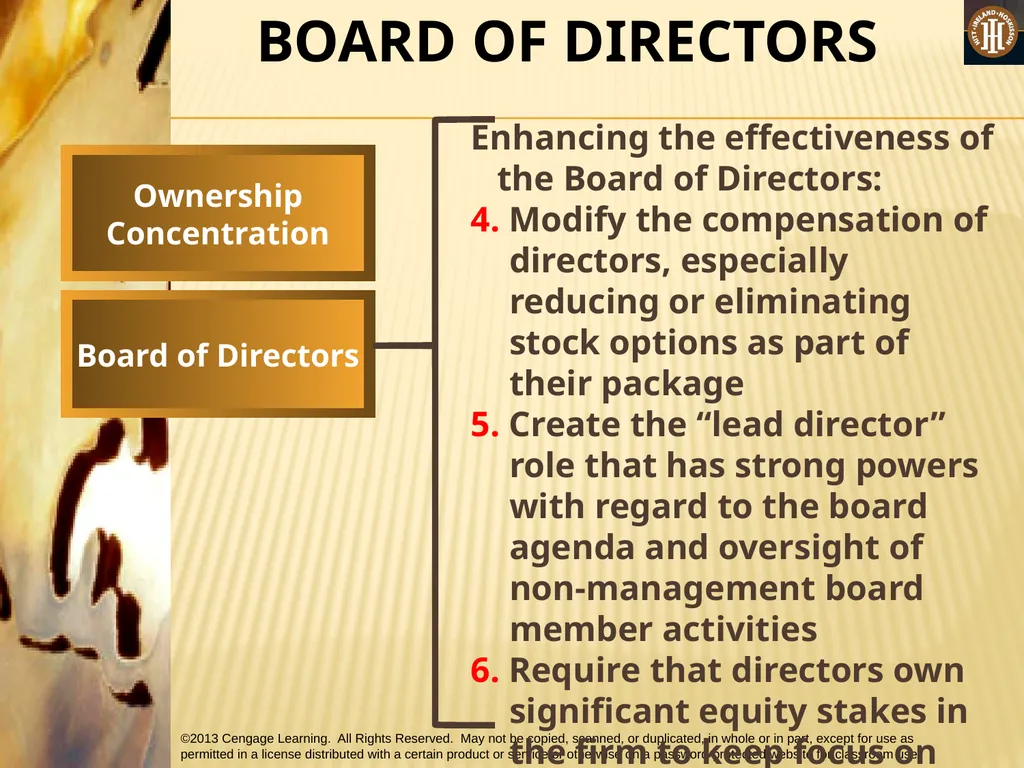
4. Modify the compensation of directors, especially reducing or eliminating stock options as part of their package
5. Create the “lead director” role that has strong powers with regard to the board agenda and oversight of non-management board member activities
6. Require that directors own significant equity stakes in the firm to keep focus on shareholder interests<br>
4. Modify the compensation of directors, especially reducing or eliminating stock options as part of their package
5. Create the “lead director” role that has strong powers with regard to the board agenda and oversight of non-management board member activities
6. Require that directors own significant equity stakes in the firm to keep focus on shareholder interests<br>
39
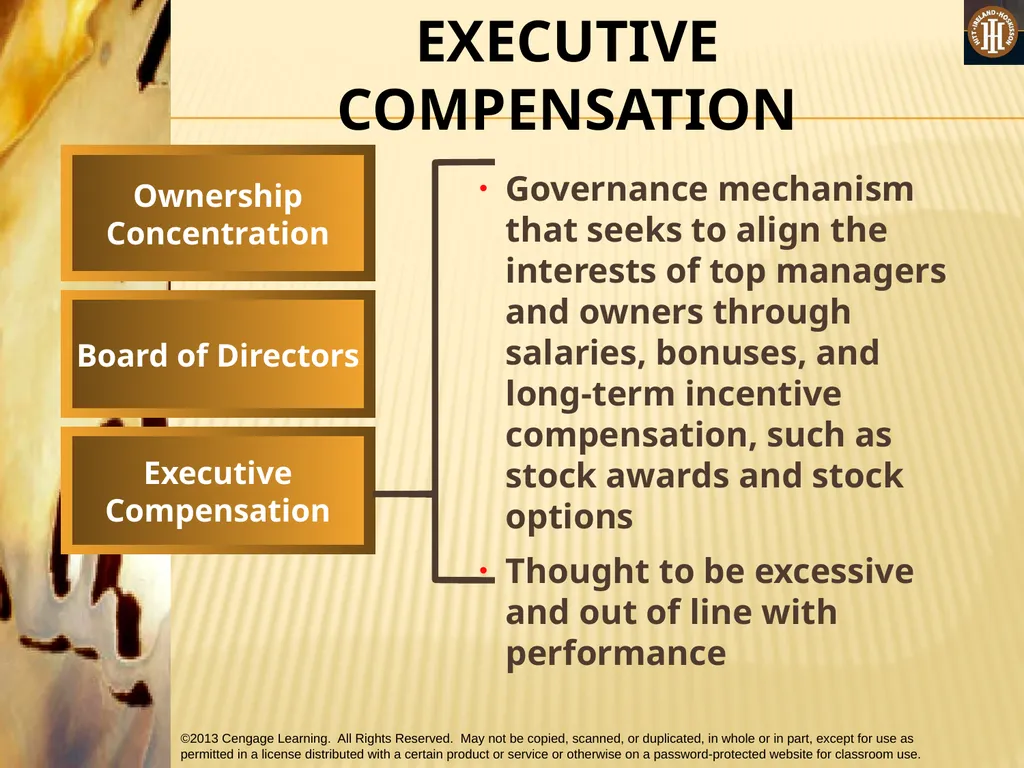
EXECUTIVE COMPENSATION Governance mechanism that seeks to align the interests of top managers and owners through salaries, bonuses, and long-term incentive compensation, such as stock awards and stock options
Thought to be excessive and out of line with performance<br>
Thought to be excessive and out of line with performance<br>
40
EXECUTIVE COMPENSATION Factors complicating executive compensation:
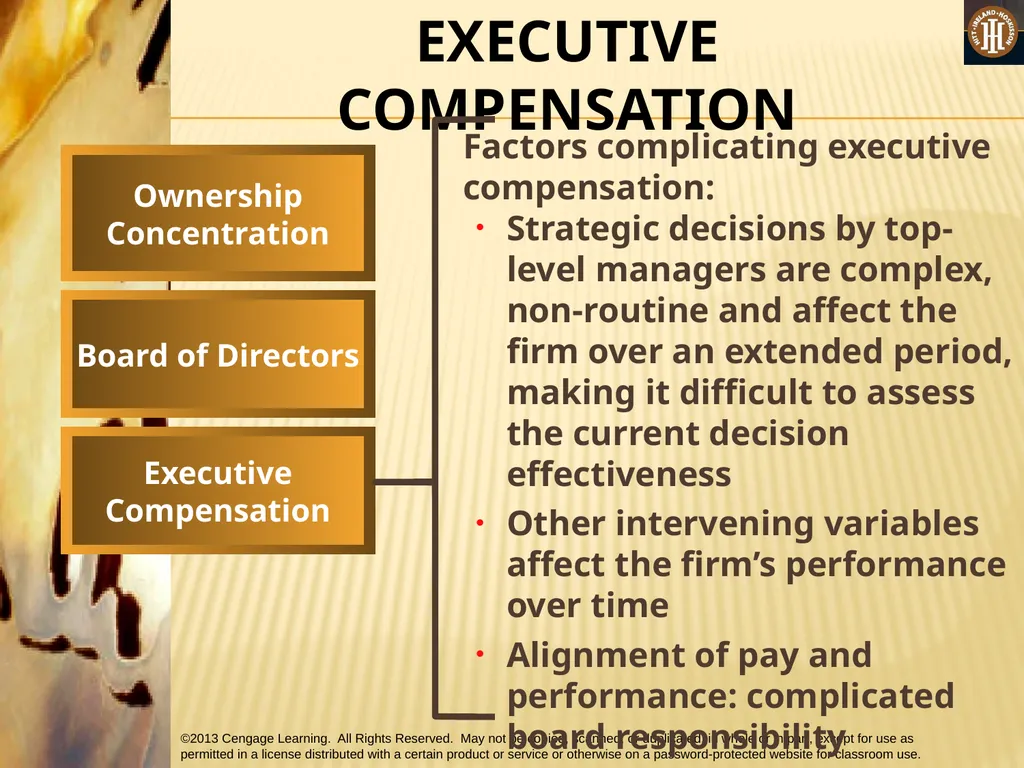
Strategic decisions by top-level managers are complex, non-routine and affect the firm over an extended period, making it difficult to assess the current decision effectiveness
Other intervening variables affect the firm’s performance over time
Alignment of pay and performance: complicated board responsibility
The effectiveness of pay plans as a governance mechanism is suspect<br>
Strategic decisions by top-level managers are complex, non-routine and affect the firm over an extended period, making it difficult to assess the current decision effectiveness
Other intervening variables affect the firm’s performance over time
Alignment of pay and performance: complicated board responsibility
The effectiveness of pay plans as a governance mechanism is suspect<br>
41
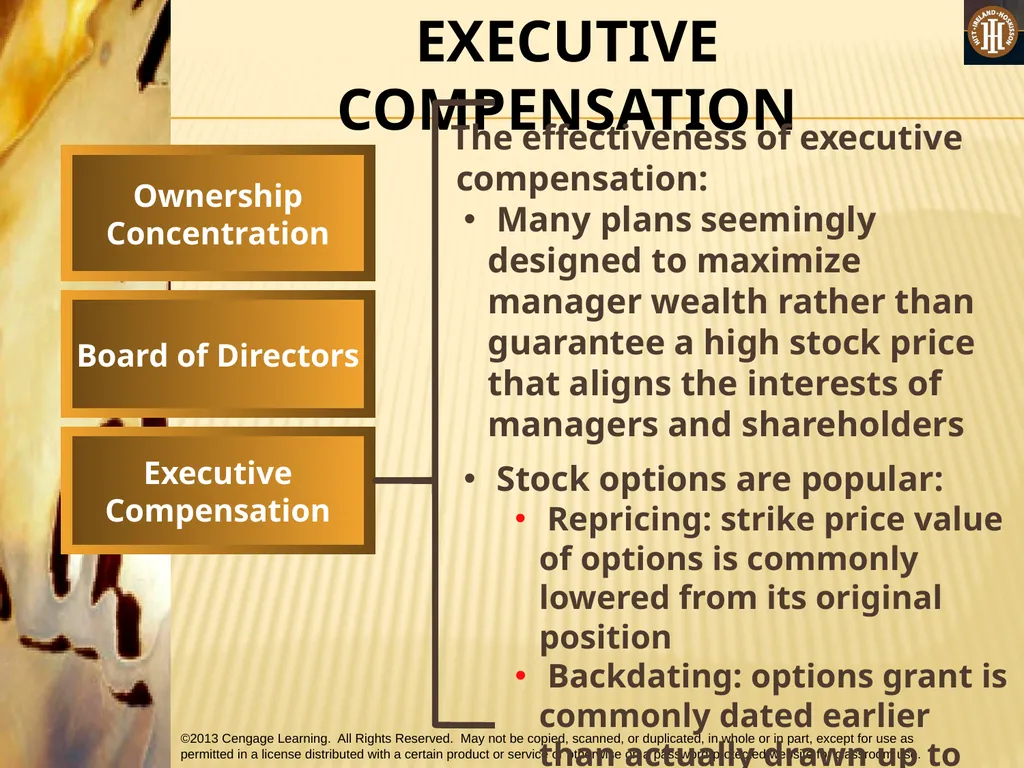
EXECUTIVE COMPENSATION The effectiveness of executive compensation:
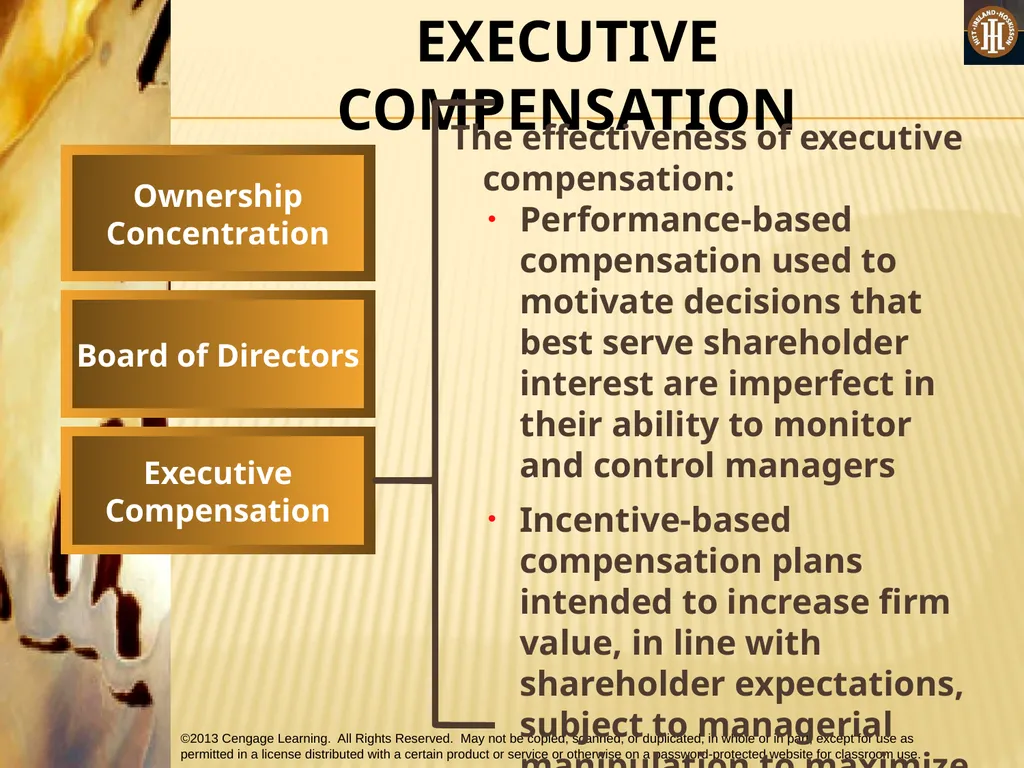
Performance-based compensation used to motivate decisions that best serve shareholder interest are imperfect in their ability to monitor and control managers
Incentive-based compensation plans intended to increase firm value, in line with shareholder expectations, subject to managerial manipulation to maximize managerial interests<br>
Performance-based compensation used to motivate decisions that best serve shareholder interest are imperfect in their ability to monitor and control managers
Incentive-based compensation plans intended to increase firm value, in line with shareholder expectations, subject to managerial manipulation to maximize managerial interests<br>
42
EXECUTIVE COMPENSATION The effectiveness of executive compensation:
Many plans seemingly designed to maximize manager wealth rather than guarantee a high stock price that aligns the interests of managers and shareholders
Stock options are popular:
Repricing: strike price value of options is commonly lowered from its original position
Backdating: options grant is commonly dated earlier than actually drawn up to ensure an attractive exercise price<br>
Many plans seemingly designed to maximize manager wealth rather than guarantee a high stock price that aligns the interests of managers and shareholders
Stock options are popular:
Repricing: strike price value of options is commonly lowered from its original position
Backdating: options grant is commonly dated earlier than actually drawn up to ensure an attractive exercise price<br>
43
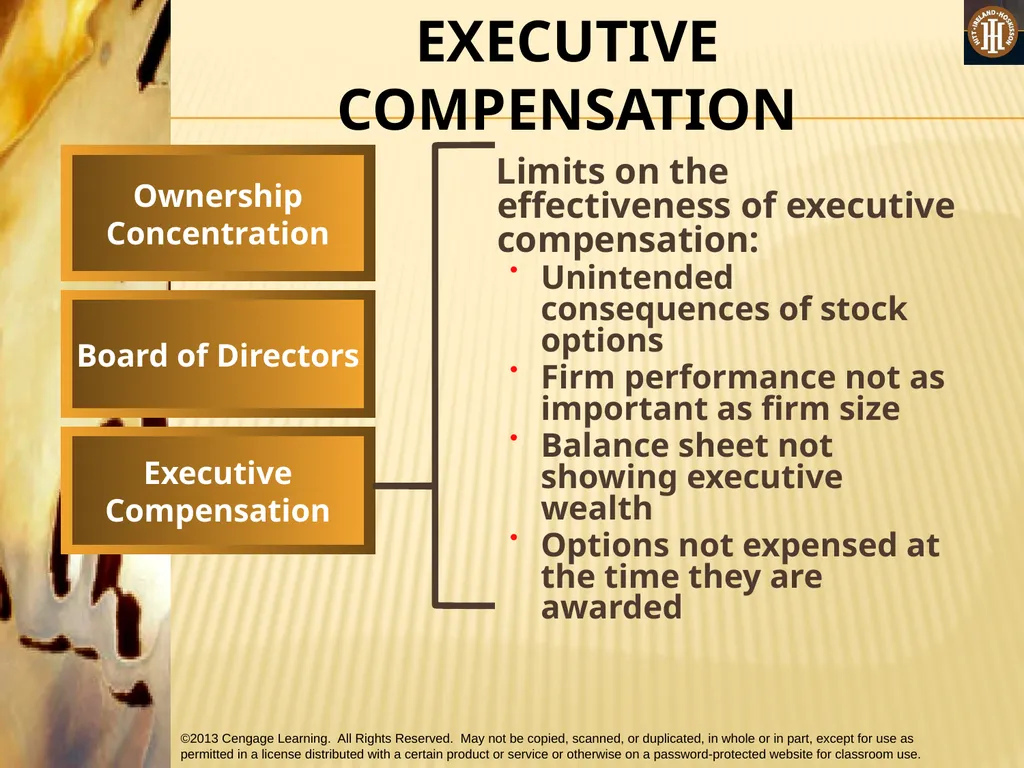
EXECUTIVE COMPENSATION Limits on the effectiveness of executive compensation:
Unintended consequences of stock options
Firm performance not as important as firm size
Balance sheet not showing executive wealth
Options not expensed at the time they are awarded<br>
Unintended consequences of stock options
Firm performance not as important as firm size
Balance sheet not showing executive wealth
Options not expensed at the time they are awarded<br>
44
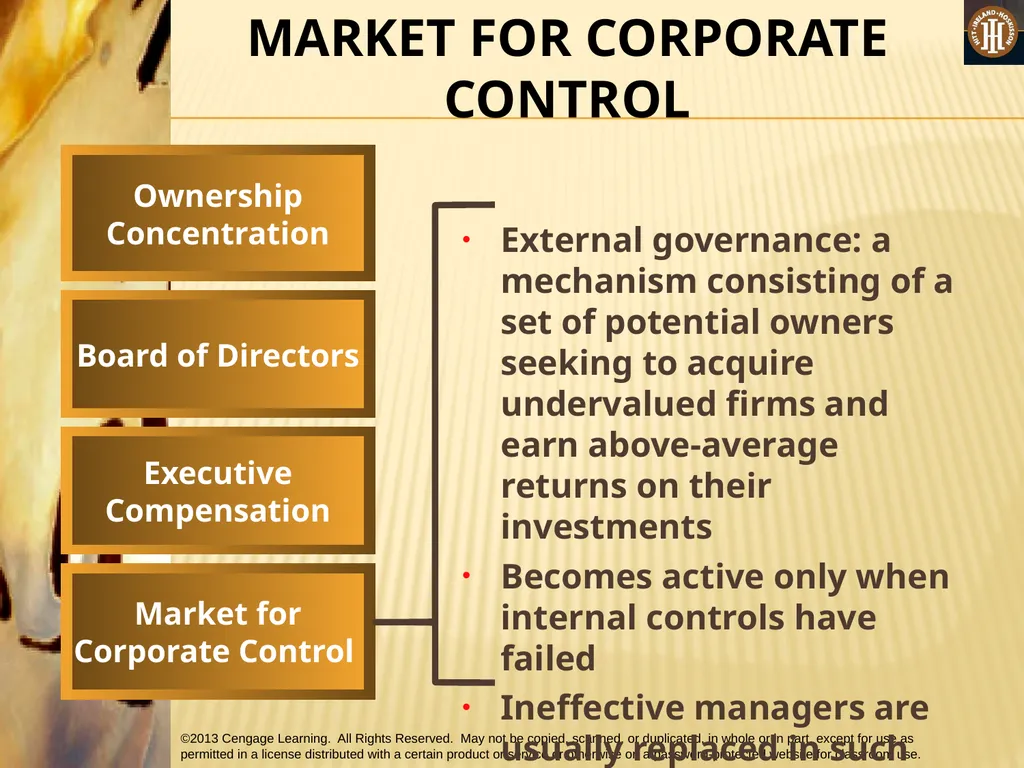
MARKET FOR CORPORATE CONTROL External governance: a mechanism consisting of a set of potential owners seeking to acquire undervalued firms and earn above-average returns on their investments
Becomes active only when internal controls have failed
Ineffective managers are usually replaced in such takeovers<br>
Becomes active only when internal controls have failed
Ineffective managers are usually replaced in such takeovers<br>
45
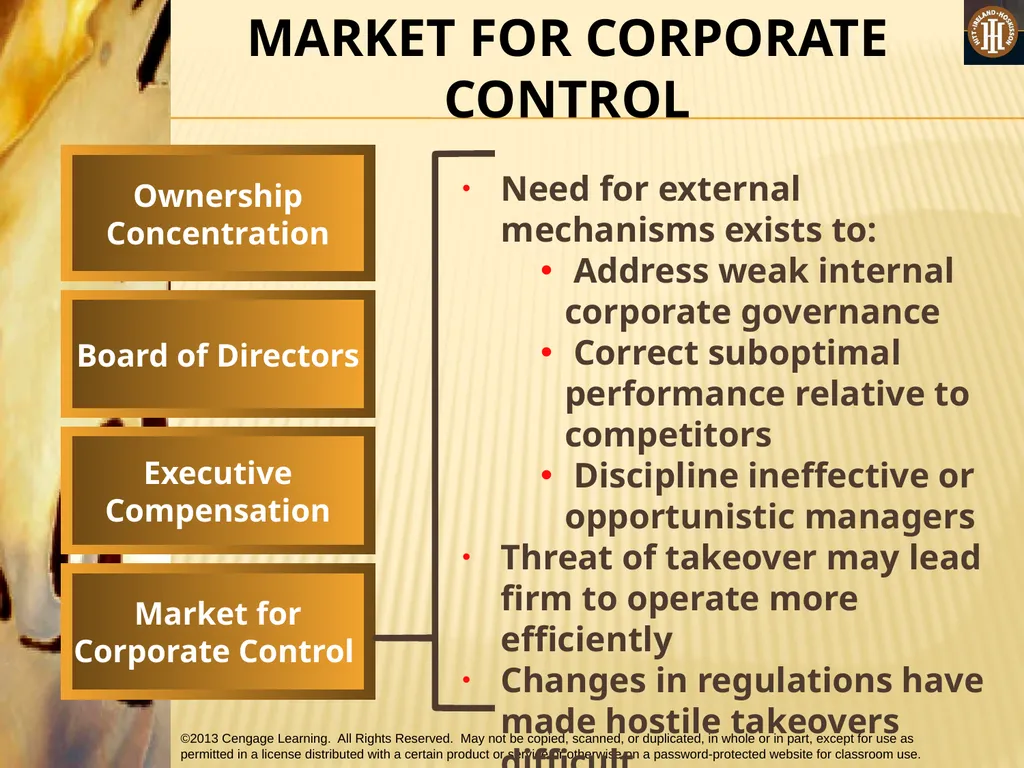
MARKET FOR CORPORATE CONTROL Need for external mechanisms exists to:
Address weak internal corporate governance
Correct suboptimal performance relative to competitors
Discipline ineffective or opportunistic managers
Threat of takeover may lead firm to operate more efficiently
Changes in regulations have made hostile takeovers difficult<br>
Address weak internal corporate governance
Correct suboptimal performance relative to competitors
Discipline ineffective or opportunistic managers
Threat of takeover may lead firm to operate more efficiently
Changes in regulations have made hostile takeovers difficult<br>
46
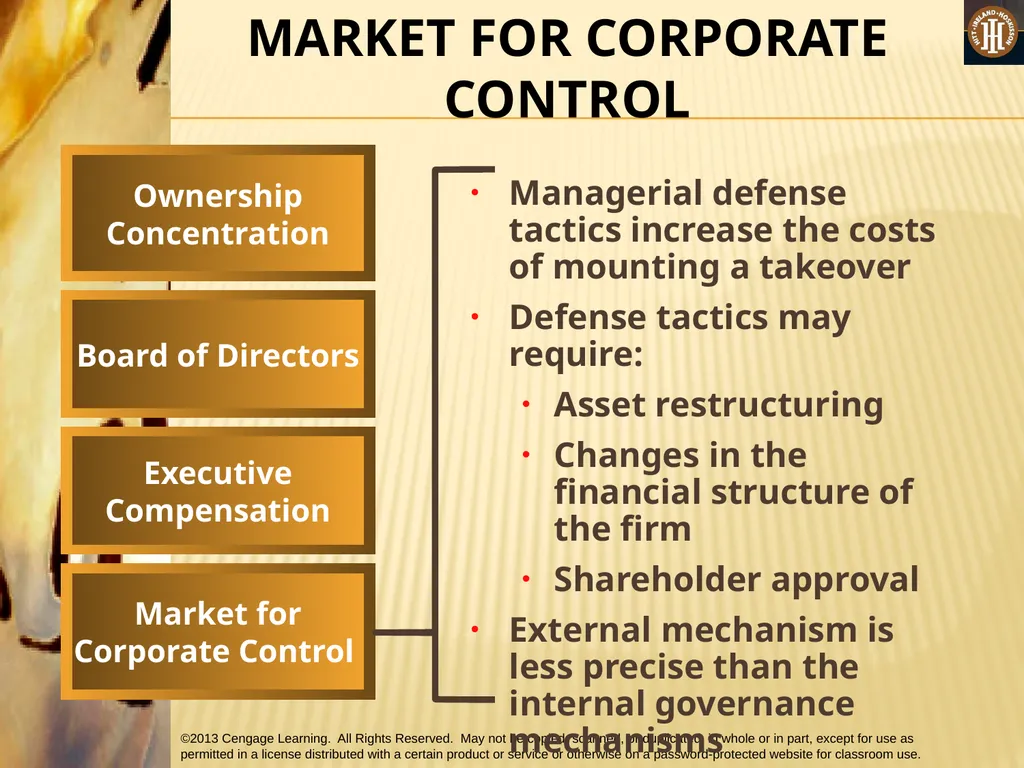
MARKET FOR CORPORATE CONTROL Managerial defense tactics increase the costs of mounting a takeover
Defense tactics may require:
Asset restructuring
Changes in the financial structure of the firm
Shareholder approval
External mechanism is less precise than the internal governance mechanisms<br>
Defense tactics may require:
Asset restructuring
Changes in the financial structure of the firm
Shareholder approval
External mechanism is less precise than the internal governance mechanisms<br>
47
HOSTILE TAKEOVER DEFENSE STRATEGIES TABLE 10.2
Hostile Takeover Defense Strategies<br>
Hostile Takeover Defense Strategies<br>
48
HOSTILE TAKEOVER DEFENSE STRATEGIES TABLE 10.2
Hostile Takeover Defense Strategies
(Cont’d)<br>
Hostile Takeover Defense Strategies
(Cont’d)<br>
49
INTERNATIONAL CORPORATE GOVERNANCE Corporate Governance in Germany
Concentration of ownership is strong
In many private German firms, the owner and manager may be the same individual
In these instances, agency problems are not present.
In publicly traded German corporations, a single shareholder is often dominant, frequently a bank
The concentration of ownership is an important means of corporate governance in Germany, as it is in the U.S.<br>
Concentration of ownership is strong
In many private German firms, the owner and manager may be the same individual
In these instances, agency problems are not present.
In publicly traded German corporations, a single shareholder is often dominant, frequently a bank
The concentration of ownership is an important means of corporate governance in Germany, as it is in the U.S.<br>
50
INTERNATIONAL CORPORATE GOVERNANCE Corporate Governance in Germany
Banks exercise significant power as a source of financing for firms.
Two-tiered board structures, required for larger employers (more than 2,000 employees), place responsibility for monitoring and controlling managerial decisions and actions with separate groups.
Power sharing includes representation from the community as well as unions.<br>
Banks exercise significant power as a source of financing for firms.
Two-tiered board structures, required for larger employers (more than 2,000 employees), place responsibility for monitoring and controlling managerial decisions and actions with separate groups.
Power sharing includes representation from the community as well as unions.<br>
51
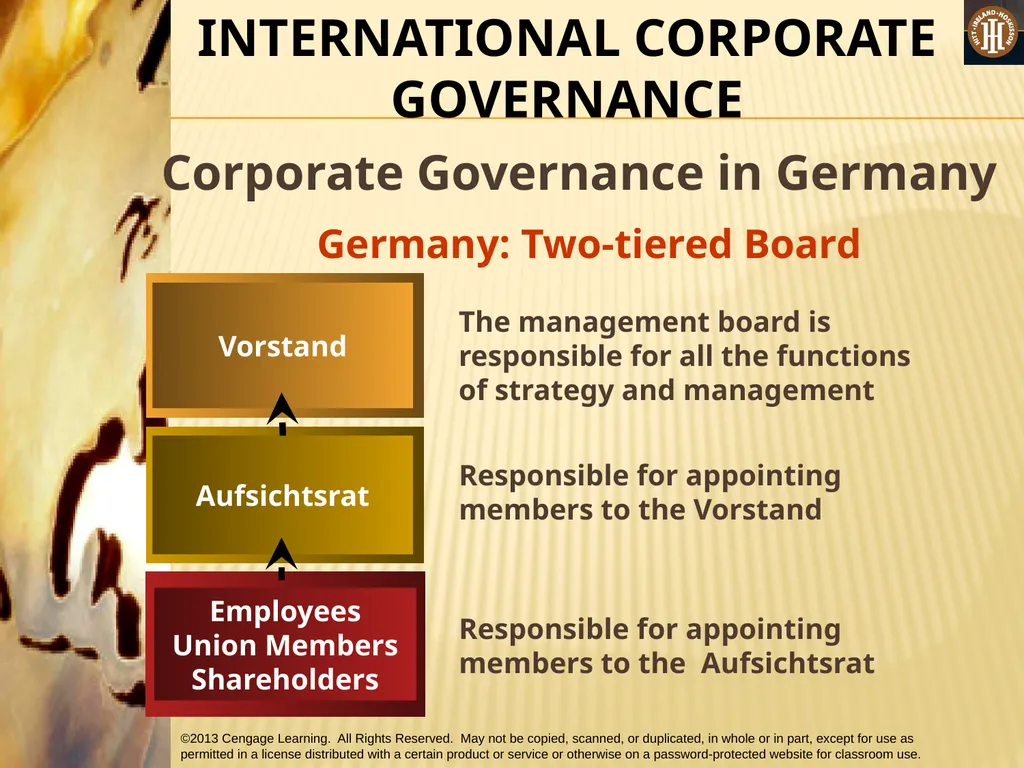
INTERNATIONAL CORPORATE GOVERNANCE Corporate Governance in Germany Germany: Two-tiered Board The management board is responsible for all the functions of strategy and management Responsible for appointing members to the Vorstand Responsible for appointing members to the Aufsichtsrat<br>
52
INTERNATIONAL CORPORATE GOVERNANCE Corporate Governance in Germany
● Proponents of the German structure suggest that it helps prevent corporate wrongdoing and rash decisions by “dictatorial CEOs”
● Critics maintain that it slows decision making and often ties a CEO’s hands
● The corporate governance practices in Germany make it difficult to restructure companies as quickly as in the U.S.
● Banks are powerful; private shareholders rarely have major ownership positions in German firms<br>
● Proponents of the German structure suggest that it helps prevent corporate wrongdoing and rash decisions by “dictatorial CEOs”
● Critics maintain that it slows decision making and often ties a CEO’s hands
● The corporate governance practices in Germany make it difficult to restructure companies as quickly as in the U.S.
● Banks are powerful; private shareholders rarely have major ownership positions in German firms<br>
53
INTERNATIONAL CORPORATE GOVERNANCE Corporate Governance in Germany
● Large institutional investors, e.g., pension funds and insurance companies, are also relatively insignificant owners of corporate stock
● Less emphasis on shareholder value
● This traditional system produced agency costs because of a lack of external ownership power
● Changes - German firms with listings on U.S. stock exchanges have increasingly adopted executive stock option compensation as a long-term incentive pay policy<br>
● Large institutional investors, e.g., pension funds and insurance companies, are also relatively insignificant owners of corporate stock
● Less emphasis on shareholder value
● This traditional system produced agency costs because of a lack of external ownership power
● Changes - German firms with listings on U.S. stock exchanges have increasingly adopted executive stock option compensation as a long-term incentive pay policy<br>
54
INTERNATIONAL CORPORATE GOVERNANCE Corporate Governance in Japan
● Cultural concepts of obligation, family, and consensus affect attitudes toward governance
● Close relationships between stakeholders and a company are manifested in cross-shareholding, and can negatively impact efficiencies
● Keiretsus: strongly interrelated groups of firms tied together by cross-shareholdings
● Banks (especially “main bank”) are highly influential with firm’s managers<br>
● Cultural concepts of obligation, family, and consensus affect attitudes toward governance
● Close relationships between stakeholders and a company are manifested in cross-shareholding, and can negatively impact efficiencies
● Keiretsus: strongly interrelated groups of firms tied together by cross-shareholdings
● Banks (especially “main bank”) are highly influential with firm’s managers<br>
55
INTERNATIONAL CORPORATE GOVERNANCE Corporate Governance in Japan
● Japan has a bank-based financial and corporate governance structure whereas the United States has a market-based financial and governance structure
● Banks play an important role in financing and monitoring large public firms
● Powerful government intervention
● Despite the counter-cultural nature of corporate takeovers, changes in corporate governance have introduced this practice<br>
● Japan has a bank-based financial and corporate governance structure whereas the United States has a market-based financial and governance structure
● Banks play an important role in financing and monitoring large public firms
● Powerful government intervention
● Despite the counter-cultural nature of corporate takeovers, changes in corporate governance have introduced this practice<br>
56
INTERNATIONAL CORPORATE GOVERNANCE Corporate Governance in Japan
Changes:
● Deregulation in the financial sector has reduced the cost of hostile takeovers, facilitating Japan’s previously nonexistent market for corporate control
● Diminishing role of banks monitoring and controlling managerial behavior, due to their development as economic organizations
● CEOs of both public and private companies receive similar levels of compensation, which is closely tied to observable performance goals<br>
Changes:
● Deregulation in the financial sector has reduced the cost of hostile takeovers, facilitating Japan’s previously nonexistent market for corporate control
● Diminishing role of banks monitoring and controlling managerial behavior, due to their development as economic organizations
● CEOs of both public and private companies receive similar levels of compensation, which is closely tied to observable performance goals<br>
57
INTERNATIONAL CORPORATE GOVERNANCE Corporate Governance in China
Changes:
● Major changes over the past decade
● Privatization of business and the development and integrity of equity market
● The stock markets in China remain young and underdeveloped; in their early years, they were weak because of significant insider trading, but with stronger governance these markets have improved
● The state dominates—directly or indirectly—the strategies that most firms employ<br>
Changes:
● Major changes over the past decade
● Privatization of business and the development and integrity of equity market
● The stock markets in China remain young and underdeveloped; in their early years, they were weak because of significant insider trading, but with stronger governance these markets have improved
● The state dominates—directly or indirectly—the strategies that most firms employ<br>
58
INTERNATIONAL CORPORATE GOVERNANCE Corporate Governance in China
● Firms with higher state ownership have lower market value and more volatility
● The state is imposing social goals on these firms and executives are not trying to maximize shareholder wealth
● Moving toward a Western-style model
● Chinese executives are being compensated based on the firm’s financial performance
● Much work remains if the governance of Chinese companies is to meet international and Western standards<br>
● Firms with higher state ownership have lower market value and more volatility
● The state is imposing social goals on these firms and executives are not trying to maximize shareholder wealth
● Moving toward a Western-style model
● Chinese executives are being compensated based on the firm’s financial performance
● Much work remains if the governance of Chinese companies is to meet international and Western standards<br>
59
INTERNATIONAL CORPORATE GOVERNANCE Global Corporate Governance Relatively uniform governance structures are evolving
These structures are moving closer to the U.S. corporate governance model
Although implementation is slower, merging with U.S. practices is occurring even in transitional economies<br>
These structures are moving closer to the U.S. corporate governance model
Although implementation is slower, merging with U.S. practices is occurring even in transitional economies<br>
60
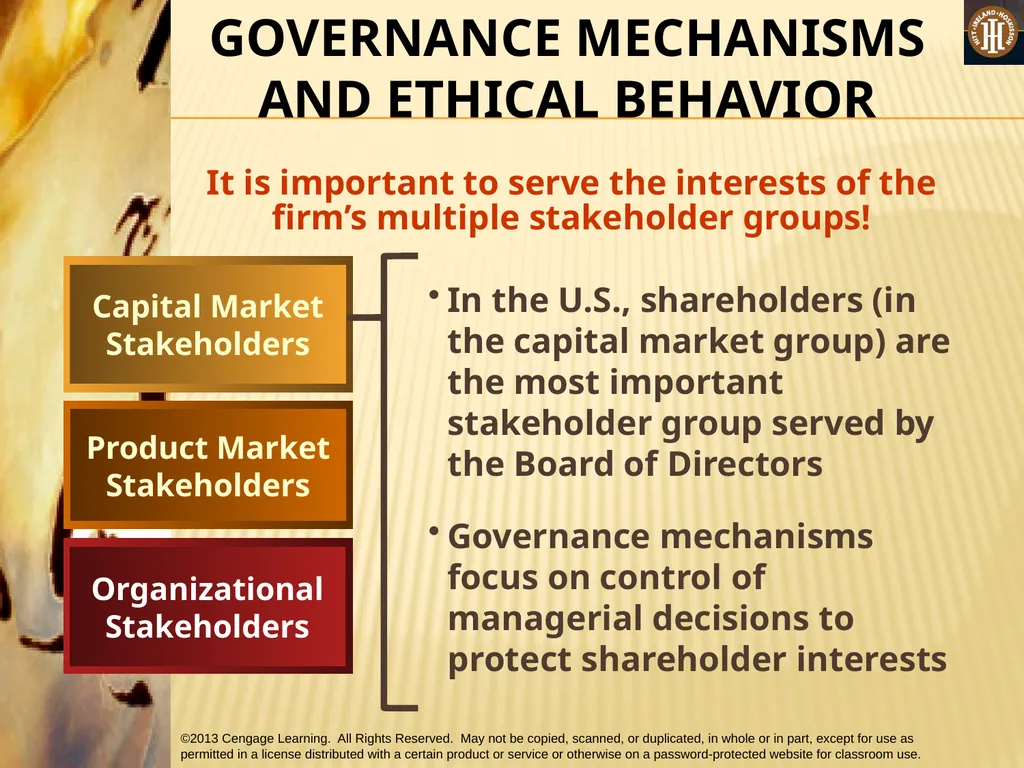
GOVERNANCE MECHANISMS AND ETHICAL BEHAVIOR It is important to serve the interests of the firm’s multiple stakeholder groups! In the U.S., shareholders (in the capital market group) are the most important stakeholder group served by the Board of Directors
Governance mechanisms focus on control of managerial decisions to protect shareholder interests<br>
Governance mechanisms focus on control of managerial decisions to protect shareholder interests<br>
61
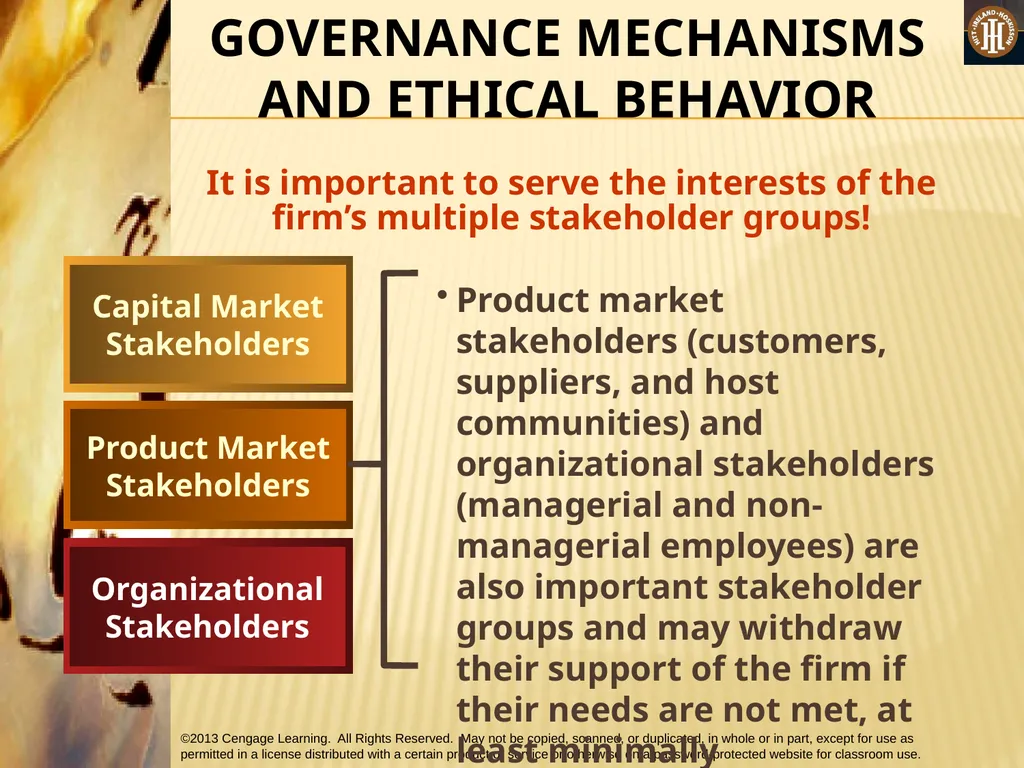
GOVERNANCE MECHANISMS AND ETHICAL BEHAVIOR It is important to serve the interests of the firm’s multiple stakeholder groups! Product market stakeholders (customers, suppliers, and host communities) and organizational stakeholders (managerial and non-managerial employees) are also important stakeholder groups and may withdraw their support of the firm if their needs are not met, at least minimally<br>
62
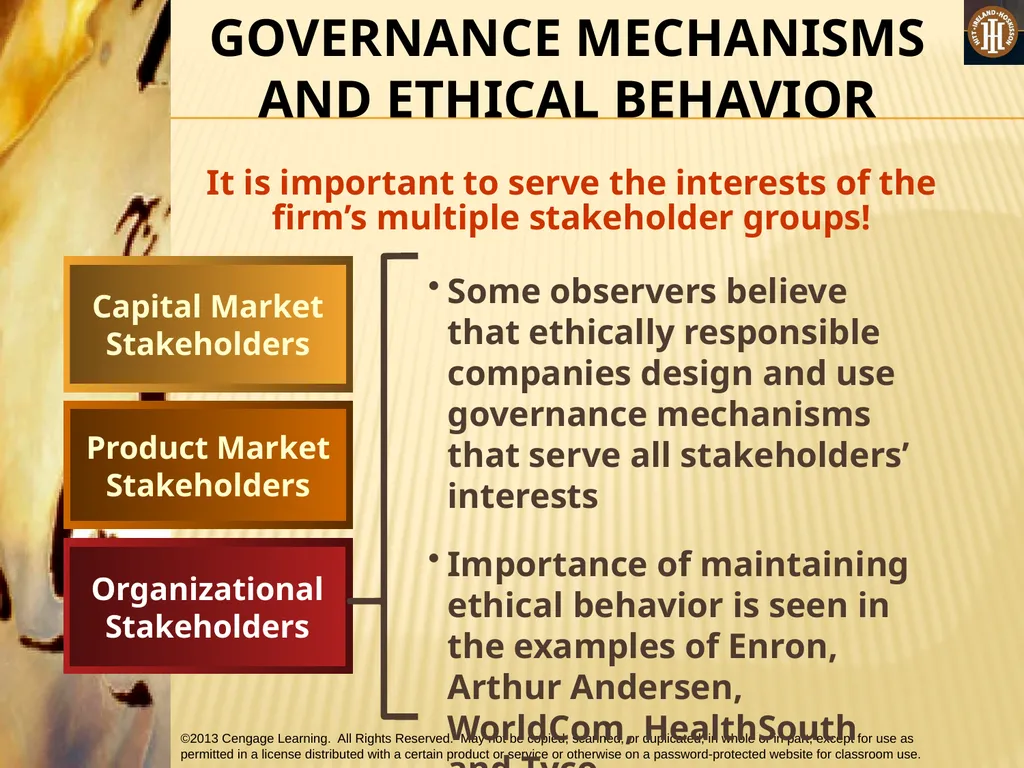
GOVERNANCE MECHANISMS AND ETHICAL BEHAVIOR It is important to serve the interests of the firm’s multiple stakeholder groups! Some observers believe that ethically responsible companies design and use governance mechanisms that serve all stakeholders’ interests
Importance of maintaining ethical behavior is seen in the examples of Enron, Arthur Andersen, WorldCom, HealthSouth and Tyco<br>
Importance of maintaining ethical behavior is seen in the examples of Enron, Arthur Andersen, WorldCom, HealthSouth and Tyco<br>
63
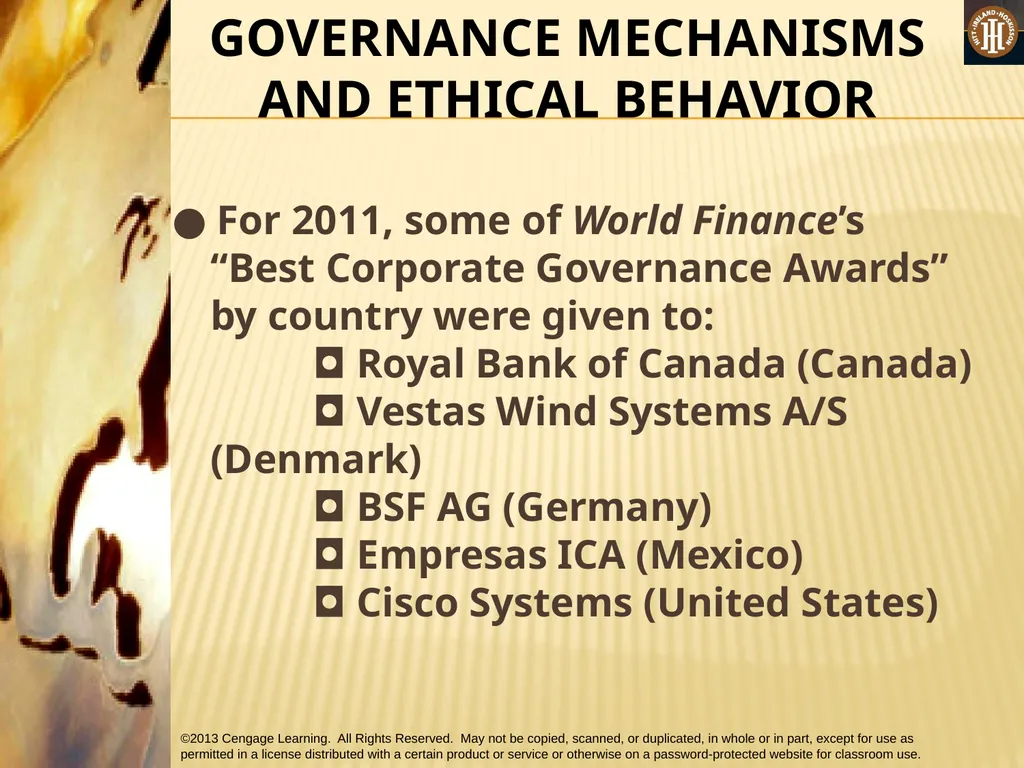
GOVERNANCE MECHANISMS AND ETHICAL BEHAVIOR ● For 2011, some of World Finance’s “Best Corporate Governance Awards” by country were given to:
◘ Royal Bank of Canada (Canada)
◘ Vestas Wind Systems A/S (Denmark)
◘ BSF AG (Germany)
◘ Empresas ICA (Mexico)
◘ Cisco Systems (United States)<br>
◘ Royal Bank of Canada (Canada)
◘ Vestas Wind Systems A/S (Denmark)
◘ BSF AG (Germany)
◘ Empresas ICA (Mexico)
◘ Cisco Systems (United States)<br>
64
GOVERNANCE MECHANISMS AND ETHICAL BEHAVIOR ● These awards are determined by analyzing a number of corporate governance issues:
◘ Board accountability/financial disclosure
◘ Executive compensation
◘ Shareholder rights
◘ Ownership base
◘ Takeover provisions
◘ Corporate behavior
◘ Overall responsibility exhibited by firm<br>
◘ Board accountability/financial disclosure
◘ Executive compensation
◘ Shareholder rights
◘ Ownership base
◘ Takeover provisions
◘ Corporate behavior
◘ Overall responsibility exhibited by firm<br>