
Part A REVIEW Review your current practices and


Description: Part A REVIEW Review your current practices and processes to ensure the foundations that underpin better practice are in place. This Playbook discusses better practice compliance monitoring inspections in two parts This Playbook outlines
Related Topics
Download Presentation
"Part A REVIEW Review your current practices and" is the property of its rightful owner. Permission is granted to download and print the materials on this website for personal, non-commercial use only, and to display it on your personal computer provided you do not modify the materials and that you retain all copyright notices contained in the materials. By downloading content from our website, you accept the terms of this agreement.
Presentation Transcript
slide1. Part A REVIEW
Review your current practices and processes to ensure the foundations that underpin better practice are in place.<br>
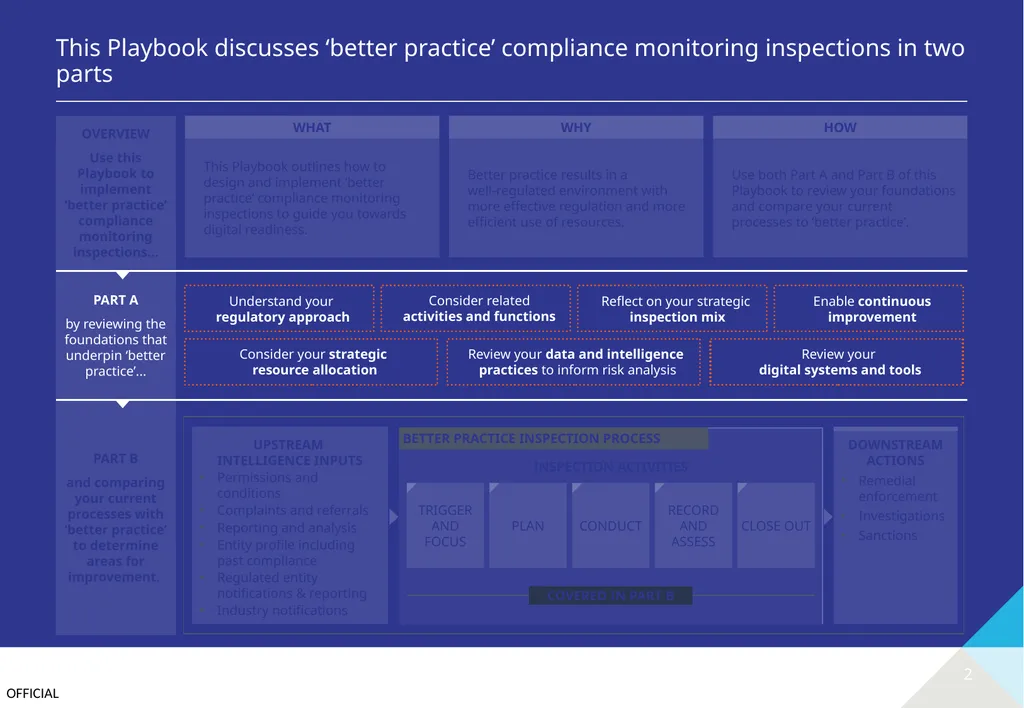
slide2. This Playbook discusses ‘better practice’ compliance monitoring inspections in two parts This Playbook outlines how to design and implement ‘better practice’ compliance monitoring inspections to guide you towards digital readiness. WHAT Better practice results in a well-regulated environment with more effective regulation and more efficient use of resources. WHY Use both Part A and Part B of this Playbook to review your foundations and compare your current processes to ‘better practice’. HOW Understand your regulatory approach Consider related activities and functions Reflect on your strategic inspection mix Consider your strategic resource allocation Review your data and intelligence practices to inform risk analysis Enable continuous improvement Review your digital systems and tools<br>
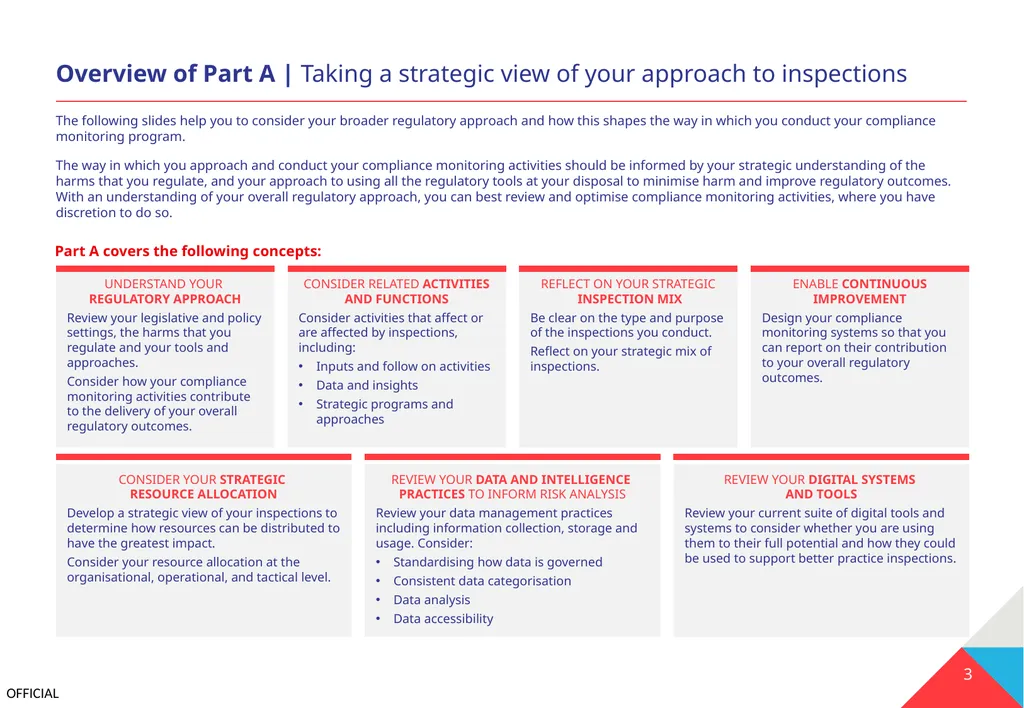
slide3. Overview of Part A | Taking a strategic view of your approach to inspections The following slides help you to consider your broader regulatory approach and how this shapes the way in which you conduct your compliance monitoring program.
The way in which you approach and conduct your compliance monitoring activities should be informed by your strategic understanding of the harms that you regulate, and your approach to using all the regulatory tools at your disposal to minimise harm and improve regulatory outcomes. With an understanding of your overall regulatory approach, you can best review and optimise compliance monitoring activities, where you have discretion to do so. UNDERSTAND YOUR REGULATORY APPROACH
Review your legislative and policy settings, the harms that you regulate and your tools and approaches.
Consider how your compliance monitoring activities contribute to the delivery of your overall regulatory outcomes. CONSIDER RELATED ACTIVITIES AND FUNCTIONS
Consider activities that affect or are affected by inspections, including:
Inputs and follow on activities
Data and insights
Strategic programs and approaches REFLECT ON YOUR STRATEGIC INSPECTION MIX
Be clear on the type and purpose of the inspections you conduct.
Reflect on your strategic mix of inspections. ENABLE CONTINUOUS IMPROVEMENT
Design your compliance monitoring systems so that you can report on their contribution to your overall regulatory outcomes. CONSIDER YOUR STRATEGIC RESOURCE ALLOCATION
Develop a strategic view of your inspections to determine how resources can be distributed to have the greatest impact.
Consider your resource allocation at the organisational, operational, and tactical level. REVIEW YOUR DATA AND INTELLIGENCE PRACTICES TO INFORM RISK ANALYSIS
Review your data management practices including information collection, storage and usage. Consider:
Standardising how data is governed
Consistent data categorisation
Data analysis
Data accessibility REVIEW YOUR DIGITAL SYSTEMS AND TOOLS
Review your current suite of digital tools and systems to consider whether you are using them to their full potential and how they could be used to support better practice inspections. Part A covers the following concepts:<br>
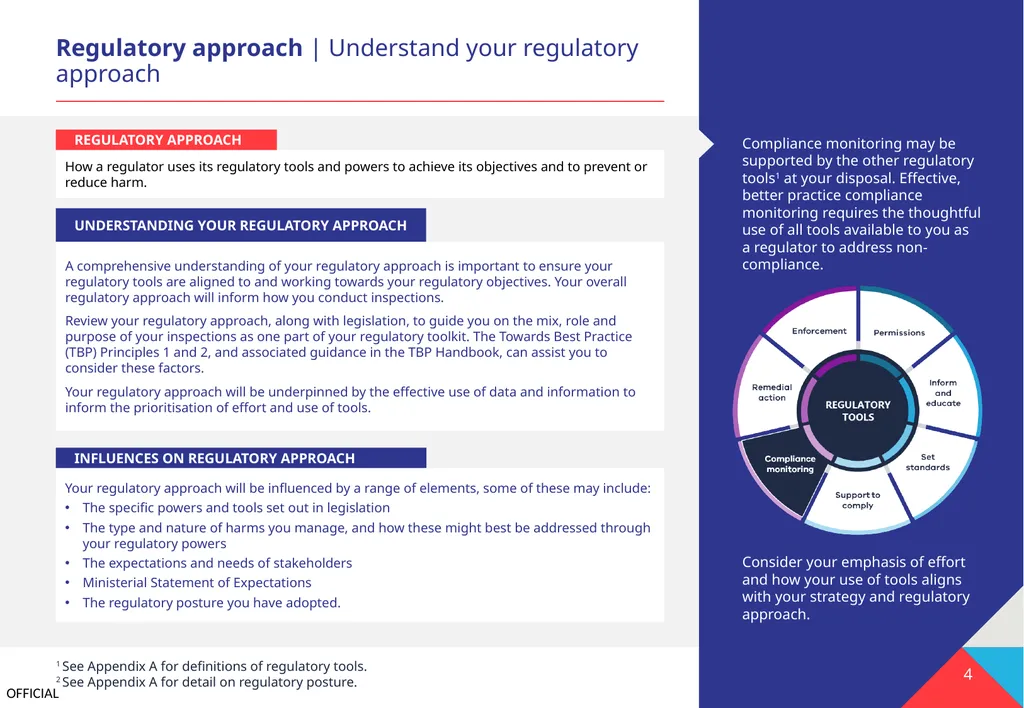
slide4. Regulatory approach | Understand your regulatory approach Compliance monitoring may be supported by the other regulatory tools1 at your disposal. Effective, better practice compliance monitoring requires the thoughtful use of all tools available to you as a regulator to address non-compliance. Consider your emphasis of effort and how your use of tools aligns with your strategy and regulatory approach. 1 See Appendix A for definitions of regulatory tools.
2 See Appendix A for detail on regulatory posture. How a regulator uses its regulatory tools and powers to achieve its objectives and to prevent or reduce harm. REGULATORY APPROACH A comprehensive understanding of your regulatory approach is important to ensure your regulatory tools are aligned to and working towards your regulatory objectives. Your overall regulatory approach will inform how you conduct inspections.
Review your regulatory approach, along with legislation, to guide you on the mix, role and purpose of your inspections as one part of your regulatory toolkit. The Towards Best Practice (TBP) Principles 1 and 2, and associated guidance in the TBP Handbook, can assist you to consider these factors.
Your regulatory approach will be underpinned by the effective use of data and information to inform the prioritisation of effort and use of tools. UNDERSTANDING YOUR REGULATORY APPROACH Your regulatory approach will be influenced by a range of elements, some of these may include:
The specific powers and tools set out in legislation
The type and nature of harms you manage, and how these might best be addressed through your regulatory powers
The expectations and needs of stakeholders
Ministerial Statement of Expectations
The regulatory posture you have adopted. INFLUENCES ON REGULATORY APPROACH<br>
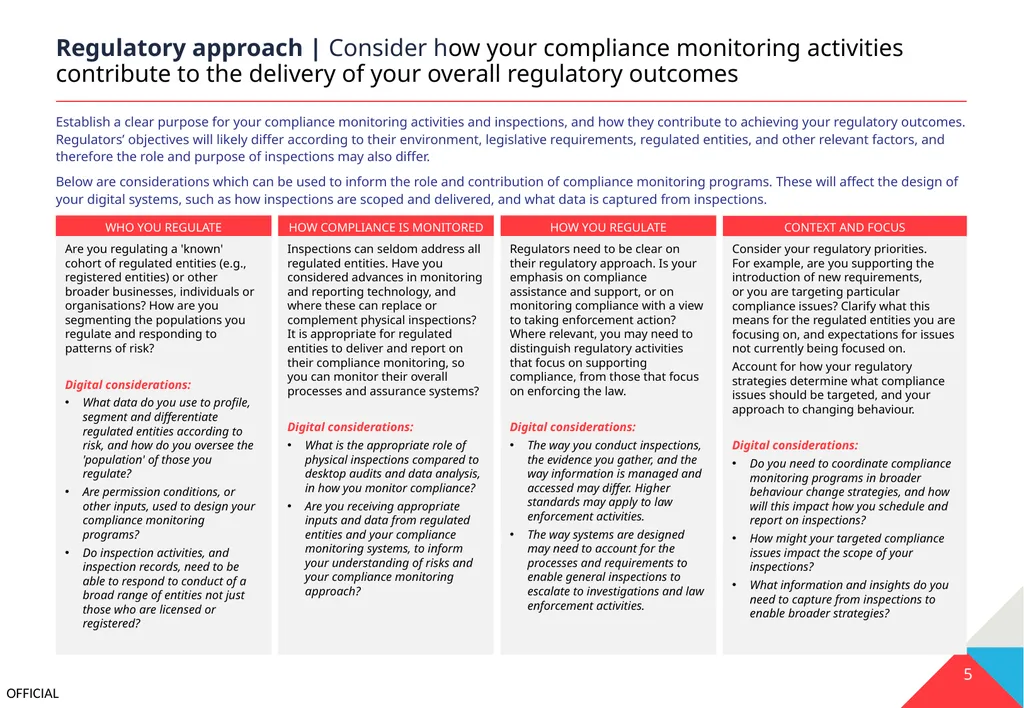
slide5. Regulatory approach | Consider how your compliance monitoring activities contribute to the delivery of your overall regulatory outcomes Establish a clear purpose for your compliance monitoring activities and inspections, and how they contribute to achieving your regulatory outcomes. Regulators’ objectives will likely differ according to their environment, legislative requirements, regulated entities, and other relevant factors, and therefore the role and purpose of inspections may also differ.
Below are considerations which can be used to inform the role and contribution of compliance monitoring programs. These will affect the design of your digital systems, such as how inspections are scoped and delivered, and what data is captured from inspections. Are you regulating a 'known' cohort of regulated entities (e.g., registered entities) or other broader businesses, individuals or organisations? How are you segmenting the populations you regulate and responding to patterns of risk?
Digital considerations:
What data do you use to profile, segment and differentiate regulated entities according to risk, and how do you oversee the 'population' of those you regulate?
Are permission conditions, or other inputs, used to design your compliance monitoring programs?
Do inspection activities, and inspection records, need to be able to respond to conduct of a broad range of entities not just those who are licensed or registered? WHO YOU REGULATE Inspections can seldom address all regulated entities. Have you considered advances in monitoring and reporting technology, and where these can replace or complement physical inspections? It is appropriate for regulated entities to deliver and report on their compliance monitoring, so you can monitor their overall processes and assurance systems?
Digital considerations:
What is the appropriate role of physical inspections compared to desktop audits and data analysis, in how you monitor compliance?
Are you receiving appropriate inputs and data from regulated entities and your compliance monitoring systems, to inform your understanding of risks and your compliance monitoring approach? HOW COMPLIANCE IS MONITORED Regulators need to be clear on their regulatory approach. Is your emphasis on compliance assistance and support, or on monitoring compliance with a view to taking enforcement action? Where relevant, you may need to distinguish regulatory activities that focus on supporting compliance, from those that focus on enforcing the law.
Digital considerations:
The way you conduct inspections, the evidence you gather, and the way information is managed and accessed may differ. Higher standards may apply to law enforcement activities.
The way systems are designed may need to account for the processes and requirements to enable general inspections to escalate to investigations and law enforcement activities. HOW YOU REGULATE Consider your regulatory priorities. For example, are you supporting the introduction of new requirements, or you are targeting particular compliance issues? Clarify what this means for the regulated entities you are focusing on, and expectations for issues not currently being focused on.
Account for how your regulatory strategies determine what compliance issues should be targeted, and your approach to changing behaviour.
Digital considerations:
Do you need to coordinate compliance monitoring programs in broader behaviour change strategies, and how will this impact how you schedule and report on inspections?
How might your targeted compliance issues impact the scope of your inspections?
What information and insights do you need to capture from inspections to enable broader strategies? CONTEXT AND FOCUS<br>
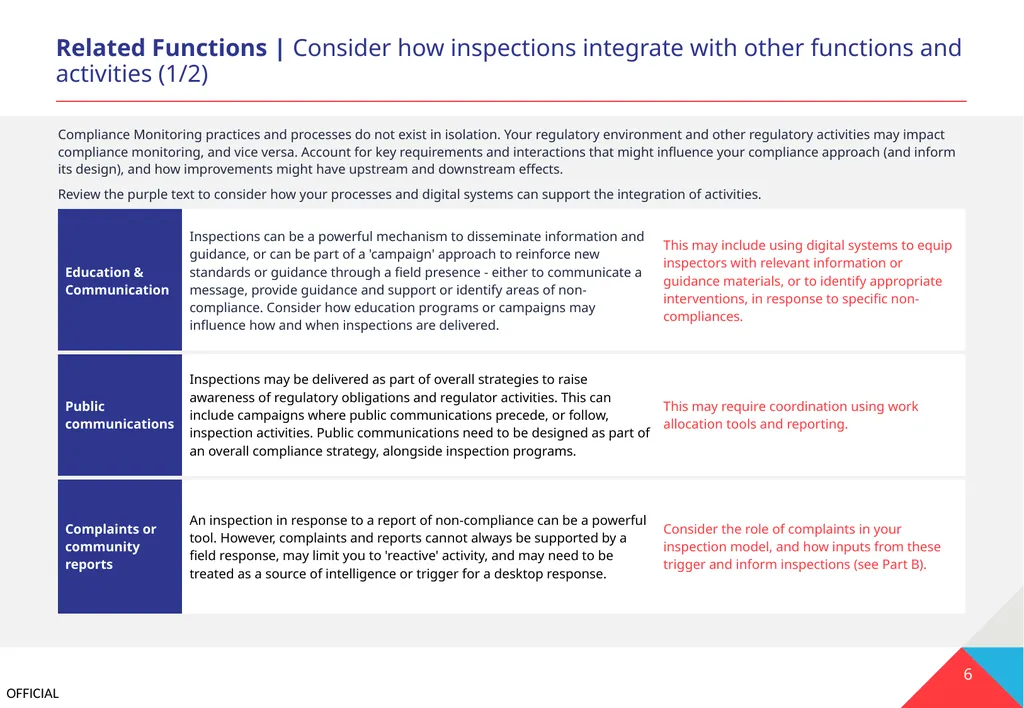
slide6. Compliance Monitoring practices and processes do not exist in isolation. Your regulatory environment and other regulatory activities may impact compliance monitoring, and vice versa. Account for key requirements and interactions that might influence your compliance approach (and inform its design), and how improvements might have upstream and downstream effects.
Review the purple text to consider how your processes and digital systems can support the integration of activities. Related Functions | Consider how inspections integrate with other functions and activities (1/2)<br>
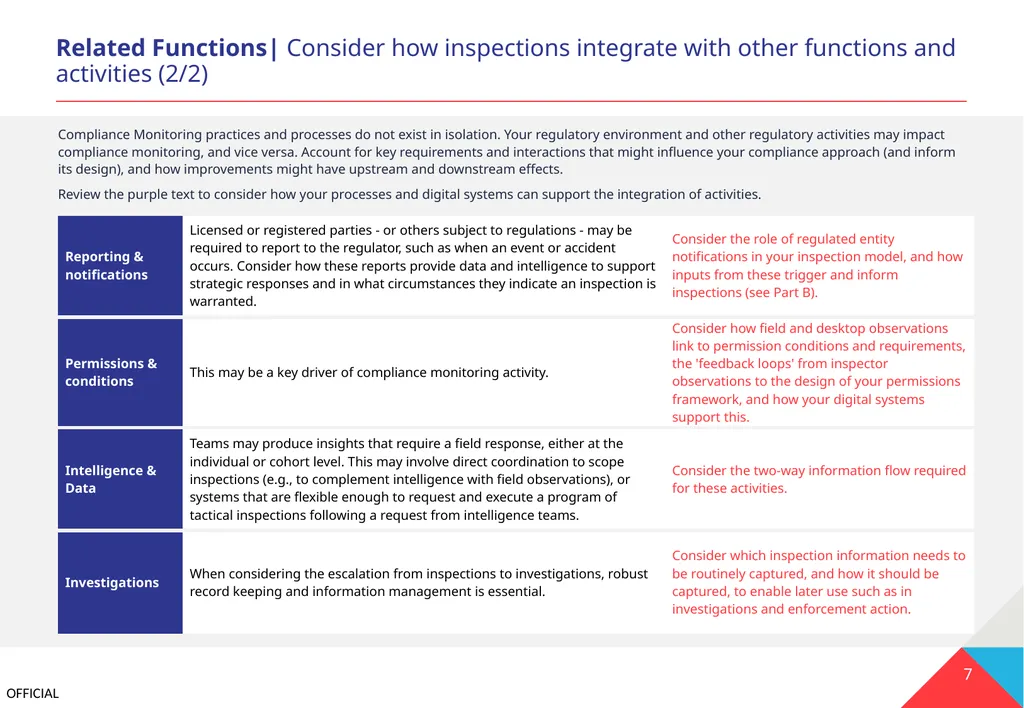
slide7. Related Functions| Consider how inspections integrate with other functions and activities (2/2) Compliance Monitoring practices and processes do not exist in isolation. Your regulatory environment and other regulatory activities may impact compliance monitoring, and vice versa. Account for key requirements and interactions that might influence your compliance approach (and inform its design), and how improvements might have upstream and downstream effects.
Review the purple text to consider how your processes and digital systems can support the integration of activities.<br>
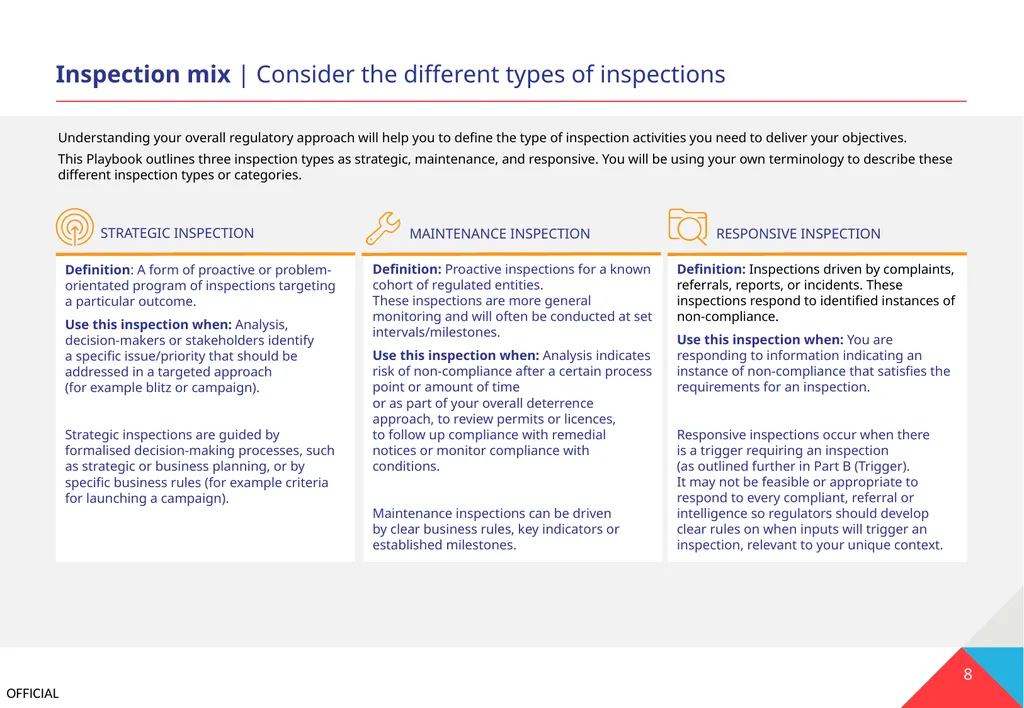
slide8. Inspection mix | Consider the different types of inspections Understanding your overall regulatory approach will help you to define the type of inspection activities you need to deliver your objectives.
This Playbook outlines three inspection types as strategic, maintenance, and responsive. You will be using your own terminology to describe these different inspection types or categories. Definition: A form of proactive or problem-orientated program of inspections targeting a particular outcome.
Use this inspection when: Analysis, decision-makers or stakeholders identify a specific issue/priority that should be addressed in a targeted approach (for example blitz or campaign).
Strategic inspections are guided by formalised decision-making processes, such as strategic or business planning, or by specific business rules (for example criteria for launching a campaign). Definition: Proactive inspections for a known cohort of regulated entities. These inspections are more general monitoring and will often be conducted at set intervals/milestones.
Use this inspection when: Analysis indicates risk of non-compliance after a certain process point or amount of time or as part of your overall deterrence approach, to review permits or licences, to follow up compliance with remedial notices or monitor compliance with conditions.
Maintenance inspections can be driven by clear business rules, key indicators or established milestones. Definition: Inspections driven by complaints, referrals, reports, or incidents. These inspections respond to identified instances of non-compliance.
Use this inspection when: You are responding to information indicating an instance of non-compliance that satisfies the requirements for an inspection.
Responsive inspections occur when there is a trigger requiring an inspection (as outlined further in Part B (Trigger). It may not be feasible or appropriate to respond to every compliant, referral or intelligence so regulators should develop clear rules on when inputs will trigger an inspection, relevant to your unique context. STRATEGIC INSPECTION MAINTENANCE INSPECTION RESPONSIVE INSPECTION<br>
slide9. Inspection mix | Reflect on your current mix of inspections and whether it suits your regulatory approach Note: Not all inspection types may be required in your inspection mix and an even distribution across inspection types may not reflect your regulatory approach. You should consider the value added by each inspection type proportionate to the effort required to undertake the activity. 1 These types of inspection are described in detail in subsequent slides. Different types of inspections are used by regulators for different purposes and to achieve different objectives. Inspections might be Strategic, Maintenance or Responsive Inspections1 and might have an educative or directive purpose. Take a critical look at your current mix of inspections to ensure it aligns with your regulatory strategy and overall approach.
Consider your types of inspections, the outcomes they achieve, and whether they are appropriately resourced in line with your regulatory approach. You will need to balance resource allocation, depth of inspections, and the mixture of general and specialist capabilities applied to inspections. Your regulatory approach will also communicate when decisions to focus in one area (e.g., more attention to higher-risk sites) will affect another (e.g. a higher volume of lower-risk sites) and this will be reflected in your inspection mix.
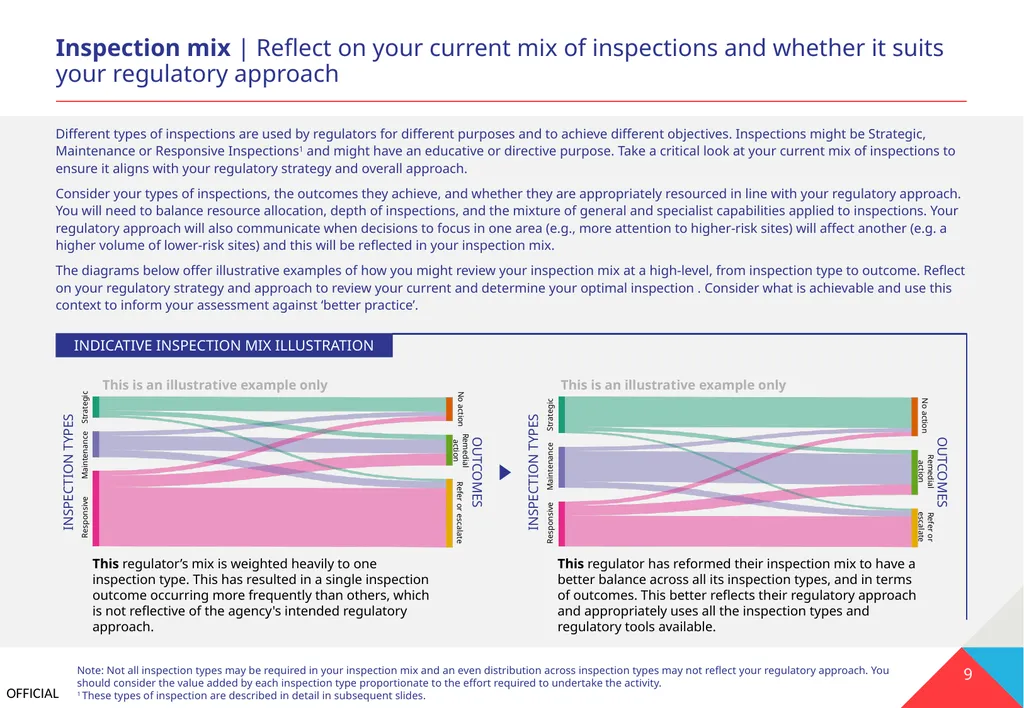
The diagrams below offer illustrative examples of how you might review your inspection mix at a high-level, from inspection type to outcome. Reflect on your regulatory strategy and approach to review your current and determine your optimal inspection . Consider what is achievable and use this context to inform your assessment against ‘better practice’. INSPECTION TYPES OUTCOMES INSPECTION TYPES OUTCOMES This regulator’s mix is weighted heavily to one inspection type. This has resulted in a single inspection outcome occurring more frequently than others, which is not reflective of the agency's intended regulatory approach. This regulator has reformed their inspection mix to have a better balance across all its inspection types, and in terms of outcomes. This better reflects their regulatory approach and appropriately uses all the inspection types and regulatory tools available. Strategic Maintenance Responsive Strategic Maintenance Responsive No action Remedial action Refer or escalate No action Remedial action Refer or escalate This is an illustrative example only This is an illustrative example only<br>
slide10. Continuous Improvement | Design your digital systems so you can report on the contribution of your inspections to regulatory outcomes measuring end-to-end compliance monitoring activities
While you may measure the rate of an activity (e.g., the percentage of complaints responded to), you should also assess the connections and relationships between your activities. For example, to build an informed view you might measure:
the percentage of complaints responded to,
the percentage of those complaints that led to the detection of non-compliance, and
the percentage of non-compliance that you responded to and what the impact of that response was.
Your regulatory systems should support you in making and reporting on these connections. Digitisation provides an opportunity to improve how you monitor and report on your compliance monitoring activities.
In doing so, you should reflect on and measure how well your end-to-end compliance monitoring activities work together and collectively support you to achieve your objectives.
This could include gathering measures to help you answer:
Whether you have the right mix of inspection types and what is the optimal mix for your regulatory environment
How each type of inspection is being conducted and is performing in terms of contributing to your regulatory objectives
Whether appropriate decisions are being made in the field in response to non-compliance, and how risk is being applied in officer decision-making
How inspections connect to 'upstream' activities (such as complaints) and 'downstream' activities (such as enforcement), including the flow or throughput of work across functions. IMPROVING YOUR COMPLIANCE MONITORING ACTIVITIES Digital platforms should support holistic performance reporting.
When building a system to support better practice inspection processes, it is important that data is captured to support performance measurement and reporting. Being conscious of what types of data to capture and when to collect it helps you to report on the performance of different types of inspections and adjust to achieve the optimal the mix of inspections types over time.
Better practice performance reporting considers how your end-to-end compliance monitoring processes work together to minimise harms. PERFORMANCE REPORTING 3 See Appendix A for model inspection measures.<br>
slide11. Resources | Consider your resourcing at three levels Regulators can take a strategic view of their inspections to determine how resources can be distributed to have the greatest impact.
Consider your resource allocation at three key levels – organisational, operational, and tactical. The levels are interconnected, and all levels should be reviewed to identify the balance that best supports you to prevent and respond to non-compliance, targeting effort proportionate to risk and achievement of regulatory objectives.
Note that the organisational level is expected to have been considered before reading this Playbook. 11 Tool 1: Regulators can review their operational resource allocation using the tool provided to test scenarios and identify the best allocation of resources, see Tool 1.<br>
slide12. Tool 1 | Adopt an approach to strategic resource allocation tool This tool enables regulators to strategically plan how they allocate their resources across different types of inspections, and what trade-offs exist between inspection activities and resourcing.
PURPOSE
The strategic resource allocation tool provides a strategic view of resource allocation and inspection activities. It enables regulators to:
obtain the insights and inputs to inform strategic planning, including trade-offs in terms of activity volumes
think strategically about how they allocate capacity across their compliance inspection types, and their desired mix of activities
consider the appropriate number of resources required to meet their compliance objectives.
HOW IT WORKS
Please refer to the instructions provided within the tool.
This tool supports regulators to test scenarios and determine the best mix of inspections. Included is three steps:
Provide your activity and resourcing inputs
Set your compliance mix by allocating capacity across inspection categories
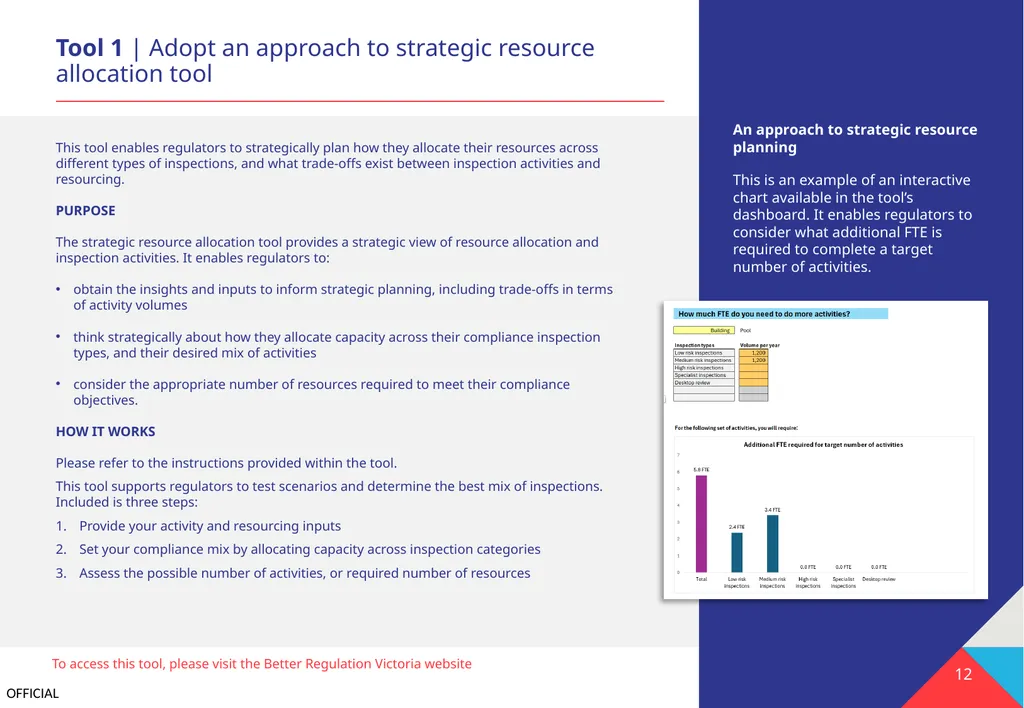
Assess the possible number of activities, or required number of resources An approach to strategic resource planning
This is an example of an interactive chart available in the tool’s dashboard. It enables regulators to consider what additional FTE is required to complete a target number of activities. To access this tool, please visit the Better Regulation Victoria website<br>
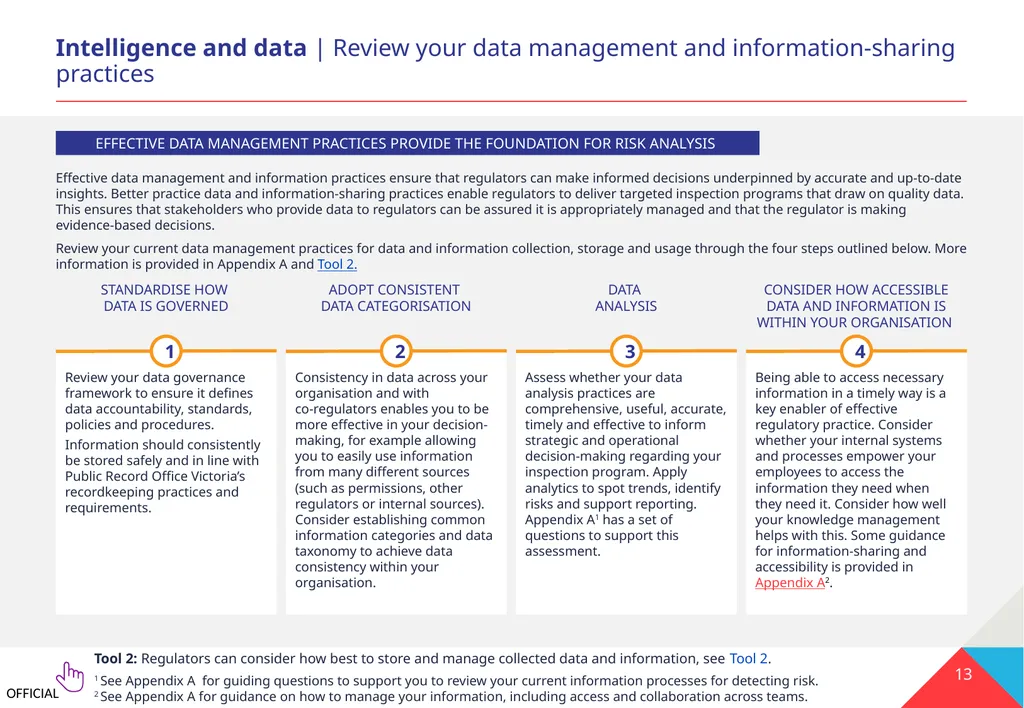
slide13. Effective data management and information practices ensure that regulators can make informed decisions underpinned by accurate and up-to-date insights. Better practice data and information-sharing practices enable regulators to deliver targeted inspection programs that draw on quality data. This ensures that stakeholders who provide data to regulators can be assured it is appropriately managed and that the regulator is making evidence-based decisions.
Review your current data management practices for data and information collection, storage and usage through the four steps outlined below. More information is provided in Appendix A and Tool 2. Intelligence and data | Review your data management and information-sharing practices Tool 2: Regulators can consider how best to store and manage collected data and information, see Tool 2.
1 See Appendix A for guiding questions to support you to review your current information processes for detecting risk.
2 See Appendix A for guidance on how to manage your information, including access and collaboration across teams. EFFECTIVE DATA MANAGEMENT PRACTICES PROVIDE THE FOUNDATION FOR RISK ANALYSIS Review your data governance framework to ensure it defines data accountability, standards, policies and procedures.
Information should consistently be stored safely and in line with Public Record Office Victoria’s recordkeeping practices and requirements. STANDARDISE HOW DATA IS GOVERNED Consistency in data across your organisation and with co-regulators enables you to be more effective in your decision-making, for example allowing you to easily use information from many different sources (such as permissions, other regulators or internal sources). Consider establishing common information categories and data taxonomy to achieve data consistency within your organisation. ADOPT CONSISTENT DATA CATEGORISATION Assess whether your data analysis practices are comprehensive, useful, accurate, timely and effective to inform strategic and operational decision-making regarding your inspection program. Apply analytics to spot trends, identify risks and support reporting. Appendix A1 has a set of questions to support this assessment. DATA ANALYSIS Being able to access necessary information in a timely way is a key enabler of effective regulatory practice. Consider whether your internal systems and processes empower your employees to access the information they need when they need it. Consider how well your knowledge management helps with this. Some guidance for information-sharing and accessibility is provided in Appendix A2. CONSIDER HOW ACCESSIBLE DATA AND INFORMATION IS WITHIN YOUR ORGANISATION 1 4 3 2<br>
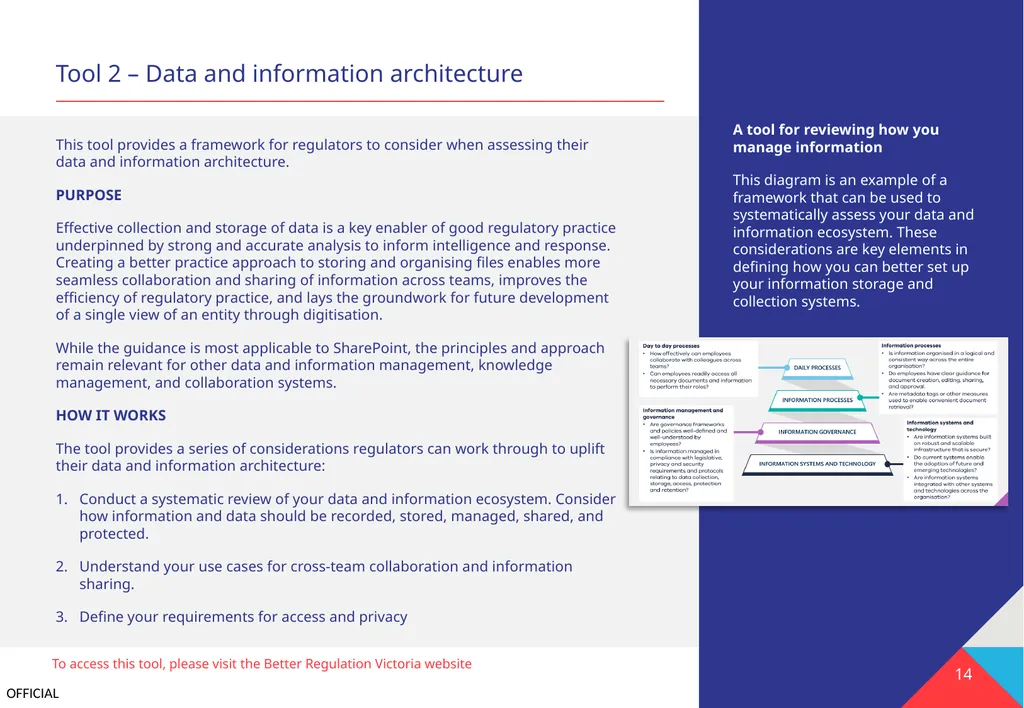
slide14. Tool 2 – Data and information architecture This tool provides a framework for regulators to consider when assessing their data and information architecture.
PURPOSE
Effective collection and storage of data is a key enabler of good regulatory practice underpinned by strong and accurate analysis to inform intelligence and response. Creating a better practice approach to storing and organising files enables more seamless collaboration and sharing of information across teams, improves the efficiency of regulatory practice, and lays the groundwork for future development of a single view of an entity through digitisation.
While the guidance is most applicable to SharePoint, the principles and approach remain relevant for other data and information management, knowledge management, and collaboration systems.
HOW IT WORKS
The tool provides a series of considerations regulators can work through to uplift their data and information architecture:
Conduct a systematic review of your data and information ecosystem. Consider how information and data should be recorded, stored, managed, shared, and protected.
Understand your use cases for cross-team collaboration and information sharing.
Define your requirements for access and privacy A tool for reviewing how you manage information
This diagram is an example of a framework that can be used to systematically assess your data and information ecosystem. These considerations are key elements in defining how you can better set up your information storage and collection systems. To access this tool, please visit the Better Regulation Victoria website<br>
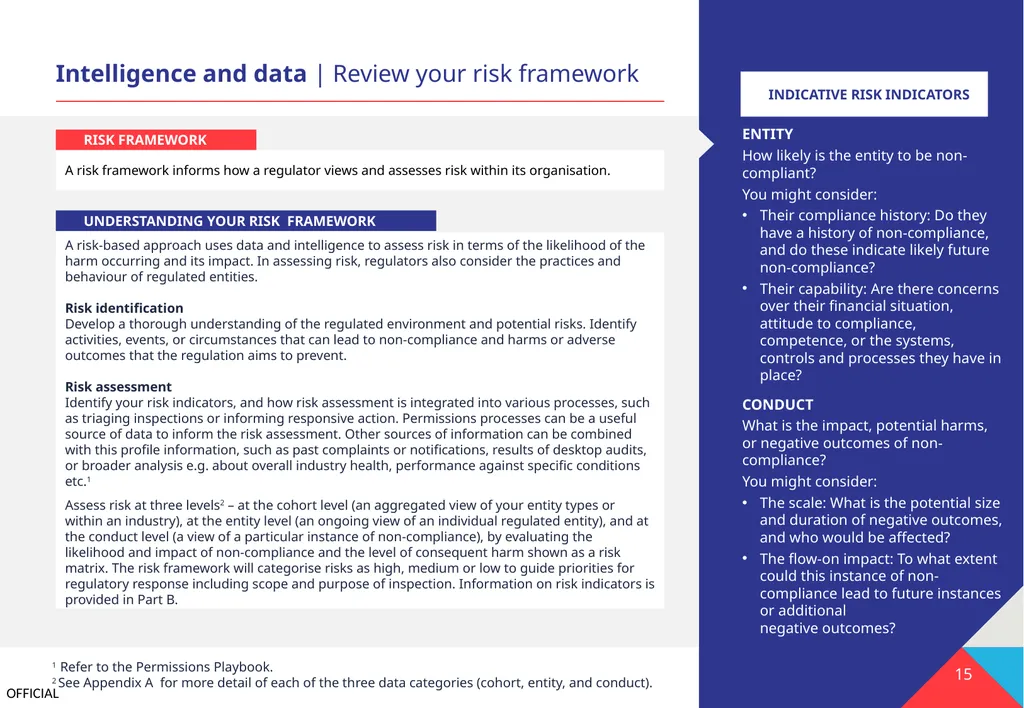
slide15. Intelligence and data | Review your risk framework ENTITY
How likely is the entity to be non-compliant?
You might consider:
Their compliance history: Do they have a history of non-compliance, and do these indicate likely future non-compliance?
Their capability: Are there concerns over their financial situation, attitude to compliance, competence, or the systems, controls and processes they have in place?
CONDUCT
What is the impact, potential harms, or negative outcomes of non-compliance?
You might consider:
The scale: What is the potential size and duration of negative outcomes, and who would be affected?
The flow-on impact: To what extent could this instance of non-compliance lead to future instances or additional negative outcomes? A risk framework informs how a regulator views and assesses risk within its organisation. RISK FRAMEWORK A risk-based approach uses data and intelligence to assess risk in terms of the likelihood of the harm occurring and its impact. In assessing risk, regulators also consider the practices and behaviour of regulated entities.
Risk identification
Develop a thorough understanding of the regulated environment and potential risks. Identify activities, events, or circumstances that can lead to non-compliance and harms or adverse outcomes that the regulation aims to prevent.
Risk assessment
Identify your risk indicators, and how risk assessment is integrated into various processes, such as triaging inspections or informing responsive action. Permissions processes can be a useful source of data to inform the risk assessment. Other sources of information can be combined with this profile information, such as past complaints or notifications, results of desktop audits, or broader analysis e.g. about overall industry health, performance against specific conditions etc.1
Assess risk at three levels2 – at the cohort level (an aggregated view of your entity types or within an industry), at the entity level (an ongoing view of an individual regulated entity), and at the conduct level (a view of a particular instance of non-compliance), by evaluating the likelihood and impact of non-compliance and the level of consequent harm shown as a risk matrix. The risk framework will categorise risks as high, medium or low to guide priorities for regulatory response including scope and purpose of inspection. Information on risk indicators is provided in Part B. UNDERSTANDING YOUR RISK FRAMEWORK INDICATIVE RISK INDICATORS 1 Refer to the Permissions Playbook.
2 See Appendix A for more detail of each of the three data categories (cohort, entity, and conduct).<br>
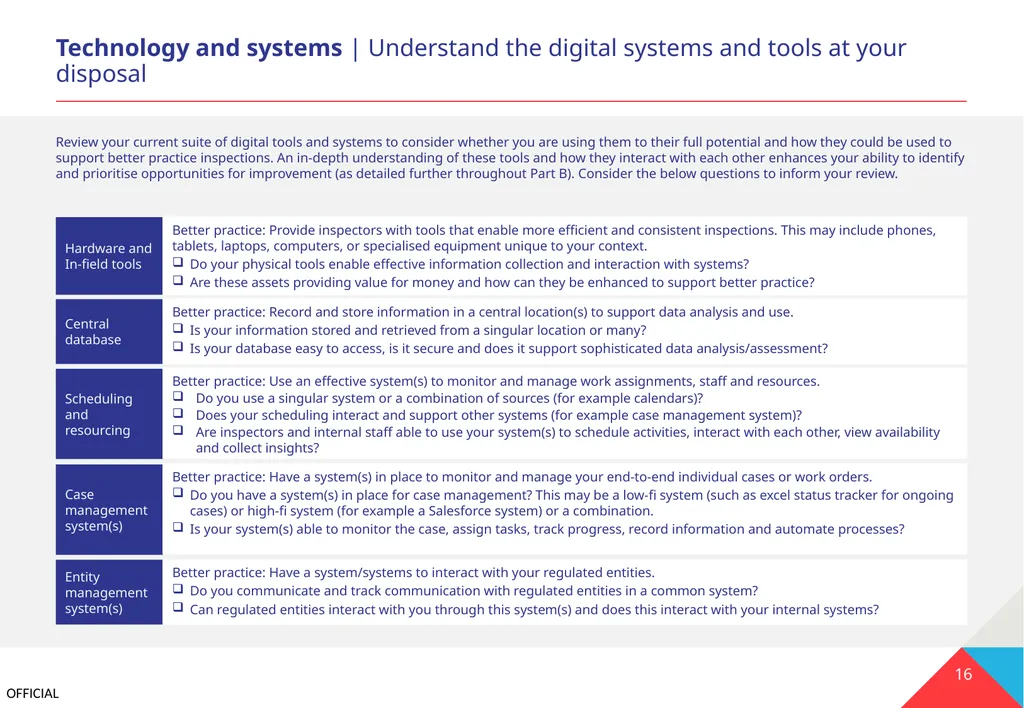
slide16. Technology and systems | Understand the digital systems and tools at your disposal Review your current suite of digital tools and systems to consider whether you are using them to their full potential and how they could be used to support better practice inspections. An in-depth understanding of these tools and how they interact with each other enhances your ability to identify and prioritise opportunities for improvement (as detailed further throughout Part B). Consider the below questions to inform your review. Central database Case management system(s) Hardware and In-field tools Better practice: Provide inspectors with tools that enable more efficient and consistent inspections. This may include phones, tablets, laptops, computers, or specialised equipment unique to your context.
Do your physical tools enable effective information collection and interaction with systems?
Are these assets providing value for money and how can they be enhanced to support better practice? Better practice: Record and store information in a central location(s) to support data analysis and use.
Is your information stored and retrieved from a singular location or many?
Is your database easy to access, is it secure and does it support sophisticated data analysis/assessment? Better practice: Have a system(s) in place to monitor and manage your end-to-end individual cases or work orders.
Do you have a system(s) in place for case management? This may be a low-fi system (such as excel status tracker for ongoing cases) or high-fi system (for example a Salesforce system) or a combination.
Is your system(s) able to monitor the case, assign tasks, track progress, record information and automate processes? Entity management system(s) Better practice: Have a system/systems to interact with your regulated entities.
Do you communicate and track communication with regulated entities in a common system?
Can regulated entities interact with you through this system(s) and does this interact with your internal systems? Scheduling and resourcing Better practice: Use an effective system(s) to monitor and manage work assignments, staff and resources.
Do you use a singular system or a combination of sources (for example calendars)?
Does your scheduling interact and support other systems (for example case management system)?
Are inspectors and internal staff able to use your system(s) to schedule activities, interact with each other, view availability and collect insights?<br>
slide17. Pause and reflect | Summary of Part A – getting the foundations in place Part A supports you to ensure your regulatory foundations are in place. Use this understanding to inform your view of better practice and identify opportunities for improvement.
Review the below to reflect on Part A and ensure your understanding before moving to Part B. FOUNDATIONS THAT UNDERPIN ‘BETTER PRACTICE’ INCLUDE… Do you have a deep understanding of your regulatory approach which you can use to guide better practice inspections? Does your compliance monitoring program reflect the regulatory approach? Does your process and approach support continuous improvement? Are you clear on your mix of inspections and your business rules that guide the selection of different inspection types? Does your mix of inspections reflect the trade offs articulated in your regulatory approach? Does your approach to resourcing and to risk support and inform better practice inspections and reflect your regulatory approach? Do you have the right balance of resources across your functions to address risks? Have you optimised your Information and data management processes and digital systems to support inspection processes and measure the effectiveness of your compliance monitoring program. Outline your current compliance monitoring processes from upstream to downstream to create a comparison for better practice (Part B). DIGITAL READINESS MEANS… You use your current digital tools to their full ability to create efficient workflows and reduce manual involvement. You have defined business rules where relevant to support digital workflows and potential automation. You use and categorise information effectively, with business rules for how intelligence informs risk assessment to provide the basis of triaging and resource allocation. You have a detailed understanding of your compliance processes, considering how systems interact with each other to design digital process flows. You have defined priorities for digital reform in your inspection process, highlighting the most beneficial opportunities for the required resources.<br>
Review your current practices and processes to ensure the foundations that underpin better practice are in place.<br>
slide2. This Playbook discusses ‘better practice’ compliance monitoring inspections in two parts This Playbook outlines how to design and implement ‘better practice’ compliance monitoring inspections to guide you towards digital readiness. WHAT Better practice results in a well-regulated environment with more effective regulation and more efficient use of resources. WHY Use both Part A and Part B of this Playbook to review your foundations and compare your current processes to ‘better practice’. HOW Understand your regulatory approach Consider related activities and functions Reflect on your strategic inspection mix Consider your strategic resource allocation Review your data and intelligence practices to inform risk analysis Enable continuous improvement Review your digital systems and tools<br>
slide3. Overview of Part A | Taking a strategic view of your approach to inspections The following slides help you to consider your broader regulatory approach and how this shapes the way in which you conduct your compliance monitoring program.
The way in which you approach and conduct your compliance monitoring activities should be informed by your strategic understanding of the harms that you regulate, and your approach to using all the regulatory tools at your disposal to minimise harm and improve regulatory outcomes. With an understanding of your overall regulatory approach, you can best review and optimise compliance monitoring activities, where you have discretion to do so. UNDERSTAND YOUR REGULATORY APPROACH
Review your legislative and policy settings, the harms that you regulate and your tools and approaches.
Consider how your compliance monitoring activities contribute to the delivery of your overall regulatory outcomes. CONSIDER RELATED ACTIVITIES AND FUNCTIONS
Consider activities that affect or are affected by inspections, including:
Inputs and follow on activities
Data and insights
Strategic programs and approaches REFLECT ON YOUR STRATEGIC INSPECTION MIX
Be clear on the type and purpose of the inspections you conduct.
Reflect on your strategic mix of inspections. ENABLE CONTINUOUS IMPROVEMENT
Design your compliance monitoring systems so that you can report on their contribution to your overall regulatory outcomes. CONSIDER YOUR STRATEGIC RESOURCE ALLOCATION
Develop a strategic view of your inspections to determine how resources can be distributed to have the greatest impact.
Consider your resource allocation at the organisational, operational, and tactical level. REVIEW YOUR DATA AND INTELLIGENCE PRACTICES TO INFORM RISK ANALYSIS
Review your data management practices including information collection, storage and usage. Consider:
Standardising how data is governed
Consistent data categorisation
Data analysis
Data accessibility REVIEW YOUR DIGITAL SYSTEMS AND TOOLS
Review your current suite of digital tools and systems to consider whether you are using them to their full potential and how they could be used to support better practice inspections. Part A covers the following concepts:<br>
slide4. Regulatory approach | Understand your regulatory approach Compliance monitoring may be supported by the other regulatory tools1 at your disposal. Effective, better practice compliance monitoring requires the thoughtful use of all tools available to you as a regulator to address non-compliance. Consider your emphasis of effort and how your use of tools aligns with your strategy and regulatory approach. 1 See Appendix A for definitions of regulatory tools.
2 See Appendix A for detail on regulatory posture. How a regulator uses its regulatory tools and powers to achieve its objectives and to prevent or reduce harm. REGULATORY APPROACH A comprehensive understanding of your regulatory approach is important to ensure your regulatory tools are aligned to and working towards your regulatory objectives. Your overall regulatory approach will inform how you conduct inspections.
Review your regulatory approach, along with legislation, to guide you on the mix, role and purpose of your inspections as one part of your regulatory toolkit. The Towards Best Practice (TBP) Principles 1 and 2, and associated guidance in the TBP Handbook, can assist you to consider these factors.
Your regulatory approach will be underpinned by the effective use of data and information to inform the prioritisation of effort and use of tools. UNDERSTANDING YOUR REGULATORY APPROACH Your regulatory approach will be influenced by a range of elements, some of these may include:
The specific powers and tools set out in legislation
The type and nature of harms you manage, and how these might best be addressed through your regulatory powers
The expectations and needs of stakeholders
Ministerial Statement of Expectations
The regulatory posture you have adopted. INFLUENCES ON REGULATORY APPROACH<br>
slide5. Regulatory approach | Consider how your compliance monitoring activities contribute to the delivery of your overall regulatory outcomes Establish a clear purpose for your compliance monitoring activities and inspections, and how they contribute to achieving your regulatory outcomes. Regulators’ objectives will likely differ according to their environment, legislative requirements, regulated entities, and other relevant factors, and therefore the role and purpose of inspections may also differ.
Below are considerations which can be used to inform the role and contribution of compliance monitoring programs. These will affect the design of your digital systems, such as how inspections are scoped and delivered, and what data is captured from inspections. Are you regulating a 'known' cohort of regulated entities (e.g., registered entities) or other broader businesses, individuals or organisations? How are you segmenting the populations you regulate and responding to patterns of risk?
Digital considerations:
What data do you use to profile, segment and differentiate regulated entities according to risk, and how do you oversee the 'population' of those you regulate?
Are permission conditions, or other inputs, used to design your compliance monitoring programs?
Do inspection activities, and inspection records, need to be able to respond to conduct of a broad range of entities not just those who are licensed or registered? WHO YOU REGULATE Inspections can seldom address all regulated entities. Have you considered advances in monitoring and reporting technology, and where these can replace or complement physical inspections? It is appropriate for regulated entities to deliver and report on their compliance monitoring, so you can monitor their overall processes and assurance systems?
Digital considerations:
What is the appropriate role of physical inspections compared to desktop audits and data analysis, in how you monitor compliance?
Are you receiving appropriate inputs and data from regulated entities and your compliance monitoring systems, to inform your understanding of risks and your compliance monitoring approach? HOW COMPLIANCE IS MONITORED Regulators need to be clear on their regulatory approach. Is your emphasis on compliance assistance and support, or on monitoring compliance with a view to taking enforcement action? Where relevant, you may need to distinguish regulatory activities that focus on supporting compliance, from those that focus on enforcing the law.
Digital considerations:
The way you conduct inspections, the evidence you gather, and the way information is managed and accessed may differ. Higher standards may apply to law enforcement activities.
The way systems are designed may need to account for the processes and requirements to enable general inspections to escalate to investigations and law enforcement activities. HOW YOU REGULATE Consider your regulatory priorities. For example, are you supporting the introduction of new requirements, or you are targeting particular compliance issues? Clarify what this means for the regulated entities you are focusing on, and expectations for issues not currently being focused on.
Account for how your regulatory strategies determine what compliance issues should be targeted, and your approach to changing behaviour.
Digital considerations:
Do you need to coordinate compliance monitoring programs in broader behaviour change strategies, and how will this impact how you schedule and report on inspections?
How might your targeted compliance issues impact the scope of your inspections?
What information and insights do you need to capture from inspections to enable broader strategies? CONTEXT AND FOCUS<br>
slide6. Compliance Monitoring practices and processes do not exist in isolation. Your regulatory environment and other regulatory activities may impact compliance monitoring, and vice versa. Account for key requirements and interactions that might influence your compliance approach (and inform its design), and how improvements might have upstream and downstream effects.
Review the purple text to consider how your processes and digital systems can support the integration of activities. Related Functions | Consider how inspections integrate with other functions and activities (1/2)<br>
slide7. Related Functions| Consider how inspections integrate with other functions and activities (2/2) Compliance Monitoring practices and processes do not exist in isolation. Your regulatory environment and other regulatory activities may impact compliance monitoring, and vice versa. Account for key requirements and interactions that might influence your compliance approach (and inform its design), and how improvements might have upstream and downstream effects.
Review the purple text to consider how your processes and digital systems can support the integration of activities.<br>
slide8. Inspection mix | Consider the different types of inspections Understanding your overall regulatory approach will help you to define the type of inspection activities you need to deliver your objectives.
This Playbook outlines three inspection types as strategic, maintenance, and responsive. You will be using your own terminology to describe these different inspection types or categories. Definition: A form of proactive or problem-orientated program of inspections targeting a particular outcome.
Use this inspection when: Analysis, decision-makers or stakeholders identify a specific issue/priority that should be addressed in a targeted approach (for example blitz or campaign).
Strategic inspections are guided by formalised decision-making processes, such as strategic or business planning, or by specific business rules (for example criteria for launching a campaign). Definition: Proactive inspections for a known cohort of regulated entities. These inspections are more general monitoring and will often be conducted at set intervals/milestones.
Use this inspection when: Analysis indicates risk of non-compliance after a certain process point or amount of time or as part of your overall deterrence approach, to review permits or licences, to follow up compliance with remedial notices or monitor compliance with conditions.
Maintenance inspections can be driven by clear business rules, key indicators or established milestones. Definition: Inspections driven by complaints, referrals, reports, or incidents. These inspections respond to identified instances of non-compliance.
Use this inspection when: You are responding to information indicating an instance of non-compliance that satisfies the requirements for an inspection.
Responsive inspections occur when there is a trigger requiring an inspection (as outlined further in Part B (Trigger). It may not be feasible or appropriate to respond to every compliant, referral or intelligence so regulators should develop clear rules on when inputs will trigger an inspection, relevant to your unique context. STRATEGIC INSPECTION MAINTENANCE INSPECTION RESPONSIVE INSPECTION<br>
slide9. Inspection mix | Reflect on your current mix of inspections and whether it suits your regulatory approach Note: Not all inspection types may be required in your inspection mix and an even distribution across inspection types may not reflect your regulatory approach. You should consider the value added by each inspection type proportionate to the effort required to undertake the activity. 1 These types of inspection are described in detail in subsequent slides. Different types of inspections are used by regulators for different purposes and to achieve different objectives. Inspections might be Strategic, Maintenance or Responsive Inspections1 and might have an educative or directive purpose. Take a critical look at your current mix of inspections to ensure it aligns with your regulatory strategy and overall approach.
Consider your types of inspections, the outcomes they achieve, and whether they are appropriately resourced in line with your regulatory approach. You will need to balance resource allocation, depth of inspections, and the mixture of general and specialist capabilities applied to inspections. Your regulatory approach will also communicate when decisions to focus in one area (e.g., more attention to higher-risk sites) will affect another (e.g. a higher volume of lower-risk sites) and this will be reflected in your inspection mix.
The diagrams below offer illustrative examples of how you might review your inspection mix at a high-level, from inspection type to outcome. Reflect on your regulatory strategy and approach to review your current and determine your optimal inspection . Consider what is achievable and use this context to inform your assessment against ‘better practice’. INSPECTION TYPES OUTCOMES INSPECTION TYPES OUTCOMES This regulator’s mix is weighted heavily to one inspection type. This has resulted in a single inspection outcome occurring more frequently than others, which is not reflective of the agency's intended regulatory approach. This regulator has reformed their inspection mix to have a better balance across all its inspection types, and in terms of outcomes. This better reflects their regulatory approach and appropriately uses all the inspection types and regulatory tools available. Strategic Maintenance Responsive Strategic Maintenance Responsive No action Remedial action Refer or escalate No action Remedial action Refer or escalate This is an illustrative example only This is an illustrative example only<br>
slide10. Continuous Improvement | Design your digital systems so you can report on the contribution of your inspections to regulatory outcomes measuring end-to-end compliance monitoring activities
While you may measure the rate of an activity (e.g., the percentage of complaints responded to), you should also assess the connections and relationships between your activities. For example, to build an informed view you might measure:
the percentage of complaints responded to,
the percentage of those complaints that led to the detection of non-compliance, and
the percentage of non-compliance that you responded to and what the impact of that response was.
Your regulatory systems should support you in making and reporting on these connections. Digitisation provides an opportunity to improve how you monitor and report on your compliance monitoring activities.
In doing so, you should reflect on and measure how well your end-to-end compliance monitoring activities work together and collectively support you to achieve your objectives.
This could include gathering measures to help you answer:
Whether you have the right mix of inspection types and what is the optimal mix for your regulatory environment
How each type of inspection is being conducted and is performing in terms of contributing to your regulatory objectives
Whether appropriate decisions are being made in the field in response to non-compliance, and how risk is being applied in officer decision-making
How inspections connect to 'upstream' activities (such as complaints) and 'downstream' activities (such as enforcement), including the flow or throughput of work across functions. IMPROVING YOUR COMPLIANCE MONITORING ACTIVITIES Digital platforms should support holistic performance reporting.
When building a system to support better practice inspection processes, it is important that data is captured to support performance measurement and reporting. Being conscious of what types of data to capture and when to collect it helps you to report on the performance of different types of inspections and adjust to achieve the optimal the mix of inspections types over time.
Better practice performance reporting considers how your end-to-end compliance monitoring processes work together to minimise harms. PERFORMANCE REPORTING 3 See Appendix A for model inspection measures.<br>
slide11. Resources | Consider your resourcing at three levels Regulators can take a strategic view of their inspections to determine how resources can be distributed to have the greatest impact.
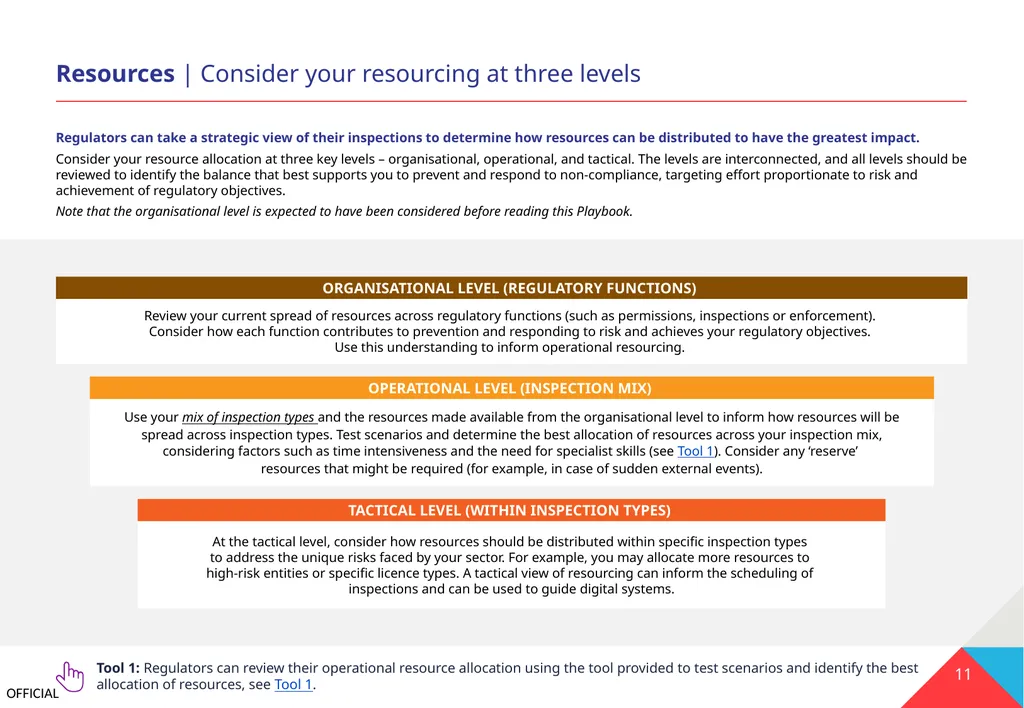
Consider your resource allocation at three key levels – organisational, operational, and tactical. The levels are interconnected, and all levels should be reviewed to identify the balance that best supports you to prevent and respond to non-compliance, targeting effort proportionate to risk and achievement of regulatory objectives.
Note that the organisational level is expected to have been considered before reading this Playbook. 11 Tool 1: Regulators can review their operational resource allocation using the tool provided to test scenarios and identify the best allocation of resources, see Tool 1.<br>
slide12. Tool 1 | Adopt an approach to strategic resource allocation tool This tool enables regulators to strategically plan how they allocate their resources across different types of inspections, and what trade-offs exist between inspection activities and resourcing.
PURPOSE
The strategic resource allocation tool provides a strategic view of resource allocation and inspection activities. It enables regulators to:
obtain the insights and inputs to inform strategic planning, including trade-offs in terms of activity volumes
think strategically about how they allocate capacity across their compliance inspection types, and their desired mix of activities
consider the appropriate number of resources required to meet their compliance objectives.
HOW IT WORKS
Please refer to the instructions provided within the tool.
This tool supports regulators to test scenarios and determine the best mix of inspections. Included is three steps:
Provide your activity and resourcing inputs
Set your compliance mix by allocating capacity across inspection categories
Assess the possible number of activities, or required number of resources An approach to strategic resource planning
This is an example of an interactive chart available in the tool’s dashboard. It enables regulators to consider what additional FTE is required to complete a target number of activities. To access this tool, please visit the Better Regulation Victoria website<br>
slide13. Effective data management and information practices ensure that regulators can make informed decisions underpinned by accurate and up-to-date insights. Better practice data and information-sharing practices enable regulators to deliver targeted inspection programs that draw on quality data. This ensures that stakeholders who provide data to regulators can be assured it is appropriately managed and that the regulator is making evidence-based decisions.
Review your current data management practices for data and information collection, storage and usage through the four steps outlined below. More information is provided in Appendix A and Tool 2. Intelligence and data | Review your data management and information-sharing practices Tool 2: Regulators can consider how best to store and manage collected data and information, see Tool 2.
1 See Appendix A for guiding questions to support you to review your current information processes for detecting risk.
2 See Appendix A for guidance on how to manage your information, including access and collaboration across teams. EFFECTIVE DATA MANAGEMENT PRACTICES PROVIDE THE FOUNDATION FOR RISK ANALYSIS Review your data governance framework to ensure it defines data accountability, standards, policies and procedures.
Information should consistently be stored safely and in line with Public Record Office Victoria’s recordkeeping practices and requirements. STANDARDISE HOW DATA IS GOVERNED Consistency in data across your organisation and with co-regulators enables you to be more effective in your decision-making, for example allowing you to easily use information from many different sources (such as permissions, other regulators or internal sources). Consider establishing common information categories and data taxonomy to achieve data consistency within your organisation. ADOPT CONSISTENT DATA CATEGORISATION Assess whether your data analysis practices are comprehensive, useful, accurate, timely and effective to inform strategic and operational decision-making regarding your inspection program. Apply analytics to spot trends, identify risks and support reporting. Appendix A1 has a set of questions to support this assessment. DATA ANALYSIS Being able to access necessary information in a timely way is a key enabler of effective regulatory practice. Consider whether your internal systems and processes empower your employees to access the information they need when they need it. Consider how well your knowledge management helps with this. Some guidance for information-sharing and accessibility is provided in Appendix A2. CONSIDER HOW ACCESSIBLE DATA AND INFORMATION IS WITHIN YOUR ORGANISATION 1 4 3 2<br>
slide14. Tool 2 – Data and information architecture This tool provides a framework for regulators to consider when assessing their data and information architecture.
PURPOSE
Effective collection and storage of data is a key enabler of good regulatory practice underpinned by strong and accurate analysis to inform intelligence and response. Creating a better practice approach to storing and organising files enables more seamless collaboration and sharing of information across teams, improves the efficiency of regulatory practice, and lays the groundwork for future development of a single view of an entity through digitisation.
While the guidance is most applicable to SharePoint, the principles and approach remain relevant for other data and information management, knowledge management, and collaboration systems.
HOW IT WORKS
The tool provides a series of considerations regulators can work through to uplift their data and information architecture:
Conduct a systematic review of your data and information ecosystem. Consider how information and data should be recorded, stored, managed, shared, and protected.
Understand your use cases for cross-team collaboration and information sharing.
Define your requirements for access and privacy A tool for reviewing how you manage information
This diagram is an example of a framework that can be used to systematically assess your data and information ecosystem. These considerations are key elements in defining how you can better set up your information storage and collection systems. To access this tool, please visit the Better Regulation Victoria website<br>
slide15. Intelligence and data | Review your risk framework ENTITY
How likely is the entity to be non-compliant?
You might consider:
Their compliance history: Do they have a history of non-compliance, and do these indicate likely future non-compliance?
Their capability: Are there concerns over their financial situation, attitude to compliance, competence, or the systems, controls and processes they have in place?
CONDUCT
What is the impact, potential harms, or negative outcomes of non-compliance?
You might consider:
The scale: What is the potential size and duration of negative outcomes, and who would be affected?
The flow-on impact: To what extent could this instance of non-compliance lead to future instances or additional negative outcomes? A risk framework informs how a regulator views and assesses risk within its organisation. RISK FRAMEWORK A risk-based approach uses data and intelligence to assess risk in terms of the likelihood of the harm occurring and its impact. In assessing risk, regulators also consider the practices and behaviour of regulated entities.
Risk identification
Develop a thorough understanding of the regulated environment and potential risks. Identify activities, events, or circumstances that can lead to non-compliance and harms or adverse outcomes that the regulation aims to prevent.
Risk assessment
Identify your risk indicators, and how risk assessment is integrated into various processes, such as triaging inspections or informing responsive action. Permissions processes can be a useful source of data to inform the risk assessment. Other sources of information can be combined with this profile information, such as past complaints or notifications, results of desktop audits, or broader analysis e.g. about overall industry health, performance against specific conditions etc.1
Assess risk at three levels2 – at the cohort level (an aggregated view of your entity types or within an industry), at the entity level (an ongoing view of an individual regulated entity), and at the conduct level (a view of a particular instance of non-compliance), by evaluating the likelihood and impact of non-compliance and the level of consequent harm shown as a risk matrix. The risk framework will categorise risks as high, medium or low to guide priorities for regulatory response including scope and purpose of inspection. Information on risk indicators is provided in Part B. UNDERSTANDING YOUR RISK FRAMEWORK INDICATIVE RISK INDICATORS 1 Refer to the Permissions Playbook.
2 See Appendix A for more detail of each of the three data categories (cohort, entity, and conduct).<br>
slide16. Technology and systems | Understand the digital systems and tools at your disposal Review your current suite of digital tools and systems to consider whether you are using them to their full potential and how they could be used to support better practice inspections. An in-depth understanding of these tools and how they interact with each other enhances your ability to identify and prioritise opportunities for improvement (as detailed further throughout Part B). Consider the below questions to inform your review. Central database Case management system(s) Hardware and In-field tools Better practice: Provide inspectors with tools that enable more efficient and consistent inspections. This may include phones, tablets, laptops, computers, or specialised equipment unique to your context.
Do your physical tools enable effective information collection and interaction with systems?
Are these assets providing value for money and how can they be enhanced to support better practice? Better practice: Record and store information in a central location(s) to support data analysis and use.
Is your information stored and retrieved from a singular location or many?
Is your database easy to access, is it secure and does it support sophisticated data analysis/assessment? Better practice: Have a system(s) in place to monitor and manage your end-to-end individual cases or work orders.
Do you have a system(s) in place for case management? This may be a low-fi system (such as excel status tracker for ongoing cases) or high-fi system (for example a Salesforce system) or a combination.
Is your system(s) able to monitor the case, assign tasks, track progress, record information and automate processes? Entity management system(s) Better practice: Have a system/systems to interact with your regulated entities.
Do you communicate and track communication with regulated entities in a common system?
Can regulated entities interact with you through this system(s) and does this interact with your internal systems? Scheduling and resourcing Better practice: Use an effective system(s) to monitor and manage work assignments, staff and resources.
Do you use a singular system or a combination of sources (for example calendars)?
Does your scheduling interact and support other systems (for example case management system)?
Are inspectors and internal staff able to use your system(s) to schedule activities, interact with each other, view availability and collect insights?<br>
slide17. Pause and reflect | Summary of Part A – getting the foundations in place Part A supports you to ensure your regulatory foundations are in place. Use this understanding to inform your view of better practice and identify opportunities for improvement.
Review the below to reflect on Part A and ensure your understanding before moving to Part B. FOUNDATIONS THAT UNDERPIN ‘BETTER PRACTICE’ INCLUDE… Do you have a deep understanding of your regulatory approach which you can use to guide better practice inspections? Does your compliance monitoring program reflect the regulatory approach? Does your process and approach support continuous improvement? Are you clear on your mix of inspections and your business rules that guide the selection of different inspection types? Does your mix of inspections reflect the trade offs articulated in your regulatory approach? Does your approach to resourcing and to risk support and inform better practice inspections and reflect your regulatory approach? Do you have the right balance of resources across your functions to address risks? Have you optimised your Information and data management processes and digital systems to support inspection processes and measure the effectiveness of your compliance monitoring program. Outline your current compliance monitoring processes from upstream to downstream to create a comparison for better practice (Part B). DIGITAL READINESS MEANS… You use your current digital tools to their full ability to create efficient workflows and reduce manual involvement. You have defined business rules where relevant to support digital workflows and potential automation. You use and categorise information effectively, with business rules for how intelligence informs risk assessment to provide the basis of triaging and resource allocation. You have a detailed understanding of your compliance processes, considering how systems interact with each other to design digital process flows. You have defined priorities for digital reform in your inspection process, highlighting the most beneficial opportunities for the required resources.<br>