
Participating Business and FFA Guide : B N
TF
Published · 34 slides · 0 views

1 / 1




Description
Participating Business and FFA Guide : B N Rangarajan Presented By : 1. Ankit Sethi 2. Vishal Vermani 3. Pallavi Agarwal 4. K T Jayasager 34th India Fellowship Webinar Date: 23rd January 2021 Agenda Basic concepts : Asset share and Fund for
Related Topics
Share
Embed code
Download this presentation From Below
"Participating Business and FFA Guide : B N" is the property of its rightful owner. Permission is granted to download and print the materials on this website for personal, non-commercial use only, and to display it on your personal computer provided you do not modify the materials and that you retain all copyright notices contained in the materials. By downloading content from our website, you accept the terms of this agreement.
Presentation Transcript
01
Participating Business and FFA Guide : B N Rangarajan
Presented By :
1. Ankit Sethi
2. Vishal Vermani
3. Pallavi Agarwal
4. K T Jayasager 34th India Fellowship Webinar
Date: 23rd January 2021<br>
Presented By :
1. Ankit Sethi
2. Vishal Vermani
3. Pallavi Agarwal
4. K T Jayasager 34th India Fellowship Webinar
Date: 23rd January 2021<br>
02
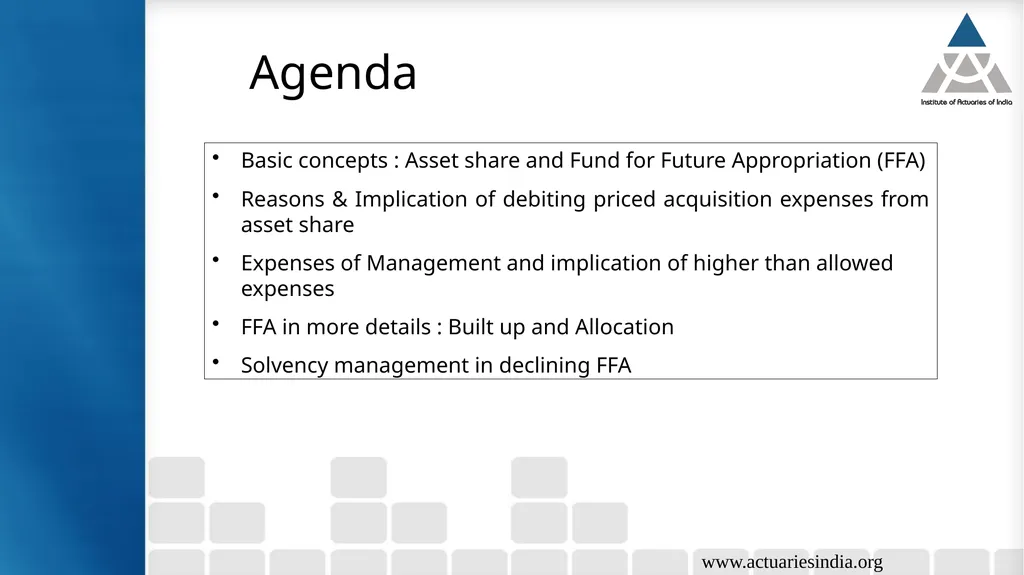
Agenda Basic concepts : Asset share and Fund for Future Appropriation (FFA)
Reasons & Implication of debiting priced acquisition expenses from asset share
Expenses of Management and implication of higher than allowed expenses
FFA in more details : Built up and Allocation
Solvency management in declining FFA www.actuariesindia.org<br>
Reasons & Implication of debiting priced acquisition expenses from asset share
Expenses of Management and implication of higher than allowed expenses
FFA in more details : Built up and Allocation
Solvency management in declining FFA www.actuariesindia.org<br>
03
Basic concepts : Asset share and Fund for Future Appropriation (FFA) www.actuariesindia.org<br>
04
Asset Share is accumulation of : www.actuariesindia.org<br>
05
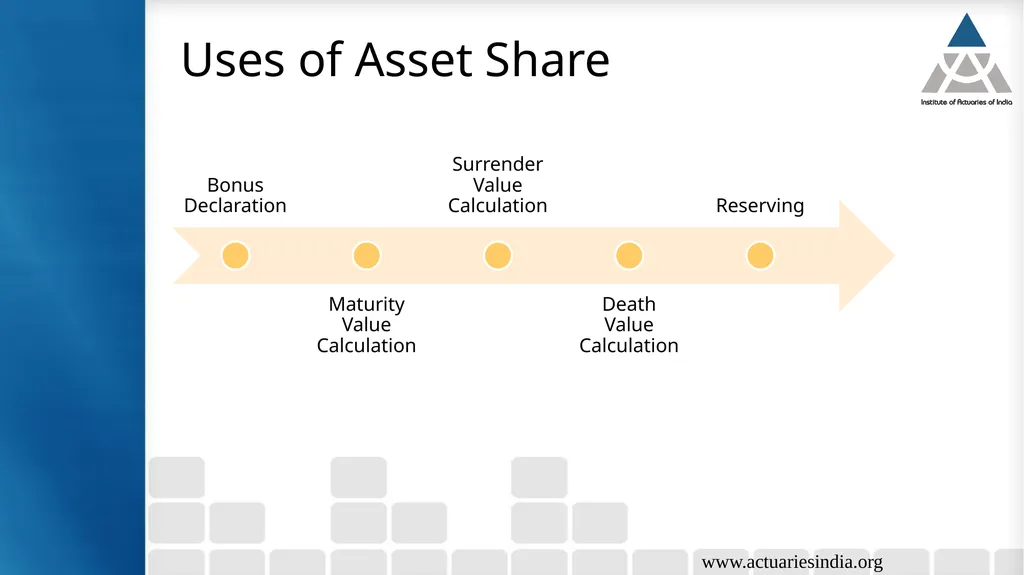
Uses of Asset Share www.actuariesindia.org<br>
06
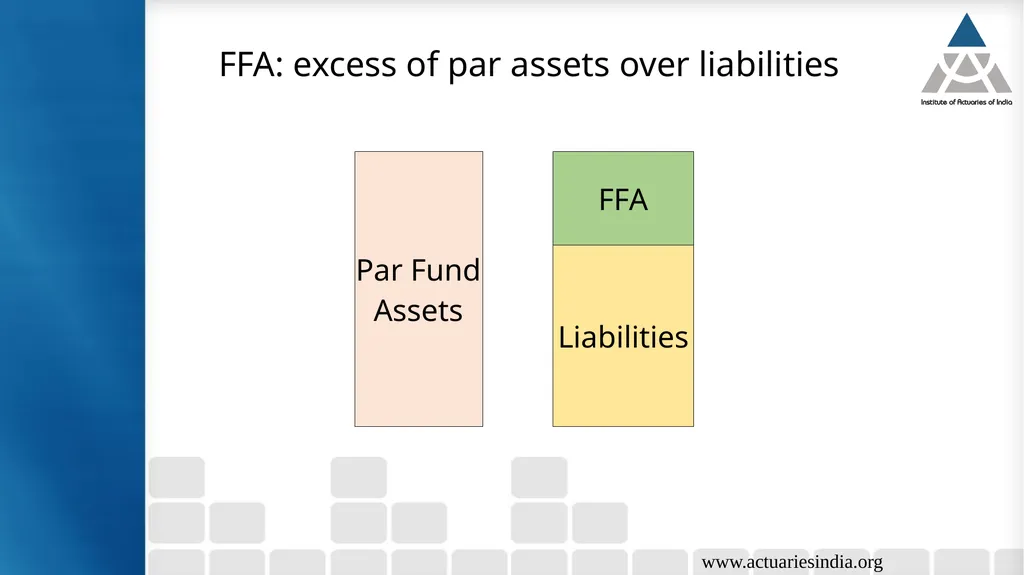
www.actuariesindia.org FFA: excess of par assets over liabilities<br>
07
Reasons & Implication of debiting priced acquisition expenses from asset share www.actuariesindia.org<br>
08
www.actuariesindia.org Guidance Note (GN)6 :Management of participating life insurance business with reference to distribution of surplus – suggests expenses being charged to the asset share should be consistent to what has been illustrated to the policyholders
Expenses of Management (EOM) regulations –
specifies maximum expenses that can be spent by a life insurance company in India, exemption conditions and actions for non-compliance
requires insurers to have Board approved expense allocation policy.
policy needs to be reviewed annually and primarily covers policy around which expenses to be allocated to various segments and basis/manner of allocation
IRDAI (Non-Linked Insurance Products) Regulations 2019 – Expenses charged to asset share shall be determined by the Appointed Actuary. Expenses charged to the With Profit fund and its appropriateness shall be disclosed to the With Profit Committee Expense Related Relevant Regulations & Professional Guidance<br>
Expenses of Management (EOM) regulations –
specifies maximum expenses that can be spent by a life insurance company in India, exemption conditions and actions for non-compliance
requires insurers to have Board approved expense allocation policy.
policy needs to be reviewed annually and primarily covers policy around which expenses to be allocated to various segments and basis/manner of allocation
IRDAI (Non-Linked Insurance Products) Regulations 2019 – Expenses charged to asset share shall be determined by the Appointed Actuary. Expenses charged to the With Profit fund and its appropriateness shall be disclosed to the With Profit Committee Expense Related Relevant Regulations & Professional Guidance<br>
09
Acquisition Expenses Charged to Asset Share www.actuariesindia.org Policyholder Reasonable Expectation
Level of acquisition expenses should be known with greater certainty
It would be unreasonable to charge higher acquisition expenses than provided in benefit illustrations given the timing of expense is just after the sale of the policy
Charging higher than expected expenses could result in bad publicity Fairness of Treatment between different generation of Policyholder
As asset share of older cohort of policyholders was debited by pricing acquisition expenses hence it would be unfair to charge actual (higher) acquisition expenses from the current or new policyholders<br>
Level of acquisition expenses should be known with greater certainty
It would be unreasonable to charge higher acquisition expenses than provided in benefit illustrations given the timing of expense is just after the sale of the policy
Charging higher than expected expenses could result in bad publicity Fairness of Treatment between different generation of Policyholder
As asset share of older cohort of policyholders was debited by pricing acquisition expenses hence it would be unfair to charge actual (higher) acquisition expenses from the current or new policyholders<br>
10
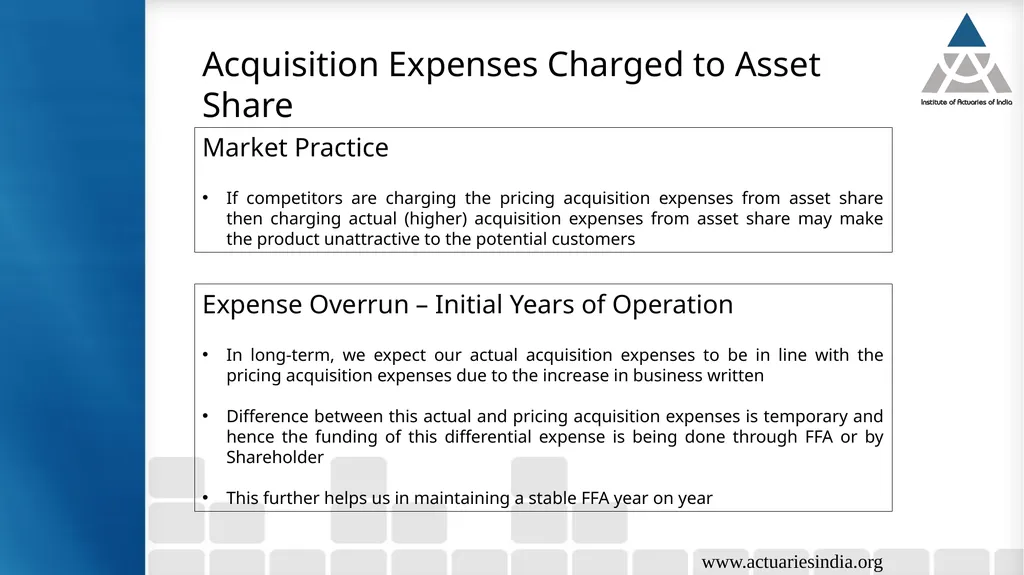
Acquisition Expenses Charged to Asset Share www.actuariesindia.org Market Practice
If competitors are charging the pricing acquisition expenses from asset share then charging actual (higher) acquisition expenses from asset share may make the product unattractive to the potential customers Expense Overrun – Initial Years of Operation
In long-term, we expect our actual acquisition expenses to be in line with the pricing acquisition expenses due to the increase in business written
Difference between this actual and pricing acquisition expenses is temporary and hence the funding of this differential expense is being done through FFA or by Shareholder
This further helps us in maintaining a stable FFA year on year<br>
If competitors are charging the pricing acquisition expenses from asset share then charging actual (higher) acquisition expenses from asset share may make the product unattractive to the potential customers Expense Overrun – Initial Years of Operation
In long-term, we expect our actual acquisition expenses to be in line with the pricing acquisition expenses due to the increase in business written
Difference between this actual and pricing acquisition expenses is temporary and hence the funding of this differential expense is being done through FFA or by Shareholder
This further helps us in maintaining a stable FFA year on year<br>
11
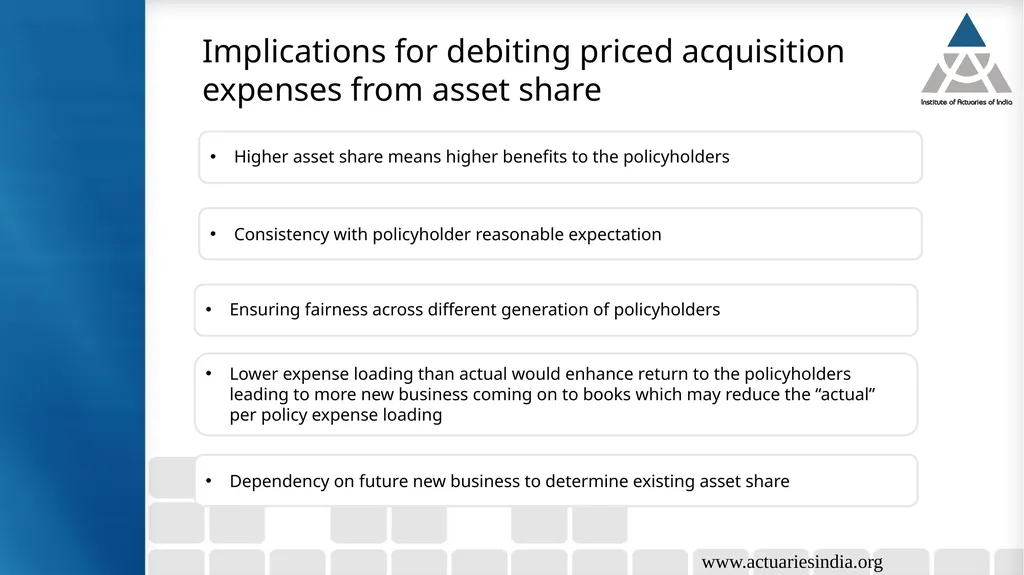
Implications for debiting priced acquisition expenses from asset share www.actuariesindia.org<br>
12
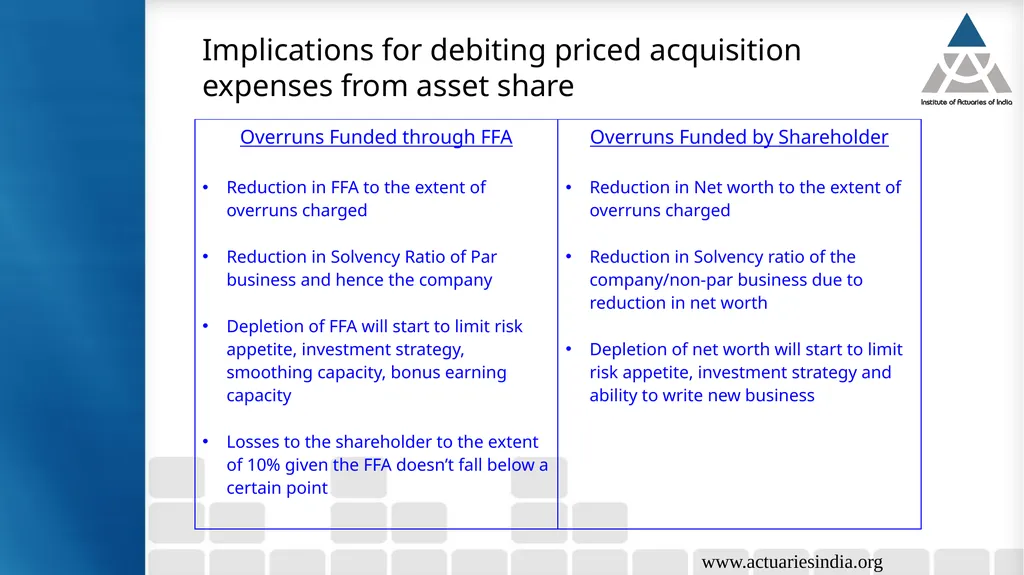
Implications for debiting priced acquisition expenses from asset share www.actuariesindia.org<br>
13
Expenses of Management and implication of higher than allowed expenses www.actuariesindia.org<br>
14
Reasons for expenses being higher than allowed www.actuariesindia.org EOM regulations requires insurers to have Board approved expense allocation policy. Regulation also specifies
maximum expenses that can be spent by a life insurance company in India,
exemption conditions and
action for non-compliance including charging expenses to Shareholder’s Account, restriction on NB, removal of Managerial Personnel/Appointment of Administrator etc.
Possible reasons for having higher than allowed expenses
Initial years of operation
High cost of operations
High expense channel
High proportion of single/ limited pay policies
Low case size
Lower than expected volume
Capital expenditure/one-off costs<br>
maximum expenses that can be spent by a life insurance company in India,
exemption conditions and
action for non-compliance including charging expenses to Shareholder’s Account, restriction on NB, removal of Managerial Personnel/Appointment of Administrator etc.
Possible reasons for having higher than allowed expenses
Initial years of operation
High cost of operations
High expense channel
High proportion of single/ limited pay policies
Low case size
Lower than expected volume
Capital expenditure/one-off costs<br>
15
Importance of managing the expenses www.actuariesindia.org Higher than allowable expenses need to be represented to the regulator with business plan and time period required to bring expenses in line with the regulation
Non-compliance can lead to severe consequences including restriction on opening of new branches and restriction on NB.
Company needs to manage expenses well to avoid non-compliance actions
Also, participating products can be part of product strategy and if managed well, can bring good value to the shareholders. It is, therefore, beneficial for the company too to make its participating product strategy work<br>
Non-compliance can lead to severe consequences including restriction on opening of new branches and restriction on NB.
Company needs to manage expenses well to avoid non-compliance actions
Also, participating products can be part of product strategy and if managed well, can bring good value to the shareholders. It is, therefore, beneficial for the company too to make its participating product strategy work<br>
16
Medium to long term implication of higher than allowed Expenses (1/2) www.actuariesindia.org Higher than allowed expenses will have direct impact on shareholder’s profit as excess expenses are being reallocated to SH fund
FFA may build up as excess expenses are being charged to SH. This FFA may have to be distributed to PH too.
Higher than allowed expenses will impact solvency position of the company.
New benefit illustration requires illustrations to be reviewed annually. The Company will be at competitive disadvantage if bonuses are revised down as a result of not managing the expenses well.
Company might have to redraw its distribution channel strategy to reduce cost while considering impact on business and employees
Need to consider if company’s channel cost is higher than its competitors
What can be done to reduce cost?
Reduce overheads e.g. moving office to less expensive property, outsourcing
Reduction in commission or other remuneration – it might affect sale
Are there too many layers?
Move to/increase sale from less expensive channel e.g. Digital<br>
FFA may build up as excess expenses are being charged to SH. This FFA may have to be distributed to PH too.
Higher than allowed expenses will impact solvency position of the company.
New benefit illustration requires illustrations to be reviewed annually. The Company will be at competitive disadvantage if bonuses are revised down as a result of not managing the expenses well.
Company might have to redraw its distribution channel strategy to reduce cost while considering impact on business and employees
Need to consider if company’s channel cost is higher than its competitors
What can be done to reduce cost?
Reduce overheads e.g. moving office to less expensive property, outsourcing
Reduction in commission or other remuneration – it might affect sale
Are there too many layers?
Move to/increase sale from less expensive channel e.g. Digital<br>
17
Medium to long term implication of higher than allowed Expenses (2/2) www.actuariesindia.org Company might also have to rework its product strategy
Increase case size of the policies
Write longer term policies
Write more products that have lower expenses
Acq/maintenance commission split
On the positive side, if insurer is new, it can be made a marketing point
In the long run, it can be seen as lack of financial discipline by the company which can lead to bad press<br>
Increase case size of the policies
Write longer term policies
Write more products that have lower expenses
Acq/maintenance commission split
On the positive side, if insurer is new, it can be made a marketing point
In the long run, it can be seen as lack of financial discipline by the company which can lead to bad press<br>
18
FFA: Built up and Allocation www.actuariesindia.org<br>
19
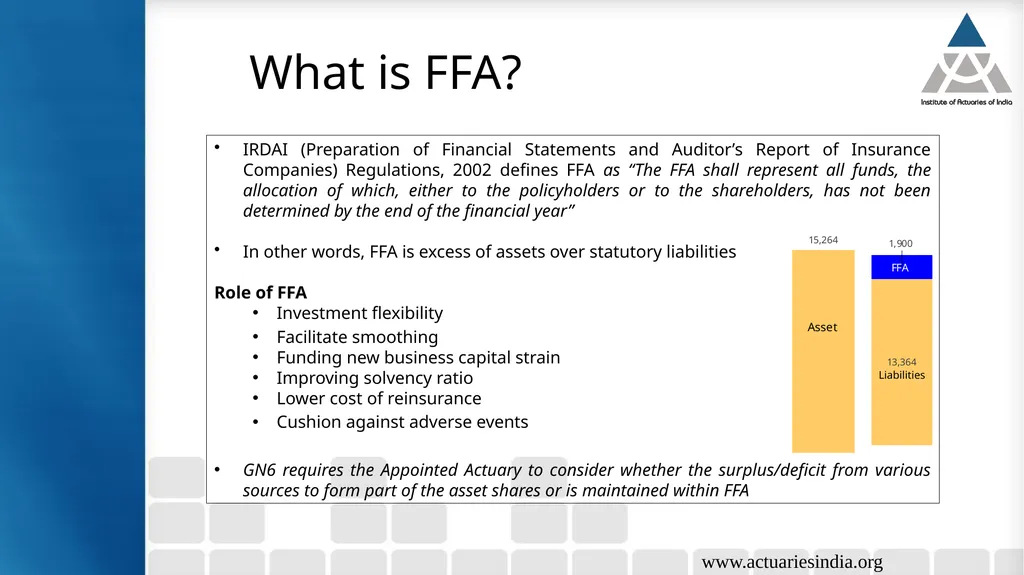
What is FFA? IRDAI (Preparation of Financial Statements and Auditor’s Report of Insurance Companies) Regulations, 2002 defines FFA as “The FFA shall represent all funds, the allocation of which, either to the policyholders or to the shareholders, has not been determined by the end of the financial year”
In other words, FFA is excess of assets over statutory liabilities
Role of FFA
Investment flexibility
Facilitate smoothing
Funding new business capital strain
Improving solvency ratio
Lower cost of reinsurance
Cushion against adverse events
GN6 requires the Appointed Actuary to consider whether the surplus/deficit from various sources to form part of the asset shares or is maintained within FFA www.actuariesindia.org Liabilities<br>
In other words, FFA is excess of assets over statutory liabilities
Role of FFA
Investment flexibility
Facilitate smoothing
Funding new business capital strain
Improving solvency ratio
Lower cost of reinsurance
Cushion against adverse events
GN6 requires the Appointed Actuary to consider whether the surplus/deficit from various sources to form part of the asset shares or is maintained within FFA www.actuariesindia.org Liabilities<br>
20
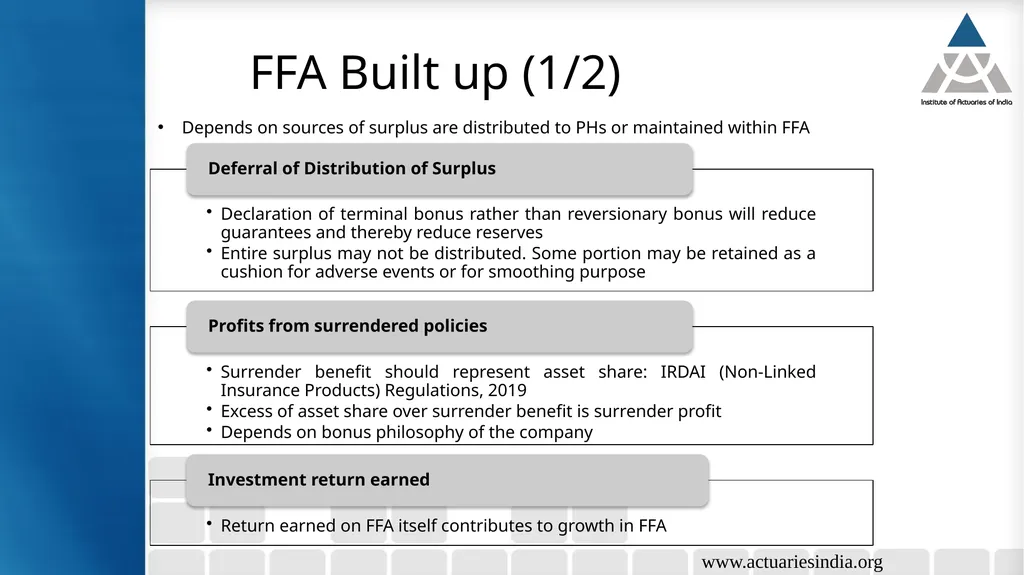
FFA Built up (1/2) www.actuariesindia.org Depends on sources of surplus are distributed to PHs or maintained within FFA<br>
21
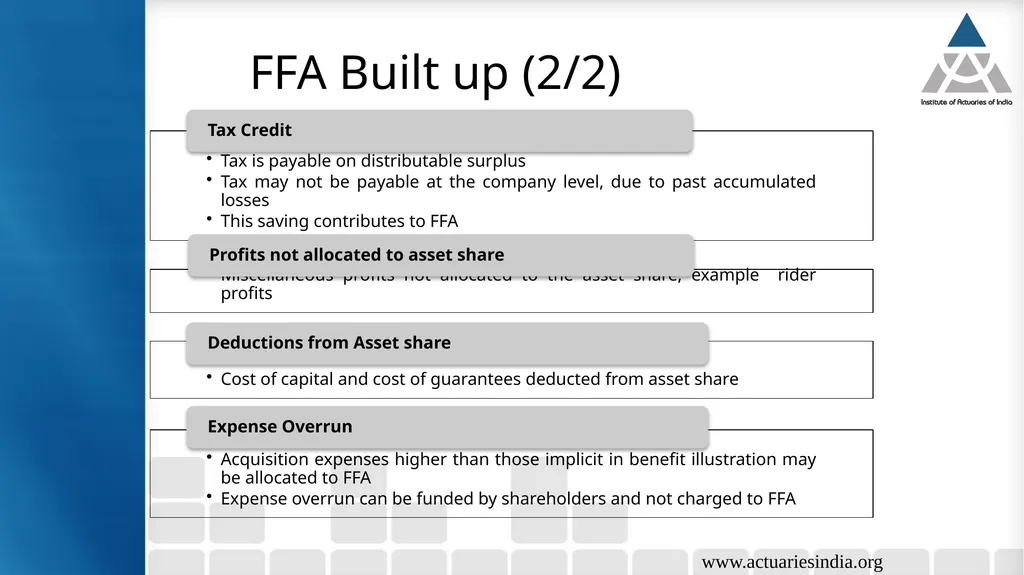
FFA Built up (2/2) www.actuariesindia.org<br>
22
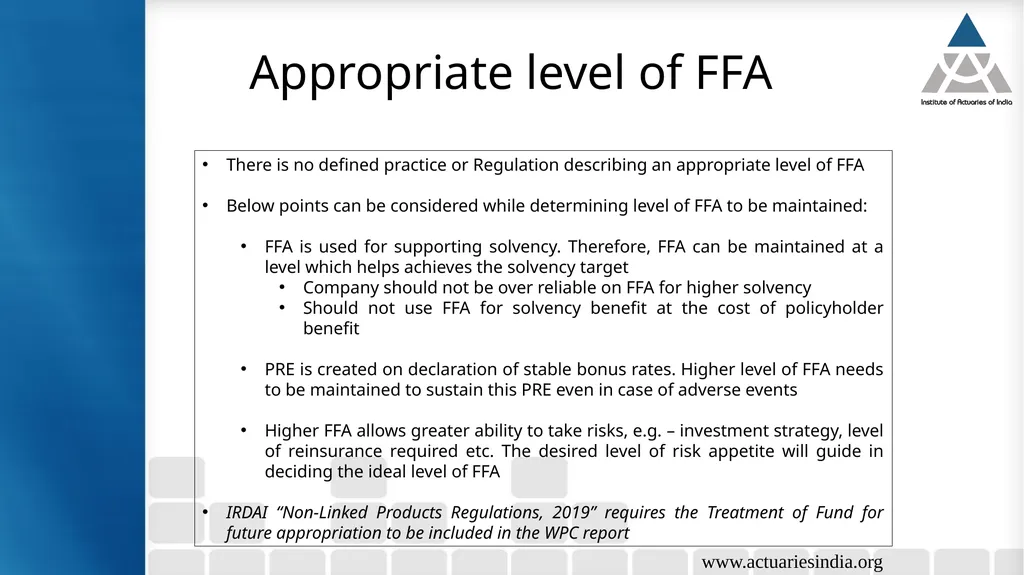
Appropriate level of FFA www.actuariesindia.org There is no defined practice or Regulation describing an appropriate level of FFA
Below points can be considered while determining level of FFA to be maintained:
FFA is used for supporting solvency. Therefore, FFA can be maintained at a level which helps achieves the solvency target
Company should not be over reliable on FFA for higher solvency
Should not use FFA for solvency benefit at the cost of policyholder benefit
PRE is created on declaration of stable bonus rates. Higher level of FFA needs to be maintained to sustain this PRE even in case of adverse events
Higher FFA allows greater ability to take risks, e.g. – investment strategy, level of reinsurance required etc. The desired level of risk appetite will guide in deciding the ideal level of FFA
IRDAI “Non-Linked Products Regulations, 2019” requires the Treatment of Fund for future appropriation to be included in the WPC report<br>
Below points can be considered while determining level of FFA to be maintained:
FFA is used for supporting solvency. Therefore, FFA can be maintained at a level which helps achieves the solvency target
Company should not be over reliable on FFA for higher solvency
Should not use FFA for solvency benefit at the cost of policyholder benefit
PRE is created on declaration of stable bonus rates. Higher level of FFA needs to be maintained to sustain this PRE even in case of adverse events
Higher FFA allows greater ability to take risks, e.g. – investment strategy, level of reinsurance required etc. The desired level of risk appetite will guide in deciding the ideal level of FFA
IRDAI “Non-Linked Products Regulations, 2019” requires the Treatment of Fund for future appropriation to be included in the WPC report<br>
23
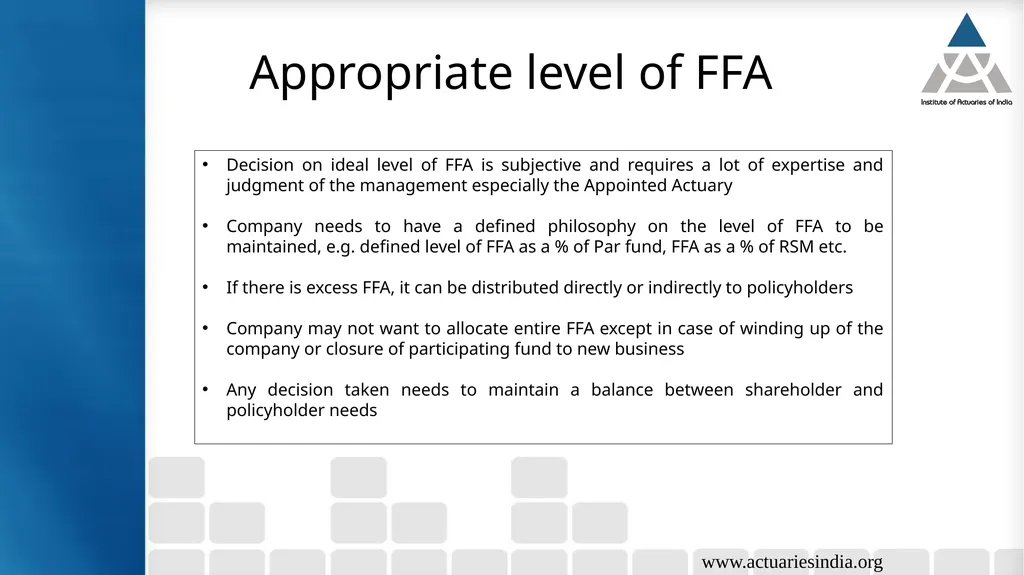
Appropriate level of FFA www.actuariesindia.org Decision on ideal level of FFA is subjective and requires a lot of expertise and judgment of the management especially the Appointed Actuary
Company needs to have a defined philosophy on the level of FFA to be maintained, e.g. defined level of FFA as a % of Par fund, FFA as a % of RSM etc.
If there is excess FFA, it can be distributed directly or indirectly to policyholders
Company may not want to allocate entire FFA except in case of winding up of the company or closure of participating fund to new business
Any decision taken needs to maintain a balance between shareholder and policyholder needs<br>
Company needs to have a defined philosophy on the level of FFA to be maintained, e.g. defined level of FFA as a % of Par fund, FFA as a % of RSM etc.
If there is excess FFA, it can be distributed directly or indirectly to policyholders
Company may not want to allocate entire FFA except in case of winding up of the company or closure of participating fund to new business
Any decision taken needs to maintain a balance between shareholder and policyholder needs<br>
24
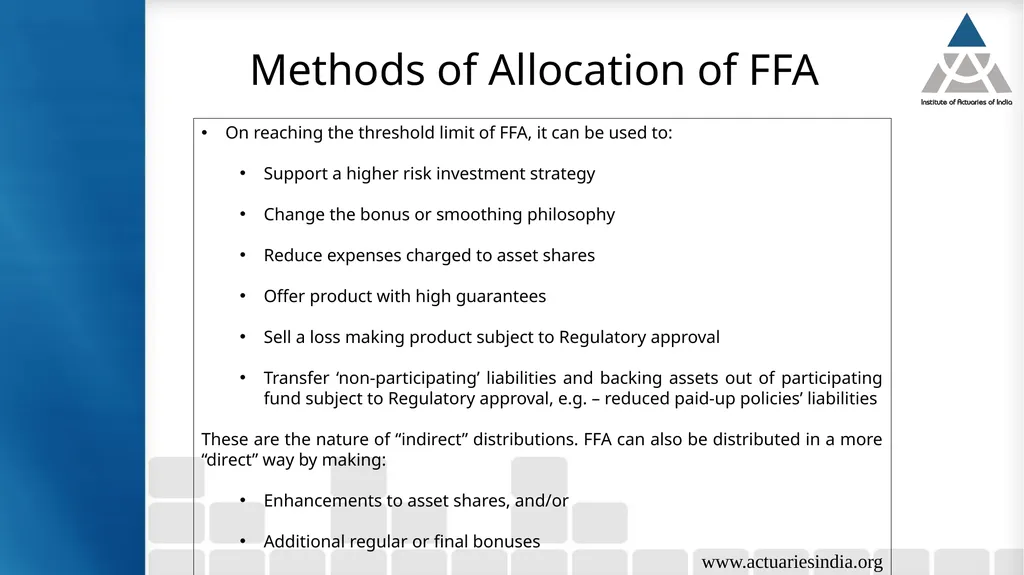
Methods of Allocation of FFA www.actuariesindia.org On reaching the threshold limit of FFA, it can be used to:
Support a higher risk investment strategy
Change the bonus or smoothing philosophy
Reduce expenses charged to asset shares
Offer product with high guarantees
Sell a loss making product subject to Regulatory approval
Transfer ‘non-participating’ liabilities and backing assets out of participating fund subject to Regulatory approval, e.g. – reduced paid-up policies’ liabilities
These are the nature of “indirect” distributions. FFA can also be distributed in a more “direct” way by making:
Enhancements to asset shares, and/or
Additional regular or final bonuses<br>
Support a higher risk investment strategy
Change the bonus or smoothing philosophy
Reduce expenses charged to asset shares
Offer product with high guarantees
Sell a loss making product subject to Regulatory approval
Transfer ‘non-participating’ liabilities and backing assets out of participating fund subject to Regulatory approval, e.g. – reduced paid-up policies’ liabilities
These are the nature of “indirect” distributions. FFA can also be distributed in a more “direct” way by making:
Enhancements to asset shares, and/or
Additional regular or final bonuses<br>
25
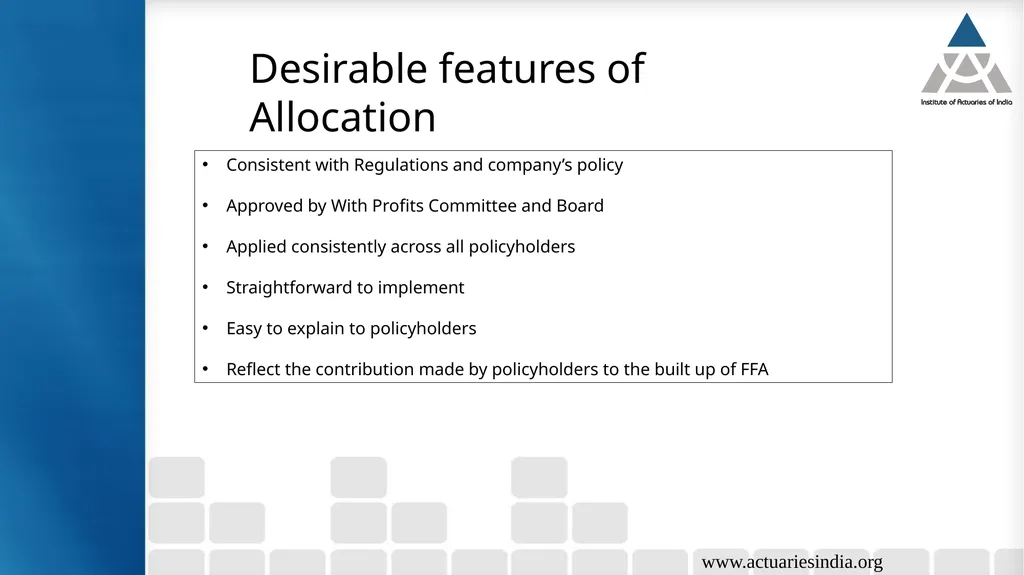
Desirable features of Allocation www.actuariesindia.org Consistent with Regulations and company’s policy
Approved by With Profits Committee and Board
Applied consistently across all policyholders
Straightforward to implement
Easy to explain to policyholders
Reflect the contribution made by policyholders to the built up of FFA<br>
Approved by With Profits Committee and Board
Applied consistently across all policyholders
Straightforward to implement
Easy to explain to policyholders
Reflect the contribution made by policyholders to the built up of FFA<br>
26
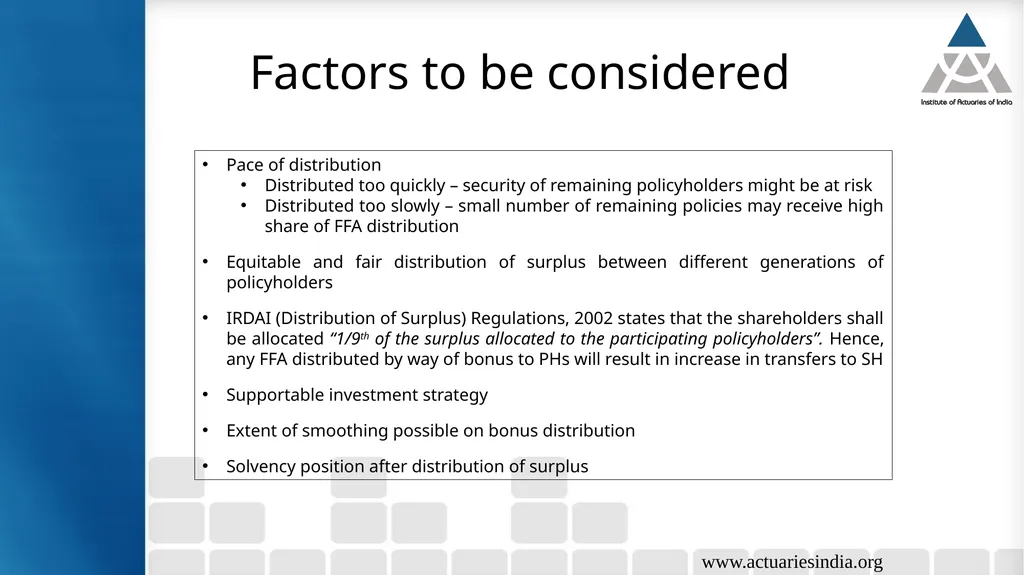
Factors to be considered www.actuariesindia.org Pace of distribution
Distributed too quickly – security of remaining policyholders might be at risk
Distributed too slowly – small number of remaining policies may receive high share of FFA distribution
Equitable and fair distribution of surplus between different generations of policyholders
IRDAI (Distribution of Surplus) Regulations, 2002 states that the shareholders shall be allocated “1/9th of the surplus allocated to the participating policyholders”. Hence, any FFA distributed by way of bonus to PHs will result in increase in transfers to SH
Supportable investment strategy
Extent of smoothing possible on bonus distribution
Solvency position after distribution of surplus<br>
Distributed too quickly – security of remaining policyholders might be at risk
Distributed too slowly – small number of remaining policies may receive high share of FFA distribution
Equitable and fair distribution of surplus between different generations of policyholders
IRDAI (Distribution of Surplus) Regulations, 2002 states that the shareholders shall be allocated “1/9th of the surplus allocated to the participating policyholders”. Hence, any FFA distributed by way of bonus to PHs will result in increase in transfers to SH
Supportable investment strategy
Extent of smoothing possible on bonus distribution
Solvency position after distribution of surplus<br>
27
Solvency management in declining FFA www.actuariesindia.org<br>
28
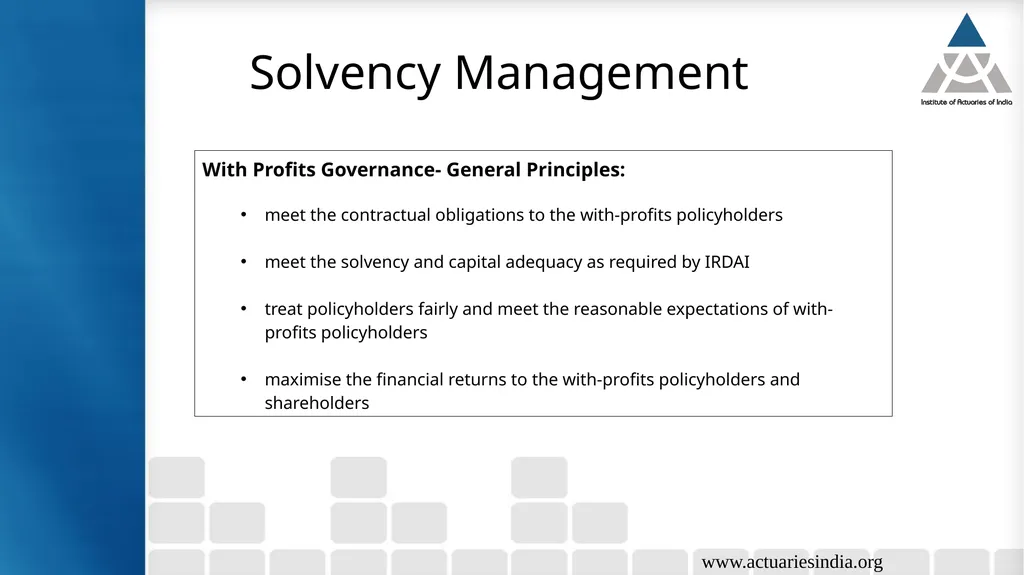
Solvency Management www.actuariesindia.org With Profits Governance- General Principles:
meet the contractual obligations to the with-profits policyholders
meet the solvency and capital adequacy as required by IRDAI
treat policyholders fairly and meet the reasonable expectations of with-profits policyholders
maximise the financial returns to the with-profits policyholders and shareholders<br>
meet the contractual obligations to the with-profits policyholders
meet the solvency and capital adequacy as required by IRDAI
treat policyholders fairly and meet the reasonable expectations of with-profits policyholders
maximise the financial returns to the with-profits policyholders and shareholders<br>
29
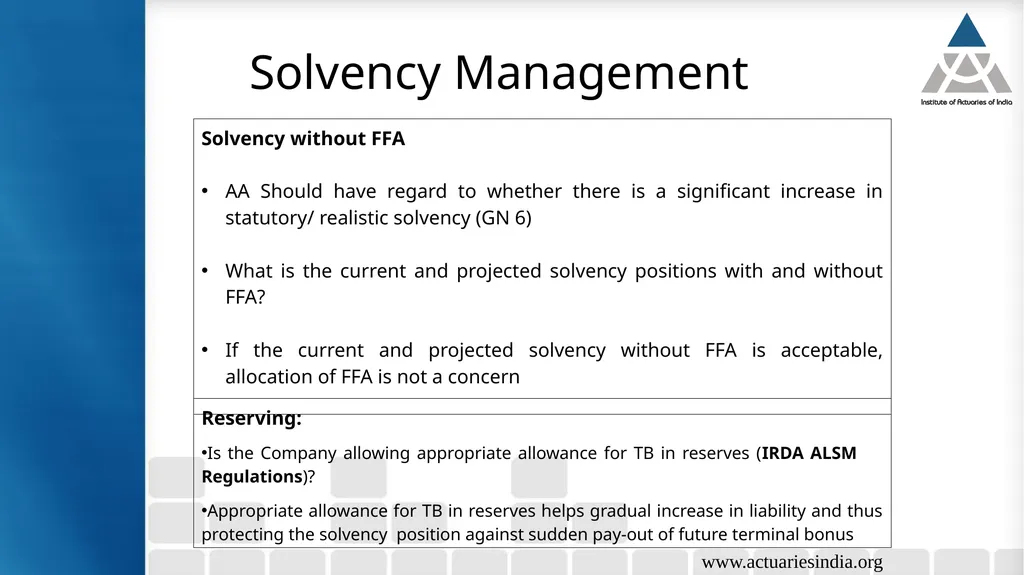
Solvency Management www.actuariesindia.org Solvency without FFA
AA Should have regard to whether there is a significant increase in statutory/ realistic solvency (GN 6)
What is the current and projected solvency positions with and without FFA?
If the current and projected solvency without FFA is acceptable, allocation of FFA is not a concern Reserving:
Is the Company allowing appropriate allowance for TB in reserves (IRDA ALSM Regulations)?
Appropriate allowance for TB in reserves helps gradual increase in liability and thus protecting the solvency position against sudden pay-out of future terminal bonus<br>
AA Should have regard to whether there is a significant increase in statutory/ realistic solvency (GN 6)
What is the current and projected solvency positions with and without FFA?
If the current and projected solvency without FFA is acceptable, allocation of FFA is not a concern Reserving:
Is the Company allowing appropriate allowance for TB in reserves (IRDA ALSM Regulations)?
Appropriate allowance for TB in reserves helps gradual increase in liability and thus protecting the solvency position against sudden pay-out of future terminal bonus<br>
30
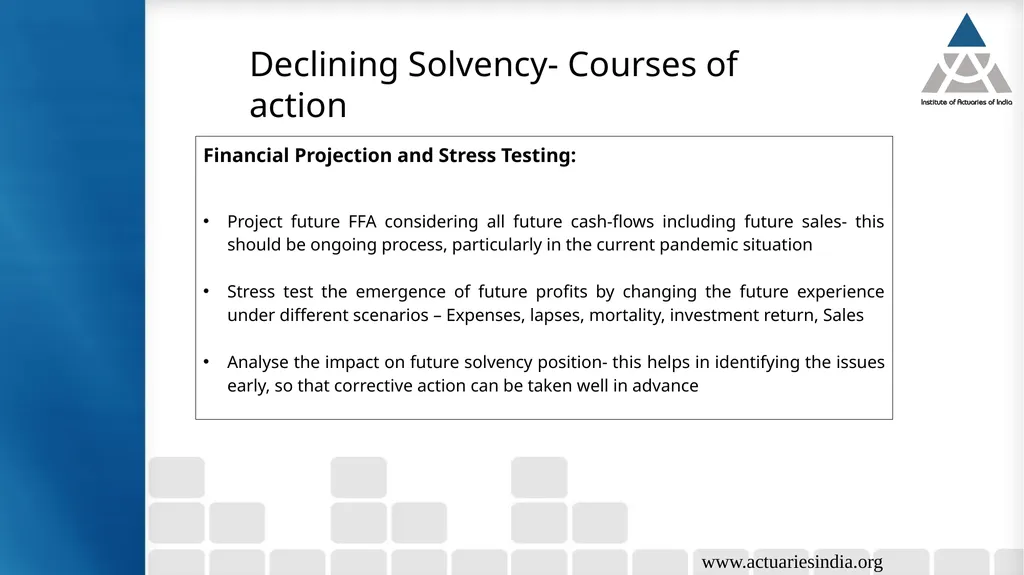
Declining Solvency- Courses of action www.actuariesindia.org Financial Projection and Stress Testing:
Project future FFA considering all future cash-flows including future sales- this should be ongoing process, particularly in the current pandemic situation
Stress test the emergence of future profits by changing the future experience under different scenarios – Expenses, lapses, mortality, investment return, Sales
Analyse the impact on future solvency position- this helps in identifying the issues early, so that corrective action can be taken well in advance<br>
Project future FFA considering all future cash-flows including future sales- this should be ongoing process, particularly in the current pandemic situation
Stress test the emergence of future profits by changing the future experience under different scenarios – Expenses, lapses, mortality, investment return, Sales
Analyse the impact on future solvency position- this helps in identifying the issues early, so that corrective action can be taken well in advance<br>
31
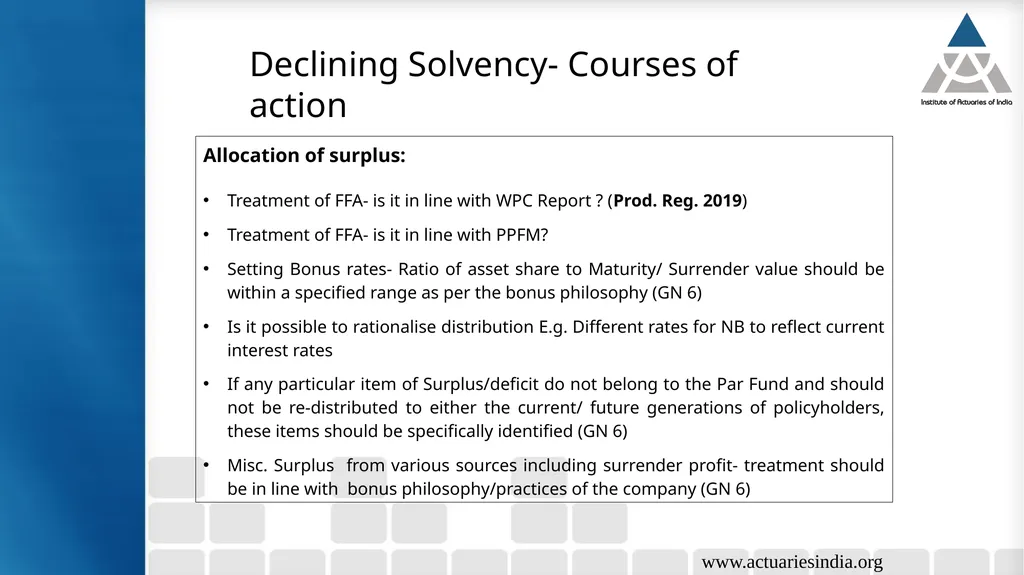
Declining Solvency- Courses of action www.actuariesindia.org Allocation of surplus:
Treatment of FFA- is it in line with WPC Report ? (Prod. Reg. 2019)
Treatment of FFA- is it in line with PPFM?
Setting Bonus rates- Ratio of asset share to Maturity/ Surrender value should be within a specified range as per the bonus philosophy (GN 6)
Is it possible to rationalise distribution E.g. Different rates for NB to reflect current interest rates
If any particular item of Surplus/deficit do not belong to the Par Fund and should not be re-distributed to either the current/ future generations of policyholders, these items should be specifically identified (GN 6)
Misc. Surplus from various sources including surrender profit- treatment should be in line with bonus philosophy/practices of the company (GN 6)<br>
Treatment of FFA- is it in line with WPC Report ? (Prod. Reg. 2019)
Treatment of FFA- is it in line with PPFM?
Setting Bonus rates- Ratio of asset share to Maturity/ Surrender value should be within a specified range as per the bonus philosophy (GN 6)
Is it possible to rationalise distribution E.g. Different rates for NB to reflect current interest rates
If any particular item of Surplus/deficit do not belong to the Par Fund and should not be re-distributed to either the current/ future generations of policyholders, these items should be specifically identified (GN 6)
Misc. Surplus from various sources including surrender profit- treatment should be in line with bonus philosophy/practices of the company (GN 6)<br>
32
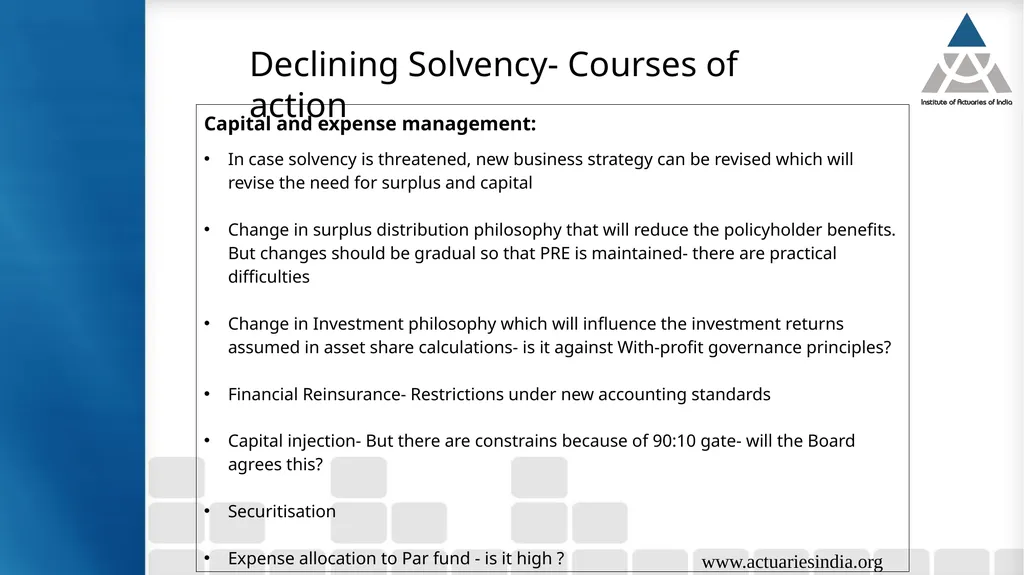
Declining Solvency- Courses of action www.actuariesindia.org Capital and expense management:
In case solvency is threatened, new business strategy can be revised which will revise the need for surplus and capital
Change in surplus distribution philosophy that will reduce the policyholder benefits. But changes should be gradual so that PRE is maintained- there are practical difficulties
Change in Investment philosophy which will influence the investment returns assumed in asset share calculations- is it against With-profit governance principles?
Financial Reinsurance- Restrictions under new accounting standards
Capital injection- But there are constrains because of 90:10 gate- will the Board agrees this?
Securitisation
Expense allocation to Par fund - is it high ?<br>
In case solvency is threatened, new business strategy can be revised which will revise the need for surplus and capital
Change in surplus distribution philosophy that will reduce the policyholder benefits. But changes should be gradual so that PRE is maintained- there are practical difficulties
Change in Investment philosophy which will influence the investment returns assumed in asset share calculations- is it against With-profit governance principles?
Financial Reinsurance- Restrictions under new accounting standards
Capital injection- But there are constrains because of 90:10 gate- will the Board agrees this?
Securitisation
Expense allocation to Par fund - is it high ?<br>
33
Thank You www.actuariesindia.org<br>
34
Any questions??? www.actuariesindia.org<br>