
Participation and Competition in Public


Description: Participation and Competition in Public Procurement: Brothers in Arms? Prof. Gustavo Piga Director of IPPM, International Master in Public Procurement Management Department of Business Government Philosophy Studies University of Rome Tor
Related Topics
Download Presentation
"Participation and Competition in Public" is the property of its rightful owner. Permission is granted to download and print the materials on this website for personal, non-commercial use only, and to display it on your personal computer provided you do not modify the materials and that you retain all copyright notices contained in the materials. By downloading content from our website, you accept the terms of this agreement.
Presentation Transcript
slide1. Participation and Competition in Public Procurement:
Brothers in Arms? Prof. Gustavo Piga
Director of IPPM, International Master in Public Procurement Management
Department of Business Government Philosophy Studies
University of Rome Tor Vergata
www.masterprocurement.eu X Conferencia Anual sobre Compras Gubernamentales de las Américas de la RICG
Asunción, October 29th, 2014<br>
slide2. PARTICIPATION AND COMPETITION:
RIVALS?<br>
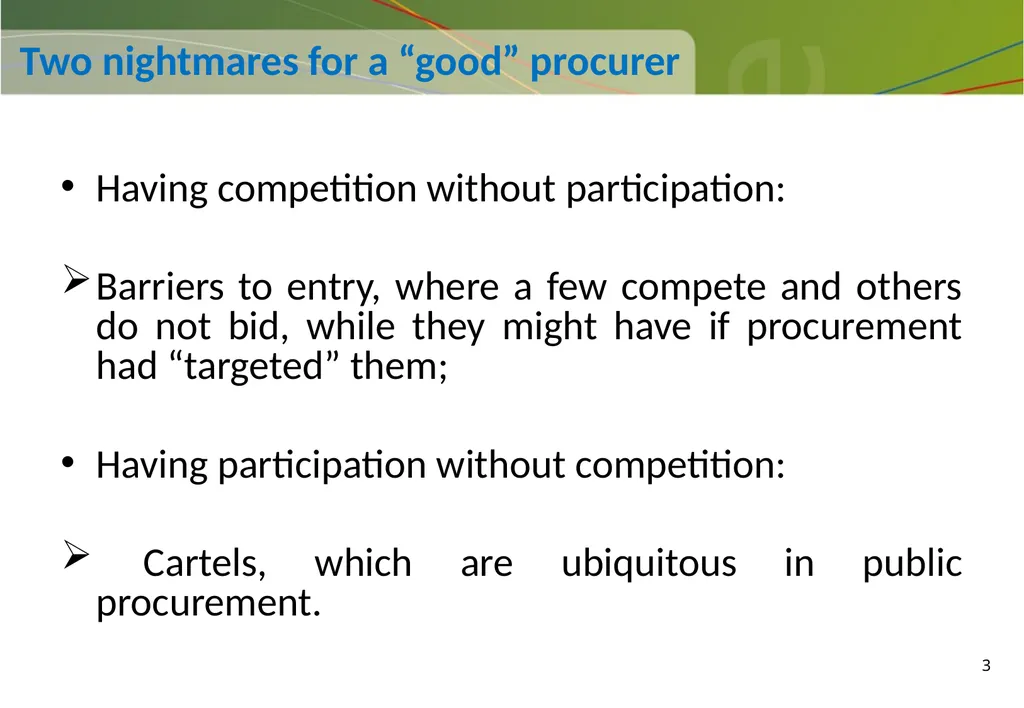
slide3. Two nightmares for a “good” procurer Having competition without participation:
Barriers to entry, where a few compete and others do not bid, while they might have if procurement had “targeted” them;
Having participation without competition:
Cartels, which are ubiquitous in public procurement.<br>
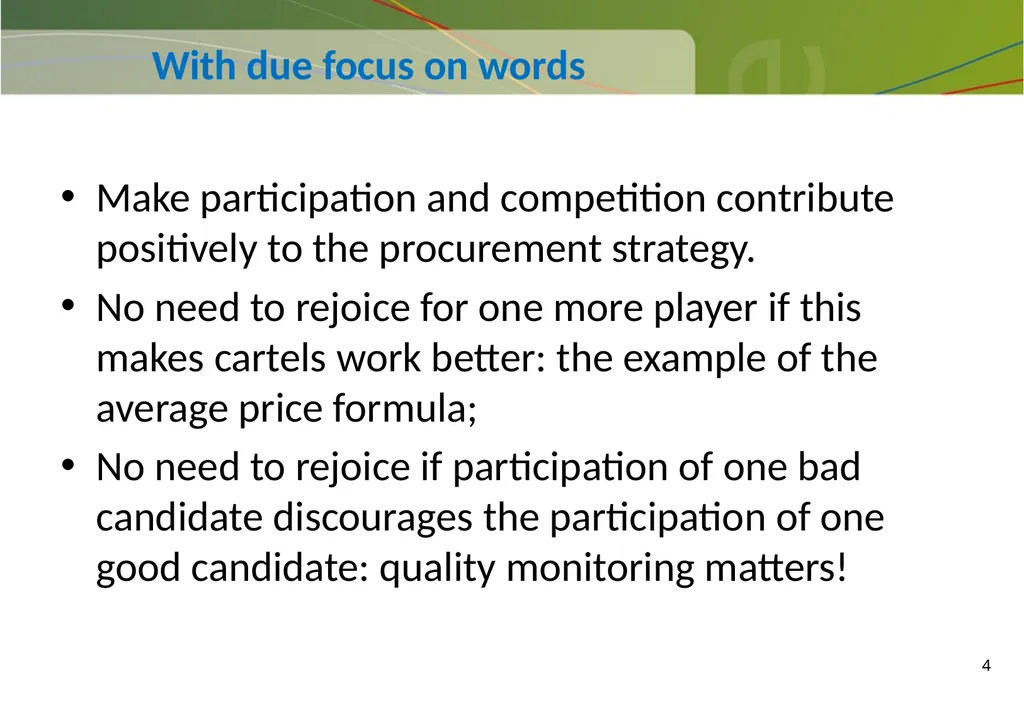
slide4. With due focus on words Make participation and competition contribute positively to the procurement strategy.
No need to rejoice for one more player if this makes cartels work better: the example of the average price formula;
No need to rejoice if participation of one bad candidate discourages the participation of one good candidate: quality monitoring matters!<br>
slide5. Two nightmares in one Bos and Harrington (2010) show that stable cartels are often not all-inclusive.
They show that a firm finds it optimal not to join the cartel when its capacity is sufficiently low, because the effect of its membership on price is trivial but, at the same time, it experiences a non-trivial reduction in its output.
Thus, they claim we should not expect a cartel to include very small firms.<br>
slide6. Policy action might encounter unexpected trade-offs:
Trying to elicit participation one might simply reduce competition!
And trying to strengthen competition one might decrease participation!
Are these true trade-offs or simply «little» mistakes? Nightmares or Mistakes?<br>
slide7. The contracting authority should have a duty to consider the appropriateness of dividing large contracts into lots while remaining free to decide autonomously on the basis of any reason it deems pertinent, without being subject to administrative or judicial supervision. Where the contracting authority decides that it would not be appropriate to divide the contract into lots, the individual report or the contract award notice should contain an indication of the main reasons for the contracting authority's choice.
Such reasons could for instance be that the contracting authority finds that such division could risk restricting competition, or risk rendering the execution of the contract excessively technically difficult or expensive, or that the need to coordinate the different contractors for the lots could seriously risk undermining the proper execution of the contract.
Harder to do one lot.
New Directive EU: Eliciting Participation?<br>
slide8. “A contracting authority that used to tender a single lot every year and now tenders a single lot of half the original size every 6 months, is required to justify why it tenders a single lot.
An administration that used to tender a certain type of goods or services divided in 4 lots and repeated every 6 months, and that now bundles demand and tenders everything divided in two very large lots once a year will not have to justify its bundling choices, because its procurements have 2 lots.
This sounds very much against the general spirit of article 46 that, according to my understanding, aims at fostering unbundling of tenders in smaller lots that are more accessible to SMEs… Having 4 instead of 40 lots may have much bigger consequences than having 1 lot instead of 3”.
Giancarlo Spagnolo, Second Interdisciplinary Symposium on Public Procurement, Budapest 2014. EU: Discouraging the Right Policy<br>
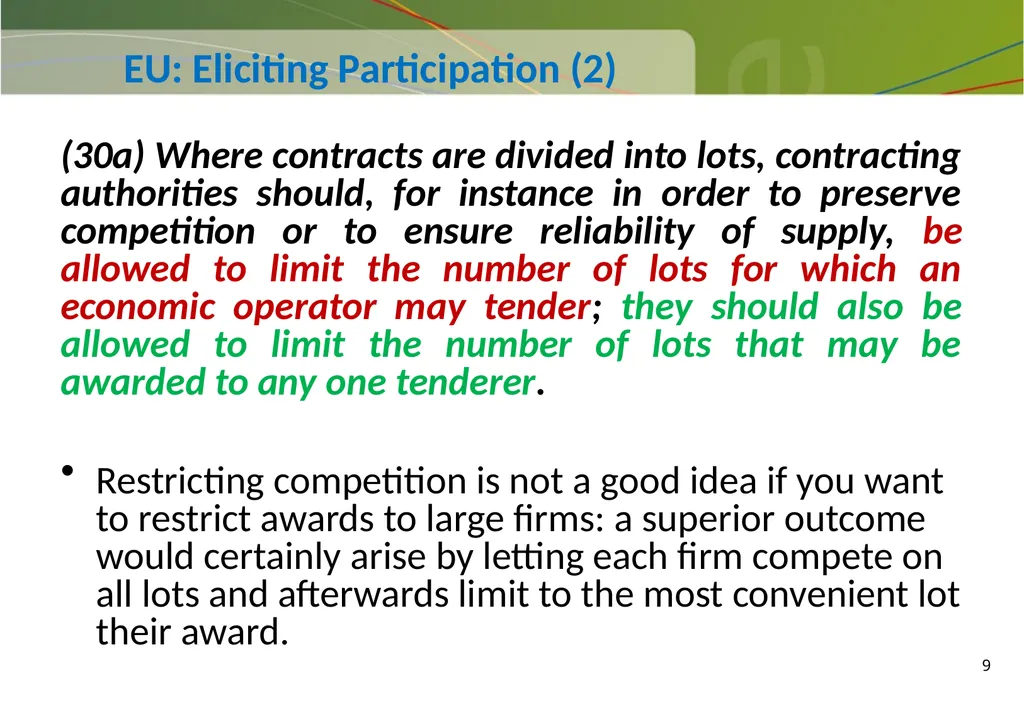
slide9. (30a) Where contracts are divided into lots, contracting authorities should, for instance in order to preserve competition or to ensure reliability of supply, be allowed to limit the number of lots for which an economic operator may tender; they should also be allowed to limit the number of lots that may be awarded to any one tenderer.
Restricting competition is not a good idea if you want to restrict awards to large firms: a superior outcome would certainly arise by letting each firm compete on all lots and afterwards limit to the most convenient lot their award. EU: Eliciting Participation (2)<br>
slide10. DISCRIMINATION AGAINST SMEs?<br>
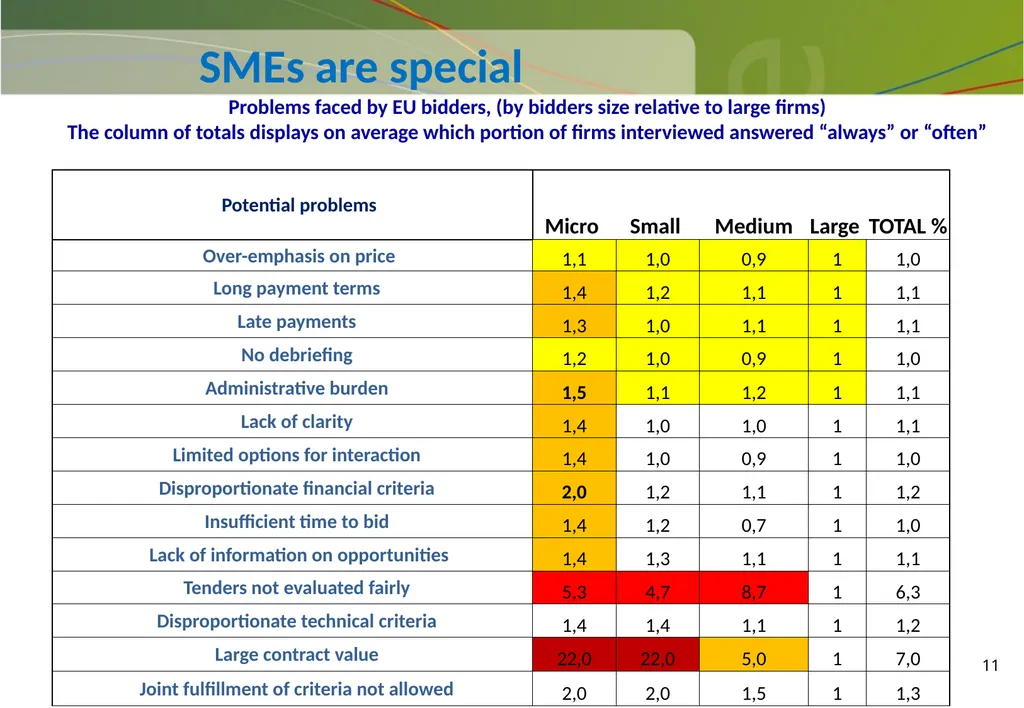
slide11. SMEs are special Problems faced by EU bidders, (by bidders size relative to large firms) The column of totals displays on average which portion of firms interviewed answered “always” or “often”<br>
slide12. Are large contracts the business of large firms only?<br>
slide13. “We have strong evidence than in many cases SMEs are considerably MORE efficient than large firms, so that the issue of how to involve them in government procurement is one of immediate efficiency, not just a political constraint or a costly investment for the future.
This evidence is under the eyes of everybody: it is the amount of subcontracting to SMEs that most large suppliers undertake after they win large contracts from bundled procurement. If the large firms were more efficient than SMEs, they would lose money by subcontracting to SMEs, hence we would only observe subcontracting to other large firms”
Giancarlo Spagnolo, Second Interdisciplinary Symposium on Public Procurement, Budapest 2014. Are SMEs Good? So why large contracts?<br>
slide14. The typical problem with directly involving SMEs in Public Procurement is coordinating their work and ensuring a reliable and constant level of quality, not risking to pay more. Quality problems and coordination problems are important, they should be taken into account, and they are typically solved well by large suppliers who use subcontracting to all the time.
Even though SMEs are often more efficient in production than large firms, coordination and quality control problems could be large enough to make it preferable for the government to contract with large firms and let them deal with SMEs as subcontractors.
Therefore, the problem is: how do we know when the difference in production efficiency between large firms and SMEs that could be captured by the buyer by having smaller lots and direct involvement of SMEs, are larger than the additional administrative, coordination and quality control costs that the buyer will have to incur when there is not a large supplier serving as an intermediary?
Giancarlo Spagnolo, Second Interdisciplinary Symposium on Public Procurement, Budapest 2014. Not always?<br>
slide15. Efficient SMEs? Have small lots on which everybody can bid, but also allow for bids conditional on winning a large number of lots, a "package" or "combination" of lots. Combinatorial bidding is in the New Directives.
“Inefficient” (new) SMEs? Accept the short-term cost in terms of competition today for more competition tomorrow: set-asides. But the European Union bans set-asides, in the name of competition and fairness. 2 Types of Solutions<br>
slide16. The EU: Eliciting Competition? “The EU is not in favour of reserving markets to specific undertakings. Such actions would also be in contradiction with the principle of equal treatment of tenderers, a fundamental pillar of the EU public procurement regime anchored by the Court of Justice in the Treaty freedoms.” Green Paper.<br>
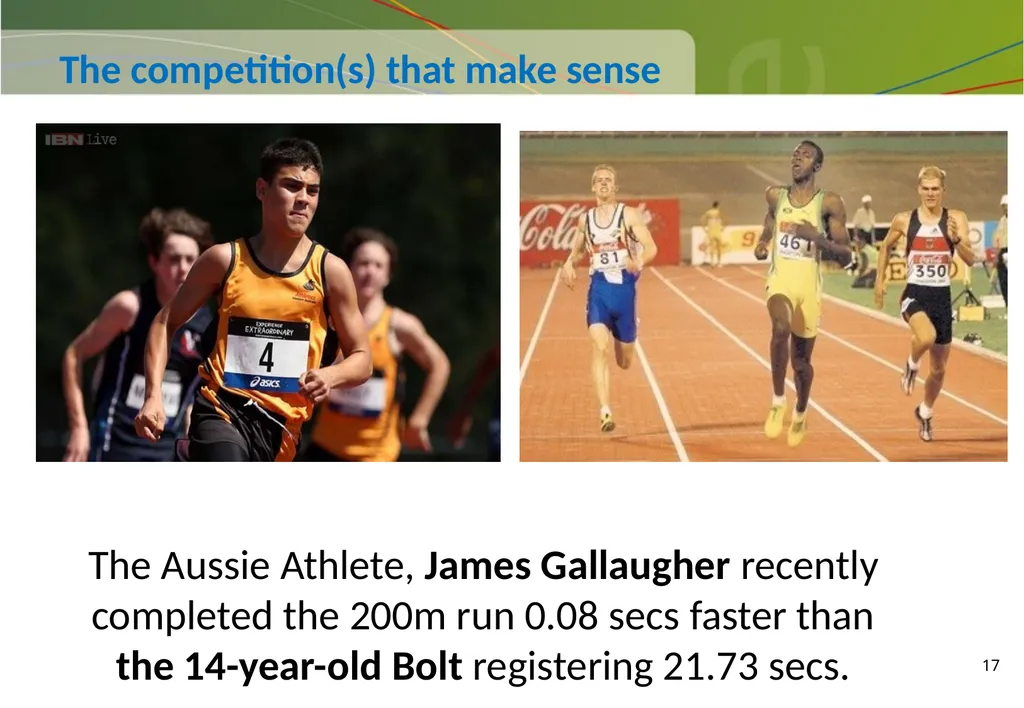
slide17. The Aussie Athlete, James Gallaugher recently completed the 200m run 0.08 secs faster than the 14-year-old Bolt registering 21.73 secs. The competition(s) that make sense<br>
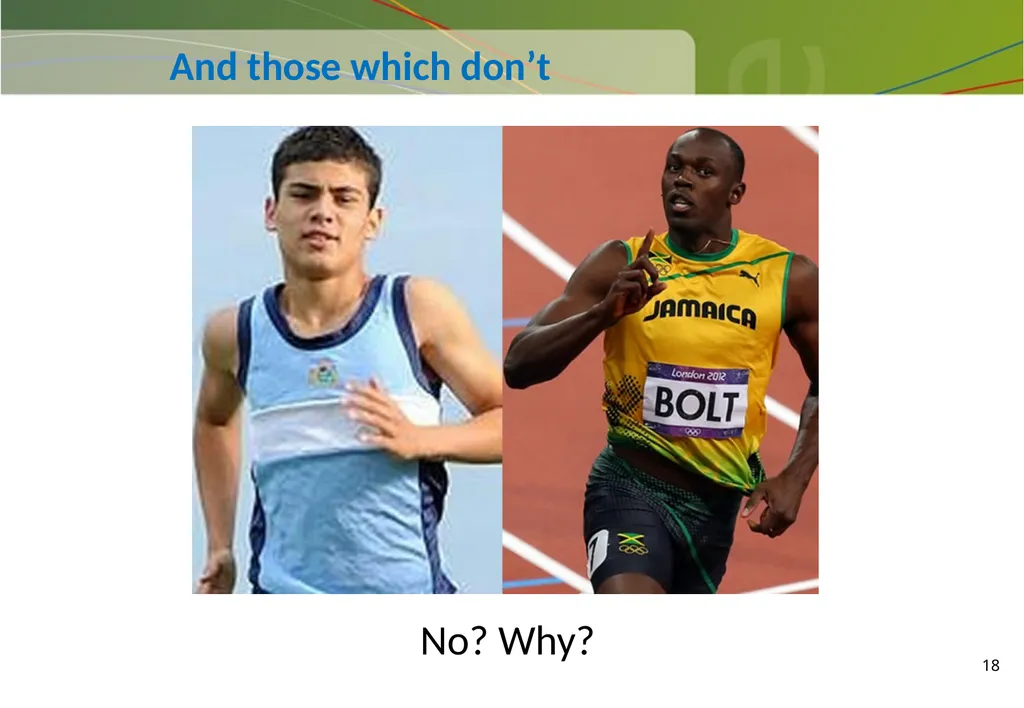
slide18. And those which don’t No? Why?<br>
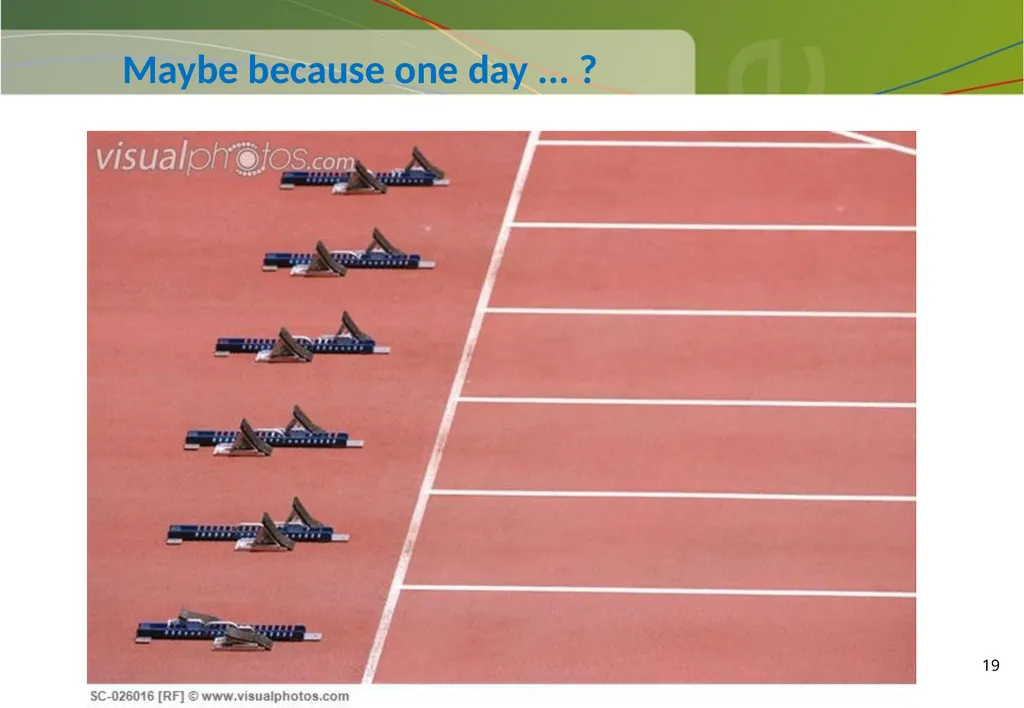
slide19. Maybe because one day ... ?<br>
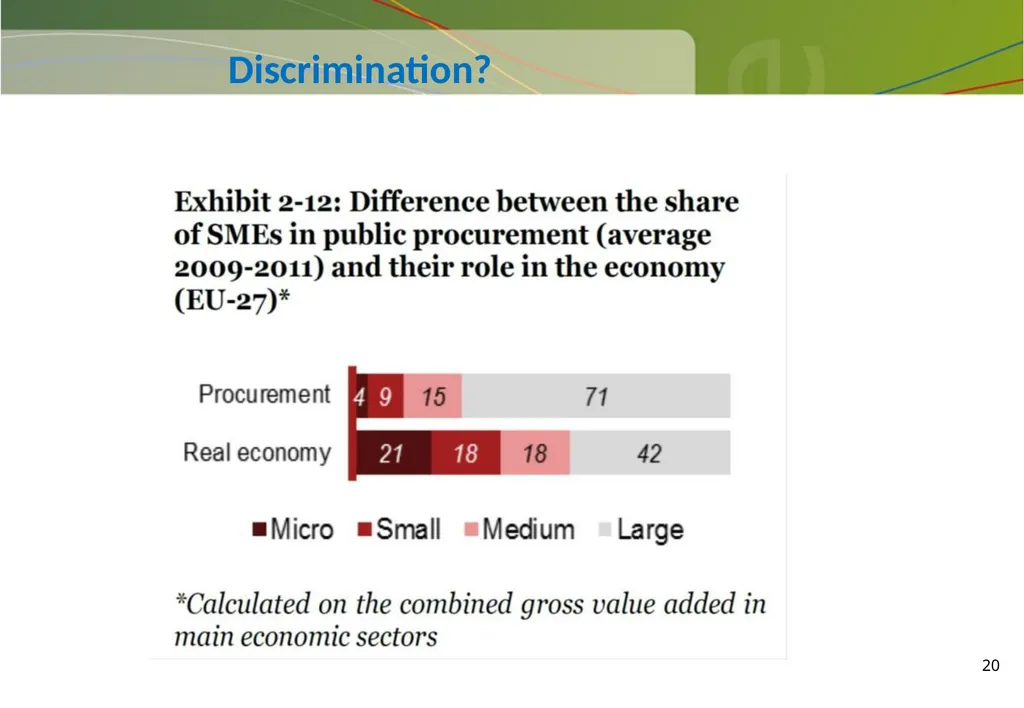
slide20. Discrimination?<br>
slide21. - skills assessment and development programs
- business mentoring or coaching
- training in commercial tendering
- small business advice
- simplification of bidding documents and questionnaires
- translation of documents into local language
- lowering or rationalization of pre-qualification criteria
- reduction in costs of bidding, e.g. payment for bidding documents
- lowering of barriers to entry, e.g. compulsory industry registrations
- access to additional or cheaper forms of business financing and investment
- more transparent publication of business opportunities
- communication programs Classic solutions to deal with SMEs<br>
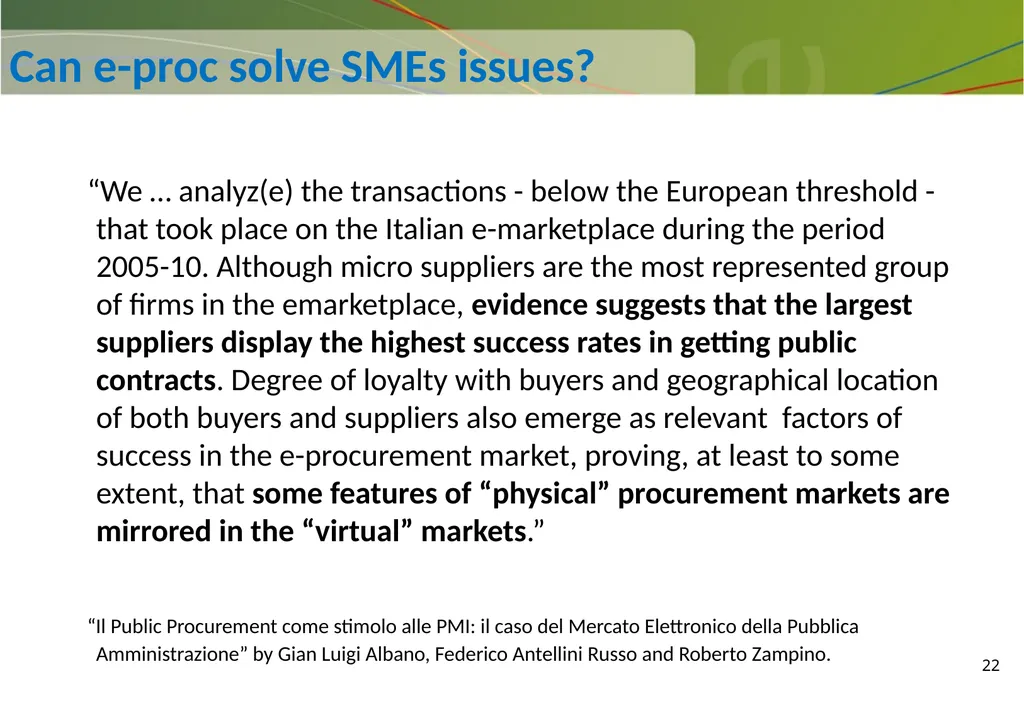
slide22. “We … analyz(e) the transactions - below the European threshold - that took place on the Italian e-marketplace during the period 2005-10. Although micro suppliers are the most represented group of firms in the emarketplace, evidence suggests that the largest suppliers display the highest success rates in getting public contracts. Degree of loyalty with buyers and geographical location of both buyers and suppliers also emerge as relevant factors of success in the e-procurement market, proving, at least to some extent, that some features of “physical” procurement markets are mirrored in the “virtual” markets.”
“Il Public Procurement come stimolo alle PMI: il caso del Mercato Elettronico della Pubblica Amministrazione” by Gian Luigi Albano, Federico Antellini Russo and Roberto Zampino. Can e-proc solve SMEs issues?<br>
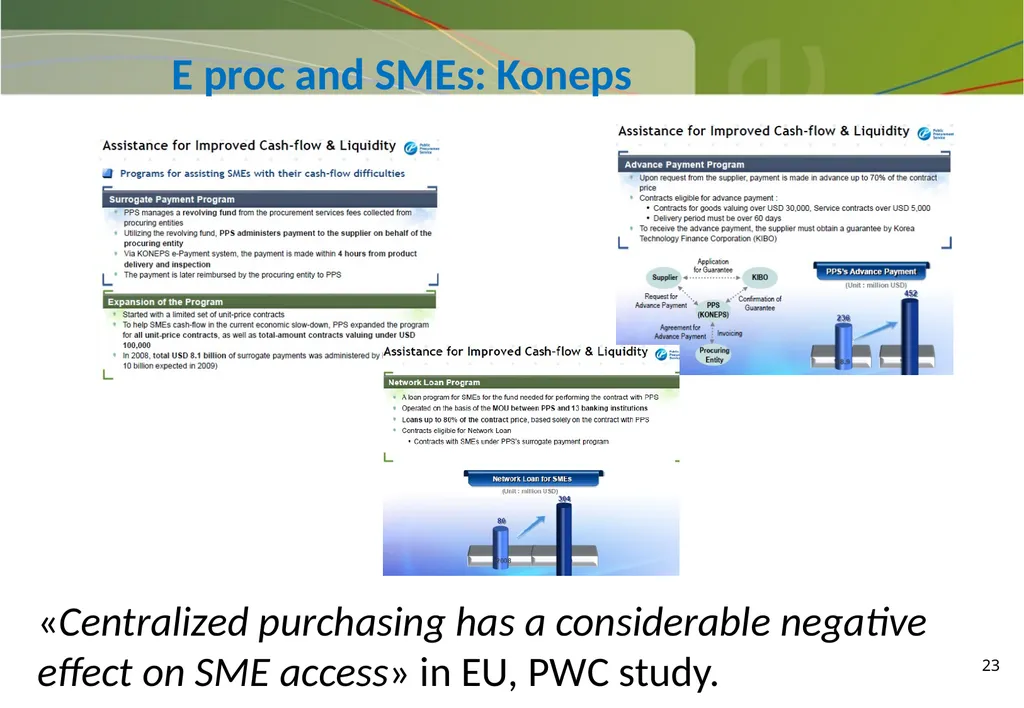
slide23. E proc and SMEs: Koneps «Centralized purchasing has a considerable negative effect on SME access» in EU, PWC study.<br>
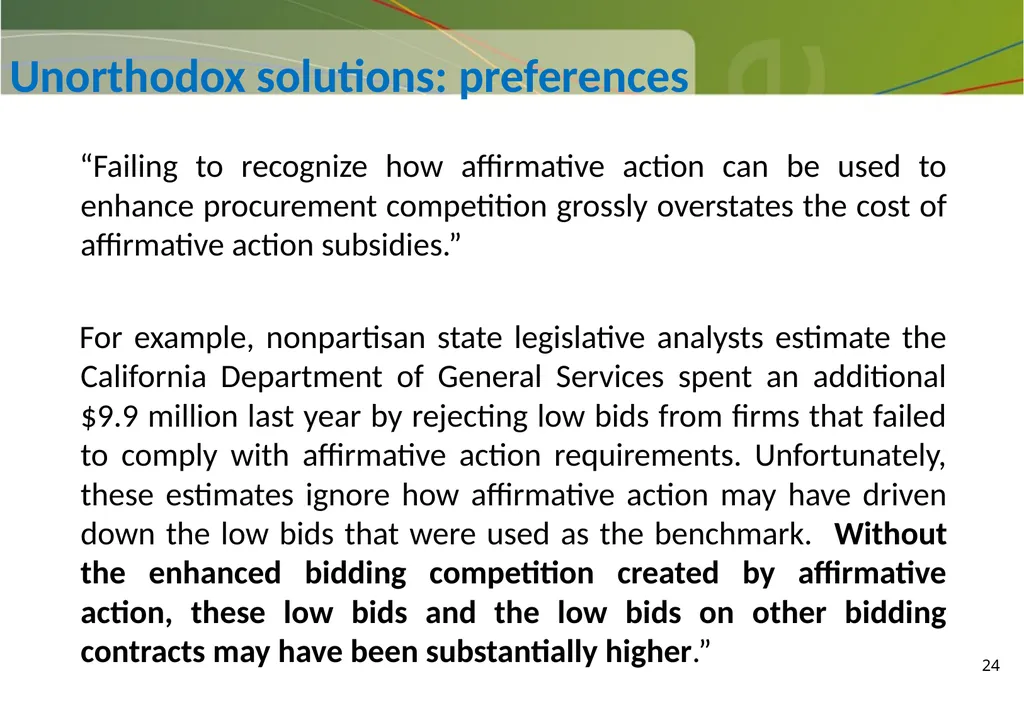
slide24. “Failing to recognize how affirmative action can be used to enhance procurement competition grossly overstates the cost of affirmative action subsidies.”
For example, nonpartisan state legislative analysts estimate the California Department of General Services spent an additional $9.9 million last year by rejecting low bids from firms that failed to comply with affirmative action requirements. Unfortunately, these estimates ignore how affirmative action may have driven down the low bids that were used as the benchmark. Without the enhanced bidding competition created by affirmative action, these low bids and the low bids on other bidding contracts may have been substantially higher.” Unorthodox solutions: preferences<br>
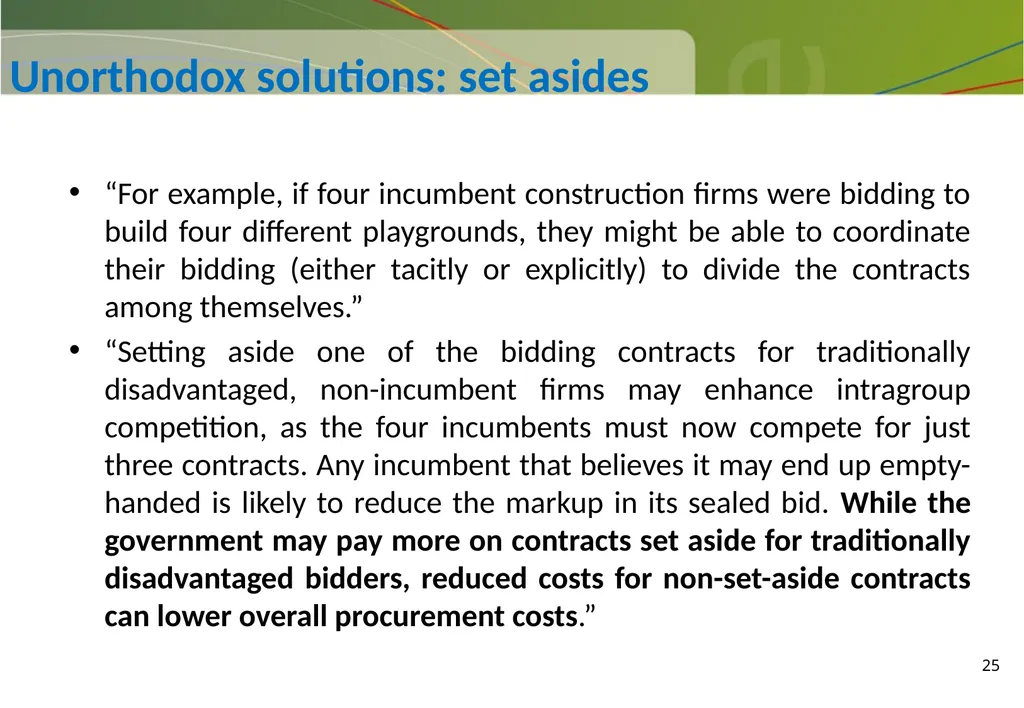
slide25. Unorthodox solutions: set asides “For example, if four incumbent construction firms were bidding to build four different playgrounds, they might be able to coordinate their bidding (either tacitly or explicitly) to divide the contracts among themselves.”
“Setting aside one of the bidding contracts for traditionally disadvantaged, non-incumbent firms may enhance intragroup competition, as the four incumbents must now compete for just three contracts. Any incumbent that believes it may end up empty-handed is likely to reduce the markup in its sealed bid. While the government may pay more on contracts set aside for traditionally disadvantaged bidders, reduced costs for non-set-aside contracts can lower overall procurement costs.”<br>
slide26. Fraud. “fake” (small) corporations might be created only for the purpose of being awarded the procurement contract at a higher price. Or else, large companies might redefine their structure to participate as small ones and obtain the advantage (Brazil). A corrupt environment might make this fraud easier.
Preferences in the hands of dominant lobby. Risks? In certain environments, yes<br>
slide27. Set-aside and preferences might be optimal with competences, professionalization and integrity.
Set-asides and preferences are risky with incompetence and disastrous with systemic corruption. Conclusions (tentative)<br>
slide28. At least import this! These are representatives of the U.S. Small Business Administration in the various large Procurement Agencies.
Functions and Powers:
1. Analyze the procurement strategies and verify if contract-bundling is necessary and justified
2. Propose alternative solutions to the contracting officer to foster SMEs partecipation
3. In case of a failed agreement, escalate the issue in the hands of the Agency Manager.<br>
slide29. P&C
WORKING TOGETHER<br>
slide30. Brothers in Arms: Spotting a cartel Too hard to do for a single procurer:
Cartels can be done over time (today I go, tomorrow you go) or over space (I go to Rome you go to Paris): how can one notice?
Stopping a cartel might mean stopping sourcing of urgent services or delivery of goods: organizational problem and internal resistance.
So….
Antitrust authorities and availability of public procurement data, together with whistleblowing legislation are the best instruments to fight it.
Internally, competences and the right procurement strategy might still help to make cartels’ life miserable.
And in the process, 2 birds with one stone (in Italian: with one bean).<br>
slide31. The Second Bird Corruption and Collusion are strategic complements.
a) Collusion benefits from corruption:
- To make defection harder or impossible;
To make cartels even more profitable.
b) Corruption can be facilitated by collusion
Rents (extra profits) are resources for corruption.
Lower probability to blow the whistle against corrupt officers.<br>
slide32. The Bean? Waste arises from:
Incompetence and Corruption.
Keeping in mind that:
Incompetence and Corruption sustain each other;
Cartels and Corruption sustain each other;
Cartels do exclude SMEs.
Strive for Competence and Performance in Organizations and
Participation and Competition will be maximized, becoming …<br>
slide33. There's so many different worlds
So many different suns
And we have just one world
But we live in different ones
But it's written in the starlight
And every line on your palm
We're fools to make war
On our brothers in arms Participation & Competition, Brothers in Arms<br>
Brothers in Arms? Prof. Gustavo Piga
Director of IPPM, International Master in Public Procurement Management
Department of Business Government Philosophy Studies
University of Rome Tor Vergata
www.masterprocurement.eu X Conferencia Anual sobre Compras Gubernamentales de las Américas de la RICG
Asunción, October 29th, 2014<br>
slide2. PARTICIPATION AND COMPETITION:
RIVALS?<br>
slide3. Two nightmares for a “good” procurer Having competition without participation:
Barriers to entry, where a few compete and others do not bid, while they might have if procurement had “targeted” them;
Having participation without competition:
Cartels, which are ubiquitous in public procurement.<br>
slide4. With due focus on words Make participation and competition contribute positively to the procurement strategy.
No need to rejoice for one more player if this makes cartels work better: the example of the average price formula;
No need to rejoice if participation of one bad candidate discourages the participation of one good candidate: quality monitoring matters!<br>
slide5. Two nightmares in one Bos and Harrington (2010) show that stable cartels are often not all-inclusive.
They show that a firm finds it optimal not to join the cartel when its capacity is sufficiently low, because the effect of its membership on price is trivial but, at the same time, it experiences a non-trivial reduction in its output.
Thus, they claim we should not expect a cartel to include very small firms.<br>
slide6. Policy action might encounter unexpected trade-offs:
Trying to elicit participation one might simply reduce competition!
And trying to strengthen competition one might decrease participation!
Are these true trade-offs or simply «little» mistakes? Nightmares or Mistakes?<br>
slide7. The contracting authority should have a duty to consider the appropriateness of dividing large contracts into lots while remaining free to decide autonomously on the basis of any reason it deems pertinent, without being subject to administrative or judicial supervision. Where the contracting authority decides that it would not be appropriate to divide the contract into lots, the individual report or the contract award notice should contain an indication of the main reasons for the contracting authority's choice.
Such reasons could for instance be that the contracting authority finds that such division could risk restricting competition, or risk rendering the execution of the contract excessively technically difficult or expensive, or that the need to coordinate the different contractors for the lots could seriously risk undermining the proper execution of the contract.
Harder to do one lot.
New Directive EU: Eliciting Participation?<br>
slide8. “A contracting authority that used to tender a single lot every year and now tenders a single lot of half the original size every 6 months, is required to justify why it tenders a single lot.
An administration that used to tender a certain type of goods or services divided in 4 lots and repeated every 6 months, and that now bundles demand and tenders everything divided in two very large lots once a year will not have to justify its bundling choices, because its procurements have 2 lots.
This sounds very much against the general spirit of article 46 that, according to my understanding, aims at fostering unbundling of tenders in smaller lots that are more accessible to SMEs… Having 4 instead of 40 lots may have much bigger consequences than having 1 lot instead of 3”.
Giancarlo Spagnolo, Second Interdisciplinary Symposium on Public Procurement, Budapest 2014. EU: Discouraging the Right Policy<br>
slide9. (30a) Where contracts are divided into lots, contracting authorities should, for instance in order to preserve competition or to ensure reliability of supply, be allowed to limit the number of lots for which an economic operator may tender; they should also be allowed to limit the number of lots that may be awarded to any one tenderer.
Restricting competition is not a good idea if you want to restrict awards to large firms: a superior outcome would certainly arise by letting each firm compete on all lots and afterwards limit to the most convenient lot their award. EU: Eliciting Participation (2)<br>
slide10. DISCRIMINATION AGAINST SMEs?<br>
slide11. SMEs are special Problems faced by EU bidders, (by bidders size relative to large firms) The column of totals displays on average which portion of firms interviewed answered “always” or “often”<br>
slide12. Are large contracts the business of large firms only?<br>
slide13. “We have strong evidence than in many cases SMEs are considerably MORE efficient than large firms, so that the issue of how to involve them in government procurement is one of immediate efficiency, not just a political constraint or a costly investment for the future.
This evidence is under the eyes of everybody: it is the amount of subcontracting to SMEs that most large suppliers undertake after they win large contracts from bundled procurement. If the large firms were more efficient than SMEs, they would lose money by subcontracting to SMEs, hence we would only observe subcontracting to other large firms”
Giancarlo Spagnolo, Second Interdisciplinary Symposium on Public Procurement, Budapest 2014. Are SMEs Good? So why large contracts?<br>
slide14. The typical problem with directly involving SMEs in Public Procurement is coordinating their work and ensuring a reliable and constant level of quality, not risking to pay more. Quality problems and coordination problems are important, they should be taken into account, and they are typically solved well by large suppliers who use subcontracting to all the time.
Even though SMEs are often more efficient in production than large firms, coordination and quality control problems could be large enough to make it preferable for the government to contract with large firms and let them deal with SMEs as subcontractors.
Therefore, the problem is: how do we know when the difference in production efficiency between large firms and SMEs that could be captured by the buyer by having smaller lots and direct involvement of SMEs, are larger than the additional administrative, coordination and quality control costs that the buyer will have to incur when there is not a large supplier serving as an intermediary?
Giancarlo Spagnolo, Second Interdisciplinary Symposium on Public Procurement, Budapest 2014. Not always?<br>
slide15. Efficient SMEs? Have small lots on which everybody can bid, but also allow for bids conditional on winning a large number of lots, a "package" or "combination" of lots. Combinatorial bidding is in the New Directives.
“Inefficient” (new) SMEs? Accept the short-term cost in terms of competition today for more competition tomorrow: set-asides. But the European Union bans set-asides, in the name of competition and fairness. 2 Types of Solutions<br>
slide16. The EU: Eliciting Competition? “The EU is not in favour of reserving markets to specific undertakings. Such actions would also be in contradiction with the principle of equal treatment of tenderers, a fundamental pillar of the EU public procurement regime anchored by the Court of Justice in the Treaty freedoms.” Green Paper.<br>
slide17. The Aussie Athlete, James Gallaugher recently completed the 200m run 0.08 secs faster than the 14-year-old Bolt registering 21.73 secs. The competition(s) that make sense<br>
slide18. And those which don’t No? Why?<br>
slide19. Maybe because one day ... ?<br>
slide20. Discrimination?<br>
slide21. - skills assessment and development programs
- business mentoring or coaching
- training in commercial tendering
- small business advice
- simplification of bidding documents and questionnaires
- translation of documents into local language
- lowering or rationalization of pre-qualification criteria
- reduction in costs of bidding, e.g. payment for bidding documents
- lowering of barriers to entry, e.g. compulsory industry registrations
- access to additional or cheaper forms of business financing and investment
- more transparent publication of business opportunities
- communication programs Classic solutions to deal with SMEs<br>
slide22. “We … analyz(e) the transactions - below the European threshold - that took place on the Italian e-marketplace during the period 2005-10. Although micro suppliers are the most represented group of firms in the emarketplace, evidence suggests that the largest suppliers display the highest success rates in getting public contracts. Degree of loyalty with buyers and geographical location of both buyers and suppliers also emerge as relevant factors of success in the e-procurement market, proving, at least to some extent, that some features of “physical” procurement markets are mirrored in the “virtual” markets.”
“Il Public Procurement come stimolo alle PMI: il caso del Mercato Elettronico della Pubblica Amministrazione” by Gian Luigi Albano, Federico Antellini Russo and Roberto Zampino. Can e-proc solve SMEs issues?<br>
slide23. E proc and SMEs: Koneps «Centralized purchasing has a considerable negative effect on SME access» in EU, PWC study.<br>
slide24. “Failing to recognize how affirmative action can be used to enhance procurement competition grossly overstates the cost of affirmative action subsidies.”
For example, nonpartisan state legislative analysts estimate the California Department of General Services spent an additional $9.9 million last year by rejecting low bids from firms that failed to comply with affirmative action requirements. Unfortunately, these estimates ignore how affirmative action may have driven down the low bids that were used as the benchmark. Without the enhanced bidding competition created by affirmative action, these low bids and the low bids on other bidding contracts may have been substantially higher.” Unorthodox solutions: preferences<br>
slide25. Unorthodox solutions: set asides “For example, if four incumbent construction firms were bidding to build four different playgrounds, they might be able to coordinate their bidding (either tacitly or explicitly) to divide the contracts among themselves.”
“Setting aside one of the bidding contracts for traditionally disadvantaged, non-incumbent firms may enhance intragroup competition, as the four incumbents must now compete for just three contracts. Any incumbent that believes it may end up empty-handed is likely to reduce the markup in its sealed bid. While the government may pay more on contracts set aside for traditionally disadvantaged bidders, reduced costs for non-set-aside contracts can lower overall procurement costs.”<br>
slide26. Fraud. “fake” (small) corporations might be created only for the purpose of being awarded the procurement contract at a higher price. Or else, large companies might redefine their structure to participate as small ones and obtain the advantage (Brazil). A corrupt environment might make this fraud easier.
Preferences in the hands of dominant lobby. Risks? In certain environments, yes<br>
slide27. Set-aside and preferences might be optimal with competences, professionalization and integrity.
Set-asides and preferences are risky with incompetence and disastrous with systemic corruption. Conclusions (tentative)<br>
slide28. At least import this! These are representatives of the U.S. Small Business Administration in the various large Procurement Agencies.
Functions and Powers:
1. Analyze the procurement strategies and verify if contract-bundling is necessary and justified
2. Propose alternative solutions to the contracting officer to foster SMEs partecipation
3. In case of a failed agreement, escalate the issue in the hands of the Agency Manager.<br>
slide29. P&C
WORKING TOGETHER<br>
slide30. Brothers in Arms: Spotting a cartel Too hard to do for a single procurer:
Cartels can be done over time (today I go, tomorrow you go) or over space (I go to Rome you go to Paris): how can one notice?
Stopping a cartel might mean stopping sourcing of urgent services or delivery of goods: organizational problem and internal resistance.
So….
Antitrust authorities and availability of public procurement data, together with whistleblowing legislation are the best instruments to fight it.
Internally, competences and the right procurement strategy might still help to make cartels’ life miserable.
And in the process, 2 birds with one stone (in Italian: with one bean).<br>
slide31. The Second Bird Corruption and Collusion are strategic complements.
a) Collusion benefits from corruption:
- To make defection harder or impossible;
To make cartels even more profitable.
b) Corruption can be facilitated by collusion
Rents (extra profits) are resources for corruption.
Lower probability to blow the whistle against corrupt officers.<br>
slide32. The Bean? Waste arises from:
Incompetence and Corruption.
Keeping in mind that:
Incompetence and Corruption sustain each other;
Cartels and Corruption sustain each other;
Cartels do exclude SMEs.
Strive for Competence and Performance in Organizations and
Participation and Competition will be maximized, becoming …<br>
slide33. There's so many different worlds
So many different suns
And we have just one world
But we live in different ones
But it's written in the starlight
And every line on your palm
We're fools to make war
On our brothers in arms Participation & Competition, Brothers in Arms<br>