
Participatory management for optimizing
DP
Published · 50 slides · 0 views
1 / 1

Description
Participatory management for optimizing agricultural extension 1 AKSHATHA C PALB4111 Sr. M.Sc. Contents Introduction Objectives Concept of participatory management and participation Perspective of participatory extension in India Stages of
Related Topics
Share
Embed code
Download this presentation From Below
"Participatory management for optimizing" is the property of its rightful owner. Permission is granted to download and print the materials on this website for personal, non-commercial use only, and to display it on your personal computer provided you do not modify the materials and that you retain all copyright notices contained in the materials. By downloading content from our website, you accept the terms of this agreement.
Presentation Transcript
01
Participatory management for optimizing agricultural extension 1 AKSHATHA C
PALB4111
Sr. M.Sc.<br>
PALB4111
Sr. M.Sc.<br>
02
Contents Introduction
Objectives
Concept of participatory management and participation
Perspective of participatory extension in India
Stages of participatory management
Roles of extension managers
Application of participatory approaches in extension
Research studies 2<br>
Objectives
Concept of participatory management and participation
Perspective of participatory extension in India
Stages of participatory management
Roles of extension managers
Application of participatory approaches in extension
Research studies 2<br>
03
Introduction Participation is a dynamic group process.
Members: contribute, share and are influenced
Interchange of ideas and activities toward problem-solving or decision making.
Enables local people to have command, confidence and do own analysis and decision to take action. 3<br>
Members: contribute, share and are influenced
Interchange of ideas and activities toward problem-solving or decision making.
Enables local people to have command, confidence and do own analysis and decision to take action. 3<br>
04
Objectives To know the concept of participatory management
To understand and discuss the participatory management in optimizing agricultural extension
To review the research studies related to the same. 4<br>
To understand and discuss the participatory management in optimizing agricultural extension
To review the research studies related to the same. 4<br>
05
Definition ‘those with legitimate interests in a project both influence decisions which affect them and receive a proportion of any benefits which may accrue’ (ODA, 1996).
It implies a major role for local populations in allocating rights and responsibilities over resources.
Involves partnerships with other interest groups at micro and macro levels. 5<br>
It implies a major role for local populations in allocating rights and responsibilities over resources.
Involves partnerships with other interest groups at micro and macro levels. 5<br>
06
Perspectives of participatory extension Sen indicates that people’s participation is a central feature of contemporary rural development and extension efforts: developing countries.
Participation is essential for sustenance of all development initiatives.
Involvement of people in the development agencies initiated programmes of social change directed towards the solving the problems based on the people priorities.
People contribute their ideas, materials, resources, labour and time, etc. and finally evaluating the results thus accrued to themselves. 6<br>
07
Rationale of People’s Participation Purpose: Human Resource Development
The development of human and inner material resources, with stimulus and support external to the community.
Involves transfer of administrative and financial powers to have-nots and sharing of technical and legal information with the local people. 7<br>
The development of human and inner material resources, with stimulus and support external to the community.
Involves transfer of administrative and financial powers to have-nots and sharing of technical and legal information with the local people. 7<br>
08
Concept of Participation In ancient Greece: It was viewed as a matter of voting, holding offices, attending public meetings, paying taxes and defending the state (Samad, 2002:49).
In modern times: It became synonymous of ‘sharing’ (Kaler, 1999:125).
Gram (1993), Oakley and Marsden (1984) and Wolfe (1985) put forward that participation is closely linked with the concept of empowerment.
Cohen & Uphoff (1980): "people's involvement in decision making processes, in implementing program, their sharing in the benefits of development programs”. 8<br>
09
Participation Popular participation can be defined as the active involvement of the local people in the planning and implementation of development projects.
For effective plan formulation, control of projects and sharing of benefits of development, participation is necessary. 9<br>
For effective plan formulation, control of projects and sharing of benefits of development, participation is necessary. 9<br>
10
Types of participation Uphoff (1987) defines four types of participation as stated below (cited in Khan and Asaduzzaman, 1995:98):
a. Participation in decision making, in identifying, formulating alternatives, planning activities, allocating resources etc;
b. Participating in implementation, in carrying out activities, managing and operating programs, partaking of services;
c. Participating in evaluation of the activity and outcomes';
d. Participation in economic, social, cultural or other benefits, individually or collectively. 10<br>
11
Categories of participation Typical categories of membership and participation include:
• Core group: a relatively small group of people whose passion and engagement energize and nurture the community.
• Active participants: members who are recognized as practitioners and define the community (though they may not be of one mind as to what the community is about).
• Occasional participants: members who only participate when the topic is of special interest, when they have some specific to contribute, or when they are involved in a project related to the domain of the community. 11<br>
12
Categories of participation Peripheral participants: people who have a sustained connection to the community, but with less engagement and authority, either because they are still newcomers. These people may be active elsewhere and carry the learning to these places.
Transactional participants: outsiders who interact with the community occasionally without being members themselves, to receive or provide a service or to gain access to artefacts produced by the community, such as its publications, its website, or its tools. 12<br>
Transactional participants: outsiders who interact with the community occasionally without being members themselves, to receive or provide a service or to gain access to artefacts produced by the community, such as its publications, its website, or its tools. 12<br>
13
Levels of Workers’ Participation The difference is that of degree and nature of application.
Information participation: It ensures that employees are able to receive information and express their views pertaining to the matters of general economic importance.
2. Consultative participation: Here works are consulted on the matters of employee welfare such as work, safety and health.
-Final decision always rests at the option of management and employees’ views are only of advisory nature.
3. Associative participation: It is extension of consultative participation as management here is under moral obligation to accept and implement the unanimous decisions of employees. 13<br>
14
Levels of Workers’ Participation Administrative participation: It ensure greater share of works in discharge of managerial functions.
Decision already taken by the management come to employees, preferably with alternatives for administration and employees have to select the best from those for implementation.
5. Decisive participation: Highest level of participation where decisions are jointly taken on the matters relation to production, welfare etc. is called decisive participation. 14<br>
15
Seven Levels of Participation 1. Consult
2. Consume
3. Connect
4. Compete
5. Comment
6. Create
7. Curate 15<br>
2. Consume
3. Connect
4. Compete
5. Comment
6. Create
7. Curate 15<br>
16
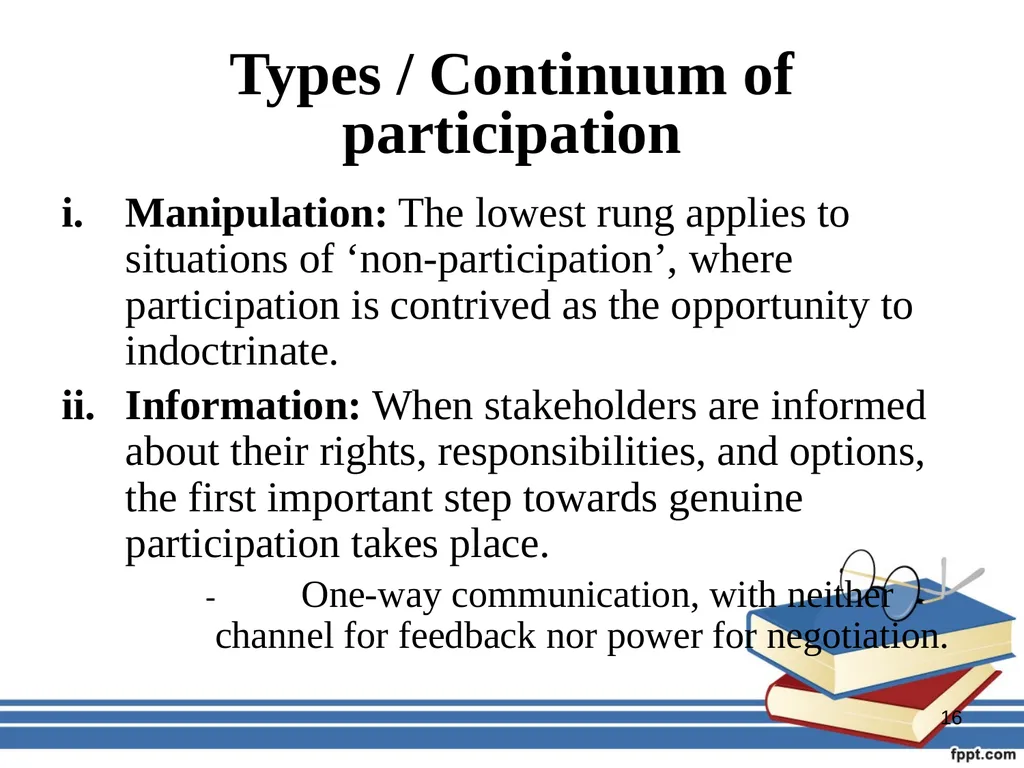
Types / Continuum of participation Manipulation: The lowest rung applies to situations of ‘non-participation’, where participation is contrived as the opportunity to indoctrinate.
Information: When stakeholders are informed about their rights, responsibilities, and options, the first important step towards genuine participation takes place.
- One-way communication, with neither channel for feedback nor power for negotiation. 16<br>
Information: When stakeholders are informed about their rights, responsibilities, and options, the first important step towards genuine participation takes place.
- One-way communication, with neither channel for feedback nor power for negotiation. 16<br>
17
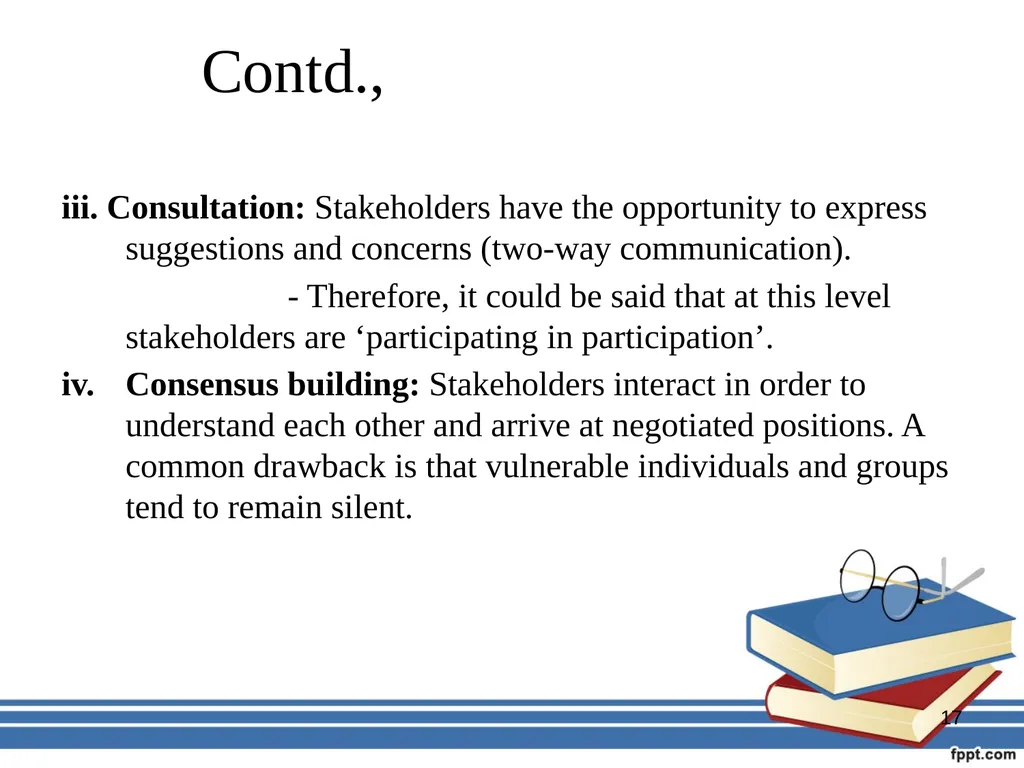
Contd., iii. Consultation: Stakeholders have the opportunity to express suggestions and concerns (two-way communication).
- Therefore, it could be said that at this level stakeholders are ‘participating in participation’.
iv. Consensus building: Stakeholders interact in order to understand each other and arrive at negotiated positions. A common drawback is that vulnerable individuals and groups tend to remain silent. 17<br>
18
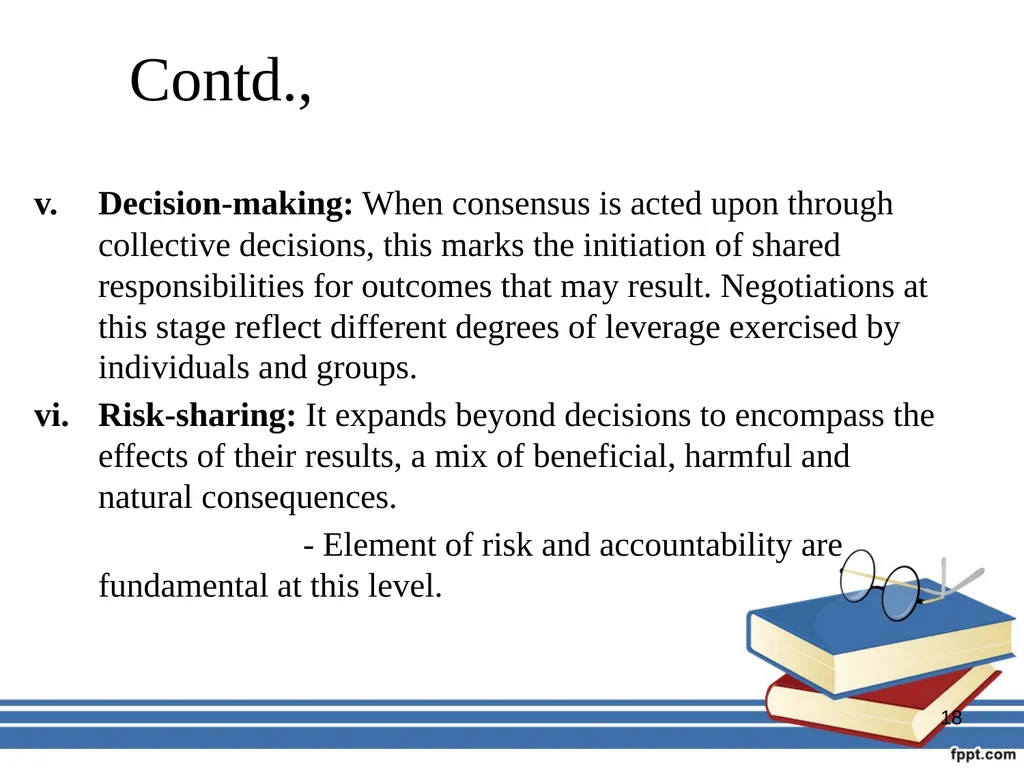
Contd., Decision-making: When consensus is acted upon through collective decisions, this marks the initiation of shared responsibilities for outcomes that may result. Negotiations at this stage reflect different degrees of leverage exercised by individuals and groups.
Risk-sharing: It expands beyond decisions to encompass the effects of their results, a mix of beneficial, harmful and natural consequences.
- Element of risk and accountability are fundamental at this level. 18<br>
Risk-sharing: It expands beyond decisions to encompass the effects of their results, a mix of beneficial, harmful and natural consequences.
- Element of risk and accountability are fundamental at this level. 18<br>
19
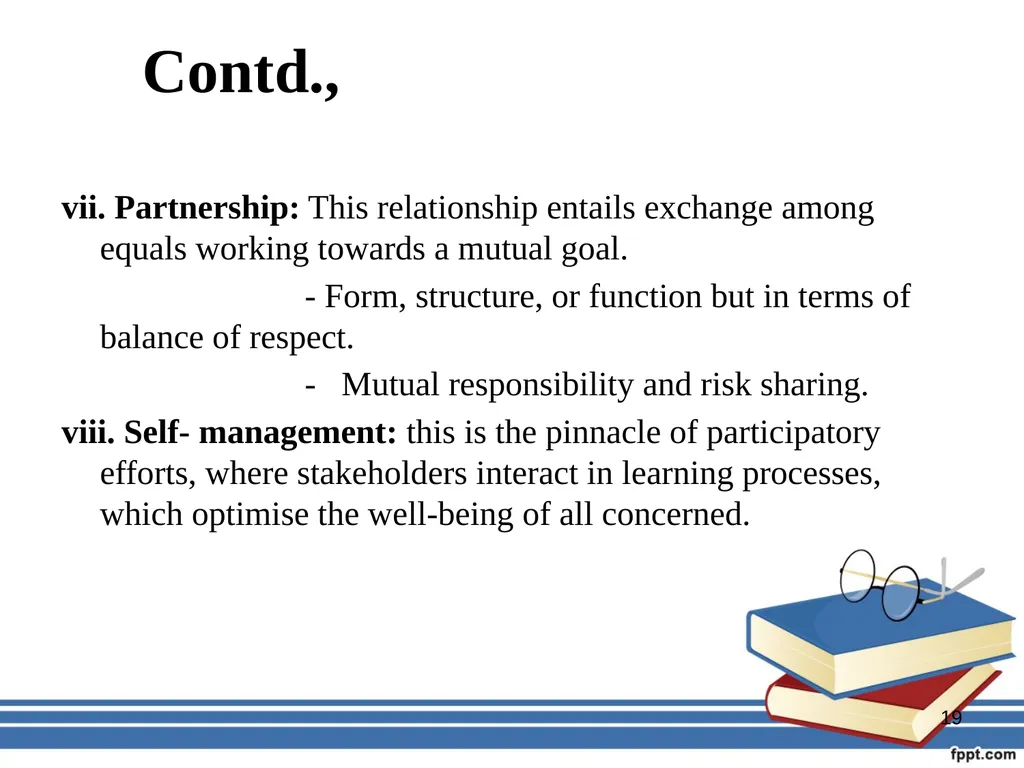
Contd., vii. Partnership: This relationship entails exchange among equals working towards a mutual goal.
- Form, structure, or function but in terms of balance of respect.
- Mutual responsibility and risk sharing.
viii. Self- management: this is the pinnacle of participatory efforts, where stakeholders interact in learning processes, which optimise the well-being of all concerned. 19<br>
- Form, structure, or function but in terms of balance of respect.
- Mutual responsibility and risk sharing.
viii. Self- management: this is the pinnacle of participatory efforts, where stakeholders interact in learning processes, which optimise the well-being of all concerned. 19<br>
20
Stages of Participatory Management It consists of diagnosis of issues and understanding the resources base, planning the interventions, implementation, monitoring and evaluation of the outcomes and processes.
There should be a logical sequence of actions and events. Generating information on the resource situations and issues concerned. 20<br>
There should be a logical sequence of actions and events. Generating information on the resource situations and issues concerned. 20<br>
21
1.Information Generation Information that is realistic and fact-based serves as the basis for remaining stages of participatory management.
Local people and the development agency jointly need to understand the resource situation of the areas, the problems associated with the communities and the resources. 21<br>
Local people and the development agency jointly need to understand the resource situation of the areas, the problems associated with the communities and the resources. 21<br>
22
2.Participatory Planning In management, planning is the crucial function that involves determination of both ends and means with rationalization and fair thought.
Planning is looking at the future with today’s eyes.
Participatory planning must attach due value to local people’s knowledge and skills and the purpose of planning needs to be understood by the local people.
Results/outputs of planning must be documented to serve as a tool for direction for development and needs to be made readily available. 22<br>
23
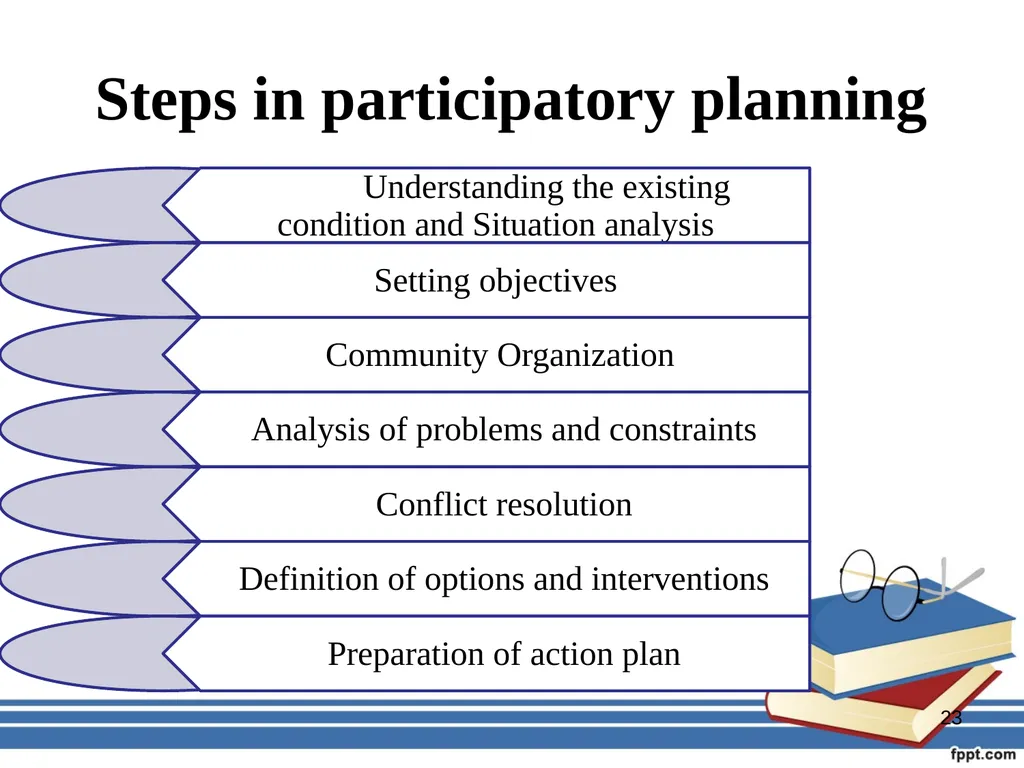
Steps in participatory planning 23<br>
24
3.Participatory Implementation The stakeholders and the development agency develop good understanding of the project, the directions they have to take, activities to be carried out in the time schedules, etc by the time they complete the process of participatory planning.
Putting the developed plan into action by the stakeholders is participatory implementation. 24<br>
Putting the developed plan into action by the stakeholders is participatory implementation. 24<br>
25
Steps in implementation 25<br>
26
4.Participatory Monitoring Monitoring:
A continuous/periodic review and surveillance by management at every level of the implementation of an activity to ensure that input deliveries, work schedules, targeted outputs to proceed according to plan.
a. Participatory monitoring
It is the systematic recording and periodic analysis of information that has been chosen and recorded by insiders with the help of outsiders.
The main purpose is to provide information during the life of the project, so that adjustments and modifications can be made if necessary. 26<br>
27
4.Participatory Monitoring b. Participatory Evaluation:
For set times throughout the life of the activities.
These can be mid-way through the activities, or after each cycle of activities, depending on when the community decides it needs to stop and examine past performance. 27<br>
For set times throughout the life of the activities.
These can be mid-way through the activities, or after each cycle of activities, depending on when the community decides it needs to stop and examine past performance. 27<br>
28
5. Impact Assessment After the tasks completed, it will be necessary to analyze and synthesize information to know the impact of the programme.
Some of the information may have already been analyzed, it will simply have to be put in its place in the presentation. 28<br>
Some of the information may have already been analyzed, it will simply have to be put in its place in the presentation. 28<br>
29
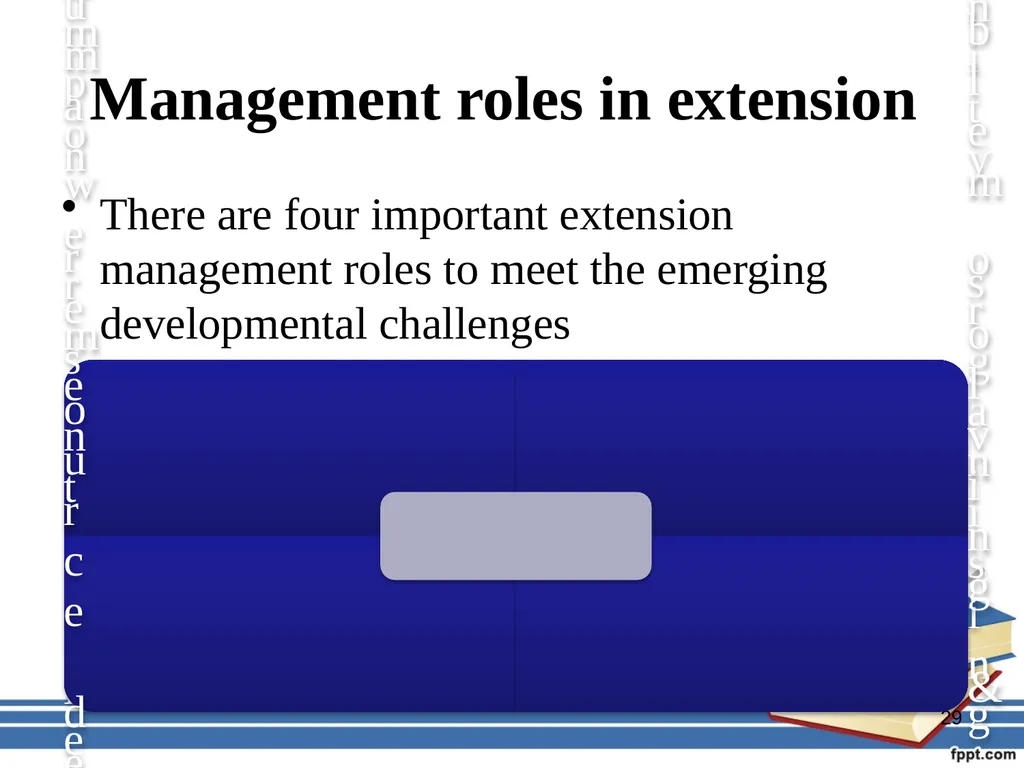
Management roles in extension There are four important extension management roles to meet the emerging developmental challenges 29<br>
30
Empowerment role Role is to help farmers and rural communities organise themselves and take charge of their growth and development through sharing, co-operation and working together.
Extension agents should not direct but show or demonstrate to help triggering imagination 30<br>
Extension agents should not direct but show or demonstrate to help triggering imagination 30<br>
31
Stages of empowerment of the people 31<br>
32
Community organising role Extension agents must learn the principles of community organising and group management skills.
Steps in organising farmers’ organisations :
Understanding village community
Identify potential leaders
Help local leaders to convene meetings
Develop farmers’ organisation through education and action learning
Gearing up for action
Implementation selected projects
Monitoring and evaluation of projects 32<br>
33
Human resource development role This includes human capacity building to understand their personal and group styles of managing themselves and improve their skills.
Both technical and management capabilities should be developed 33<br>
Both technical and management capabilities should be developed 33<br>
34
Problem solving & educational role Problem solving - done by helping farmers to identify the problem and seek right solutions by combining their indigenous knowledge with the current improved knowledge and by using their resources properly .
Educational - learning by practice and encouraging farmers and organisations to conduct experiments and undertake action learning projects. 34<br>
Educational - learning by practice and encouraging farmers and organisations to conduct experiments and undertake action learning projects. 34<br>
35
Applications of Participatory Approaches in Extension • Natural resources and agriculture
• Soil and water conservation (especially in watershed)
• Forestry (especially joint forest management) and agro forestry
• Fisheries and aquaculture
• Biodiversity and wildlife reserve management
Village resource management planning and action
• Integrated pest management
• Crops and animal husbandry, including farmer participatory research
• Irrigation
• Marketing 35<br>
36
Programmes for equity • Women’s empowerment, gender awareness etc
• Children
• Micro-finance
• Selecting and deselecting people for poverty-oriented programmes
• Identification and analysis of non-agricultural income earning opportunities. Analysis by poor people of livelihoods and coping, leading to household Plans
• Participation by communities and their members in complex political emergencies 36<br>
37
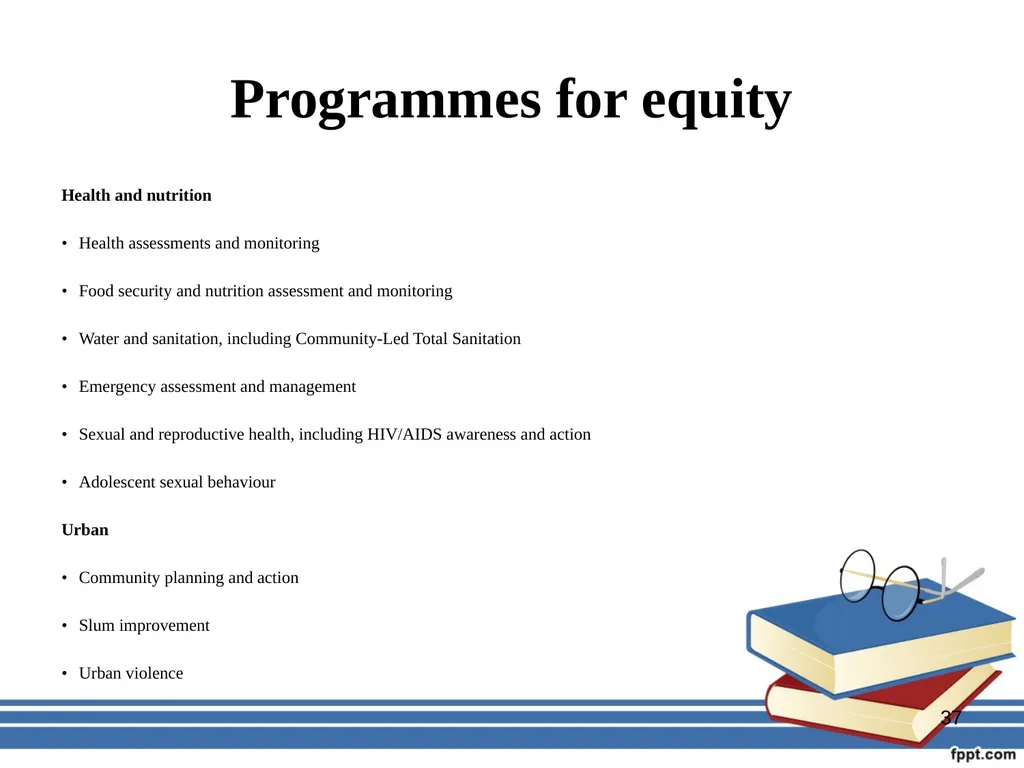
Programmes for equity Health and nutrition
• Health assessments and monitoring
• Food security and nutrition assessment and monitoring
• Water and sanitation, including Community-Led Total Sanitation
• Emergency assessment and management
• Sexual and reproductive health, including HIV/AIDS awareness and action
• Adolescent sexual behaviour
Urban
• Community planning and action
• Slum improvement
• Urban violence 37<br>
38
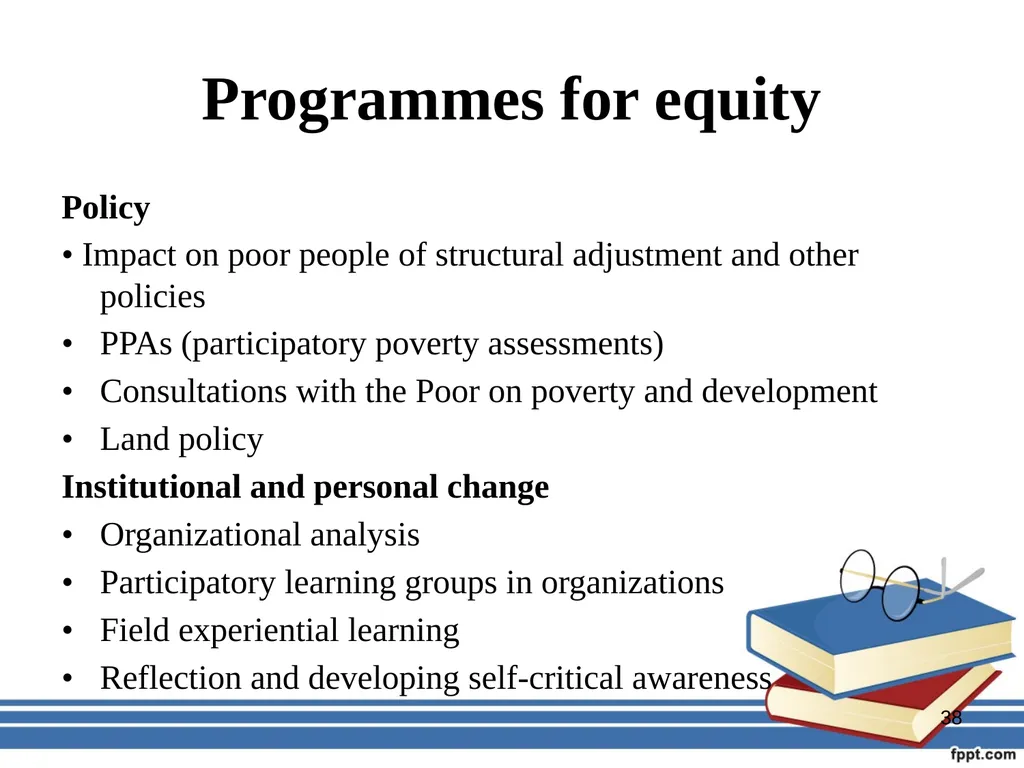
Programmes for equity Policy
• Impact on poor people of structural adjustment and other policies
• PPAs (participatory poverty assessments)
• Consultations with the Poor on poverty and development
• Land policy
Institutional and personal change
• Organizational analysis
• Participatory learning groups in organizations
• Field experiential learning
• Reflection and developing self-critical awareness 38<br>
39
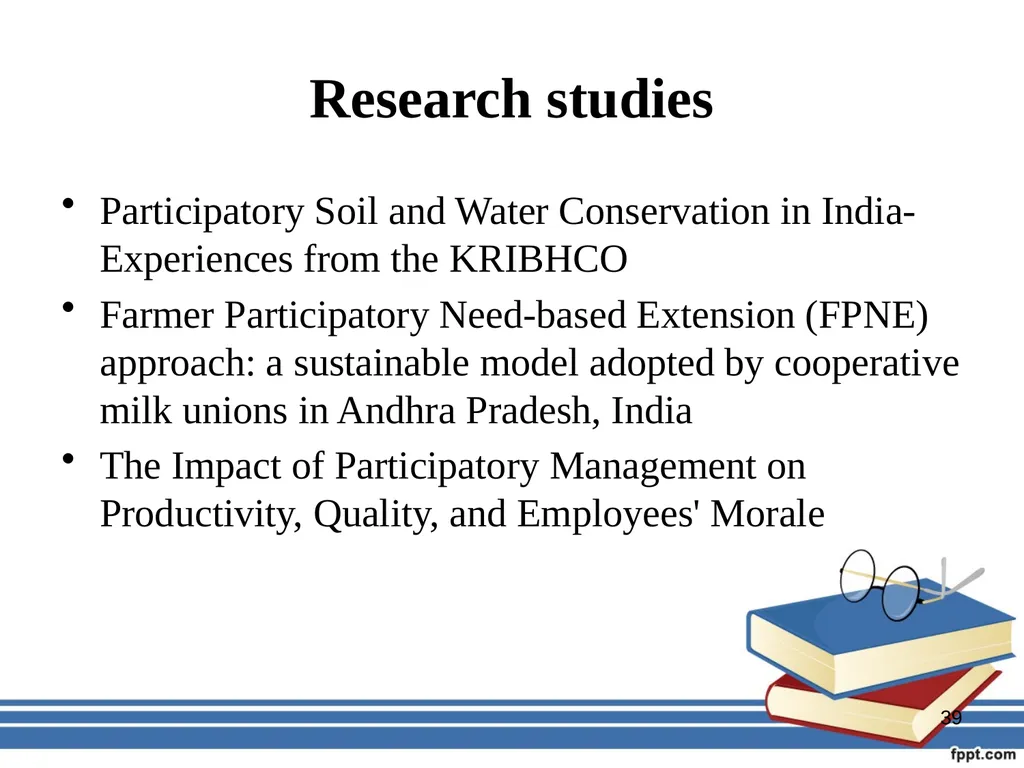
Research studies Participatory Soil and Water Conservation in India- Experiences from the KRIBHCO
Farmer Participatory Need-based Extension (FPNE) approach: a sustainable model adopted by cooperative milk unions in Andhra Pradesh, India
The Impact of Participatory Management on Productivity, Quality, and Employees' Morale 39<br>
Farmer Participatory Need-based Extension (FPNE) approach: a sustainable model adopted by cooperative milk unions in Andhra Pradesh, India
The Impact of Participatory Management on Productivity, Quality, and Employees' Morale 39<br>
40
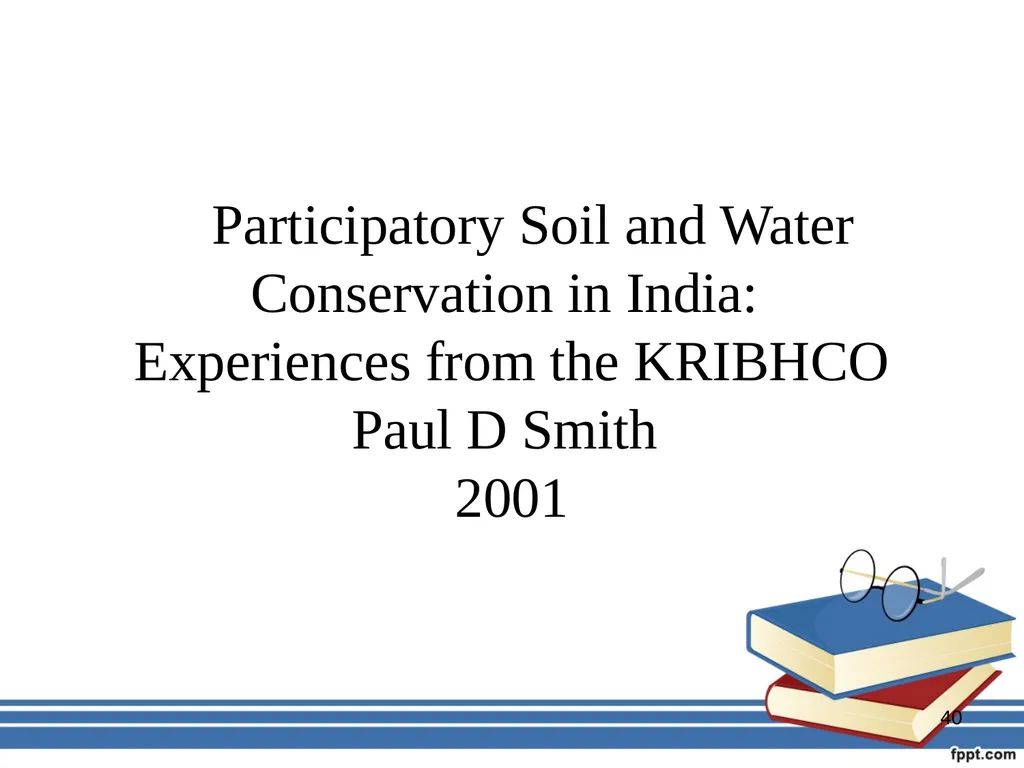
Participatory Soil and Water Conservation in India:
Experiences from the KRIBHCO
Paul D Smith
2001 40<br>
41
The paper describes the attempts by the KRIBHCO to develop participatory approaches to natural resources management including soil and water conservation. 41<br>
42
Farmer Participatory Need-based Extension (FPNE) approach:
A sustainable model adopted by cooperative milk unions in Andhra Pradesh, India
Sabyasachi Roy and D V Rangnekar
2007 42<br>
43
Objective of the study Describes the process of adoption “Farmer Participatory Need-based Extension” of approach starting with orientation and sensitization of the cooperative milk union staff for participatory situation analysis, identification and characterization of priority needs/constraints and actions taken by the cooperative milk unions to overcome some of them. 43<br>
44
Process The process broadly involves five steps as indicated below.
1. Situation Analysis- involving major stakeholders, to understand current status, constraints, needs and priorities of the producers through:
i. Information gathering from primary and secondary sources,
ii. Identification, characterization and prioritizing of constraints,
2. Planning of interventions on the basis of situation analysis and priorities.
3. Implementation of the Plan as per the time frame.
4. Joint monitoring and evaluation of the interventions.
5. Reanalysis of situation for further considerations and actions
Guntur, Krishna, Nalgonda Rangareddy, Mulukanoor and Vishaka tried adoption of FPNE approach with facilitation from NDDB. 44<br>
45
Outcomes The main outcome of the process is
Sensitization of major stakeholders like management team, extension officers and producer members of the cooperative milk unions towards the need to continuously interact for sustained improvement in productivity and quality of milk.
Realization to establish linkages with other organizations, from related fields, to overcome the constraints.
The trials also showed that participatory and systems approach can help in in-depth understanding of rural dairy business systems, perception of producers, particularly that of women producers, identification and characterization of constraints and in choosing appropriate approaches or technologies to overcome the constraints, with due involvement of producers. 45<br>
46
THE IMPACT OF PARTICIPATORY MANAGEMENT
ON PRODUCTIVITY, QUALITY, AND EMPLOYEES' MORALE
By Charles Saye Gono
2013 46<br>
ON PRODUCTIVITY, QUALITY, AND EMPLOYEES' MORALE
By Charles Saye Gono
2013 46<br>
47
Objective
The purpose of this study was to determine the impact of participatory management on productivity, quality, and employees' morale in the United States manufacturing industry.
Methodology
Quantitative data was collected by means of 106 questionnaires.
The questionnaires were sent to manufacturing managers of various companies throughout the United States. Respondents rated the degree of impact of participatory management on productivity, quality, and employees' morale. 47<br>
48
Findings Findings of the study showed that overwhelming majority (88.9%) of the respondents saw an increase in productivity after instituting participatory management style within their companies.
On the question of quality, 81.1% of the respondents saw a significant improvement in quality after the implementation of participatory management.
As it pertained to employees' morale, 88.7% of the respondents saw an increase in employees' morale after the introduction of participatory management 48<br>
49
Conclusion Thus, understanding the process of participatory management would help the extension functionaries to encourage participation at field level and to play an effective role in sustainable development of agriculture as a facilitator and catalyst. 49<br>
50
Thank You 50<br>