
Partnered Care Overview July 2021 What is
SB
Published · 12 slides · 0 views

1 / 1
Description
Partnered Care Overview July 2021 What is Partnered Care? Oranga Tamariki funds and works with around 60 care partners that provide safe homes and places to live for children in care. A care partner is an organisation that provides care for
Related Topics
Share
Embed code
Download this presentation From Below
"Partnered Care Overview July 2021 What is" is the property of its rightful owner. Permission is granted to download and print the materials on this website for personal, non-commercial use only, and to display it on your personal computer provided you do not modify the materials and that you retain all copyright notices contained in the materials. By downloading content from our website, you accept the terms of this agreement.
Presentation Transcript
01
Partnered Care Overview
July 2021<br>
July 2021<br>
02
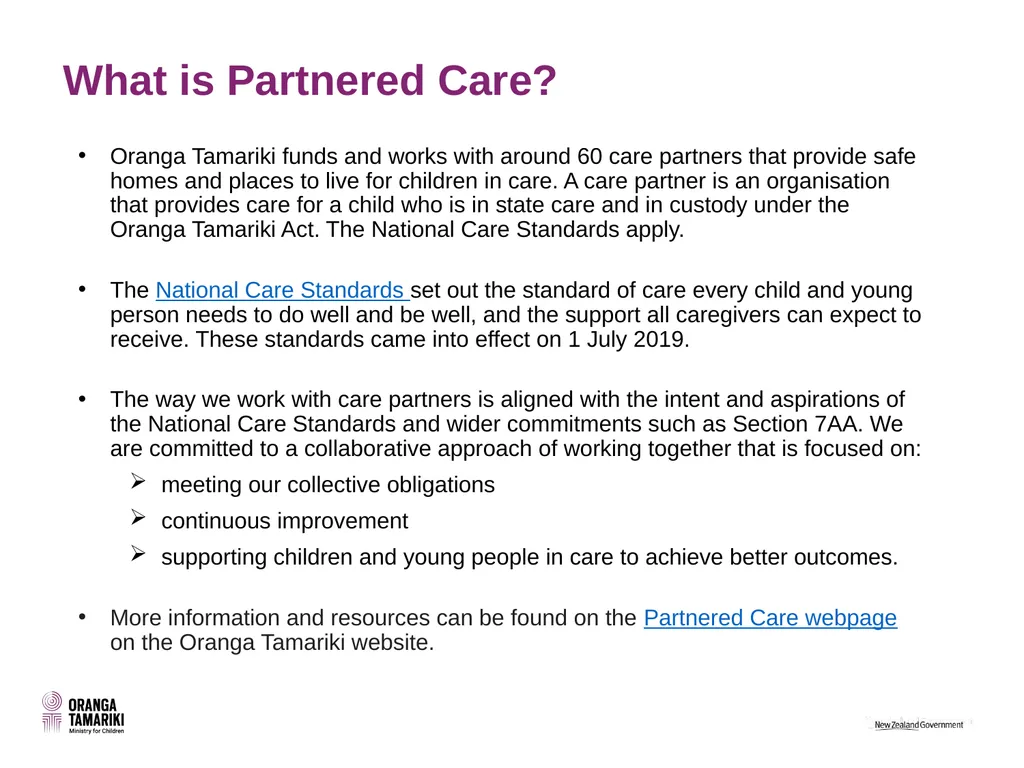
What is Partnered Care? Oranga Tamariki funds and works with around 60 care partners that provide safe homes and places to live for children in care. A care partner is an organisation that provides care for a child who is in state care and in custody under the Oranga Tamariki Act. The National Care Standards apply.
The National Care Standards set out the standard of care every child and young person needs to do well and be well, and the support all caregivers can expect to receive. These standards came into effect on 1 July 2019.
The way we work with care partners is aligned with the intent and aspirations of the National Care Standards and wider commitments such as Section 7AA. We are committed to a collaborative approach of working together that is focused on:
meeting our collective obligations
continuous improvement
supporting children and young people in care to achieve better outcomes.
More information and resources can be found on the Partnered Care webpage on the Oranga Tamariki website.<br>
03
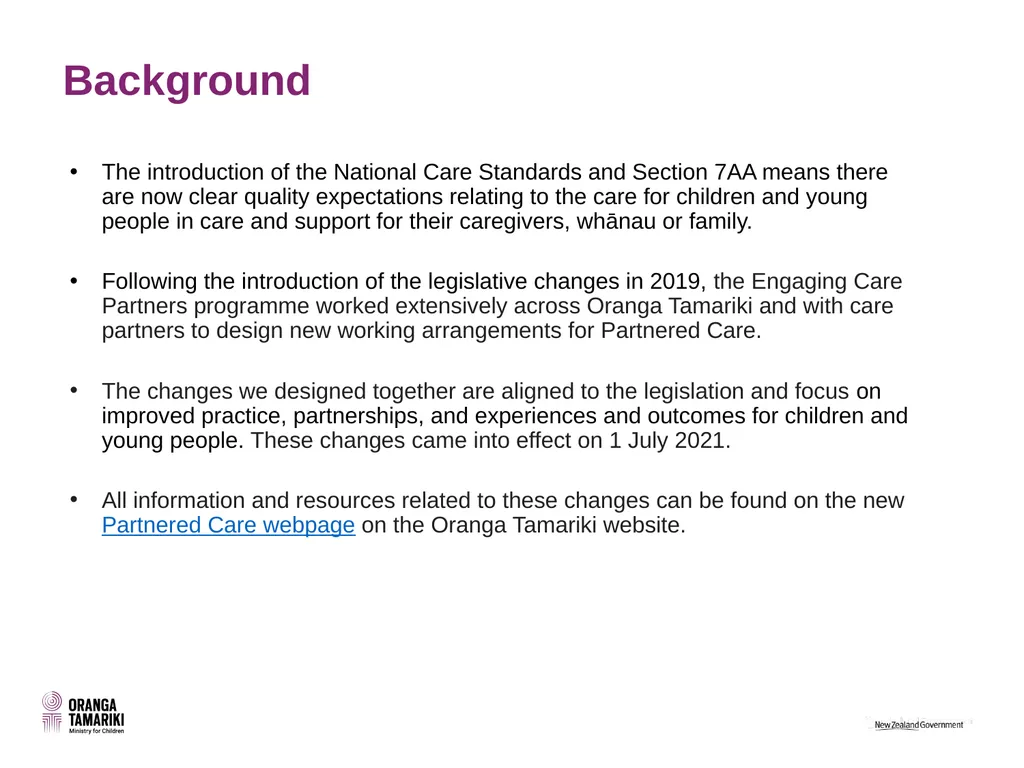
The introduction of the National Care Standards and Section 7AA means there are now clear quality expectations relating to the care for children and young people in care and support for their caregivers, whānau or family.
Following the introduction of the legislative changes in 2019, the Engaging Care Partners programme worked extensively across Oranga Tamariki and with care partners to design new working arrangements for Partnered Care.
The changes we designed together are aligned to the legislation and focus on improved practice, partnerships, and experiences and outcomes for children and young people. These changes came into effect on 1 July 2021.
All information and resources related to these changes can be found on the new Partnered Care webpage on the Oranga Tamariki website. Background<br>
04
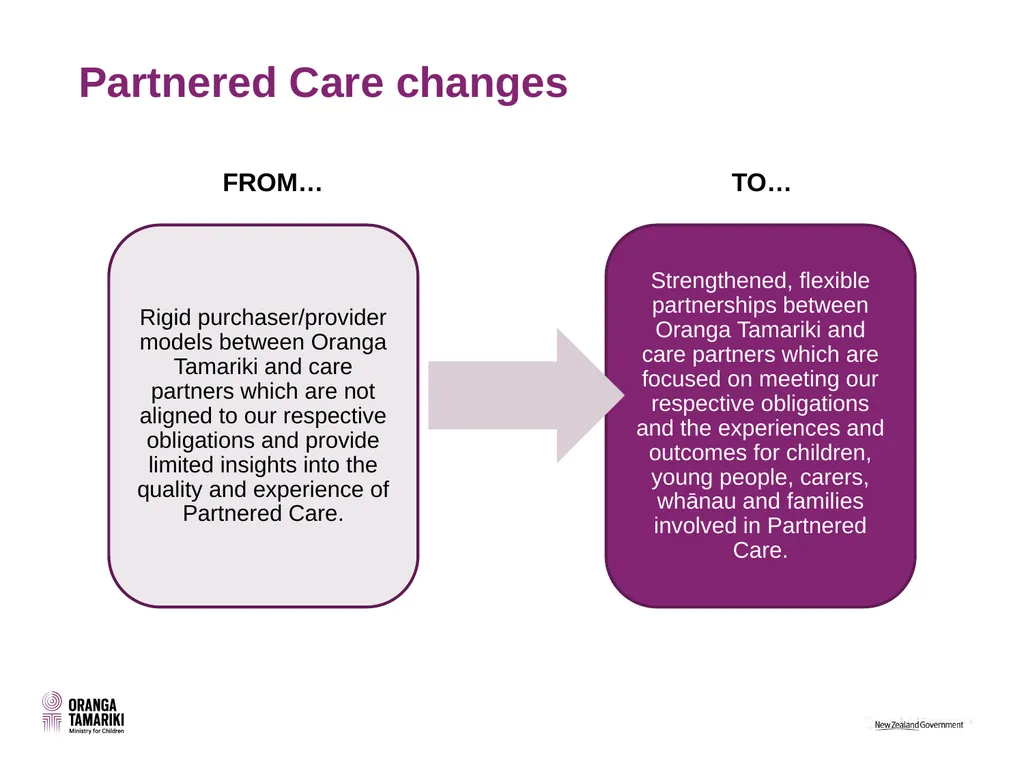
Partnered Care changes Rigid purchaser/provider models between Oranga Tamariki and care partners which are not aligned to our respective obligations and provide limited insights into the quality and experience of Partnered Care. Strengthened, flexible partnerships between Oranga Tamariki and care partners which are focused on meeting our respective obligations and the experiences and outcomes for children, young people, carers, whānau and families involved in Partnered Care. FROM… TO…<br>
05
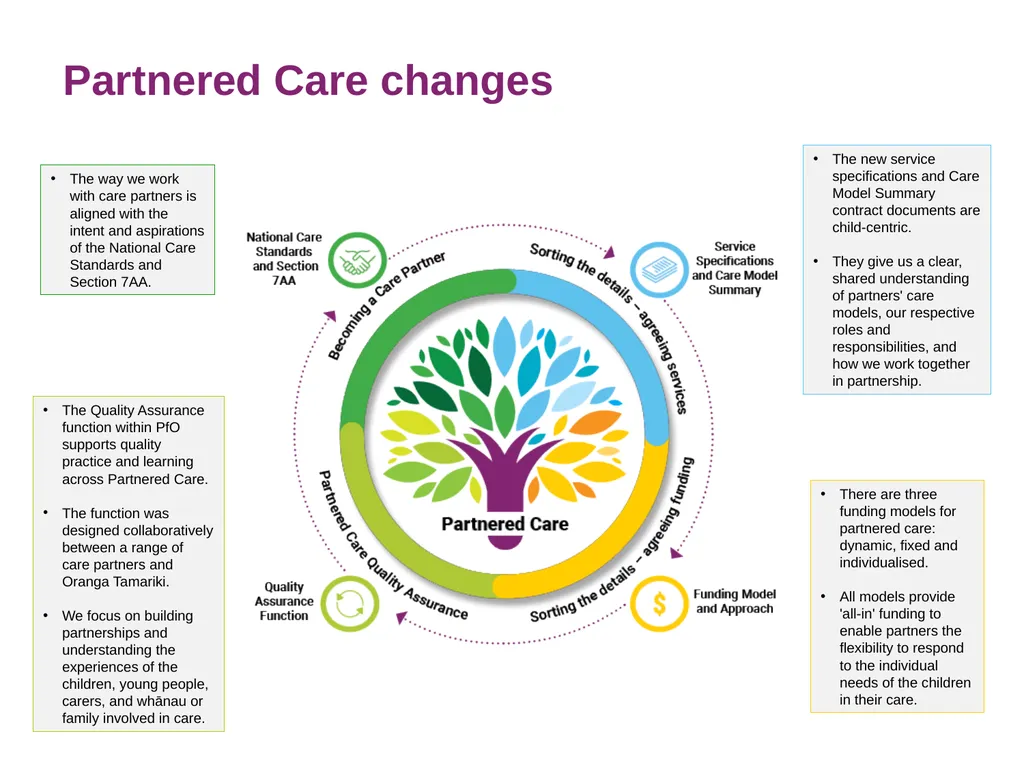
The new service specifications and Care Model Summary contract documents are child-centric.
They give us a clear, shared understanding of partners' care models, our respective roles and responsibilities, and how we work together in partnership. The way we work with care partners is aligned with the intent and aspirations of the National Care Standards and Section 7AA. The Quality Assurance function within PfO supports quality practice and learning across Partnered Care.
The function was designed collaboratively between a range of care partners and Oranga Tamariki.
We focus on building partnerships and understanding the experiences of the children, young people, carers, and whānau or family involved in care. There are three funding models for partnered care: dynamic, fixed and individualised.
All models provide 'all-in' funding to enable partners the flexibility to respond to the individual needs of the children in their care. Partnered Care changes<br>
06
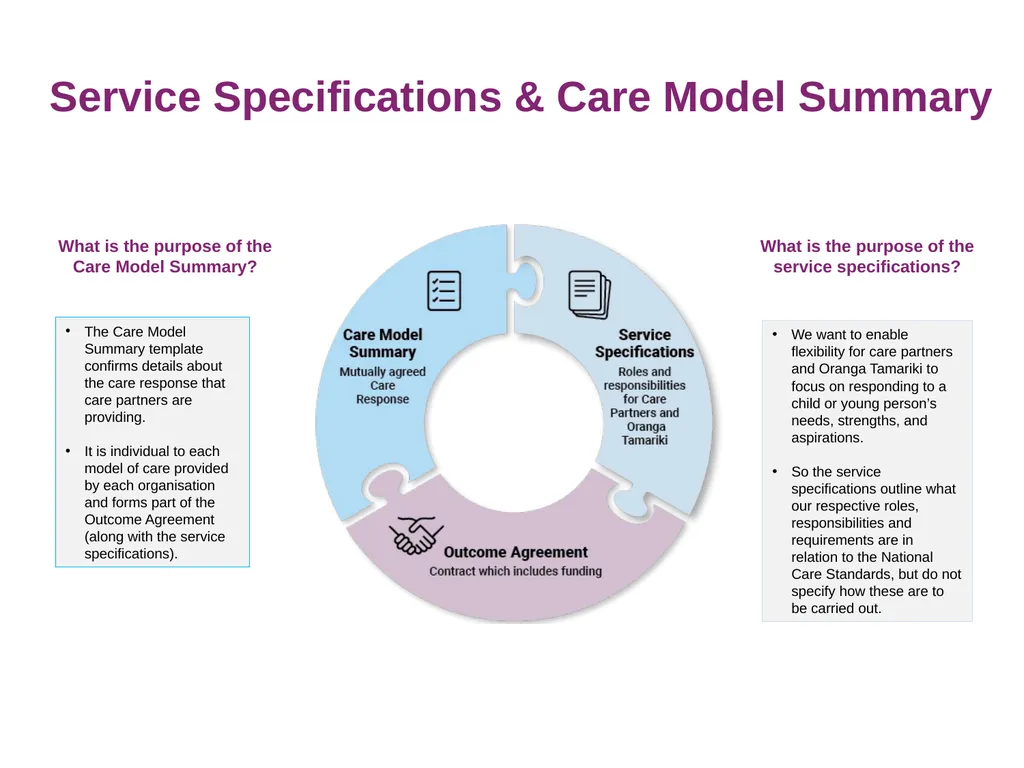
The Care Model Summary template confirms details about the care response that care partners are providing.
It is individual to each model of care provided by each organisation and forms part of the Outcome Agreement (along with the service specifications). We want to enable flexibility for care partners and Oranga Tamariki to focus on responding to a child or young person’s needs, strengths, and aspirations.
So the service specifications outline what our respective roles, responsibilities and requirements are in relation to the National Care Standards, but do not specify how these are to be carried out. Service Specifications & Care Model Summary What is the purpose of the Care Model Summary? What is the purpose of the service specifications?<br>
07
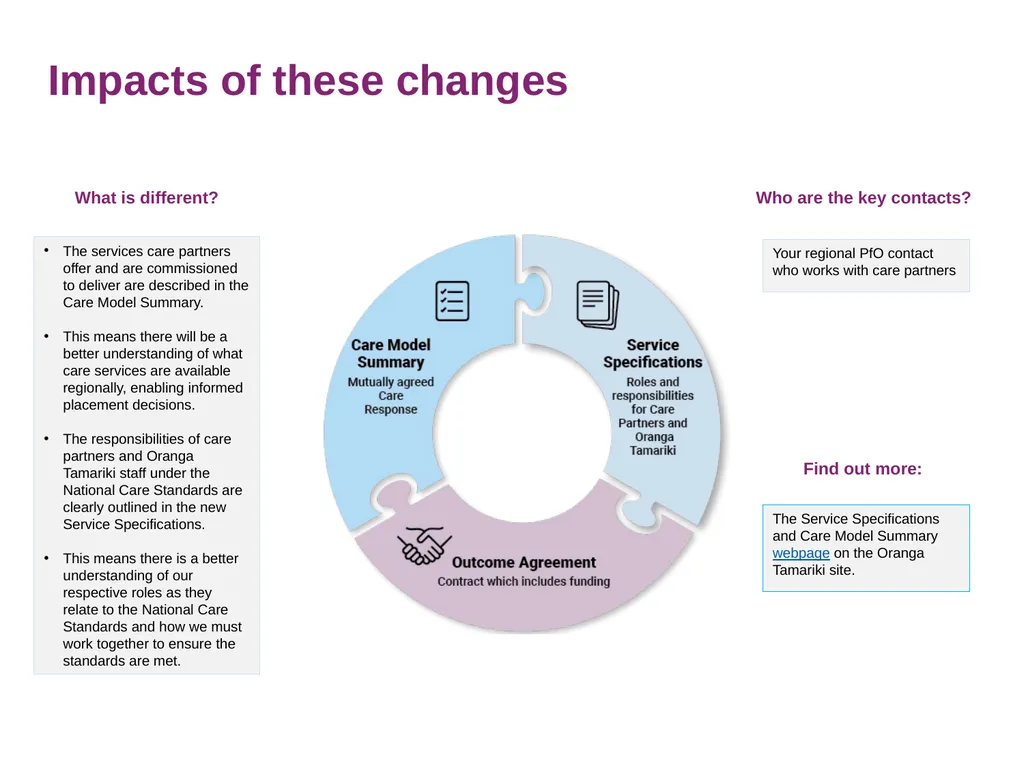
The services care partners offer and are commissioned to deliver are described in the Care Model Summary.
This means there will be a better understanding of what care services are available regionally, enabling informed placement decisions.
The responsibilities of care partners and Oranga Tamariki staff under the National Care Standards are clearly outlined in the new Service Specifications.
This means there is a better understanding of our respective roles as they relate to the National Care Standards and how we must work together to ensure the standards are met. Your regional PfO contact who works with care partners Impacts of these changes What is different? Who are the key contacts? The Service Specifications and Care Model Summary webpage on the Oranga Tamariki site. Find out more:<br>
08
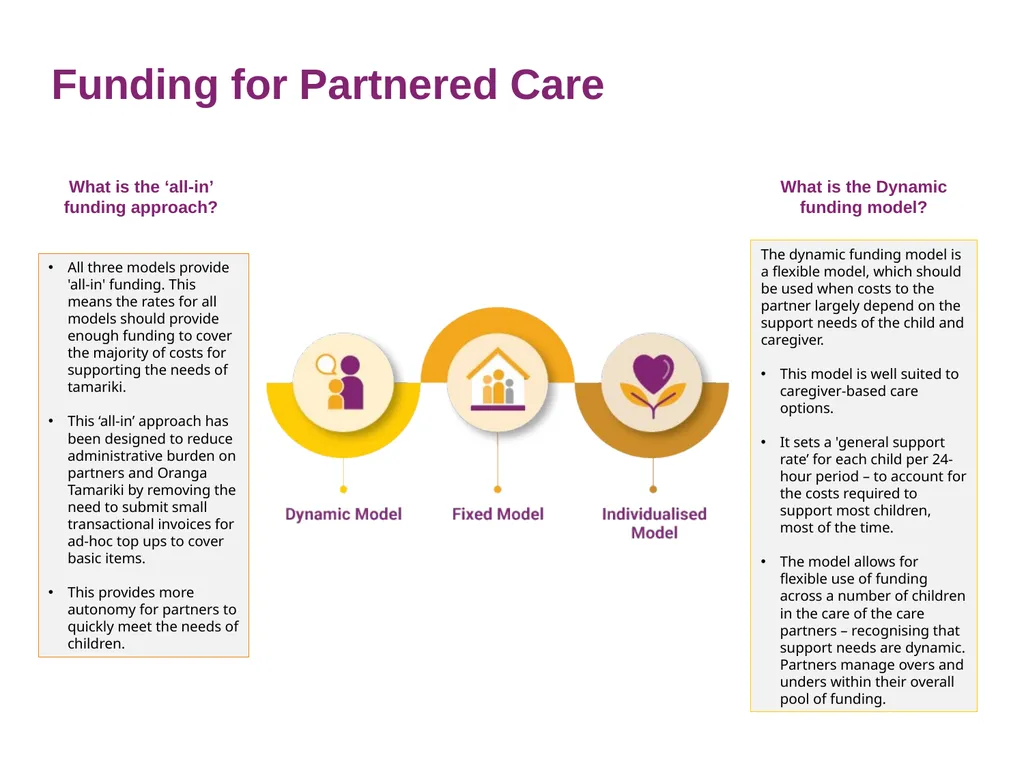
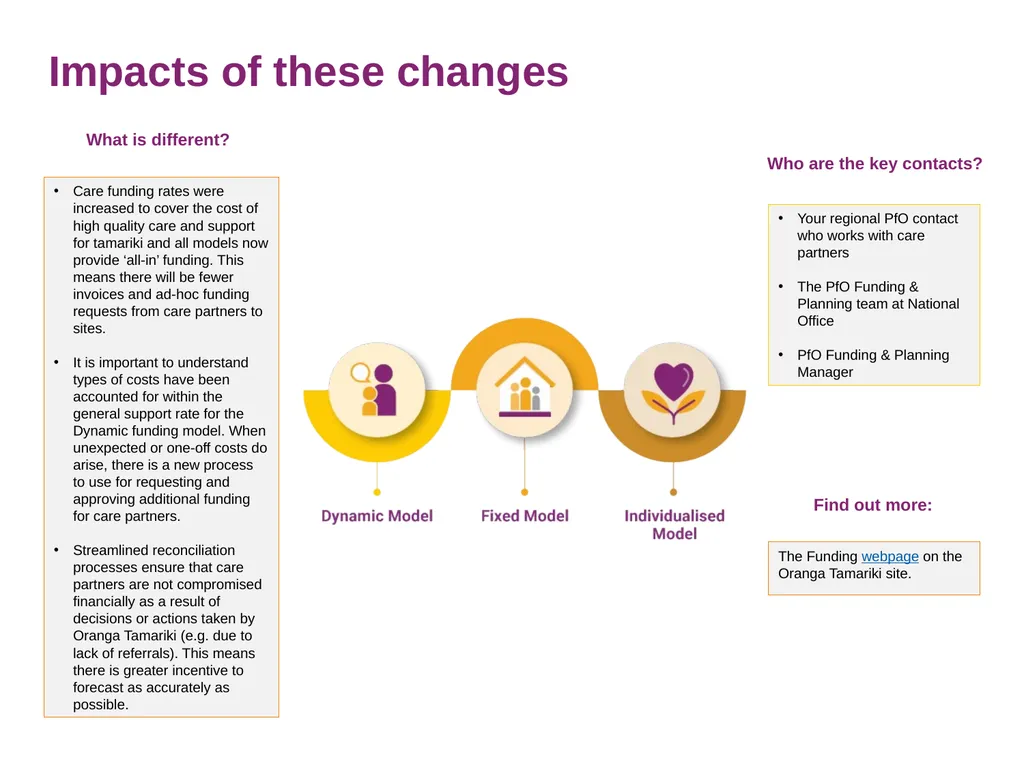
All three models provide 'all-in' funding. This means the rates for all models should provide enough funding to cover the majority of costs for supporting the needs of tamariki.
This ‘all-in’ approach has been designed to reduce administrative burden on partners and Oranga Tamariki by removing the need to submit small transactional invoices for ad-hoc top ups to cover basic items.
This provides more autonomy for partners to quickly meet the needs of children. The dynamic funding model is a flexible model, which should be used when costs to the partner largely depend on the support needs of the child and caregiver.
This model is well suited to caregiver-based care options.
It sets a 'general support rate’ for each child per 24-hour period – to account for the costs required to support most children, most of the time.
The model allows for flexible use of funding across a number of children in the care of the care partners – recognising that support needs are dynamic. Partners manage overs and unders within their overall pool of funding. Funding for Partnered Care What is the ‘all-in’ funding approach? What is the Dynamic funding model?<br>
09
Impacts of these changes Care funding rates were increased to cover the cost of high quality care and support for tamariki and all models now provide ‘all-in’ funding. This means there will be fewer invoices and ad-hoc funding requests from care partners to sites.
It is important to understand types of costs have been accounted for within the general support rate for the Dynamic funding model. When unexpected or one-off costs do arise, there is a new process to use for requesting and approving additional funding for care partners.
Streamlined reconciliation processes ensure that care partners are not compromised financially as a result of decisions or actions taken by Oranga Tamariki (e.g. due to lack of referrals). This means there is greater incentive to forecast as accurately as possible. What is different? Your regional PfO contact who works with care partners
The PfO Funding & Planning team at National Office
PfO Funding & Planning Manager Who are the key contacts? The Funding webpage on the Oranga Tamariki site. Find out more:<br>
10
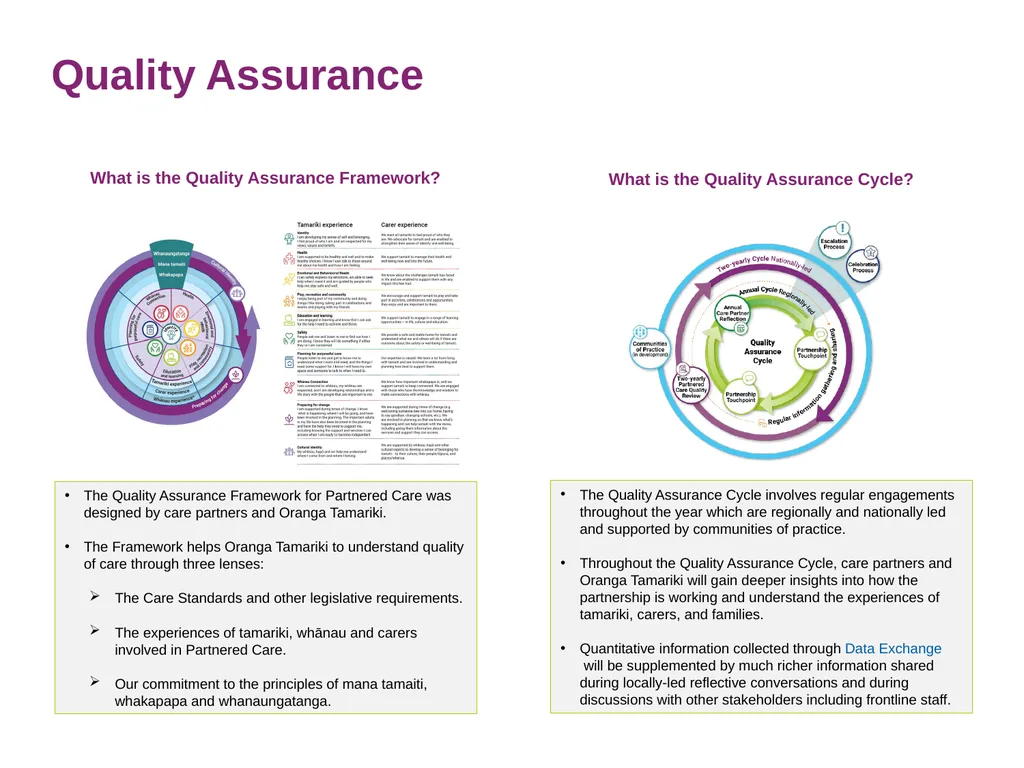
Quality Assurance The Quality Assurance Cycle involves regular engagements throughout the year which are regionally and nationally led and supported by communities of practice.
Throughout the Quality Assurance Cycle, care partners and Oranga Tamariki will gain deeper insights into how the partnership is working and understand the experiences of tamariki, carers, and families.
Quantitative information collected through Data Exchange will be supplemented by much richer information shared during locally-led reflective conversations and during discussions with other stakeholders including frontline staff. What is the Quality Assurance Framework? What is the Quality Assurance Cycle? The Quality Assurance Framework for Partnered Care was designed by care partners and Oranga Tamariki.
The Framework helps Oranga Tamariki to understand quality of care through three lenses:
The Care Standards and other legislative requirements.
The experiences of tamariki, whānau and carers involved in Partnered Care.
Our commitment to the principles of mana tamaiti, whakapapa and whanaungatanga.<br>
11
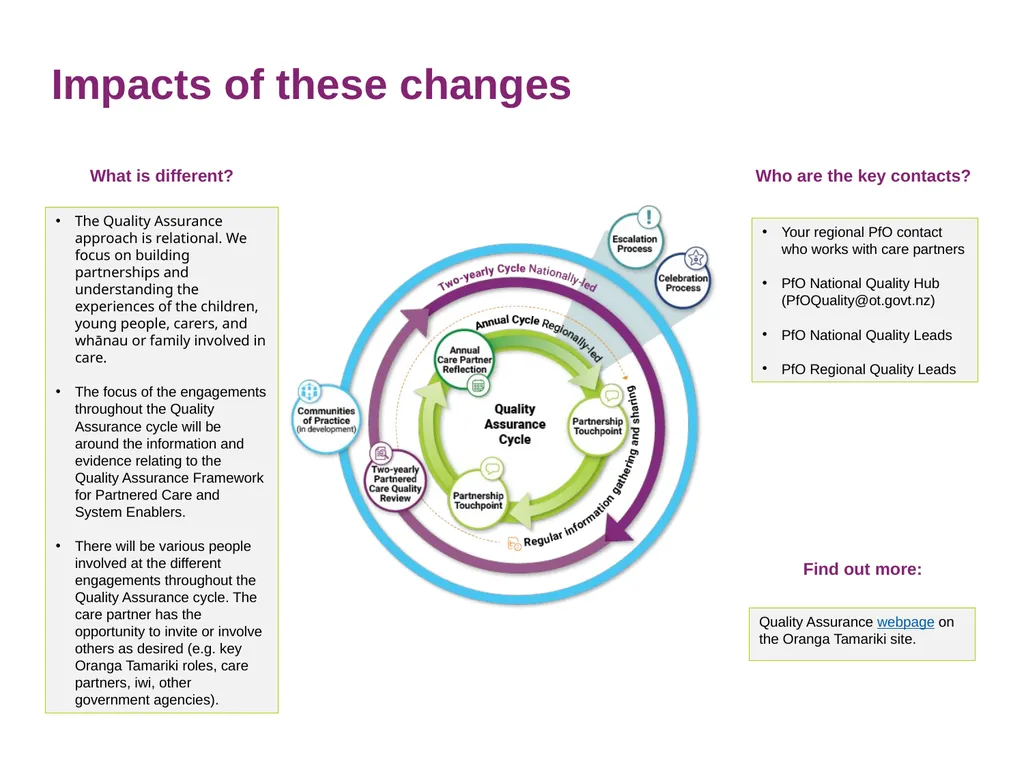
Impacts of these changes The Quality Assurance approach is relational. We focus on building partnerships and understanding the experiences of the children, young people, carers, and whānau or family involved in care.
The focus of the engagements throughout the Quality Assurance cycle will be around the information and evidence relating to the Quality Assurance Framework for Partnered Care and System Enablers.
There will be various people involved at the different engagements throughout the Quality Assurance cycle. The care partner has the opportunity to invite or involve others as desired (e.g. key Oranga Tamariki roles, care partners, iwi, other government agencies). Your regional PfO contact who works with care partners
PfO National Quality Hub (PfOQuality@ot.govt.nz)
PfO National Quality Leads
PfO Regional Quality Leads What is different? Who are the key contacts? Quality Assurance webpage on the Oranga Tamariki site. Find out more:<br>
12
More information and support All information, resources and support materials related to these changes can be found on the Oranga Tamariki website. Visit the Partnered Care webpage.
Get in touch with your local PfO Quality Lead, PfO Care Lead or key PfO contact for more information and support.<br>
Get in touch with your local PfO Quality Lead, PfO Care Lead or key PfO contact for more information and support.<br>