Patent Valuation Chirag Patel, CPVA, CFA Holzer patel drennan Uses for Patent Valuation Litigation Use of patents as collateral Inter-company transfer Acquisition of IP based companies Reporting on financial statements Valuation approach
"Patent Valuation Chirag Patel, CPVA, CFA Holzer" is the property of its rightful owner. Permission is granted to
download and print the materials on this website for personal, non-commercial use only, and to display it
on your personal computer provided you do not modify the materials and that you retain all copyright
notices contained in the materials. By downloading content from our website, you accept the terms of this
agreement.
Presentation Transcript
01
Patent Valuation Chirag Patel, CPVA, CFA
Holzer patel drennan<br>
02
Uses for Patent Valuation Litigation
Use of patents as collateral
Inter-company transfer
Acquisition of IP based companies
Reporting on financial statements
Valuation approach may defer based on the use of the patent valuation
Financial reporting prudence and consistency
Transfer Pricing arms length transaction, defensible, see IRS guidelines
Sale (90% of patents that go to brokers do not result in sale)<br>
03
How much is a patent worth? What is my house worth? Is is the cost to build? Is it based on income generation (if rental)? Market Value?
Similar methods and questions for patent valuation
A comprehensive valuation report will have valuation using multiple methods to support the final valuation
More support for the valuation, the more likely that you can justify the value
“It is better to be approximately right than to be precisely wrong” – Warren Buffet<br>
04
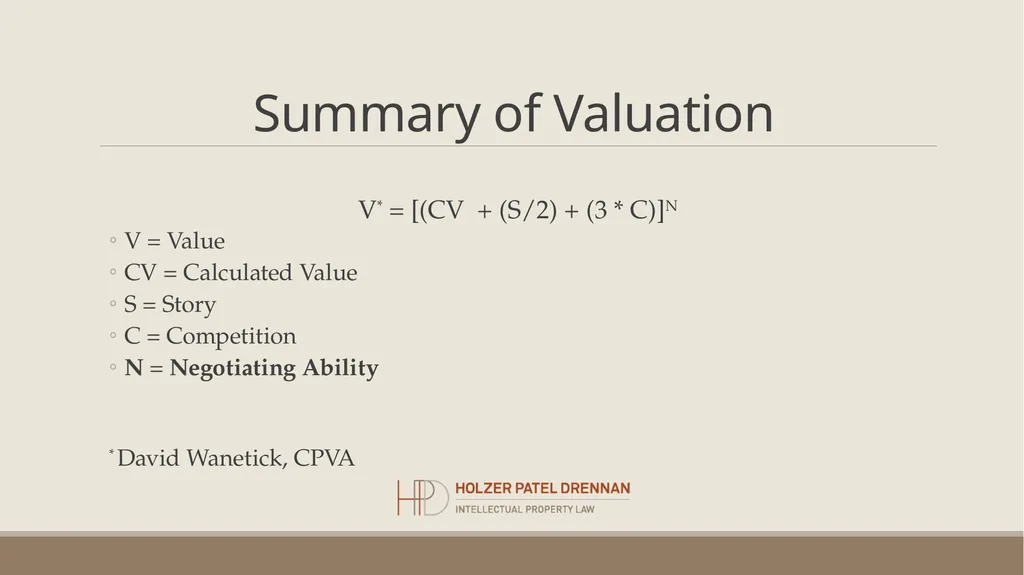
Summary of Valuation V* = [(CV + (S/2) + (3 * C)]N
V = Value
CV = Calculated Value
S = Story
C = Competition
N = Negotiating Ability
* David Wanetick, CPVA<br>
05
Where do we start? Most valuation methods discussed here are likely to be used with portfolio of patents
Start with legal analysis of the quality of patents (number of claims, file history, etc.)
More detailed legal analysis of patents needed for smaller portfolios
Separate the wheat from the chaff (Allison Analysis) and perform valuation exercise on selected patents<br>
06
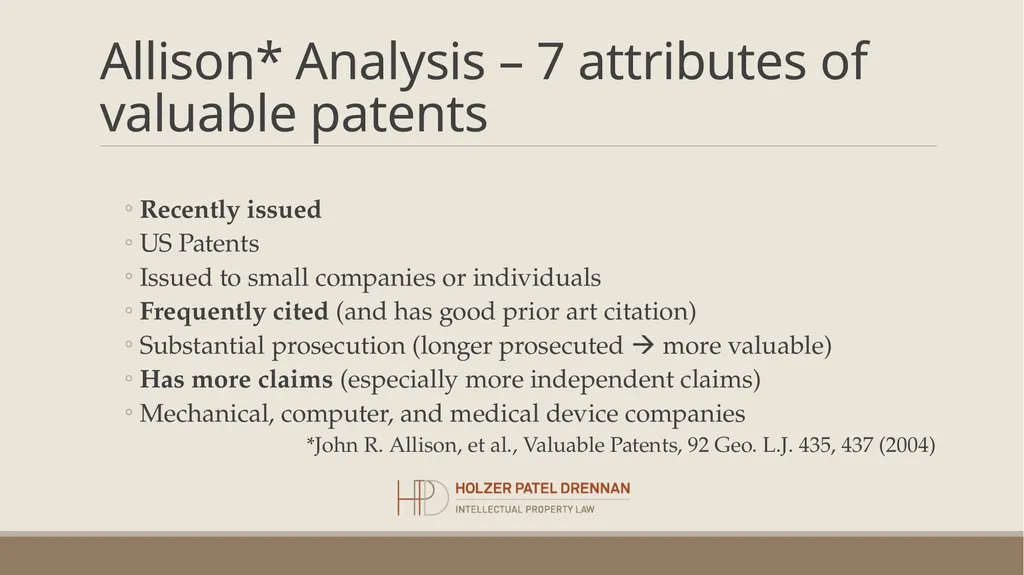
Allison* Analysis – 7 attributes of valuable patents Recently issued
US Patents
Issued to small companies or individuals
Frequently cited (and has good prior art citation)
Substantial prosecution (longer prosecuted more valuable)
Has more claims (especially more independent claims)
Mechanical, computer, and medical device companies
*John R. Allison, et al., Valuable Patents, 92 Geo. L.J. 435, 437 (2004)<br>
07
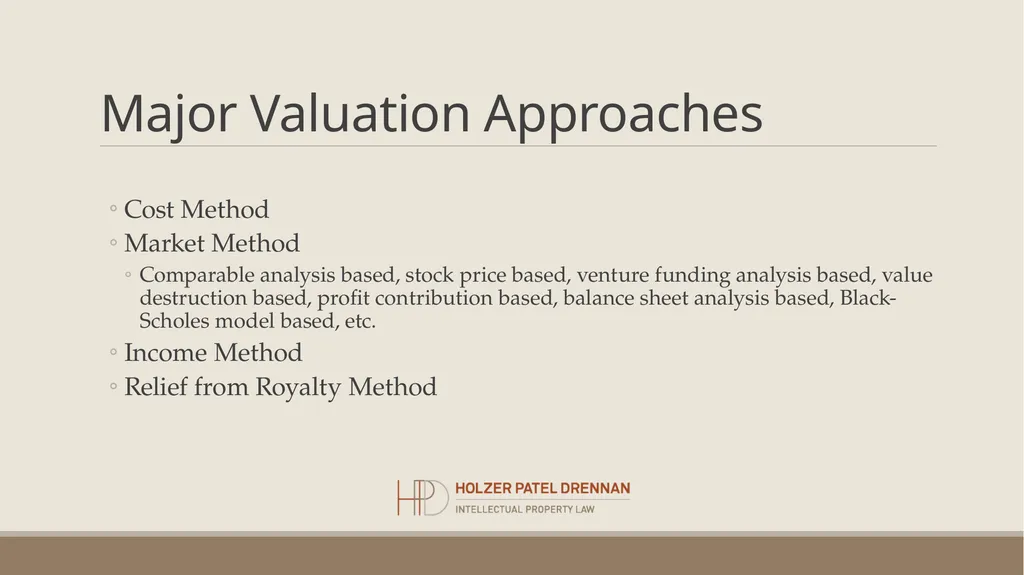
Major Valuation Approaches Cost Method
Market Method
Comparable analysis based, stock price based, venture funding analysis based, value destruction based, profit contribution based, balance sheet analysis based, Black-Scholes model based, etc.
Income Method
Relief from Royalty Method<br>
08
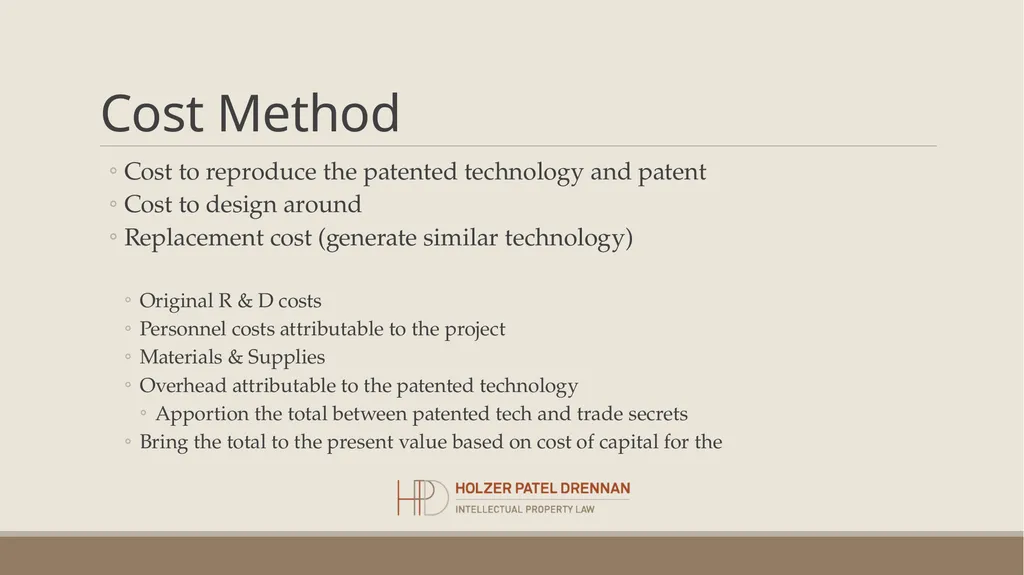
Cost Method Cost to reproduce the patented technology and patent
Cost to design around
Replacement cost (generate similar technology)
Original R & D costs
Personnel costs attributable to the project
Materials & Supplies
Overhead attributable to the patented technology
Apportion the total between patented tech and trade secrets
Bring the total to the present value based on cost of capital for the<br>
09
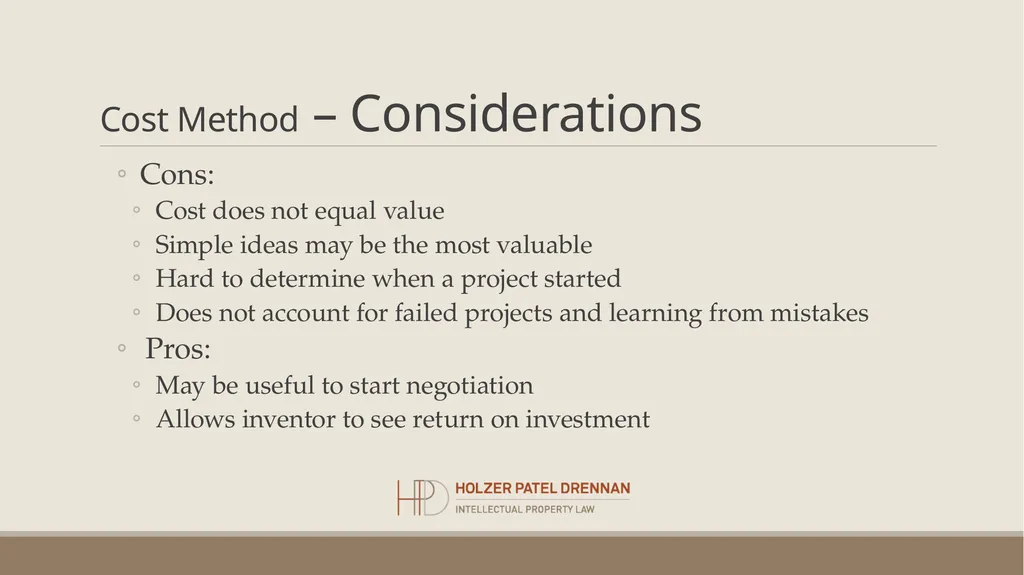
Cost Method – Considerations Cons:
Cost does not equal value
Simple ideas may be the most valuable
Hard to determine when a project started
Does not account for failed projects and learning from mistakes
Pros:
May be useful to start negotiation
Allows inventor to see return on investment<br>
10
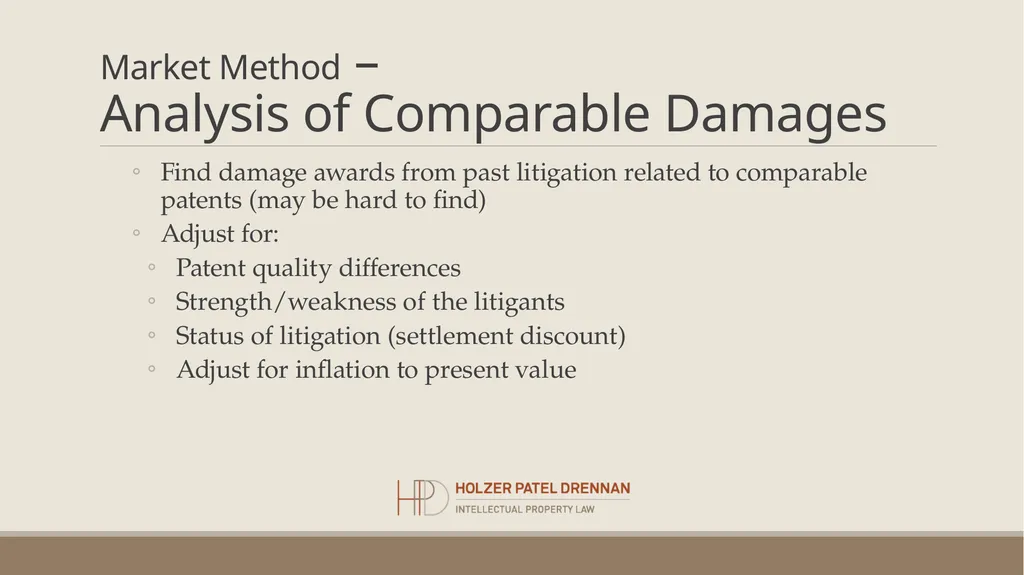
Market Method – Analysis of Comparable Damages Find damage awards from past litigation related to comparable patents (may be hard to find)
Adjust for:
Patent quality differences
Strength/weakness of the litigants
Status of litigation (settlement discount)
Adjust for inflation to present value<br>
11
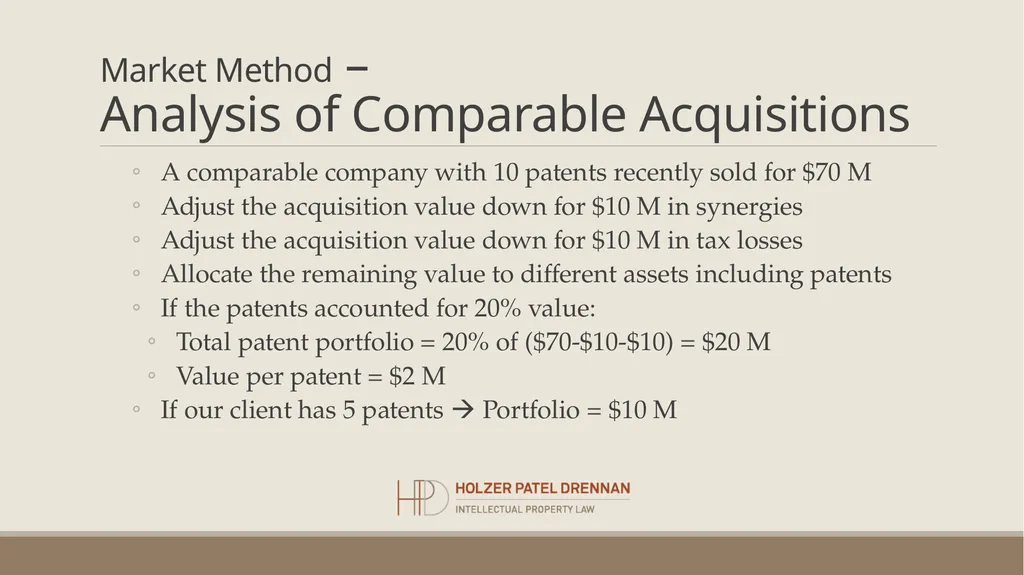
Market Method – Analysis of Comparable Acquisitions A comparable company with 10 patents recently sold for $70 M
Adjust the acquisition value down for $10 M in synergies
Adjust the acquisition value down for $10 M in tax losses
Allocate the remaining value to different assets including patents
If the patents accounted for 20% value:
Total patent portfolio = 20% of ($70-$10-$10) = $20 M
Value per patent = $2 M
If our client has 5 patents Portfolio = $10 M<br>
12
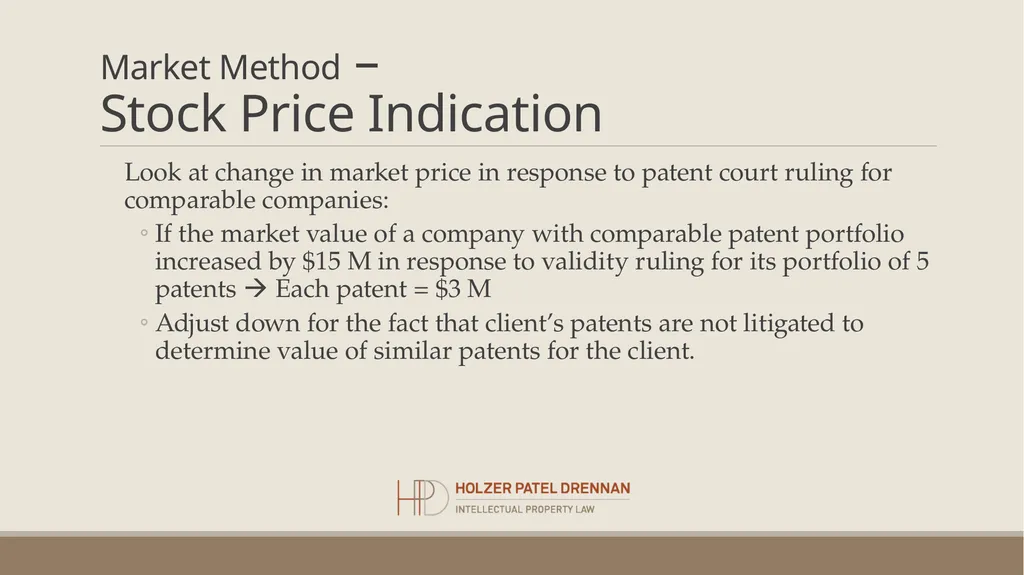
Market Method – Stock Price Indication Look at change in market price in response to patent court ruling for comparable companies:
If the market value of a company with comparable patent portfolio increased by $15 M in response to validity ruling for its portfolio of 5 patents Each patent = $3 M
Adjust down for the fact that client’s patents are not litigated to determine value of similar patents for the client.<br>
13
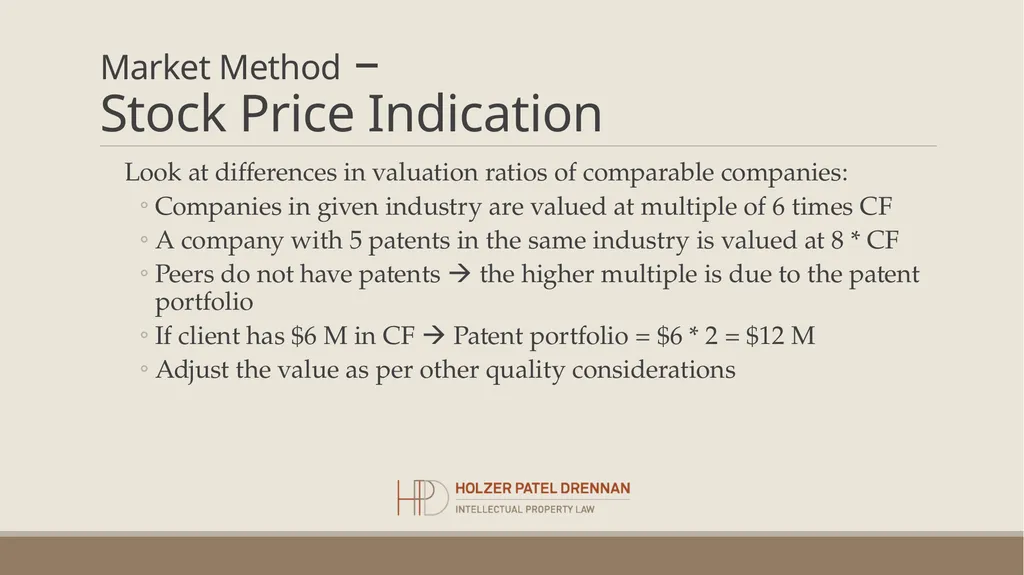
Market Method – Stock Price Indication Look at differences in valuation ratios of comparable companies:
Companies in given industry are valued at multiple of 6 times CF
A company with 5 patents in the same industry is valued at 8 * CF
Peers do not have patents the higher multiple is due to the patent portfolio
If client has $6 M in CF Patent portfolio = $6 * 2 = $12 M
Adjust the value as per other quality considerations<br>
14
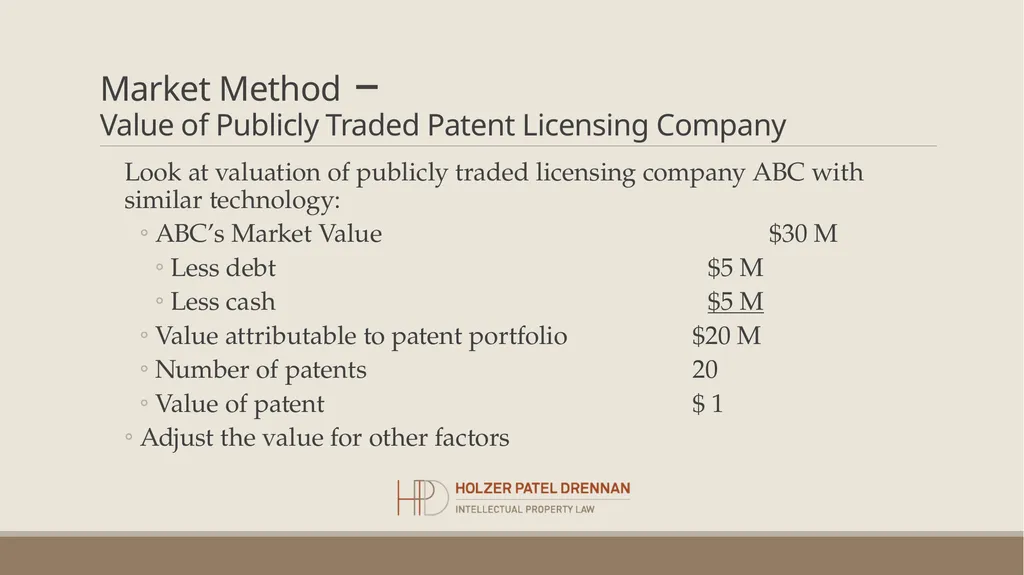
Market Method – Value of Publicly Traded Patent Licensing Company Look at valuation of publicly traded licensing company ABC with similar technology:
ABC’s Market Value $30 M
Less debt $5 M
Less cash $5 M
Value attributable to patent portfolio $20 M
Number of patents 20
Value of patent $ 1
Adjust the value for other factors<br>
15
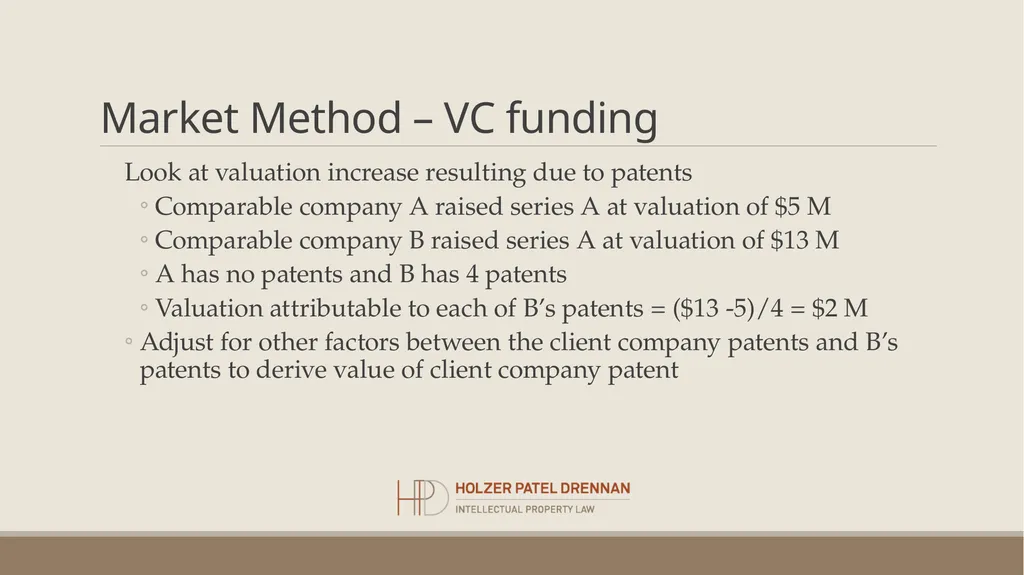
Market Method – VC funding Look at valuation increase resulting due to patents
Comparable company A raised series A at valuation of $5 M
Comparable company B raised series A at valuation of $13 M
A has no patents and B has 4 patents
Valuation attributable to each of B’s patents = ($13 -5)/4 = $2 M
Adjust for other factors between the client company patents and B’s patents to derive value of client company patent<br>
16
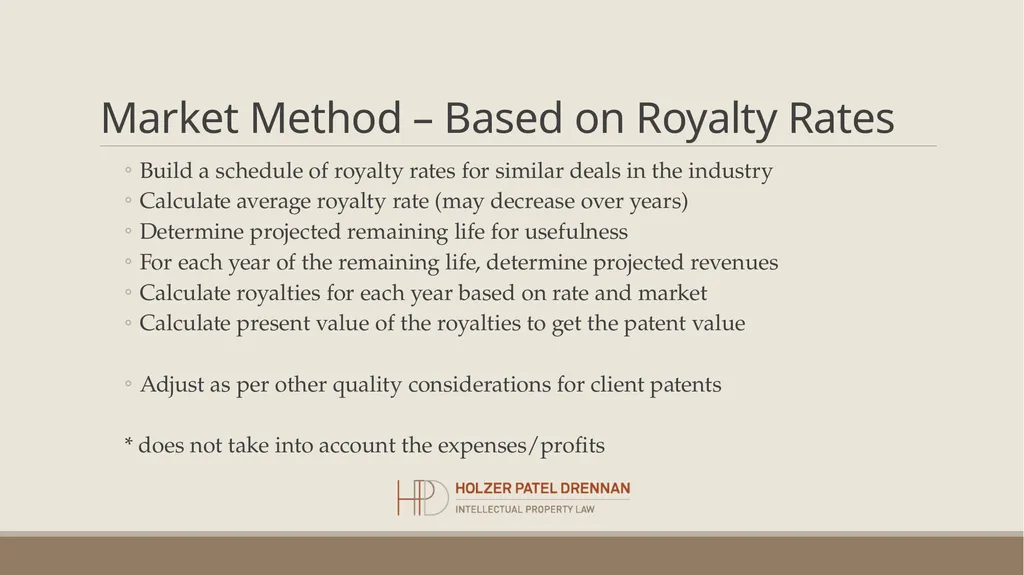
Market Method – Based on Royalty Rates Build a schedule of royalty rates for similar deals in the industry
Calculate average royalty rate (may decrease over years)
Determine projected remaining life for usefulness
For each year of the remaining life, determine projected revenues
Calculate royalties for each year based on rate and market
Calculate present value of the royalties to get the patent value
Adjust as per other quality considerations for client patents
* does not take into account the expenses/profits<br>
17
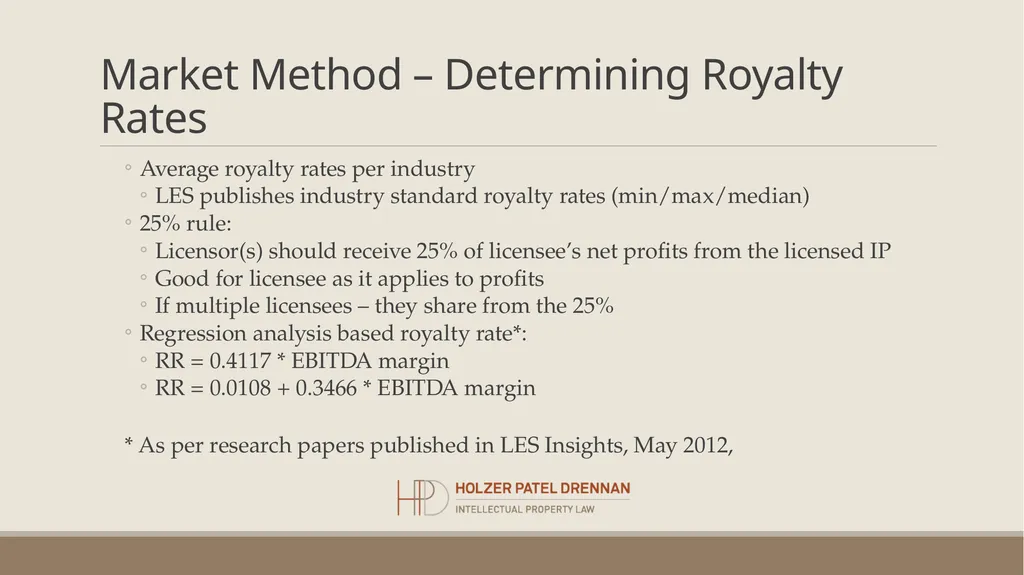
Market Method – Determining Royalty Rates Average royalty rates per industry
LES publishes industry standard royalty rates (min/max/median)
25% rule:
Licensor(s) should receive 25% of licensee’s net profits from the licensed IP
Good for licensee as it applies to profits
If multiple licensees – they share from the 25%
Regression analysis based royalty rate*:
RR = 0.4117 * EBITDA margin
RR = 0.0108 + 0.3466 * EBITDA margin
* As per research papers published in LES Insights, May 2012,<br>
18
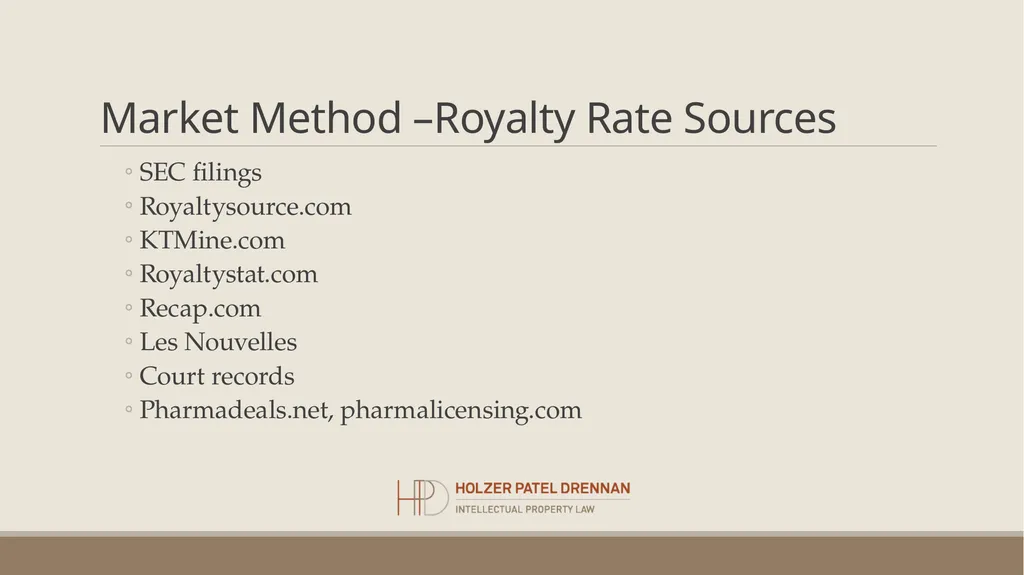
Market Method –Royalty Rate Sources SEC filings
Royaltysource.com
KTMine.com
Royaltystat.com
Recap.com
Les Nouvelles
Court records
Pharmadeals.net, pharmalicensing.com<br>
19
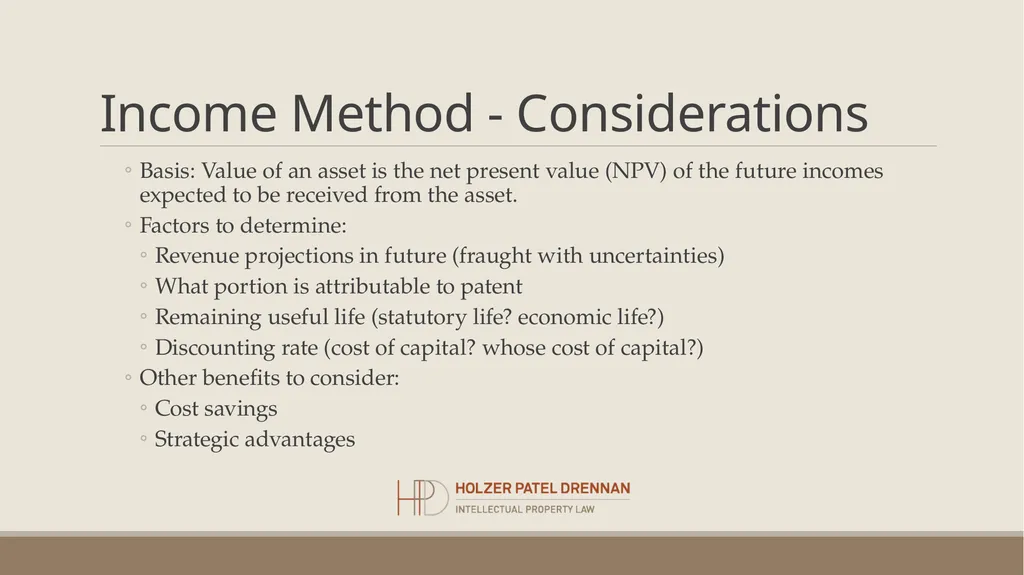
Income Method - Considerations Basis: Value of an asset is the net present value (NPV) of the future incomes expected to be received from the asset.
Factors to determine:
Revenue projections in future (fraught with uncertainties)
What portion is attributable to patent
Remaining useful life (statutory life? economic life?)
Discounting rate (cost of capital? whose cost of capital?)
Other benefits to consider:
Cost savings
Strategic advantages<br>
20
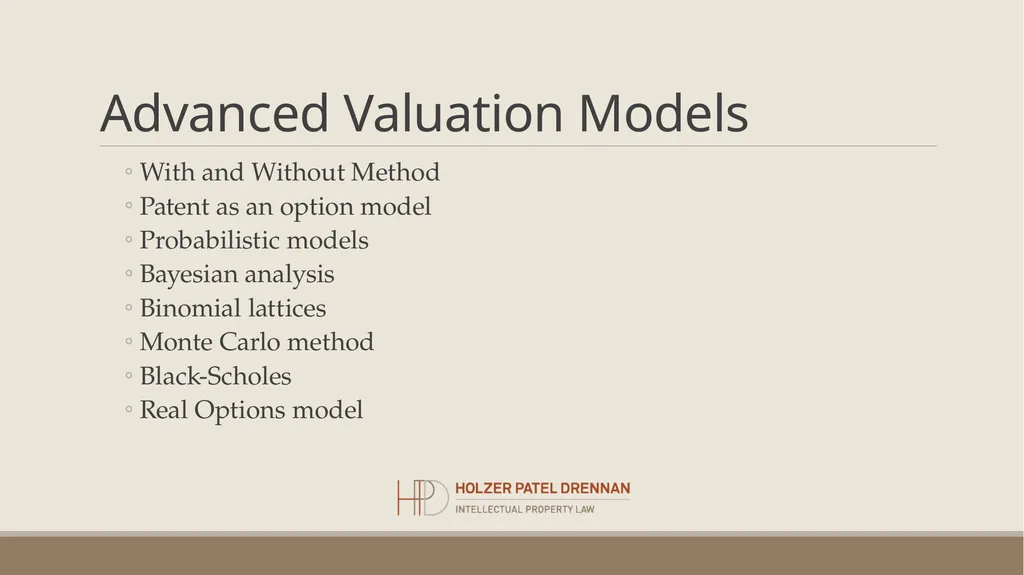
Advanced Valuation Models With and Without Method
Patent as an option model
Probabilistic models
Bayesian analysis
Binomial lattices
Monte Carlo method
Black-Scholes
Real Options model<br>
21
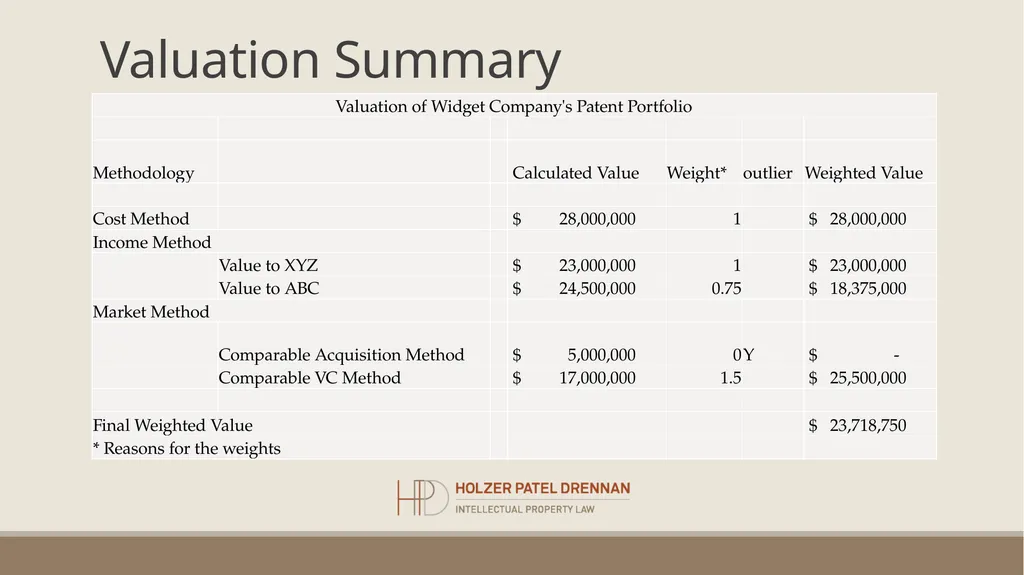
Valuation Summary<br>
22
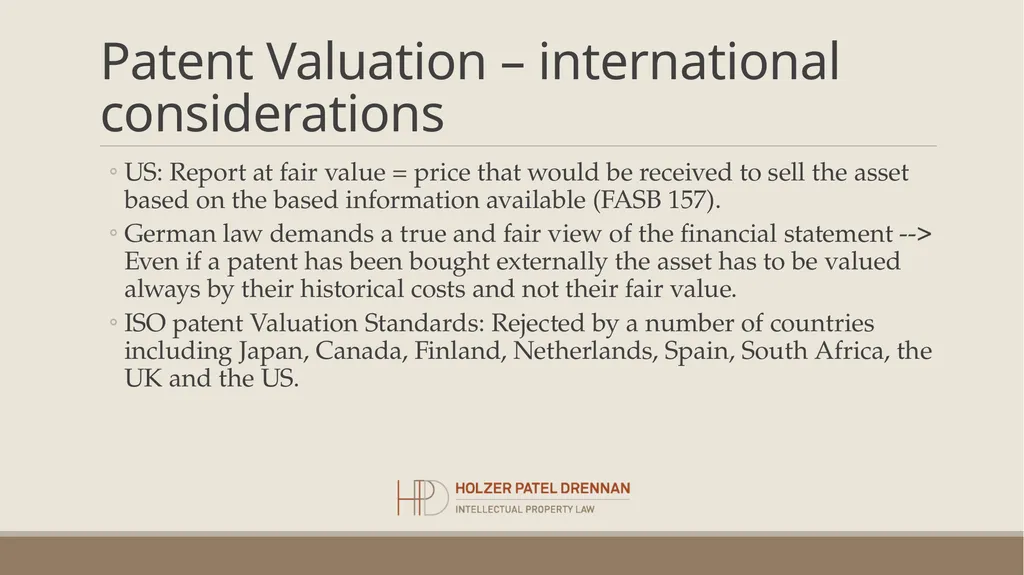
Patent Valuation – international considerations US: Report at fair value = price that would be received to sell the asset based on the based information available (FASB 157).
German law demands a true and fair view of the financial statement --> Even if a patent has been bought externally the asset has to be valued always by their historical costs and not their fair value.
ISO patent Valuation Standards: Rejected by a number of countries including Japan, Canada, Finland, Netherlands, Spain, South Africa, the UK and the US.<br>