Pathogenicity Infectious diseases The pathogen that attack plants belong to the same groups of organisms that cause diseases in humans and animals. Infectious diseases are those that result from infection of a plant by a pathogen. In such
"Pathogenicity Infectious diseases The pathogen" is the property of its rightful owner. Permission is granted to
download and print the materials on this website for personal, non-commercial use only, and to display it
on your personal computer provided you do not modify the materials and that you retain all copyright
notices contained in the materials. By downloading content from our website, you accept the terms of this
agreement.
Presentation Transcript
01
Pathogenicity<br>
02
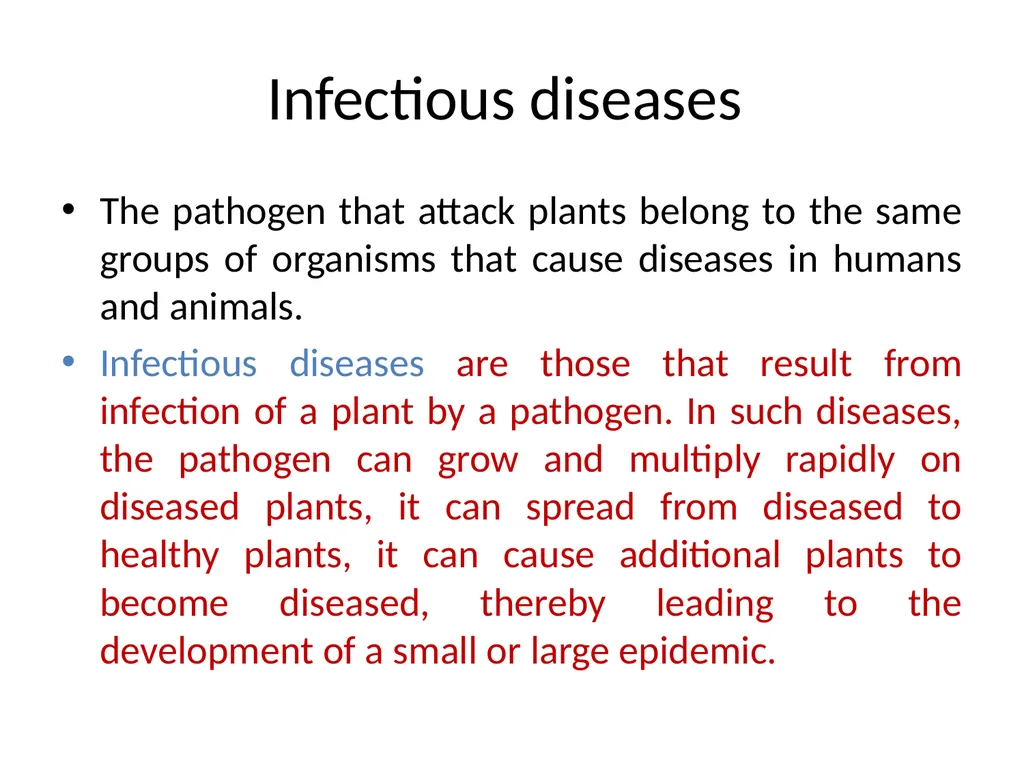
Infectious diseases The pathogen that attack plants belong to the same groups of organisms that cause diseases in humans and animals.
Infectious diseases are those that result from infection of a plant by a pathogen. In such diseases, the pathogen can grow and multiply rapidly on diseased plants, it can spread from diseased to healthy plants, it can cause additional plants to become diseased, thereby leading to the development of a small or large epidemic.<br>
03
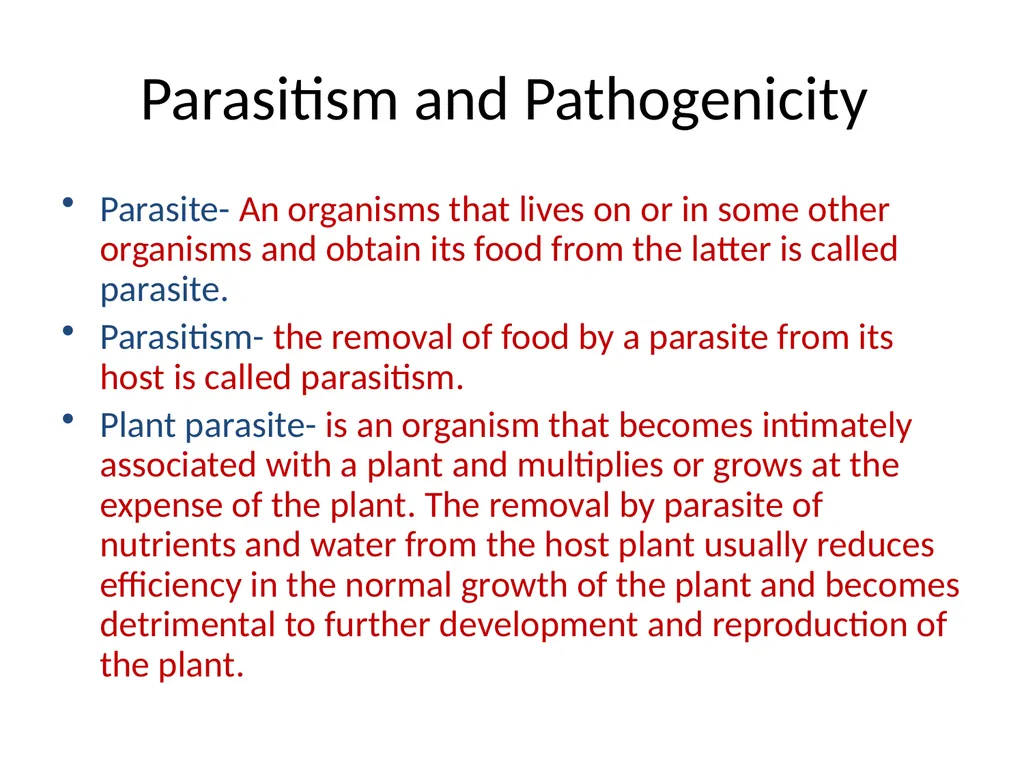
Parasitism and Pathogenicity Parasite- An organisms that lives on or in some other organisms and obtain its food from the latter is called parasite.
Parasitism- the removal of food by a parasite from its host is called parasitism.
Plant parasite- is an organism that becomes intimately associated with a plant and multiplies or grows at the expense of the plant. The removal by parasite of nutrients and water from the host plant usually reduces efficiency in the normal growth of the plant and becomes detrimental to further development and reproduction of the plant.<br>
04
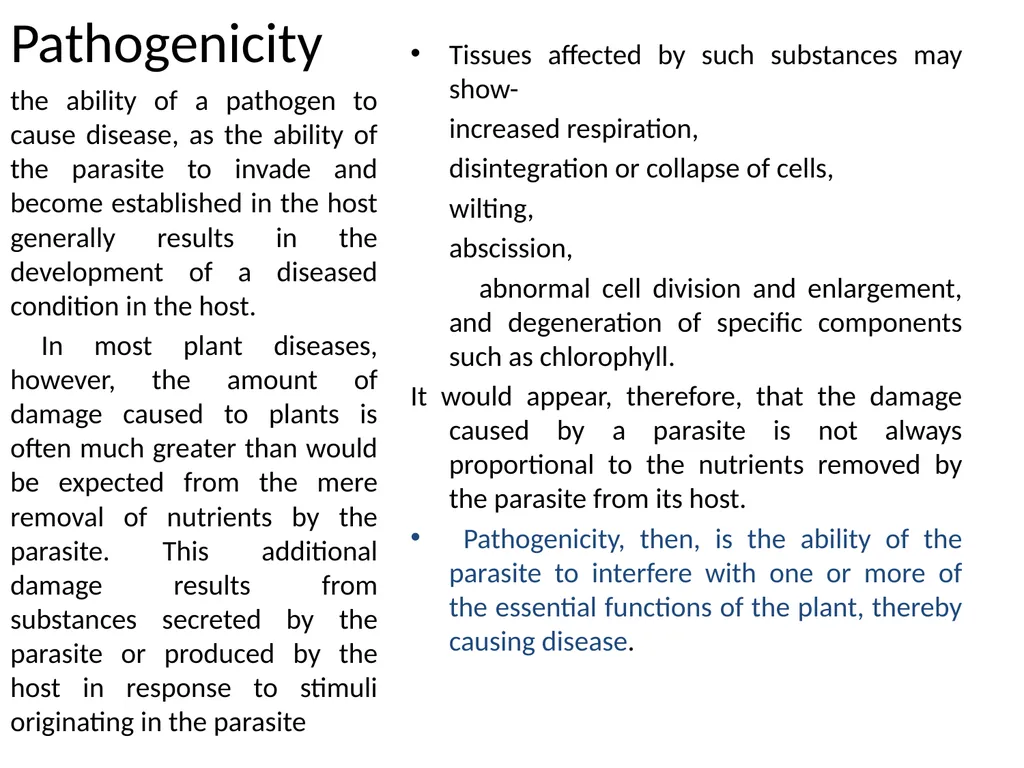
Pathogenicity Tissues affected by such substances may show-
increased respiration,
disintegration or collapse of cells,
wilting,
abscission,
abnormal cell division and enlargement, and degeneration of specific components such as chlorophyll.
It would appear, therefore, that the damage caused by a parasite is not always proportional to the nutrients removed by the parasite from its host.
Pathogenicity, then, is the ability of the parasite to interfere with one or more of the essential functions of the plant, thereby causing disease. the ability of a pathogen to cause disease, as the ability of the parasite to invade and become established in the host generally results in the development of a diseased condition in the host.
In most plant diseases, however, the amount of damage caused to plants is often much greater than would be expected from the mere removal of nutrients by the parasite. This additional damage results from substances secreted by the parasite or produced by the host in response to stimuli originating in the parasite<br>
05
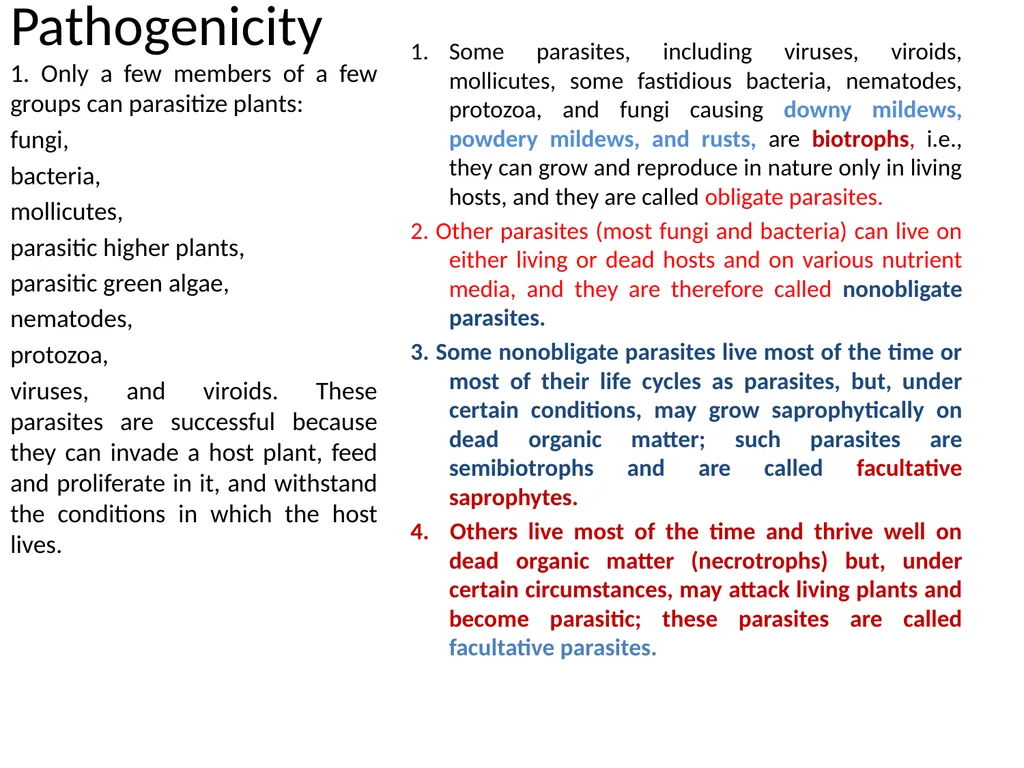
Pathogenicity Some parasites, including viruses, viroids, mollicutes, some fastidious bacteria, nematodes, protozoa, and fungi causing downy mildews, powdery mildews, and rusts, are biotrophs, i.e., they can grow and reproduce in nature only in living hosts, and they are called obligate parasites.
2. Other parasites (most fungi and bacteria) can live on either living or dead hosts and on various nutrient media, and they are therefore called nonobligate parasites.
3. Some nonobligate parasites live most of the time or most of their life cycles as parasites, but, under certain conditions, may grow saprophytically on dead organic matter; such parasites are semibiotrophs and are called facultative saprophytes.
4. Others live most of the time and thrive well on dead organic matter (necrotrophs) but, under certain circumstances, may attack living plants and become parasitic; these parasites are called facultative parasites. 1. Only a few members of a few groups can parasitize plants:
fungi,
bacteria,
mollicutes,
parasitic higher plants,
parasitic green algae,
nematodes,
protozoa,
viruses, and viroids. These parasites are successful because they can invade a host plant, feed and proliferate in it, and withstand the conditions in which the host lives.<br>