
Pediatric Collaborative Care Behavioral Health
LD
Published · 31 slides · 0 views
1 / 1

Description
Pediatric Collaborative Care Behavioral Health Conference 2024-2025 Text: 608-260-7097 Code: FADYER Please text to record your attendance and claim credit. Even if you do not need the credit, please text in to record your attendance! Need
Related Topics
Share
Embed code
Download this presentation From Below
"Pediatric Collaborative Care Behavioral Health" is the property of its rightful owner. Permission is granted to download and print the materials on this website for personal, non-commercial use only, and to display it on your personal computer provided you do not modify the materials and that you retain all copyright notices contained in the materials. By downloading content from our website, you accept the terms of this agreement.
Presentation Transcript
01
Pediatric Collaborative Care Behavioral Health Conference 2024-2025 Text: 608-260-7097
Code: FADYER
Please text to record your attendance and claim credit. Even if you do not need the credit, please text in to record your attendance!
Need support? Email Kate Dougherty at catherine.dougherty@wisc.edu Text: 608-260-7097
Code: FADYER<br>
Code: FADYER
Please text to record your attendance and claim credit. Even if you do not need the credit, please text in to record your attendance!
Need support? Email Kate Dougherty at catherine.dougherty@wisc.edu Text: 608-260-7097
Code: FADYER<br>
02
Assessment and Management of Pediatric Self-Harm and Suicidal Ideation in Primary Care Hannah Koerten, PhD
March 18, 2025
Pediatric Collaborative Care Behavioral Health Conference Session #12<br>
March 18, 2025
Pediatric Collaborative Care Behavioral Health Conference Session #12<br>
03
Conflict of Interest The planner and speaker of this CE activity has no relevant financial relationships with ineligible companies to disclose.
The speaker does not intend to discuss any unlabeled or unapproved use of drugs or devices. Text: 608-260-7097
Code: FADYER<br>
The speaker does not intend to discuss any unlabeled or unapproved use of drugs or devices. Text: 608-260-7097
Code: FADYER<br>
04
Please take a moment at the end of the session to complete your evaluation.
Thank you! Text: 608-260-7097
Code: FADYER<br>
Thank you! Text: 608-260-7097
Code: FADYER<br>
05
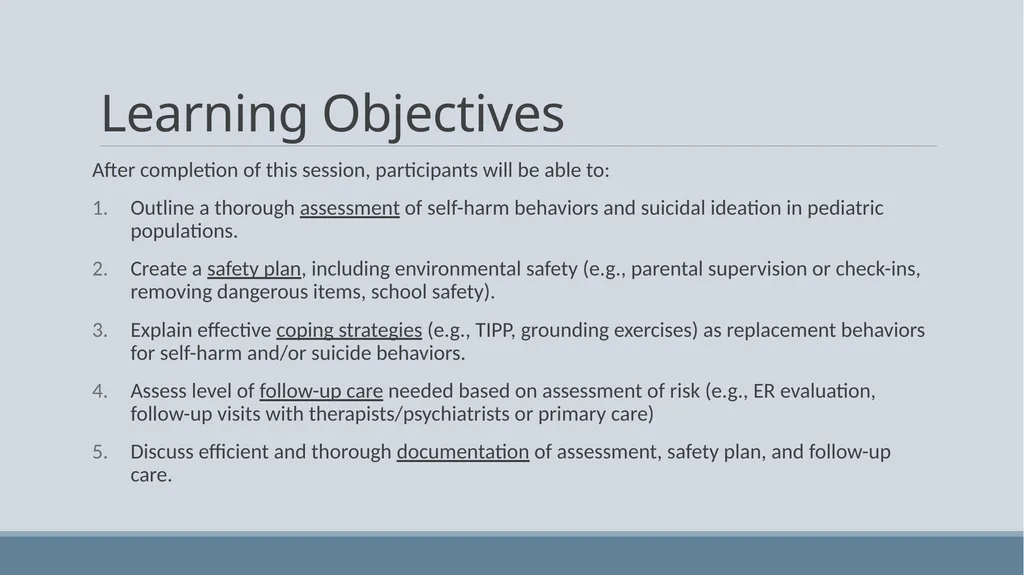
Learning Objectives After completion of this session, participants will be able to:
Outline a thorough assessment of self-harm behaviors and suicidal ideation in pediatric populations.
Create a safety plan, including environmental safety (e.g., parental supervision or check-ins, removing dangerous items, school safety).
Explain effective coping strategies (e.g., TIPP, grounding exercises) as replacement behaviors for self-harm and/or suicide behaviors.
Assess level of follow-up care needed based on assessment of risk (e.g., ER evaluation, follow-up visits with therapists/psychiatrists or primary care)
Discuss efficient and thorough documentation of assessment, safety plan, and follow-up care.<br>
Outline a thorough assessment of self-harm behaviors and suicidal ideation in pediatric populations.
Create a safety plan, including environmental safety (e.g., parental supervision or check-ins, removing dangerous items, school safety).
Explain effective coping strategies (e.g., TIPP, grounding exercises) as replacement behaviors for self-harm and/or suicide behaviors.
Assess level of follow-up care needed based on assessment of risk (e.g., ER evaluation, follow-up visits with therapists/psychiatrists or primary care)
Discuss efficient and thorough documentation of assessment, safety plan, and follow-up care.<br>
06
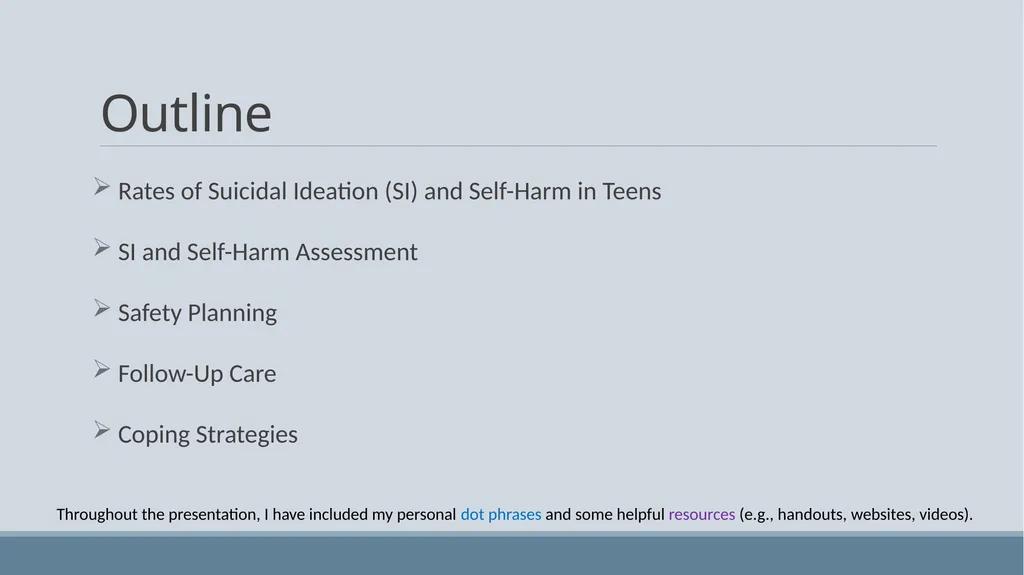
Outline Rates of Suicidal Ideation (SI) and Self-Harm in Teens
SI and Self-Harm Assessment
Safety Planning
Follow-Up Care
Coping Strategies Throughout the presentation, I have included my personal dot phrases and some helpful resources (e.g., handouts, websites, videos).<br>
SI and Self-Harm Assessment
Safety Planning
Follow-Up Care
Coping Strategies Throughout the presentation, I have included my personal dot phrases and some helpful resources (e.g., handouts, websites, videos).<br>
07
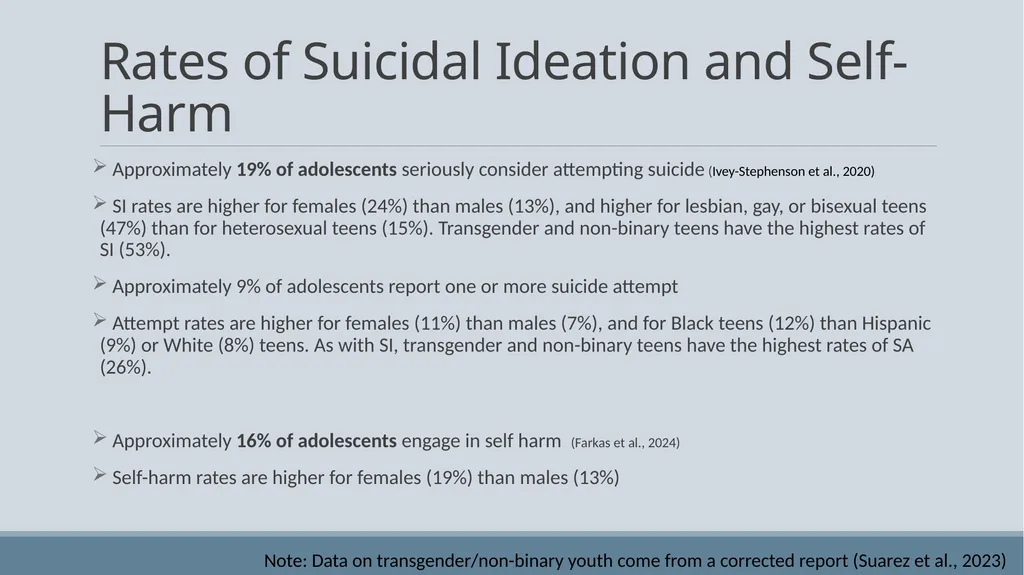
Rates of Suicidal Ideation and Self-Harm Approximately 19% of adolescents seriously consider attempting suicide (Ivey-Stephenson et al., 2020)
SI rates are higher for females (24%) than males (13%), and higher for lesbian, gay, or bisexual teens (47%) than for heterosexual teens (15%). Transgender and non-binary teens have the highest rates of SI (53%).
Approximately 9% of adolescents report one or more suicide attempt
Attempt rates are higher for females (11%) than males (7%), and for Black teens (12%) than Hispanic (9%) or White (8%) teens. As with SI, transgender and non-binary teens have the highest rates of SA (26%).
Approximately 16% of adolescents engage in self harm (Farkas et al., 2024)
Self-harm rates are higher for females (19%) than males (13%) Note: Data on transgender/non-binary youth come from a corrected report (Suarez et al., 2023)<br>
SI rates are higher for females (24%) than males (13%), and higher for lesbian, gay, or bisexual teens (47%) than for heterosexual teens (15%). Transgender and non-binary teens have the highest rates of SI (53%).
Approximately 9% of adolescents report one or more suicide attempt
Attempt rates are higher for females (11%) than males (7%), and for Black teens (12%) than Hispanic (9%) or White (8%) teens. As with SI, transgender and non-binary teens have the highest rates of SA (26%).
Approximately 16% of adolescents engage in self harm (Farkas et al., 2024)
Self-harm rates are higher for females (19%) than males (13%) Note: Data on transgender/non-binary youth come from a corrected report (Suarez et al., 2023)<br>
08
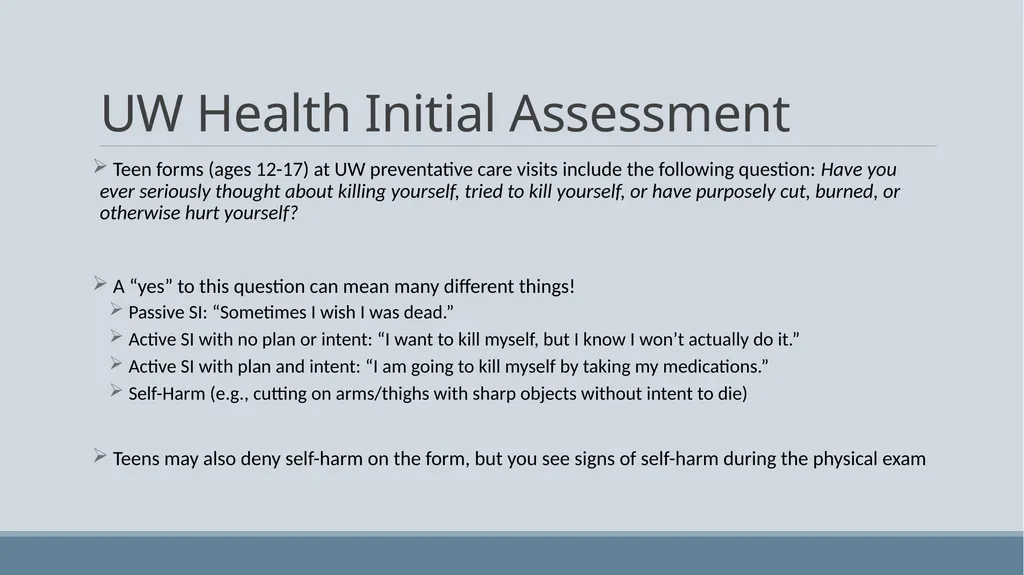
UW Health Initial Assessment Teen forms (ages 12-17) at UW preventative care visits include the following question: Have you ever seriously thought about killing yourself, tried to kill yourself, or have purposely cut, burned, or otherwise hurt yourself?
A “yes” to this question can mean many different things!
Passive SI: “Sometimes I wish I was dead.”
Active SI with no plan or intent: “I want to kill myself, but I know I won’t actually do it.”
Active SI with plan and intent: “I am going to kill myself by taking my medications.”
Self-Harm (e.g., cutting on arms/thighs with sharp objects without intent to die)
Teens may also deny self-harm on the form, but you see signs of self-harm during the physical exam<br>
A “yes” to this question can mean many different things!
Passive SI: “Sometimes I wish I was dead.”
Active SI with no plan or intent: “I want to kill myself, but I know I won’t actually do it.”
Active SI with plan and intent: “I am going to kill myself by taking my medications.”
Self-Harm (e.g., cutting on arms/thighs with sharp objects without intent to die)
Teens may also deny self-harm on the form, but you see signs of self-harm during the physical exam<br>
09
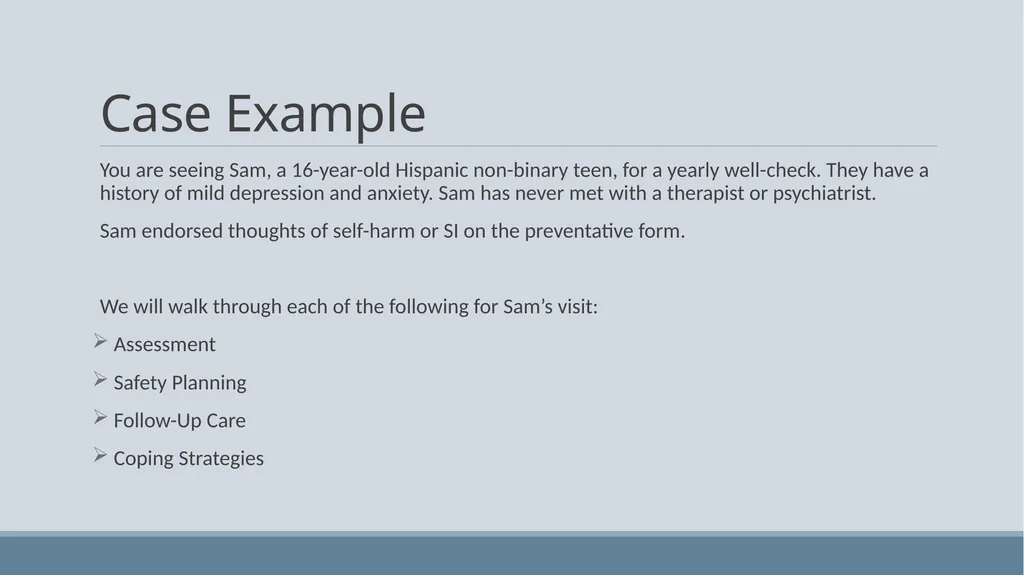
Case Example You are seeing Sam, a 16-year-old Hispanic non-binary teen, for a yearly well-check. They have a history of mild depression and anxiety. Sam has never met with a therapist or psychiatrist.
Sam endorsed thoughts of self-harm or SI on the preventative form.
We will walk through each of the following for Sam’s visit:
Assessment
Safety Planning
Follow-Up Care
Coping Strategies<br>
Sam endorsed thoughts of self-harm or SI on the preventative form.
We will walk through each of the following for Sam’s visit:
Assessment
Safety Planning
Follow-Up Care
Coping Strategies<br>
10
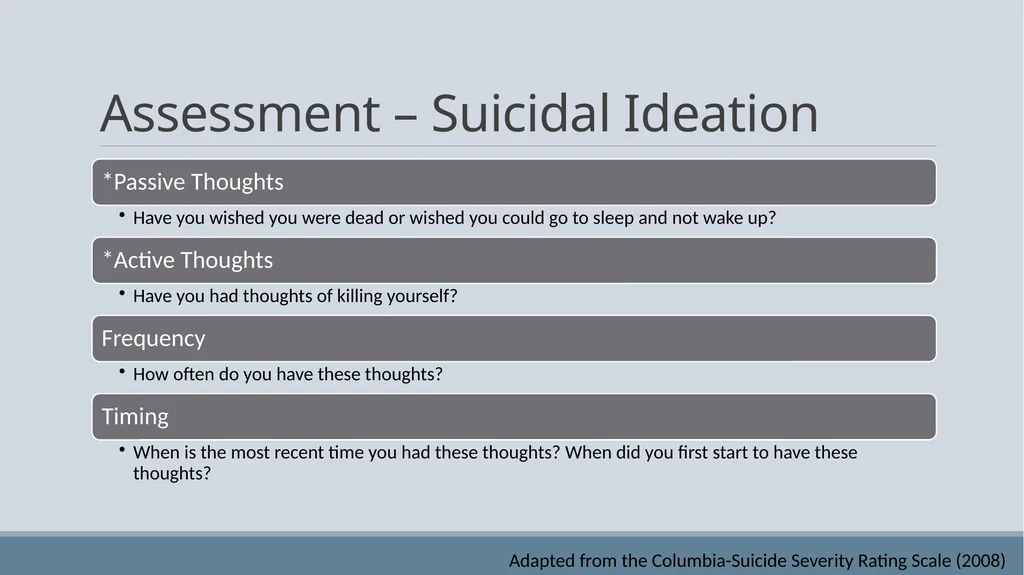
Assessment – Suicidal Ideation Adapted from the Columbia-Suicide Severity Rating Scale (2008)<br>
11
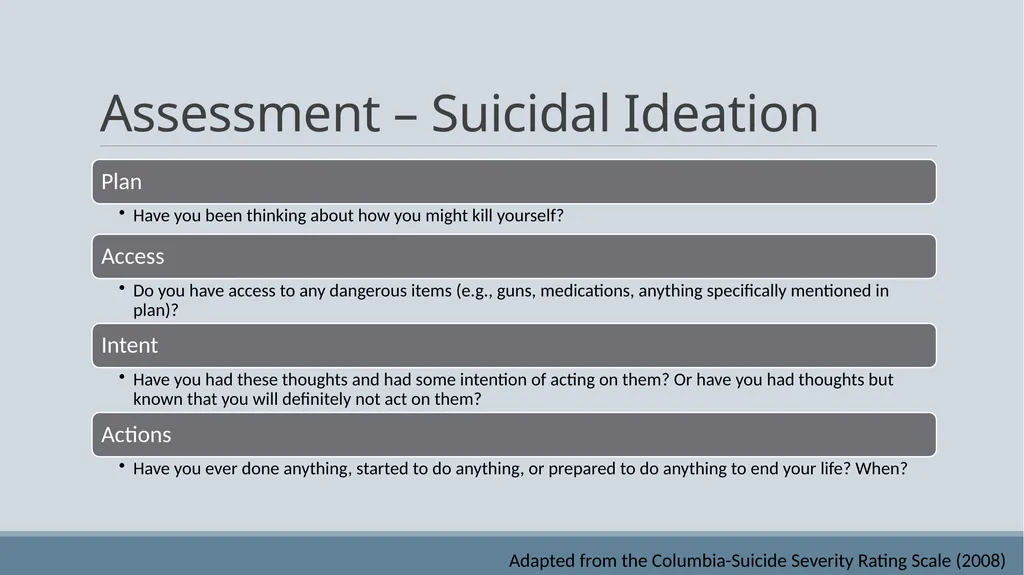
Assessment – Suicidal Ideation Adapted from the Columbia-Suicide Severity Rating Scale (2008)<br>
12
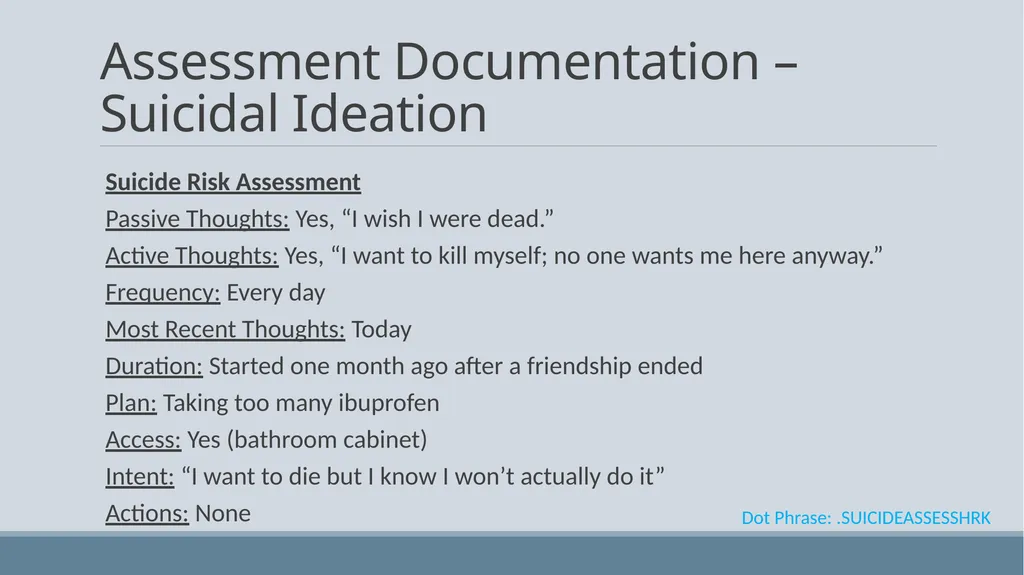
Assessment Documentation – Suicidal Ideation Suicide Risk Assessment
Passive Thoughts: Yes, “I wish I were dead.”
Active Thoughts: Yes, “I want to kill myself; no one wants me here anyway.”
Frequency: Every day
Most Recent Thoughts: Today
Duration: Started one month ago after a friendship ended
Plan: Taking too many ibuprofen
Access: Yes (bathroom cabinet)
Intent: “I want to die but I know I won’t actually do it”
Actions: None Dot Phrase: .SUICIDEASSESSHRK<br>
Passive Thoughts: Yes, “I wish I were dead.”
Active Thoughts: Yes, “I want to kill myself; no one wants me here anyway.”
Frequency: Every day
Most Recent Thoughts: Today
Duration: Started one month ago after a friendship ended
Plan: Taking too many ibuprofen
Access: Yes (bathroom cabinet)
Intent: “I want to die but I know I won’t actually do it”
Actions: None Dot Phrase: .SUICIDEASSESSHRK<br>
13
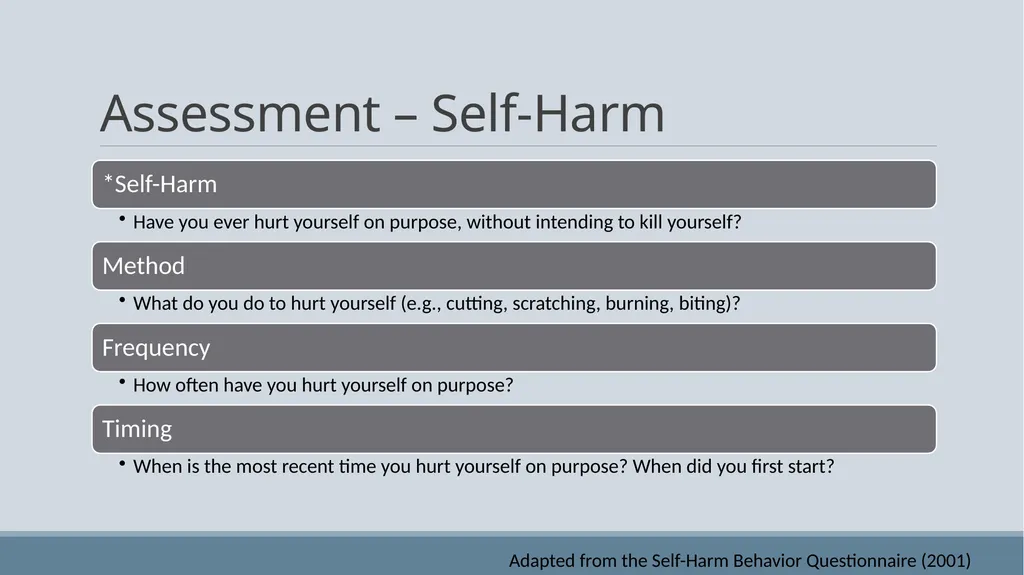
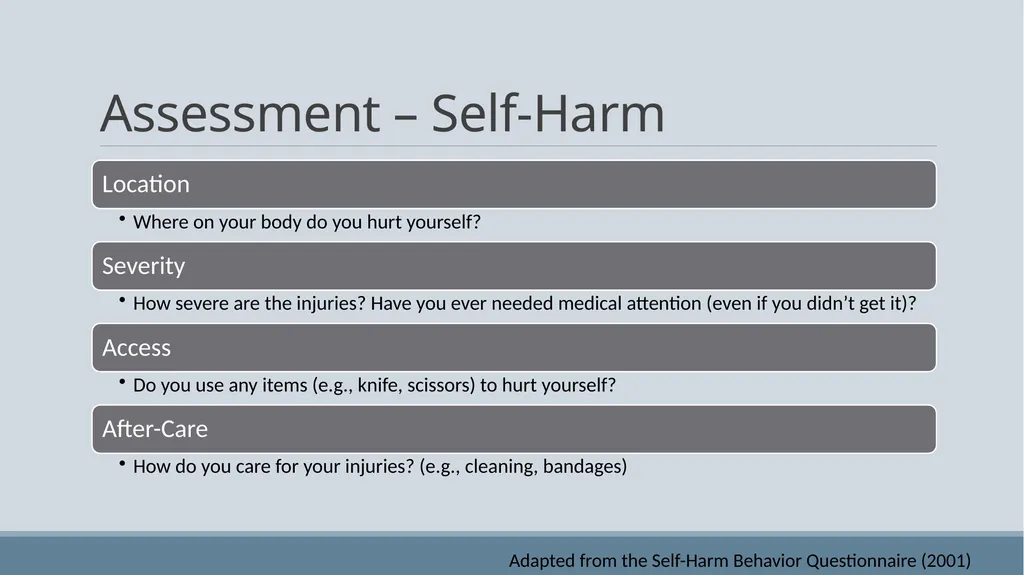
Assessment – Self-Harm Adapted from the Self-Harm Behavior Questionnaire (2001)<br>
14
Assessment – Self-Harm Adapted from the Self-Harm Behavior Questionnaire (2001)<br>
15
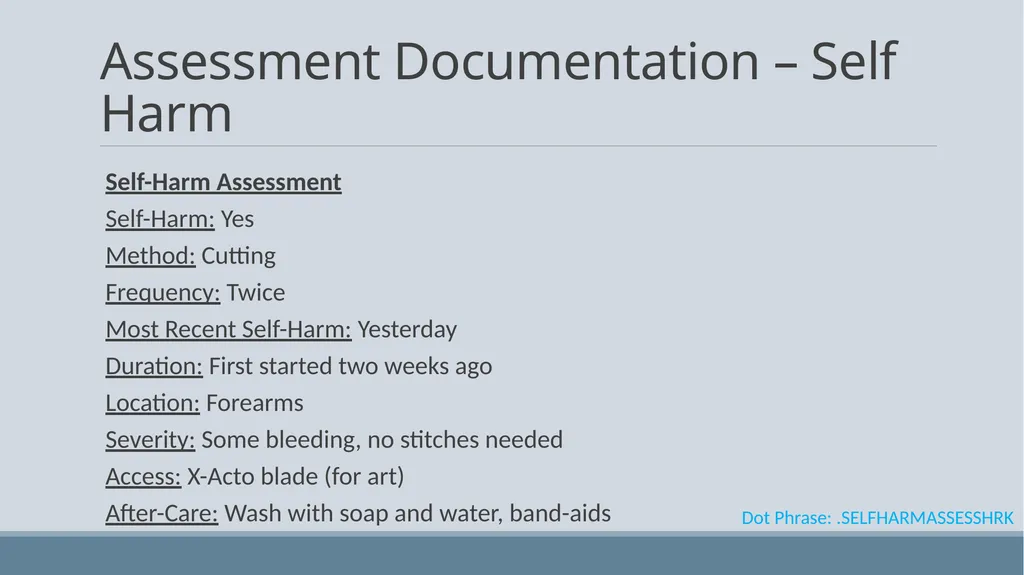
Assessment Documentation – Self Harm Self-Harm Assessment
Self-Harm: Yes
Method: Cutting
Frequency: Twice
Most Recent Self-Harm: Yesterday
Duration: First started two weeks ago
Location: Forearms
Severity: Some bleeding, no stitches needed
Access: X-Acto blade (for art)
After-Care: Wash with soap and water, band-aids Dot Phrase: .SELFHARMASSESSHRK<br>
Self-Harm: Yes
Method: Cutting
Frequency: Twice
Most Recent Self-Harm: Yesterday
Duration: First started two weeks ago
Location: Forearms
Severity: Some bleeding, no stitches needed
Access: X-Acto blade (for art)
After-Care: Wash with soap and water, band-aids Dot Phrase: .SELFHARMASSESSHRK<br>
16
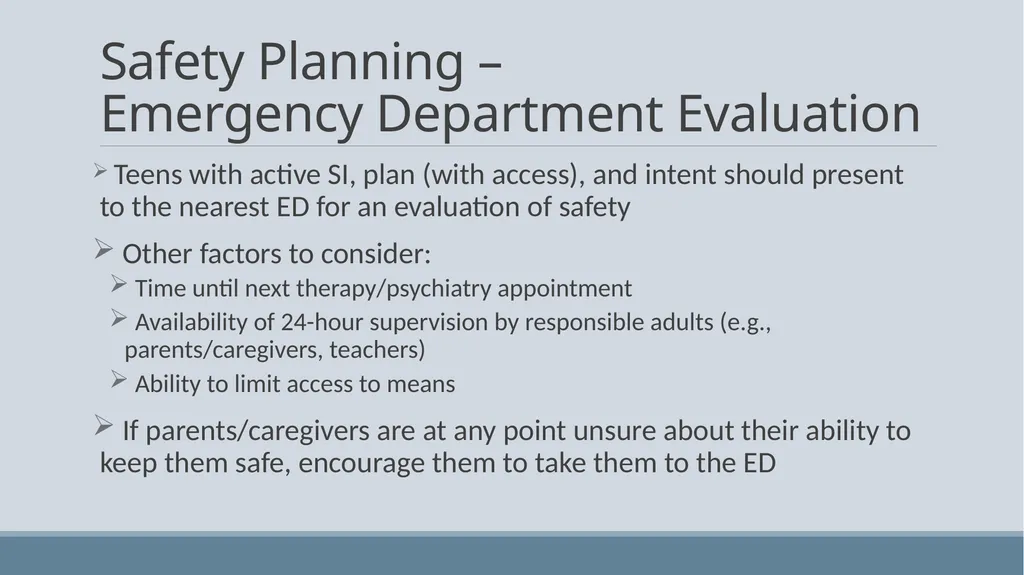
Safety Planning –
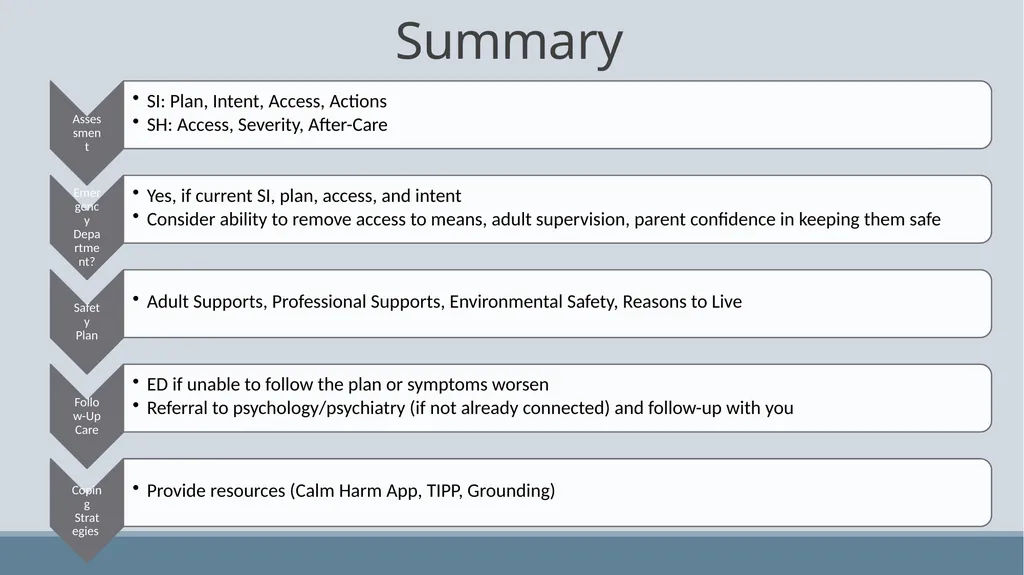
Emergency Department Evaluation Teens with active SI, plan (with access), and intent should present to the nearest ED for an evaluation of safety
Other factors to consider:
Time until next therapy/psychiatry appointment
Availability of 24-hour supervision by responsible adults (e.g., parents/caregivers, teachers)
Ability to limit access to means
If parents/caregivers are at any point unsure about their ability to keep them safe, encourage them to take them to the ED<br>
Other factors to consider:
Time until next therapy/psychiatry appointment
Availability of 24-hour supervision by responsible adults (e.g., parents/caregivers, teachers)
Ability to limit access to means
If parents/caregivers are at any point unsure about their ability to keep them safe, encourage them to take them to the ED<br>
17
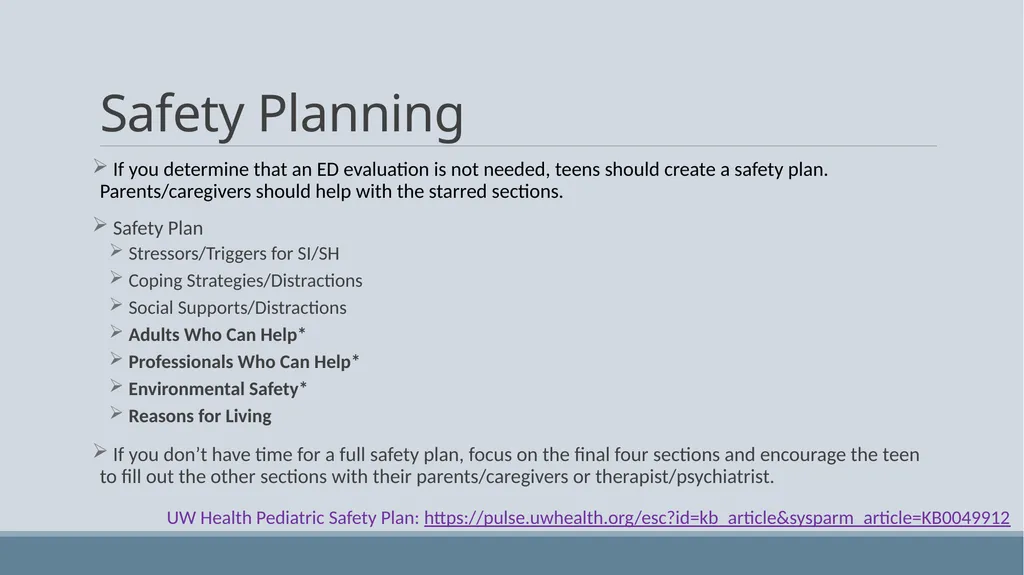
Safety Planning If you determine that an ED evaluation is not needed, teens should create a safety plan. Parents/caregivers should help with the starred sections.
Safety Plan
Stressors/Triggers for SI/SH
Coping Strategies/Distractions
Social Supports/Distractions
Adults Who Can Help*
Professionals Who Can Help*
Environmental Safety*
Reasons for Living
If you don’t have time for a full safety plan, focus on the final four sections and encourage the teen to fill out the other sections with their parents/caregivers or therapist/psychiatrist. UW Health Pediatric Safety Plan: https://pulse.uwhealth.org/esc?id=kb_article&sysparm_article=KB0049912<br>
Safety Plan
Stressors/Triggers for SI/SH
Coping Strategies/Distractions
Social Supports/Distractions
Adults Who Can Help*
Professionals Who Can Help*
Environmental Safety*
Reasons for Living
If you don’t have time for a full safety plan, focus on the final four sections and encourage the teen to fill out the other sections with their parents/caregivers or therapist/psychiatrist. UW Health Pediatric Safety Plan: https://pulse.uwhealth.org/esc?id=kb_article&sysparm_article=KB0049912<br>
18
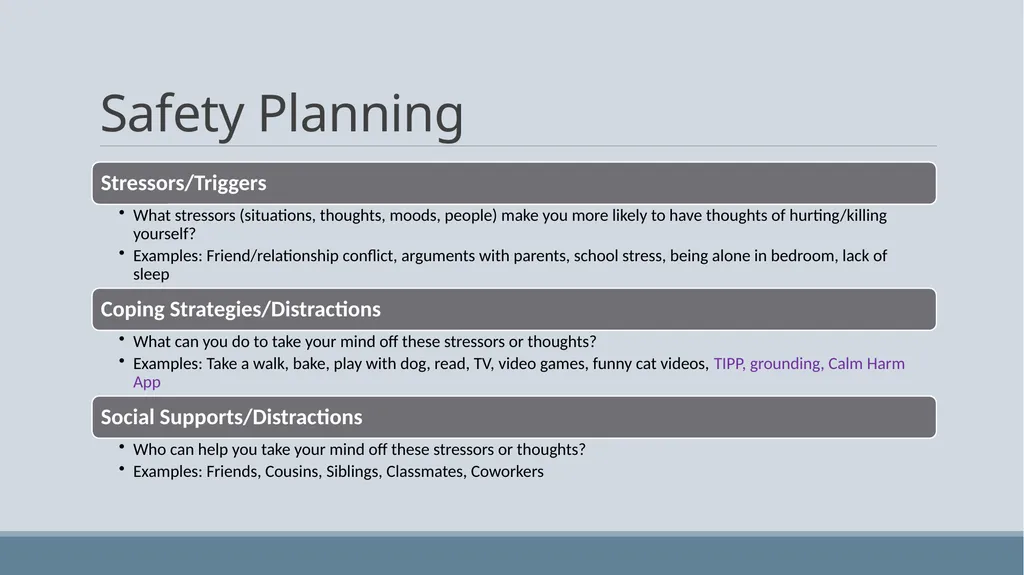
Safety Planning<br>
19
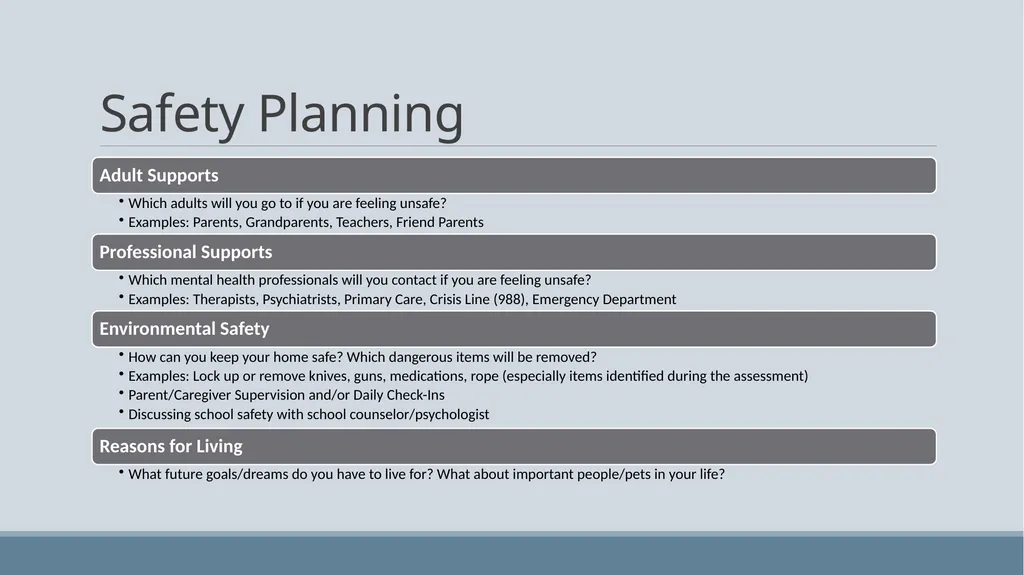
Safety Planning<br>
20
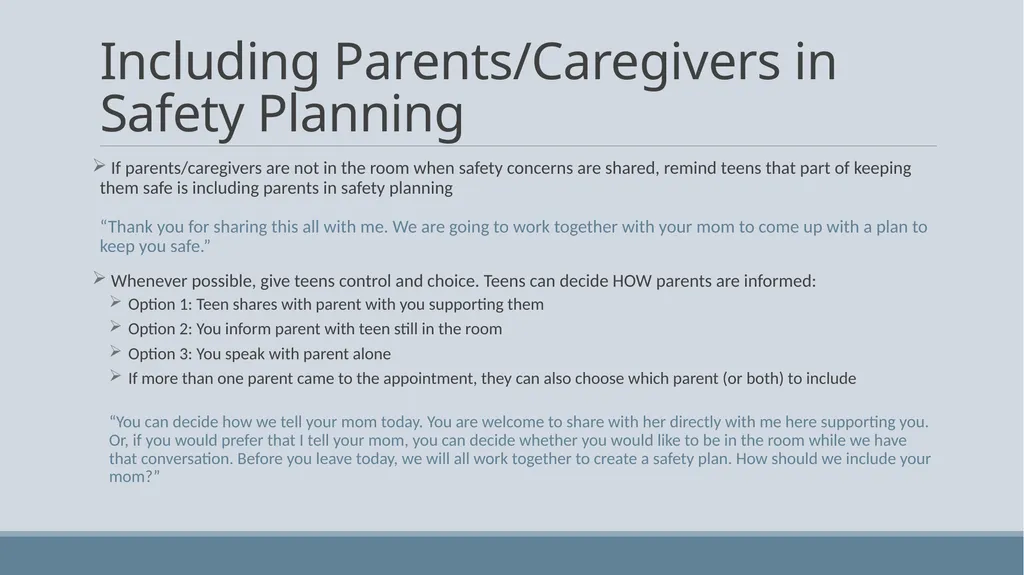
Including Parents/Caregivers in
Safety Planning If parents/caregivers are not in the room when safety concerns are shared, remind teens that part of keeping them safe is including parents in safety planning
“Thank you for sharing this all with me. We are going to work together with your mom to come up with a plan to keep you safe.”
Whenever possible, give teens control and choice. Teens can decide HOW parents are informed:
Option 1: Teen shares with parent with you supporting them
Option 2: You inform parent with teen still in the room
Option 3: You speak with parent alone
If more than one parent came to the appointment, they can also choose which parent (or both) to include
“You can decide how we tell your mom today. You are welcome to share with her directly with me here supporting you. Or, if you would prefer that I tell your mom, you can decide whether you would like to be in the room while we have that conversation. Before you leave today, we will all work together to create a safety plan. How should we include your mom?”<br>
Whenever possible, give teens control and choice. Teens can decide HOW parents are informed:
Option 1: Teen shares with parent with you supporting them
Option 2: You inform parent with teen still in the room
Option 3: You speak with parent alone
If more than one parent came to the appointment, they can also choose which parent (or both) to include
“You can decide how we tell your mom today. You are welcome to share with her directly with me here supporting you. Or, if you would prefer that I tell your mom, you can decide whether you would like to be in the room while we have that conversation. Before you leave today, we will all work together to create a safety plan. How should we include your mom?”<br>
21
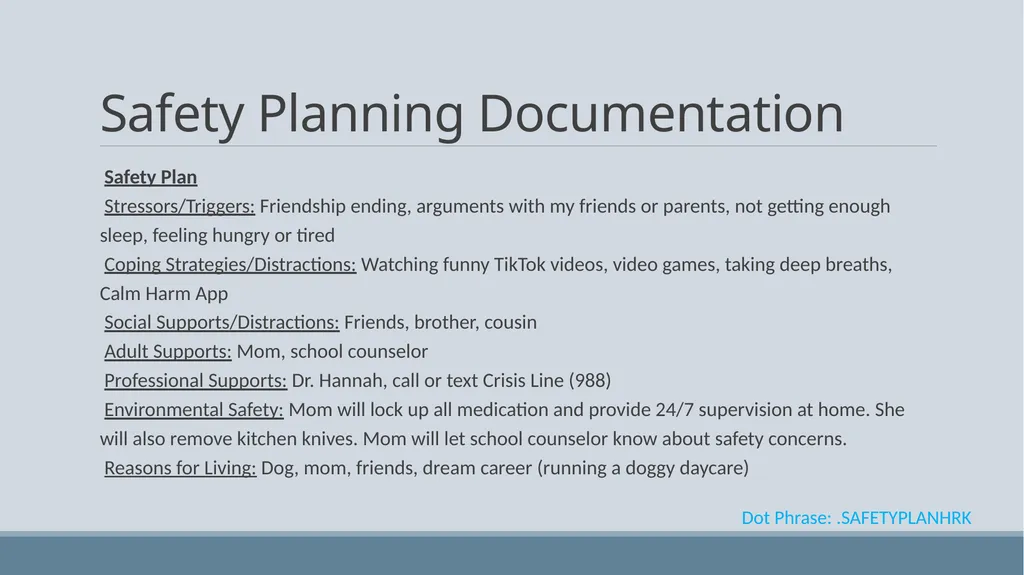
Safety Planning Documentation Safety Plan
Stressors/Triggers: Friendship ending, arguments with my friends or parents, not getting enough sleep, feeling hungry or tired
Coping Strategies/Distractions: Watching funny TikTok videos, video games, taking deep breaths, Calm Harm App
Social Supports/Distractions: Friends, brother, cousin
Adult Supports: Mom, school counselor
Professional Supports: Dr. Hannah, call or text Crisis Line (988)
Environmental Safety: Mom will lock up all medication and provide 24/7 supervision at home. She will also remove kitchen knives. Mom will let school counselor know about safety concerns.
Reasons for Living: Dog, mom, friends, dream career (running a doggy daycare) Dot Phrase: .SAFETYPLANHRK<br>
Stressors/Triggers: Friendship ending, arguments with my friends or parents, not getting enough sleep, feeling hungry or tired
Coping Strategies/Distractions: Watching funny TikTok videos, video games, taking deep breaths, Calm Harm App
Social Supports/Distractions: Friends, brother, cousin
Adult Supports: Mom, school counselor
Professional Supports: Dr. Hannah, call or text Crisis Line (988)
Environmental Safety: Mom will lock up all medication and provide 24/7 supervision at home. She will also remove kitchen knives. Mom will let school counselor know about safety concerns.
Reasons for Living: Dog, mom, friends, dream career (running a doggy daycare) Dot Phrase: .SAFETYPLANHRK<br>
22
Follow-Up Care<br>
23
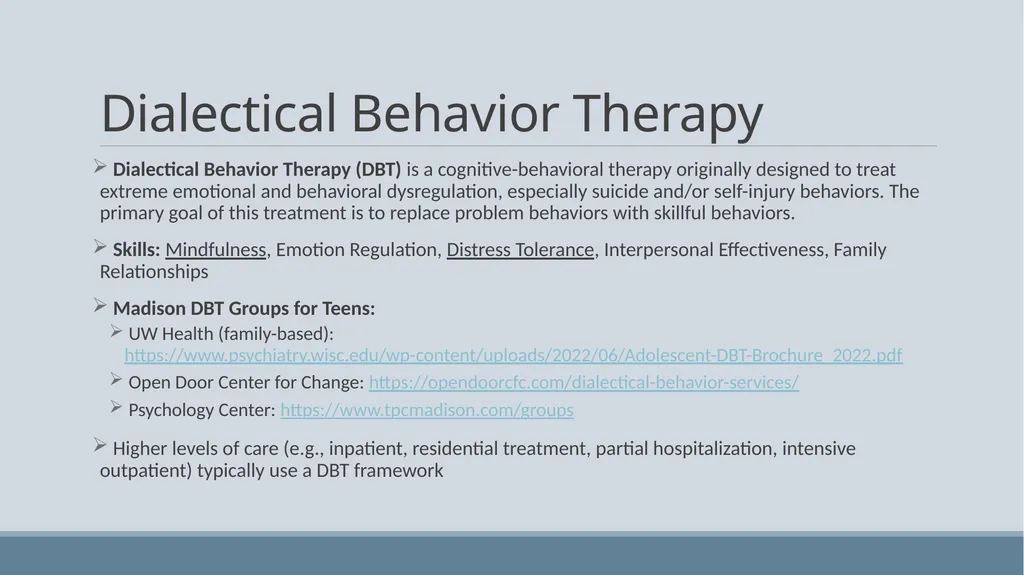
Dialectical Behavior Therapy Dialectical Behavior Therapy (DBT) is a cognitive-behavioral therapy originally designed to treat extreme emotional and behavioral dysregulation, especially suicide and/or self-injury behaviors. The primary goal of this treatment is to replace problem behaviors with skillful behaviors.
Skills: Mindfulness, Emotion Regulation, Distress Tolerance, Interpersonal Effectiveness, Family Relationships
Madison DBT Groups for Teens:
UW Health (family-based): https://www.psychiatry.wisc.edu/wp-content/uploads/2022/06/Adolescent-DBT-Brochure_2022.pdf
Open Door Center for Change: https://opendoorcfc.com/dialectical-behavior-services/
Psychology Center: https://www.tpcmadison.com/groups
Higher levels of care (e.g., inpatient, residential treatment, partial hospitalization, intensive outpatient) typically use a DBT framework<br>
Skills: Mindfulness, Emotion Regulation, Distress Tolerance, Interpersonal Effectiveness, Family Relationships
Madison DBT Groups for Teens:
UW Health (family-based): https://www.psychiatry.wisc.edu/wp-content/uploads/2022/06/Adolescent-DBT-Brochure_2022.pdf
Open Door Center for Change: https://opendoorcfc.com/dialectical-behavior-services/
Psychology Center: https://www.tpcmadison.com/groups
Higher levels of care (e.g., inpatient, residential treatment, partial hospitalization, intensive outpatient) typically use a DBT framework<br>
24
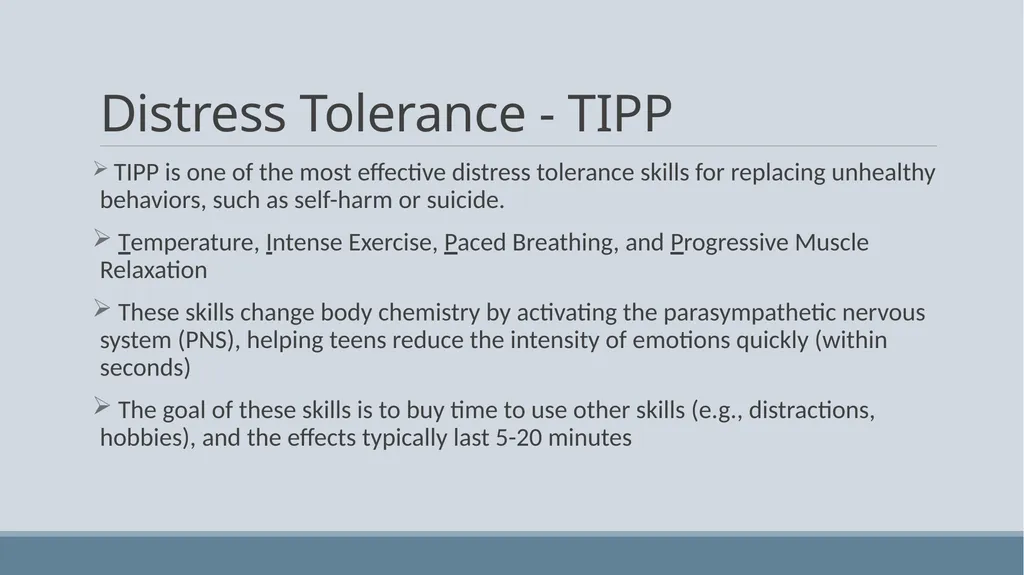
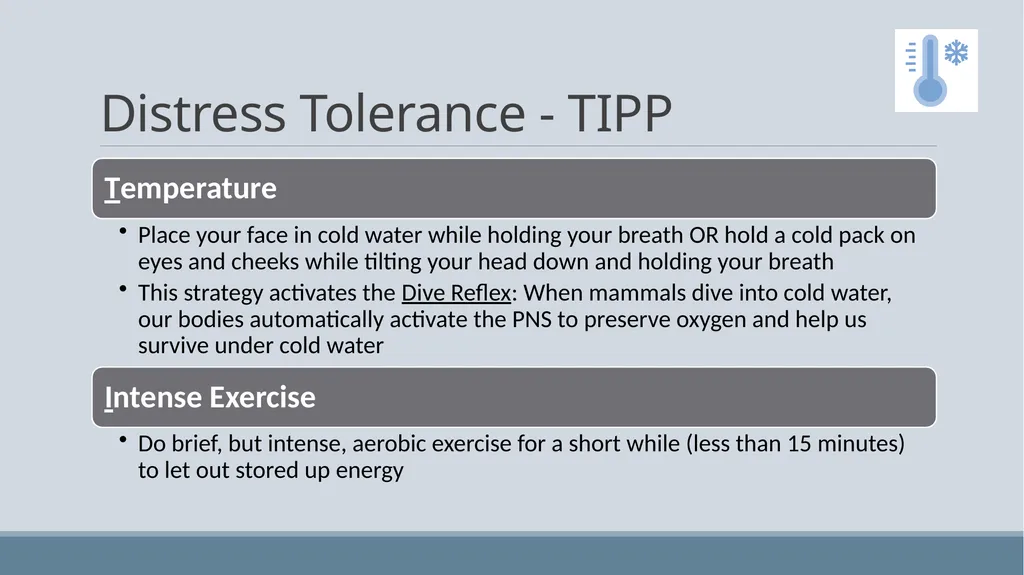
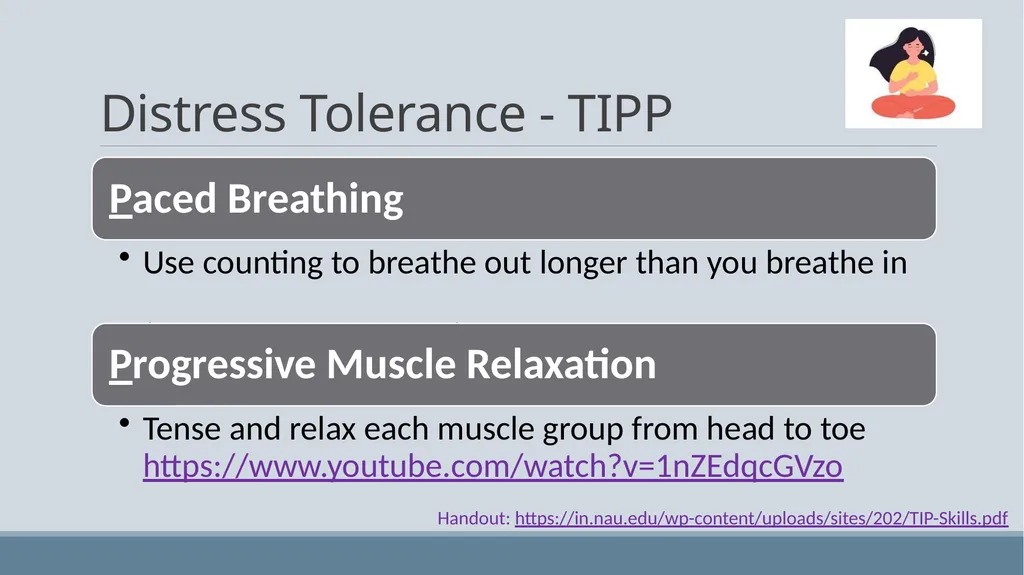
Distress Tolerance - TIPP TIPP is one of the most effective distress tolerance skills for replacing unhealthy behaviors, such as self-harm or suicide.
Temperature, Intense Exercise, Paced Breathing, and Progressive Muscle Relaxation
These skills change body chemistry by activating the parasympathetic nervous system (PNS), helping teens reduce the intensity of emotions quickly (within seconds)
The goal of these skills is to buy time to use other skills (e.g., distractions, hobbies), and the effects typically last 5-20 minutes<br>
Temperature, Intense Exercise, Paced Breathing, and Progressive Muscle Relaxation
These skills change body chemistry by activating the parasympathetic nervous system (PNS), helping teens reduce the intensity of emotions quickly (within seconds)
The goal of these skills is to buy time to use other skills (e.g., distractions, hobbies), and the effects typically last 5-20 minutes<br>
25
Distress Tolerance - TIPP<br>
26
Distress Tolerance - TIPP Handout: https://in.nau.edu/wp-content/uploads/sites/202/TIP-Skills.pdf<br>
27
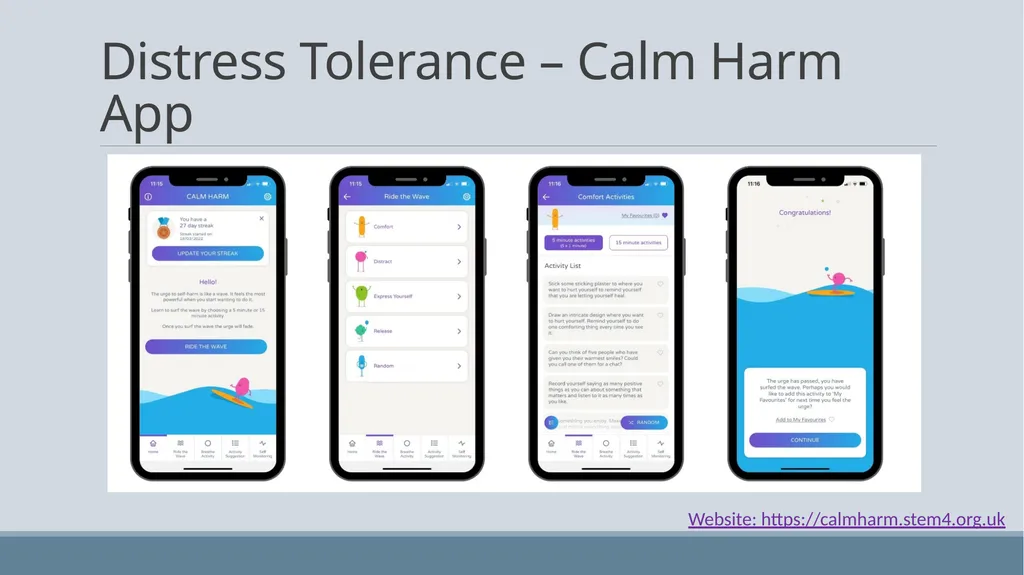
Distress Tolerance – Calm Harm App Website: https://calmharm.stem4.org.uk<br>
28
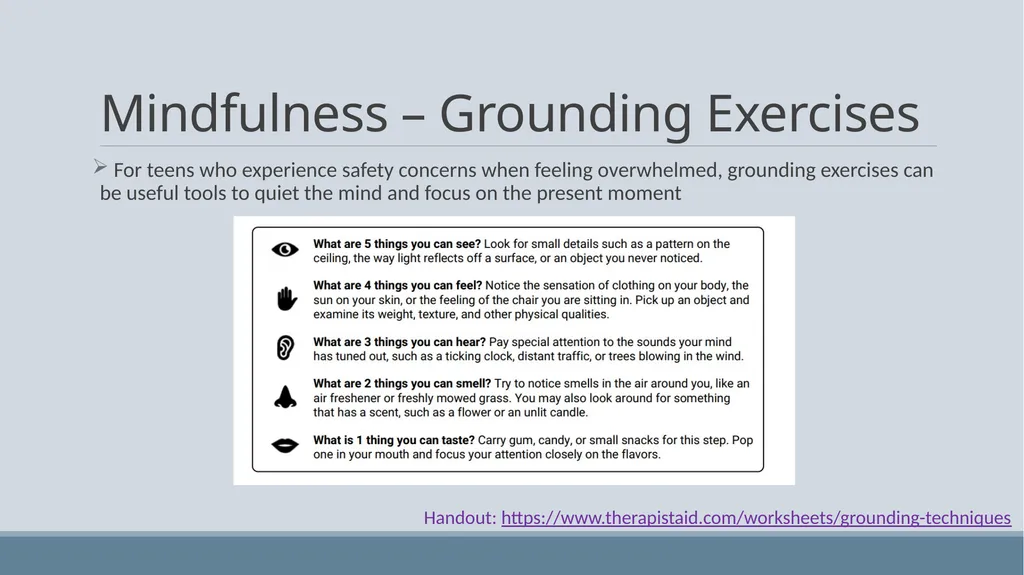
Mindfulness – Grounding Exercises For teens who experience safety concerns when feeling overwhelmed, grounding exercises can be useful tools to quiet the mind and focus on the present moment Handout: https://www.therapistaid.com/worksheets/grounding-techniques<br>
29
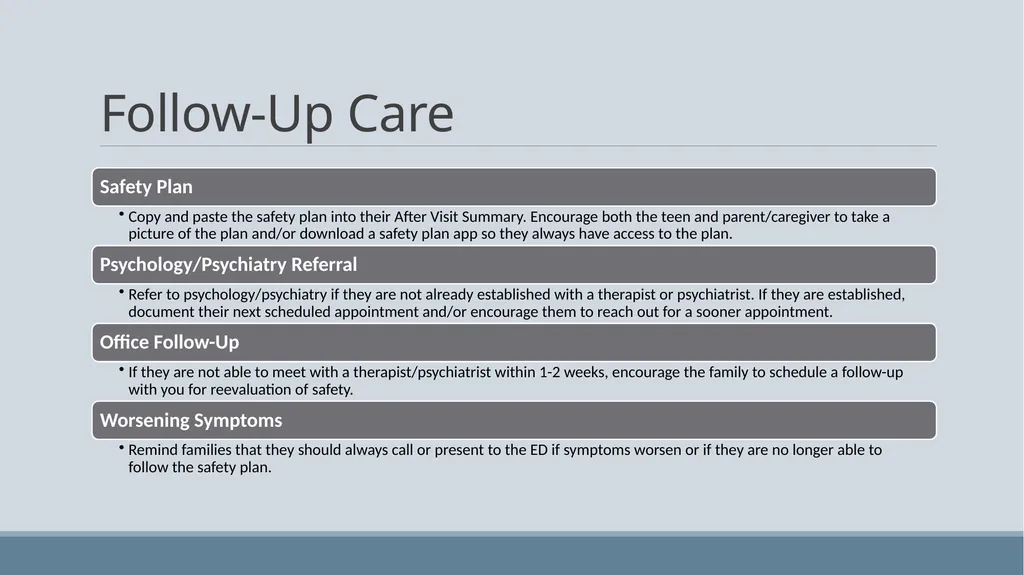
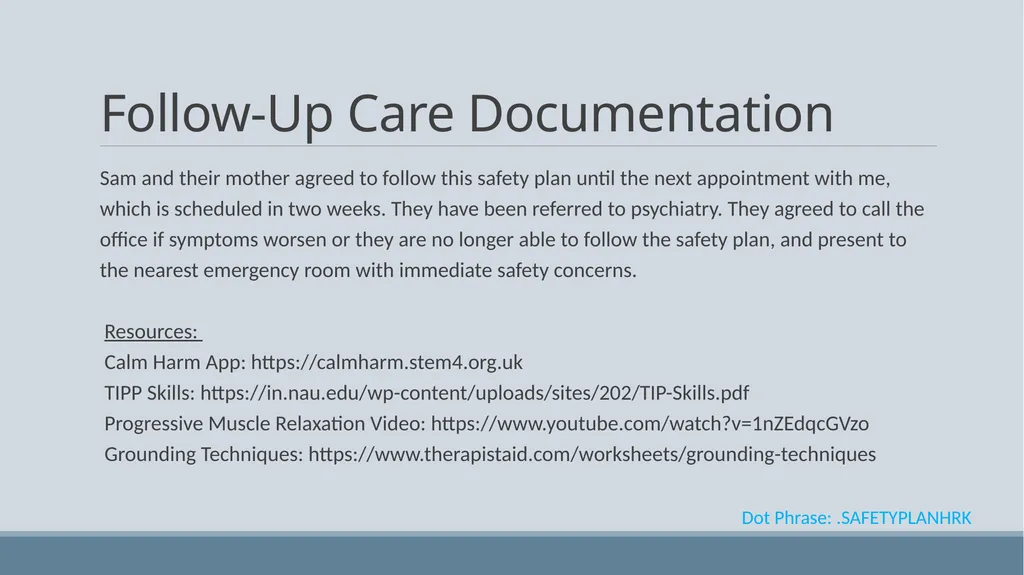
Follow-Up Care Documentation Sam and their mother agreed to follow this safety plan until the next appointment with me, which is scheduled in two weeks. They have been referred to psychiatry. They agreed to call the office if symptoms worsen or they are no longer able to follow the safety plan, and present to the nearest emergency room with immediate safety concerns.
Resources:
Calm Harm App: https://calmharm.stem4.org.uk
TIPP Skills: https://in.nau.edu/wp-content/uploads/sites/202/TIP-Skills.pdf
Progressive Muscle Relaxation Video: https://www.youtube.com/watch?v=1nZEdqcGVzo
Grounding Techniques: https://www.therapistaid.com/worksheets/grounding-techniques Dot Phrase: .SAFETYPLANHRK<br>
Resources:
Calm Harm App: https://calmharm.stem4.org.uk
TIPP Skills: https://in.nau.edu/wp-content/uploads/sites/202/TIP-Skills.pdf
Progressive Muscle Relaxation Video: https://www.youtube.com/watch?v=1nZEdqcGVzo
Grounding Techniques: https://www.therapistaid.com/worksheets/grounding-techniques Dot Phrase: .SAFETYPLANHRK<br>
30
Summary<br>
31
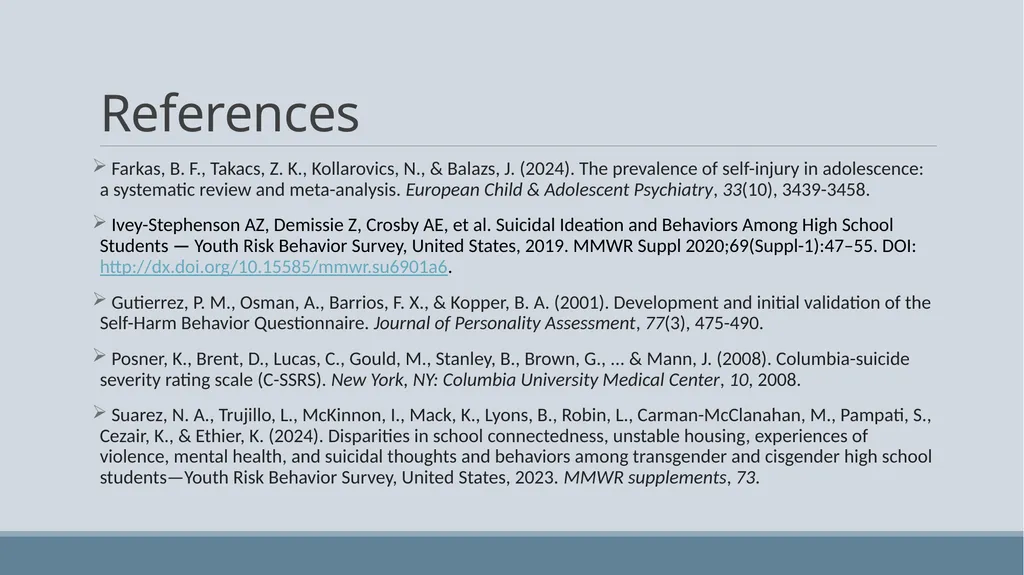
References Farkas, B. F., Takacs, Z. K., Kollarovics, N., & Balazs, J. (2024). The prevalence of self-injury in adolescence: a systematic review and meta-analysis. European Child & Adolescent Psychiatry, 33(10), 3439-3458.
Ivey-Stephenson AZ, Demissie Z, Crosby AE, et al. Suicidal Ideation and Behaviors Among High School Students — Youth Risk Behavior Survey, United States, 2019. MMWR Suppl 2020;69(Suppl-1):47–55. DOI: http://dx.doi.org/10.15585/mmwr.su6901a6.
Gutierrez, P. M., Osman, A., Barrios, F. X., & Kopper, B. A. (2001). Development and initial validation of the Self-Harm Behavior Questionnaire. Journal of Personality Assessment, 77(3), 475-490.
Posner, K., Brent, D., Lucas, C., Gould, M., Stanley, B., Brown, G., ... & Mann, J. (2008). Columbia-suicide severity rating scale (C-SSRS). New York, NY: Columbia University Medical Center, 10, 2008.
Suarez, N. A., Trujillo, L., McKinnon, I., Mack, K., Lyons, B., Robin, L., Carman-McClanahan, M., Pampati, S., Cezair, K., & Ethier, K. (2024). Disparities in school connectedness, unstable housing, experiences of violence, mental health, and suicidal thoughts and behaviors among transgender and cisgender high school students—Youth Risk Behavior Survey, United States, 2023. MMWR supplements, 73.<br>
Ivey-Stephenson AZ, Demissie Z, Crosby AE, et al. Suicidal Ideation and Behaviors Among High School Students — Youth Risk Behavior Survey, United States, 2019. MMWR Suppl 2020;69(Suppl-1):47–55. DOI: http://dx.doi.org/10.15585/mmwr.su6901a6.
Gutierrez, P. M., Osman, A., Barrios, F. X., & Kopper, B. A. (2001). Development and initial validation of the Self-Harm Behavior Questionnaire. Journal of Personality Assessment, 77(3), 475-490.
Posner, K., Brent, D., Lucas, C., Gould, M., Stanley, B., Brown, G., ... & Mann, J. (2008). Columbia-suicide severity rating scale (C-SSRS). New York, NY: Columbia University Medical Center, 10, 2008.
Suarez, N. A., Trujillo, L., McKinnon, I., Mack, K., Lyons, B., Robin, L., Carman-McClanahan, M., Pampati, S., Cezair, K., & Ethier, K. (2024). Disparities in school connectedness, unstable housing, experiences of violence, mental health, and suicidal thoughts and behaviors among transgender and cisgender high school students—Youth Risk Behavior Survey, United States, 2023. MMWR supplements, 73.<br>