PERMANENT METHODS OF CONTRACEPTION INTRODUCTION Voluntary Surgical Contraception (VSC) includes female and male sterilization procedures that are intended to provide permanent contraception. As such, special care must be taken to ensure
"PERMANENT METHODS OF CONTRACEPTION INTRODUCTION" is the property of its rightful owner. Permission is granted to
download and print the materials on this website for personal, non-commercial use only, and to display it
on your personal computer provided you do not modify the materials and that you retain all copyright
notices contained in the materials. By downloading content from our website, you accept the terms of this
agreement.
Presentation Transcript
01
PERMANENT METHODS OF CONTRACEPTION<br>
02
INTRODUCTION Voluntary Surgical Contraception (VSC) includes female and male sterilization procedures that are intended to provide permanent contraception.
As such, special care must be taken to ensure that every client makes a voluntary, informed choice of the method.<br>
03
Particular attention must be given to counseling in the case of
young people,
nulliparous women,
men who are not yet fathers,
clients with mental health problems, including depressive conditions.<br>
04
All clients must be carefully counseled about the intended permanence of the sterilization and the availability of alternative, long-term, highly effective methods.<br>
05
Medical Eligibility Criteria There are no medical condition that would absolutely restrict a person’s eligibility for sterilization although some conditions and circumstances will require that certain precautions are taken, including those where the recommendation is C-Caution, D-Delay, or S-Special.<br>
06
Definition of Conditions A. Accept: no medical reason to deny sterilization to a person with this condition.
C. Caution: procedure is normally conducted in a routine setting, but with extra preparation and precautions.
D. Delay: procedure is delayed until the condition is evaluated and/or corrected.
S. Special: The procedure should be undertaken in a setting with an experienced surgeon and staff, equipment needed to provide general anesthesia, and other back up medical support.<br>
07
FEMALE VOLUNTARY SURGICAL CONTRACEPTION<br>
08
Definition A minor surgical operation, which involves the tying and cutting of the fallopian tubes in order to prevent the egg released by the ovary from being fertilized by sperm
Generally a safe procedure, and when performed by trained provider
Overall rates of complications are in the rage of 0.4-2.0%.<br>
09
It is a highly effective method of contraception, failing in less than 1% of women in the first year after surgery.
Tubal ligation can be performed under conscious sedation and local anaesthesia.
Tubal ligation is a permanent FP method (reversal cannot be assured). Hence,<br>
10
Thorough, careful counseling is needed before decision making.
A consent form must be signed by the client in all cases before the procedure is undertaken.
In the case of mentally challenged clients, a signature of the parent/guardian must be obtained.<br>
11
Types Minilaparotomy (postpartum or interval)
Laparoscopic tubal ligation-interval
At caesarean section or other abdominal surgery<br>
12
Contraceptive Benefits Highly effective
Immediately effective
No change in sexual function – does not interfere with intercourse
Good choice of FP for client if pregnancy would be a serious health risk
Does not affect breastfeeding<br>
13
Limitations Generally irreversible – success of reversal surgery cannot be guaranteed
Risks associated with surgical procedures
Pain
Haematoma
Wound infection
Does not protect against STIs/HIV/AIDS
Usually painful for a few days after the procedure
Can only be offered by a trained provider.<br>
14
Who Can Use Tubal Ligation (Category A) Women of reproductive age
Women who are certain they have achieved the desired family size
Clients in whom pregnancy would pose a serious health risk
Women who understands and voluntarily follow informed consent procedure<br>
15
Who Should Not Use Clients who are uncertain of their desire for future fertility
Clients who cannot withstand surgery
Clients who do not give voluntary informed consent<br>
16
CAUTION Procedure can be conducted in a routine setting, but with extra preparation and precautions
Young age
Obesity
Hypertension adequately controlled
History of ischaemic heart disease
Uncomplicated valvular heart disease
Epilepsy or depressive disorders
Uterine fibroids
Diabetes
Liver Cirrhosis and Liver tumors
Anaemias
Previous abdominal or pelvic surgery
Kidney disease
Severe nutritional deficiency<br>
17
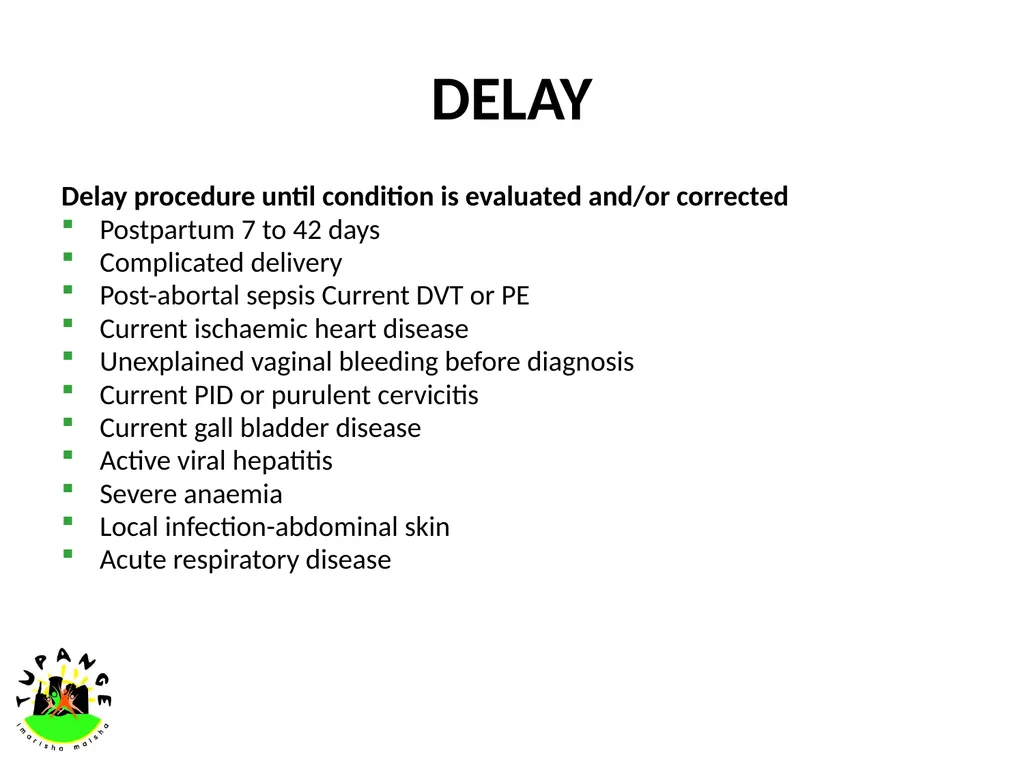
DELAY Delay procedure until condition is evaluated and/or corrected
Postpartum 7 to 42 days
Complicated delivery
Post-abortal sepsis Current DVT or PE
Current ischaemic heart disease
Unexplained vaginal bleeding before diagnosis
Current PID or purulent cervicitis
Current gall bladder disease
Active viral hepatitis
Severe anaemia
Local infection-abdominal skin
Acute respiratory disease<br>
18
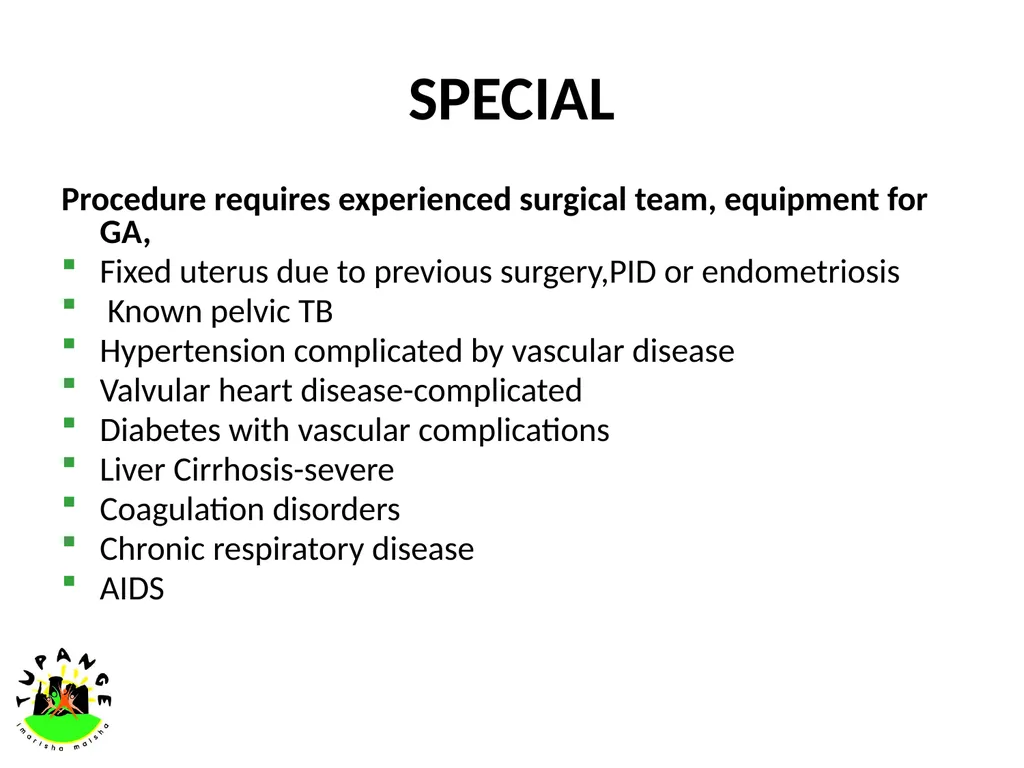
SPECIAL Procedure requires experienced surgical team, equipment for GA,
Fixed uterus due to previous surgery,PID or endometriosis
Known pelvic TB
Hypertension complicated by vascular disease
Valvular heart disease-complicated
Diabetes with vascular complications
Liver Cirrhosis-severe
Coagulation disorders
Chronic respiratory disease
AIDS<br>
19
VASECTOMY<br>
20
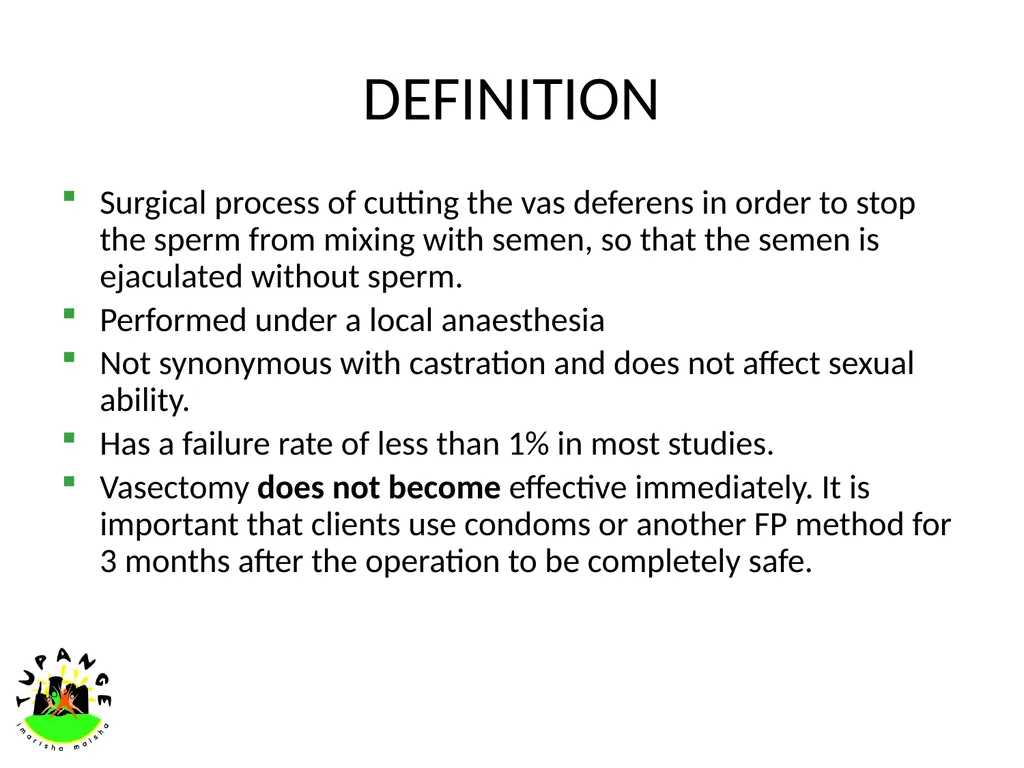
DEFINITION Surgical process of cutting the vas deferens in order to stop the sperm from mixing with semen, so that the semen is ejaculated without sperm.
Performed under a local anaesthesia
Not synonymous with castration and does not affect sexual ability.
Has a failure rate of less than 1% in most studies.
Vasectomy does not become effective immediately. It is important that clients use condoms or another FP method for 3 months after the operation to be completely safe.<br>
Who Can Use Vasectomy Men of reproductive age
Men who have achieved desired family size
Men who understand and voluntarily give informed consent for the procedure.<br>
23
CAUTION Procedure can be conducted in a routine
setting, but with extra preparation and
precautions
Young age
Depressive disorders
Diabetes
Previous scrotal injury
Large varicocele or hydrocele
Cryptorchidism<br>
24
DELAY Delay procedure until condition is
evaluated and/or corrected
Local skin infection
Active STI or Systemic infection
Filariasis or elephantiasis
Intra-scrotal mass<br>
25
SPECIAL Procedure requires experienced surgical
team, equipment for GA,
Coagulation disorders
AIDS
Inguinal hernia<br>