04
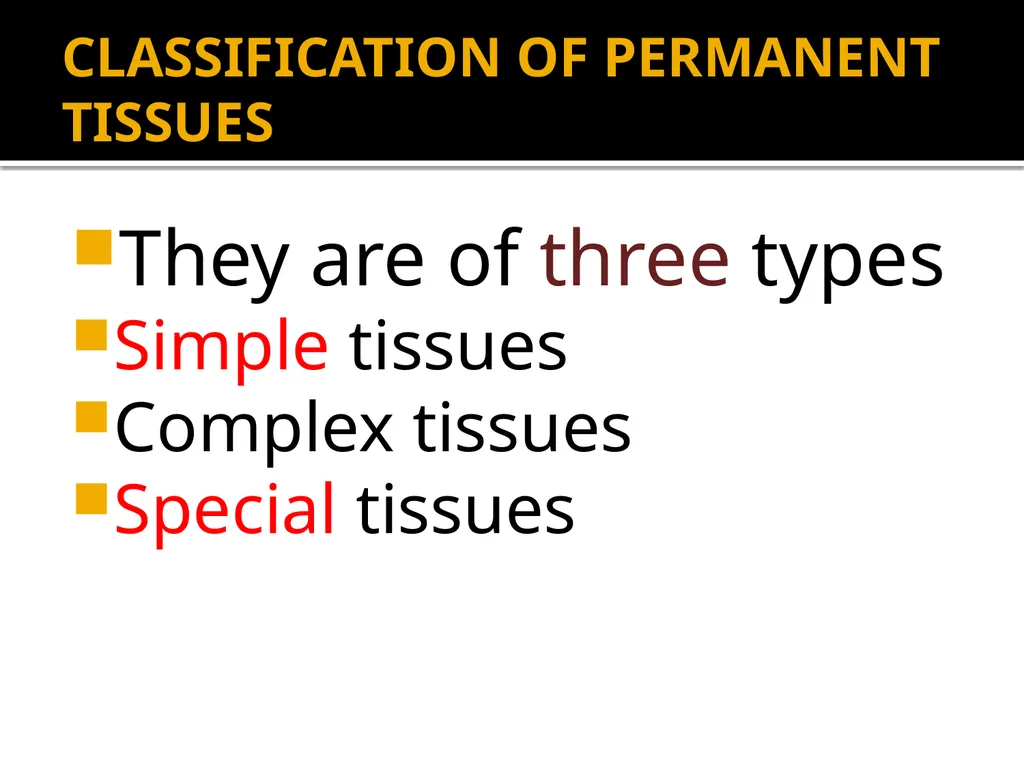
SIMPLE TISSUES These tissues are composed of only one type of cells which are similar in their structure and function. That is all the cells are homogenous. Simple tissues are again of three types
Parenchyma
Collenchyma
Sclerenchyma<br>
05
Parenchyma- Cell wall are thin composed of cellulose and calcium pectate .Cells are living with a clear and well defined nucleus.
Intercellular space is found between cells.
Cells are with vacuole.
The cell shape can be round, oval, rectangular, cylindrical or stellate<br>
06
Found in all the soft tissues in plants.
They are also found in complex tissues like xylem and phloem.
They are simple primary cells. Most of the plant part is made up of this type of cells. That’s why they are called ground tissues. Rest of all the cells and tissues develop from this basic type of cells<br>
07
They develop from the primary meristematic cells. The parenchymatous cells found in primary xylem and phloem tissues develops form procambial cells . The parenchymatous cells found in the secondary xylem and phloem is formed from cambium and cork cambium<br>
08
They are mostly isodiametric but in some plants they can be long and of different shapes.
They are set close to each other without much intercellular space in the parenchyma tissue of endosperm but the pulp of fruits have large intercellular spaces between the parenchyma cells.<br>
09
Usually the cell wall is thin composed of cellulose, pectin and hemicellulose. Plasmodesmata is present . The parenchyma cells of secondary xylem are thickwalled with lignin.
The cell content differs according to their function but nucleus in found in all.<br>
10
Types of parenchyma Chlorenchyma –when chloroplast is present . These tissues perform photosynthesis.
Aerenchyma –large intercellular space is found . The space is filled with gas. This makes the tissue buoyant . These tissue are found in aquatic plants.<br>
11
Idioblasts-these are special type of parenchyma in which tannin , oil, calcium oxalate crystals like raphides are stored.
Prosenchyma – parenchymatous cell iso diametric to elongated with tapered ends slightly thick walled found in the pericycle of dicots.<br>
12
Stellate parenchyma – star shaped with large intercellular spaces . Found in the leaf base of banana and certain aquatic plants.
Functions –store starch ,protein, oil like in potato and castor, chlorenchymatous performs photosynthesis, provides buoyancy, stores water for example in Opuntia and Euphorbia , divides and provides cells for secondary growth and for healing the injured parts.<br>
13
COLLENCHYMA Develops from parenchyma and thickened at corners which is a diagnostic feature of this tissue they are longer than parenchyma cells the cell wall contains cellulose , hemicellulose and pectin but not lignin. The hydrophilic nature of pectin causes the cell wall to be soft and moist.<br>
14
The cell wall gets thickened along with the elongation. Found in the soft organs like branches, stems leaves, leaf bases giving flexibility along with strength. They are the reason why plants can bend in response to strong winds without breaking .<br>
15
It is found in the primary structure of usually a dicot plant and very rarely or absent in monocot plants, not found in underground parts. In dicot stem it is found beneath the epidermis as layer or patches forming hypodermis..<br>
16
TYPES OF COLLENCHYMA Different thickening by the pectin and hemicellulose
Angular collenchyma-when the thickening is found at the corners example in Datura and Lycopersicon (tomato).<br>
17
Lacunar or tubular collenchyma-clear and distinct intercellular space is present and the thickening is present on the cell wall which is near to or surrounding the intercellular space example in Salvia and Malva.<br>
18
Lamellar or plate collenchyma- thickening along the tangential walls rather than the radial wall example in stem of Raphanus<br>
19
FUNCTION Gives elastic strength or tensile strength, avoiding breakage of branches in strong winds.
Development of chloroplast in the different organs leads to making of food
As they are living they can divide according to need and convert into meristematic cells and fills the injury and forms cambium.<br>
20
Sclerenchyma The cells are long, tapering at the ends, the cell wall are thick, lignified and are dead when mature. Simple pits are found in these tissues. Thickening by deposition of lignin is found only in these tissues .<br>
21
The thick wall leads to attainment of permanent shape by the cells. The space occupied by the cytoplasm is reduced gradually due to deposition of layers of lignin. As lignin is not permeable to water the less water content of the cell leads to death of the cells .<br>
22
TYPES OF SCLERENCHYMA Two types of sclerenchyma are found normally
Sclerenchyma fibres
Stone cells or sclerids<br>
23
SCLERENCHYMA FIBRES The cells are long, thin and tapering on both ends. Sometimes the cell wall gets very thick and the lumen gets very thin or completely blocked. The cell wall has small simple pits. They are found in the cortex, pericycle, xylem and phloem . In monocots they form a boundary up or down the vascular bundle and is called the bundle sheath cells.<br>
24
On the basis of presence of the fibres in the plant axis they are divided into two groups-
Wood fibres, xylary fibres- they arise from the same meristematic cells from which the rest of other xylem cells arises. Found in tracheids of secondary xylem. The secondary wall is lignified. They are extremely thin and long the ends are thin and pointed<br>
25
EXTRAXYLARY, PHLOEM OR BAST FIBRES Found in many plants as circular strips or patches. They are thought to be originated from phloem they are also called pericyclic or perivascular fibres.
The fibres are long, soft and the heads or ends are tapered or pointed. For this reason they get entangled with each other.<br>
26
For this reason the fibers of the whole strip cam be isolated together. The mechanical strength so conferred makes them important for making ropes, mats. In plants also they provide mechanical strength so that the plants can take pressure.<br>
27
The length of the fibres is 20mm. Some time the fibres are as long as 200mm. In dicots they are found in Crotolaria juncea, Hibiscus cannabis and Corchorus capsularis (jute). The mechanical strength the fibres have give them economic value they are used for making ropes, mats, bags<br>
28
In monocots the useful fibres are obtained from the leaves. The lignified walls are comparatively more thick. They are smaller, more rough and smaller in comparison. They are called hard fibres. The fibres of Musa textilis, Agave are example.<br>
29
SCLERIDS They are also called stone cells and they are found in most of the plants. They are more broader than their length, with thick wall and narrow lumen. They are isodiametric but some are elongated also.<br>
30
Stone cells are present in hard parts like endocarp of coconut, hard seed coats and also in some fruit pulp. They are common in cortex and pith of gymnosperms.
Function of sclerids is mechanical.<br>
31
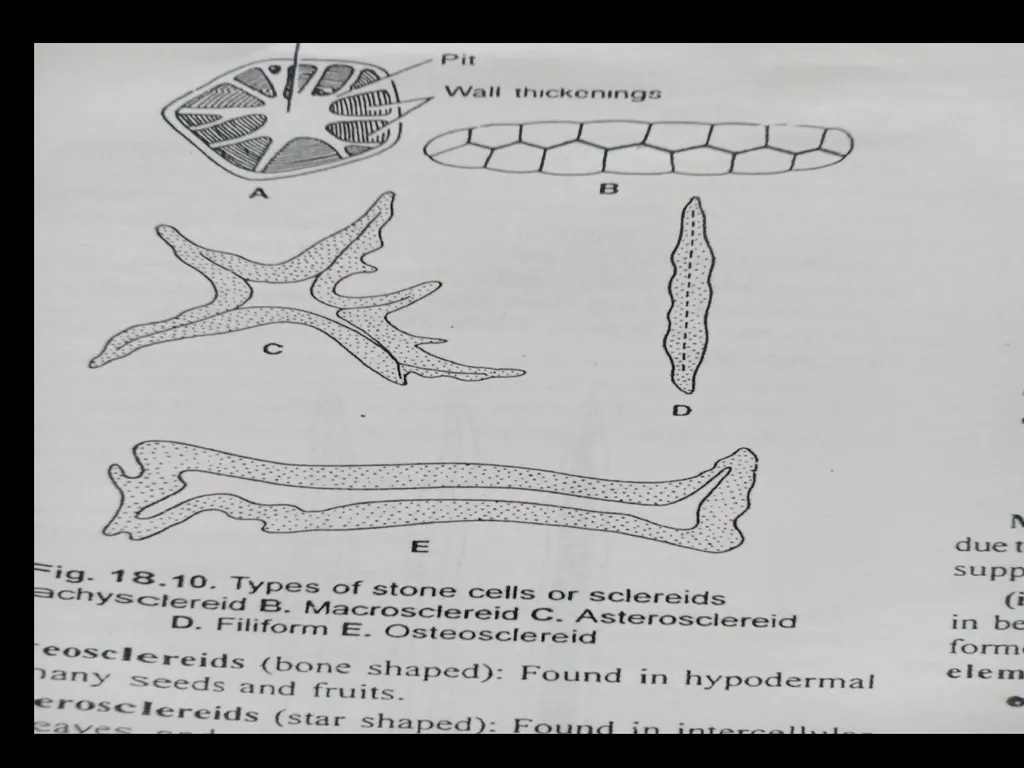
SCLERIDS Brachysclerids- (small , oval or rounded ) found in cortex, pith and phloem of stem.
Macrosclerids –( large rod shaped) found in hard seed coat of leguminosae family.
Osteosclerids – bone shaped found in the hypodermal tissue of many seeds and fruits.
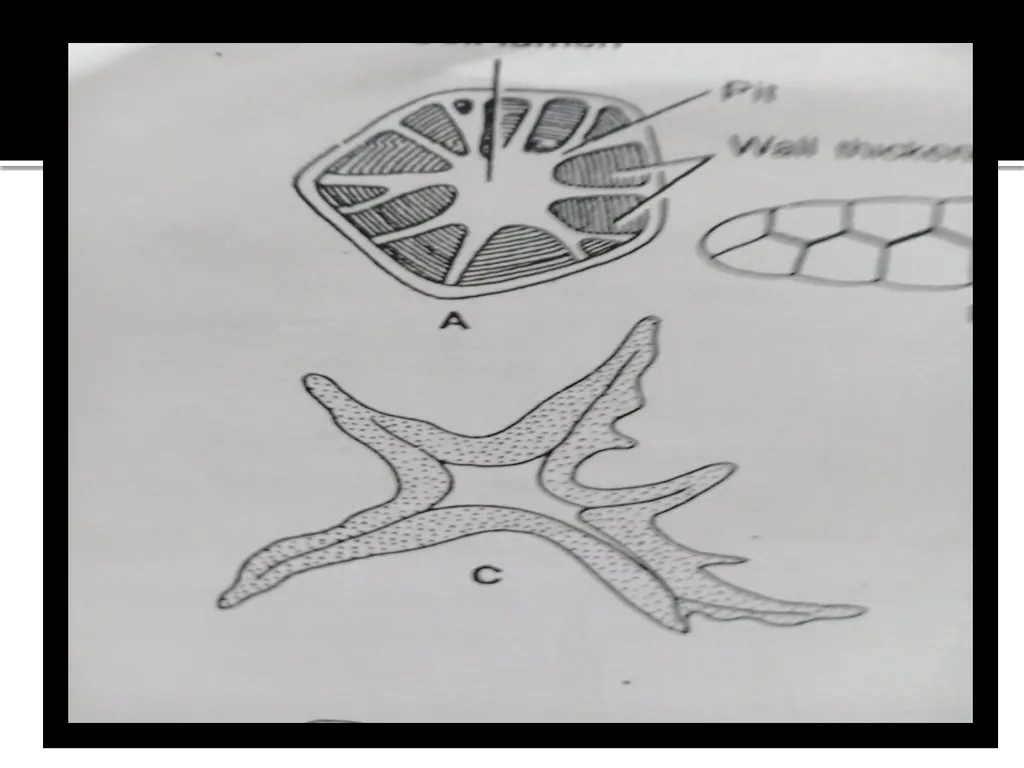
Asterosclerids –star shaped found in inter cellular space of leaves of some hydrophytes.<br>