
Personal Financial Literacy Financial Literacy
CS
Published · 42 slides · 0 views

1 / 1
Description
Personal Financial Literacy Financial Literacy Financial Personal Literacy Knowledge and skills which characterize economic decision-making including a basic understanding of saving, credit, checking, investing, budgeting and other personal
Related Topics
Share
Embed code
Download this presentation From Below
"Personal Financial Literacy Financial Literacy" is the property of its rightful owner. Permission is granted to download and print the materials on this website for personal, non-commercial use only, and to display it on your personal computer provided you do not modify the materials and that you retain all copyright notices contained in the materials. By downloading content from our website, you accept the terms of this agreement.
Presentation Transcript
01
Personal Financial Literacy<br>
02
Financial Literacy Financial Personal Literacy
Knowledge and skills which characterize economic decision-making including a basic understanding of saving, credit, checking, investing, budgeting and other personal decisions involving money.
A lack of financial literacy could lead to poor economic decisions and avoidable challenges and obstacles.<br>
Knowledge and skills which characterize economic decision-making including a basic understanding of saving, credit, checking, investing, budgeting and other personal decisions involving money.
A lack of financial literacy could lead to poor economic decisions and avoidable challenges and obstacles.<br>
03
Setting Priorities One of the most important parts of financial literacy is one’s ability to set priorities:
What do I want?
Does it make sense now?
What are the trade-offs?
Who can help me make these decisions?
What are my goals?<br>
What do I want?
Does it make sense now?
What are the trade-offs?
Who can help me make these decisions?
What are my goals?<br>
04
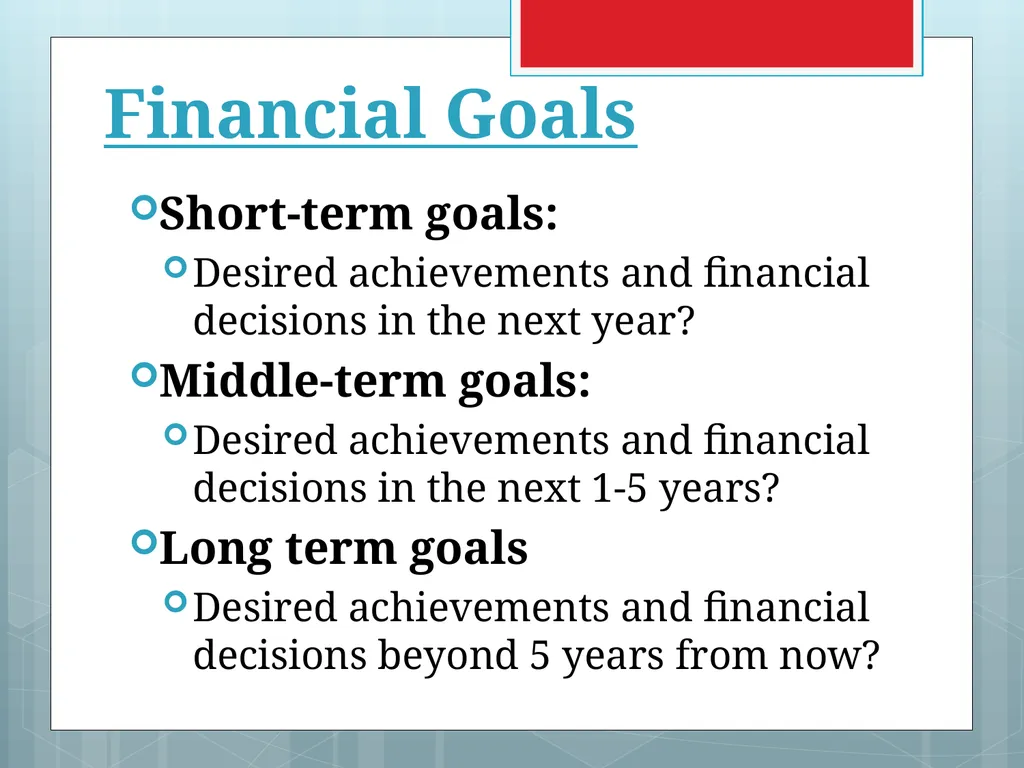
Financial Goals Short-term goals:
Desired achievements and financial decisions in the next year?
Middle-term goals:
Desired achievements and financial decisions in the next 1-5 years?
Long term goals
Desired achievements and financial decisions beyond 5 years from now?<br>
Desired achievements and financial decisions in the next year?
Middle-term goals:
Desired achievements and financial decisions in the next 1-5 years?
Long term goals
Desired achievements and financial decisions beyond 5 years from now?<br>
05
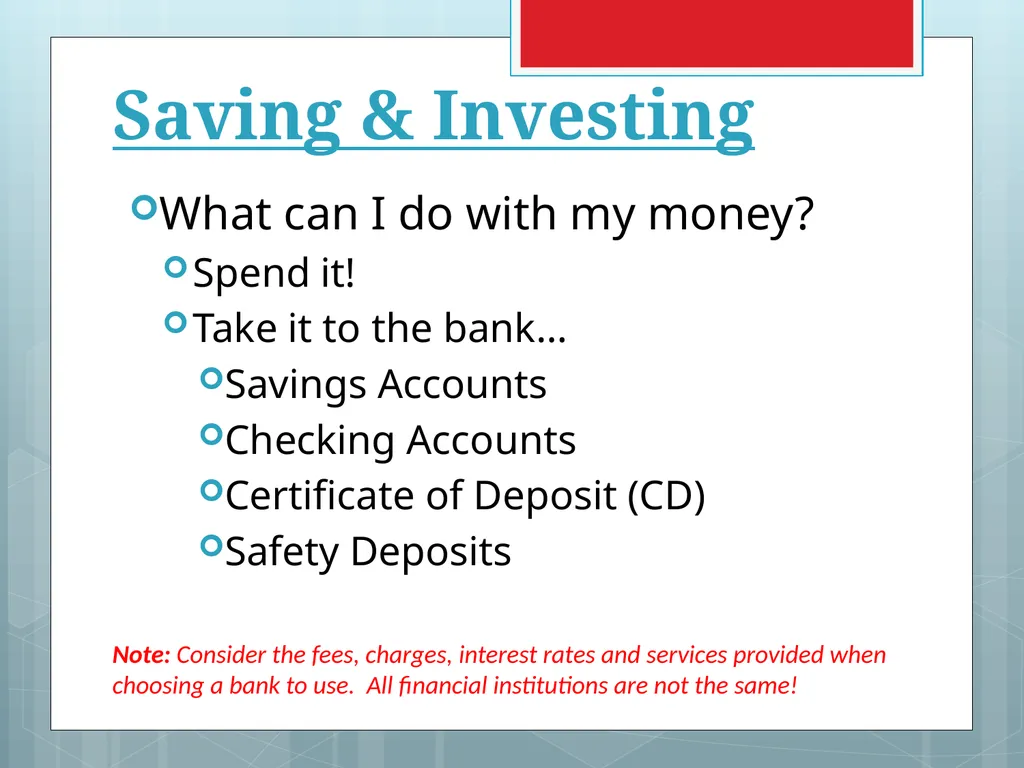
Saving & Investing What can I do with my money?
Spend it!
Take it to the bank…
Savings Accounts
Checking Accounts
Certificate of Deposit (CD)
Safety Deposits Note: Consider the fees, charges, interest rates and services provided when choosing a bank to use. All financial institutions are not the same!<br>
Spend it!
Take it to the bank…
Savings Accounts
Checking Accounts
Certificate of Deposit (CD)
Safety Deposits Note: Consider the fees, charges, interest rates and services provided when choosing a bank to use. All financial institutions are not the same!<br>
06
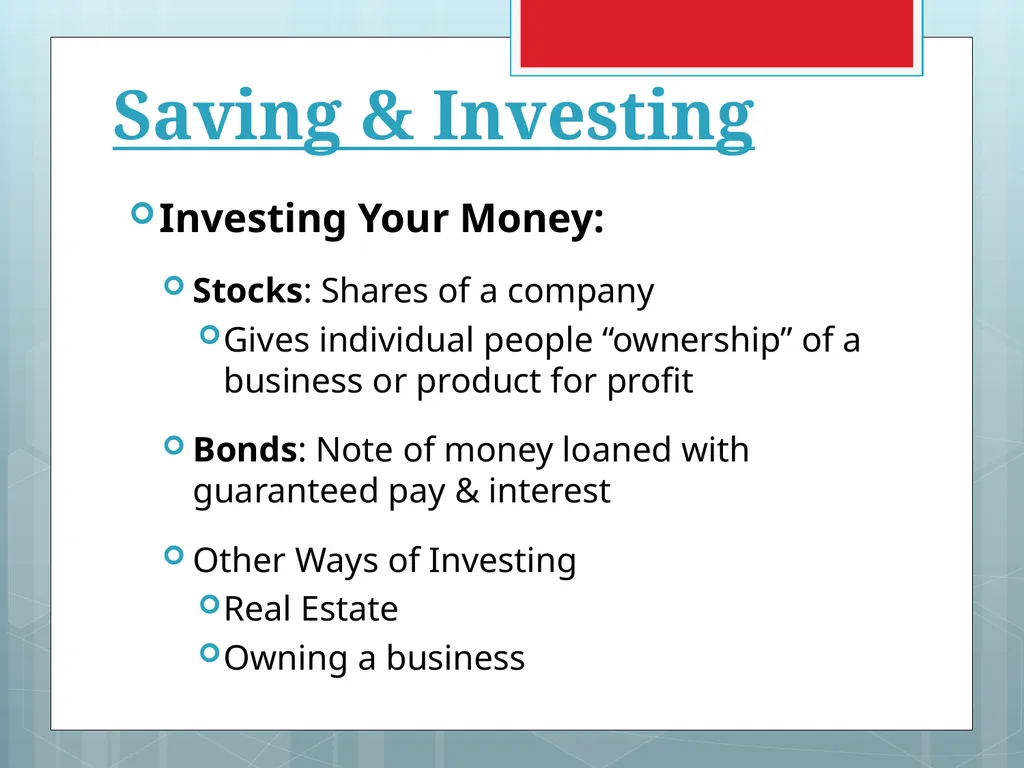
Saving & Investing Investing Your Money:
Stocks: Shares of a company
Gives individual people “ownership” of a business or product for profit
Bonds: Note of money loaned with guaranteed pay & interest
Other Ways of Investing
Real Estate
Owning a business<br>
Stocks: Shares of a company
Gives individual people “ownership” of a business or product for profit
Bonds: Note of money loaned with guaranteed pay & interest
Other Ways of Investing
Real Estate
Owning a business<br>
07
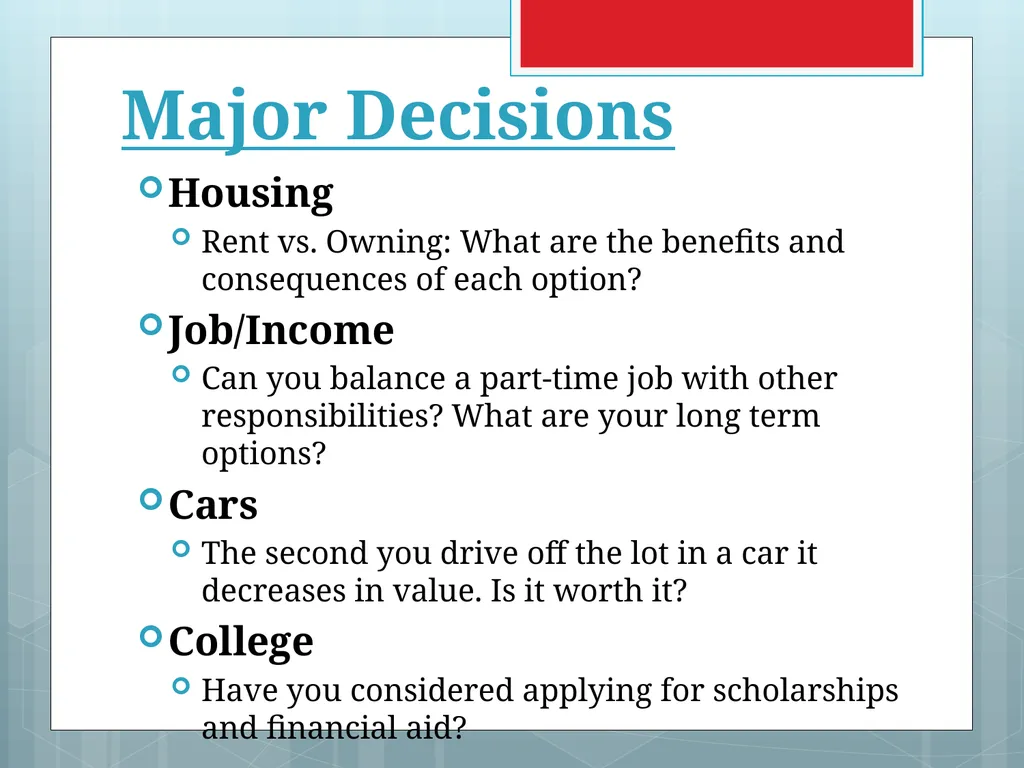
Major Decisions Housing
Rent vs. Owning: What are the benefits and consequences of each option?
Job/Income
Can you balance a part-time job with other responsibilities? What are your long term options?
Cars
The second you drive off the lot in a car it decreases in value. Is it worth it?
College
Have you considered applying for scholarships and financial aid?<br>
Rent vs. Owning: What are the benefits and consequences of each option?
Job/Income
Can you balance a part-time job with other responsibilities? What are your long term options?
Cars
The second you drive off the lot in a car it decreases in value. Is it worth it?
College
Have you considered applying for scholarships and financial aid?<br>
08
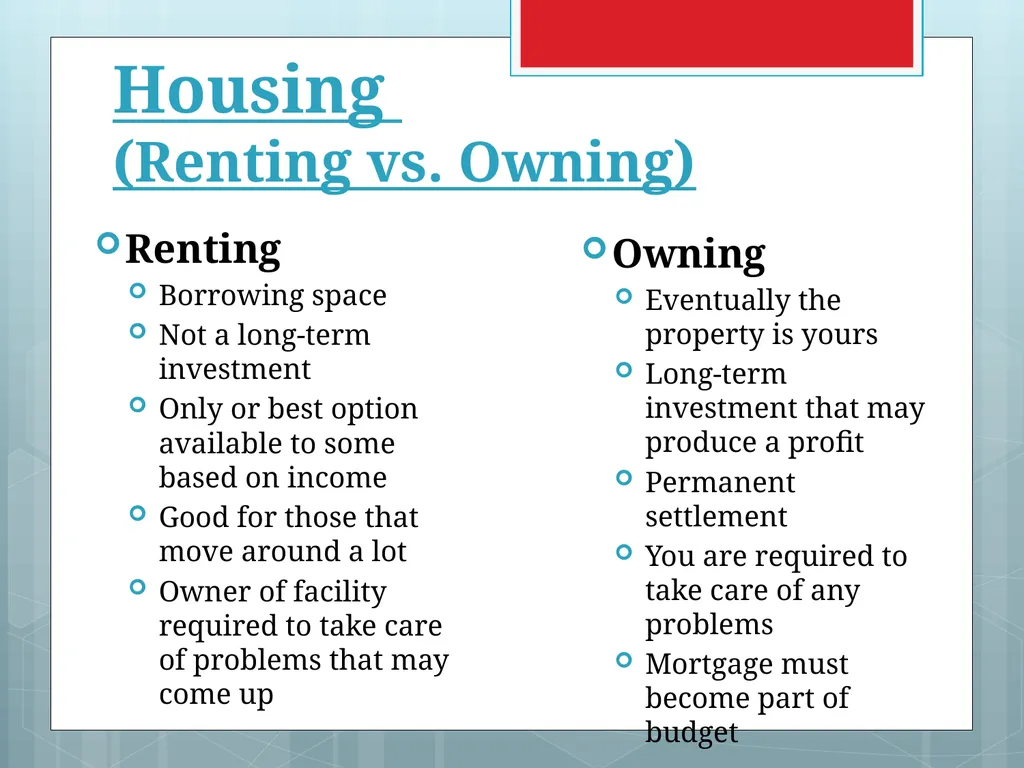
Housing
(Renting vs. Owning) Renting
Borrowing space
Not a long-term investment
Only or best option available to some based on income
Good for those that move around a lot
Owner of facility required to take care of problems that may come up Owning
Eventually the property is yours
Long-term investment that may produce a profit
Permanent settlement
You are required to take care of any problems
Mortgage must become part of budget<br>
Borrowing space
Not a long-term investment
Only or best option available to some based on income
Good for those that move around a lot
Owner of facility required to take care of problems that may come up Owning
Eventually the property is yours
Long-term investment that may produce a profit
Permanent settlement
You are required to take care of any problems
Mortgage must become part of budget<br>
09
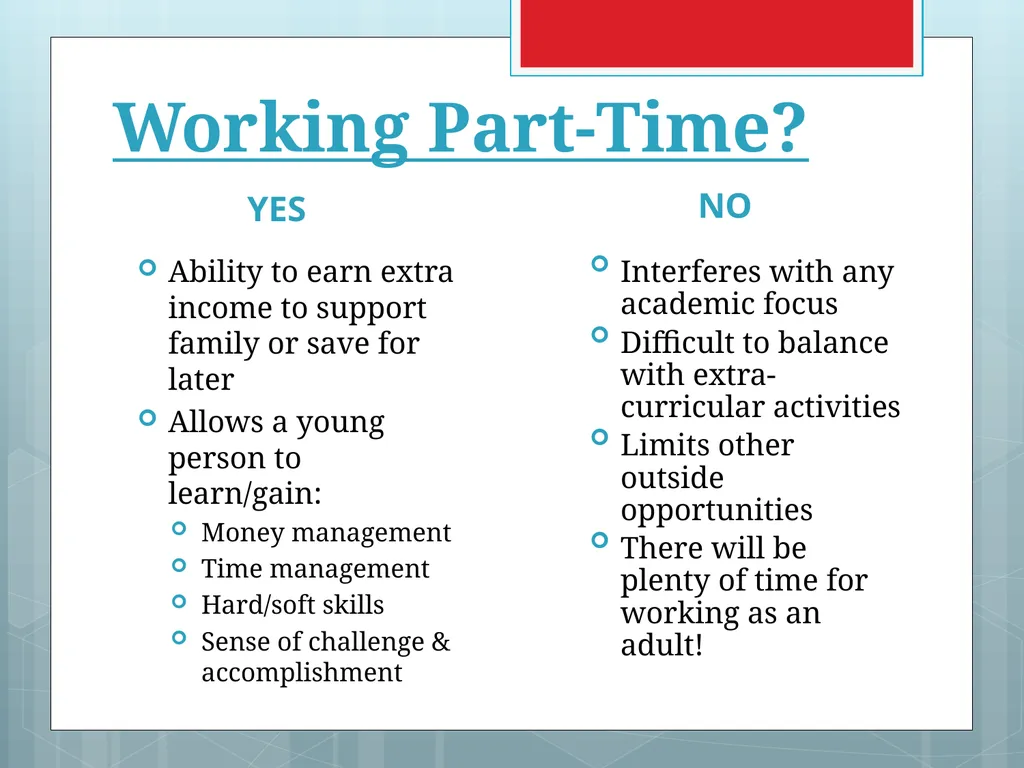
Working Part-Time? YES Ability to earn extra income to support family or save for later
Allows a young person to learn/gain:
Money management
Time management
Hard/soft skills
Sense of challenge & accomplishment NO Interferes with any academic focus
Difficult to balance with extra-curricular activities
Limits other outside opportunities
There will be plenty of time for working as an adult!<br>
Allows a young person to learn/gain:
Money management
Time management
Hard/soft skills
Sense of challenge & accomplishment NO Interferes with any academic focus
Difficult to balance with extra-curricular activities
Limits other outside opportunities
There will be plenty of time for working as an adult!<br>
10
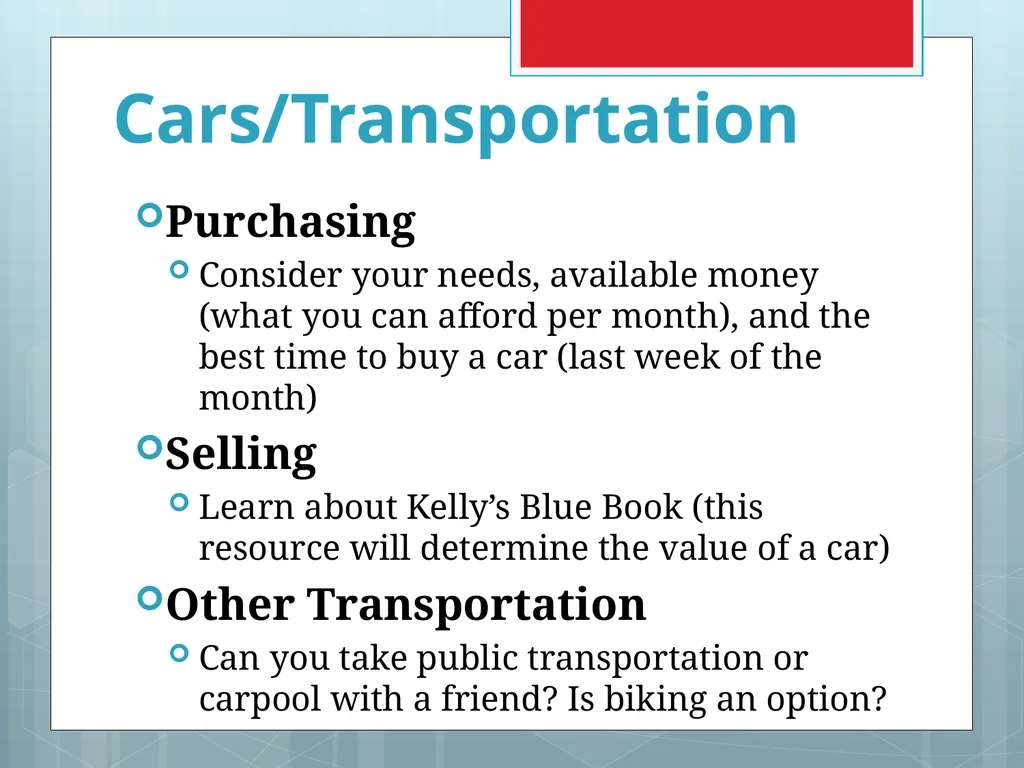
Cars/Transportation Purchasing
Consider your needs, available money (what you can afford per month), and the best time to buy a car (last week of the month)
Selling
Learn about Kelly’s Blue Book (this resource will determine the value of a car)
Other Transportation
Can you take public transportation or carpool with a friend? Is biking an option?<br>
Consider your needs, available money (what you can afford per month), and the best time to buy a car (last week of the month)
Selling
Learn about Kelly’s Blue Book (this resource will determine the value of a car)
Other Transportation
Can you take public transportation or carpool with a friend? Is biking an option?<br>
11
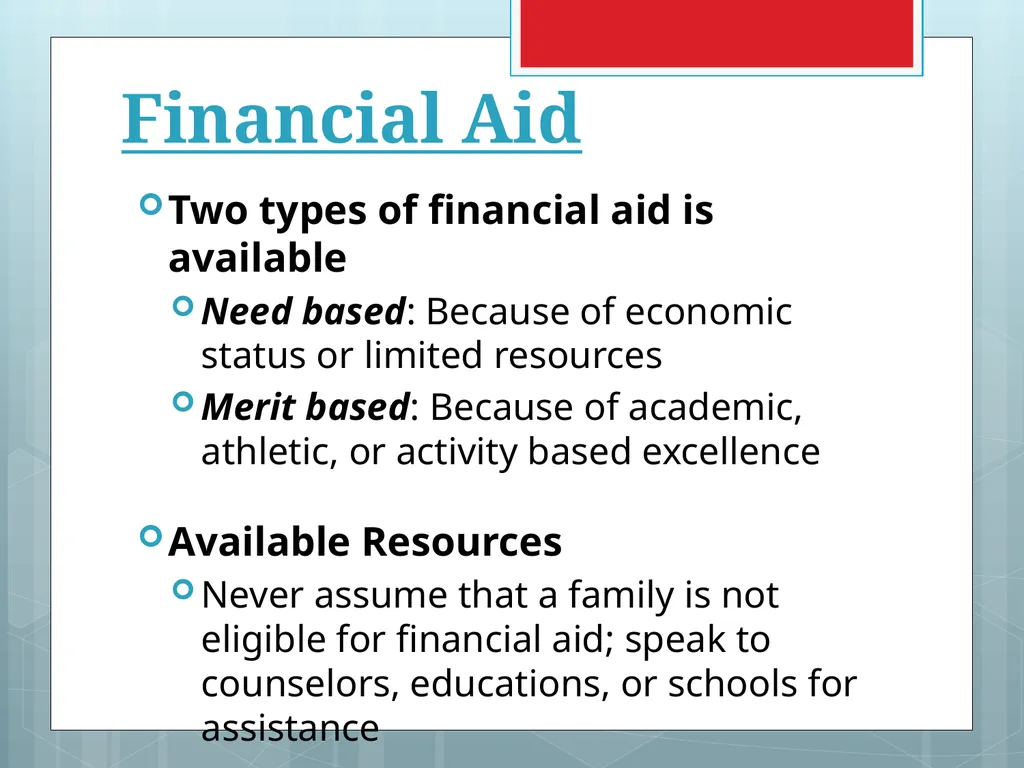
Financial Aid Two types of financial aid is available
Need based: Because of economic status or limited resources
Merit based: Because of academic, athletic, or activity based excellence
Available Resources
Never assume that a family is not eligible for financial aid; speak to counselors, educations, or schools for assistance<br>
Need based: Because of economic status or limited resources
Merit based: Because of academic, athletic, or activity based excellence
Available Resources
Never assume that a family is not eligible for financial aid; speak to counselors, educations, or schools for assistance<br>
12
Budgeting & Spending Spending: Needs vs. Wants
Needs are items required for survival while wants are items that we desire
Short term, middle term, and long term goals
Choices: What will you do?
Prioritize your financial goals
What resources will help you achieve your goals?
Support systems: Parents and/or school?
Three E’s: Enrolled, Employed, or Enlisted?
Career Possibilities…
What interests you?<br>
Needs are items required for survival while wants are items that we desire
Short term, middle term, and long term goals
Choices: What will you do?
Prioritize your financial goals
What resources will help you achieve your goals?
Support systems: Parents and/or school?
Three E’s: Enrolled, Employed, or Enlisted?
Career Possibilities…
What interests you?<br>
13
Budgeting & Spending Budget: Plan for spending, collecting, and managing money
Fixed expenses – stay the same in a given time period
Variable expenses – change over time
Borrowing money
Consider the ideas of Loans (amount of money borrowed) and Interest (the cost of borrowing money)
Build “good credit” by paying your bills on time, taking advantage of credit cards, and establish a good history of financial decision making<br>
Fixed expenses – stay the same in a given time period
Variable expenses – change over time
Borrowing money
Consider the ideas of Loans (amount of money borrowed) and Interest (the cost of borrowing money)
Build “good credit” by paying your bills on time, taking advantage of credit cards, and establish a good history of financial decision making<br>
14
Insurance & Taxes<br>
15
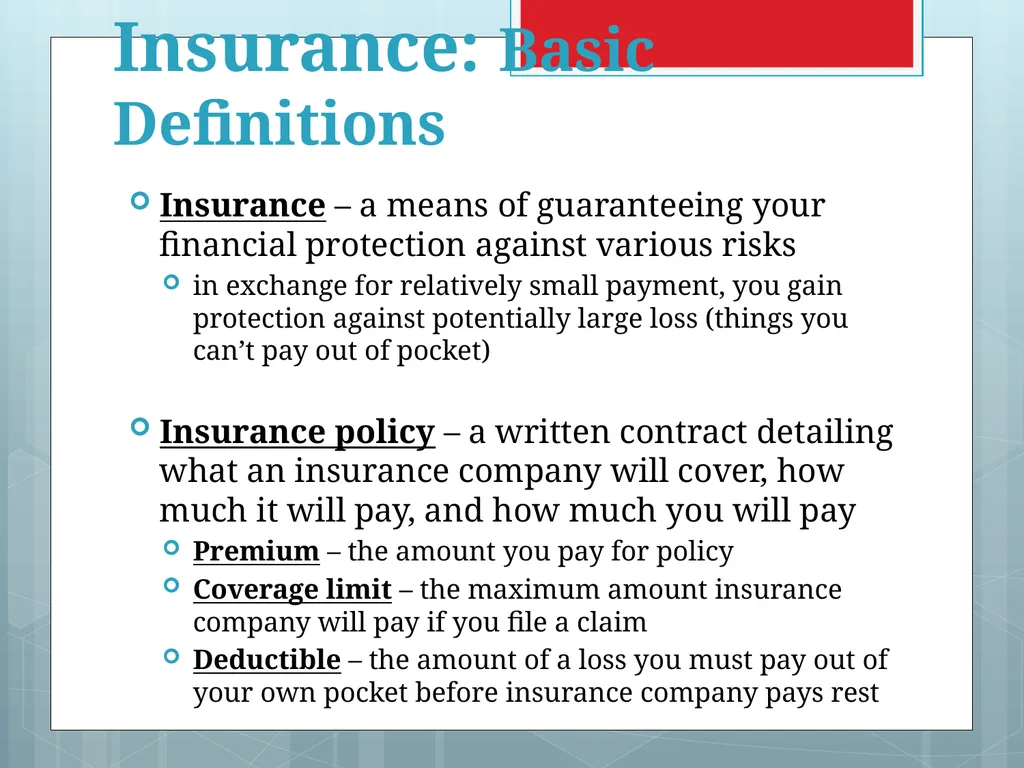
Insurance: Basic Definitions Insurance – a means of guaranteeing your financial protection against various risks
in exchange for relatively small payment, you gain protection against potentially large loss (things you can’t pay out of pocket)
Insurance policy – a written contract detailing what an insurance company will cover, how much it will pay, and how much you will pay
Premium – the amount you pay for policy
Coverage limit – the maximum amount insurance company will pay if you file a claim
Deductible – the amount of a loss you must pay out of your own pocket before insurance company pays rest<br>
in exchange for relatively small payment, you gain protection against potentially large loss (things you can’t pay out of pocket)
Insurance policy – a written contract detailing what an insurance company will cover, how much it will pay, and how much you will pay
Premium – the amount you pay for policy
Coverage limit – the maximum amount insurance company will pay if you file a claim
Deductible – the amount of a loss you must pay out of your own pocket before insurance company pays rest<br>
16
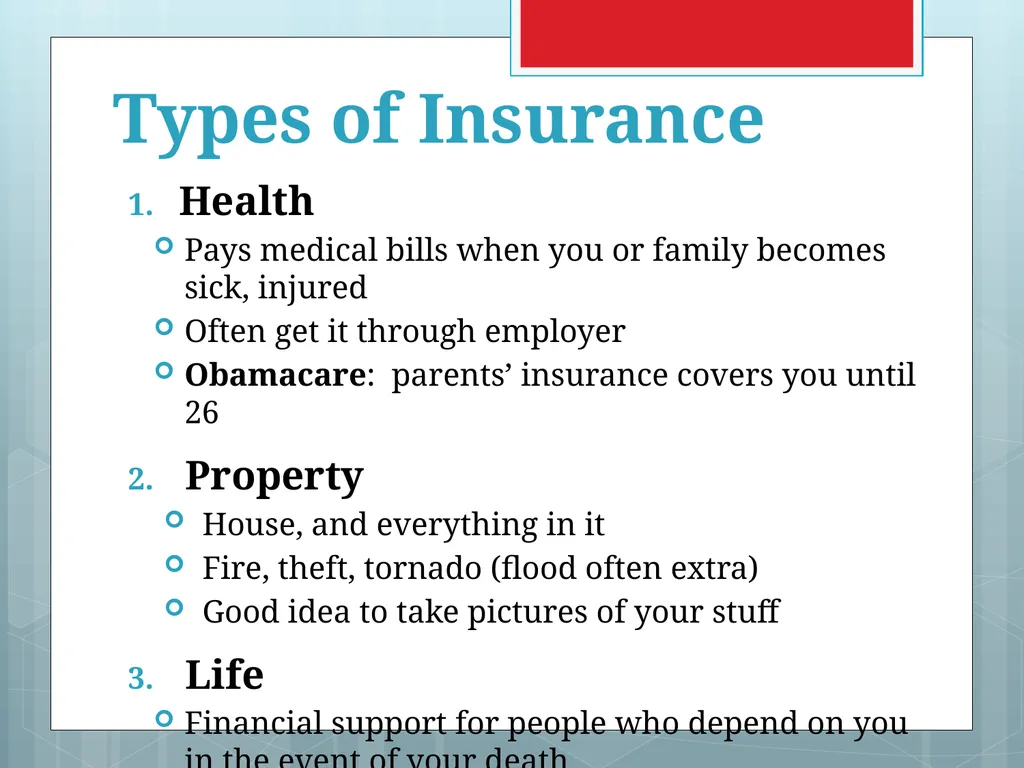
Types of Insurance Health
Pays medical bills when you or family becomes sick, injured
Often get it through employer
Obamacare: parents’ insurance covers you until 26
Property
House, and everything in it
Fire, theft, tornado (flood often extra)
Good idea to take pictures of your stuff
Life
Financial support for people who depend on you in the event of your death<br>
Pays medical bills when you or family becomes sick, injured
Often get it through employer
Obamacare: parents’ insurance covers you until 26
Property
House, and everything in it
Fire, theft, tornado (flood often extra)
Good idea to take pictures of your stuff
Life
Financial support for people who depend on you in the event of your death<br>
17
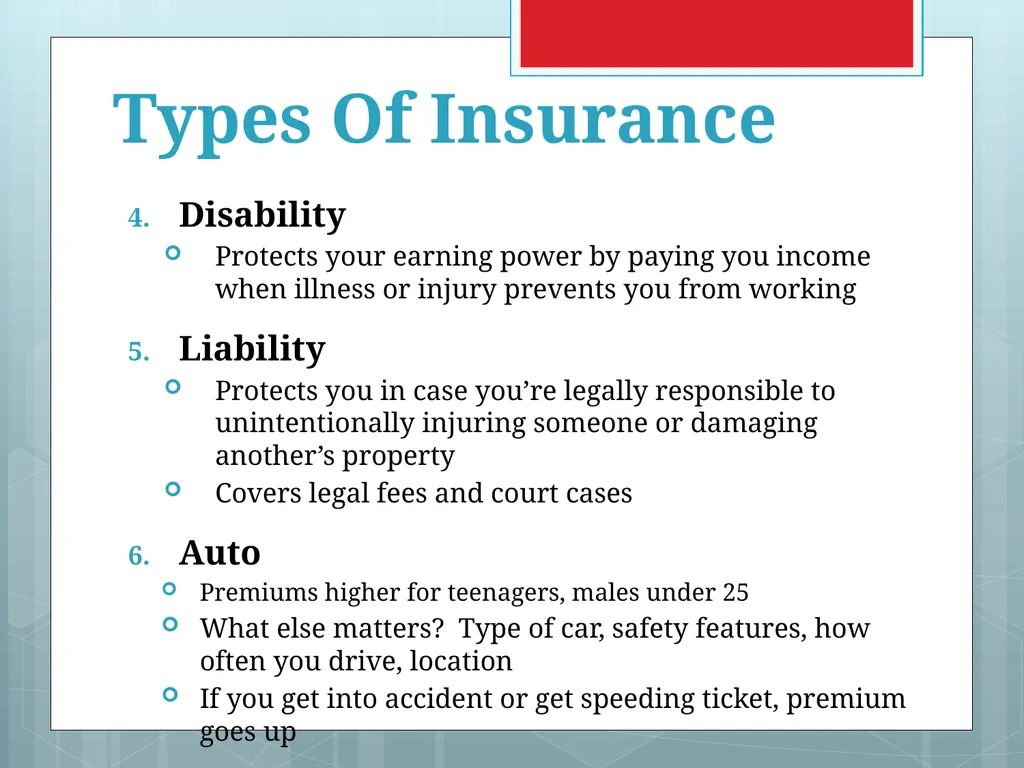
Types Of Insurance Disability
Protects your earning power by paying you income when illness or injury prevents you from working
Liability
Protects you in case you’re legally responsible to unintentionally injuring someone or damaging another’s property
Covers legal fees and court cases
Auto
Premiums higher for teenagers, males under 25
What else matters? Type of car, safety features, how often you drive, location
If you get into accident or get speeding ticket, premium goes up<br>
Protects your earning power by paying you income when illness or injury prevents you from working
Liability
Protects you in case you’re legally responsible to unintentionally injuring someone or damaging another’s property
Covers legal fees and court cases
Auto
Premiums higher for teenagers, males under 25
What else matters? Type of car, safety features, how often you drive, location
If you get into accident or get speeding ticket, premium goes up<br>
18
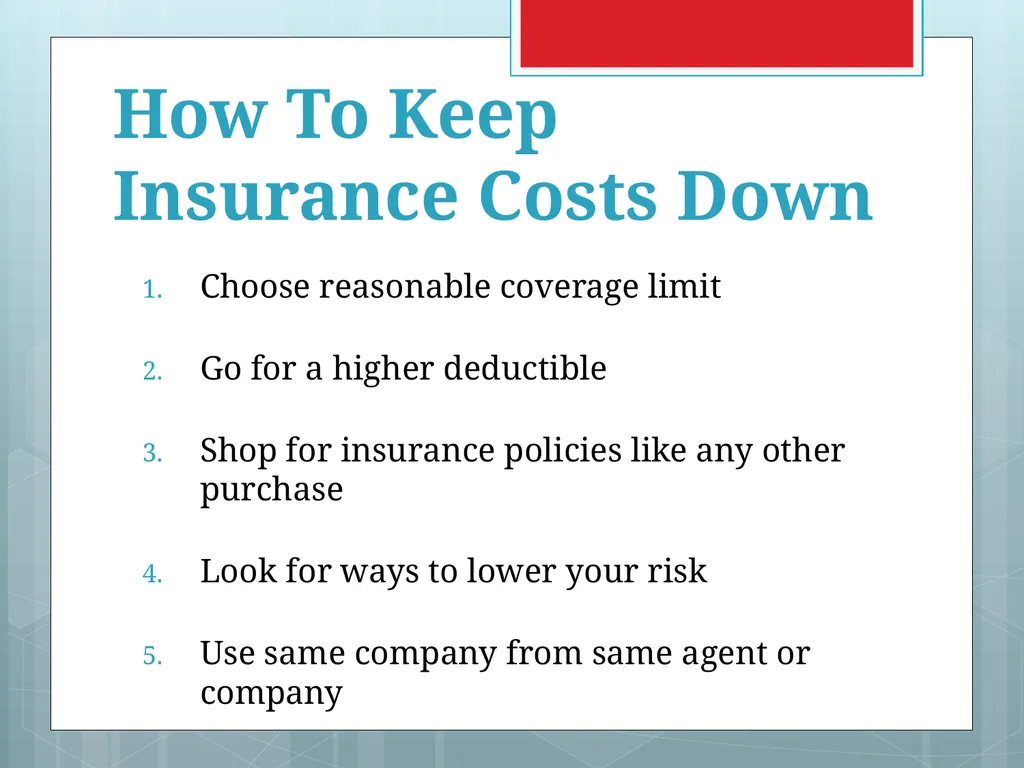
How To Keep Insurance Costs Down Choose reasonable coverage limit
Go for a higher deductible
Shop for insurance policies like any other purchase
Look for ways to lower your risk
Use same company from same agent or company<br>
Go for a higher deductible
Shop for insurance policies like any other purchase
Look for ways to lower your risk
Use same company from same agent or company<br>
19
Where To Keep What Keep in your files:
Current insurance policies
Premium statements
Medical bills
Inventory of personal assets
Documentation of any claims you’ve filed
Keep In Wallet:
Auto insurance ID card
Health insurance card<br>
Current insurance policies
Premium statements
Medical bills
Inventory of personal assets
Documentation of any claims you’ve filed
Keep In Wallet:
Auto insurance ID card
Health insurance card<br>
20
Taxes Four Common Deductions On A Pay Stub
Federal Income Tax
Employers withhold this tax from employees as payroll deductions and then send tax to IRS
A person who owns their own business pays a self-employment tax
State Income Tax
Also collected by employer; sent to N.C. Dept. of Revenue
Social Security Tax
Provides small income and other services to the elderly, disabled, and orphans<br>
Federal Income Tax
Employers withhold this tax from employees as payroll deductions and then send tax to IRS
A person who owns their own business pays a self-employment tax
State Income Tax
Also collected by employer; sent to N.C. Dept. of Revenue
Social Security Tax
Provides small income and other services to the elderly, disabled, and orphans<br>
21
Taxes Medicare
Provides medical insurance to elderly and some disabled
To gather funds for S.S. and Medicare, employee earnings are taxed (FICA taxes)
Deducted from employee’s wages each pay period
Employers send deductions to the S.S. Administration along with a matching amount paid by employer<br>
Provides medical insurance to elderly and some disabled
To gather funds for S.S. and Medicare, employee earnings are taxed (FICA taxes)
Deducted from employee’s wages each pay period
Employers send deductions to the S.S. Administration along with a matching amount paid by employer<br>
22
Other Tax Terms Gross vs. Net Income
Gross – total amount of income from your wages or before any payroll deductions
Net – income after employer has deducted taxes from your gross income (your “take-home pay”)
This is what you’ll be able to deposit and use for your budget
W-4
You can’t avoid paying taxes, but you can have some control over how much you have withheld from your check
You fill it out when you start your job
Can choose to pay more taxes throughout the year, or wait and pay more at tax time<br>
Gross – total amount of income from your wages or before any payroll deductions
Net – income after employer has deducted taxes from your gross income (your “take-home pay”)
This is what you’ll be able to deposit and use for your budget
W-4
You can’t avoid paying taxes, but you can have some control over how much you have withheld from your check
You fill it out when you start your job
Can choose to pay more taxes throughout the year, or wait and pay more at tax time<br>
23
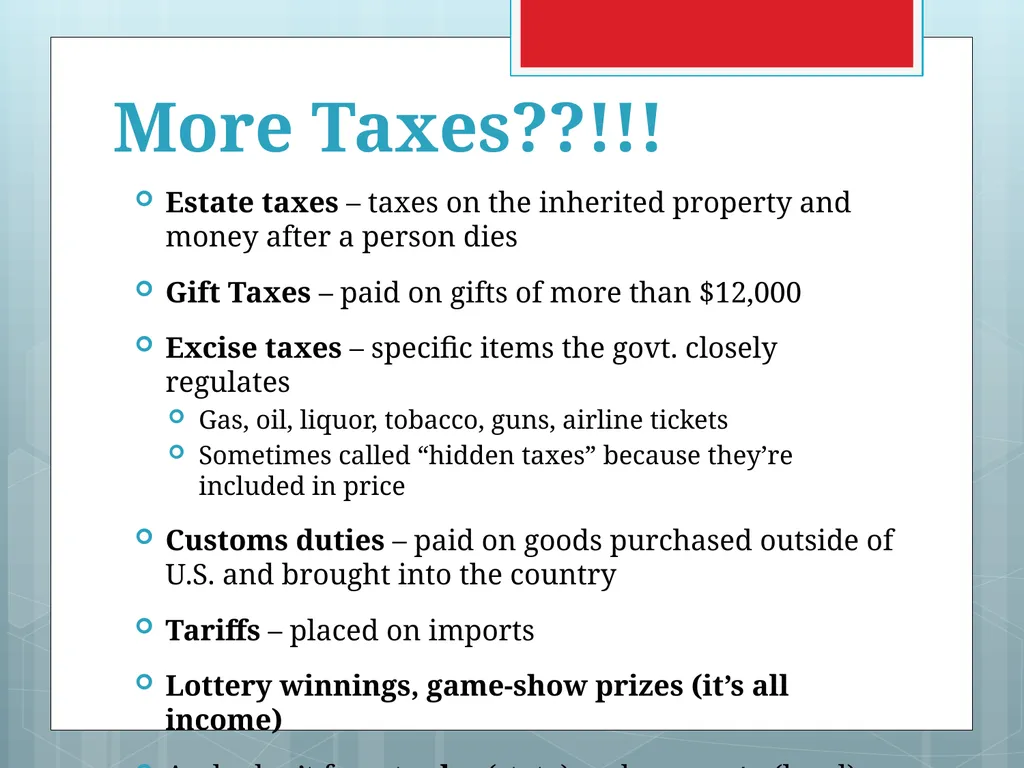
More Taxes??!!! Estate taxes – taxes on the inherited property and money after a person dies
Gift Taxes – paid on gifts of more than $12,000
Excise taxes – specific items the govt. closely regulates
Gas, oil, liquor, tobacco, guns, airline tickets
Sometimes called “hidden taxes” because they’re included in price
Customs duties – paid on goods purchased outside of U.S. and brought into the country
Tariffs – placed on imports
Lottery winnings, game-show prizes (it’s all income)
And…don’t forget sales (state) and property (local)<br>
Gift Taxes – paid on gifts of more than $12,000
Excise taxes – specific items the govt. closely regulates
Gas, oil, liquor, tobacco, guns, airline tickets
Sometimes called “hidden taxes” because they’re included in price
Customs duties – paid on goods purchased outside of U.S. and brought into the country
Tariffs – placed on imports
Lottery winnings, game-show prizes (it’s all income)
And…don’t forget sales (state) and property (local)<br>
24
Credit<br>
25
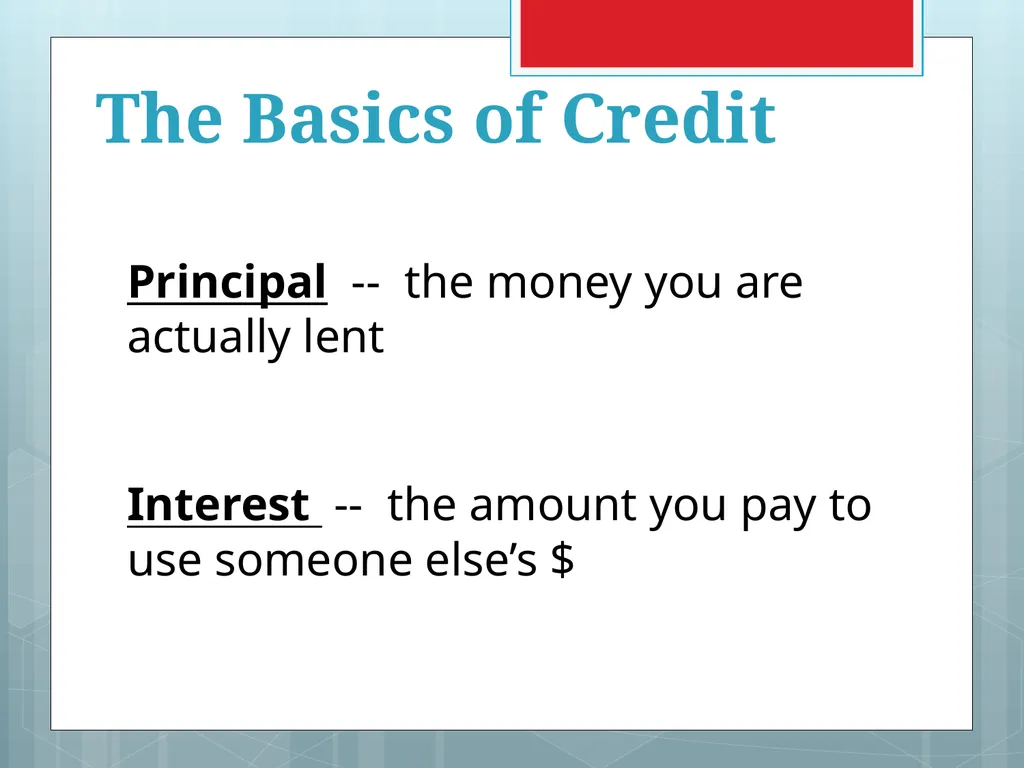
The Basics of Credit Principal -- the money you are actually lent
Interest -- the amount you pay to use someone else’s $<br>
Interest -- the amount you pay to use someone else’s $<br>
26
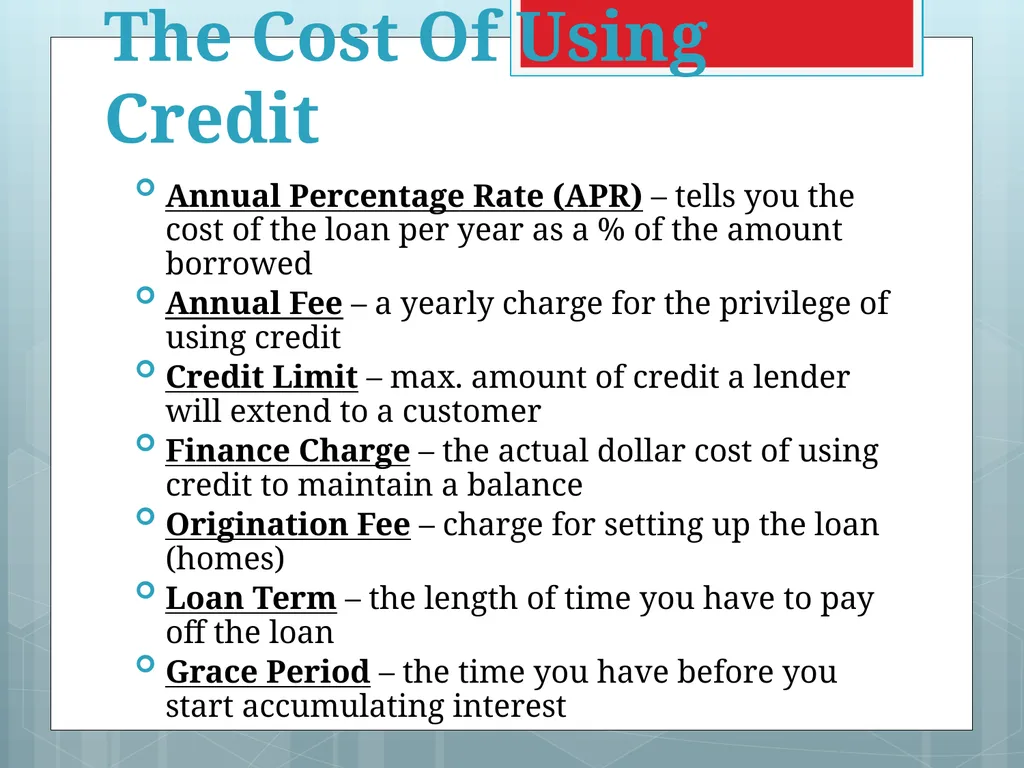
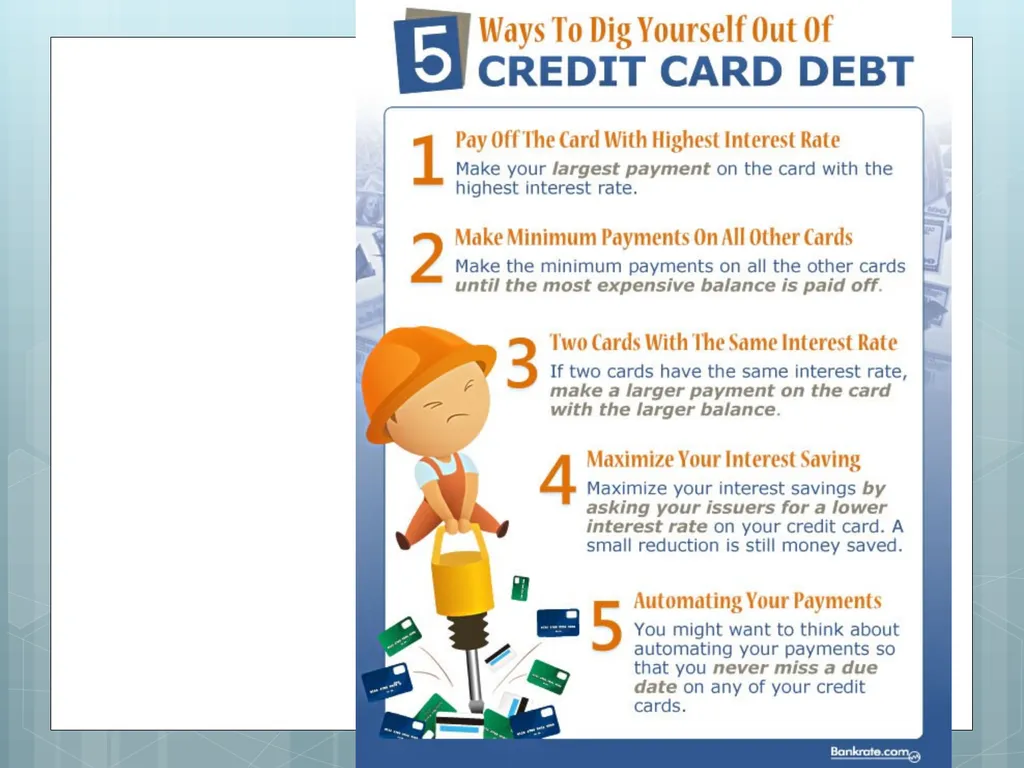
The Cost Of Using Credit Annual Percentage Rate (APR) – tells you the cost of the loan per year as a % of the amount borrowed
Annual Fee – a yearly charge for the privilege of using credit
Credit Limit – max. amount of credit a lender will extend to a customer
Finance Charge – the actual dollar cost of using credit to maintain a balance
Origination Fee – charge for setting up the loan (homes)
Loan Term – the length of time you have to pay off the loan
Grace Period – the time you have before you start accumulating interest<br>
Annual Fee – a yearly charge for the privilege of using credit
Credit Limit – max. amount of credit a lender will extend to a customer
Finance Charge – the actual dollar cost of using credit to maintain a balance
Origination Fee – charge for setting up the loan (homes)
Loan Term – the length of time you have to pay off the loan
Grace Period – the time you have before you start accumulating interest<br>
27
The Cost of Using Credit Late Fee – penalty for making a payment after the due date
Default – failing to pay back what you owe<br>
Default – failing to pay back what you owe<br>
28
The Rewards of Credit Convenience
Buy something you couldn’t otherwise afford to pay for all at once (house, car, tuition)
Easier and safer than carrying cash
Buy items on Internet
Protection
Easier to get a refund than with cash
Emergencies
Opportunity to build credit
using credit responsibly builds your credit history, makes it easier to get more credit when you need it later<br>
Buy something you couldn’t otherwise afford to pay for all at once (house, car, tuition)
Easier and safer than carrying cash
Buy items on Internet
Protection
Easier to get a refund than with cash
Emergencies
Opportunity to build credit
using credit responsibly builds your credit history, makes it easier to get more credit when you need it later<br>
29
The Rewards of Credit Quicker Gratification
Don’t have to wait until you’ve saved up $ for major purchase
Special Offers
Deals that allow you to buy an item now, but not have to make payments for a year
Bonuses
Frequent flyer miles; build up points, get a flight for free
“Earn cash back”<br>
Don’t have to wait until you’ve saved up $ for major purchase
Special Offers
Deals that allow you to buy an item now, but not have to make payments for a year
Bonuses
Frequent flyer miles; build up points, get a flight for free
“Earn cash back”<br>
30
Risks of Credit Interest
Automatically makes item more expensive than cash purchase
Overspending
People often use credit to live beyond their means
Buy items they can’t afford, build up debt
Gets harder and harder to pay the balance<br>
Automatically makes item more expensive than cash purchase
Overspending
People often use credit to live beyond their means
Buy items they can’t afford, build up debt
Gets harder and harder to pay the balance<br>
31
Risks of Credit Debt
If unable to pay your debt, lenders (creditors) can take you to court and foreclose your property.
Identity Theft
When someone uses your personal info w/out your permission to commit fraud or other crimes.
Giving out credit card # puts you at risk for someone stealing info to run up debts in your name.<br>
If unable to pay your debt, lenders (creditors) can take you to court and foreclose your property.
Identity Theft
When someone uses your personal info w/out your permission to commit fraud or other crimes.
Giving out credit card # puts you at risk for someone stealing info to run up debts in your name.<br>
32
Keeping Up With Credit Credit Report – a record of your personal financial transactions (credit history)
Lenders look at these to see how well you’ve managed your $
Use them to decide if they should lend you $
Credit Score – the number that reflects your creditworthiness
When you apply for credit, lenders want to know their risk
Score changes over time as your financial situation changes (new job, promotion or raise, taking on big expenses)<br>
Lenders look at these to see how well you’ve managed your $
Use them to decide if they should lend you $
Credit Score – the number that reflects your creditworthiness
When you apply for credit, lenders want to know their risk
Score changes over time as your financial situation changes (new job, promotion or raise, taking on big expenses)<br>
33
Keeping Up With Credit Hurting your credit history and credit score:
Making late payments (always pay balance on time)
Bouncing checks
Having a lot of credit cards and loans
Maintaining a high balance
Lenders don’t like to see you spend $ up to your credit limit
Changing cards frequently
Lenders like to see long-term relationship between you and credit-card companies<br>
Making late payments (always pay balance on time)
Bouncing checks
Having a lot of credit cards and loans
Maintaining a high balance
Lenders don’t like to see you spend $ up to your credit limit
Changing cards frequently
Lenders like to see long-term relationship between you and credit-card companies<br>
34
Keeping Up With Credit Why does your credit score matter?
Bad credit score could cause you to not get approved to borrow $
Could even prevent you from getting a job or getting married
People like to see you’re financially reliable<br>
Bad credit score could cause you to not get approved to borrow $
Could even prevent you from getting a job or getting married
People like to see you’re financially reliable<br>
35
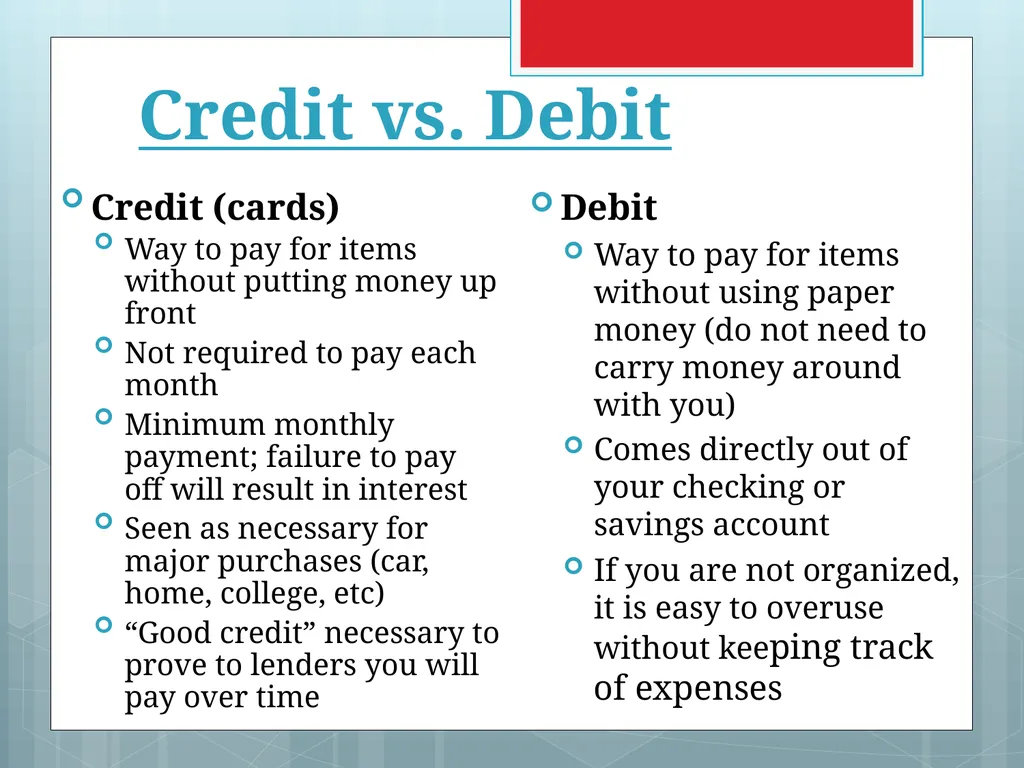
Credit vs. Debit Credit (cards)
Way to pay for items without putting money up front
Not required to pay each month
Minimum monthly payment; failure to pay off will result in interest
Seen as necessary for major purchases (car, home, college, etc)
“Good credit” necessary to prove to lenders you will pay over time Debit
Way to pay for items without using paper money (do not need to carry money around with you)
Comes directly out of your checking or savings account
If you are not organized, it is easy to overuse without keeping track of expenses<br>
Way to pay for items without putting money up front
Not required to pay each month
Minimum monthly payment; failure to pay off will result in interest
Seen as necessary for major purchases (car, home, college, etc)
“Good credit” necessary to prove to lenders you will pay over time Debit
Way to pay for items without using paper money (do not need to carry money around with you)
Comes directly out of your checking or savings account
If you are not organized, it is easy to overuse without keeping track of expenses<br>
36
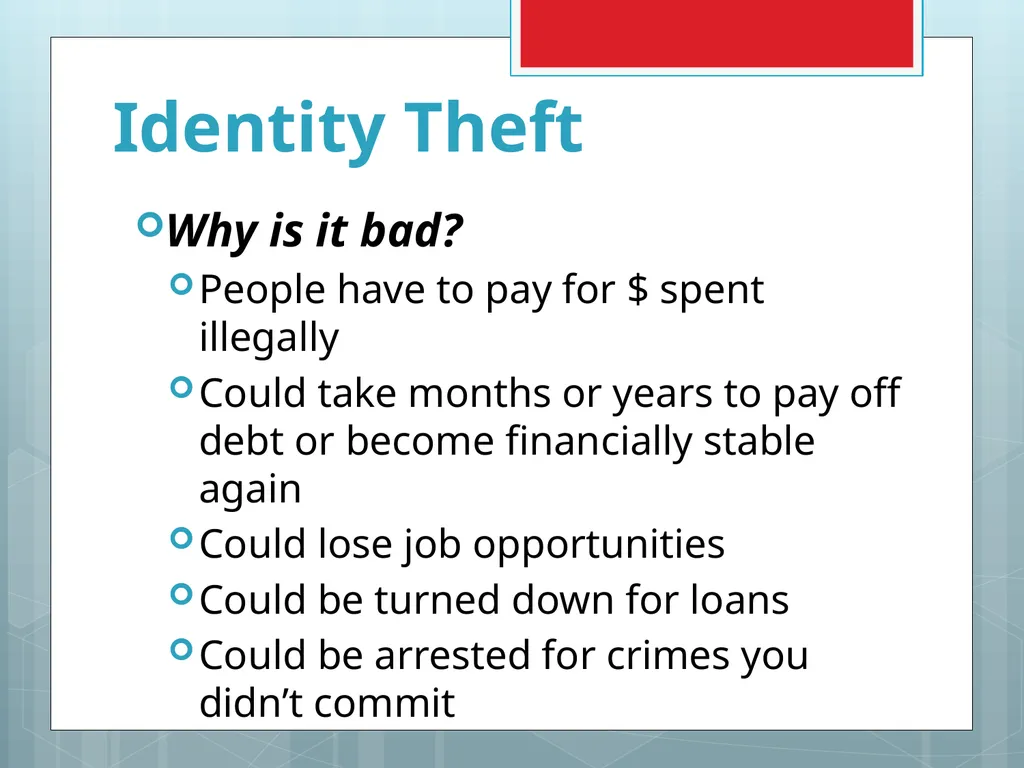
Identity Theft Why is it bad?
People have to pay for $ spent illegally
Could take months or years to pay off debt or become financially stable again
Could lose job opportunities
Could be turned down for loans
Could be arrested for crimes you didn’t commit<br>
People have to pay for $ spent illegally
Could take months or years to pay off debt or become financially stable again
Could lose job opportunities
Could be turned down for loans
Could be arrested for crimes you didn’t commit<br>
37
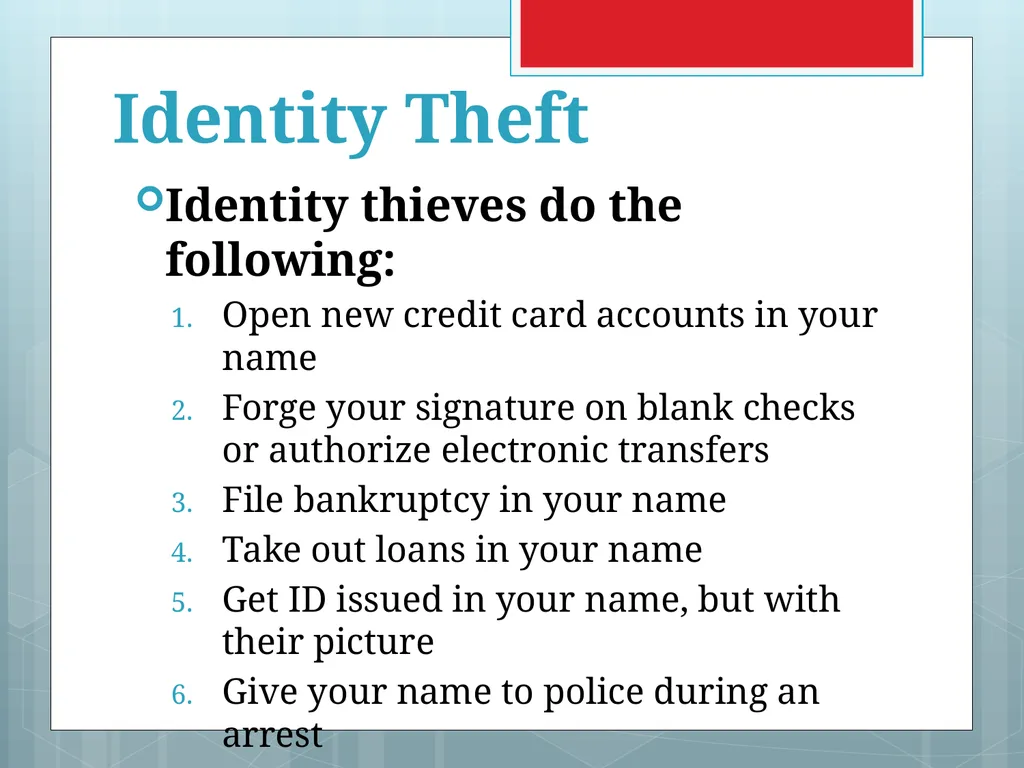
Identity Theft Identity thieves do the following:
Open new credit card accounts in your name
Forge your signature on blank checks or authorize electronic transfers
File bankruptcy in your name
Take out loans in your name
Get ID issued in your name, but with their picture
Give your name to police during an arrest
Change billing address on your credit card account<br>
Open new credit card accounts in your name
Forge your signature on blank checks or authorize electronic transfers
File bankruptcy in your name
Take out loans in your name
Get ID issued in your name, but with their picture
Give your name to police during an arrest
Change billing address on your credit card account<br>
38
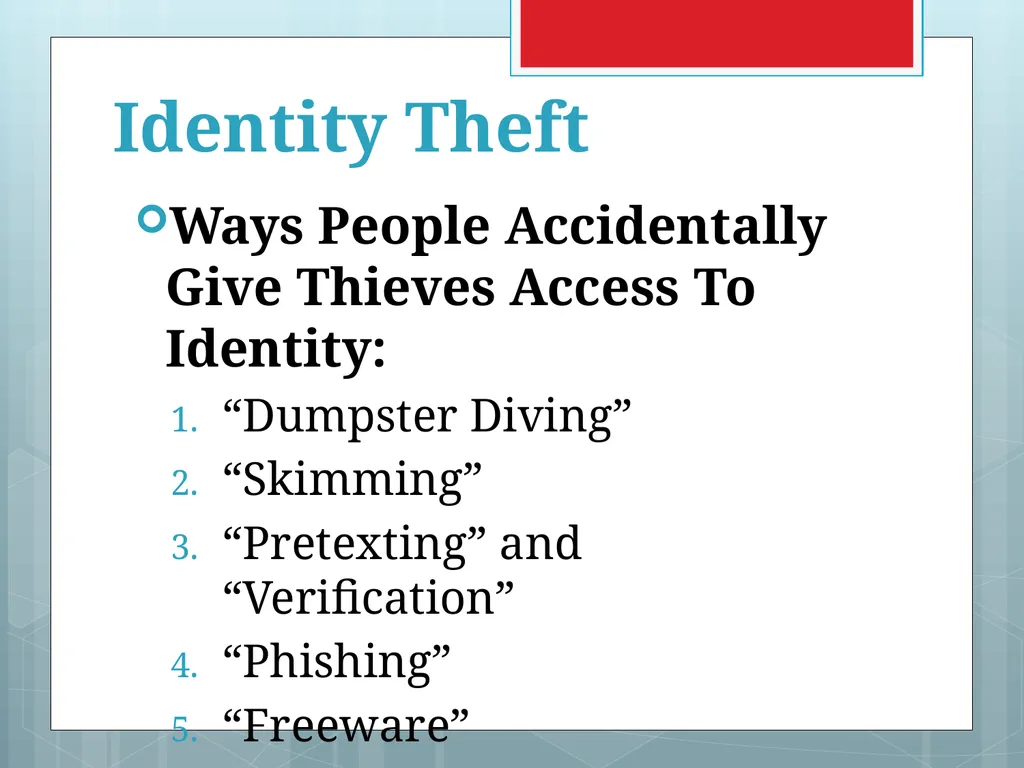
Identity Theft Ways People Accidentally Give Thieves Access To Identity:
“Dumpster Diving”
“Skimming”
“Pretexting” and “Verification”
“Phishing”
“Freeware”
“Spyware”<br>
“Dumpster Diving”
“Skimming”
“Pretexting” and “Verification”
“Phishing”
“Freeware”
“Spyware”<br>
39
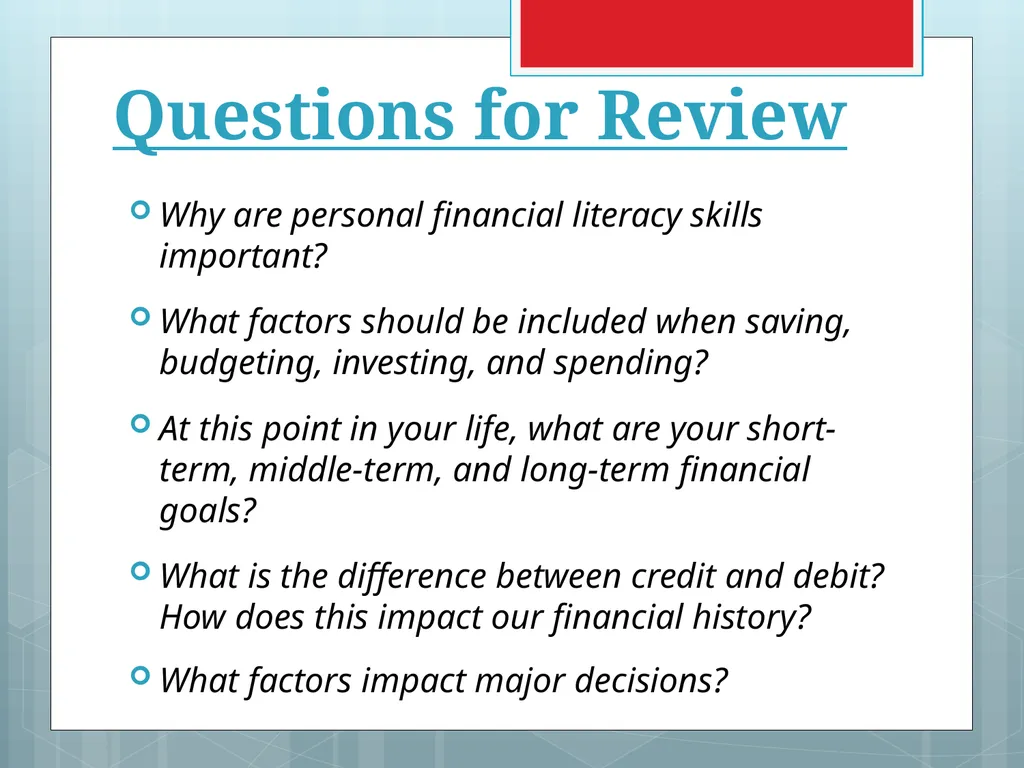
Questions for Review Why are personal financial literacy skills important?
What factors should be included when saving, budgeting, investing, and spending?
At this point in your life, what are your short-term, middle-term, and long-term financial goals?
What is the difference between credit and debit? How does this impact our financial history?
What factors impact major decisions?<br>
What factors should be included when saving, budgeting, investing, and spending?
At this point in your life, what are your short-term, middle-term, and long-term financial goals?
What is the difference between credit and debit? How does this impact our financial history?
What factors impact major decisions?<br>