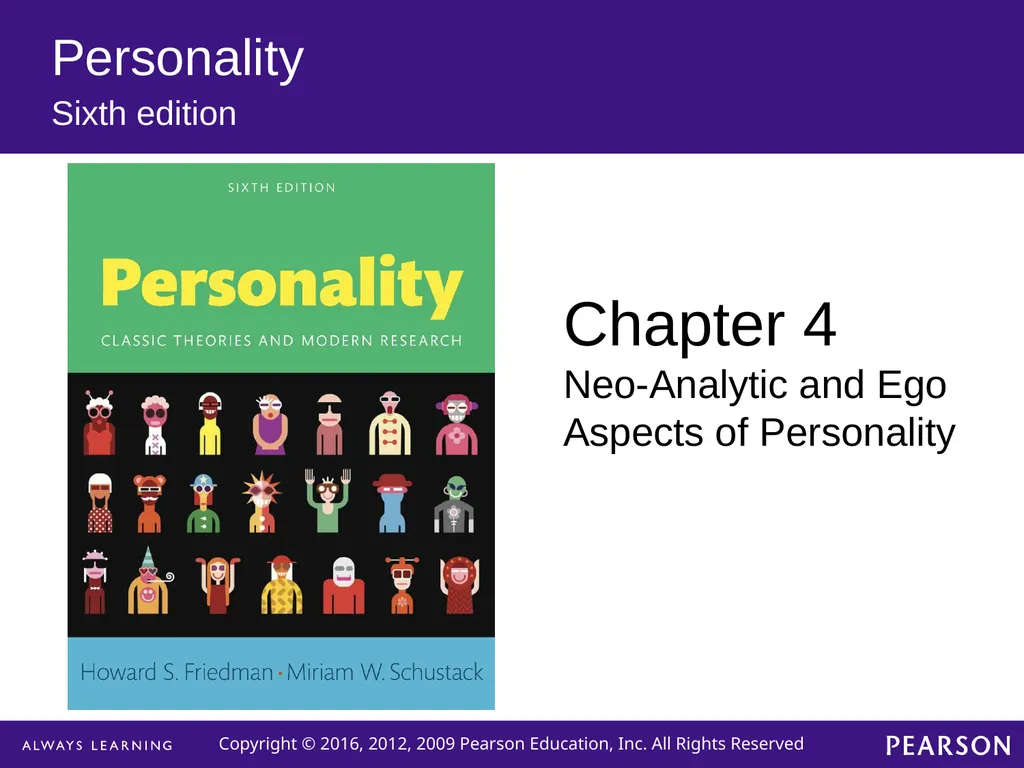
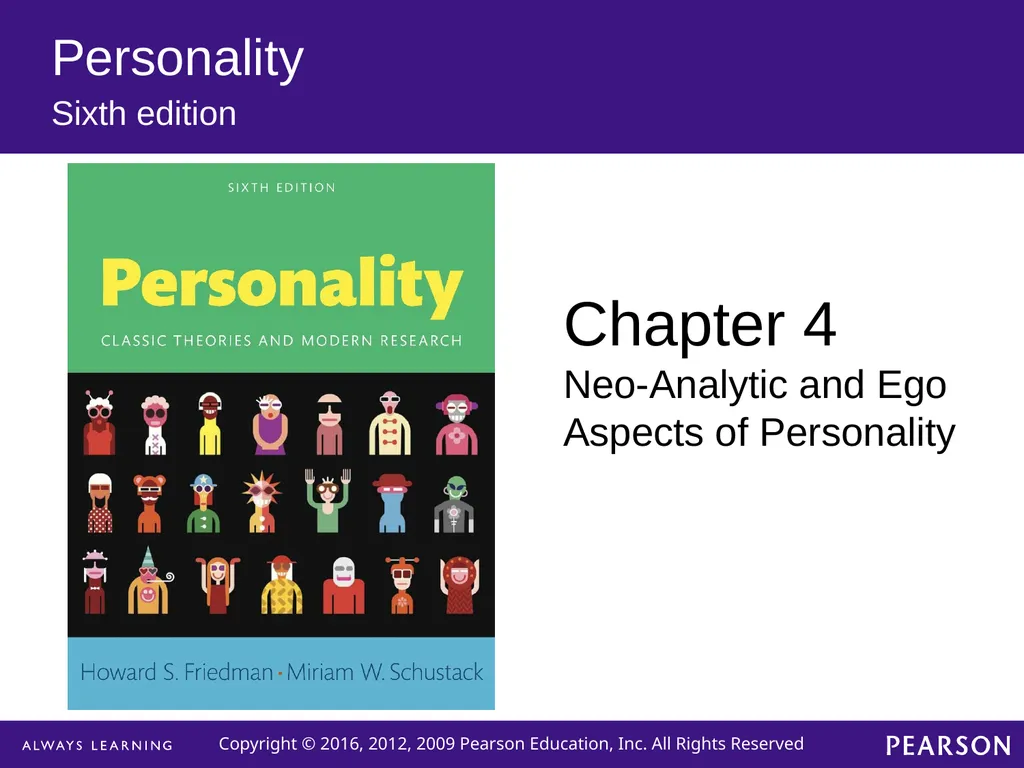
Personality Sixth edition Chapter 4 Neo-Analytic and Ego Aspects of Personality Modules (1 of 2) Introduction: Neo-Analytic and Ego Aspects of Personality 4.1: Carl G. Jung and Selfhood 4.2: Alfred Adler 4.3: Karen Horney 4.4: Anna Freud
"Personality Sixth edition Chapter 4 Neo-Analytic" is the property of its rightful owner. Permission is granted to
download and print the materials on this website for personal, non-commercial use only, and to display it
on your personal computer provided you do not modify the materials and that you retain all copyright
notices contained in the materials. By downloading content from our website, you accept the terms of this
agreement.
Presentation Transcript
01
Personality Sixth edition Chapter 4 Neo-Analytic and Ego Aspects of Personality<br>
02
Modules (1 of 2) Introduction: Neo-Analytic and Ego Aspects of Personality
4.1: Carl G. Jung and Selfhood
4.2: Alfred Adler
4.3: Karen Horney
4.4: Anna Freud and Heinz Hartmann
4.5: Object Relations Theories
4.6: Erik Erikson<br>
03
Modules (2 of 2) 4.7: Modern Approaches to Identity
Conclusion: Neo-Analytic and Ego Aspects of Personality: Identity<br>
04
Learning Objectives (1 of 2) 4.1: Probe the development of the Carl Jung school of psychology as distinct from that of Freud
4.2: Recognize the three fundamental social issues that need to be addressed as suggested by Alfred Adler
4.3: Describe Karen Horney's theories on culture and feminism
4.4: Report the work done by Anna Freud and Heinz Hartmann on psychoanalysis<br>
05
Learning Objectives (2 of 2) 4.5: Analyze the object relations theories as propagated by different theorists
4.6: Examine how identity formation is a lifelong process as propagated by Erik Erikson
4.7: Express the modern approaches to identity<br>
06
Introduction: Neo-Analytic and Ego Aspects of Personality Cliques and puppy love
Complexes
Neo-analytic<br>
07
Objective: Probe the development of the Carl Jung school of psychology as distinct from that of Freud Examples
Explanation 4.1: Carl G. Jung and Selfhood<br>
08
4.1.1: Background to Jung’s Approach Childhood beliefs
Beginnings of his theory<br>
09
4.1.2: Jung’s Analytic Psychology The conscious ego
The personal unconscious
The collective unconscious
Complex
Functions and attitudes<br>
10
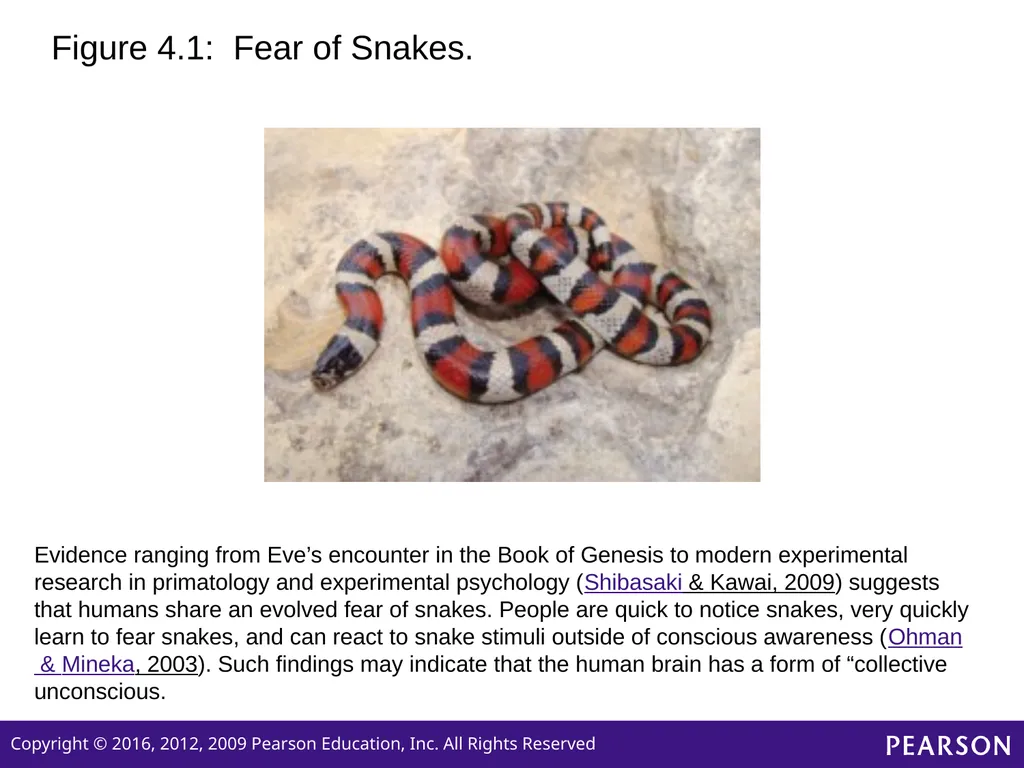
Figure 4.1: Fear of Snakes. Evidence ranging from Eve’s encounter in the Book of Genesis to modern experimental research in primatology and experimental psychology (Shibasaki & Kawai, 2009) suggests that humans share an evolved fear of snakes. People are quick to notice snakes, very quickly learn to fear snakes, and can react to snake stimuli outside of conscious awareness (Ohman & Mineka, 2003). Such findings may indicate that the human brain has a form of “collective unconscious.<br>
11
Objective: Recognize the three fundamental social issues that need to be addressed as suggested by Alfred Adler Early life
Theoretical constructs 4.2: Alfred Adler<br>
12
4.2.1: Adler’s Differences with Freudian Theory Overview
Point of contention<br>
13
4.2.2: Adler’s Individual Psychology Striving for superiority
Concepts
The role of birth order
Personality typology<br>
14
Objective: Describe Karen Horney's theories on culture and feminism Life history
Similarities with Adler 4.3: Karen Horney<br>
15
4.3.1: Rejection of Penis Envy Horney’s reasons
What women really wanted<br>
16
4.3.2: Basic Anxiety Reasons
Different styles<br>
17
4.3.3: The Self Real self
Despised self
Ideal self<br>
18
4.3.4: Neurotic Coping Strategies Moving toward
Moving against
Moving away<br>
19
4.3.5: Horney’s Impact on Psychoanalytic Thinking Transcending emphases
Horney’s beliefs<br>
20
Objective: Report the work done by Anna Freud and Heinz Hartmann on psychoanalysis Anna Freud’s works
Heinz Hartmann’s works 4.4: Anna Freud and Heinz Hartmann<br>
21
Objective: Analyze the object relations theories as propagated by different theorists Overview
Overlap in theories 4.5: Object Relations Theories<br>
22
4.5.1: Margaret Mahler and Symbiosis Symbiotic psychotic children
Normal symbiotic children<br>
23
4.5.2: Melanie Klein, Heinz Kohut, and the Relational Perspective Klein’s contributions
Kohut’s works
Relational perspective<br>
24
4.5.3: The Contributions of Object Relations Approaches Overview
Neo-analytic ideas<br>
25
Objective: Examine how identity formation is a lifelong process as propagated by Erik Erikson People who expanded psychoanalytic theorizing
Erikson’s contributions 4.6: Erik Erikson<br>
26
4.6.1: Erikson’s Life Path Early life
Adulthood<br>
27
4.6.2: Identity Formation and Ego Crises Identity formation
Ego crises<br>
28
Objective: Express the modern approaches to identity Focus areas 4.7: Modern Approaches to Identity<br>
29
4.7.1: Personal and Social Identity Defunct hypotheses
Acceptable explanations<br>
30
4.7.2: The Role of Goals and Life Tasks Personal projects
Personal strivings
Life tasks<br>
31
4.7.3: Possible Selves and the Search for a Meaningful Life Higgins’s theory
Baumeister’s view of identity<br>
32
Conclusion: Neo-Analytic and Ego Aspects of Personality: Identity Notion of conscious “self”
Jungian contributions
Adler’s works
Karen Horney’s contributions
Erik Erikson’s influences<br>