Peter G. Klein Mises University 2021 petergklein MisesU Competition and Monopoly Mainstream economists be like Markets are pretty good at producing shoes, toothpaste, computers, automobiles, etc. BUT Market prices dont incorporate
"Peter G. Klein Mises University 2021 @petergklein" is the property of its rightful owner. Permission is granted to
download and print the materials on this website for personal, non-commercial use only, and to display it
on your personal computer provided you do not modify the materials and that you retain all copyright
notices contained in the materials. By downloading content from our website, you accept the terms of this
agreement.
Presentation Transcript
01
Peter G. Klein
Mises University
2021
@petergklein
#MisesU Competition and Monopoly<br>
02
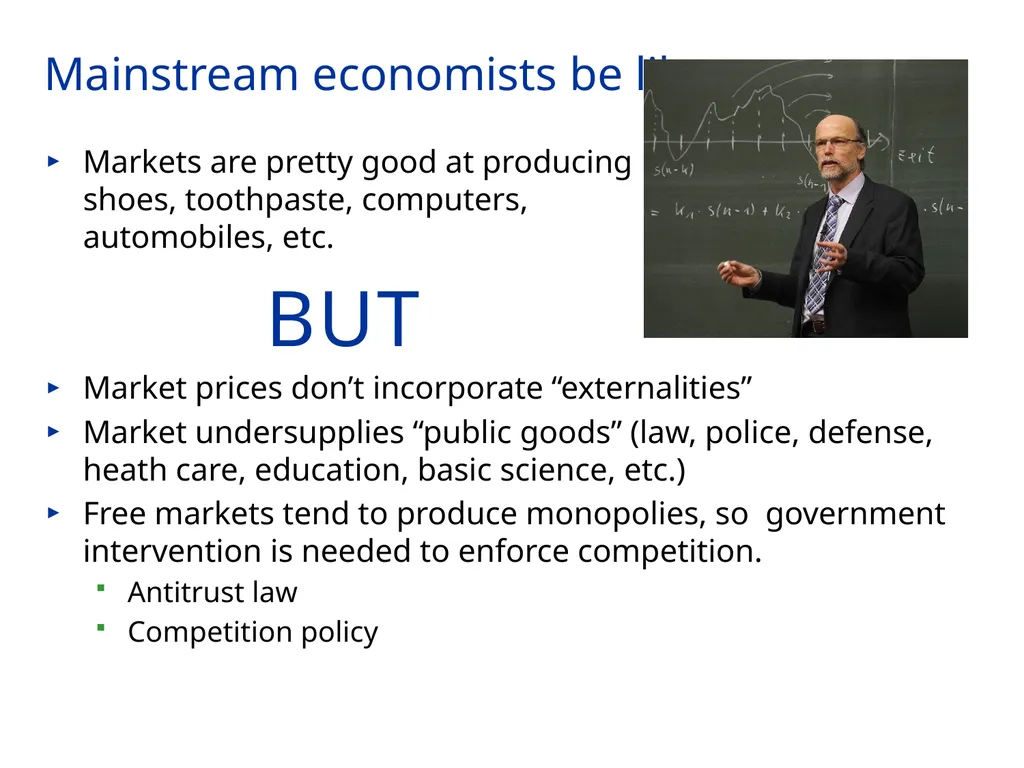
Mainstream economists be like Markets are pretty good at producing
shoes, toothpaste, computers,
automobiles, etc.
BUT
Market prices don’t incorporate “externalities”
Market undersupplies “public goods” (law, police, defense, heath care, education, basic science, etc.)
Free markets tend to produce monopolies, so government intervention is needed to enforce competition.
Antitrust law
Competition policy<br>
03
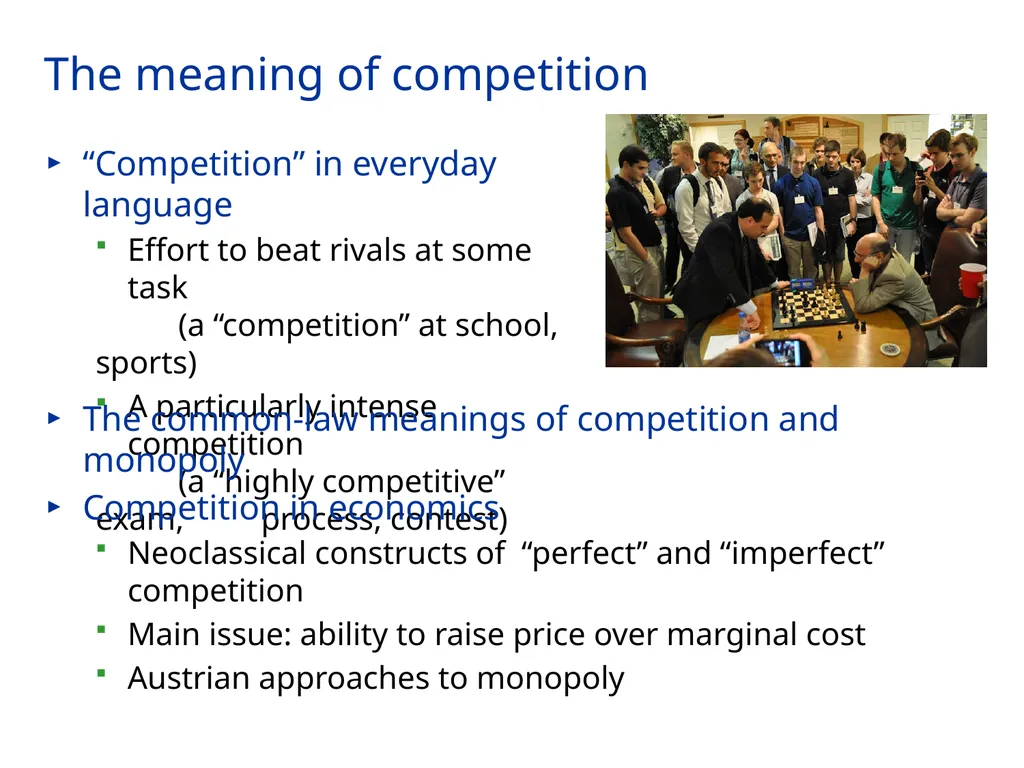
The meaning of competition “Competition” in everyday language
Effort to beat rivals at some task
(a “competition” at school, sports)
A particularly intense competition
(a “highly competitive” exam, process, contest) The common-law meanings of competition and monopoly
Competition in economics
Neoclassical constructs of “perfect” and “imperfect” competition
Main issue: ability to raise price over marginal cost
Austrian approaches to monopoly<br>
04
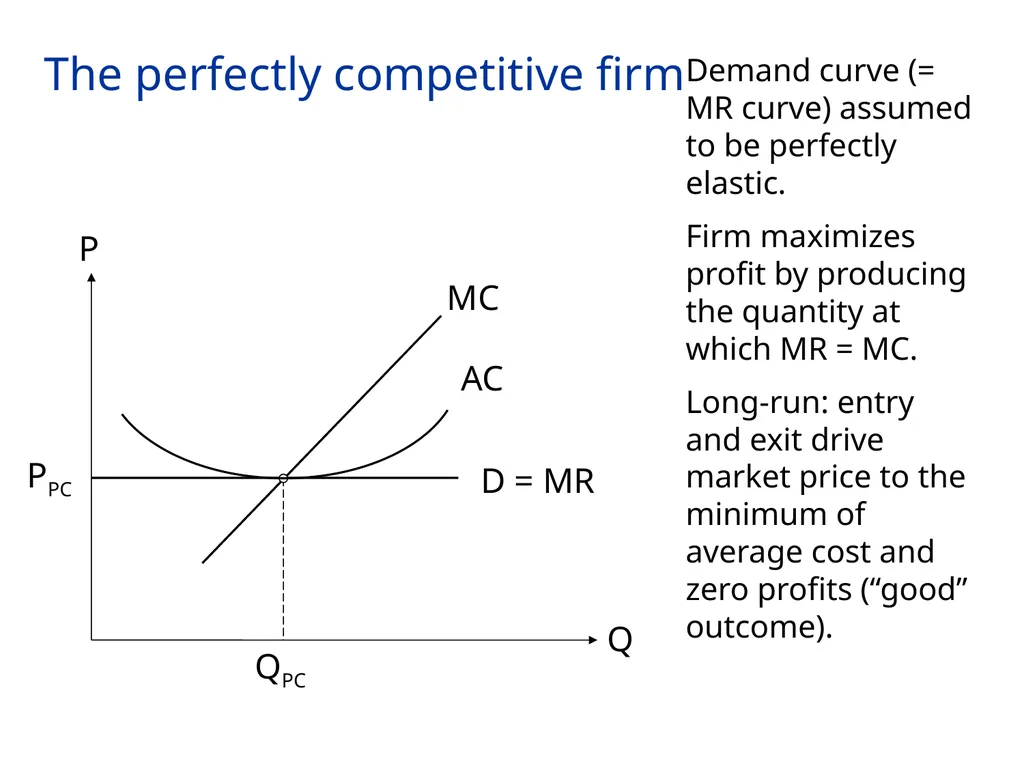
The perfectly competitive firm P Q MC D = MR PPC Demand curve (= MR curve) assumed to be perfectly elastic.
Firm maximizes profit by producing the quantity at which MR = MC.
Long-run: entry and exit drive market price to the minimum of average cost and zero profits (“good” outcome). QPC AC<br>
05
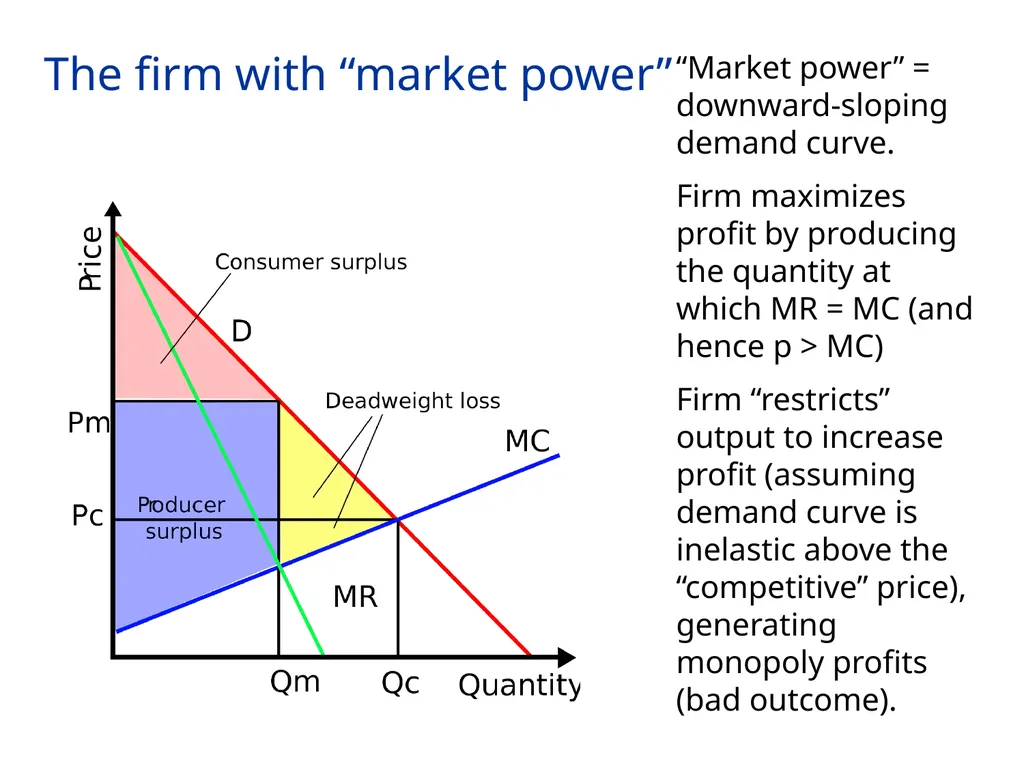
The firm with “market power” “Market power” = downward-sloping demand curve.
Firm maximizes profit by producing the quantity at which MR = MC (and hence p > MC)
Firm “restricts” output to increase profit (assuming demand curve is inelastic above the “competitive” price), generating monopoly profits (bad outcome).<br>
06
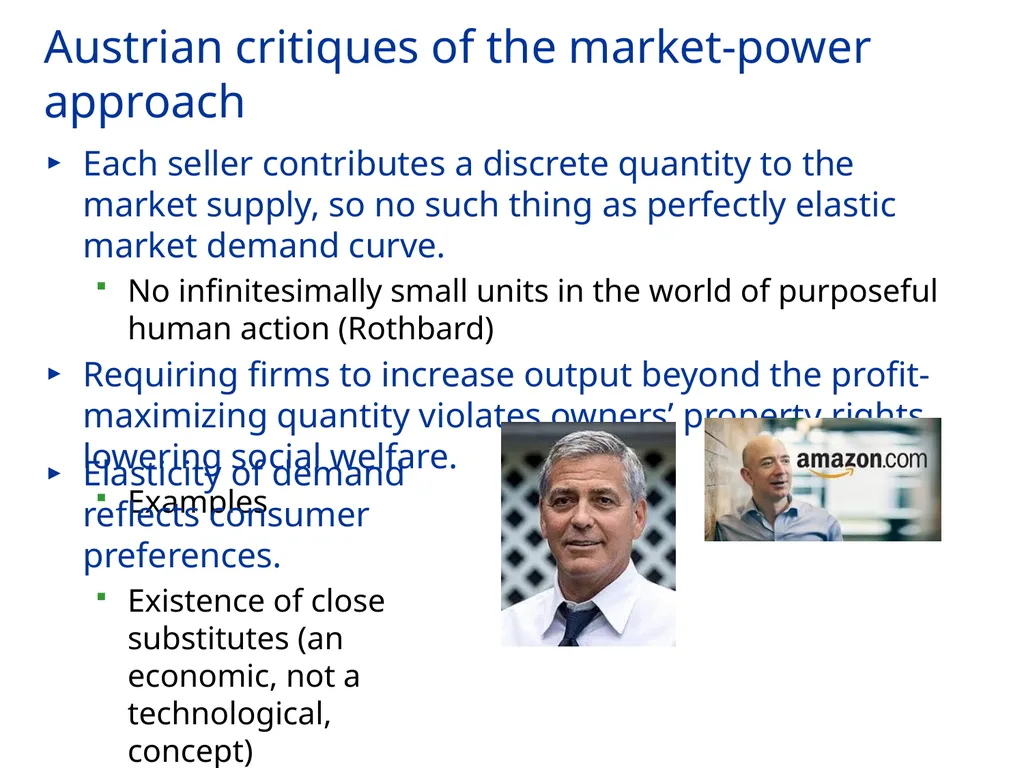
Austrian critiques of the market-power approach Each seller contributes a discrete quantity to the market supply, so no such thing as perfectly elastic market demand curve.
No infinitesimally small units in the world of purposeful human action (Rothbard)
Requiring firms to increase output beyond the profit-maximizing quantity violates owners’ property rights, lowering social welfare.
Examples Elasticity of demand reflects consumer preferences.
Existence of close substitutes (an economic, not a technological, concept)<br>
07
Mises on monopoly prices Monopoly prices emerge only under special conditions.
Single seller of a unique good (or sellers’ cartel)
Inelastic demand above the competitive price (the price that would otherwise have obtained)
Monopoly prices do violate consumer sovereignty.
But the conditions giving rise to monopoly prices are rare, and not usually relevant for policy.<br>
08
Rothbard’s refinement of Mises’s monopoly theory All sellers face a downward-sloping demand curve.
No way to distinguish a “monopoly” from a “competitive” price, in the absence of legal restrictions.
All firms try to maximize net income given their estimates of demand.
All firms price in the elastic range of their demand curve (and elasticity is the result of consumer preference, i.e., voluntary).
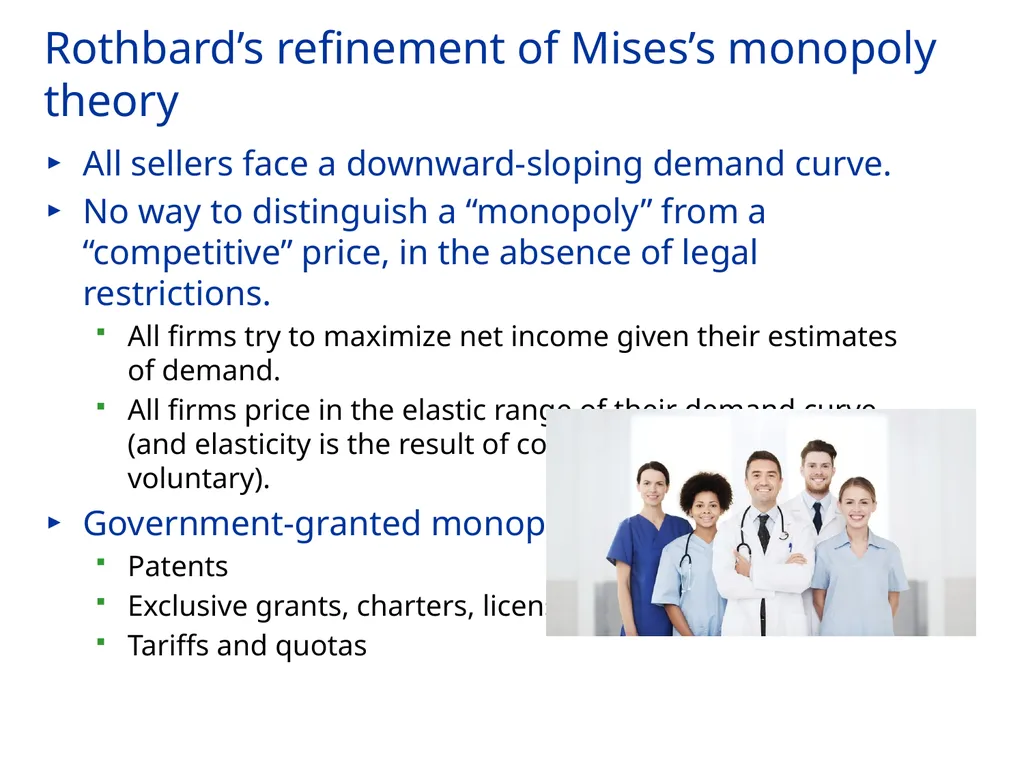
Government-granted monopoly
Patents
Exclusive grants, charters, licenses
Tariffs and quotas<br>
09
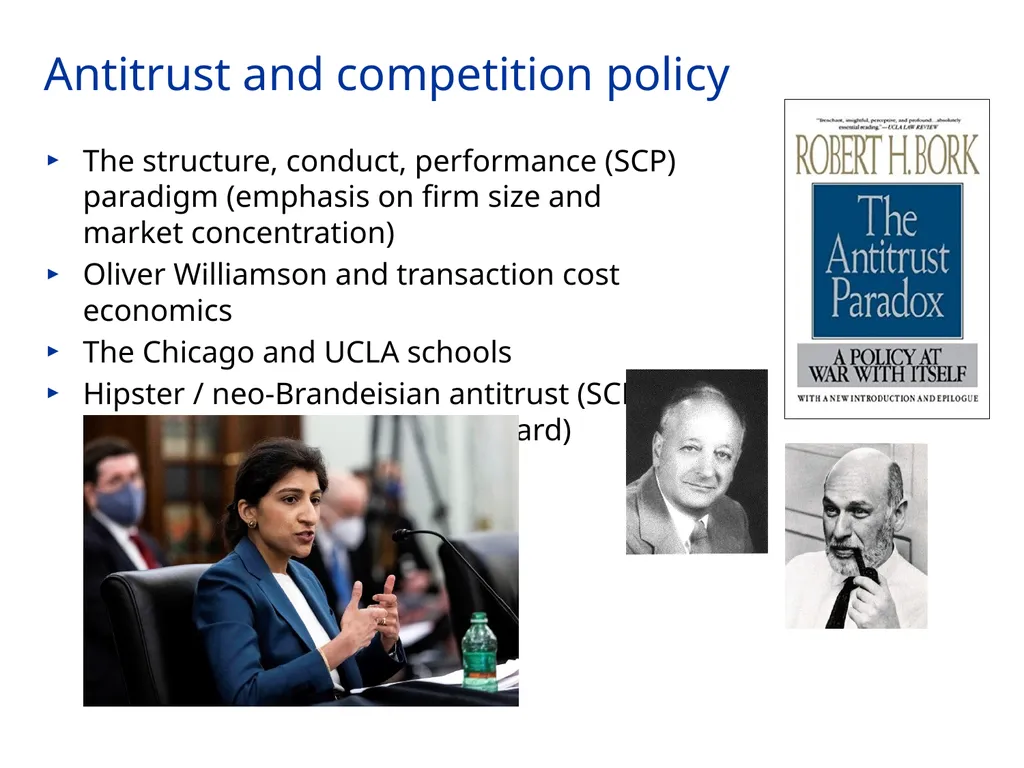
Antitrust and competition policy The structure, conduct, performance (SCP) paradigm (emphasis on firm size and market concentration)
Oliver Williamson and transaction cost economics
The Chicago and UCLA schools
Hipster / neo-Brandeisian antitrust (SCP minus consumer welfare standard)<br>
10
Biden’s July 2021 competition order Background assumption of decreasing competition
Increased concentration at broad industry levels, increased markups
Technological change, up-front investments
A few good things
Relaxation of some entry restrictions (hearing aids, occupational licensing
Many questionable things
Re-review of previously approved mergers (increased regulatory uncertainty)
Net neutrality
Ban on non-compete agreements
Right to repair
Mandatory data portability in banking<br>
11
Summary Competition is a process of rivalry among entrepreneurs who are free to compete as they see fit, within the legal framework.
Few firms or many firms
Large firms or small firms
Profits and losses
Entry, exit, growth, innovation, experimentation
Government attempts to limit “monopoly power” cannot improve well-being.
Best government policy: don’t grant monopoly privilege!<br>