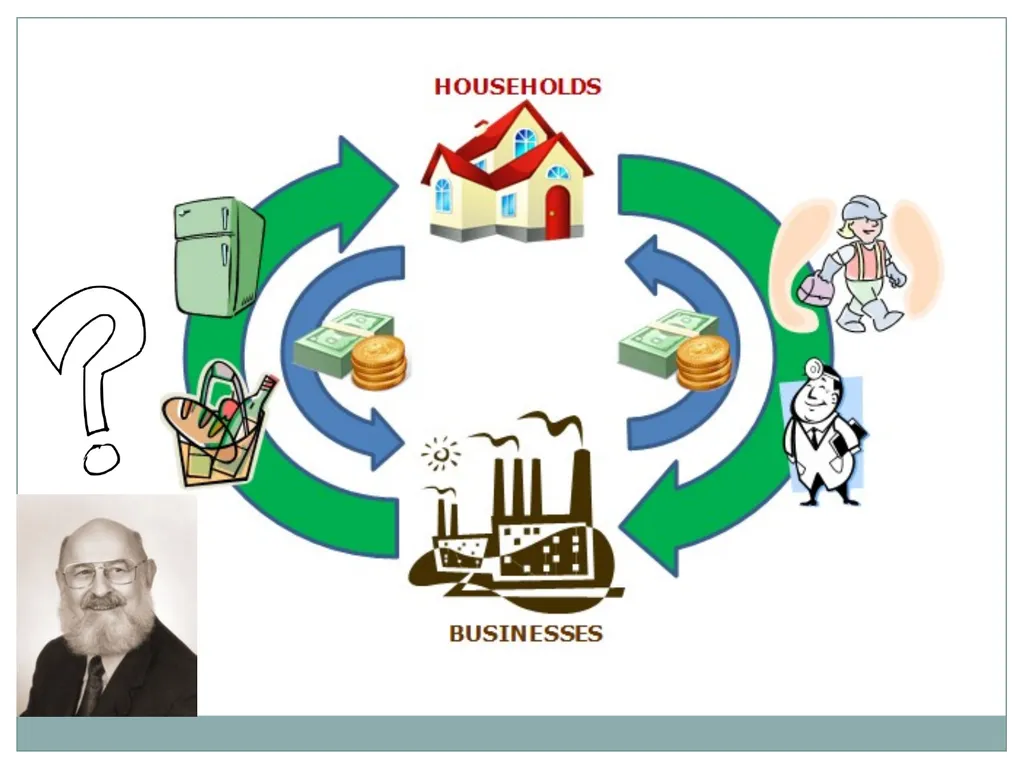
Peter W. Schuhmann UNC Wilmington What is economics? What do economists do? What is economics all about? ECON 101 definition: Economics is the study of how people , businesses, societies, or nations deal with scarcity. Economics is what
"Peter W. Schuhmann UNC Wilmington What is" is the property of its rightful owner. Permission is granted to
download and print the materials on this website for personal, non-commercial use only, and to display it
on your personal computer provided you do not modify the materials and that you retain all copyright
notices contained in the materials. By downloading content from our website, you accept the terms of this
agreement.
Presentation Transcript
01
Peter W. Schuhmann
UNC Wilmington What is economics? What do economists do?<br>
02
What is economics all about? ECON 101 definition:
Economics is “the study of how people , businesses, societies, or nations deal with scarcity”.
Economics is “what economists do”.<br>
03
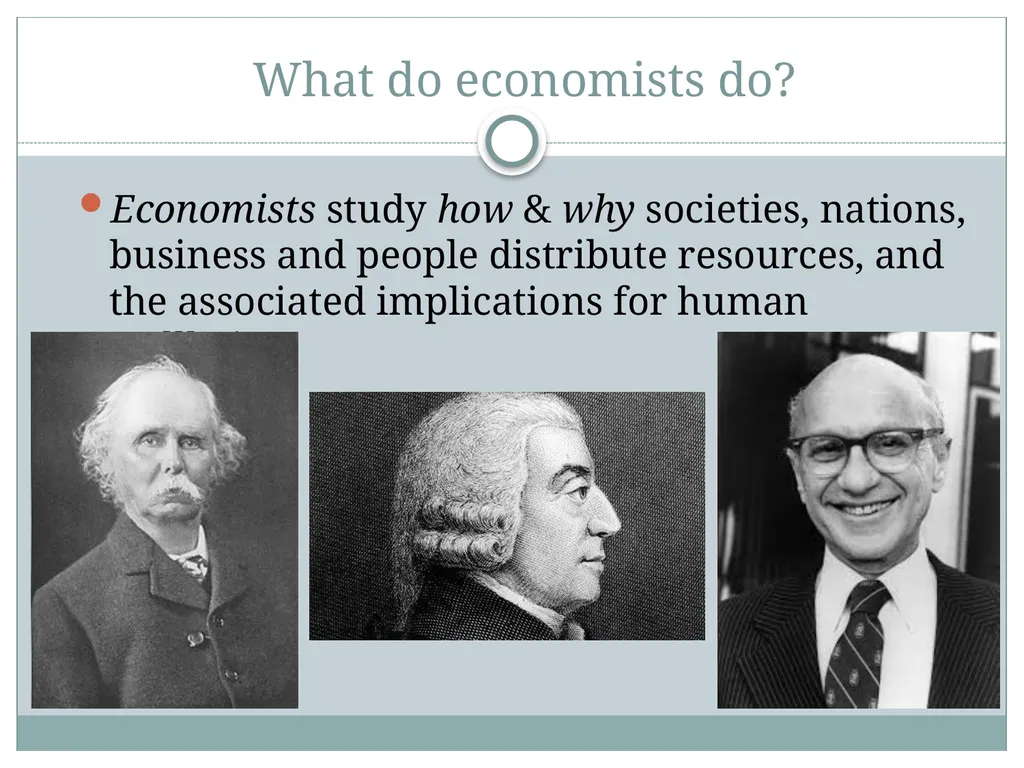
What do economists do? Economists study how & why societies, nations, business and people distribute resources, and the associated implications for human wellbeing.<br>
04
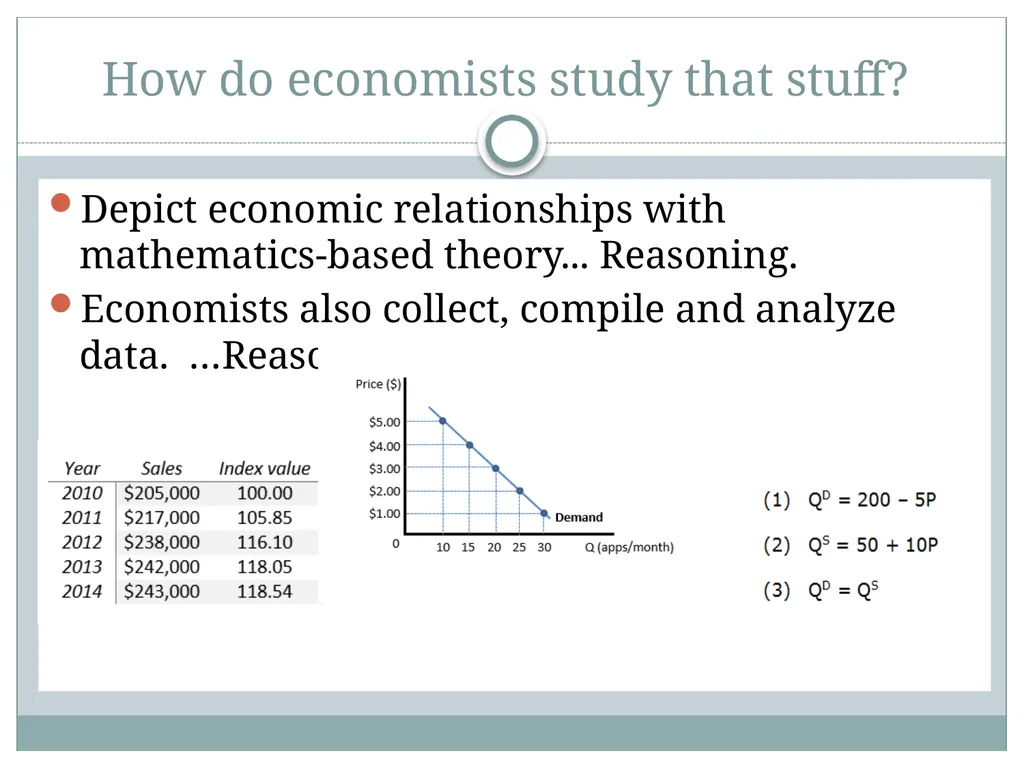
How do economists study that stuff? Depict economic relationships with mathematics-based theory... Reasoning.
Economists also collect, compile and analyze data. …Reasoning.<br>
05
Then what? Economists try to provide information that will be useful for decision-makers.
What is the nature and magnitude of cause-and-effect?
How did we get here?
What would happen if…?
What are the costs and benefits of an action (or inaction)?
What is the best way to accomplish a particular goal?
Economists use theory, data, math and statistics to help solve real-world problems.<br>
06
Economics is (supposed to be) objective When economists analyze a situation, they tend to do so without personal opinion.
A cold-hearted search for the truth…<br>
07
Is economics a science? Yes and no.
Science can viewed as the study of things that can be proven false (even if the likelihood is very small).
Karl Popper
Economists use theory to examine how facts fit together.
Economists empirically test theory to see whether the facts support what theory predicts.
But, unlike some physical scientists, economists rarely use controlled experiments to test theories.
We must use whatever facts are available and rely on statistical analysis to draw conclusions.<br>
08
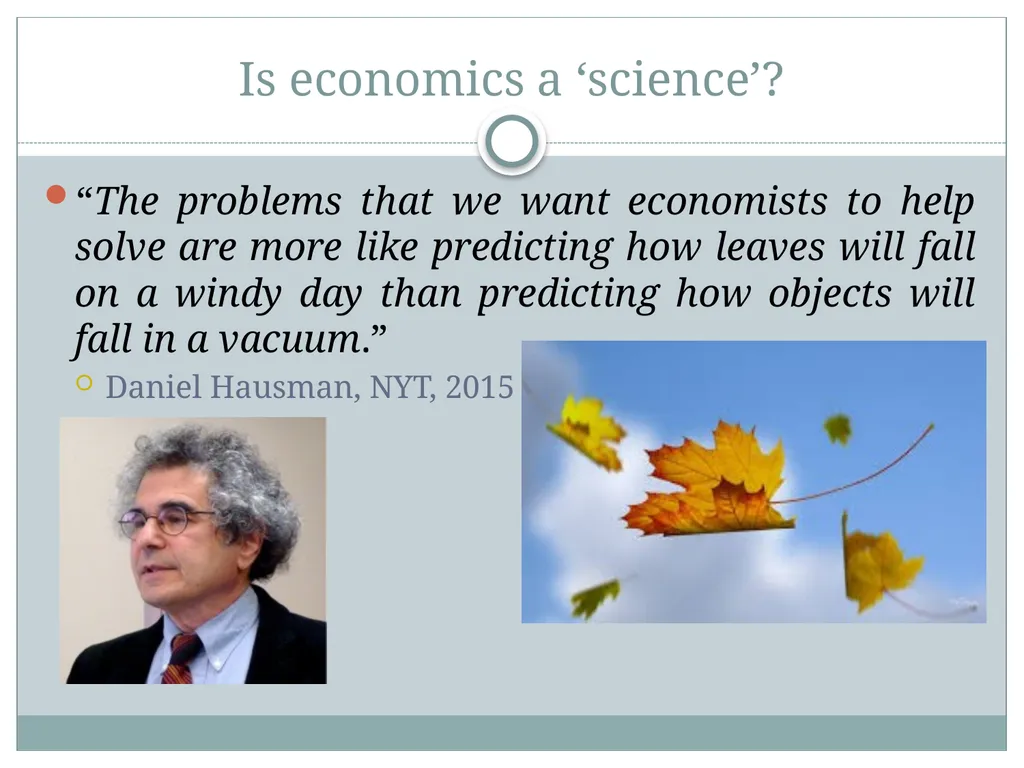
Is economics a ‘science’? “The problems that we want economists to help solve are more like predicting how leaves will fall on a windy day than predicting how objects will fall in a vacuum.”
Daniel Hausman, NYT, 2015<br>
09
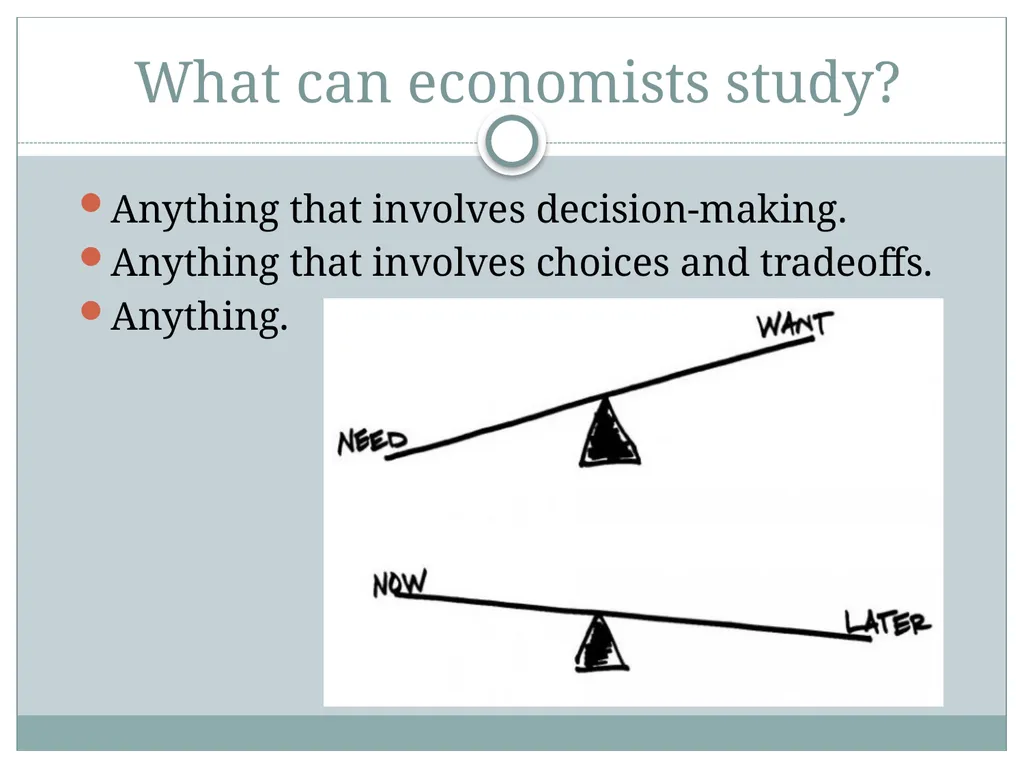
What can economists study? Anything that involves decision-making.
Anything that involves choices and tradeoffs.
Anything.<br>
10
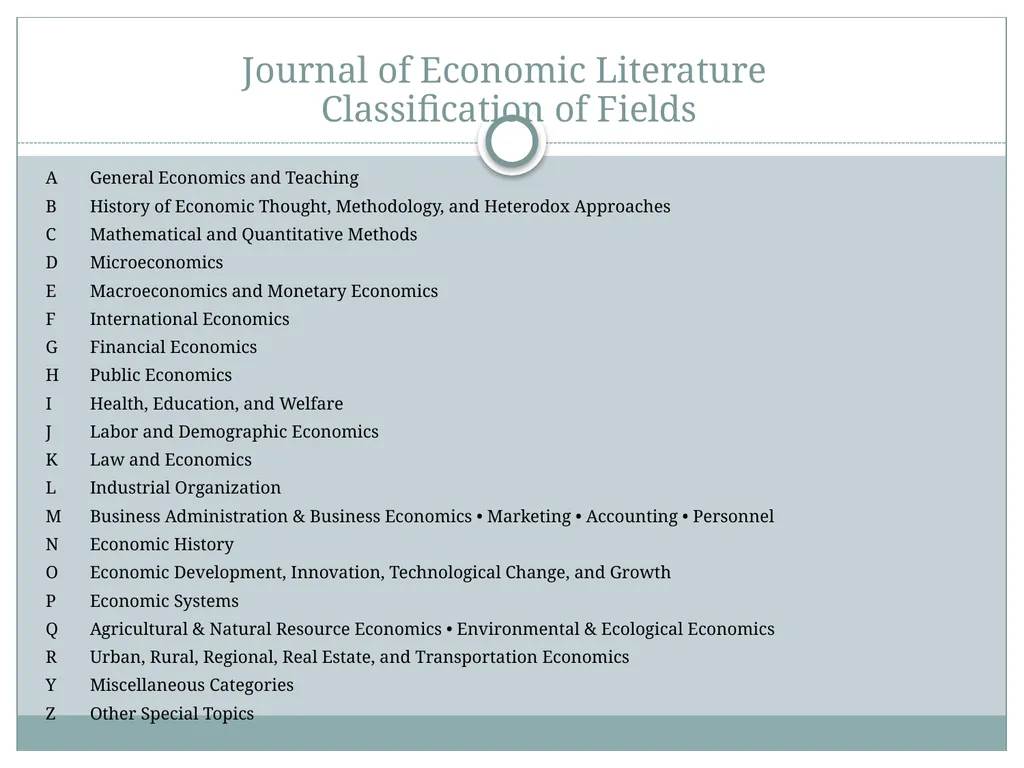
Journal of Economic Literature Classification of Fields A General Economics and Teaching
B History of Economic Thought, Methodology, and Heterodox Approaches
C Mathematical and Quantitative Methods
D Microeconomics
E Macroeconomics and Monetary Economics
F International Economics
G Financial Economics
H Public Economics
I Health, Education, and Welfare
J Labor and Demographic Economics
K Law and Economics
L Industrial Organization
M Business Administration & Business Economics • Marketing • Accounting • Personnel
N Economic History
O Economic Development, Innovation, Technological Change, and Growth
P Economic Systems
Q Agricultural & Natural Resource Economics • Environmental & Ecological Economics
R Urban, Rural, Regional, Real Estate, and Transportation Economics
Y Miscellaneous Categories
Z Other Special Topics<br>
11
Micro and Macro Macroeconomics is the study of the entire economy.
Macroeconomists are concerned with relationships between broadly defined economic variables such as the overall price level, total output and unemployment.
Macroeconomists might attempt to forecast the effects of large scale unemployment, economic growth, inflation, productivity, and investments.
What is the economy going to do next...?<br>
12
Fields of Macroeconomics Monetary economics
Money
Central banking and policy
Interest rates
Credit markets
International economics
Trade
Exchange rates
International investment
Growth and development
Foreign aid<br>
13
Micro and Macro Microeconomics is the study of the choices and behaviors of individual consumers, businesses and governments.
Private sector microeconomists might help businesses maximize profits, reduce costs or establish prices.
Public sector microeconomists might analyze the costs and benefits of government programs or policies (e.g. transportation, health care, environment).<br>
14
Fields of Microeconomics Health economics
Economics of education
Environmental and natural resource economics
Industrial organization
Urban/regional economics
Labor and demographics<br>
15
What kind of skills do economists use? Critical thinking
Mathematics
Statistics
Data acquisition & analysis
Technical software
Writing, reporting & communication<br>
16
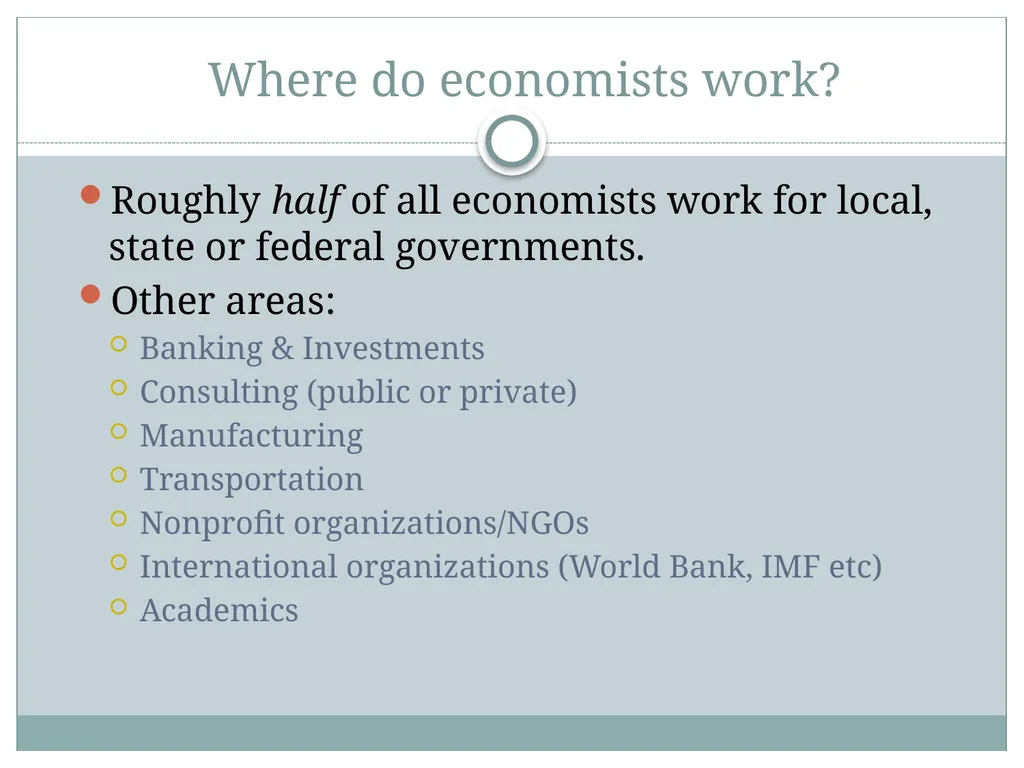
Where do economists work? Roughly half of all economists work for local, state or federal governments.
Other areas:
Banking & Investments
Consulting (public or private)
Manufacturing
Transportation
Nonprofit organizations/NGOs
International organizations (World Bank, IMF etc)
Academics<br>
17
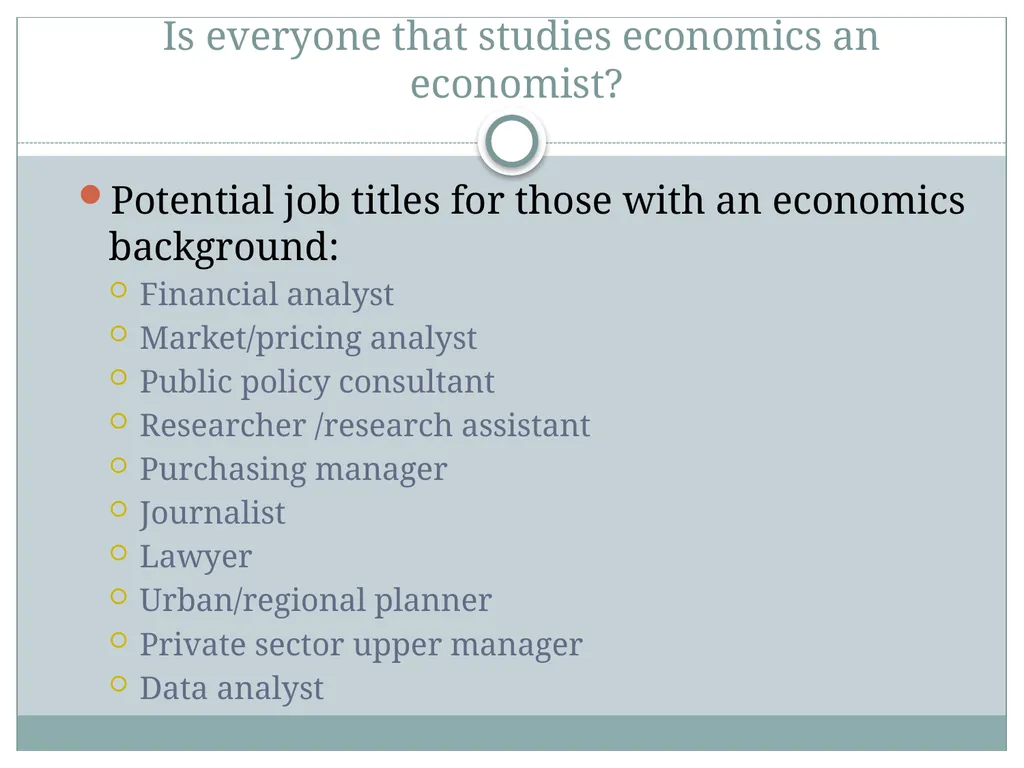
Is everyone that studies economics an economist? Potential job titles for those with an economics background:
Financial analyst
Market/pricing analyst
Public policy consultant
Researcher /research assistant
Purchasing manager
Journalist
Lawyer
Urban/regional planner
Private sector upper manager
Data analyst<br>
18
Do economists agree on everything? No.<br>
19
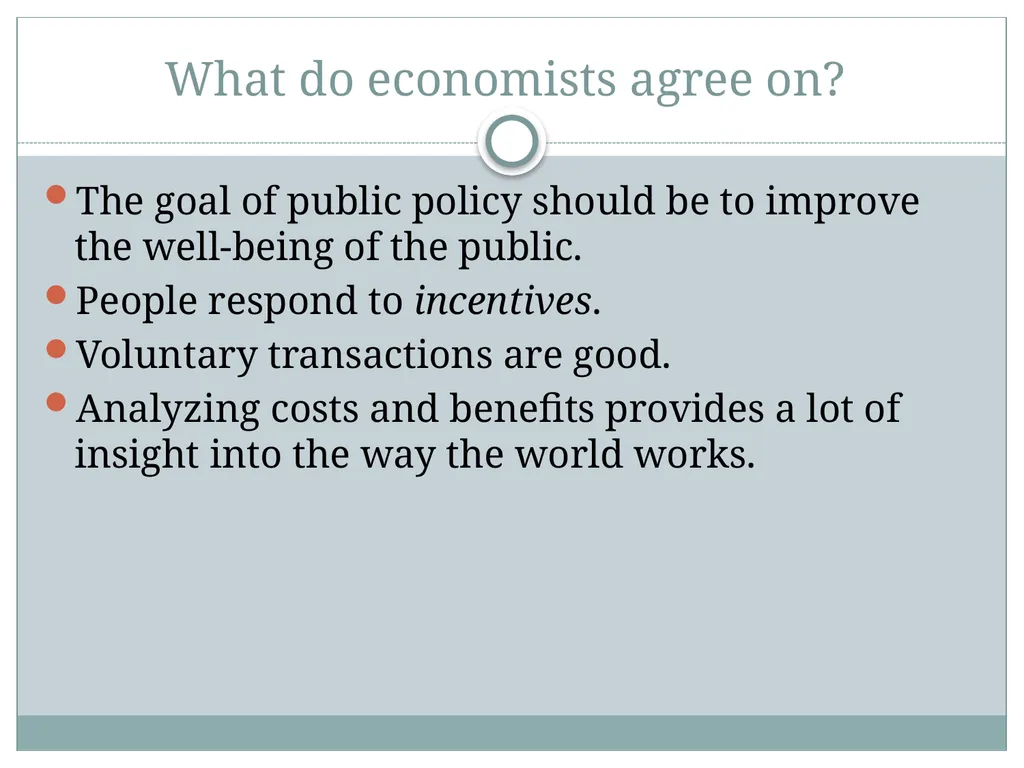
What do economists agree on? The goal of public policy should be to improve the well-being of the public.
People respond to incentives.
Voluntary transactions are good.
Analyzing costs and benefits provides a lot of insight into the way the world works.<br>
20
What are the most important concepts in econ? Opportunity costs (“TiNSTaaFL”)
Thinking at “the margin”<br>
21
Thank you!<br>
22
Environmental Econ. Vs. Ecological Econ. Both are concerned with how socio-economic systems interact with natural systems.
Environmental economics tends to operate within the mainstream neoclassical methodology (basic tenets of behavior).
Jim’s talk will cover the basics and you’ll get lots more info during the week!<br>
23
Environmental Econ. Vs. Ecological Econ. “Ecological Economics” started in the 80s (Costanza).
Views the economy as a subset of the biosphere rather than viewing the environment as an input into the economy.
Focus on systems rather than resources.
Given the constraints of a closed system, focus on development rather than growth.
(Initially) rejected the market mechanism as an approach to understanding and solving environmental problems.
Asks “big picture” questions (e.g. how to change the economic system so that it achieves economic and environmental sustainability).<br>