PHL424: Feynman diagrams PHL424: Feynman diagrams

Published  . 0 views
↓ Download
PHL424: Feynman diagrams PHL424: Feynman diagrams
1 / 1
PHL424: Feynman diagrams PHL424: Feynman diagrams - slide 1 of 14 PHL424: Feynman diagrams PHL424: Feynman diagrams - slide 2 of 14 PHL424: Feynman diagrams PHL424: Feynman diagrams - slide 3 of 14 PHL424: Feynman diagrams PHL424: Feynman diagrams - slide 4 of 14 PHL424: Feynman diagrams PHL424: Feynman diagrams - slide 5 of 14 PHL424: Feynman diagrams PHL424: Feynman diagrams - slide 6 of 14 PHL424: Feynman diagrams PHL424: Feynman diagrams - slide 7 of 14 PHL424: Feynman diagrams PHL424: Feynman diagrams - slide 8 of 14 PHL424: Feynman diagrams PHL424: Feynman diagrams - slide 9 of 14 PHL424: Feynman diagrams PHL424: Feynman diagrams - slide 10 of 14 PHL424: Feynman diagrams PHL424: Feynman diagrams - slide 11 of 14 PHL424: Feynman diagrams PHL424: Feynman diagrams - slide 12 of 14 PHL424: Feynman diagrams PHL424: Feynman diagrams - slide 13 of 14 PHL424: Feynman diagrams PHL424: Feynman diagrams - slide 14 of 14
Description: PHL424: Feynman diagrams PHL424: Feynman diagrams The Feynman diagram is a simple combination of a quark weak vertex and a lepton-weak vertex. The quarks come form the same generation. Similarly, the leptons are a first generation pair.

Related Topics

Download Presentation

"PHL424: Feynman diagrams PHL424: Feynman diagrams" is the property of its rightful owner. Permission is granted to download and print the materials on this website for personal, non-commercial use only, and to display it on your personal computer provided you do not modify the materials and that you retain all copyright notices contained in the materials. By downloading content from our website, you accept the terms of this agreement.

Presentation Transcript

slide1. PHL424: Feynman diagrams<br>
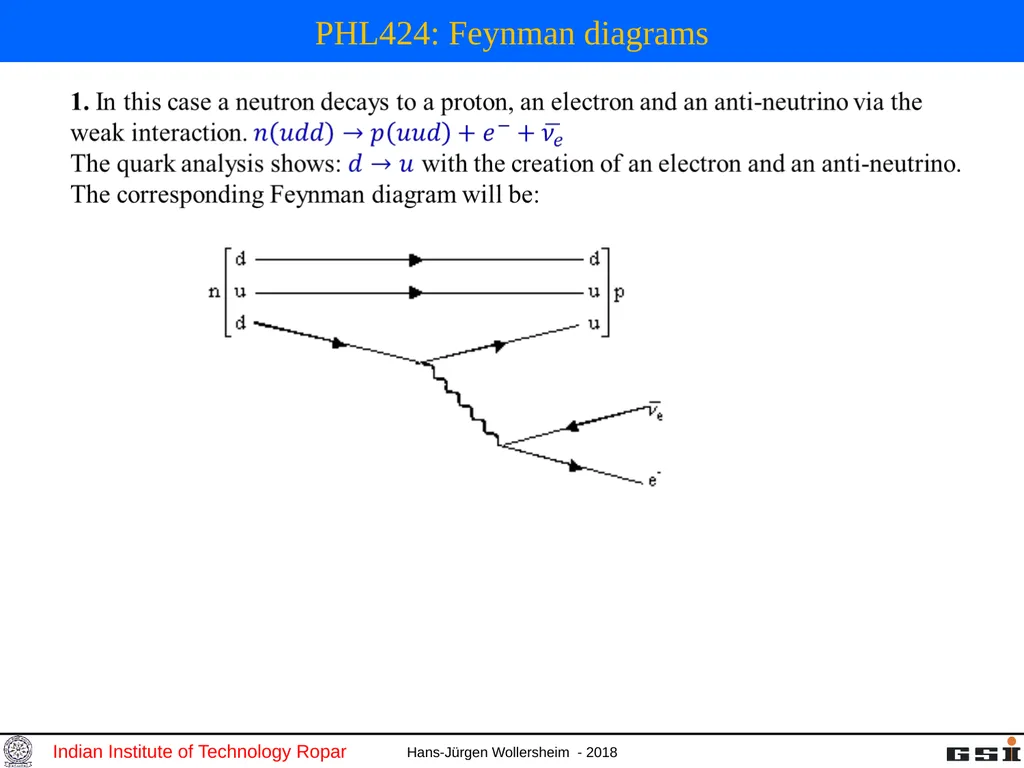
slide2. PHL424: Feynman diagrams The Feynman diagram is a simple combination of a quark weak vertex and a lepton-weak vertex. The quarks come form the same generation. Similarly, the leptons are a first generation pair.<br>
slide3. PHL424: Feynman diagrams<br>
slide4. PHL424: Feynman diagrams This is a weak decay of the anti-strange quark. It is an allowed diagonal change between anti-quark generations. The Feynman diagram shows a combination of an antiquark-weak vertex and a quark-weak vertex.<br>
slide5. PHL424: Feynman diagrams This is a weak decay of the strange quark. It is an allowed diagonal change between quark generations. The Feynman diagram for the s to u transition is a combination of two quark-W vertices. The pion is derived from a same generation quark weak vertex The corresponding Feynman diagram will be:<br>
slide6. PHL424: Feynman diagrams This is a weak decay of the strange quark. It is an allowed diagonal change between quark generations. The Feynman diagram for the s to u transition is a combination of two quark-W vertices. The corresponding Feynman diagram will be:<br>
slide7. PHL424: Feynman diagrams The electron emits a real photon and becomes a virtual electron. This virtual electron then annihilates with the positron with the emission further photon. It is a combination of two electromagnetic-lepton vertices.<br>
slide8. PHL424: Feynman diagrams This is a weak decay of the strange quark. It is an allowed diagonal change between quark generation: We also can see a quark weak vertex leading to a anti-up and a down quark. This event involves only neutral particles and you may think that it could never be "seen" in a bubble chamber picture. BUT... The signaled tracks in the picture above shows the xi zero decay, in the bubble chamber picture of the discovery of omega minus! The two gammas come from pi zero disintegration! The corresponding Feynman diagram will be:<br>
slide9. PHL424: Feynman diagrams This is a weak interaction of the anti-strange quark to an anti-up quark with the creation of a W-plus. The W-plus decays and an anti-down quark and an up quark are created. A gluon is created and materializes a down quark and an anti-down quark. The anti-strange to anti-up vertex is an allowed diagonal change between anti-quark generations.<br>
slide10. PHL424: Feynman diagrams<br>
slide11. PHL424: Feynman diagrams This is a weak decay of the strange quark. It is an allowed diagonal change between quark generation: We also can see a quark weak vertex leading to a anti-up and a down quark. The corresponding Feynman diagram will be:<br>
slide12. PHL424: Feynman diagrams The suggested Feynman diagram might be:<br>
slide13. PHL424: Feynman diagrams This is a strong interaction and involves quark-gluon vertices only. The corresponding Feynman diagram will be:<br>
slide14. PHL424: Feynman diagrams This is a weak decay of the strange quark. It is an allowed diagonal change between quark generations. The Feynman diagram illustrates that the reaction is a combination of a quark weak vertex and a weak-lepton vertex. The corresponding Feynman diagram will be:<br>