
Photo by Markus Spiske, unsplash SDMX Information
PT
Published · 49 slides · 0 views

1 / 1

Description
Photo by Markus Spiske, unsplash SDMX Information Model Abdulla Gozalov UNSD-ESCWA Advanced SDMX Workshop Beirut, 27 Jun 1 Jul 2022 2529 Tourism establishments Italy Annual data Number Figures vs data 2 Figures by themselves are
Related Topics
Share
Embed code
Download this presentation From Below
"Photo by Markus Spiske, unsplash SDMX Information" is the property of its rightful owner. Permission is granted to download and print the materials on this website for personal, non-commercial use only, and to display it on your personal computer provided you do not modify the materials and that you retain all copyright notices contained in the materials. By downloading content from our website, you accept the terms of this agreement.
Presentation Transcript
01
Photo by Markus Spiske, unsplash SDMX Information Model Abdulla Gozalov
UNSD-ESCWA Advanced SDMX Workshop
Beirut, 27 Jun – 1 Jul 2022<br>
UNSD-ESCWA Advanced SDMX Workshop
Beirut, 27 Jun – 1 Jul 2022<br>
02
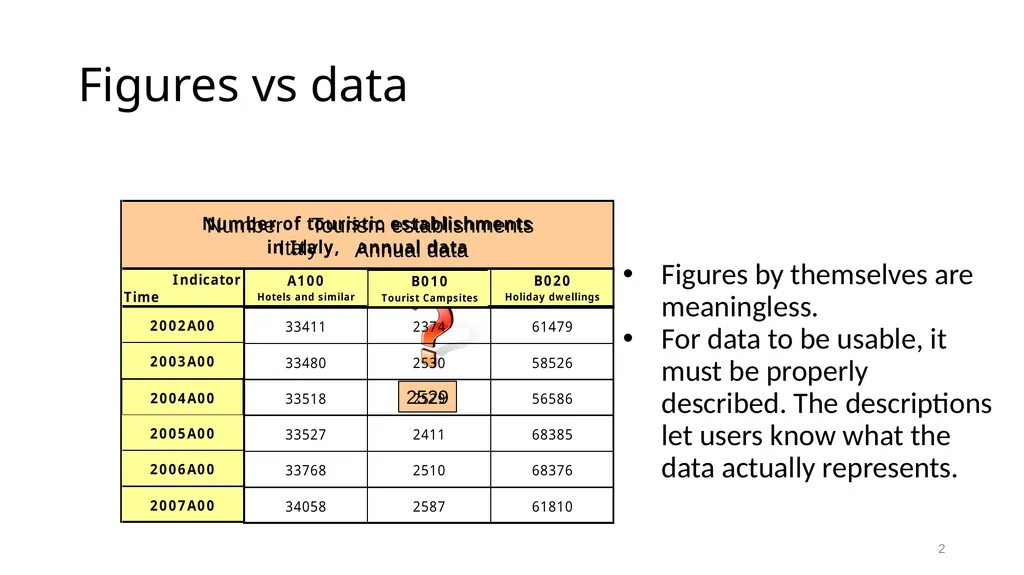
2529 Tourism establishments Italy Annual data Number Figures vs data 2 Figures by themselves are meaningless.
For data to be usable, it must be properly described. The descriptions let users know what the data actually represents.<br>
For data to be usable, it must be properly described. The descriptions let users know what the data actually represents.<br>
03
Developing a Data Model for Data Exchange Data model is developed to provide descriptions for all relevant characteristics of the data to be exchanged
In some aspects similar to developing a relational database
In SDMX, data model is represented by a Data Structure Definition (DSD).
The “shape” of SDMX DSD is roughly similar to star schema.
To design a DSD, we first need to find concepts that identify and describe our data. 3<br>
In some aspects similar to developing a relational database
In SDMX, data model is represented by a Data Structure Definition (DSD).
The “shape” of SDMX DSD is roughly similar to star schema.
To design a DSD, we first need to find concepts that identify and describe our data. 3<br>
04
Concept “Unit of thought created by a unique combination of characteristics”*
Each concept describes something about the data.
Concepts should express all relevant data characteristics. 4 * Source: SDMX Glossary<br>
Each concept describes something about the data.
Concepts should express all relevant data characteristics. 4 * Source: SDMX Glossary<br>
05
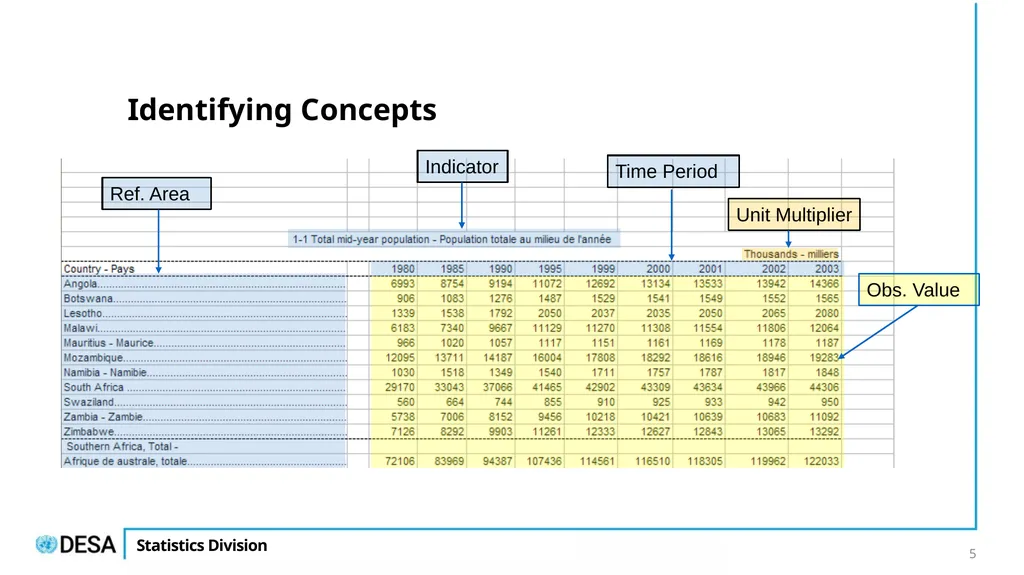
Identifying Concepts 5 Indicator Ref. Area Time Period Unit Multiplier Obs. Value<br>
06
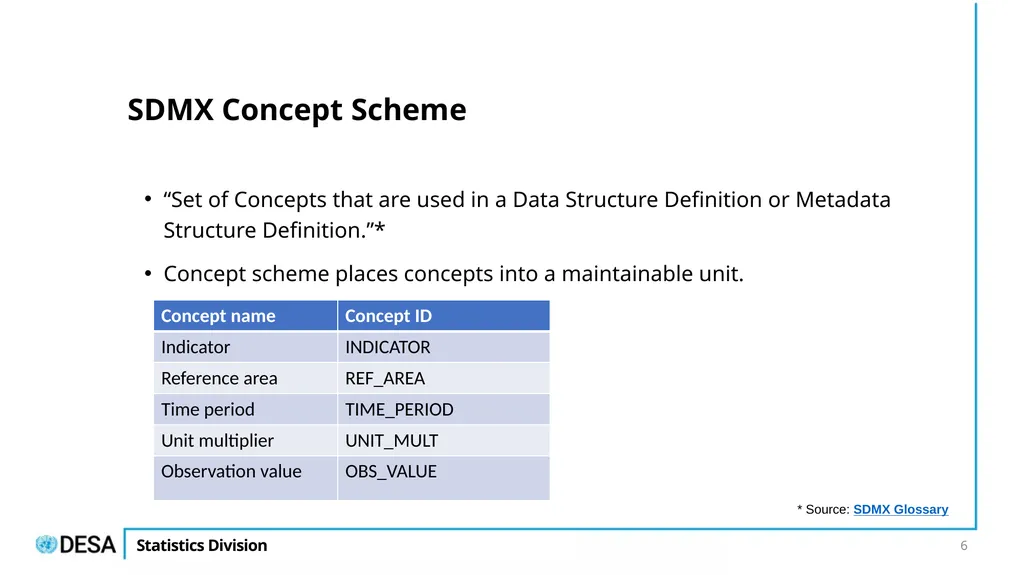
SDMX Concept Scheme “Set of Concepts that are used in a Data Structure Definition or Metadata Structure Definition.”*
Concept scheme places concepts into a maintainable unit. 6 * Source: SDMX Glossary<br>
Concept scheme places concepts into a maintainable unit. 6 * Source: SDMX Glossary<br>
07
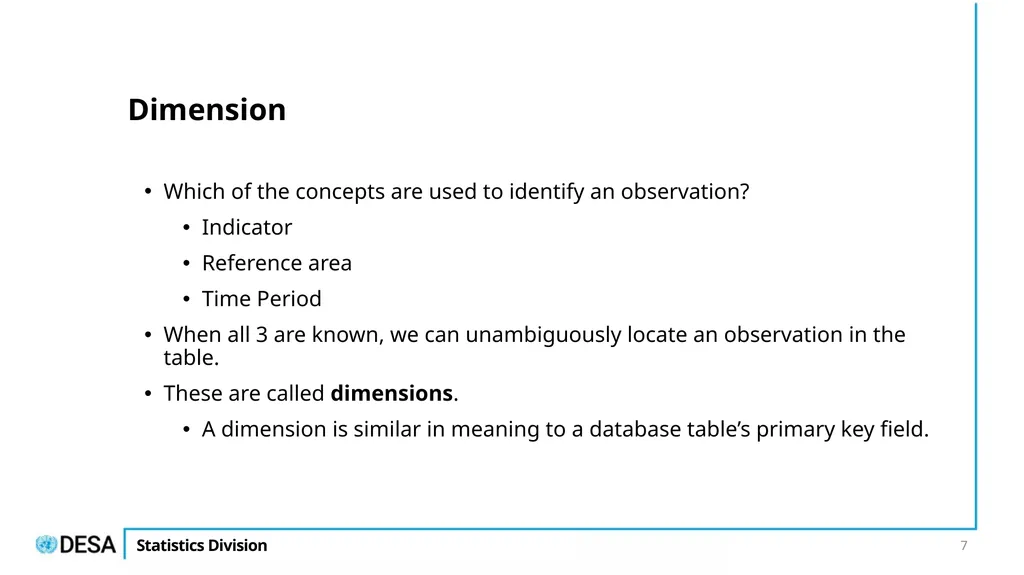
Dimension Which of the concepts are used to identify an observation?
Indicator
Reference area
Time Period
When all 3 are known, we can unambiguously locate an observation in the table.
These are called dimensions.
A dimension is similar in meaning to a database table’s primary key field. 7<br>
Indicator
Reference area
Time Period
When all 3 are known, we can unambiguously locate an observation in the table.
These are called dimensions.
A dimension is similar in meaning to a database table’s primary key field. 7<br>
08
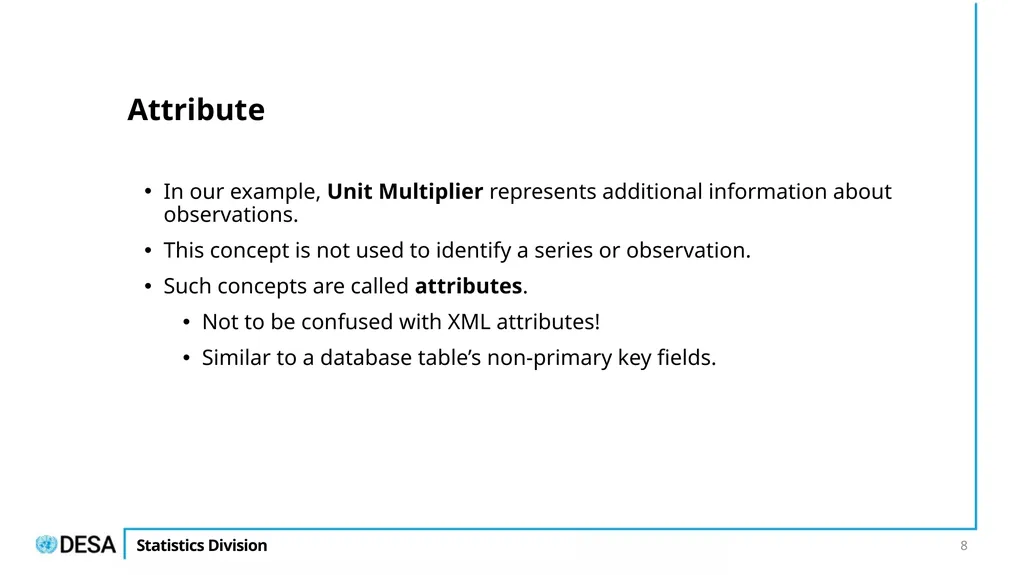
Attribute In our example, Unit Multiplier represents additional information about observations.
This concept is not used to identify a series or observation.
Such concepts are called attributes.
Not to be confused with XML attributes!
Similar to a database table’s non-primary key fields. 8<br>
This concept is not used to identify a series or observation.
Such concepts are called attributes.
Not to be confused with XML attributes!
Similar to a database table’s non-primary key fields. 8<br>
09
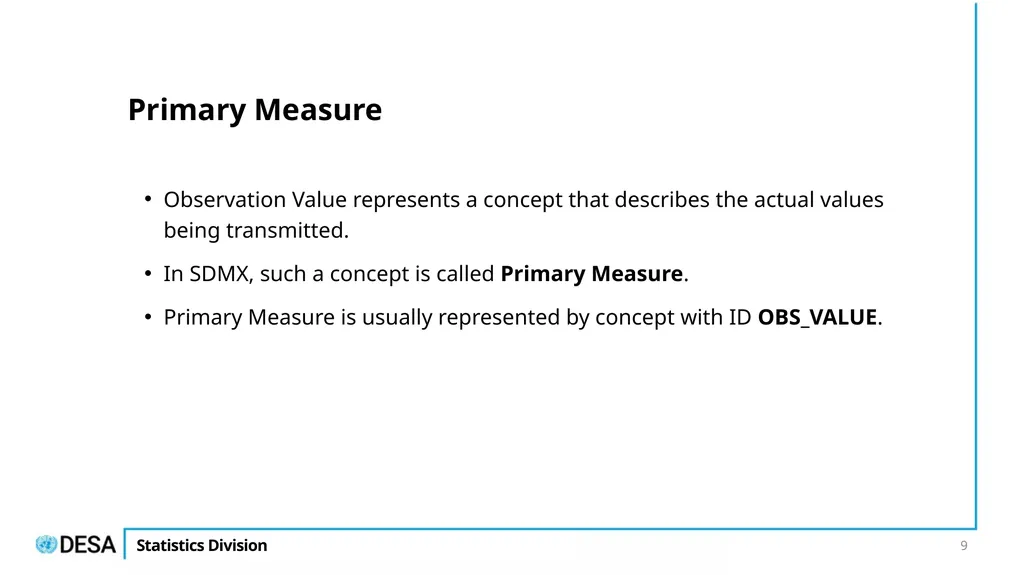
Primary Measure Observation Value represents a concept that describes the actual values being transmitted.
In SDMX, such a concept is called Primary Measure.
Primary Measure is usually represented by concept with ID OBS_VALUE. 9<br>
In SDMX, such a concept is called Primary Measure.
Primary Measure is usually represented by concept with ID OBS_VALUE. 9<br>
10
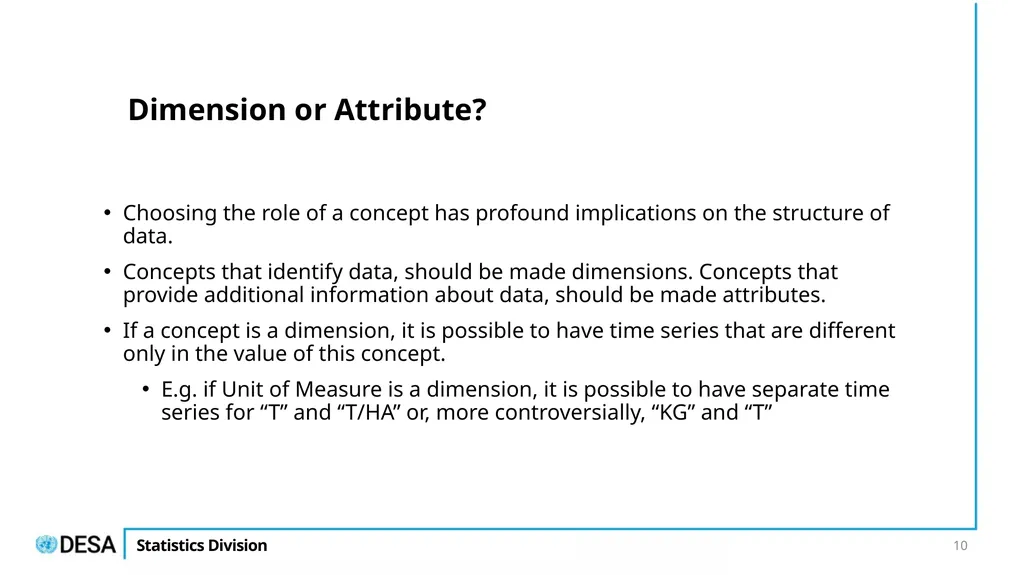
Dimension or Attribute? Choosing the role of a concept has profound implications on the structure of data.
Concepts that identify data, should be made dimensions. Concepts that provide additional information about data, should be made attributes.
If a concept is a dimension, it is possible to have time series that are different only in the value of this concept.
E.g. if Unit of Measure is a dimension, it is possible to have separate time series for “T” and “T/HA” or, more controversially, “KG” and “T” 10<br>
Concepts that identify data, should be made dimensions. Concepts that provide additional information about data, should be made attributes.
If a concept is a dimension, it is possible to have time series that are different only in the value of this concept.
E.g. if Unit of Measure is a dimension, it is possible to have separate time series for “T” and “T/HA” or, more controversially, “KG” and “T” 10<br>
11
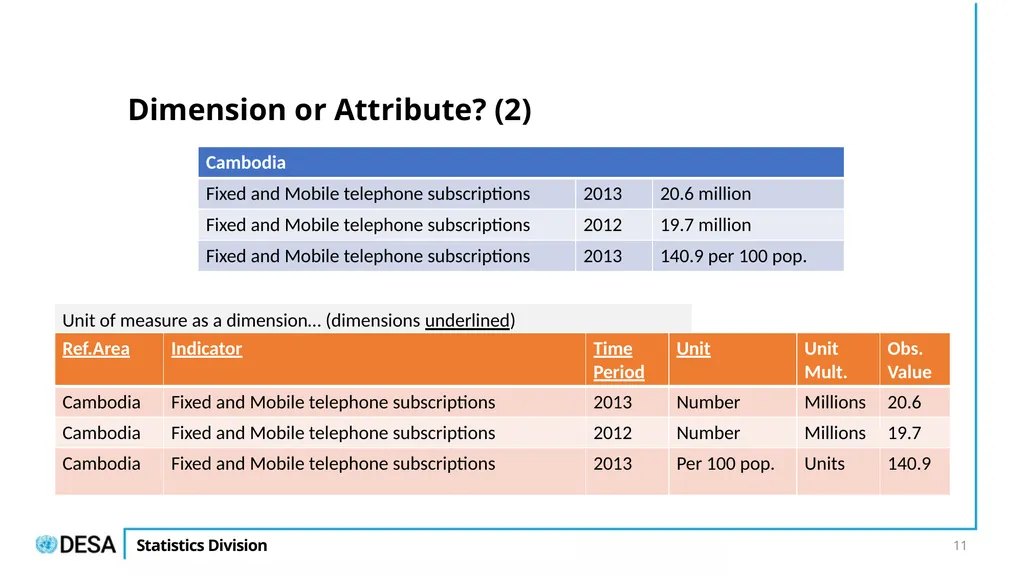
Dimension or Attribute? (2) 11 Unit of measure as a dimension… (dimensions underlined)<br>
12
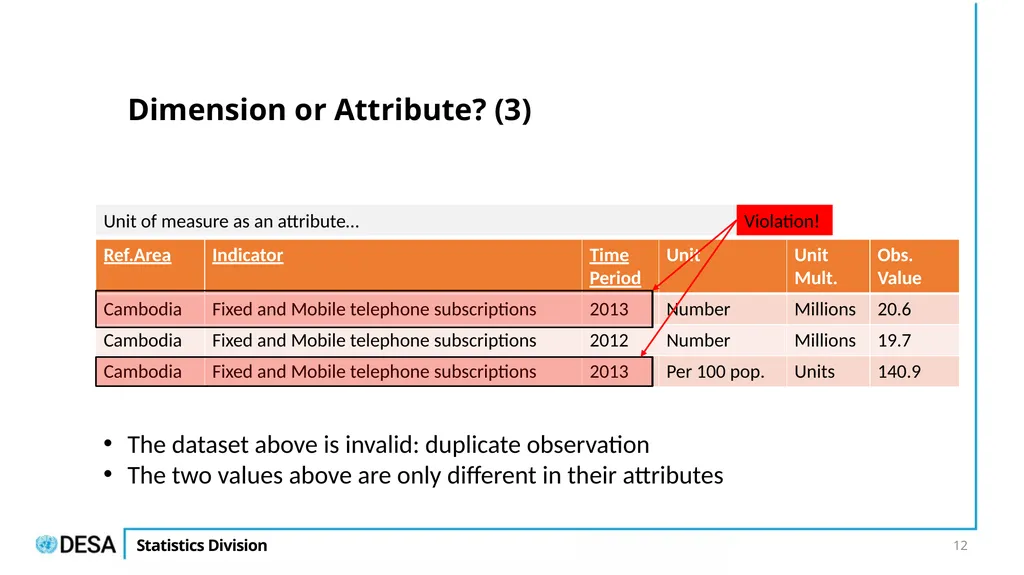
Dimension or Attribute? (3) 12 Unit of measure as an attribute… Violation! The dataset above is invalid: duplicate observation
The two values above are only different in their attributes<br>
The two values above are only different in their attributes<br>
13
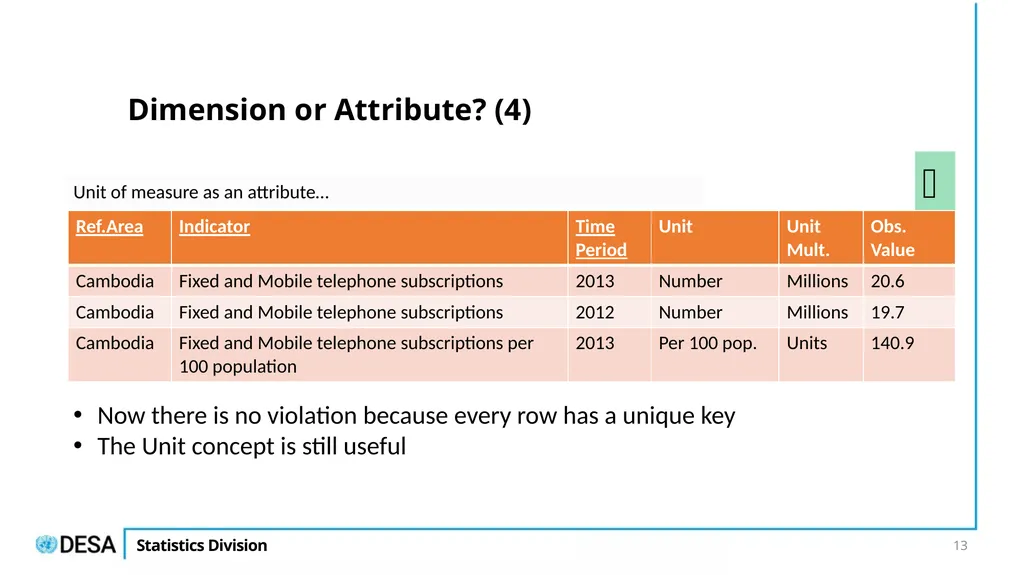
Dimension or Attribute? (4) 13 Unit of measure as an attribute… Now there is no violation because every row has a unique key
The Unit concept is still useful <br>
The Unit concept is still useful <br>
14
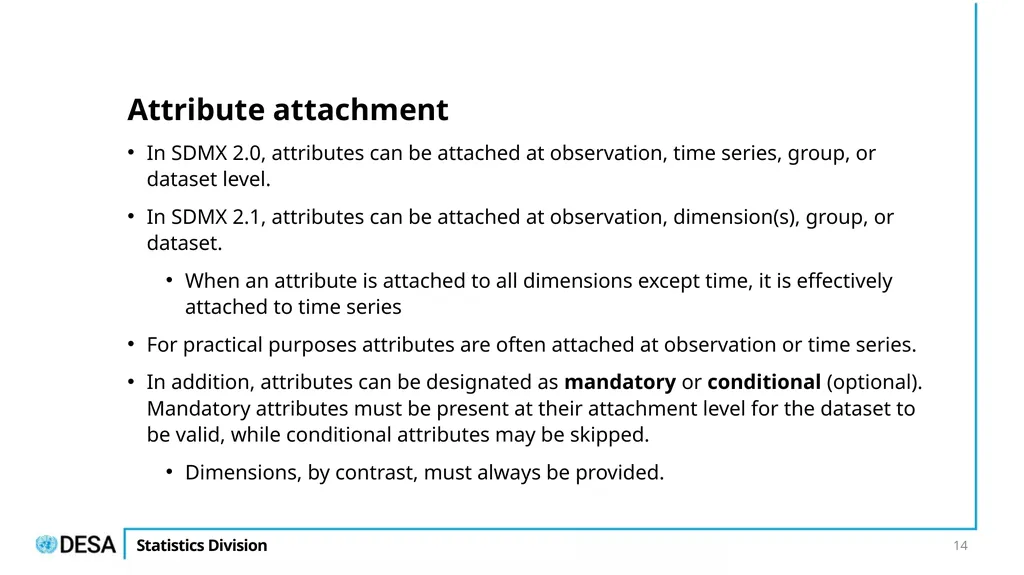
Attribute attachment In SDMX 2.0, attributes can be attached at observation, time series, group, or dataset level.
In SDMX 2.1, attributes can be attached at observation, dimension(s), group, or dataset.
When an attribute is attached to all dimensions except time, it is effectively attached to time series
For practical purposes attributes are often attached at observation or time series.
In addition, attributes can be designated as mandatory or conditional (optional). Mandatory attributes must be present at their attachment level for the dataset to be valid, while conditional attributes may be skipped.
Dimensions, by contrast, must always be provided. 14<br>
In SDMX 2.1, attributes can be attached at observation, dimension(s), group, or dataset.
When an attribute is attached to all dimensions except time, it is effectively attached to time series
For practical purposes attributes are often attached at observation or time series.
In addition, attributes can be designated as mandatory or conditional (optional). Mandatory attributes must be present at their attachment level for the dataset to be valid, while conditional attributes may be skipped.
Dimensions, by contrast, must always be provided. 14<br>
15
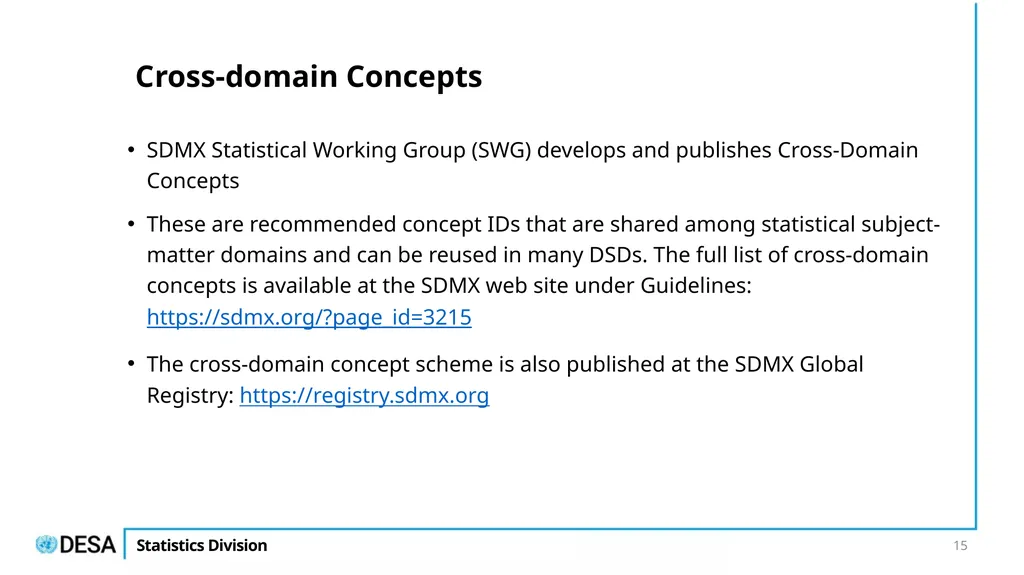
Cross-domain Concepts SDMX Statistical Working Group (SWG) develops and publishes Cross-Domain Concepts
These are recommended concept IDs that are shared among statistical subject-matter domains and can be reused in many DSDs. The full list of cross-domain concepts is available at the SDMX web site under Guidelines: https://sdmx.org/?page_id=3215
The cross-domain concept scheme is also published at the SDMX Global Registry: https://registry.sdmx.org 15<br>
These are recommended concept IDs that are shared among statistical subject-matter domains and can be reused in many DSDs. The full list of cross-domain concepts is available at the SDMX web site under Guidelines: https://sdmx.org/?page_id=3215
The cross-domain concept scheme is also published at the SDMX Global Registry: https://registry.sdmx.org 15<br>
16
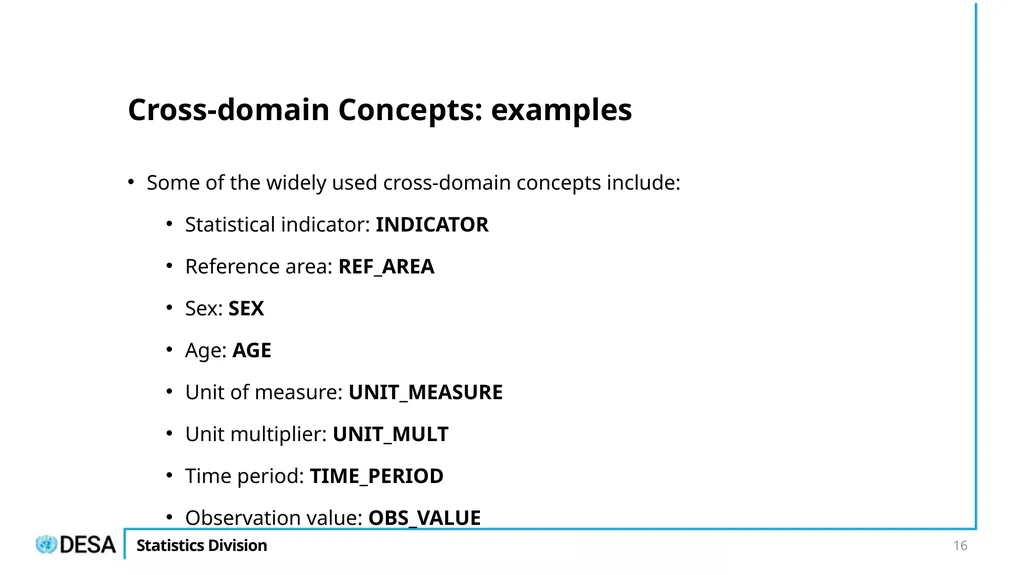
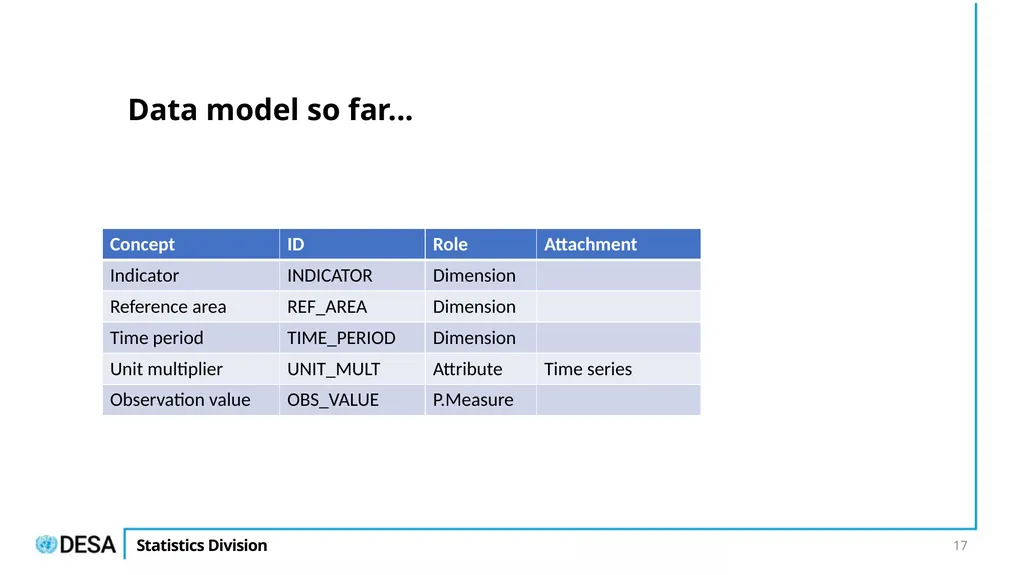
Cross-domain Concepts: examples Some of the widely used cross-domain concepts include:
Statistical indicator: INDICATOR
Reference area: REF_AREA
Sex: SEX
Age: AGE
Unit of measure: UNIT_MEASURE
Unit multiplier: UNIT_MULT
Time period: TIME_PERIOD
Observation value: OBS_VALUE 16<br>
Statistical indicator: INDICATOR
Reference area: REF_AREA
Sex: SEX
Age: AGE
Unit of measure: UNIT_MEASURE
Unit multiplier: UNIT_MULT
Time period: TIME_PERIOD
Observation value: OBS_VALUE 16<br>
17
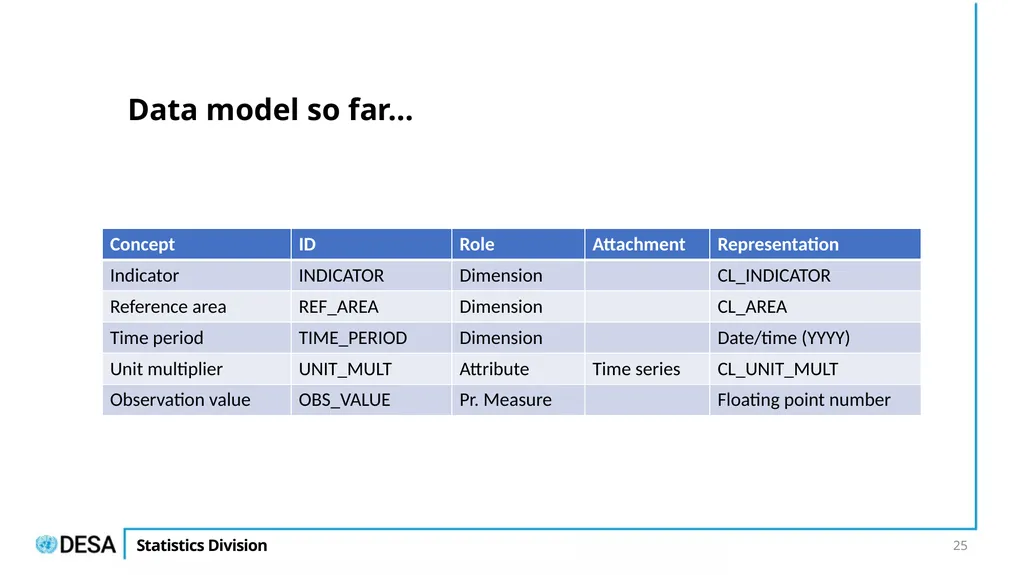
Data model so far... 17<br>
18
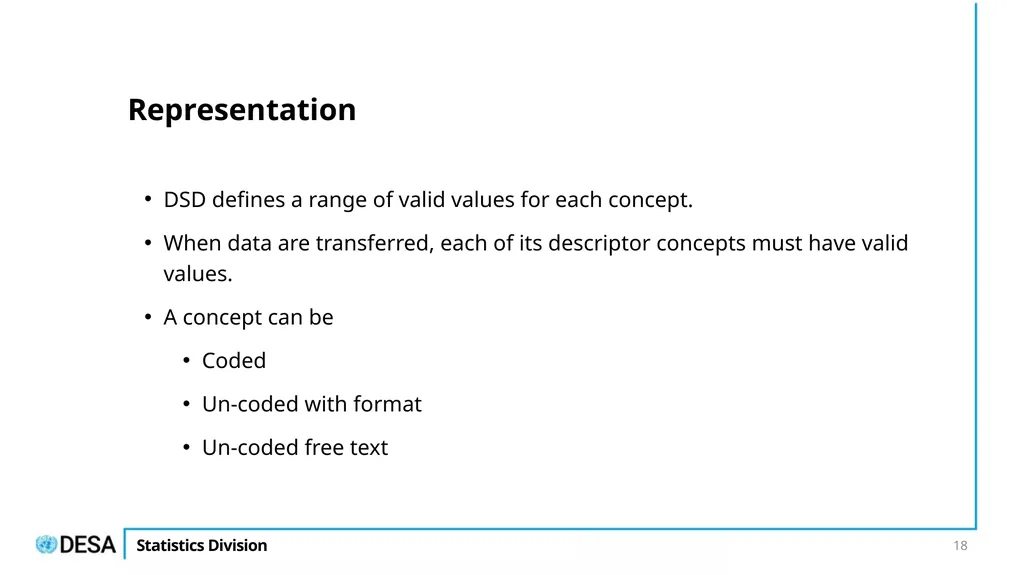
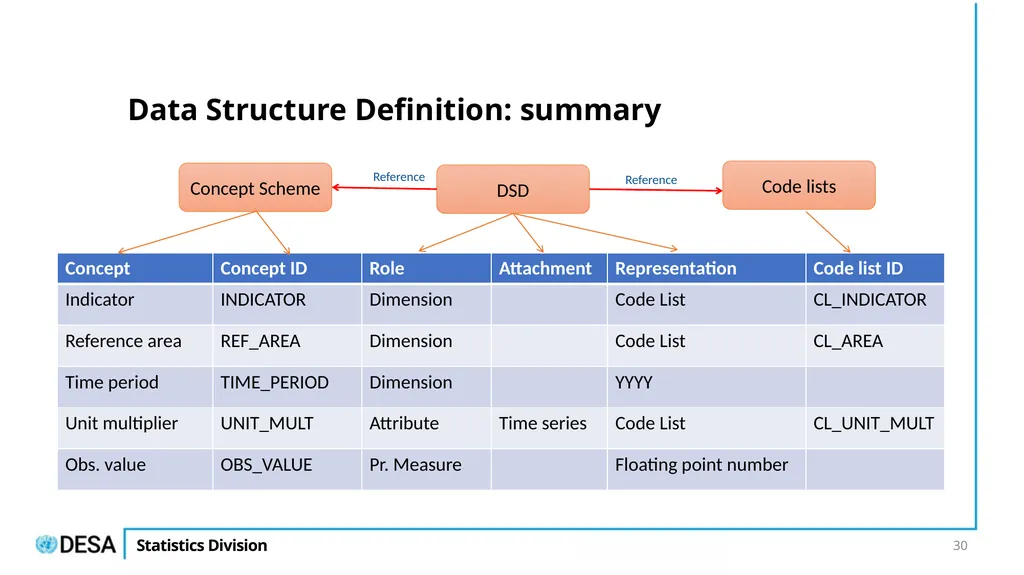
Representation DSD defines a range of valid values for each concept.
When data are transferred, each of its descriptor concepts must have valid values.
A concept can be
Coded
Un-coded with format
Un-coded free text 18<br>
When data are transferred, each of its descriptor concepts must have valid values.
A concept can be
Coded
Un-coded with format
Un-coded free text 18<br>
19
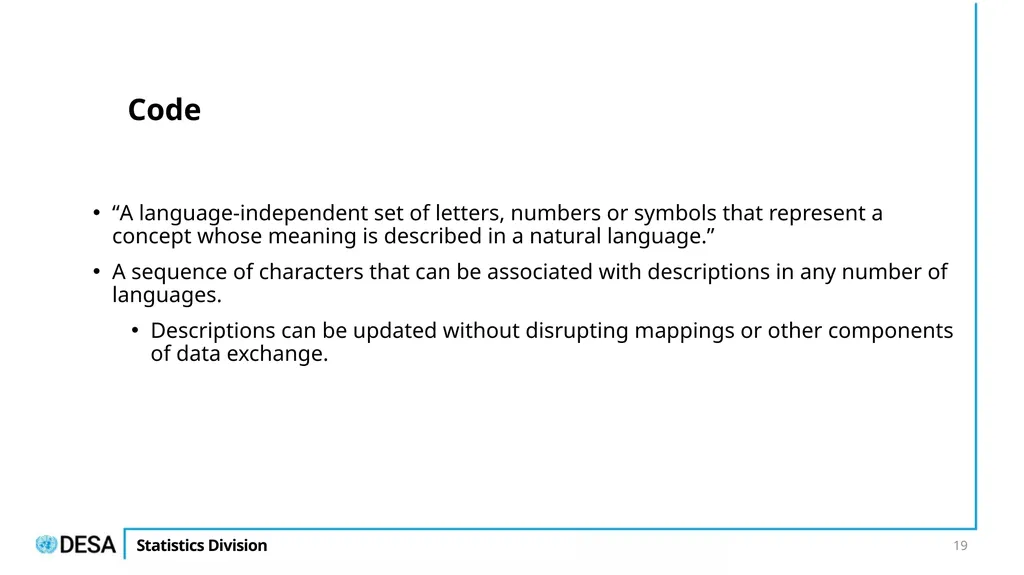
Code “A language-independent set of letters, numbers or symbols that represent a concept whose meaning is described in a natural language.”
A sequence of characters that can be associated with descriptions in any number of languages.
Descriptions can be updated without disrupting mappings or other components of data exchange. 19<br>
A sequence of characters that can be associated with descriptions in any number of languages.
Descriptions can be updated without disrupting mappings or other components of data exchange. 19<br>
20
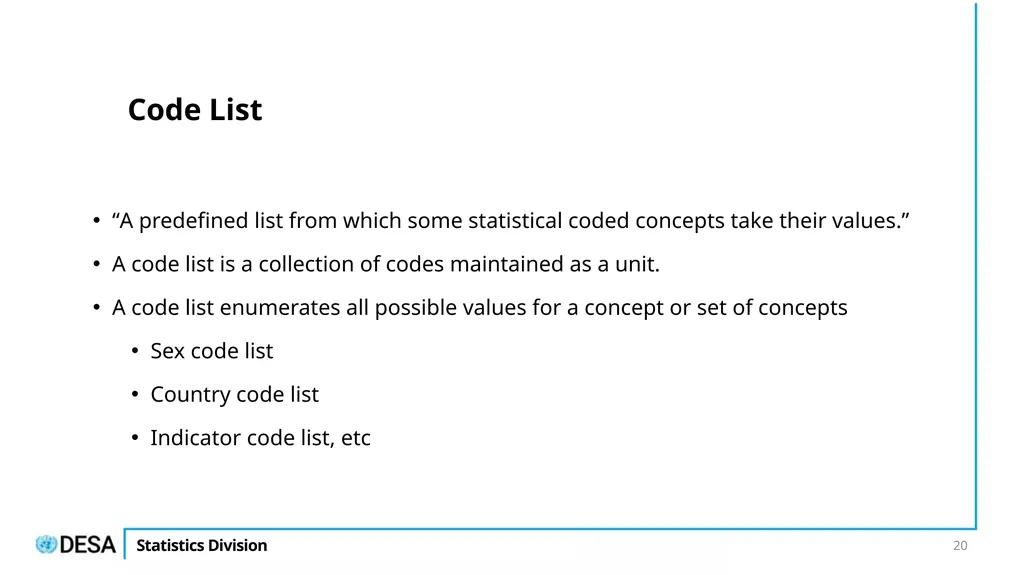
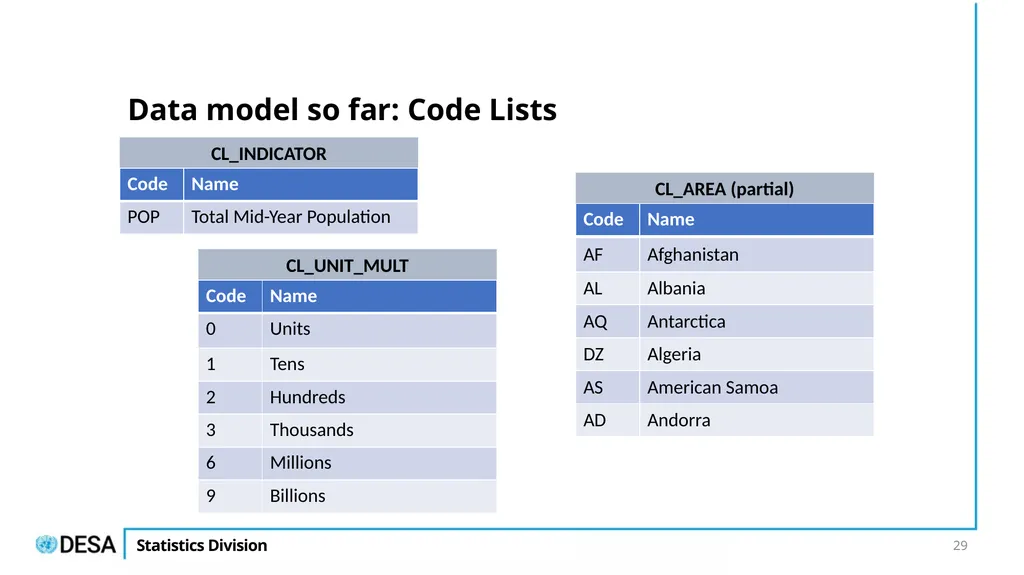
Code List “A predefined list from which some statistical coded concepts take their values.”
A code list is a collection of codes maintained as a unit.
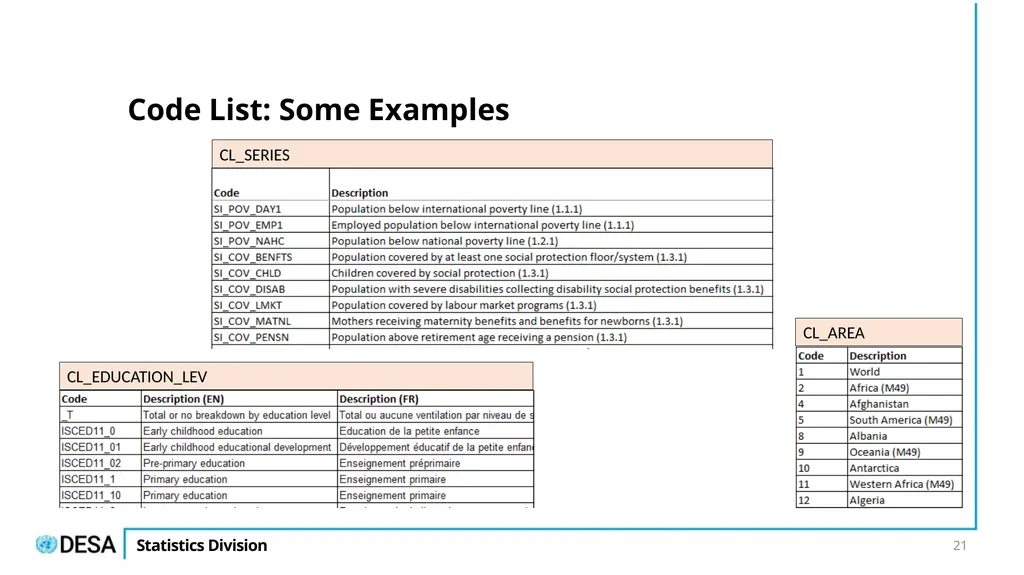
A code list enumerates all possible values for a concept or set of concepts
Sex code list
Country code list
Indicator code list, etc 20<br>
A code list is a collection of codes maintained as a unit.
A code list enumerates all possible values for a concept or set of concepts
Sex code list
Country code list
Indicator code list, etc 20<br>
21
Code List: Some Examples 21<br>
22
SDMX Concepts and Code lists Code lists provide a representation for concepts, in terms of Codes.
Codes are language-independent and may include descriptions in multiple languages.
Code lists must be harmonized among all data providers that will be involved in exchange. 22<br>
Codes are language-independent and may include descriptions in multiple languages.
Code lists must be harmonized among all data providers that will be involved in exchange. 22<br>
23
Un-coded Concepts Can be free-text: Any valid text can be used as a value for the concept.
Footnote
Can have their format specified
Postal code: 5 digits
Last update: date/time 23<br>
Footnote
Can have their format specified
Postal code: 5 digits
Last update: date/time 23<br>
24
Representation of concepts in SDMX Dimensions must be either coded or have their format specified.
Free text is not allowed.
Attributes can be coded or un-coded; format may optionally be specified. 24<br>
Free text is not allowed.
Attributes can be coded or un-coded; format may optionally be specified. 24<br>
25
Data model so far… 25<br>
26
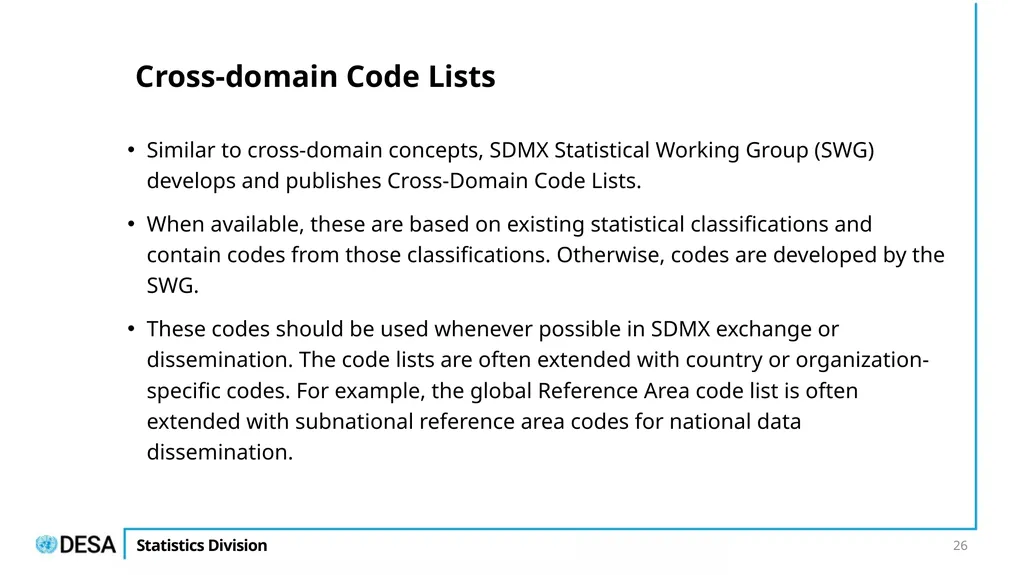
Cross-domain Code Lists Similar to cross-domain concepts, SDMX Statistical Working Group (SWG) develops and publishes Cross-Domain Code Lists.
When available, these are based on existing statistical classifications and contain codes from those classifications. Otherwise, codes are developed by the SWG.
These codes should be used whenever possible in SDMX exchange or dissemination. The code lists are often extended with country or organization-specific codes. For example, the global Reference Area code list is often extended with subnational reference area codes for national data dissemination. 26<br>
When available, these are based on existing statistical classifications and contain codes from those classifications. Otherwise, codes are developed by the SWG.
These codes should be used whenever possible in SDMX exchange or dissemination. The code lists are often extended with country or organization-specific codes. For example, the global Reference Area code list is often extended with subnational reference area codes for national data dissemination. 26<br>
27
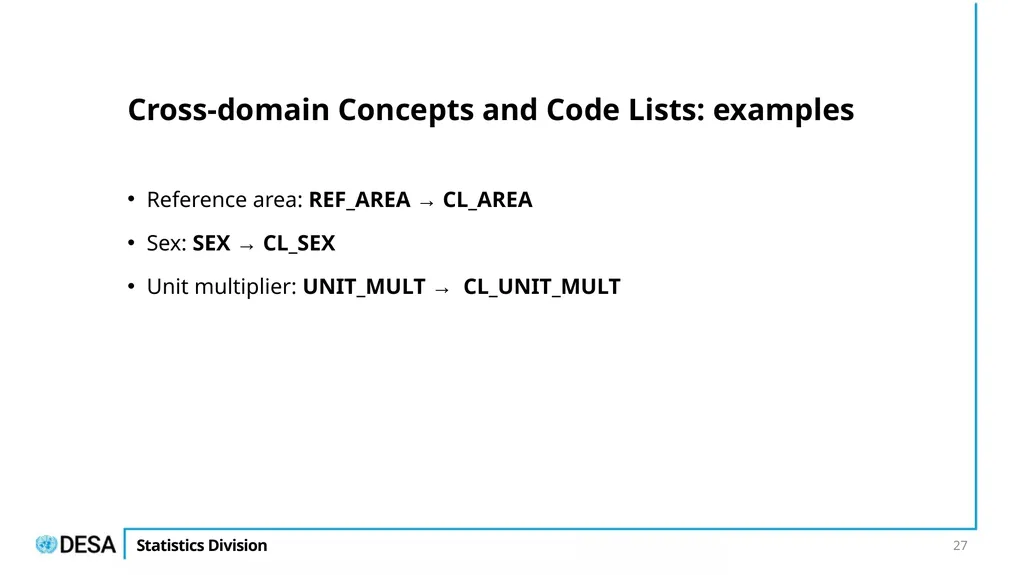
Cross-domain Concepts and Code Lists: examples Reference area: REF_AREA → CL_AREA
Sex: SEX → CL_SEX
Unit multiplier: UNIT_MULT → CL_UNIT_MULT 27<br>
Sex: SEX → CL_SEX
Unit multiplier: UNIT_MULT → CL_UNIT_MULT 27<br>
28
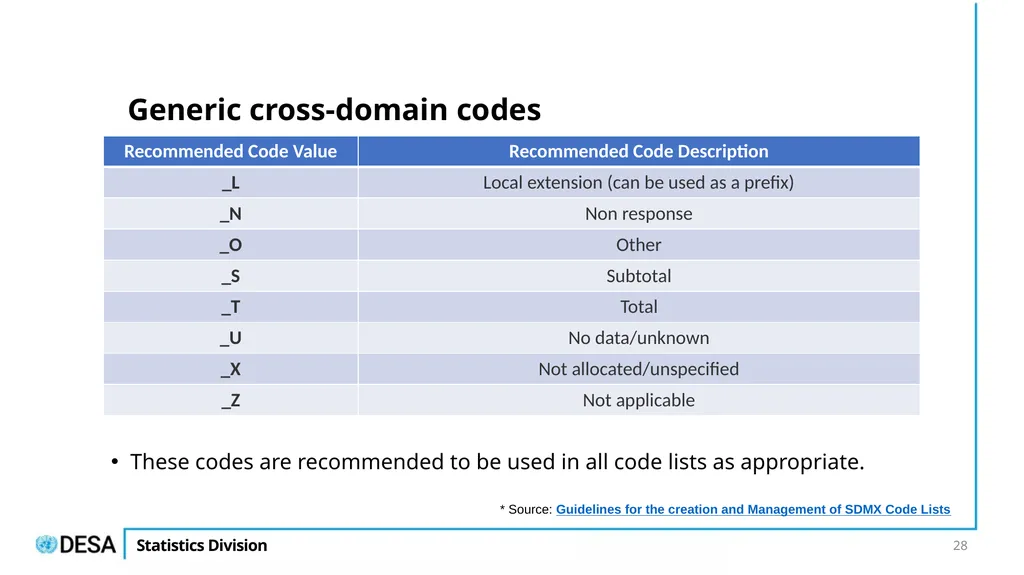
Generic cross-domain codes 28 These codes are recommended to be used in all code lists as appropriate. * Source: Guidelines for the creation and Management of SDMX Code Lists<br>
29
Data model so far: Code Lists 29<br>
30
Data Structure Definition: summary 30<br>
31
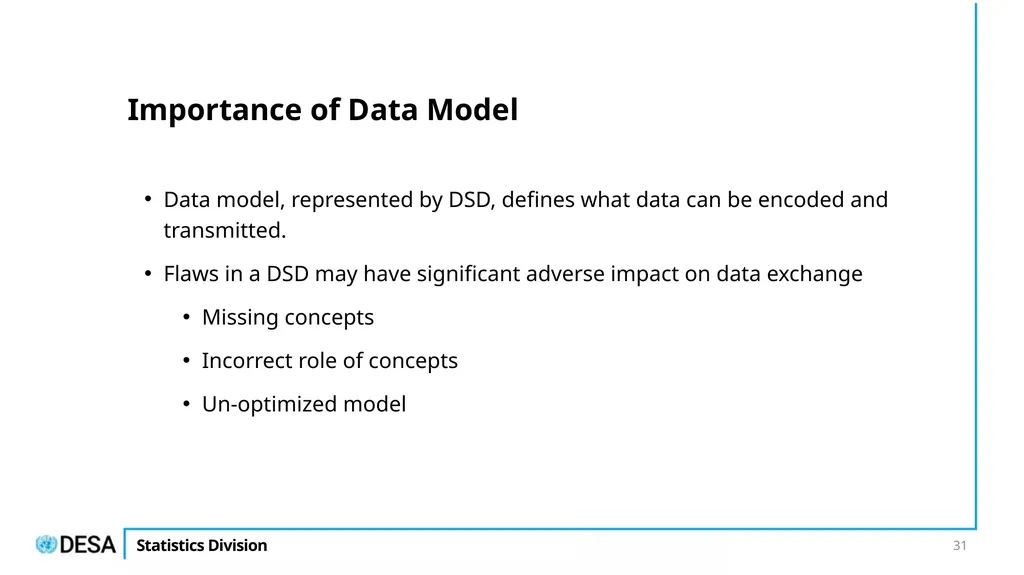
Importance of Data Model Data model, represented by DSD, defines what data can be encoded and transmitted.
Flaws in a DSD may have significant adverse impact on data exchange
Missing concepts
Incorrect role of concepts
Un-optimized model 31<br>
Flaws in a DSD may have significant adverse impact on data exchange
Missing concepts
Incorrect role of concepts
Un-optimized model 31<br>
32
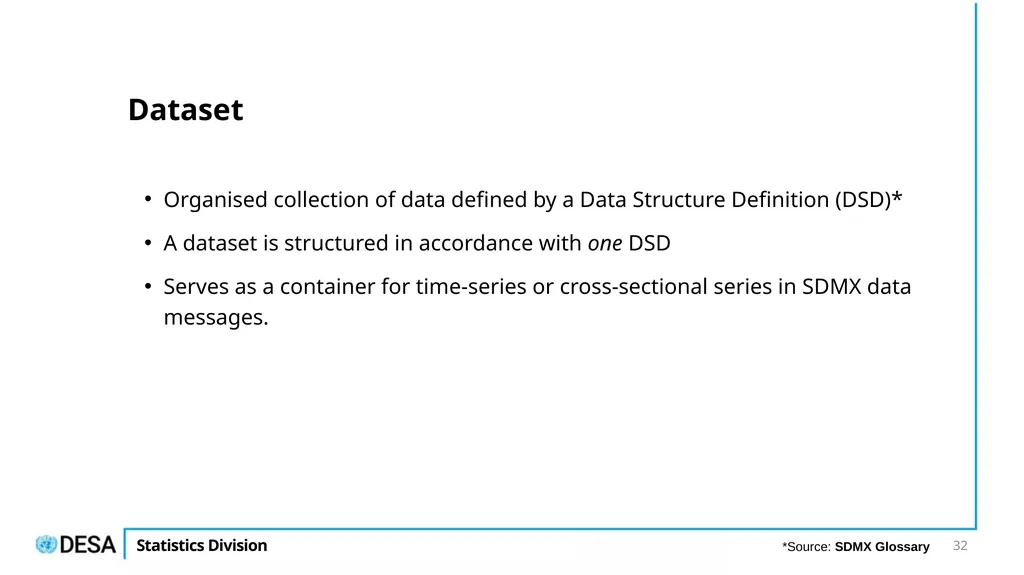
Dataset Organised collection of data defined by a Data Structure Definition (DSD)*
A dataset is structured in accordance with one DSD
Serves as a container for time-series or cross-sectional series in SDMX data messages. 32 *Source: SDMX Glossary<br>
A dataset is structured in accordance with one DSD
Serves as a container for time-series or cross-sectional series in SDMX data messages. 32 *Source: SDMX Glossary<br>
33
Time Series A set of observations of a particular variable, taken at different points in time.
Observations that belong to the same time series, differ in their time dimension.
All other dimension values are identical.
Observation-level attributes may differ across observations of the same time series. 33<br>
Observations that belong to the same time series, differ in their time dimension.
All other dimension values are identical.
Observation-level attributes may differ across observations of the same time series. 33<br>
34
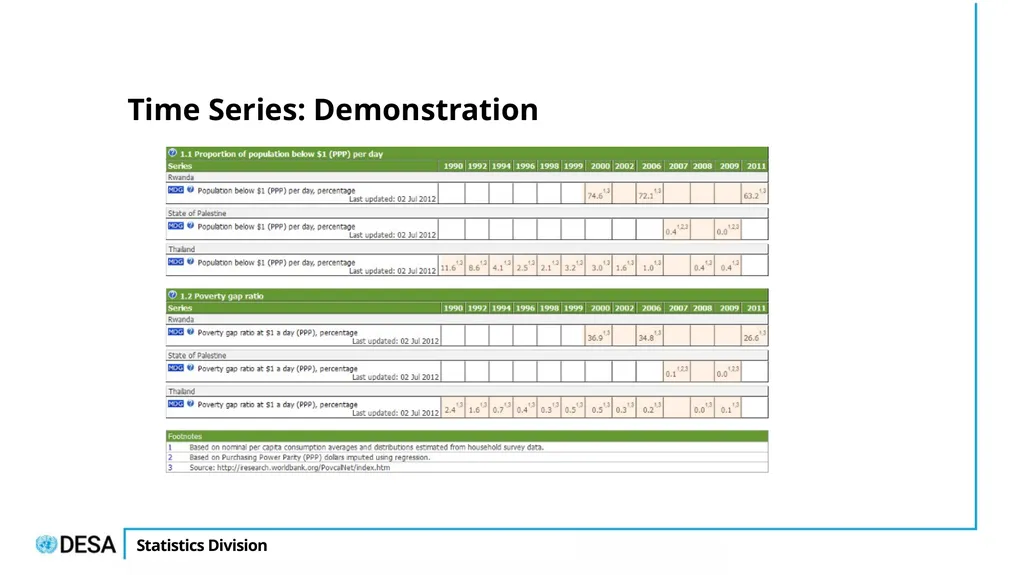
Time Series: Demonstration<br>
35
Non-Time Series Data
(a.k.a. Cross-Sectional Data1) A non-time dimension(s) is chosen along which a set of observations is constructed.
E.g. for a survey or census the time is usually fixed and another dimension may be chosen to be reported at the observation level
Used less frequently than time series representation 35 1 The term "Cross-sectional" was discontinued in SDMX 2.1<br>
E.g. for a survey or census the time is usually fixed and another dimension may be chosen to be reported at the observation level
Used less frequently than time series representation 35 1 The term "Cross-sectional" was discontinued in SDMX 2.1<br>
36
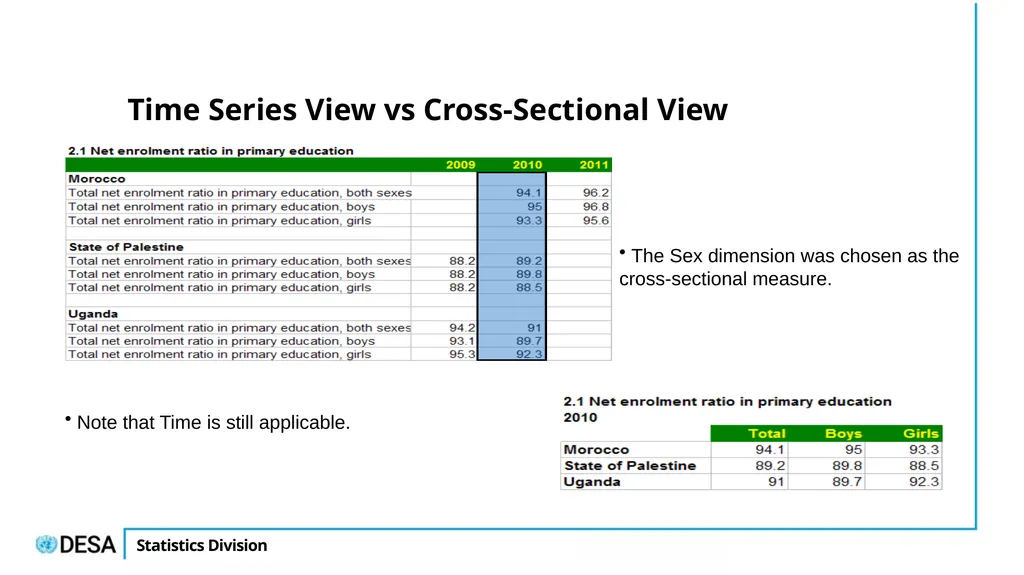
Time Series View vs Cross-Sectional View 36 The Sex dimension was chosen as the cross-sectional measure. Note that Time is still applicable.<br>
37
Keys in SDMX Series key uniquely identifies a series
In the case of time series, consists of all dimensions except time
Group key uniquely identifies a group of time series
Consists of a subset of the series key 37<br>
In the case of time series, consists of all dimensions except time
Group key uniquely identifies a group of time series
Consists of a subset of the series key 37<br>
38
Structural and Reference Metadata Structural Metadata: Identifiers and Descriptors, e.g.
Data Structure Definition
Concept Scheme
Code
Reference Metadata: Describes contents and quality of data, e.g.
Indicator definition
Comments and limitations 38 What we have covered
so far<br>
Data Structure Definition
Concept Scheme
Code
Reference Metadata: Describes contents and quality of data, e.g.
Indicator definition
Comments and limitations 38 What we have covered
so far<br>
39
Reference Metadata in SDMX Can be stored or exchanged separately from the object it describes, but be linked to it
Can be indexed and searched
Reported according to a defined structure 39<br>
Can be indexed and searched
Reported according to a defined structure 39<br>
40
Metadata Structure Definition (MSD) MSD Defines:
The object type to which reference metadata can be associated
E.g. DSD, Dataflow.
The components comprising the object identifier of the target object
E.g. the draft SDG MSD allows metadata to be attached a partial key.
Concepts used to express metadata (“metadata attributes”).
E.g. Indicator Definition, Quality Management 40<br>
The object type to which reference metadata can be associated
E.g. DSD, Dataflow.
The components comprising the object identifier of the target object
E.g. the draft SDG MSD allows metadata to be attached a partial key.
Concepts used to express metadata (“metadata attributes”).
E.g. Indicator Definition, Quality Management 40<br>
41
Reference metadata in SDMX 3.0 Reference metadata support will be redesigned in SDMX 3.0.
To simplify implementation, discovery, and use
It will be possible to declare reference metadata concepts directly in the DSD, and transmit reference metadata as part of a dataset or in a separate message.
Metadata Structure Definitions, metadata sets, and metadata flows will still be supported for higher-level metadata that is not attached to specific datasets.
It is expected that simplification of reference metadata will lead to its implementation in common tools as well as much broader usage. 41<br>
To simplify implementation, discovery, and use
It will be possible to declare reference metadata concepts directly in the DSD, and transmit reference metadata as part of a dataset or in a separate message.
Metadata Structure Definitions, metadata sets, and metadata flows will still be supported for higher-level metadata that is not attached to specific datasets.
It is expected that simplification of reference metadata will lead to its implementation in common tools as well as much broader usage. 41<br>
42
Dataflow and Metadataflow Dataflow defines a “view” on a Data Structure Definition
Can be constrained to a subset of codes in any dimension
Can be categorized, i.e. can have categories attached
In its simplest form defines any data valid according to a DSD
Similarly, Metadataflow defines a view on a Metadata Structure Definition. 42<br>
Can be constrained to a subset of codes in any dimension
Can be categorized, i.e. can have categories attached
In its simplest form defines any data valid according to a DSD
Similarly, Metadataflow defines a view on a Metadata Structure Definition. 42<br>
43
Content Constraints Constraints can be used to define which codes or combinations of codes are allowed (or disallowed)
Constraints can define more granular validation rules than a simple validation of codes
Are often attached to the Dataflow but can also be attached to DSD, Provision Agreement, etc 43<br>
Constraints can define more granular validation rules than a simple validation of codes
Are often attached to the Dataflow but can also be attached to DSD, Provision Agreement, etc 43<br>
44
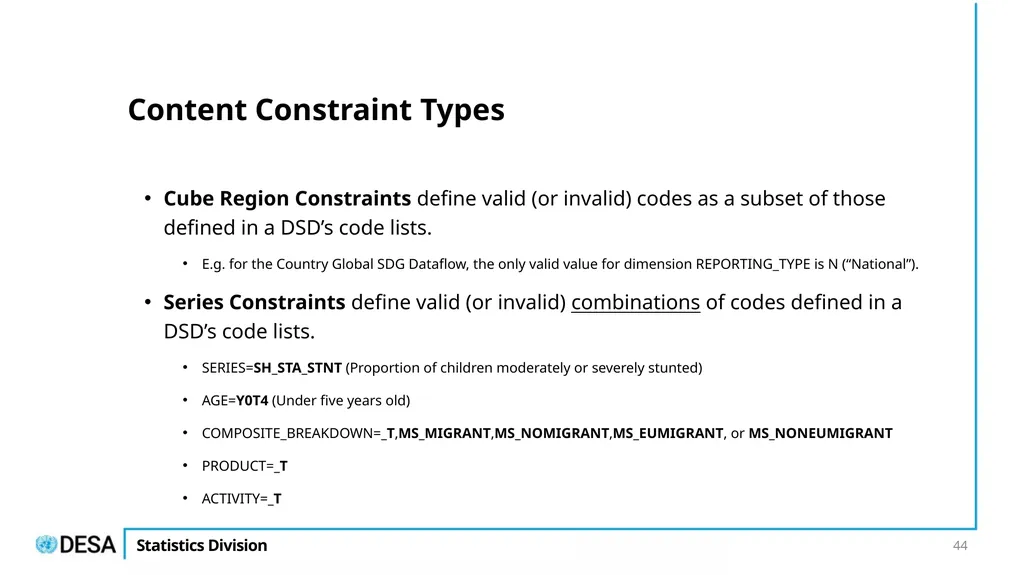
Content Constraint Types Cube Region Constraints define valid (or invalid) codes as a subset of those defined in a DSD’s code lists.
E.g. for the Country Global SDG Dataflow, the only valid value for dimension REPORTING_TYPE is N (“National”).
Series Constraints define valid (or invalid) combinations of codes defined in a DSD’s code lists.
SERIES=SH_STA_STNT (Proportion of children moderately or severely stunted)
AGE=Y0T4 (Under five years old)
COMPOSITE_BREAKDOWN=_T,MS_MIGRANT,MS_NOMIGRANT,MS_EUMIGRANT, or MS_NONEUMIGRANT
PRODUCT=_T
ACTIVITY=_T 44<br>
E.g. for the Country Global SDG Dataflow, the only valid value for dimension REPORTING_TYPE is N (“National”).
Series Constraints define valid (or invalid) combinations of codes defined in a DSD’s code lists.
SERIES=SH_STA_STNT (Proportion of children moderately or severely stunted)
AGE=Y0T4 (Under five years old)
COMPOSITE_BREAKDOWN=_T,MS_MIGRANT,MS_NOMIGRANT,MS_EUMIGRANT, or MS_NONEUMIGRANT
PRODUCT=_T
ACTIVITY=_T 44<br>
45
Category, Category Scheme, and Categorisation Category is a way of classifying data for reporting or dissemination
Subject matter-domains are commonly implemented as Categories, such as “Demographic Statistics”, “Economic Statistics”
Category Scheme groups Categories into a maintainable unit.
Categorisation links a Category to the object to which it applies. 45<br>
Subject matter-domains are commonly implemented as Categories, such as “Demographic Statistics”, “Economic Statistics”
Category Scheme groups Categories into a maintainable unit.
Categorisation links a Category to the object to which it applies. 45<br>
46
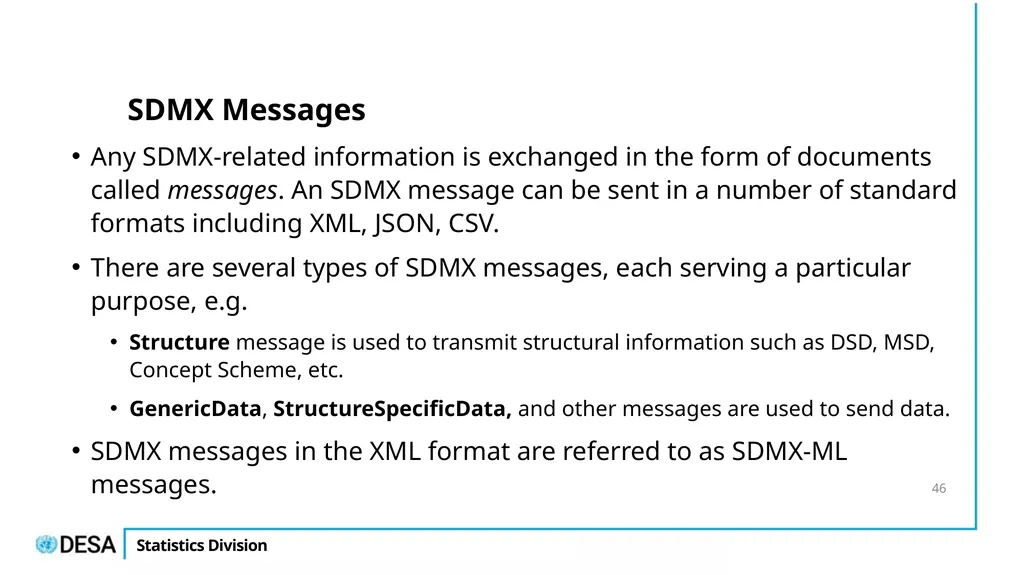
SDMX Messages Any SDMX-related information is exchanged in the form of documents called messages. An SDMX message can be sent in a number of standard formats including XML, JSON, CSV.
There are several types of SDMX messages, each serving a particular purpose, e.g.
Structure message is used to transmit structural information such as DSD, MSD, Concept Scheme, etc.
GenericData, StructureSpecificData, and other messages are used to send data.
SDMX messages in the XML format are referred to as SDMX-ML messages. 46<br>
There are several types of SDMX messages, each serving a particular purpose, e.g.
Structure message is used to transmit structural information such as DSD, MSD, Concept Scheme, etc.
GenericData, StructureSpecificData, and other messages are used to send data.
SDMX messages in the XML format are referred to as SDMX-ML messages. 46<br>
47
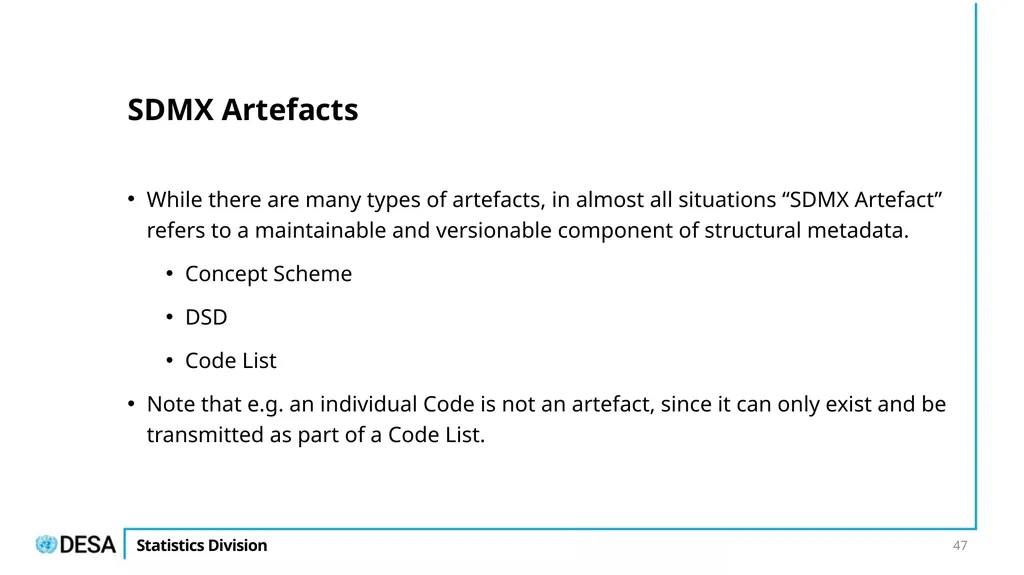
SDMX Artefacts While there are many types of artefacts, in almost all situations “SDMX Artefact” refers to a maintainable and versionable component of structural metadata.
Concept Scheme
DSD
Code List
Note that e.g. an individual Code is not an artefact, since it can only exist and be transmitted as part of a Code List. 47<br>
Concept Scheme
DSD
Code List
Note that e.g. an individual Code is not an artefact, since it can only exist and be transmitted as part of a Code List. 47<br>
48
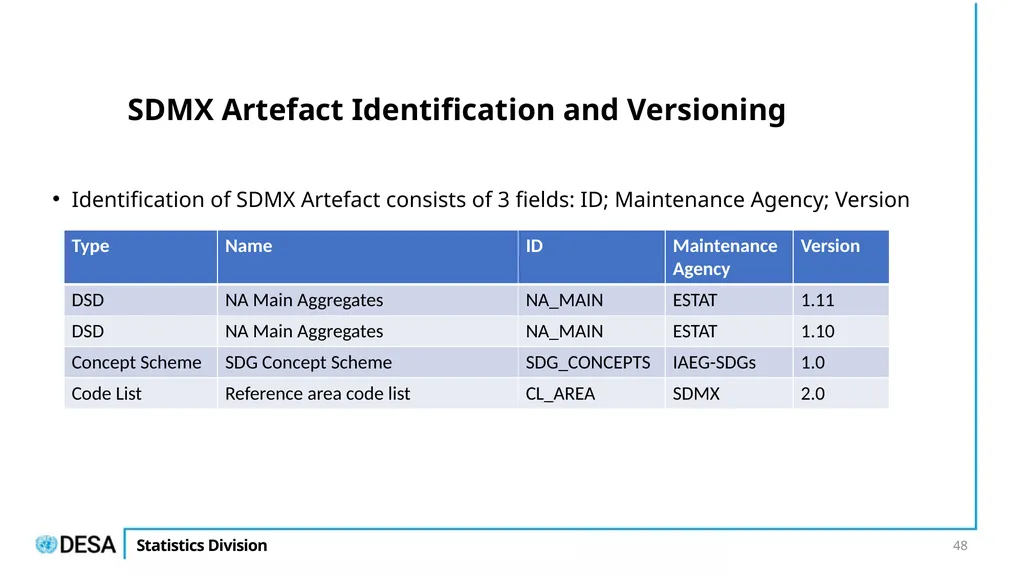
SDMX Artefact Identification and Versioning Identification of SDMX Artefact consists of 3 fields: ID; Maintenance Agency; Version 48<br>
49
THANK YOU 49<br>