
PHYSICAL ENVIRONMENT LIGHT, VENTILATION AND















Description: PHYSICAL ENVIRONMENT LIGHT, VENTILATION AND OVERCROWDING By Dr. Ajay K. Agarwal Professor, Department of Community Medicine RMCH, Bareilly LIGHT Light is electromagnetic radiation within a certain portion of the electromagnetic spectrum.
Related Topics
Download Presentation
"PHYSICAL ENVIRONMENT LIGHT, VENTILATION AND" is the property of its rightful owner. Permission is granted to download and print the materials on this website for personal, non-commercial use only, and to display it on your personal computer provided you do not modify the materials and that you retain all copyright notices contained in the materials. By downloading content from our website, you accept the terms of this agreement.
Presentation Transcript
slide1. PHYSICAL ENVIRONMENT
LIGHT, VENTILATION AND OVERCROWDING By Dr. Ajay K. Agarwal
Professor, Department of Community Medicine
RMCH, Bareilly<br>
slide2. LIGHT<br>
slide3. Light is electromagnetic radiation within a certain portion of the electromagnetic spectrum.
The word usually refers to visible light, which is visible to the human eye and is responsible for the sense of sight.
Visible light is usually defined as having wavelengths in the range of 400–700 nanometres (nm), between the infrared (with longer wavelengths) and the ultraviolet (with shorter wavelengths).<br>
slide4. LIGHT Essential for vision.
SOURCES OF LIGHT:
Natural source
Artificial source<br>
slide7. NATURAL SOURCE:
Natural source is sun.
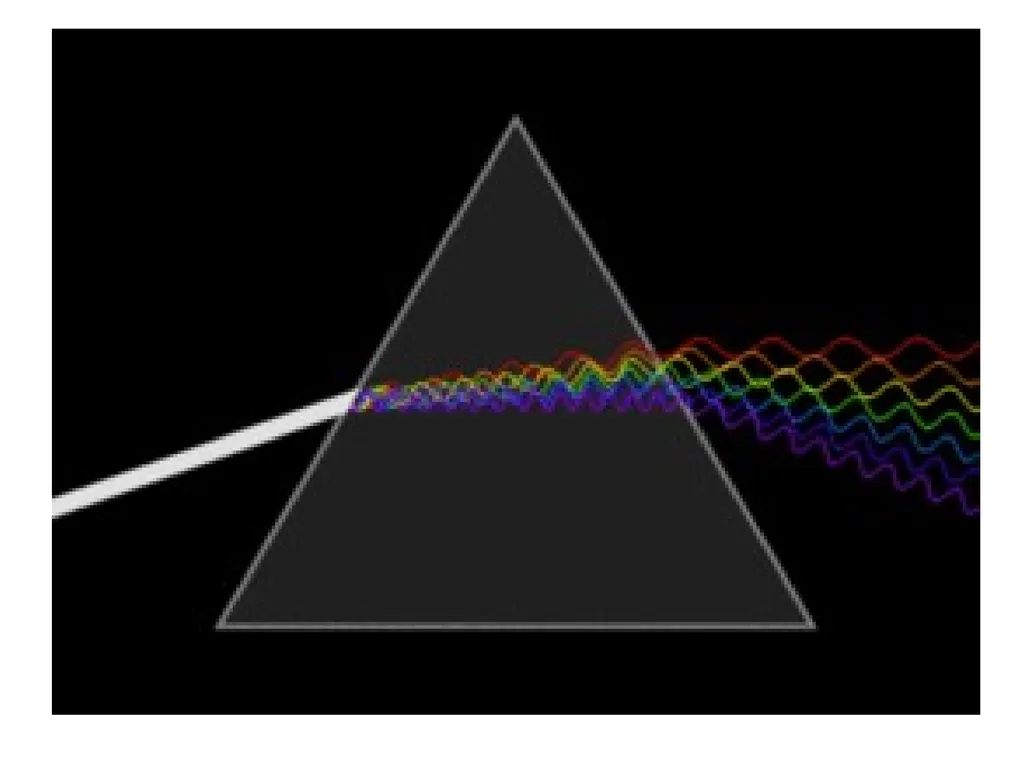
Visible rays of sunlight constitute solar spectrum.
Sunrays beyond spectrum are invisible.
Rays beyond violet end are ultraviolet rays and rays beyond red end are infrared rays<br>
slide8. DAY LIGHT FACTOR FOR CARRYING OUT WORK EFFICIENTLY WITH EFFICIENT VISION:
Sufficient illumination of 15-20 foot candles
Uniform distribution in working place.
Absence of glare (glare is excessive contrast)
Absence of sharp shadows
Steadiness of source of light
White color of light
Contrast surroundings<br>
slide9. MEASUREMENT OF LIGHT CANDLE:
Amount of light given off by burning of spermwax candle burning 120 grain per hour is called 1 candle power.
Illumination received from one candle at a distance of one foot, is known as one foot candle.
Measured by instrument photometer.<br>
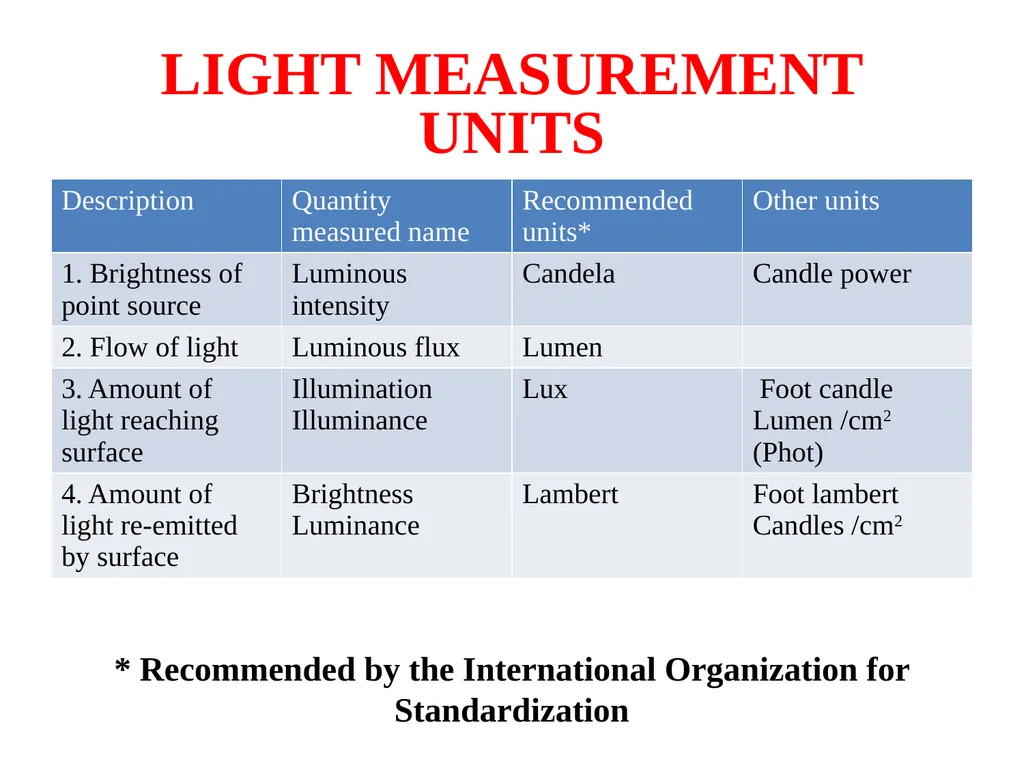
slide10. Light also measured
Luminous flux (flow of light) expressed in lumens.
Illumination (amount of light reaching a surface) expressed as lux per unit area.
Luminance (brightness i.e. amount of light refracted from a surface ) expressed as lamberts.<br>
slide11. LIGHT MEASUREMENT UNITS * Recommended by the International Organization for Standardization<br>
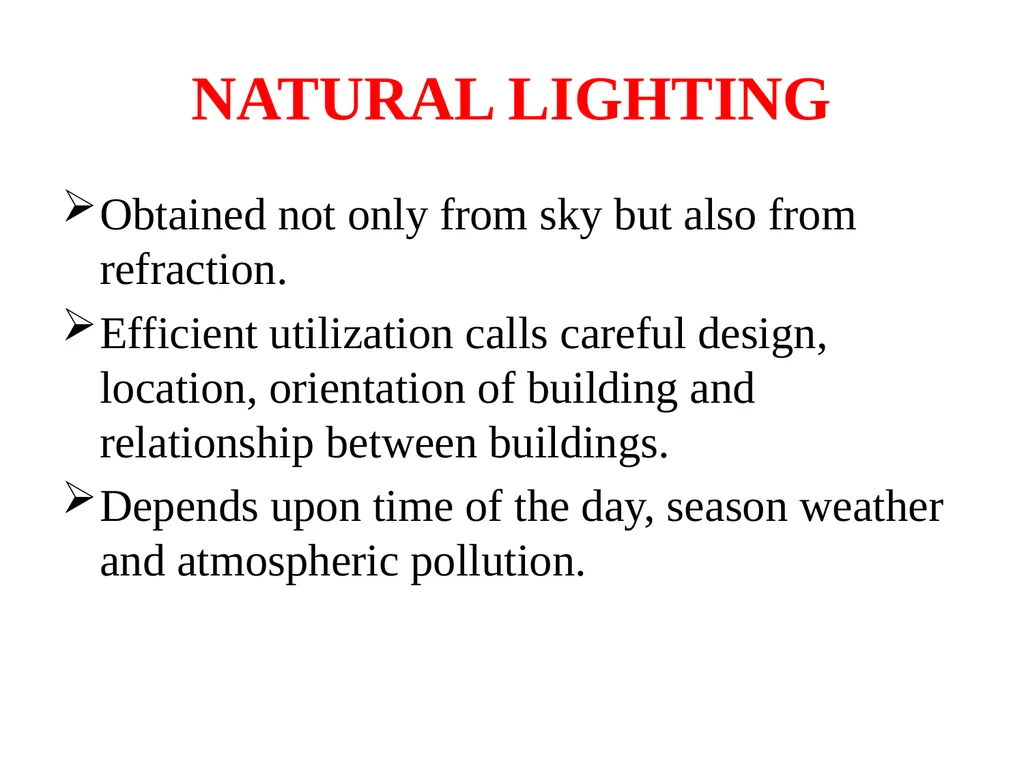
slide12. NATURAL LIGHTING Obtained not only from sky but also from refraction.
Efficient utilization calls careful design, location, orientation of building and relationship between buildings.
Depends upon time of the day, season weather and atmospheric pollution.<br>
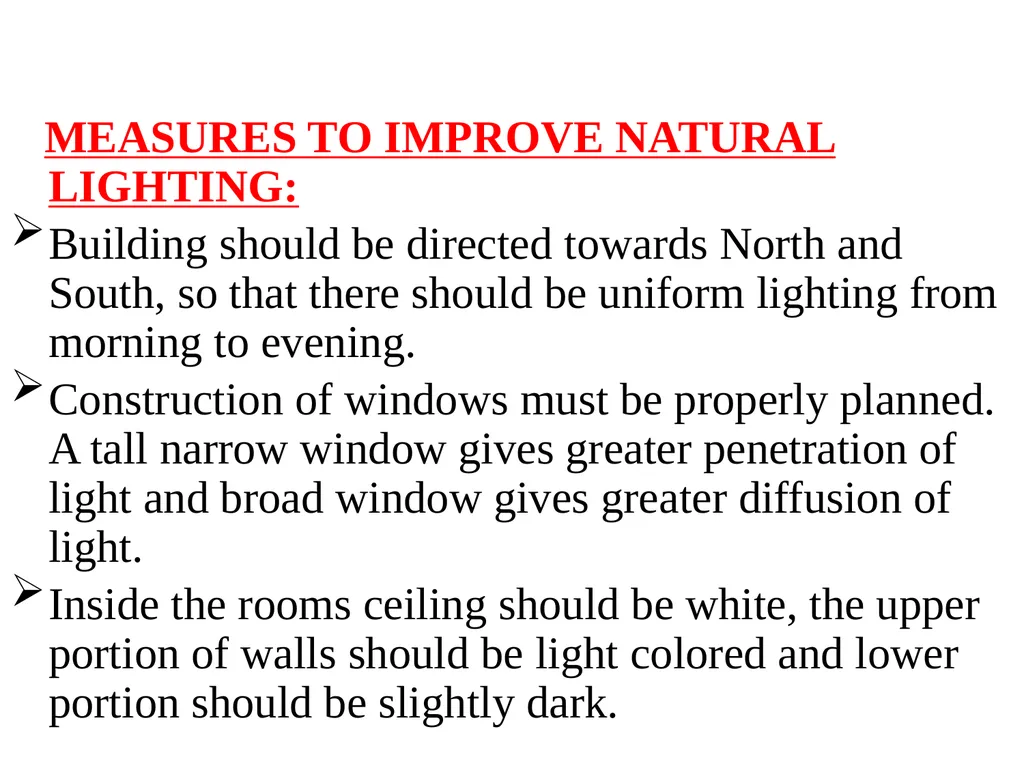
slide13. MEASURES TO IMPROVE NATURAL LIGHTING:
Building should be directed towards North and South, so that there should be uniform lighting from morning to evening.
Construction of windows must be properly planned. A tall narrow window gives greater penetration of light and broad window gives greater diffusion of light.
Inside the rooms ceiling should be white, the upper portion of walls should be light colored and lower portion should be slightly dark.<br>
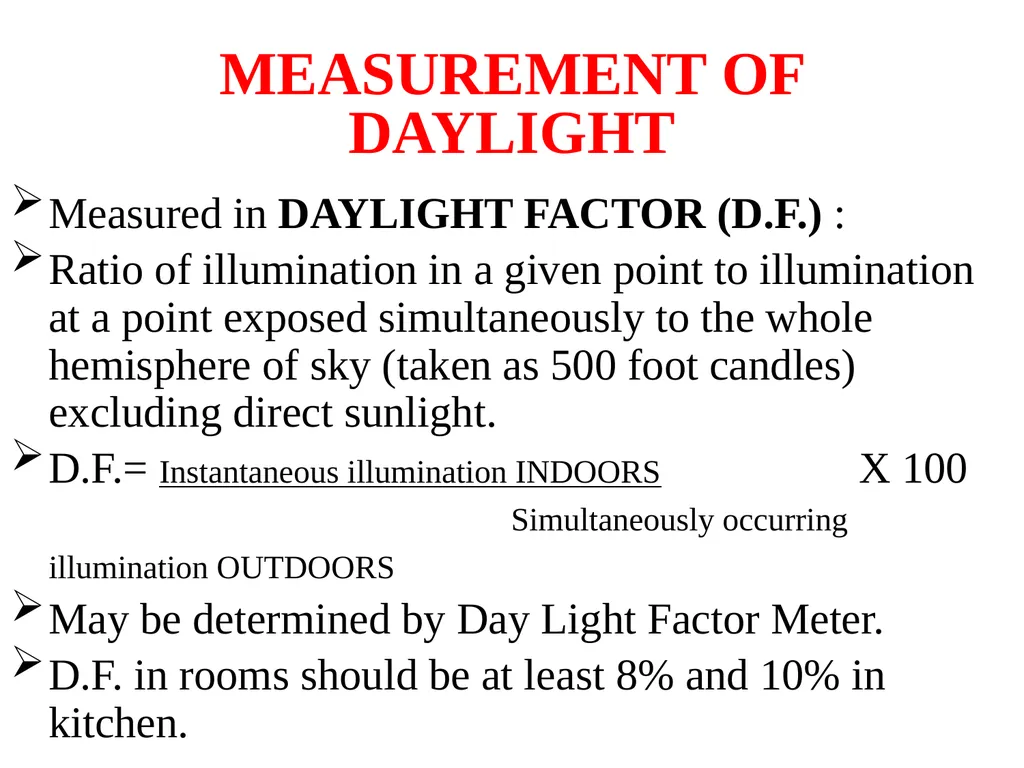
slide14. MEASUREMENT OF DAYLIGHT Measured in DAYLIGHT FACTOR (D.F.) :
Ratio of illumination in a given point to illumination at a point exposed simultaneously to the whole hemisphere of sky (taken as 500 foot candles) excluding direct sunlight.
D.F.= Instantaneous illumination INDOORS X 100 Simultaneously occurring illumination OUTDOORS
May be determined by Day Light Factor Meter.
D.F. in rooms should be at least 8% and 10% in kitchen.<br>
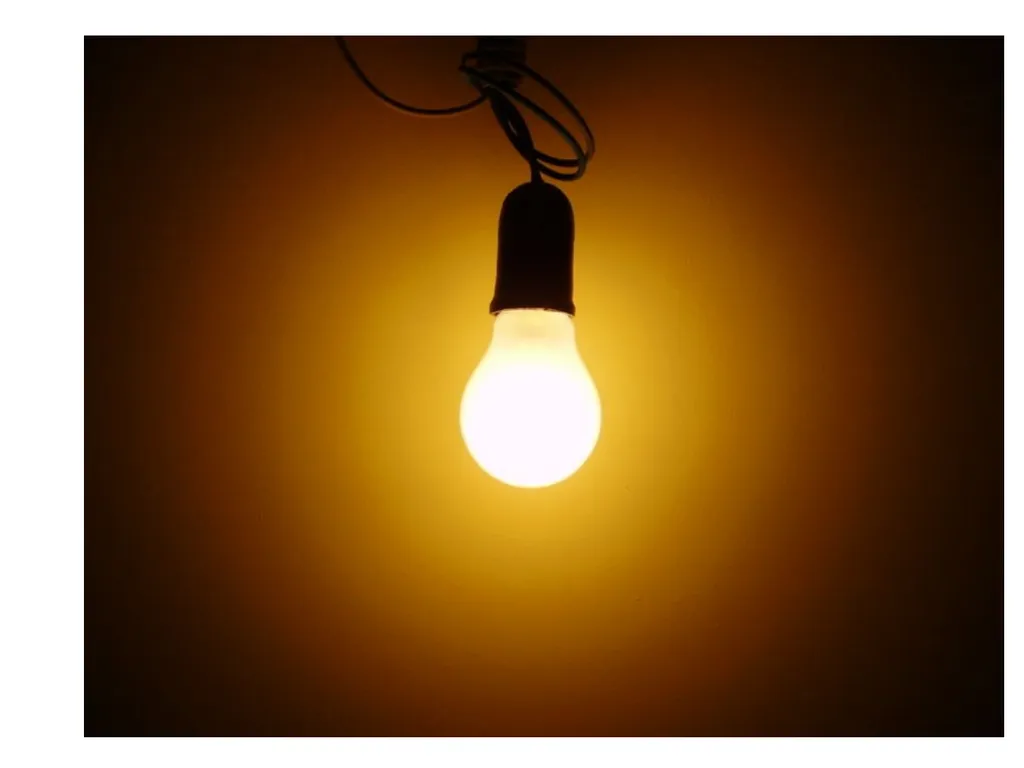
slide16. ARTIFICIAL LIGHTING Electric lighting-as no combustion nor any reduction in oxygen content of atmosphere.
Gives good, steady and bright light.
DIFFERENT TYPES OF ELECTRIC LIGHTS:
FILAMENT LAMPS:
Tungsten filament is heated and light is emitted.
Only 5% for light rest 95% expended as heat.<br>
slide17. FLUORESCENT LAMPS (VAPOR LAMPS):
Neon filled sodium discharge lamp:
Gives yellow light.
MERCURY VAPOR LAMP:
Glass tube filled with mercury vapor and electrode fitted at each end. Inside is coated with fluorescent chemicals which absorbs ultraviolet radiations<br>
slide18. COLD CATHODE NEON LAMPS:
Used for decorative purpose.
SHADOW LESS LIGHT:
Especially necessary in operation theaters.<br>
slide19. LIGHTING STANDARDS Eyes responds to a range of illumination from 0.1 lux (full moonlight night) to 100,000 lux (bright sunshine).
Visual efficacy increase with increase of illumination, but the curve flatten out at higher levels..
Rule of thumb is that illumination level should be 30 times higher than the level at which task can be just done.<br>
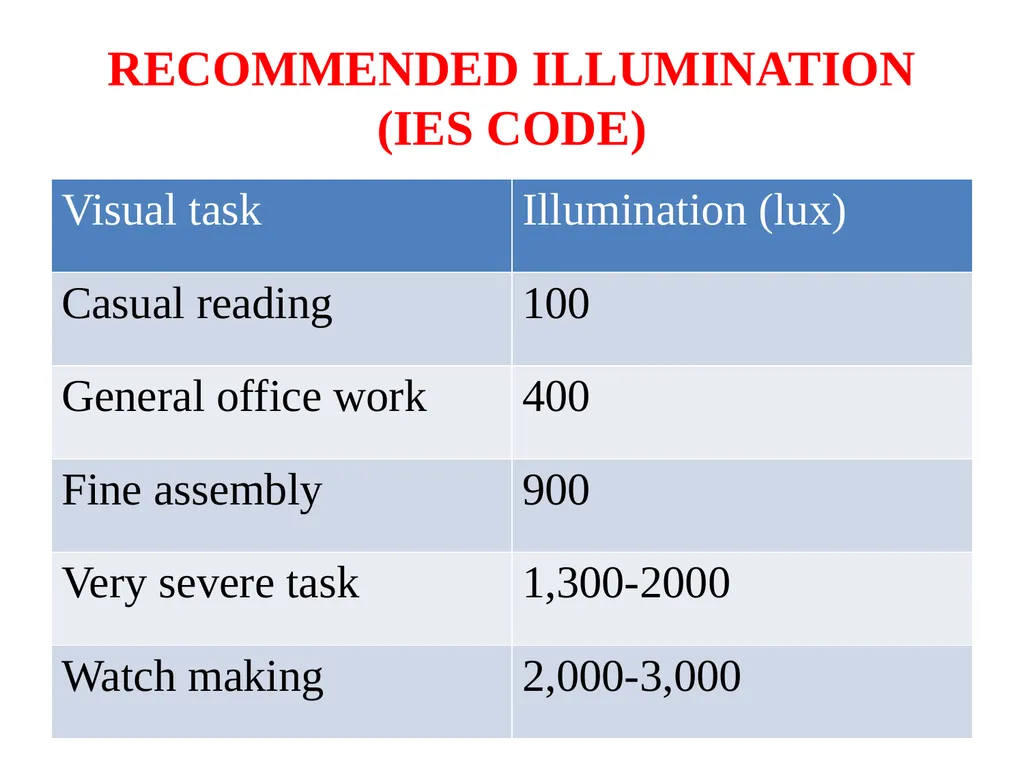
slide20. RECOMMENDED ILLUMINATION (IES CODE)<br>
slide21. BIOLOGICAL EFFECTS OF LIGHT Daylight could cause in vitro degradation of bilirubin now being used as a therapeutic measure in premature infants with hyper- bilirubinaemia.
Biologic rhythms of body temperature, physical activity, the stimulation of melanin synthesis, the activation of precursors of vitamin D, adrenocortical secretion and food consumption.<br>
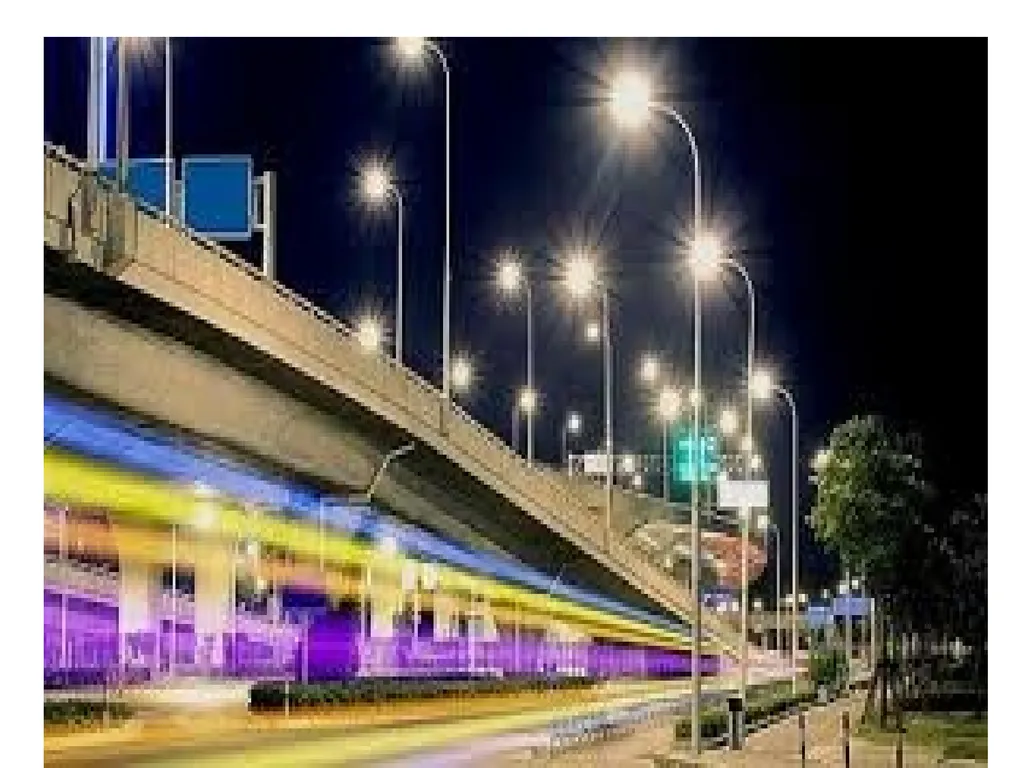
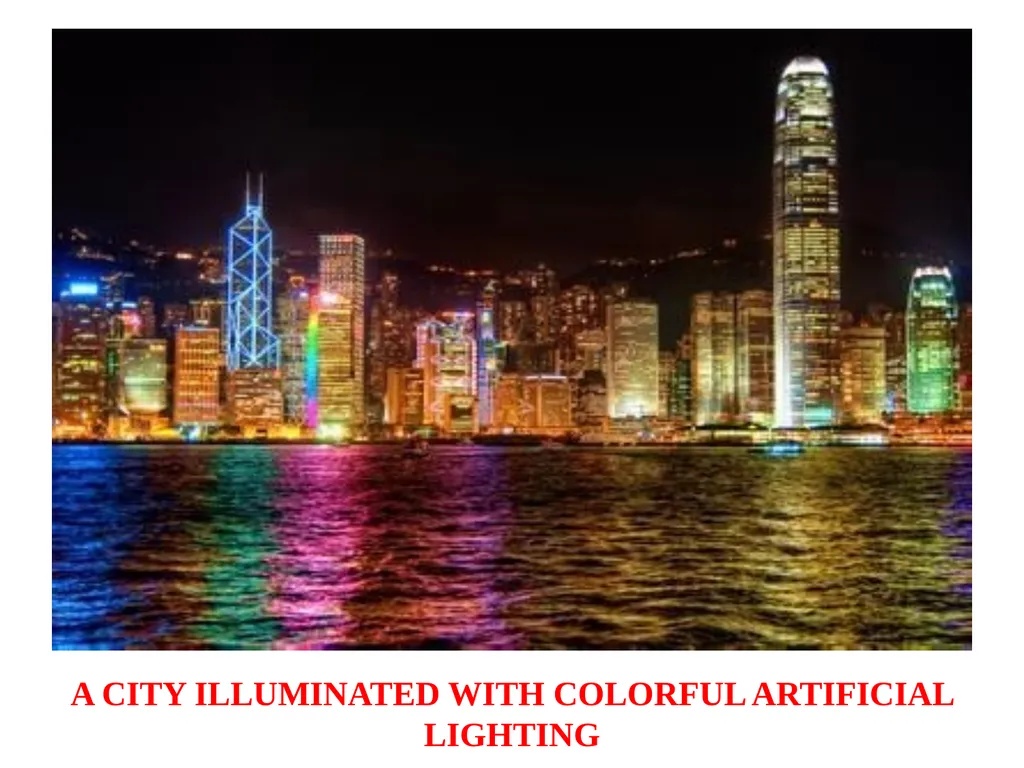
slide23. A CITY ILLUMINATED WITH COLORFUL ARTIFICIAL LIGHTING<br>
slide24. VENTILATION Replacement of vitiated air (stagnant, warm and moist air) by drier, cooler and moving air but also control of quality of incoming air.
Internal and external ventilation.
INTERNAL VENTILATION-ventilation of rooms.
EXTERNAL VENTILATION-by making street broad, building houses with sufficient gap in between and to sufficient height, watering the street to lay the dust, by keeping plenty of open spaces and parks etc.<br>
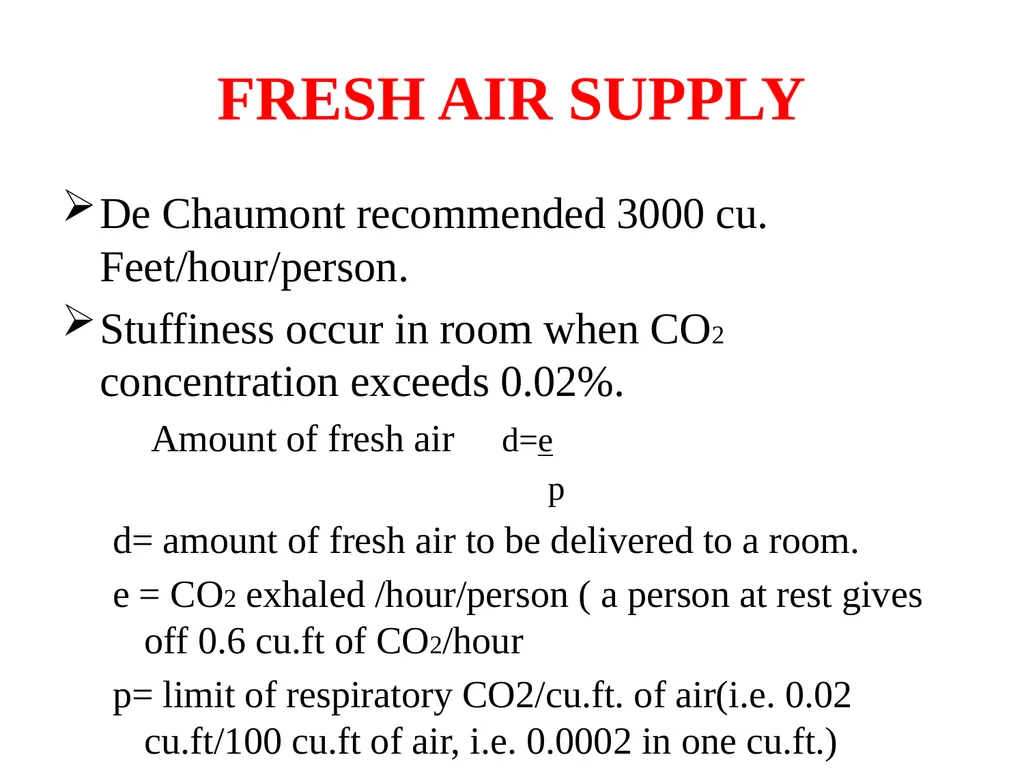
slide25. FRESH AIR SUPPLY De Chaumont recommended 3000 cu. Feet/hour/person.
Stuffiness occur in room when CO2 concentration exceeds 0.02%.
Amount of fresh air d=e
p
d= amount of fresh air to be delivered to a room.
e = CO2 exhaled /hour/person ( a person at rest gives off 0.6 cu.ft of CO2/hour
p= limit of respiratory CO2/cu.ft. of air(i.e. 0.02 cu.ft/100 cu.ft of air, i.e. 0.0002 in one cu.ft.)<br>
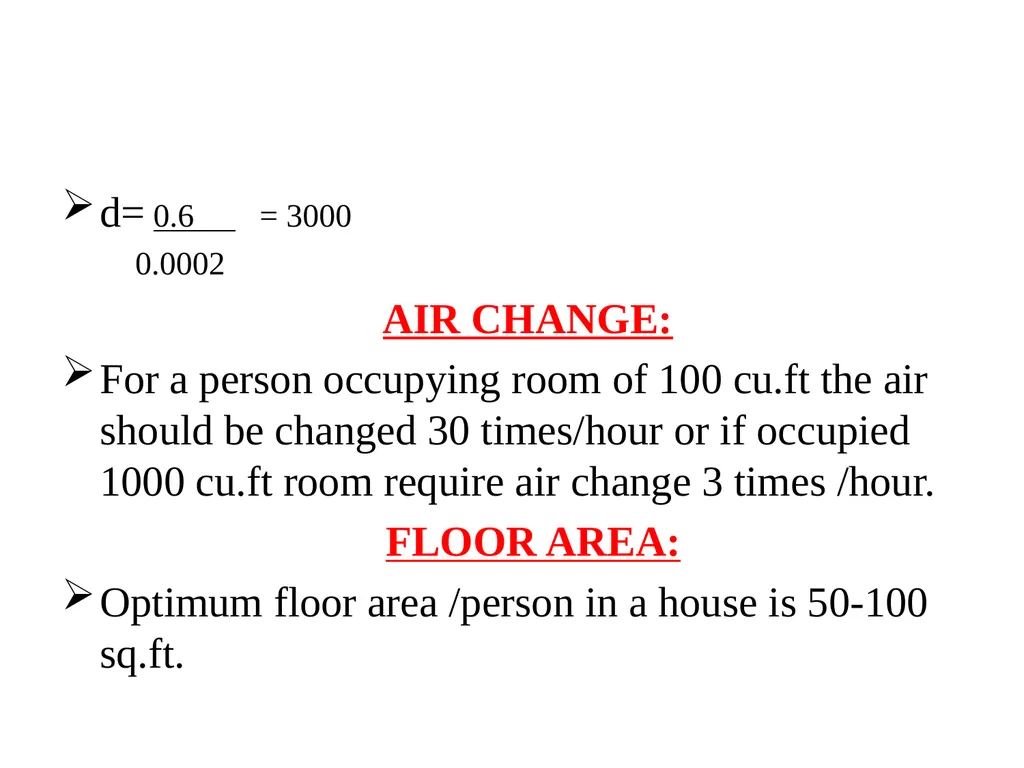
slide26. d= 0.6 = 3000
0.0002
AIR CHANGE:
For a person occupying room of 100 cu.ft the air should be changed 30 times/hour or if occupied 1000 cu.ft room require air change 3 times /hour.
FLOOR AREA:
Optimum floor area /person in a house is 50-100 sq.ft.<br>
slide27. SYSTEMS OF VENTILATION 1. Natural
2. Artificial
NATURAL VENTILATION:
Perflation and aspiration of the wind
Difference of temperature
Diffusion of gases<br>
slide28. If buildings are constructed with sufficient open space around and by having large number of windows preferably opening direct outside.
Cross ventilation means perflation between windows and other opening placed opposite to each other.<br>
slide29. PERFLATION AND ASPIRATION OF THE WIND:
Blowing of air through a room, when doors and windows are open.<br>
slide30. EFFECTS OF DIFFERENCE OF TEMPERATURE:
Air always flows from high density to low density.
Outer cooler air is of high density, inside air of room being of lower density.
Greater the difference of temperature, greater will be velocity of incoming air.<br>
slide31. DIFFUSION OF GASES:
Passing of gases through smallest opening or spaces.
Very slow and very small so as a ventilating agent , of little value.<br>
slide32. ARTIFICIAL VENTILATION (MECHANICAL VENTILATION) 1. Vacuum system
2. Plenum system
3. Balanced system
4. Air conditioning<br>
slide33. 1. VACUUM SYSTEM (EXHAUST OR EXTRACTION SYSTEM):
Fowl vitiated air is extracted or exhausted to the outside by using exhaust fan, so vacuum is created and fresh air enters in.<br>
slide34. PLENUM SYSTEM (PROPELLER SYSTEM):
Fresh air is pushed into the room by centrifugal fans or high pressure fans.
Create a positive pressure and displaces vitiated air.<br>
slide35. BALANCED SYSTEM:
Combination of both exhaust system and plenum system<br>
slide36. AIR CONDITIONING:
Outer air is conditioned or controlled with reference to physical and chemical conditions-
Cleaning free from pathogens dirt and dust, adjustment of temperature-cool or warm, adjustment of humidity and at a measured rate and volume without producing draught.<br>
slide37. Overcrowding Overcrowding:
Overcrowding refers to the situation in which more people are living within a single dwelling than there is space for, so that movement is restricted, privacy secluded, hygiene impossible, rest and sleep difficult<br>
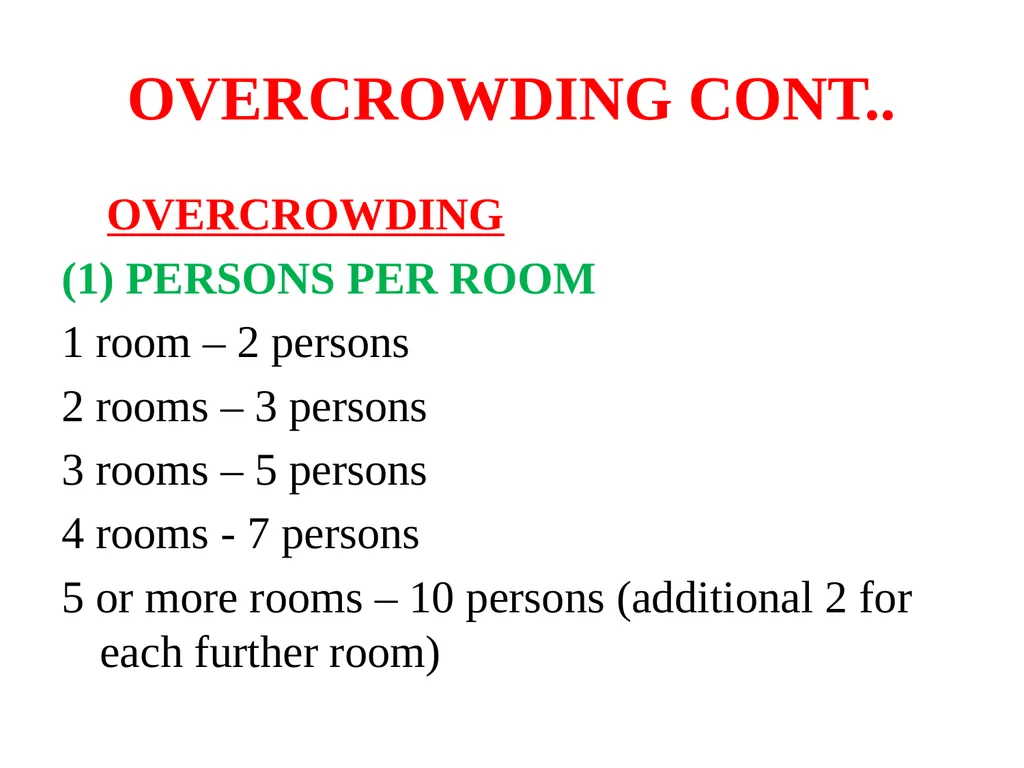
slide38. OVERCROWDING CONT.. OVERCROWDING
(1) PERSONS PER ROOM
1 room – 2 persons
2 rooms – 3 persons
3 rooms – 5 persons
4 rooms - 7 persons
5 or more rooms – 10 persons (additional 2 for each further room)<br>
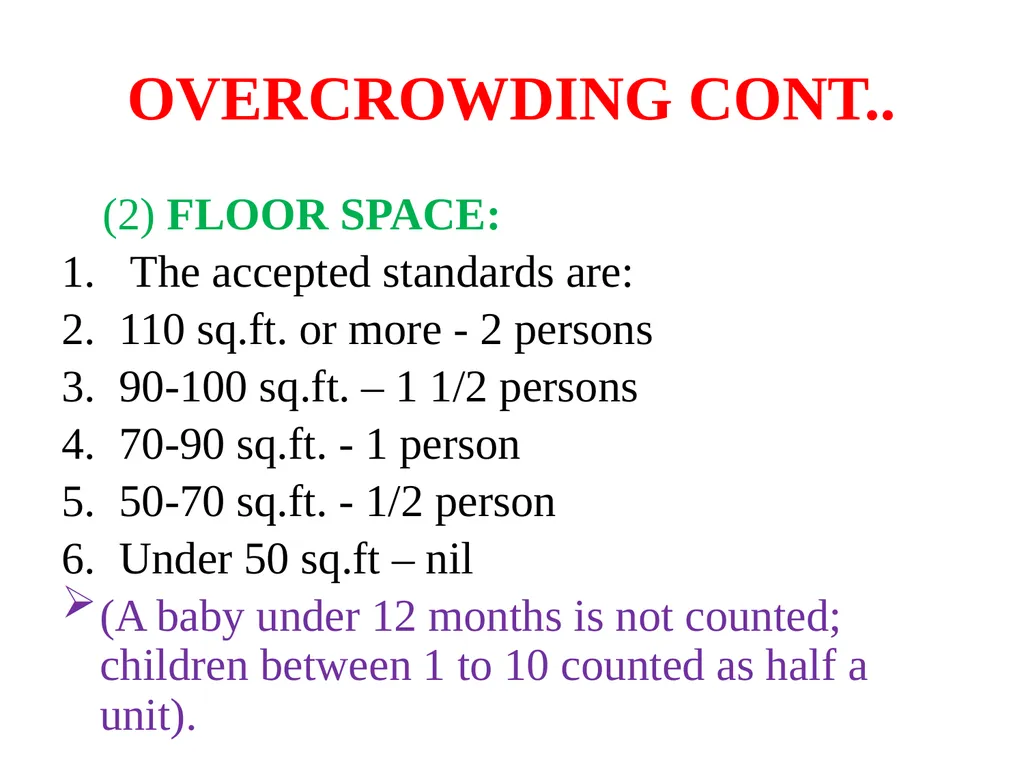
slide39. OVERCROWDING CONT.. (2) FLOOR SPACE:
The accepted standards are:
110 sq.ft. or more - 2 persons
90-100 sq.ft. – 1 1/2 persons
70-90 sq.ft. - 1 person
50-70 sq.ft. - 1/2 person
Under 50 sq.ft – nil
(A baby under 12 months is not counted; children between 1 to 10 counted as half a unit).<br>
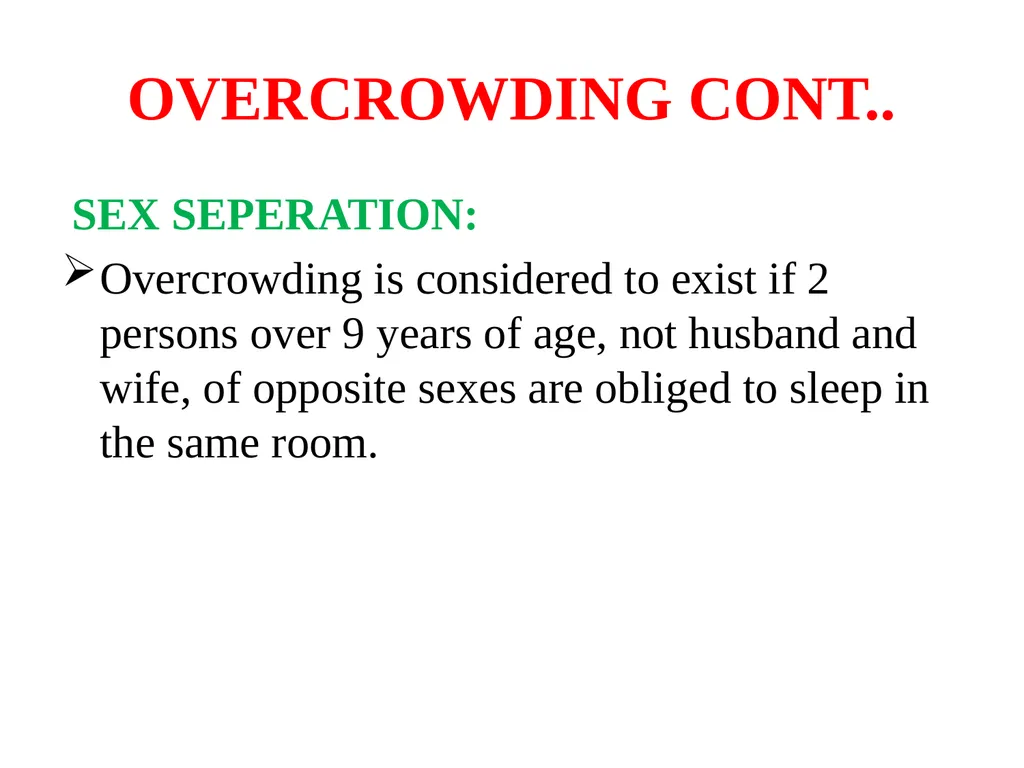
slide40. OVERCROWDING CONT.. SEX SEPERATION:
Overcrowding is considered to exist if 2 persons over 9 years of age, not husband and wife, of opposite sexes are obliged to sleep in the same room.<br>
slide41. NOISE<br>
slide42. NOISE INTRODUCTION:
Unwanted sound, causing disturbance or annoyance.
MEASURABLE PROPERTIES:
1. frequency
2. Intensity<br>
slide43. FREQUENCY:
Number of complete vibration cycles per second.
Measured in units –Hertz (Hz)
One Hz = one wave/second.
Determines pitch of sound.
Normal human audio frequency range 20-20000 Hz
Below 20 Hz infra-sounds
Above 20,000 Hz are ultra-sounds<br>
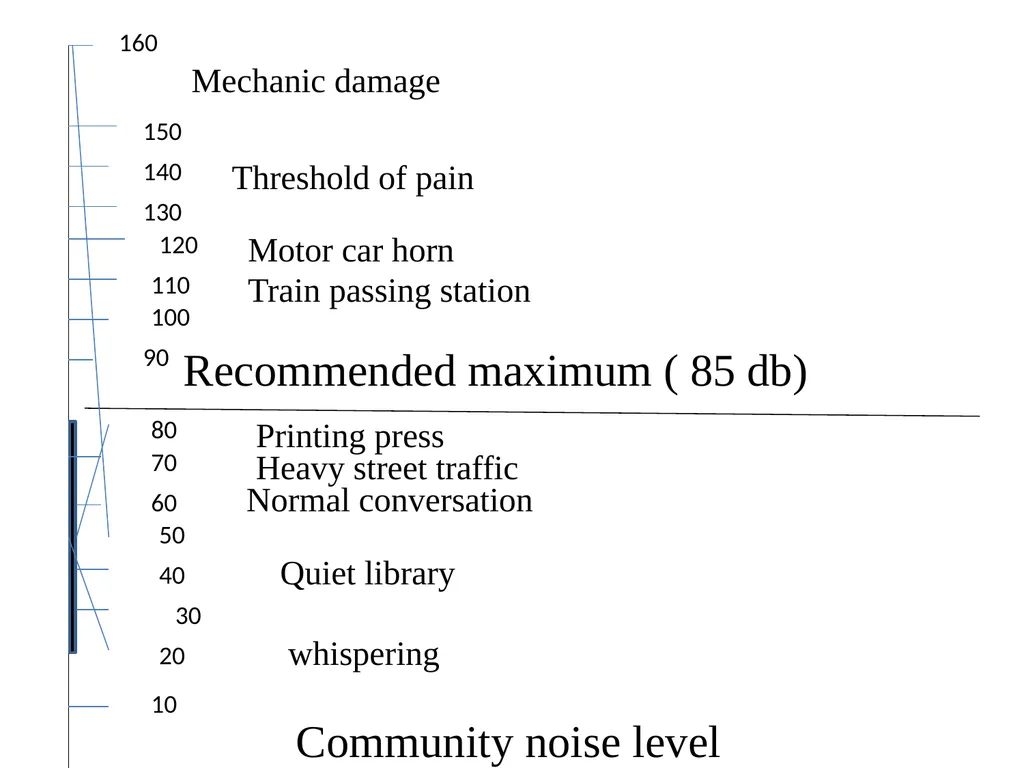
slide44. Recommended maximum ( 85 db) Mechanic damage 160 150 140 Threshold of pain 130 120 Motor car horn 110 100 90 Train passing station 80 Printing press 70 Heavy street traffic 60 Normal conversation 50 40 Quiet library 30 20 whispering 10 Community noise level<br>
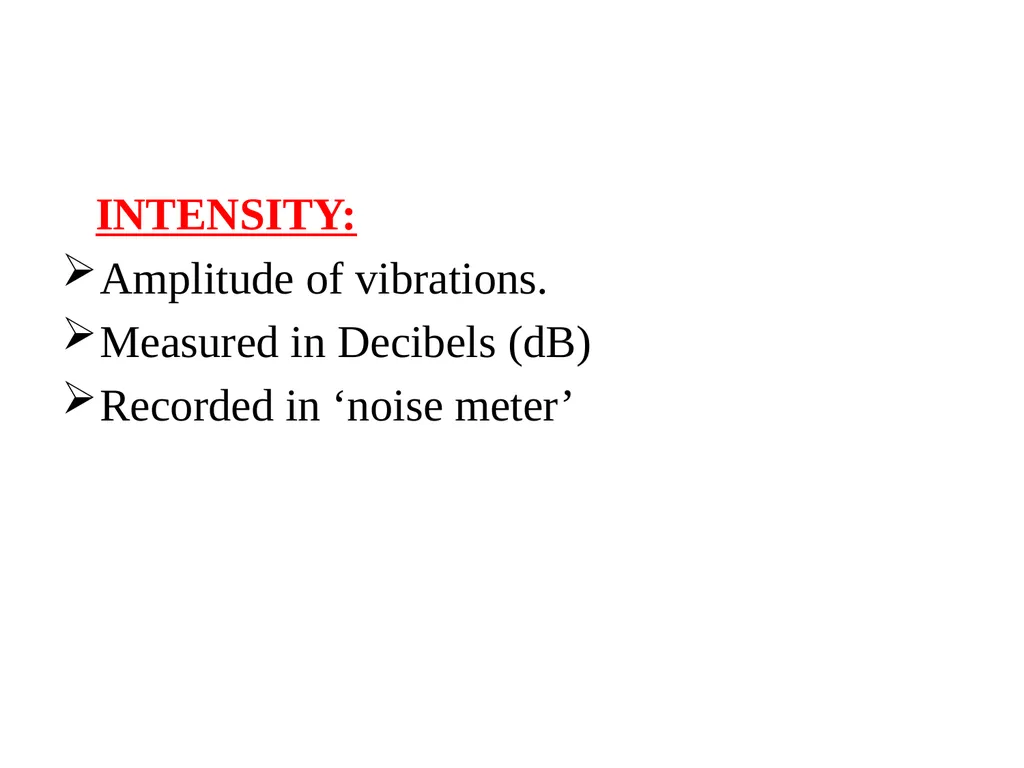
slide45. INTENSITY:
Amplitude of vibrations.
Measured in Decibels (dB)
Recorded in ‘noise meter’<br>
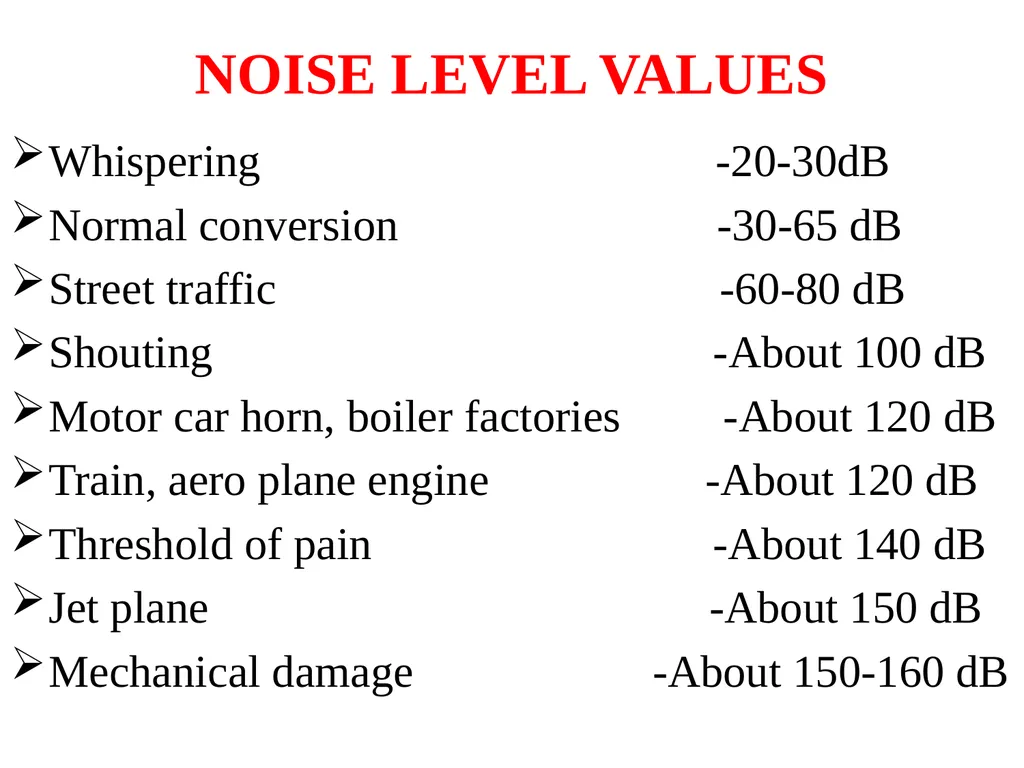
slide46. NOISE LEVEL VALUES Whispering -20-30dB
Normal conversion -30-65 dB
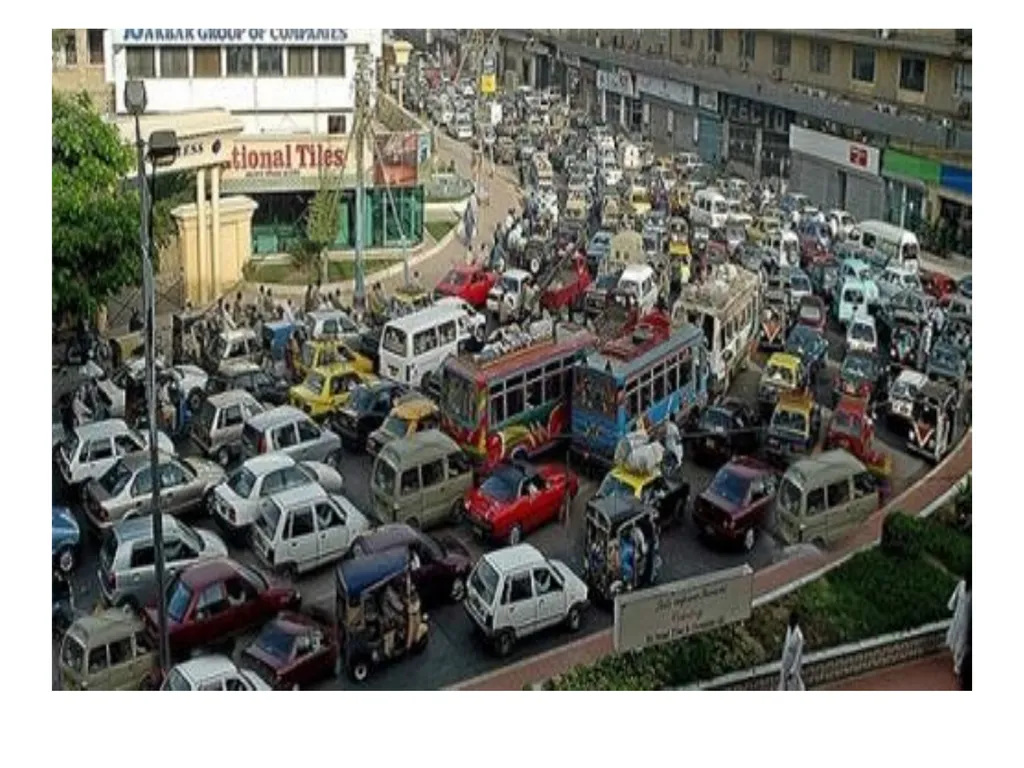
Street traffic -60-80 dB
Shouting -About 100 dB
Motor car horn, boiler factories -About 120 dB
Train, aero plane engine -About 120 dB
Threshold of pain -About 140 dB
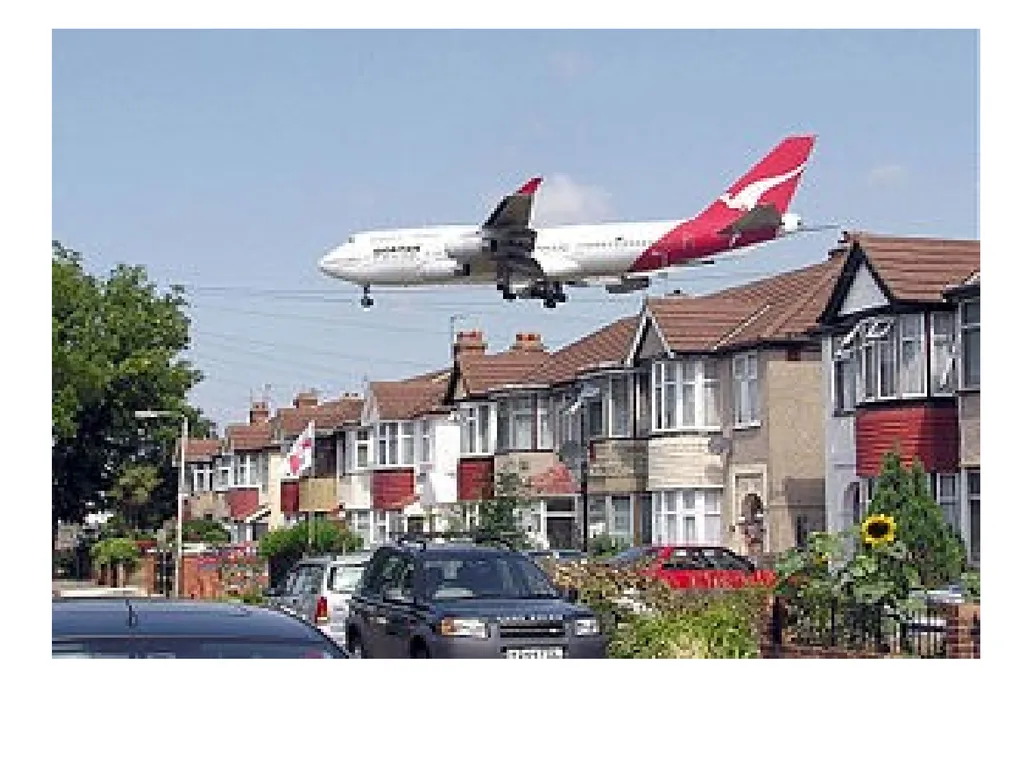
Jet plane -About 150 dB
Mechanical damage -About 150-160 dB<br>
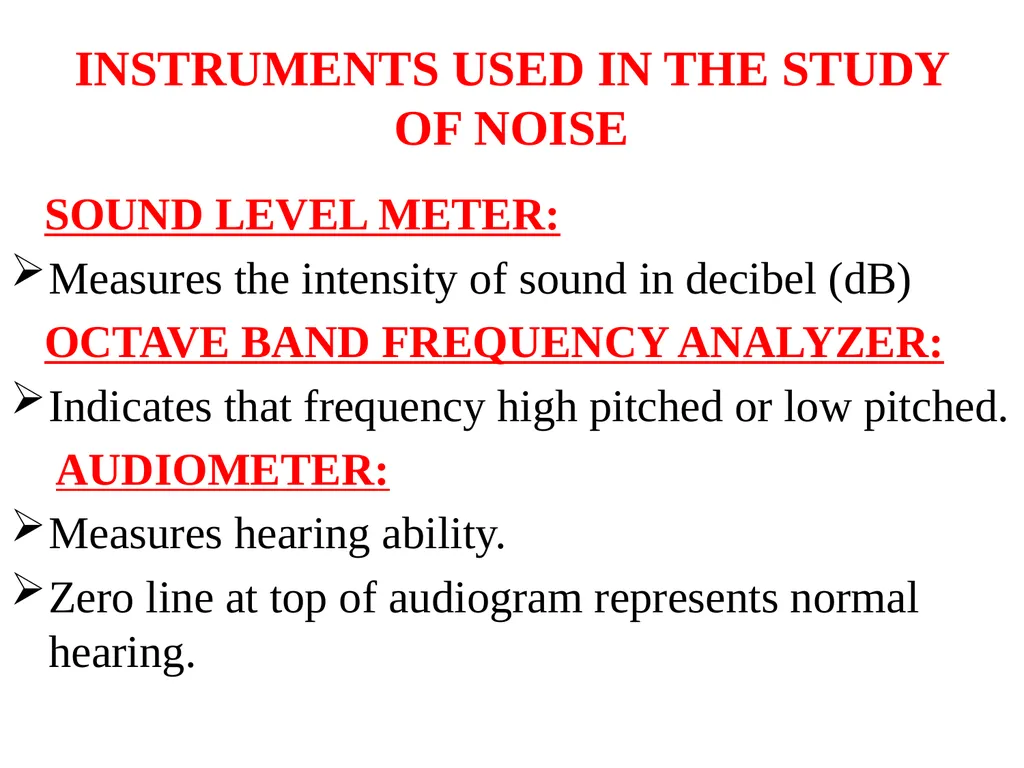
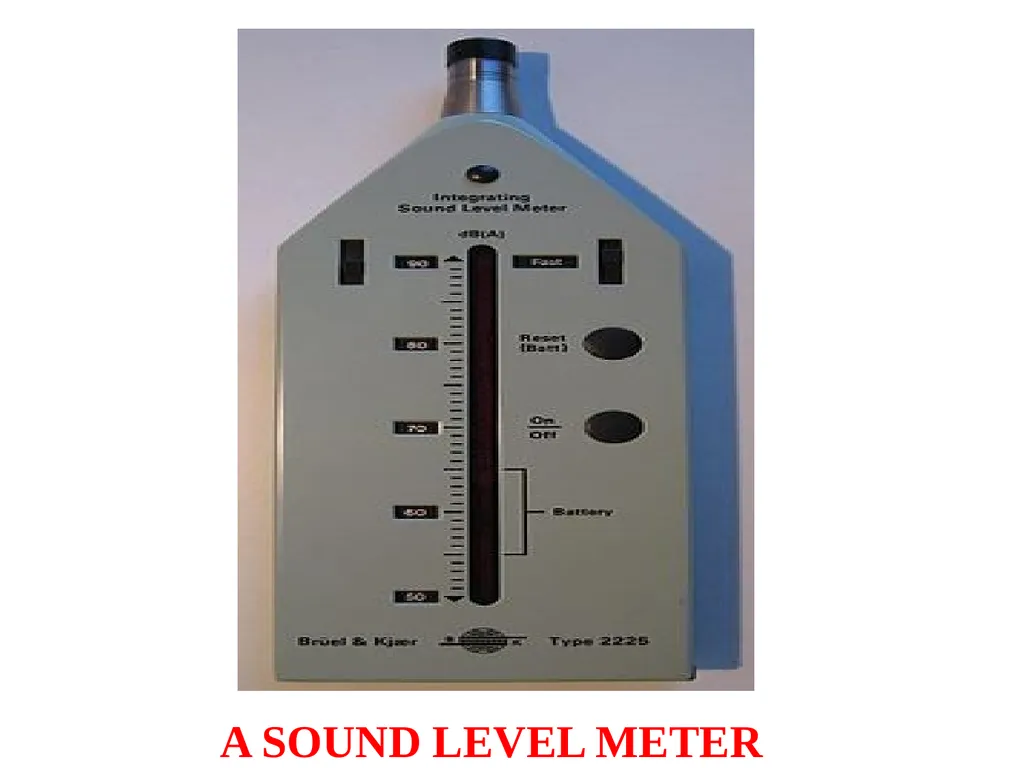
slide47. INSTRUMENTS USED IN THE STUDY OF NOISE SOUND LEVEL METER:
Measures the intensity of sound in decibel (dB)
OCTAVE BAND FREQUENCY ANALYZER:
Indicates that frequency high pitched or low pitched.
AUDIOMETER:
Measures hearing ability.
Zero line at top of audiogram represents normal hearing.<br>
slide48. A SOUND LEVEL METER<br>
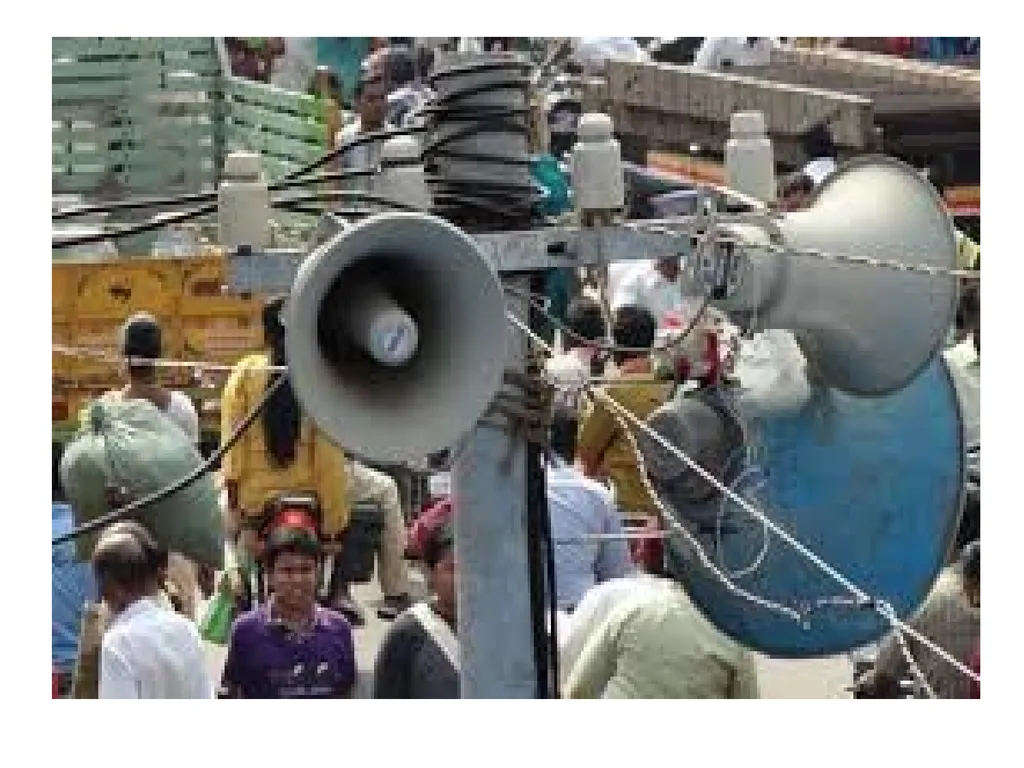
slide49. Noise pollution or noise disturbance is the disturbing or excessive noise that may harm the activity or balance of human or animal life.<br>
slide53. HAZARDS OF NOISE POLLUTION 1. Auditory effects
2. Non-auditory effects<br>
slide54. AUDITORY EFFECTS:
Quantifiable
Non-quantifiable<br>
slide55. QUANTIFIABLE:
Threshold shift (temporary, later permanent)
Auditory fatigue (associated with whistling and buzzing)
Deafness (temporary or permanent) (occupational deafness).
Temporary hearing loss in frequency range 4000-6000 Hz.
Repeated or continuous exposure to noise around 100 dB result in permanent deafness.
Exposure above 160 dB may cause rupture of tympanic membrane and cause permanent deafness.<br>
slide56. NON-QUANTIFIABLE:
Tinnitus (ringing, buzzing or whistling), vertigo<br>
slide57. NON-AUDITORY EFFECTS:
Interference with speech communication
Annoyance (irritability, short temperedness, impatience quarreling and decreased production in the industries)
Decreased efficiency in the work
Lack of concentration
Physiological changes-interference with sleep, rise in blood pressure, rise in intracranial pressure, increase in heart rate and breathing, increase in sweating, headache, giddiness, nausea fatigue, visual disturbances etc.<br>
slide58. PREVENTION AND CONTROL OF NOISE POLLUTION CONTROL OF NOISE AT SOURCE:
Planned maintenance of the machines
Modification of speed of machines
Use of resilient material (rubber between impacting surfaces)
Enclosure of machines
Sound proofing of walls
Replacement of equipment, insertion of silencer<br>
slide59. INCREASING THE DISTANCE:
Possible if in open field.
If in closed room, made sound proof by lining the walls with absorbent material<br>
slide60. REDUCTION OF EXPOSURE TIME:
By job rotation.<br>
slide61. ACOUSTIC BARRIER:
1. AROUD THE SOURCE-insulation, damping.
2. AT THE RECIEVER-use of personal protective devices.<br>
slide62. Careful planning of the cities:
By dividing residential zone, industrial zone, transportation zone, widening of the roads, green belts between traffic and houses
Heavy vehicles:
Should pass by by-pass roads.
By adopting suitable legistration.
Preplacement and periodic examination of industrial workers.
Health education of the people<br>
slide63. RADIATION<br>
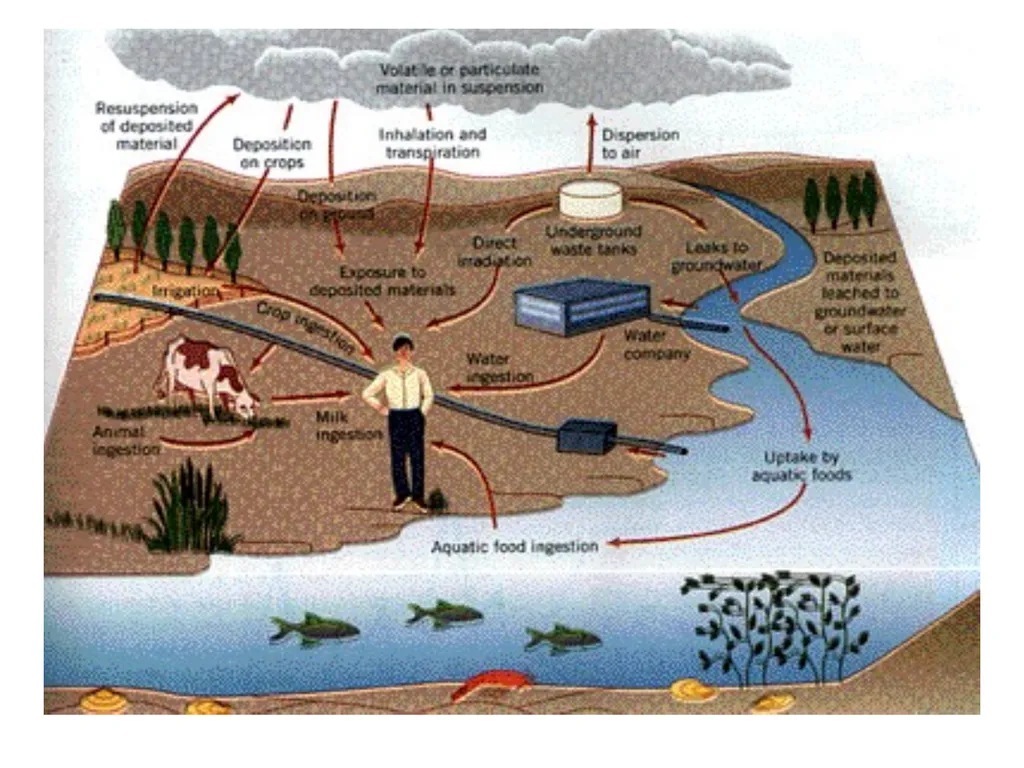
slide64. Radioactive contamination, also called radiological contamination, is the deposition of, or presence of radioactive substances on surfaces or within solids, liquids or gases (including the human body), where their presence is unintended or undesirable (from the International Atomic Energy Agency - IAEA - definition).<br>
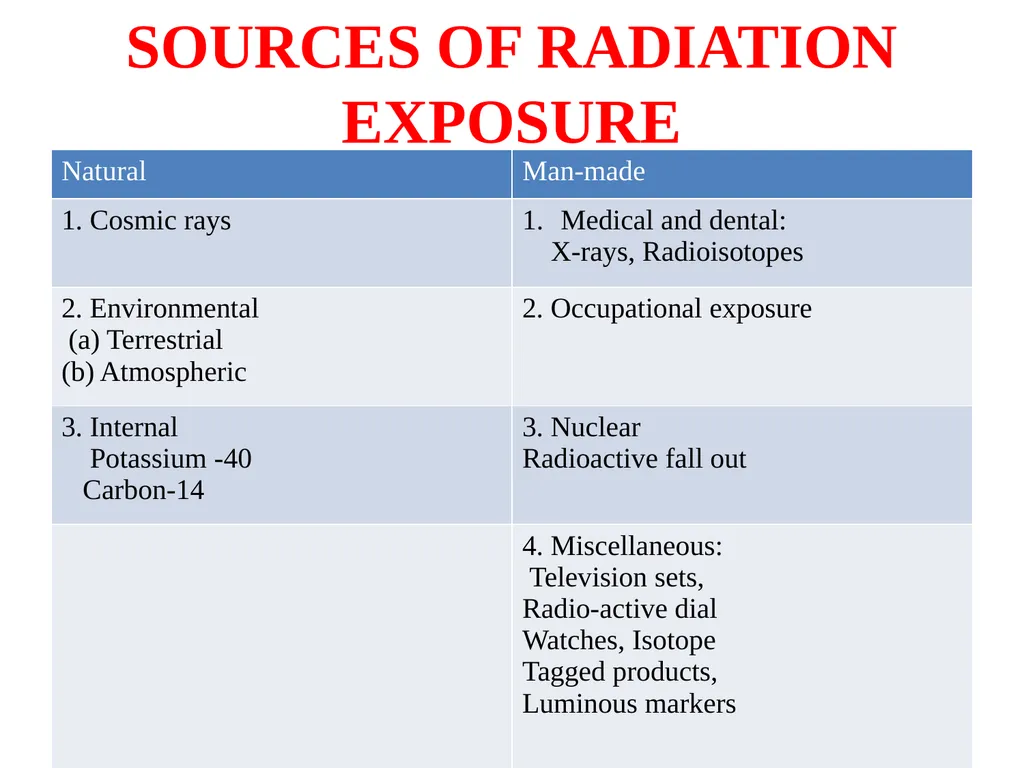
slide67. SOURCES OF RADIATION EXPOSURE<br>
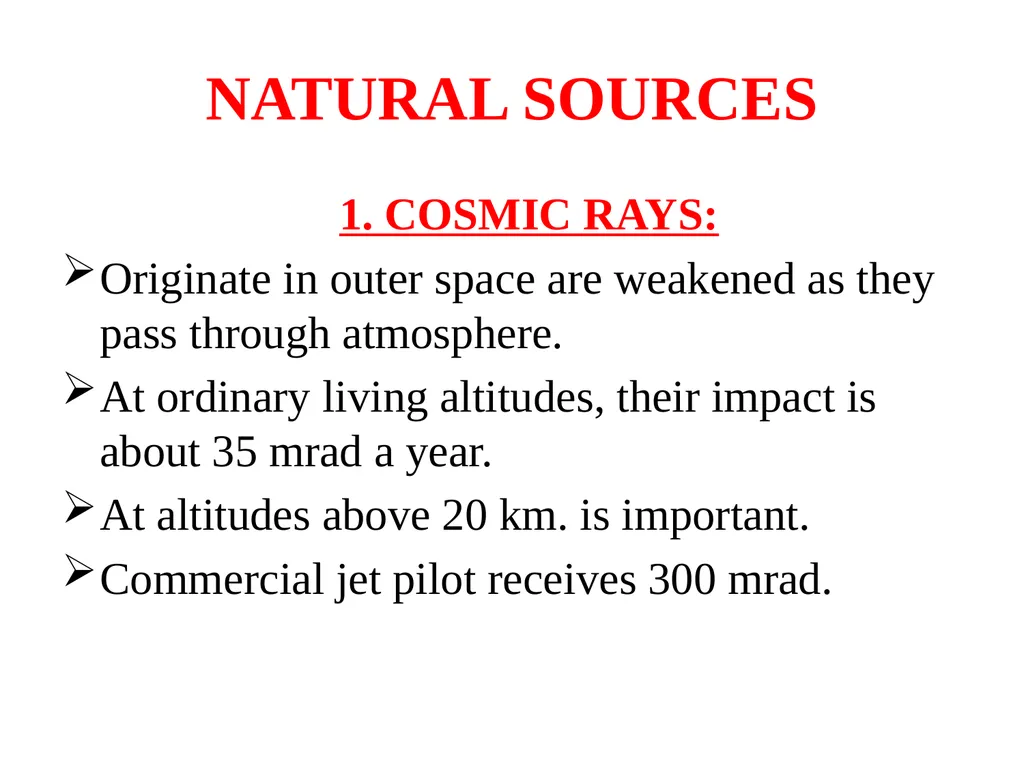
slide68. NATURAL SOURCES 1. COSMIC RAYS:
Originate in outer space are weakened as they pass through atmosphere.
At ordinary living altitudes, their impact is about 35 mrad a year.
At altitudes above 20 km. is important.
Commercial jet pilot receives 300 mrad.<br>
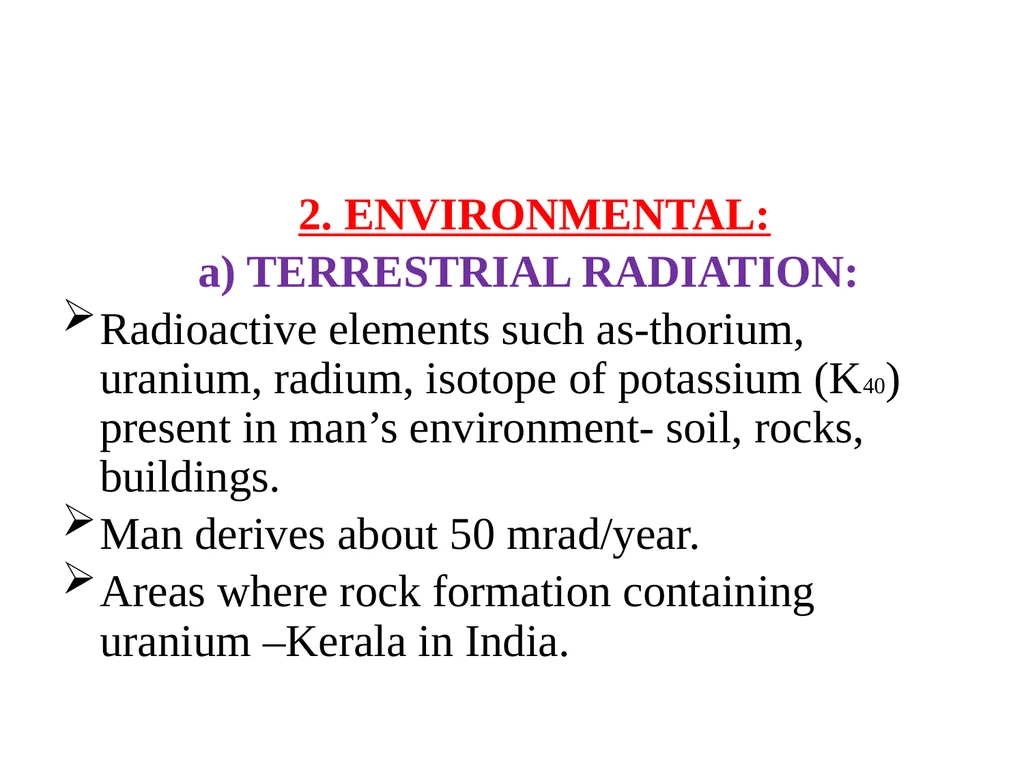
slide69. 2. ENVIRONMENTAL:
a) TERRESTRIAL RADIATION:
Radioactive elements such as-thorium, uranium, radium, isotope of potassium (K40) present in man’s environment- soil, rocks, buildings.
Man derives about 50 mrad/year.
Areas where rock formation containing uranium –Kerala in India.<br>
slide70. 3. INTERNAL RADIATION:
Radioactive matters stored in the body tissue.
Minute quantities of uranium, thorium and related substances, isotopes of potassium (K40), strontium (Sr 90), Carbon (C14).
Inflict about 25 mrad a year..
Total natural radiation to which an average person is 0.1 rad/year.<br>
slide71. MAN-MADE SOURCES 1. X-RAYS:
medical and dental X-rays.
Patients and radiologist and medical technicians involved.
When optimum radiological technique – skin dose to the patient from single X-ray film 0.02-3.0 rad.<br>
slide72. 2. RADIOACTIVE FALLOUT:
Nuclear explosion release tremendous amount of energy in form of heat, light, ionizing radiation and many radioactive substances- isotopes of Carbon (C14), Iodine (131), Cesium (Cs 137) and Strontium (Sr 90).
Cs 137 and Sr 90 liberated in large amount and remain radioactive for many years.
Half life of Sr 90 is 28 years and that of Cs 137 is 30 years<br>
slide73. 3. MISCELLANEOUS:
TV sets, luminous wrist watches.
But radiation is too small.<br>
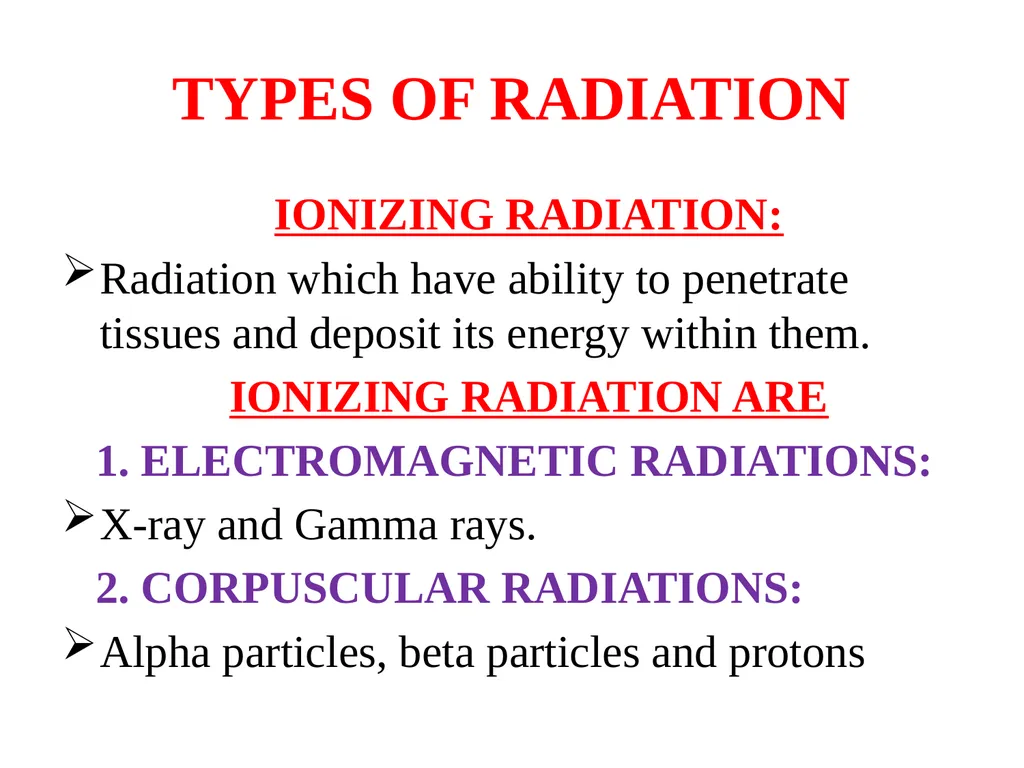
slide74. TYPES OF RADIATION IONIZING RADIATION:
Radiation which have ability to penetrate tissues and deposit its energy within them.
IONIZING RADIATION ARE
1. ELECTROMAGNETIC RADIATIONS:
X-ray and Gamma rays.
2. CORPUSCULAR RADIATIONS:
Alpha particles, beta particles and protons<br>
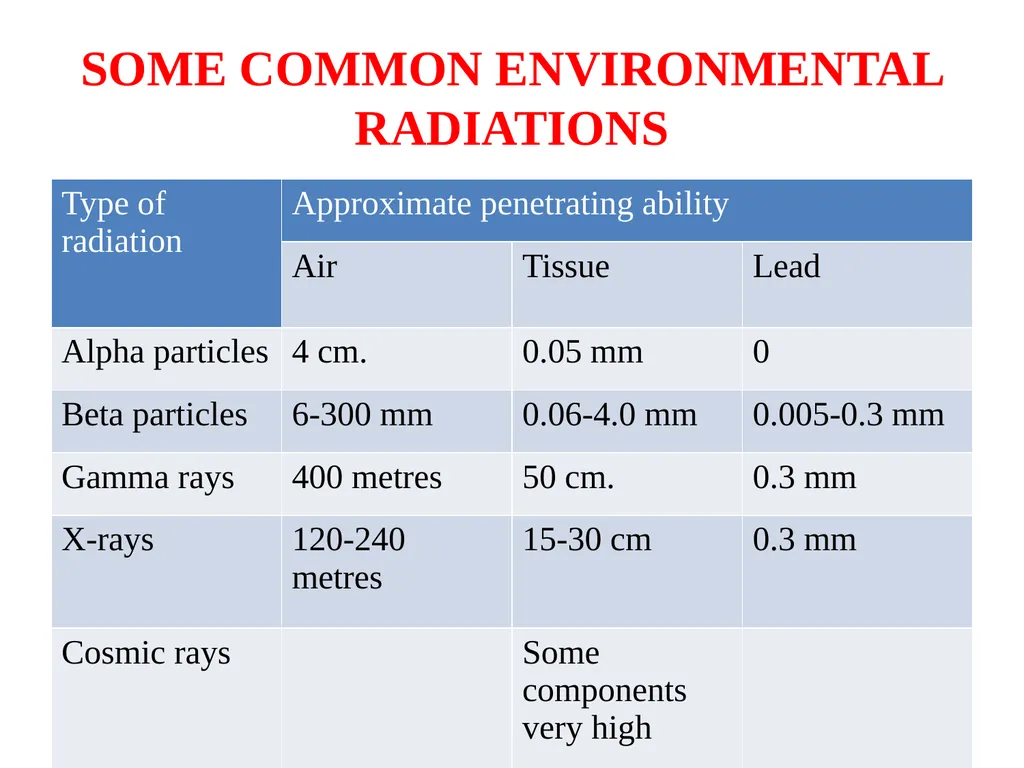
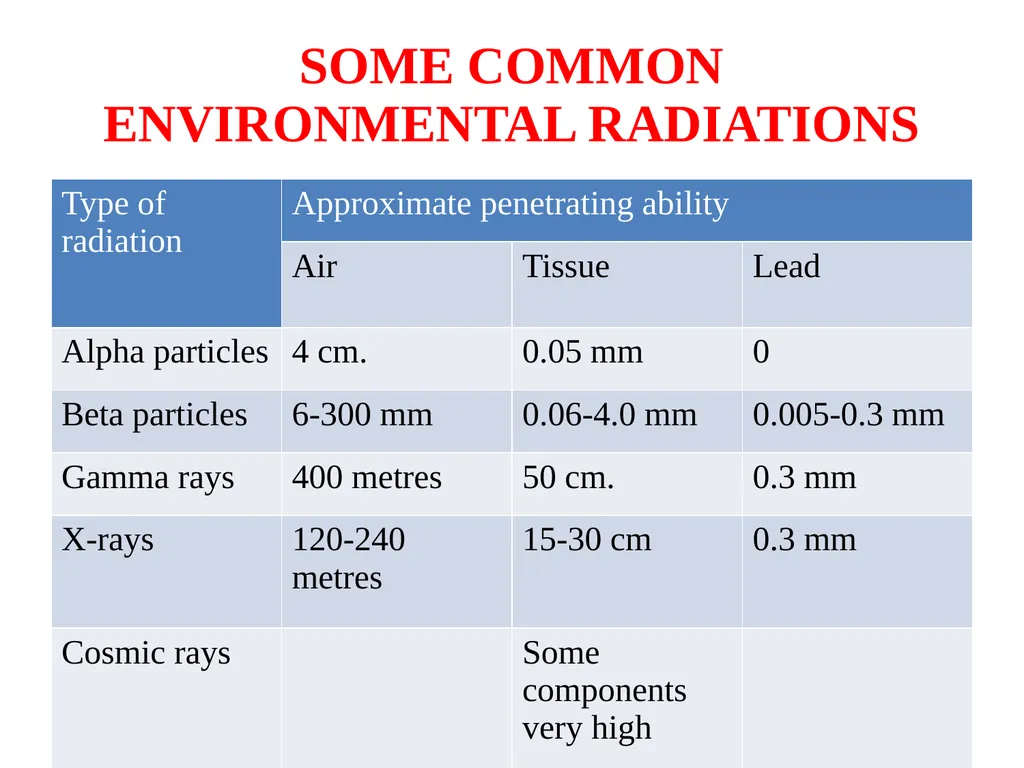
slide77. SOME COMMON ENVIRONMENTAL RADIATIONS<br>
slide78. SOME COMMON ENVIRONMENTAL RADIATIONS<br>
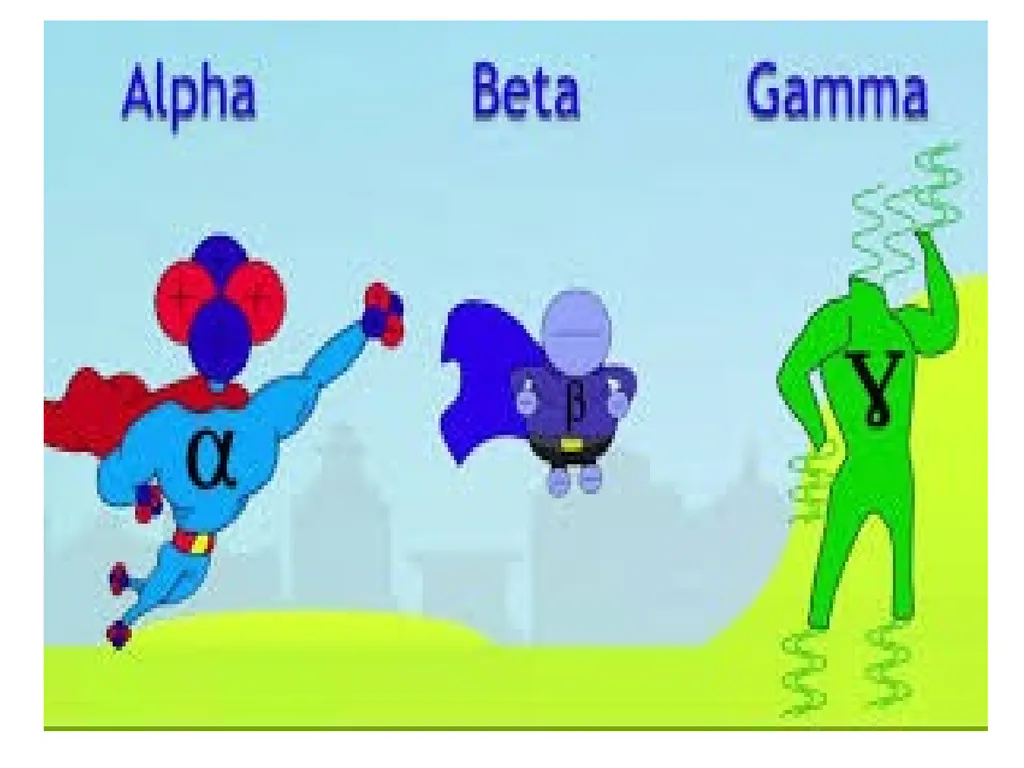
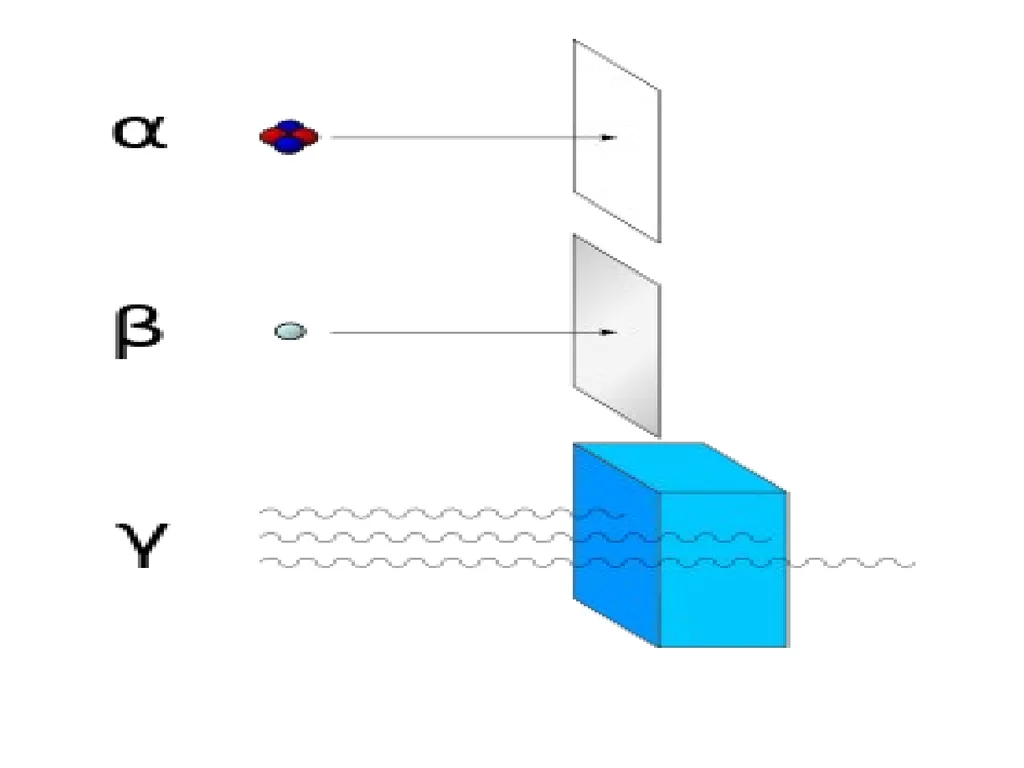
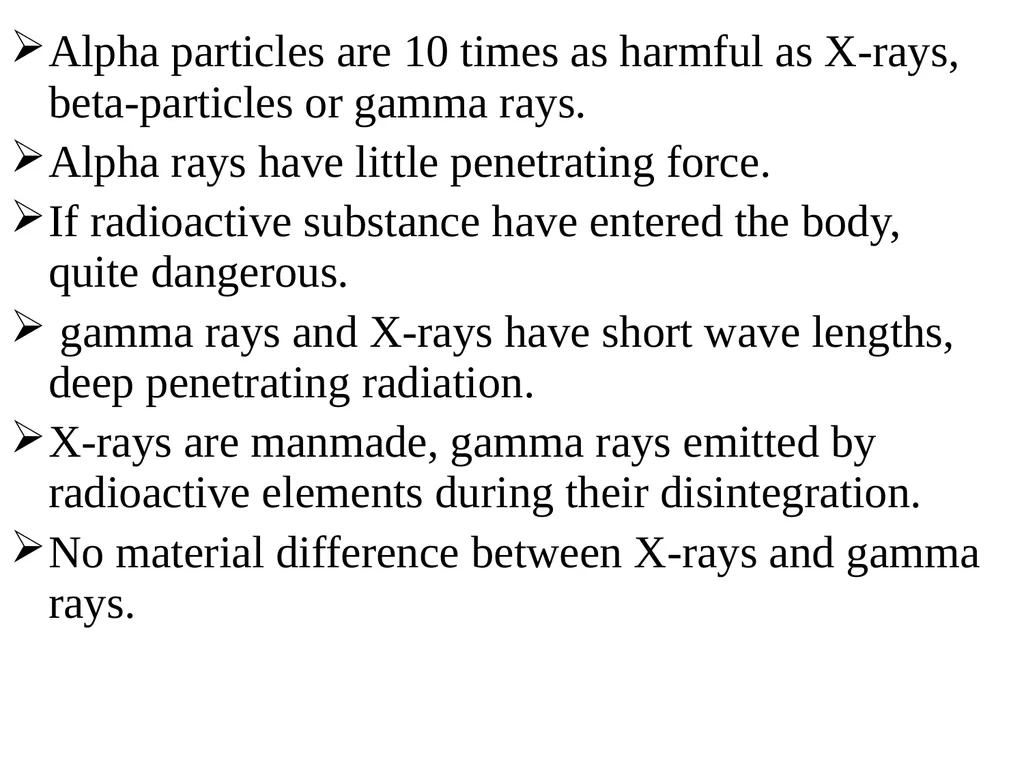
slide79. Alpha particles are 10 times as harmful as X-rays, beta-particles or gamma rays.
Alpha rays have little penetrating force.
If radioactive substance have entered the body, quite dangerous.
gamma rays and X-rays have short wave lengths, deep penetrating radiation.
X-rays are manmade, gamma rays emitted by radioactive elements during their disintegration.
No material difference between X-rays and gamma rays.<br>
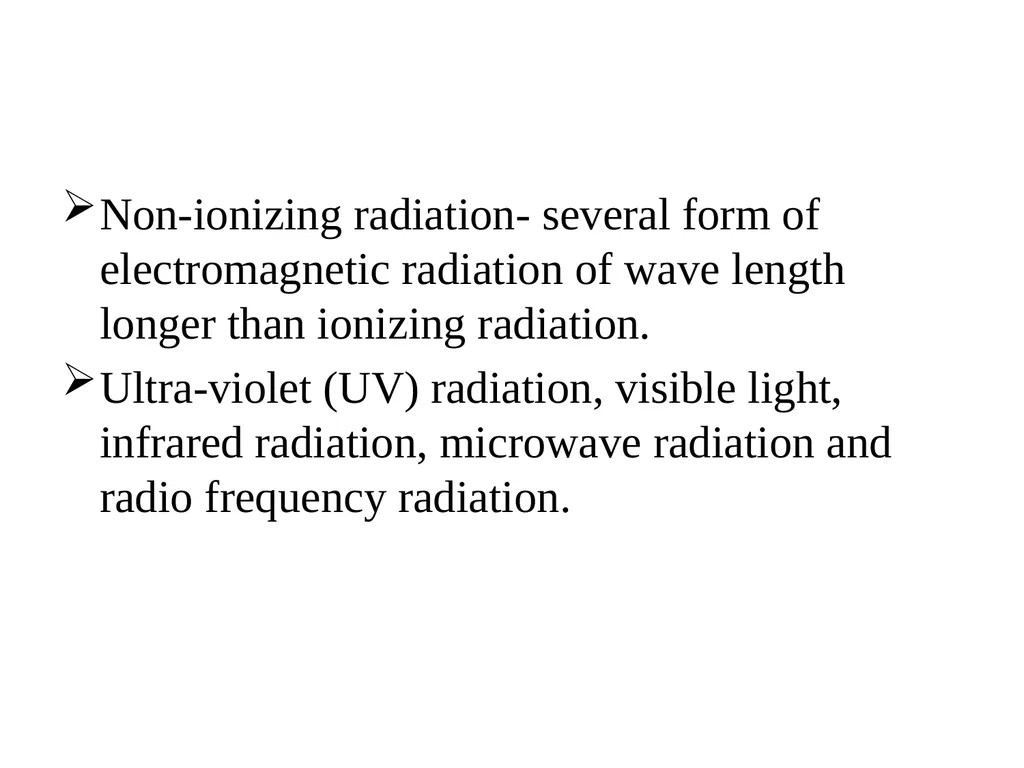
slide80. Non-ionizing radiation- several form of electromagnetic radiation of wave length longer than ionizing radiation.
Ultra-violet (UV) radiation, visible light, infrared radiation, microwave radiation and radio frequency radiation.<br>
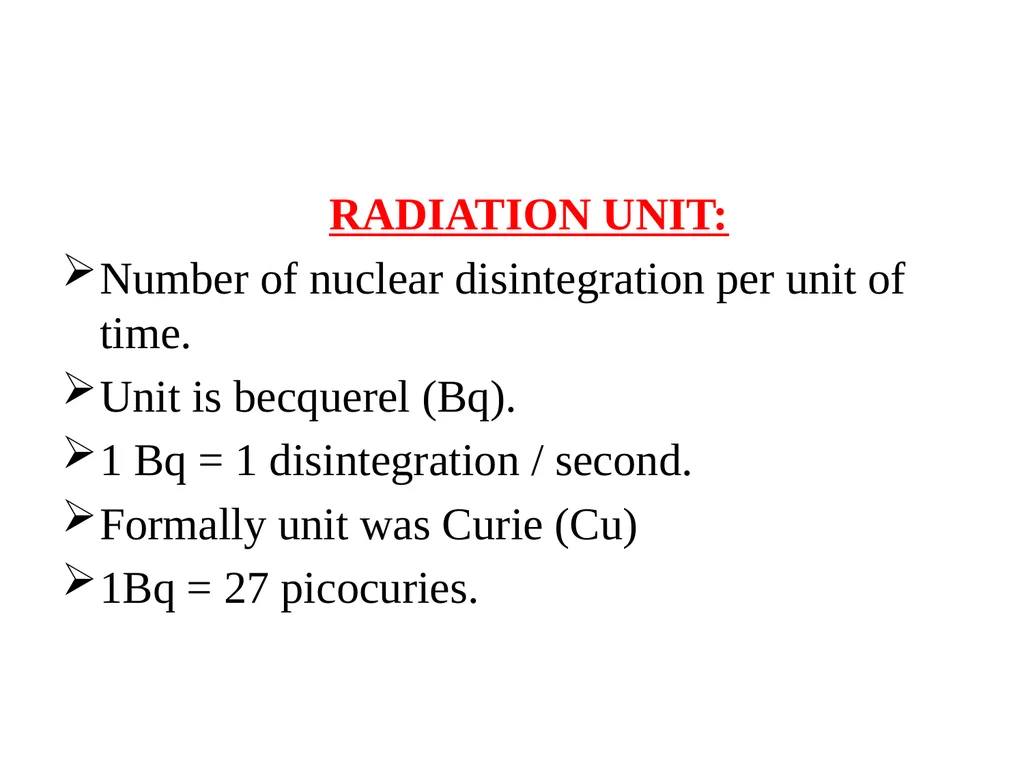
slide81. RADIATION UNIT:
Number of nuclear disintegration per unit of time.
Unit is becquerel (Bq).
1 Bq = 1 disintegration / second.
Formally unit was Curie (Cu)
1Bq = 27 picocuries.<br>
slide82. POTENCY OF RADIATION:
1. ROENTGEN:
Is unit of exposure.
Amount of radiation absorbed in air at a given point.
2. RAD:
Unit of absorbed dose.
Amount of radioactive energy absorbed per gram of tissue.
A mrad= 0.001 rad<br>
slide83. 3. REM:
Product of absorbed dose and the modifying factors.
Degree of potential danger to health.
Average to which average citizen is exposed is made up of al most of the fast moving, highly penetrating X-rays and gamma rays, where ram and rad are equal.<br>
slide84. The radiation units (roentgen, rad, ram ) are replaced by the new SI Units (International System of Units).
1. Coulomb per Kilogram (C/Kg):
Replacing the roentgen.
1 roentgen= 2.58X 10 -4 CKg-1.
Unit for exposure.<br>
slide85. 2.Gray (Gy):
Replacing rad.
Unit of absorbed dose.
Dose of ionizing radiation that impart 1 joule of energy to 1 kg of absorbing material.
1 rad = 0.01 Gy
3. SIEVERT (Sv):
Replacing the rem.
1 Sivert = 100 rems<br>
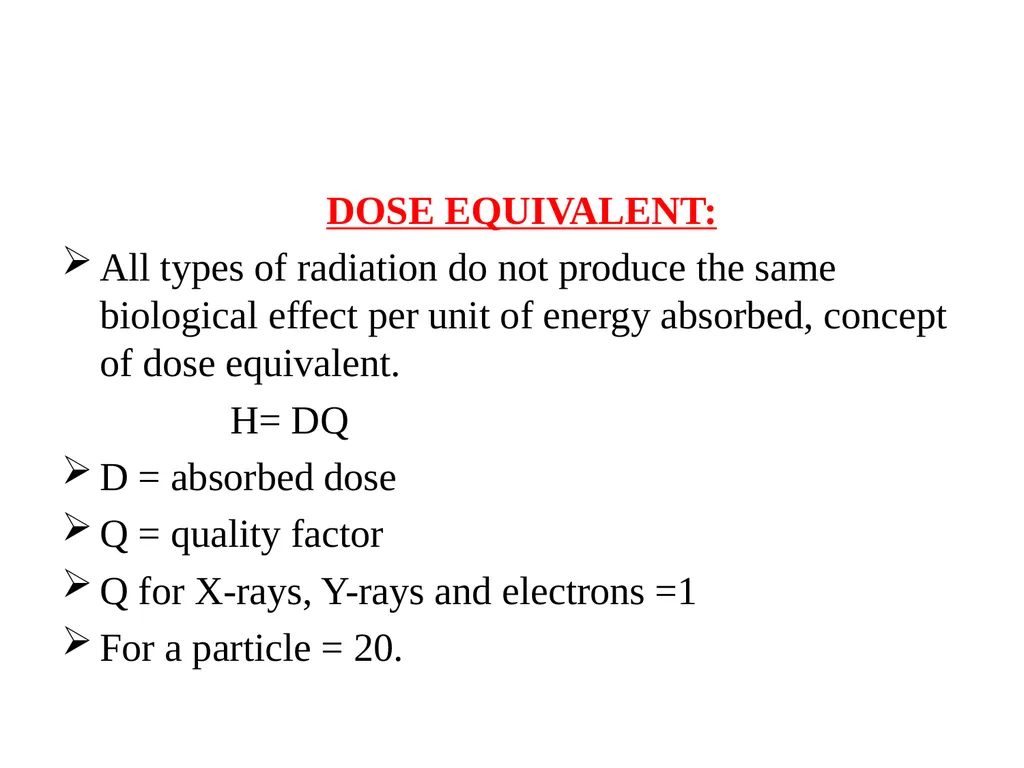
slide86. DOSE EQUIVALENT:
All types of radiation do not produce the same biological effect per unit of energy absorbed, concept of dose equivalent.
H= DQ
D = absorbed dose
Q = quality factor
Q for X-rays, Y-rays and electrons =1
For a particle = 20.<br>
slide87. BIOLOGICAL EFFECT OF RADIATION 1. ACUTE OR SHORT TERM EFFECT:
Exposure to high doses of radiation over a short period of time.
Kill cells causing organ damage.
Called “Acute Radiation Syndrome”<br>
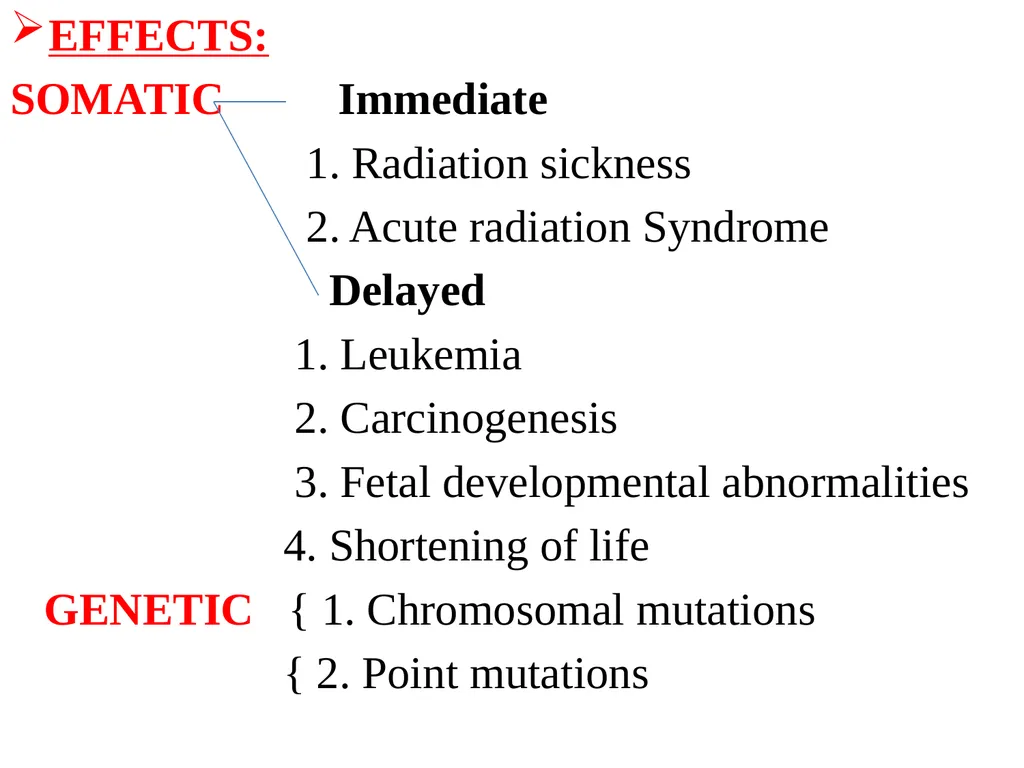
slide88. EFFECTS:
SOMATIC Immediate
1. Radiation sickness
2. Acute radiation Syndrome
Delayed
1. Leukemia
2. Carcinogenesis
3. Fetal developmental abnormalities
4. Shortening of life
GENETIC { 1. Chromosomal mutations
{ 2. Point mutations<br>
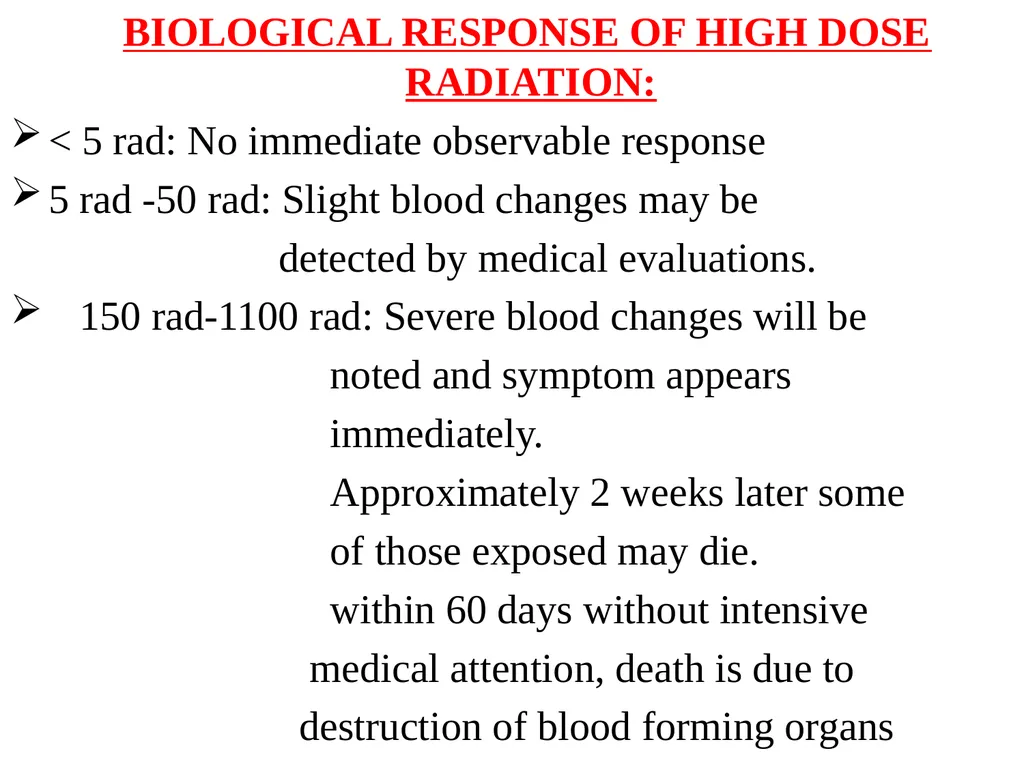
slide89. BIOLOGICAL RESPONSE OF HIGH DOSE RADIATION:
< 5 rad: No immediate observable response
5 rad -50 rad: Slight blood changes may be
detected by medical evaluations.
150 rad-1100 rad: Severe blood changes will be
noted and symptom appears
immediately.
Approximately 2 weeks later some
of those exposed may die.
within 60 days without intensive
medical attention, death is due to
destruction of blood forming organs<br>
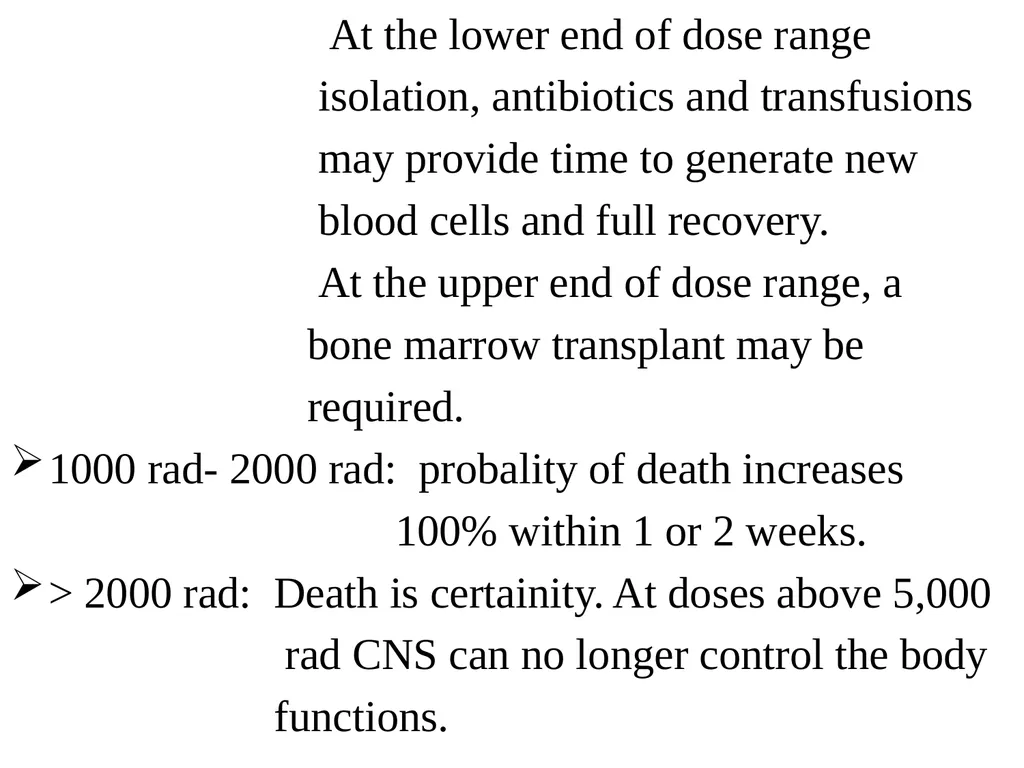
slide90. At the lower end of dose range
isolation, antibiotics and transfusions
may provide time to generate new
blood cells and full recovery.
At the upper end of dose range, a
bone marrow transplant may be
required.
1000 rad- 2000 rad: probality of death increases
100% within 1 or 2 weeks.
> 2000 rad: Death is certainity. At doses above 5,000
rad CNS can no longer control the body
functions.<br>
slide91. GENETIC EFFECTS:
Genetic effects
manifests in more or less
in remote offspring.
results from injury to
chromosomes.-
chromosome mutation,
point mutation.<br>
slide92. PREVENTION AND CONTROL OF RADIATION HAZARDS Primary prevention
Secondary prevention
PRIMARY PREVENTION:
1. Safety of machine
2. Man
3. Environment
4.Other measures<br>
slide93. 1. SAFETY OF THE MACHINE:
Machine should be of approved quality and installed properly.
Periodical servicing and proper maintenance.
Use of efficient filters so that unwanted radiations are excluded.
Operated on high kilo-voltage with fast film and image intensifier so that exposure reduced to minimum dose.
Machine connected to door in such a way that it should stop functioning automatically, the moment door is open accidently.<br>
slide94. 2. SAFETY OF THE WORKER:
Preplacement examination of the worker to exclude contraindication (ergonomics)
Health education about radiation hazards and avoiding unnecessary exposure.
Regulation of exposure to limit exposure, by provision of holidays, recreation and rotation.
Personal protection:
Filter respirators/masks<br>
slide95. Spectacles with refracting mirrors
Lead aprons, lead gloves (lead reduces intensity over 90%)
Pocket dosimeter
Use of lead boxes to keep radium needles and radio-active isotopes
Use of long forceps to handle radium needles.
Use of shield between source and recipient.
Avoiding eating and drinking in the working rooms.<br>
slide96. SAFETY OF THE ENVIRONMENT:
Air, soil and water should be clean and pure.
They should be free from pollution.<br>
slide97. OTHER MEASURES:
SPECIFICATION OF ROOMS OF COBALT UNIT AND X-RAY MACHINE:
Walls must be thick and made up of concrete.
Roof must be high.
Wet mopping of floor.
Vacuum cleaning of the room.
Lead protected doors.
Lead glasses to be used for windows.
Exhaust system of ventilation.
Controlling machine should be as far away as possible from the worker.
Enclosure of the machine, ventilated hoods, splash-trays control release of dust<br>
slide98. DISPOSAL OF RADIOACTIVE WASTE:
By putting in a steel case and embedding deep in sea bed at 1800 mts deep.
By putting it in underground concrete seal.
By burning in special incinerator provided with filters and very tall stacks.<br>
slide99. SECONDARY PREVENTION:
Early diagnosis and detection
Periodical analysis of dosimeter.
Treatment:
For leukemia- predinsolone, vincristine, daunorubicin, arabinosylcytosine
For bone marrow aplasia- by antibiotics and blood transfusion.
For bone sarcoma- by amputation followed by chemo-therapy.<br>
slide100. SECONDARY PREVENTION:
Early diagnosis and detection
Periodical analysis of dosimeter.
Treatment:
For leukemia- predinsolone, vincristine, daunorubicin, arabinosylcytosine
For bone marrow aplasia- by antibiotics and blood transfusion.
For bone sarcoma- by amputation followed by chemo-therapy.<br>
slide101. If accidently exposed, immediately decontaminated:
If implanted, skin is excised, radio-active material is removed, washed with hot water and soap followed by application of citric acid.
If swallowed, adsorbents- Prussian blue or ion exchange agents followed by emetics and salt purgatives. Diethylene tri aminapenta acetic acid (DTPA) is effective.<br>
slide102. Radiation protection is youngest branch of hygiene.
International Commission on Radiological Protection (ICRP), International Atomic Energy Agency (IAEA) and WHO active in this field.<br>
slide103. HOUSING<br>
slide104. "Housing”-
In the modern concept includes not only the 'PHYSICAL STRUCTURE' providing shelter, but also the immediate surroundings, and the related community services and facilities.<br>
slide105. It has become part of the concept of "HUMAN SETTLEMENT", which is defined as “all places in which a group of people reside and pursue their life goals”
“The size of the settlement may vary from a single family to millions of people".<br>
slide106. It has become part of the concept of "HUMAN SETTLEMENT", which is defined as “all places in which a group of people reside and pursue their life goals”
“The size of the settlement may vary from a single family to millions of people".<br>
slide107. A WHO Expert Group (1961)
Use the term “residential environment”
Defind as physical structure that man uses and the environs of the structure including all necessary services, facilities, equipment and devises needed and desired for the physical and mental health and social wellbeing of the family and individual.
The immediate surroundings of the residential building as neighborhood or micro district.<br>
slide108. Social goals of housing (1) Shelter.
(2) Family life.
(3) Access to community facilities.
(4) Family participation in community life.
(5) Economic stability.<br>
slide109. The implementation of social goals in housing-
1) Introduce social housing schemes
2) Establish both minimum and maximum standards.
3) Create financial and fiscal institutions geared to helping low income people obtain credit for building or improving their houses.<br>
slide110. CRITERIA FOR HEALTHFUL HOUSING-
1) Physical protection and shelter.
2) Provides adequately for cooking, eating, washing and excretory functions.
3) Is designed, constructed, maintained and used in a manner such as to prevent the spread of communicable diseases<br>
slide111. 4) Protection from hazards of exposure to noise and pollution.
5) Is free from unsafe physical arrangements due to construction or maintenance and from toxic or harmful materials.
6) Encourages personal and community development, promotes social relationships, reflects a regards for ecological principals and promotes mental health.<br>
slide112. Housing standards SITE:
(a) The site should be elevated from its surroundings
(b) The site should have an independent access to a street of adequate width
(c) Should be away from the breeding places of mosquitoes and flies<br>
slide113. (d) Should be away from nuisances such as dust, smoke, smell, excessive noise and traffic
(e) Should be in pleasing surroundings
(f) The soil should be dry and safe for founding the structure and should be well drained. "Made soil"<br>
slide114. SET BACK SET BACK:
For proper lighting and ventilation, there should be an open space all round the house this is called "set back".
In rural areas it is recommended that the built-up area should not exceed one-third of the total area. In urban areas where land is costly, the built-up area may be up to two thirds.<br>
slide115. FLOOR FLOOR:
The floor should be pucca and satisfy the following criteria:
(a)Should be impermeable so that it can be easily washed and kept clean and dry. Mud floors tend to break up and cause dust; they are not recommended,<br>
slide116. (b) The floor must be smooth and free from cracks and crevices to prevent the breeding of insects and harborage of dust,
(c) The floors should be damp-proof,
(d) The height of the plinth should be 2 to 3 feet<br>
slide117. WALLS WALLS:
The walls should be
(a) Reasonably strong
(b) Should have a low heat capacity i.e., should not absorb heat and conduct the same
(c) Weather resistant<br>
slide118. (d) Unsuitable for harborage of rats and vermin
(e) Not easily damaged and
(f) Smooth.
These standards can be attained by 9-inch brick wall plastered smooth and colored cream or white.<br>
slide119. ROOF ROOF:
The height of the roof should not be less than 10 feet in the absence of air-conditioning for comfort. The roof should have a low heat transmittance coefficient.<br>
slide120. ROOMS ROOMS:
The number of living rooms should not be less than two, at least one of which can be closed for security. The other may be open on one side if that side is a private courtyard.<br>
slide121. FLOOR AREA FLOOR AREA:
The floor area of a living room should be at least 120 sq.ft for occupancy by more than one person and at least 100 sq.ft for occupancy by a single person.
The floor area available in living rooms per person should not be less than 50 sq.ft; the optimum is 100 sq.ft.<br>
slide122. CUBIC SPACE CUBIC SPACE:
Air space of at least 500 cu. ft. per capita, preferably 1,000 cu. ft.<br>
slide123. WINDOWS WINDOWS:
(a) Every living room should be provided with at least 2 windows, and at least one of them should open directly on to an open space,
(b) The windows should be placed at a height of not more than 3 feet above the ground in living rooms
(c) Window area should be 1/5th of the floor area. Doors and windows combined should have 2/5th the floor area.<br>
slide124. LIGHTING LIGHTING:
The daylight factor should exceed 1% over half the floor area.<br>
slide125. KITCHEN KITCHEN:
Must have a separate kitchen.
Protected against dust and smoke.
Adequately lighted.
Arrangement for storing foods fuel and provisions.
Provided with water supply.
Provided with sink for washing utensils and fitted with arrangement for proper drainage.
Floor must be impervious.<br>
slide126. PRIVY PRIVY :
a sanitary privy belonging exclusively to it and readily accessible.
May equipped with water carriage system.<br>
slide127. GARBAGE AND REFUSE GARBAGE AND REFUSE:
Should be removed at least once daily.
Disposed of in a sanitary manner.<br>
slide128. BATHING AND WASHING BATHING AND WASHING:
Should have facilities for bathing and washing<br>
slide129. WATER SUPPLY WATER SUPPLY:
Safe and adequate water supply.<br>
slide130. Overcrowding Overcrowding:
Overcrowding refers to the situation in which more people are living within a single dwelling than there is space for, so that movement is restricted, privacy secluded, hygiene impossible, rest and sleep difficult<br>
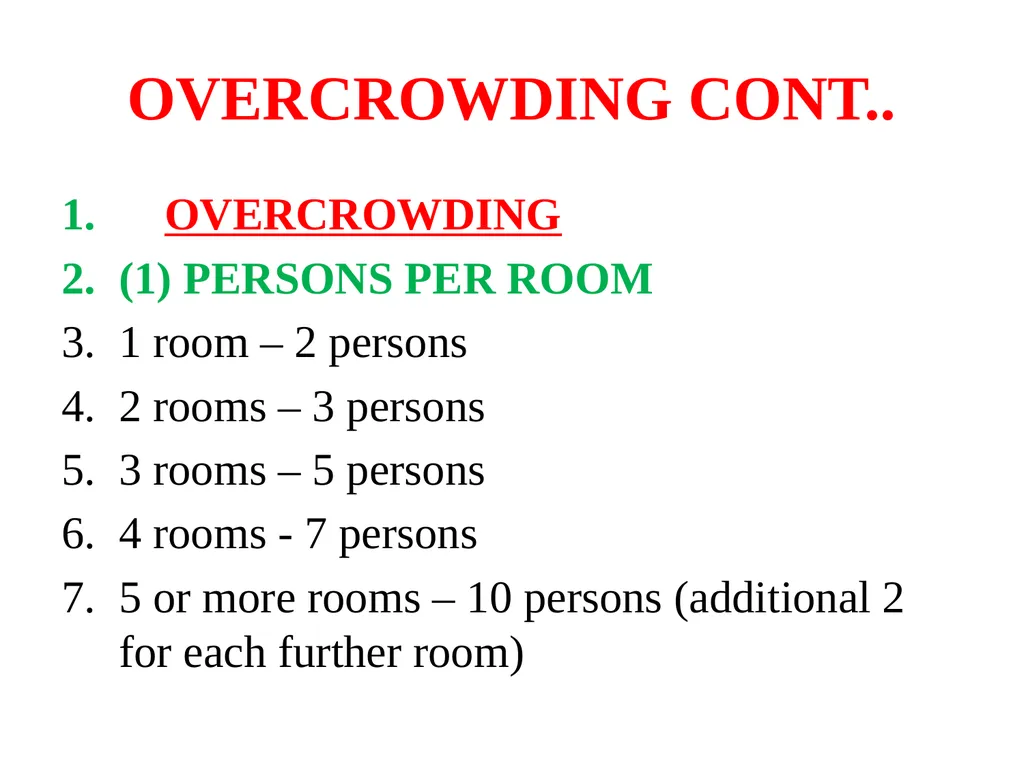
slide131. OVERCROWDING CONT.. OVERCROWDING
(1) PERSONS PER ROOM
1 room – 2 persons
2 rooms – 3 persons
3 rooms – 5 persons
4 rooms - 7 persons
5 or more rooms – 10 persons (additional 2 for each further room)<br>
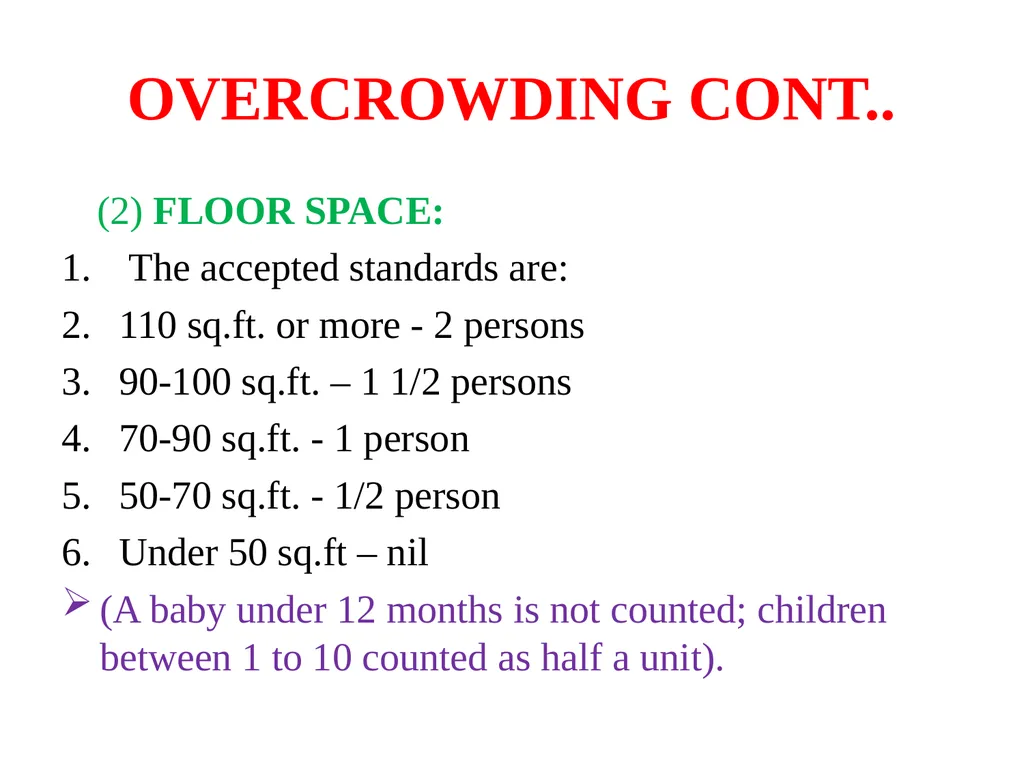
slide132. OVERCROWDING CONT.. (2) FLOOR SPACE:
The accepted standards are:
110 sq.ft. or more - 2 persons
90-100 sq.ft. – 1 1/2 persons
70-90 sq.ft. - 1 person
50-70 sq.ft. - 1/2 person
Under 50 sq.ft – nil
(A baby under 12 months is not counted; children between 1 to 10 counted as half a unit).<br>
slide133. OVERCROWDING CONT.. SEX SEPERATION:
Overcrowding is considered to exist if 2 persons over 9 years of age, not husband and wife, of opposite sexes are obliged to sleep in the same room.<br>
slide134. RURAL HOUSING Approved standards may be lower than in towns.
1) At-least 2 living rooms.
2) Ample verandah space
3) Built-up area not exceed 1/3rd of total area.
4) Separate kitchen with a paved sink or platform for washing utensils.<br>
slide135. RURAL HOUSING Cont…. 5) a sanitary latrine.
6) Window area at-least 10% of floor area.
7) a sanitary well or tube-well within 1/4th mile.
8) Cattle sheds at-least 25 ft. away, open on all sides, 8ft.X4ft. For each cattle.
9) Adequate arrangement for disposal of waste water, refuse and garbage.<br>
slide136. HOUSING AND HEALTH POOR HOUSING-
1) RESPIRATORY INFECTIONS:
Common cold
Tuberculosis
Influenza
Diphtheria
Bronchitis
Measles
Whooping cough etc.<br>
slide137. SKIN INFECTIONS:
Scabies
Ringworm
Impetigo
Leprosy
RAT INFESTATION:
Plague<br>
slide138. ARTHROPODS:
Houseflies
Mosquitoes
Fleas and
Bugs
ACCIDENTS:
Caused by some defect in home and its environments.<br>
slide139. MORBIDITY AND MORTALITY:
High morbidity and mortality in sub-standard housing conditions.
PSYCHOLOGICAL EFFECTS:
Must not be overlooked.
Sense of isolation in persons living in upper floors, densely populated urban areas- leads to neurosis and behavior disorders.<br>
slide140. INDICATORS OF HOUSING 1) PHYSICAL:
Floor space
Cubic space
Room height
Persons per room
Rooms per dwelling
Environmental quality-air, light, water, noise, sewage disposal etc.<br>
slide141. 2) ECONOMIC INDICATORS:
Cost of building
Rental levels
Taxes
Expenditure on housing etc.<br>
slide142. 3) SOCIAL INDICATORS:
a) INDICATORS RELATED TO PREVENTION OF ILLNESS-
1) Frequency of illness due to inadequate sewage and garbage collection.
2) Frequency of illness associated with contaminated water source.
3) Frequency of insect borne diseases
4) Frequency of illness due to overcrowding.
5) Frequency of illness due to accidents
6) Frequency of illness due to proximity to animals
7) Access to medical facility<br>
slide143. b) INDICATORS RELATED TO COMFORT:
1) Thermal comfort
2) Acoustic comfort
3) Visual comfort
4) Spatial comfort
c) INDICATORS RELATED TO MENTAL HEALTH AND SOCIAL WELL-BEING:
1) Frequency of suicides in the neighborhood.
2) Neglected and abandoned youth in the neighborhood.
3) Drug abuse (including alcohol) in the neighborhood.<br>
slide144. HOUSING PROBLEMS In India housing problems due to population explosion, migration of population due to industrialization and urbanization, eruptions of slums, faulty methods of construction of houses, lack of provision of protected water supply, disposal of refuse and excreta causes following problems:
1. Non-availability of houses.
2. Substandard houses and slums.
3.Dilapidated and crumbing houses
4. Good houses in bad surrounding.
5.House with bad social environment.<br>
slide145. MEASURE TO SOLVE HOUSING PROBLEM Provision of sites with loan on easy terms to landless poor.
Improvement of existing slums.
Encouragement of owner of large establishment to built quarters for employees.
Construction of shelters for street children.<br>
slide146. Indira Awas Yojana
Ashraya Program
Nirman Kendra<br>
slide147. INDIRA AWAS YOJANA:
“Provision of Public Housing Assistance to all shelter less poor families”- is Basic Minimum Service (BMS).
Program part of 9th five year plan.
Later National Housing and Habitat Policy 1998-ultimate goal to provide “Shelter to all”
Launched 1985-86<br>
slide148. Criteria for funds to the States and UTs-assigning 75% weightage to housing shortage and 25% to poverty ratio.
Allocation to SC/ST component.
60% for benefiting SC/ST families, 3% for physically handicapped and 15% for minorities.
45,000 /unit for plain areas and 48,000 for hilly/ difficult areas.<br>
slide149. Further 20,000 top-up loan under Differential Rare of Interest (DRI Schemes) from any Nationalized Bank at a interest rate of 4%/ annum.
Govt. enhance unit assistance from Rs.45,000 to Rs.70,000 in plain areas and from 48,000 to 75,000 in hilly and difficult areas from April 2013.
Rs. 15,000 for up gradation of dwelling unit.
Rs. 20,000 for purchase of homestead plots.
Funding shared by Center and State in ratio of 75:25<br>
Professor, Department of Community Medicine
RMCH, Bareilly<br>
slide2. LIGHT<br>
slide3. Light is electromagnetic radiation within a certain portion of the electromagnetic spectrum.
The word usually refers to visible light, which is visible to the human eye and is responsible for the sense of sight.
Visible light is usually defined as having wavelengths in the range of 400–700 nanometres (nm), between the infrared (with longer wavelengths) and the ultraviolet (with shorter wavelengths).<br>
slide4. LIGHT Essential for vision.
SOURCES OF LIGHT:
Natural source
Artificial source<br>
slide7. NATURAL SOURCE:
Natural source is sun.
Visible rays of sunlight constitute solar spectrum.
Sunrays beyond spectrum are invisible.
Rays beyond violet end are ultraviolet rays and rays beyond red end are infrared rays<br>
slide8. DAY LIGHT FACTOR FOR CARRYING OUT WORK EFFICIENTLY WITH EFFICIENT VISION:
Sufficient illumination of 15-20 foot candles
Uniform distribution in working place.
Absence of glare (glare is excessive contrast)
Absence of sharp shadows
Steadiness of source of light
White color of light
Contrast surroundings<br>
slide9. MEASUREMENT OF LIGHT CANDLE:
Amount of light given off by burning of spermwax candle burning 120 grain per hour is called 1 candle power.
Illumination received from one candle at a distance of one foot, is known as one foot candle.
Measured by instrument photometer.<br>
slide10. Light also measured
Luminous flux (flow of light) expressed in lumens.
Illumination (amount of light reaching a surface) expressed as lux per unit area.
Luminance (brightness i.e. amount of light refracted from a surface ) expressed as lamberts.<br>
slide11. LIGHT MEASUREMENT UNITS * Recommended by the International Organization for Standardization<br>
slide12. NATURAL LIGHTING Obtained not only from sky but also from refraction.
Efficient utilization calls careful design, location, orientation of building and relationship between buildings.
Depends upon time of the day, season weather and atmospheric pollution.<br>
slide13. MEASURES TO IMPROVE NATURAL LIGHTING:
Building should be directed towards North and South, so that there should be uniform lighting from morning to evening.
Construction of windows must be properly planned. A tall narrow window gives greater penetration of light and broad window gives greater diffusion of light.
Inside the rooms ceiling should be white, the upper portion of walls should be light colored and lower portion should be slightly dark.<br>
slide14. MEASUREMENT OF DAYLIGHT Measured in DAYLIGHT FACTOR (D.F.) :
Ratio of illumination in a given point to illumination at a point exposed simultaneously to the whole hemisphere of sky (taken as 500 foot candles) excluding direct sunlight.
D.F.= Instantaneous illumination INDOORS X 100 Simultaneously occurring illumination OUTDOORS
May be determined by Day Light Factor Meter.
D.F. in rooms should be at least 8% and 10% in kitchen.<br>
slide16. ARTIFICIAL LIGHTING Electric lighting-as no combustion nor any reduction in oxygen content of atmosphere.
Gives good, steady and bright light.
DIFFERENT TYPES OF ELECTRIC LIGHTS:
FILAMENT LAMPS:
Tungsten filament is heated and light is emitted.
Only 5% for light rest 95% expended as heat.<br>
slide17. FLUORESCENT LAMPS (VAPOR LAMPS):
Neon filled sodium discharge lamp:
Gives yellow light.
MERCURY VAPOR LAMP:
Glass tube filled with mercury vapor and electrode fitted at each end. Inside is coated with fluorescent chemicals which absorbs ultraviolet radiations<br>
slide18. COLD CATHODE NEON LAMPS:
Used for decorative purpose.
SHADOW LESS LIGHT:
Especially necessary in operation theaters.<br>
slide19. LIGHTING STANDARDS Eyes responds to a range of illumination from 0.1 lux (full moonlight night) to 100,000 lux (bright sunshine).
Visual efficacy increase with increase of illumination, but the curve flatten out at higher levels..
Rule of thumb is that illumination level should be 30 times higher than the level at which task can be just done.<br>
slide20. RECOMMENDED ILLUMINATION (IES CODE)<br>
slide21. BIOLOGICAL EFFECTS OF LIGHT Daylight could cause in vitro degradation of bilirubin now being used as a therapeutic measure in premature infants with hyper- bilirubinaemia.
Biologic rhythms of body temperature, physical activity, the stimulation of melanin synthesis, the activation of precursors of vitamin D, adrenocortical secretion and food consumption.<br>
slide23. A CITY ILLUMINATED WITH COLORFUL ARTIFICIAL LIGHTING<br>
slide24. VENTILATION Replacement of vitiated air (stagnant, warm and moist air) by drier, cooler and moving air but also control of quality of incoming air.
Internal and external ventilation.
INTERNAL VENTILATION-ventilation of rooms.
EXTERNAL VENTILATION-by making street broad, building houses with sufficient gap in between and to sufficient height, watering the street to lay the dust, by keeping plenty of open spaces and parks etc.<br>
slide25. FRESH AIR SUPPLY De Chaumont recommended 3000 cu. Feet/hour/person.
Stuffiness occur in room when CO2 concentration exceeds 0.02%.
Amount of fresh air d=e
p
d= amount of fresh air to be delivered to a room.
e = CO2 exhaled /hour/person ( a person at rest gives off 0.6 cu.ft of CO2/hour
p= limit of respiratory CO2/cu.ft. of air(i.e. 0.02 cu.ft/100 cu.ft of air, i.e. 0.0002 in one cu.ft.)<br>
slide26. d= 0.6 = 3000
0.0002
AIR CHANGE:
For a person occupying room of 100 cu.ft the air should be changed 30 times/hour or if occupied 1000 cu.ft room require air change 3 times /hour.
FLOOR AREA:
Optimum floor area /person in a house is 50-100 sq.ft.<br>
slide27. SYSTEMS OF VENTILATION 1. Natural
2. Artificial
NATURAL VENTILATION:
Perflation and aspiration of the wind
Difference of temperature
Diffusion of gases<br>
slide28. If buildings are constructed with sufficient open space around and by having large number of windows preferably opening direct outside.
Cross ventilation means perflation between windows and other opening placed opposite to each other.<br>
slide29. PERFLATION AND ASPIRATION OF THE WIND:
Blowing of air through a room, when doors and windows are open.<br>
slide30. EFFECTS OF DIFFERENCE OF TEMPERATURE:
Air always flows from high density to low density.
Outer cooler air is of high density, inside air of room being of lower density.
Greater the difference of temperature, greater will be velocity of incoming air.<br>
slide31. DIFFUSION OF GASES:
Passing of gases through smallest opening or spaces.
Very slow and very small so as a ventilating agent , of little value.<br>
slide32. ARTIFICIAL VENTILATION (MECHANICAL VENTILATION) 1. Vacuum system
2. Plenum system
3. Balanced system
4. Air conditioning<br>
slide33. 1. VACUUM SYSTEM (EXHAUST OR EXTRACTION SYSTEM):
Fowl vitiated air is extracted or exhausted to the outside by using exhaust fan, so vacuum is created and fresh air enters in.<br>
slide34. PLENUM SYSTEM (PROPELLER SYSTEM):
Fresh air is pushed into the room by centrifugal fans or high pressure fans.
Create a positive pressure and displaces vitiated air.<br>
slide35. BALANCED SYSTEM:
Combination of both exhaust system and plenum system<br>
slide36. AIR CONDITIONING:
Outer air is conditioned or controlled with reference to physical and chemical conditions-
Cleaning free from pathogens dirt and dust, adjustment of temperature-cool or warm, adjustment of humidity and at a measured rate and volume without producing draught.<br>
slide37. Overcrowding Overcrowding:
Overcrowding refers to the situation in which more people are living within a single dwelling than there is space for, so that movement is restricted, privacy secluded, hygiene impossible, rest and sleep difficult<br>
slide38. OVERCROWDING CONT.. OVERCROWDING
(1) PERSONS PER ROOM
1 room – 2 persons
2 rooms – 3 persons
3 rooms – 5 persons
4 rooms - 7 persons
5 or more rooms – 10 persons (additional 2 for each further room)<br>
slide39. OVERCROWDING CONT.. (2) FLOOR SPACE:
The accepted standards are:
110 sq.ft. or more - 2 persons
90-100 sq.ft. – 1 1/2 persons
70-90 sq.ft. - 1 person
50-70 sq.ft. - 1/2 person
Under 50 sq.ft – nil
(A baby under 12 months is not counted; children between 1 to 10 counted as half a unit).<br>
slide40. OVERCROWDING CONT.. SEX SEPERATION:
Overcrowding is considered to exist if 2 persons over 9 years of age, not husband and wife, of opposite sexes are obliged to sleep in the same room.<br>
slide41. NOISE<br>
slide42. NOISE INTRODUCTION:
Unwanted sound, causing disturbance or annoyance.
MEASURABLE PROPERTIES:
1. frequency
2. Intensity<br>
slide43. FREQUENCY:
Number of complete vibration cycles per second.
Measured in units –Hertz (Hz)
One Hz = one wave/second.
Determines pitch of sound.
Normal human audio frequency range 20-20000 Hz
Below 20 Hz infra-sounds
Above 20,000 Hz are ultra-sounds<br>
slide44. Recommended maximum ( 85 db) Mechanic damage 160 150 140 Threshold of pain 130 120 Motor car horn 110 100 90 Train passing station 80 Printing press 70 Heavy street traffic 60 Normal conversation 50 40 Quiet library 30 20 whispering 10 Community noise level<br>
slide45. INTENSITY:
Amplitude of vibrations.
Measured in Decibels (dB)
Recorded in ‘noise meter’<br>
slide46. NOISE LEVEL VALUES Whispering -20-30dB
Normal conversion -30-65 dB
Street traffic -60-80 dB
Shouting -About 100 dB
Motor car horn, boiler factories -About 120 dB
Train, aero plane engine -About 120 dB
Threshold of pain -About 140 dB
Jet plane -About 150 dB
Mechanical damage -About 150-160 dB<br>
slide47. INSTRUMENTS USED IN THE STUDY OF NOISE SOUND LEVEL METER:
Measures the intensity of sound in decibel (dB)
OCTAVE BAND FREQUENCY ANALYZER:
Indicates that frequency high pitched or low pitched.
AUDIOMETER:
Measures hearing ability.
Zero line at top of audiogram represents normal hearing.<br>
slide48. A SOUND LEVEL METER<br>
slide49. Noise pollution or noise disturbance is the disturbing or excessive noise that may harm the activity or balance of human or animal life.<br>
slide53. HAZARDS OF NOISE POLLUTION 1. Auditory effects
2. Non-auditory effects<br>
slide54. AUDITORY EFFECTS:
Quantifiable
Non-quantifiable<br>
slide55. QUANTIFIABLE:
Threshold shift (temporary, later permanent)
Auditory fatigue (associated with whistling and buzzing)
Deafness (temporary or permanent) (occupational deafness).
Temporary hearing loss in frequency range 4000-6000 Hz.
Repeated or continuous exposure to noise around 100 dB result in permanent deafness.
Exposure above 160 dB may cause rupture of tympanic membrane and cause permanent deafness.<br>
slide56. NON-QUANTIFIABLE:
Tinnitus (ringing, buzzing or whistling), vertigo<br>
slide57. NON-AUDITORY EFFECTS:
Interference with speech communication
Annoyance (irritability, short temperedness, impatience quarreling and decreased production in the industries)
Decreased efficiency in the work
Lack of concentration
Physiological changes-interference with sleep, rise in blood pressure, rise in intracranial pressure, increase in heart rate and breathing, increase in sweating, headache, giddiness, nausea fatigue, visual disturbances etc.<br>
slide58. PREVENTION AND CONTROL OF NOISE POLLUTION CONTROL OF NOISE AT SOURCE:
Planned maintenance of the machines
Modification of speed of machines
Use of resilient material (rubber between impacting surfaces)
Enclosure of machines
Sound proofing of walls
Replacement of equipment, insertion of silencer<br>
slide59. INCREASING THE DISTANCE:
Possible if in open field.
If in closed room, made sound proof by lining the walls with absorbent material<br>
slide60. REDUCTION OF EXPOSURE TIME:
By job rotation.<br>
slide61. ACOUSTIC BARRIER:
1. AROUD THE SOURCE-insulation, damping.
2. AT THE RECIEVER-use of personal protective devices.<br>
slide62. Careful planning of the cities:
By dividing residential zone, industrial zone, transportation zone, widening of the roads, green belts between traffic and houses
Heavy vehicles:
Should pass by by-pass roads.
By adopting suitable legistration.
Preplacement and periodic examination of industrial workers.
Health education of the people<br>
slide63. RADIATION<br>
slide64. Radioactive contamination, also called radiological contamination, is the deposition of, or presence of radioactive substances on surfaces or within solids, liquids or gases (including the human body), where their presence is unintended or undesirable (from the International Atomic Energy Agency - IAEA - definition).<br>
slide67. SOURCES OF RADIATION EXPOSURE<br>
slide68. NATURAL SOURCES 1. COSMIC RAYS:
Originate in outer space are weakened as they pass through atmosphere.
At ordinary living altitudes, their impact is about 35 mrad a year.
At altitudes above 20 km. is important.
Commercial jet pilot receives 300 mrad.<br>
slide69. 2. ENVIRONMENTAL:
a) TERRESTRIAL RADIATION:
Radioactive elements such as-thorium, uranium, radium, isotope of potassium (K40) present in man’s environment- soil, rocks, buildings.
Man derives about 50 mrad/year.
Areas where rock formation containing uranium –Kerala in India.<br>
slide70. 3. INTERNAL RADIATION:
Radioactive matters stored in the body tissue.
Minute quantities of uranium, thorium and related substances, isotopes of potassium (K40), strontium (Sr 90), Carbon (C14).
Inflict about 25 mrad a year..
Total natural radiation to which an average person is 0.1 rad/year.<br>
slide71. MAN-MADE SOURCES 1. X-RAYS:
medical and dental X-rays.
Patients and radiologist and medical technicians involved.
When optimum radiological technique – skin dose to the patient from single X-ray film 0.02-3.0 rad.<br>
slide72. 2. RADIOACTIVE FALLOUT:
Nuclear explosion release tremendous amount of energy in form of heat, light, ionizing radiation and many radioactive substances- isotopes of Carbon (C14), Iodine (131), Cesium (Cs 137) and Strontium (Sr 90).
Cs 137 and Sr 90 liberated in large amount and remain radioactive for many years.
Half life of Sr 90 is 28 years and that of Cs 137 is 30 years<br>
slide73. 3. MISCELLANEOUS:
TV sets, luminous wrist watches.
But radiation is too small.<br>
slide74. TYPES OF RADIATION IONIZING RADIATION:
Radiation which have ability to penetrate tissues and deposit its energy within them.
IONIZING RADIATION ARE
1. ELECTROMAGNETIC RADIATIONS:
X-ray and Gamma rays.
2. CORPUSCULAR RADIATIONS:
Alpha particles, beta particles and protons<br>
slide77. SOME COMMON ENVIRONMENTAL RADIATIONS<br>
slide78. SOME COMMON ENVIRONMENTAL RADIATIONS<br>
slide79. Alpha particles are 10 times as harmful as X-rays, beta-particles or gamma rays.
Alpha rays have little penetrating force.
If radioactive substance have entered the body, quite dangerous.
gamma rays and X-rays have short wave lengths, deep penetrating radiation.
X-rays are manmade, gamma rays emitted by radioactive elements during their disintegration.
No material difference between X-rays and gamma rays.<br>
slide80. Non-ionizing radiation- several form of electromagnetic radiation of wave length longer than ionizing radiation.
Ultra-violet (UV) radiation, visible light, infrared radiation, microwave radiation and radio frequency radiation.<br>
slide81. RADIATION UNIT:
Number of nuclear disintegration per unit of time.
Unit is becquerel (Bq).
1 Bq = 1 disintegration / second.
Formally unit was Curie (Cu)
1Bq = 27 picocuries.<br>
slide82. POTENCY OF RADIATION:
1. ROENTGEN:
Is unit of exposure.
Amount of radiation absorbed in air at a given point.
2. RAD:
Unit of absorbed dose.
Amount of radioactive energy absorbed per gram of tissue.
A mrad= 0.001 rad<br>
slide83. 3. REM:
Product of absorbed dose and the modifying factors.
Degree of potential danger to health.
Average to which average citizen is exposed is made up of al most of the fast moving, highly penetrating X-rays and gamma rays, where ram and rad are equal.<br>
slide84. The radiation units (roentgen, rad, ram ) are replaced by the new SI Units (International System of Units).
1. Coulomb per Kilogram (C/Kg):
Replacing the roentgen.
1 roentgen= 2.58X 10 -4 CKg-1.
Unit for exposure.<br>
slide85. 2.Gray (Gy):
Replacing rad.
Unit of absorbed dose.
Dose of ionizing radiation that impart 1 joule of energy to 1 kg of absorbing material.
1 rad = 0.01 Gy
3. SIEVERT (Sv):
Replacing the rem.
1 Sivert = 100 rems<br>
slide86. DOSE EQUIVALENT:
All types of radiation do not produce the same biological effect per unit of energy absorbed, concept of dose equivalent.
H= DQ
D = absorbed dose
Q = quality factor
Q for X-rays, Y-rays and electrons =1
For a particle = 20.<br>
slide87. BIOLOGICAL EFFECT OF RADIATION 1. ACUTE OR SHORT TERM EFFECT:
Exposure to high doses of radiation over a short period of time.
Kill cells causing organ damage.
Called “Acute Radiation Syndrome”<br>
slide88. EFFECTS:
SOMATIC Immediate
1. Radiation sickness
2. Acute radiation Syndrome
Delayed
1. Leukemia
2. Carcinogenesis
3. Fetal developmental abnormalities
4. Shortening of life
GENETIC { 1. Chromosomal mutations
{ 2. Point mutations<br>
slide89. BIOLOGICAL RESPONSE OF HIGH DOSE RADIATION:
< 5 rad: No immediate observable response
5 rad -50 rad: Slight blood changes may be
detected by medical evaluations.
150 rad-1100 rad: Severe blood changes will be
noted and symptom appears
immediately.
Approximately 2 weeks later some
of those exposed may die.
within 60 days without intensive
medical attention, death is due to
destruction of blood forming organs<br>
slide90. At the lower end of dose range
isolation, antibiotics and transfusions
may provide time to generate new
blood cells and full recovery.
At the upper end of dose range, a
bone marrow transplant may be
required.
1000 rad- 2000 rad: probality of death increases
100% within 1 or 2 weeks.
> 2000 rad: Death is certainity. At doses above 5,000
rad CNS can no longer control the body
functions.<br>
slide91. GENETIC EFFECTS:
Genetic effects
manifests in more or less
in remote offspring.
results from injury to
chromosomes.-
chromosome mutation,
point mutation.<br>
slide92. PREVENTION AND CONTROL OF RADIATION HAZARDS Primary prevention
Secondary prevention
PRIMARY PREVENTION:
1. Safety of machine
2. Man
3. Environment
4.Other measures<br>
slide93. 1. SAFETY OF THE MACHINE:
Machine should be of approved quality and installed properly.
Periodical servicing and proper maintenance.
Use of efficient filters so that unwanted radiations are excluded.
Operated on high kilo-voltage with fast film and image intensifier so that exposure reduced to minimum dose.
Machine connected to door in such a way that it should stop functioning automatically, the moment door is open accidently.<br>
slide94. 2. SAFETY OF THE WORKER:
Preplacement examination of the worker to exclude contraindication (ergonomics)
Health education about radiation hazards and avoiding unnecessary exposure.
Regulation of exposure to limit exposure, by provision of holidays, recreation and rotation.
Personal protection:
Filter respirators/masks<br>
slide95. Spectacles with refracting mirrors
Lead aprons, lead gloves (lead reduces intensity over 90%)
Pocket dosimeter
Use of lead boxes to keep radium needles and radio-active isotopes
Use of long forceps to handle radium needles.
Use of shield between source and recipient.
Avoiding eating and drinking in the working rooms.<br>
slide96. SAFETY OF THE ENVIRONMENT:
Air, soil and water should be clean and pure.
They should be free from pollution.<br>
slide97. OTHER MEASURES:
SPECIFICATION OF ROOMS OF COBALT UNIT AND X-RAY MACHINE:
Walls must be thick and made up of concrete.
Roof must be high.
Wet mopping of floor.
Vacuum cleaning of the room.
Lead protected doors.
Lead glasses to be used for windows.
Exhaust system of ventilation.
Controlling machine should be as far away as possible from the worker.
Enclosure of the machine, ventilated hoods, splash-trays control release of dust<br>
slide98. DISPOSAL OF RADIOACTIVE WASTE:
By putting in a steel case and embedding deep in sea bed at 1800 mts deep.
By putting it in underground concrete seal.
By burning in special incinerator provided with filters and very tall stacks.<br>
slide99. SECONDARY PREVENTION:
Early diagnosis and detection
Periodical analysis of dosimeter.
Treatment:
For leukemia- predinsolone, vincristine, daunorubicin, arabinosylcytosine
For bone marrow aplasia- by antibiotics and blood transfusion.
For bone sarcoma- by amputation followed by chemo-therapy.<br>
slide100. SECONDARY PREVENTION:
Early diagnosis and detection
Periodical analysis of dosimeter.
Treatment:
For leukemia- predinsolone, vincristine, daunorubicin, arabinosylcytosine
For bone marrow aplasia- by antibiotics and blood transfusion.
For bone sarcoma- by amputation followed by chemo-therapy.<br>
slide101. If accidently exposed, immediately decontaminated:
If implanted, skin is excised, radio-active material is removed, washed with hot water and soap followed by application of citric acid.
If swallowed, adsorbents- Prussian blue or ion exchange agents followed by emetics and salt purgatives. Diethylene tri aminapenta acetic acid (DTPA) is effective.<br>
slide102. Radiation protection is youngest branch of hygiene.
International Commission on Radiological Protection (ICRP), International Atomic Energy Agency (IAEA) and WHO active in this field.<br>
slide103. HOUSING<br>
slide104. "Housing”-
In the modern concept includes not only the 'PHYSICAL STRUCTURE' providing shelter, but also the immediate surroundings, and the related community services and facilities.<br>
slide105. It has become part of the concept of "HUMAN SETTLEMENT", which is defined as “all places in which a group of people reside and pursue their life goals”
“The size of the settlement may vary from a single family to millions of people".<br>
slide106. It has become part of the concept of "HUMAN SETTLEMENT", which is defined as “all places in which a group of people reside and pursue their life goals”
“The size of the settlement may vary from a single family to millions of people".<br>
slide107. A WHO Expert Group (1961)
Use the term “residential environment”
Defind as physical structure that man uses and the environs of the structure including all necessary services, facilities, equipment and devises needed and desired for the physical and mental health and social wellbeing of the family and individual.
The immediate surroundings of the residential building as neighborhood or micro district.<br>
slide108. Social goals of housing (1) Shelter.
(2) Family life.
(3) Access to community facilities.
(4) Family participation in community life.
(5) Economic stability.<br>
slide109. The implementation of social goals in housing-
1) Introduce social housing schemes
2) Establish both minimum and maximum standards.
3) Create financial and fiscal institutions geared to helping low income people obtain credit for building or improving their houses.<br>
slide110. CRITERIA FOR HEALTHFUL HOUSING-
1) Physical protection and shelter.
2) Provides adequately for cooking, eating, washing and excretory functions.
3) Is designed, constructed, maintained and used in a manner such as to prevent the spread of communicable diseases<br>
slide111. 4) Protection from hazards of exposure to noise and pollution.
5) Is free from unsafe physical arrangements due to construction or maintenance and from toxic or harmful materials.
6) Encourages personal and community development, promotes social relationships, reflects a regards for ecological principals and promotes mental health.<br>
slide112. Housing standards SITE:
(a) The site should be elevated from its surroundings
(b) The site should have an independent access to a street of adequate width
(c) Should be away from the breeding places of mosquitoes and flies<br>
slide113. (d) Should be away from nuisances such as dust, smoke, smell, excessive noise and traffic
(e) Should be in pleasing surroundings
(f) The soil should be dry and safe for founding the structure and should be well drained. "Made soil"<br>
slide114. SET BACK SET BACK:
For proper lighting and ventilation, there should be an open space all round the house this is called "set back".
In rural areas it is recommended that the built-up area should not exceed one-third of the total area. In urban areas where land is costly, the built-up area may be up to two thirds.<br>
slide115. FLOOR FLOOR:
The floor should be pucca and satisfy the following criteria:
(a)Should be impermeable so that it can be easily washed and kept clean and dry. Mud floors tend to break up and cause dust; they are not recommended,<br>
slide116. (b) The floor must be smooth and free from cracks and crevices to prevent the breeding of insects and harborage of dust,
(c) The floors should be damp-proof,
(d) The height of the plinth should be 2 to 3 feet<br>
slide117. WALLS WALLS:
The walls should be
(a) Reasonably strong
(b) Should have a low heat capacity i.e., should not absorb heat and conduct the same
(c) Weather resistant<br>
slide118. (d) Unsuitable for harborage of rats and vermin
(e) Not easily damaged and
(f) Smooth.
These standards can be attained by 9-inch brick wall plastered smooth and colored cream or white.<br>
slide119. ROOF ROOF:
The height of the roof should not be less than 10 feet in the absence of air-conditioning for comfort. The roof should have a low heat transmittance coefficient.<br>
slide120. ROOMS ROOMS:
The number of living rooms should not be less than two, at least one of which can be closed for security. The other may be open on one side if that side is a private courtyard.<br>
slide121. FLOOR AREA FLOOR AREA:
The floor area of a living room should be at least 120 sq.ft for occupancy by more than one person and at least 100 sq.ft for occupancy by a single person.
The floor area available in living rooms per person should not be less than 50 sq.ft; the optimum is 100 sq.ft.<br>
slide122. CUBIC SPACE CUBIC SPACE:
Air space of at least 500 cu. ft. per capita, preferably 1,000 cu. ft.<br>
slide123. WINDOWS WINDOWS:
(a) Every living room should be provided with at least 2 windows, and at least one of them should open directly on to an open space,
(b) The windows should be placed at a height of not more than 3 feet above the ground in living rooms
(c) Window area should be 1/5th of the floor area. Doors and windows combined should have 2/5th the floor area.<br>
slide124. LIGHTING LIGHTING:
The daylight factor should exceed 1% over half the floor area.<br>
slide125. KITCHEN KITCHEN:
Must have a separate kitchen.
Protected against dust and smoke.
Adequately lighted.
Arrangement for storing foods fuel and provisions.
Provided with water supply.
Provided with sink for washing utensils and fitted with arrangement for proper drainage.
Floor must be impervious.<br>
slide126. PRIVY PRIVY :
a sanitary privy belonging exclusively to it and readily accessible.
May equipped with water carriage system.<br>
slide127. GARBAGE AND REFUSE GARBAGE AND REFUSE:
Should be removed at least once daily.
Disposed of in a sanitary manner.<br>
slide128. BATHING AND WASHING BATHING AND WASHING:
Should have facilities for bathing and washing<br>
slide129. WATER SUPPLY WATER SUPPLY:
Safe and adequate water supply.<br>
slide130. Overcrowding Overcrowding:
Overcrowding refers to the situation in which more people are living within a single dwelling than there is space for, so that movement is restricted, privacy secluded, hygiene impossible, rest and sleep difficult<br>
slide131. OVERCROWDING CONT.. OVERCROWDING
(1) PERSONS PER ROOM
1 room – 2 persons
2 rooms – 3 persons
3 rooms – 5 persons
4 rooms - 7 persons
5 or more rooms – 10 persons (additional 2 for each further room)<br>
slide132. OVERCROWDING CONT.. (2) FLOOR SPACE:
The accepted standards are:
110 sq.ft. or more - 2 persons
90-100 sq.ft. – 1 1/2 persons
70-90 sq.ft. - 1 person
50-70 sq.ft. - 1/2 person
Under 50 sq.ft – nil
(A baby under 12 months is not counted; children between 1 to 10 counted as half a unit).<br>
slide133. OVERCROWDING CONT.. SEX SEPERATION:
Overcrowding is considered to exist if 2 persons over 9 years of age, not husband and wife, of opposite sexes are obliged to sleep in the same room.<br>
slide134. RURAL HOUSING Approved standards may be lower than in towns.
1) At-least 2 living rooms.
2) Ample verandah space
3) Built-up area not exceed 1/3rd of total area.
4) Separate kitchen with a paved sink or platform for washing utensils.<br>
slide135. RURAL HOUSING Cont…. 5) a sanitary latrine.
6) Window area at-least 10% of floor area.
7) a sanitary well or tube-well within 1/4th mile.
8) Cattle sheds at-least 25 ft. away, open on all sides, 8ft.X4ft. For each cattle.
9) Adequate arrangement for disposal of waste water, refuse and garbage.<br>
slide136. HOUSING AND HEALTH POOR HOUSING-
1) RESPIRATORY INFECTIONS:
Common cold
Tuberculosis
Influenza
Diphtheria
Bronchitis
Measles
Whooping cough etc.<br>
slide137. SKIN INFECTIONS:
Scabies
Ringworm
Impetigo
Leprosy
RAT INFESTATION:
Plague<br>
slide138. ARTHROPODS:
Houseflies
Mosquitoes
Fleas and
Bugs
ACCIDENTS:
Caused by some defect in home and its environments.<br>
slide139. MORBIDITY AND MORTALITY:
High morbidity and mortality in sub-standard housing conditions.
PSYCHOLOGICAL EFFECTS:
Must not be overlooked.
Sense of isolation in persons living in upper floors, densely populated urban areas- leads to neurosis and behavior disorders.<br>
slide140. INDICATORS OF HOUSING 1) PHYSICAL:
Floor space
Cubic space
Room height
Persons per room
Rooms per dwelling
Environmental quality-air, light, water, noise, sewage disposal etc.<br>
slide141. 2) ECONOMIC INDICATORS:
Cost of building
Rental levels
Taxes
Expenditure on housing etc.<br>
slide142. 3) SOCIAL INDICATORS:
a) INDICATORS RELATED TO PREVENTION OF ILLNESS-
1) Frequency of illness due to inadequate sewage and garbage collection.
2) Frequency of illness associated with contaminated water source.
3) Frequency of insect borne diseases
4) Frequency of illness due to overcrowding.
5) Frequency of illness due to accidents
6) Frequency of illness due to proximity to animals
7) Access to medical facility<br>
slide143. b) INDICATORS RELATED TO COMFORT:
1) Thermal comfort
2) Acoustic comfort
3) Visual comfort
4) Spatial comfort
c) INDICATORS RELATED TO MENTAL HEALTH AND SOCIAL WELL-BEING:
1) Frequency of suicides in the neighborhood.
2) Neglected and abandoned youth in the neighborhood.
3) Drug abuse (including alcohol) in the neighborhood.<br>
slide144. HOUSING PROBLEMS In India housing problems due to population explosion, migration of population due to industrialization and urbanization, eruptions of slums, faulty methods of construction of houses, lack of provision of protected water supply, disposal of refuse and excreta causes following problems:
1. Non-availability of houses.
2. Substandard houses and slums.
3.Dilapidated and crumbing houses
4. Good houses in bad surrounding.
5.House with bad social environment.<br>
slide145. MEASURE TO SOLVE HOUSING PROBLEM Provision of sites with loan on easy terms to landless poor.
Improvement of existing slums.
Encouragement of owner of large establishment to built quarters for employees.
Construction of shelters for street children.<br>
slide146. Indira Awas Yojana
Ashraya Program
Nirman Kendra<br>
slide147. INDIRA AWAS YOJANA:
“Provision of Public Housing Assistance to all shelter less poor families”- is Basic Minimum Service (BMS).
Program part of 9th five year plan.
Later National Housing and Habitat Policy 1998-ultimate goal to provide “Shelter to all”
Launched 1985-86<br>
slide148. Criteria for funds to the States and UTs-assigning 75% weightage to housing shortage and 25% to poverty ratio.
Allocation to SC/ST component.
60% for benefiting SC/ST families, 3% for physically handicapped and 15% for minorities.
45,000 /unit for plain areas and 48,000 for hilly/ difficult areas.<br>
slide149. Further 20,000 top-up loan under Differential Rare of Interest (DRI Schemes) from any Nationalized Bank at a interest rate of 4%/ annum.
Govt. enhance unit assistance from Rs.45,000 to Rs.70,000 in plain areas and from 48,000 to 75,000 in hilly and difficult areas from April 2013.
Rs. 15,000 for up gradation of dwelling unit.
Rs. 20,000 for purchase of homestead plots.
Funding shared by Center and State in ratio of 75:25<br>