
Physician Presenter Disclaimer Products, services,
TF
Published · 30 slides · 0 views

1 / 1









Description
Physician Presenter Disclaimer Products, services, or therapies discussed in this presentation may be subject to regulatory approvalclearance and therefore labeling may change. Opinions given during this presentation are my personal,
Related Topics
Share
Embed code
Download this presentation From Below
"Physician Presenter Disclaimer Products, services," is the property of its rightful owner. Permission is granted to download and print the materials on this website for personal, non-commercial use only, and to display it on your personal computer provided you do not modify the materials and that you retain all copyright notices contained in the materials. By downloading content from our website, you accept the terms of this agreement.
Presentation Transcript
01
Physician Presenter Disclaimer Products, services, or therapies discussed in this presentation may be subject to regulatory approval/clearance and therefore labeling may change.
Opinions given during this presentation are my personal, professional opinion.
(Note to physician: Review disclaimer and insert appropriate language and/or content changes to fit your individual circumstances and address any content changes.)<br>
Opinions given during this presentation are my personal, professional opinion.
(Note to physician: Review disclaimer and insert appropriate language and/or content changes to fit your individual circumstances and address any content changes.)<br>
02
[Physician Name] [Credentials/Specialty/Title]
[Practice Name/Hospital]
[Locations]
[Contact Information]
[Education]
[Affiliations]<br>
[Practice Name/Hospital]
[Locations]
[Contact Information]
[Education]
[Affiliations]<br>
03
[Physician] Specializes in
[Include additional information about your practice]<br>
[Include additional information about your practice]<br>
04
Prostate Overview<br>
05
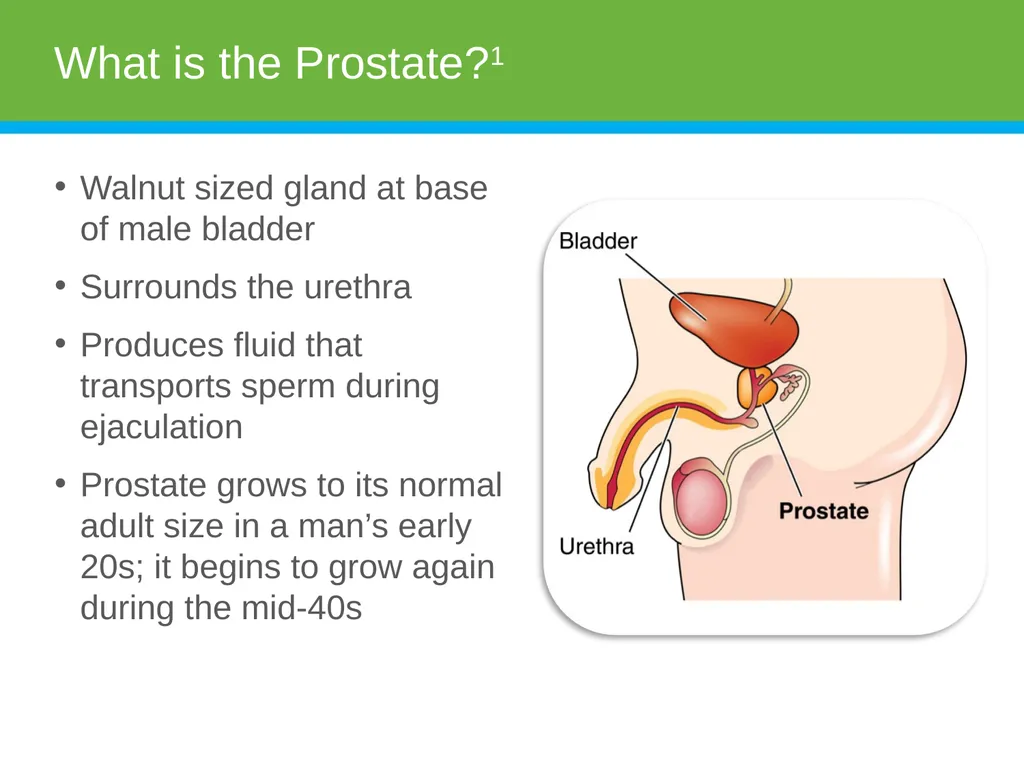
What is the Prostate?1 Walnut sized gland at base of male bladder
Surrounds the urethra
Produces fluid that transports sperm during ejaculation
Prostate grows to its normal adult size in a man’s early 20s; it begins to grow again during the mid-40s<br>
Surrounds the urethra
Produces fluid that transports sperm during ejaculation
Prostate grows to its normal adult size in a man’s early 20s; it begins to grow again during the mid-40s<br>
06
What Can Happen to the Prostate?2 Enlarged Prostate or Benign Prostatic Hyperplasia (BPH)
Prostatitis
Prostate Cancer
Each condition affects the prostate differently.<br>
Prostatitis
Prostate Cancer
Each condition affects the prostate differently.<br>
07
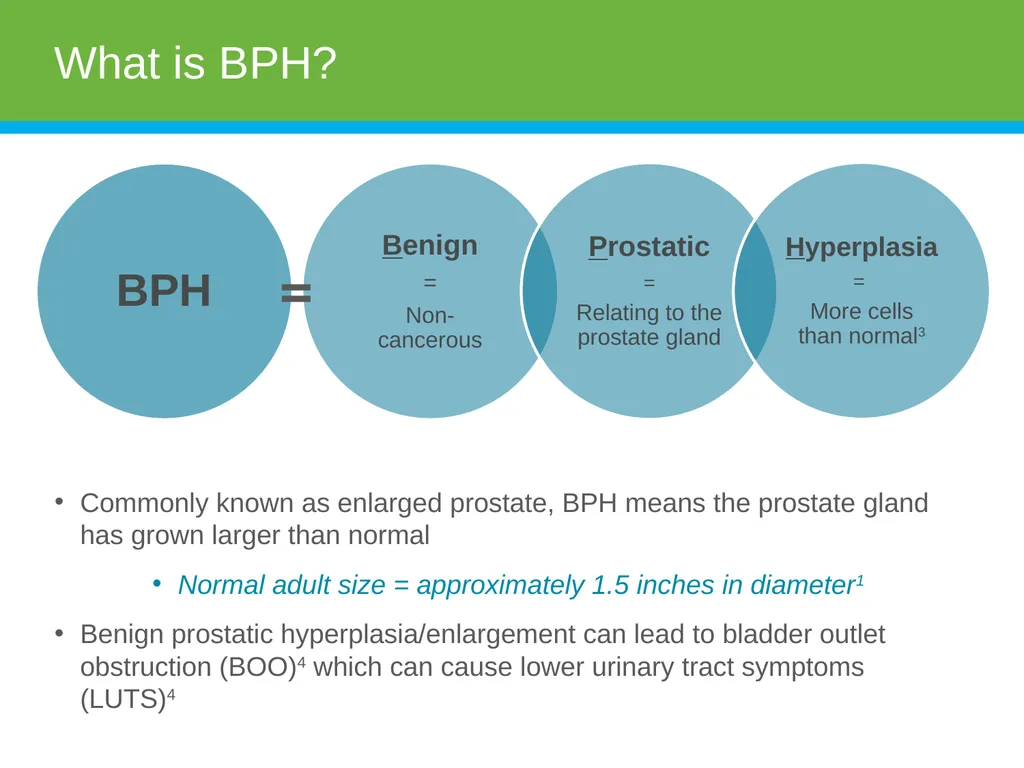
What is BPH? Commonly known as enlarged prostate, BPH means the prostate gland has grown larger than normal
Normal adult size = approximately 1.5 inches in diameter1
Benign prostatic hyperplasia/enlargement can lead to bladder outlet obstruction (BOO)4 which can cause lower urinary tract symptoms (LUTS)4 =<br>
Normal adult size = approximately 1.5 inches in diameter1
Benign prostatic hyperplasia/enlargement can lead to bladder outlet obstruction (BOO)4 which can cause lower urinary tract symptoms (LUTS)4 =<br>
08
Does BPH Mean I Have Prostate Cancer? BPH’s Relation to Prostate Cancer
BPH is not prostate cancer5
BPH does not cause prostate cancer5
BPH symptoms are similar to those of cancer1
BPH may co-exist with prostate cancer1
Prostate-Specific Antigen (PSA) levels alone do not distinguish BPH from prostate cancer.1 Both BPH and prostate cancer can cause elevated PSA levels.1<br>
BPH is not prostate cancer5
BPH does not cause prostate cancer5
BPH symptoms are similar to those of cancer1
BPH may co-exist with prostate cancer1
Prostate-Specific Antigen (PSA) levels alone do not distinguish BPH from prostate cancer.1 Both BPH and prostate cancer can cause elevated PSA levels.1<br>
09
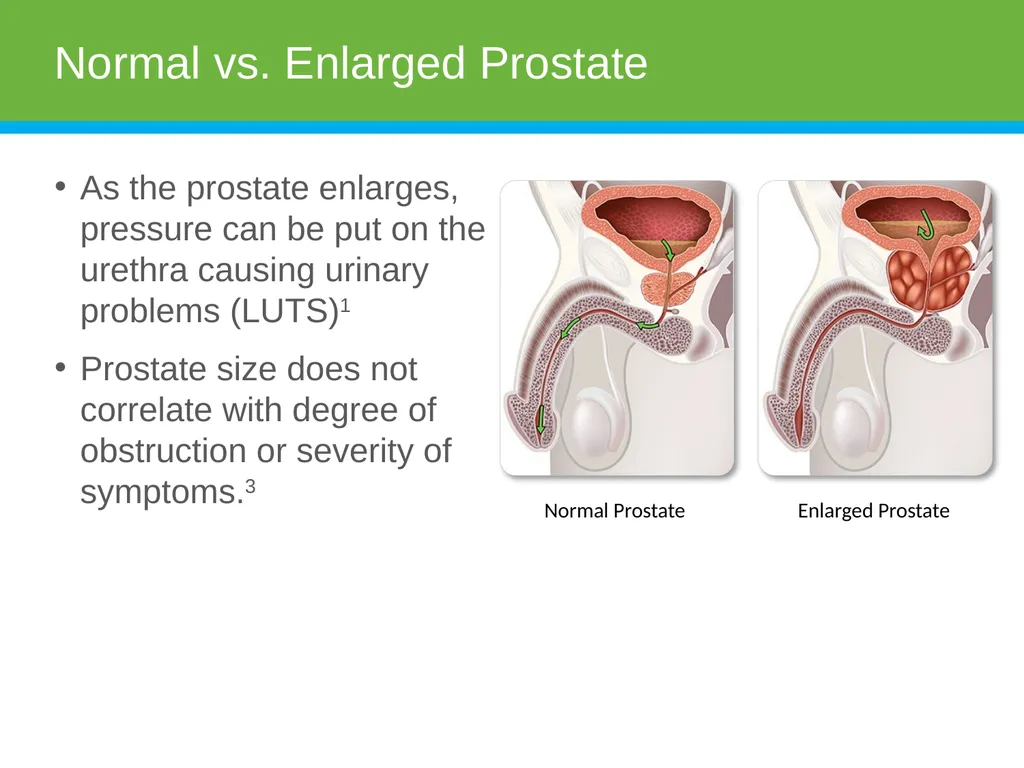
Normal vs. Enlarged Prostate As the prostate enlarges, pressure can be put on the urethra causing urinary problems (LUTS)1
Prostate size does not correlate with degree of obstruction or severity of symptoms.3 Normal Prostate Enlarged Prostate<br>
Prostate size does not correlate with degree of obstruction or severity of symptoms.3 Normal Prostate Enlarged Prostate<br>
10
What are the Symptoms of BPH?1 Frequent urination during the day and/or night
Sudden urge to urinate
Burning, painful urination
Weak urine flow
Sensation the bladder is not empty after urination
Inability to urinate
Trouble stopping and starting of urine flow<br>
Sudden urge to urinate
Burning, painful urination
Weak urine flow
Sensation the bladder is not empty after urination
Inability to urinate
Trouble stopping and starting of urine flow<br>
11
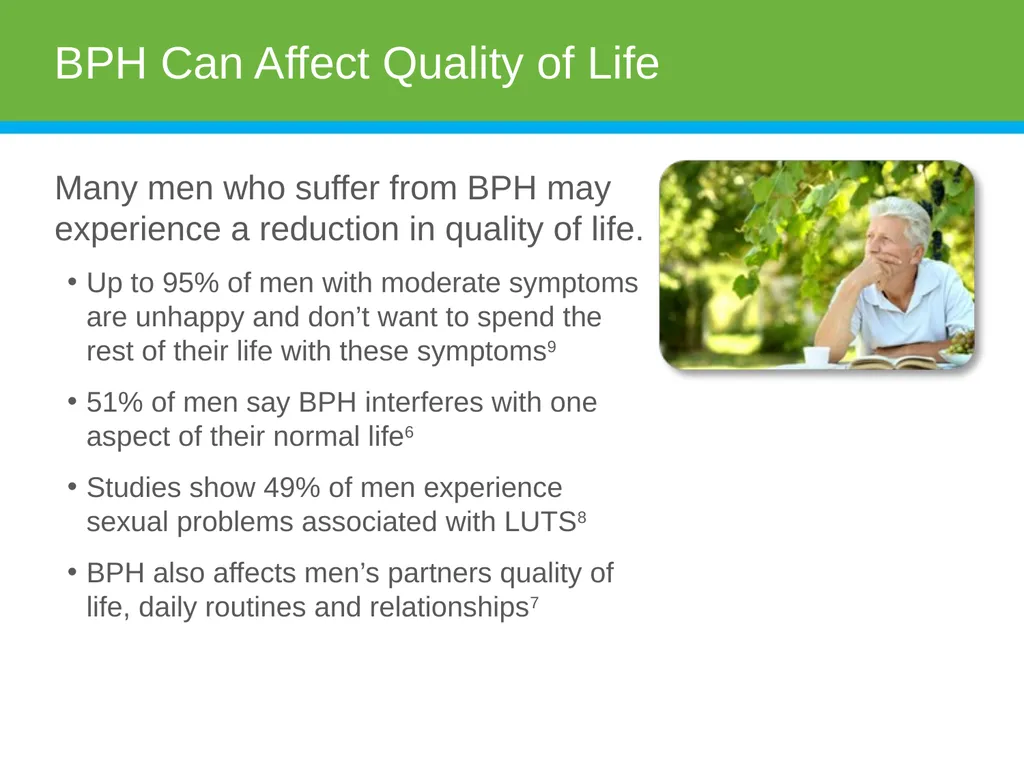
BPH Can Affect Quality of Life Many men who suffer from BPH may experience a reduction in quality of life.
Up to 95% of men with moderate symptoms are unhappy and don’t want to spend the rest of their life with these symptoms9
51% of men say BPH interferes with one aspect of their normal life6
Studies show 49% of men experience sexual problems associated with LUTS8
BPH also affects men’s partners quality of life, daily routines and relationships7<br>
Up to 95% of men with moderate symptoms are unhappy and don’t want to spend the rest of their life with these symptoms9
51% of men say BPH interferes with one aspect of their normal life6
Studies show 49% of men experience sexual problems associated with LUTS8
BPH also affects men’s partners quality of life, daily routines and relationships7<br>
12
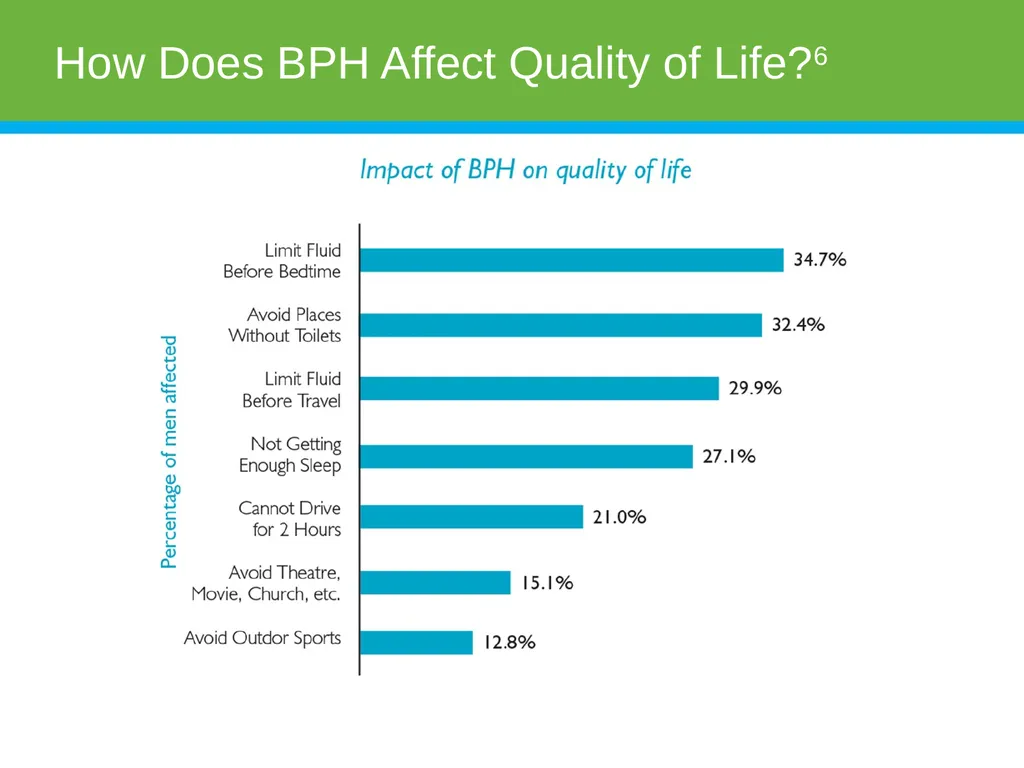
How Does BPH Affect Quality of Life?6<br>
13
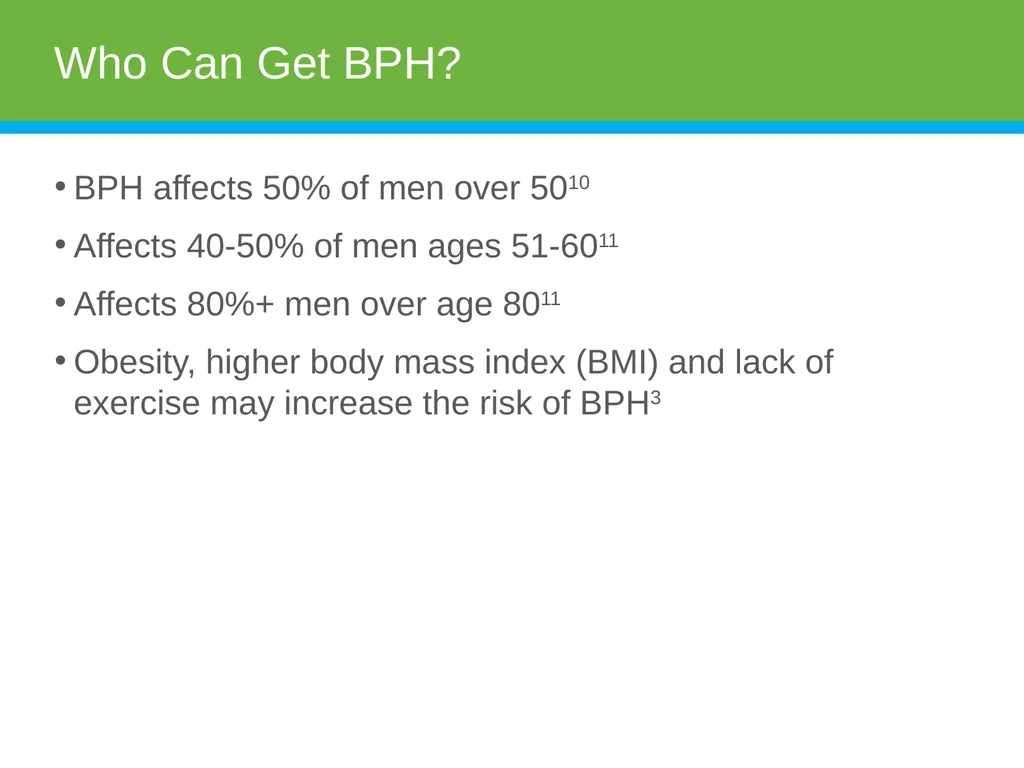
Who Can Get BPH? BPH affects 50% of men over 5010
Affects 40-50% of men ages 51-6011
Affects 80%+ men over age 8011
Obesity, higher body mass index (BMI) and lack of exercise may increase the risk of BPH3<br>
Affects 40-50% of men ages 51-6011
Affects 80%+ men over age 8011
Obesity, higher body mass index (BMI) and lack of exercise may increase the risk of BPH3<br>
14
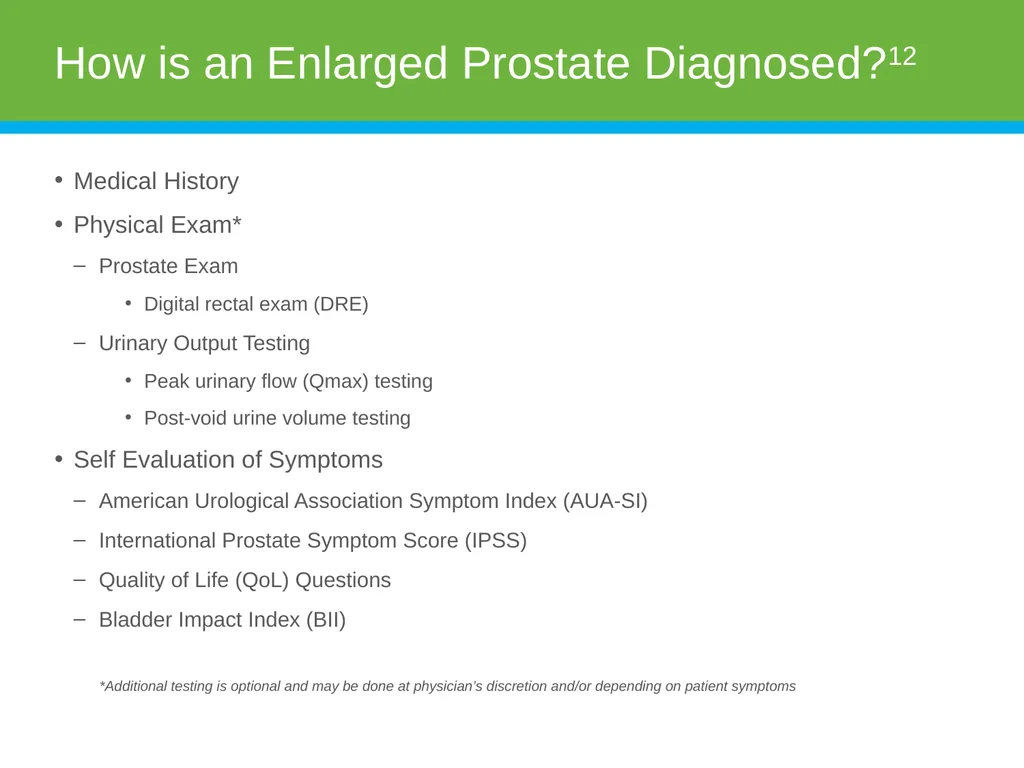
How is an Enlarged Prostate Diagnosed?12 Medical History
Physical Exam*
Prostate Exam
Digital rectal exam (DRE)
Urinary Output Testing
Peak urinary flow (Qmax) testing
Post-void urine volume testing
Self Evaluation of Symptoms
American Urological Association Symptom Index (AUA-SI)
International Prostate Symptom Score (IPSS)
Quality of Life (QoL) Questions
Bladder Impact Index (BII)
*Additional testing is optional and may be done at physician’s discretion and/or depending on patient symptoms<br>
Physical Exam*
Prostate Exam
Digital rectal exam (DRE)
Urinary Output Testing
Peak urinary flow (Qmax) testing
Post-void urine volume testing
Self Evaluation of Symptoms
American Urological Association Symptom Index (AUA-SI)
International Prostate Symptom Score (IPSS)
Quality of Life (QoL) Questions
Bladder Impact Index (BII)
*Additional testing is optional and may be done at physician’s discretion and/or depending on patient symptoms<br>
15
Treatment Options<br>
16
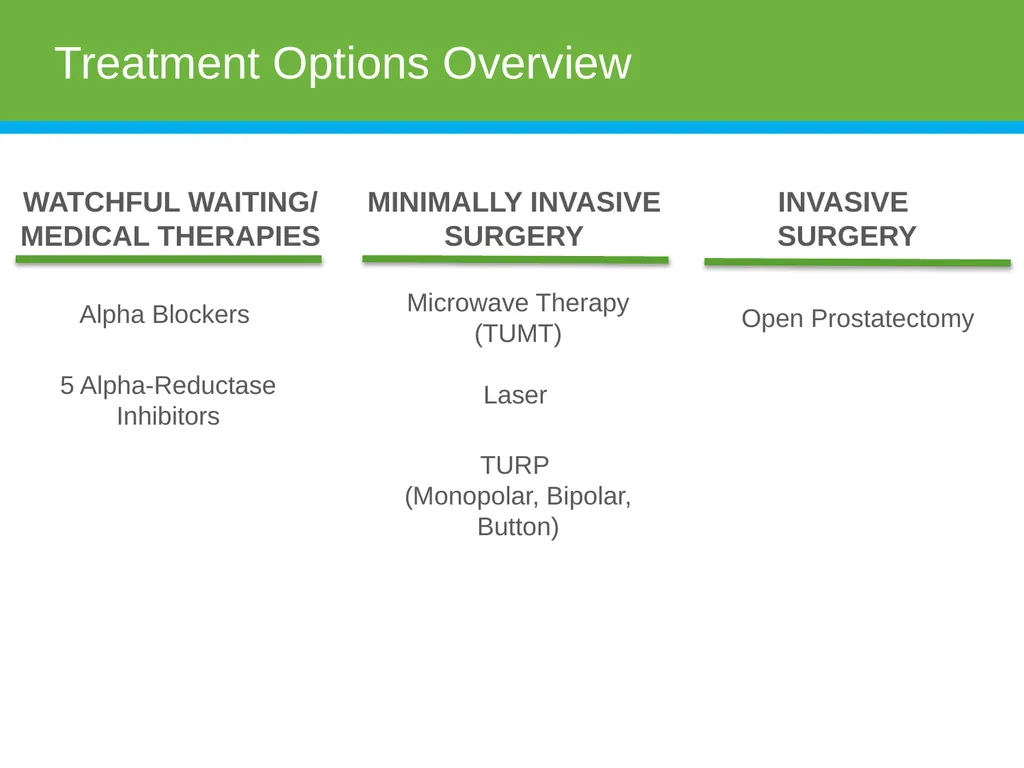
Treatment Options Overview WATCHFUL WAITING/
MEDICAL THERAPIES MINIMALLY INVASIVE SURGERY INVASIVE
SURGERY Alpha Blockers 5 Alpha-Reductase
Inhibitors Microwave Therapy
(TUMT) Laser TURP
(Monopolar, Bipolar, Button) Open Prostatectomy<br>
MEDICAL THERAPIES MINIMALLY INVASIVE SURGERY INVASIVE
SURGERY Alpha Blockers 5 Alpha-Reductase
Inhibitors Microwave Therapy
(TUMT) Laser TURP
(Monopolar, Bipolar, Button) Open Prostatectomy<br>
17
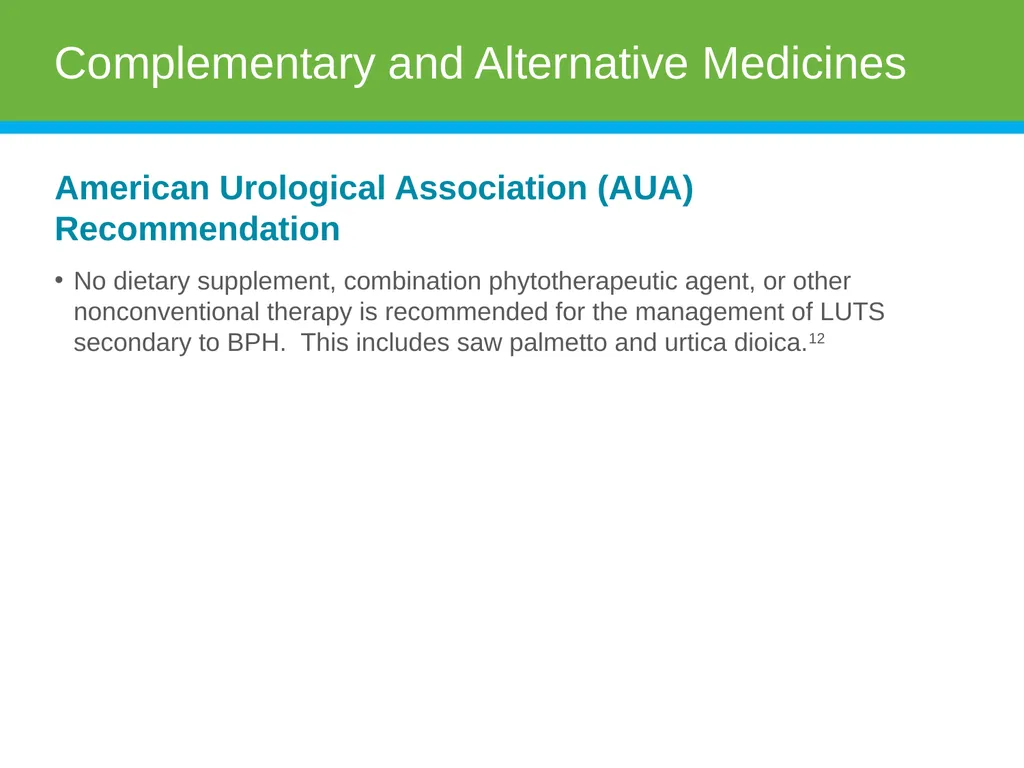
Complementary and Alternative Medicines American Urological Association (AUA) Recommendation
No dietary supplement, combination phytotherapeutic agent, or other nonconventional therapy is recommended for the management of LUTS secondary to BPH. This includes saw palmetto and urtica dioica.12<br>
No dietary supplement, combination phytotherapeutic agent, or other nonconventional therapy is recommended for the management of LUTS secondary to BPH. This includes saw palmetto and urtica dioica.12<br>
18
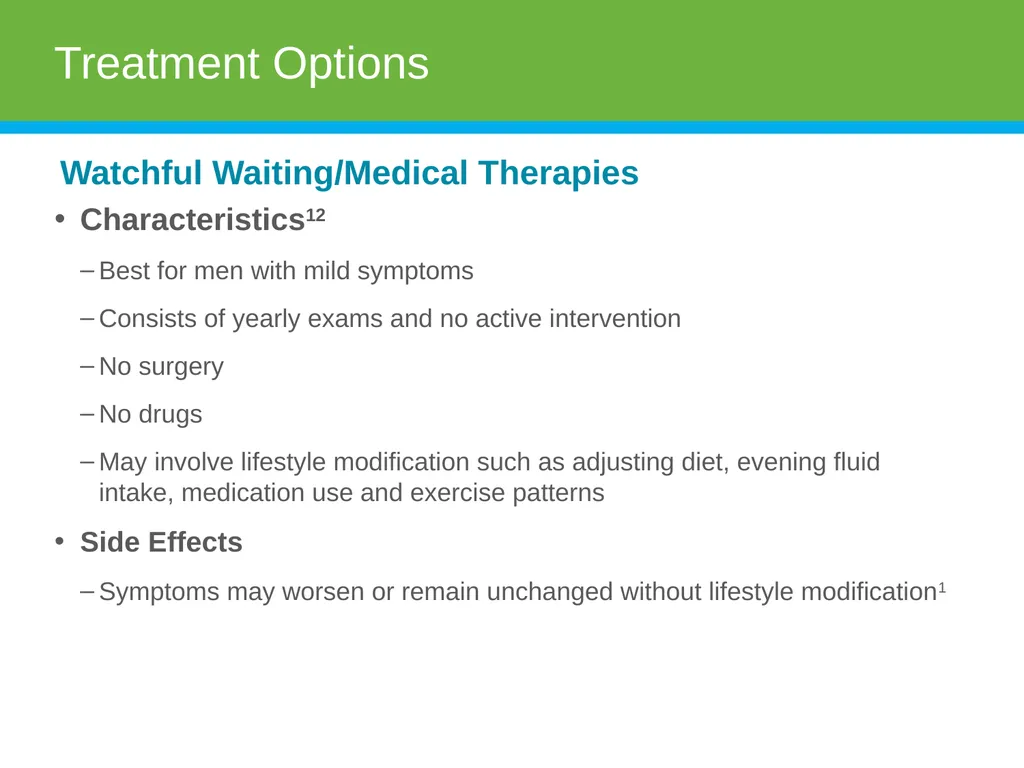
Treatment Options Characteristics12
Best for men with mild symptoms
Consists of yearly exams and no active intervention
No surgery
No drugs
May involve lifestyle modification such as adjusting diet, evening fluid intake, medication use and exercise patterns
Side Effects
Symptoms may worsen or remain unchanged without lifestyle modification1 Watchful Waiting/Medical Therapies<br>
Best for men with mild symptoms
Consists of yearly exams and no active intervention
No surgery
No drugs
May involve lifestyle modification such as adjusting diet, evening fluid intake, medication use and exercise patterns
Side Effects
Symptoms may worsen or remain unchanged without lifestyle modification1 Watchful Waiting/Medical Therapies<br>
19
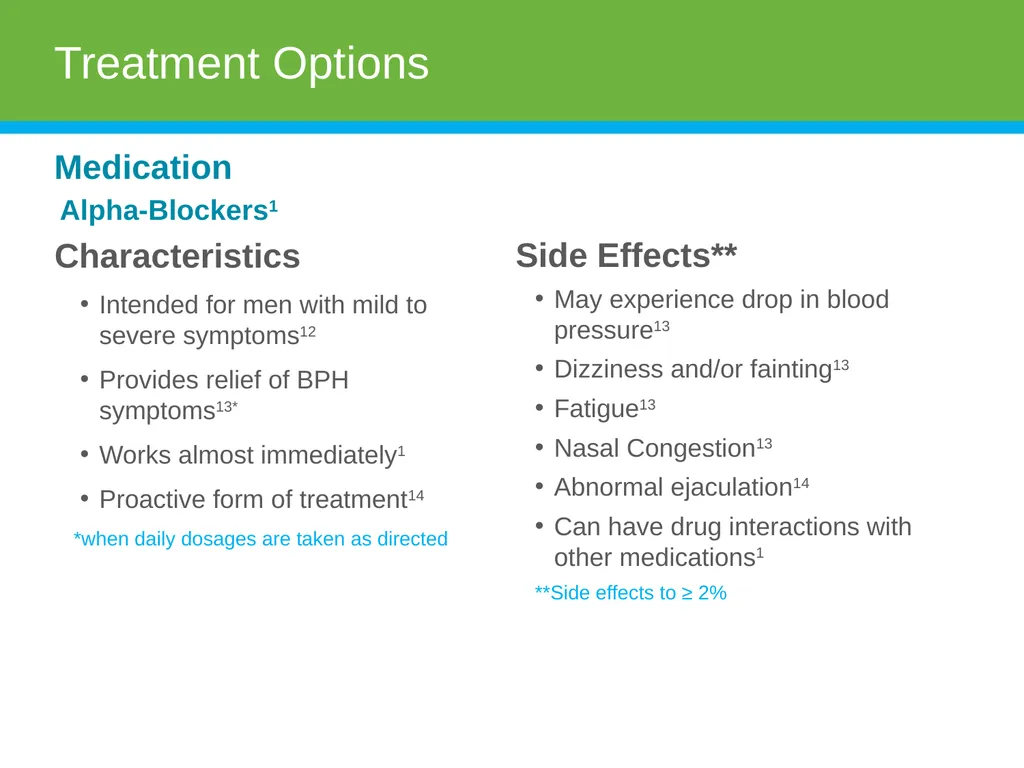
Treatment Options Characteristics
Intended for men with mild to severe symptoms12
Provides relief of BPH symptoms13*
Works almost immediately1
Proactive form of treatment14
*when daily dosages are taken as directed Medication Alpha-Blockers1 Side Effects**
May experience drop in blood pressure13
Dizziness and/or fainting13
Fatigue13
Nasal Congestion13
Abnormal ejaculation14
Can have drug interactions with other medications1
**Side effects to ≥ 2%<br>
Intended for men with mild to severe symptoms12
Provides relief of BPH symptoms13*
Works almost immediately1
Proactive form of treatment14
*when daily dosages are taken as directed Medication Alpha-Blockers1 Side Effects**
May experience drop in blood pressure13
Dizziness and/or fainting13
Fatigue13
Nasal Congestion13
Abnormal ejaculation14
Can have drug interactions with other medications1
**Side effects to ≥ 2%<br>
20
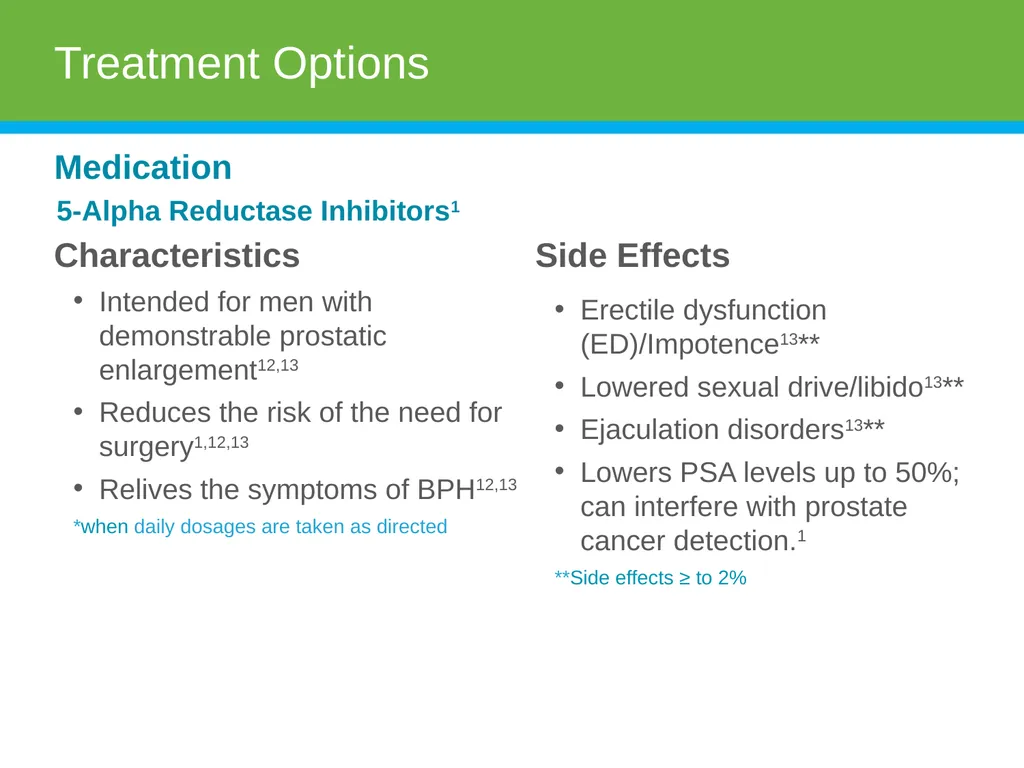
Treatment Options Medication 5-Alpha Reductase Inhibitors1 Characteristics
Intended for men with demonstrable prostatic enlargement12,13
Reduces the risk of the need for surgery1,12,13
Relives the symptoms of BPH12,13
*when daily dosages are taken as directed Side Effects
Erectile dysfunction (ED)/Impotence13**
Lowered sexual drive/libido13**
Ejaculation disorders13**
Lowers PSA levels up to 50%; can interfere with prostate cancer detection.1
**Side effects ≥ to 2%<br>
Intended for men with demonstrable prostatic enlargement12,13
Reduces the risk of the need for surgery1,12,13
Relives the symptoms of BPH12,13
*when daily dosages are taken as directed Side Effects
Erectile dysfunction (ED)/Impotence13**
Lowered sexual drive/libido13**
Ejaculation disorders13**
Lowers PSA levels up to 50%; can interfere with prostate cancer detection.1
**Side effects ≥ to 2%<br>
21
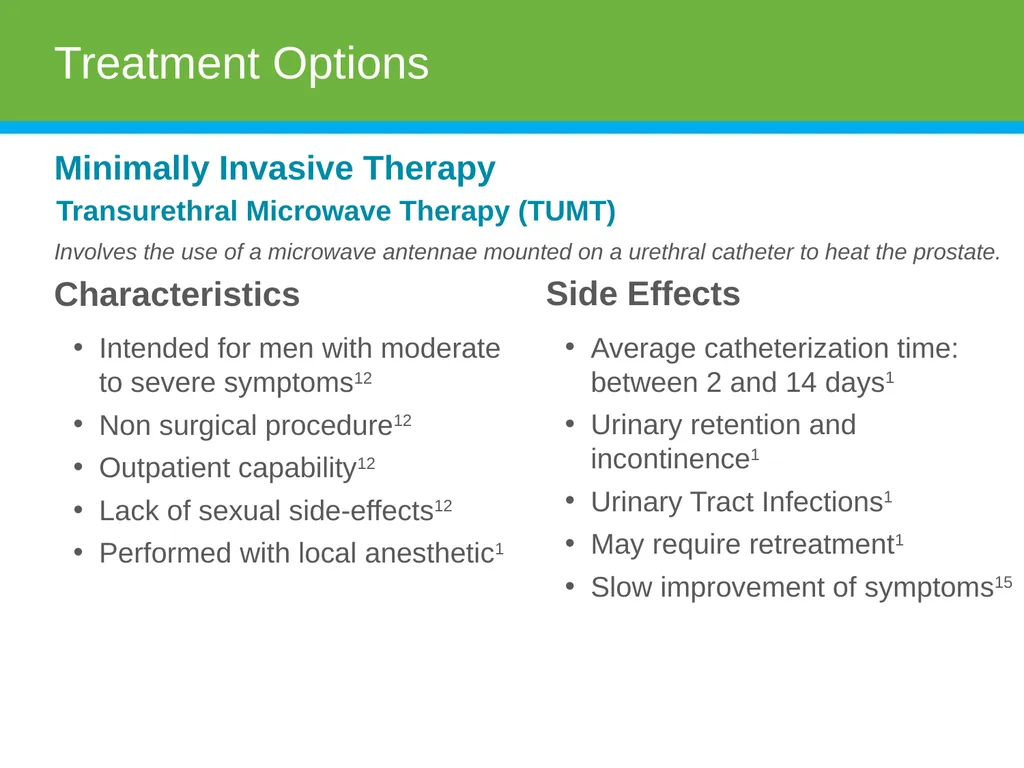
Treatment Options Characteristics
Intended for men with moderate to severe symptoms12
Non surgical procedure12
Outpatient capability12
Lack of sexual side-effects12
Performed with local anesthetic1 Side Effects
Average catheterization time: between 2 and 14 days1
Urinary retention and incontinence1
Urinary Tract Infections1
May require retreatment1
Slow improvement of symptoms15 Minimally Invasive Therapy Transurethral Microwave Therapy (TUMT) Involves the use of a microwave antennae mounted on a urethral catheter to heat the prostate.<br>
Intended for men with moderate to severe symptoms12
Non surgical procedure12
Outpatient capability12
Lack of sexual side-effects12
Performed with local anesthetic1 Side Effects
Average catheterization time: between 2 and 14 days1
Urinary retention and incontinence1
Urinary Tract Infections1
May require retreatment1
Slow improvement of symptoms15 Minimally Invasive Therapy Transurethral Microwave Therapy (TUMT) Involves the use of a microwave antennae mounted on a urethral catheter to heat the prostate.<br>
22
Treatment Options Characteristics12
Intended for men with moderate to severe symptoms
Performed under general or spinal anesthesia
Typically requires post-operative hospitalization ≥ 2 days1
Post-void residual
Improved Quality of Life scores
Provides symptoms relief
Demonstrated improved Qmax (volume of urine per sec)
Demonstrated improved prostate volume Side Effects
TUR Syndrome12
Sexual problems/ED1
Urinary retention1
Urethral strictures1
Prolonged catheterization1
Bladder neck contracture12
Retrograde ejaculation1
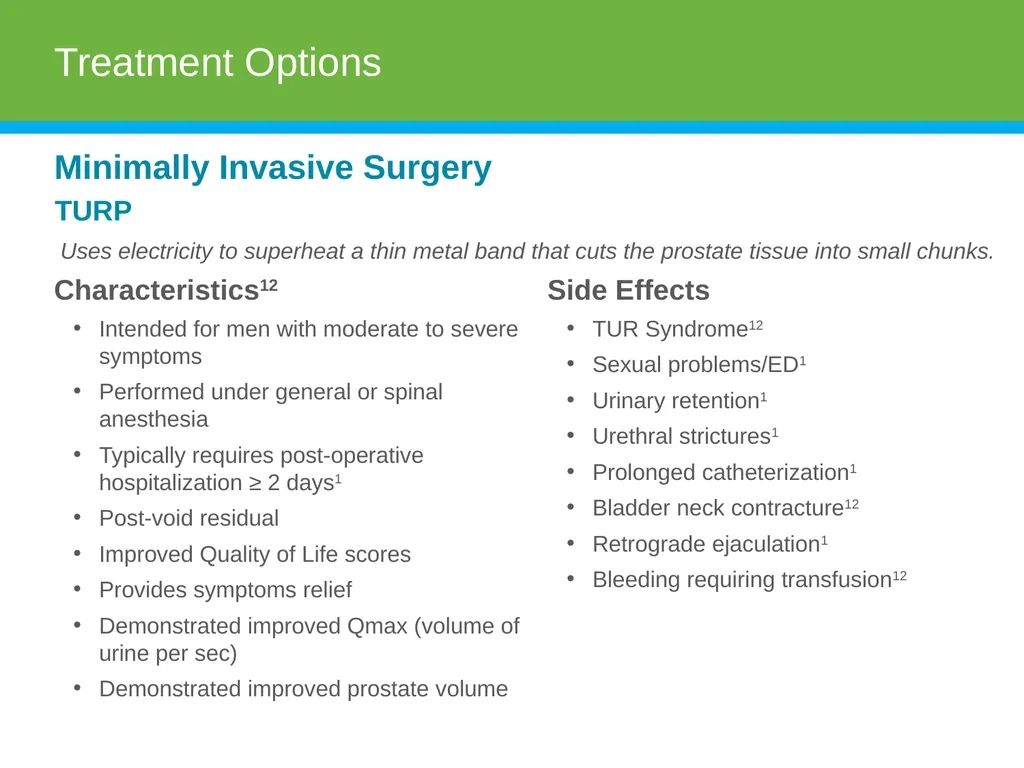
Bleeding requiring transfusion12 Minimally Invasive Surgery TURP Uses electricity to superheat a thin metal band that cuts the prostate tissue into small chunks.<br>
Intended for men with moderate to severe symptoms
Performed under general or spinal anesthesia
Typically requires post-operative hospitalization ≥ 2 days1
Post-void residual
Improved Quality of Life scores
Provides symptoms relief
Demonstrated improved Qmax (volume of urine per sec)
Demonstrated improved prostate volume Side Effects
TUR Syndrome12
Sexual problems/ED1
Urinary retention1
Urethral strictures1
Prolonged catheterization1
Bladder neck contracture12
Retrograde ejaculation1
Bleeding requiring transfusion12 Minimally Invasive Surgery TURP Uses electricity to superheat a thin metal band that cuts the prostate tissue into small chunks.<br>
23
Treatment Options Characteristics
Intended for men with BPH14
Typically done in an outpatient setting16
Provides sustainable symptom relief17
Rapid urine flow improvement after the procedure17
Minimal blood loss1 Side Effects
Retrograde ejaculation17
Urgency/frequency16
Dysuria14
Hematuria/blood in the urine16
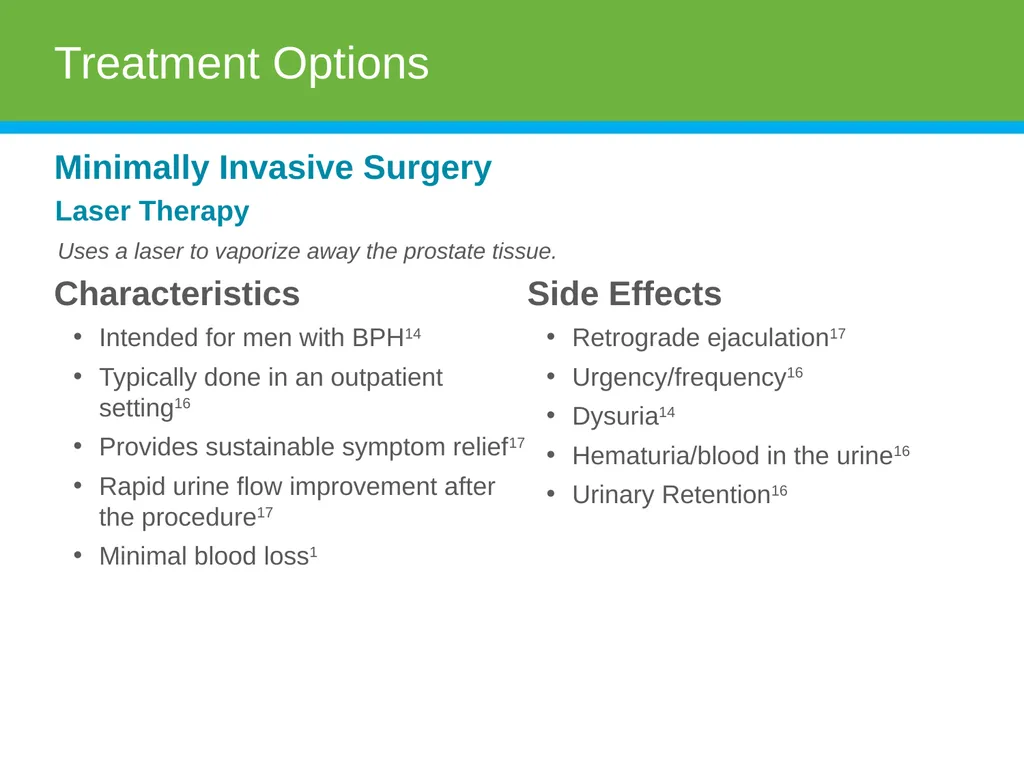
Urinary Retention16 Minimally Invasive Surgery Laser Therapy Uses a laser to vaporize away the prostate tissue.<br>
Intended for men with BPH14
Typically done in an outpatient setting16
Provides sustainable symptom relief17
Rapid urine flow improvement after the procedure17
Minimal blood loss1 Side Effects
Retrograde ejaculation17
Urgency/frequency16
Dysuria14
Hematuria/blood in the urine16
Urinary Retention16 Minimally Invasive Surgery Laser Therapy Uses a laser to vaporize away the prostate tissue.<br>
24
Treatment Options Characteristics12
Typically is performed on patients with larger prostate volumes (>80 - 100 mL)
Effective for men with:
Very enlarged prostate glands
Bladder diverticula (pockets)
Stones Side Effects12
Associated with a longer hospital stay
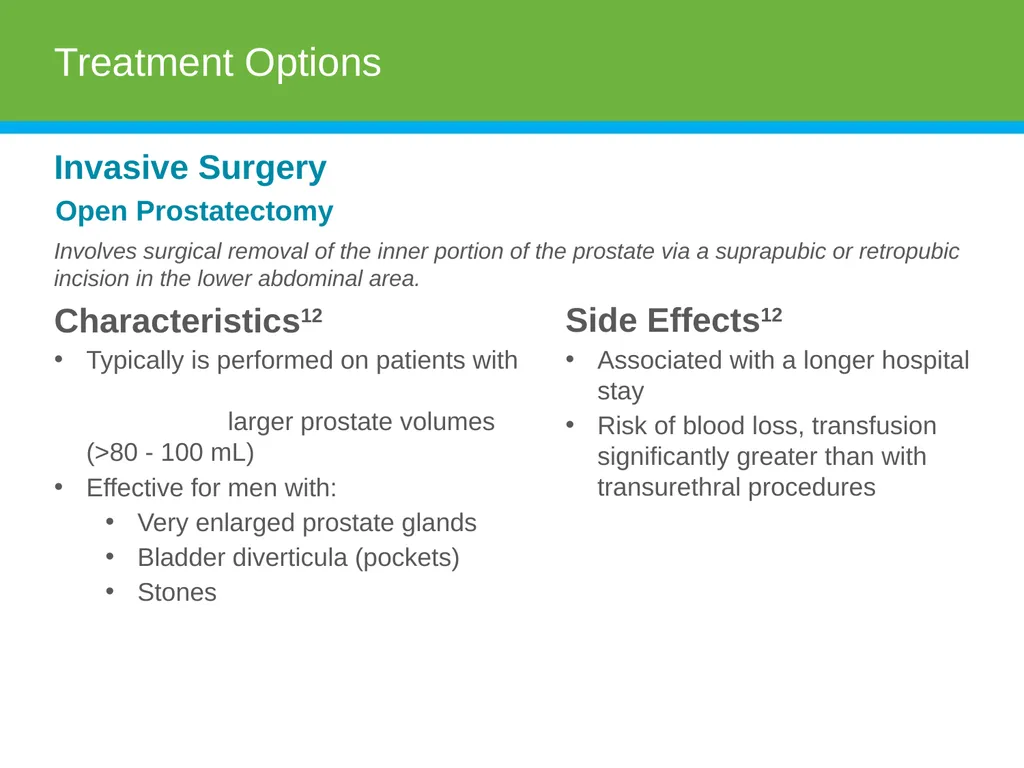
Risk of blood loss, transfusion significantly greater than with transurethral procedures Invasive Surgery Involves surgical removal of the inner portion of the prostate via a suprapubic or retropubic incision in the lower abdominal area. Open Prostatectomy<br>
Typically is performed on patients with larger prostate volumes (>80 - 100 mL)
Effective for men with:
Very enlarged prostate glands
Bladder diverticula (pockets)
Stones Side Effects12
Associated with a longer hospital stay
Risk of blood loss, transfusion significantly greater than with transurethral procedures Invasive Surgery Involves surgical removal of the inner portion of the prostate via a suprapubic or retropubic incision in the lower abdominal area. Open Prostatectomy<br>
25
Insurance Coverage It is the responsibility of the patient to contact their insurance provider for specific coverage information.<br>
26
In Summary What is the prostate and how does it work?
Enlarged prostate = BPH
Treatment Options
Watchful Waiting/Medical Therapy
Minimally Invasive Surgical Therapy
Heat Therapy
TURP
Laser Therapy
Surgical Therapy
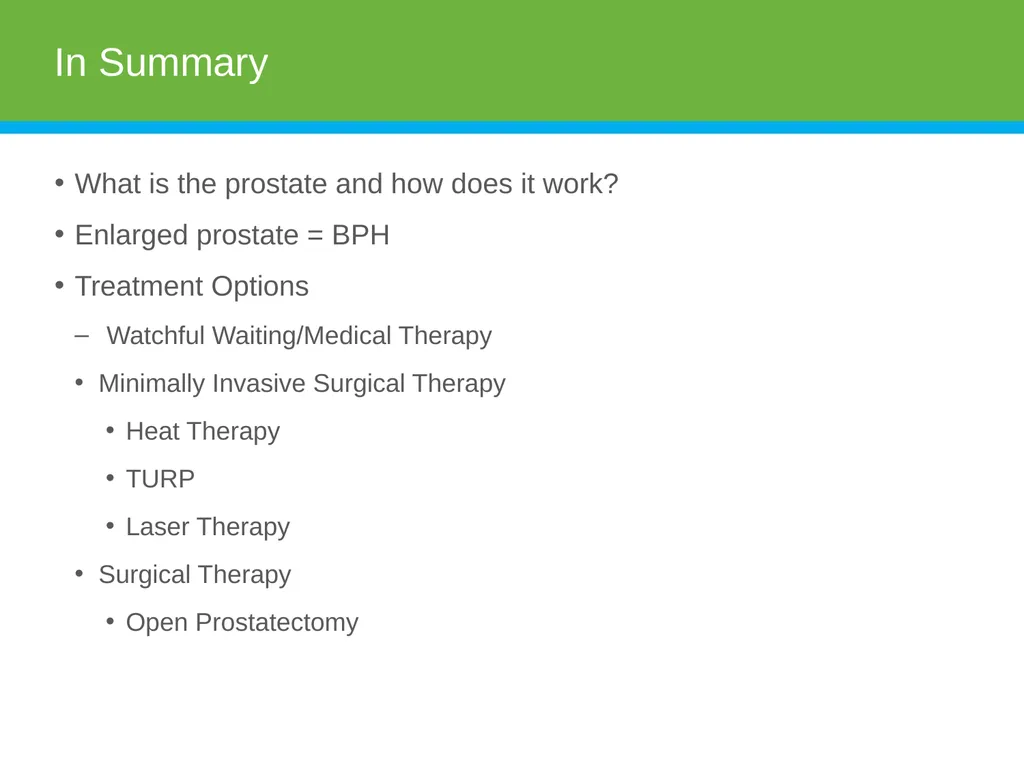
Open Prostatectomy<br>
Enlarged prostate = BPH
Treatment Options
Watchful Waiting/Medical Therapy
Minimally Invasive Surgical Therapy
Heat Therapy
TURP
Laser Therapy
Surgical Therapy
Open Prostatectomy<br>
27
Next Steps Consultation with your Urologist is required to determine what therapy option is the best treatment option for you.<br>
28
References 1. Carter HB. Prostate Disorders: the Johns Hopkins White Papers. Baltimore, MD: Johns Hopkins Medicine; 2010: 1, 3.
2. Kidney and Urinary System Disorders-Prostate Disease. http://www.hopkinsmedicine.org/healthlibrary/conditions/adult/kidney_and_urinary_system_disorders/prostate_disease_85,P01492. Accessed 6/14/12.
3. Roehrborn, C. Benign Prostatic Hyperplasia: Etiology, Pathophysiology, Epidemiology, and Natural History. Campbell-Walsh Urology Tenth Edition. Philadelphia, PA: Saunders, an Imprint of Elsevier, Inc.; 2012;91:2579.
4. Kirby, R., Gilling, P. Fast Facts: Benign Prostatic Hyperplasia, Sixth Edition. United Kingdom: Health Press; 2010:14, 16, 19. 5
5. Clinical Practice Guideline-Treating Your Enlarged Prostate. U.S. Department of Health and Human Services. Rockville, MD: Agency for Health Care Policy and Research (AHCPR) Publication No. 943-0584. February 1994; Number 8:1.
6. Garraway, WM, McKelvie, GB, Russell, EBAW, Hehir, M., Lee, R., Rogers ACN, et. Al. Impact of previously unrecognized benign prostatic hyperplasia on the daily activities of middle-aged and elderly men. British Journal of General Practice. 1993:43:318.
7. Shvartzman, P., Borkan, J., Stoliar, L., Peleg, A., Nakar, S., Nir, G., et. A. Second-hand prostatism: effects of prostatic volumes in spouses’ quality of life, daily routines and family relationships. Family Practice. 2001;18-6:610-612.
8. Rosen, R., Update on the relationship between sexual dysfunction and lower urinary tract symptoms/benign prostatic hyperplasia. Current Opinion in Urology. 2006; 16:11-12,15.
9. Bertaccini, A., Vassallo, F., Martino, F., Luzzi, L., Rossetti, S., Di Silverio, F., et. Al. Symptoms, bothersomeness and quality of life in patients with LUTS suggestive of BPH. Eur Urol. 2001;40 (Suppl 1):16.
10. Berry, S, Coffey, D, Walsh, P, Ewing, J, The Development of Human Benign Prostatic Hyperplasia with Age. Journal of Urology 1984; 132:1-6.
11. http://kidney.niddk.nih.gov/KUDiseases/pubs/kustats/index.aspx. Accessed 6/13/12.
12. American Urological Association Education Research, Inc. American Urological Association Guideline: Management of Benign Prostatic Hyperplasia (BPH), Revised, 2010:Appendix 280, 283-285.
13. Cambio, AJ, Evans, CP. Outcomes and quality of life issues in the pharmacological management of benign prostatic hyperplasia (BPH). Ther Clin Risk Manag. March 2007;3-1:193.
14. Wojcik, M., Dennison, D. Home Study Program-Photoselective vaporization of the prostate in ambulatory surgery. AORN Journal. February 2006;83-2:332.
15. Johns Hopkins Health Alert, Prostate on BPH Treatment Options: Special Report, Minimally Invasive Treatments for BPH (Benign Prostatic Hyperplasia) http://www.johnshopkinshealthalerts.com/reports/prostate_disorders/140-1.html Accessed 01/31/14.
16. Te, A., Malloy, Stein, B., Ulchaker, J., Nseyo, U., Hai, M., Malek, R. Photoselective Vaporization of the Prostate for the Treatment of Benign Prostatic Hyperplasia: 12-Month Results from the First United States Multicenter Prospective Trial. The Journal of Urology. 2004;172:1406.
17. Sarica, K., Alkan, E., Luleci, H., Tasci, A. Photoselective Vaporization of the Enlarged Prostate with KTP Laser: Long-Term Results in 240 Patients. Journal of Endourology. 2005;19-10:1200-1201. © 2014 American Medical Systems, Inc. (“AMS”).
The grant of permission to use AMS’s copyrighted material does not constitute endorsement by AMS of any persons, products, services or organizations. BPH-00977(2)b/March 2014<br>
2. Kidney and Urinary System Disorders-Prostate Disease. http://www.hopkinsmedicine.org/healthlibrary/conditions/adult/kidney_and_urinary_system_disorders/prostate_disease_85,P01492. Accessed 6/14/12.
3. Roehrborn, C. Benign Prostatic Hyperplasia: Etiology, Pathophysiology, Epidemiology, and Natural History. Campbell-Walsh Urology Tenth Edition. Philadelphia, PA: Saunders, an Imprint of Elsevier, Inc.; 2012;91:2579.
4. Kirby, R., Gilling, P. Fast Facts: Benign Prostatic Hyperplasia, Sixth Edition. United Kingdom: Health Press; 2010:14, 16, 19. 5
5. Clinical Practice Guideline-Treating Your Enlarged Prostate. U.S. Department of Health and Human Services. Rockville, MD: Agency for Health Care Policy and Research (AHCPR) Publication No. 943-0584. February 1994; Number 8:1.
6. Garraway, WM, McKelvie, GB, Russell, EBAW, Hehir, M., Lee, R., Rogers ACN, et. Al. Impact of previously unrecognized benign prostatic hyperplasia on the daily activities of middle-aged and elderly men. British Journal of General Practice. 1993:43:318.
7. Shvartzman, P., Borkan, J., Stoliar, L., Peleg, A., Nakar, S., Nir, G., et. A. Second-hand prostatism: effects of prostatic volumes in spouses’ quality of life, daily routines and family relationships. Family Practice. 2001;18-6:610-612.
8. Rosen, R., Update on the relationship between sexual dysfunction and lower urinary tract symptoms/benign prostatic hyperplasia. Current Opinion in Urology. 2006; 16:11-12,15.
9. Bertaccini, A., Vassallo, F., Martino, F., Luzzi, L., Rossetti, S., Di Silverio, F., et. Al. Symptoms, bothersomeness and quality of life in patients with LUTS suggestive of BPH. Eur Urol. 2001;40 (Suppl 1):16.
10. Berry, S, Coffey, D, Walsh, P, Ewing, J, The Development of Human Benign Prostatic Hyperplasia with Age. Journal of Urology 1984; 132:1-6.
11. http://kidney.niddk.nih.gov/KUDiseases/pubs/kustats/index.aspx. Accessed 6/13/12.
12. American Urological Association Education Research, Inc. American Urological Association Guideline: Management of Benign Prostatic Hyperplasia (BPH), Revised, 2010:Appendix 280, 283-285.
13. Cambio, AJ, Evans, CP. Outcomes and quality of life issues in the pharmacological management of benign prostatic hyperplasia (BPH). Ther Clin Risk Manag. March 2007;3-1:193.
14. Wojcik, M., Dennison, D. Home Study Program-Photoselective vaporization of the prostate in ambulatory surgery. AORN Journal. February 2006;83-2:332.
15. Johns Hopkins Health Alert, Prostate on BPH Treatment Options: Special Report, Minimally Invasive Treatments for BPH (Benign Prostatic Hyperplasia) http://www.johnshopkinshealthalerts.com/reports/prostate_disorders/140-1.html Accessed 01/31/14.
16. Te, A., Malloy, Stein, B., Ulchaker, J., Nseyo, U., Hai, M., Malek, R. Photoselective Vaporization of the Prostate for the Treatment of Benign Prostatic Hyperplasia: 12-Month Results from the First United States Multicenter Prospective Trial. The Journal of Urology. 2004;172:1406.
17. Sarica, K., Alkan, E., Luleci, H., Tasci, A. Photoselective Vaporization of the Enlarged Prostate with KTP Laser: Long-Term Results in 240 Patients. Journal of Endourology. 2005;19-10:1200-1201. © 2014 American Medical Systems, Inc. (“AMS”).
The grant of permission to use AMS’s copyrighted material does not constitute endorsement by AMS of any persons, products, services or organizations. BPH-00977(2)b/March 2014<br>
29
Thank You<br>