
Physics Book Chapters 16 and 17 Conceptual Book
Description: Physics Book Chapters 16 and 17 Conceptual Book Chapters 25 and 26 Unit 9 - Waves and Sound Waves are everywhere! Examples of waves: Visible light Radio Microwaves Water Sine, Cosine Stadium Earthquake Slinky String What is a Wave? A wave
Related Topics
Download Presentation
"Physics Book Chapters 16 and 17 Conceptual Book" is the property of its rightful owner. Permission is granted to download and print the materials on this website for personal, non-commercial use only, and to display it on your personal computer provided you do not modify the materials and that you retain all copyright notices contained in the materials. By downloading content from our website, you accept the terms of this agreement.
Presentation Transcript
slide1. Physics Book Chapters 16 and 17
Conceptual Book Chapters 25 and 26 Unit 9 - Waves and Sound<br>
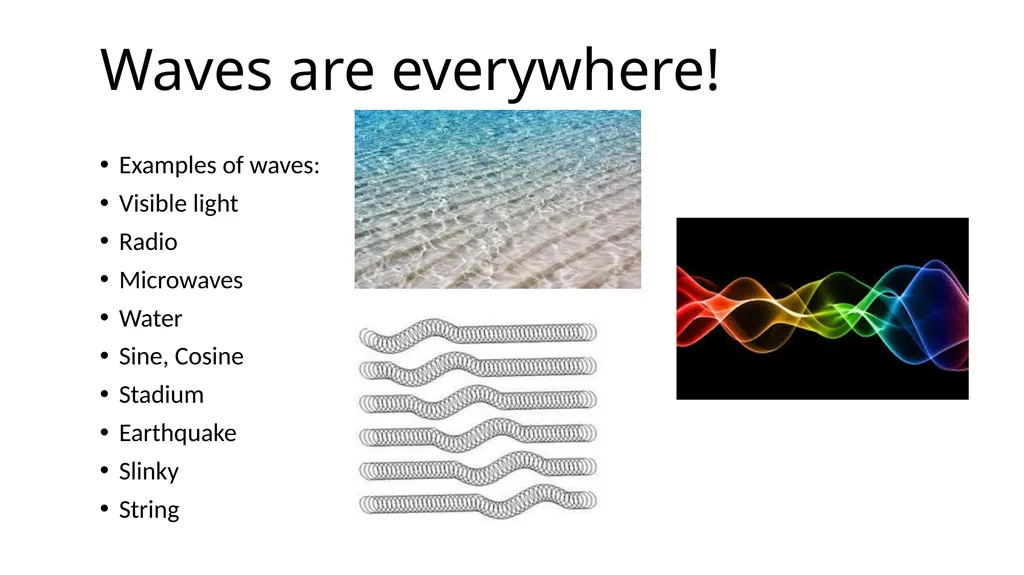
slide2. Waves are everywhere! Examples of waves:
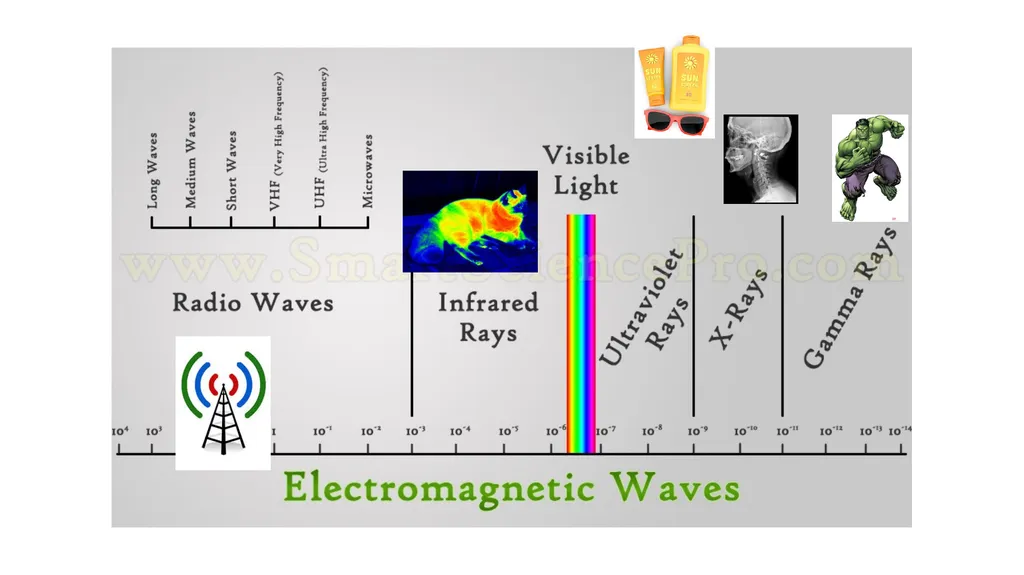
Visible light
Radio
Microwaves
Water
Sine, Cosine
Stadium
Earthquake
Slinky
String<br>
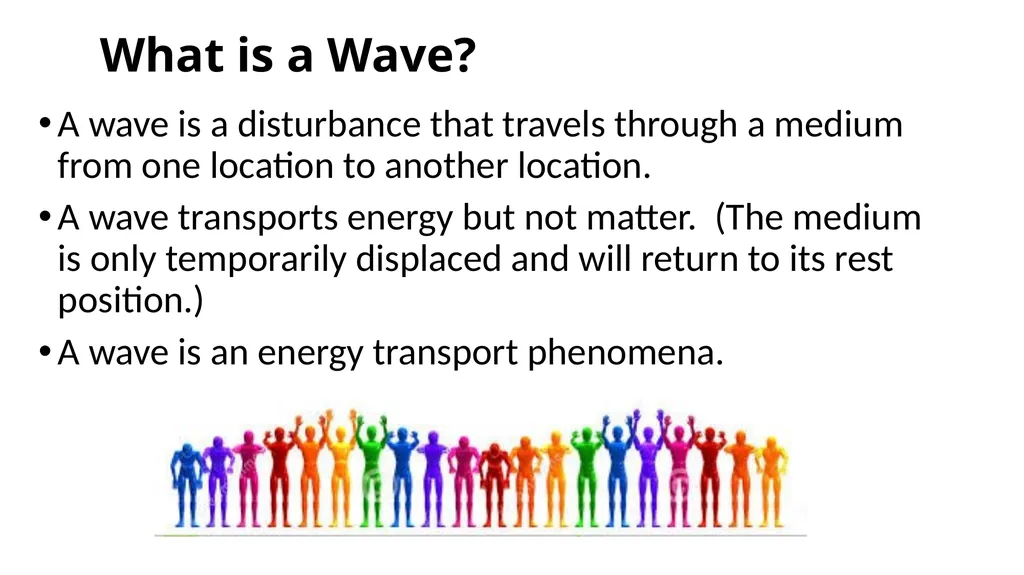
slide3. What is a Wave? A wave is a disturbance that travels through a medium from one location to another location.
A wave transports energy but not matter. (The medium is only temporarily displaced and will return to its rest position.)
A wave is an energy transport phenomena.<br>
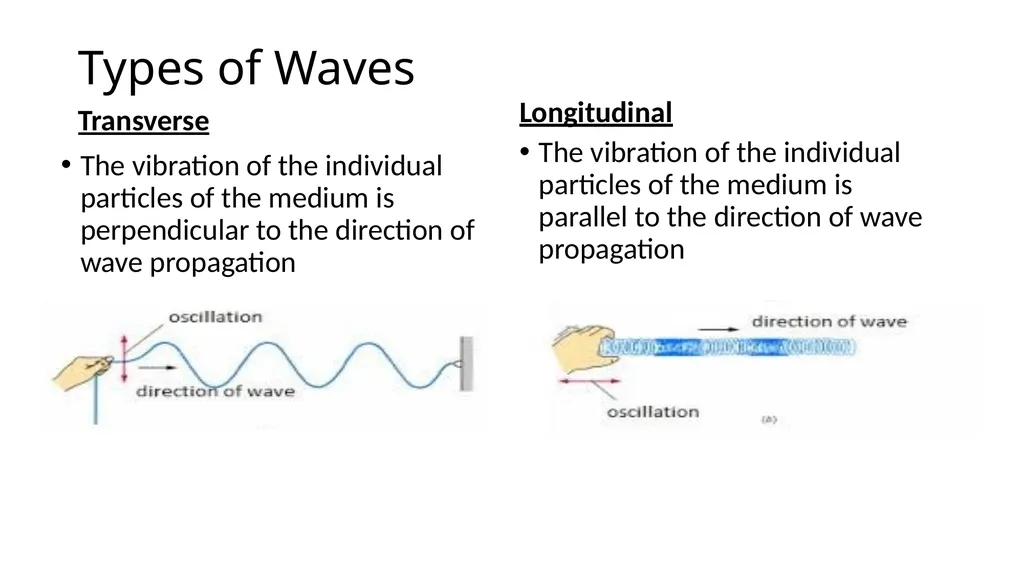
slide4. Types of Waves Transverse The vibration of the individual particles of the medium is perpendicular to the direction of wave propagation Longitudinal The vibration of the individual particles of the medium is parallel to the direction of wave propagation<br>
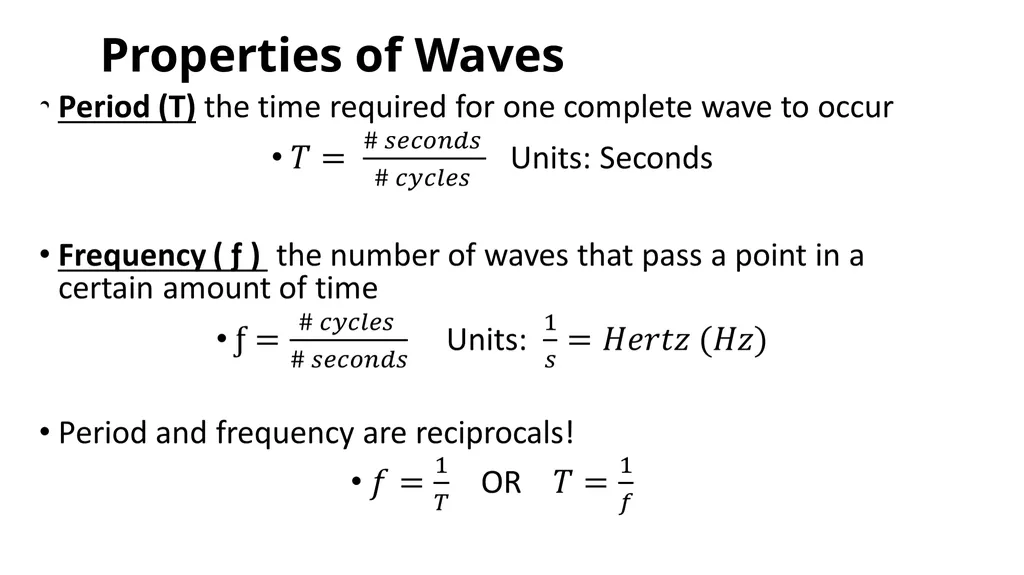
slide5. Properties of Waves<br>
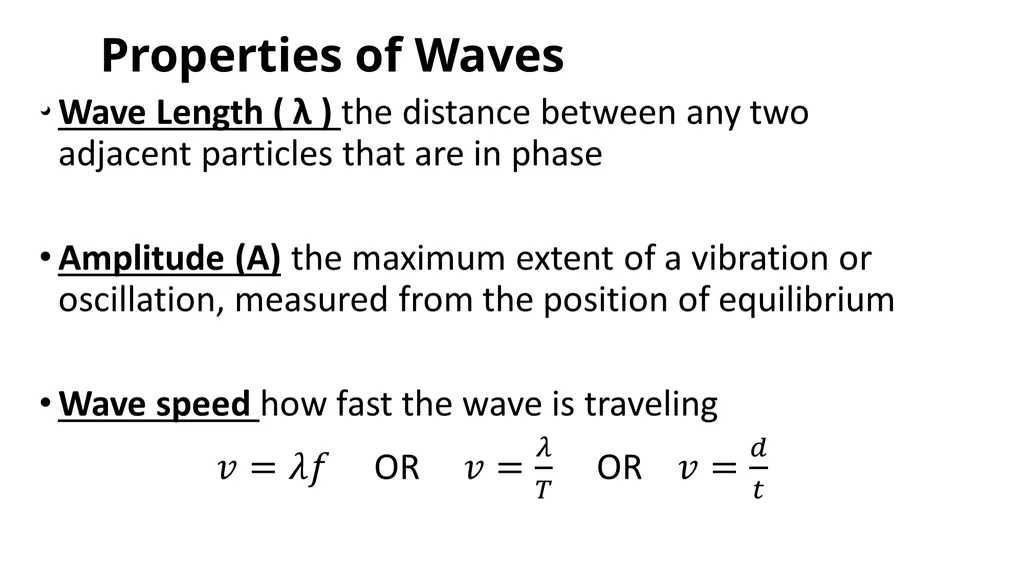
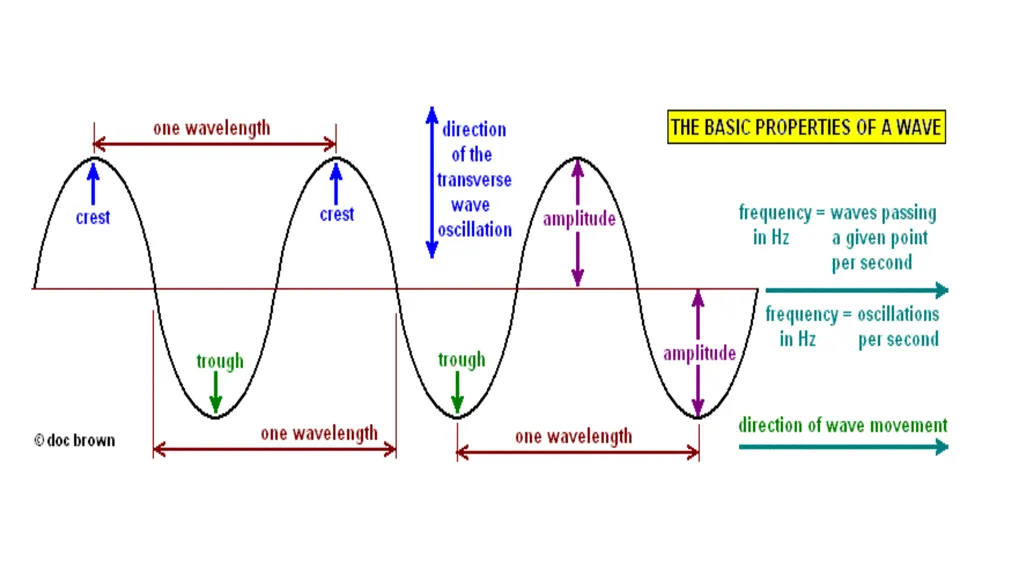
slide6. Properties of Waves<br>
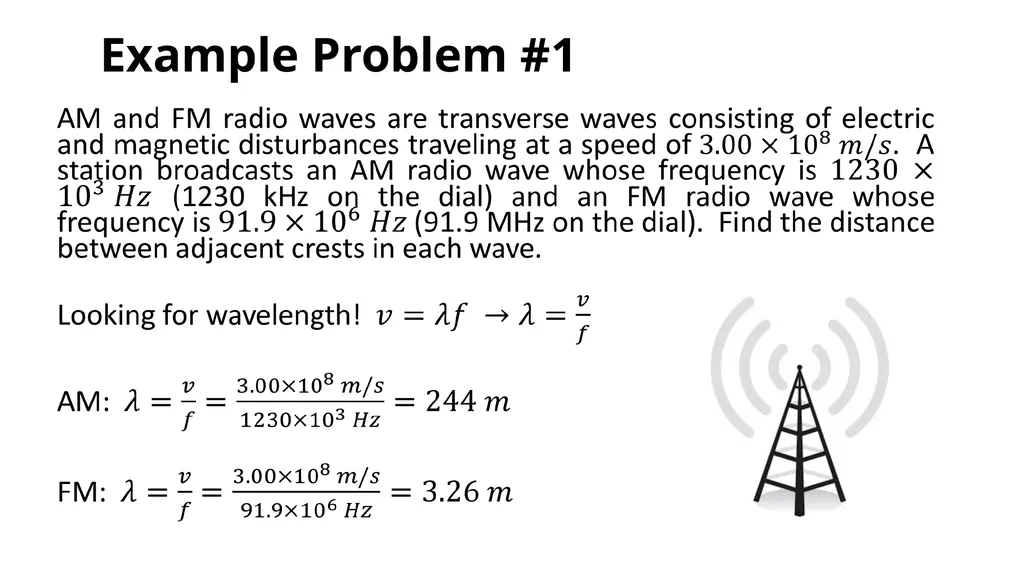
slide8. Example Problem #1<br>
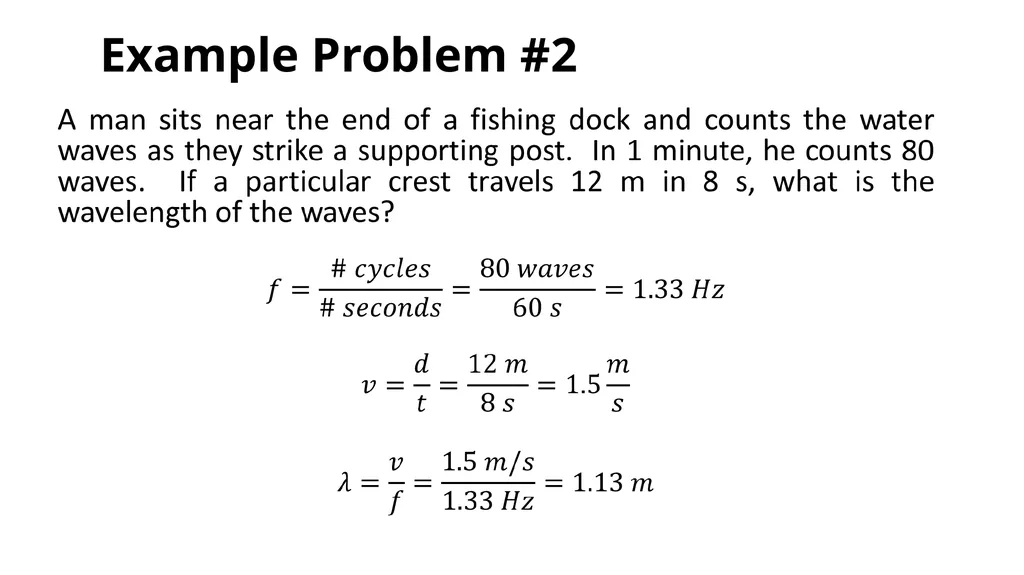
slide9. Example Problem #2<br>
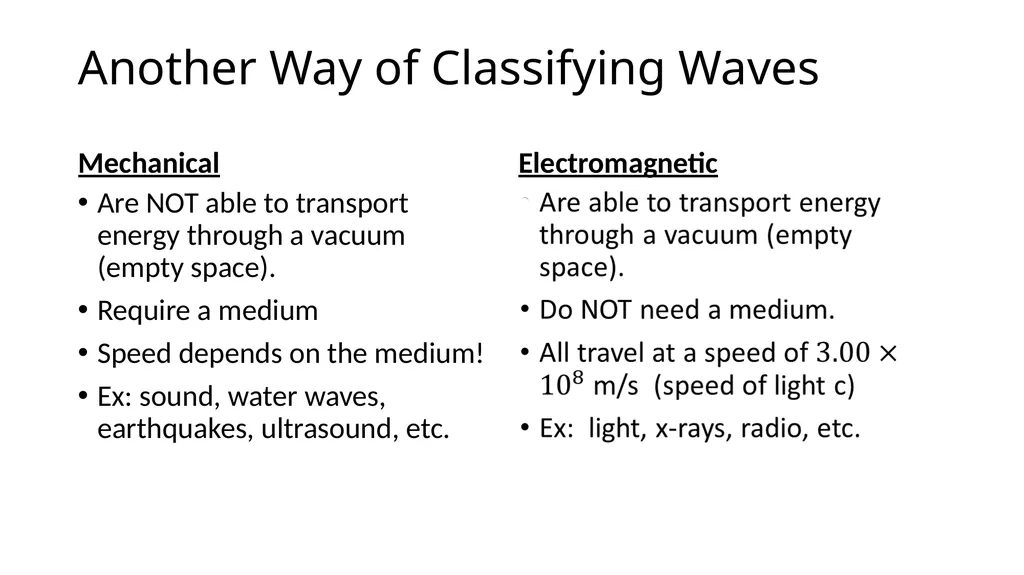
slide10. Another Way of Classifying Waves Mechanical Are NOT able to transport energy through a vacuum (empty space).
Require a medium
Speed depends on the medium!
Ex: sound, water waves, earthquakes, ultrasound, etc. Electromagnetic<br>
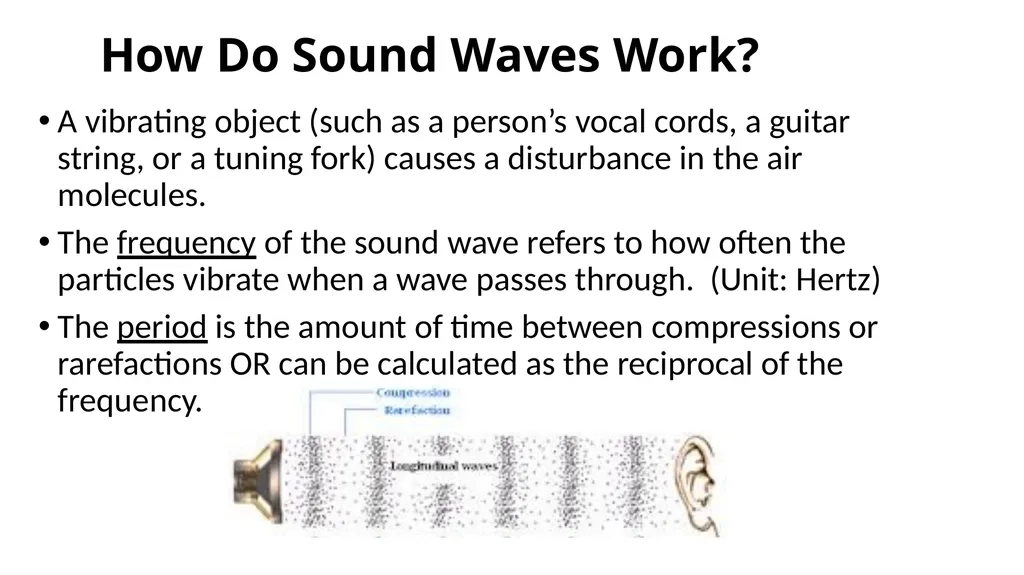
slide12. How Do Sound Waves Work? A vibrating object (such as a person’s vocal cords, a guitar string, or a tuning fork) causes a disturbance in the air molecules.
The frequency of the sound wave refers to how often the particles vibrate when a wave passes through. (Unit: Hertz)
The period is the amount of time between compressions or rarefactions OR can be calculated as the reciprocal of the frequency.<br>
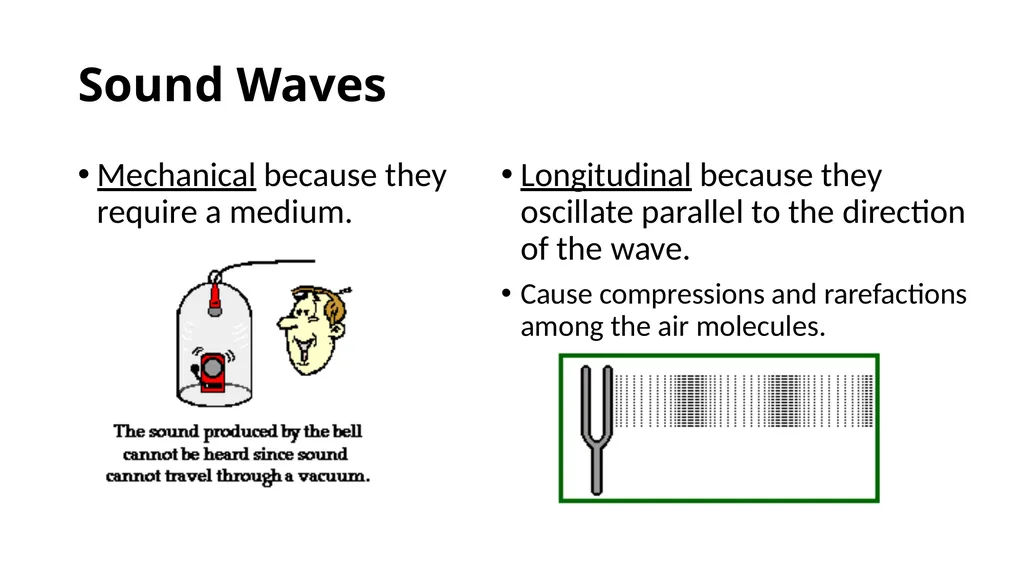
slide13. Sound Waves Mechanical because they require a medium. Longitudinal because they oscillate parallel to the direction of the wave.
Cause compressions and rarefactions among the air molecules.<br>
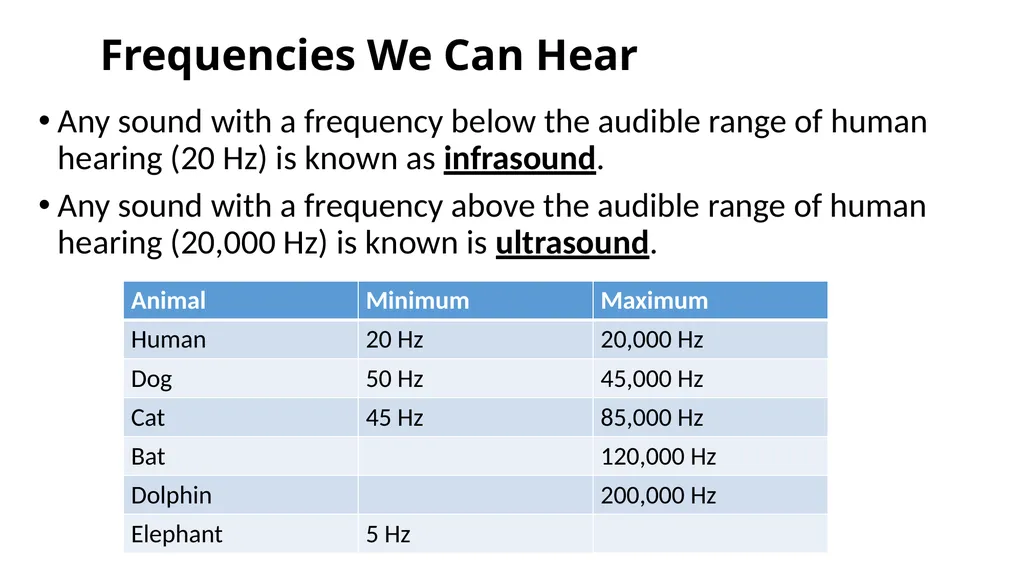
slide14. Frequencies We Can Hear Any sound with a frequency below the audible range of human hearing (20 Hz) is known as infrasound.
Any sound with a frequency above the audible range of human hearing (20,000 Hz) is known is ultrasound.<br>
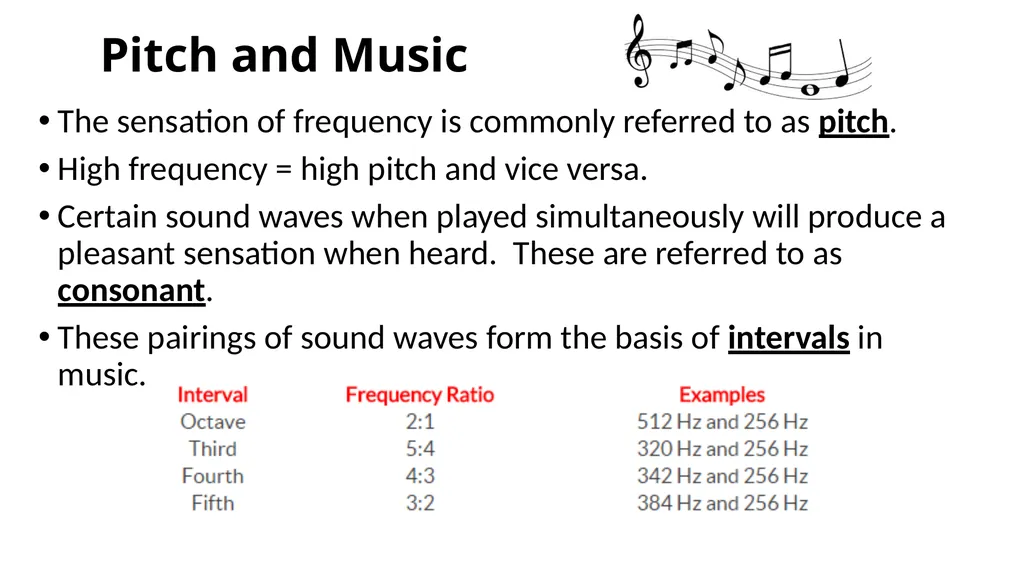
slide15. Pitch and Music The sensation of frequency is commonly referred to as pitch.
High frequency = high pitch and vice versa.
Certain sound waves when played simultaneously will produce a pleasant sensation when heard. These are referred to as consonant.
These pairings of sound waves form the basis of intervals in music.<br>
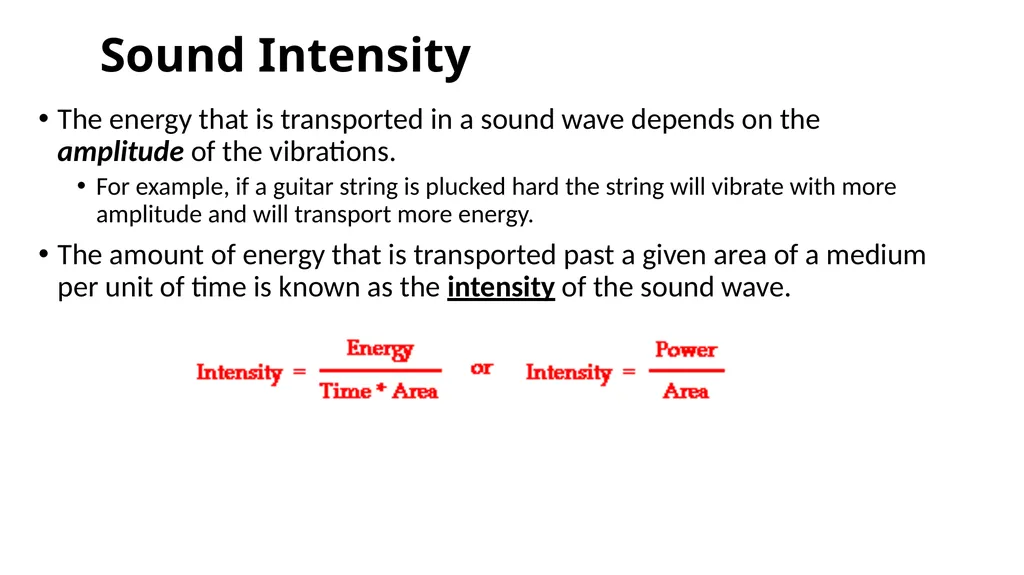
slide16. Sound Intensity The energy that is transported in a sound wave depends on the amplitude of the vibrations.
For example, if a guitar string is plucked hard the string will vibrate with more amplitude and will transport more energy.
The amount of energy that is transported past a given area of a medium per unit of time is known as the intensity of the sound wave.<br>
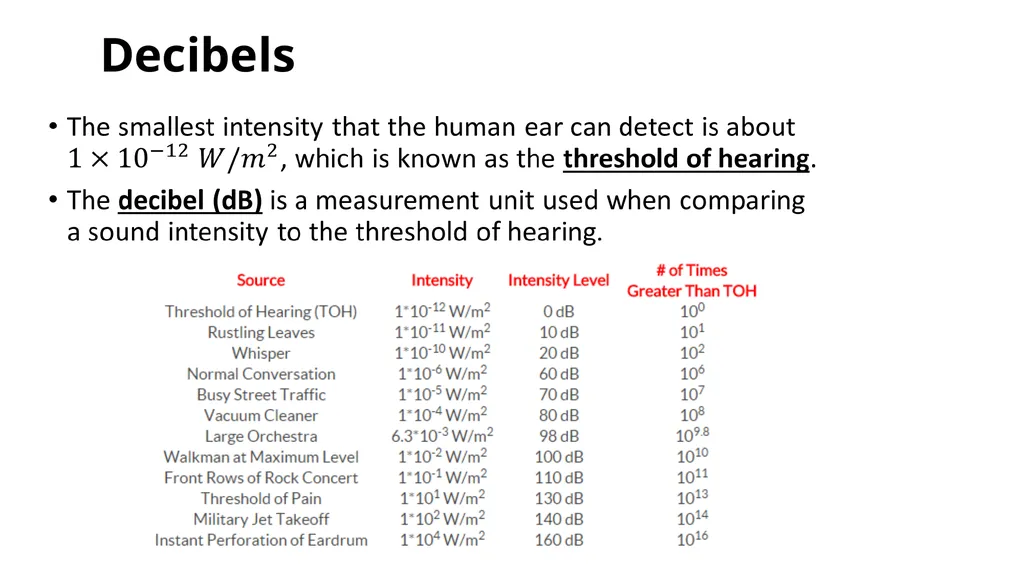
slide17. Decibels<br>
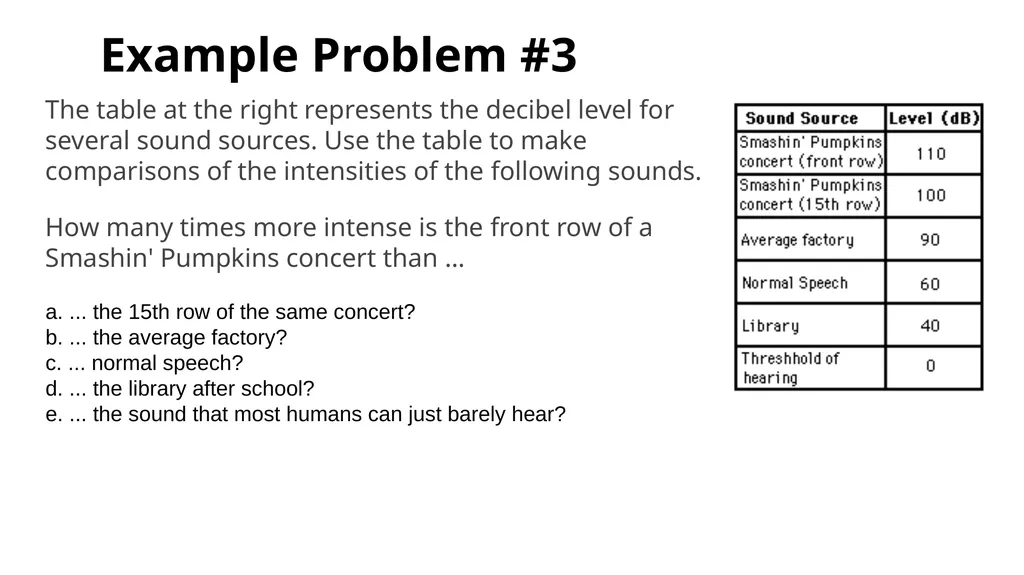
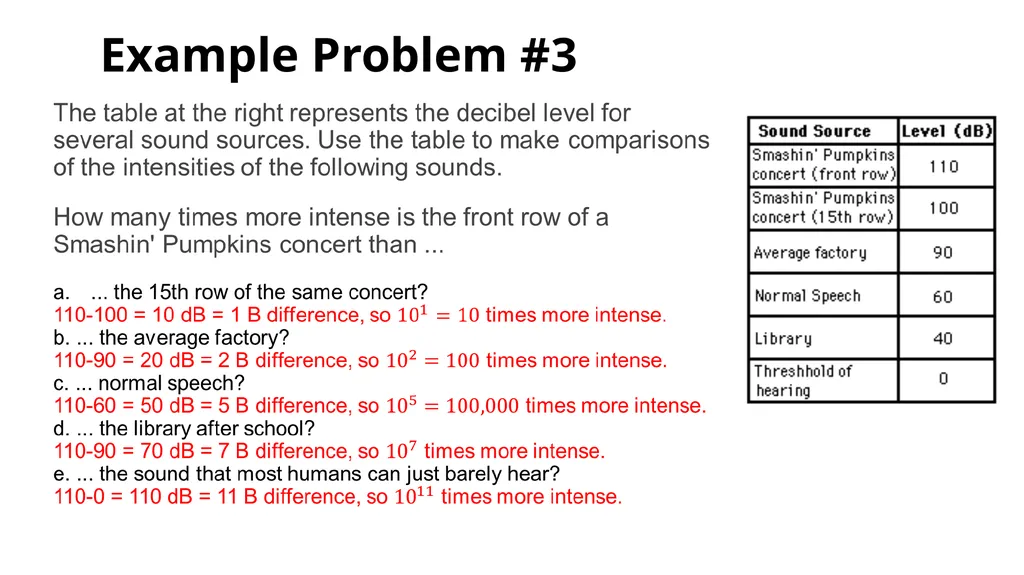
slide18. Example Problem #3 The table at the right represents the decibel level for several sound sources. Use the table to make comparisons of the intensities of the following sounds.
How many times more intense is the front row of a Smashin' Pumpkins concert than ...
a. ... the 15th row of the same concert?
b. ... the average factory?
c. ... normal speech?
d. ... the library after school?
e. ... the sound that most humans can just barely hear?<br>
slide19. Example Problem #3<br>
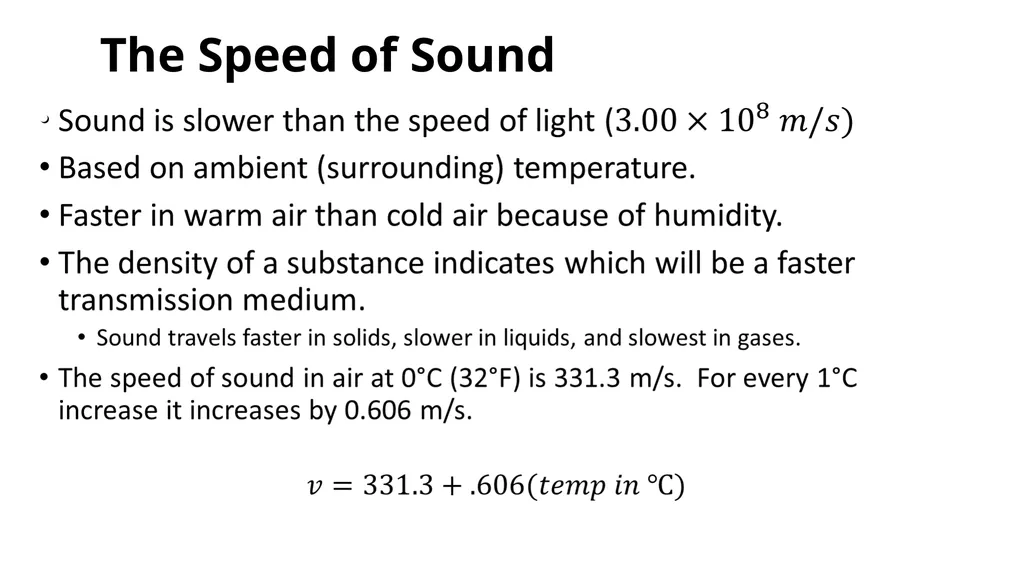
slide20. The Speed of Sound<br>
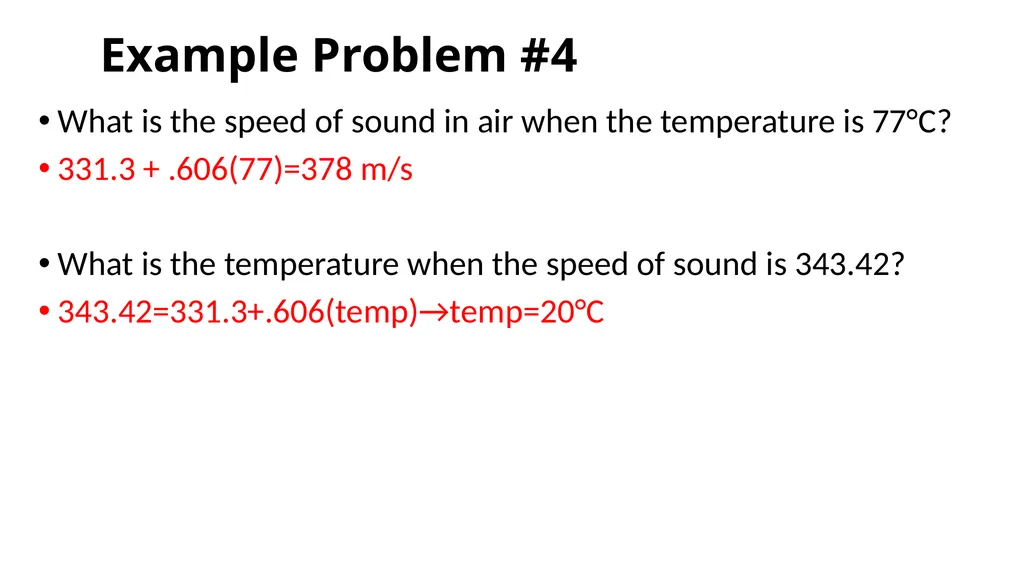
slide21. Example Problem #4 What is the speed of sound in air when the temperature is 77°C?
331.3 + .606(77)=378 m/s
What is the temperature when the speed of sound is 343.42?
343.42=331.3+.606(temp)→temp=20°C<br>
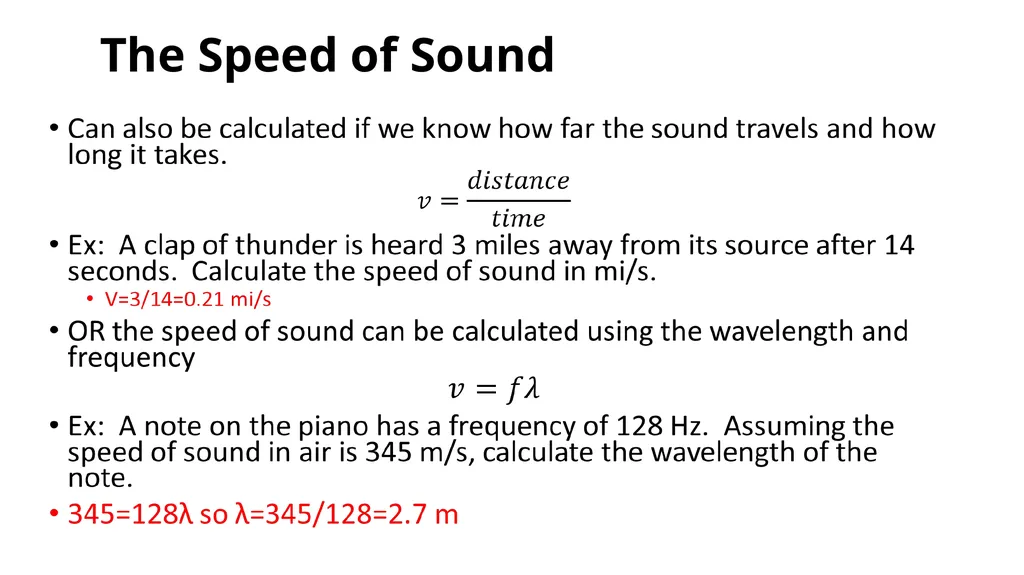
slide22. The Speed of Sound<br>
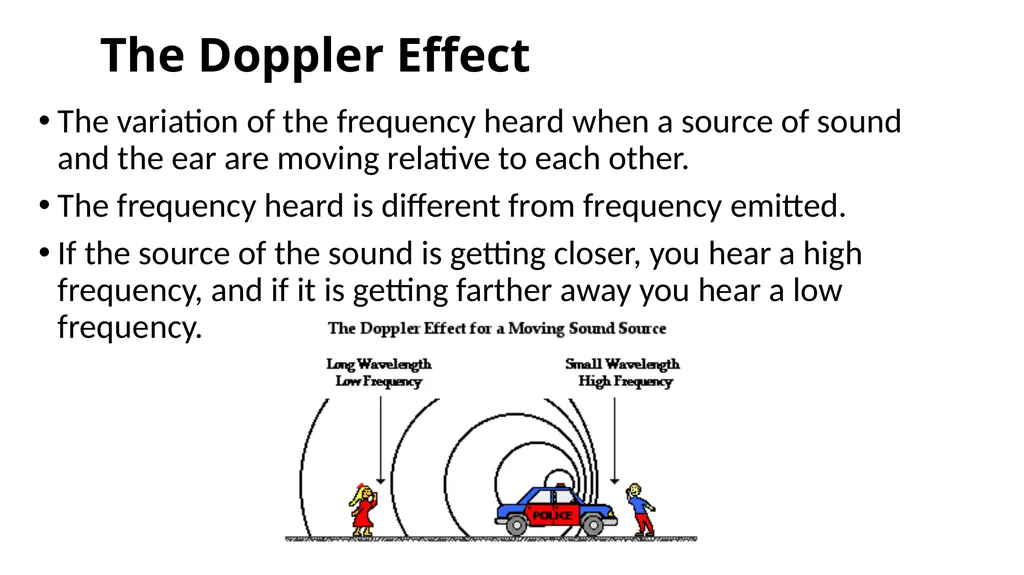
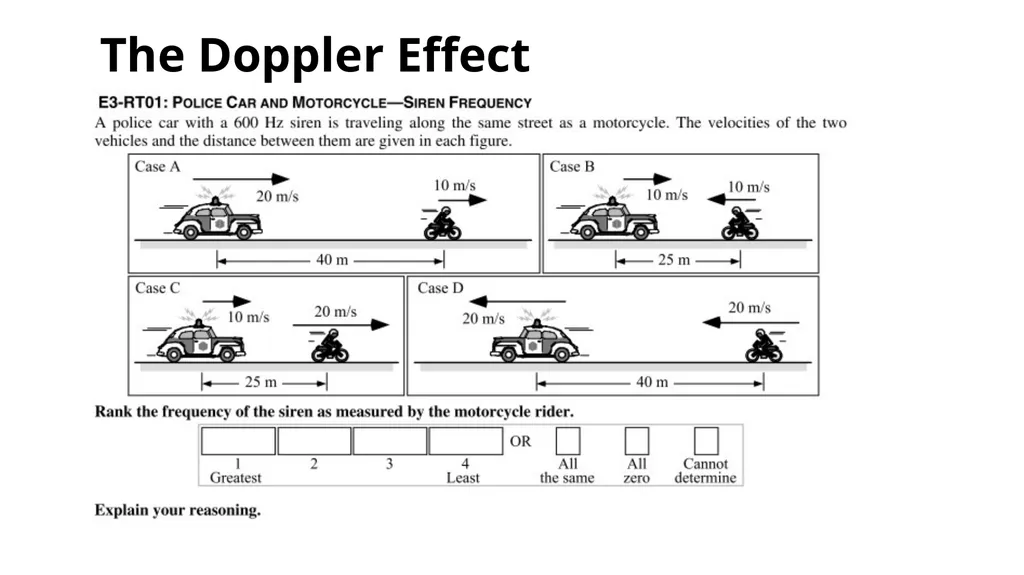
slide23. The Doppler Effect The variation of the frequency heard when a source of sound and the ear are moving relative to each other.
The frequency heard is different from frequency emitted.
If the source of the sound is getting closer, you hear a high frequency, and if it is getting farther away you hear a low frequency.<br>
slide24. The Doppler Effect<br>
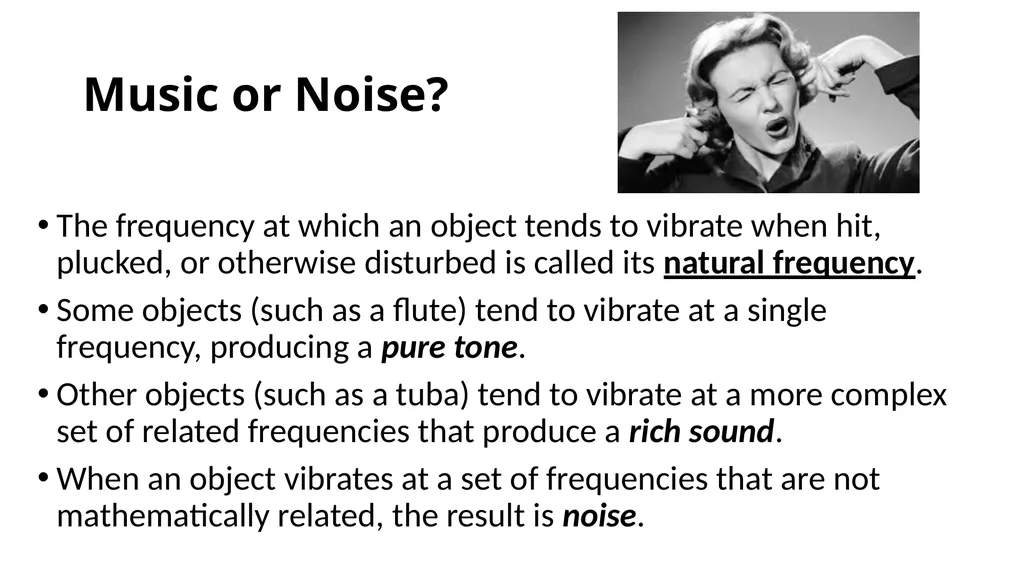
slide25. Music or Noise? The frequency at which an object tends to vibrate when hit, plucked, or otherwise disturbed is called its natural frequency.
Some objects (such as a flute) tend to vibrate at a single frequency, producing a pure tone.
Other objects (such as a tuba) tend to vibrate at a more complex set of related frequencies that produce a rich sound.
When an object vibrates at a set of frequencies that are not mathematically related, the result is noise.<br>
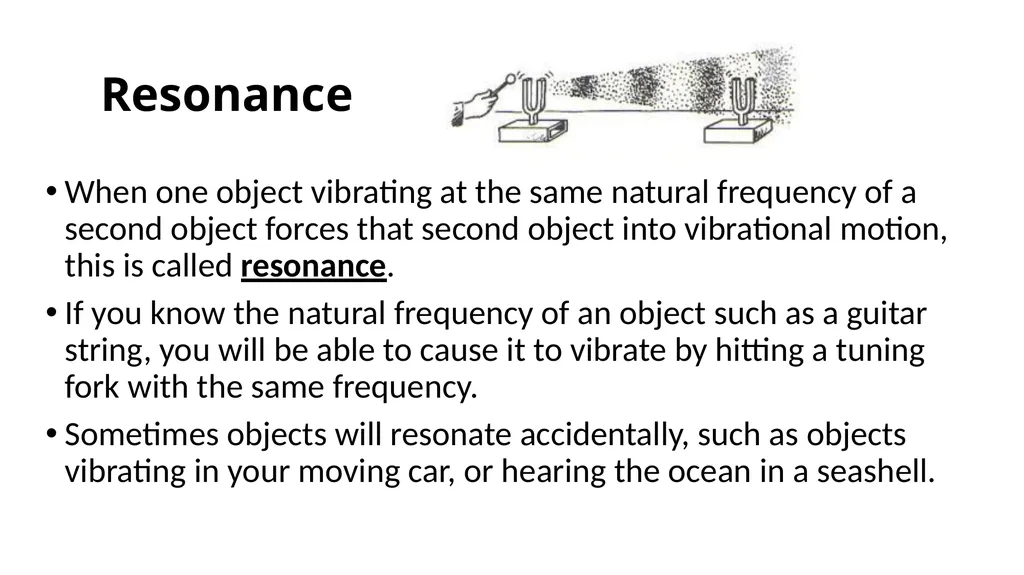
slide26. Resonance When one object vibrating at the same natural frequency of a second object forces that second object into vibrational motion, this is called resonance.
If you know the natural frequency of an object such as a guitar string, you will be able to cause it to vibrate by hitting a tuning fork with the same frequency.
Sometimes objects will resonate accidentally, such as objects vibrating in your moving car, or hearing the ocean in a seashell.<br>
Conceptual Book Chapters 25 and 26 Unit 9 - Waves and Sound<br>
slide2. Waves are everywhere! Examples of waves:
Visible light
Radio
Microwaves
Water
Sine, Cosine
Stadium
Earthquake
Slinky
String<br>
slide3. What is a Wave? A wave is a disturbance that travels through a medium from one location to another location.
A wave transports energy but not matter. (The medium is only temporarily displaced and will return to its rest position.)
A wave is an energy transport phenomena.<br>
slide4. Types of Waves Transverse The vibration of the individual particles of the medium is perpendicular to the direction of wave propagation Longitudinal The vibration of the individual particles of the medium is parallel to the direction of wave propagation<br>
slide5. Properties of Waves<br>
slide6. Properties of Waves<br>
slide8. Example Problem #1<br>
slide9. Example Problem #2<br>
slide10. Another Way of Classifying Waves Mechanical Are NOT able to transport energy through a vacuum (empty space).
Require a medium
Speed depends on the medium!
Ex: sound, water waves, earthquakes, ultrasound, etc. Electromagnetic<br>
slide12. How Do Sound Waves Work? A vibrating object (such as a person’s vocal cords, a guitar string, or a tuning fork) causes a disturbance in the air molecules.
The frequency of the sound wave refers to how often the particles vibrate when a wave passes through. (Unit: Hertz)
The period is the amount of time between compressions or rarefactions OR can be calculated as the reciprocal of the frequency.<br>
slide13. Sound Waves Mechanical because they require a medium. Longitudinal because they oscillate parallel to the direction of the wave.
Cause compressions and rarefactions among the air molecules.<br>
slide14. Frequencies We Can Hear Any sound with a frequency below the audible range of human hearing (20 Hz) is known as infrasound.
Any sound with a frequency above the audible range of human hearing (20,000 Hz) is known is ultrasound.<br>
slide15. Pitch and Music The sensation of frequency is commonly referred to as pitch.
High frequency = high pitch and vice versa.
Certain sound waves when played simultaneously will produce a pleasant sensation when heard. These are referred to as consonant.
These pairings of sound waves form the basis of intervals in music.<br>
slide16. Sound Intensity The energy that is transported in a sound wave depends on the amplitude of the vibrations.
For example, if a guitar string is plucked hard the string will vibrate with more amplitude and will transport more energy.
The amount of energy that is transported past a given area of a medium per unit of time is known as the intensity of the sound wave.<br>
slide17. Decibels<br>
slide18. Example Problem #3 The table at the right represents the decibel level for several sound sources. Use the table to make comparisons of the intensities of the following sounds.
How many times more intense is the front row of a Smashin' Pumpkins concert than ...
a. ... the 15th row of the same concert?
b. ... the average factory?
c. ... normal speech?
d. ... the library after school?
e. ... the sound that most humans can just barely hear?<br>
slide19. Example Problem #3<br>
slide20. The Speed of Sound<br>
slide21. Example Problem #4 What is the speed of sound in air when the temperature is 77°C?
331.3 + .606(77)=378 m/s
What is the temperature when the speed of sound is 343.42?
343.42=331.3+.606(temp)→temp=20°C<br>
slide22. The Speed of Sound<br>
slide23. The Doppler Effect The variation of the frequency heard when a source of sound and the ear are moving relative to each other.
The frequency heard is different from frequency emitted.
If the source of the sound is getting closer, you hear a high frequency, and if it is getting farther away you hear a low frequency.<br>
slide24. The Doppler Effect<br>
slide25. Music or Noise? The frequency at which an object tends to vibrate when hit, plucked, or otherwise disturbed is called its natural frequency.
Some objects (such as a flute) tend to vibrate at a single frequency, producing a pure tone.
Other objects (such as a tuba) tend to vibrate at a more complex set of related frequencies that produce a rich sound.
When an object vibrates at a set of frequencies that are not mathematically related, the result is noise.<br>
slide26. Resonance When one object vibrating at the same natural frequency of a second object forces that second object into vibrational motion, this is called resonance.
If you know the natural frequency of an object such as a guitar string, you will be able to cause it to vibrate by hitting a tuning fork with the same frequency.
Sometimes objects will resonate accidentally, such as objects vibrating in your moving car, or hearing the ocean in a seashell.<br>