
Pining for a Common Source SELF-PACED EXERCISE
TF
Published · 171 slides · 0 views

1 / 1


Description
Pining for a Common Source SELF-PACED EXERCISE Developed by the New York State Integrated Food Safety Center of Excellence (NYCoE) Course Objectives: After completing this case study, you will be able to: Explain what constitutes a
Related Topics
Share
Embed code
Download this presentation From Below
"Pining for a Common Source SELF-PACED EXERCISE" is the property of its rightful owner. Permission is granted to download and print the materials on this website for personal, non-commercial use only, and to display it on your personal computer provided you do not modify the materials and that you retain all copyright notices contained in the materials. By downloading content from our website, you accept the terms of this agreement.
Presentation Transcript
01
Pining for a Common Source SELF-PACED EXERCISE Developed by the New York State Integrated Food Safety Center of Excellence (NYCoE)<br>
02
Course Objectives: After completing this case study, you will be able to:
Explain what constitutes a foodborne illness cluster/outbreak
Describe the steps in a foodborne illness outbreak investigation
Identify the roles and responsibilities of the outbreak investigation team
Epidemiology, environmental health, laboratory and communications
Understand the importance of information sharing during an outbreak investigation
Draw and interpret an epidemic curve
Establish and refine an outbreak case definition
Describe the types of epidemiologic tools used during an outbreak investigation
Describe the purpose of conducting environmental assessments/traceback investigations
Describe the types of laboratory techniques used during an outbreak investigation
Explain how to summarize and communicate outbreak investigation findings<br>
Explain what constitutes a foodborne illness cluster/outbreak
Describe the steps in a foodborne illness outbreak investigation
Identify the roles and responsibilities of the outbreak investigation team
Epidemiology, environmental health, laboratory and communications
Understand the importance of information sharing during an outbreak investigation
Draw and interpret an epidemic curve
Establish and refine an outbreak case definition
Describe the types of epidemiologic tools used during an outbreak investigation
Describe the purpose of conducting environmental assessments/traceback investigations
Describe the types of laboratory techniques used during an outbreak investigation
Explain how to summarize and communicate outbreak investigation findings<br>
03
THE INVESTIGATION BEGINS… PART A.<br>
04
Routine Disease Surveillance During the first week of September, five laboratory reports of Salmonella Enteritidis are reported to Empire County in Liberty (LB) State from local laboratories
In LB, physicians, hospitals and laboratories are required to report confirmed/suspected Salmonella infections to the local health jurisdiction where the patient resides
This number of laboratory reports of S. Enteritidis is not unusual within the given time period and not considered above baseline for the county<br>
In LB, physicians, hospitals and laboratories are required to report confirmed/suspected Salmonella infections to the local health jurisdiction where the patient resides
This number of laboratory reports of S. Enteritidis is not unusual within the given time period and not considered above baseline for the county<br>
05
Routine Case Follow-up Epidemiologists at Empire County investigate the Salmonella cases following standard procedures
Each case is contacted to complete an initial interview using a standardized Salmonella questionnaire which collects information on exposures preceding their illness
All clinical, laboratory, and exposure data are entered into a secure LB State Health Department (LBHD) electronic surveillance database<br>
Each case is contacted to complete an initial interview using a standardized Salmonella questionnaire which collects information on exposures preceding their illness
All clinical, laboratory, and exposure data are entered into a secure LB State Health Department (LBHD) electronic surveillance database<br>
06
Routine Cluster Analysis Completed interview questionnaires are reviewed and compared by Empire County epidemiologists to identify:
Commonalties (e.g., household contacts, attended same party or event)
High-risk exposure settings (e.g., cases that work/reside in a sensitive setting such as a restaurant, daycare or healthcare facility)<br>
Commonalties (e.g., household contacts, attended same party or event)
High-risk exposure settings (e.g., cases that work/reside in a sensitive setting such as a restaurant, daycare or healthcare facility)<br>
07
Initial PFGE Report from the Laboratory On Friday, September 16, an epidemiologist from the LBHD Communicable Disease Program was notified that the LB State Public Health Laboratory (LBPHL) had 2 S. Enteritidis infections (from the 5 cases reported in early September) with matching pulsed-field gel electrophoresis (PFGE) patterns in Empire County
The assigned XbaI pattern is JEGX01.0008<br>
The assigned XbaI pattern is JEGX01.0008<br>
08
Note: In LB, hospital and commercial laboratories are required to submit all Salmonella isolates to the LBPHL where confirmation, serotype determination, PFGE and whole genome sequencing (WGS) are completed<br>
09
Question 1: You are an epidemiologist at LBHD
What additional laboratory information would you request from LBPHL?<br>
What additional laboratory information would you request from LBPHL?<br>
10
Q.1 Answer The epidemiologist places an inquiry to LB State Lab to determine if PFGE pattern JEGX01.0008 is common or rare
The epidemiologist will also request that a PulseNet search be performed to identify cases from other states that may have a matching PFGE pattern
LB State Lab normally reviews PulseNet data for the prior 60 days, but this may vary by state or disease<br>
The epidemiologist will also request that a PulseNet search be performed to identify cases from other states that may have a matching PFGE pattern
LB State Lab normally reviews PulseNet data for the prior 60 days, but this may vary by state or disease<br>
11
Question 2: You are an epidemiologist at LBHD
What steps would you take next?<br>
What steps would you take next?<br>
12
Q.2 Answer The epidemiologist decides as a first step to review both patient case reports to identify dates of onset illness and any commonalities or rare exposures among the 2 cases
The epidemiologist will also conduct a quick literature search to determine what products, if any, have been implicated in past outbreaks involving:
S. Enteritidis, in general
S. Enteritidis pattern JEGX01.0008, in particular<br>
The epidemiologist will also conduct a quick literature search to determine what products, if any, have been implicated in past outbreaks involving:
S. Enteritidis, in general
S. Enteritidis pattern JEGX01.0008, in particular<br>
13
Question 3: What type of questionnaire do you use in your jurisdiction?
What type of information is gathered?<br>
What type of information is gathered?<br>
14
Q.3 Answer Options may include:
a lengthy, hypothesis generating questionnaire
a short questionnaire to assess attendance at high-risk settings
a short questionnaire that focuses on exposures commonly identified to be the source of Salmonella
Type of questionnaire used will dictate what information is obtained and how it can be used in an investigation<br>
a lengthy, hypothesis generating questionnaire
a short questionnaire to assess attendance at high-risk settings
a short questionnaire that focuses on exposures commonly identified to be the source of Salmonella
Type of questionnaire used will dictate what information is obtained and how it can be used in an investigation<br>
15
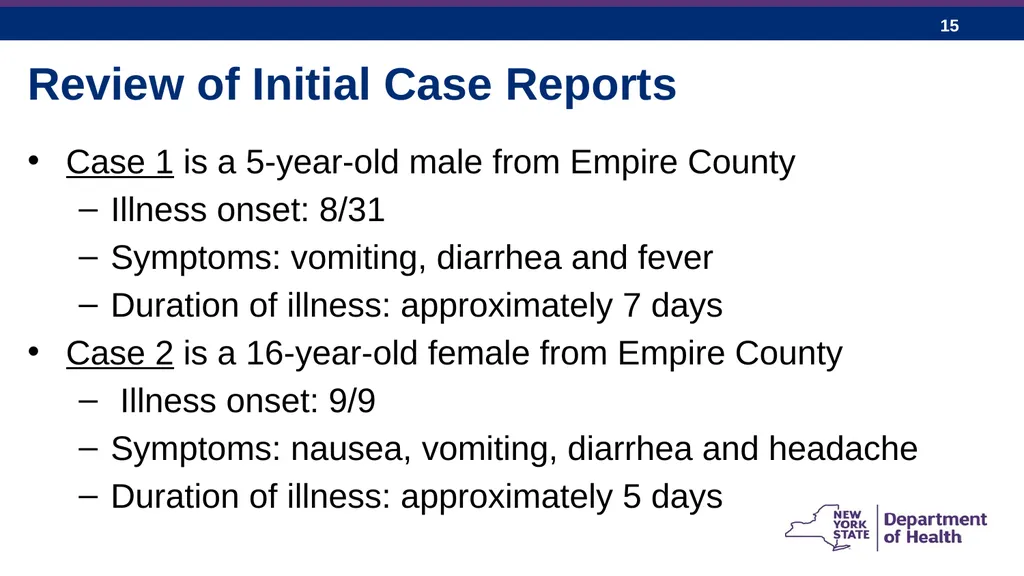
Review of Initial Case Reports Case 1 is a 5-year-old male from Empire County
Illness onset: 8/31
Symptoms: vomiting, diarrhea and fever
Duration of illness: approximately 7 days
Case 2 is a 16-year-old female from Empire County
Illness onset: 9/9
Symptoms: nausea, vomiting, diarrhea and headache
Duration of illness: approximately 5 days<br>
Illness onset: 8/31
Symptoms: vomiting, diarrhea and fever
Duration of illness: approximately 7 days
Case 2 is a 16-year-old female from Empire County
Illness onset: 9/9
Symptoms: nausea, vomiting, diarrhea and headache
Duration of illness: approximately 5 days<br>
16
Comparisons and Commonalities Cases were not household contacts
Cases did not attend the same school
Neither case attended large gatherings during their incubation period<br>
Cases did not attend the same school
Neither case attended large gatherings during their incubation period<br>
17
Comparisons and Commonalities Both cases had exposure to:
Commonly consumed items (chicken, tomatoes, eggs)
Dining out (different locations)
Supermarket Chain W (different store locations)
Chain W is an extremely popular supermarket chain which has multiple locations in the region
Household pets<br>
Commonly consumed items (chicken, tomatoes, eggs)
Dining out (different locations)
Supermarket Chain W (different store locations)
Chain W is an extremely popular supermarket chain which has multiple locations in the region
Household pets<br>
18
Initial Investigation – Laboratory Findings Late Friday afternoon, LBPHL verifies that there are no other matching isolates in other states at this time
LBPHL also reports that PFGE pattern JEGX01.0008 had never been previously reported in LB State<br>
LBPHL also reports that PFGE pattern JEGX01.0008 had never been previously reported in LB State<br>
19
Initial Investigation – Communications The epidemiologist prepares a summary to send to the individuals on their investigation team to inform them of the cluster investigation and the action steps underway<br>
20
Question 4: Who might be part of the investigation team?
In one sentence, describe the role of each team member<br>
In one sentence, describe the role of each team member<br>
21
Q.4 Answer Laboratory Investigator
focuses on testing clinical specimens and environmental/food samples, and on analyzing/interpreting test results
Environmental Health Investigator
focuses on the contaminated food and/or food preparation site, water, and environmental sources
Epidemiology Investigator
focuses on cases, developing and testing hypotheses, and case finding to identify and describe clusters
Public Health Nurse
focuses on patient and public health education<br>
focuses on testing clinical specimens and environmental/food samples, and on analyzing/interpreting test results
Environmental Health Investigator
focuses on the contaminated food and/or food preparation site, water, and environmental sources
Epidemiology Investigator
focuses on cases, developing and testing hypotheses, and case finding to identify and describe clusters
Public Health Nurse
focuses on patient and public health education<br>
22
The Basic Investigation Team At LBHD, epidemiologists and public health nurses often play overlapping roles
Members of this team may also be comprised of staff from various levels of government (county/local health department, state health department, etc.)<br>
Members of this team may also be comprised of staff from various levels of government (county/local health department, state health department, etc.)<br>
23
Question 5: Would you involve all these team members right now?
If not, who would you involve?<br>
If not, who would you involve?<br>
24
Q5. Answer The epidemiologist shares the cluster summary with the members on their investigation team from:
LB State Health Department (LBHD) epidemiology and environmental health staff
LB State Public Health Laboratory (LBPHL)
Empire County (epidemiologists/public health nurses)
Optionally: Empire County environmental health (if warranted, based on strength of food/event association)<br>
LB State Health Department (LBHD) epidemiology and environmental health staff
LB State Public Health Laboratory (LBPHL)
Empire County (epidemiologists/public health nurses)
Optionally: Empire County environmental health (if warranted, based on strength of food/event association)<br>
25
Question 6: What are your next steps?<br>
26
Q.6 Answer Right now, no commonalities, no other PFGE matching isolates – so, with a sigh of relief, the epidemiologist leaves their office at 5PM - very pleased to not have to stay late and spend the entire weekend following up on this investigation
Probably nothing to worry about…!<br>
Probably nothing to worry about…!<br>
27
ADDITIONAL CASES REPORTED… PART B.<br>
28
The Cluster Grows… On Monday September 26th, LBHD is notified that LBPHL just confirmed 7 additional cases with PFGE-matching S. Enteritidis pattern JEGX01.0008
6 of the 7 new cases reside in Empire County
The 7th case resides in Apple County (in LB State)<br>
6 of the 7 new cases reside in Empire County
The 7th case resides in Apple County (in LB State)<br>
29
Case Review The epidemiologist compares the interview forms for all 9 LB cases to date
2 case interviews are pending
6/7 cases reported shopping at various locations of Chain W in Empire and Apple Counties, where the chain is a popular place to shop<br>
2 case interviews are pending
6/7 cases reported shopping at various locations of Chain W in Empire and Apple Counties, where the chain is a popular place to shop<br>
30
Case Review None are members of the same household
None work or reside in a sensitive setting
No common restaurants or event exposures
Food history exposures are extensively reviewed to identify the food items consumed by 50% or more of the cases
Chicken, tomatoes, eggs and grapes<br>
None work or reside in a sensitive setting
No common restaurants or event exposures
Food history exposures are extensively reviewed to identify the food items consumed by 50% or more of the cases
Chicken, tomatoes, eggs and grapes<br>
31
Case Review Note: Typically any exposure reported by 50% or more of the cases could be considered a possible hypothesis to explore further<br>
32
Question 7: Describe how this situation could be defined as a cluster AND an outbreak?
Provide an explanation for your choice<br>
Provide an explanation for your choice<br>
33
Q.7 Answer At this point, the investigation would be defined as a cluster
To classify cases as part of an outbreak, there must be a common exposure among the cases, like dining at the same restaurant, attending the same catered event, or eating the same food item
What about shopping at Chain W as a commonality?<br>
To classify cases as part of an outbreak, there must be a common exposure among the cases, like dining at the same restaurant, attending the same catered event, or eating the same food item
What about shopping at Chain W as a commonality?<br>
34
Q.7 Answer While we have identified multiple PFGE-matching cases, at this point we have not been able to identify a link among the cases other than shopping at Chain W
Some may consider this enough of a commonality to be an outbreak, however, the investigators in this cluster did not
Chain W was the most popular grocery store chain in the area where the cases were occurring<br>
Some may consider this enough of a commonality to be an outbreak, however, the investigators in this cluster did not
Chain W was the most popular grocery store chain in the area where the cases were occurring<br>
35
Question 8: Who would you notify about this growing investigation?<br>
36
Q.8 Answer The epidemiologist notifies members of their investigation team, which includes:
LBHD – epidemiology, environmental health and leadership staff (Department Directors)
LBPHL
Epidemiologists/public health nurses and environmental health investigators at Empire County Health Department and Apple County Health Department<br>
LBHD – epidemiology, environmental health and leadership staff (Department Directors)
LBPHL
Epidemiologists/public health nurses and environmental health investigators at Empire County Health Department and Apple County Health Department<br>
37
Q.8 Answer The epidemiologist decides it is too early in the investigation to communicate with:
The public (via a press release or public notification)
USDA or the FDA as a contaminated product has not been suspected or confirmed
The epidemiologist may or may not choose to notify CDC at this time
Because no other PFGE-matching cases have been identified outside of LB State, the epidemiologist decides not to notify the CDC to alert them about this ongoing investigation<br>
The public (via a press release or public notification)
USDA or the FDA as a contaminated product has not been suspected or confirmed
The epidemiologist may or may not choose to notify CDC at this time
Because no other PFGE-matching cases have been identified outside of LB State, the epidemiologist decides not to notify the CDC to alert them about this ongoing investigation<br>
38
Cluster vs. Outbreak? The epidemiologist shares the new case count and exposure summary with the investigation team, and classifies the cases as a cluster, not an outbreak
Although multiple PFGE-matching cases have been identified, no common associations among cases have been identified from review and comparisons of initial case questionnaires<br>
Although multiple PFGE-matching cases have been identified, no common associations among cases have been identified from review and comparisons of initial case questionnaires<br>
39
Epidemic Curve The epidemiologist draws an epidemic curve of the cluster hoping to shed some light about how the Salmonella has spread and to provide a visual representation of the cluster
The shape of the epidemic curve can reveal the outbreak’s likely mode of spread<br>
The shape of the epidemic curve can reveal the outbreak’s likely mode of spread<br>
40
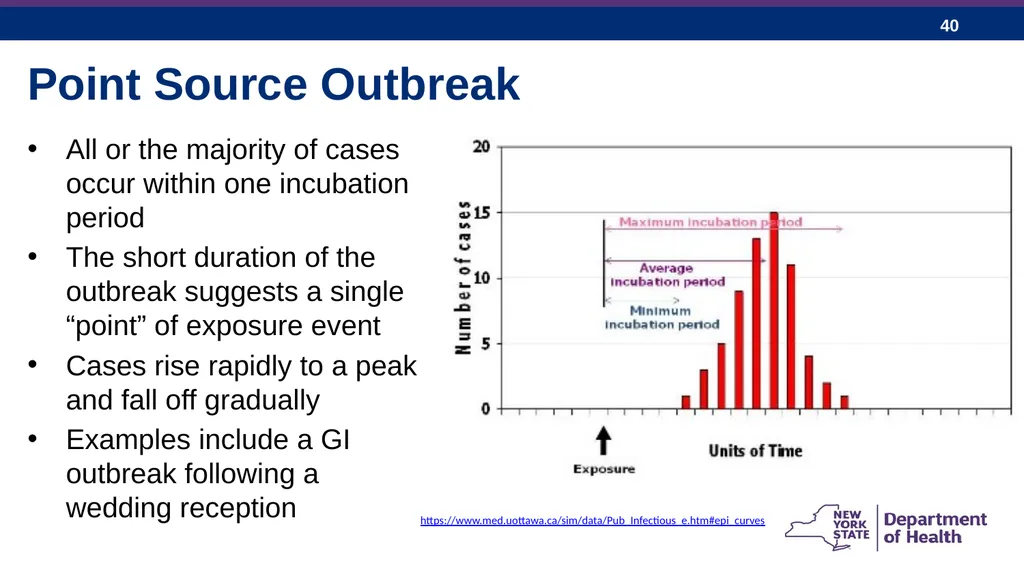
Point Source Outbreak All or the majority of cases occur within one incubation period
The short duration of the outbreak suggests a single “point” of exposure event
Cases rise rapidly to a peak and fall off gradually
Examples include a GI outbreak following a wedding reception https://www.med.uottawa.ca/sim/data/Pub_Infectious_e.htm#epi_curves<br>
The short duration of the outbreak suggests a single “point” of exposure event
Cases rise rapidly to a peak and fall off gradually
Examples include a GI outbreak following a wedding reception https://www.med.uottawa.ca/sim/data/Pub_Infectious_e.htm#epi_curves<br>
41
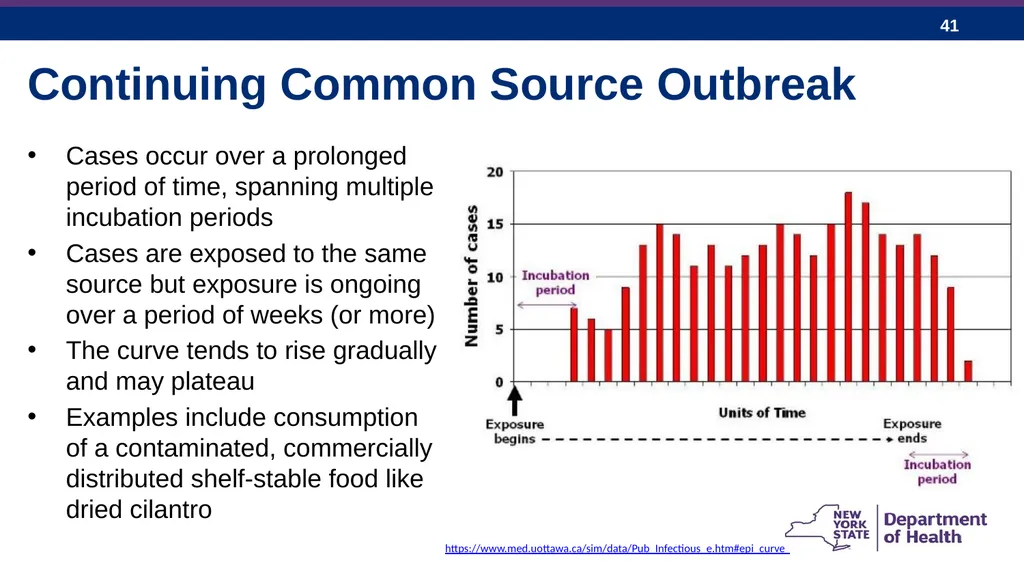
Continuing Common Source Outbreak Cases occur over a prolonged period of time, spanning multiple incubation periods
Cases are exposed to the same source but exposure is ongoing over a period of weeks (or more)
The curve tends to rise gradually and may plateau
Examples include consumption of a contaminated, commercially distributed shelf-stable food like dried cilantro https://www.med.uottawa.ca/sim/data/Pub_Infectious_e.htm#epi_curves<br>
Cases are exposed to the same source but exposure is ongoing over a period of weeks (or more)
The curve tends to rise gradually and may plateau
Examples include consumption of a contaminated, commercially distributed shelf-stable food like dried cilantro https://www.med.uottawa.ca/sim/data/Pub_Infectious_e.htm#epi_curves<br>
42
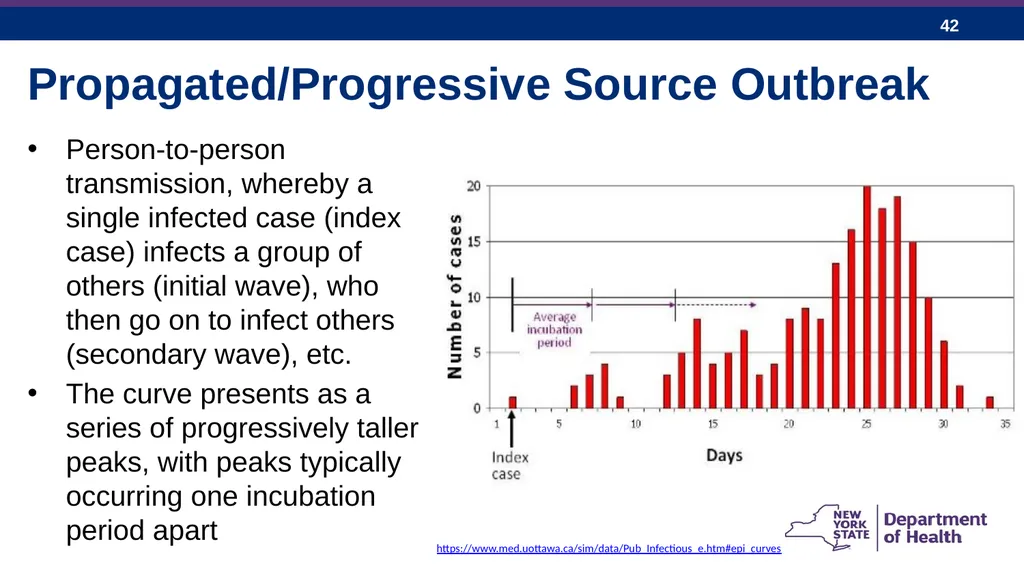
Propagated/Progressive Source Outbreak Person-to-person transmission, whereby a single infected case (index case) infects a group of others (initial wave), who then go on to infect others (secondary wave), etc.
The curve presents as a series of progressively taller peaks, with peaks typically occurring one incubation period apart https://www.med.uottawa.ca/sim/data/Pub_Infectious_e.htm#epi_curves<br>
The curve presents as a series of progressively taller peaks, with peaks typically occurring one incubation period apart https://www.med.uottawa.ca/sim/data/Pub_Infectious_e.htm#epi_curves<br>
43
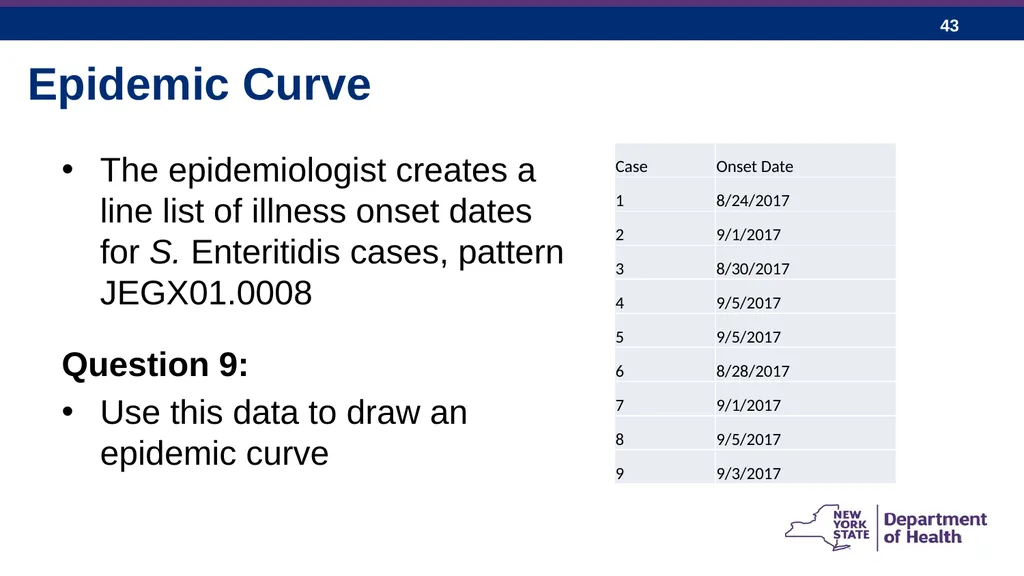
Epidemic Curve The epidemiologist creates a line list of illness onset dates for S. Enteritidis cases, pattern JEGX01.0008
Question 9:
Use this data to draw an epidemic curve<br>
Question 9:
Use this data to draw an epidemic curve<br>
44
Hints for Creating Epidemic Curves The epidemic curve is a histogram showing the number of outbreak associated cases by their time of onset
Include a brief, descriptive title (including place and time)
The x/y axis should be clearly labeled:
The x-axis represents the date or time of illness onset among cases; the unit of time is usually 1/4 to 1/3 of median incubation period
The typical incubation period for Salmonella is 2-3 days
The y-axis shows the number of ill cases<br>
Include a brief, descriptive title (including place and time)
The x/y axis should be clearly labeled:
The x-axis represents the date or time of illness onset among cases; the unit of time is usually 1/4 to 1/3 of median incubation period
The typical incubation period for Salmonella is 2-3 days
The y-axis shows the number of ill cases<br>
45
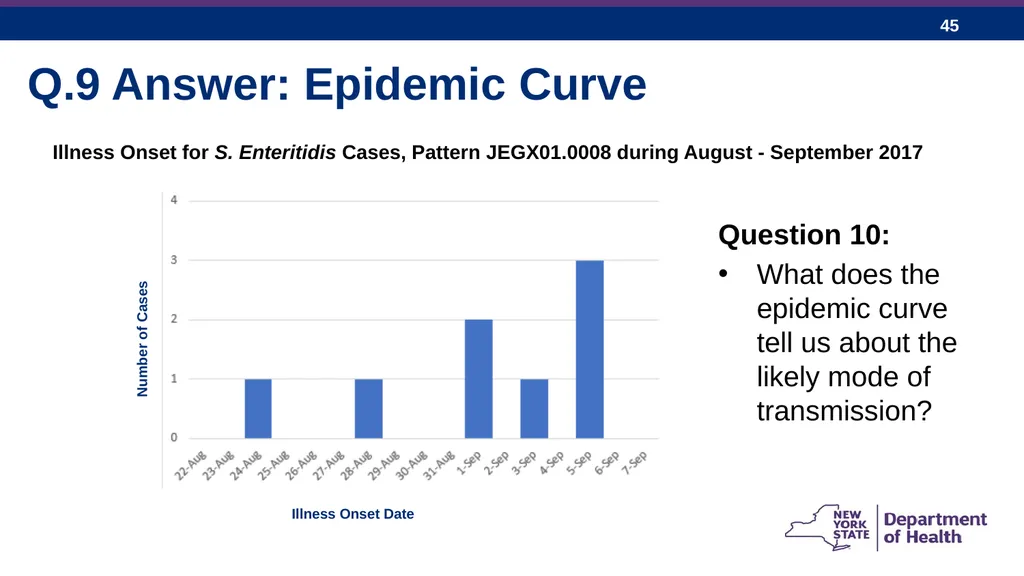
Q.9 Answer: Epidemic Curve Number of Cases Question 10:
What does the epidemic curve tell us about the likely mode of transmission? Illness Onset Date Illness Onset for S. Enteritidis Cases, Pattern JEGX01.0008 during August - September 2017<br>
What does the epidemic curve tell us about the likely mode of transmission? Illness Onset Date Illness Onset for S. Enteritidis Cases, Pattern JEGX01.0008 during August - September 2017<br>
46
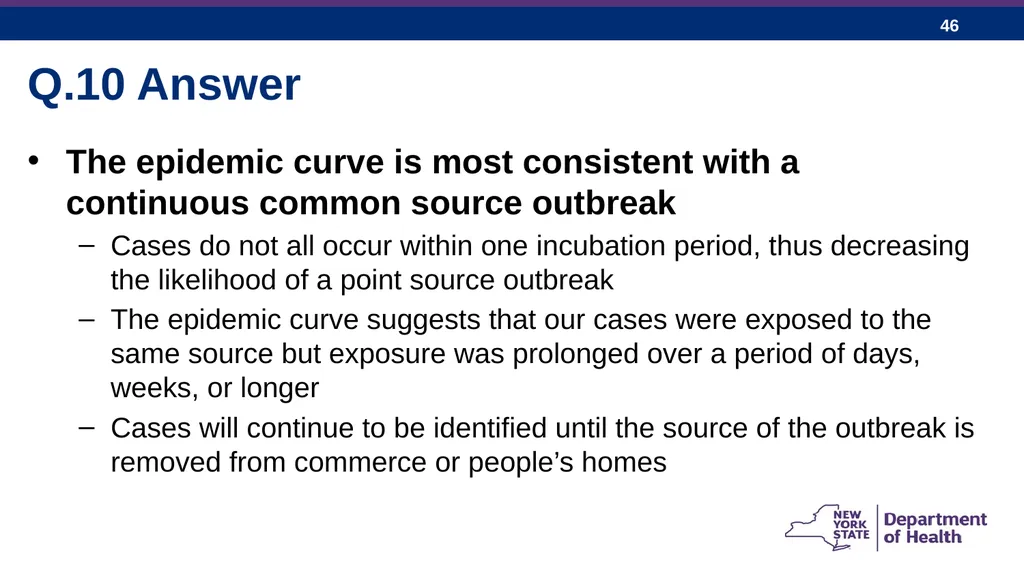
Q.10 Answer The epidemic curve is most consistent with a continuous common source outbreak
Cases do not all occur within one incubation period, thus decreasing the likelihood of a point source outbreak
The epidemic curve suggests that our cases were exposed to the same source but exposure was prolonged over a period of days, weeks, or longer
Cases will continue to be identified until the source of the outbreak is removed from commerce or people’s homes<br>
Cases do not all occur within one incubation period, thus decreasing the likelihood of a point source outbreak
The epidemic curve suggests that our cases were exposed to the same source but exposure was prolonged over a period of days, weeks, or longer
Cases will continue to be identified until the source of the outbreak is removed from commerce or people’s homes<br>
47
Case Review The epidemiologist examines demographic characteristics (e.g., gender, age, and race/ethnicity) of cases for possible clues as to what exposure is causing the illnesses
Strong demographic characteristics of a cluster may suggest a particular food vehicle
In accordance with religious practices, cultural traditions or preferences by age and/or gender<br>
Strong demographic characteristics of a cluster may suggest a particular food vehicle
In accordance with religious practices, cultural traditions or preferences by age and/or gender<br>
48
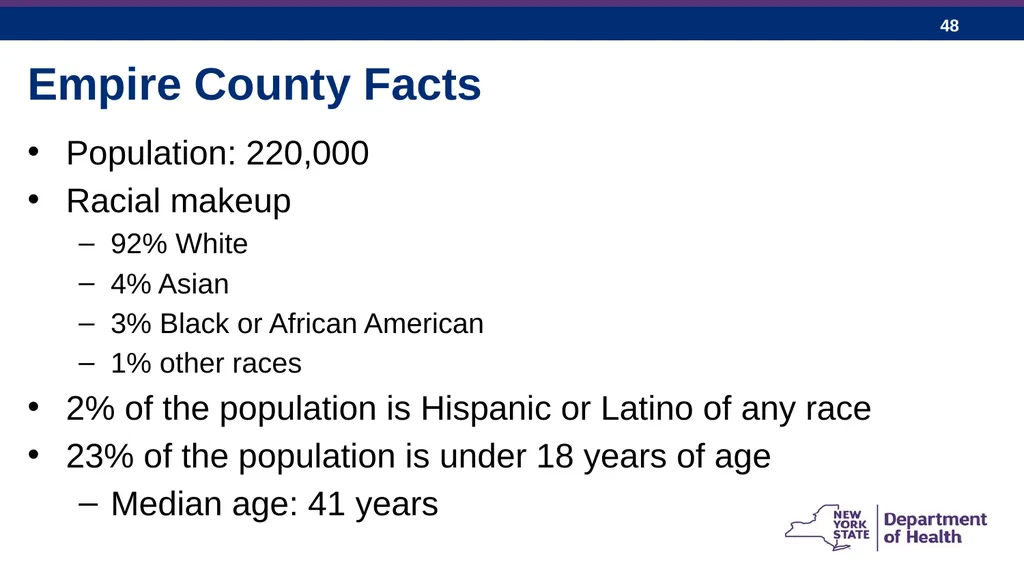
Empire County Facts Population: 220,000
Racial makeup
92% White
4% Asian
3% Black or African American
1% other races
2% of the population is Hispanic or Latino of any race
23% of the population is under 18 years of age
Median age: 41 years<br>
Racial makeup
92% White
4% Asian
3% Black or African American
1% other races
2% of the population is Hispanic or Latino of any race
23% of the population is under 18 years of age
Median age: 41 years<br>
49
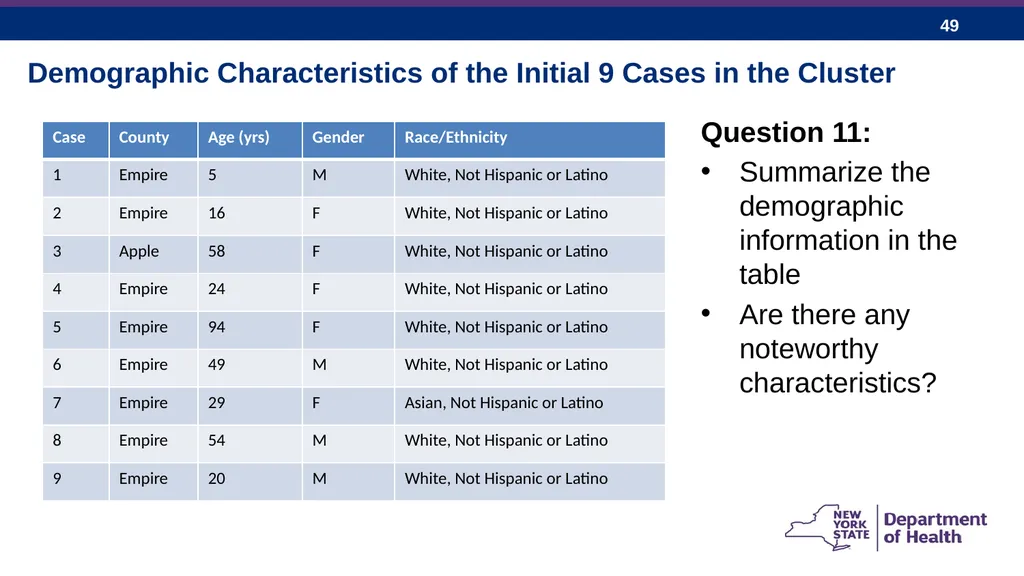
Demographic Characteristics of the Initial 9 Cases in the Cluster Question 11:
Summarize the demographic information in the table
Are there any noteworthy characteristics?<br>
Summarize the demographic information in the table
Are there any noteworthy characteristics?<br>
50
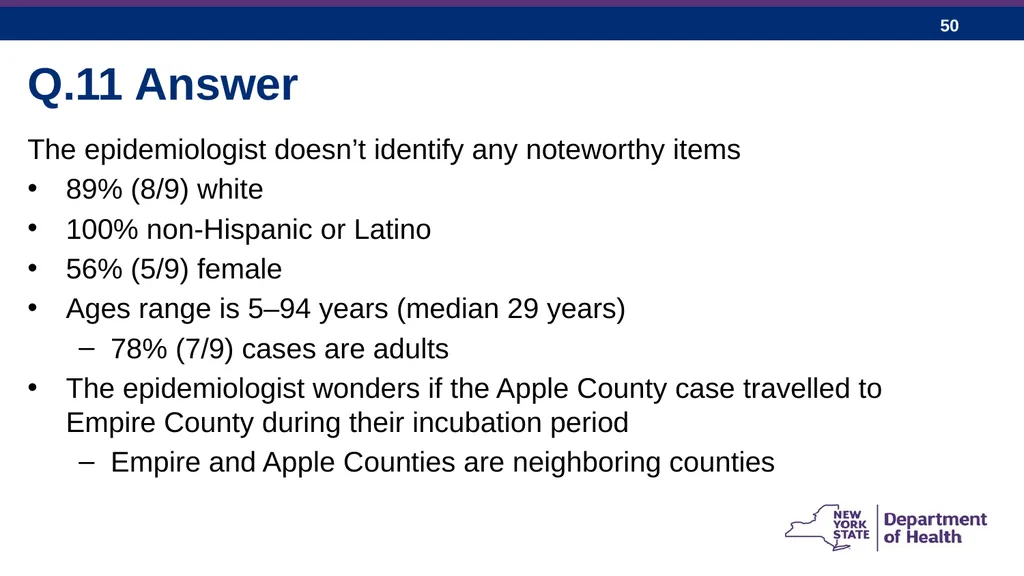
Q.11 Answer The epidemiologist doesn’t identify any noteworthy items
89% (8/9) white
100% non-Hispanic or Latino
56% (5/9) female
Ages range is 5–94 years (median 29 years)
78% (7/9) cases are adults
The epidemiologist wonders if the Apple County case travelled to Empire County during their incubation period
Empire and Apple Counties are neighboring counties<br>
89% (8/9) white
100% non-Hispanic or Latino
56% (5/9) female
Ages range is 5–94 years (median 29 years)
78% (7/9) cases are adults
The epidemiologist wonders if the Apple County case travelled to Empire County during their incubation period
Empire and Apple Counties are neighboring counties<br>
51
Next Steps: To determine next steps, a conference call is held among epidemiologists and environmental health specialists from:
Empire County
Apple County
LBHD<br>
Empire County
Apple County
LBHD<br>
52
Cluster Investigation The epidemiologists decide that all PFGE-matching cases would be re-interviewed using a standardized National Hypothesis Generating Questionnaire (NHGQ) to obtain comprehensive information regarding:
Food exposures
Travel history
Water exposures
Animal exposures<br>
Food exposures
Travel history
Water exposures
Animal exposures<br>
53
Cluster Investigation Team members all agree that public notification about the illnesses is not warranted at this time
Question 12: Do you agree or disagree about the decision not to notify the public at this time? Why?<br>
Question 12: Do you agree or disagree about the decision not to notify the public at this time? Why?<br>
54
Question 13: What are tasks the County health departments might complete?
What are the tasks the County health departments might ask LB State Health to complete?<br>
What are the tasks the County health departments might ask LB State Health to complete?<br>
55
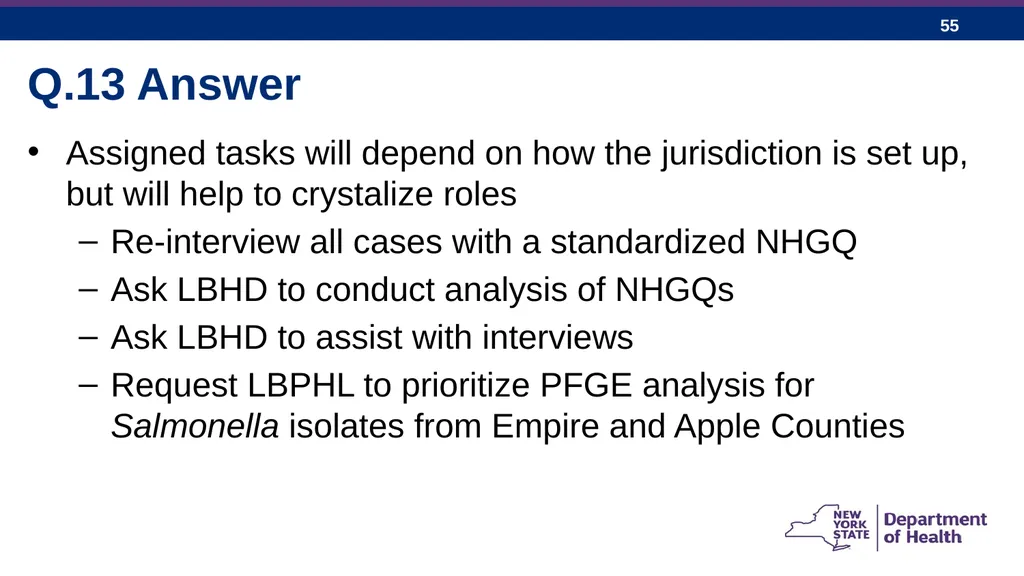
Q.13 Answer Assigned tasks will depend on how the jurisdiction is set up, but will help to crystalize roles
Re-interview all cases with a standardized NHGQ
Ask LBHD to conduct analysis of NHGQs
Ask LBHD to assist with interviews
Request LBPHL to prioritize PFGE analysis for Salmonella isolates from Empire and Apple Counties<br>
Re-interview all cases with a standardized NHGQ
Ask LBHD to conduct analysis of NHGQs
Ask LBHD to assist with interviews
Request LBPHL to prioritize PFGE analysis for Salmonella isolates from Empire and Apple Counties<br>
56
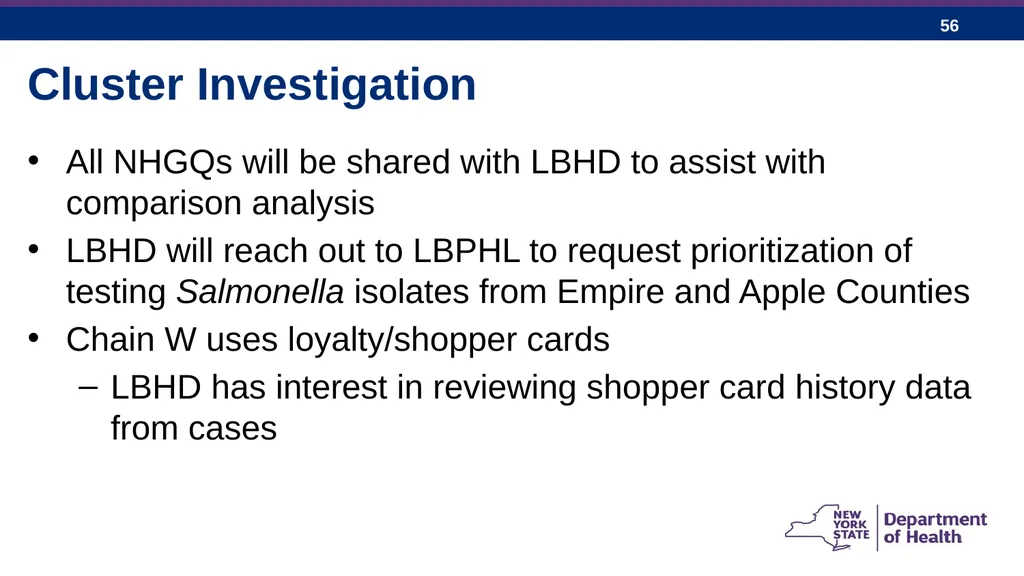
Cluster Investigation All NHGQs will be shared with LBHD to assist with comparison analysis
LBHD will reach out to LBPHL to request prioritization of testing Salmonella isolates from Empire and Apple Counties
Chain W uses loyalty/shopper cards
LBHD has interest in reviewing shopper card history data from cases<br>
LBHD will reach out to LBPHL to request prioritization of testing Salmonella isolates from Empire and Apple Counties
Chain W uses loyalty/shopper cards
LBHD has interest in reviewing shopper card history data from cases<br>
57
Question 14: Describe the process by which LBHD will attain shopper card histories from cases
How and what information will be collected?
What time period will you look at?
What agencies will you partner with?<br>
How and what information will be collected?
What time period will you look at?
What agencies will you partner with?<br>
58
Q.14 Answer All cases will be asked to provide a signed shopper card release for Chain W to obtain the food purchase history for the 3-month period prior to illness onset
Chain W is regulated by LB Department of Agriculture (LBDA)
LBHD and LBDA will work with Chain W to collect shopper card histories of cases with signed consent forms
Purchase histories are shared with LBHD epidemiologists for analysis of common purchases<br>
Chain W is regulated by LB Department of Agriculture (LBDA)
LBHD and LBDA will work with Chain W to collect shopper card histories of cases with signed consent forms
Purchase histories are shared with LBHD epidemiologists for analysis of common purchases<br>
59
Shopper Card Release Note: It is standard practice at LBHD to obtain food purchase history for the 3-month period prior to illness onset when there is no hypothesis developed for the specific source of illness. A 3-month food purchase history provides an adequate time period to review purchase data for perishable or shelf-stable food commonalities<br>
60
Shopper Card Data Chain W’s Corporate Office was notified that LBHD is investigating a Salmonella outbreak where the only common exposure among cases was shopping at Chain W
Purchase histories were gathered/analyzed more quickly after Chain W agreed to suspend their standard policy requiring a signed consent form in favor of accepting verbal consent to release purchase history
This is an example of industry and public health cooperating to solve an emergent disease issue<br>
Purchase histories were gathered/analyzed more quickly after Chain W agreed to suspend their standard policy requiring a signed consent form in favor of accepting verbal consent to release purchase history
This is an example of industry and public health cooperating to solve an emergent disease issue<br>
61
THE CLUSTER GROWS…again PART C.<br>
62
Cluster Grows Again… On September 30, the LBPHL reports 8 additional PFGE-matching S. Enteritidis infections
6 from Empire County
1 from Adirondack County
1 from Hudson County<br>
6 from Empire County
1 from Adirondack County
1 from Hudson County<br>
63
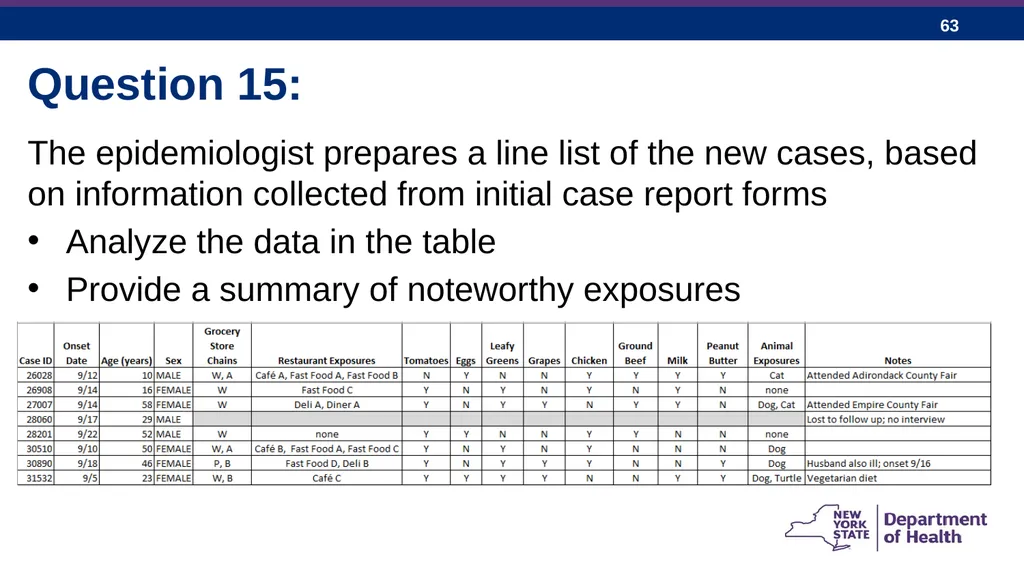
Question 15: The epidemiologist prepares a line list of the new cases, based on information collected from initial case report forms
Analyze the data in the table
Provide a summary of noteworthy exposures<br>
Analyze the data in the table
Provide a summary of noteworthy exposures<br>
64
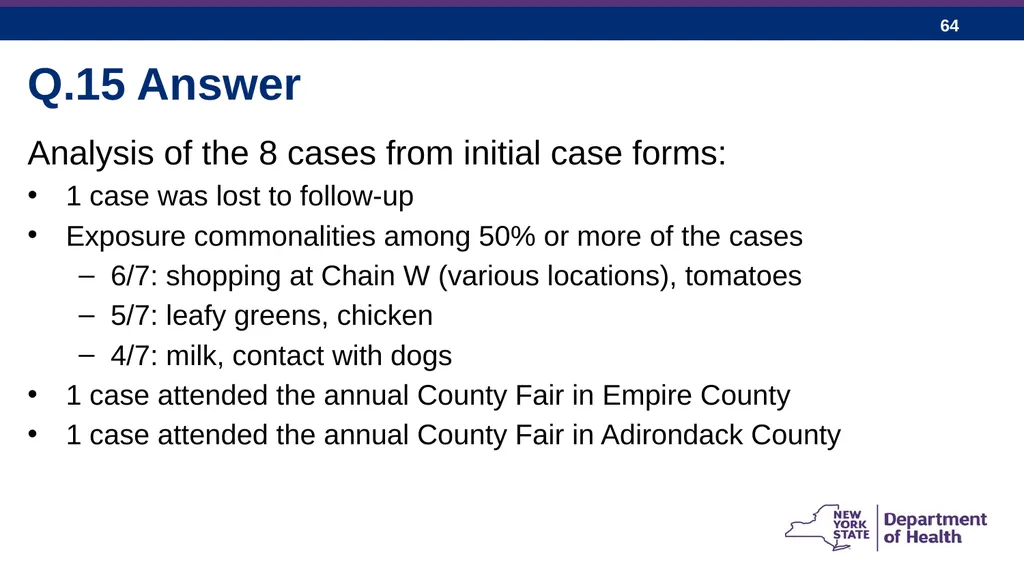
Q.15 Answer Analysis of the 8 cases from initial case forms:
1 case was lost to follow-up
Exposure commonalities among 50% or more of the cases
6/7: shopping at Chain W (various locations), tomatoes
5/7: leafy greens, chicken
4/7: milk, contact with dogs
1 case attended the annual County Fair in Empire County
1 case attended the annual County Fair in Adirondack County<br>
1 case was lost to follow-up
Exposure commonalities among 50% or more of the cases
6/7: shopping at Chain W (various locations), tomatoes
5/7: leafy greens, chicken
4/7: milk, contact with dogs
1 case attended the annual County Fair in Empire County
1 case attended the annual County Fair in Adirondack County<br>
65
Cluster Follow-up LBHD notifies each local health jurisdiction of the new matches and requests the following:
Cases be interviewed with the NHGQ
Obtain verbal consent for shopper card releases from Chain W<br>
Cases be interviewed with the NHGQ
Obtain verbal consent for shopper card releases from Chain W<br>
66
Question 16: What are you suspecting as a possible source? Why?<br>
67
Q.16 Answer Something purchased at Chain W
The only common exposure among cases was shopping at Chain W (various locations)<br>
The only common exposure among cases was shopping at Chain W (various locations)<br>
68
Multistate Cluster On October 3, LBPHL notifies LBHD that ongoing lab surveillance has just identified additional PFGE-matching S. Enteritidis infections in nearby states:
4 cases in State X
3 cases in State Y
Isolate dates range from September 9-16<br>
4 cases in State X
3 cases in State Y
Isolate dates range from September 9-16<br>
69
Multistate Cluster LBDH alerts all the counties with cases in LB that this is now considered a multi-state cluster
Follow-up with States X and Y will be conducted immediately to determine:
Exposure history of cases
If there are any common exposures among the cases in the three states<br>
Follow-up with States X and Y will be conducted immediately to determine:
Exposure history of cases
If there are any common exposures among the cases in the three states<br>
70
Question 17: What information would you like to know about these new PFGE-matching cases from State X and State Y?<br>
71
Q.17 Answer LBHD contacts State X and State Y to determine:
Demographic information (age, sex, race/ethnicity)
Clinical details (illness onset date, if hospitalized, patient outcome)
Do the states have any hypotheses?
Do cases shop at Chain W? Are shopper card releases available?
Did cases go to any fairs, festivals or events?
Did the cases travel to LB?
Any other food, water, travel and animal exposures?
What questionnaire do the other states use?
Would they be willing to use the NHGQ so there is standardization?<br>
Demographic information (age, sex, race/ethnicity)
Clinical details (illness onset date, if hospitalized, patient outcome)
Do the states have any hypotheses?
Do cases shop at Chain W? Are shopper card releases available?
Did cases go to any fairs, festivals or events?
Did the cases travel to LB?
Any other food, water, travel and animal exposures?
What questionnaire do the other states use?
Would they be willing to use the NHGQ so there is standardization?<br>
72
Multistate Cluster LBHD contacts State X and State Y for information on the PFGE-matching cases, including:
Demographic information (age, sex, race/ethnicity)
Clinical details (illness onset date, if hospitalized, recovery status)
All available exposure information regarding food, water, travel and animal exposures<br>
Demographic information (age, sex, race/ethnicity)
Clinical details (illness onset date, if hospitalized, recovery status)
All available exposure information regarding food, water, travel and animal exposures<br>
73
Multistate Cluster LBHD determines that Chain W has locations in both State X and State Y, but not as many as in LB State
Of utmost interest is whether the out-of-state cases:
Shopped at Chain W
Work(ed) in or had travel to LB
Attended any fairs/festivals/events<br>
Of utmost interest is whether the out-of-state cases:
Shopped at Chain W
Work(ed) in or had travel to LB
Attended any fairs/festivals/events<br>
74
Multistate Cluster Follow-up LBHD learns that 2/3 cases from State X and 3/3 cases from State Y shopped at Chain W
Chain W is a rarer chain to frequent in both states
One case travelled 2 hours to shop at the closest chain location
The two cases from State X each attended different county fairs
No cases work(ed) in or had travel to LB State
LBHD asks States X and Y to collect/share shopper card releases from Chain W for their cases<br>
Chain W is a rarer chain to frequent in both states
One case travelled 2 hours to shop at the closest chain location
The two cases from State X each attended different county fairs
No cases work(ed) in or had travel to LB State
LBHD asks States X and Y to collect/share shopper card releases from Chain W for their cases<br>
75
Question 18: Would you expand your investigation team to include federal partners?
If yes, who would you include/not include and what information would you share at this point?<br>
If yes, who would you include/not include and what information would you share at this point?<br>
76
Q.18 Answer Yes, now that this is a multistate investigation you would include the CDC and share the following:
Epi summary of 17 LB cases, including demographic data, clinical data, and exposures of note
Commonalities identified with out-of-state cases
Action items, including that analysis of shopper card purchase history is underway<br>
Epi summary of 17 LB cases, including demographic data, clinical data, and exposures of note
Commonalities identified with out-of-state cases
Action items, including that analysis of shopper card purchase history is underway<br>
77
Q.18 Answer (continued) At this time the USDA or FDA would not be involved because there is not enough data to suggest what food product(s) might be associated with illness
To increase case finding, you may consider contacting other Local Health Departments (LHDs) and suggest they notify state health authorities of Salmonella cases with exposure to Chain W<br>
To increase case finding, you may consider contacting other Local Health Departments (LHDs) and suggest they notify state health authorities of Salmonella cases with exposure to Chain W<br>
78
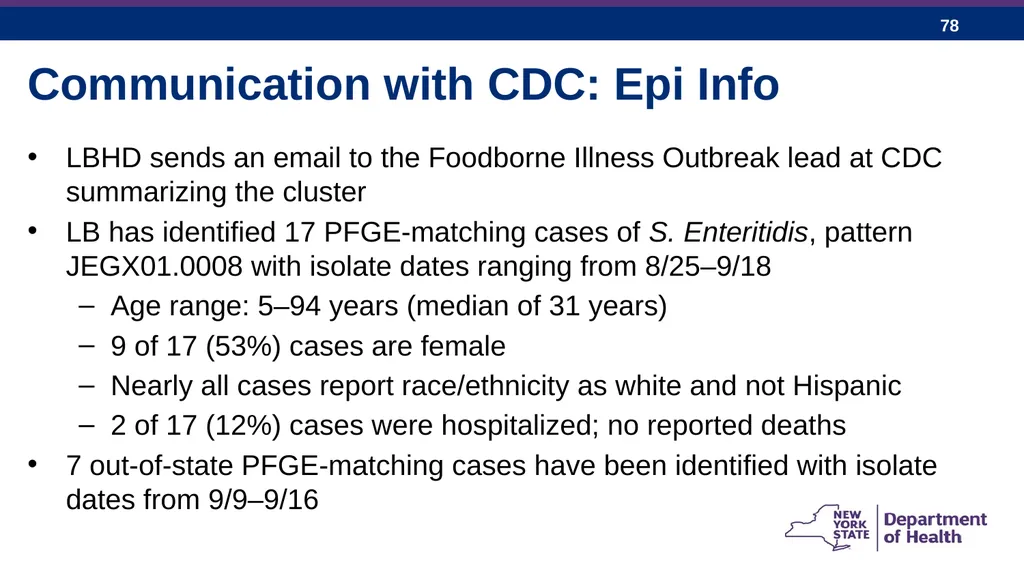
Communication with CDC: Epi Info LBHD sends an email to the Foodborne Illness Outbreak lead at CDC summarizing the cluster
LB has identified 17 PFGE-matching cases of S. Enteritidis, pattern JEGX01.0008 with isolate dates ranging from 8/25–9/18
Age range: 5–94 years (median of 31 years)
9 of 17 (53%) cases are female
Nearly all cases report race/ethnicity as white and not Hispanic
2 of 17 (12%) cases were hospitalized; no reported deaths
7 out-of-state PFGE-matching cases have been identified with isolate dates from 9/9–9/16<br>
LB has identified 17 PFGE-matching cases of S. Enteritidis, pattern JEGX01.0008 with isolate dates ranging from 8/25–9/18
Age range: 5–94 years (median of 31 years)
9 of 17 (53%) cases are female
Nearly all cases report race/ethnicity as white and not Hispanic
2 of 17 (12%) cases were hospitalized; no reported deaths
7 out-of-state PFGE-matching cases have been identified with isolate dates from 9/9–9/16<br>
79
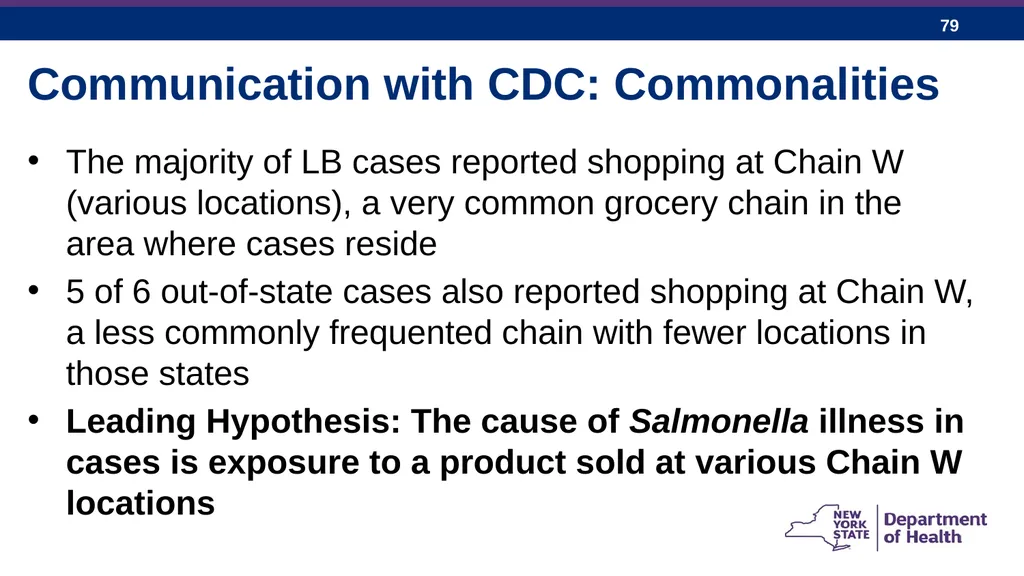
Communication with CDC: Commonalities The majority of LB cases reported shopping at Chain W (various locations), a very common grocery chain in the area where cases reside
5 of 6 out-of-state cases also reported shopping at Chain W, a less commonly frequented chain with fewer locations in those states
Leading Hypothesis: The cause of Salmonella illness in cases is exposure to a product sold at various Chain W locations<br>
5 of 6 out-of-state cases also reported shopping at Chain W, a less commonly frequented chain with fewer locations in those states
Leading Hypothesis: The cause of Salmonella illness in cases is exposure to a product sold at various Chain W locations<br>
80
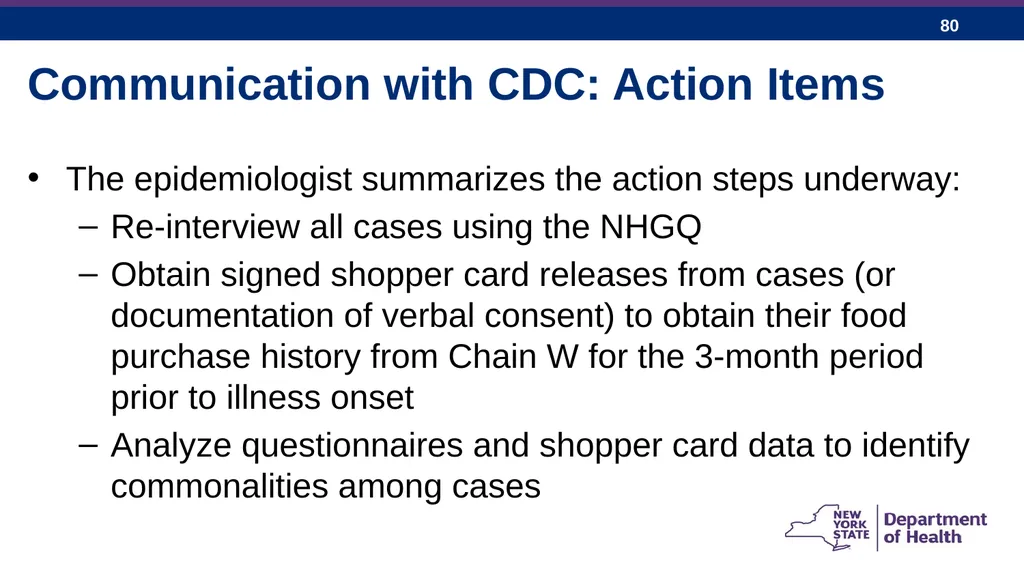
Communication with CDC: Action Items The epidemiologist summarizes the action steps underway:
Re-interview all cases using the NHGQ
Obtain signed shopper card releases from cases (or documentation of verbal consent) to obtain their food purchase history from Chain W for the 3-month period prior to illness onset
Analyze questionnaires and shopper card data to identify commonalities among cases<br>
Re-interview all cases using the NHGQ
Obtain signed shopper card releases from cases (or documentation of verbal consent) to obtain their food purchase history from Chain W for the 3-month period prior to illness onset
Analyze questionnaires and shopper card data to identify commonalities among cases<br>
81
SHOPPER CARD REVIEW PART D.<br>
82
Initial Review of Shopper Card Histories As of October 11, LBHD received Chain W Shopper card histories for 6 cases
Upon analysis, shopper card histories revealed that 3 food items were purchased among >50% of cases:
6/6 tomatoes
5/6 avocados
5/6 Turkish pine nuts<br>
Upon analysis, shopper card histories revealed that 3 food items were purchased among >50% of cases:
6/6 tomatoes
5/6 avocados
5/6 Turkish pine nuts<br>
83
Question 19: List all the agencies who LBHD would contact to share these findings<br>
84
Q.19 Answer To share findings from shopper card review, LBHD notifies:
Empire, Apple, Adirondack and Hudson County Health Departments
State X and State Y Health Departments
CDC
LBDA
Exposure analysis has identified products of note sold in facilities they regulate<br>
Empire, Apple, Adirondack and Hudson County Health Departments
State X and State Y Health Departments
CDC
LBDA
Exposure analysis has identified products of note sold in facilities they regulate<br>
85
Information Sharing On October 13, a call is held among:
CDC
LBHD
LBDA
State X and State Y Health Departments
Shopper card review and information analyzed from the NHGQ seems to suggest a “healthy” food/eater signal of nuts, fruits, and vegetables<br>
CDC
LBHD
LBDA
State X and State Y Health Departments
Shopper card review and information analyzed from the NHGQ seems to suggest a “healthy” food/eater signal of nuts, fruits, and vegetables<br>
86
More Data are Needed The team decides it is time to deploy an outbreak-specific questionnaire focusing on produce and nut exposures
Developed by LBHD and CDC
Re-interview past cases with the outbreak-specific questionnaire and only use this questionnaire when interviewing newly identified PFGE-matching cases
The team also decides that shopper card data be collected from new cases if they shopped at Chain W<br>
Developed by LBHD and CDC
Re-interview past cases with the outbreak-specific questionnaire and only use this questionnaire when interviewing newly identified PFGE-matching cases
The team also decides that shopper card data be collected from new cases if they shopped at Chain W<br>
87
Question 20: Would it be beneficial to contact Chain W to discuss investigation findings?
Should the USDA or FDA be contacted at this time?<br>
Should the USDA or FDA be contacted at this time?<br>
88
Q.20 Answer The team decides it would be beneficial to contact Chain W to discuss investigation findings to date (healthy food signal) and possible next steps
The team decides to notify FDA
FDA regulates vegetables, fruits and nuts which was the leading hypothesis as source of exposure at this point in the investigation<br>
The team decides to notify FDA
FDA regulates vegetables, fruits and nuts which was the leading hypothesis as source of exposure at this point in the investigation<br>
89
Conference Call with Chain W The next day, October 14, a call is held with Chain W
Partners on the call included:
LBHD
LBDA
State X and State Y Health Departments
CDC
FDA<br>
Partners on the call included:
LBHD
LBDA
State X and State Y Health Departments
CDC
FDA<br>
90
Question 21: What information should be shared with Chain W?
What information wouldn’t you share and why?<br>
What information wouldn’t you share and why?<br>
91
Q.21 Answer What information should be shared with Chain W?
Multistate summary of the ongoing epidemiologic investigation
Case counts and descriptive epi data (person, place, time)
Exposures of interest (from interviews/shopper card receipts):
Shopping at various locations of Chain W
Purchasing tomatoes, avocadoes and Turkish pine nuts from Chain W
What information wouldn’t you share?
Identifiable information of cases<br>
Multistate summary of the ongoing epidemiologic investigation
Case counts and descriptive epi data (person, place, time)
Exposures of interest (from interviews/shopper card receipts):
Shopping at various locations of Chain W
Purchasing tomatoes, avocadoes and Turkish pine nuts from Chain W
What information wouldn’t you share?
Identifiable information of cases<br>
92
Conference Call with Chain W LBHD provides Chain W with an overview of the ongoing multistate investigation
Case count and descriptive epi data (person, place, time)
Cases report shopping at various Chain W locations
The food exposures of interest are emphasized:
Tomatoes
Avocados
Turkish pine nuts<br>
Case count and descriptive epi data (person, place, time)
Cases report shopping at various Chain W locations
The food exposures of interest are emphasized:
Tomatoes
Avocados
Turkish pine nuts<br>
93
Question 22: What information would the outbreak team want to gather from Chain W?<br>
94
Q.22 Answer Obtain general information on tomatoes, Turkish pine nuts, and avocados:
Invoices dating back 3 months
Brand names, source of products, shipment records
Consumer interest in these products (inventory records)
Whether these products are used as “stealth” ingredients (used as ingredients in other products made/sold at Chain W), for example, tomatoes in pre-made salsa
Customer complaint history of these products
Records of ill workers who might handle these products<br>
Invoices dating back 3 months
Brand names, source of products, shipment records
Consumer interest in these products (inventory records)
Whether these products are used as “stealth” ingredients (used as ingredients in other products made/sold at Chain W), for example, tomatoes in pre-made salsa
Customer complaint history of these products
Records of ill workers who might handle these products<br>
95
Conference Call with Chain W Chain W is asked to share general information about tomatoes, Turkish pine nuts, and avocados
To aid in traceback activities the team requests
Invoices dating back 3 months
Source of products, brand name, shipment records
Consumer interest in these products (inventory records)
Customer complaints received about these products
Records of ill workers who might handle these products<br>
To aid in traceback activities the team requests
Invoices dating back 3 months
Source of products, brand name, shipment records
Consumer interest in these products (inventory records)
Customer complaints received about these products
Records of ill workers who might handle these products<br>
96
Conference Call with Chain W The investigation team also asks Chain W:
Whether these products are used as “stealth” ingredients (used as ingredients in other products made/sold at Chain W), for example, tomatoes in pre-made salsa
If any of the products had the potential to be distributed to all the Chain W locations cited by cases
Chain W is cooperative and agrees to work on gathering the requested information and submitting it as soon as possible<br>
Whether these products are used as “stealth” ingredients (used as ingredients in other products made/sold at Chain W), for example, tomatoes in pre-made salsa
If any of the products had the potential to be distributed to all the Chain W locations cited by cases
Chain W is cooperative and agrees to work on gathering the requested information and submitting it as soon as possible<br>
97
Foods of Statistical Significance? Investigation by the epidemiologist continues…
While shopper card data suggests that the majority of cases purchased tomatoes, avocados, and Turkish pine nuts from Chain W, it is important to identify the statistical significance of these exposures<br>
While shopper card data suggests that the majority of cases purchased tomatoes, avocados, and Turkish pine nuts from Chain W, it is important to identify the statistical significance of these exposures<br>
98
Question 23: What method(s) could you use to determine statistical significance?<br>
99
Q.23 Answer Analytic study
Case-control study
Case-case comparison
CDC Foodborne Diseases Active Surveillance Network Population Survey Atlas of Exposures, 2006-2007 (FoodNet Pop survey) and the Binomial Probability calculation<br>
Case-control study
Case-case comparison
CDC Foodborne Diseases Active Surveillance Network Population Survey Atlas of Exposures, 2006-2007 (FoodNet Pop survey) and the Binomial Probability calculation<br>
100
Determining Statistical Significance Conduct an analytic study to quantify the statistical significance of the food items in question, and therefore validate further efforts to investigate them
A case-control study with controls matched by age group and geography is extremely labor/time intensive
A case-case comparison study compares exposures among cases of interest and another group of cases and is less labor/time intensive
But…why not conduct an even easier, quicker analytic study instead?<br>
A case-control study with controls matched by age group and geography is extremely labor/time intensive
A case-case comparison study compares exposures among cases of interest and another group of cases and is less labor/time intensive
But…why not conduct an even easier, quicker analytic study instead?<br>
101
Determining Statistical Significance The epidemiologist decides that the quickest and most efficient way to determine statistical significance is to use:
FoodNet Pop survey
Provides background consumption rates of food, based on geographic location
Binomial Probability calculation
Compares case consumption rates against estimated background consumption rates<br>
FoodNet Pop survey
Provides background consumption rates of food, based on geographic location
Binomial Probability calculation
Compares case consumption rates against estimated background consumption rates<br>
102
BINOMIAL ANALYSIS PART E.<br>
103
Binomial Model Analysis To assess statistical significance, the epidemiologist will perform binomial analysis of:
Tomatoes
Avocados
Turkish pine nuts
To date, there are 17 outbreak-related cases in LB and the analyses will only include these cases<br>
Tomatoes
Avocados
Turkish pine nuts
To date, there are 17 outbreak-related cases in LB and the analyses will only include these cases<br>
104
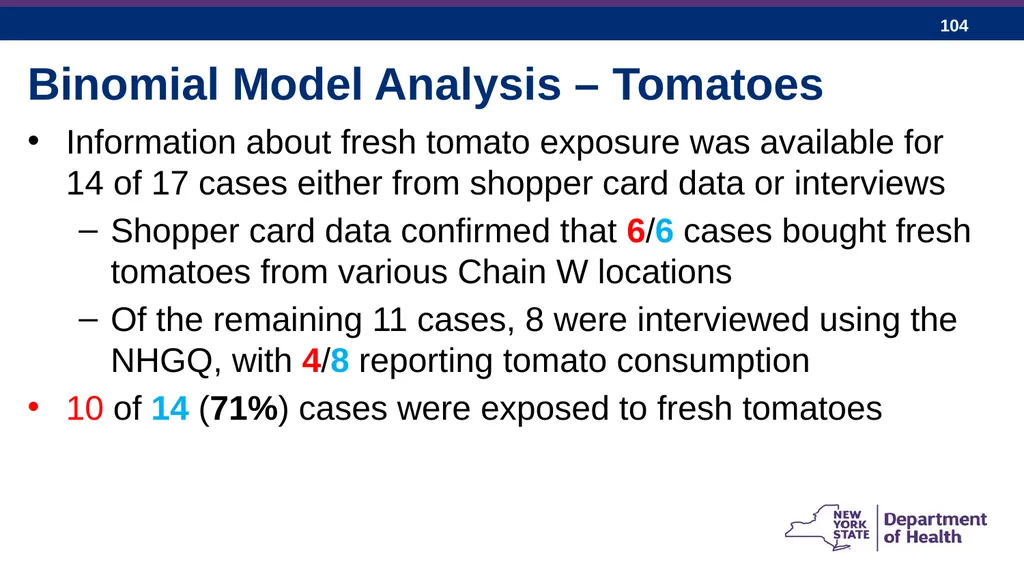
Binomial Model Analysis – Tomatoes Information about fresh tomato exposure was available for 14 of 17 cases either from shopper card data or interviews
Shopper card data confirmed that 6/6 cases bought fresh tomatoes from various Chain W locations
Of the remaining 11 cases, 8 were interviewed using the NHGQ, with 4/8 reporting tomato consumption
10 of 14 (71%) cases were exposed to fresh tomatoes<br>
Shopper card data confirmed that 6/6 cases bought fresh tomatoes from various Chain W locations
Of the remaining 11 cases, 8 were interviewed using the NHGQ, with 4/8 reporting tomato consumption
10 of 14 (71%) cases were exposed to fresh tomatoes<br>
105
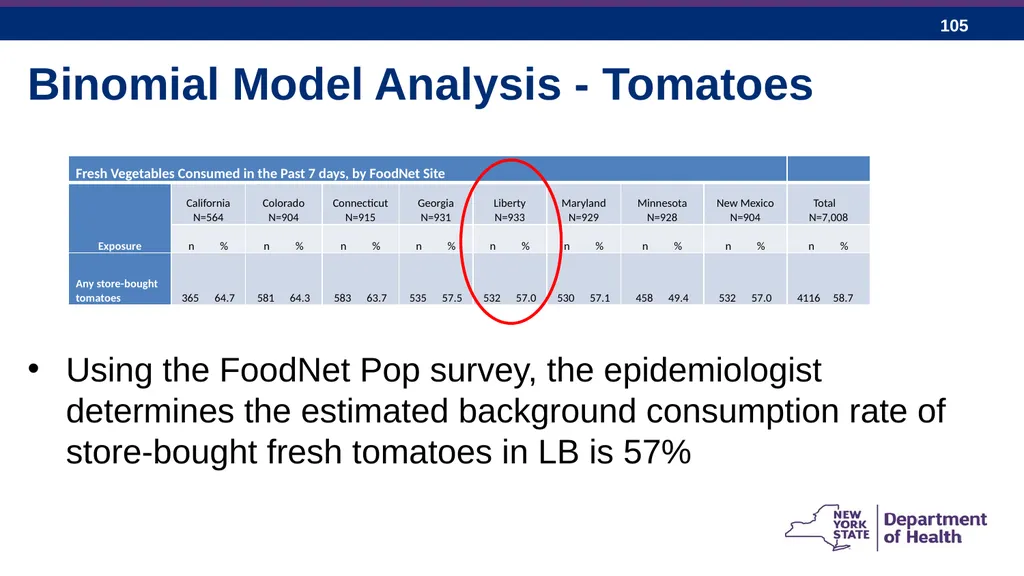
Binomial Model Analysis - Tomatoes Using the FoodNet Pop survey, the epidemiologist determines the estimated background consumption rate of store-bought fresh tomatoes in LB is 57%<br>
106
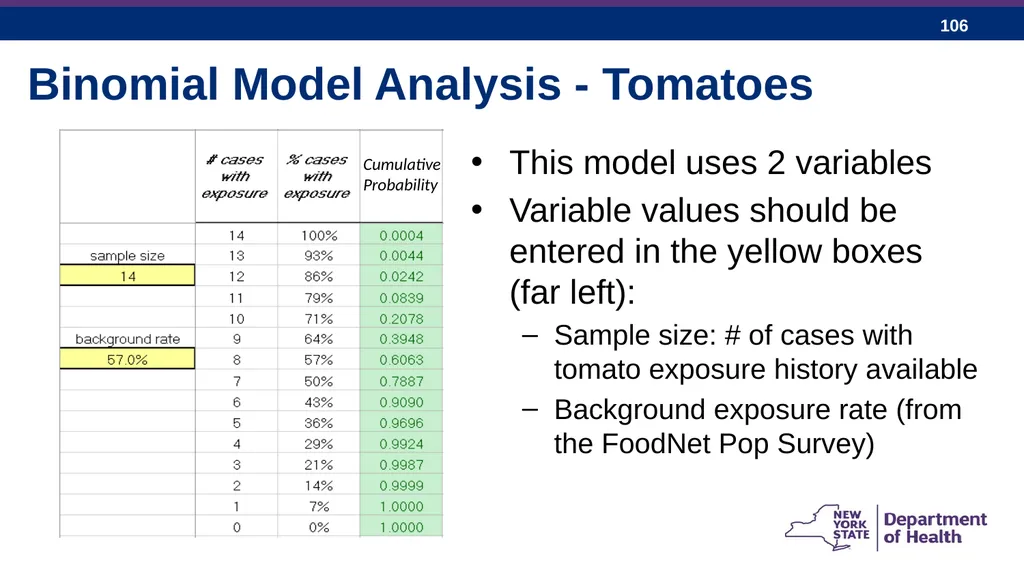
Binomial Model Analysis - Tomatoes This model uses 2 variables
Variable values should be entered in the yellow boxes (far left):
Sample size: # of cases with tomato exposure history available
Background exposure rate (from the FoodNet Pop Survey) Cumulative
Probability<br>
Variable values should be entered in the yellow boxes (far left):
Sample size: # of cases with tomato exposure history available
Background exposure rate (from the FoodNet Pop Survey) Cumulative
Probability<br>
107
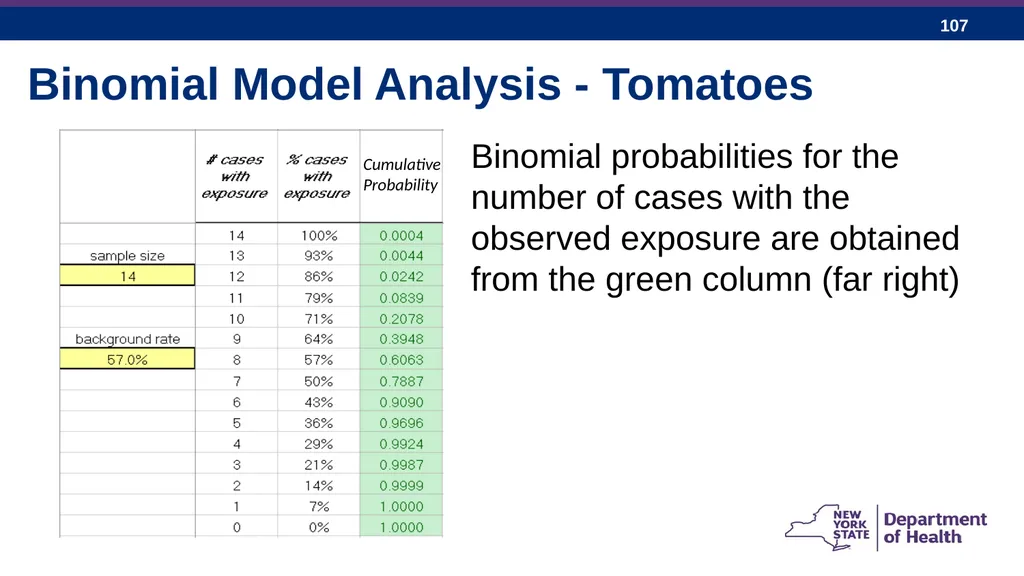
Binomial Model Analysis - Tomatoes Binomial probabilities for the number of cases with the observed exposure are obtained from the green column (far right) Cumulative
Probability<br>
Probability<br>
108
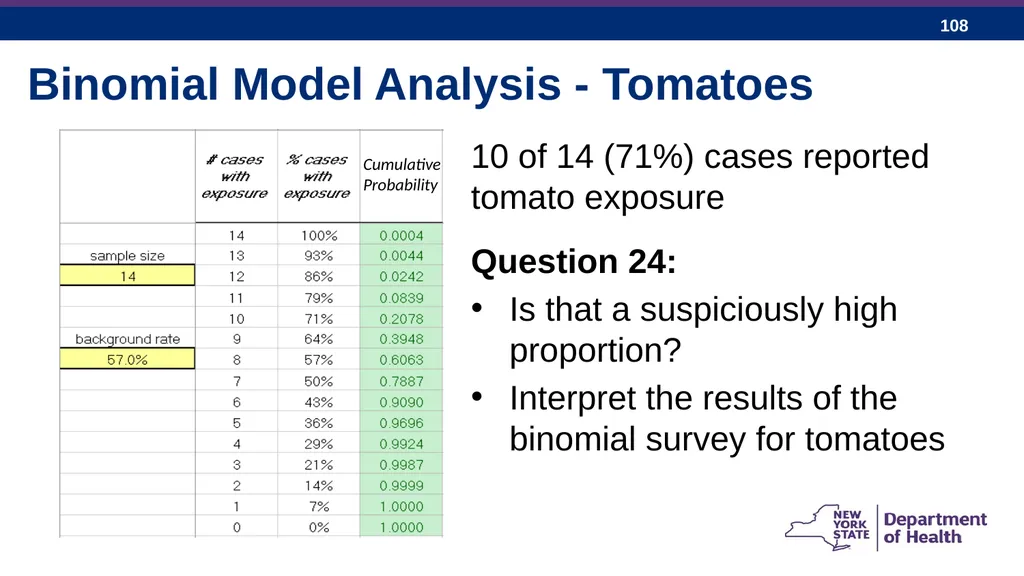
Binomial Model Analysis - Tomatoes 10 of 14 (71%) cases reported tomato exposure
Question 24:
Is that a suspiciously high proportion?
Interpret the results of the binomial survey for tomatoes Cumulative
Probability<br>
Question 24:
Is that a suspiciously high proportion?
Interpret the results of the binomial survey for tomatoes Cumulative
Probability<br>
109
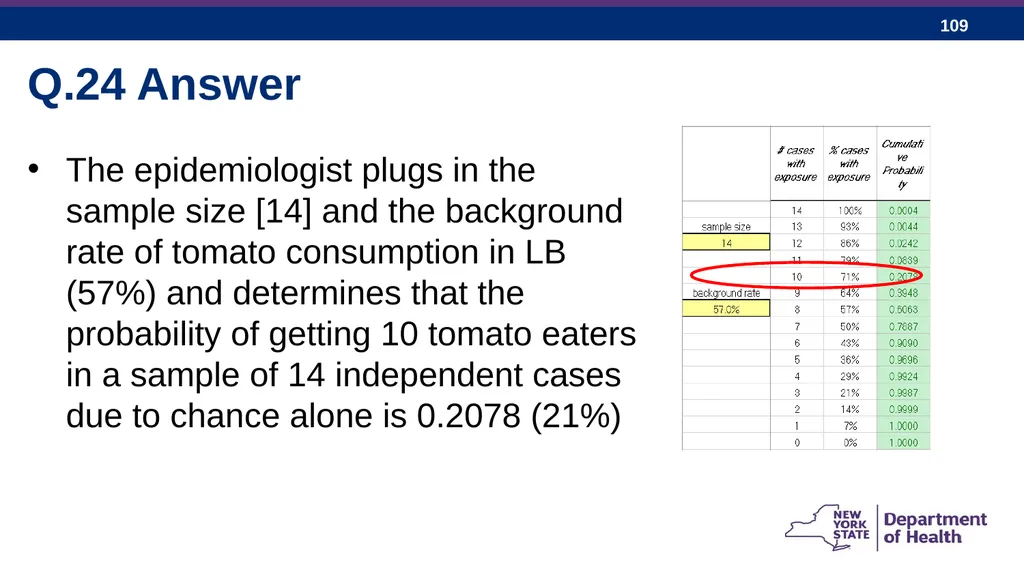
Q.24 Answer The epidemiologist plugs in the sample size [14] and the background rate of tomato consumption in LB (57%) and determines that the probability of getting 10 tomato eaters in a sample of 14 independent cases due to chance alone is 0.2078 (21%)<br>
110
Tomato Follow-up? Typically, a chance of 0.05 (5%) or less is considered statistically significant and would require additional follow-up
With a 21% chance, tomatoes are unlikely the exposure of interest that caused the outbreak
The epidemiologist decides to next run the model for avocado exposure to see how that compares<br>
With a 21% chance, tomatoes are unlikely the exposure of interest that caused the outbreak
The epidemiologist decides to next run the model for avocado exposure to see how that compares<br>
111
Binomial Model Analysis - Avocados Information about avocado exposure was available for 14 of 17 cases either from shopper card data or interviews
Shopper card data confirmed that 5/6 cases purchased avocados from various Chain W locations
Of the remaining 11 cases, 8 have been interviewed with the NHGQ, with 3/8 reporting avocado consumption
8 of 14 (57%) of cases were exposed to avocados<br>
Shopper card data confirmed that 5/6 cases purchased avocados from various Chain W locations
Of the remaining 11 cases, 8 have been interviewed with the NHGQ, with 3/8 reporting avocado consumption
8 of 14 (57%) of cases were exposed to avocados<br>
112
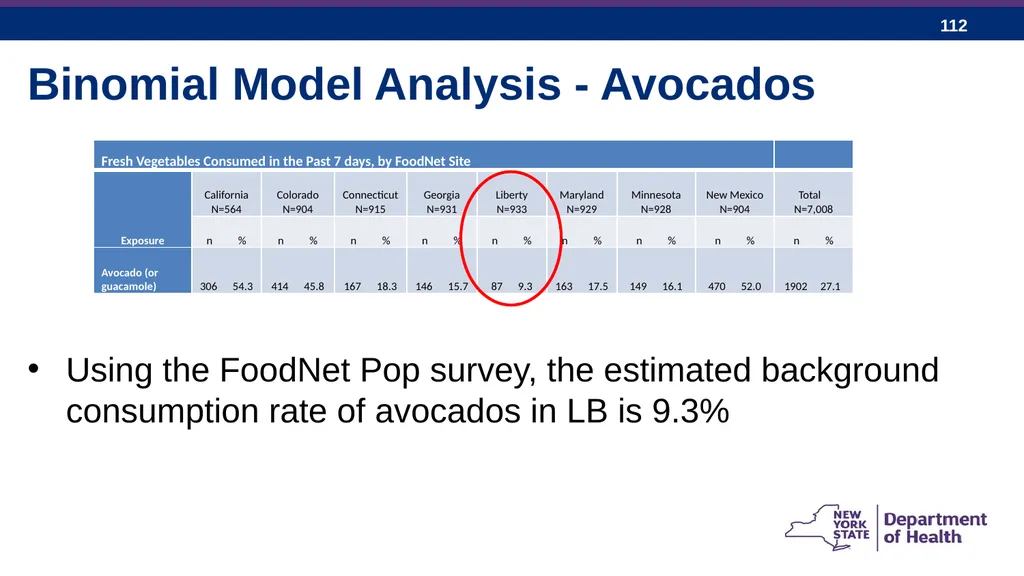
Binomial Model Analysis - Avocados Using the FoodNet Pop survey, the estimated background consumption rate of avocados in LB is 9.3%<br>
113
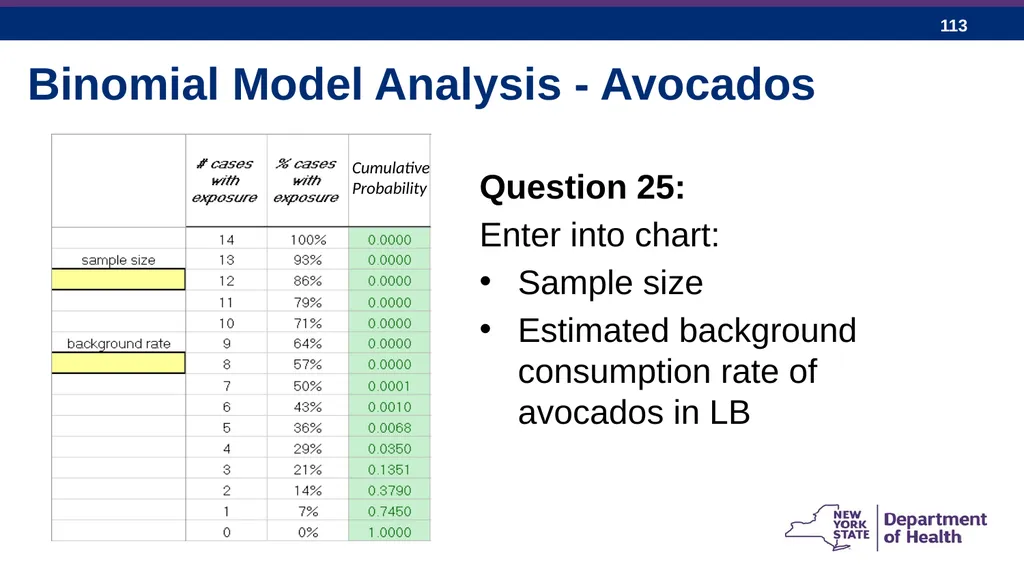
Binomial Model Analysis - Avocados Question 25:
Enter into chart:
Sample size
Estimated background consumption rate of avocados in LB Cumulative
Probability<br>
Enter into chart:
Sample size
Estimated background consumption rate of avocados in LB Cumulative
Probability<br>
114
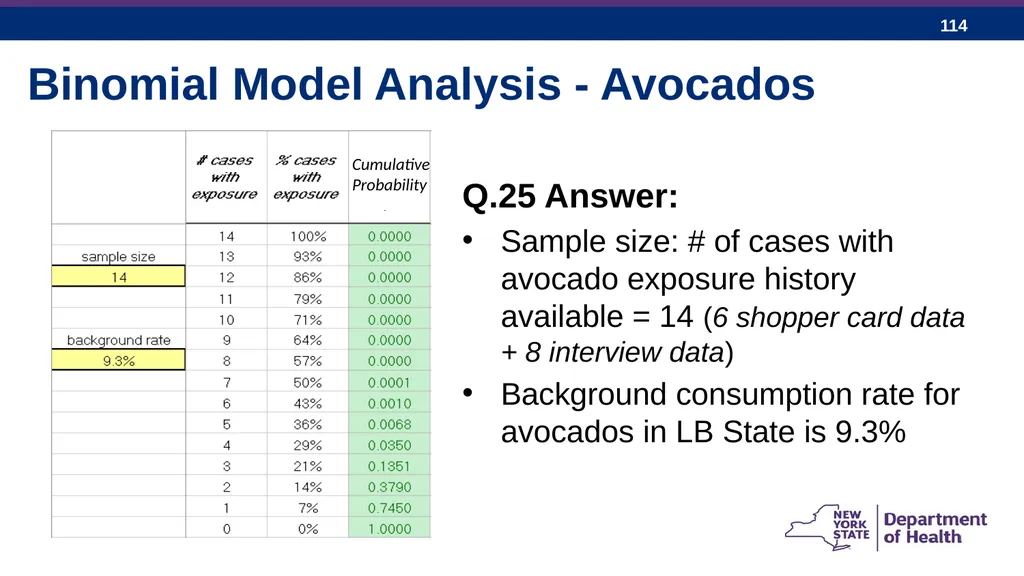
Binomial Model Analysis - Avocados Q.25 Answer:
Sample size: # of cases with avocado exposure history available = 14 (6 shopper card data + 8 interview data)
Background consumption rate for avocados in LB State is 9.3% Cumulative
Probability<br>
Sample size: # of cases with avocado exposure history available = 14 (6 shopper card data + 8 interview data)
Background consumption rate for avocados in LB State is 9.3% Cumulative
Probability<br>
115
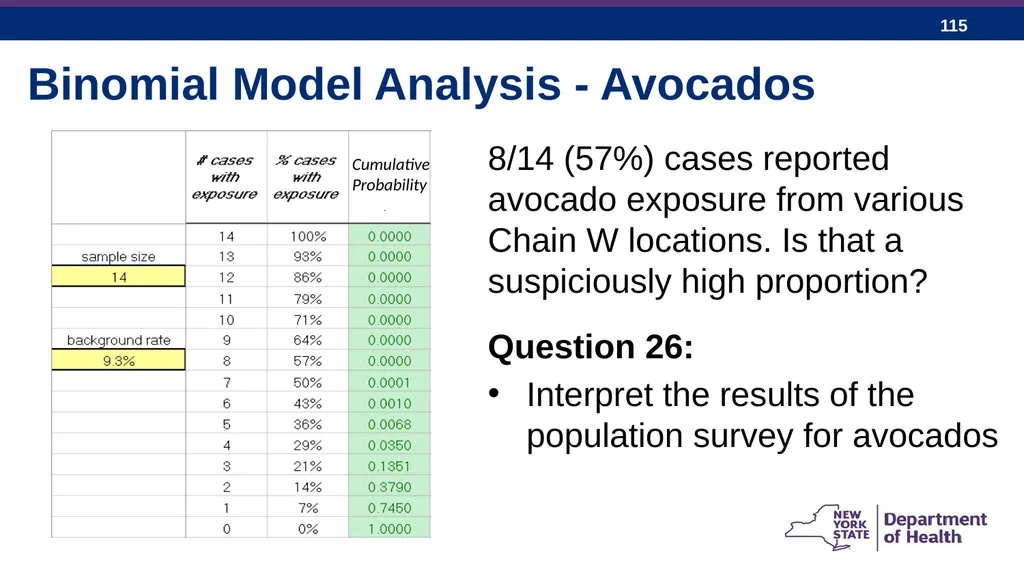
Binomial Model Analysis - Avocados 8/14 (57%) cases reported avocado exposure from various Chain W locations. Is that a suspiciously high proportion?
Question 26:
Interpret the results of the population survey for avocados Cumulative
Probability<br>
Question 26:
Interpret the results of the population survey for avocados Cumulative
Probability<br>
116
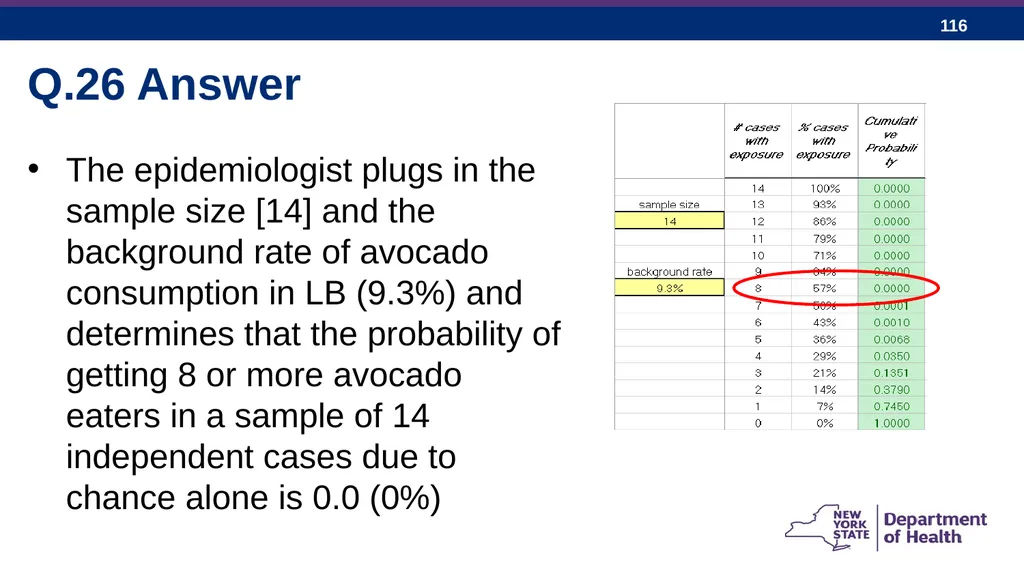
Q.26 Answer The epidemiologist plugs in the sample size [14] and the background rate of avocado consumption in LB (9.3%) and determines that the probability of getting 8 or more avocado eaters in a sample of 14 independent cases due to chance alone is 0.0 (0%)<br>
117
Avocado Follow-up? Could avocados be the cause of this outbreak?
More information will need to be gathered to investigate this hypothesis
But first, the epidemiologist will run the final model for pine nut exposure to see how that compares<br>
More information will need to be gathered to investigate this hypothesis
But first, the epidemiologist will run the final model for pine nut exposure to see how that compares<br>
118
Binomial Model Analysis – Pine Nuts Information about Turkish pine nuts was available for 6 of 17 cases from shopper card data
Shopper card data confirmed that 5/6 cases bought Turkish pine nuts from various Chain W locations
Cases were not asked about their exposure to Turkish pine nuts at initial or NHGQ interviews
The epidemiologist searches the FoodNet Pop survey, but Turkish pine nut exposure is not listed in the survey
So, now what…?<br>
Shopper card data confirmed that 5/6 cases bought Turkish pine nuts from various Chain W locations
Cases were not asked about their exposure to Turkish pine nuts at initial or NHGQ interviews
The epidemiologist searches the FoodNet Pop survey, but Turkish pine nut exposure is not listed in the survey
So, now what…?<br>
119
Binomial Model Analysis – Pine Nuts Rather than forgo the calculation altogether, the epidemiologist decides to use peanut consumption as a proxy for Turkish pine nut consumption
The true background consumption rate of Turkish pine nuts is likely lower
Better to be conservative and err on the high side when using background consumption estimates in this manner<br>
The true background consumption rate of Turkish pine nuts is likely lower
Better to be conservative and err on the high side when using background consumption estimates in this manner<br>
120
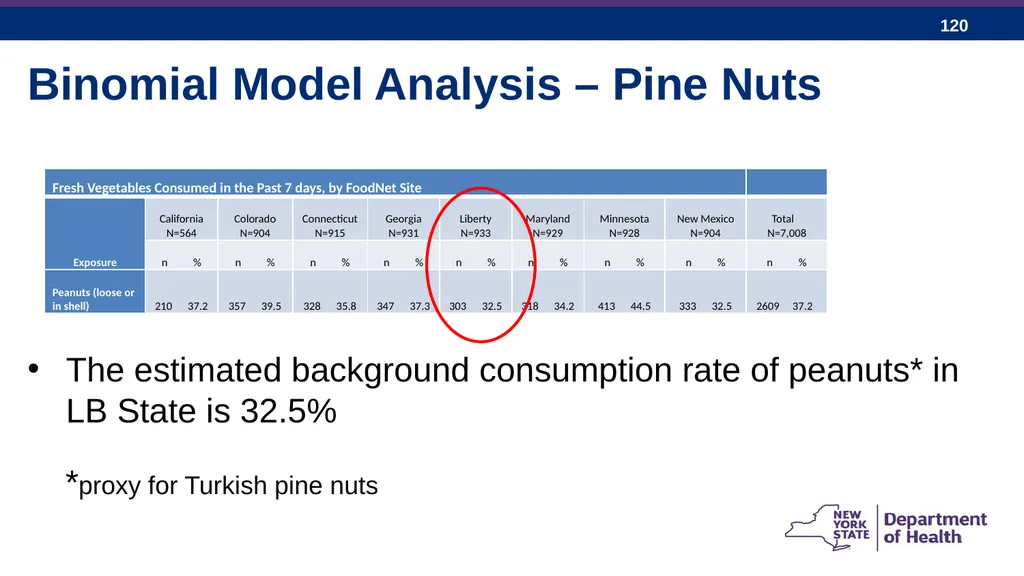
Binomial Model Analysis – Pine Nuts The estimated background consumption rate of peanuts* in LB State is 32.5%
*proxy for Turkish pine nuts<br>
*proxy for Turkish pine nuts<br>
121
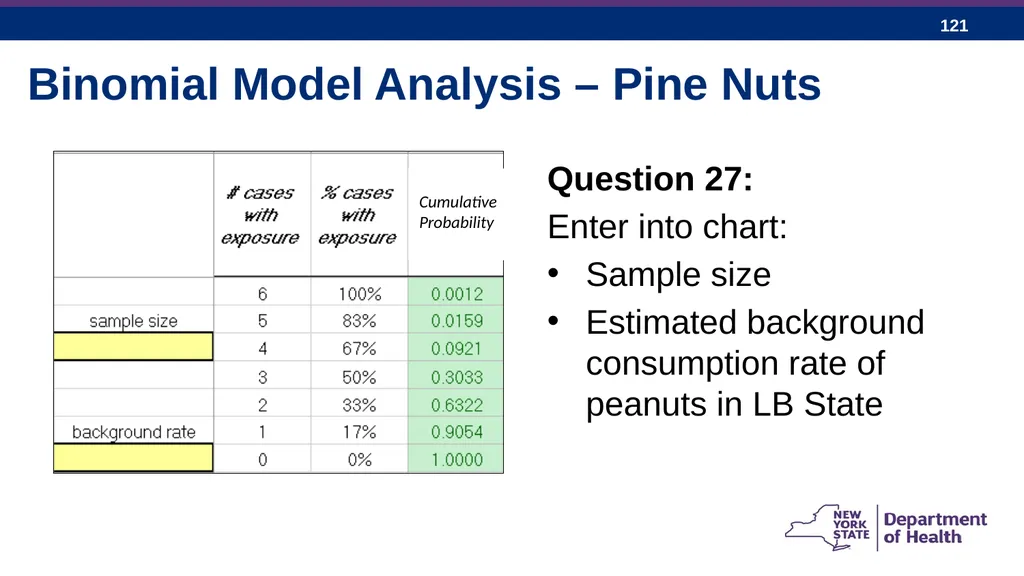
Binomial Model Analysis – Pine Nuts Question 27:
Enter into chart:
Sample size
Estimated background consumption rate of peanuts in LB State Cumulative
Probability<br>
Enter into chart:
Sample size
Estimated background consumption rate of peanuts in LB State Cumulative
Probability<br>
122
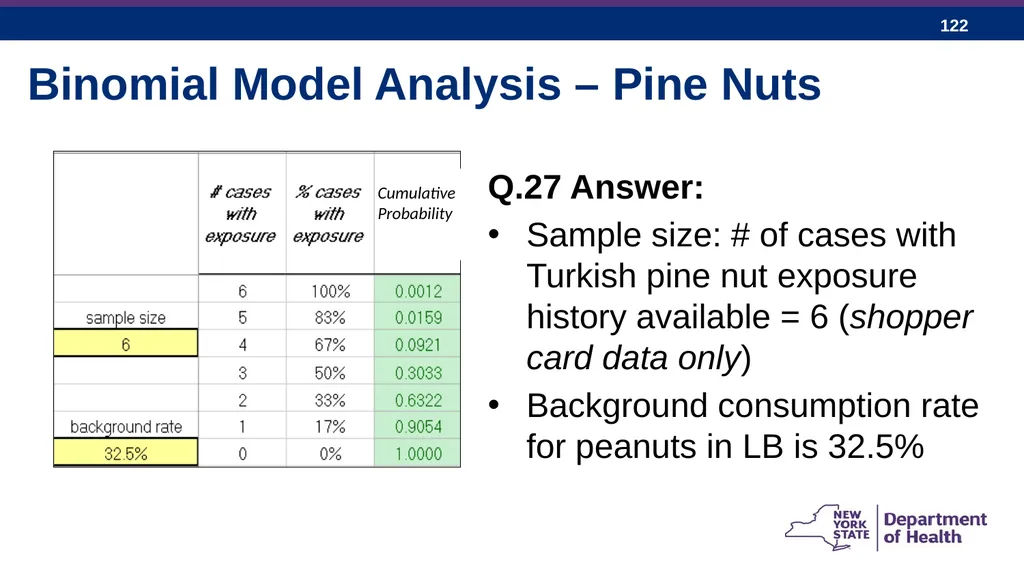
Binomial Model Analysis – Pine Nuts Q.27 Answer:
Sample size: # of cases with Turkish pine nut exposure history available = 6 (shopper card data only)
Background consumption rate for peanuts in LB is 32.5% Cumulative
Probability<br>
Sample size: # of cases with Turkish pine nut exposure history available = 6 (shopper card data only)
Background consumption rate for peanuts in LB is 32.5% Cumulative
Probability<br>
123
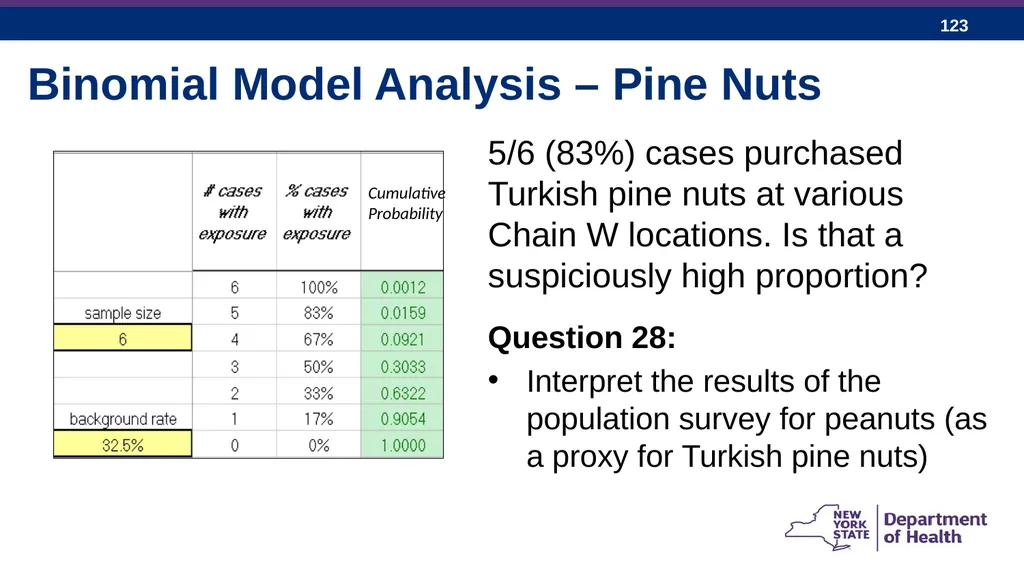
Binomial Model Analysis – Pine Nuts 5/6 (83%) cases purchased Turkish pine nuts at various Chain W locations. Is that a suspiciously high proportion?
Question 28:
Interpret the results of the population survey for peanuts (as a proxy for Turkish pine nuts) Cumulative
Probability<br>
Question 28:
Interpret the results of the population survey for peanuts (as a proxy for Turkish pine nuts) Cumulative
Probability<br>
124
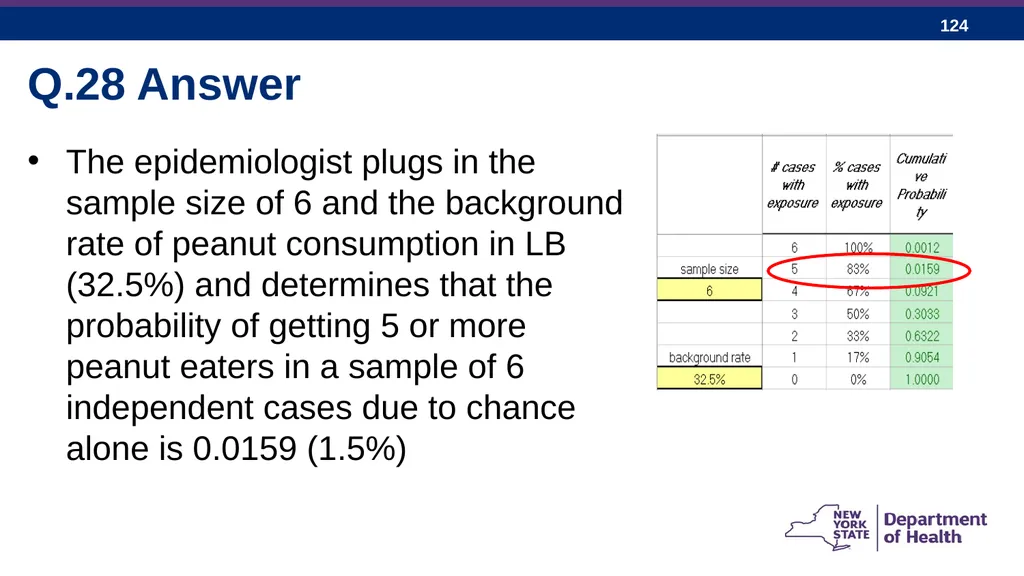
Q.28 Answer The epidemiologist plugs in the sample size of 6 and the background rate of peanut consumption in LB (32.5%) and determines that the probability of getting 5 or more peanut eaters in a sample of 6 independent cases due to chance alone is 0.0159 (1.5%)<br>
125
Turkish Pine Nuts Follow-up? Could Turkish pine nuts be the cause of this outbreak?
More information will need to be gathered to investigate this hypothesis<br>
More information will need to be gathered to investigate this hypothesis<br>
126
Question 29: Based on population survey results, do you have a food exposure of interest?<br>
127
Q.29 Answer Based on population survey results it is determined that:
Consumption of tomatoes is not a statistically significant exposure
Consumption of avocados and Turkish pine nuts are a significant exposure related to illness
The frequency of these exposures was above the expected baseline consumption rate of the general population<br>
Consumption of tomatoes is not a statistically significant exposure
Consumption of avocados and Turkish pine nuts are a significant exposure related to illness
The frequency of these exposures was above the expected baseline consumption rate of the general population<br>
128
WORKING WITH INDUSTRY & PRODUCT SAMPLING PART F.<br>
129
Information Sharing with Chain W On October 6 a call is held among LBHD, LBPHL, LBDA and Chain W
On a call with Chain W two days prior, LBHD had asked Chain W to gather consumer and traceback information about tomatoes, Turkish pine nuts, and avocados
LBHD now informs Chain W that they are most interested to hear about this information for avocados and Turkish pine nuts
These products are not necessarily the source of illness, but epidemiologic analysis has identified them as statistically significant commonalities
The team needs more information to continue the investigation<br>
On a call with Chain W two days prior, LBHD had asked Chain W to gather consumer and traceback information about tomatoes, Turkish pine nuts, and avocados
LBHD now informs Chain W that they are most interested to hear about this information for avocados and Turkish pine nuts
These products are not necessarily the source of illness, but epidemiologic analysis has identified them as statistically significant commonalities
The team needs more information to continue the investigation<br>
130
Information Sharing with Chain W Chain W performed analysis of shopper card histories and reviewed distribution patterns for tomatoes, avocados and Turkish pine nuts received at store locations
Produce items received by Chain W (including tomatoes and avocados) were distributed not only to Chain W establishments, but to other commercial grocery establishments/chains around the state<br>
Produce items received by Chain W (including tomatoes and avocados) were distributed not only to Chain W establishments, but to other commercial grocery establishments/chains around the state<br>
131
Information Sharing with Chain W Chain W identified a unique distribution pattern regarding Turkish pine nuts:
Chain W received Turkish pine nuts in bulk exclusively from Distributor T
This information is noteworthy to investigators because cases reported shopping only at Chain W locations and no other grocery store establishment/chain<br>
Chain W received Turkish pine nuts in bulk exclusively from Distributor T
This information is noteworthy to investigators because cases reported shopping only at Chain W locations and no other grocery store establishment/chain<br>
132
Question 30: At the end of the call it is decided that that the collection of product samples for testing and analysis would be beneficial to the investigation
From what locations should you collect samples?<br>
From what locations should you collect samples?<br>
133
Q.30 Answer Chain W location(s) cited by cases
Leftover product(s) from case households
Distributor T<br>
Leftover product(s) from case households
Distributor T<br>
134
Sample Collection On October 17, LBDA collected bulk Turkish pine nuts for testing at their laboratory from:
A single Chain W establishment which had been reported as a common shopping location for 8 cases
2 additional Chain W locations cited by cases<br>
A single Chain W establishment which had been reported as a common shopping location for 8 cases
2 additional Chain W locations cited by cases<br>
135
Product Sampling from Chain W LBDA investigated whether Turkish pine nuts were ingredients of other products prepared and sold at Chain W
Invoices for Turkish pine nuts were collected by LBDA and provided to the FDA
Since multiple states are involved, traceback efforts for the Turkish pine nuts are coordinated by the FDA<br>
Invoices for Turkish pine nuts were collected by LBDA and provided to the FDA
Since multiple states are involved, traceback efforts for the Turkish pine nuts are coordinated by the FDA<br>
136
Sampling of Product Leftovers The epidemiology team is asked to review outbreak questionnaires to identify any cases who reported Turkish pine nut consumption and acknowledged availability of product leftovers in the home
2 cases from Empire County had homemade pesto made with bulk Turkish pine nuts purchased at 2 different Chain W locations
1 case from Hudson County had whole bulk Turkish pine nuts purchased at a third Chain W location<br>
2 cases from Empire County had homemade pesto made with bulk Turkish pine nuts purchased at 2 different Chain W locations
1 case from Hudson County had whole bulk Turkish pine nuts purchased at a third Chain W location<br>
137
Sampling of Product Leftovers LBHD, in coordination with the FDA, contact the involved local health jurisdictions serving Empire and Hudson counties to arrange for the collection of product leftovers from cases’ homes for testing at the LBPHL
Food samples submitted to the LBPHL are tested for the presence of Salmonella by culture and molecular methods<br>
Food samples submitted to the LBPHL are tested for the presence of Salmonella by culture and molecular methods<br>
138
Information Sharing On October 18, a conference call is held with LBHD, LBDA, CDC, FDA, other involved state health departments, and Chain W
There are now 30 PFGE-matching cases from 6 states associated with this cluster
Illness onset dates range from August 24 - October 2
All cases live in states with Chain W locations<br>
There are now 30 PFGE-matching cases from 6 states associated with this cluster
Illness onset dates range from August 24 - October 2
All cases live in states with Chain W locations<br>
139
Information Sharing Shopper card histories received from 23/30 (77%) cases
13/23 (57%) cases indicated that bulk Turkish pine nuts had been purchased from Chain W sometime during the 3 months prior to illness onset
17/26 (65%) cases who completed the outbreak-specific questionnaire indicated exposure to bulk Turkish pine nuts purchased at Chain W<br>
13/23 (57%) cases indicated that bulk Turkish pine nuts had been purchased from Chain W sometime during the 3 months prior to illness onset
17/26 (65%) cases who completed the outbreak-specific questionnaire indicated exposure to bulk Turkish pine nuts purchased at Chain W<br>
140
Question 31: Not all purchase histories and/or questionnaires of ill cases indicated exposure to Turkish pine nuts.
What may be some explanations as to why?<br>
What may be some explanations as to why?<br>
141
Q.31 Answer A variety of explanations could support why not all purchase histories indicated exposure to the product:
Case bought Turkish pine nuts without using a shopper card
Someone else purchased the Turkish pine nuts for the case
Case used someone else’s shopper card to purchase the Turkish pine nuts
Exposure to pine nuts may have occurred outside the home
Turkish pine nuts used as a stealth ingredient in a meal
Poor exposure recall<br>
Case bought Turkish pine nuts without using a shopper card
Someone else purchased the Turkish pine nuts for the case
Case used someone else’s shopper card to purchase the Turkish pine nuts
Exposure to pine nuts may have occurred outside the home
Turkish pine nuts used as a stealth ingredient in a meal
Poor exposure recall<br>
142
Chain W Data About Turkish Pine Nuts Chain W reported that <1% of their customers purchased bulk Turkish pine nuts
Various foods prepared and sold at Chain W stores contained bulk Turkish pine nuts:
Cases may have been unaware of/unable to recall exposure during interview
Shopper card histories were not previously analyzed for these prepared products
LBHD is willing to conduct further analysis, if requested<br>
Various foods prepared and sold at Chain W stores contained bulk Turkish pine nuts:
Cases may have been unaware of/unable to recall exposure during interview
Shopper card histories were not previously analyzed for these prepared products
LBHD is willing to conduct further analysis, if requested<br>
143
Voluntary Recall of Turkish Pine Nuts Based on the information relayed on the call, Chain W decides to:
Voluntarily cease sales of all bulk Turkish pine nuts from their stores
Voluntarily cease sales of premade products that contain Turkish pine nuts<br>
Voluntarily cease sales of all bulk Turkish pine nuts from their stores
Voluntarily cease sales of premade products that contain Turkish pine nuts<br>
144
Question 32: Do you think this represents an outbreak or a cluster?
Provide an explanation for your choice<br>
Provide an explanation for your choice<br>
145
Q.32 Answer Represents an outbreak
Cases are associated with pine nut exposure purchased from Chain W<br>
Cases are associated with pine nut exposure purchased from Chain W<br>
146
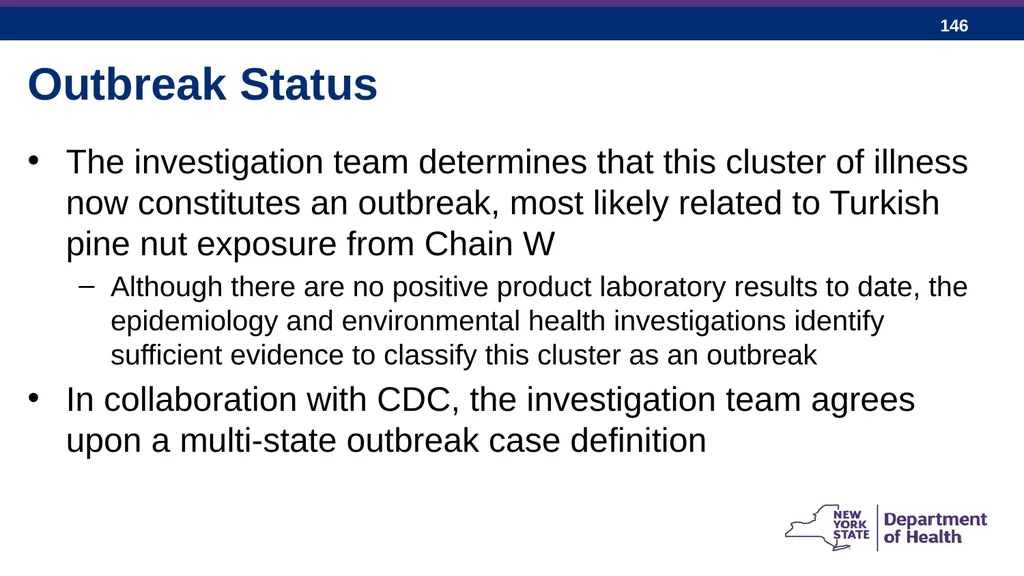
Outbreak Status The investigation team determines that this cluster of illness now constitutes an outbreak, most likely related to Turkish pine nut exposure from Chain W
Although there are no positive product laboratory results to date, the epidemiology and environmental health investigations identify sufficient evidence to classify this cluster as an outbreak
In collaboration with CDC, the investigation team agrees upon a multi-state outbreak case definition<br>
Although there are no positive product laboratory results to date, the epidemiology and environmental health investigations identify sufficient evidence to classify this cluster as an outbreak
In collaboration with CDC, the investigation team agrees upon a multi-state outbreak case definition<br>
147
Question 33: Develop a case definition for this outbreak
Note: A case definition is a standard set of criteria used to classify ill people as being cases associated with a particular outbreak. Criteria include clinical findings (signs, symptoms, laboratory results) and is restricted by time, place (if known), and person<br>
Note: A case definition is a standard set of criteria used to classify ill people as being cases associated with a particular outbreak. Criteria include clinical findings (signs, symptoms, laboratory results) and is restricted by time, place (if known), and person<br>
148
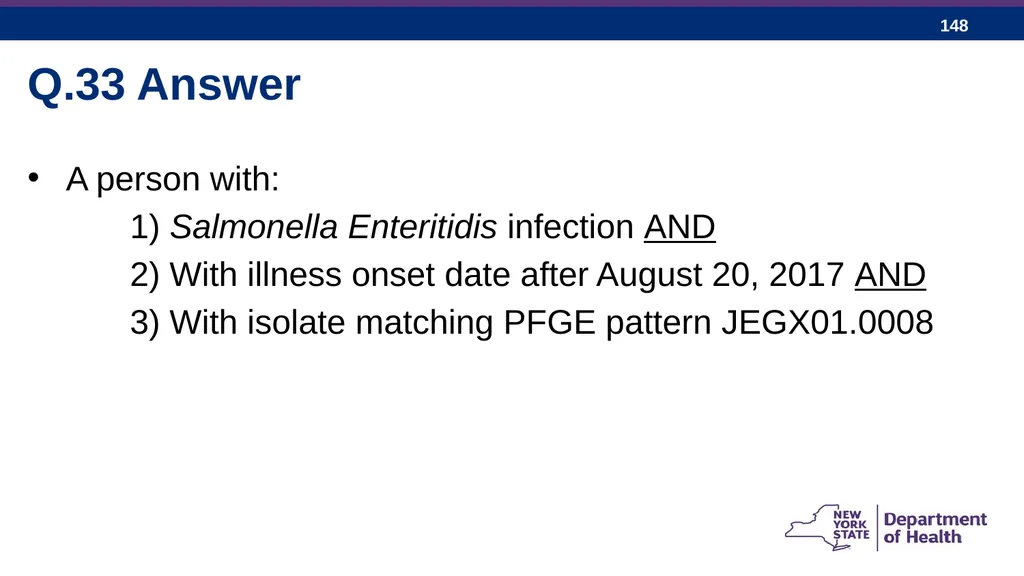
Q.33 Answer A person with:
1) Salmonella Enteritidis infection AND
2) With illness onset date after August 20, 2017 AND
3) With isolate matching PFGE pattern JEGX01.0008<br>
1) Salmonella Enteritidis infection AND
2) With illness onset date after August 20, 2017 AND
3) With isolate matching PFGE pattern JEGX01.0008<br>
149
Question 34: Should we have included exposure to Chain W or Turkish pine nuts in the case definition?
Why, or why not?<br>
Why, or why not?<br>
150
Q.34 Answer: Never include the suspect source of the outbreak in your case definition.
Instead, possible exposures/vehicles that caused the disease should be described as part of your hypotheses
Hypotheses for this outbreak will include exposure to Chain W and/or Turkish pine nuts<br>
Instead, possible exposures/vehicles that caused the disease should be described as part of your hypotheses
Hypotheses for this outbreak will include exposure to Chain W and/or Turkish pine nuts<br>
151
Does the Hypothesis Make Sense? Admittedly, the outbreak investigation team does not know anything about how pine nuts are harvested
The team would like to understand how contamination of pine nuts may occur and if their hypothesis is plausible
So, they did a little research…<br>
The team would like to understand how contamination of pine nuts may occur and if their hypothesis is plausible
So, they did a little research…<br>
152
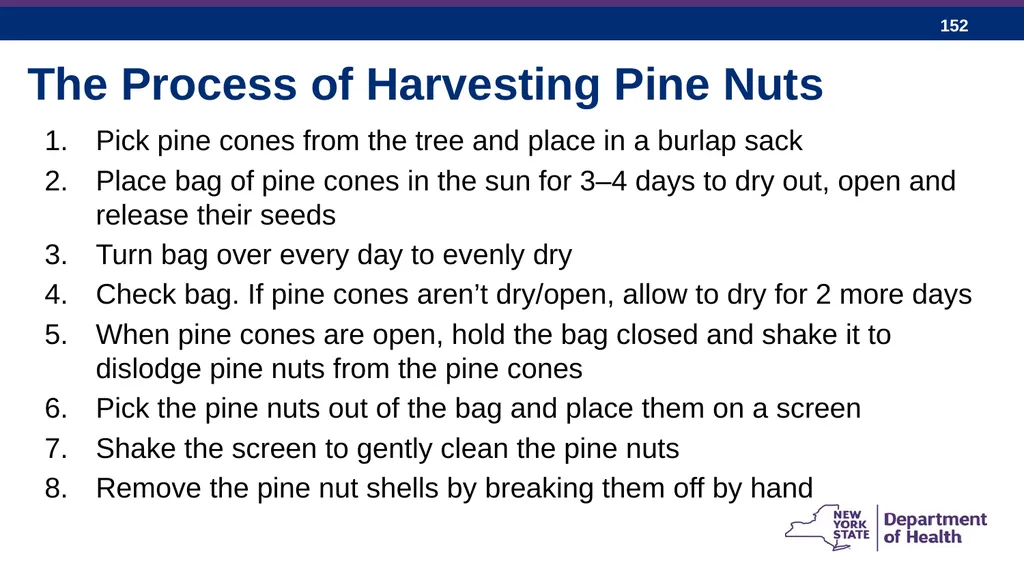
The Process of Harvesting Pine Nuts Pick pine cones from the tree and place in a burlap sack
Place bag of pine cones in the sun for 3–4 days to dry out, open and release their seeds
Turn bag over every day to evenly dry
Check bag. If pine cones aren’t dry/open, allow to dry for 2 more days
When pine cones are open, hold the bag closed and shake it to dislodge pine nuts from the pine cones
Pick the pine nuts out of the bag and place them on a screen
Shake the screen to gently clean the pine nuts
Remove the pine nut shells by breaking them off by hand<br>
Place bag of pine cones in the sun for 3–4 days to dry out, open and release their seeds
Turn bag over every day to evenly dry
Check bag. If pine cones aren’t dry/open, allow to dry for 2 more days
When pine cones are open, hold the bag closed and shake it to dislodge pine nuts from the pine cones
Pick the pine nuts out of the bag and place them on a screen
Shake the screen to gently clean the pine nuts
Remove the pine nut shells by breaking them off by hand<br>
153
Question 35: How might contamination to Turkish pine nuts occur during the harvesting process?<br>
154
Q.35 Answer During the harvesting process, contamination to Turkish pine nuts may occur:
If the pine cone falls on the ground and picks up contamination from the soil
When left drying in the sun in a bag, are accessed and contaminated by animals
If pine nuts are handled by ill persons during the harvesting process, they may contaminate them with their hands
Through the use of contaminated bags/screens<br>
If the pine cone falls on the ground and picks up contamination from the soil
When left drying in the sun in a bag, are accessed and contaminated by animals
If pine nuts are handled by ill persons during the harvesting process, they may contaminate them with their hands
Through the use of contaminated bags/screens<br>
155
LAB RESULTS & ENVIRONMENTAL TRACEBACK PART G.<br>
156
Laboratory Results On October 26, the investigation team was notified by LBPHL that the 3 food samples (2 homemade pestos, 1 bulk pine nuts) collected from case households contained S. Enteritidis, with outbreak strain PFGE pattern JEGX01.0008
State X Health Department also reported leftover pine nuts collected from a case’s home and pine nuts collected from a Chain W store in their state were both PFGE matches
LBDA laboratory did not isolate S. Enteritidis from whole pine nut samples collected from the 3 Chain W locations<br>
State X Health Department also reported leftover pine nuts collected from a case’s home and pine nuts collected from a Chain W store in their state were both PFGE matches
LBDA laboratory did not isolate S. Enteritidis from whole pine nut samples collected from the 3 Chain W locations<br>
157
Environmental Traceback LBDA coordinates with Chain W to review invoices for bulk Turkish pine nuts received at Chain W locations
LBDA confirms that bulk Turkish pine nuts were purchased from Distributor T, located in LB
Distributor T was the only distributor supplying Turkish pine nuts to Chain W
All information was provided to the FDA<br>
LBDA confirms that bulk Turkish pine nuts were purchased from Distributor T, located in LB
Distributor T was the only distributor supplying Turkish pine nuts to Chain W
All information was provided to the FDA<br>
158
Environmental Traceback The FDA and LBDA collect Turkish pine nut samples from Distributor T for testing
The FDA conducts a traceback study, linking the Turkish pine nuts to a single out-of-state importer, Importer V
FDA visits Importer V and collects pine nut samples for testing<br>
The FDA conducts a traceback study, linking the Turkish pine nuts to a single out-of-state importer, Importer V
FDA visits Importer V and collects pine nut samples for testing<br>
159
Question 36: Based on the epidemiological, environmental health and laboratory information received to date, what public health response actions would be appropriate to take at this point?<br>
160
Q.36 Answer Public notification
Press release
Product recall
Education at pine nut harvest location<br>
Press release
Product recall
Education at pine nut harvest location<br>
161
Public Health Response/Media On October 27, CDC issues a public health notification on their website about the outbreak
Chain W recalls approximately 5,000 pounds of potentially Salmonella-contaminated, bulk Turkish pine nuts sold between July 1st and October 18th from their stores
Affected State and local health jurisdictions issue press releases
Education at pine nut harvest locations is provided to prevent similar outbreaks in the future<br>
Chain W recalls approximately 5,000 pounds of potentially Salmonella-contaminated, bulk Turkish pine nuts sold between July 1st and October 18th from their stores
Affected State and local health jurisdictions issue press releases
Education at pine nut harvest locations is provided to prevent similar outbreaks in the future<br>
162
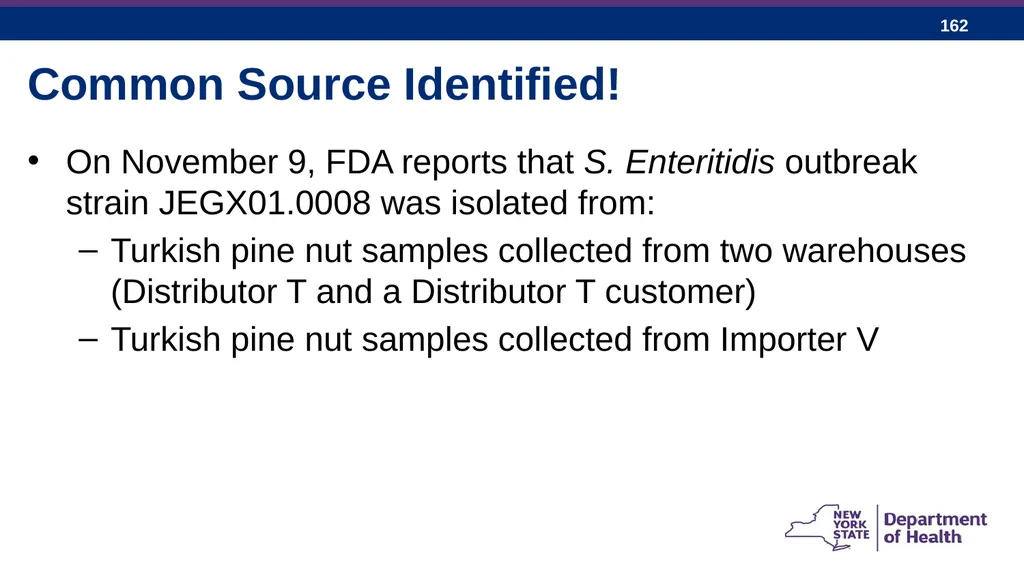
Common Source Identified! On November 9, FDA reports that S. Enteritidis outbreak strain JEGX01.0008 was isolated from:
Turkish pine nut samples collected from two warehouses (Distributor T and a Distributor T customer)
Turkish pine nut samples collected from Importer V<br>
Turkish pine nut samples collected from two warehouses (Distributor T and a Distributor T customer)
Turkish pine nut samples collected from Importer V<br>
163
OUTBREAK SUMMARY PART H.<br>
164
Final Outbreak Report In the aftermath of the outbreak, the investigation team prepares a final report on the investigation
Question 37:
What are the key components of a final outbreak report?<br>
Question 37:
What are the key components of a final outbreak report?<br>
165
Q.37 Answer: Context/background
Investigation methods
Investigation findings/results
Discussion/conclusion
Recommendations
Key investigators<br>
Investigation methods
Investigation findings/results
Discussion/conclusion
Recommendations
Key investigators<br>
166
S. Enteritidis Outbreak Summary At final report, this outbreak consisted of 53 cases from 6 states
Illness onset date range: August 20 - December 29, 2017
Median age of patients: 43 years (range: <1-94 years)
64% were female
Two hospitalizations and no deaths reported
Case interviews and shopper card records identified that 87.5% of cases (35/40) had exposure to Turkish pine nuts from Chain W<br>
Illness onset date range: August 20 - December 29, 2017
Median age of patients: 43 years (range: <1-94 years)
64% were female
Two hospitalizations and no deaths reported
Case interviews and shopper card records identified that 87.5% of cases (35/40) had exposure to Turkish pine nuts from Chain W<br>
167
S. Enteritidis Outbreak Summary Traceback studies identified a single out-of-state importer as the source of Turkish pine nuts to Chain W
The outbreak strain was isolated from Turkish pine nuts and products containing Turkish pine nuts that were collected from cases’ homes, retail locations, and warehouses
In total over 21,000 pounds of Turkish pine nuts were voluntarily recalled from Distributor T<br>
The outbreak strain was isolated from Turkish pine nuts and products containing Turkish pine nuts that were collected from cases’ homes, retail locations, and warehouses
In total over 21,000 pounds of Turkish pine nuts were voluntarily recalled from Distributor T<br>
168
Several lines of evidence associated the cases with exposure to S. Enteritidis-contaminated, bulk Turkish pine nuts from a single importer: The outbreaks in all 6 states were clustered in time
All case isolates (in all states) had the same PFGE pattern
Turkish pine nuts sold in bulk from Chain W was found to be a common exposure among all investigations
S. Enteritidis isolates from leftover food products collected from cases’ homes in 4 different states, retail samples of bulk Turkish pine nuts collected from Chain W in 2 different states, samples from Distributor T and samples from Importer V were PFGE matches to the outbreak strain<br>
All case isolates (in all states) had the same PFGE pattern
Turkish pine nuts sold in bulk from Chain W was found to be a common exposure among all investigations
S. Enteritidis isolates from leftover food products collected from cases’ homes in 4 different states, retail samples of bulk Turkish pine nuts collected from Chain W in 2 different states, samples from Distributor T and samples from Importer V were PFGE matches to the outbreak strain<br>
169
This case study was adapted from an actual Salmonella investigation initiated by the New York State Department of Health in 2011, heralding a multistate outbreak
It was the first Salmonella outbreak in the U.S. associated with pine nuts
Obtaining shopper card information and engaging industry proved essential throughout this cluster investigation. While investigating the source of this outbreak, collection of Chain W shopper card purchases allowed investigators to narrow down the list of potential exposures and develop an outbreak specific questionnaire which eventually led to a hypothesis that exposure to Turkish pine nuts was associated with illness
Product recalls likely prevented additional illnesses. As evidenced in this outbreak investigation, early identification of patient exposures can assist in determining a common source of infection so that effective control efforts can be implemented<br>
It was the first Salmonella outbreak in the U.S. associated with pine nuts
Obtaining shopper card information and engaging industry proved essential throughout this cluster investigation. While investigating the source of this outbreak, collection of Chain W shopper card purchases allowed investigators to narrow down the list of potential exposures and develop an outbreak specific questionnaire which eventually led to a hypothesis that exposure to Turkish pine nuts was associated with illness
Product recalls likely prevented additional illnesses. As evidenced in this outbreak investigation, early identification of patient exposures can assist in determining a common source of infection so that effective control efforts can be implemented<br>
170
Links to Online Resources FoodNet Pop Survey, 2006-2007:
(https://www.cdc.gov/foodnet/PDFs/FNExpAtl03022011.pdf)
Binomial Probability calculation
(http://www.oregon.gov/oha/ph/DiseasesConditions/CommunicableDisease/Outbreaks/Gastroenteritis/Pages/Outbreak-Investigation-Tools.aspx#binomial)<br>
(https://www.cdc.gov/foodnet/PDFs/FNExpAtl03022011.pdf)
Binomial Probability calculation
(http://www.oregon.gov/oha/ph/DiseasesConditions/CommunicableDisease/Outbreaks/Gastroenteritis/Pages/Outbreak-Investigation-Tools.aspx#binomial)<br>
171
“Pining for a Common Source” was developed by the New York Integrated Food Safety Center of Excellence (2019) For additional information or to provide feedback contact Paula Huth, NY CoE Coordinator, at 518-473-4439 or
paula.pennell-huth@health.ny.gov
All products and services of the NY CoE available at: https://nyfoodsafety.cals.cornell.edu/about<br>
paula.pennell-huth@health.ny.gov
All products and services of the NY CoE available at: https://nyfoodsafety.cals.cornell.edu/about<br>