
Planning effective mental healthcare in prisons
CM
Published · 27 slides · 0 views

1 / 1

Description
Planning effective mental healthcare in prisons using the Care Programme Approach and the Community Mental Health Framework Quality Network for Prison Mental Health Services What is the Community Mental Health Framework (CMHF)? Published in
Related Topics
Share
Embed code
Download this presentation From Below
"Planning effective mental healthcare in prisons" is the property of its rightful owner. Permission is granted to download and print the materials on this website for personal, non-commercial use only, and to display it on your personal computer provided you do not modify the materials and that you retain all copyright notices contained in the materials. By downloading content from our website, you accept the terms of this agreement.
Presentation Transcript
01
Planning effective mental healthcare in prisons
using the Care Programme Approach and the
Community Mental Health Framework Quality Network for Prison Mental Health Services<br>
02
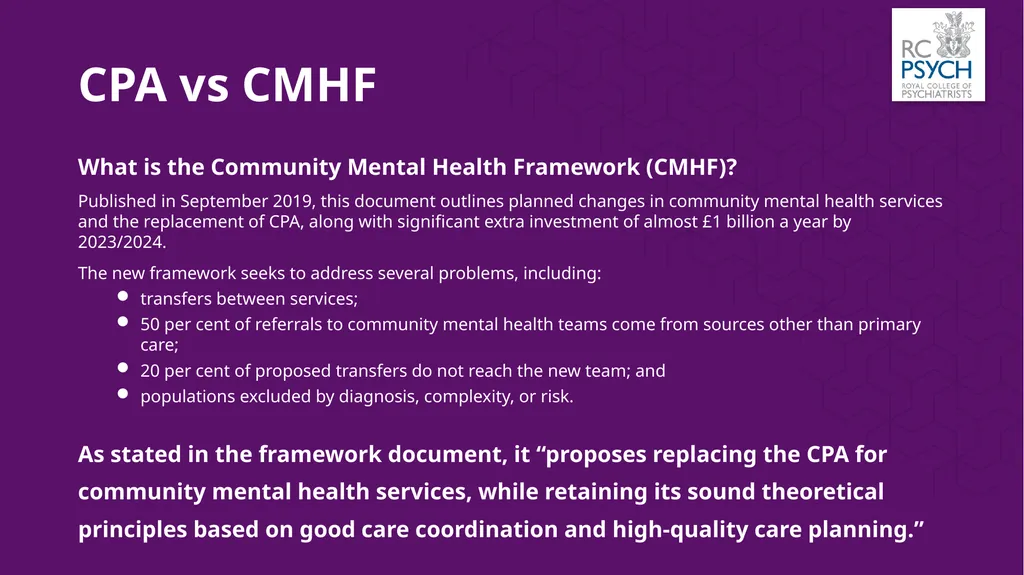
What is the Community Mental Health Framework (CMHF)?
Published in September 2019, this document outlines planned changes in community mental health services and the replacement of CPA, along with significant extra investment of almost £1 billion a year by 2023/2024.
The new framework seeks to address several problems, including:
transfers between services;
50 per cent of referrals to community mental health teams come from sources other than primary care;
20 per cent of proposed transfers do not reach the new team; and
populations excluded by diagnosis, complexity, or risk.
As stated in the framework document, it “proposes replacing the CPA for
community mental health services, while retaining its sound theoretical
principles based on good care coordination and high-quality care planning.” CPA vs CMHF<br>
03
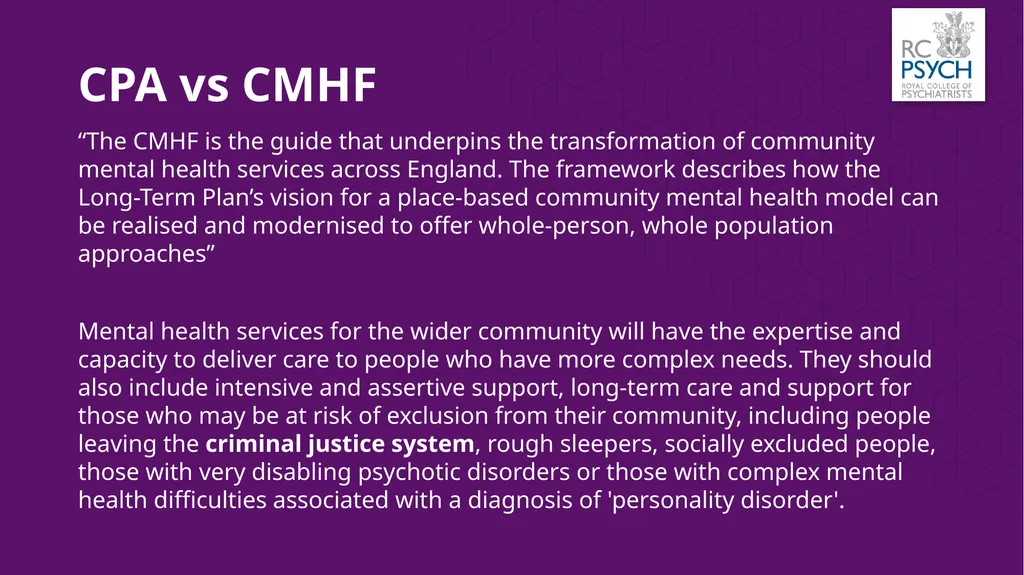
“The CMHF is the guide that underpins the transformation of community mental health services across England. The framework describes how the Long-Term Plan’s vision for a place-based community mental health model can be realised and modernised to offer whole-person, whole population approaches”
Mental health services for the wider community will have the expertise and capacity to deliver care to people who have more complex needs. They should also include intensive and assertive support, long-term care and support for those who may be at risk of exclusion from their community, including people leaving the criminal justice system, rough sleepers, socially excluded people, those with very disabling psychotic disorders or those with complex mental health difficulties associated with a diagnosis of 'personality disorder'. CPA vs CMHF<br>
04
Resources:
Part 1: Setting the Framework
Part 2: The Framework in Practice
CMHF – A Short Guide
Rolling out the CMHF: Eight Key Messages
This training will refer to the CMHF throughout, rather than CPA CPA vs CMHF<br>
05
Care Programme Approach (CPA), Community Mental Health Framework (CMHF), Promoting Quality Care (PQC), Care and Treatment Planning (CTP)
Aims to improve care for people with mental illness. A framework for assessing secondary mental health needs and coordinating care.
The framework is applicable to people irrespective of their diagnosis (including personality disorder, substance misuse disorders and severe mental illnesses).
Includes intensive, long-term support for those who may be at risk of exclusion from their community, including people leaving the criminal justice system. Basic Principles<br>
06
Often represents a discontinuity of care and social support during a period of high vulnerability for self-harm, suicide, victimisation for people with mental health difficulties
The point of release is often a period of crisis without accommodation to go to and the need to access or re-access community services – time of increased risk of suicide
Patients in prison risk dropping their formalised review of care, or having no continuity of care during a time of high vulnerability. Community Mental Health Framework in Prisons<br>
07
The following criteria has been devised to support services in identifying those most in need of support under CMHF:
Require secondary mental health services with a (working) diagnosis of a mental disorder, including personality disorder, neurodevelopmental disorders, such as learning disabilities, autism spectrum disorder (ASD) and ADHD
Individuals currently registered to receive CMHF on reception into prison Who is Eligible for CMHF?<br>
08
In addition to these, individuals may present a range of factors that may contribute towards making a decision to provide support under CMHF in complex cases:
Significant trauma now or in the past
History of difficulties engaging with mental health services now or in the past
Risk of self-harm or suicide, or harming other people
Comorbid substance misuse
Requiring support from a range of agencies in addition to mental health, such as housing, physical care, criminal justice or voluntary agencies
It should not be reserved solely for a very small group of highly complex and high-risk individuals within prisons. Who is Eligible for CMHF?<br>
09
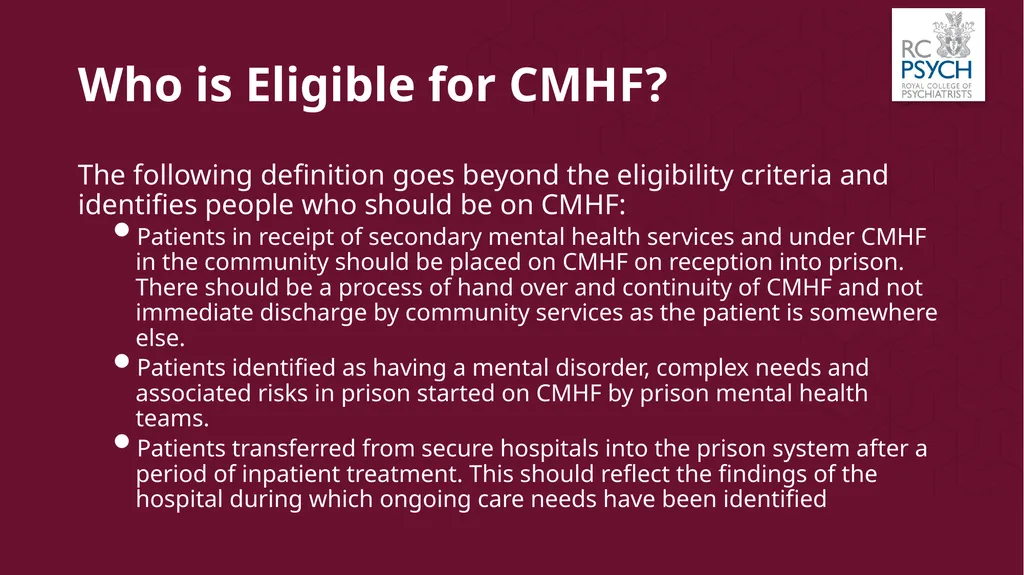
The following definition goes beyond the eligibility criteria and identifies people who should be on CMHF:
Patients in receipt of secondary mental health services and under CMHF in the community should be placed on CMHF on reception into prison. There should be a process of hand over and continuity of CMHF and not immediate discharge by community services as the patient is somewhere else.
Patients identified as having a mental disorder, complex needs and associated risks in prison started on CMHF by prison mental health teams.
Patients transferred from secure hospitals into the prison system after a period of inpatient treatment. This should reflect the findings of the hospital during which ongoing care needs have been identified Who is Eligible for CMHF?<br>
10
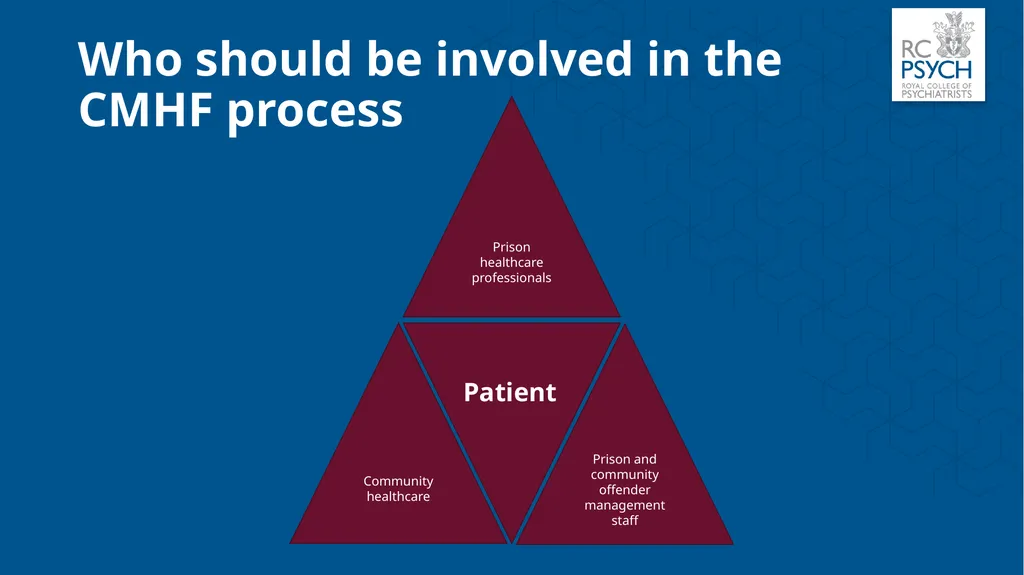
Who should be involved in the CMHF process<br>
11
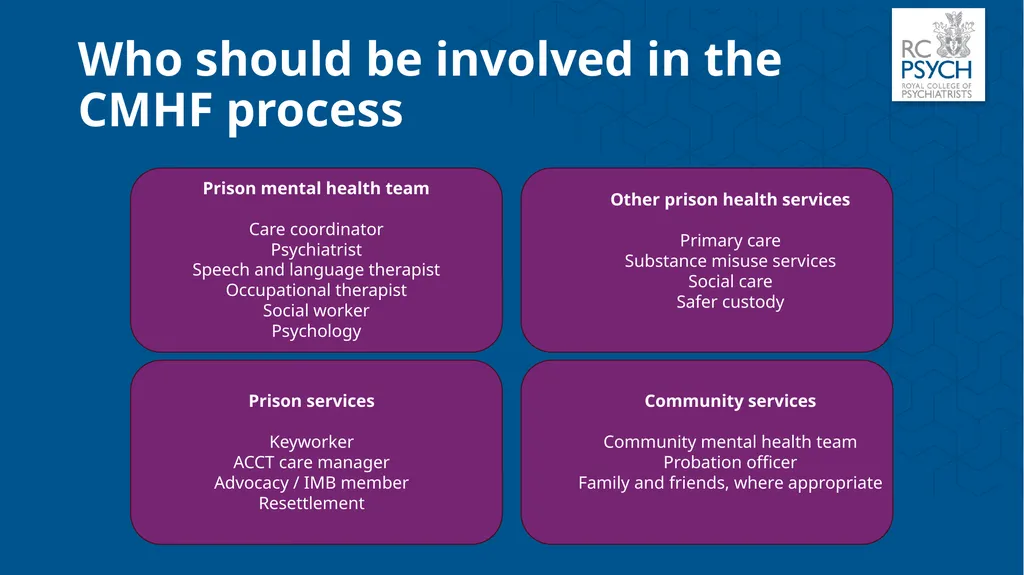
Who should be involved in the CMHF process<br>
12
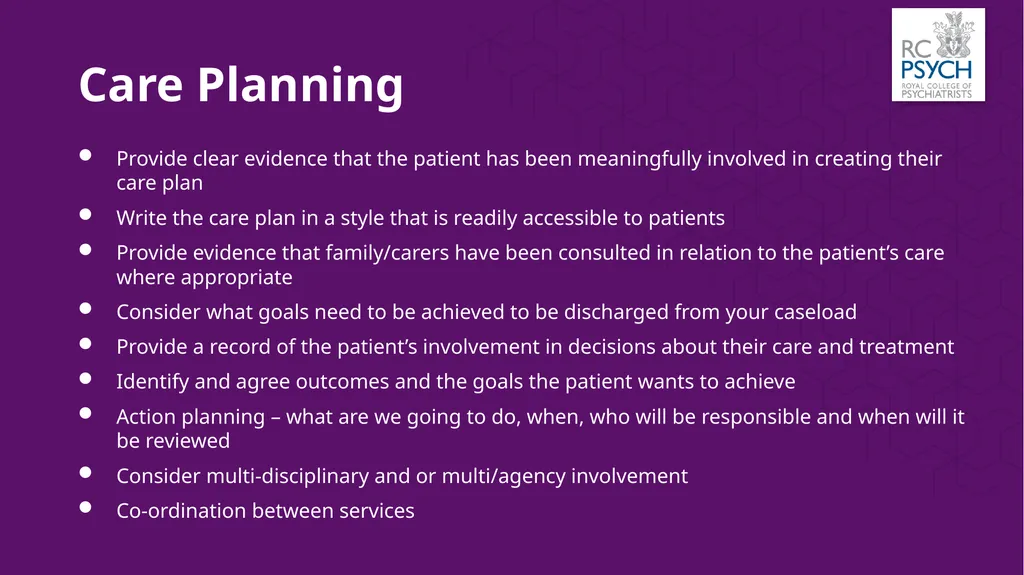
Provide clear evidence that the patient has been meaningfully involved in creating their care plan
Write the care plan in a style that is readily accessible to patients
Provide evidence that family/carers have been consulted in relation to the patient’s care where appropriate
Consider what goals need to be achieved to be discharged from your caseload
Provide a record of the patient’s involvement in decisions about their care and treatment
Identify and agree outcomes and the goals the patient wants to achieve
Action planning – what are we going to do, when, who will be responsible and when will it be reviewed
Consider multi-disciplinary and or multi/agency involvement
Co-ordination between services Care Planning<br>
13
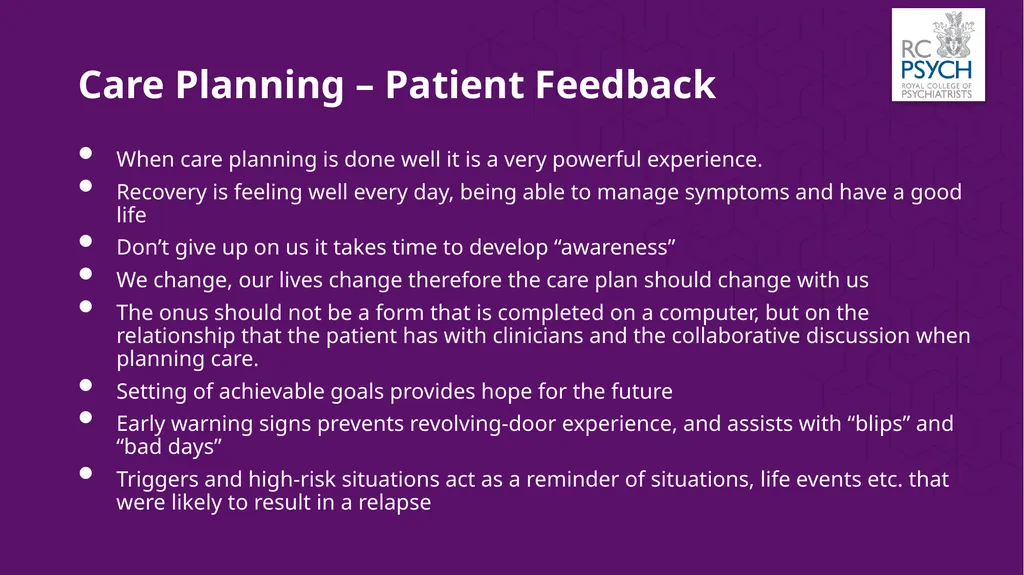
When care planning is done well it is a very powerful experience.
Recovery is feeling well every day, being able to manage symptoms and have a good life
Don’t give up on us it takes time to develop “awareness”
We change, our lives change therefore the care plan should change with us
The onus should not be a form that is completed on a computer, but on the relationship that the patient has with clinicians and the collaborative discussion when planning care.
Setting of achievable goals provides hope for the future
Early warning signs prevents revolving-door experience, and assists with “blips” and “bad days”
Triggers and high-risk situations act as a reminder of situations, life events etc. that were likely to result in a relapse Care Planning – Patient Feedback<br>
14
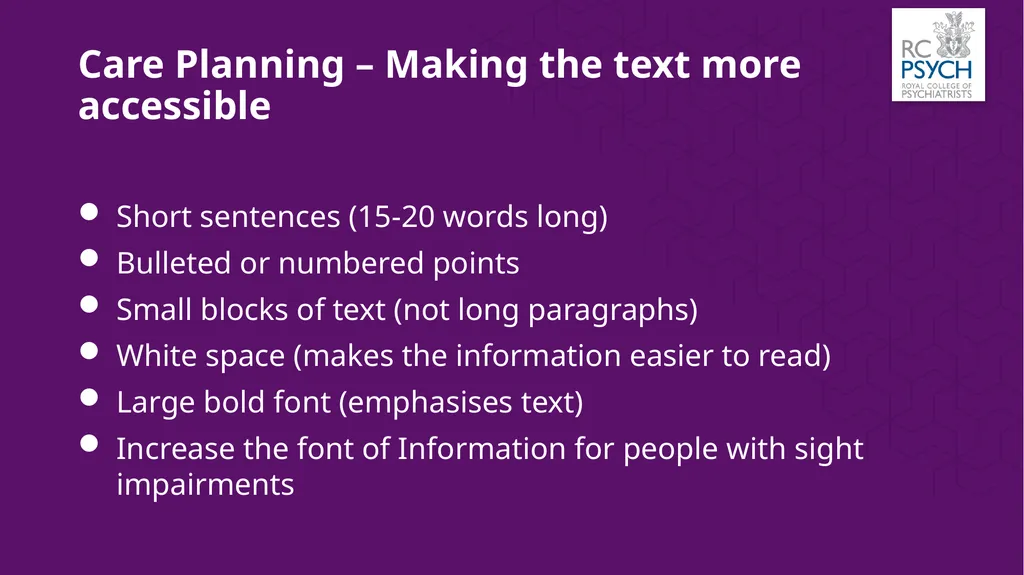
Short sentences (15-20 words long)
Bulleted or numbered points
Small blocks of text (not long paragraphs)
White space (makes the information easier to read)
Large bold font (emphasises text)
Increase the font of Information for people with sight impairments Care Planning – Making the text more accessible<br>
15
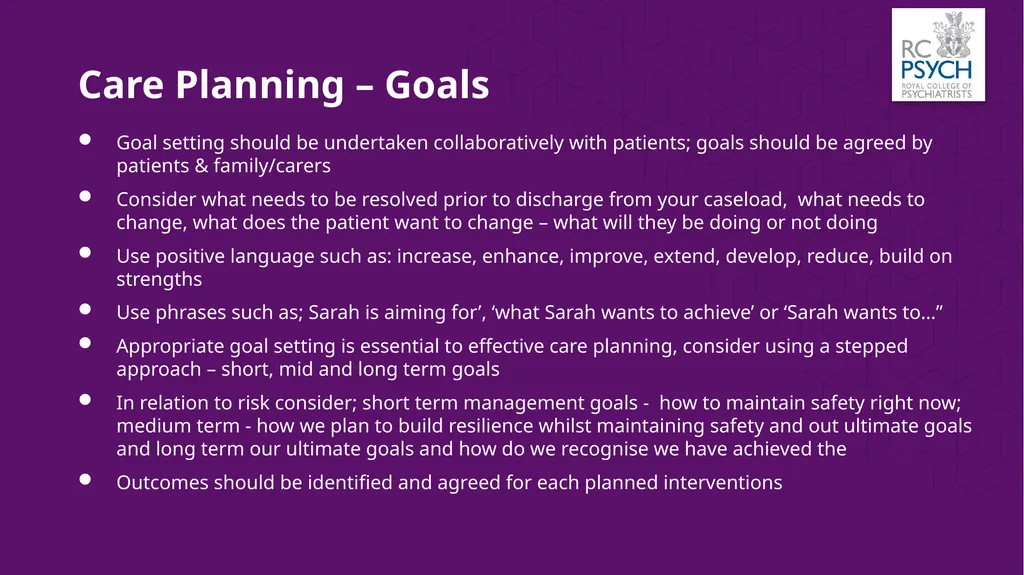
Goal setting should be undertaken collaboratively with patients; goals should be agreed by patients & family/carers
Consider what needs to be resolved prior to discharge from your caseload, what needs to change, what does the patient want to change – what will they be doing or not doing
Use positive language such as: increase, enhance, improve, extend, develop, reduce, build on strengths
Use phrases such as; Sarah is aiming for’, ‘what Sarah wants to achieve’ or ‘Sarah wants to…”
Appropriate goal setting is essential to effective care planning, consider using a stepped approach – short, mid and long term goals
In relation to risk consider; short term management goals - how to maintain safety right now; medium term - how we plan to build resilience whilst maintaining safety and out ultimate goals and long term our ultimate goals and how do we recognise we have achieved the
Outcomes should be identified and agreed for each planned interventions Care Planning – Goals<br>
16
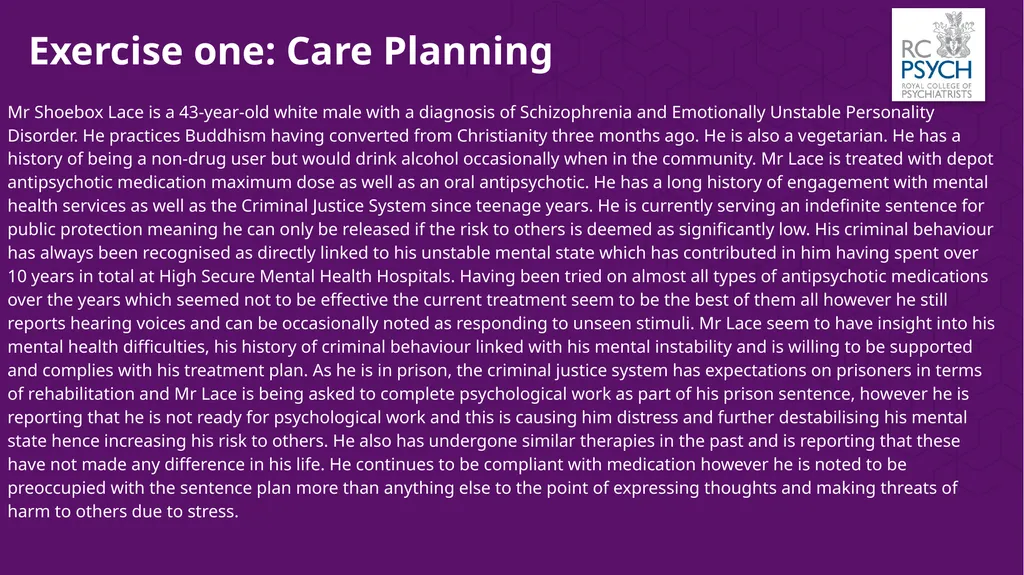
Exercise one: Care Planning Mr Shoebox Lace is a 43-year-old white male with a diagnosis of Schizophrenia and Emotionally Unstable Personality Disorder. He practices Buddhism having converted from Christianity three months ago. He is also a vegetarian. He has a history of being a non-drug user but would drink alcohol occasionally when in the community. Mr Lace is treated with depot antipsychotic medication maximum dose as well as an oral antipsychotic. He has a long history of engagement with mental health services as well as the Criminal Justice System since teenage years. He is currently serving an indefinite sentence for public protection meaning he can only be released if the risk to others is deemed as significantly low. His criminal behaviour has always been recognised as directly linked to his unstable mental state which has contributed in him having spent over 10 years in total at High Secure Mental Health Hospitals. Having been tried on almost all types of antipsychotic medications over the years which seemed not to be effective the current treatment seem to be the best of them all however he still reports hearing voices and can be occasionally noted as responding to unseen stimuli. Mr Lace seem to have insight into his mental health difficulties, his history of criminal behaviour linked with his mental instability and is willing to be supported and complies with his treatment plan. As he is in prison, the criminal justice system has expectations on prisoners in terms of rehabilitation and Mr Lace is being asked to complete psychological work as part of his prison sentence, however he is reporting that he is not ready for psychological work and this is causing him distress and further destabilising his mental state hence increasing his risk to others. He also has undergone similar therapies in the past and is reporting that these have not made any difference in his life. He continues to be compliant with medication however he is noted to be preoccupied with the sentence plan more than anything else to the point of expressing thoughts and making threats of harm to others due to stress.<br>
17
The patient is included in all parts of their CMHF meeting, where appropriate. Patient’s ability to engage is considered throughout the process.
The patient is able to discuss and agree who should be invited to their CMHF meeting. The patient will be informed of the professionals that are required to attend.
The patient is made aware of the advocacy service and they will have the choice for advocacy support within the CMHF process and meeting.
The patient is informed of the structure and content of the CMHF meeting.
The patient is supported to prepare for the meeting.
The patient will be given the option to chair some/all of their CMHF meeting or select an appropriate chair.
Where possible, the patient will be involved in helping to set up the room where the meeting will be held. How can patients be encouraged to take ownership of their own care?<br>
18
An action plan is collaboratively agreed at the end of the meeting, with clearly identified people for each goal/action point and clear timescales are set.
The date for the next CMHF meeting and proposed attendees are agreed at the end of the meeting.
The patient is shown a final draft report and they are supported to add their own views and comments.
The patient should be spoken to directly by the people reading or summarising the report, and not spoken over.
All reports should be written in clear and simple language and avoiding the use of jargon.
Paper and pens will be available at the meeting, unless risk prohibits this. How can patients be encouraged to take ownership of their own care?<br>
19
Should actively involve the patient throughout the process. Inclusivity is key.
Prepare advanced statements of patients’ wishes that are recorded on SystmOne (or other relevant system).
Create a discharge summary in easy-to-read bullet points to make follow-ups and after care easier.
If the patient is transferred or released from prison, discharge summaries should be created immediately and passed onto the next point of care. This could be other prison mental health teams, CMHTs, or local GPs where the mental health team is not available or known. Discharge and After Care<br>
20
Engagement and Discharge If a patient does not engage with the CMHF meetings, the MDT meetings should still go ahead, and steps made to try and re-engage the patient. Should the MDT and other agencies feel that the risk remains too high to discharge, steps should be made to contact relevant agencies in the patient’s absence.
Patients should not be discharged solely because of lack of engagement.
It is important to consider language and accessibility of the team.<br>
21
Exercise two: Engagement and discharge Scenario 1 – The prison in-reach have initiated a CMHF/ CPA. However, at point of release the community team does not feel that this is appropriate. What would you do?
Scenario 2 - You have someone who has arrived in the first night centre. They present ok and denies any illness. They do not want any support from mental health services. What would you do?<br>
22
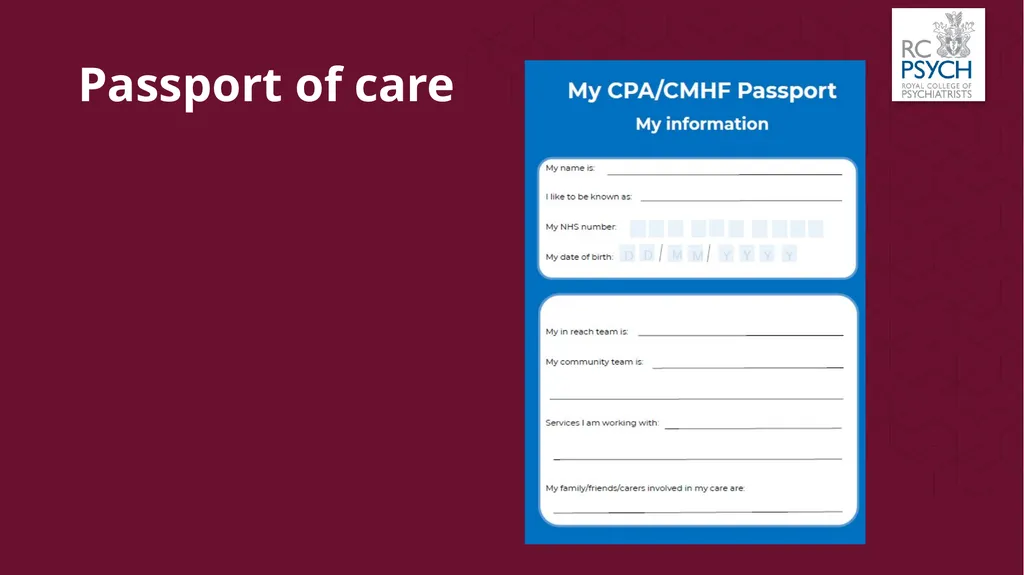
Passport of care<br>
23
Patients should not be discharged from the community mental health teams when they enter prison, but their care transferred to the prison mental health team
Discharge from the community mental health team caseload should not take place until it is clear they will not return to the community within a year
The community mental health teams should accept referrals of CMHF patients directly from prison mental health teams and do not require patients to register with a GP then undergo a re-assessment
Robust mechanisms for transferring shared care agreements are required to ensure continuity of care Coordinating Care Across Different Services<br>
24
There should be local agreements between prison mental health service providers and local trusts where there are significant patient flows (e.g. local remand prison service catchment areas)
Increased use of MS Teams or other virtual platform software to make accessibility to meetings easier
Information sharing should be improved between services Coordinating Care Across Different Services<br>
25
Exercise three: Coordinating Care Across Different Services John Doe arrived at HMP Portland in August 2021 after being transferred from HMP Bristol after receiving a four year custodial sentence for assault on a family member. Mr Doe had been NFA in Bristol prior to his arrest. He has had intermittent contact with Community Mental Health Services since 2011. John has always had sporadic engagement with Community Services but was prescribed Mirtazapine from 2012 to 2016 for a major depressive episode in 2011 which led to a significant suicide attempt in the Community. Mr Doe last had contact with a CMHT in 2018 but disengaged quickly and was discharged. He has had no recorded contact with medical services since this time. After obtaining consent, contact was made by an RMN at HMP Portland to the CMHT in question at the end of August 2021 when it was decided that Mr Doe would benefit from CPA input due to working with multiple services and being treated for moderate/severe depression. The CMHT stated that they would not be attending any CPA meetings for Mr Doe whilst he was in prison as he does not have a Care Coordinator with them anymore but would be happy to become involved in the lead up to his release. Contact was also made with Community Housing and two additional third sectors support services in his local area. All services stated that they would not attend current CPA meetings in prison as Mr Doe was not known to them. 50% stated that they would consider attending meetings in the lead up to release, but the other 50% declined, stating that he would need to self-refer when he arrived back in the area (different County). This was all documented on SystmOne and uploaded to the patient record.<br>
26
Create a formal agreement with CMHTs that they will not discharge a patient unless it’s clear the patient will be in custody for over one year
Make contact with previous CPA holder to get updates and attendance.
Create a SOP / formal agreement with teams who are difficult to reach, for transfers and remission between trusts and community mental health team
If there is no contact from the other agencies who have been involved in their care, record and escalate within the organisation
Contact the Caldicott guardian or safeguarding team if required Procedures when recommendations are not agreed<br>
27
21 years old, transgender prisoner, with a long history of contacts with secondary mental health services but with no clear diagnosis. Contact with services was due to risk, vulnerabilities and unclear presentation. This was H’s first time in custody, they engaged with the initial health screening and all other processes in the first night centre. No issues were raised in police custody or during the first night centre. H continued through the COVID cohorts and after 10 days isolation was placed in the main jail. Within 48 hours of H arriving at the jail, his current community team (early intervention in psychosis) made contact and so did the new team (specialist PD Network) whom early interventions had referred H to. H is under a CPA and was due to be discharged and referred on at the point that he was arrested and charged. His team (using a person centred approach) kept H open to them until they completed a proper handover with the in reach and the new team had formally assessed him. Both teams have communicated jointly with the named nurse (in reach) – they have done this by simply all being cc’d into the same emails – this has saved different emails going between different services and getting lost in communication or causing delays. By doing this, all 3 teams have been kept up to date with what stage of assessing/discharging each service is at. They have also been kept up to date with H’s presentation in custody. During this time the PD network have been to visit H and completed a formal assessment. A Microsoft teams meeting was held as an ‘informal catch up and feedback from the assessment’. This helped professionals to put ‘faces to names’ and enabled conversations around progress and H’s arising difficulties in prison. Since this, early interventions team will be discharging H as he does not meet the criteria for their service (does not have psychotic illness) his CPA will be transferred to IMHT and then transferred to PD network upon his release. A formal CPA transfer has been arranged and this will see a smooth transfer of care take place. Good practice example<br>