
Plant Physiology Presented By Garima Yadav
TA
Published · 13 slides · 0 views

1 / 1

Description
Plant Physiology Presented By Garima Yadav Research Scholar Mohanlal Sukhadia University, Udaipur Department Of Botany Plant Growth Regulators Plant development is exquisitely sensitive to a wide range of environmental factors and is
Related Topics
Share
Embed code
Download this presentation From Below
"Plant Physiology Presented By Garima Yadav" is the property of its rightful owner. Permission is granted to download and print the materials on this website for personal, non-commercial use only, and to display it on your personal computer provided you do not modify the materials and that you retain all copyright notices contained in the materials. By downloading content from our website, you accept the terms of this agreement.
Presentation Transcript
01
Plant Physiology Presented By
Garima Yadav
Research Scholar
Mohanlal Sukhadia University, Udaipur Department Of Botany<br>
Garima Yadav
Research Scholar
Mohanlal Sukhadia University, Udaipur Department Of Botany<br>
02
Plant Growth Regulators Plant development is exquisitely sensitive to a wide range of environmental factors and is extremely plastic, i.e. very flexible. There are underlying basic patterns in plant development, but there is considerable regulation by environmental signals of how and when these patterns are expressed. It has been known for decades (if not centuries) that plants contain a range of compounds which have profound effects on many aspects of growth and developmental physiology, and act as a means of communication within the plant. These plant growth hormones, sometimes referred to as plant growth regulators. Controlling cell division, growth and differentiation, which in turn determine the morphology and ultimately the physiology of the whole plant. The concentrations of the hormones are greatly influenced by environmental factors, and the movement of hormones in the plant can also be under environmental control.
These naturally occurring (endogenous) growth substances are commonly known as plant hormones, while the synthetic ones are called growth regulators.<br>
These naturally occurring (endogenous) growth substances are commonly known as plant hormones, while the synthetic ones are called growth regulators.<br>
03
Plant Growth Regulators Plant growth hormones are naturally occurring compounds synthesized produced within the plant in very low concentrations and transported to another part of the plant where it causes a response.
Specific receptors exist within the plants which bind to plant hormones kind of signaling molecule
Plant growth hormones are synthesized throughout the plant but apical meristems and young, developing tissues are rich sources of these compounds. They are transported, perhaps through only a few cells, but often throughout the plant, giving rise to a response in target tissues.
Often the presence of one plant growth hormone will affect the synthesis or action of other plant growth hormones.
The concentration of a plant growth hormone at a particular site will depend upon many different factors including the rate of synthesis, degradation and transport to and from the target cell. In addition, plant growth hormones are often chemically modified, which may inactivate them, although – as this process is often reversible – it can also increase the effective concentration of a plant growth hormone in a cell. Finally, as the activity of plant hormones is thought to require binding to specific receptors, transport in and out of subcellular compartments also controls the concentration perceived by the cell. As all of these processes have the potential to be regulated by the environment, it can be seen that plant growth hormones act as a means of integrating environmental signals and distributing them around the plant.<br>
04
Plant Growth Regulators The concentration of a plant growth hormone at a particular site will depend upon many different factors including the rate of synthesis, degradation and transport to and from the target cell. In addition, plant growth hormones are often chemically modified, which may inactivate them, although – as this process is often reversible – it can also increase the effective concentration of a plant growth hormone in a cell. Finally, as the activity of plant hormones is thought to require binding to specific receptors, transport in and out of subcellular compartments also controls the concentration perceived by the cell. As all of these processes have the potential to be regulated by the environment, it can be seen that plant growth hormones act as a means of integrating environmental signals and distributing them around the plant.
More than 60 years ago Julius Sachs in 1880 postulated: that endogenous substances regulate the growth of various plant organs.
In 1926, Went, in Holland, provided convincing evidence of a diffusible substance (auxin) from oat (Avena sativa) seedlings that promoted growth of these seedlings.<br>
More than 60 years ago Julius Sachs in 1880 postulated: that endogenous substances regulate the growth of various plant organs.
In 1926, Went, in Holland, provided convincing evidence of a diffusible substance (auxin) from oat (Avena sativa) seedlings that promoted growth of these seedlings.<br>
05
Plant Growth Regulators Kurosawa , in Japan, discovered another substance (gibberellin) from cell-free fungus (Gibberella fujikuroi) filterate that promoted growth of rice (Oryza sativa) seedlings. But it was not until 1955 that Skoog and his associates discovered kinetin in an autoclaved sample of herring sperm DNA, which was active in what Wiesner in 1892 called cell division factor
H. Fitting introduced the term hormone into the plant physiology literature.
Plant development was thought to be regulated by only five types of hormones: auxins, gibberellins, cytokinins, ethylene, and abscisic acid. However, there is now compelling evidence for the existence of plant steroid hormones, the brassinosteroids, that have a wide range of morphological effects on plant development
These are identified as promotors (auxin, gibberellin, and cytokinin), inhibitors (abscisic acid, xanthoxin, and violaxanthin), ethylene, and other hypothetical growth substances (florigen, death hormone, etc.).
These hormones are found in all actively growing plant parts; young leaves and apical buds are particularly high in auxin, whereas young roots are high in gibberellins and cytokinins. Fruits and seeds are generally rich in all growth hormones. Therefore, these hormones are ubiquitous in plants and crops and are generally not species specific.<br>
06
Auxin Auxin is a Greek word derived from auxein, which means “to increase.” It is a generic term for chemicals that typically stimulate cell elongation, but auxins also influence a wide range of growth and development response.
Auxin was the first plant hormone to be discovered and it has a principal role in the most fundamental of plant responses—the enlargement of plant cells. Auxin is synthesized in meristematic regions and other actively growing organs such as coleoptiles apices, root tips, germinating seeds, and the apical buds of growing stems. Young, rapidly growing leaves, developing inflorescences, and embryos following pollination and fertilization are also significant sites of auxin synthesis. Auxin, more than any other growth substance, appears to be actively distributed throughout the entire plant.
Although a large number of compounds have been discovered with auxin activity e.g.indole-3-acetic acid. indole-3-butyric acid (IBA) is chemically synthesized auxin
(IAA) is the most widely distributed natural auxin. In addition to IAA, several other naturally occurring indole derivatives are known to express auxin activity, including indole-3-ethanol, indole- 3-acetaldehyde, and indole-3-acetonitrile. However, these compounds all serve as precursors to IAA and their activity is due to conversion to IAA in the tissue.
.<br>
07
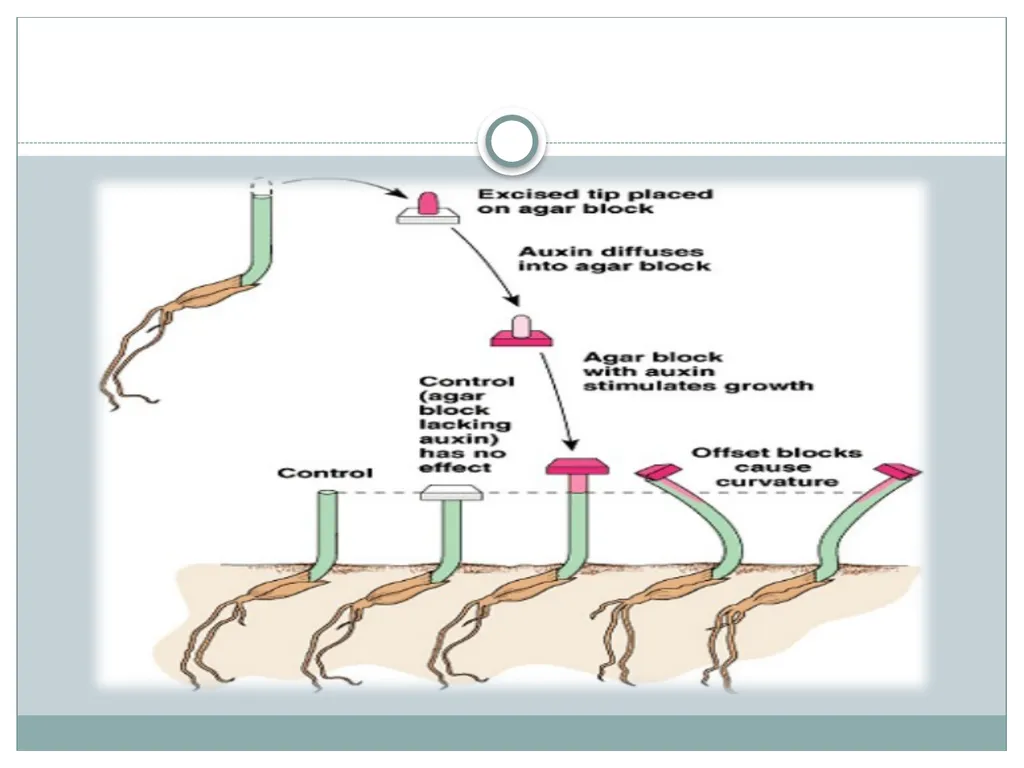
Auxin transport The main axes of shoots and roots, along with their branches, exhibit apex–base structural polarity, and this structural polarity has its origin in the polarity of auxin transport. Soon after Went developed the coleoptile curvature test for auxin, it was discovered that IAA moves mainly from the apical to the basal end (basipetally) in excised oat coleoptile sections. This type of unidirectional transport is termed polar transport.
Auxin is the only plant growth hormone known to be transported polarly. Because the shoot apex serves as the primary source of auxin for the entire plant, polar transport has long been believed to be the principal cause of an auxin gradient extending from the shoot tip to the root tip. The longitudinal gradient of auxin from the shoot to the root affects various developmental processes, including stem elongation, apical dominance, wound healing, and leaf senescence. Recently it has been recognized that a significant amount of auxin transport also occurs in the phloem, and that the phloem is probably the principal route by which auxin is transported acropetally (i.e., toward the tip) in the root. Thus, more than one pathway is responsible for the distribution of auxin in the plant<br>
Auxin is the only plant growth hormone known to be transported polarly. Because the shoot apex serves as the primary source of auxin for the entire plant, polar transport has long been believed to be the principal cause of an auxin gradient extending from the shoot tip to the root tip. The longitudinal gradient of auxin from the shoot to the root affects various developmental processes, including stem elongation, apical dominance, wound healing, and leaf senescence. Recently it has been recognized that a significant amount of auxin transport also occurs in the phloem, and that the phloem is probably the principal route by which auxin is transported acropetally (i.e., toward the tip) in the root. Thus, more than one pathway is responsible for the distribution of auxin in the plant<br>
08
Physiological role of Auxin Apical Dominance
It has been recognized for many years that auxin, produced in the shoot apex, can repress the development of axillary buds in a process known as apical dominance. If the shoot apex is removed, this inhibition is released and the axillary buds develop as side shoots.
Phototropism, or growth with respect to light, is expressed in all shoots and some roots; it ensures that leaves will receive optimal sunlight for photosynthesis
Gravitropism, growth in response to gravity, enables roots to grow downward into the soil and shoots to grow upward away from the soil, which is especially critical during the early stages of germination.<br>
09
Physiological role of Auxin Auxin Delays the Onset of Leaf Abscission The shedding of leaves, flowers, and fruits from the living plant is known as abscission. These parts abscise in a region called the abscission zone, which is located near the base of the petiole of leaves. In most plants, leaf abscission is preceded by the differentiation of a distinct layer of cells, the abscission layer, within the abscission zone. During leaf senescence, the walls of the cells in the abscission layer are digested, which causes them to become soft and weak. The leaf eventually breaks off at the abscission layer as a result of stress on the weakened cell walls. Auxin levels are high in young leaves, progressively decrease in maturing leaves, and are relatively low in senescing leaves when the abscission process begins. Abscission is triggered during leaf senescence, when auxin is no longer being produced
Auxin Transport Regulates Floral Bud Development<br>
Auxin Transport Regulates Floral Bud Development<br>
10
Physiological role of Auxin Parthenocarpy
In some plant species, seedless fruits may be produced naturally, or they may be induced by treatment of the unpollinated flowers with auxin. The production of such seedless fruits is called parthenocarpy. In stimulating the formation of parthenocarpic fruits, auxin may act primarily to induce fruit set, which in turn may trigger the endogenous production of auxin by certain fruit tissues to complete the developmental process.
Indolebutyric acid and naphthaleneacetic acid are both widely used in vegetative propagation. The propagation of plants from stem and leaf cuttings. This application can be traced to the propensity for auxin to stimulate adventitious root formation. Generally marketed as ‘‘rooting hormone’’ preparations,
Auxin Promotes Fruit Development Much evidence suggests that auxin is involved in the regulation of fruit development. Auxin is produced in pollen and in the endosperm and the embryo of developing seeds, and the initial stimulus for fruit growth may result from pollination. Successful pollination initiates ovule growth, which is known asfruit set. After fertilization, fruit growth may depend on auxin produced in developing seeds. The endosperm may contribute auxin during the initial stage of fruit growth, and the developing embryo may take over as the main auxin source during the later stages.<br>
11
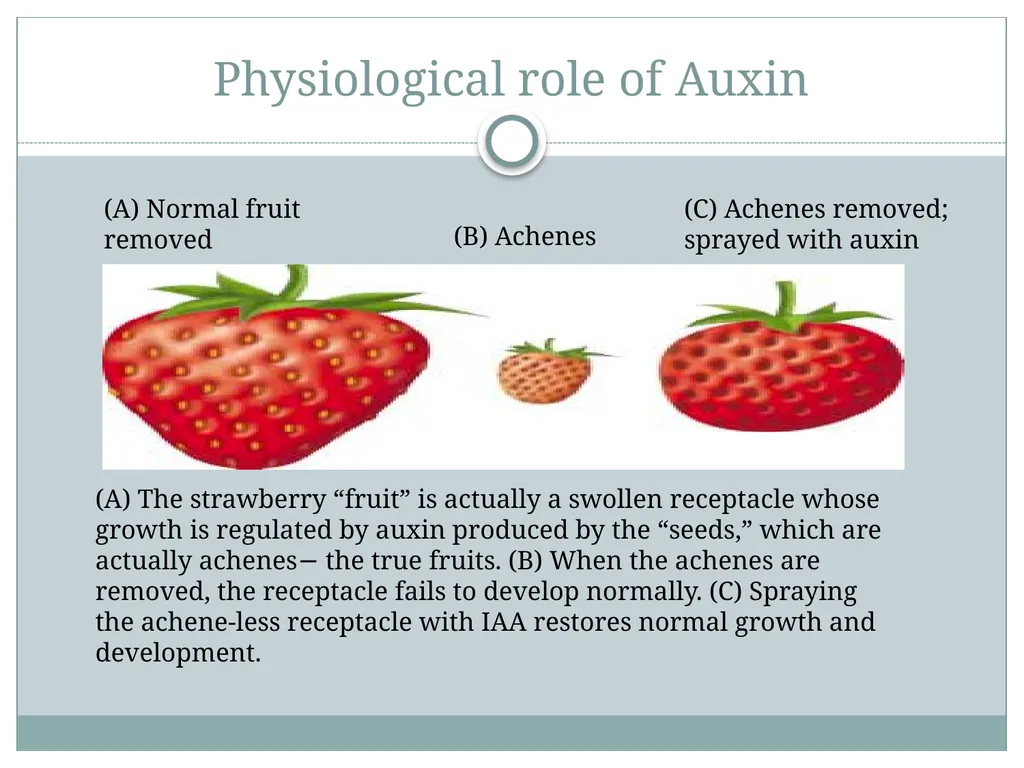
Physiological role of Auxin (A) The strawberry “fruit” is actually a swollen receptacle whose
growth is regulated by auxin produced by the “seeds,” which are actually achenes− the true fruits. (B) When the achenes are removed, the receptacle fails to develop normally. (C) Spraying the achene-less receptacle with IAA restores normal growth and development. (A) Normal fruit
removed (B) Achenes (C) Achenes removed;
sprayed with auxin<br>
12
Thank You<br>