
Please have your planner open on today’s date
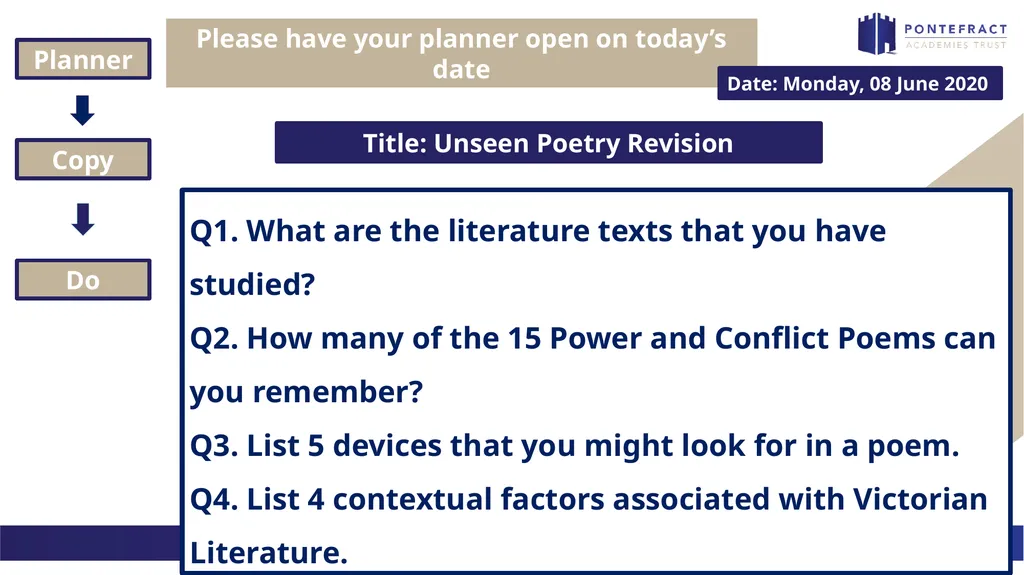
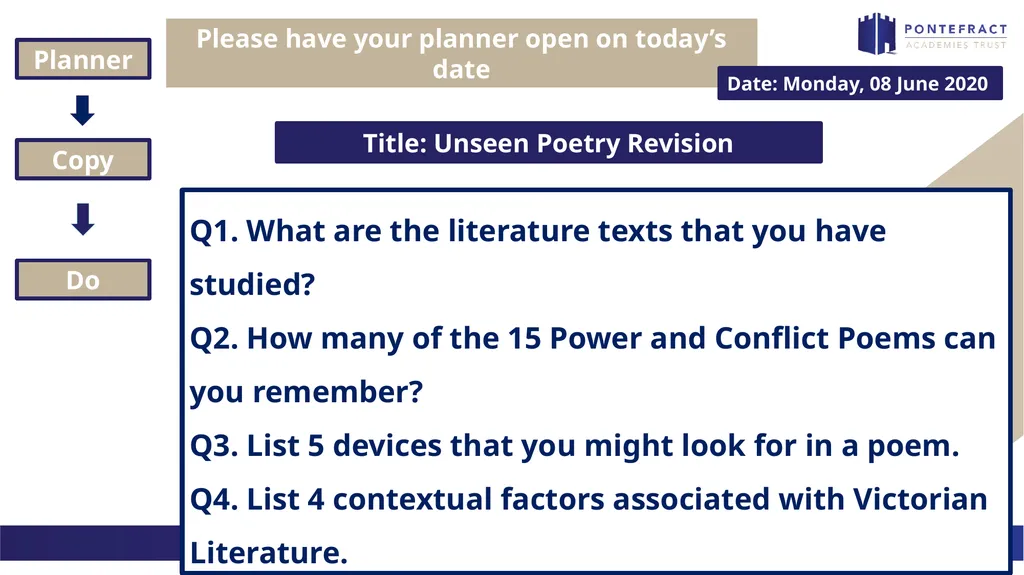



Description: Please have your planner open on todays date Date: Monday, 08 June 2020 Title: Unseen Poetry Revision Q1. What are the literature texts that you have studied? Q2. How many of the 15 Power and Conflict Poems can you remember? Q3. List 5
Related Topics
Download Presentation
"Please have your planner open on today’s date" is the property of its rightful owner. Permission is granted to download and print the materials on this website for personal, non-commercial use only, and to display it on your personal computer provided you do not modify the materials and that you retain all copyright notices contained in the materials. By downloading content from our website, you accept the terms of this agreement.
Presentation Transcript
slide1. Please have your planner open on today’s date Date: Monday, 08 June 2020 Title: Unseen Poetry Revision Q1. What are the literature texts that you have studied?
Q2. How many of the 15 Power and Conflict Poems can you remember?
Q3. List 5 devices that you might look for in a poem.
Q4. List 4 contextual factors associated with Victorian Literature.<br>
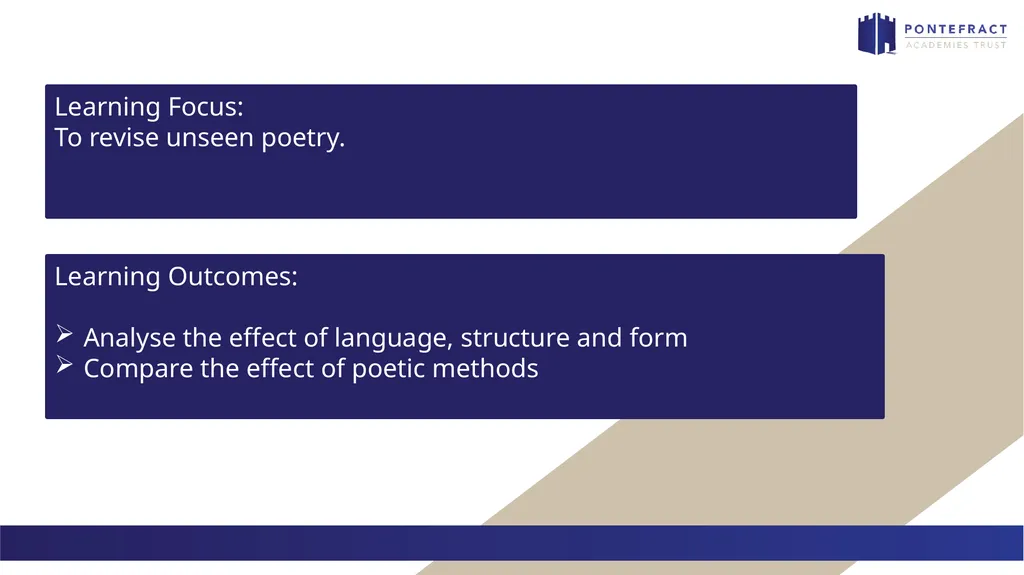
slide2. Learning Focus:
To revise unseen poetry. Learning Outcomes:
Analyse the effect of language, structure and form
Compare the effect of poetic methods<br>
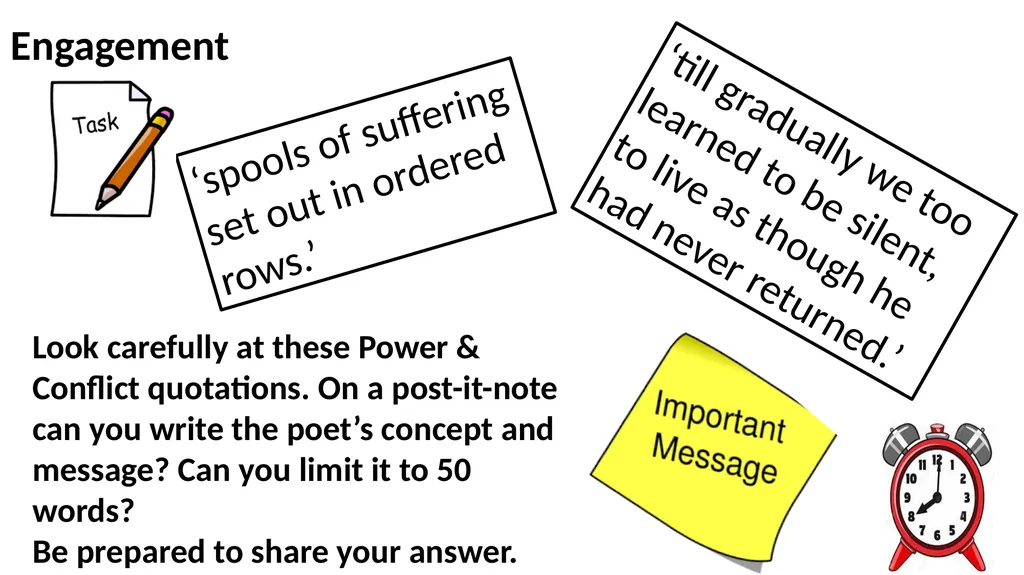
slide3. Engagement ‘spools of suffering set out in ordered rows.’ ‘till gradually we too learned to be silent, to live as though he had never returned.’ Look carefully at these Power & Conflict quotations. On a post-it-note can you write the poet’s concept and message? Can you limit it to 50 words?
Be prepared to share your answer.<br>
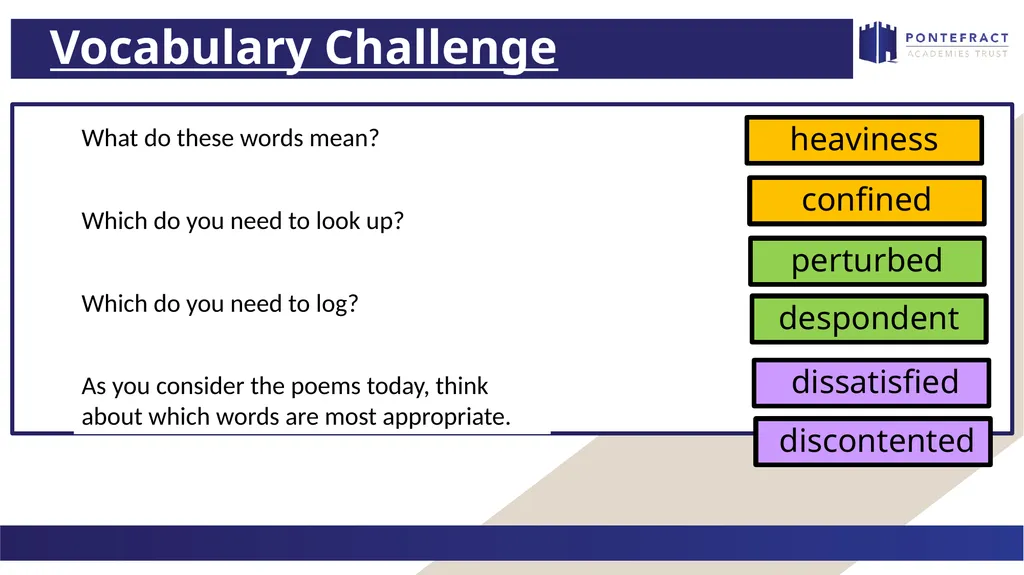
slide4. What do these words mean?
Which do you need to look up?
Which do you need to log?
As you consider the poems today, think about which words are most appropriate. Vocabulary Challenge heaviness confined perturbed despondent dissatisfied discontented<br>
slide5. What is a concept?<br>
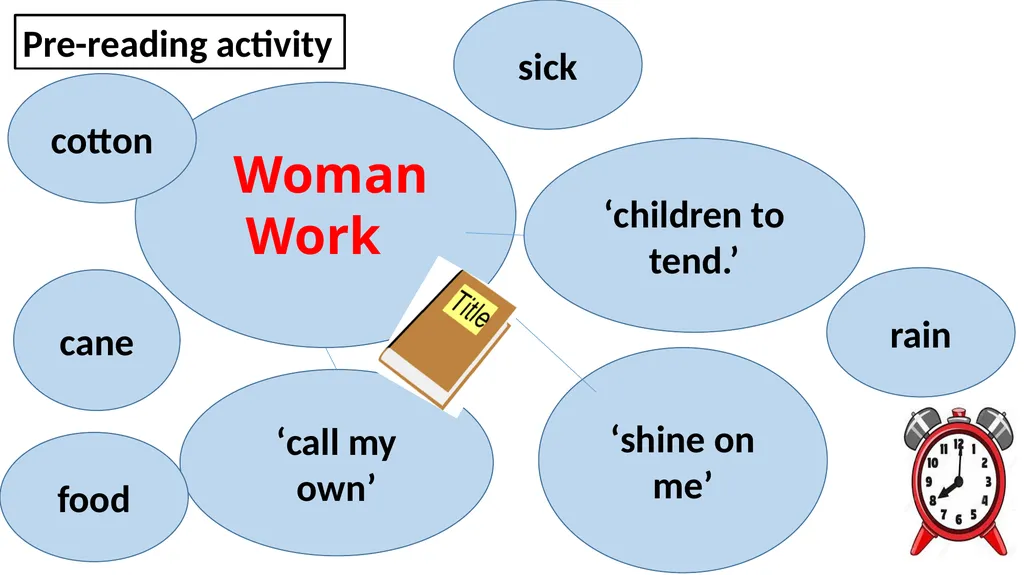
slide6. Woman Work ‘call my own’ ‘children to tend.’ ‘shine on me’ Pre-reading activity sick cane rain food cotton<br>
slide7. You now have 5 minutes to MAGPIE speak to your closest partner, sharing your ideas about what you predict the poem will be about. Please record your best findings in your English booklet.
Mr Verity’s tip: Speak to at least 2 other students in the class!<br>
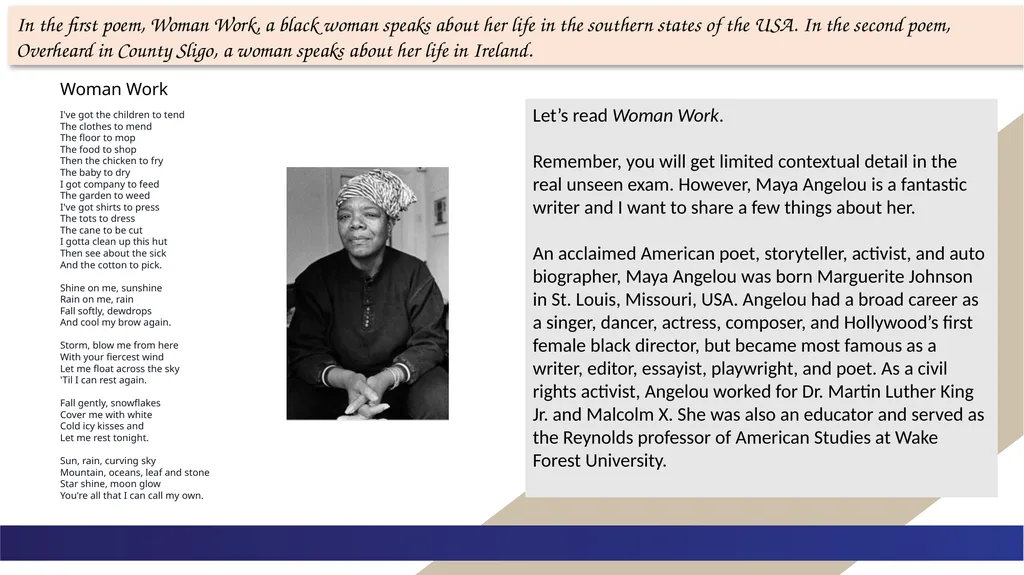
slide8. In the first poem, Woman Work, a black woman speaks about her life in the southern states of the USA. In the second poem, Overheard in County Sligo, a woman speaks about her life in Ireland. Woman Work
I've got the children to tend The clothes to mend The floor to mop The food to shop Then the chicken to fry The baby to dry I got company to feed The garden to weed I've got shirts to press The tots to dress The cane to be cut I gotta clean up this hut Then see about the sick And the cotton to pick.
Shine on me, sunshine Rain on me, rain Fall softly, dewdrops And cool my brow again. Storm, blow me from here With your fiercest wind Let me float across the sky 'Til I can rest again. Fall gently, snowflakes Cover me with white Cold icy kisses and Let me rest tonight. Sun, rain, curving sky Mountain, oceans, leaf and stone Star shine, moon glow You're all that I can call my own. Let’s read Woman Work.
Remember, you will get limited contextual detail in the real unseen exam. However, Maya Angelou is a fantastic writer and I want to share a few things about her.
An acclaimed American poet, storyteller, activist, and auto biographer, Maya Angelou was born Marguerite Johnson in St. Louis, Missouri, USA. Angelou had a broad career as a singer, dancer, actress, composer, and Hollywood’s first female black director, but became most famous as a writer, editor, essayist, playwright, and poet. As a civil rights activist, Angelou worked for Dr. Martin Luther King Jr. and Malcolm X. She was also an educator and served as the Reynolds professor of American Studies at Wake Forest University.<br>
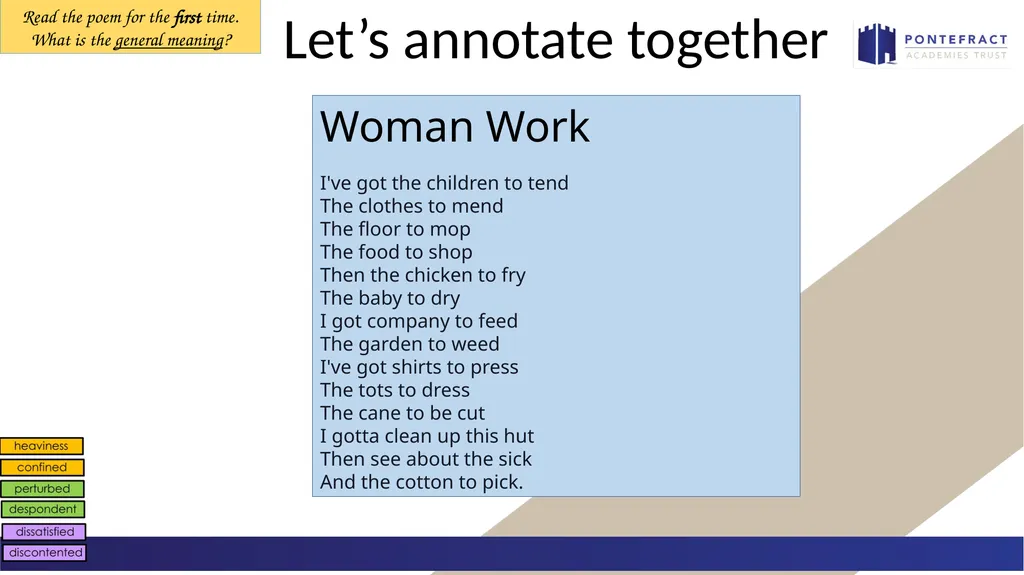
slide9. Read the poem for the first time.
What is the general meaning? Woman Work
I've got the children to tend The clothes to mend The floor to mop The food to shop Then the chicken to fry The baby to dry I got company to feed The garden to weed I've got shirts to press The tots to dress The cane to be cut I gotta clean up this hut Then see about the sick And the cotton to pick. Let’s annotate together<br>
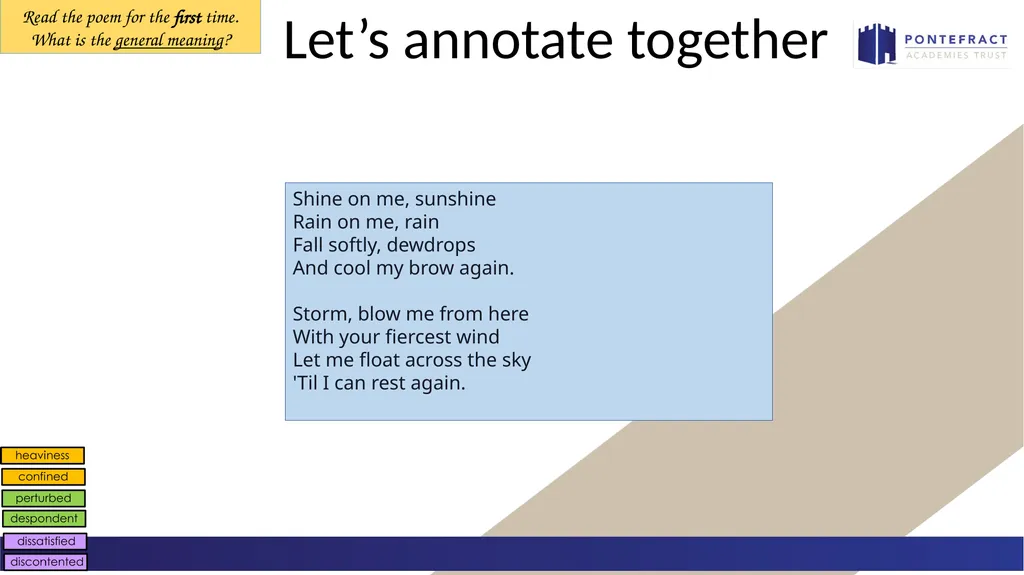
slide10. Read the poem for the first time.
What is the general meaning? Shine on me, sunshine Rain on me, rain Fall softly, dewdrops And cool my brow again. Storm, blow me from here With your fiercest wind Let me float across the sky 'Til I can rest again. Let’s annotate together<br>
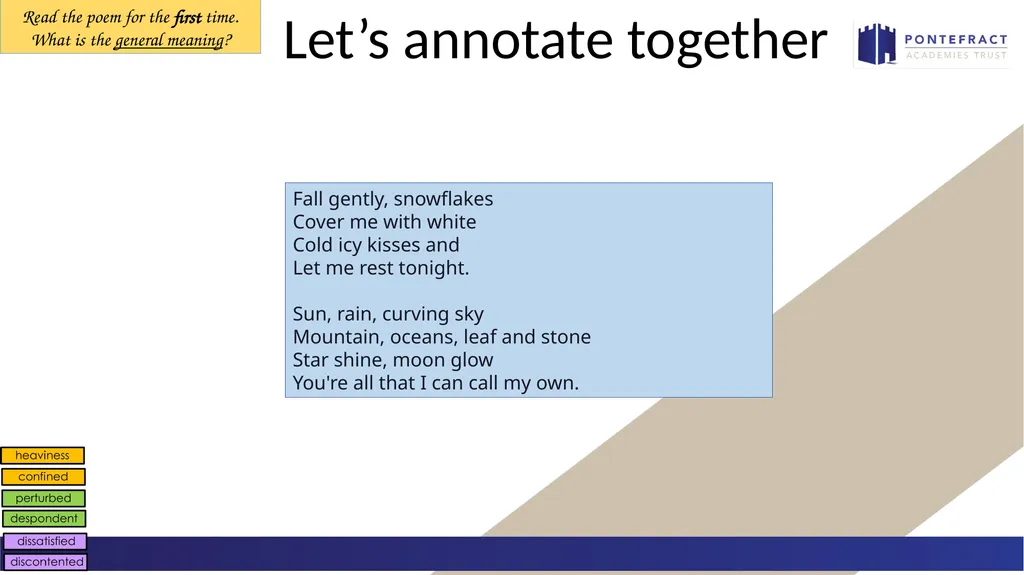
slide11. Read the poem for the first time.
What is the general meaning? Fall gently, snowflakes Cover me with white Cold icy kisses and Let me rest tonight. Sun, rain, curving sky Mountain, oceans, leaf and stone Star shine, moon glow You're all that I can call my own. Let’s annotate together<br>
slide12. ‘Sun, rain, curving sky Mountain, oceans, leaf and stone Star shine, moon glow You're all that I can call my own.’ Why has Mr Verity chosen this quotation as being a key, important moment?
Challenge:
Can you explain what method the poet has used?<br>
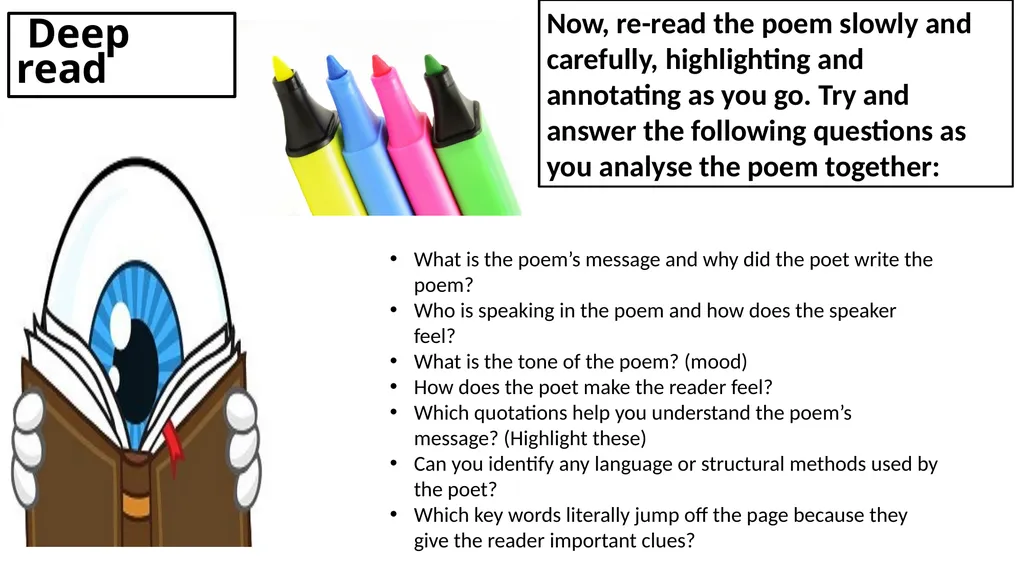
slide13. Now, re-read the poem slowly and carefully, highlighting and annotating as you go. Try and answer the following questions as you analyse the poem together: Deep read What is the poem’s message and why did the poet write the poem?
Who is speaking in the poem and how does the speaker feel?
What is the tone of the poem? (mood)
How does the poet make the reader feel?
Which quotations help you understand the poem’s message? (Highlight these)
Can you identify any language or structural methods used by the poet?
Which key words literally jump off the page because they give the reader important clues?<br>
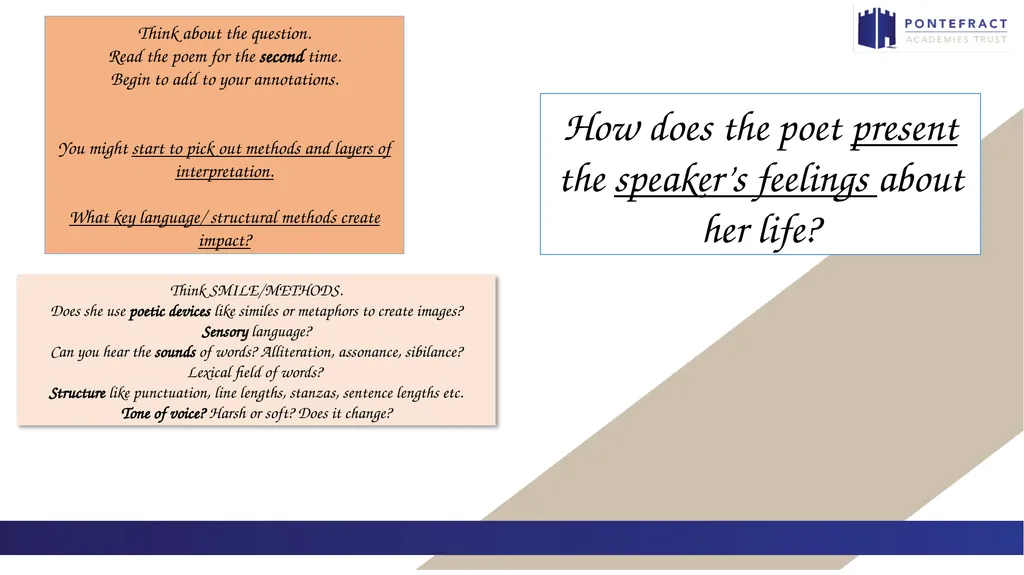
slide14. Think about the question.
Read the poem for the second time.
Begin to add to your annotations.
You might start to pick out methods and layers of interpretation.
What key language/ structural methods create impact? How does the poet present the speaker’s feelings about her life? Think SMILE/METHODS.
Does she use poetic devices like similes or metaphors to create images?
Sensory language?
Can you hear the sounds of words? Alliteration, assonance, sibilance?
Lexical field of words?
Structure like punctuation, line lengths, stanzas, sentence lengths etc.
Tone of voice? Harsh or soft? Does it change?<br>
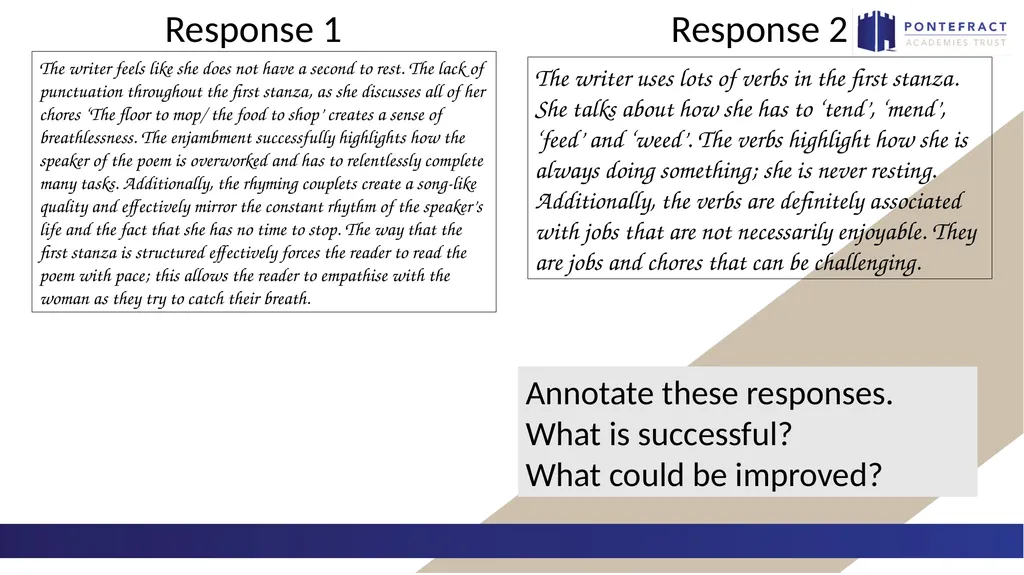
slide15. The writer feels like she does not have a second to rest. The lack of punctuation throughout the first stanza, as she discusses all of her chores ‘The floor to mop/ the food to shop’ creates a sense of breathlessness. The enjambment successfully highlights how the speaker of the poem is overworked and has to relentlessly complete many tasks. Additionally, the rhyming couplets create a song-like quality and effectively mirror the constant rhythm of the speaker’s life and the fact that she has no time to stop. The way that the first stanza is structured effectively forces the reader to read the poem with pace; this allows the reader to empathise with the woman as they try to catch their breath. Response 1 The writer uses lots of verbs in the first stanza. She talks about how she has to ‘tend’, ‘mend’, ‘feed’ and ‘weed’. The verbs highlight how she is always doing something; she is never resting. Additionally, the verbs are definitely associated with jobs that are not necessarily enjoyable. They are jobs and chores that can be challenging. Response 2 Annotate these responses.
What is successful?
What could be improved?<br>
slide16. Over to you.
You have 30 minutes to write up your best three ideas. TOP BAND CHECKLIST
-Relate to the buzz words of the question throughout
-Sophisticated style/ phrasing
-Strong evidence (is it embedded?)
-Identify techniques/ methods/ zoom in on key words
-Layers of interpretation (explore the effect)
…this is effective because…
…this successfully highlights…
…this strongly asserts that…
…this is particularly good at…
…this makes the reader feel…
…this creates a sense of…
-Writer’s didactic purpose How does the poet present the speaker’s feelings about her life?<br>
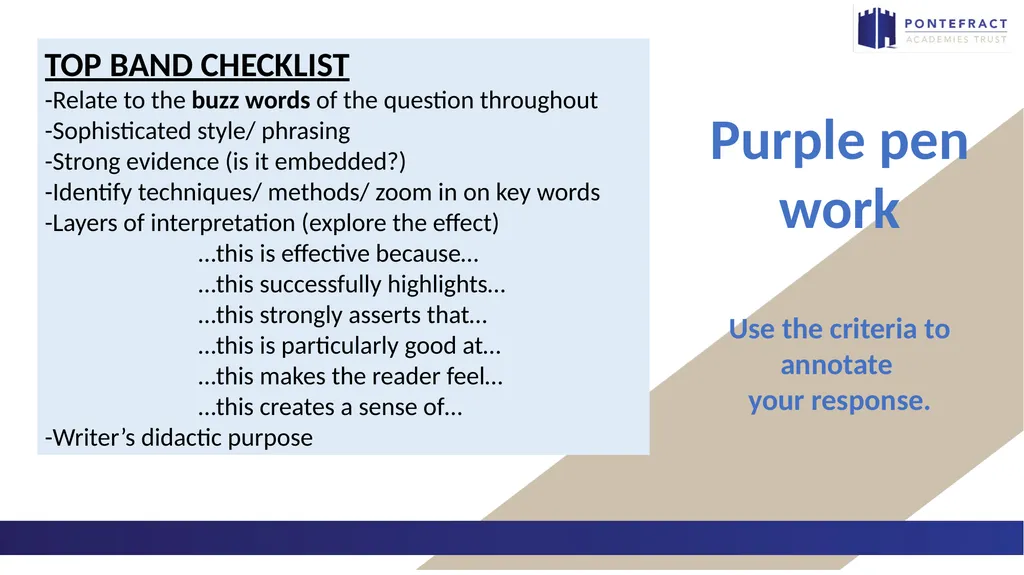
slide17. TOP BAND CHECKLIST
-Relate to the buzz words of the question throughout
-Sophisticated style/ phrasing
-Strong evidence (is it embedded?)
-Identify techniques/ methods/ zoom in on key words
-Layers of interpretation (explore the effect)
…this is effective because…
…this successfully highlights…
…this strongly asserts that…
…this is particularly good at…
…this makes the reader feel…
…this creates a sense of…
-Writer’s didactic purpose Purple pen work
Use the criteria to annotate
your response.<br>
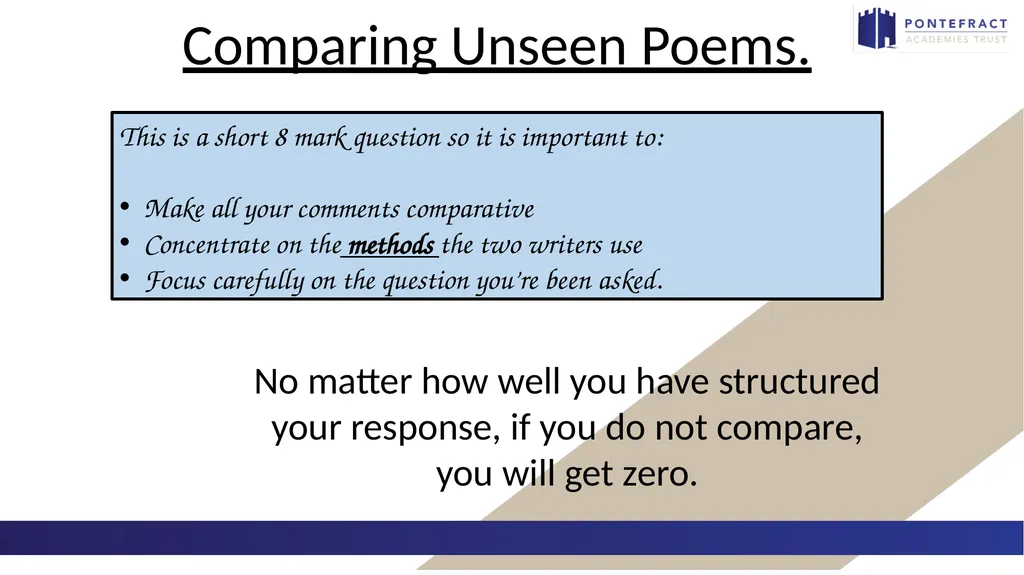
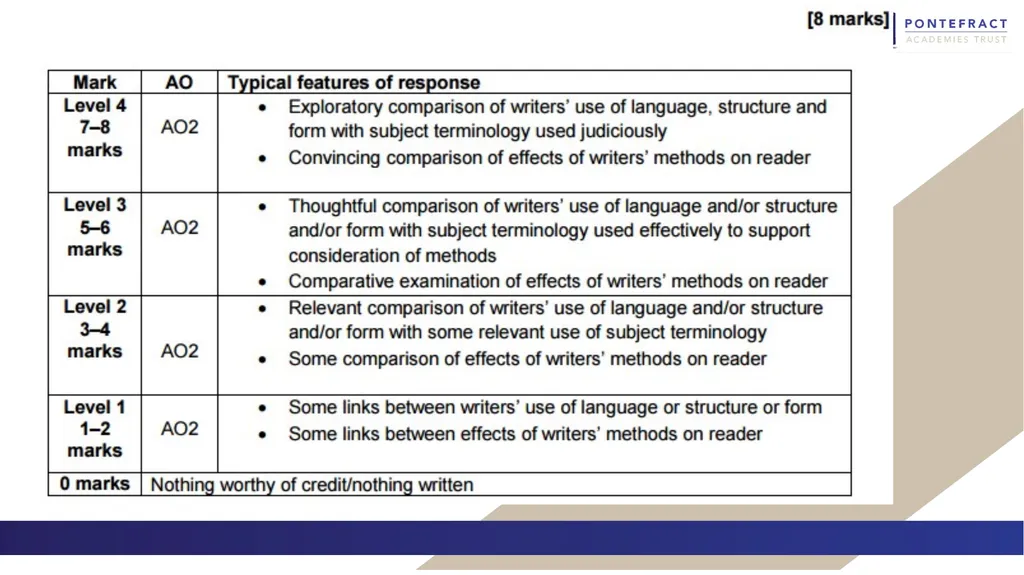
slide18. Comparing Unseen Poems. This is a short 8 mark question so it is important to:
Make all your comments comparative
Concentrate on the methods the two writers use
Focus carefully on the question you’re been asked. No matter how well you have structured your response, if you do not compare, you will get zero.<br>
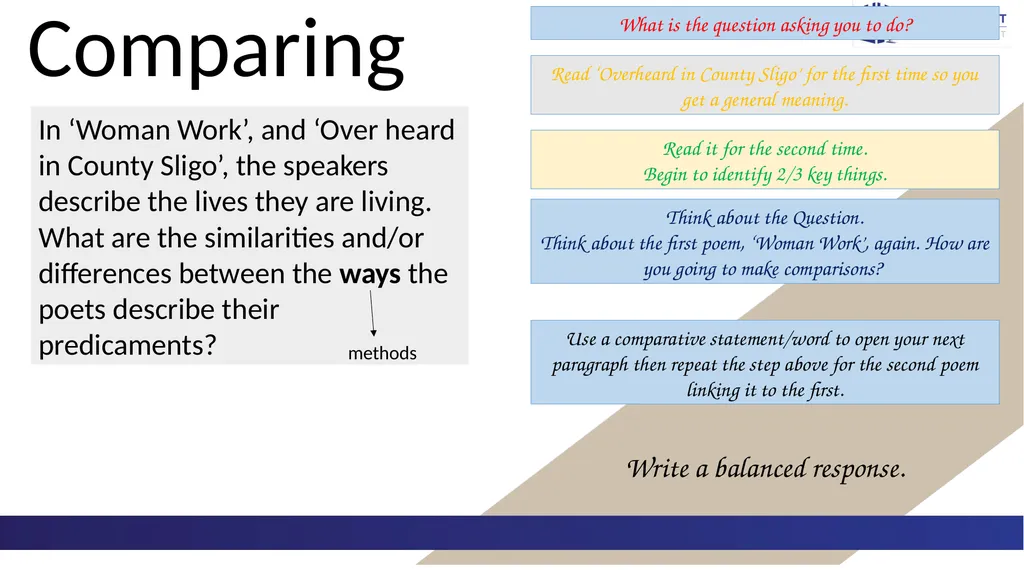
slide19. Comparing In ‘Woman Work’, and ‘Over heard in County Sligo’, the speakers describe the lives they are living. What are the similarities and/or differences between the ways the poets describe their predicaments? methods Read ‘Overheard in County Sligo’ for the first time so you get a general meaning. Read it for the second time.
Begin to identify 2/3 key things. Think about the Question.
Think about the first poem, ‘Woman Work’, again. How are you going to make comparisons? What is the question asking you to do? Use a comparative statement/word to open your next paragraph then repeat the step above for the second poem linking it to the first. Write a balanced response.<br>
slide20. Read the poem for the first time.
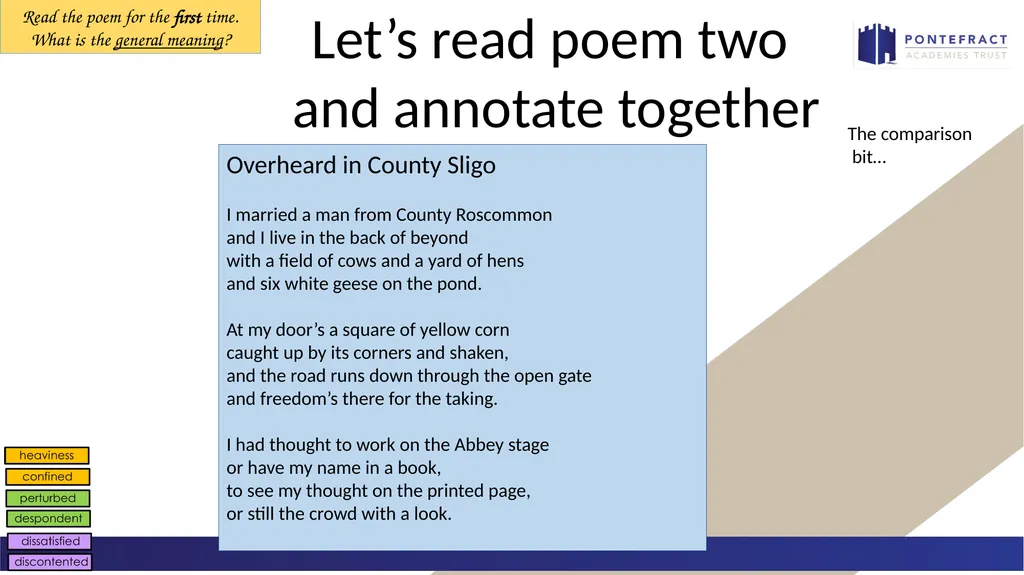
What is the general meaning? Overheard in County Sligo I married a man from County Roscommon and I live in the back of beyond with a field of cows and a yard of hens and six white geese on the pond. At my door’s a square of yellow corn caught up by its corners and shaken, and the road runs down through the open gate and freedom’s there for the taking. I had thought to work on the Abbey stage or have my name in a book, to see my thought on the printed page, or still the crowd with a look. Let’s read poem two
and annotate together The comparison
bit…<br>
slide21. Read the poem for the first time.
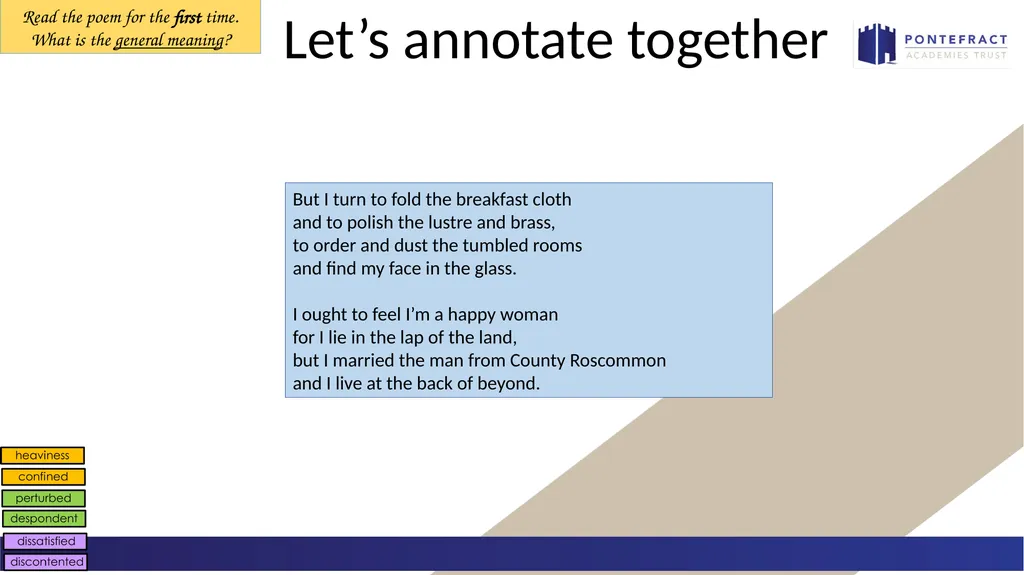
What is the general meaning? But I turn to fold the breakfast cloth and to polish the lustre and brass, to order and dust the tumbled rooms and find my face in the glass. I ought to feel I’m a happy woman for I lie in the lap of the land, but I married the man from County Roscommon and I live at the back of beyond. Let’s annotate together<br>
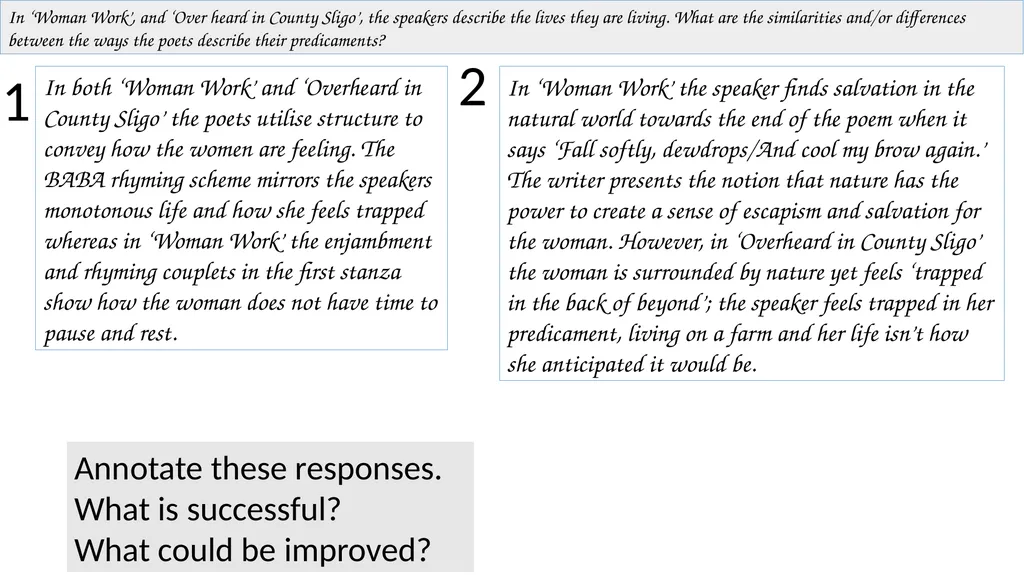
slide22. In ‘Woman Work’, and ‘Over heard in County Sligo’, the speakers describe the lives they are living. What are the similarities and/or differences between the ways the poets describe their predicaments? In both ‘Woman Work’ and ‘Overheard in County Sligo’ the poets utilise structure to convey how the women are feeling. The BABA rhyming scheme mirrors the speakers monotonous life and how she feels trapped whereas in ‘Woman Work’ the enjambment and rhyming couplets in the first stanza show how the woman does not have time to pause and rest. In ‘Woman Work’ the speaker finds salvation in the natural world towards the end of the poem when it says ‘Fall softly, dewdrops/And cool my brow again.’ The writer presents the notion that nature has the power to create a sense of escapism and salvation for the woman. However, in ‘Overheard in County Sligo’ the woman is surrounded by nature yet feels ‘trapped in the back of beyond’; the speaker feels trapped in her predicament, living on a farm and her life isn’t how she anticipated it would be. 1 2 Annotate these responses.
What is successful?
What could be improved?<br>
slide23. Over to you.
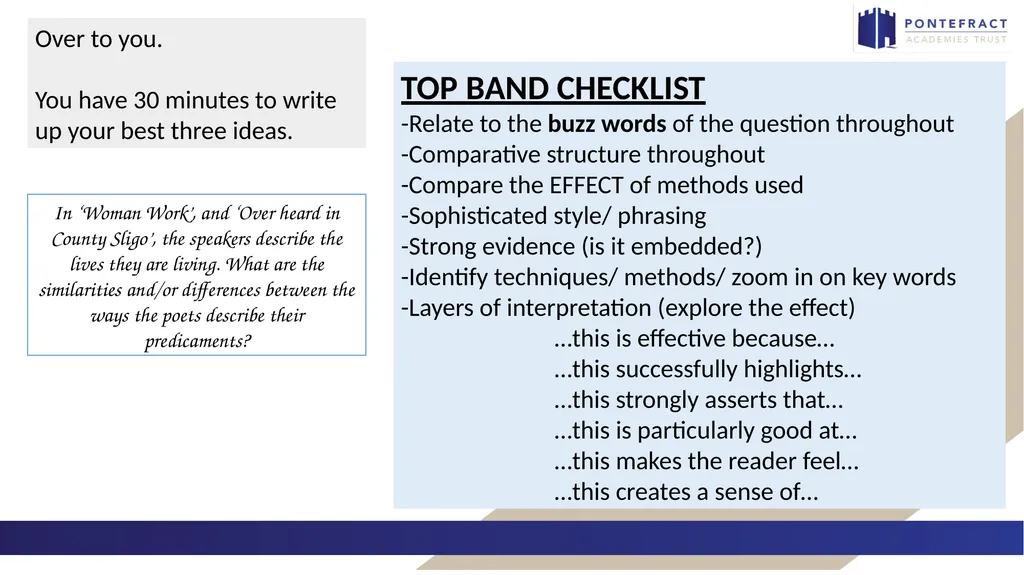
You have 30 minutes to write up your best three ideas. TOP BAND CHECKLIST
-Relate to the buzz words of the question throughout
-Comparative structure throughout
-Compare the EFFECT of methods used
-Sophisticated style/ phrasing
-Strong evidence (is it embedded?)
-Identify techniques/ methods/ zoom in on key words
-Layers of interpretation (explore the effect)
…this is effective because…
…this successfully highlights…
…this strongly asserts that…
…this is particularly good at…
…this makes the reader feel…
…this creates a sense of… In ‘Woman Work’, and ‘Over heard in County Sligo’, the speakers describe the lives they are living. What are the similarities and/or differences between the ways the poets describe their predicaments?<br>
Q2. How many of the 15 Power and Conflict Poems can you remember?
Q3. List 5 devices that you might look for in a poem.
Q4. List 4 contextual factors associated with Victorian Literature.<br>
slide2. Learning Focus:
To revise unseen poetry. Learning Outcomes:
Analyse the effect of language, structure and form
Compare the effect of poetic methods<br>
slide3. Engagement ‘spools of suffering set out in ordered rows.’ ‘till gradually we too learned to be silent, to live as though he had never returned.’ Look carefully at these Power & Conflict quotations. On a post-it-note can you write the poet’s concept and message? Can you limit it to 50 words?
Be prepared to share your answer.<br>
slide4. What do these words mean?
Which do you need to look up?
Which do you need to log?
As you consider the poems today, think about which words are most appropriate. Vocabulary Challenge heaviness confined perturbed despondent dissatisfied discontented<br>
slide5. What is a concept?<br>
slide6. Woman Work ‘call my own’ ‘children to tend.’ ‘shine on me’ Pre-reading activity sick cane rain food cotton<br>
slide7. You now have 5 minutes to MAGPIE speak to your closest partner, sharing your ideas about what you predict the poem will be about. Please record your best findings in your English booklet.
Mr Verity’s tip: Speak to at least 2 other students in the class!<br>
slide8. In the first poem, Woman Work, a black woman speaks about her life in the southern states of the USA. In the second poem, Overheard in County Sligo, a woman speaks about her life in Ireland. Woman Work
I've got the children to tend The clothes to mend The floor to mop The food to shop Then the chicken to fry The baby to dry I got company to feed The garden to weed I've got shirts to press The tots to dress The cane to be cut I gotta clean up this hut Then see about the sick And the cotton to pick.
Shine on me, sunshine Rain on me, rain Fall softly, dewdrops And cool my brow again. Storm, blow me from here With your fiercest wind Let me float across the sky 'Til I can rest again. Fall gently, snowflakes Cover me with white Cold icy kisses and Let me rest tonight. Sun, rain, curving sky Mountain, oceans, leaf and stone Star shine, moon glow You're all that I can call my own. Let’s read Woman Work.
Remember, you will get limited contextual detail in the real unseen exam. However, Maya Angelou is a fantastic writer and I want to share a few things about her.
An acclaimed American poet, storyteller, activist, and auto biographer, Maya Angelou was born Marguerite Johnson in St. Louis, Missouri, USA. Angelou had a broad career as a singer, dancer, actress, composer, and Hollywood’s first female black director, but became most famous as a writer, editor, essayist, playwright, and poet. As a civil rights activist, Angelou worked for Dr. Martin Luther King Jr. and Malcolm X. She was also an educator and served as the Reynolds professor of American Studies at Wake Forest University.<br>
slide9. Read the poem for the first time.
What is the general meaning? Woman Work
I've got the children to tend The clothes to mend The floor to mop The food to shop Then the chicken to fry The baby to dry I got company to feed The garden to weed I've got shirts to press The tots to dress The cane to be cut I gotta clean up this hut Then see about the sick And the cotton to pick. Let’s annotate together<br>
slide10. Read the poem for the first time.
What is the general meaning? Shine on me, sunshine Rain on me, rain Fall softly, dewdrops And cool my brow again. Storm, blow me from here With your fiercest wind Let me float across the sky 'Til I can rest again. Let’s annotate together<br>
slide11. Read the poem for the first time.
What is the general meaning? Fall gently, snowflakes Cover me with white Cold icy kisses and Let me rest tonight. Sun, rain, curving sky Mountain, oceans, leaf and stone Star shine, moon glow You're all that I can call my own. Let’s annotate together<br>
slide12. ‘Sun, rain, curving sky Mountain, oceans, leaf and stone Star shine, moon glow You're all that I can call my own.’ Why has Mr Verity chosen this quotation as being a key, important moment?
Challenge:
Can you explain what method the poet has used?<br>
slide13. Now, re-read the poem slowly and carefully, highlighting and annotating as you go. Try and answer the following questions as you analyse the poem together: Deep read What is the poem’s message and why did the poet write the poem?
Who is speaking in the poem and how does the speaker feel?
What is the tone of the poem? (mood)
How does the poet make the reader feel?
Which quotations help you understand the poem’s message? (Highlight these)
Can you identify any language or structural methods used by the poet?
Which key words literally jump off the page because they give the reader important clues?<br>
slide14. Think about the question.
Read the poem for the second time.
Begin to add to your annotations.
You might start to pick out methods and layers of interpretation.
What key language/ structural methods create impact? How does the poet present the speaker’s feelings about her life? Think SMILE/METHODS.
Does she use poetic devices like similes or metaphors to create images?
Sensory language?
Can you hear the sounds of words? Alliteration, assonance, sibilance?
Lexical field of words?
Structure like punctuation, line lengths, stanzas, sentence lengths etc.
Tone of voice? Harsh or soft? Does it change?<br>
slide15. The writer feels like she does not have a second to rest. The lack of punctuation throughout the first stanza, as she discusses all of her chores ‘The floor to mop/ the food to shop’ creates a sense of breathlessness. The enjambment successfully highlights how the speaker of the poem is overworked and has to relentlessly complete many tasks. Additionally, the rhyming couplets create a song-like quality and effectively mirror the constant rhythm of the speaker’s life and the fact that she has no time to stop. The way that the first stanza is structured effectively forces the reader to read the poem with pace; this allows the reader to empathise with the woman as they try to catch their breath. Response 1 The writer uses lots of verbs in the first stanza. She talks about how she has to ‘tend’, ‘mend’, ‘feed’ and ‘weed’. The verbs highlight how she is always doing something; she is never resting. Additionally, the verbs are definitely associated with jobs that are not necessarily enjoyable. They are jobs and chores that can be challenging. Response 2 Annotate these responses.
What is successful?
What could be improved?<br>
slide16. Over to you.
You have 30 minutes to write up your best three ideas. TOP BAND CHECKLIST
-Relate to the buzz words of the question throughout
-Sophisticated style/ phrasing
-Strong evidence (is it embedded?)
-Identify techniques/ methods/ zoom in on key words
-Layers of interpretation (explore the effect)
…this is effective because…
…this successfully highlights…
…this strongly asserts that…
…this is particularly good at…
…this makes the reader feel…
…this creates a sense of…
-Writer’s didactic purpose How does the poet present the speaker’s feelings about her life?<br>
slide17. TOP BAND CHECKLIST
-Relate to the buzz words of the question throughout
-Sophisticated style/ phrasing
-Strong evidence (is it embedded?)
-Identify techniques/ methods/ zoom in on key words
-Layers of interpretation (explore the effect)
…this is effective because…
…this successfully highlights…
…this strongly asserts that…
…this is particularly good at…
…this makes the reader feel…
…this creates a sense of…
-Writer’s didactic purpose Purple pen work
Use the criteria to annotate
your response.<br>
slide18. Comparing Unseen Poems. This is a short 8 mark question so it is important to:
Make all your comments comparative
Concentrate on the methods the two writers use
Focus carefully on the question you’re been asked. No matter how well you have structured your response, if you do not compare, you will get zero.<br>
slide19. Comparing In ‘Woman Work’, and ‘Over heard in County Sligo’, the speakers describe the lives they are living. What are the similarities and/or differences between the ways the poets describe their predicaments? methods Read ‘Overheard in County Sligo’ for the first time so you get a general meaning. Read it for the second time.
Begin to identify 2/3 key things. Think about the Question.
Think about the first poem, ‘Woman Work’, again. How are you going to make comparisons? What is the question asking you to do? Use a comparative statement/word to open your next paragraph then repeat the step above for the second poem linking it to the first. Write a balanced response.<br>
slide20. Read the poem for the first time.
What is the general meaning? Overheard in County Sligo I married a man from County Roscommon and I live in the back of beyond with a field of cows and a yard of hens and six white geese on the pond. At my door’s a square of yellow corn caught up by its corners and shaken, and the road runs down through the open gate and freedom’s there for the taking. I had thought to work on the Abbey stage or have my name in a book, to see my thought on the printed page, or still the crowd with a look. Let’s read poem two
and annotate together The comparison
bit…<br>
slide21. Read the poem for the first time.
What is the general meaning? But I turn to fold the breakfast cloth and to polish the lustre and brass, to order and dust the tumbled rooms and find my face in the glass. I ought to feel I’m a happy woman for I lie in the lap of the land, but I married the man from County Roscommon and I live at the back of beyond. Let’s annotate together<br>
slide22. In ‘Woman Work’, and ‘Over heard in County Sligo’, the speakers describe the lives they are living. What are the similarities and/or differences between the ways the poets describe their predicaments? In both ‘Woman Work’ and ‘Overheard in County Sligo’ the poets utilise structure to convey how the women are feeling. The BABA rhyming scheme mirrors the speakers monotonous life and how she feels trapped whereas in ‘Woman Work’ the enjambment and rhyming couplets in the first stanza show how the woman does not have time to pause and rest. In ‘Woman Work’ the speaker finds salvation in the natural world towards the end of the poem when it says ‘Fall softly, dewdrops/And cool my brow again.’ The writer presents the notion that nature has the power to create a sense of escapism and salvation for the woman. However, in ‘Overheard in County Sligo’ the woman is surrounded by nature yet feels ‘trapped in the back of beyond’; the speaker feels trapped in her predicament, living on a farm and her life isn’t how she anticipated it would be. 1 2 Annotate these responses.
What is successful?
What could be improved?<br>
slide23. Over to you.
You have 30 minutes to write up your best three ideas. TOP BAND CHECKLIST
-Relate to the buzz words of the question throughout
-Comparative structure throughout
-Compare the EFFECT of methods used
-Sophisticated style/ phrasing
-Strong evidence (is it embedded?)
-Identify techniques/ methods/ zoom in on key words
-Layers of interpretation (explore the effect)
…this is effective because…
…this successfully highlights…
…this strongly asserts that…
…this is particularly good at…
…this makes the reader feel…
…this creates a sense of… In ‘Woman Work’, and ‘Over heard in County Sligo’, the speakers describe the lives they are living. What are the similarities and/or differences between the ways the poets describe their predicaments?<br>