Poem at Thirty-Nine by Alice Walker How does Walker convey the power of memory in her poem Poem at Thirty-Nine? Who is Alice Walker? Alice Walker is an American novelist, poet and political activist. She wrote The Color Purple in 1982,
"Poem at Thirty-Nine by Alice Walker How does" is the property of its rightful owner. Permission is granted to
download and print the materials on this website for personal, non-commercial use only, and to display it
on your personal computer provided you do not modify the materials and that you retain all copyright
notices contained in the materials. By downloading content from our website, you accept the terms of this
agreement.
Presentation Transcript
01
Poem at Thirty-Nine by Alice Walker
How does Walker convey the power of memory in her poem ‘Poem at Thirty-Nine’?<br>
02
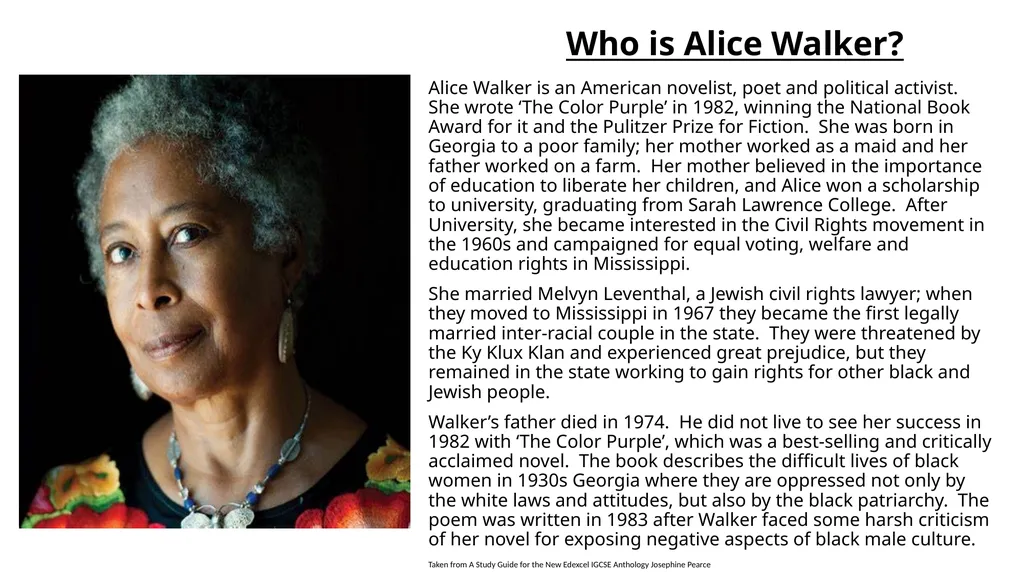
Who is Alice Walker? Alice Walker is an American novelist, poet and political activist. She wrote ‘The Color Purple’ in 1982, winning the National Book Award for it and the Pulitzer Prize for Fiction. She was born in Georgia to a poor family; her mother worked as a maid and her father worked on a farm. Her mother believed in the importance of education to liberate her children, and Alice won a scholarship to university, graduating from Sarah Lawrence College. After University, she became interested in the Civil Rights movement in the 1960s and campaigned for equal voting, welfare and education rights in Mississippi.
She married Melvyn Leventhal, a Jewish civil rights lawyer; when they moved to Mississippi in 1967 they became the first legally married inter-racial couple in the state. They were threatened by the Ky Klux Klan and experienced great prejudice, but they remained in the state working to gain rights for other black and Jewish people.
Walker’s father died in 1974. He did not live to see her success in 1982 with ‘The Color Purple’, which was a best-selling and critically acclaimed novel. The book describes the difficult lives of black women in 1930s Georgia where they are oppressed not only by the white laws and attitudes, but also by the black patriarchy. The poem was written in 1983 after Walker faced some harsh criticism of her novel for exposing negative aspects of black male culture.
Taken from A Study Guide for the New Edexcel IGCSE Anthology Josephine Pearce<br>
03
What is the poem about? The poem describes how much Walker misses her dead father. She explains all the wonderful things he taught her about life, and concludes that although he may not have agreed with all her opinions, she believes he would be proud of her at this point in her life – at thirty-nine years old.<br>
04
How does Walker convey the power of memory in her poem ‘Poem at Thirty-Nine’? Written at the age of thirty-nine – perhaps a turning point in life for her.
A reflective and nostalgic poem. She reflects she wouldn’t be who she is today, without his influence.
A free verse poem drawing upon a lot of enjambment. Firstly, to show a stream of consciousness but also to support the idea that memories are fragmented and come to us in bits. This is also reflected in the short lines, which produce a staccato effect.<br>
05
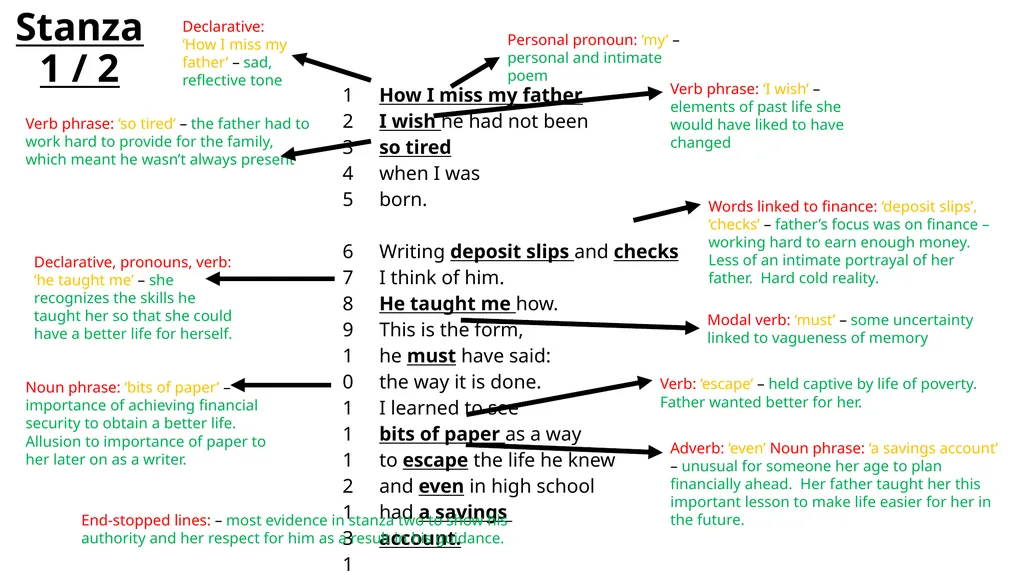
Stanza 1 / 2 Declarative: ‘How I miss my father’ – sad, reflective tone End-stopped lines: – most evidence in stanza two to show his authority and her respect for him as a result in his guidance. Verb phrase: ‘I wish’ – elements of past life she would have liked to have changed Verb phrase: ‘so tired’ – the father had to work hard to provide for the family, which meant he wasn’t always present Words linked to finance: ‘deposit slips’, ‘checks’ – father’s focus was on finance – working hard to earn enough money. Less of an intimate portrayal of her father. Hard cold reality. Declarative, pronouns, verb: ‘he taught me’ – she recognizes the skills he taught her so that she could have a better life for herself. Modal verb: ‘must’ – some uncertainty linked to vagueness of memory Noun phrase: ‘bits of paper’ – importance of achieving financial security to obtain a better life. Allusion to importance of paper to her later on as a writer. Verb: ‘escape’ – held captive by life of poverty. Father wanted better for her. Adverb: ‘even’ Noun phrase: ‘a savings account’ – unusual for someone her age to plan financially ahead. Her father taught her this important lesson to make life easier for her in the future. Personal pronoun: ‘my’ – personal and intimate poem<br>
06
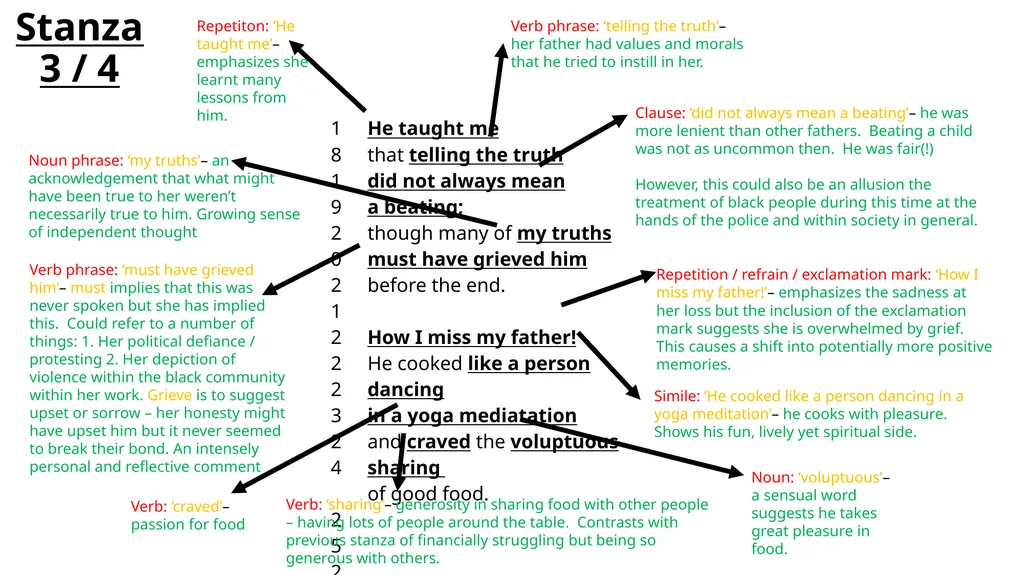
Stanza 3 / 4 Verb: ‘craved’– passion for food Verb phrase: ‘telling the truth’– her father had values and morals that he tried to instill in her. Clause: ‘did not always mean a beating’– he was more lenient than other fathers. Beating a child was not as uncommon then. He was fair(!)
However, this could also be an allusion the treatment of black people during this time at the hands of the police and within society in general. Noun phrase: ‘my truths’– an acknowledgement that what might have been true to her weren’t necessarily true to him. Growing sense of independent thought Verb phrase: ‘must have grieved him’– must implies that this was never spoken but she has implied this. Could refer to a number of things: 1. Her political defiance / protesting 2. Her depiction of violence within the black community within her work. Grieve is to suggest upset or sorrow – her honesty might have upset him but it never seemed to break their bond. An intensely personal and reflective comment Repetition / refrain / exclamation mark: ‘How I miss my father!’– emphasizes the sadness at her loss but the inclusion of the exclamation mark suggests she is overwhelmed by grief. This causes a shift into potentially more positive memories. Simile: ‘He cooked like a person dancing in a yoga meditation’– he cooks with pleasure. Shows his fun, lively yet spiritual side. Repetiton: ‘He taught me’– emphasizes she learnt many lessons from him. Noun: ‘voluptuous’– a sensual word suggests he takes great pleasure in food. Verb: ‘sharing’– generosity in sharing food with other people – having lots of people around the table. Contrasts with previous stanza of financially struggling but being so generous with others.<br>
07
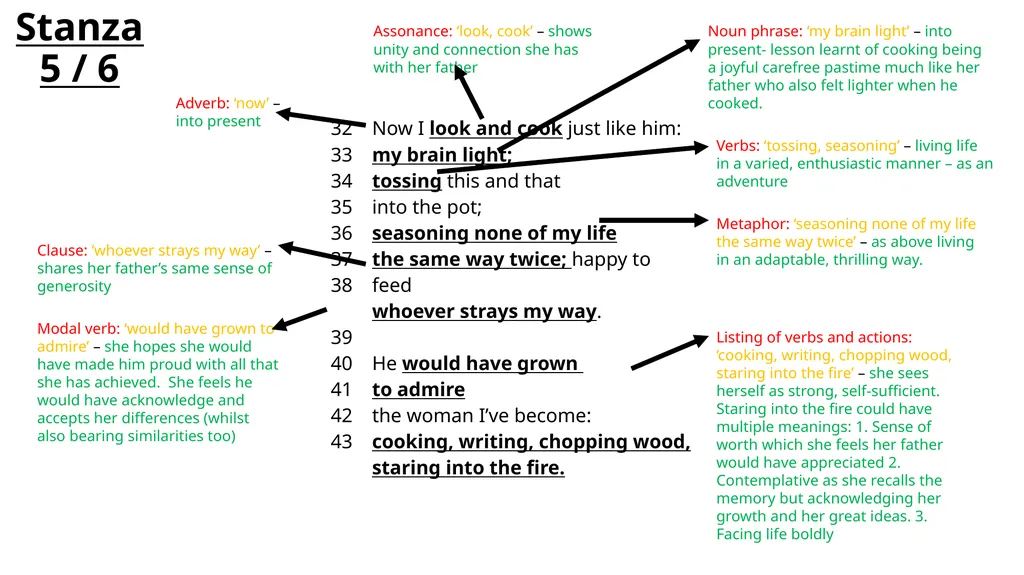
Stanza 5 / 6 Adverb: ‘now’ – into present Noun phrase: ‘my brain light’ – into present- lesson learnt of cooking being a joyful carefree pastime much like her father who also felt lighter when he cooked. Assonance: ‘look, cook’ – shows unity and connection she has with her father Verbs: ‘tossing, seasoning’ – living life in a varied, enthusiastic manner – as an adventure Metaphor: ‘seasoning none of my life the same way twice’ – as above living in an adaptable, thrilling way. Clause: ‘whoever strays my way’ – shares her father’s same sense of generosity Modal verb: ‘would have grown to admire’ – she hopes she would have made him proud with all that she has achieved. She feels he would have acknowledge and accepts her differences (whilst also bearing similarities too) Listing of verbs and actions: ‘cooking, writing, chopping wood, staring into the fire’ – she sees herself as strong, self-sufficient. Staring into the fire could have multiple meanings: 1. Sense of worth which she feels her father would have appreciated 2. Contemplative as she recalls the memory but acknowledging her growth and her great ideas. 3. Facing life boldly<br>
08
Personal reflection question:
How does Walker convey the power of memory in her poem ‘Poem at Thirty-Nine’?<br>