Poetry and prose Shakespeares language Blank verse Shakespeare wrote most widely in blank verse. This is a type of poetry that does not rhyme, but instead follows a pattern of stresses called iambic pentameter. Blank verse is close to
"Poetry and prose Shakespeare’s language Blank" is the property of its rightful owner. Permission is granted to
download and print the materials on this website for personal, non-commercial use only, and to display it
on your personal computer provided you do not modify the materials and that you retain all copyright
notices contained in the materials. By downloading content from our website, you accept the terms of this
agreement.
Presentation Transcript
01
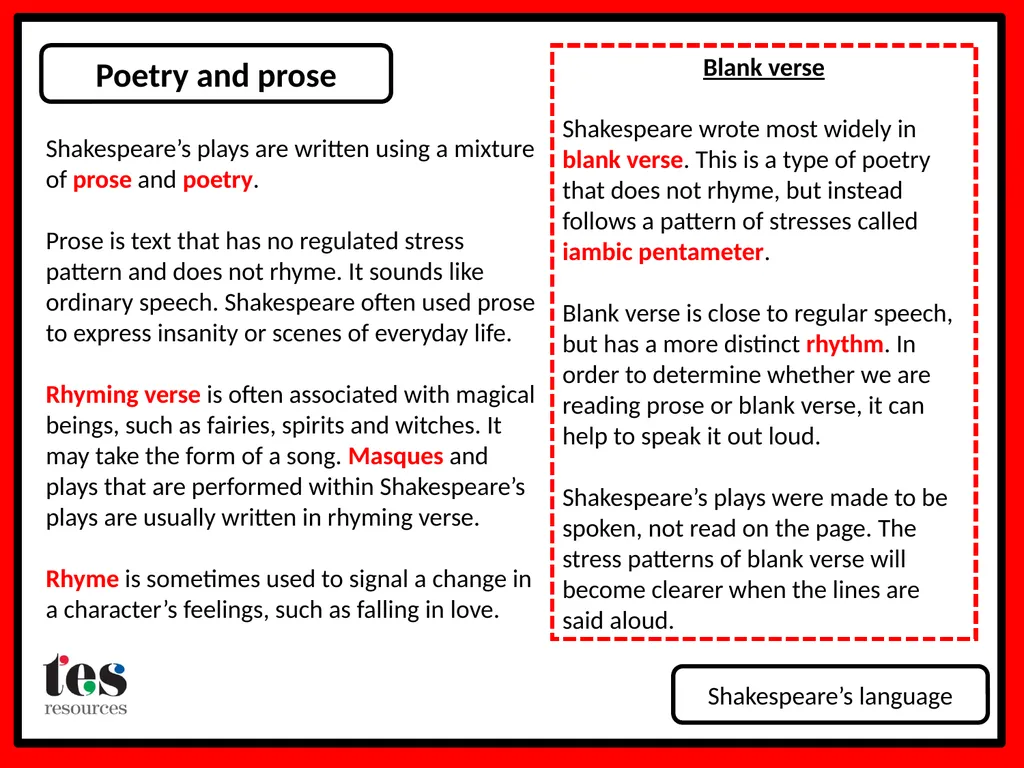
Poetry and prose Shakespeare’s language Blank verse
Shakespeare wrote most widely in blank verse. This is a type of poetry that does not rhyme, but instead follows a pattern of stresses called iambic pentameter.
Blank verse is close to regular speech, but has a more distinct rhythm. In order to determine whether we are reading prose or blank verse, it can help to speak it out loud.
Shakespeare’s plays were made to be spoken, not read on the page. The stress patterns of blank verse will become clearer when the lines are said aloud. Shakespeare’s plays are written using a mixture of prose and poetry.
Prose is text that has no regulated stress pattern and does not rhyme. It sounds like ordinary speech. Shakespeare often used prose to express insanity or scenes of everyday life.
Rhyming verse is often associated with magical beings, such as fairies, spirits and witches. It may take the form of a song. Masques and plays that are performed within Shakespeare’s plays are usually written in rhyming verse.
Rhyme is sometimes used to signal a change in a character’s feelings, such as falling in love.<br>
02
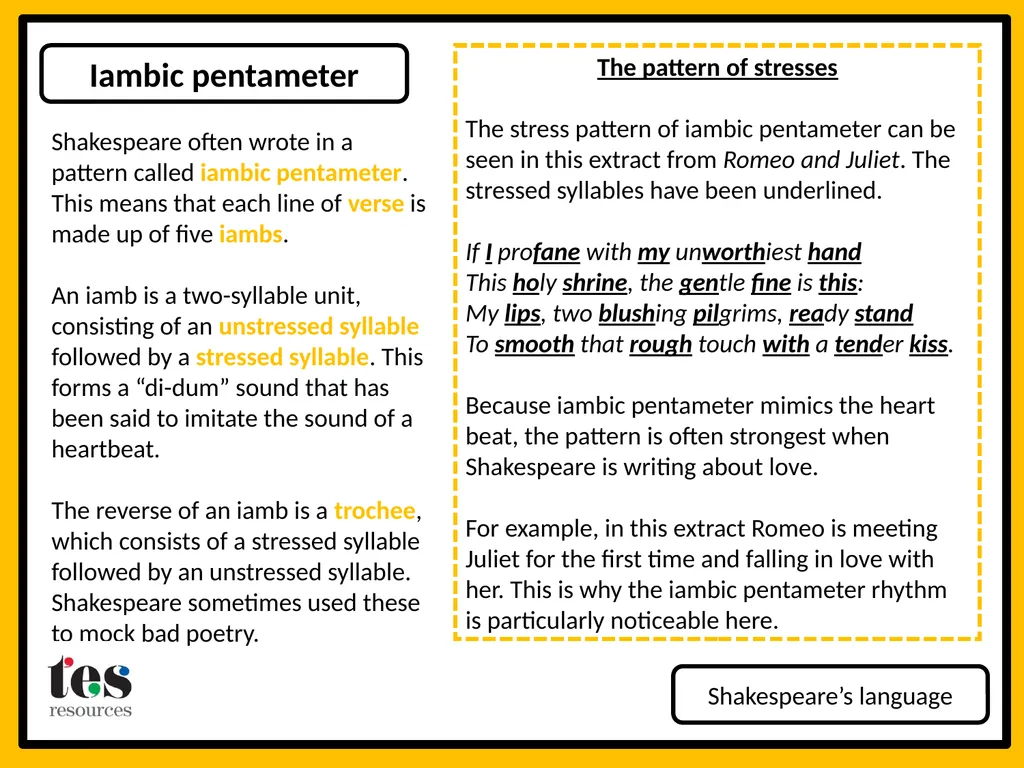
Iambic pentameter Shakespeare often wrote in a pattern called iambic pentameter. This means that each line of verse is made up of five iambs.
An iamb is a two-syllable unit, consisting of an unstressed syllable followed by a stressed syllable. This forms a “di-dum” sound that has been said to imitate the sound of a heartbeat.
The reverse of an iamb is a trochee, which consists of a stressed syllable followed by an unstressed syllable. Shakespeare sometimes used these to mock bad poetry. The pattern of stresses
The stress pattern of iambic pentameter can be seen in this extract from Romeo and Juliet. The stressed syllables have been underlined.
If I profane with my unworthiest hand This holy shrine, the gentle fine is this: My lips, two blushing pilgrims, ready stand To smooth that rough touch with a tender kiss.
Because iambic pentameter mimics the heart beat, the pattern is often strongest when Shakespeare is writing about love.
For example, in this extract Romeo is meeting Juliet for the first time and falling in love with her. This is why the iambic pentameter rhythm is particularly noticeable here. Shakespeare’s language<br>
03
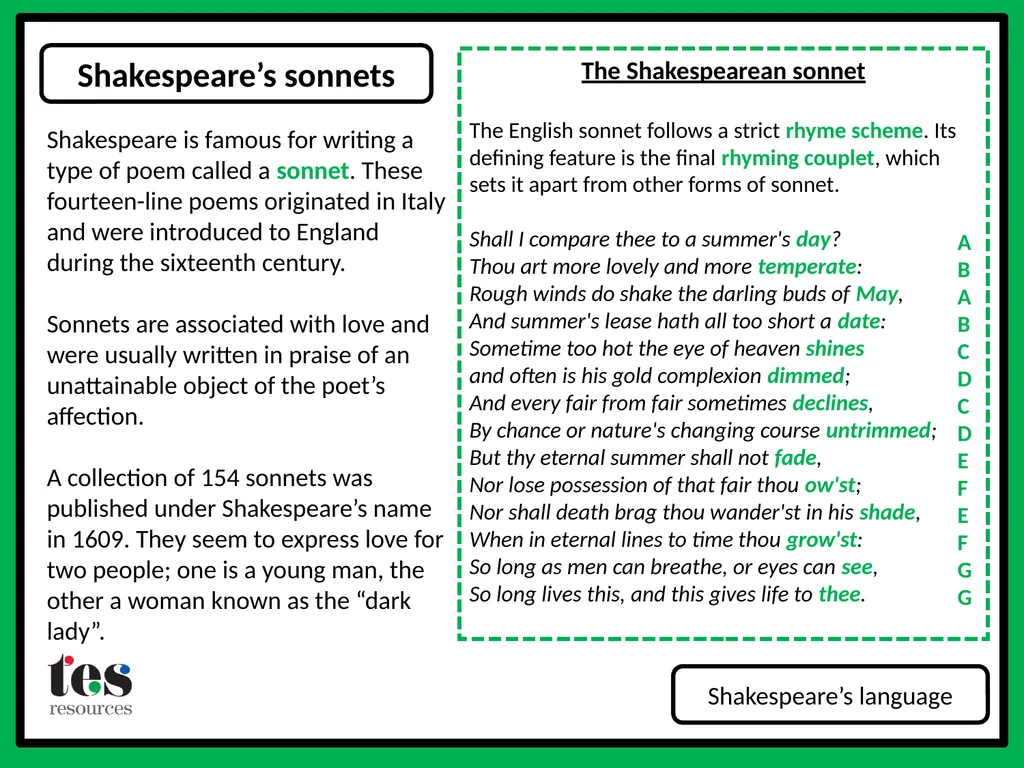
Shakespeare’s sonnets Shakespeare’s language The Shakespearean sonnet
The English sonnet follows a strict rhyme scheme. Its defining feature is the final rhyming couplet, which sets it apart from other forms of sonnet.
Shall I compare thee to a summer's day? Thou art more lovely and more temperate: Rough winds do shake the darling buds of May, And summer's lease hath all too short a date: Sometime too hot the eye of heaven shines and often is his gold complexion dimmed; And every fair from fair sometimes declines, By chance or nature's changing course untrimmed; But thy eternal summer shall not fade, Nor lose possession of that fair thou ow'st; Nor shall death brag thou wander'st in his shade, When in eternal lines to time thou grow'st: So long as men can breathe, or eyes can see, So long lives this, and this gives life to thee. A
B
A
B
CD
CD
EF
EF
GG Shakespeare is famous for writing a type of poem called a sonnet. These fourteen-line poems originated in Italy and were introduced to England during the sixteenth century.
Sonnets are associated with love and were usually written in praise of an unattainable object of the poet’s affection.
A collection of 154 sonnets was published under Shakespeare’s name in 1609. They seem to express love for two people; one is a young man, the other a woman known as the “dark lady”.<br>
04
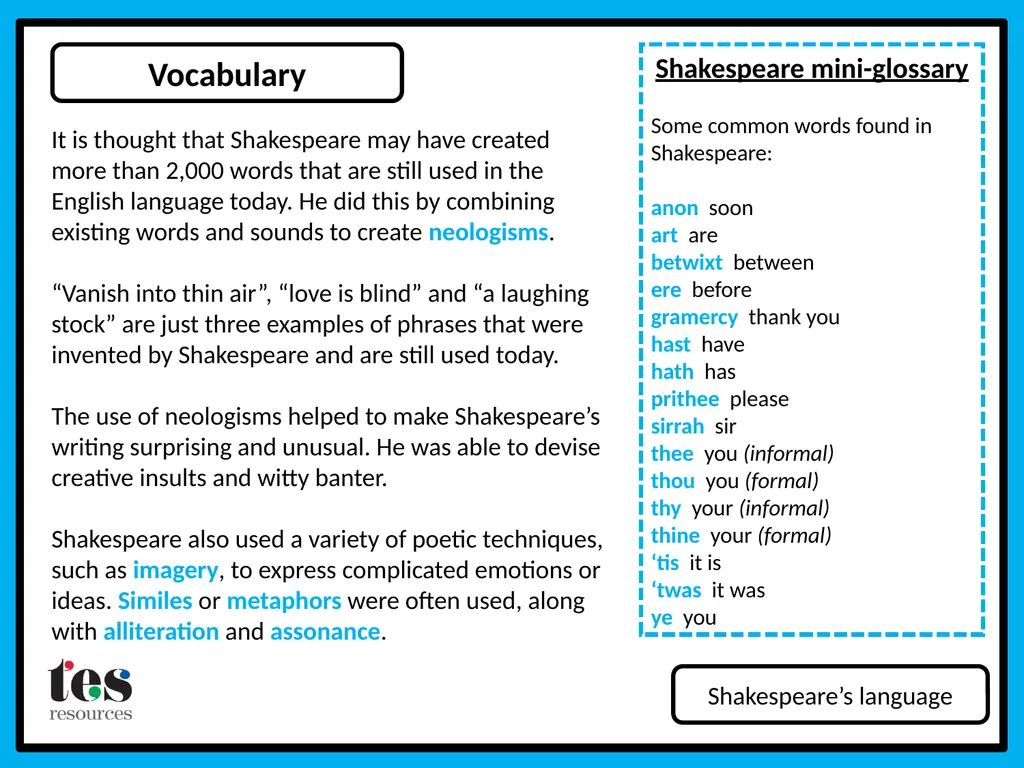
Vocabulary It is thought that Shakespeare may have created more than 2,000 words that are still used in the English language today. He did this by combining existing words and sounds to create neologisms.
“Vanish into thin air”, “love is blind” and “a laughing stock” are just three examples of phrases that were invented by Shakespeare and are still used today.
The use of neologisms helped to make Shakespeare’s writing surprising and unusual. He was able to devise creative insults and witty banter.
Shakespeare also used a variety of poetic techniques, such as imagery, to express complicated emotions or ideas. Similes or metaphors were often used, along with alliteration and assonance. Shakespeare mini-glossary
Some common words found in Shakespeare:
anon soon
art are
betwixt between
ere before gramercy thank you
hast have
hath has
prithee please
sirrah sir thee you (informal)
thou you (formal)
thy your (informal) thine your (formal) ‘tis it is
‘twas it was
ye you Shakespeare’s language<br>
05
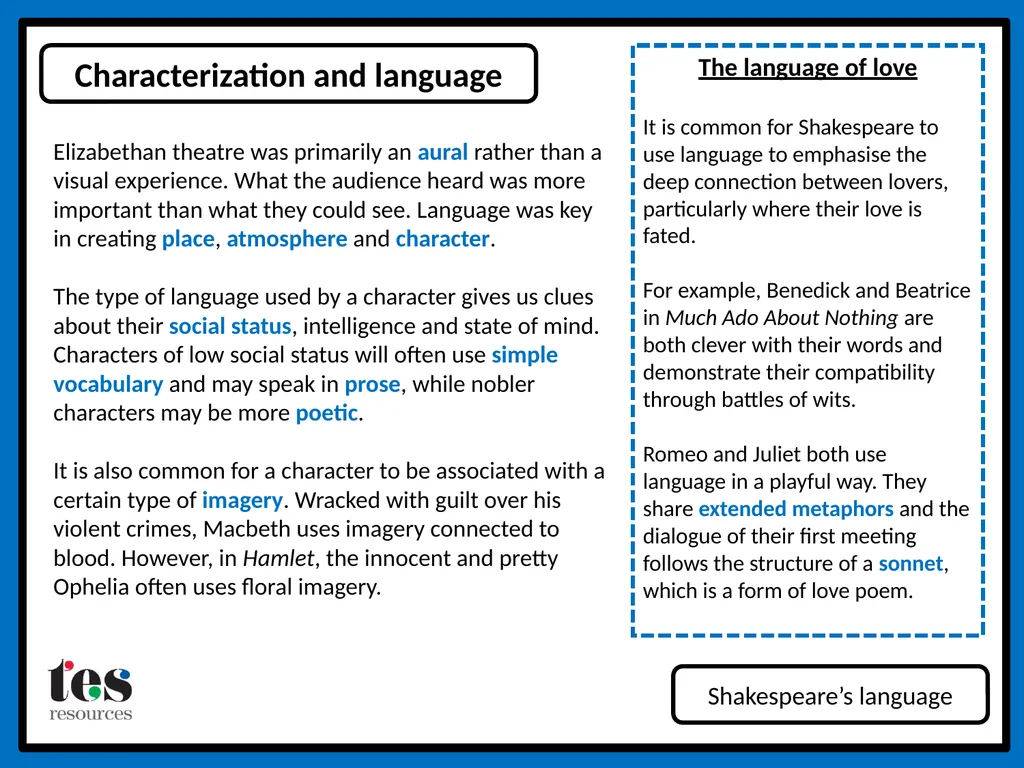
Characterization and language The language of love
It is common for Shakespeare to use language to emphasise the deep connection between lovers, particularly where their love is fated.
For example, Benedick and Beatrice in Much Ado About Nothing are both clever with their words and demonstrate their compatibility through battles of wits.
Romeo and Juliet both use language in a playful way. They share extended metaphors and the dialogue of their first meeting follows the structure of a sonnet, which is a form of love poem. Shakespeare’s language Elizabethan theatre was primarily an aural rather than a visual experience. What the audience heard was more important than what they could see. Language was key in creating place, atmosphere and character.
The type of language used by a character gives us clues about their social status, intelligence and state of mind. Characters of low social status will often use simple vocabulary and may speak in prose, while nobler characters may be more poetic.
It is also common for a character to be associated with a certain type of imagery. Wracked with guilt over his violent crimes, Macbeth uses imagery connected to blood. However, in Hamlet, the innocent and pretty Ophelia often uses floral imagery.<br>
06
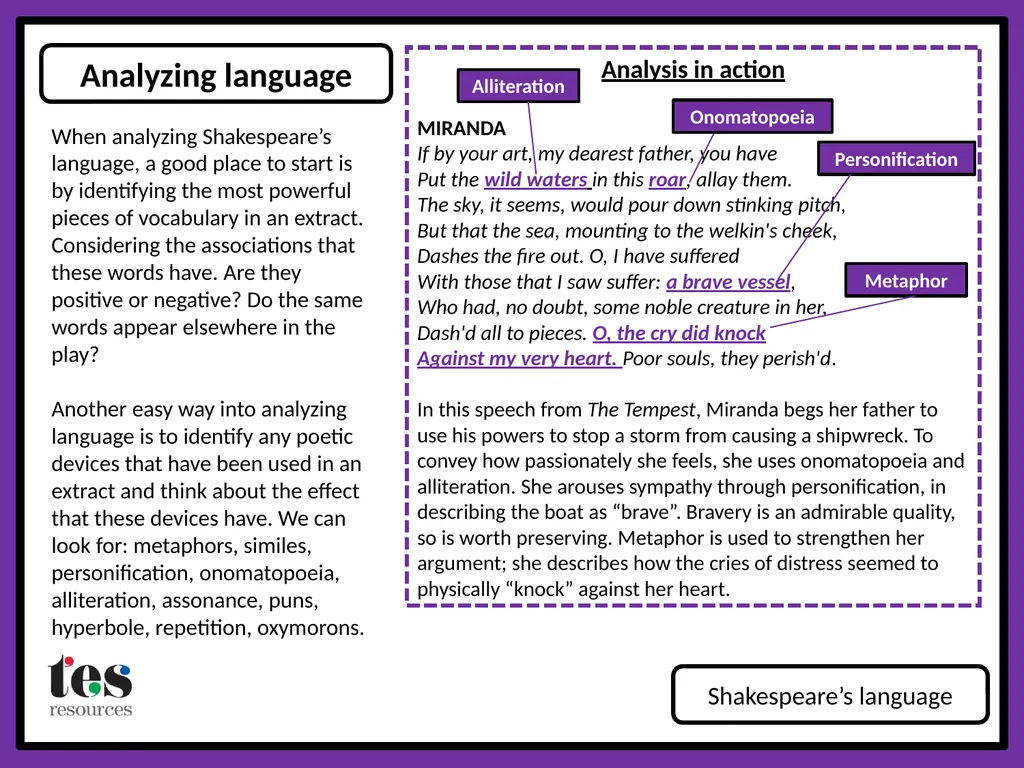
Analyzing language When analyzing Shakespeare’s language, a good place to start is by identifying the most powerful pieces of vocabulary in an extract. Considering the associations that these words have. Are they positive or negative? Do the same words appear elsewhere in the play?
Another easy way into analyzing language is to identify any poetic devices that have been used in an extract and think about the effect that these devices have. We can look for: metaphors, similes, personification, onomatopoeia, alliteration, assonance, puns, hyperbole, repetition, oxymorons. Analysis in action
MIRANDA
If by your art, my dearest father, you have Put the wild waters in this roar, allay them. The sky, it seems, would pour down stinking pitch, But that the sea, mounting to the welkin's cheek, Dashes the fire out. O, I have suffered With those that I saw suffer: a brave vessel, Who had, no doubt, some noble creature in her, Dash'd all to pieces. O, the cry did knock Against my very heart. Poor souls, they perish'd.
In this speech from The Tempest, Miranda begs her father to use his powers to stop a storm from causing a shipwreck. To convey how passionately she feels, she uses onomatopoeia and alliteration. She arouses sympathy through personification, in describing the boat as “brave”. Bravery is an admirable quality, so is worth preserving. Metaphor is used to strengthen her argument; she describes how the cries of distress seemed to physically “knock” against her heart. Shakespeare’s language Alliteration Personification Onomatopoeia Metaphor<br>