
Policy development in the framework of the 2003
LV
Published · 42 slides · 0 views

1 / 1


Description
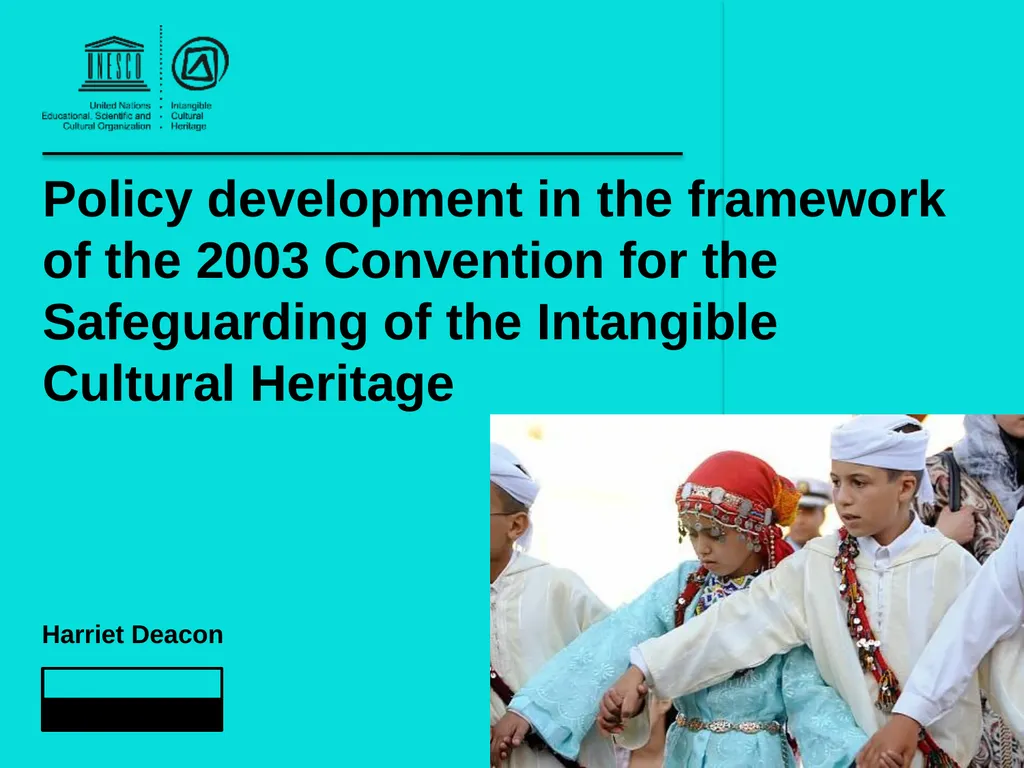
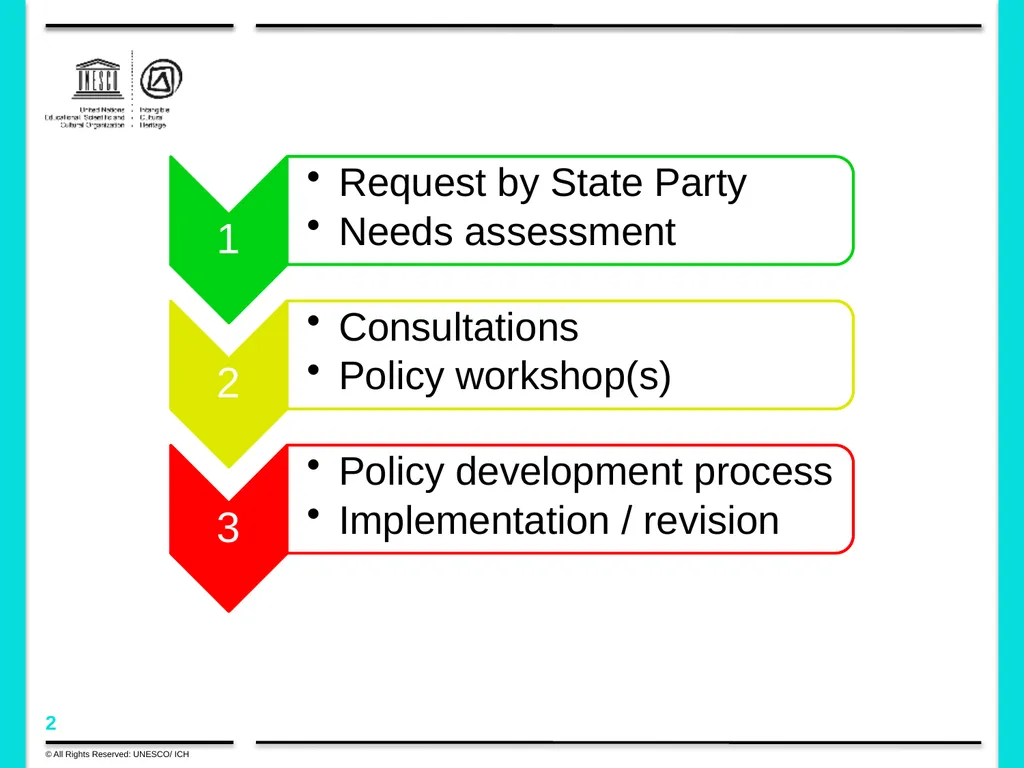
Policy development in the framework of the 2003 Convention for the Safeguarding of the Intangible Cultural Heritage Harriet Deacon All Rights Reserved: UNESCO ICH Overview ICH policy making under the Convention Experiences so far Policy
Related Topics
Share
Embed code
Download this presentation From Below
"Policy development in the framework of the 2003" is the property of its rightful owner. Permission is granted to download and print the materials on this website for personal, non-commercial use only, and to display it on your personal computer provided you do not modify the materials and that you retain all copyright notices contained in the materials. By downloading content from our website, you accept the terms of this agreement.
Presentation Transcript
01
Policy development in the framework of the 2003 Convention for the Safeguarding of the Intangible Cultural Heritage Harriet Deacon<br>
02
© All Rights Reserved: UNESCO/ ICH<br>
03
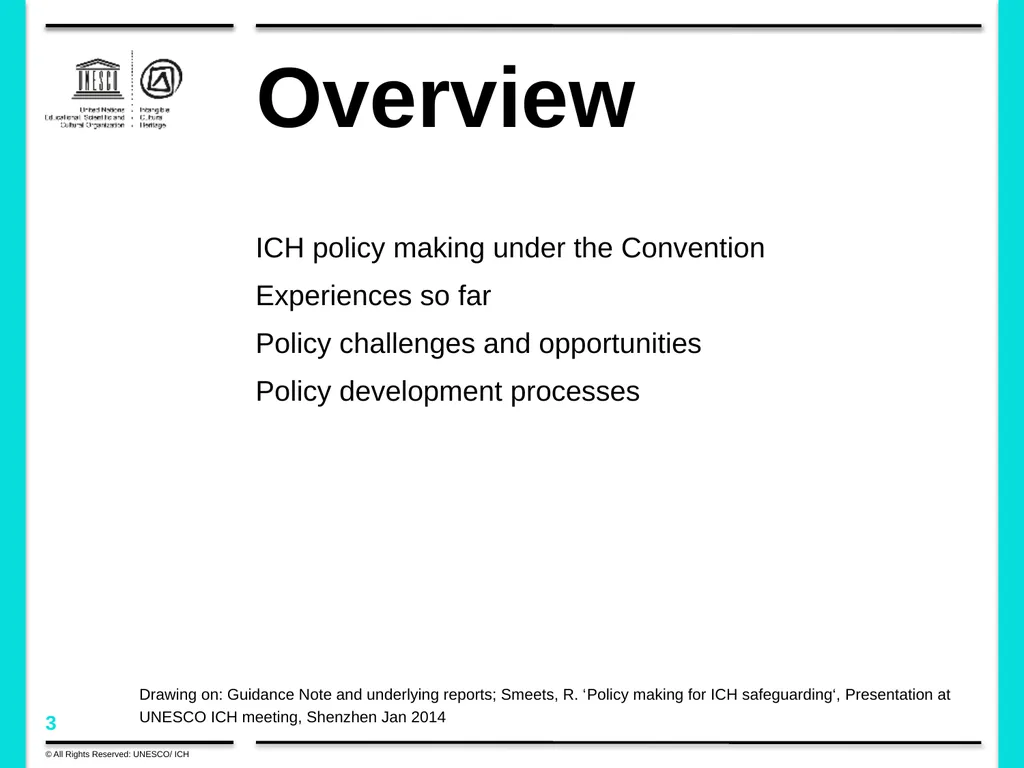
Overview ICH policy making under the Convention
Experiences so far
Policy challenges and opportunities
Policy development processes © All Rights Reserved: UNESCO/ ICH Drawing on: Guidance Note and underlying reports; Smeets, R. ‘Policy making for ICH safeguarding‘, Presentation at UNESCO ICH meeting, Shenzhen Jan 2014<br>
Experiences so far
Policy challenges and opportunities
Policy development processes © All Rights Reserved: UNESCO/ ICH Drawing on: Guidance Note and underlying reports; Smeets, R. ‘Policy making for ICH safeguarding‘, Presentation at UNESCO ICH meeting, Shenzhen Jan 2014<br>
04
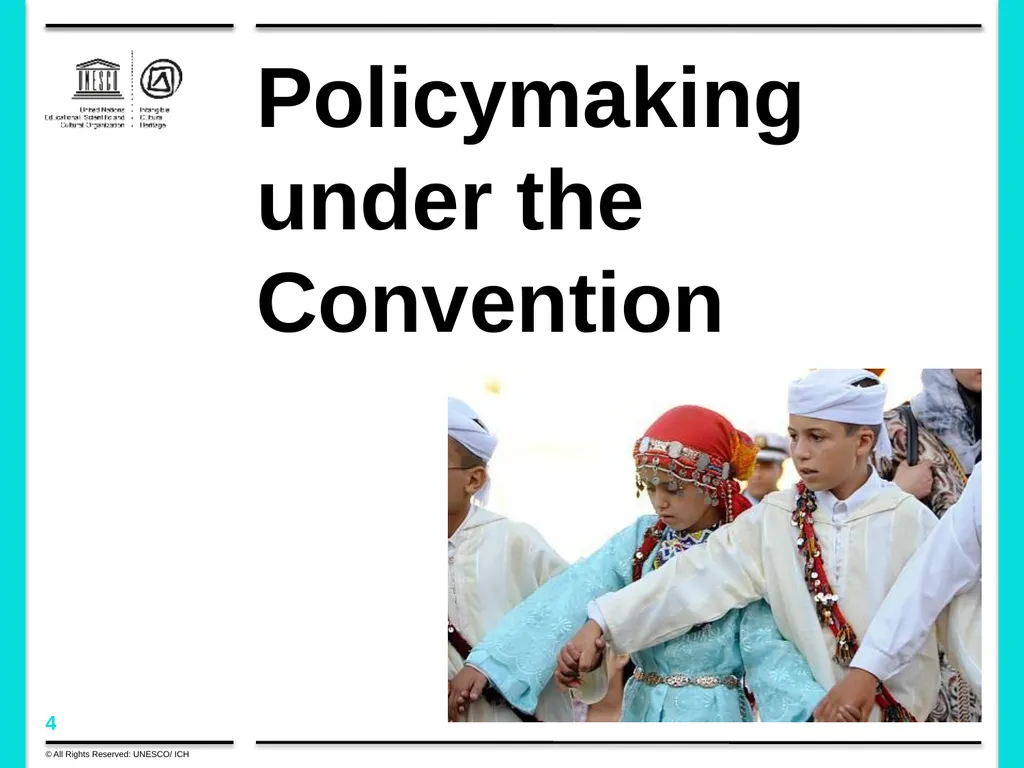
Policymaking under the Convention © All Rights Reserved: UNESCO/ ICH<br>
05
Policymaking encouraged Article 13
To ensure the safeguarding, development and promotion of the ICH present in its territory, each State Party shall endeavour to:
(a) adopt a general policy …
(d) adopt appropriate legal, technical, administrative and financial measures …<br>
To ensure the safeguarding, development and promotion of the ICH present in its territory, each State Party shall endeavour to:
(a) adopt a general policy …
(d) adopt appropriate legal, technical, administrative and financial measures …<br>
06
An infrastructure for safeguarding - I ICH-related policy, regulations and legislation (Article 13; ODs 103–105);
Bodies to assist in safeguarding with communities (Article 13(b-c); OD 109);
Consultative bodies or coordination mechanisms with community representation …(OD 80);
Documentation centres for management and access to information about the ICH (Article 13(d); OD 109);<br>
Bodies to assist in safeguarding with communities (Article 13(b-c); OD 109);
Consultative bodies or coordination mechanisms with community representation …(OD 80);
Documentation centres for management and access to information about the ICH (Article 13(d); OD 109);<br>
07
An infrastructure for safeguarding - II Building capacity for safeguarding (13(d)(i), 14, OD 82, 86, 107(k) and 109);
Encouraging cooperation and networking between communities, and between communities and other stakeholders (ODs 79–80, 86 and 88);
Financial measures (Article 13(d) and OD 78); and
Sharing expertise and information internationally (Articles 1(d) and 19, ODs 86–88).<br>
Encouraging cooperation and networking between communities, and between communities and other stakeholders (ODs 79–80, 86 and 88);
Financial measures (Article 13(d) and OD 78); and
Sharing expertise and information internationally (Articles 1(d) and 19, ODs 86–88).<br>
08
In the spirit of the Convention Policy to support the safeguarding of ICH should ideally …
Promote recognition of diversity of ICH (Article 1, Preamble),
Promote community participation in ICH safeguarding activities (Article 15, 11(b));
Respect the principles of human rights, sustainable development and mutual respect (Article 2.1); and
Promote international cooperation and assistance (Articles 19-20).<br>
Promote recognition of diversity of ICH (Article 1, Preamble),
Promote community participation in ICH safeguarding activities (Article 15, 11(b));
Respect the principles of human rights, sustainable development and mutual respect (Article 2.1); and
Promote international cooperation and assistance (Articles 19-20).<br>
09
Where is the emphasis? © All Rights Reserved: UNESCO/ ICH State encourages communities in their safeguarding activities, and assists in creating a supporting infrastructure
NGOs, research institutions and centres of expertise play a supportive role
Emphasis on community involvement in identification and safeguarding of their ICH<br>
NGOs, research institutions and centres of expertise play a supportive role
Emphasis on community involvement in identification and safeguarding of their ICH<br>
10
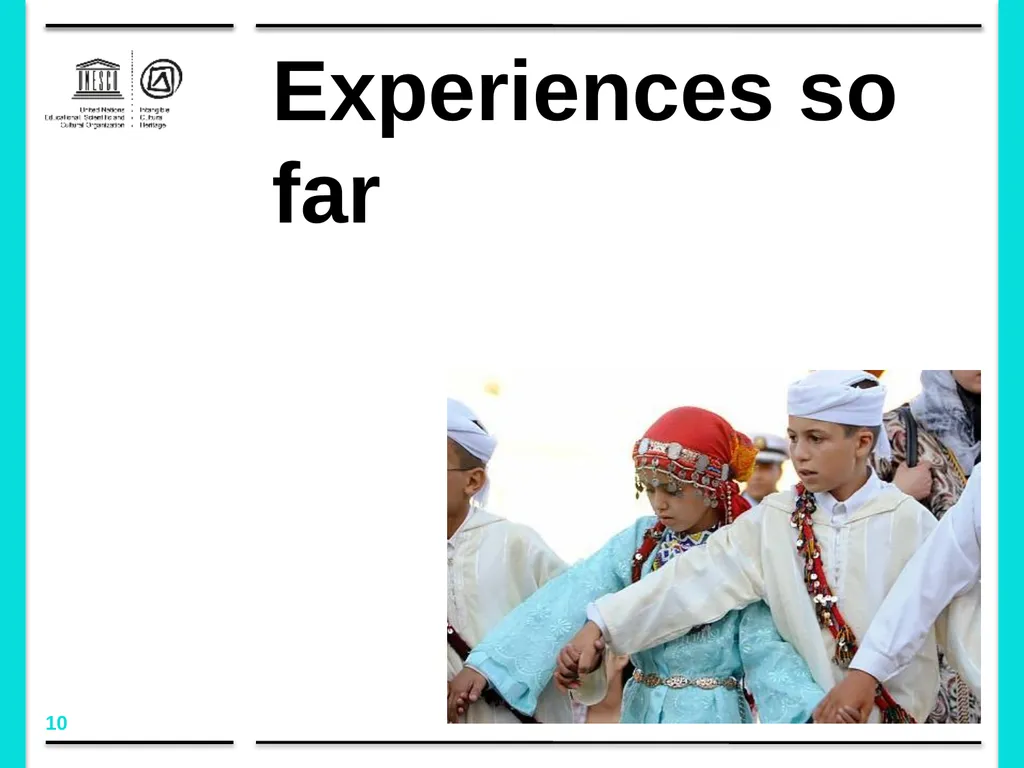
Experiences so far<br>
11
IOS evaluation: 75% of reporting States (29 out of 41 in 2011-13) developed some kind of new ICH safeguarding policy
UNESCO hosts a database of national cultural heritage laws, which can be consulted for a broader range of ICH policies; 250 entries, according to the database classification system, are ICH-related laws. http://www.unesco.org/culture/natlaws/index.php
The World Intellectual Property Organization (WIPO) maintains a database of legislation that can be filtered for entries pertaining to Traditional Cultural Expressions (1,018 entries) and Traditional Knowledge (1,965 entries).
http://www.wipo.int/wipolex/en/results.jsp?countries=&cat_id=16
http://www.wipo.int/wipolex/en/results.jsp?countries=&cat_id=18 National policy-making grows<br>
UNESCO hosts a database of national cultural heritage laws, which can be consulted for a broader range of ICH policies; 250 entries, according to the database classification system, are ICH-related laws. http://www.unesco.org/culture/natlaws/index.php
The World Intellectual Property Organization (WIPO) maintains a database of legislation that can be filtered for entries pertaining to Traditional Cultural Expressions (1,018 entries) and Traditional Knowledge (1,965 entries).
http://www.wipo.int/wipolex/en/results.jsp?countries=&cat_id=16
http://www.wipo.int/wipolex/en/results.jsp?countries=&cat_id=18 National policy-making grows<br>
12
Diversity in approaches Specific ICH policies
ICH policies integrated into overall culture policies
Devolved policy arrangements for ICH
New institutions or directorates responsible for ICH
Broader mandates of existing institutions responsible for ICH
Policies for specific ICH elements
Living Human Treasures policies
Provisions for specific communities and their ICH<br>
ICH policies integrated into overall culture policies
Devolved policy arrangements for ICH
New institutions or directorates responsible for ICH
Broader mandates of existing institutions responsible for ICH
Policies for specific ICH elements
Living Human Treasures policies
Provisions for specific communities and their ICH<br>
13
Why this diversity? Regional and international influences;
Approaches before ratification;
Interpretations of the Convention;
Reasons for ratifying the Convention; and
Socio-political, historical and economic contexts<br>
Approaches before ratification;
Interpretations of the Convention;
Reasons for ratifying the Convention; and
Socio-political, historical and economic contexts<br>
14
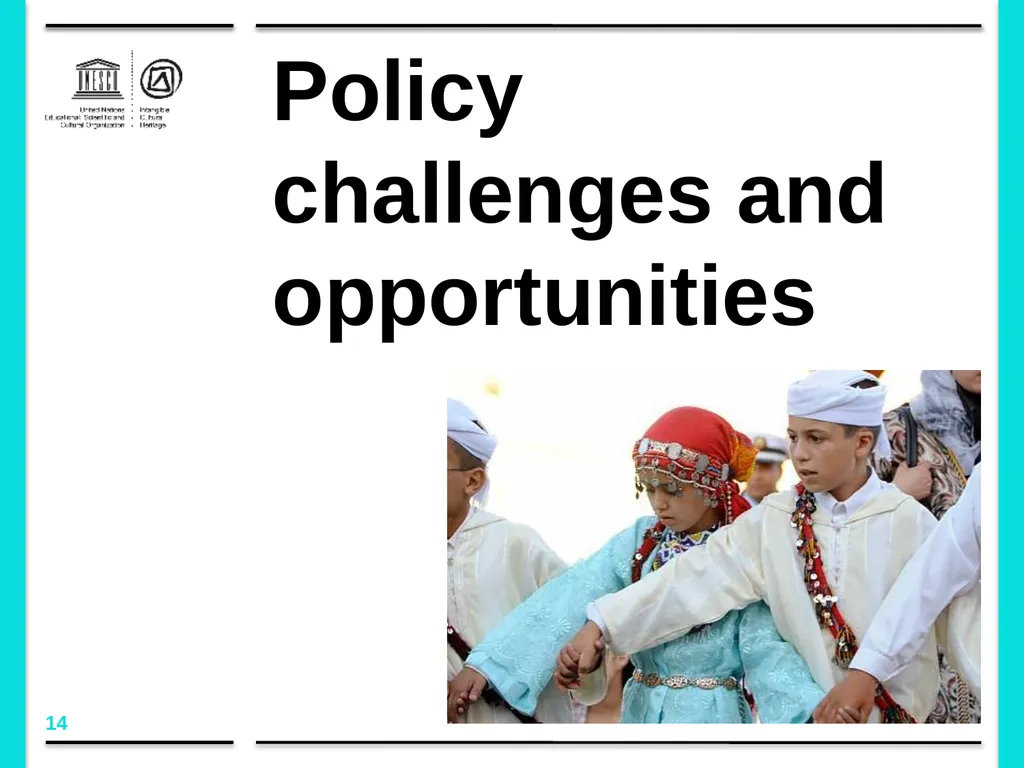
Policy challenges and opportunities<br>
15
General context
Within the culture sector
Operational challenges © All Rights Reserved: UNESCO/ ICH Challenges and opportunities<br>
Within the culture sector
Operational challenges © All Rights Reserved: UNESCO/ ICH Challenges and opportunities<br>
16
1. General challenges and opportunities New area for policy development; different reasons for making ICH policy
No detailed guidance on policymaking in the Convention and its ODs - policymaking encouraged but not a binding obligation
Complexity of integration into existing policy agendas
Different policy roles for ‘culture’ as concept
Low political priority given to culture<br>
No detailed guidance on policymaking in the Convention and its ODs - policymaking encouraged but not a binding obligation
Complexity of integration into existing policy agendas
Different policy roles for ‘culture’ as concept
Low political priority given to culture<br>
17
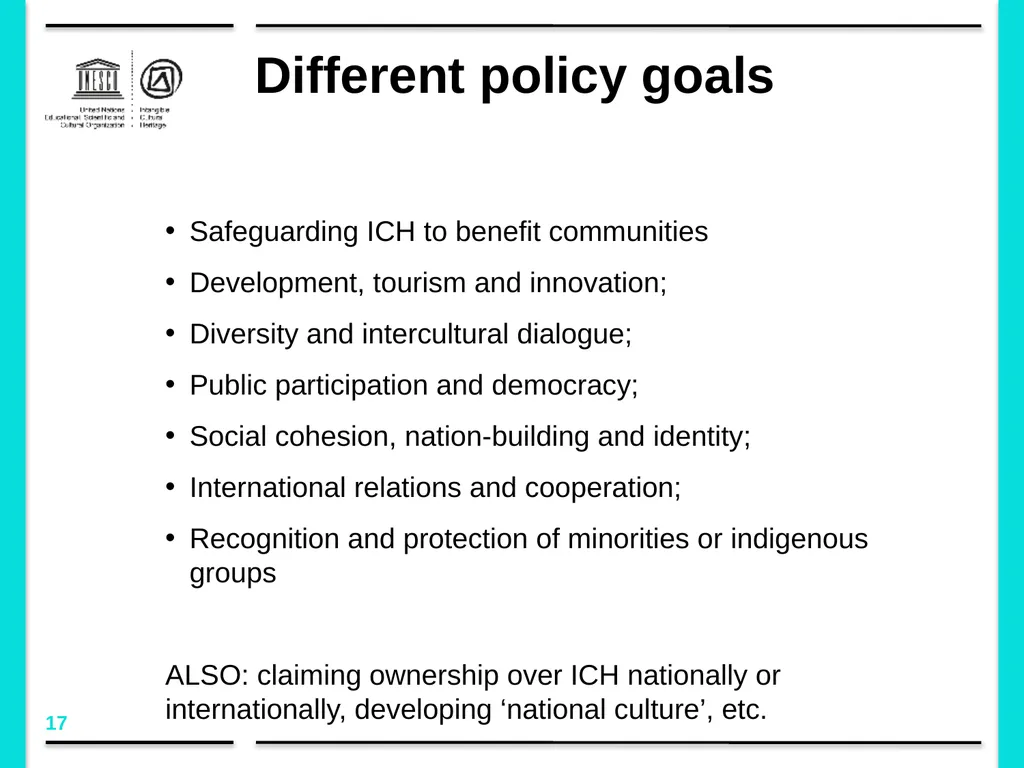
Different policy goals Safeguarding ICH to benefit communities
Development, tourism and innovation;
Diversity and intercultural dialogue;
Public participation and democracy;
Social cohesion, nation-building and identity;
International relations and cooperation;
Recognition and protection of minorities or indigenous groups
ALSO: claiming ownership over ICH nationally or internationally, developing ‘national culture’, etc.<br>
Development, tourism and innovation;
Diversity and intercultural dialogue;
Public participation and democracy;
Social cohesion, nation-building and identity;
International relations and cooperation;
Recognition and protection of minorities or indigenous groups
ALSO: claiming ownership over ICH nationally or internationally, developing ‘national culture’, etc.<br>
18
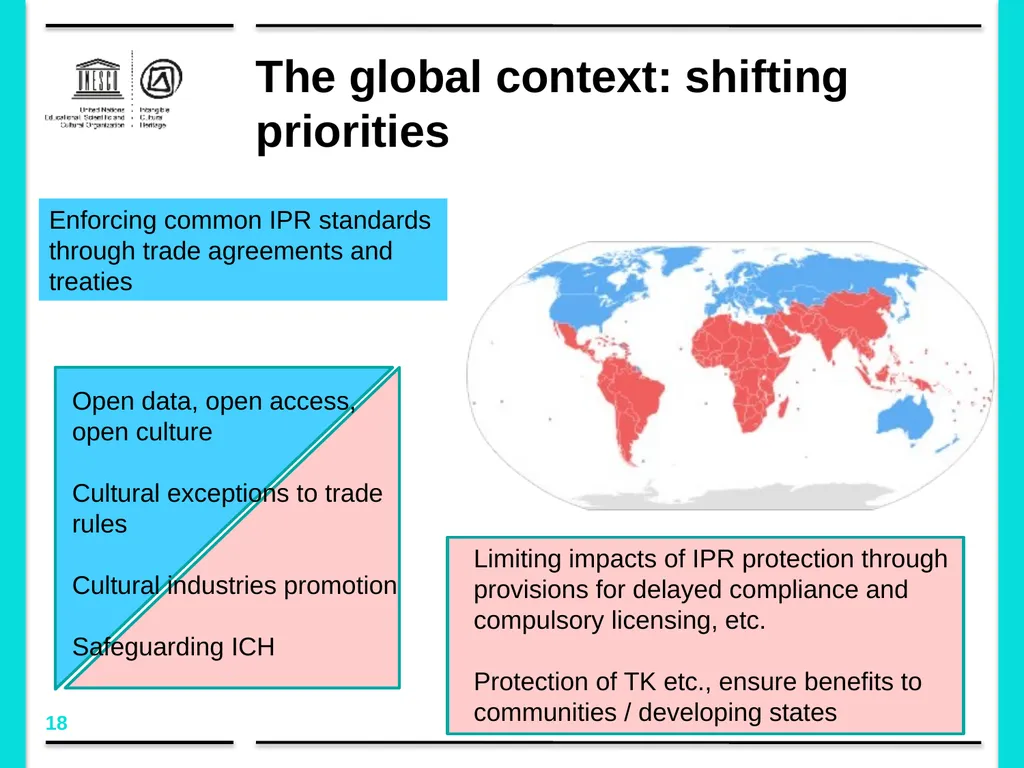
The global context: shifting priorities Limiting impacts of IPR protection through provisions for delayed compliance and compulsory licensing, etc.
Protection of TK etc., ensure benefits to communities / developing states Enforcing common IPR standards through trade agreements and treaties Open data, open access, open culture
Cultural exceptions to trade rules
Cultural industries promotion
Safeguarding ICH<br>
Protection of TK etc., ensure benefits to communities / developing states Enforcing common IPR standards through trade agreements and treaties Open data, open access, open culture
Cultural exceptions to trade rules
Cultural industries promotion
Safeguarding ICH<br>
19
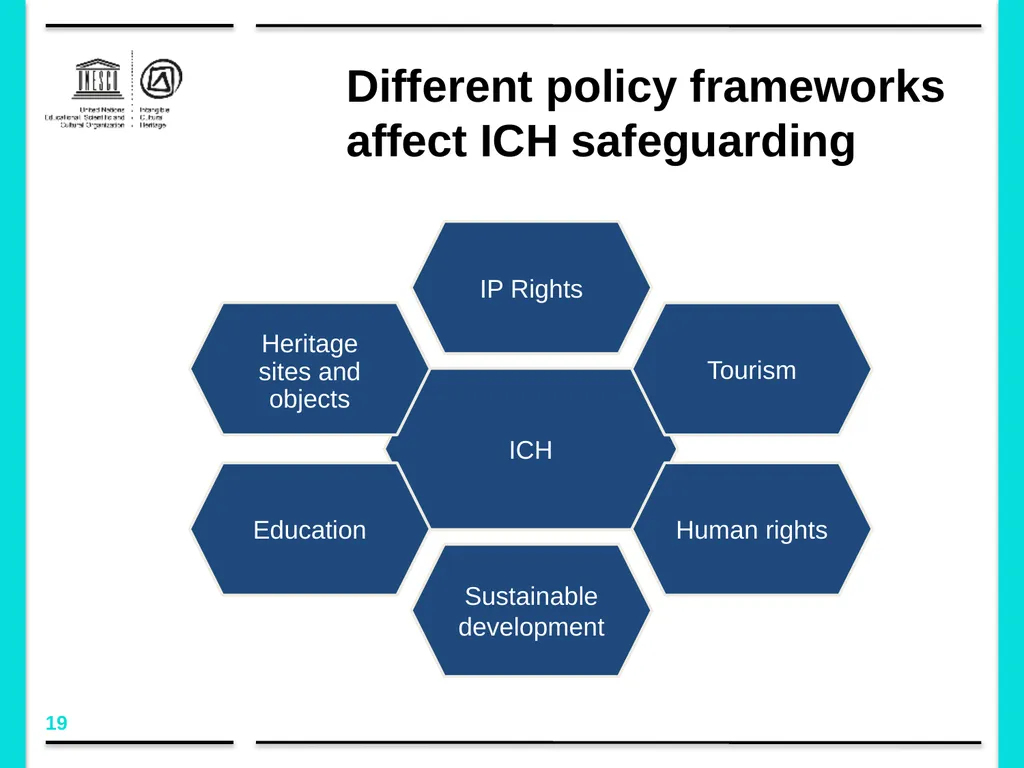
Different policy frameworks affect ICH safeguarding<br>
20
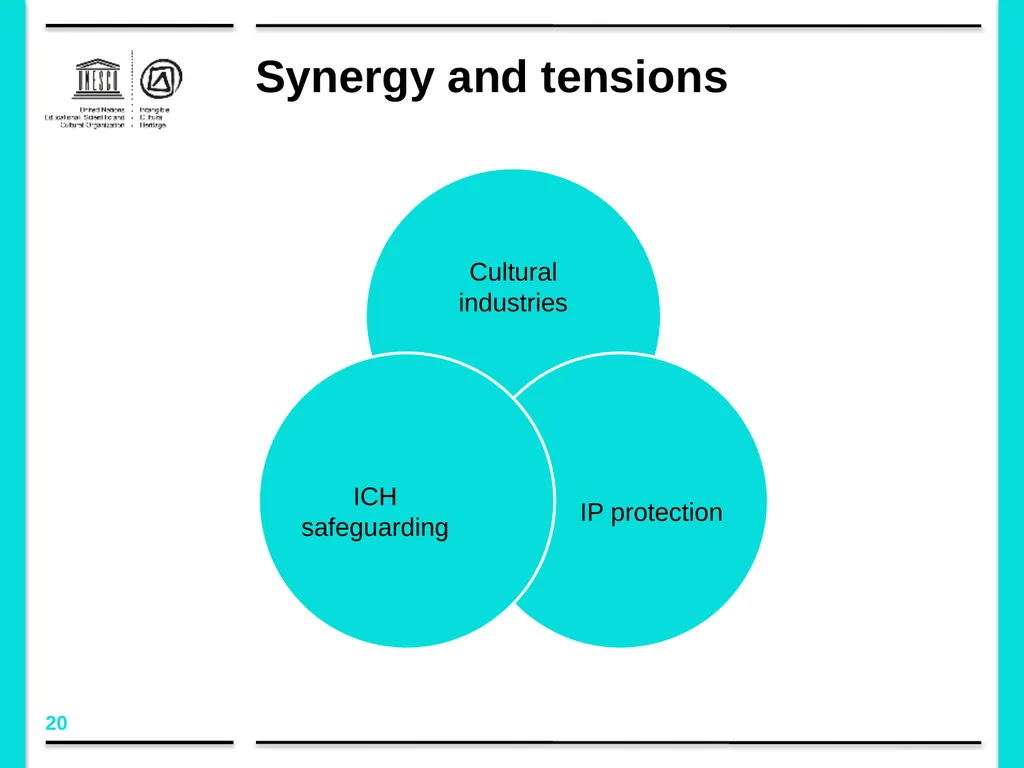
Synergy and tensions<br>
21
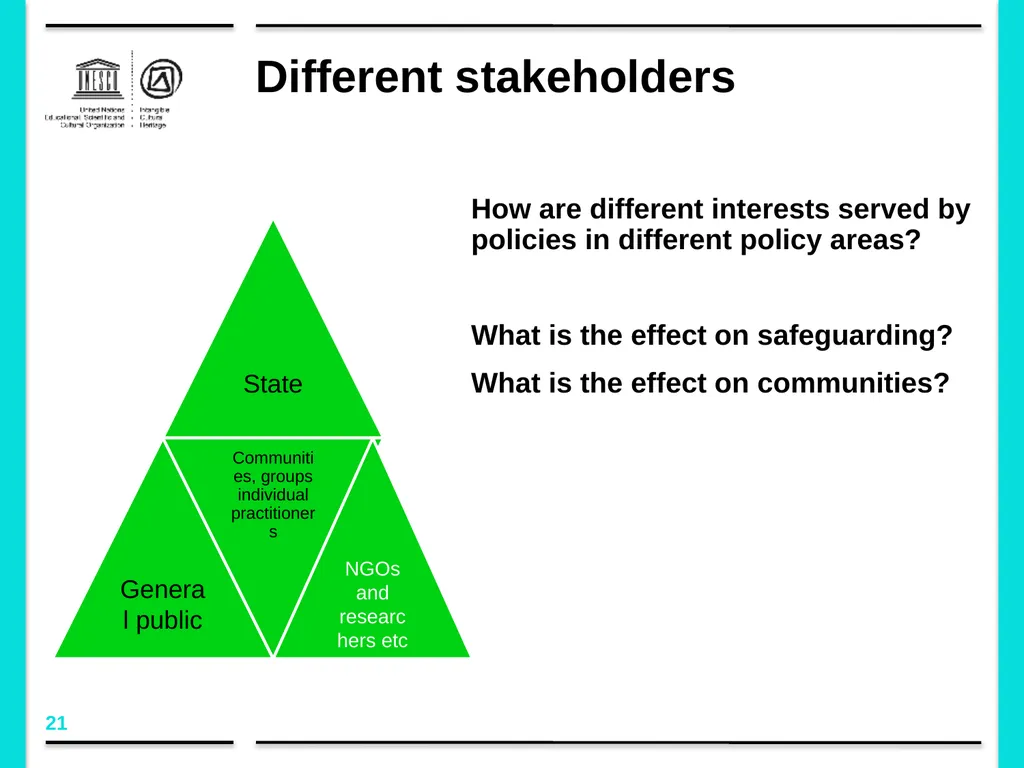
Different stakeholders How are different interests served by policies in different policy areas?
What is the effect on safeguarding?
What is the effect on communities?<br>
What is the effect on safeguarding?
What is the effect on communities?<br>
22
The work that ‘culture’ does Culture as ‘civilization of the nation’ (a model for everyone)
Culture as identity (freedom of association, expression)
Culture as a reason for giving specific rights or allowing exceptions to rights provisions for certain groups and not others
Culture as creativity (promoting individual artistry)<br>
Culture as identity (freedom of association, expression)
Culture as a reason for giving specific rights or allowing exceptions to rights provisions for certain groups and not others
Culture as creativity (promoting individual artistry)<br>
23
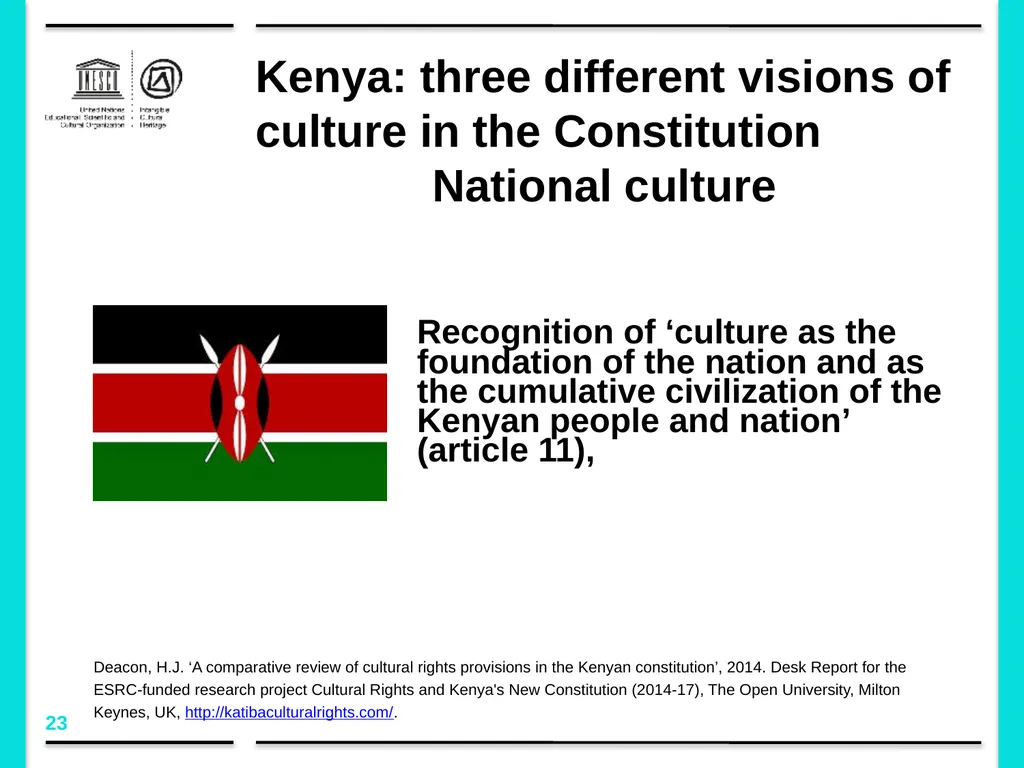
Kenya: three different visions of culture in the Constitution
National culture Recognition of ‘culture as the foundation of the nation and as the cumulative civilization of the Kenyan people and nation’ (article 11), Deacon, H.J. ‘A comparative review of cultural rights provisions in the Kenyan constitution’, 2014. Desk Report for the ESRC-funded research project Cultural Rights and Kenya's New Constitution (2014-17), The Open University, Milton Keynes, UK, http://katibaculturalrights.com/.<br>
24
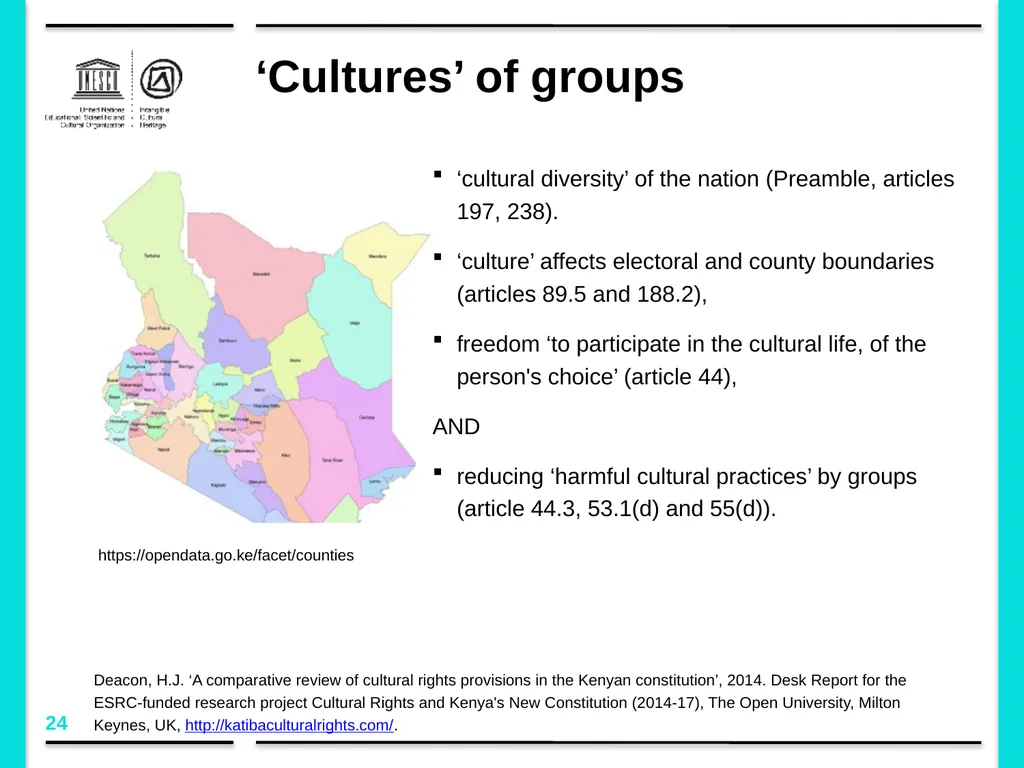
‘Cultures’ of groups ‘cultural diversity’ of the nation (Preamble, articles 197, 238).
‘culture’ affects electoral and county boundaries (articles 89.5 and 188.2),
freedom ‘to participate in the cultural life, of the person's choice’ (article 44),
AND
reducing ‘harmful cultural practices’ by groups (article 44.3, 53.1(d) and 55(d)). https://opendata.go.ke/facet/counties Deacon, H.J. ‘A comparative review of cultural rights provisions in the Kenyan constitution’, 2014. Desk Report for the ESRC-funded research project Cultural Rights and Kenya's New Constitution (2014-17), The Open University, Milton Keynes, UK, http://katibaculturalrights.com/.<br>
‘culture’ affects electoral and county boundaries (articles 89.5 and 188.2),
freedom ‘to participate in the cultural life, of the person's choice’ (article 44),
AND
reducing ‘harmful cultural practices’ by groups (article 44.3, 53.1(d) and 55(d)). https://opendata.go.ke/facet/counties Deacon, H.J. ‘A comparative review of cultural rights provisions in the Kenyan constitution’, 2014. Desk Report for the ESRC-funded research project Cultural Rights and Kenya's New Constitution (2014-17), The Open University, Milton Keynes, UK, http://katibaculturalrights.com/.<br>
25
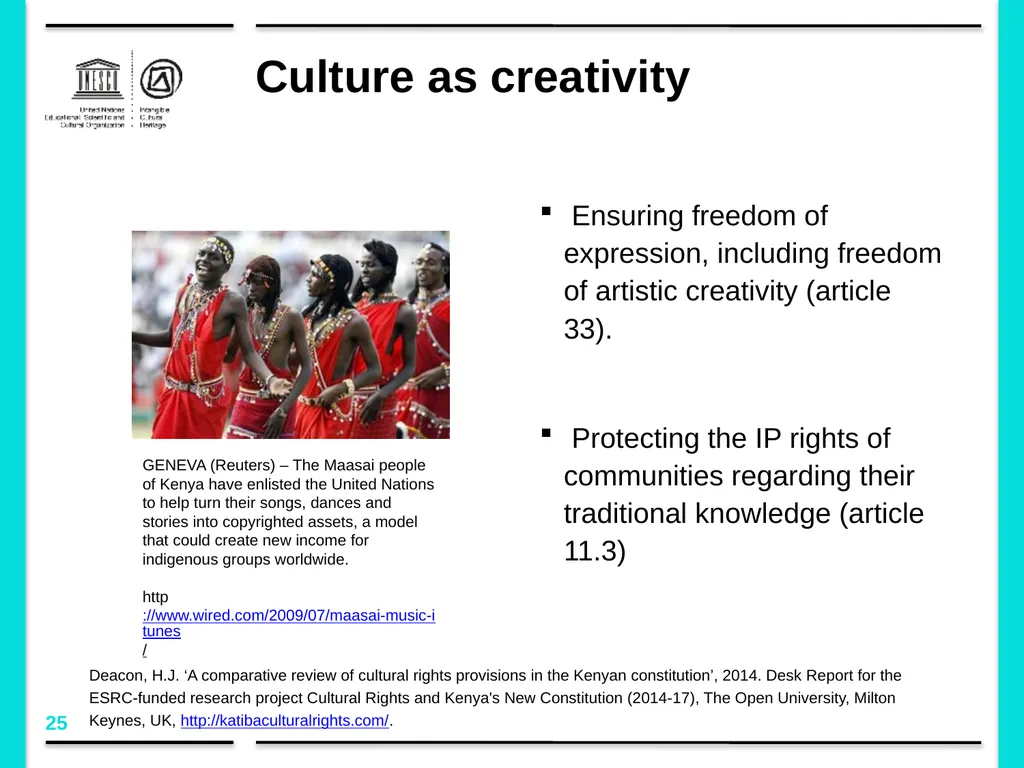
Culture as creativity Ensuring freedom of expression, including freedom of artistic creativity (article 33).
Protecting the IP rights of communities regarding their traditional knowledge (article 11.3) GENEVA (Reuters) – The Maasai people of Kenya have enlisted the United Nations to help turn their songs, dances and stories into copyrighted assets, a model that could create new income for indigenous groups worldwide.
http://www.wired.com/2009/07/maasai-music-itunes/ Deacon, H.J. ‘A comparative review of cultural rights provisions in the Kenyan constitution’, 2014. Desk Report for the ESRC-funded research project Cultural Rights and Kenya's New Constitution (2014-17), The Open University, Milton Keynes, UK, http://katibaculturalrights.com/.<br>
Protecting the IP rights of communities regarding their traditional knowledge (article 11.3) GENEVA (Reuters) – The Maasai people of Kenya have enlisted the United Nations to help turn their songs, dances and stories into copyrighted assets, a model that could create new income for indigenous groups worldwide.
http://www.wired.com/2009/07/maasai-music-itunes/ Deacon, H.J. ‘A comparative review of cultural rights provisions in the Kenyan constitution’, 2014. Desk Report for the ESRC-funded research project Cultural Rights and Kenya's New Constitution (2014-17), The Open University, Milton Keynes, UK, http://katibaculturalrights.com/.<br>
26
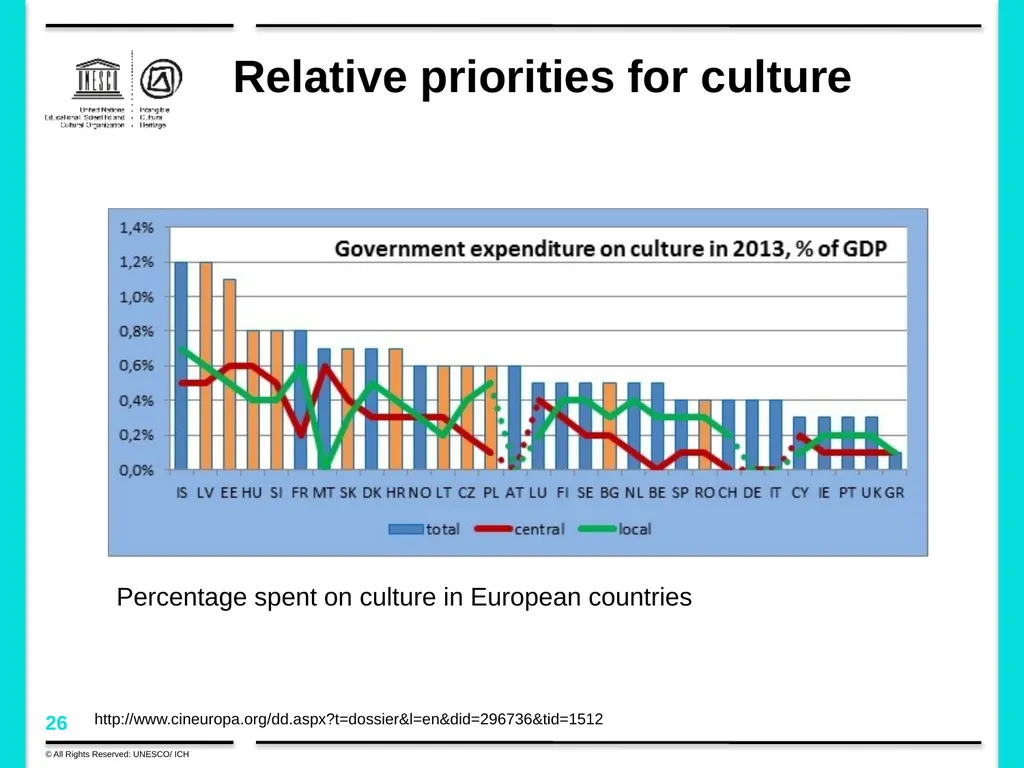
Relative priorities for culture © All Rights Reserved: UNESCO/ ICH Percentage spent on culture in European countries http://www.cineuropa.org/dd.aspx?t=dossier&l=en&did=296736&tid=1512<br>
27
2. Challenges and opportunities within the culture sector Relationships between policies within the culture sector; some vested interests
Safeguarding measures can be tailored to specific situations, but ICH policy needs to accommodate diversity and change
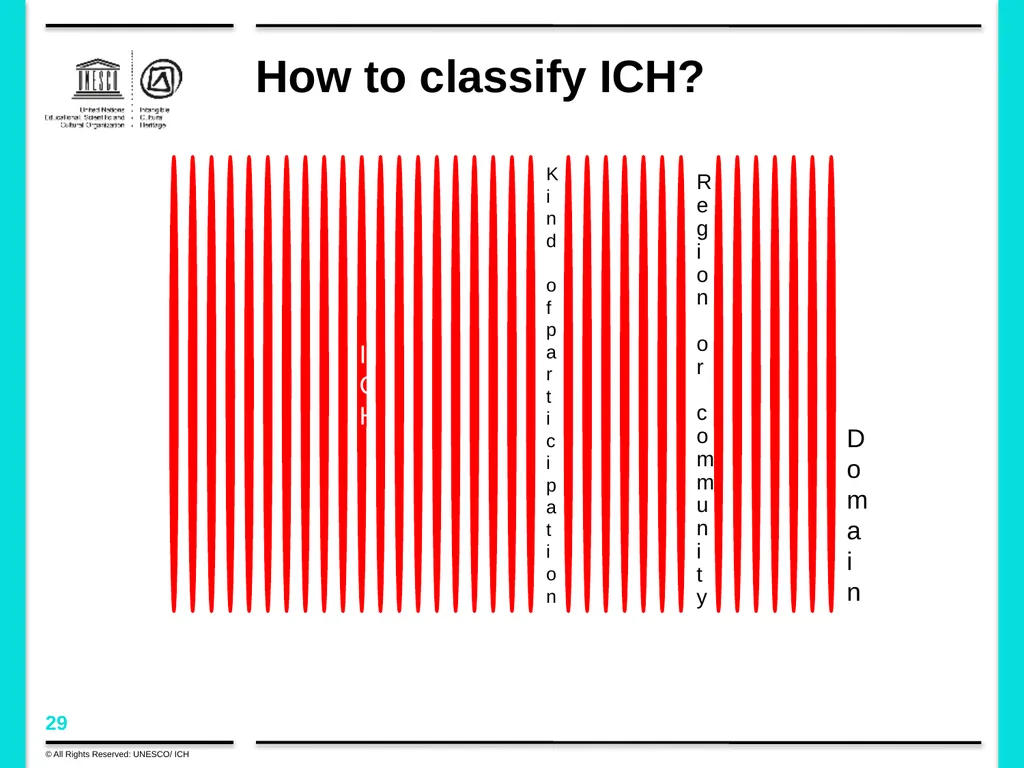
Variety of ICH forms and domains: how to classify?
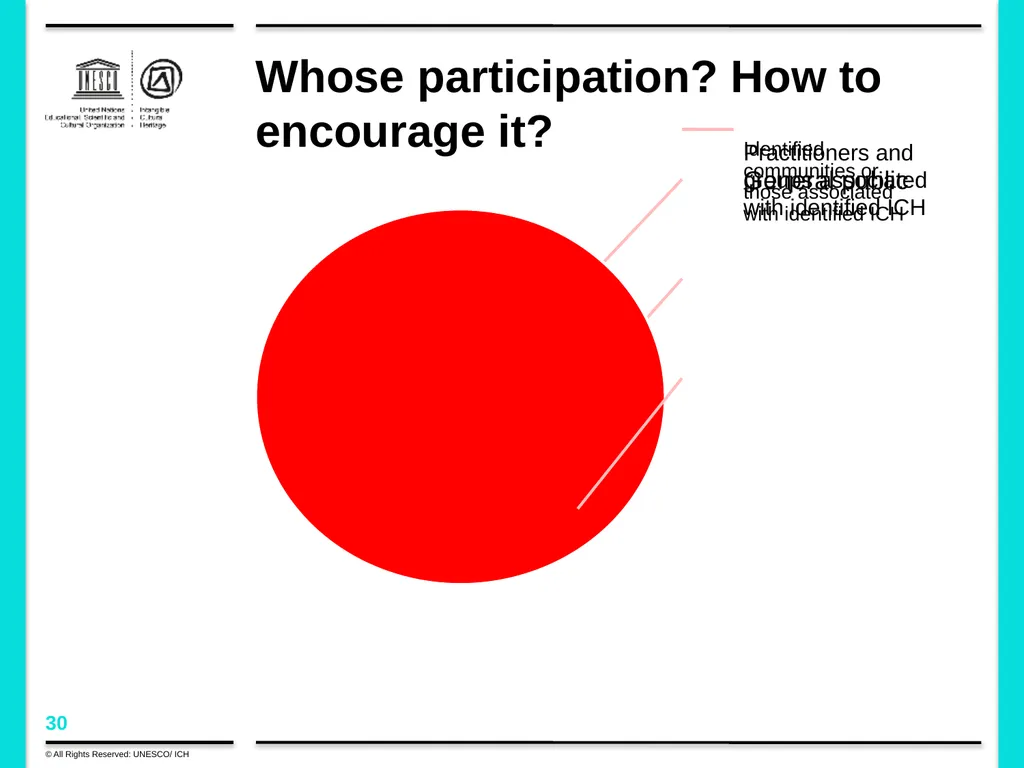
Diversity of communities and groups concerned: how to encourage participation?<br>
Safeguarding measures can be tailored to specific situations, but ICH policy needs to accommodate diversity and change
Variety of ICH forms and domains: how to classify?
Diversity of communities and groups concerned: how to encourage participation?<br>
28
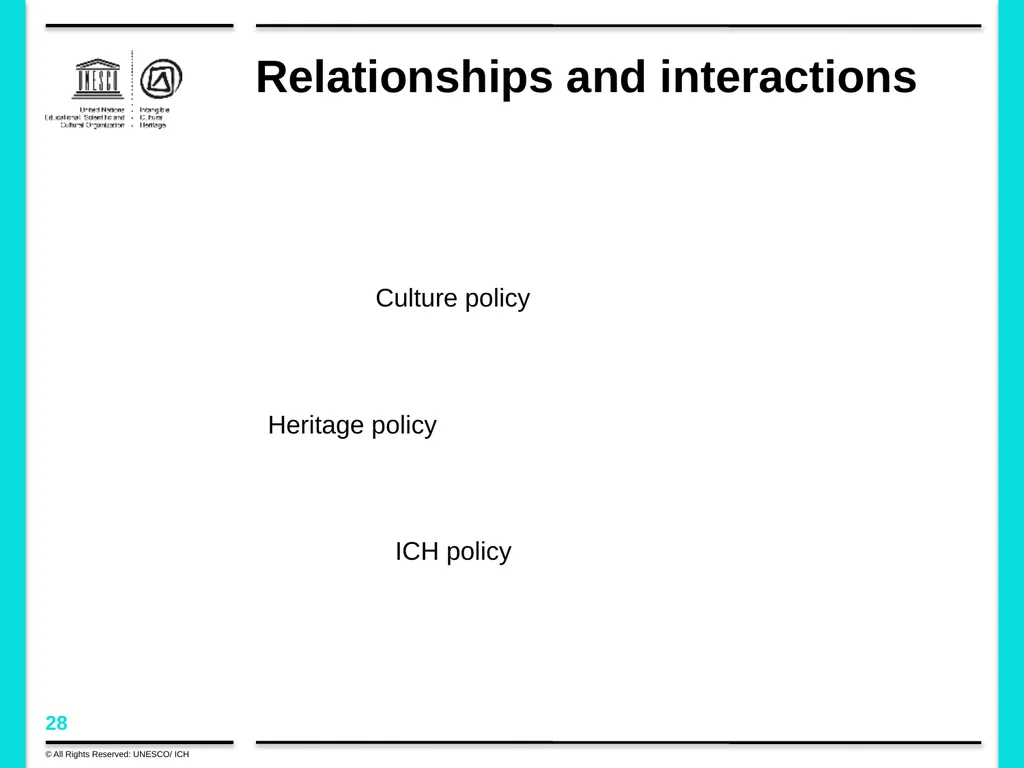
Relationships and interactions © All Rights Reserved: UNESCO/ ICH<br>
29
How to classify ICH? © All Rights Reserved: UNESCO/ ICH<br>
30
Whose participation? How to encourage it? © All Rights Reserved: UNESCO/ ICH<br>
31
Broad definition of communities
Enabling consultation and cooperation between communities and other stakeholders
Ensuring representatives have appropriate mandates
Proof of free, prior and informed consent from communities
Access and benefit sharing agreements with communities
Community involvement in institutional arrangements
Benefit to communities
Respect for traditional access limitations
Codes of ethics, etc. Involving communities: how policies can help<br>
Enabling consultation and cooperation between communities and other stakeholders
Ensuring representatives have appropriate mandates
Proof of free, prior and informed consent from communities
Access and benefit sharing agreements with communities
Community involvement in institutional arrangements
Benefit to communities
Respect for traditional access limitations
Codes of ethics, etc. Involving communities: how policies can help<br>
32
3. Operational challenges Weak public and community consultation mechanisms
Weak communication and collaboration within government agencies / administrative centres
Weak institutional capacities<br>
Weak communication and collaboration within government agencies / administrative centres
Weak institutional capacities<br>
33
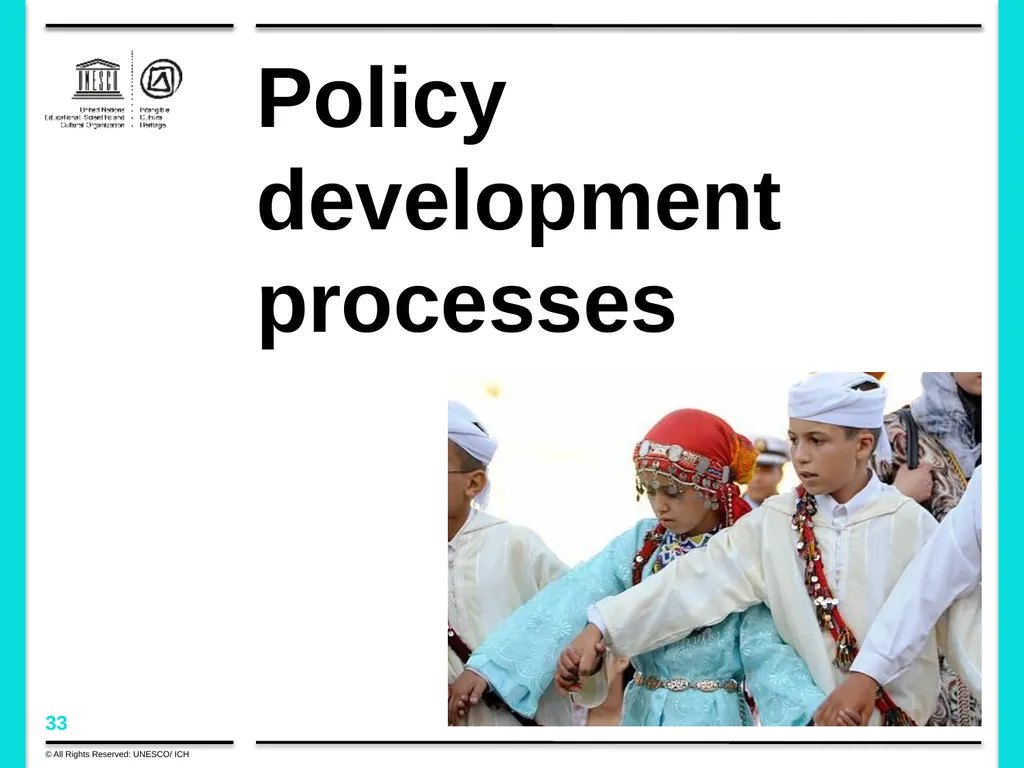
Policy development processes © All Rights Reserved: UNESCO/ ICH<br>
34
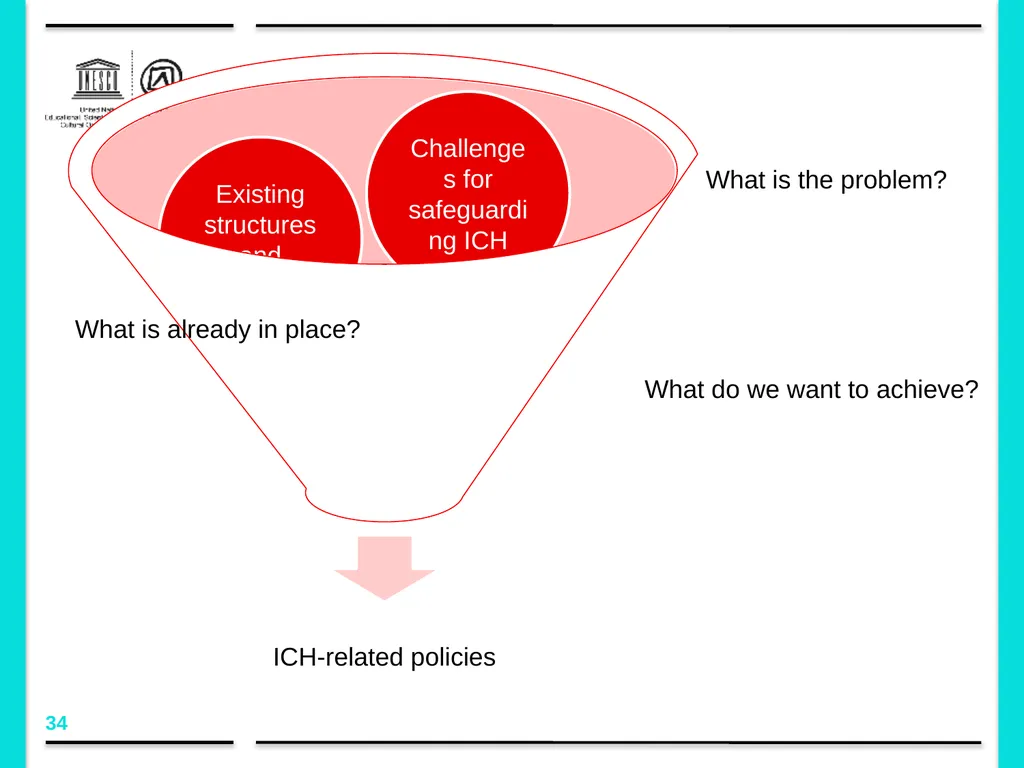
What is the problem? What is already in place? What do we want to achieve?<br>
35
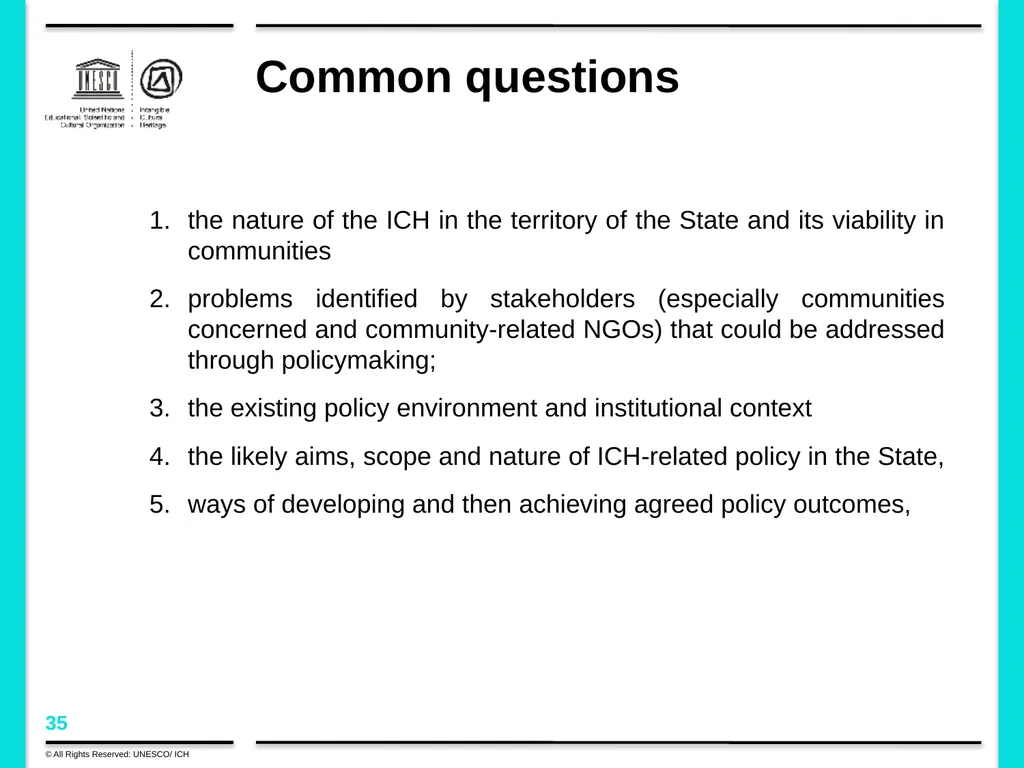
Common questions © All Rights Reserved: UNESCO/ ICH the nature of the ICH in the territory of the State and its viability in communities
problems identified by stakeholders (especially communities concerned and community-related NGOs) that could be addressed through policymaking;
the existing policy environment and institutional context
the likely aims, scope and nature of ICH-related policy in the State,
ways of developing and then achieving agreed policy outcomes,<br>
problems identified by stakeholders (especially communities concerned and community-related NGOs) that could be addressed through policymaking;
the existing policy environment and institutional context
the likely aims, scope and nature of ICH-related policy in the State,
ways of developing and then achieving agreed policy outcomes,<br>
36
No simple recipe © All Rights Reserved: UNESCO/ ICH<br>
37
Key ingredients Participation of communities
Broad public support
Political will © All Rights Reserved: UNESCO/ ICH<br>
Broad public support
Political will © All Rights Reserved: UNESCO/ ICH<br>
38
Broad definition of communities
Participation by a diversity of communities and groups
Diversity of ways to involve the public
Ensuring representatives of communities have appropriate mandates to do so and are given the opportunity to consult with their constituencies Involving communities: process<br>
Participation by a diversity of communities and groups
Diversity of ways to involve the public
Ensuring representatives of communities have appropriate mandates to do so and are given the opportunity to consult with their constituencies Involving communities: process<br>
39
Other factors for policy success Evidence-based
Feasible
Effective © All Rights Reserved: UNESCO/ ICH<br>
Feasible
Effective © All Rights Reserved: UNESCO/ ICH<br>
40
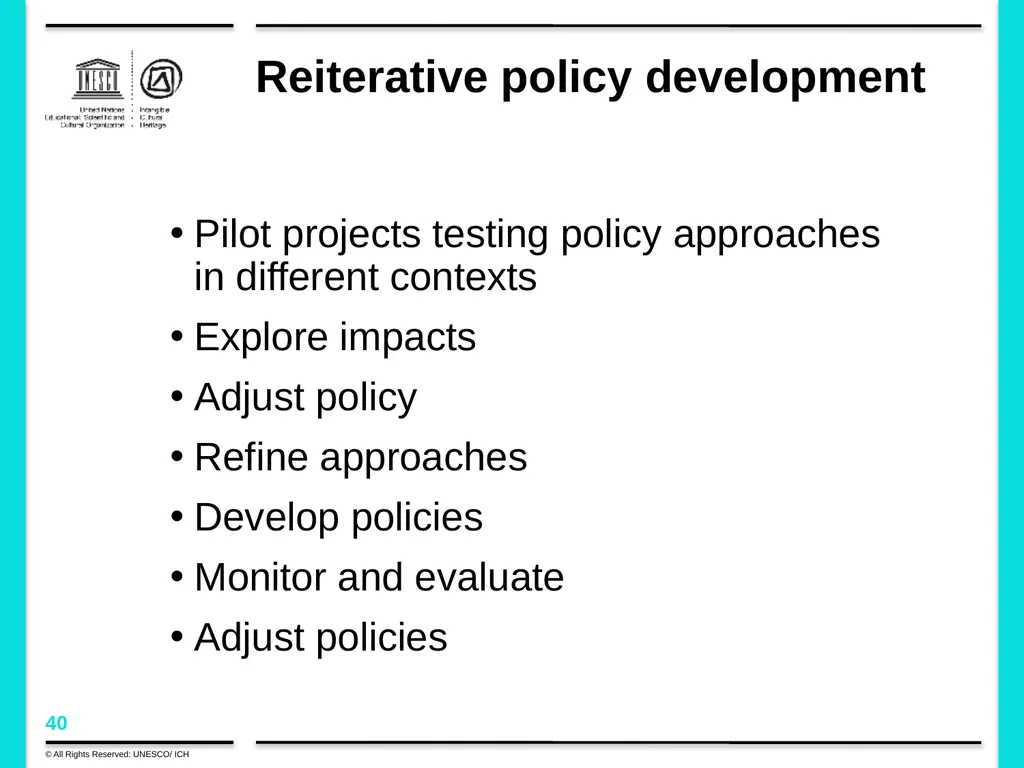
Reiterative policy development Pilot projects testing policy approaches in different contexts
Explore impacts
Adjust policy
Refine approaches
Develop policies
Monitor and evaluate
Adjust policies © All Rights Reserved: UNESCO/ ICH<br>
Explore impacts
Adjust policy
Refine approaches
Develop policies
Monitor and evaluate
Adjust policies © All Rights Reserved: UNESCO/ ICH<br>
41
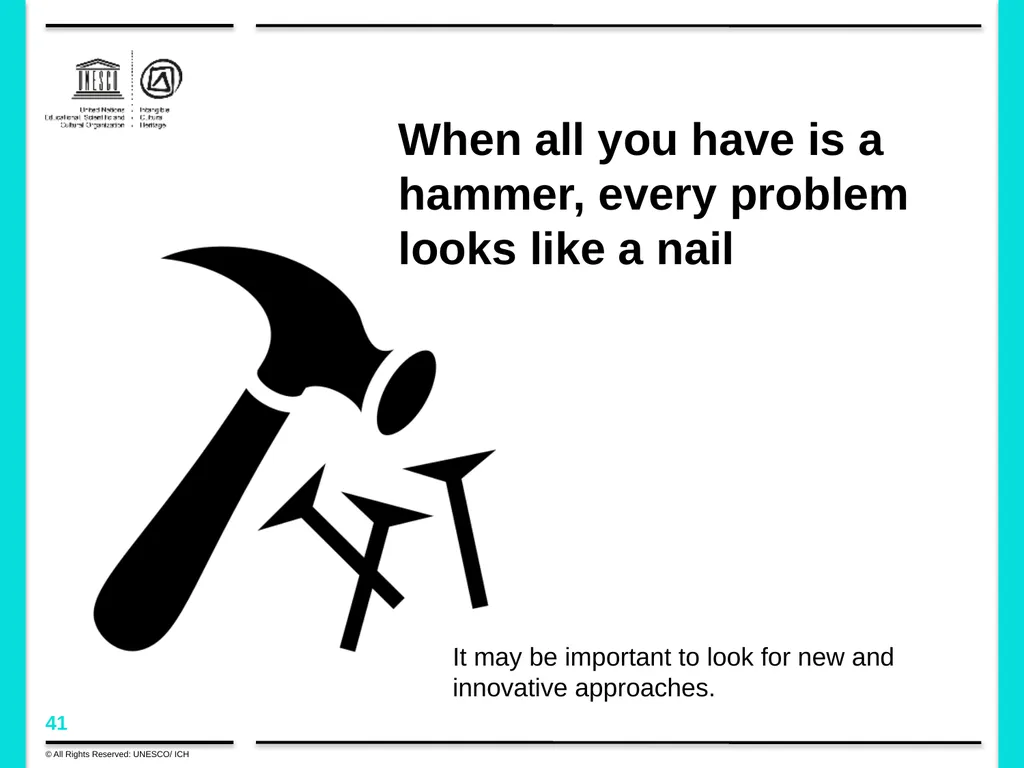
When all you have is a hammer, every problem looks like a nail © All Rights Reserved: UNESCO/ ICH It may be important to look for new and innovative approaches.<br>
42
Thank you © All Rights Reserved: UNESCO/ ICH<br>