
Portfolio Committee on Economic Development the
MJ
Published · 29 slides · 0 views

1 / 1






Description
Portfolio Committee on Economic Development the dtis involvement in the States procurement of ARVs Directorate: Pharmaceuticals and Medical Devices NATIONAL DEPARTMENT OF TRADE AND INDUSTRY 28 June 2017 1 Overview of the South African
Related Topics
Share
Embed code
Download this presentation From Below
"Portfolio Committee on Economic Development the" is the property of its rightful owner. Permission is granted to download and print the materials on this website for personal, non-commercial use only, and to display it on your personal computer provided you do not modify the materials and that you retain all copyright notices contained in the materials. By downloading content from our website, you accept the terms of this agreement.
Presentation Transcript
01
Portfolio Committee on Economic Development
the dti’s involvement in the State’s procurement of ARV’s Directorate: Pharmaceuticals and Medical Devices
NATIONAL DEPARTMENT OF TRADE AND INDUSTRY
28 June 2017 1<br>
NATIONAL DEPARTMENT OF TRADE AND INDUSTRY
28 June 2017 1<br>
02
Overview of the South African Pharmaceuticals Industry 2<br>
03
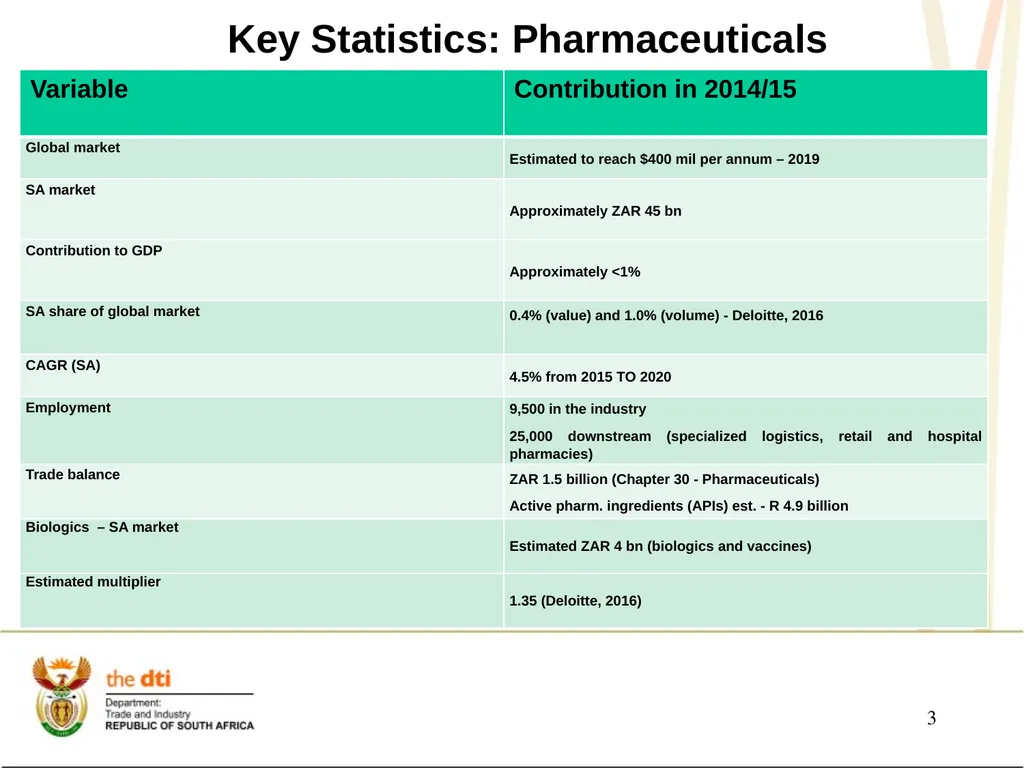
Key Statistics: Pharmaceuticals 3<br>
04
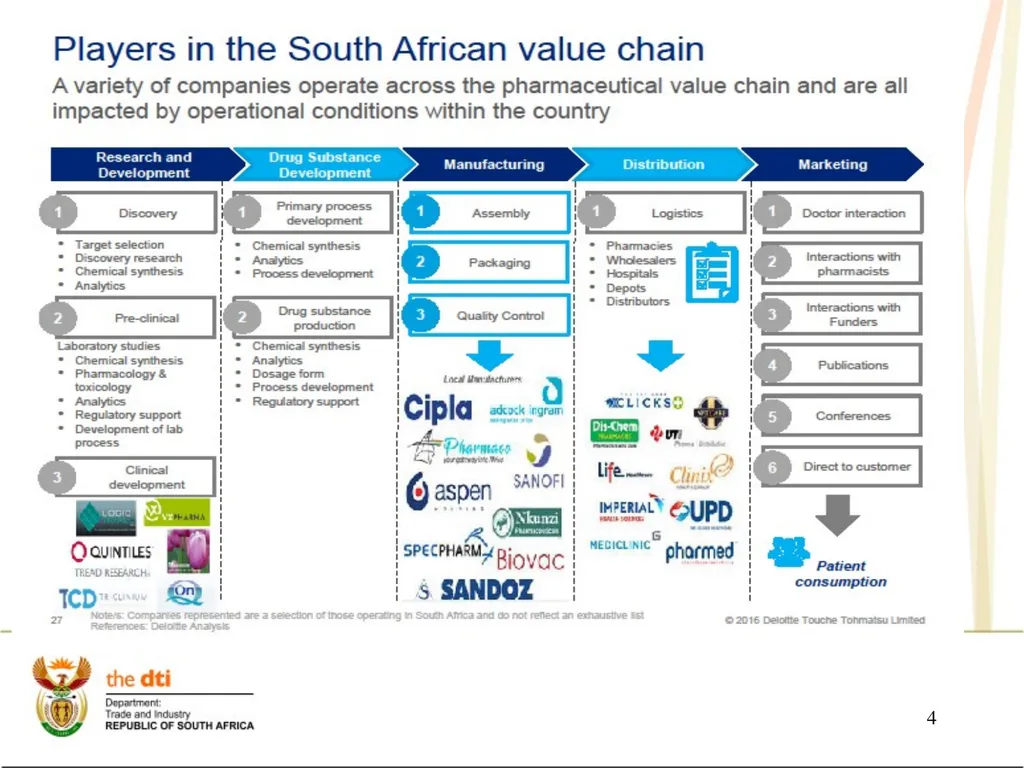
4<br>
05
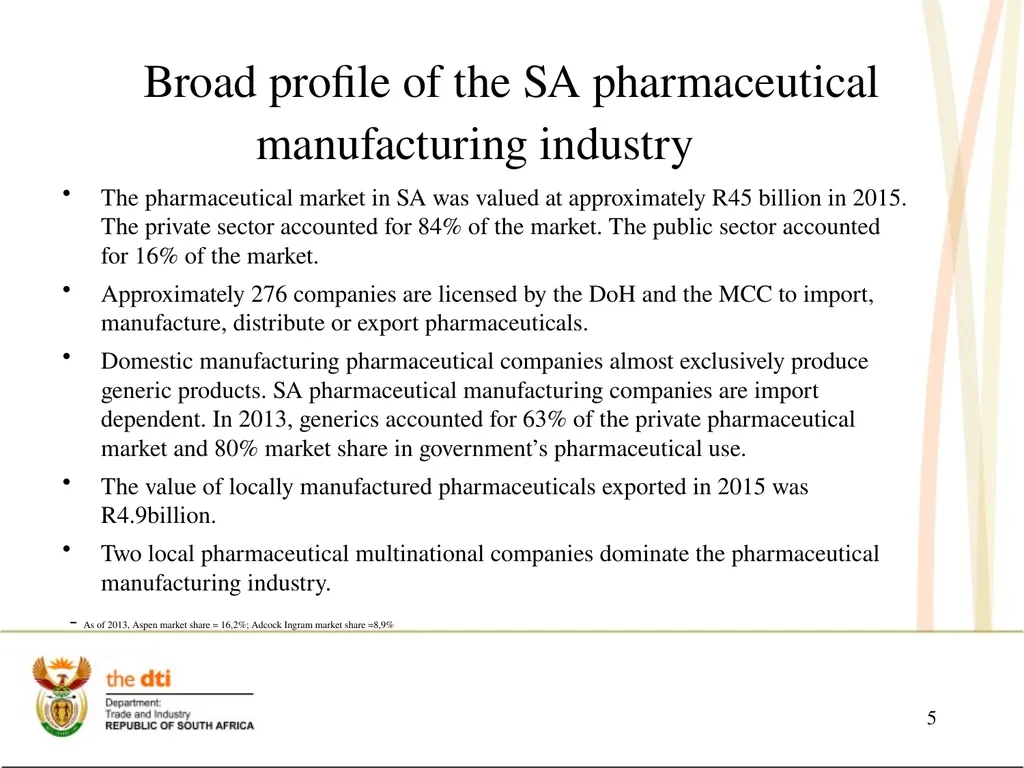
The pharmaceutical market in SA was valued at approximately R45 billion in 2015. The private sector accounted for 84% of the market. The public sector accounted for 16% of the market.
Approximately 276 companies are licensed by the DoH and the MCC to import, manufacture, distribute or export pharmaceuticals.
Domestic manufacturing pharmaceutical companies almost exclusively produce generic products. SA pharmaceutical manufacturing companies are import dependent. In 2013, generics accounted for 63% of the private pharmaceutical market and 80% market share in government’s pharmaceutical use.
The value of locally manufactured pharmaceuticals exported in 2015 was R4.9billion.
Two local pharmaceutical multinational companies dominate the pharmaceutical manufacturing industry.
- As of 2013, Aspen market share = 16,2%; Adcock Ingram market share =8,9% Broad profile of the SA pharmaceutical manufacturing industry 5<br>
Approximately 276 companies are licensed by the DoH and the MCC to import, manufacture, distribute or export pharmaceuticals.
Domestic manufacturing pharmaceutical companies almost exclusively produce generic products. SA pharmaceutical manufacturing companies are import dependent. In 2013, generics accounted for 63% of the private pharmaceutical market and 80% market share in government’s pharmaceutical use.
The value of locally manufactured pharmaceuticals exported in 2015 was R4.9billion.
Two local pharmaceutical multinational companies dominate the pharmaceutical manufacturing industry.
- As of 2013, Aspen market share = 16,2%; Adcock Ingram market share =8,9% Broad profile of the SA pharmaceutical manufacturing industry 5<br>
06
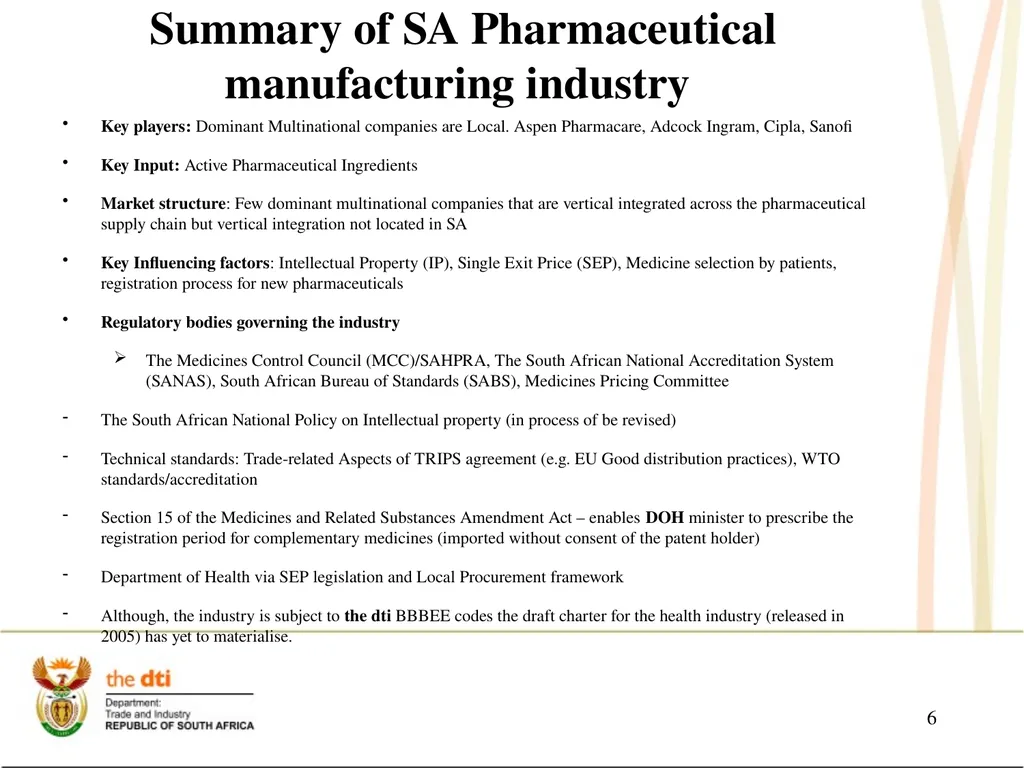
Key players: Dominant Multinational companies are Local. Aspen Pharmacare, Adcock Ingram, Cipla, Sanofi
Key Input: Active Pharmaceutical Ingredients
Market structure: Few dominant multinational companies that are vertical integrated across the pharmaceutical supply chain but vertical integration not located in SA
Key Influencing factors: Intellectual Property (IP), Single Exit Price (SEP), Medicine selection by patients, registration process for new pharmaceuticals
Regulatory bodies governing the industry
The Medicines Control Council (MCC)/SAHPRA, The South African National Accreditation System (SANAS), South African Bureau of Standards (SABS), Medicines Pricing Committee
The South African National Policy on Intellectual property (in process of be revised)
Technical standards: Trade-related Aspects of TRIPS agreement (e.g. EU Good distribution practices), WTO standards/accreditation
Section 15 of the Medicines and Related Substances Amendment Act – enables DOH minister to prescribe the registration period for complementary medicines (imported without consent of the patent holder)
Department of Health via SEP legislation and Local Procurement framework
Although, the industry is subject to the dti BBBEE codes the draft charter for the health industry (released in 2005) has yet to materialise. Summary of SA Pharmaceutical manufacturing industry 6<br>
Key Input: Active Pharmaceutical Ingredients
Market structure: Few dominant multinational companies that are vertical integrated across the pharmaceutical supply chain but vertical integration not located in SA
Key Influencing factors: Intellectual Property (IP), Single Exit Price (SEP), Medicine selection by patients, registration process for new pharmaceuticals
Regulatory bodies governing the industry
The Medicines Control Council (MCC)/SAHPRA, The South African National Accreditation System (SANAS), South African Bureau of Standards (SABS), Medicines Pricing Committee
The South African National Policy on Intellectual property (in process of be revised)
Technical standards: Trade-related Aspects of TRIPS agreement (e.g. EU Good distribution practices), WTO standards/accreditation
Section 15 of the Medicines and Related Substances Amendment Act – enables DOH minister to prescribe the registration period for complementary medicines (imported without consent of the patent holder)
Department of Health via SEP legislation and Local Procurement framework
Although, the industry is subject to the dti BBBEE codes the draft charter for the health industry (released in 2005) has yet to materialise. Summary of SA Pharmaceutical manufacturing industry 6<br>
07
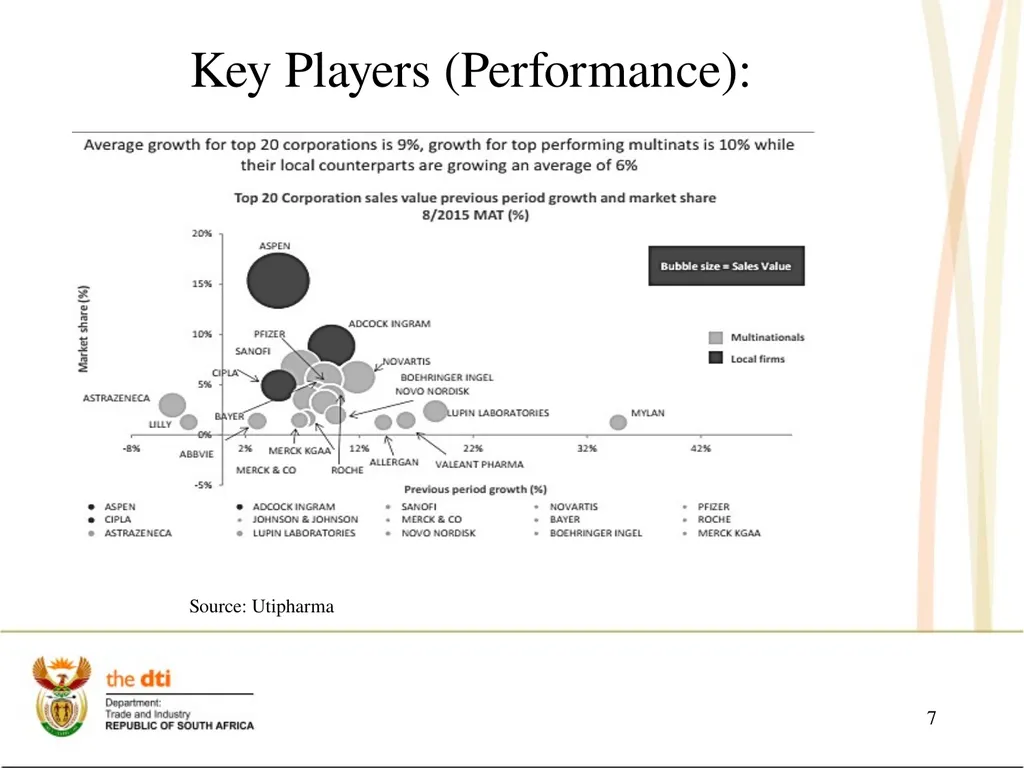
Key Players (Performance): Source: Utipharma 7<br>
08
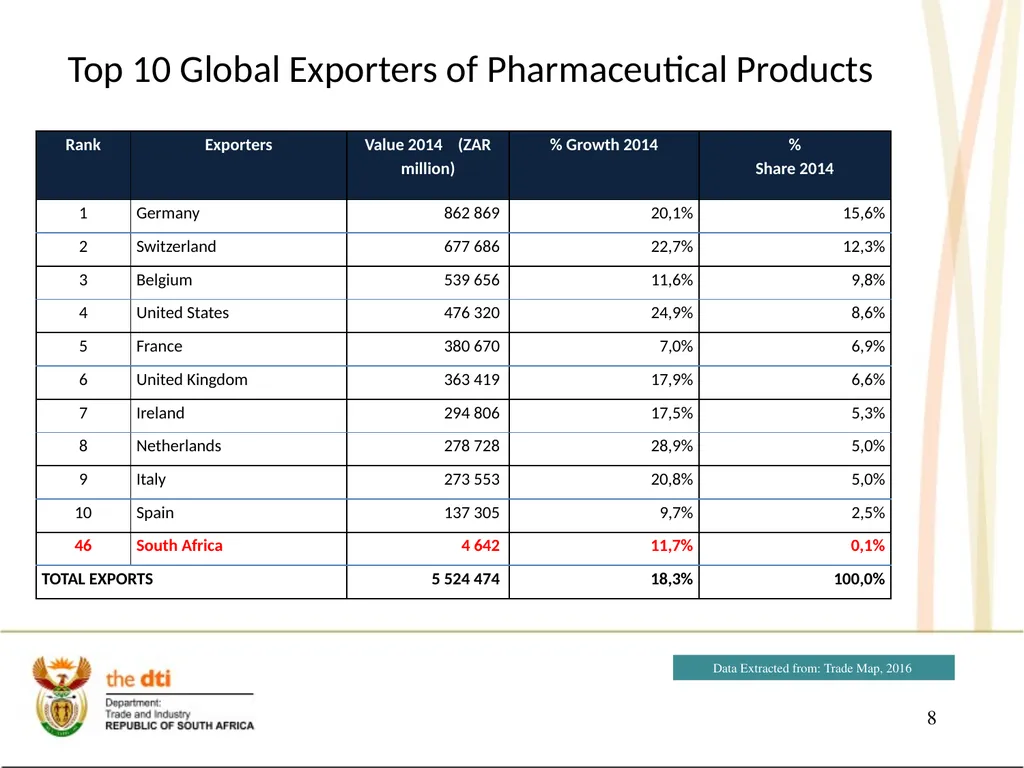
Top 10 Global Exporters of Pharmaceutical Products Data Extracted from: Trade Map, 2016 8<br>
09
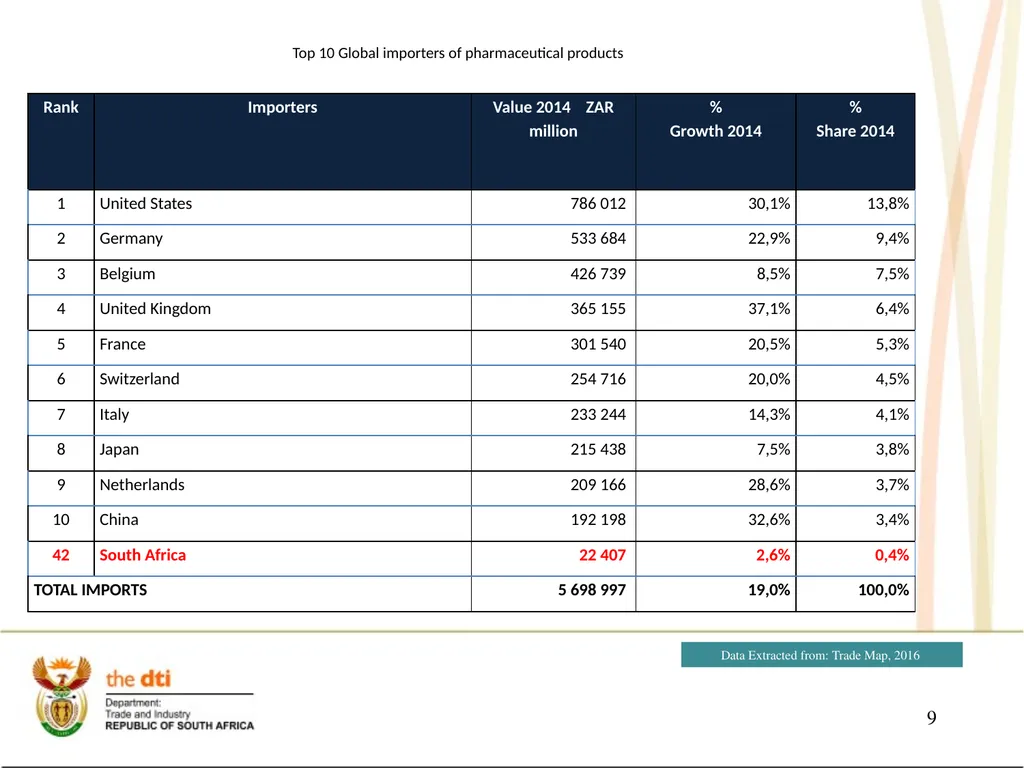
Top 10 Global importers of pharmaceutical products Data Extracted from: Trade Map, 2016 9<br>
10
South Africa’s Trade in Pharmaceutical Products Note: *BMI Forecasted Values
^ Quantec values
It is evident that imports are five times more than exports, thus the huge deficit in the pharmaceutical trade Data Extracted from: Trade Map, 2016; Quantec, 2016; BMI 2016a & BMI 2016b 10<br>
^ Quantec values
It is evident that imports are five times more than exports, thus the huge deficit in the pharmaceutical trade Data Extracted from: Trade Map, 2016; Quantec, 2016; BMI 2016a & BMI 2016b 10<br>
11
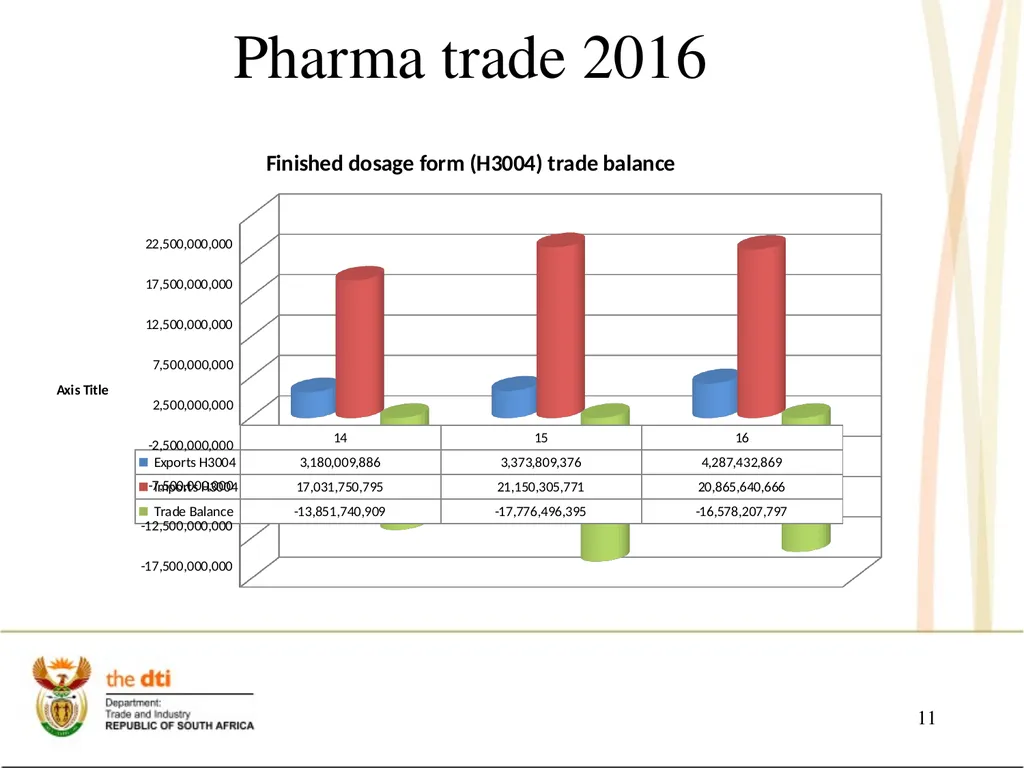
Pharma trade 2016 11<br>
12
South Africa pharmaceutical imports source countries Data Extracted from: Quantec, 2016 12<br>
13
Top 10 South Africa’s Pharmaceutical Exports Destination Countries Data Extracted from: Quantec, 2016 13<br>
14
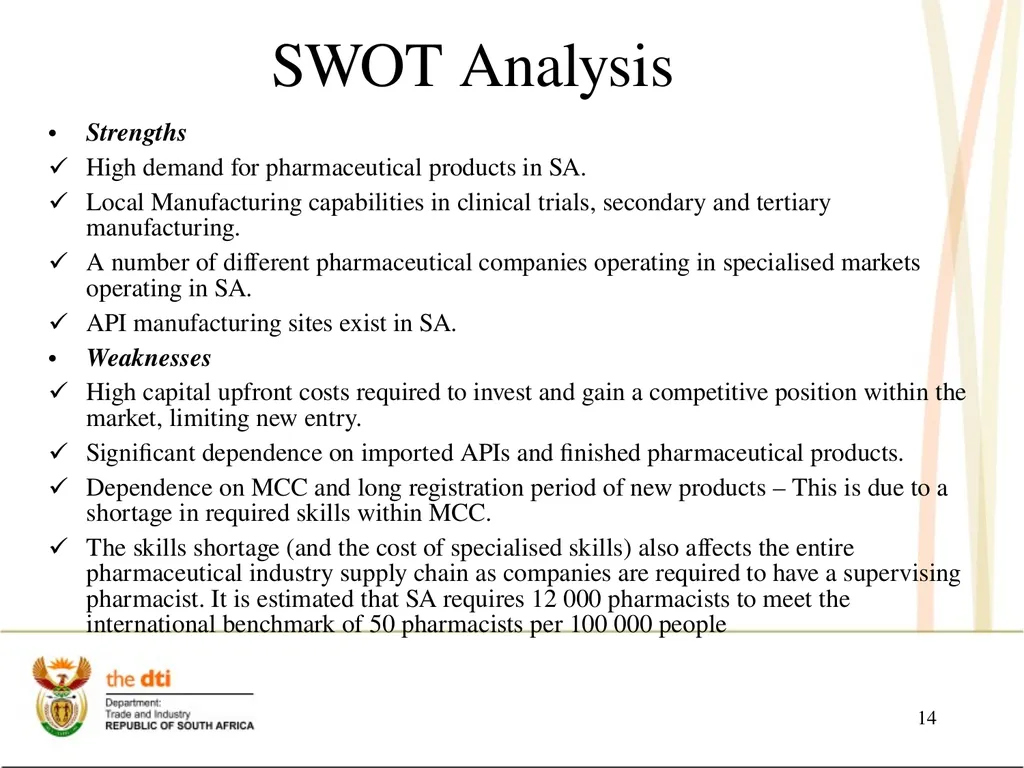
Strengths
High demand for pharmaceutical products in SA.
Local Manufacturing capabilities in clinical trials, secondary and tertiary manufacturing.
A number of different pharmaceutical companies operating in specialised markets operating in SA.
API manufacturing sites exist in SA.
Weaknesses
High capital upfront costs required to invest and gain a competitive position within the market, limiting new entry.
Significant dependence on imported APIs and finished pharmaceutical products.
Dependence on MCC and long registration period of new products – This is due to a shortage in required skills within MCC.
The skills shortage (and the cost of specialised skills) also affects the entire pharmaceutical industry supply chain as companies are required to have a supervising pharmacist. It is estimated that SA requires 12 000 pharmacists to meet the international benchmark of 50 pharmacists per 100 000 people SWOT Analysis 14<br>
High demand for pharmaceutical products in SA.
Local Manufacturing capabilities in clinical trials, secondary and tertiary manufacturing.
A number of different pharmaceutical companies operating in specialised markets operating in SA.
API manufacturing sites exist in SA.
Weaknesses
High capital upfront costs required to invest and gain a competitive position within the market, limiting new entry.
Significant dependence on imported APIs and finished pharmaceutical products.
Dependence on MCC and long registration period of new products – This is due to a shortage in required skills within MCC.
The skills shortage (and the cost of specialised skills) also affects the entire pharmaceutical industry supply chain as companies are required to have a supervising pharmacist. It is estimated that SA requires 12 000 pharmacists to meet the international benchmark of 50 pharmacists per 100 000 people SWOT Analysis 14<br>
15
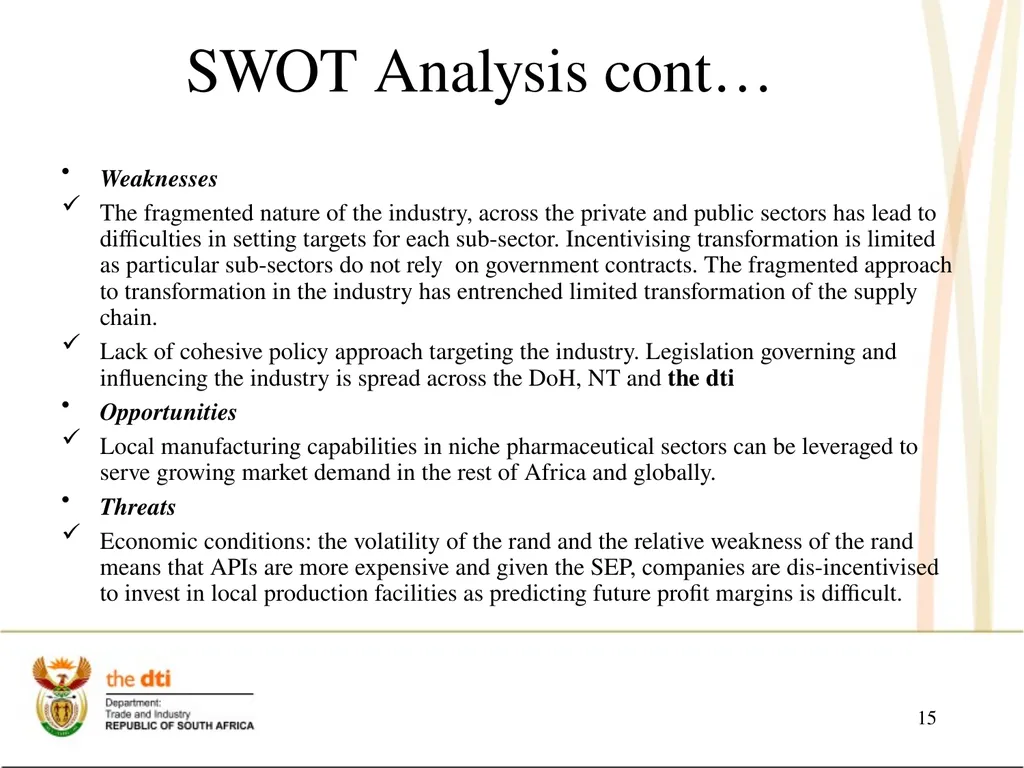
Weaknesses
The fragmented nature of the industry, across the private and public sectors has lead to difficulties in setting targets for each sub-sector. Incentivising transformation is limited as particular sub-sectors do not rely on government contracts. The fragmented approach to transformation in the industry has entrenched limited transformation of the supply chain.
Lack of cohesive policy approach targeting the industry. Legislation governing and influencing the industry is spread across the DoH, NT and the dti
Opportunities
Local manufacturing capabilities in niche pharmaceutical sectors can be leveraged to serve growing market demand in the rest of Africa and globally.
Threats
Economic conditions: the volatility of the rand and the relative weakness of the rand means that APIs are more expensive and given the SEP, companies are dis-incentivised to invest in local production facilities as predicting future profit margins is difficult. SWOT Analysis cont… 15<br>
The fragmented nature of the industry, across the private and public sectors has lead to difficulties in setting targets for each sub-sector. Incentivising transformation is limited as particular sub-sectors do not rely on government contracts. The fragmented approach to transformation in the industry has entrenched limited transformation of the supply chain.
Lack of cohesive policy approach targeting the industry. Legislation governing and influencing the industry is spread across the DoH, NT and the dti
Opportunities
Local manufacturing capabilities in niche pharmaceutical sectors can be leveraged to serve growing market demand in the rest of Africa and globally.
Threats
Economic conditions: the volatility of the rand and the relative weakness of the rand means that APIs are more expensive and given the SEP, companies are dis-incentivised to invest in local production facilities as predicting future profit margins is difficult. SWOT Analysis cont… 15<br>
16
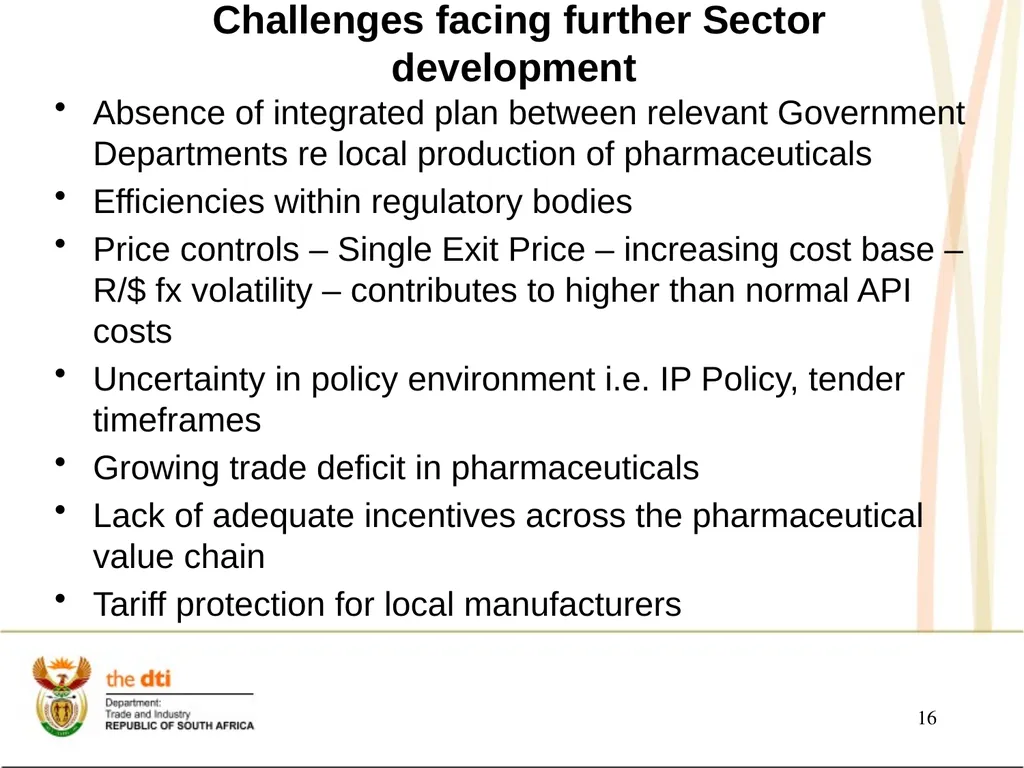
Challenges facing further Sector development Absence of integrated plan between relevant Government Departments re local production of pharmaceuticals
Efficiencies within regulatory bodies
Price controls – Single Exit Price – increasing cost base – R/$ fx volatility – contributes to higher than normal API costs
Uncertainty in policy environment i.e. IP Policy, tender timeframes
Growing trade deficit in pharmaceuticals
Lack of adequate incentives across the pharmaceutical value chain
Tariff protection for local manufacturers 16<br>
Efficiencies within regulatory bodies
Price controls – Single Exit Price – increasing cost base – R/$ fx volatility – contributes to higher than normal API costs
Uncertainty in policy environment i.e. IP Policy, tender timeframes
Growing trade deficit in pharmaceuticals
Lack of adequate incentives across the pharmaceutical value chain
Tariff protection for local manufacturers 16<br>
17
R1 invested in production
= R 0.35 in Fiscal Revenue
= R 1.13 in Value Created
R1 M invested in production
= 3 sustained jobs Knowledge economy
Skills development
Job creation
Broader tax base
Reference: Deloitte 2016 Key Multipliers Impact on the Economy Business Case for Local Manufacture of Pharmaceuticals 17<br>
= R 0.35 in Fiscal Revenue
= R 1.13 in Value Created
R1 M invested in production
= 3 sustained jobs Knowledge economy
Skills development
Job creation
Broader tax base
Reference: Deloitte 2016 Key Multipliers Impact on the Economy Business Case for Local Manufacture of Pharmaceuticals 17<br>
18
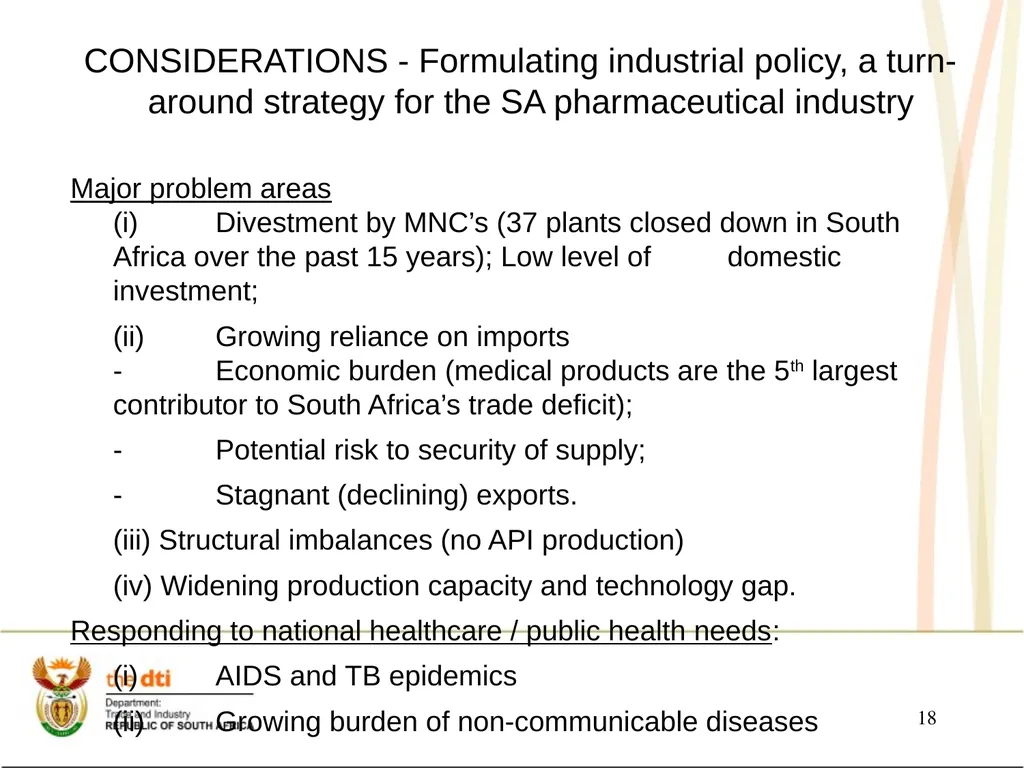
CONSIDERATIONS - Formulating industrial policy, a turn-around strategy for the SA pharmaceutical industry Major problem areas
(i) Divestment by MNC’s (37 plants closed down in South Africa over the past 15 years); Low level of domestic investment;
(ii) Growing reliance on imports
- Economic burden (medical products are the 5th largest contributor to South Africa’s trade deficit);
- Potential risk to security of supply;
- Stagnant (declining) exports.
(iii) Structural imbalances (no API production)
(iv) Widening production capacity and technology gap.
Responding to national healthcare / public health needs:
(i) AIDS and TB epidemics
(ii) Growing burden of non-communicable diseases 18<br>
(i) Divestment by MNC’s (37 plants closed down in South Africa over the past 15 years); Low level of domestic investment;
(ii) Growing reliance on imports
- Economic burden (medical products are the 5th largest contributor to South Africa’s trade deficit);
- Potential risk to security of supply;
- Stagnant (declining) exports.
(iii) Structural imbalances (no API production)
(iv) Widening production capacity and technology gap.
Responding to national healthcare / public health needs:
(i) AIDS and TB epidemics
(ii) Growing burden of non-communicable diseases 18<br>
19
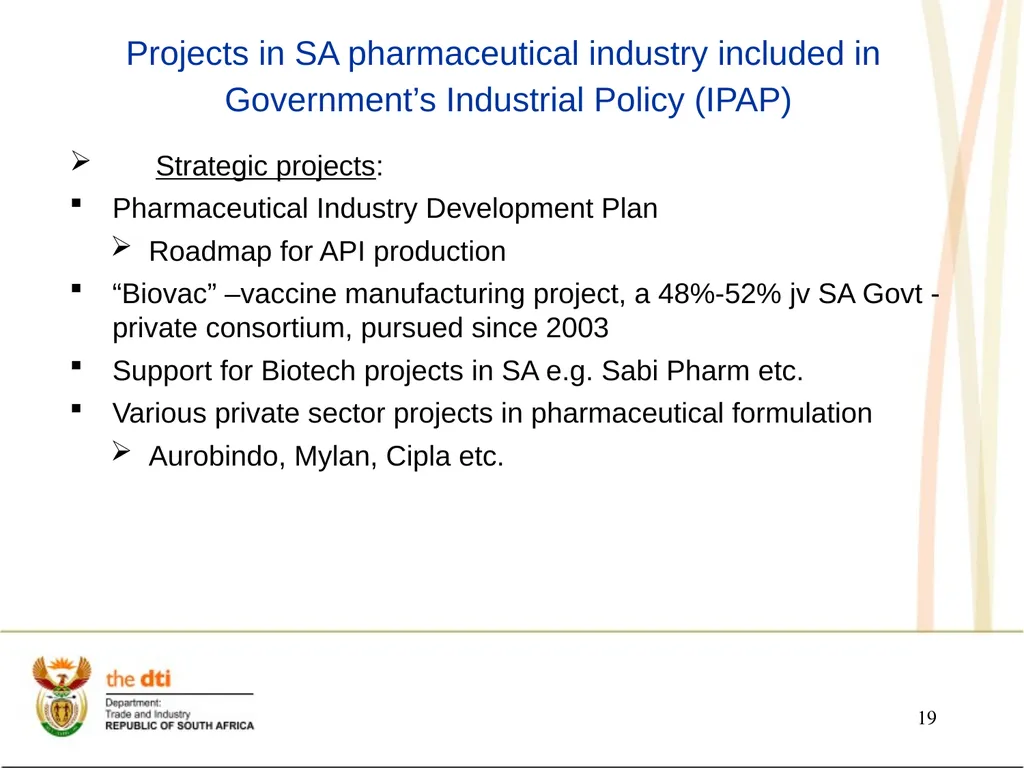
Projects in SA pharmaceutical industry included in Government’s Industrial Policy (IPAP) Strategic projects:
Pharmaceutical Industry Development Plan
Roadmap for API production
“Biovac” –vaccine manufacturing project, a 48%-52% jv SA Govt - private consortium, pursued since 2003
Support for Biotech projects in SA e.g. Sabi Pharm etc.
Various private sector projects in pharmaceutical formulation
Aurobindo, Mylan, Cipla etc. 19<br>
Pharmaceutical Industry Development Plan
Roadmap for API production
“Biovac” –vaccine manufacturing project, a 48%-52% jv SA Govt - private consortium, pursued since 2003
Support for Biotech projects in SA e.g. Sabi Pharm etc.
Various private sector projects in pharmaceutical formulation
Aurobindo, Mylan, Cipla etc. 19<br>
20
KEY POINTS
in DTI’s Industrial Policy for Pharmaceutical industry 1. Building investors’ confidence:
I. Using Government procurement to leverage local manufacture.
II. Exploring the means (also political) to boost exports (to Africa, to the Least Developed Countries etc.), to the Global fund and the UN procurement agencies such as Unicef, UNDP, UNAIDS
III. Reasonable approach to the medicines pricing policy.
Growing domestic capacity in the manufacture of key APIs (ARVs, anti-TB, biologics, reagents for in vitro diagnostics etc.) via technology transfer arrangements, investment incentives, tariff protection, expedited regulatory approval processes, NIPP etc.
Looking beyond simple manufacturing; Establishing alliances in R&D, Promoting clinical R&D, Preparing foundations for the upcoming revolution in pharmaceutical technologies and treatment (biologics, individual therapies). 20<br>
I. Using Government procurement to leverage local manufacture.
II. Exploring the means (also political) to boost exports (to Africa, to the Least Developed Countries etc.), to the Global fund and the UN procurement agencies such as Unicef, UNDP, UNAIDS
III. Reasonable approach to the medicines pricing policy.
Growing domestic capacity in the manufacture of key APIs (ARVs, anti-TB, biologics, reagents for in vitro diagnostics etc.) via technology transfer arrangements, investment incentives, tariff protection, expedited regulatory approval processes, NIPP etc.
Looking beyond simple manufacturing; Establishing alliances in R&D, Promoting clinical R&D, Preparing foundations for the upcoming revolution in pharmaceutical technologies and treatment (biologics, individual therapies). 20<br>
21
the dti’s industrial policy toolbox Public procurement
- localisation
- NIPP
Industrial Financing, incentives and export support
Developmental Trade Policy
SEZ’s
Tariffs
Cluster Development
Regional integration 21<br>
- localisation
- NIPP
Industrial Financing, incentives and export support
Developmental Trade Policy
SEZ’s
Tariffs
Cluster Development
Regional integration 21<br>
22
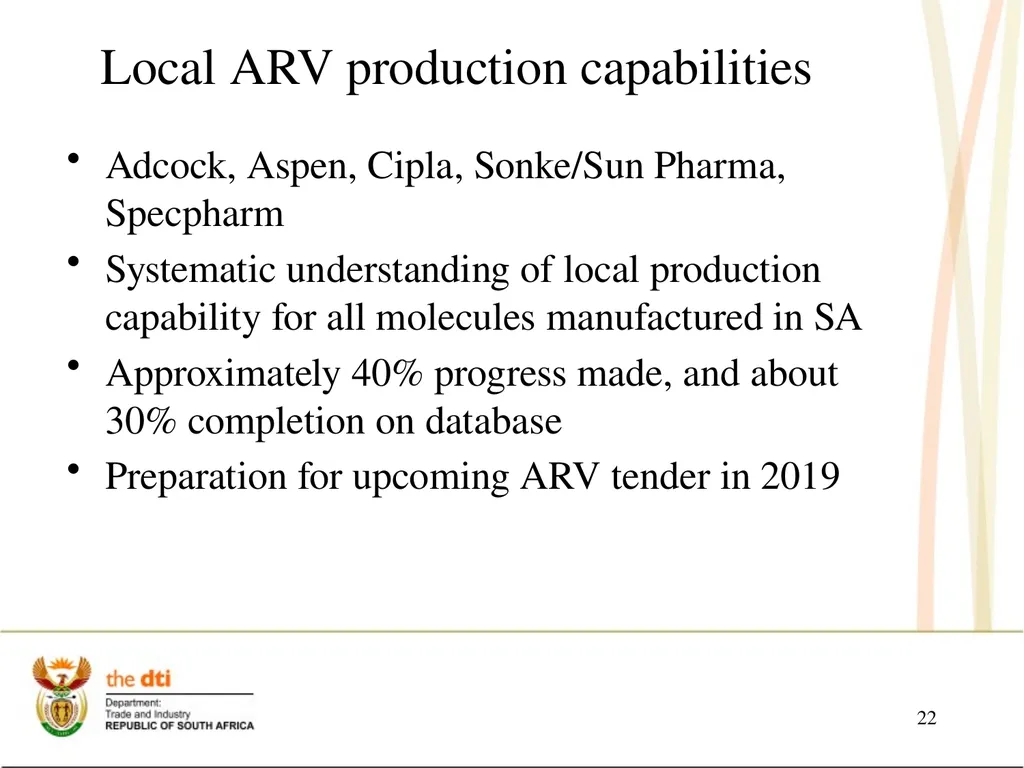
Local ARV production capabilities Adcock, Aspen, Cipla, Sonke/Sun Pharma, Specpharm
Systematic understanding of local production capability for all molecules manufactured in SA
Approximately 40% progress made, and about 30% completion on database
Preparation for upcoming ARV tender in 2019 22<br>
Systematic understanding of local production capability for all molecules manufactured in SA
Approximately 40% progress made, and about 30% completion on database
Preparation for upcoming ARV tender in 2019 22<br>
23
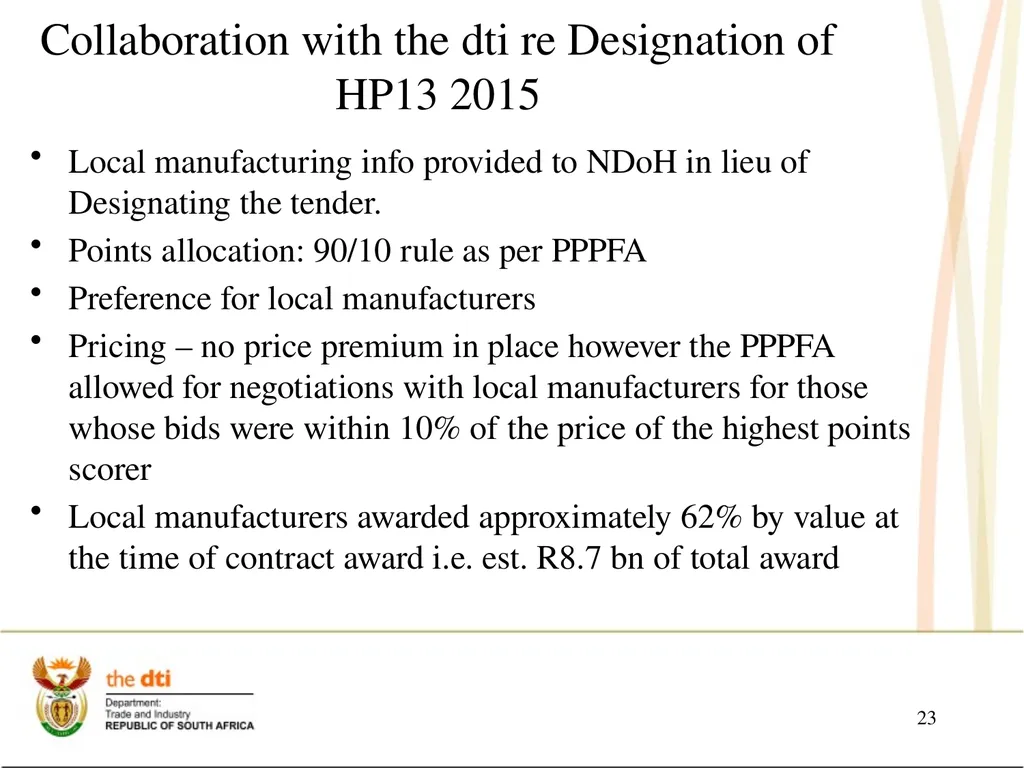
Collaboration with the dti re Designation of HP13 2015 Local manufacturing info provided to NDoH in lieu of Designating the tender.
Points allocation: 90/10 rule as per PPPFA
Preference for local manufacturers
Pricing – no price premium in place however the PPPFA allowed for negotiations with local manufacturers for those whose bids were within 10% of the price of the highest points scorer
Local manufacturers awarded approximately 62% by value at the time of contract award i.e. est. R8.7 bn of total award 23<br>
Points allocation: 90/10 rule as per PPPFA
Preference for local manufacturers
Pricing – no price premium in place however the PPPFA allowed for negotiations with local manufacturers for those whose bids were within 10% of the price of the highest points scorer
Local manufacturers awarded approximately 62% by value at the time of contract award i.e. est. R8.7 bn of total award 23<br>
24
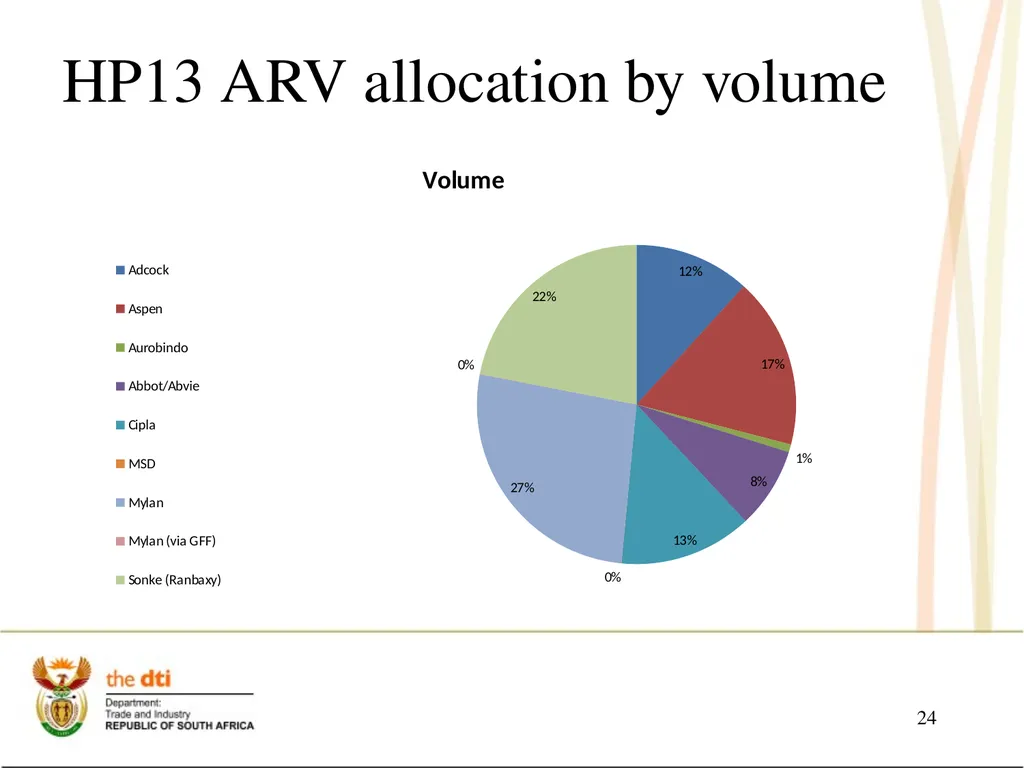
HP13 ARV allocation by volume 24<br>
25
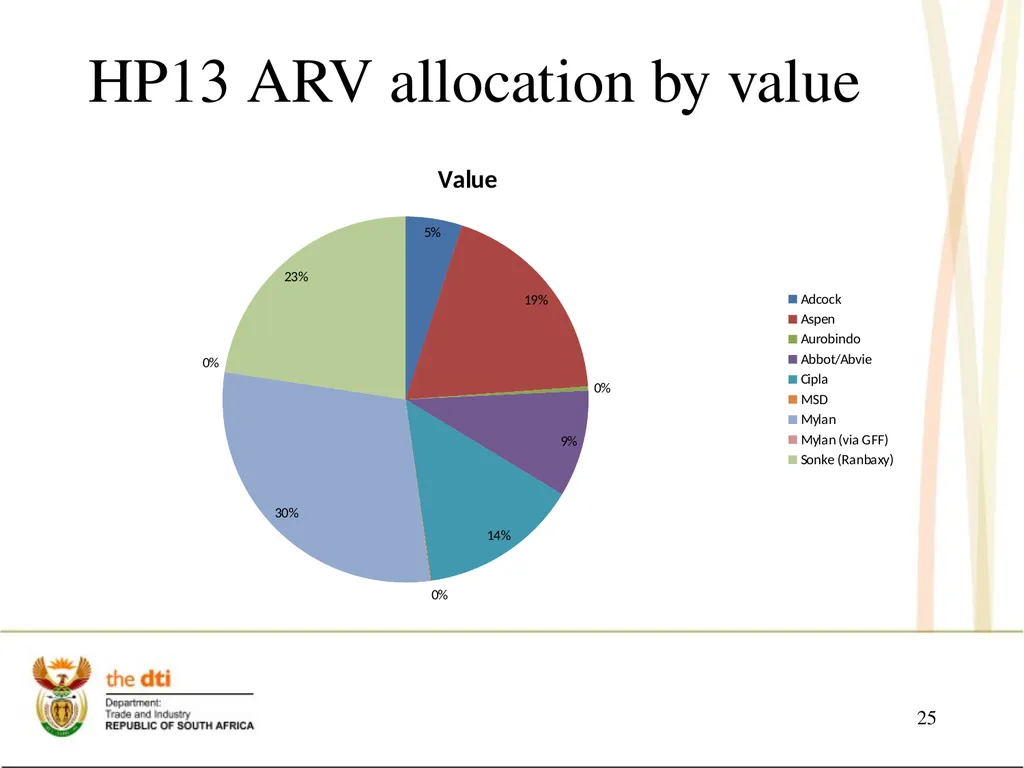
HP13 ARV allocation by value 25<br>
26
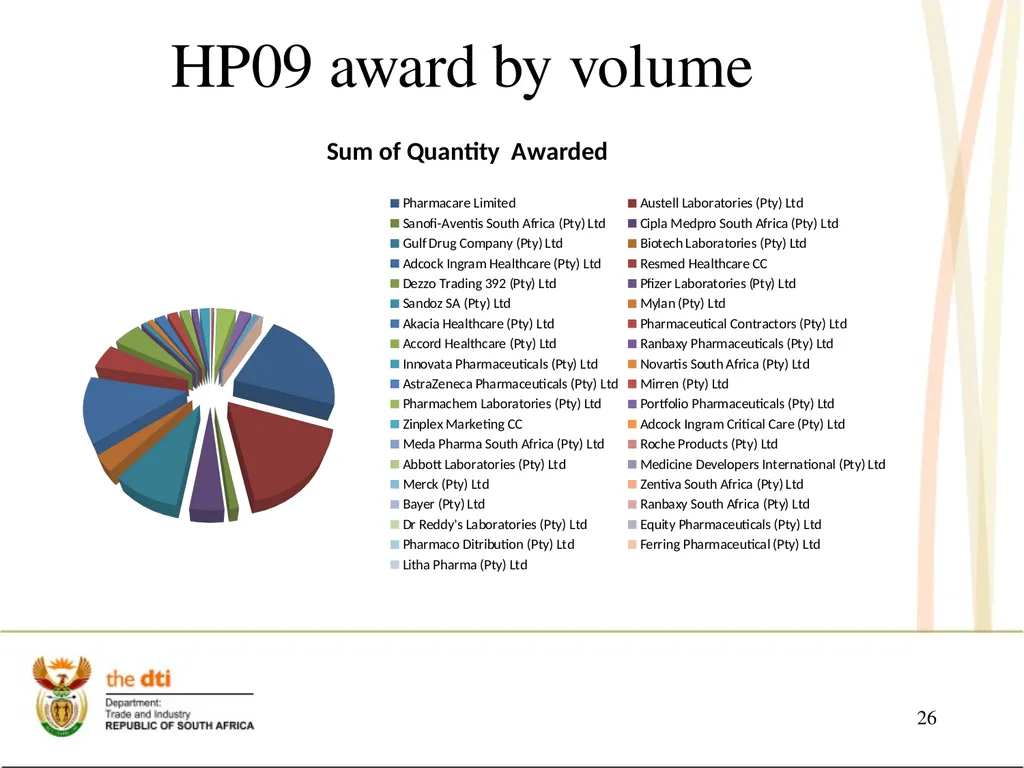
HP09 award by volume 26<br>
27
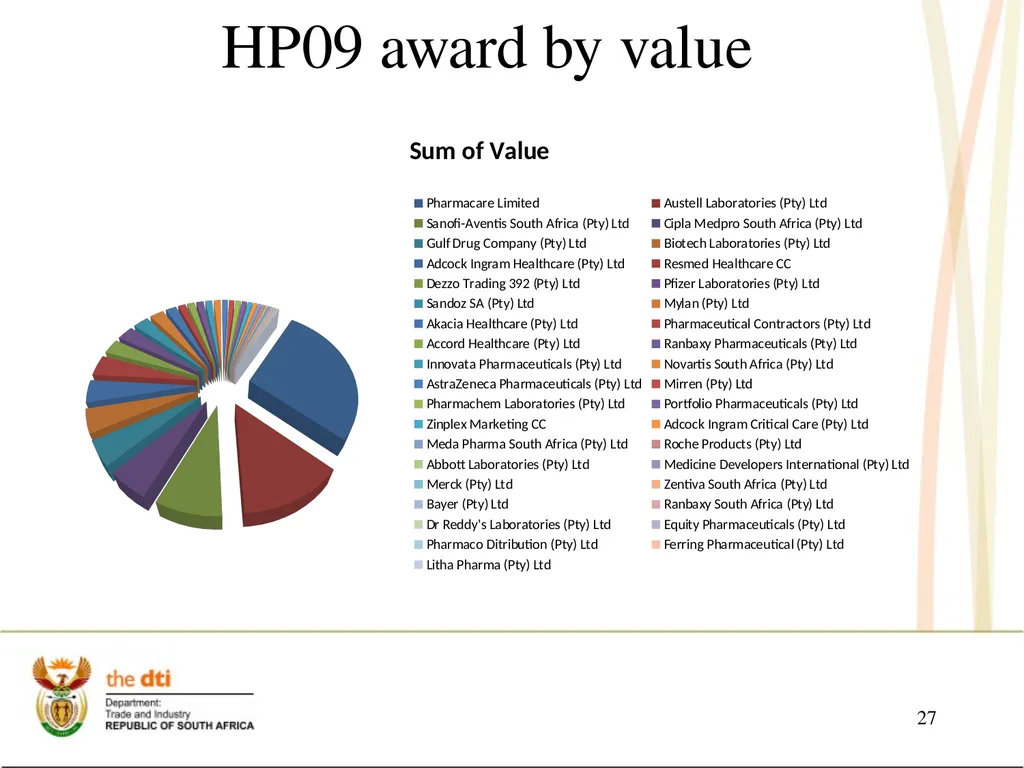
HP09 award by value 27<br>
28
Condom manufacturing industry 2018 tender estimated to be valued at ?
Collaboration with NT to understand local manufacturing capacity and phase in a preferential procurement mechanism
Current 2 bona fide local manufacturers, 2 additional to come on-line by 2018, the dti and DFI support – local industry creation
Collaboration with NT around possible tech transfer for local manufacture of female condoms 28<br>
Collaboration with NT to understand local manufacturing capacity and phase in a preferential procurement mechanism
Current 2 bona fide local manufacturers, 2 additional to come on-line by 2018, the dti and DFI support – local industry creation
Collaboration with NT around possible tech transfer for local manufacture of female condoms 28<br>
29
Thank You!! Swasthi Soomaroo
Director: Pharmaceuticals and Medical Devices
Tel: 082 944 0027
Email: SSoomaroo@thedti.gov.za 29<br>
Director: Pharmaceuticals and Medical Devices
Tel: 082 944 0027
Email: SSoomaroo@thedti.gov.za 29<br>