
PORTFOLIO COMMITTEE PRESENTATION PREAMBLE Cultural
MS
Published · 21 slides · 0 views

1 / 1
Description
PORTFOLIO COMMITTEE PRESENTATION PREAMBLE Cultural Creative Industries Federation of South Africa (CCIFSA), Government and Private Sectors need to work jointly to create a conducive environment for the growth of the South African Creative
Related Topics
Share
Embed code
Download this presentation From Below
"PORTFOLIO COMMITTEE PRESENTATION PREAMBLE Cultural" is the property of its rightful owner. Permission is granted to download and print the materials on this website for personal, non-commercial use only, and to display it on your personal computer provided you do not modify the materials and that you retain all copyright notices contained in the materials. By downloading content from our website, you accept the terms of this agreement.
Presentation Transcript
01
PORTFOLIO COMMITTEE PRESENTATION<br>
02
PREAMBLE Cultural & Creative Industries Federation of South Africa (CCIFSA), Government and Private Sectors need to work jointly to create a conducive environment for the growth of the South African Creative Economy;
The 4th Industrial Revolution and the Covid-19 have affected the Cultural and the Creative Industries as well as the stagnating growth of the South Africa economy. 2<br>
The 4th Industrial Revolution and the Covid-19 have affected the Cultural and the Creative Industries as well as the stagnating growth of the South Africa economy. 2<br>
03
BACKGROUND CCIFSA is a body whose primary focus is to represent all sectors of the cultural and creative industries;
Its objective is:
To unify and transform the industries;
To represent their interests at governmental, social, business and economic levels;
To unlock the full economic potential of the cultural and creative industries for the benefit of the creative workers whilst taking into consideration, the sectors’ contribution to the triple bottom line (inequality, poverty and unemployment);
CIFSA was established as a Non-Profit Organization to be a statutory body for the cultural and creative industries;
This came after the engagement with President Jacob Zuma in 2009 and the subsequent National Summit in 2011. 3<br>
Its objective is:
To unify and transform the industries;
To represent their interests at governmental, social, business and economic levels;
To unlock the full economic potential of the cultural and creative industries for the benefit of the creative workers whilst taking into consideration, the sectors’ contribution to the triple bottom line (inequality, poverty and unemployment);
CIFSA was established as a Non-Profit Organization to be a statutory body for the cultural and creative industries;
This came after the engagement with President Jacob Zuma in 2009 and the subsequent National Summit in 2011. 3<br>
04
BACKGROUND The need arose to organize all practitioners in the performing arts, visual arts, technical services and events, design, electronic media, crafts, publishing, cultural tourism, ethno tourism, cultural groups, cultural heritage and cultural entrepreneurship;
In the endeavour to organize these industries, practitioners are in a position to be protected from unscrupulous practices and have their social and economic conditions improved;
It is the belief of the CCIFSA constituency that if in its existence as an act of parliament it will have a legal mandate to develop and promote the arts;
CCIFSA should be seen from a viewpoint that it is an organization building blocks for a statutory body;
In the final analysis it has to market itself and the sectors it represents.
CCIFSA is located in the creative economy whose members are not beneficiaries of its value chain;
Those who are beneficiaries contribute to the national GDP very minimally. 4<br>
In the endeavour to organize these industries, practitioners are in a position to be protected from unscrupulous practices and have their social and economic conditions improved;
It is the belief of the CCIFSA constituency that if in its existence as an act of parliament it will have a legal mandate to develop and promote the arts;
CCIFSA should be seen from a viewpoint that it is an organization building blocks for a statutory body;
In the final analysis it has to market itself and the sectors it represents.
CCIFSA is located in the creative economy whose members are not beneficiaries of its value chain;
Those who are beneficiaries contribute to the national GDP very minimally. 4<br>
05
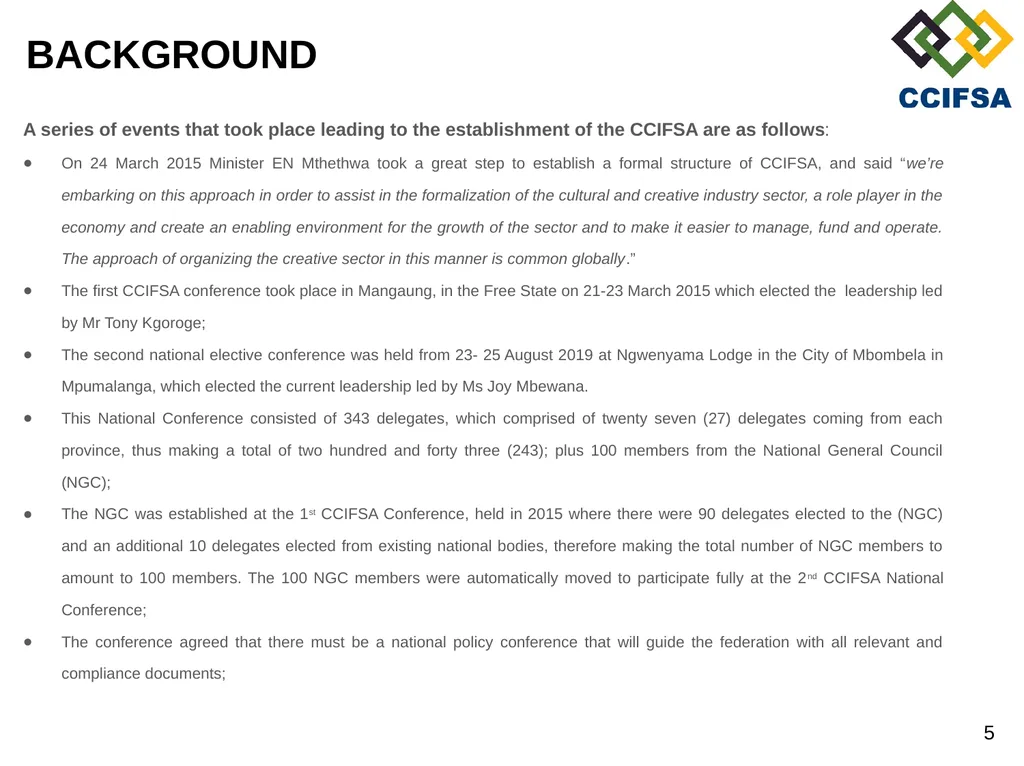
BACKGROUND A series of events that took place leading to the establishment of the CCIFSA are as follows:
On 24 March 2015 Minister EN Mthethwa took a great step to establish a formal structure of CCIFSA, and said “we’re embarking on this approach in order to assist in the formalization of the cultural and creative industry sector, a role player in the economy and create an enabling environment for the growth of the sector and to make it easier to manage, fund and operate. The approach of organizing the creative sector in this manner is common globally.”
The first CCIFSA conference took place in Mangaung, in the Free State on 21-23 March 2015 which elected the leadership led by Mr Tony Kgoroge;
The second national elective conference was held from 23- 25 August 2019 at Ngwenyama Lodge in the City of Mbombela in Mpumalanga, which elected the current leadership led by Ms Joy Mbewana.
This National Conference consisted of 343 delegates, which comprised of twenty seven (27) delegates coming from each province, thus making a total of two hundred and forty three (243); plus 100 members from the National General Council (NGC);
The NGC was established at the 1st CCIFSA Conference, held in 2015 where there were 90 delegates elected to the (NGC) and an additional 10 delegates elected from existing national bodies, therefore making the total number of NGC members to amount to 100 members. The 100 NGC members were automatically moved to participate fully at the 2nd CCIFSA National Conference;
The conference agreed that there must be a national policy conference that will guide the federation with all relevant and compliance documents; 5<br>
On 24 March 2015 Minister EN Mthethwa took a great step to establish a formal structure of CCIFSA, and said “we’re embarking on this approach in order to assist in the formalization of the cultural and creative industry sector, a role player in the economy and create an enabling environment for the growth of the sector and to make it easier to manage, fund and operate. The approach of organizing the creative sector in this manner is common globally.”
The first CCIFSA conference took place in Mangaung, in the Free State on 21-23 March 2015 which elected the leadership led by Mr Tony Kgoroge;
The second national elective conference was held from 23- 25 August 2019 at Ngwenyama Lodge in the City of Mbombela in Mpumalanga, which elected the current leadership led by Ms Joy Mbewana.
This National Conference consisted of 343 delegates, which comprised of twenty seven (27) delegates coming from each province, thus making a total of two hundred and forty three (243); plus 100 members from the National General Council (NGC);
The NGC was established at the 1st CCIFSA Conference, held in 2015 where there were 90 delegates elected to the (NGC) and an additional 10 delegates elected from existing national bodies, therefore making the total number of NGC members to amount to 100 members. The 100 NGC members were automatically moved to participate fully at the 2nd CCIFSA National Conference;
The conference agreed that there must be a national policy conference that will guide the federation with all relevant and compliance documents; 5<br>
06
BACKGROUND Since the establishment of CCIFSA there are still a lot of challenges in the SA Creative Economy Sector Industry at large and we believe that the federation is the only remedy to cure all the challenges encountered by the creative industry;
CCIFSA must be visible to the creative workers and lead to unity of all the creative workers guided by policies adopted in the policy conference that took place in Durban December 2020, in moving the industry forward to full fill the practitioners’ mandates;
CCIFSA is engaging in the process of realigning itself into a Creative Economy Business Entity in terms of operations and management;
This approach is informed by the need to position SA Creative Economy as a competitive global player.
Various South African Creative Workers (Ladysmith Black Mambazo, Nomcebo and Master KG, Dr John Kani just to mention a few have demonstrated that SA is endowed with cultural and artistic talents to influence the world to consume SA products and services. 6<br>
CCIFSA must be visible to the creative workers and lead to unity of all the creative workers guided by policies adopted in the policy conference that took place in Durban December 2020, in moving the industry forward to full fill the practitioners’ mandates;
CCIFSA is engaging in the process of realigning itself into a Creative Economy Business Entity in terms of operations and management;
This approach is informed by the need to position SA Creative Economy as a competitive global player.
Various South African Creative Workers (Ladysmith Black Mambazo, Nomcebo and Master KG, Dr John Kani just to mention a few have demonstrated that SA is endowed with cultural and artistic talents to influence the world to consume SA products and services. 6<br>
07
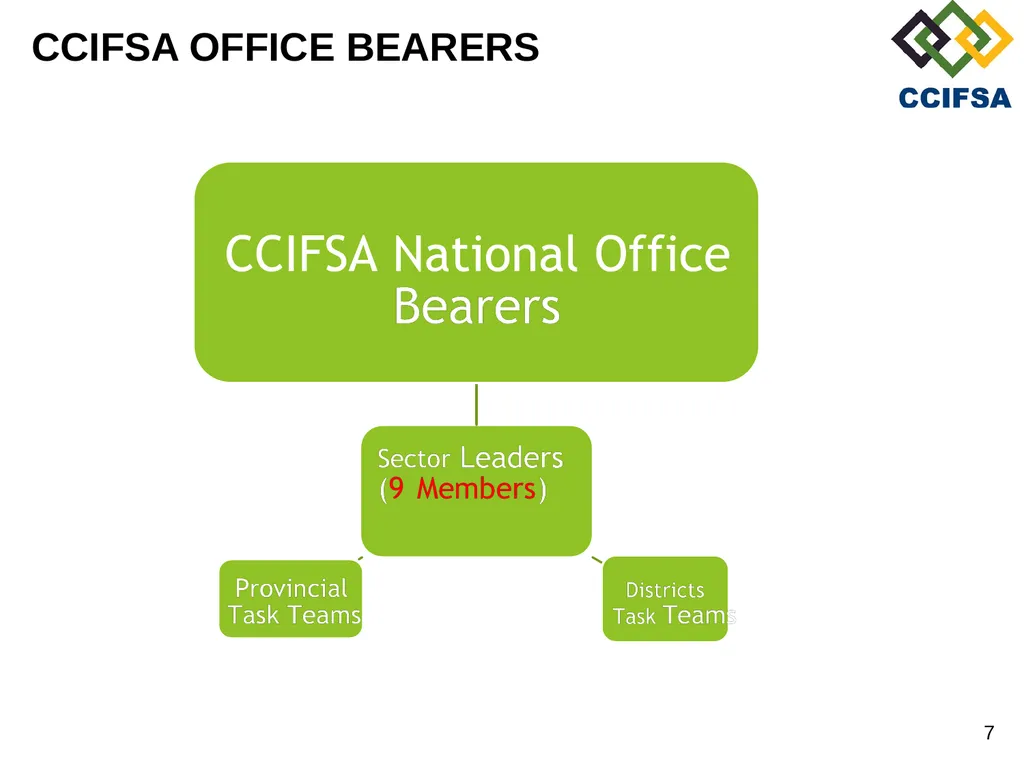
CCIFSA OFFICE BEARERS 7<br>
08
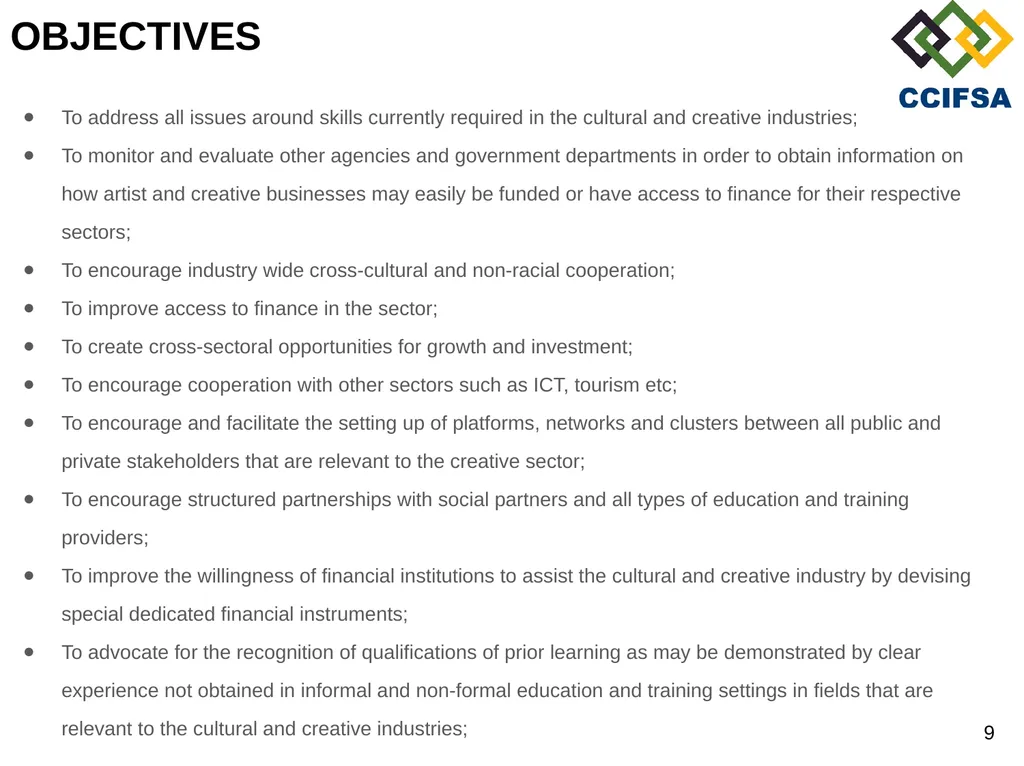
OBJECTIVES CCIFSA has the following broad objectives in terms of the Cultural and Creative Industries (CCI):
To assume an interim regulatory role ordinarily reserved for statutory regulatory bodies in the Republic of South Africa until such time that Parliament enact a law formally creating CCIFSA as a duly established statutory body for the regulation of the arts and culture industry;
To address the changing skills requirements in the Cultural and Creative Industries;
To actively encourage the development and promotion of a transformational art and cultural industry in the Republic of South Africa;
To guard against any unlawful and unconscionable practices that are designed to impoverish artists while unjustly enriching managers of art and culture companies; and where allowed by the MOI, enforce required transformational practices including issuance of sanctions against transgressors; 8<br>
To assume an interim regulatory role ordinarily reserved for statutory regulatory bodies in the Republic of South Africa until such time that Parliament enact a law formally creating CCIFSA as a duly established statutory body for the regulation of the arts and culture industry;
To address the changing skills requirements in the Cultural and Creative Industries;
To actively encourage the development and promotion of a transformational art and cultural industry in the Republic of South Africa;
To guard against any unlawful and unconscionable practices that are designed to impoverish artists while unjustly enriching managers of art and culture companies; and where allowed by the MOI, enforce required transformational practices including issuance of sanctions against transgressors; 8<br>
09
OBJECTIVES To address all issues around skills currently required in the cultural and creative industries;
To monitor and evaluate other agencies and government departments in order to obtain information on how artist and creative businesses may easily be funded or have access to finance for their respective sectors;
To encourage industry wide cross-cultural and non-racial cooperation;
To improve access to finance in the sector;
To create cross-sectoral opportunities for growth and investment;
To encourage cooperation with other sectors such as ICT, tourism etc;
To encourage and facilitate the setting up of platforms, networks and clusters between all public and private stakeholders that are relevant to the creative sector;
To encourage structured partnerships with social partners and all types of education and training providers;
To improve the willingness of financial institutions to assist the cultural and creative industry by devising special dedicated financial instruments;
To advocate for the recognition of qualifications of prior learning as may be demonstrated by clear experience not obtained in informal and non-formal education and training settings in fields that are relevant to the cultural and creative industries; 9<br>
To monitor and evaluate other agencies and government departments in order to obtain information on how artist and creative businesses may easily be funded or have access to finance for their respective sectors;
To encourage industry wide cross-cultural and non-racial cooperation;
To improve access to finance in the sector;
To create cross-sectoral opportunities for growth and investment;
To encourage cooperation with other sectors such as ICT, tourism etc;
To encourage and facilitate the setting up of platforms, networks and clusters between all public and private stakeholders that are relevant to the creative sector;
To encourage structured partnerships with social partners and all types of education and training providers;
To improve the willingness of financial institutions to assist the cultural and creative industry by devising special dedicated financial instruments;
To advocate for the recognition of qualifications of prior learning as may be demonstrated by clear experience not obtained in informal and non-formal education and training settings in fields that are relevant to the cultural and creative industries; 9<br>
10
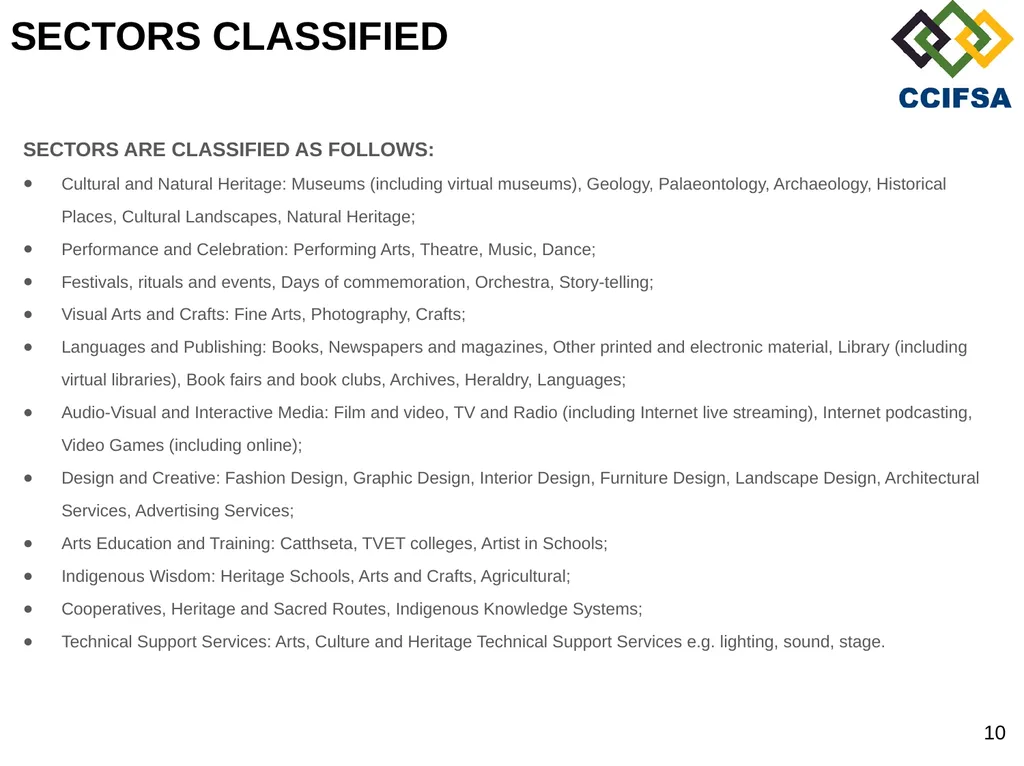
SECTORS CLASSIFIED SECTORS ARE CLASSIFIED AS FOLLOWS:
Cultural and Natural Heritage: Museums (including virtual museums), Geology, Palaeontology, Archaeology, Historical Places, Cultural Landscapes, Natural Heritage;
Performance and Celebration: Performing Arts, Theatre, Music, Dance;
Festivals, rituals and events, Days of commemoration, Orchestra, Story-telling;
Visual Arts and Crafts: Fine Arts, Photography, Crafts;
Languages and Publishing: Books, Newspapers and magazines, Other printed and electronic material, Library (including virtual libraries), Book fairs and book clubs, Archives, Heraldry, Languages;
Audio-Visual and Interactive Media: Film and video, TV and Radio (including Internet live streaming), Internet podcasting, Video Games (including online);
Design and Creative: Fashion Design, Graphic Design, Interior Design, Furniture Design, Landscape Design, Architectural Services, Advertising Services;
Arts Education and Training: Catthseta, TVET colleges, Artist in Schools;
Indigenous Wisdom: Heritage Schools, Arts and Crafts, Agricultural;
Cooperatives, Heritage and Sacred Routes, Indigenous Knowledge Systems;
Technical Support Services: Arts, Culture and Heritage Technical Support Services e.g. lighting, sound, stage. 10<br>
Cultural and Natural Heritage: Museums (including virtual museums), Geology, Palaeontology, Archaeology, Historical Places, Cultural Landscapes, Natural Heritage;
Performance and Celebration: Performing Arts, Theatre, Music, Dance;
Festivals, rituals and events, Days of commemoration, Orchestra, Story-telling;
Visual Arts and Crafts: Fine Arts, Photography, Crafts;
Languages and Publishing: Books, Newspapers and magazines, Other printed and electronic material, Library (including virtual libraries), Book fairs and book clubs, Archives, Heraldry, Languages;
Audio-Visual and Interactive Media: Film and video, TV and Radio (including Internet live streaming), Internet podcasting, Video Games (including online);
Design and Creative: Fashion Design, Graphic Design, Interior Design, Furniture Design, Landscape Design, Architectural Services, Advertising Services;
Arts Education and Training: Catthseta, TVET colleges, Artist in Schools;
Indigenous Wisdom: Heritage Schools, Arts and Crafts, Agricultural;
Cooperatives, Heritage and Sacred Routes, Indigenous Knowledge Systems;
Technical Support Services: Arts, Culture and Heritage Technical Support Services e.g. lighting, sound, stage. 10<br>
11
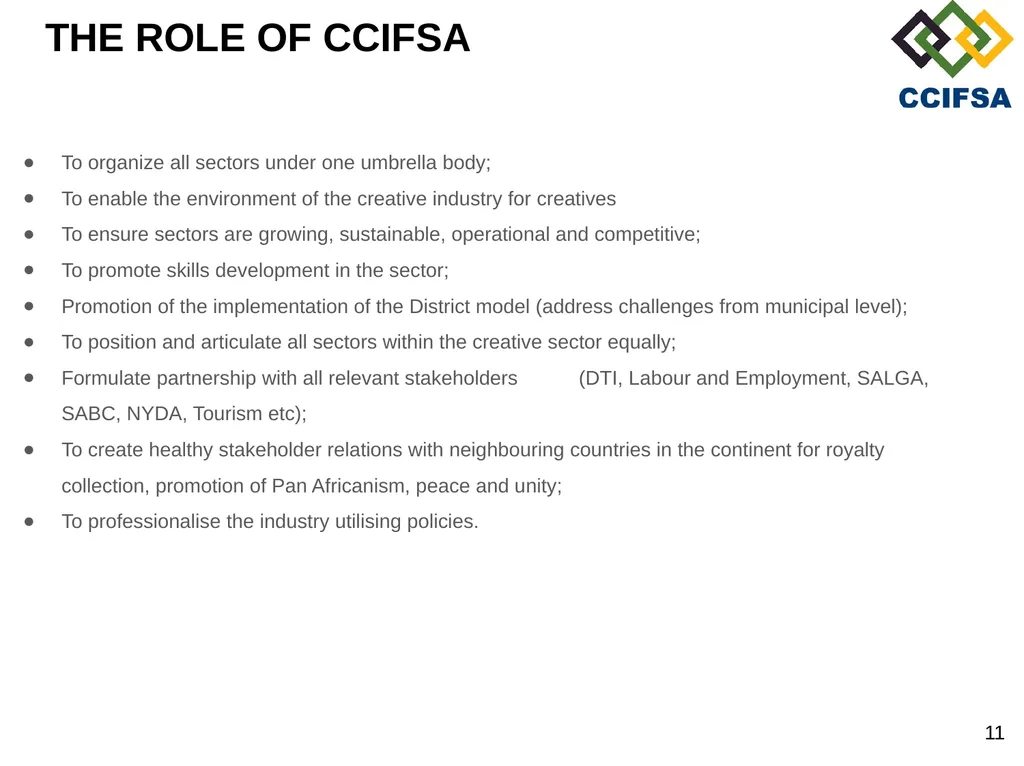
THE ROLE OF CCIFSA To organize all sectors under one umbrella body;
To enable the environment of the creative industry for creatives
To ensure sectors are growing, sustainable, operational and competitive;
To promote skills development in the sector;
Promotion of the implementation of the District model (address challenges from municipal level);
To position and articulate all sectors within the creative sector equally;
Formulate partnership with all relevant stakeholders (DTI, Labour and Employment, SALGA, SABC, NYDA, Tourism etc);
To create healthy stakeholder relations with neighbouring countries in the continent for royalty collection, promotion of Pan Africanism, peace and unity;
To professionalise the industry utilising policies. 11<br>
To enable the environment of the creative industry for creatives
To ensure sectors are growing, sustainable, operational and competitive;
To promote skills development in the sector;
Promotion of the implementation of the District model (address challenges from municipal level);
To position and articulate all sectors within the creative sector equally;
Formulate partnership with all relevant stakeholders (DTI, Labour and Employment, SALGA, SABC, NYDA, Tourism etc);
To create healthy stakeholder relations with neighbouring countries in the continent for royalty collection, promotion of Pan Africanism, peace and unity;
To professionalise the industry utilising policies. 11<br>
12
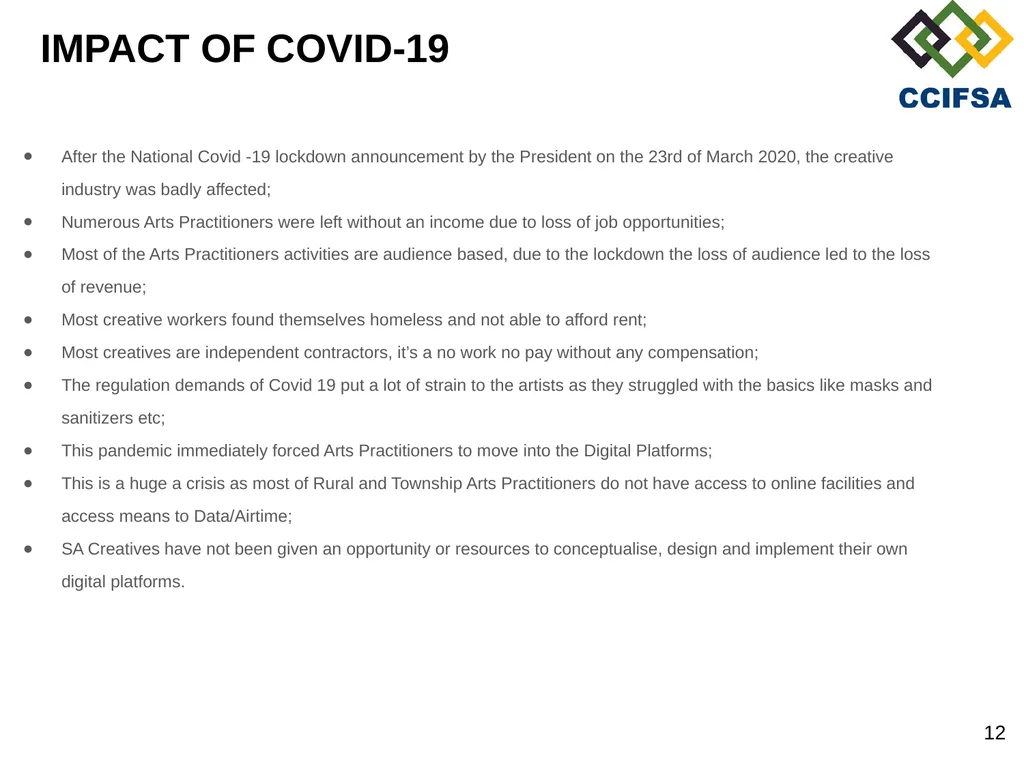
IMPACT OF COVID-19 After the National Covid -19 lockdown announcement by the President on the 23rd of March 2020, the creative industry was badly affected;
Numerous Arts Practitioners were left without an income due to loss of job opportunities;
Most of the Arts Practitioners activities are audience based, due to the lockdown the loss of audience led to the loss of revenue;
Most creative workers found themselves homeless and not able to afford rent;
Most creatives are independent contractors, it’s a no work no pay without any compensation;
The regulation demands of Covid 19 put a lot of strain to the artists as they struggled with the basics like masks and sanitizers etc;
This pandemic immediately forced Arts Practitioners to move into the Digital Platforms;
This is a huge a crisis as most of Rural and Township Arts Practitioners do not have access to online facilities and access means to Data/Airtime;
SA Creatives have not been given an opportunity or resources to conceptualise, design and implement their own digital platforms. 12<br>
Numerous Arts Practitioners were left without an income due to loss of job opportunities;
Most of the Arts Practitioners activities are audience based, due to the lockdown the loss of audience led to the loss of revenue;
Most creative workers found themselves homeless and not able to afford rent;
Most creatives are independent contractors, it’s a no work no pay without any compensation;
The regulation demands of Covid 19 put a lot of strain to the artists as they struggled with the basics like masks and sanitizers etc;
This pandemic immediately forced Arts Practitioners to move into the Digital Platforms;
This is a huge a crisis as most of Rural and Township Arts Practitioners do not have access to online facilities and access means to Data/Airtime;
SA Creatives have not been given an opportunity or resources to conceptualise, design and implement their own digital platforms. 12<br>
13
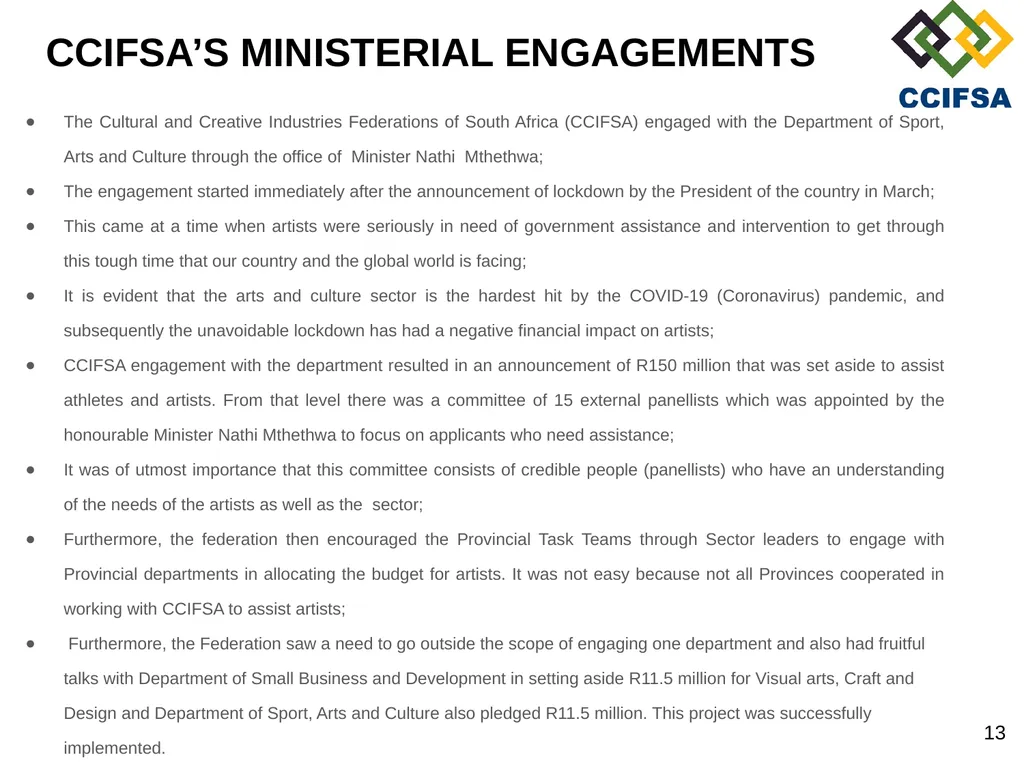
CCIFSA’S MINISTERIAL ENGAGEMENTS The Cultural and Creative Industries Federations of South Africa (CCIFSA) engaged with the Department of Sport, Arts and Culture through the office of Minister Nathi Mthethwa;
The engagement started immediately after the announcement of lockdown by the President of the country in March;
This came at a time when artists were seriously in need of government assistance and intervention to get through this tough time that our country and the global world is facing;
It is evident that the arts and culture sector is the hardest hit by the COVID-19 (Coronavirus) pandemic, and subsequently the unavoidable lockdown has had a negative financial impact on artists;
CCIFSA engagement with the department resulted in an announcement of R150 million that was set aside to assist athletes and artists. From that level there was a committee of 15 external panellists which was appointed by the honourable Minister Nathi Mthethwa to focus on applicants who need assistance;
It was of utmost importance that this committee consists of credible people (panellists) who have an understanding of the needs of the artists as well as the sector;
Furthermore, the federation then encouraged the Provincial Task Teams through Sector leaders to engage with Provincial departments in allocating the budget for artists. It was not easy because not all Provinces cooperated in working with CCIFSA to assist artists;
Furthermore, the Federation saw a need to go outside the scope of engaging one department and also had fruitful talks with Department of Small Business and Development in setting aside R11.5 million for Visual arts, Craft and Design and Department of Sport, Arts and Culture also pledged R11.5 million. This project was successfully implemented. 13<br>
The engagement started immediately after the announcement of lockdown by the President of the country in March;
This came at a time when artists were seriously in need of government assistance and intervention to get through this tough time that our country and the global world is facing;
It is evident that the arts and culture sector is the hardest hit by the COVID-19 (Coronavirus) pandemic, and subsequently the unavoidable lockdown has had a negative financial impact on artists;
CCIFSA engagement with the department resulted in an announcement of R150 million that was set aside to assist athletes and artists. From that level there was a committee of 15 external panellists which was appointed by the honourable Minister Nathi Mthethwa to focus on applicants who need assistance;
It was of utmost importance that this committee consists of credible people (panellists) who have an understanding of the needs of the artists as well as the sector;
Furthermore, the federation then encouraged the Provincial Task Teams through Sector leaders to engage with Provincial departments in allocating the budget for artists. It was not easy because not all Provinces cooperated in working with CCIFSA to assist artists;
Furthermore, the Federation saw a need to go outside the scope of engaging one department and also had fruitful talks with Department of Small Business and Development in setting aside R11.5 million for Visual arts, Craft and Design and Department of Sport, Arts and Culture also pledged R11.5 million. This project was successfully implemented. 13<br>
14
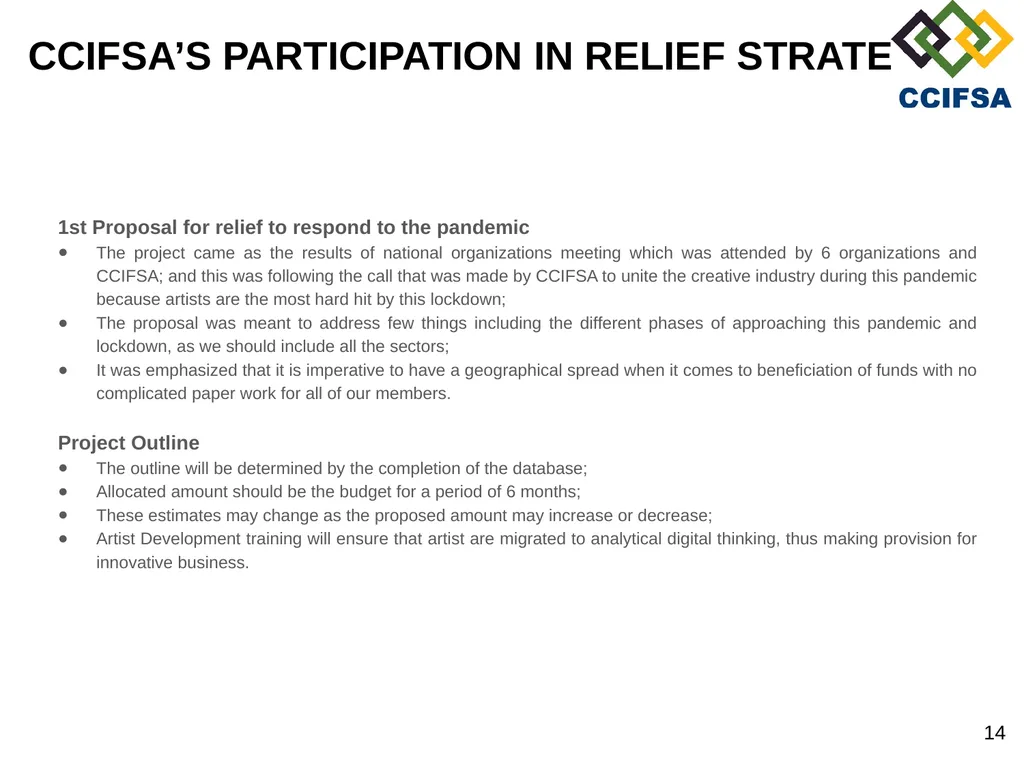
CCIFSA’S PARTICIPATION IN RELIEF STRATEGY 1st Proposal for relief to respond to the pandemic
The project came as the results of national organizations meeting which was attended by 6 organizations and CCIFSA; and this was following the call that was made by CCIFSA to unite the creative industry during this pandemic because artists are the most hard hit by this lockdown;
The proposal was meant to address few things including the different phases of approaching this pandemic and lockdown, as we should include all the sectors;
It was emphasized that it is imperative to have a geographical spread when it comes to beneficiation of funds with no complicated paper work for all of our members.
Project Outline
The outline will be determined by the completion of the database;
Allocated amount should be the budget for a period of 6 months;
These estimates may change as the proposed amount may increase or decrease;
Artist Development training will ensure that artist are migrated to analytical digital thinking, thus making provision for innovative business. 14<br>
The project came as the results of national organizations meeting which was attended by 6 organizations and CCIFSA; and this was following the call that was made by CCIFSA to unite the creative industry during this pandemic because artists are the most hard hit by this lockdown;
The proposal was meant to address few things including the different phases of approaching this pandemic and lockdown, as we should include all the sectors;
It was emphasized that it is imperative to have a geographical spread when it comes to beneficiation of funds with no complicated paper work for all of our members.
Project Outline
The outline will be determined by the completion of the database;
Allocated amount should be the budget for a period of 6 months;
These estimates may change as the proposed amount may increase or decrease;
Artist Development training will ensure that artist are migrated to analytical digital thinking, thus making provision for innovative business. 14<br>
15
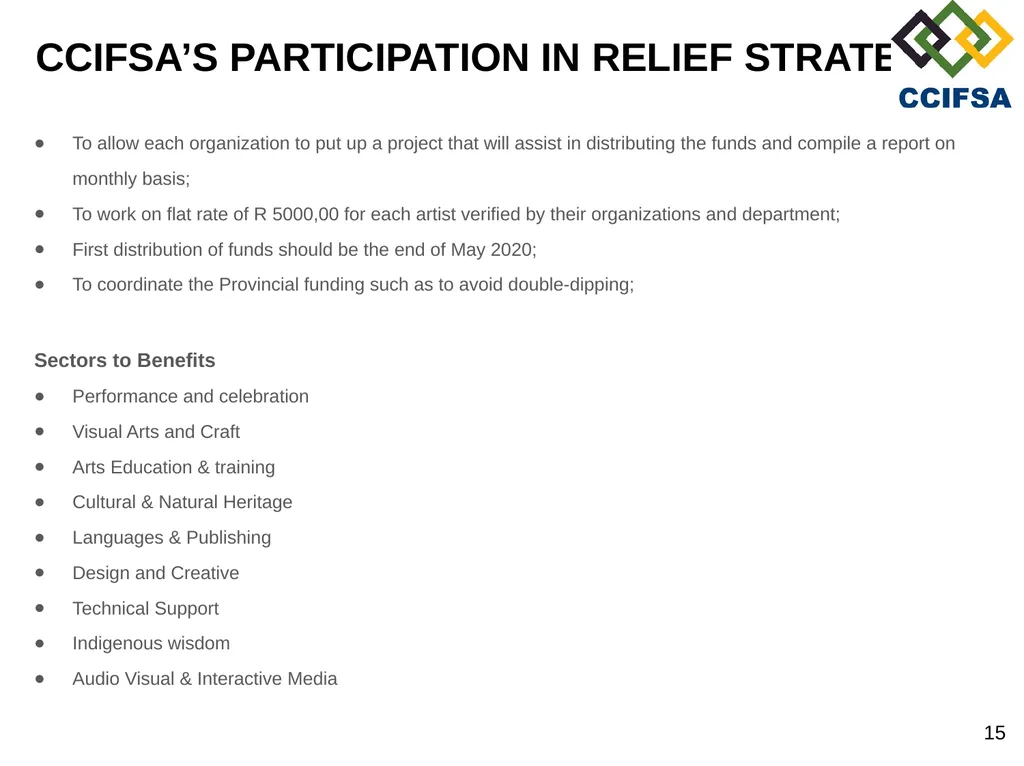
CCIFSA’S PARTICIPATION IN RELIEF STRATEGY To allow each organization to put up a project that will assist in distributing the funds and compile a report on monthly basis;
To work on flat rate of R 5000,00 for each artist verified by their organizations and department;
First distribution of funds should be the end of May 2020;
To coordinate the Provincial funding such as to avoid double-dipping;
Sectors to Benefits
Performance and celebration
Visual Arts and Craft
Arts Education & training
Cultural & Natural Heritage
Languages & Publishing
Design and Creative
Technical Support
Indigenous wisdom
Audio Visual & Interactive Media 15<br>
To work on flat rate of R 5000,00 for each artist verified by their organizations and department;
First distribution of funds should be the end of May 2020;
To coordinate the Provincial funding such as to avoid double-dipping;
Sectors to Benefits
Performance and celebration
Visual Arts and Craft
Arts Education & training
Cultural & Natural Heritage
Languages & Publishing
Design and Creative
Technical Support
Indigenous wisdom
Audio Visual & Interactive Media 15<br>
16
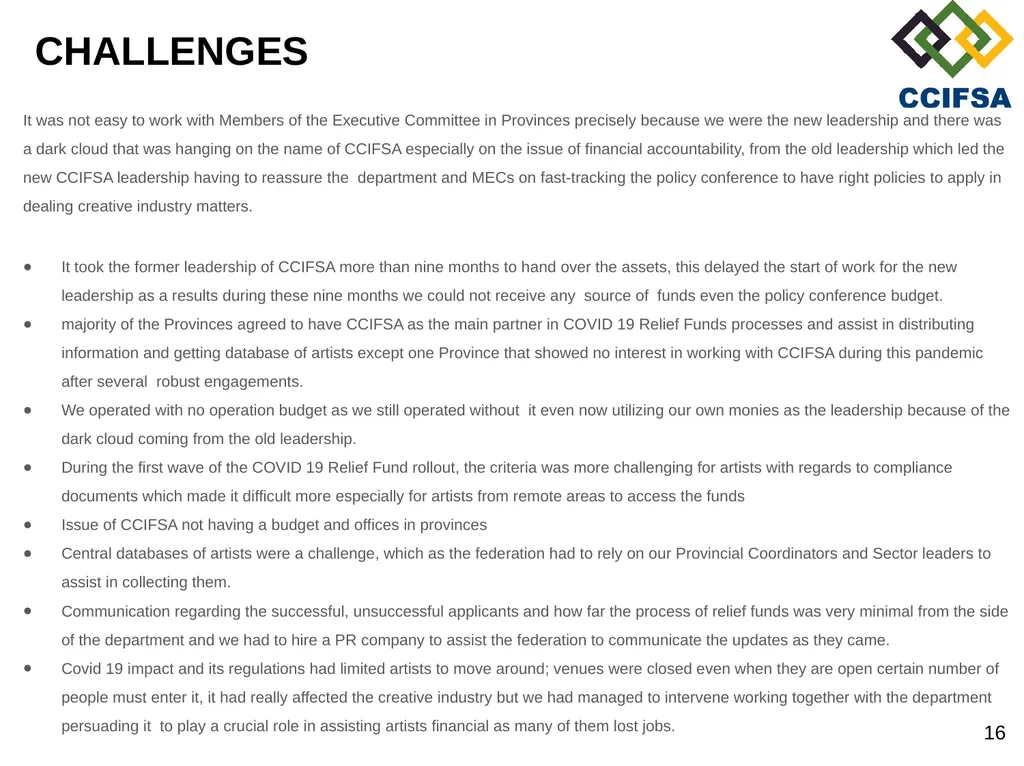
CHALLENGES It was not easy to work with Members of the Executive Committee in Provinces precisely because we were the new leadership and there was a dark cloud that was hanging on the name of CCIFSA especially on the issue of financial accountability, from the old leadership which led the new CCIFSA leadership having to reassure the department and MECs on fast-tracking the policy conference to have right policies to apply in dealing creative industry matters.
It took the former leadership of CCIFSA more than nine months to hand over the assets, this delayed the start of work for the new leadership as a results during these nine months we could not receive any source of funds even the policy conference budget.
majority of the Provinces agreed to have CCIFSA as the main partner in COVID 19 Relief Funds processes and assist in distributing information and getting database of artists except one Province that showed no interest in working with CCIFSA during this pandemic after several robust engagements.
We operated with no operation budget as we still operated without it even now utilizing our own monies as the leadership because of the dark cloud coming from the old leadership.
During the first wave of the COVID 19 Relief Fund rollout, the criteria was more challenging for artists with regards to compliance documents which made it difficult more especially for artists from remote areas to access the funds
Issue of CCIFSA not having a budget and offices in provinces
Central databases of artists were a challenge, which as the federation had to rely on our Provincial Coordinators and Sector leaders to assist in collecting them.
Communication regarding the successful, unsuccessful applicants and how far the process of relief funds was very minimal from the side of the department and we had to hire a PR company to assist the federation to communicate the updates as they came.
Covid 19 impact and its regulations had limited artists to move around; venues were closed even when they are open certain number of people must enter it, it had really affected the creative industry but we had managed to intervene working together with the department persuading it to play a crucial role in assisting artists financial as many of them lost jobs. 16<br>
It took the former leadership of CCIFSA more than nine months to hand over the assets, this delayed the start of work for the new leadership as a results during these nine months we could not receive any source of funds even the policy conference budget.
majority of the Provinces agreed to have CCIFSA as the main partner in COVID 19 Relief Funds processes and assist in distributing information and getting database of artists except one Province that showed no interest in working with CCIFSA during this pandemic after several robust engagements.
We operated with no operation budget as we still operated without it even now utilizing our own monies as the leadership because of the dark cloud coming from the old leadership.
During the first wave of the COVID 19 Relief Fund rollout, the criteria was more challenging for artists with regards to compliance documents which made it difficult more especially for artists from remote areas to access the funds
Issue of CCIFSA not having a budget and offices in provinces
Central databases of artists were a challenge, which as the federation had to rely on our Provincial Coordinators and Sector leaders to assist in collecting them.
Communication regarding the successful, unsuccessful applicants and how far the process of relief funds was very minimal from the side of the department and we had to hire a PR company to assist the federation to communicate the updates as they came.
Covid 19 impact and its regulations had limited artists to move around; venues were closed even when they are open certain number of people must enter it, it had really affected the creative industry but we had managed to intervene working together with the department persuading it to play a crucial role in assisting artists financial as many of them lost jobs. 16<br>
17
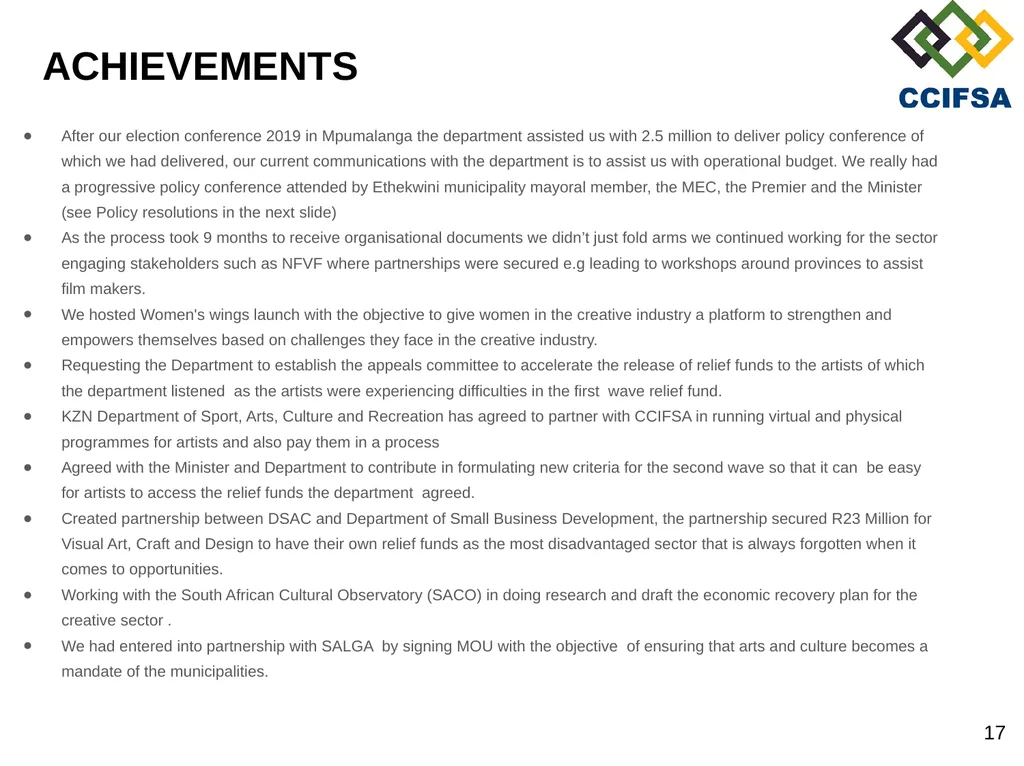
ACHIEVEMENTS After our election conference 2019 in Mpumalanga the department assisted us with 2.5 million to deliver policy conference of which we had delivered, our current communications with the department is to assist us with operational budget. We really had a progressive policy conference attended by Ethekwini municipality mayoral member, the MEC, the Premier and the Minister (see Policy resolutions in the next slide)
As the process took 9 months to receive organisational documents we didn’t just fold arms we continued working for the sector engaging stakeholders such as NFVF where partnerships were secured e.g leading to workshops around provinces to assist film makers.
We hosted Women's wings launch with the objective to give women in the creative industry a platform to strengthen and empowers themselves based on challenges they face in the creative industry.
Requesting the Department to establish the appeals committee to accelerate the release of relief funds to the artists of which the department listened as the artists were experiencing difficulties in the first wave relief fund.
KZN Department of Sport, Arts, Culture and Recreation has agreed to partner with CCIFSA in running virtual and physical programmes for artists and also pay them in a process
Agreed with the Minister and Department to contribute in formulating new criteria for the second wave so that it can be easy for artists to access the relief funds the department agreed.
Created partnership between DSAC and Department of Small Business Development, the partnership secured R23 Million for Visual Art, Craft and Design to have their own relief funds as the most disadvantaged sector that is always forgotten when it comes to opportunities.
Working with the South African Cultural Observatory (SACO) in doing research and draft the economic recovery plan for the creative sector .
We had entered into partnership with SALGA by signing MOU with the objective of ensuring that arts and culture becomes a mandate of the municipalities. 17<br>
As the process took 9 months to receive organisational documents we didn’t just fold arms we continued working for the sector engaging stakeholders such as NFVF where partnerships were secured e.g leading to workshops around provinces to assist film makers.
We hosted Women's wings launch with the objective to give women in the creative industry a platform to strengthen and empowers themselves based on challenges they face in the creative industry.
Requesting the Department to establish the appeals committee to accelerate the release of relief funds to the artists of which the department listened as the artists were experiencing difficulties in the first wave relief fund.
KZN Department of Sport, Arts, Culture and Recreation has agreed to partner with CCIFSA in running virtual and physical programmes for artists and also pay them in a process
Agreed with the Minister and Department to contribute in formulating new criteria for the second wave so that it can be easy for artists to access the relief funds the department agreed.
Created partnership between DSAC and Department of Small Business Development, the partnership secured R23 Million for Visual Art, Craft and Design to have their own relief funds as the most disadvantaged sector that is always forgotten when it comes to opportunities.
Working with the South African Cultural Observatory (SACO) in doing research and draft the economic recovery plan for the creative sector .
We had entered into partnership with SALGA by signing MOU with the objective of ensuring that arts and culture becomes a mandate of the municipalities. 17<br>
18
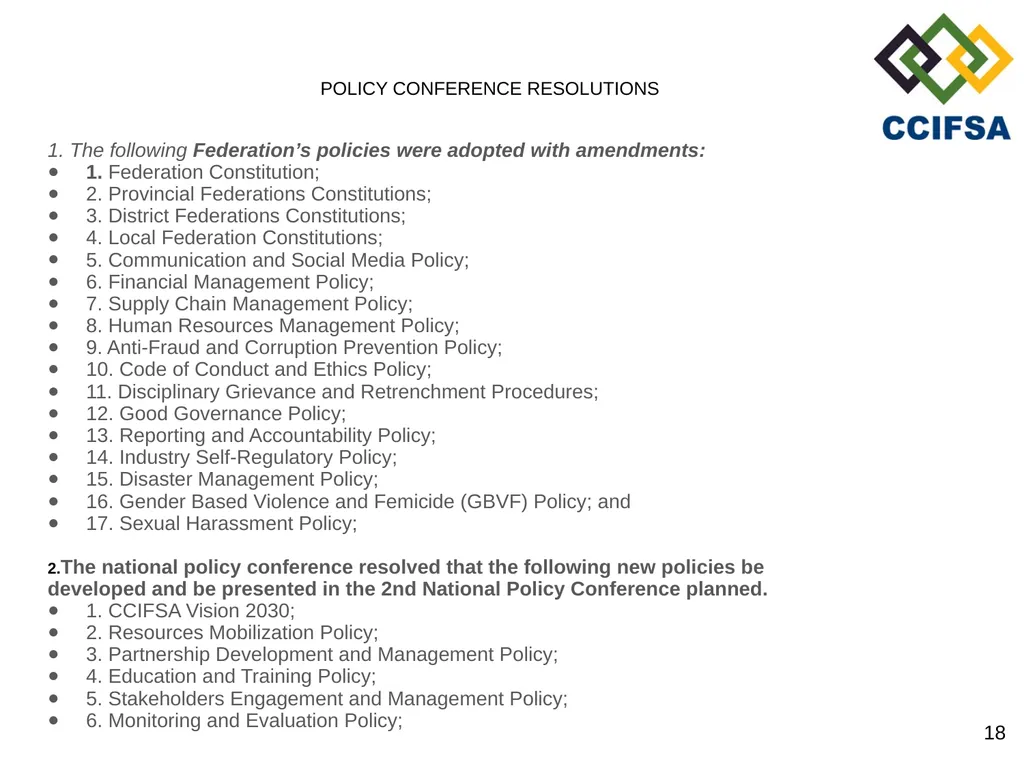
1. The following Federation’s policies were adopted with amendments:
1. Federation Constitution;
2. Provincial Federations Constitutions;
3. District Federations Constitutions;
4. Local Federation Constitutions;
5. Communication and Social Media Policy;
6. Financial Management Policy;
7. Supply Chain Management Policy;
8. Human Resources Management Policy;
9. Anti-Fraud and Corruption Prevention Policy;
10. Code of Conduct and Ethics Policy;
11. Disciplinary Grievance and Retrenchment Procedures;
12. Good Governance Policy;
13. Reporting and Accountability Policy;
14. Industry Self-Regulatory Policy;
15. Disaster Management Policy;
16. Gender Based Violence and Femicide (GBVF) Policy; and
17. Sexual Harassment Policy;
2.The national policy conference resolved that the following new policies be
developed and be presented in the 2nd National Policy Conference planned.
1. CCIFSA Vision 2030;
2. Resources Mobilization Policy;
3. Partnership Development and Management Policy;
4. Education and Training Policy;
5. Stakeholders Engagement and Management Policy;
6. Monitoring and Evaluation Policy; POLICY CONFERENCE RESOLUTIONS 18<br>
1. Federation Constitution;
2. Provincial Federations Constitutions;
3. District Federations Constitutions;
4. Local Federation Constitutions;
5. Communication and Social Media Policy;
6. Financial Management Policy;
7. Supply Chain Management Policy;
8. Human Resources Management Policy;
9. Anti-Fraud and Corruption Prevention Policy;
10. Code of Conduct and Ethics Policy;
11. Disciplinary Grievance and Retrenchment Procedures;
12. Good Governance Policy;
13. Reporting and Accountability Policy;
14. Industry Self-Regulatory Policy;
15. Disaster Management Policy;
16. Gender Based Violence and Femicide (GBVF) Policy; and
17. Sexual Harassment Policy;
2.The national policy conference resolved that the following new policies be
developed and be presented in the 2nd National Policy Conference planned.
1. CCIFSA Vision 2030;
2. Resources Mobilization Policy;
3. Partnership Development and Management Policy;
4. Education and Training Policy;
5. Stakeholders Engagement and Management Policy;
6. Monitoring and Evaluation Policy; POLICY CONFERENCE RESOLUTIONS 18<br>
19
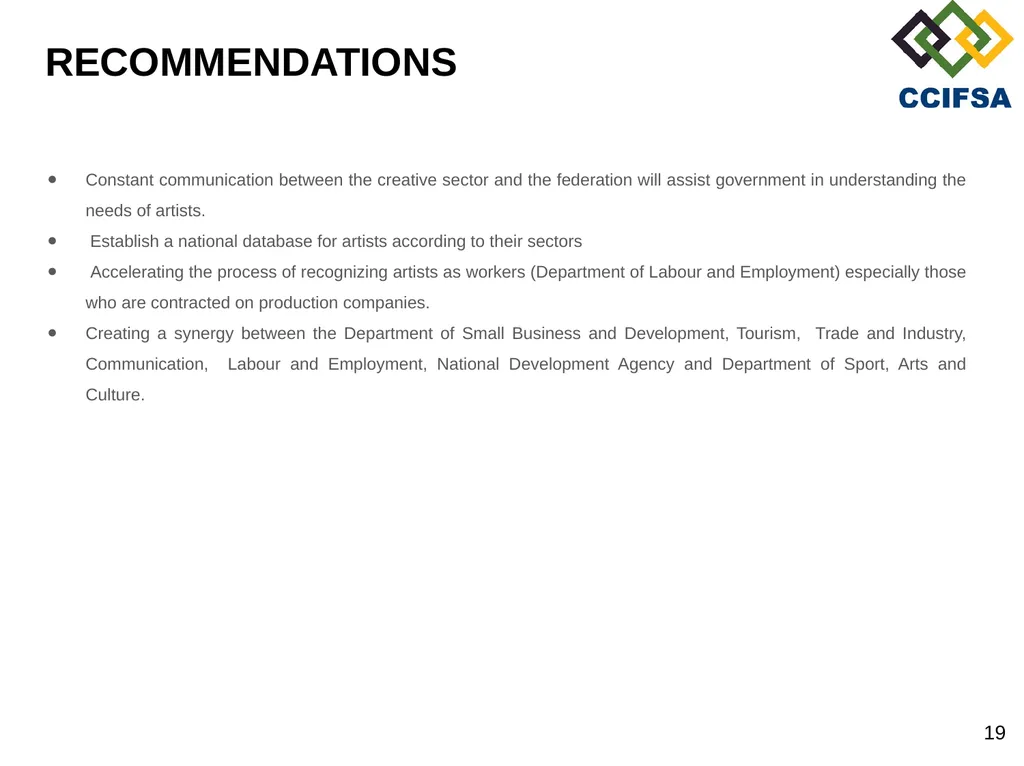
RECOMMENDATIONS Constant communication between the creative sector and the federation will assist government in understanding the needs of artists.
Establish a national database for artists according to their sectors
Accelerating the process of recognizing artists as workers (Department of Labour and Employment) especially those who are contracted on production companies.
Creating a synergy between the Department of Small Business and Development, Tourism, Trade and Industry, Communication, Labour and Employment, National Development Agency and Department of Sport, Arts and Culture. 19<br>
Establish a national database for artists according to their sectors
Accelerating the process of recognizing artists as workers (Department of Labour and Employment) especially those who are contracted on production companies.
Creating a synergy between the Department of Small Business and Development, Tourism, Trade and Industry, Communication, Labour and Employment, National Development Agency and Department of Sport, Arts and Culture. 19<br>
20
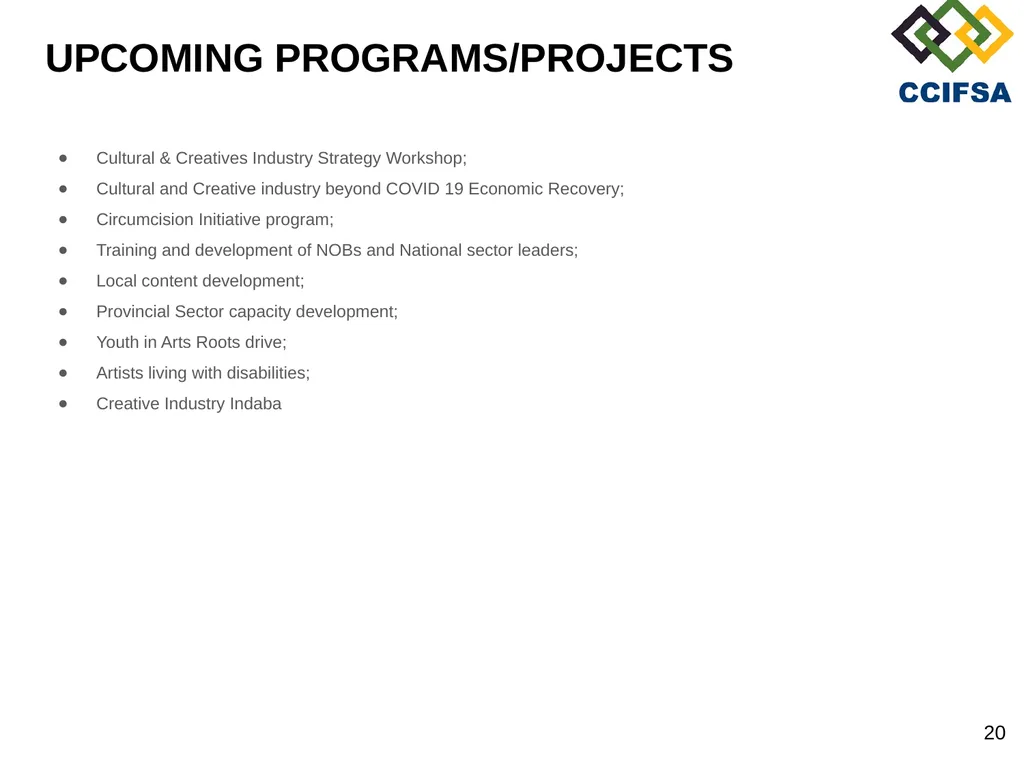
UPCOMING PROGRAMS/PROJECTS Cultural & Creatives Industry Strategy Workshop;
Cultural and Creative industry beyond COVID 19 Economic Recovery;
Circumcision Initiative program;
Training and development of NOBs and National sector leaders;
Local content development;
Provincial Sector capacity development;
Youth in Arts Roots drive;
Artists living with disabilities;
Creative Industry Indaba 20<br>
Cultural and Creative industry beyond COVID 19 Economic Recovery;
Circumcision Initiative program;
Training and development of NOBs and National sector leaders;
Local content development;
Provincial Sector capacity development;
Youth in Arts Roots drive;
Artists living with disabilities;
Creative Industry Indaba 20<br>
21
THANK YOU<br>