
POST FINANCIAL CRISIS: Options for SIDS & emerging
Description: POST FINANCIAL CRISIS: Options for SIDS emerging economies Joseph E. Stiglitz February 9, 2011 A Brief Review of the Global Economic Landscape Weve pulled back from the brink on which were poised in the fall of 2008 But we are not out of
Related Topics
Download Presentation
"POST FINANCIAL CRISIS: Options for SIDS & emerging" is the property of its rightful owner. Permission is granted to download and print the materials on this website for personal, non-commercial use only, and to display it on your personal computer provided you do not modify the materials and that you retain all copyright notices contained in the materials. By downloading content from our website, you accept the terms of this agreement.
Presentation Transcript
slide1. POST FINANCIAL CRISIS:
Options for SIDS
& emerging economies Joseph E. Stiglitz
February 9, 2011<br>
slide2. A Brief Review of the Global Economic Landscape We’ve pulled back from the brink on which were poised in the fall of 2008
But we are not out of the woods
On average, the global economy is doing well
But it’s a divided world
Asia is growing rapidly
Pulling along others with them—especially commodity exporters
But Europe and America are doing poorly
2011 is likely to be worse than 2010<br>
slide3. Negative Prognosis for Europe and America Stimulus measures taken in early 2009 are coming to an end
Before a robust recovery has really set in
Austerity measures will make things worse
Already in evidence in U.K., Greece, Ireland
Some countries have little choice
But others are voluntarily inflicting pain on themselves
And in an interconnected world, on others as well<br>
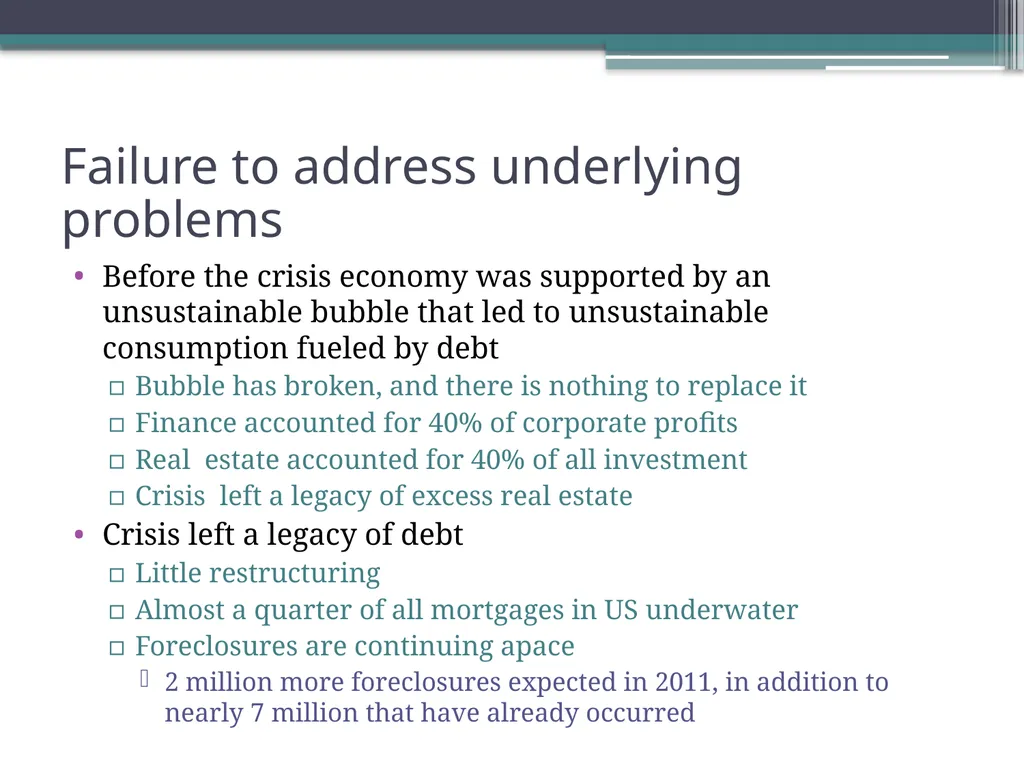
slide4. Failure to address underlying problems Before the crisis economy was supported by an unsustainable bubble that led to unsustainable consumption fueled by debt
Bubble has broken, and there is nothing to replace it
Finance accounted for 40% of corporate profits
Real estate accounted for 40% of all investment
Crisis left a legacy of excess real estate
Crisis left a legacy of debt
Little restructuring
Almost a quarter of all mortgages in US underwater
Foreclosures are continuing apace
2 million more foreclosures expected in 2011, in addition to nearly 7 million that have already occurred<br>
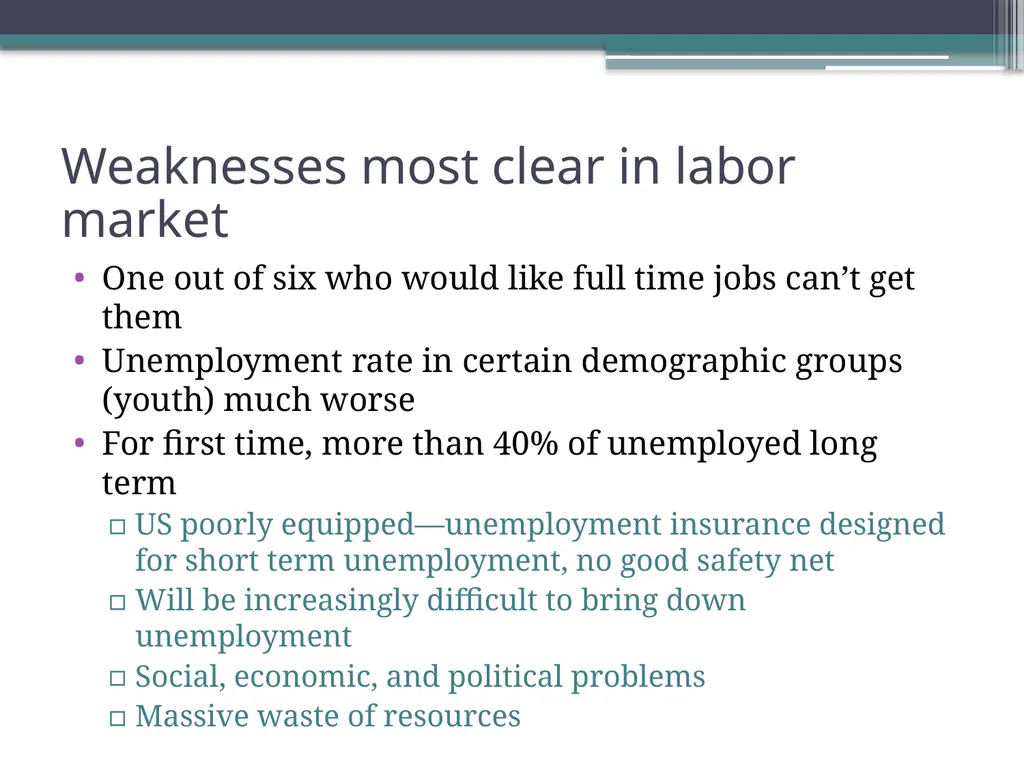
slide5. Weaknesses most clear in labor market One out of six who would like full time jobs can’t get them
Unemployment rate in certain demographic groups (youth) much worse
For first time, more than 40% of unemployed long term
US poorly equipped—unemployment insurance designed for short term unemployment, no good safety net
Will be increasingly difficult to bring down unemployment
Social, economic, and political problems
Massive waste of resources<br>
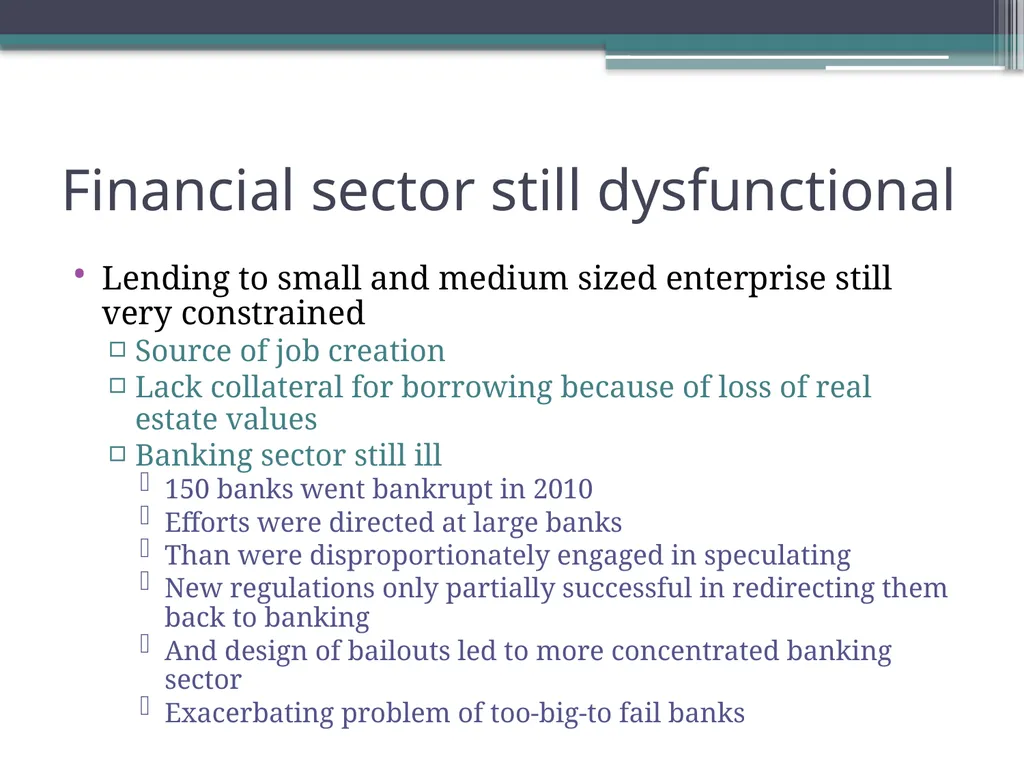
slide6. Financial sector still dysfunctional Lending to small and medium sized enterprise still very constrained
Source of job creation
Lack collateral for borrowing because of loss of real estate values
Banking sector still ill
150 banks went bankrupt in 2010
Efforts were directed at large banks
Than were disproportionately engaged in speculating
New regulations only partially successful in redirecting them back to banking
And design of bailouts led to more concentrated banking sector
Exacerbating problem of too-big-to fail banks<br>
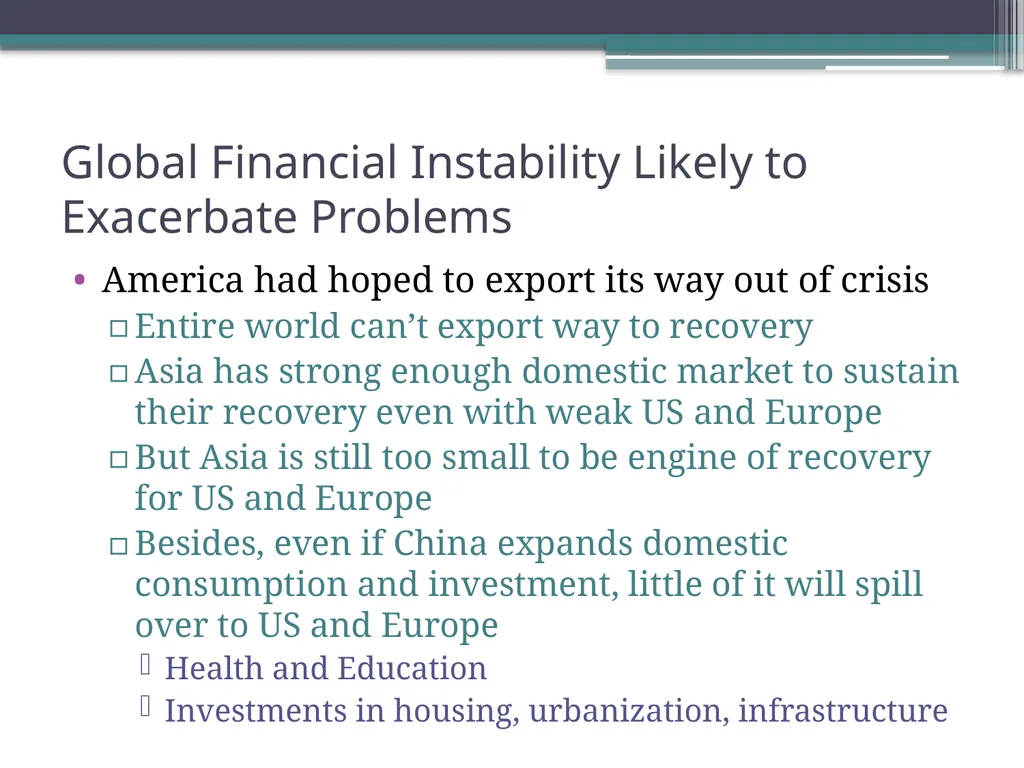
slide7. Global Financial Instability Likely to Exacerbate Problems America had hoped to export its way out of crisis
Entire world can’t export way to recovery
Asia has strong enough domestic market to sustain their recovery even with weak US and Europe
But Asia is still too small to be engine of recovery for US and Europe
Besides, even if China expands domestic consumption and investment, little of it will spill over to US and Europe
Health and Education
Investments in housing, urbanization, infrastructure<br>
slide8. European problems present additional challenge to US
Led to stronger dollar
Weaker export market
Exchange rates are like negative beauty contests
Which country is in weakest shape, worst economic policies
US had been winning
But Euro seems to be winning now
Markets are shortsighted—focus on one problem at a time
US has many problems ahead (debt ceiling, state finances)
But so does Europe (Irish and Greece problems have not been solved; problems will reappear—joined by other countries.)<br>
slide9. QE 2 is changing global financial landscape Motivation understandable
Fed largely responsible for crisis, wants to do something about the problems it created
Wants to show it is still relevant
But what the US needs is fiscal expansion
QE 2 is likely to be of little benefit to US—and could even backfire:
Little impact on interest rates (actually have increased)
Little impact on lending (banks are still broken)
Main effect through competitive devaluation
Twenty -first century version of beggar thy neighbor polivcy
But as in Great Depression, these policies don’t work
Other countries respond<br>
slide10. Failure to understand monetary policy in global economy In old world, creating liquidity in a country led to increased spending in that country
Though even then one has to be careful
In 2001 spending took form of unsustainable real estate bubble and a consumption binge—not more real investment
Similar to what has happened in many other countries
In globalized world, money looks around for highest return in the world
And finding it in dynamic emerging markets, not in US
US monetary authorities provide neither incentives nor constraints
Worse, have done little to repair banking system
Hence, money is going where it’s not need, not going where it’s needed<br>
slide11. QE2 threatens exacerbating bubbles and inflation in emerging markets Higher commodity prices may exacerbate problems for advanced industrial countries
Risk of stagflation—inflation sets in before unemployment returns to normal
Europe more likely to respond by raising interest rates, dampening recovery
Mixed effects on other countries
Inflation worse, because of larger role of food and energy in market basket
Food importers especially hard hit
Some commodity exporters benefit<br>
slide12. Responses to QE2 Countries realize they don’t have to passively accept capital inflows
Direct intervention in exchange rates
Taxes on capital inflows, capital gains
Unremunarated reserve requirements
Tougher prudential regulations
Consequence is a more fragmented global capital market—just the opposite of what the US has been advocating for years
Some countries realize that traditional responses (raising interest rates to dampen economy) are likely to fail
Higher interest rates attract even more capital
Trying novel approaches—lowering interest rates and raising reserve requirements and using other administrative measures<br>
slide13. Global Consequences New global geo-economics
China has just become second largest economy
China is already largest source of savings
Savings are being redeployed around the world
Before the crisis, they were not used well (in effect, to finance US real estate bubble, tax cuts for millionaire Americans, and wars in Asia)
Question is: can they be used better?
US is having a difficult time adjusting to the new reality<br>
slide14. G 20 The moment of global cooperation is gone
Divided interests, perspectives
Evident so clearly in disputes about QE2 and China’s currency
US/China exchange rate not likely to much affect either US multilateral trade deficit or broader global imbalances
Change in exchange rate could benefit other developing and emerging markets—likely to come directly or indirectly (real appreciation through inflation)
Win-win path through a global growth strategy
Focusing on green investments and investments in emerging markets and developing countries
Focusing on redistribution in both China and US<br>
slide15. Other elements of a global growth strategy A new global reserve currency
Makes little sense in 21st century for the world’s financial system to be so dependent on the currency of a single country
Especially when that country has evidenced such economic volatility
Current system is deflationary, unstable, and unfair
Developing countries lend to the rich at low (now close to zero) interest rates, and borrow back at much higher interest rates
“Foreign aid” to US greater than aid it gives to developing country<br>
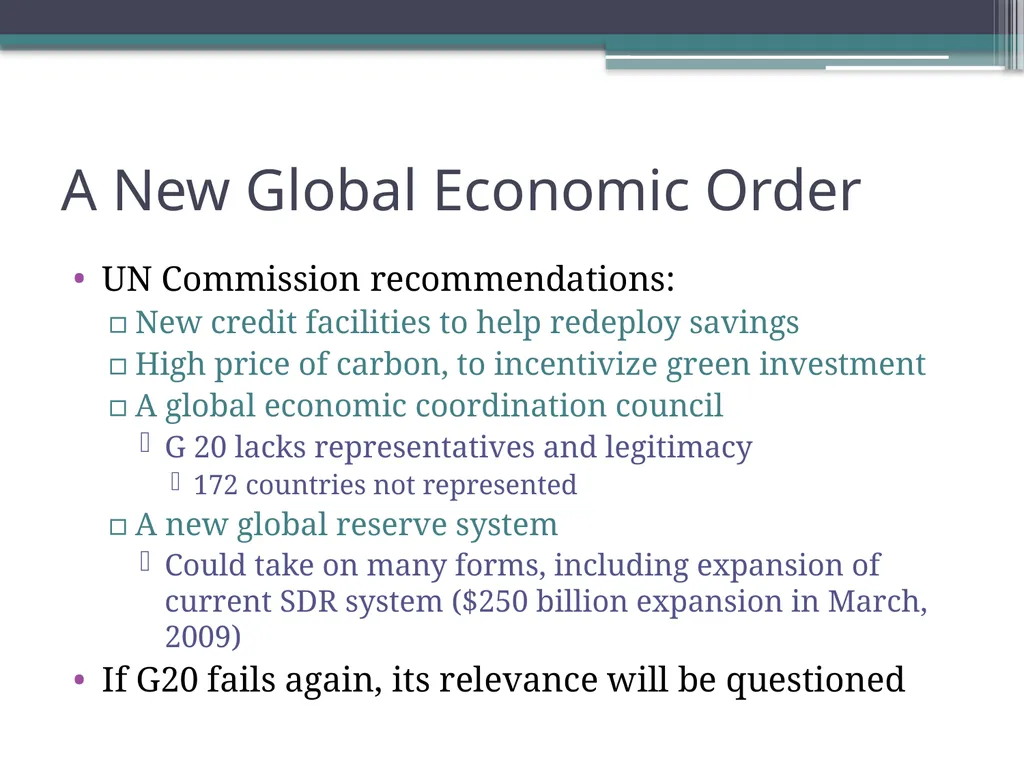
slide16. A New Global Economic Order UN Commission recommendations:
New credit facilities to help redeploy savings
High price of carbon, to incentivize green investment
A global economic coordination council
G 20 lacks representatives and legitimacy
172 countries not represented
A new global reserve system
Could take on many forms, including expansion of current SDR system ($250 billion expansion in March, 2009)
If G20 fails again, its relevance will be questioned<br>
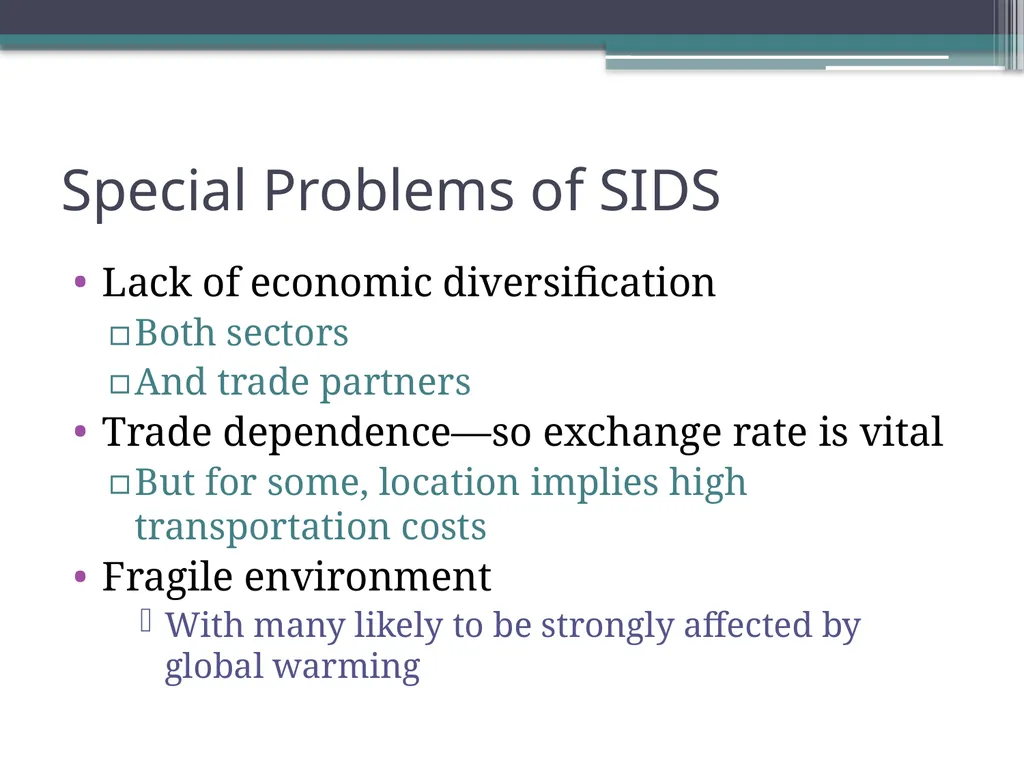
slide17. Special Problems of SIDS Lack of economic diversification
Both sectors
And trade partners
Trade dependence—so exchange rate is vital
But for some, location implies high transportation costs
Fragile environment
With many likely to be strongly affected by global warming<br>
slide18. Some economic lessons from the crisis Forced re-examination of Washington consensus policies based on market fundamentalism
Markets, on their own, may be neither efficient nor stable<br>
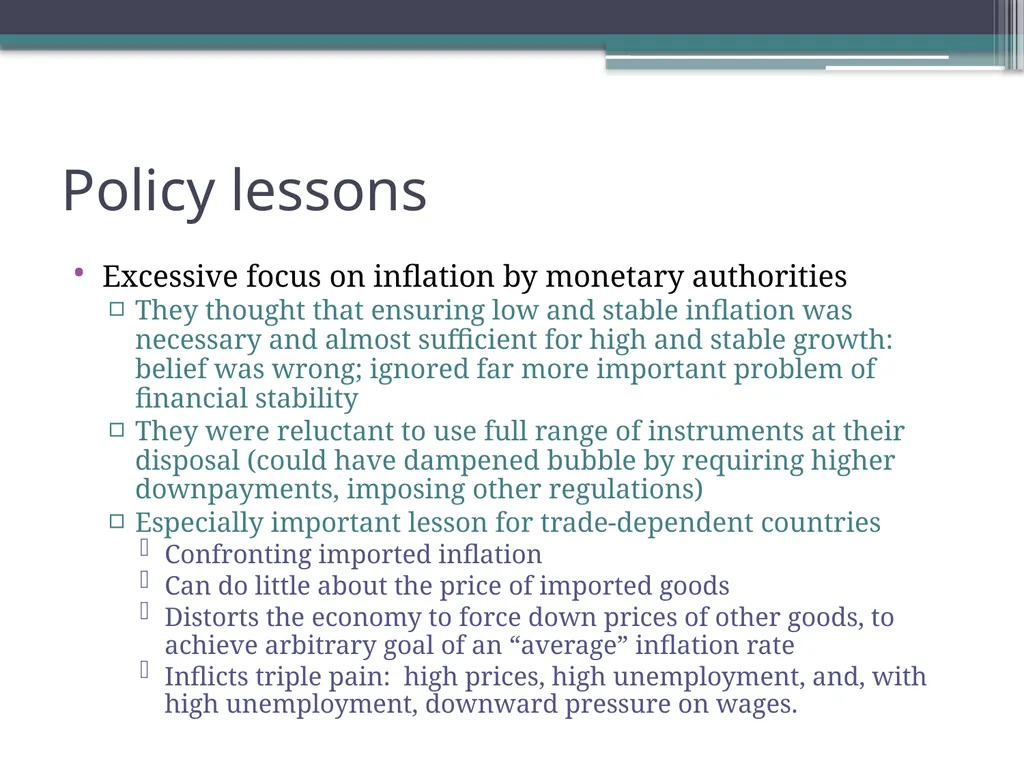
slide19. Policy lessons Excessive focus on inflation by monetary authorities
They thought that ensuring low and stable inflation was necessary and almost sufficient for high and stable growth: belief was wrong; ignored far more important problem of financial stability
They were reluctant to use full range of instruments at their disposal (could have dampened bubble by requiring higher downpayments, imposing other regulations)
Especially important lesson for trade-dependent countries
Confronting imported inflation
Can do little about the price of imported goods
Distorts the economy to force down prices of other goods, to achieve arbitrary goal of an “average” inflation rate
Inflicts triple pain: high prices, high unemployment, and, with high unemployment, downward pressure on wages.<br>
slide20. Industrial Policies: Creating Dynamic Learning Economies Key lesson: need a balanced view of role of government and market
Not just size of each, but what each does and how they interact
Many models of market economy, some perform better than others
Scandinavian model has performed better than others
On a broad range of indicators
Key has been a larger role of government, more social cohesion, low levels of inequality
Markets on their own also do not “solve” other problems
Role of government in education, technology, infrastructure, social protection and promoting environment<br>
slide21. Measuring Success GDP is not a good measure of success
Objective of economic policies should be sustainable, equitable, democratic development
Trickle down economics doesn’t work: most Americans are worse off today than they were a decade ago
Need to look at how benefits of growth are being shared<br>
slide22. Sustainability Especially important for small island states
Many dimensions: economic, political, social, and environmental sustainability
US economic policies before the crisis were not economically sustainable—true for many other countries around the world
Current patterns of growth are not environmentally sustainable
The planet will not survive if everyone aspires to America’s profligate lifestyle
Countries that adapt to the new reality sooner are more likely to prosper<br>
slide23. Concluding Remarks For the world, increasing sustainable investments is key to addressing the world’s short-run and long-run problems
Could help US and Europe emerge from the malaise into which they seem to be sliding
US, Europe, and the world are not likely to take the policy actions that would ensure greater stability going forward—or even a quick recovery for US and Europe
Smaller trade-dependent countries around the world have to adapt to this unfortunate turn of events<br>
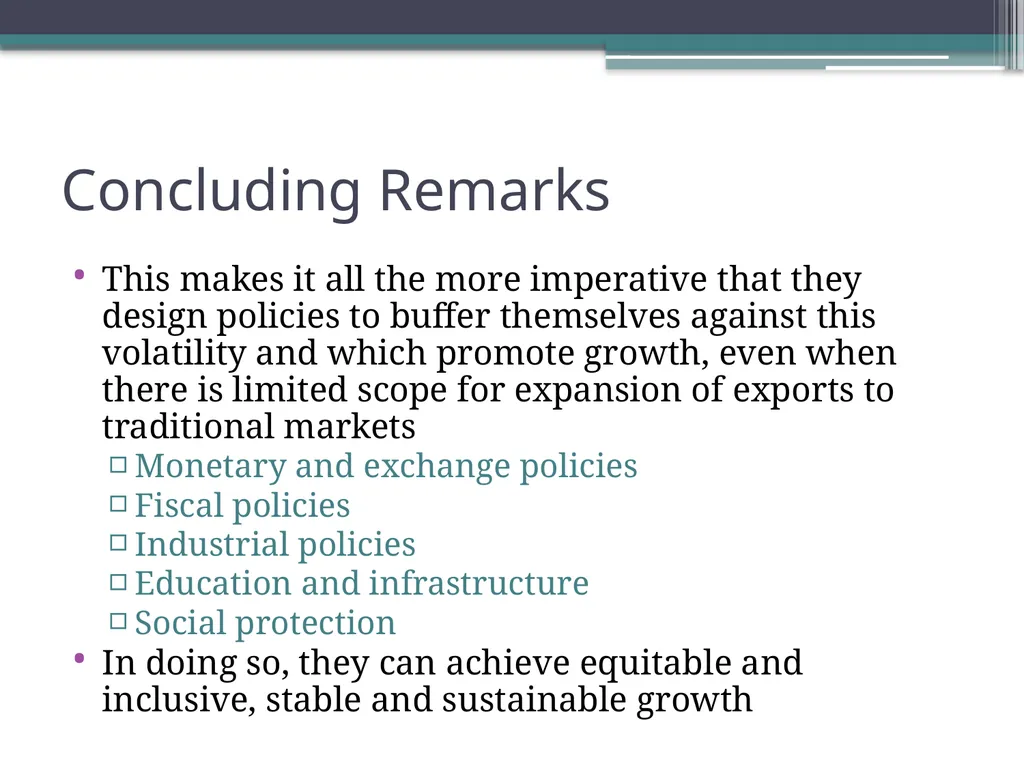
slide24. Concluding Remarks This makes it all the more imperative that they design policies to buffer themselves against this volatility and which promote growth, even when there is limited scope for expansion of exports to traditional markets
Monetary and exchange policies
Fiscal policies
Industrial policies
Education and infrastructure
Social protection
In doing so, they can achieve equitable and inclusive, stable and sustainable growth<br>
February 9, 2011<br>
slide2. A Brief Review of the Global Economic Landscape We’ve pulled back from the brink on which were poised in the fall of 2008
But we are not out of the woods
On average, the global economy is doing well
But it’s a divided world
Asia is growing rapidly
Pulling along others with them—especially commodity exporters
But Europe and America are doing poorly
2011 is likely to be worse than 2010<br>
slide3. Negative Prognosis for Europe and America Stimulus measures taken in early 2009 are coming to an end
Before a robust recovery has really set in
Austerity measures will make things worse
Already in evidence in U.K., Greece, Ireland
Some countries have little choice
But others are voluntarily inflicting pain on themselves
And in an interconnected world, on others as well<br>
slide4. Failure to address underlying problems Before the crisis economy was supported by an unsustainable bubble that led to unsustainable consumption fueled by debt
Bubble has broken, and there is nothing to replace it
Finance accounted for 40% of corporate profits
Real estate accounted for 40% of all investment
Crisis left a legacy of excess real estate
Crisis left a legacy of debt
Little restructuring
Almost a quarter of all mortgages in US underwater
Foreclosures are continuing apace
2 million more foreclosures expected in 2011, in addition to nearly 7 million that have already occurred<br>
slide5. Weaknesses most clear in labor market One out of six who would like full time jobs can’t get them
Unemployment rate in certain demographic groups (youth) much worse
For first time, more than 40% of unemployed long term
US poorly equipped—unemployment insurance designed for short term unemployment, no good safety net
Will be increasingly difficult to bring down unemployment
Social, economic, and political problems
Massive waste of resources<br>
slide6. Financial sector still dysfunctional Lending to small and medium sized enterprise still very constrained
Source of job creation
Lack collateral for borrowing because of loss of real estate values
Banking sector still ill
150 banks went bankrupt in 2010
Efforts were directed at large banks
Than were disproportionately engaged in speculating
New regulations only partially successful in redirecting them back to banking
And design of bailouts led to more concentrated banking sector
Exacerbating problem of too-big-to fail banks<br>
slide7. Global Financial Instability Likely to Exacerbate Problems America had hoped to export its way out of crisis
Entire world can’t export way to recovery
Asia has strong enough domestic market to sustain their recovery even with weak US and Europe
But Asia is still too small to be engine of recovery for US and Europe
Besides, even if China expands domestic consumption and investment, little of it will spill over to US and Europe
Health and Education
Investments in housing, urbanization, infrastructure<br>
slide8. European problems present additional challenge to US
Led to stronger dollar
Weaker export market
Exchange rates are like negative beauty contests
Which country is in weakest shape, worst economic policies
US had been winning
But Euro seems to be winning now
Markets are shortsighted—focus on one problem at a time
US has many problems ahead (debt ceiling, state finances)
But so does Europe (Irish and Greece problems have not been solved; problems will reappear—joined by other countries.)<br>
slide9. QE 2 is changing global financial landscape Motivation understandable
Fed largely responsible for crisis, wants to do something about the problems it created
Wants to show it is still relevant
But what the US needs is fiscal expansion
QE 2 is likely to be of little benefit to US—and could even backfire:
Little impact on interest rates (actually have increased)
Little impact on lending (banks are still broken)
Main effect through competitive devaluation
Twenty -first century version of beggar thy neighbor polivcy
But as in Great Depression, these policies don’t work
Other countries respond<br>
slide10. Failure to understand monetary policy in global economy In old world, creating liquidity in a country led to increased spending in that country
Though even then one has to be careful
In 2001 spending took form of unsustainable real estate bubble and a consumption binge—not more real investment
Similar to what has happened in many other countries
In globalized world, money looks around for highest return in the world
And finding it in dynamic emerging markets, not in US
US monetary authorities provide neither incentives nor constraints
Worse, have done little to repair banking system
Hence, money is going where it’s not need, not going where it’s needed<br>
slide11. QE2 threatens exacerbating bubbles and inflation in emerging markets Higher commodity prices may exacerbate problems for advanced industrial countries
Risk of stagflation—inflation sets in before unemployment returns to normal
Europe more likely to respond by raising interest rates, dampening recovery
Mixed effects on other countries
Inflation worse, because of larger role of food and energy in market basket
Food importers especially hard hit
Some commodity exporters benefit<br>
slide12. Responses to QE2 Countries realize they don’t have to passively accept capital inflows
Direct intervention in exchange rates
Taxes on capital inflows, capital gains
Unremunarated reserve requirements
Tougher prudential regulations
Consequence is a more fragmented global capital market—just the opposite of what the US has been advocating for years
Some countries realize that traditional responses (raising interest rates to dampen economy) are likely to fail
Higher interest rates attract even more capital
Trying novel approaches—lowering interest rates and raising reserve requirements and using other administrative measures<br>
slide13. Global Consequences New global geo-economics
China has just become second largest economy
China is already largest source of savings
Savings are being redeployed around the world
Before the crisis, they were not used well (in effect, to finance US real estate bubble, tax cuts for millionaire Americans, and wars in Asia)
Question is: can they be used better?
US is having a difficult time adjusting to the new reality<br>
slide14. G 20 The moment of global cooperation is gone
Divided interests, perspectives
Evident so clearly in disputes about QE2 and China’s currency
US/China exchange rate not likely to much affect either US multilateral trade deficit or broader global imbalances
Change in exchange rate could benefit other developing and emerging markets—likely to come directly or indirectly (real appreciation through inflation)
Win-win path through a global growth strategy
Focusing on green investments and investments in emerging markets and developing countries
Focusing on redistribution in both China and US<br>
slide15. Other elements of a global growth strategy A new global reserve currency
Makes little sense in 21st century for the world’s financial system to be so dependent on the currency of a single country
Especially when that country has evidenced such economic volatility
Current system is deflationary, unstable, and unfair
Developing countries lend to the rich at low (now close to zero) interest rates, and borrow back at much higher interest rates
“Foreign aid” to US greater than aid it gives to developing country<br>
slide16. A New Global Economic Order UN Commission recommendations:
New credit facilities to help redeploy savings
High price of carbon, to incentivize green investment
A global economic coordination council
G 20 lacks representatives and legitimacy
172 countries not represented
A new global reserve system
Could take on many forms, including expansion of current SDR system ($250 billion expansion in March, 2009)
If G20 fails again, its relevance will be questioned<br>
slide17. Special Problems of SIDS Lack of economic diversification
Both sectors
And trade partners
Trade dependence—so exchange rate is vital
But for some, location implies high transportation costs
Fragile environment
With many likely to be strongly affected by global warming<br>
slide18. Some economic lessons from the crisis Forced re-examination of Washington consensus policies based on market fundamentalism
Markets, on their own, may be neither efficient nor stable<br>
slide19. Policy lessons Excessive focus on inflation by monetary authorities
They thought that ensuring low and stable inflation was necessary and almost sufficient for high and stable growth: belief was wrong; ignored far more important problem of financial stability
They were reluctant to use full range of instruments at their disposal (could have dampened bubble by requiring higher downpayments, imposing other regulations)
Especially important lesson for trade-dependent countries
Confronting imported inflation
Can do little about the price of imported goods
Distorts the economy to force down prices of other goods, to achieve arbitrary goal of an “average” inflation rate
Inflicts triple pain: high prices, high unemployment, and, with high unemployment, downward pressure on wages.<br>
slide20. Industrial Policies: Creating Dynamic Learning Economies Key lesson: need a balanced view of role of government and market
Not just size of each, but what each does and how they interact
Many models of market economy, some perform better than others
Scandinavian model has performed better than others
On a broad range of indicators
Key has been a larger role of government, more social cohesion, low levels of inequality
Markets on their own also do not “solve” other problems
Role of government in education, technology, infrastructure, social protection and promoting environment<br>
slide21. Measuring Success GDP is not a good measure of success
Objective of economic policies should be sustainable, equitable, democratic development
Trickle down economics doesn’t work: most Americans are worse off today than they were a decade ago
Need to look at how benefits of growth are being shared<br>
slide22. Sustainability Especially important for small island states
Many dimensions: economic, political, social, and environmental sustainability
US economic policies before the crisis were not economically sustainable—true for many other countries around the world
Current patterns of growth are not environmentally sustainable
The planet will not survive if everyone aspires to America’s profligate lifestyle
Countries that adapt to the new reality sooner are more likely to prosper<br>
slide23. Concluding Remarks For the world, increasing sustainable investments is key to addressing the world’s short-run and long-run problems
Could help US and Europe emerge from the malaise into which they seem to be sliding
US, Europe, and the world are not likely to take the policy actions that would ensure greater stability going forward—or even a quick recovery for US and Europe
Smaller trade-dependent countries around the world have to adapt to this unfortunate turn of events<br>
slide24. Concluding Remarks This makes it all the more imperative that they design policies to buffer themselves against this volatility and which promote growth, even when there is limited scope for expansion of exports to traditional markets
Monetary and exchange policies
Fiscal policies
Industrial policies
Education and infrastructure
Social protection
In doing so, they can achieve equitable and inclusive, stable and sustainable growth<br>