POWDER MIXING solid mixing, mechanism of solid mixing Principles, Construction, Working, uses, Merits and Demerits of Double cone blender, twin shell blender, ribbon blender By Dr. Garima Joshi , Assistant Professor Dept of Pharm Sciences,
"POWDER MIXING solid mixing, mechanism of solid" is the property of its rightful owner. Permission is granted to
download and print the materials on this website for personal, non-commercial use only, and to display it
on your personal computer provided you do not modify the materials and that you retain all copyright
notices contained in the materials. By downloading content from our website, you accept the terms of this
agreement.
Presentation Transcript
01
POWDER MIXING solid mixing, mechanism of solid mixing
Principles, Construction, Working, uses, Merits and Demerits
of Double cone blender, twin shell blender, ribbon blender By Dr. Garima Joshi ,
Assistant Professor
Dept of Pharm Sciences, MLSU, Udaipur
B pharm III sem, Unit operations<br>
02
Powder mixing Powder mixing may be regarded as an operation in which two or more than two solid substances in particulate form intermingled in mixer by continuous movement of particles.
It is an example of neutral mixture and is one the most common operation employed during preparation of different formulation like powder, tablets, capsules etc<br>
03
MECHANISM OF POWDER MIXING Mixing of powder is carried out by one of the following mechanism or their combination.
Convective mixing
Shear mixing
Diffusive mixing<br>
04
CONVECTIVE MIXING It is also called bulk transport. It takes place by transferring the part of material from one location to another location of the system by means of blades or paddles of the equipment.<br>
05
SHEAR MIXING This type of mixing occurs when a layer of material flows over another layer resulting in the layers moving at different speeds and therefore mixing at the layer interface.
It occurs when the action of the mixer induces velocity gradients within the powder bed<br>
06
DIFFUSIVE MIXING Diffusive mechanism occurs by random movement of particle within a powder bed and causes them to change their relative position in relation to one another
When a powder bed is forced to move, it will dilate (The volume occupied by the bed will increase). This occurs because the powder particles become less tightly packed and there is an increase in the air spaces or voids between them. So there is the potential for the powder particles to pass through the void spaces created under gravitational forces (in tumbling mixer) or by forced movement (in fluidized bed). Mixing of individual particles is referred to as diffusive mixing<br>
07
Solid mixing devices Tumbling mixer
High shear mixture or granulator
Agitator mixer
Ribbon mixer
Planetary mixer<br>
08
TUMBLING MIXER/SHEAR MIXER In this type of mixer movement of whole mixer is responsible for mixing action of solid.
Tumbling mixer usually consist of metallic vessels which are rotated on their horizentalaxis at optimum speed by means of motor
The mixing vessel is usually made up of stainless steel and have door have loading/unloading of material.
The door is usually lined with rubber which provides a perfect seal after closure.<br>
09
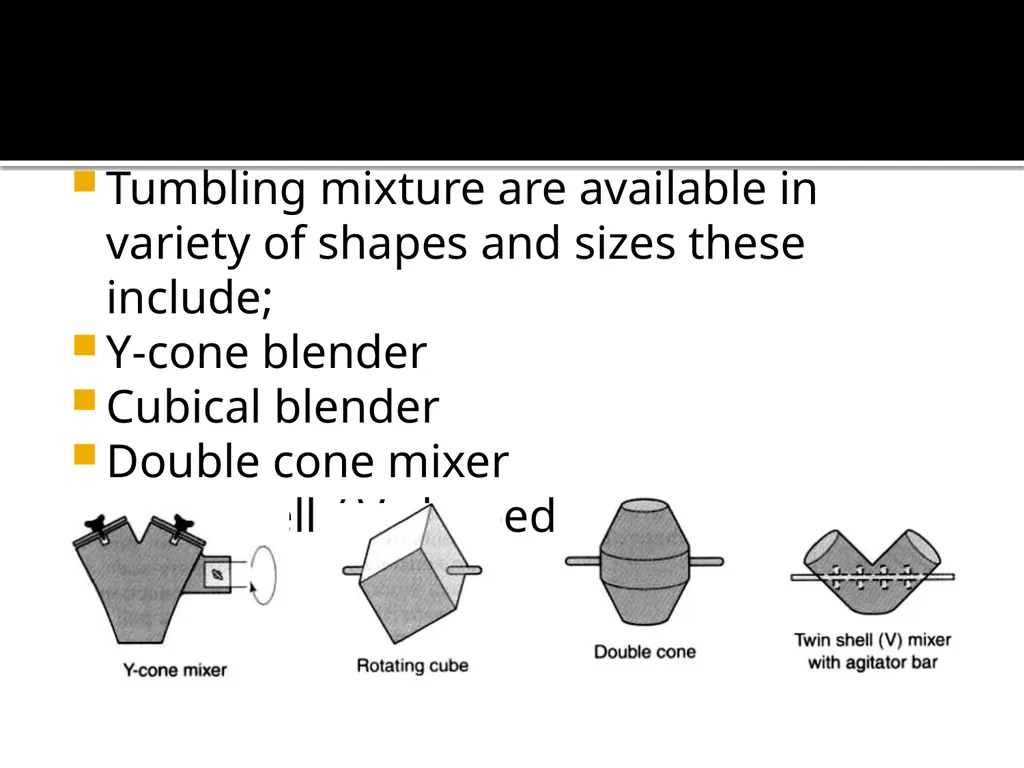
Tumbling mixture are available in variety of shapes and sizes these include;
Y-cone blender
Cubical blender
Double cone mixer
Twin shell / V-shaped mixer<br>
10
Tumbling mixer The material to be mixed is loaded into mixing vessel which is rotated at lowspeed by electric motor.
Due to slow speed of rotation the powder is raised along the sides of the vessel until the angle of repose is exceeded.
The powder then tumbles down and mixing of compound occurs.
The rotation of vessel is very important in this case
If the speed of rotation is too slow, it will cause sliding only so proper mixing will not occurs.
If it is rotated at high speed so the material will adhere to the walls due to centrifugal force so optimum speed is required (30-100 rpm)<br>
11
Mixing mostly occurs by convective mechanism
Shear mixing will occur as a velocity gradient is produced, (the top layer moving with high velocity and the velocity decreasing as the distance from the surface increases)
When the bed tumbles it dilates, allowing the particles to move downward under gravitational force, and so diffusive mixing occurs
Addition of ‘prongs’, baffles or rotating bars will also cause convective mixing<br>
12
ADVANTAGES:
Good for free flowing powders/granules
Mix from approximately 50 g (Laboratory scale) to over 100 kg (Large scale)
Can be used to produce ordered mixes
Used in the blending of lubricants, glidantsor external disintegrantswith granules prior to tableting
DISADVANTAGES:
Less effective for cohesive/poorly flowing powders
Segregation is likely to occur if there are significant differences in particle size<br>
13
HIGH SHEAR MIXER-GRANULATOR It is so called because mixing mainly occurs by shear mixing mechanism and at same time granulation is carried out
CONSTRUCTION:
It consist of a vessel having propeller with long blades
The clearance (distance b/w propeller blades and walls of vessel) is low.
There is a closing lid that closes the vessel after material to be mixed is added.
For introduction of material/granulating agent funnel is used.
For the purposes of granulation a chopper is present on side wall<br>
14
The material is to mixed id introduced to the mixer.
The centrally mounted propeller blade at the bottom of the mixer rotates at high speed, throwing material towards the mixture bowl wall by centrifugal force.
The material is then forced upward before dropping back down towards the centre of the mixer.
The particulate movement within the bowl tends to mix the components quickly owing to high shear forces (arising from the high velocity) and expansion in the bed volume that allows diffusive mixing
After mixing the granulating agent (water or alcohol) is then added through funnel.
It will produce wet mass that will go to the side wall of mixer because of propeller.
On sides, chopper with vertical, short and sharp blades, is present that is rotating at speed higher than that of the propeller and will broke the wet mass so as to produce granules.<br>
15
ADVANTAGES:
Can be used for both wet and dry mixing
For granulation purposes
DISADVANTAGE:
Materials being mixed can fracture easily due to high speed movement
Cannot be used for blending lubricants<br>
16
AGITATOR MIXER These are the mixers in which the container to hold the material is fixed. Mixing is done by means of mixing screws, paddles or blades.
Well known mixers of this type include the following:
The ribbon blender/Mixer
Planetary mixer:<br>
17
RIBBON MIXER
Construction
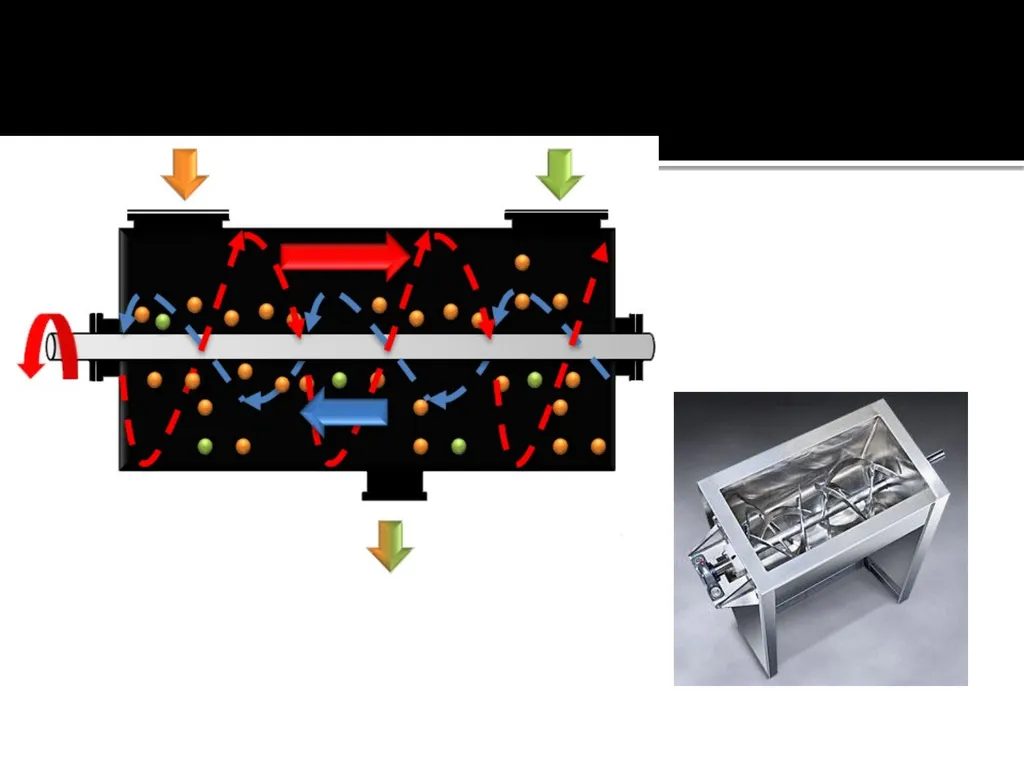
Consists of horizontal cylindrical trough with semicircular bottom usually open at the top. It is fitted with two helical blades, which are mounted on the same shaft through the long axis of the trough.
Blades have both right and left hand twists.
Blades are connected to fixed speed drive.
It can be loaded by top and emptying is done through bottom port.<br>
18
Mechanism of mixing is shear. Shear is transferred by moving blades. High shear rates are effective in breaking lumps and aggregates.
Convective mixing also occurs as the powder bed is lifted and allowed to cascade to the bottom of the container. An equilibrium state of mixing can be achieved.
Uses:
Used for mixing of finely divided solids, wet solid mass and plastic solids.
Uniform size and density materials can be easily mixed.
Used for solid –solid and liquid –solid mixing.<br>
19
Advantages:
High shear can be applied by using perforated baffles, which bring about a rubbing and breakdown of aggregates.
Headroom requires less space.
Disadvantages:
It is a poor mixer, because movement of particles is two dimensional.
Shearing action is less than in planetary mixer.
Dead spots are observed in the mixer, though they are minimum
It has fixed speed drive.
Not suitable for fragile crystals and sensitive materials.<br>