PowerWalk: Scalable Personalized PageRank via Random Walks with Vertex-Centric Decomposition Qin Liu, John C.S. Lui Chinese University of Hong Kong Zhenguo Li, Jiefeng Cheng Huawei Noahs Ark Lab Speaker: Zhipeng Huang, University of Hong
"PowerWalk: Scalable Personalized PageRank via" is the property of its rightful owner. Permission is granted to
download and print the materials on this website for personal, non-commercial use only, and to display it
on your personal computer provided you do not modify the materials and that you retain all copyright
notices contained in the materials. By downloading content from our website, you accept the terms of this
agreement.
Presentation Transcript
01
PowerWalk: Scalable Personalized PageRank via Random Walks with Vertex-Centric Decomposition Qin Liu, John C.S. Lui
Chinese University of Hong Kong
Zhenguo Li, Jiefeng Cheng
Huawei Noah’s Ark Lab
Speaker: Zhipeng Huang, University of Hong Kong<br>
02
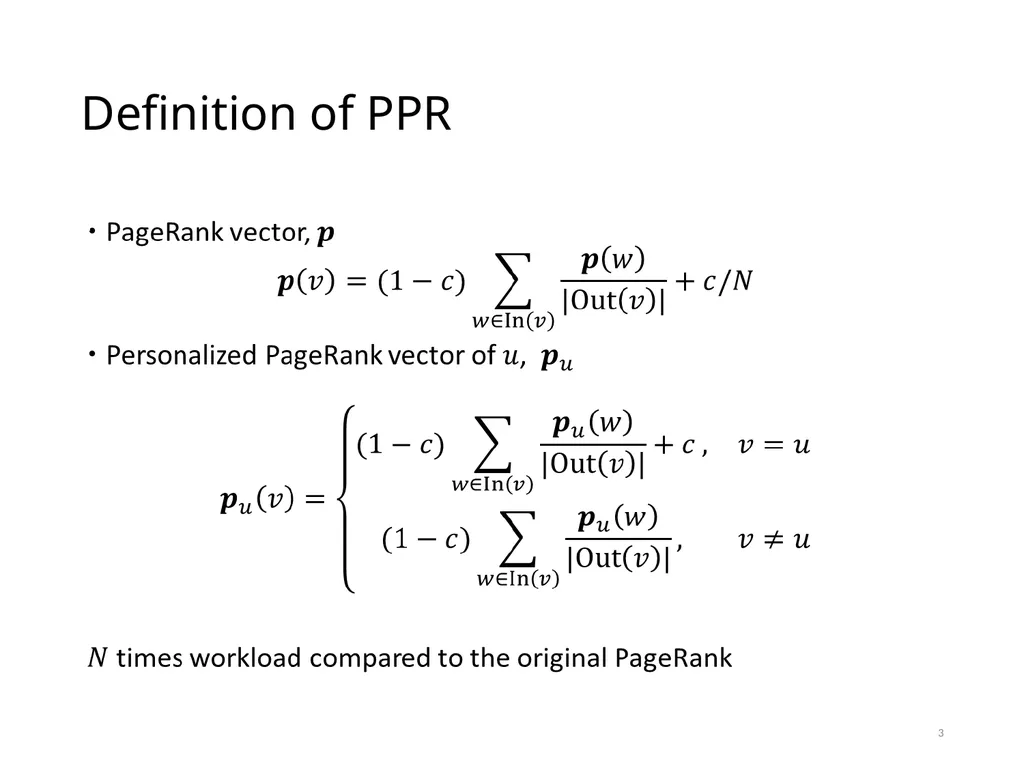
Background What is Personalized PageRank (PPR)?
PageRank: a measure of importance of vertices
Personalized PageRank: consider user preferences by assigning more importance to certain vertices
Applications of PPR:
personalization of web searches
general searches in social networks
graph partitioning[FOCS’06]
Twitter “who to follow” service[WWW’13] 2<br>
03
Definition of PPR 3<br>
04
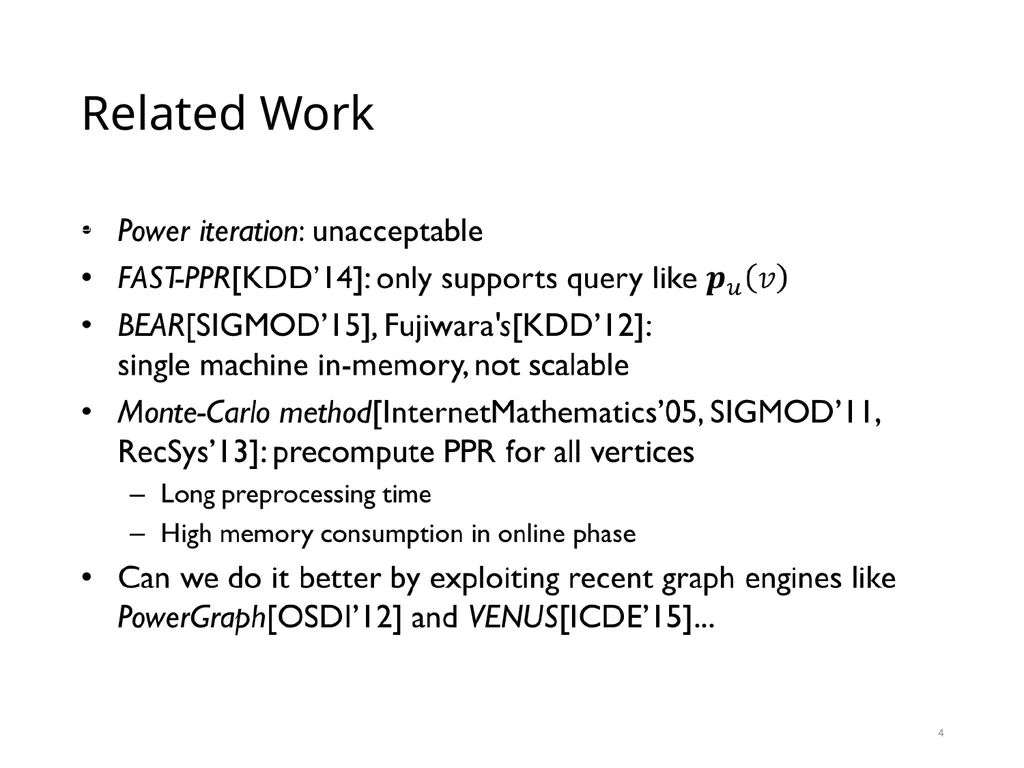
Related Work 4<br>
05
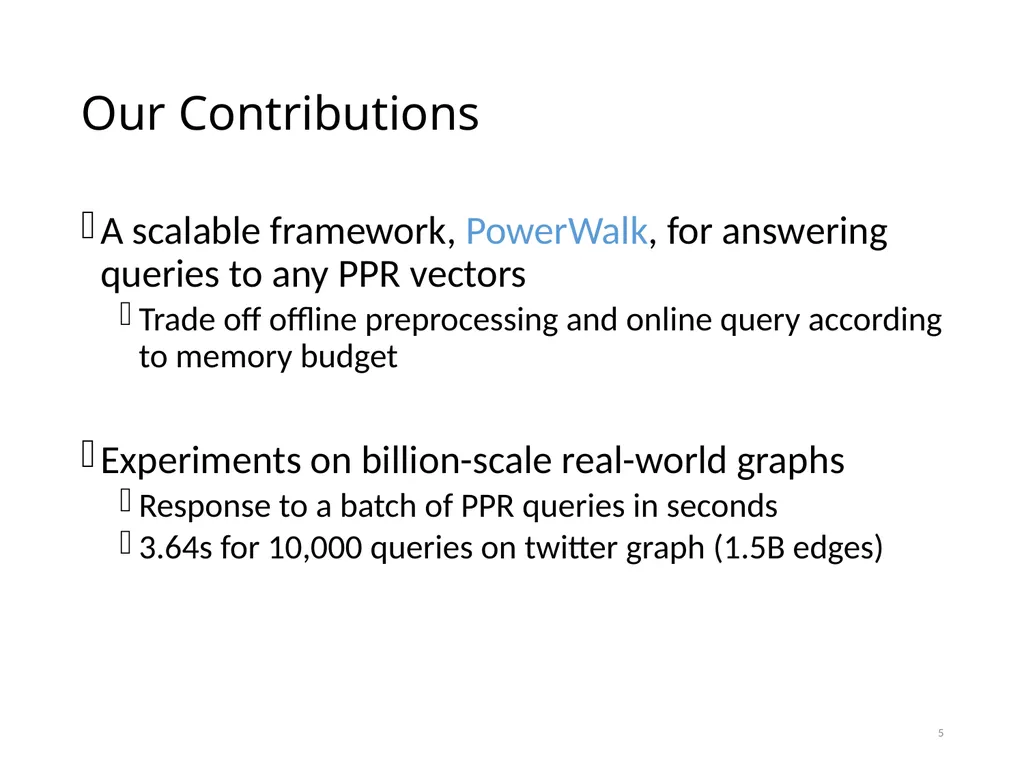
Our Contributions A scalable framework, PowerWalk, for answering queries to any PPR vectors
Trade off offline preprocessing and online query according to memory budget
Experiments on billion-scale real-world graphs
Response to a batch of PPR queries in seconds
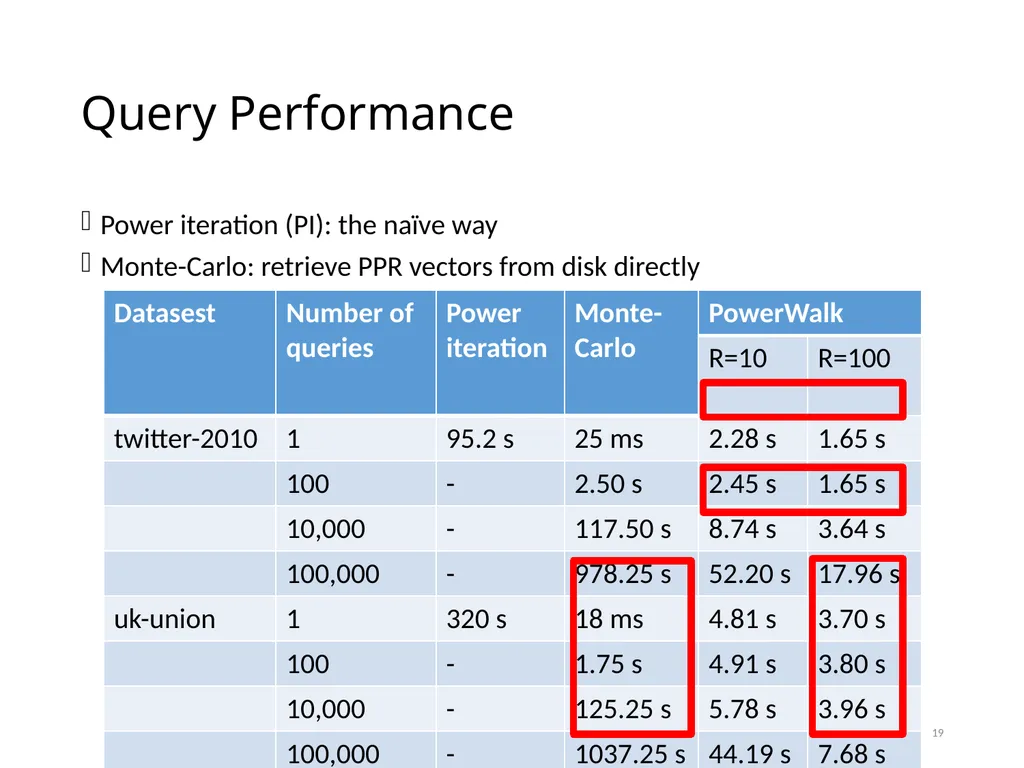
3.64s for 10,000 queries on twitter graph (1.5B edges) 5<br>
06
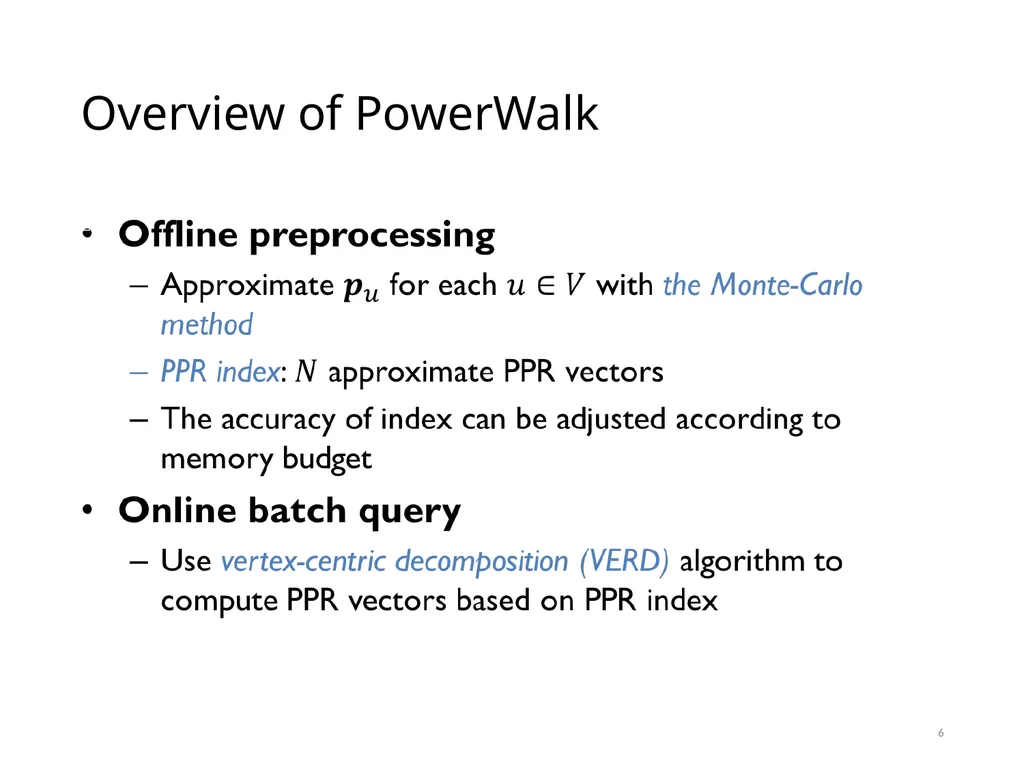
Overview of PowerWalk 6<br>
07
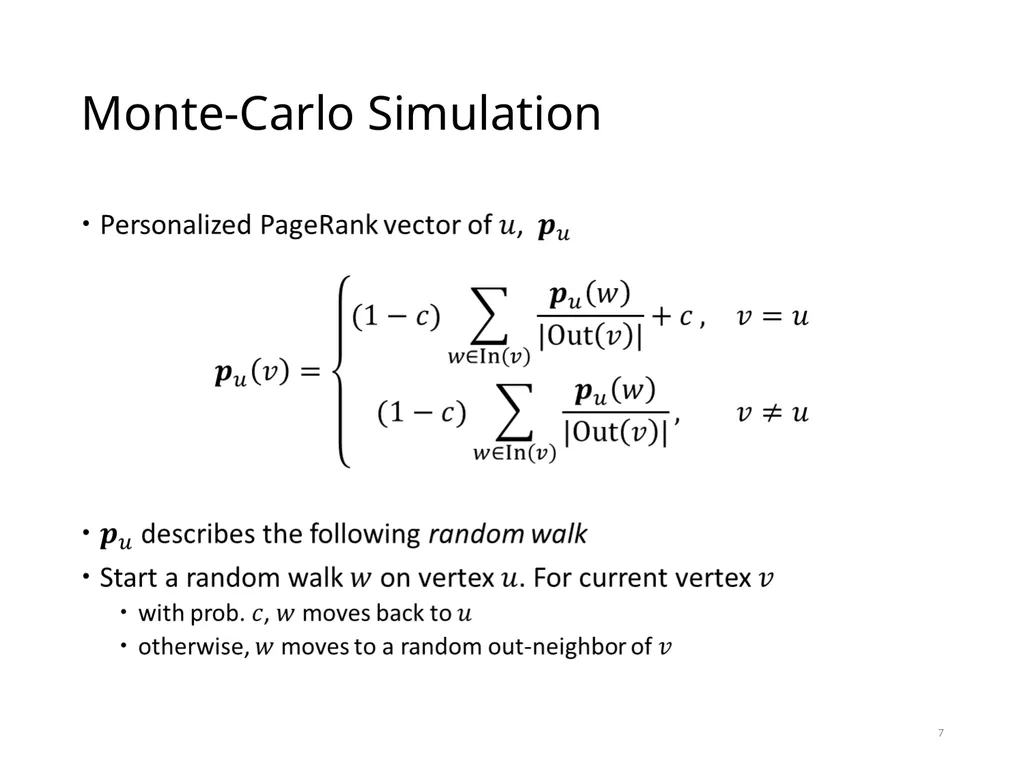
Monte-Carlo Simulation 7<br>
08
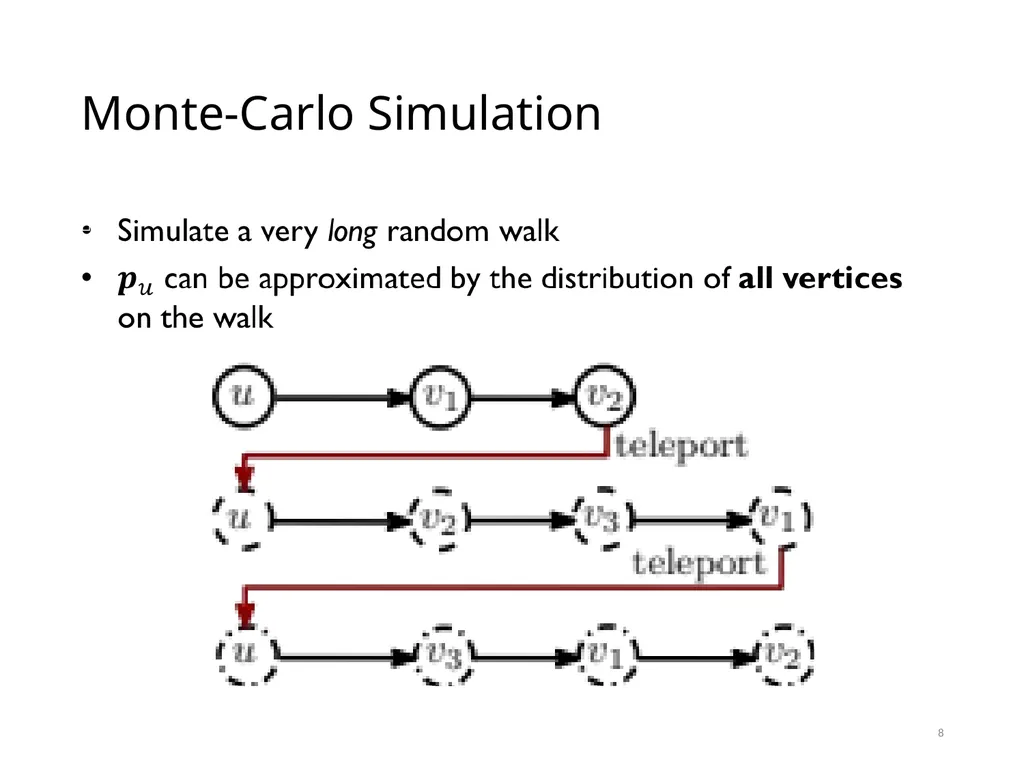
Monte-Carlo Simulation 8<br>
09
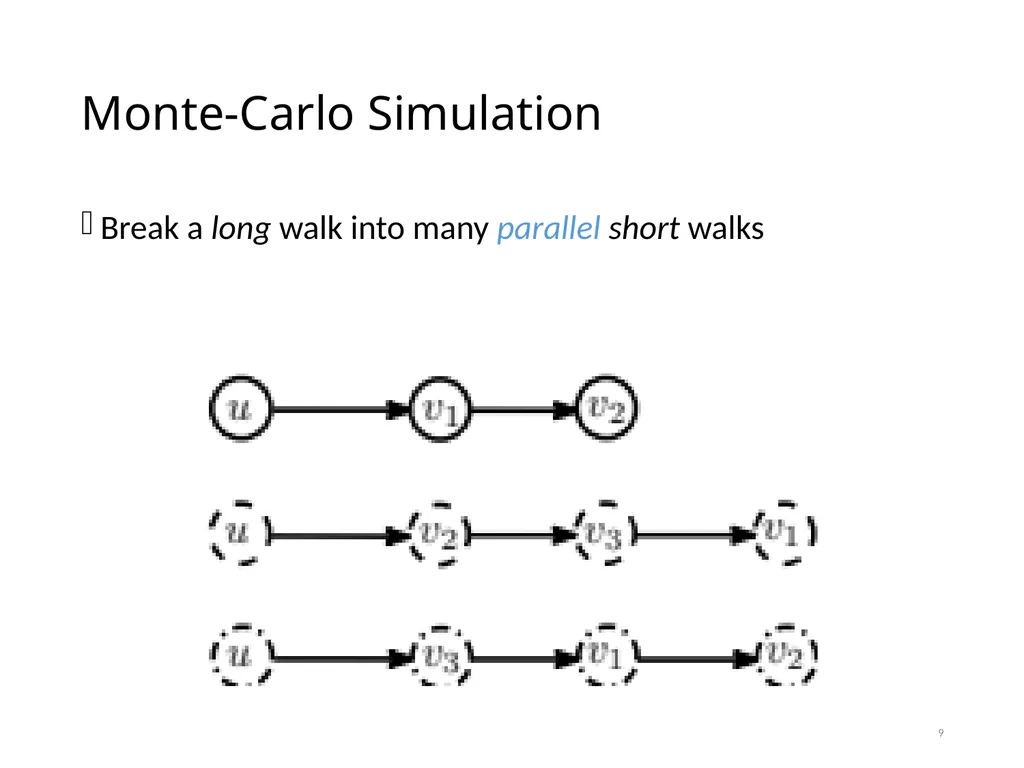
Monte-Carlo Simulation Break a long walk into many parallel short walks 9<br>
10
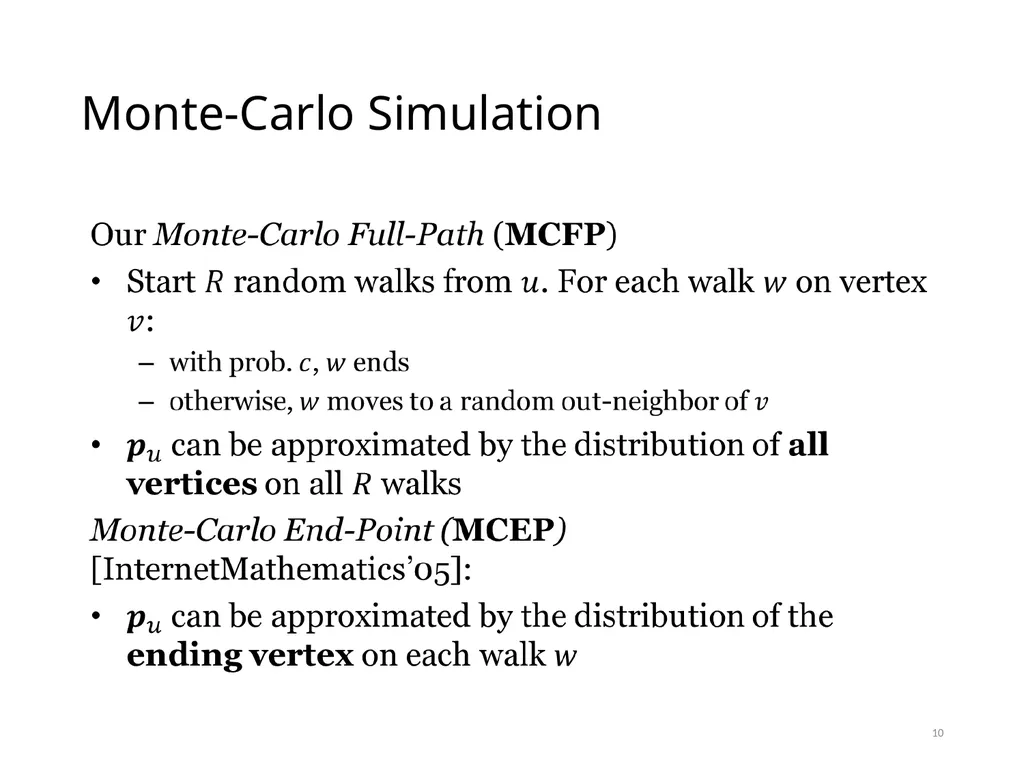
Monte-Carlo Simulation 10<br>
11
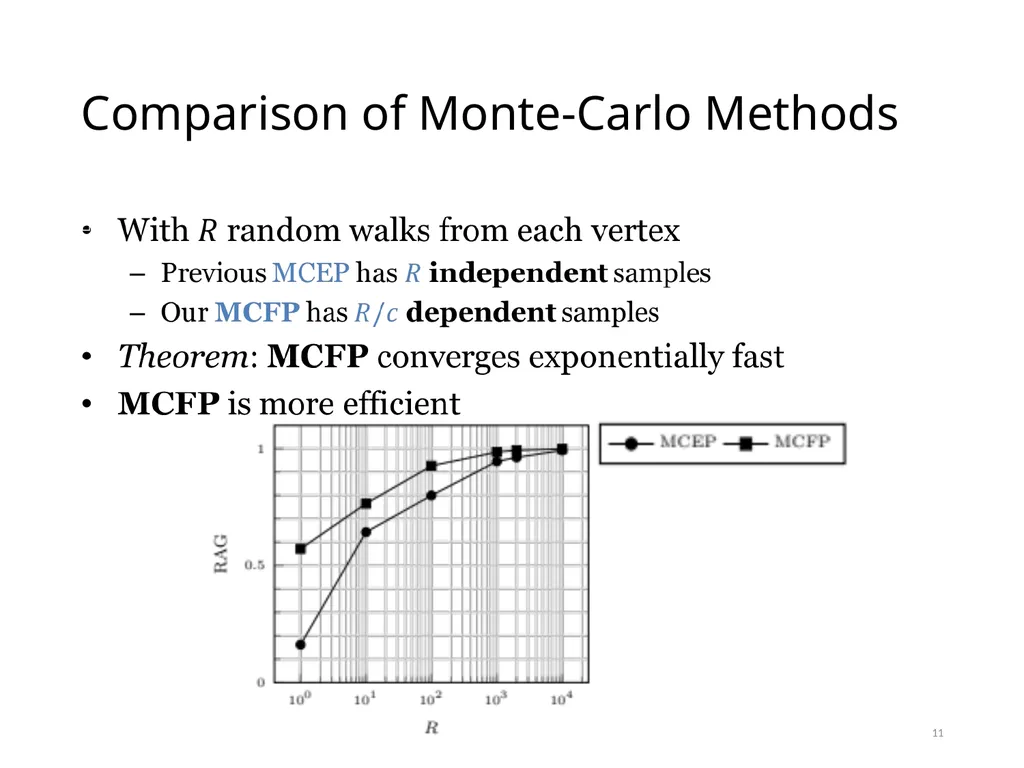
Comparison of Monte-Carlo Methods 11<br>
12
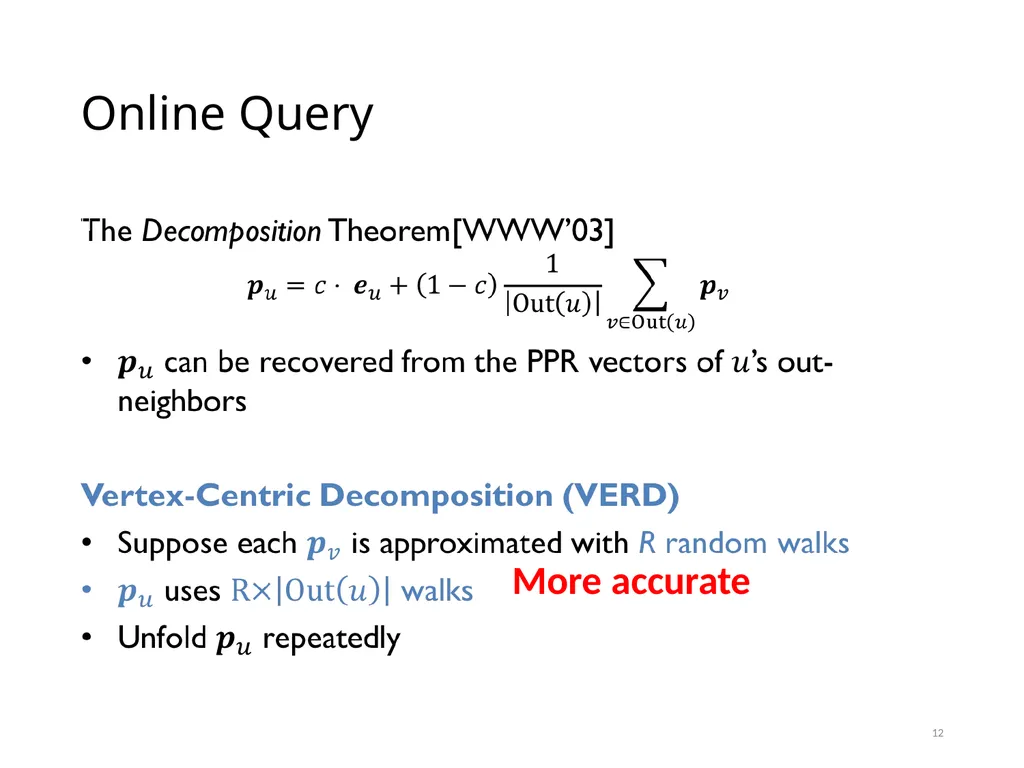
Online Query 12 More accurate<br>
13
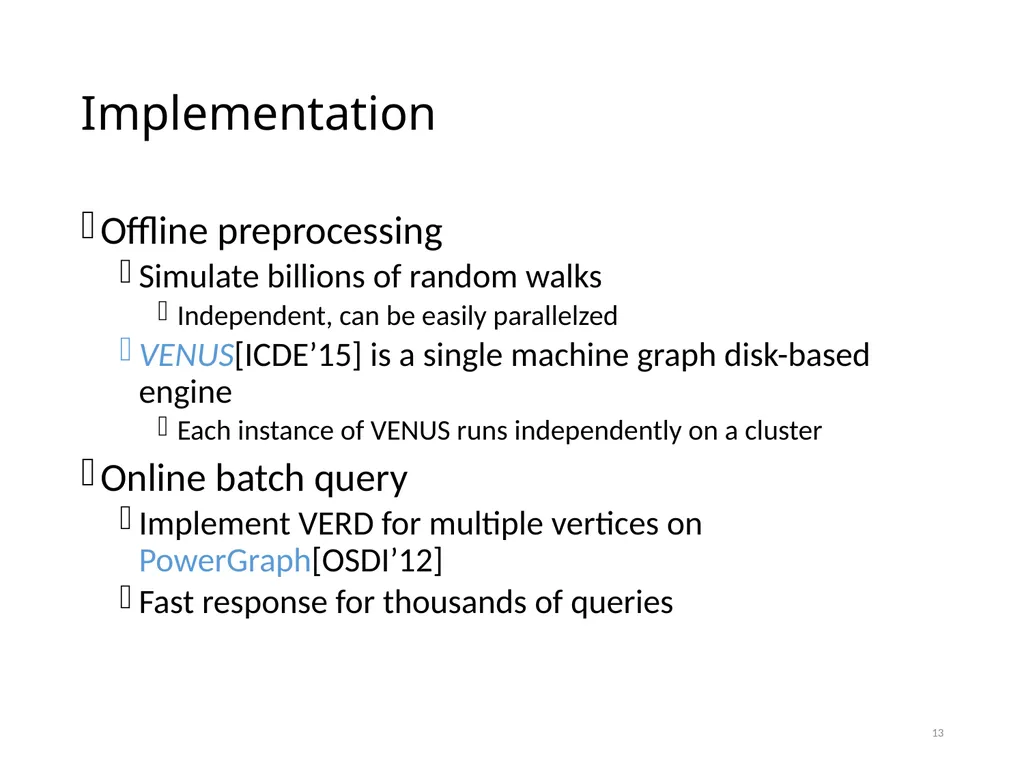
Implementation Offline preprocessing
Simulate billions of random walks
Independent, can be easily parallelzed
VENUS[ICDE’15] is a single machine graph disk-based engine
Each instance of VENUS runs independently on a cluster
Online batch query
Implement VERD for multiple vertices on PowerGraph[OSDI’12]
Fast response for thousands of queries 13<br>
14
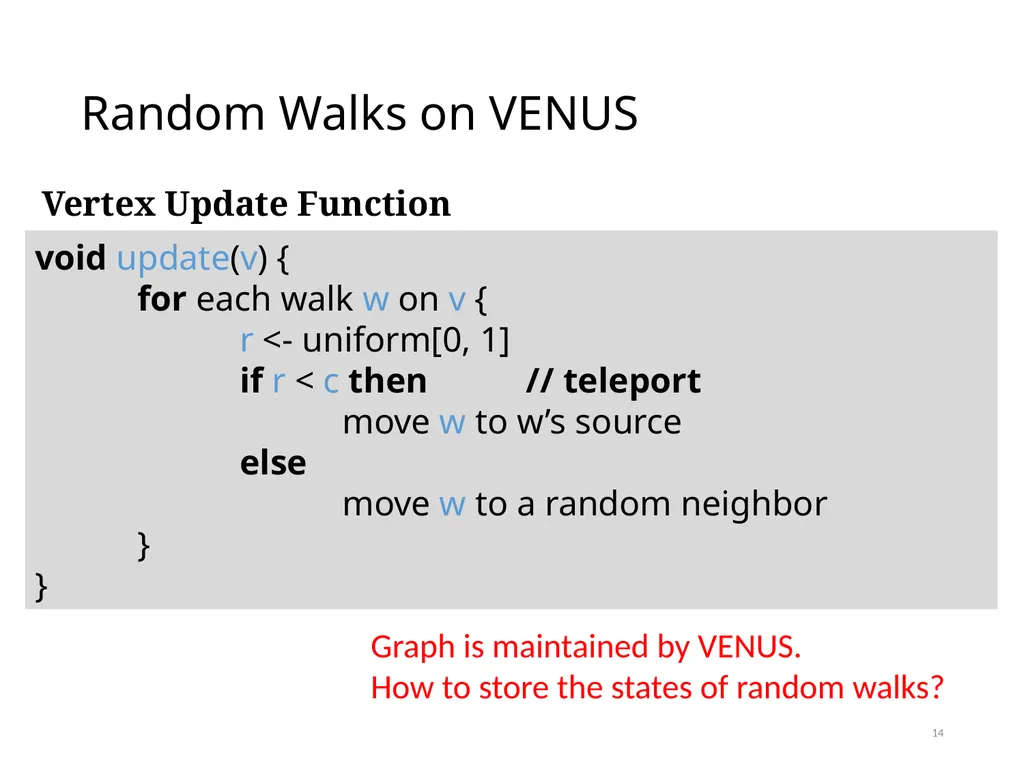
Random Walks on VENUS 14 void update(v) {
for each walk w on v {
r <- uniform[0, 1]
if r < c then // teleport
move w to w’s source
else
move w to a random neighbor
}
} Vertex Update Function Graph is maintained by VENUS.
How to store the states of random walks?<br>
15
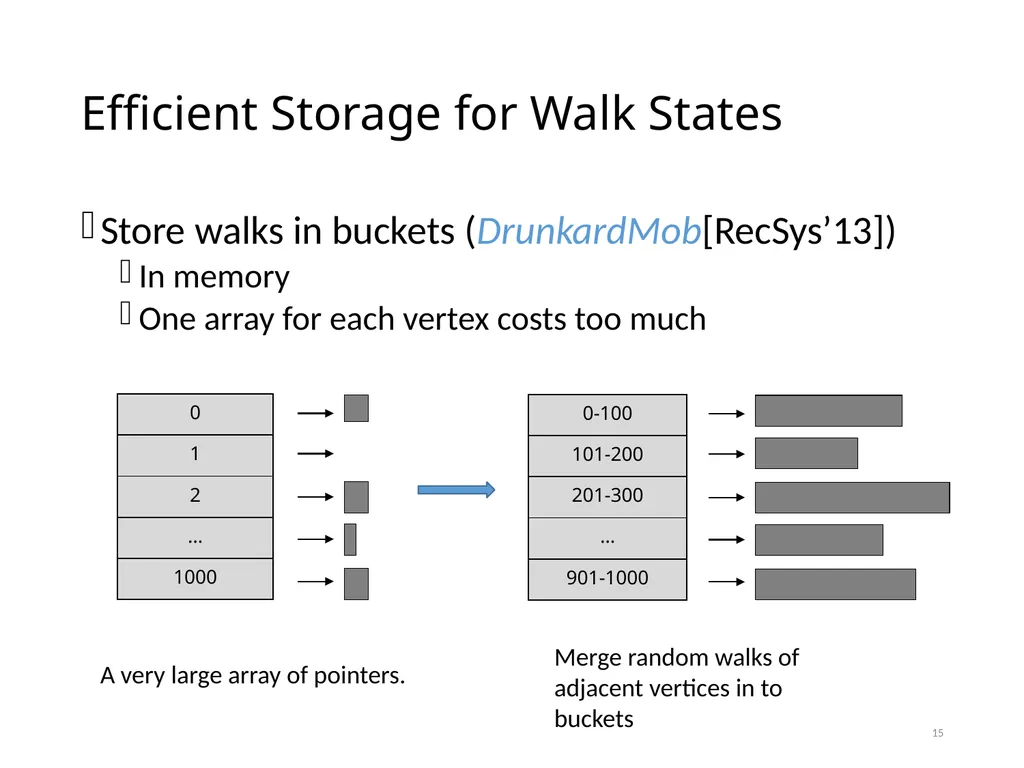
Efficient Storage for Walk States Store walks in buckets (DrunkardMob[RecSys’13])
In memory
One array for each vertex costs too much 15 A very large array of pointers. Merge random walks of adjacent vertices in to buckets<br>
16
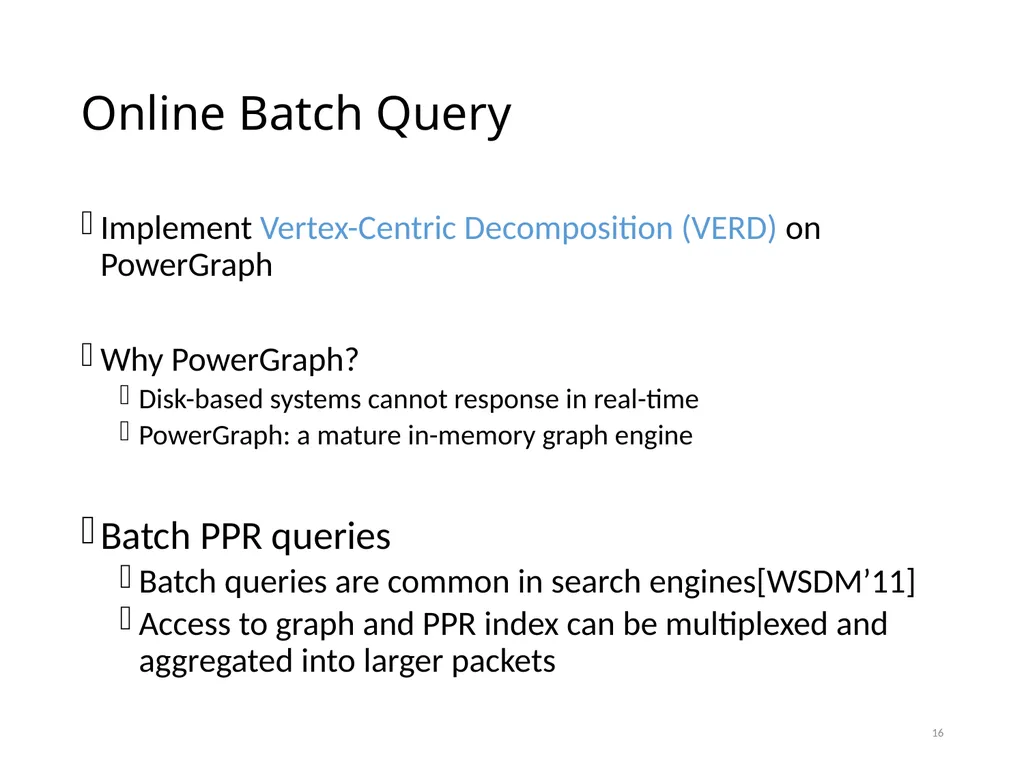
Online Batch Query Implement Vertex-Centric Decomposition (VERD) on PowerGraph
Why PowerGraph?
Disk-based systems cannot response in real-time
PowerGraph: a mature in-memory graph engine
Batch PPR queries
Batch queries are common in search engines[WSDM’11]
Access to graph and PPR index can be multiplexed and aggregated into larger packets 16<br>
Query Performance Power iteration (PI): the naïve way
Monte-Carlo: retrieve PPR vectors from disk directly 19<br>
20
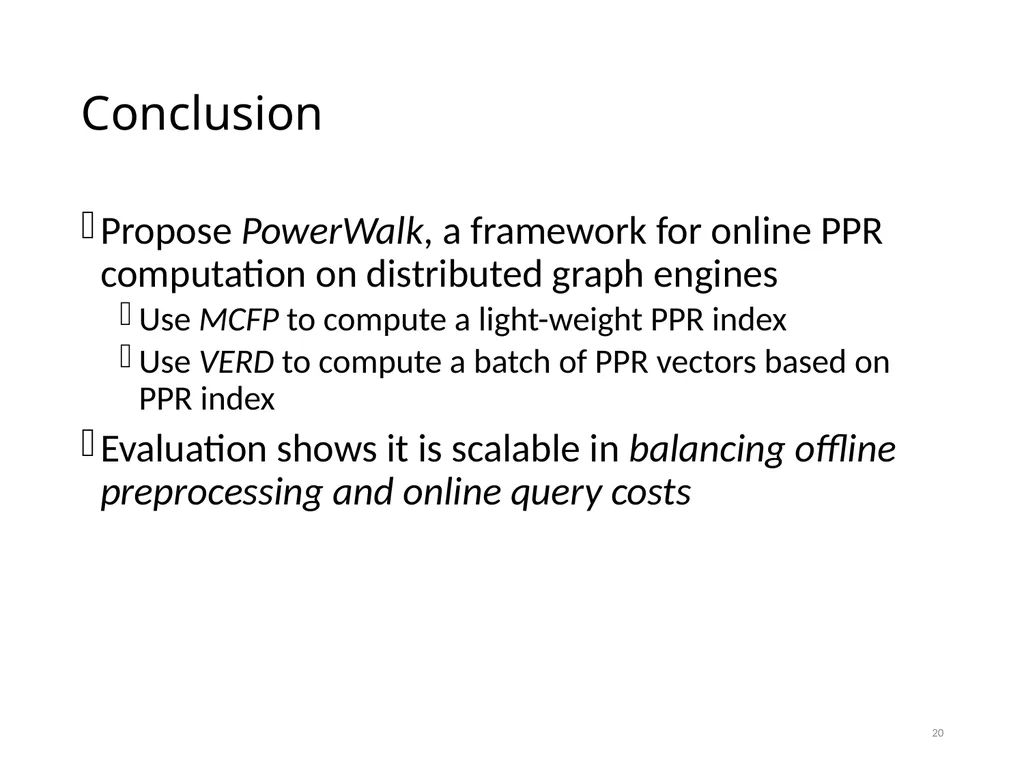
Conclusion Propose PowerWalk, a framework for online PPR computation on distributed graph engines
Use MCFP to compute a light-weight PPR index
Use VERD to compute a batch of PPR vectors based on PPR index
Evaluation shows it is scalable in balancing offline preprocessing and online query costs 20<br>